

Comparing scientific abstracts generated by ChatGPT to real abstracts with detectors and blinded human reviewers
Open accessPublished version of a preprint
The DOI matches its Crossref record; 34 of the 34 references it cites were found in a registry or an index.
Abstract
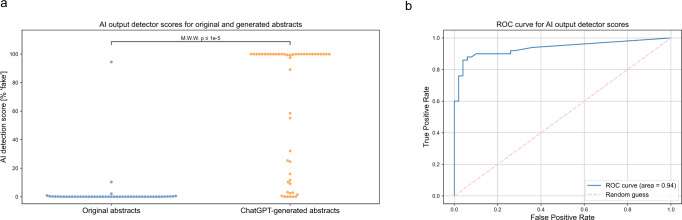
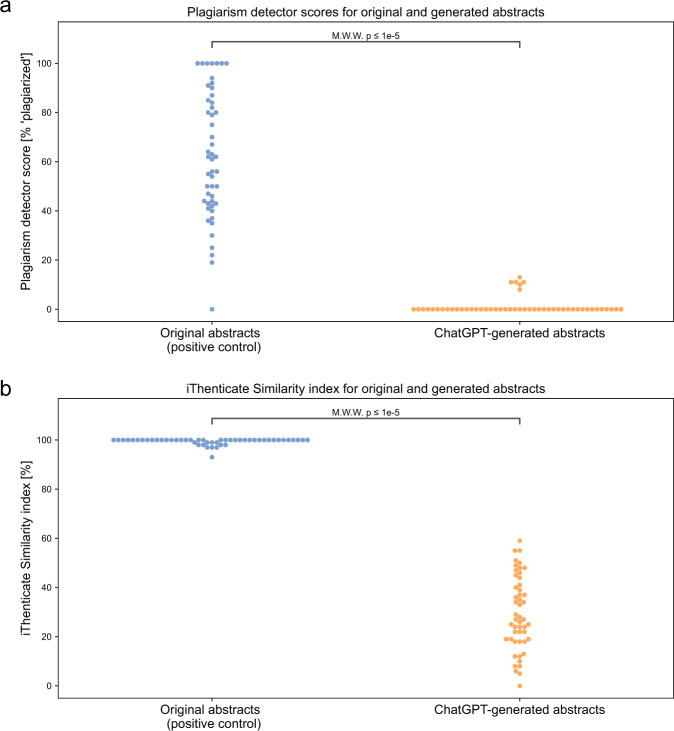
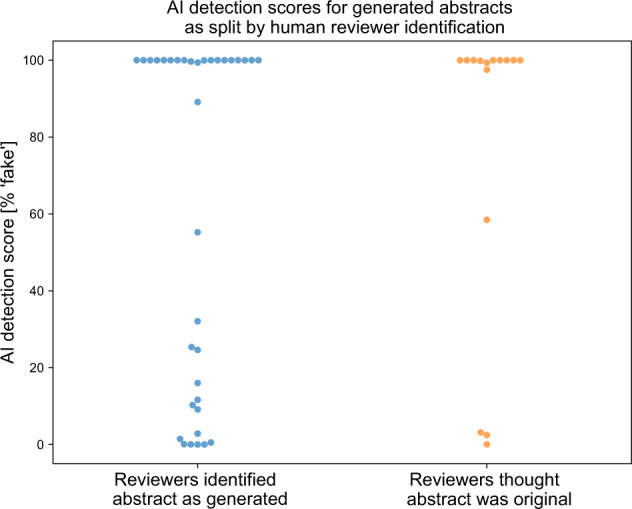
Large language models such as ChatGPT can produce increasingly realistic text, with unknown information on the accuracy and integrity of using these models in scientific writing. We gathered fifth research abstracts from five high-impact factor medical journals and asked ChatGPT to generate research abstracts based on their titles and journals. Most generated abstracts were detected using an AI output detector, ‘GPT-2 Output Detector’, with % ‘fake’ scores (higher meaning more likely to be generated) of median [interquartile range] of 99.98% ‘fake’ [12.73%, 99.98%] compared with median 0.02% [IQR 0.02%, 0.09%] for the original abstracts. The AUROC of the AI output detector was 0.94. Generated abstracts scored lower than original abstracts when run through a plagiarism detector website and iThenticate (higher scores meaning more matching text found). When given a mixture of original and general abstracts, blinded human reviewers correctly identified 68% of generated abstracts as being generated by ChatGPT, but incorrectly identified 14% of original abstracts as being generated. Reviewers indicated that it was surprisingly difficult to differentiate between the two, though abstracts they suspected were generated were vaguer and more formulaic. ChatGPT writes believable scientific abstracts, though with completely generated data. Depending on publisher-specific guidelines, AI output detectors may serve as an editorial tool to help maintain scientific standards. The boundaries of ethical and acceptable use of large language models to help scientific writing are still being discussed, and different journals and conferences are adopting varying policies.
Overview
The claims and statistics of this paper haven’t been checked yet.
Free: it reads the open-access text and checks the first 5 claims that cite a source we can check. Create a free account to check every claim.
Integrity signals
Registry
Cites
Statistics
Figures
Verification
Claims the paper makes
The claims and statistics of this paper haven’t been checked yet.
Free: it reads the open-access text and checks the first 5 claims that cite a source we can check. Create a free account to check every claim.
Claims other papers make about this one
Each is checked against this paper’s own text: does it say what the citing paper says it does?
The source backs part of the claim, not all of it — or backs it for a different population, condition or comparison.
In the citing paper
“ChatGPT’s GPT-3.5 iteration has already shown promise in several routine medical tasks and medical research [4-7], even raising ethical concerns in the literature [2,3,8].”
From Comparison of the Performance of GPT-3.5 and GPT-4 With That of Medical Students on the Written German Medical Licensing Examination: Observational Study (2024) · cites this paper as [7]
Experimental — accuracy not yet measuredThe source backs part of the claim, not all of it — or backs it for a different population, condition or comparison.
In the citing paper
“in practice, it takes a neural network to reliably catch another neural network.”
From Fine-Grained Detection of AI-Generated Writing in the Biomedical Literature (2026) · cites this paper as [6]
Experimental — accuracy not yet measuredThe source backs part of the claim, not all of it — or backs it for a different population, condition or comparison.
In the citing paper
“Rather than just copying ChatGPT output, many students seem to use it as a tool for brainstorming, refining ideas, or enhancing their writing style 16 .”
From Style, sentiment, and quality of undergraduate writing in the AI era: A cross-sectional and longitudinal analysis of 4,820 authentic empirical reports (2025) · cites this paper as [16]
Experimental — accuracy not yet measuredThe cited source says what the claim attributes to it.
In the citing paper
“Gao et al. (2023) found that ChatGPT can produce plausible scientific abstracts that humans often find difficult to distinguish from originals, though reviewers noted that AI abstracts tended to be 'vaguer and more formulaic'.”
From Metadiscourse Patterns in Human-Written vs. Generative AI-Authored Research Abstracts: A Comparative Corpus-Based Analysis (2026) · cites this paper as Gao et al. (2023)
The cited source says what the claim attributes to it.
In the citing paper
“Indeed, ChatGPT abstracts were noted by human reviewers as 'vague' or 'formulaic' , a qualitative impression that aligns with our finding of scant stance markers.”
From Metadiscourse Patterns in Human-Written vs. Generative AI-Authored Research Abstracts: A Comparative Corpus-Based Analysis (2026) · cites this paper as Gao et al. (2023)
3 more claims about this paper
Create a free account to see every claim other papers make about this one.
Self-check
Percentages, sums and reported differences re-computed from the paper’s own numbers.
The self-check needs the paper’s full text.
Citations
Cites
Scikit-learn: Machine Learning in Python
Pedregosa, F., Varoquaux, G., Gramfort, A., Michel, V., Thirion, B., Grisel, O., Blondel, M., Müller, A., Nothman, J., Louppe, G., et al. (2012) · arXiv · doi:10.48550/arxiv.1201.0490 · Cited by 71,016
Matplotlib: a 2D graphics environment
Hunter, J. D. (2007) · Computing in Science & Engineering · doi:10.1109/mcse.2007.55 · Cited by 39,249
SciPy 1.0: fundamental algorithms for scientific computing in Python
Virtanen, P., Gommers, R., Oliphant, T. E., Haberland, M., Reddy, T., Cournapeau, D., Burovski, E., Peterson, P., Weckesser, W., Bright, J., et al. (2020) · Nature Methods · doi:10.1038/s41592-019-0686-2 · Cited by 38,430
SciPy 1.0: fundamental algorithms for scientific computing in Python
Virtanen, P., Gommers, R., Oliphant, T. E., Haberland, M., Reddy, T., Cournapeau, D., Burovski, E., Peterson, P., Weckesser, W., Bright, J., et al. (2019) · Apollo - University of Cambridge Repository · doi:10.17863/cam.64134 · Cited by 10,460
seaborn: statistical data visualization
Waskom, M. (2021) · Journal of Open Source Software · doi:10.21105/joss.03021 · Cited by 7,310
NWChem: A comprehensive and scalable open-source solution for large scale molecular simulations
Valiev, M., Bylaska, E. J., Govind, N., Kowalski, K., Straatsma, T. P., Van Dam, H. J. J., Wang, D., Nieplocha, J., Apra, E., Windus, T. L., et al. (2010) · Computer Physics Communications · doi:10.1016/j.cpc.2010.04.018 · Cited by 5,779
Kung, T. H., Cheatham, M., Medenilla, A., Sillos, C., De Leon, L., Elepaño, C., Madriaga, M., Aggabao, R., Diaz-Candido, G., Maningo, J., et al. (2023) · PLOS Digital Health · doi:10.1371/journal.pdig.0000198 · Cited by 4,115 · cited 1×
“Articles are bemoaning the death of the traditional school essay assignment 4,6,7 , as ChatGPT has been shown to generate high-scoring papers 8 , correctly answer USMLE questions 9 , and even articulate critical thinking 10 .”
Kung, T. H., Cheatham, M., ChatGPT, Medenilla, A., Sillos, C., De Leon, L., Elepaño, C., Madriaga, M., Aggabao, R., Diaz-Candido, G., et al. (2022) · doi:10.1101/2022.12.19.22283643 · Cited by 4,115
ChatGPT is fun, but not an author
Thorp, H. H. (2023) · Science · doi:10.1126/science.adg7879 · Cited by 1,437 · cited 2×
“Different journals and publishers are developing their own policies on whether large language models can contribute to the writing of papers, ranging from not allowing any AI-generated text 12 to allowing its use as long as it is openly disclosed 13,14,28 .”
Artificial Intelligence in Medicine: Today and Tomorrow
Briganti, G., & Le Moine, O. (2020) · Frontiers in Medicine · doi:10.3389/fmed.2020.00027 · Cited by 743
Cited by
Items 701–800 of 1,018
Role of ChatGPT in the Accounting Field
Biancone, P., & Chmet, F. (2024) · EAI/Springer Innovations in Communication and Computing · doi:10.1007/978-3-031-52296-3_8 · Cited by 6
Letter to the Editor: Could ChatGPT Improve Knowledge in Surgery?
Tel, A., Parodi, P. C., Robiony, M., Zanotti, B., & Zingaretti, N. (2023) · Annals of Surgical Oncology · doi:10.1245/s10434-023-13518-z · Cited by 5
DEMASQ: unmasking the ChatGPT wordsmith
Kumari, K., Pegoraro, A., Fereidooni, H., & Sadeghi, A.-R. (2023) · arXiv · doi:10.48550/arxiv.2311.05019 · Cited by 5
Fine-Grained Detection of AI-Generated Writing in the Biomedical Literature
She, R. (2026) · bioRxiv (Cold Spring Harbor Laboratory) · doi:10.64898/2026.01.01.697311 · Cited by 4
“To answer these questions, we need tools that can surpass the limits of human intuition alone in detecting AI generated text 5,6 ; in practice, it takes a neural network to reliably catch another neural network.”
Safran, E., & Çalı, A. (2025) · Anatolian Current Medical Journal · doi:10.38053/acmj.1746227 · Cited by 4
Angeles, C. N., Samson, B. D., Mama, B. R. Z. I., Luriaga, R. L., Delizo, J. P. D., & Ching, M. R. D. (2024) · Proceedings of the 2024 8th International Conference on E-Commerce, E-Business, and E-Government · doi:10.1145/3675585.3675587 · Cited by 4
Artificial Intelligence and Publishing Ethics: A Narrative Review and SWOT Analysis
Gurnal, P., & Rana, L. (2025) · Cureus · doi:10.7759/cureus.84098 · Cited by 5
“Misleading image and graph practices, such as replication and deletion, damage the integrity of science as a whole [34,35].”
InfluentialLeiva-Araos, A., Kalasapudi, V. S., Jiang, A., & Kaushal, H. (2025) · IEEE Access · doi:10.1109/access.2025.3613246 · Cited by 5
“This human-in-the-loop approach aligns with recent recommendations for combining AI-based text generation with domain expert oversight to ensure reliability in research synthesis [35], [36], [37].”
Mauffrey, O. J., Lashani, S., Heyer, J. H., Logterman, S. L., Goodbody, C. M., & Mitchell, S. L. (2025) · Journal of the Pediatric Orthopaedic Society of North America · doi:10.1016/j.jposna.2025.100273 · Cited by 4
“There are also ethical discussions regarding the potential for plagiarism when text is analyzed and potentially replicated by a large language model such as ChatGPT with no credit to the original author [24,25].”
Matthes, J., & Vranken, S. (2025) · Communication and Change · doi:10.1007/s44382-025-00019-8 · Cited by 4
“It has even been shown that reviewers and editors cannot distinguish between human-generated texts and AI-generated ones (Casal & Kessler, 2023; Gao et al., 2023; Hadan et al., 2024).”
Using artificial intelligence in educational research: The competencies of researchers
Eid, M., Ewees, H., & Khatiry, A. R. (2025) · Innovations in Education and Teaching International · doi:10.1080/14703297.2025.2574059 · Cited by 4
Artificial Intelligence in Surgical Research: Transformative Impacts and Evolving Ethical Challenges
Morris, M. X., Rustom, F., Chun, B. D., Limon, D., Raghavan, N., Guo, L., & Rajesh, A. (2025) · The American Surgeon · doi:10.1177/00031348251409740 · Cited by 5
“23,54 While proponents argue that LLMs de-mocratize access to scienti fi c writing and may streamline peer review, unchecked use risks undermining authorship, peer review, and intellectual property norms.”
Sebo, P., Nie, B., & Wang, T. (2025) · F1000Research · doi:10.12688/f1000research.173647.1 · Cited by 5
Yang, Y. Y.-H., Wang, C., Chou, P.-L., Tien, C.-Y., Wen, J.-C., & Chen, N.-H. (2026) · Computers in Human Behavior · doi:10.1016/j.chb.2026.108904 · Cited by 4
Wani, T. A., Liem, M. K., Prasad, N., Robinson, K. M., Nexhip, A., Tassos, M., Gjorgioski, S., Khan, U. R., Boyd, J., & Riley, M. M. (2026) · JMIR Medical Education · doi:10.2196/82988 · Cited by 5
“In some instances, GenAI can fabricate information, which raises the question of the reliability of the outputs [7].”
ChatGPT: is it really a threat to medical research paper writing?
Thaware, P., Trivedi, S., & Lakra, P. R. (2023) · Ain-Shams Journal of Anaesthesiology · doi:10.1186/s42077-023-00365-z · Cited by 4
ChatGPT: a promising AI technology for psychoradiology research and practice
Pan, N., Qin, K., Shekara, A., & DelBello, M. P. (2023) · Psychoradiology · doi:10.1093/psyrad/kkad018 · Cited by 5
Inteligência Artificial e Comunicação Científica
Lustosa, M. D. M., Farias, M. G. G., & de Farias, G. B. (2024) · Brazilian Journal of Information Science research trends · doi:10.36311/1981-1640.2024.v18.e024004 · Cited by 4
The Role of Large Language Models in Modern Medical Education: Opportunities and Challenges
Mahdavi, A., Amanzadeh, M., & Hamedan, M. (2024) · Shiraz E-Medical Journal · doi:10.5812/semj-144847 · Cited by 4
Detection and Classification of ChatGPT Generated Contents Using Deep Transformer Models
Sushma, D. S., Pooja, C., Varsha, H., Hussain, Y., & Yashash, P. (2024) · International Research Journal on Advanced Engineering Hub (IRJAEH) · doi:10.47392/irjaeh.2024.0193 · Cited by 4
“This pipeline was pre-trained using the onto Notes Release 5.0 dataset, a large annotated corpus that includes diverse genres of [4] text such as news articles, conversational telephone speech, weblogs, Usenet newsgroups, broadcast transcripts, and talk shows figure 1.”
MethodInfluentialEducational Innovation in the Information Age: AI Tutoring and Micro-Learning
Mrabet, J., Studholme, R., & Thompson, N. L. (2024) · Advances in human resources management and organizational development book series · doi:10.4018/979-8-3693-3096-8.ch013 · Cited by 5
Artificial Intelligence–Generated Editorials in Radiology: Can Expert Editors Detect Them?
Ozkara, B. B., Boutet, A., Comstock, B. A., Goethem, J. W. V., Huisman, T. A. G. M., Ross, J. S., Saba, L., Shah, L. M., Wintermark, M., & Castillo, M. (2024) · American Journal of Neuroradiology · doi:10.3174/ajnr.a8505 · Cited by 5
Garro-Mena, L. (2024) · REDU Revista de Docencia Universitaria · doi:10.4995/redu.2024.21989 · Cited by 5
ChatGPT in Academic Writing: A Boon or a Bane?
Abbas, M. S. (2025) · Journal of Electronic & Information Systems · doi:10.30564/jeis.v6i2.8491 · Cited by 5
Miller, A. S., Tyagi, A., Sudah, S. Y., Rompala, A., Nicholson, A. D., Srikumaran, U., & Menendez, M. E. (2025) · JSES International · doi:10.1016/j.jseint.2025.05.027 · Cited by 4
Stern, J. M., Fernandez-Perez, A. M., Cruz-Ossa, N., Hernandez, V. H., McNamara, C., & D’Apuzzo, M. R. (2025) · The Journal of Arthroplasty · doi:10.1016/j.arth.2025.07.072 · Cited by 5
Nassar, J. E., Farias, M. J., Singh, M., Dinh, P. V., Sahhar, M., Daher, M., Fallon, R. T., Marcaccio, S. E., Daniels, A. H., & Owens, B. D. (2025) · Orthopaedic Journal of Sports Medicine · doi:10.1177/23259671251371234 · Cited by 4
“4,15,25 To address these concerns, guidelines have been implemented to regulate the use of AI in research.”
Hong, L. (2026) · Linguistics and Education · doi:10.1016/j.linged.2026.101508 · Cited by 8
ChatGPT and Medicine: Fears, Fantasy, and the Future of Physicians
Peterson, C. (2023) · The Southwest Respiratory and Critical Care Chronicles · doi:10.12746/swrccc.v11i48.1193 · Cited by 4
“82 And studies of physician gestalt, such as the ability to predict acute coronary syndrome or appendicitis, are mixed at best, 5,83–87 though these predictions were often made in lieu of other readily available diagnostic data.”
BackgroundAI interprets the Central Dogma and Genetic Code
Ille, A. M., & Mathews, M. B. (2023) · Trends in Biochemical Sciences · doi:10.1016/j.tibs.2023.09.004 · Cited by 4
Dierickx, L., Lindén, C., & Opdahl, A. L. (2023) · Lecture notes in computer science · doi:10.1007/978-3-031-47896-3_5 · Cited by 6
Cowap, A., Graham, Y., & Foster, J. (2023) · Findings of the Association for Computational Linguistics: EMNLP 2023 · doi:10.18653/v1/2023.findings-emnlp.665 · Cited by 4
Selitskiy, S., Inoue, C., Schetinin, V., & Jakaite, L. (2023) · International Conference on Social Networks Analysis, Management and Security (SNAMS) · doi:10.1109/snams60348.2023.10375471 · Cited by 5
University Students’ Perspective on ChatGPT and Technology Literacies
Dawa, T., Dhendup, S., Tashi, S., & Rosso, M. A. (2024) · Educational innovation and practice · doi:10.17102/eip.7.2024.10 · Cited by 6
Toward the novel AI tasks in infection biology
Yakimovich, A. (2024) · mSphere · doi:10.1128/msphere.00591-23 · Cited by 5
Tessler, I., Yamin, T., Peeri, H., Alon, E. E., Zimlichman, E., Glicksberg, B. S., & Klang, E. (2024) · Future Medicine AI · doi:10.2217/fmai-2024-0001 · Cited by 4
Large Language Models and OpenLogos: An Educational Case Scenario
Pavlova, A., Gerazov, B., & Barreiro, A. M. (2024) · Open Research Europe · doi:10.12688/openreseurope.17605.1 · Cited by 4
Singh, S., Prasad, P., Joshi, K., Singh, J., Garg, N., & Jain, K. (2024) · Cancer Research Statistics and Treatment · doi:10.4103/crst.crst_330_23 · Cited by 4
Exploring the Practitioner Perspective of ChatGPT in Academic Research: A Quantitative Analysis
Ara, A., & Thomas, A. (2024) · International Women in Data Science Conference at Prince Sultan University (WiDS PSU) · doi:10.1109/wids-psu61003.2024.00018 · Cited by 4
How to Design and Deliver Courses for Higher Education in the AI Era?
Wazan, A. S., Taj, I., Shoufan, A., Laborde, R., & Venant, R. (2024) · Springer eBooks · doi:10.1007/978-3-031-65691-0_18 · Cited by 4
Bailey, H. E., Carter‐Templeton, H., Peterson, G. M., Oermann, M. H., & Owens, J. K. (2024) · CIN Computers Informatics Nursing · doi:10.1097/cin.0000000000001237 · Cited by 4
Pre-service Preschool and Primary School Teachers’ Position on Artificial Intelligence
Lamanauskas, V., & Makarskaitė-Petkevičienė, R. (2025) · EAI/Springer Innovations in Communication and Computing · doi:10.1007/978-3-031-81261-3_14 · Cited by 5
Şensoy, E., & Çıtırık, M. (2025) · Turkish journal of clinical and experimental ophthalmology. · doi:10.37844/tj-ceo.2025.20.6 · Cited by 4
Felemban, D., Jazzar, A., Mair, Y., Alsharif, M., Alsharif, A., & Kassim, S. (2025) · Digital Health · doi:10.1177/20552076251355847 · Cited by 4
With great power comes great responsibility – deductions of using ChatGPT for medical research
Mahmood, S., Khan, M. O., & Hameed, I. (2023) · EXCLI journal · doi:10.17179/excli2023-6163 · Cited by 6
“To add to this, when given a mixture of original and AI-generated abstracts, blinded human reviewers incorrectly identified 14 % of original abstracts as being generated (Gao et al., 2023).”
InfluentialChatGPT: A New Era in Research Writing Assistance
Osama, M., & Afridi, S. (2023) · Journal of the Pakistan Medical Association · doi:10.47391/jpma.9183 · Cited by 4
Lee, S. (2024) · Advances in educational technologies and instructional design book series · doi:10.4018/979-8-3693-0872-1.ch013 · Cited by 9
Generative AI for Trustworthy, Open, and Equitable Scholarship
Bourg, C., Kriegsman, S., Lindsay, N., Sardis, H., Stalberg, E., & Altman, M. (2024) · doi:10.21428/e4baedd9.567bfd15 · Cited by 6
Koester, S. W., Catapano, J. S., Hartke, J. N., Rudy, R. F., Cole, T. S., Naik, A., Winkler, E. A., Graffeo, C. S., Srinivasan, V. M., Jadhav, A. P., et al. (2024) · Journal of NeuroInterventional Surgery · doi:10.1136/jnis-2024-021480 · Cited by 4
Inteligencia artificial e innovación educativa: retos jurídicos y emprendimiento docente
Dopazo, P. (2023) · REVISTA ELETRÔNICA PESQUISEDUCA · doi:10.58422/repesq.2023.e1521 · Cited by 5
Evaluation of Current Artificial Intelligence Programs on the Knowledge of Glaucoma
Şensoy, E., & Çıtırık, M. (2024) · Klinische Monatsblätter für Augenheilkunde · doi:10.1055/a-2327-8484 · Cited by 4
Albuck, A. L., Becnel, C. M., Sirna, D. J., & Turner, J. (2024) · Journal of Surgical Research · doi:10.1016/j.jss.2024.07.021 · Cited by 5
Advances in Machine Learning & Artificial Intelligence
Akram, A. (2021) · Advances in Machine Learning & Artificial Intelligence · doi:10.33140/amlai · Cited by 5
Bonilla, D. A., Daga, R., Gamero, A., Pérez‐López, A., Pérez‐Esteve, É., Pérez-Armijo, P., Petermann-Rocha, F. E., Lozano‐Lorca, M., García-Galbis, M. R., Kouiti, M., et al. (2023) · Revista Española de Nutrición Humana y Dietética · doi:10.14306/renhyd.27.4.2054 · Cited by 6
Staying vigilant in the Age of AI: From content generation to content authenticationPreprint
Li, Y., Wang, Z., & Papatheodorou, T. (2024) · arXiv (Cornell University) · doi:10.48550/arxiv.2407.00922 · Cited by 4
Comparative Analysis of AI-Generated Research Content: Evaluating ChatGPT and Google GeminiPreprint
Akhoon, I. U. H., Khan, M. Y., & Bhat, T. A. (2024) · Research Square · doi:10.21203/rs.3.rs-5265799/v1 · Cited by 4
Ghafoor, S., & Yahya, A. (2023) · Research Square · doi:10.21203/rs.3.rs-3152561/v1 · Cited by 4
ChatGPT as speechwriter for the French presidents
Labbé, D., Labbé, C., & Savoy, J. (2025) · Digital Scholarship in the Humanities · doi:10.1093/llc/fqaf032 · Cited by 3
Human or Algorithm? The Visual Turing Test of AI-Generated Images
Wang, C. (2024) · Journal of Multimedia Information System · doi:10.33851/jmis.2024.11.3.201 · Cited by 5
ChatGPT Practices: Finance and Banking Domain
Hassan, M. K., Parvin, S., & Siddikee, J. A. (2024) · Journal of Business Communication & Technology · doi:10.56632/bct.2024.3203 · Cited by 4
Ferro, N., & Maistro, M. (2024) · ACM eBooks · doi:10.1145/3674127.3674132 · Cited by 6
Zhang, W., Zavalniuk, I., Bohatko, V., Кухар, Н., & Pavlyuk, O. (2025) · Metaverse Basic and Applied Research · doi:10.56294/mr2025161 · Cited by 3
Bernstein, E., Ramsamooj, A., Millar, K. L., & Lum, Z. C. (2025) · JMIR AI · doi:10.2196/68603 · Cited by 4
The Misclassification of Autistic Writing as AI-Generated
Chambers, S., & Kelley, M. C. (2025) · Lecture notes in computer science · doi:10.1007/978-3-031-98420-4_7 · Cited by 5
“It has been shown in multiple contexts and domains that humans are no better—and often worse—than automated detection models at identifying AI-generated content [13].”
Kahan, R., Shen, C. P., Wellborn, P. K., Lauder, A. S., Berchuck, S. I., Javeed, H., Pean, C. A., & Federer, A. E. (2025) · Journal of the American Academy of Orthopaedic Surgeons · doi:10.5435/jaaos-d-25-00456 · Cited by 3
More polished, not necessarily more learned: LLMs and perceived text quality in higher education
Tärning, B., Tjøstheim, T. A., & Wallin, A. (2025) · Frontiers in Artificial Intelligence · doi:10.3389/frai.2025.1653992 · Cited by 5
AI-generated language in introductory physics lab reports in the first year of ChatGPT
Arvidsson, K. (2025) · Discover Artificial Intelligence · doi:10.1007/s44163-025-00742-7 · Cited by 4
“Gao et al. [13] found that the medical field experts that participated in the study correctly identified AI-generated medical journal abstracts 68% of the time.”
HQML-NLP: A hybrid quantum machine learning framework for scholarly AI-text detection
Hazim, L. R., & Ata, O. (2026) · Applied Soft Computing · doi:10.1016/j.asoc.2026.114634 · Cited by 3
Malingering depression: a comparative study of human and GPT-3.5 performance
Battista, F., Lanciano, T., Ribatti, R. M., & Curci, A. (2026) · Current Psychology · doi:10.1007/s12144-025-09009-x · Cited by 4
Yao, G., & Liu, Z. (2026) · Journal of English for Academic Purposes · doi:10.1016/j.jeap.2026.101640 · Cited by 3
AL-Rawas, M., Qader, O. A. J. A., Lin, G. S. S., Beh, Y. H., Sabarudin, M. A., Ang, Y., Low, J. F., Abdullah, J. Y., & Noorani, T. Y. (2026) · Scientific Reports · doi:10.1038/s41598-026-42555-3 · Cited by 3
“To account for ChatGPT’s sensitivity to prior requests within the same chat, we executed each prompt in a separate session 13 .”
Generative AI and management education: a knowledge management perspective
Rai, H., Malik, N., & Varma, A. (2026) · Journal of Knowledge Management · doi:10.1108/jkm-01-2025-0102 · Cited by 3
Clarity Without Credibility? Human Versus AI Abstracts in Otolaryngology
Hack, S., Attal, R., Levi, L., Liu, D. T., Manavi, M. S., Locatello, L. G., Fieux, M., de Joya, E. M., Gutovitz, J. M., Eliahu, S., et al. (2026) · World Journal of Otorhinolaryngology - Head and Neck Surgery · doi:10.1002/wjo2.70104 · Cited by 3
Giusti, R., Filetti, M., Lombardi, P., Bianco, F. L., Sganga, S., Giovagnoli, T., Iannantuono, G. M., Spinazzola, A., Santini, D., Mariniello, M., et al. (2026) · Frontiers in Oncology · doi:10.3389/fonc.2026.1717048 · Cited by 3
LLM or Human? Perceptions of Trust and Quality in Research Summaries
Akpinar, N.-J., Avula, S., Lee, C., Dang, B., Razat, K., & Murdock, V. (2026) · CHI Conference on Human Factors in Computing Systems · doi:10.1145/3772318.3793386 · Cited by 8
“Gao et al. [14] test ChatGPT on generating medical abstracts from only titles and journal-style cues.”
Abdelrahman, M., Hu, S., Al-Shamaileh, O., Hammady, R., & Nizamuddin, N. (2026) · Journal of Information Communication and Ethics in Society · doi:10.1108/jices-09-2025-0261 · Cited by 4
Hashem, R., Fidalgo, P., Alramamneh, Y., ElKaleh, E. S., Zein, F. E., & Hussien, A. M. (2026) · Education Sciences · doi:10.3390/educsci16071122 · Cited by 3
“Second, solid verification mechanisms and procedures are required to assess generative outcomes (Haman & Školník, 2023; Gao et al., 2023).”
InfluentialАКАДЕМИЯЛЫҚ ЗЕРТТЕУЛЕРДЕ CHATGPT ТЕХНОЛОГИЯСЫН ҚОЛДАНУДЫ ТАЛДАУ
Frigerio, A. (2023) · Habaršy. Pedagogika ġylymdary seriâsy · doi:10.51889/1728-5496.2023.1.76.002 · Cited by 3
Role of AI in Academic Research
Kondaveeti, H. K., Kumar, S. V. S., Manusree, A. V. N., Kumari, V. V., & Ananthachari, P. (2024) · Advances in educational technologies and instructional design book series · doi:10.4018/979-8-3693-1798-3.ch001 · Cited by 5
Capítulo 3. Inteligencia Artificial en la comunicación científica
Calle-Pesántez, S. E., & Pallo-Chiguano, M. (2024) · Espejo de Monografías de Comunicación Social · doi:10.52495/c3.emcs.23.ti12 · Cited by 3
AI in Scholarly Communications and Academic Research
Tzanova, S. (2024) · Advances in library and information science (ALIS) book series · doi:10.4018/979-8-3693-3053-1.ch002 · Cited by 4
Training Future Library Professionals to Use Neural Networks in Socio-Cultural Activities
Козленко, Е. Ю. (2024) · Bibliosphere · doi:10.20913/1815-3186-2024-3-5-14 · Cited by 5
Tonellotto, N. (2024) · ACM eBooks · doi:10.1145/3674127.3674130 · Cited by 4
Evaluating ChatGPT’s Ability to Address Frequently Asked Questions in Gender-Affirmation Surgery
Rothchild, E., Jung, G., & Ricci, J. A. (2025) · Journal of Homosexuality · doi:10.1080/00918369.2025.2466712 · Cited by 3
Alchokr, R., Starzew, E., Saake, G., Leich, T., & Krüger, J. (2024) · ACM/IEEE Joint Conference on Digital Libraries · doi:10.1145/3677389.3702508 · Cited by 5
Durrani, N., Imran, M., & Saeed, R. (2025) · Journal of Family Medicine and Primary Care · doi:10.4103/jfmpc.jfmpc_1615_24 · Cited by 6
Schlee, M., Kant, G., Ehrling, C., Säfken, B., & Kneib, T. (2025) · Artificial Intelligence Review · doi:10.1007/s10462-025-11188-9 · Cited by 3
“This is manifested in several instances of abuse by ChatGPT in various domains including education (Debby et al. 2024 ), scientific writing (Gao et al. 2023 ), and the medical field (Anderson et al. 2023 ).”
Bilingual generated text detection through semantic and statistical analysis
Min, C., Zhang, R., & Liu, J. (2025) · Intelligent Data Analysis · doi:10.1177/1088467x241307192 · Cited by 4
Ethical Challenges in the Era of Generative AI: Insights from a Practice-Informed Rapid Review
Hiep, N. T. (2025) · International Journal of Research and Innovation in Social Science · doi:10.47772/ijriss.2025.910000666 · Cited by 3
Rodríguez-Anzola, J. E., & Palacios-Núñez, M. L. (2025) · HOMERO · doi:10.64492/xejrd221 · Cited by 3
ACCEPT OR REJECT? WHAT DO ACADEMICS THINK ABOUT UTILISING CHATGPT PUBLICATIONS?
TUNÇER, M., & Zeybek, G. (2024) · Nevşehir Hacı Bektaş Veli Üniversitesi SBE Dergisi · doi:10.30783/nevsosbilen.1413539 · Cited by 3
From Chatbots to Mind-bots: Navigating Assessments in the Advent of ChatGPT
Ibrahim, M. S., & Hassan, N. M. (2024) · Education in Medicine Journal · doi:10.21315/eimj2024.16.1.13 · Cited by 3
Is ChatGPT a Reliable Source of Transportation Equity Information for Scientific Writing?
Kutela, B., Li, S., Das, S., & Liu, J. (2024) · ASCE International Conference on Transportation and Development (ICTD) · doi:10.1061/9780784485514.046 · Cited by 3
Klimczak, J., & Hamed, A. A. (2024) · Lecture notes in computer science · doi:10.1007/978-3-031-63775-9_18 · Cited by 3
Ogunleye, O. S. (2023) · International Conference on Computational Science and Computational Intelligence (CSCI) · doi:10.1109/csci62032.2023.00278 · Cited by 3
Cinco minutos en saltárselo: el TFG y los trabajos académicos a la luz de la Inteligencia Artificial
Ramos, J. M. (2024) · Jornadas sobre Innovación Docente en Arquitectura (JIDA) · doi:10.5821/jida.2024.13307 · Cited by 3
An Investigation of Using ChatGPT to Personalize Student’s Learning Process in EFL Writing Classes
Nguyen, H. N., & Nguyen, T. L. (2025) · AsiaCALL Online Journal · doi:10.54855/acoj.2516110 · Cited by 4
The Digital Influence ChatGPT and its Role in Shaping Youth Cognitive Processes and Decision-Making
Nidugonda, P. S., & Shaik, S. A. (2025) · International Journal of Innovative Science and Research Technology · doi:10.38124/ijisrt/25apr987 · Cited by 3
Rethinking Scientific Integrity in the Era of Artificial Intelligence
Silva, A. D. O., & Janes, D. D. S. (2025) · PromptAI Academy Journal · doi:10.37497/promptai.4.2025.75 · Cited by 3
Managing Lexical-Semantic Hybrid Records of FAIR Metrics Analyses with the NPDS Cyberinfrastructure
Craig, A., Athreya, A., & Taswell, C. (2023) · Brainiacs Journal of Brain Imaging And Computing Sciences · doi:10.48085/d5b2734f2 · Cited by 3
Metadata
- Authors
- Gao, C. A., Howard, F. M., Markov, N. S., Dyer, E. C., Ramesh, S., Luo, Y., & Pearson, A. T.
- Affiliations
- Northwestern University (US)
- University of Chicago (US)
- Corresponding author
- Gao, Catherine A.
- ORCID
- Venue
- npj Digital Medicine
- Published
- 2023-04-26
- Volume
- 6
- Issue
- 1
- Pages
- 75-75
- ISSN
- 2398-6352 (ISSN-L)
- PMC
- PMC10133283
- OpenAlex
- W4367051110
- Semantic Scholar
- 7d648061157109e8a1a8b382b15ded7ffe690c25
- Cited by
- 1,099
- References
- 26
- Citations by year
- 2026: 189 · 2025: 235 · 2024: 342 · 2023: 326
- FWCI
- 273.24
- Type
- journal article
- Language
- en
- Open access
- gold
- doi.org
- Licence
- cc-by
- creativecommons.org/licenses/by/4.0 (tdm)
- creativecommons.org/licenses/by/4.0 (vor)
- Locations
- npj Digital Medicine (publishedVersion, cc-by)
- bioRxiv (Cold Spring Harbor Laboratory) (acceptedVersion, cc-by-nc-nd)
- PubMed Central (publishedVersion, cc-by)
- PubMed (publishedVersion)
- Knowledge@UChicago (University of Chicago) (submittedVersion, cc-by-nc-nd)
- DOAJ (DOAJ: Directory of Open Access Journals) (submittedVersion, cc-by-sa)
- University of Chicago (cc-by)
- Funders
- U.S. Department of Health and Human Services (U01-CA243075, R01LM013337, R56-DE030958, U01TR003528)
- Burroughs Wellcome Fund
- Conquer Cancer Foundation (2022YIA-6675470300)
- Breast Cancer Research Foundation (2022YIA-6675470300)
- Cancer Research Foundation
- Fanconi Anemia Research Fund
- American Society of Clinical Oncology (2022YIA-6675470300)
- Horizon Therapeutics
- National Institutes of Health (U01TR003528)
- Stand Up To Cancer
- National Heart, Lung, and Blood Institute (F32HL162377)
- National Cancer Institute (K12CA139160, U01CA243075)
- National Institute of Dental and Craniofacial Research (R56DE030958)
- U.S. National Library of Medicine (R01LM013337)
- National Center for Advancing Translational Sciences
- Topics
- Social Sciences › Education › Academic integrity and plagiarism
- Social Sciences › Library and Information Sciences › Academic Writing and Publishing
- Health Sciences › Medicine › Health Informatics › Artificial Intelligence in Healthcare and Education
- Keywords
- ChatGPT, large language models, AI-generated text detection, scientific abstracts, plagiarism detection, medical journal abstracts, scientific integrity, AI in scientific writing, editorial guidelines
About these checks
Registry, retraction, Cites and statistics results are computed, not judged, with one exception: a printed reference that no index lists is read once by a model before it counts as a citation error. Claims are extracted by a model and kept only when their quote appears verbatim in the text; each cited source is then checked, with a model’s help, for whether it says what the claim relies on. Those verdicts can be wrong — read the claim’s quote and the cited source before relying on one.
Statistics and arithmetic are recomputed, not judged.
Confidence bands are shown only for fields calibrated on our annotated test set. None is calibrated yet, so no band is shown.
What counts as a claim ›How we measure confidence ›How we check this ›
Are you an author, or do you see a problem with this page? Request a review
Data sources
Bibliographic data: Semantic Scholar, OpenAlex, Crossref.
Contains information from the Semantic Scholar Academic Graph Datasets, made available under the ODC Attribution License (ODC-BY 1.0).
Semantic Scholar’s data is described in: Kinney, R., et al. (2023). The Semantic Scholar Open Data Platform. arXiv:2301.10140.
