

Variational quantum algorithms
Open accessThe DOI matches its Crossref record; 332 of the 333 references it cites were found in a registry or an index, and 1 are not checked yet; 179 of the 264 sources its claims cite were checked for support.
Abstract
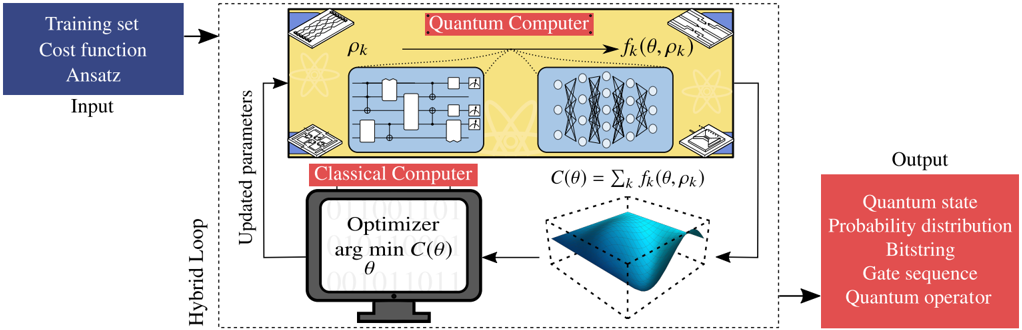
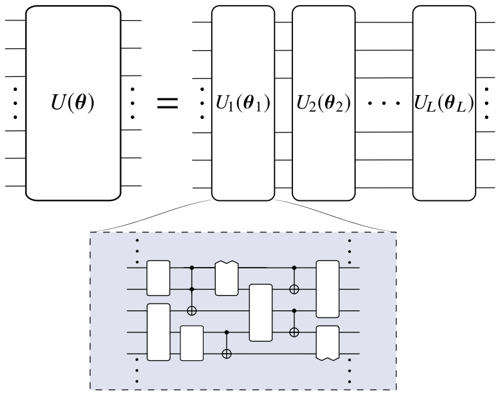
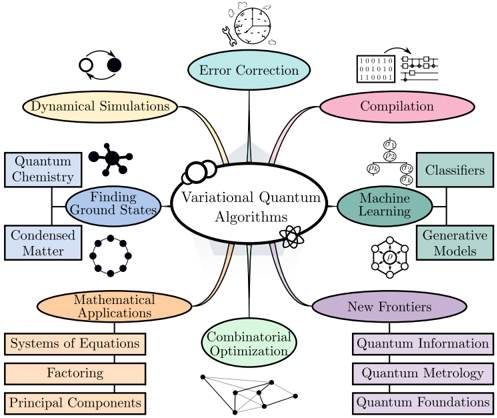
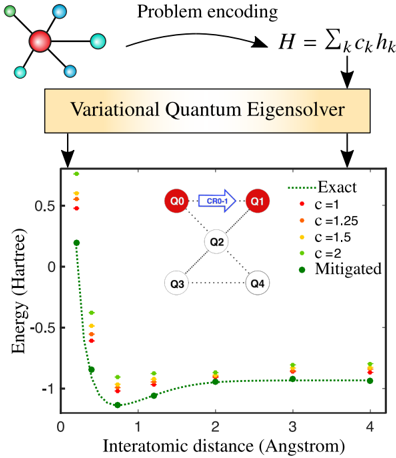
Applications such as simulating complicated quantum systems or solving large-scale linear algebra problems are very challenging for classical computers, owing to the extremely high computational cost. Quantum computers promise a solution, although fault-tolerant quantum computers will probably not be available in the near future. Current quantum devices have serious constraints, including limited numbers of qubits and noise processes that limit circuit depth. Variational quantum algorithms (VQAs), which use a classical optimizer to train a parameterized quantum circuit, have emerged as a leading strategy to address these constraints. VQAs have now been proposed for essentially all applications that researchers have envisaged for quantum computers, and they appear to be the best hope for obtaining quantum advantage. Nevertheless, challenges remain, including the trainability, accuracy and efficiency of VQAs. Here we overview the field of VQAs, discuss strategies to overcome their challenges and highlight the exciting prospects for using them to obtain quantum advantage. The advent of commercial quantum devices has ushered in the era of near-term quantum computing. Variational quantum algorithms are promising candidates to make use of these devices for achieving a practical quantum advantage over classical computers. Variational quantum algorithms (VQAs) are the leading proposal for achieving quantum advantage using near-term quantum computers. VQAs have been developed for a wide range of applications, including finding ground states of molecules, simulating dynamics of quantum systems and solving linear systems of equations. VQAs share a common structure, where a task is encoded into a parameterized cost function that is evaluated using a quantum computer, and a classical optimizer trains the parameters in the VQA. The adaptive nature of VQAs is well suited to handle the constraints of near-term quantum computers. Trainability, accuracy and efficiency are three challenges that arise when applying VQAs to large-scale applications, and strategies are currently being developed to address these challenges. Variational quantum algorithms (VQAs) are the leading proposal for achieving quantum advantage using near-term quantum computers. VQAs have been developed for a wide range of applications, including finding ground states of molecules, simulating dynamics of quantum systems and solving linear systems of equations. VQAs share a common structure, where a task is encoded into a parameterized cost function that is evaluated using a quantum computer, and a classical optimizer trains the parameters in the VQA. The adaptive nature of VQAs is well suited to handle the constraints of near-term quantum computers. Trainability, accuracy and efficiency are three challenges that arise when applying VQAs to large-scale applications, and strategies are currently being developed to address these challenges.
Verified 2026-11-22 · 1 reference not checked yet
Overview
CoChat Summary
TL;DR
Variational quantum algorithms (VQAs) train parametrized quantum circuits with a classical optimizer and are presented as the leading strategy for obtaining quantum advantage on noisy intermediate-scale quantum (NISQ) devices. The review surveys VQA components, applications, challenges, and prospects, emphasizing that trainability, accuracy, and efficiency remain central obstacles.
Key findings
- VQAs have been proposed for essentially all applications envisioned for quantum computers, including finding ground and excited states, dynamical quantum simulation, combinatorial optimization, linear systems, compiling, error correction, machine learning, and metrology.
- Current state-of-the-art device size ranges from 50 to 100 qubits, and VQAs are argued to be the best hope for near-term quantum advantage because they keep circuit depth shallow and outsource parameter optimization to classical optimizers.
- Trainability is threatened by barren plateaus, where cost-function partial derivatives vanish exponentially with system size on average; noise can also induce barren plateaus regardless of the ansatz.
- Resource and scaling examples reported include: VQE requires \(O(1/\epsilon^2)\) measurements for precision \(\epsilon\), whereas quantum phase estimation requires \(O(\log(1/\epsilon))\); chemical Hamiltonians have Pauli-string counts scaling as \(n^4\), with commuting groupings reducing measurement scaling to \(n^3\); classical shadows scale logarithmically with \(n\); and a variational quantum linear solver study used \(n=10,\ldots,30\) qubits for Ising-inspired systems and \(n=2,\ldots,7\) qubits for random sparse linear systems.
Methods
- Design: narrative review/overview of the VQA field, not a primary experimental or theoretical study.
- Data or sample: no primary data or sample; the paper synthesizes prior literature and cites numerical and experimental results from other works.
- Main analysis: conceptual description of VQA architecture (cost function, ansatz, gradients, optimizers), applications, challenges, and opportunities for near-term quantum advantage.
Limitations
- The paper states that challenges remain including the trainability, accuracy, and efficiency of VQAs, and that barren plateaus could erase a potential quantum advantage.
- The paper states that the degree to which error mitigation can correct noise effects is still an open question, and that measurement efficiency is not guaranteed even without barren plateaus.
- Evident from the text: as a review, it presents no new experimental results, and many performance claims rely on cited heuristic or numerical studies rather than a systematic meta-analysis.
Model-written summary. Check it against the paper before relying on it.
Integrity signals
Registry
Cites
Statistics
Figures
Verification
Claims the paper makes
53 Valid · 74 Not valid · 51 Not checked · 84 Own results and interpretations
At least one cited source doesn’t support this claim or points to a different paper, and none confirmed it — see the verdicts below.
In the paper
“Hence, a VQA for factoring as a potential near-term alternative was introduced in Ref. [145].”
What the sources say
- Disputedcites [145] [147] Ryan LaRose, Arkin Tikku, Étude O'Neel-Judy, Lukasz Cincio, and Patrick J Coles, 'Variational quantum state diagonalization,' npj Quantum Information 5 , 110 (2019). - sourceExperimental — accuracy not yet measured
The Introduction says factoring is typically a longer-term application because of its high resource requirements, while identifying other applications as nearer term. The paper introduces variational quantum state diagonalization, not a variational algorithm for factoring. (LLM, conf=0.88)
Checked by a reasoning model — may be wrong.
plain- Asserted: passes — The authors put it forward as true.
- Checkable: passes — It can be checked against evidence.
- Load-bearing: unclear — It is unclear whether the paper’s conclusions depend on it.
- Based: passes — The paper gives a reason why it holds.
- Disputed
At least one cited source doesn’t support this claim or points to a different paper, and none confirmed it — see the verdicts below.
In the paper
“This qubit requirement can be reduced with the VQA of Ref. [113], which requires only n qubits.”
What the sources say
- Disputedcites [113] [114] Daochen Wang, Oscar Higgott, and Stephen Brierley, 'Accelerated variational quantum eigensolver,' Physical Review Letters 122 , 140504 (2019). - sourceExperimental — accuracy not yet measured
Section II B (p. 3) describes an (n+1)-qubit controlled sign flip in the proposed algorithm and says its cited implementation requires additional ancillas. That contradicts the claim that this VQA requires only n qubits; the paper discusses reductions in measurements and circuit depth, not a reduction to n qubits. (LLM, conf=0.84)
Checked by a reasoning model — may be wrong.
plainstates a cause- Asserted: passes — The authors put it forward as true.
- Checkable: passes — It can be checked against evidence.
- Load-bearing: unclear — It is unclear whether the paper’s conclusions depend on it.
- Based: passes — The paper gives a reason why it holds.
- Disputed
The cited sources that could be checked couldn’t confirm or dispute this claim.
In the paper
“The classical optimization problems associated with VQAs are expected to be NP-hard in general as they involve cost functions that can have many local minima [94].”
What the sources say
- Could not verifycites [94] [81] Maria Schuld, Ville Bergholm, Christian Gogolin, Josh Izaac, and Nathan Killoran, 'Evaluating analytic gradients on quantum hardware,' Phys. Rev. A 99 , 032331 (2019). - sourceExperimental — accuracy not yet measured
The Introduction (p. 1) describes hybrid quantum-classical cost functions and the need for gradients, but does not address the complexity of optimizing them. Searches for “NP-hard,” “local minima,” and related terms found no passage saying that VQA optimization is generally NP-hard or attributing that difficulty to many local minima. (LLM, conf=0.74)
hedgedstates a cause- Asserted: passes — The authors put it forward as true.
- Checkable: passes — It can be checked against evidence.
- Load-bearing: unclear — It is unclear whether the paper’s conclusions depend on it.
- Based: passes — The paper gives a reason why it holds.
- Could not verify
The cited sources that could be checked couldn’t confirm or dispute this claim.
In the paper
“Numerical simulations showed that QVECTOR can find quantum codes that outperform existing ones [152].”
What the sources say
- Could not verifycites [152] [154] Jacob Biamonte, Peter Wittek, Nicola Pancotti, Patrick Rebentrost, Nathan Wiebe, and Seth Lloyd, 'Quantum machine learning,' Nature 549 , 195-202 (2017). - sourceExperimental — accuracy not yet measured
The closest discussion in our copy, “Designing and controlling quantum systems” (p. 12), concerns machine-learning methods for improving quantum gates, not finding quantum codes. Searches for QVECTOR and for simulations of codes outperforming existing ones found no passage addressing the claim. (LLM, conf=0.76)
plainstates a cause- Asserted: passes — The authors put it forward as true.
- Checkable: passes — It can be checked against evidence.
- Load-bearing: passes — The paper’s conclusions depend on it.
- Based: passes — The paper gives a reason why it holds.
- Could not verify
The cited sources that could be checked couldn’t confirm or dispute this claim.
In the paper
“The importance of parameter initialization was made clear in Ref. [204] where it was noted that the optimal parameters in QAOA exhibit persistent patterns.”
What the sources say
- Could not verifycites [204] [206] Tyler Volkoff and Patrick J Coles, 'Large gradients via correlation in random parameterized quantum circuits,' Quantum Science and Technology 6 , 025008 (2021). - sourceExperimental — accuracy not yet measured
Appendix C (page unavailable) studies QAOA with parameters constrained to be equal across layers and describes that approach as suboptimal for the ring-of-disagrees problem. The Introduction and Conclusions discuss parameter correlation and trainability, but the passages found do not say that optimal QAOA parameters exhibit persistent patterns (searched: optimal parameters, QAOA patterns, initialization). (LLM, conf=0.76)
boosted- Asserted: passes — The authors put it forward as true.
- Checkable: passes — It can be checked against evidence.
- Load-bearing: passes — The paper’s conclusions depend on it.
- Based: passes — The paper gives a reason why it holds.
- Could not verify
125 more claims · 57 with their cited sources checked
Create a free account to see all 262 claims and to verify the 24 references still open.
- Probably not a substantial claim. 94
- It may state two separate claims as one. 57
Claims other papers make about this one
Each is checked against this paper’s own text: does it say what the citing paper says it does?
The source backs part of the claim, not all of it — or backs it for a different population, condition or comparison.
In the citing paper
“Google's recent proof of quantum supremacy is a major step forward for quantum computing [15].”
From Quantum Computing: Vision and Challenges (2025) · cites this paper as [15]
Experimental — accuracy not yet measuredThe cited source says what the claim attributes to it.
In the citing paper
“An important class of algorithms for NISQ hardware are socalled hybrid quantum-classical algorithms that partition the computational workload between a classical and a quantum computer.[124,125]”
From Quantum Computing for Molecular Biology** (2023) · cites this paper as [125]
The cited source says what the claim attributes to it.
In the citing paper
“In this regard, References [164] and [171] focus on gate-based algorithms that can be implemented on NISQ devices and therefore may be applied to various application areas with CO just as one example of those.”
From Quantum Combinatorial Optimization in the NISQ Era: A Systematic Mapping Study (2024) · cites this paper as [171]
Self-check
Percentages, sums and reported differences re-computed from the paper’s own numbers.
Each contradiction between two passages listed here was confirmed by an independent check.
Rated minor: it would not touch a result — a value no result rests on, a p-value that stays on the same side of the significance level, or a conflict that is clerical, resolved elsewhere in the paper, or outside its own findings.
In the paper
§ E. Error correction · p. 12
“two parametrized circuits V ( θ 1 ) (on n ≥ k qubits) and W ( θ 2 ) (on n + r qubits)”
§ E. Error correction · p. 12
“ρ out = W ( θ 1 ) V ( θ 1 )( ψ ⊗ | 0 〉〈 0 | ⊗ n -k + r ) V ( θ 1 ) † W ( θ 1 ) †”
Rated minor: it would not touch a result — a value no result rests on, a p-value that stays on the same side of the significance level, or a conflict that is clerical, resolved elsewhere in the paper, or outside its own findings.
In the paper
§ 1. Linear systems · p. 11
“the task is to prepare a normalized state | x 〉 such that A | x 〉 ∝ | b 〉”
§ 1. Linear systems · p. 11
“one can then construct a Hamiltonian whose ground state is the solution to the QLSP and apply a variational approach to minimize the cost C ( θ ) = 〈 ψ ( θ ) | H G | ψ ( ψ ) 〉 . Refs. [139-141] considered the Hamiltonian H G = A ( ✶ -| b 〉 〈 b | ) A †”
Citations
Cites
Items 201–333 of 333
Variational-state quantum metrology
Koczor, B., Endo, S., Jones, T., Matsuzaki, Y., & Benjamin, S. C. (2020) · New Journal of Physics · doi:10.1088/1367-2630/ab965e · Cited by 101
Self-citationAltaisky, M. V. (2001) · arXiv · doi:10.48550/arxiv.quant-ph/0107012 · Cited by 101
Practical optimization for hybrid quantum-classical algorithms
Guerreschi, G. G., & Smelyanskiy, M. (2017) · arXiv · doi:10.48550/arxiv.1701.01450 · Cited by 99
Experimental Realization of a Quantum Autoencoder: The Compression of Qutrits via Machine Learning
Pepper, A., Tischler, N., & Pryde, G. J. (2019) · Physical Review Letters · doi:10.1103/physrevlett.122.060501 · Cited by 97 · cited 1×
“Quantum autoencoders have seen experimental implementation on quantum hardware [142], and will likely be an important primitive in quantum machine learning.”
BackgroundJastrow-type Decomposition in Quantum Chemistry for Low-Depth Quantum Circuits
Matsuzawa, Y., & Kurashige, Y. (2020) · Journal of Chemical Theory and Computation · doi:10.1021/acs.jctc.9b00963 · Cited by 97
Classical and Quantum Bounded Depth Approximation Algorithms
Hastings, M. B. (2019) · arXiv · doi:10.48550/arxiv.1905.07047 · Cited by 96
Effects of Quantum Noise on Quantum Approximate Optimization Algorithm
Xue, C., Chen, Z.-Y., Wu, Y.-C., & Guo, G.-P. (2019) · arXiv · doi:10.48550/arxiv.1909.02196 · Cited by 96
On the Universality of the Quantum Approximate Optimization Algorithm
Morales, M. E. S., Biamonte, J., & Zimborás, Z. (2019) · arXiv · doi:10.48550/arxiv.1909.03123 · Cited by 95
On the universality of the quantum approximate optimization algorithm
Morales, M. E. S., Biamonte, J. D., & Zimborás, Z. (2020) · Quantum Information Processing · doi:10.1007/s11128-020-02748-9 · Cited by 94
Variational quantum unsampling on a quantum photonic processor
Carolan, J., Mohseni, M., Olson, J. P., Prabhu, M., Chen, C., Bunandar, D., Niu, M. Y., Harris, N. C., Wong, F. N. C., Hochberg, M., et al. (2020) · Nature Physics · doi:10.1038/s41567-019-0747-6 · Cited by 88 · cited 2×
“Hence, several VQAs have been introduced that can potentially be used to accelerate this task [103, 126–129].”
MethodWecker, D., Hastings, M. B., & Troyer, M. (2016) · Physical Review A · doi:10.1103/physreva.94.022309 · Cited by 88
A quantum algorithm to train neural networks using low-depth circuits
Verdon, G., Broughton, M., & Biamonte, J. (2017) · arXiv · doi:10.48550/arxiv.1712.05304 · Cited by 87 · cited 1×
“The idea of training a parametrized quantum circuit for a QML implementation can also be applied for a generative model [143, 144], which is an unsupervised statistical learning task with the goal of learning a probability distribution that generates a given data set.”
BackgroundCalculation of the Green's function on near-term quantum computers
Endo, S., Kurata, I., & Nakagawa, Y. O. (2020) · Physical Review Research · doi:10.1103/physrevresearch.2.033281 · Cited by 87
Self-citationQuantum-optimal-control-inspired ansatz for variational quantum algorithms
Choquette, A., Di Paolo, A., Barkoutsos, P. K., Sénéchal, D., Tavernelli, I., & Blais, A. (2021) · Physical Review Research · doi:10.1103/physrevresearch.3.023092 · Cited by 86
Noise-Assisted Quantum Autoencoder
Cao, C., & Wang, X. (2021) · Physical Review Applied · doi:10.1103/physrevapplied.15.054012 · Cited by 81
Enhancing quantum control by bootstrapping a quantum processor of 12 qubits
Lu, D., Li, K., Li, J., Katiyar, H., Park, A. J., Feng, G., Xin, T., Li, H., Long, G., Brodutch, A., et al. (2017) · npj Quantum Information · doi:10.1038/s41534-017-0045-z · Cited by 80 · cited 2×
“[35, 36] have explored using variational quantum algorithms to construct optimal control sequences.”
BackgroundMethodPrecise measurement of quantum observables with neural-network estimators
Torlai, G., Mazzola, G., Carleo, G., & Mezzacapo, A. (2020) · Physical Review Research · doi:10.1103/physrevresearch.2.022060 · Cited by 80 · cited 2×
“However, by computing the expectation value on an approximate RBM instead of directly from measurements the sampling variance for a given number of shots is substantially reduced at the cost of introducing a small, positive bias [199].”
BackgroundMethodExperimental quantum kernel trick with nuclear spins in a solid
Kusumoto, T., Mitarai, K., Fujii, K., Kitagawa, M., & Negoro, M. (2021) · npj Quantum Information · doi:10.1038/s41534-021-00423-0 · Cited by 80
Self-citationQuantum simulation with hybrid tensor networks
Yuan, X., Sun, J., Liu, J., Zhao, Q., & Zhou, Y. (2020) · arXiv · doi:10.48550/arxiv.2007.00958 · Cited by 79
Self-citationOptimizing quantum heuristics with meta-learning
Wilson, M., Stromswold, R., Wudarski, F., Hadfield, S., Tubman, N. M., & Rieffel, E. G. (2021) · Quantum Machine Intelligence · doi:10.1007/s42484-020-00022-w · Cited by 79
Resource Estimation for Quantum Variational Simulations of the Hubbard Model
Cai, Z. (2020) · Physical Review Applied · doi:10.1103/physrevapplied.14.014059 · Cited by 78 · cited 1×
“More reasonable resource estimates can be reached for restricted problems such as the Hubbard model [182, 183], how This need to efficiently estimate the expected values of operators from digital quantum circuits has inspired a variety of approaches [184].”
BackgroundProving Consistency Assertions for Automotive Product Data Management
Küchlin, W., & Sinz, C. (2000) · Journal of Automated Reasoning · doi:10.1023/a:1006370506164 · Cited by 78
Minimizing Estimation Runtime on Noisy Quantum Computers
Wang, G., Koh, D. E., Johnson, P. D., & Cao, Y. (2021) · PRX Quantum · doi:10.1103/prxquantum.2.010346 · Cited by 77
Optimizing quantum heuristics with meta-learning
Wilson, M., Stromswold, S., Wudarski, F., Hadfield, S., Tubman, N. M., & Rieffel, E. (2019) · arXiv · doi:10.48550/arxiv.1908.03185 · Cited by 77
Variational Quantum Algorithm for Estimating the Quantum Fisher Information
Beckey, J. L., Cerezo, M., Sone, A., & Coles, P. J. (2020) · arXiv · doi:10.48550/arxiv.2010.10488 · Cited by 77
Self-citationCai, Z. (2021) · npj Quantum Information · doi:10.1038/s41534-021-00404-3 · Cited by 76 · cited 2×
“First, Richardson extrapolation was proposed [74, 89, 205], and it was shown that single- and multi-exponential extrapolation work well for Markovian gate errors, with the latter subsequently shown to have very broad efficacy [206, 207].”
BackgroundMethodScherer, A., Valiron, B., Mau, S.-C., Alexander, S., van den Berg, E., & Chapuran, T. E. (2017) · Quantum Information Processing · doi:10.1007/s11128-016-1495-5 · Cited by 73 · cited 1×
“These pioneering quantum algorithms, however, will be difficult to implement in the near term due to the enormous circuit depth requirements [117].”
BackgroundLearning to learn with quantum neural networks via classical neural networks
Verdon, G., Broughton, M., McClean, J. R., Sung, K. J., Babbush, R., Zhang, J., Neven, H., & Mohseni, M. (2019) · arXiv (Cornell University) · doi:10.48550/arxiv.1907.05415 · Cited by 73 · cited 2×
“Other ansatz strategies include the proposals in [180] to learning a mixed state, where one leverages knowledge of the target Hamiltonian to create a Hamiltonian variational ansatz.”
BackgroundMethodSelf-citationTkachenko, N. V., Sud, J., Zhang, Y., Tretiak, S., Anisimov, P. M., Arrasmith, A. T., Coles, P. J., Cincio, L., & Dub, P. A. (2021) · PRX Quantum · doi:10.1103/prxquantum.2.020337 · Cited by 73 · cited 1×
“One of the main advantages of the hardware efficient ansatz is its versatility, as it can accommodate encoding symmetries [11, 12] and bringing correlated qubits closer for depth reduction [13], as well as being especially”
BackgroundSelf-citationMitigating algorithmic errors in a Hamiltonian simulation
Endo, S., Zhao, Q., Li, Y., Benjamin, S., & Yuan, X. (2019) · Physical Review A · doi:10.1103/physreva.99.012334 · Cited by 72 · cited 1×
“Furthermore, it has been observed that the extrapolation method can mitigate algorithmic errors that arise due to insufficiency in the number of time steps [209].”
BackgroundSelf-citationCharacterizing the loss landscape of variational quantum circuits
Huembeli, P., & Dauphin, A. (2021) · Quantum Science and Technology · doi:10.1088/2058-9565/abdbc9 · Cited by 71 · cited 1×
“The cost landscapes of VQAs are generally non-convex and can be complicated [83], making it difficult to make general guarantees about the computational expense of the optimizations.”
BackgroundOn the Hardness of Distinguishing Mixed-State Quantum Computations
Rosgen, B., & Watrous, J. (2005) · 20th Annual IEEE Conference on Computational Complexity (CCC'05) · doi:10.1109/ccc.2005.21 · Cited by 70 · cited 1×
“While it is know that these problems are hard for general quantum states [157], Ref.”
BackgroundA universal training algorithm for quantum deep learning
Verdon, G., Pye, J., & Broughton, M. (2018) · arXiv · doi:10.48550/arxiv.1806.09729 · Cited by 68 · cited 1×
“(See [139, 140] for alternative approaches to quantum autoencoders.”
BackgroundProduct spectrum ansatz and the simplicity of thermal states
Martyn, J., & Swingle, B. (2019) · Physical Review A · doi:10.1103/physreva.100.032107 · Cited by 66 · cited 1×
“[52, 57] have proposed a method to variationally obtain a purification |ψ〉 = ∑”
MethodVariational consistent histories as a hybrid algorithm for quantum foundations
Arrasmith, A., Cincio, L., Sornborger, A. T., Zurek, W. H., & Coles, P. J. (2019) · Nature Communications · doi:10.1038/s41467-019-11417-0 · Cited by 66 · cited 1×
“[155] proposed the Variational Consistent Histories (VCH) algorithm.”
MethodSelf-citationScaling of variational quantum circuit depth for condensed matter systems
Bravo-Prieto, C., Lumbreras-Zarapico, J., Tagliacozzo, L., & Latorre, J. I. (2020) · Quantum · doi:10.22331/q-2020-05-28-272 · Cited by 66
Fujii, K., Mizuta, K., Ueda, H., Mitarai, K., Mizukami, W., & Nakagawa, Y. O. (2020) · arXiv · doi:10.48550/arxiv.2007.10917 · Cited by 66 · cited 1×
“An alternative hybrid approach was proposed via the deep variational quantum eigensolver, where the algorithm divides the whole system into small subsystems and sequentially solves each subsystem and the interaction between the subsystems [55].”
MethodSelf-citationQuantum singular value decomposer
Bravo-Prieto, C., García-Martín, D., & Latorre, J. I. (2020) · Physical Review A · doi:10.1103/physreva.101.062310 · Cited by 64 · cited 2×
“Several VQAs have been introduced to extract the entanglement spectrum of a quantum state [97, 125, 159].”
MethodQuantum approximate optimization is computationally universal
Lloyd, S. (2018) · arXiv (Cornell University) · doi:10.48550/arxiv.1812.11075 · Cited by 64
Near-term quantum algorithms for linear systems of equations
Huang, H.-Y., Bharti, K., & Rebentrost, P. (2019) · arXiv · doi:10.48550/arxiv.1909.07344 · Cited by 62
Quantum Filter Diagonalization: Quantum Eigendecomposition without Full Quantum Phase Estimation
Parrish, R. M., & McMahon, P. L. (2019) · arXiv (Cornell University) · doi:10.48550/arxiv.1909.08925 · Cited by 62
Recovering noise-free quantum observables
Otten, M., & Gray, S. K. (2019) · Physical Review A · doi:10.1103/physreva.99.012338 · Cited by 61
Characterizing local noise in QAOA circuits
Marshall, J., Wudarski, F., Hadfield, S., & Hogg, T. (2020) · IOP SciNotes · doi:10.1088/2633-1357/abb0d7 · Cited by 61 · cited 2×
“As discussed in Section IVA1, the intuition behind this slowing down is that the cost landscape is flattened, and hence gradient magnitudes are reduced, by the presence of incoherent noise [173, 202, 203].”
BackgroundResultVariational quantum eigensolver for frustrated quantum systems
Uvarov, A., Biamonte, J. D., & Yudin, D. (2020) · Physical Review B · doi:10.1103/physrevb.102.075104 · Cited by 61 · cited 1×
“These results have been numerically verified in [168] and further extended in [169].”
ResultA Domain-agnostic, Noise-resistant, Hardware-efficient Evolutionary Variational Quantum Eigensolver
Rattew, A. G., Hu, S., Pistoia, M., Chen, R., & Wood, S. (2019) · arXiv · doi:10.48550/arxiv.1910.09694 · Cited by 59
Du, Y., Huang, T., You, S., Hsieh, M.-H., & Tao, D. (2020) · arXiv.org · doi:10.48550/arxiv.2010.10217 · Cited by 59
Solving quantum statistical mechanics with variational autoregressive networks and quantum circuits
Liu, J.-G., Mao, L., Zhang, P., & Wang, L. (2021) · Machine Learning: Science and Technology · doi:10.1088/2632-2153/aba19d · Cited by 57 · cited 1×
“More recently, there has been a proposal to generate mixed states which uses the autoregressive model [60].”
BackgroundSubspace Variational Quantum Simulator
Heya, K., Nakanishi, K. M., Mitarai, K., Yan, Z., Zuo, K., Suzuki, Y., Sugiyama, T., Tamate, S., Tabuchi, Y., Fujii, K., et al. (2019) · arXiv · doi:10.48550/arxiv.1904.08566 · Cited by 56
Self-citationMeasurement Cost of Metric-Aware Variational Quantum Algorithms
van Straaten, B., & Koczor, B. (2021) · PRX Quantum · doi:10.1103/prxquantum.2.030324 · Cited by 55 · cited 1×
“Optimizing the sampling of the metric tensor (Section IIC) has also been explored, with the conclusion that these costs need not be dominant in metric-aware VQAs [196].”
BackgroundVariational quantum algorithm for nonequilibrium steady states
Yoshioka, N., Nakagawa, Y. O., Mitarai, K., & Fujii, K. (2020) · Physical Review Research · doi:10.1103/physrevresearch.2.043289 · Cited by 54 · cited 1×
“i √ pi|ψi〉|φi〉 of ρ, while [58] introduced a method to construct a state |ρ〉 = 1c ∑ i pi|ψi〉|ψi〉 with normalization c = ∑ i p 2 i .”
Self-citationQuantum natural gradient generalised to noisy and non-unitary circuits
Koczor, B., & Benjamin, S. C. (2019) · arXiv · doi:10.48550/arxiv.1912.08660 · Cited by 54
Self-citationRobust quantum compilation and circuit optimisation via energy minimisation
Jones, T., & Benjamin, S. C. (2018) · arXiv · doi:10.48550/arxiv.1811.03147 · Cited by 54
Self-citationOperator Sampling for Shot-frugal Optimization in Variational Algorithms
Arrasmith, A., Cincio, L., Somma, R. D., & Coles, P. J. (2020) · arXiv · doi:10.48550/arxiv.2004.06252 · Cited by 53
Self-citationPerformance of QAOA on Typical Instances of Constraint Satisfaction Problems with Bounded DegreePreprint
Lin, C. Y.-Y., & Zhu, E. Y. (2016) · arXiv (Cornell University) · doi:10.48550/arxiv.1601.01744 · Cited by 52
QVECTOR: an algorithm for device-tailored quantum error correction
Johnson, P. D., Romero, J., Olson, J., Cao, Y., & Aspuru-Guzik, A. (2017) · arXiv · doi:10.48550/arxiv.1711.02249 · Cited by 50
Noise-resilient variational hybrid quantum-classical optimization
Gentini, L., Cuccoli, A., Pirandola, S., Verrucchi, P., & Banchi, L. (2020) · Physical Review A · doi:10.1103/physreva.102.052414 · Cited by 46
Abrupt transitions in variational quantum circuit training
Campos, E., Nasrallah, A., & Biamonte, J. (2021) · Physical Review A · doi:10.1103/physreva.103.032607 · Cited by 46 · cited 1×
“While the latter guarantees that the number of parameters and randomness remains small for the first steps of the training, it has been shown [179] this method can lead to an abrupt transition in the ability of quantum circuits to be trained.”
BackgroundQuantum Hamiltonian-Based Models and the Variational Quantum Thermalizer Algorithm
Verdon, G., Marks, J., Nanda, S., Leichenauer, S., & Hidary, J. (2019) · arXiv · doi:10.48550/arxiv.1910.02071 · Cited by 45 · cited 2×
“[57] proposed to use a simple product distribution based on physical insights, while a more general proposals for energy based models was introduced in [59].”
MethodLow depth mechanisms for quantum optimization
McClean, J. R., Harrigan, M. P., Mohseni, M., Rubin, N. C., Jiang, Z., Boixo, S., Smelyanskiy, V. N., Babbush, R., & Neven, H. (2020) · arXiv · doi:10.48550/arxiv.2008.08615 · Cited by 45
Self-citationNonunitary Operations for Ground-State Calculations in Near-Term Quantum Computers
Mazzola, G., Ollitrault, P. J., Barkoutsos, P. K., & Tavernelli, I. (2019) · Physical Review Letters · doi:10.1103/physrevlett.123.130501 · Cited by 43 · cited 1×
“metric matrix) to a parametrized quantum state |ψ(θ)〉 with the goal of obtaining a more accurate result by optimizing together J and θ [56].”
BackgroundLow-Depth Mechanisms for Quantum Optimization
McClean, J. R., Harrigan, M. P., Mohseni, M., Rubin, N. C., Jiang, Z., Boixo, S., Smelyanskiy, V. N., Babbush, R., & Neven, H. (2021) · PRX Quantum · doi:10.1103/prxquantum.2.030312 · Cited by 43
Self-citationVariational Hamiltonian Diagonalization for Dynamical Quantum Simulation
Commeau, B., Cerezo, M., Holmes, Z., Cincio, L., Coles, P. J., & Sornborger, A. (2020) · arXiv · doi:10.48550/arxiv.2009.02559 · Cited by 42 · cited 1×
“As shown in [104], the ensuing Trotter error of this approach can be removed by diagonalizing instead the Hamiltonian H that generates the evolution.”
BackgroundSelf-citationFate of Lattice Gauge Theories Under DecoherencePreprint
Halimeh, J. C., Kasper, V., & Hauke, P. (2020) · arXiv (Cornell University) · doi:10.48550/arxiv.2009.07848 · Cited by 42
Variational Quantum Gate Optimization
Heya, K., Suzuki, Y., Nakamura, Y., & Fujii, K. (2018) · arXiv · doi:10.48550/arxiv.1810.12745 · Cited by 41
Self-citationMoG-VQE: Multiobjective genetic variational quantum eigensolver
Сергеевич, Ч. Д., Samarin, A., Игоревич, У. В., Iorsh, I. V., Оганов, А. Р., & Kyriienko, O. (2020) · arXiv (Cornell University) · doi:10.48550/arxiv.2007.04424 · Cited by 40
Machine learning in quantum spaces
Schuld, M. (2019) · Nature · doi:10.1038/d41586-019-00771-0 · Cited by 39
Entanglement-Induced Barren Plateaus
Ortiz Marrero, C., Kieferová, M., & Wiebe, N. (2021) · PRX Quantum · doi:10.1103/prxquantum.2.040316 · Cited by 39
Variational Circuit Compiler for Quantum Error Correction
Xu, X., Benjamin, S. C., & Yuan, X. (2021) · Physical Review Applied · doi:10.1103/physrevapplied.15.034068 · Cited by 36 · cited 2×
“Numerical studies showed the encoding circuits for the five- and seven-qubit codes with different noisy hardware [131].”
BackgroundSelf-citationToward Trainability of Quantum Neural Networks
Zhang, K., Hsieh, M.-H., Liu, L., & Tao, D. (2020) · arXiv · doi:10.48550/arxiv.2011.06258 · Cited by 36
Variational circuit compiler for quantum error correction
Xu, X., Benjamin, S. C., & Yuan, X. (2019) · arXiv · doi:10.48550/arxiv.1911.05759 · Cited by 36
Self-citationVariational Quantum Linear Solver: A Hybrid Algorithm for Linear SystemsPreprint
Bravo-Prieto, C., LaRose, R., Cerezo, M., Subaşı, Y., Cincio, Ł., & Coles, P. J. (2019) · arXiv (Cornell University) · Cited by 35
Self-citationNon-trivial symmetries in quantum landscapes and their resilience to quantum noise
Fontana, E., Cerezo, M., Arrasmith, A., Rungger, I., & Coles, P. J. (2020) · arXiv · doi:10.48550/arxiv.2011.08763 · Cited by 32 · cited 1×
“For example, it was heuristically observed that the noise-free cost achieves lower values with noise-free training than with noisy training [79, 195, 201].”
BackgroundSelf-citationNoise-resilient preparation of quantum many-body ground statesPreprint
Kim, I. H. (2017) · arXiv (Cornell University) · doi:10.48550/arxiv.1703.00032 · Cited by 31
Adaptive Circuit Learning for Quantum Metrology
Ma, Z., Gokhale, P., Zheng, T.-X., Zhou, S., Yu, X., Jiang, L., Maurer, P. C., & Chong, F. T. (2021) · IEEE International Conference on Quantum Computing and Engineering (QCE) · doi:10.1109/qce52317.2021.00063 · Cited by 31
Noise-Resilient Quantum Dynamics Using Symmetry-Preserving Ansatzes
Otten, M., Cortes, C. L., & Gray, S. K. (2019) · arXiv · doi:10.48550/arxiv.1910.06284 · Cited by 30 · cited 2×
“One of the main advantages of the hardware efficient ansatz is its versatility, as it can accommodate encoding symmetries [11, 12] and bringing correlated qubits closer for depth reduction [13], as well as being especially”
BackgroundMethodRobust entanglement renormalization on a noisy quantum computer
Kim, I. H., & Swingle, B. (2017) · arXiv · doi:10.48550/arxiv.1711.07500 · Cited by 29
Long-time simulations with high fidelity on quantum hardware
Gibbs, J., Gili, K., Holmes, Z., Commeau, B., Arrasmith, A., Cincio, L., Coles, P. J., & Sornborger, A. (2021) · arXiv · doi:10.48550/arxiv.2102.04313 · Cited by 28
Self-citationAddressing hard classical problems with Adiabatically Assisted Variational Quantum Eigensolvers
Garcia-Saez, A., & Latorre, J. I. (2018) · arXiv · doi:10.48550/arxiv.1806.02287 · Cited by 28
Error mitigation with Clifford quantum-circuit data
Czarnik, P., Arrasmith, A., Coles, P. J., & Cincio, L. (2021) · Quantum · doi:10.22331/q-2021-11-26-592 · Cited by 27 · cited 1×
“Alternatively, one can perform a simple regression with this Clifford data to estimate how the observables have been affected and invert this regression to estimate desired noise-free expectation values [212].”
MethodSelf-citationError mitigation with Clifford quantum-circuit data
Czarnik, P., Arrasmith, A., Coles, P. J., & Cincio, L. (2020) · arXiv · doi:10.48550/arxiv.2005.10189 · Cited by 27
Self-citationPauli Partitioning with Respect to Gate Sets
Jena, A., Genin, S. N., & Mosca, M. (2019) · arXiv (Cornell University) · doi:10.48550/arxiv.1907.07859 · Cited by 26
Low-depth Hamiltonian Simulation by Adaptive Product Formula
Zhang, Z.-J., Sun, J., Yuan, X., & Yung, M.-H. (2020) · arXiv · doi:10.48550/arxiv.2011.05283 · Cited by 26
Self-citationZhu, L., Tang, H. L., Barron, G. S., et al. (2020) · arXiv (Cornell University) · doi:10.48550/arxiv.2005.10258 · Cited by 25
Adaptive Circuit Learning for Quantum Metrology
Ma, Z., Gokhale, P., Zheng, T.-X., Zhou, S., Yu, X., Jiang, L., Maurer, P., & Chong, F. T. (2020) · arXiv · doi:10.48550/arxiv.2010.08702 · Cited by 21
Error mitigation on a near-term quantum photonic device
Su, D., Israel, R., Sharma, K., Qi, H., Dhand, I., & Brádler, K. (2021) · Quantum · doi:10.22331/q-2021-05-04-452 · Cited by 19 · cited 1×
“[219] introduced a method to mitigate expectation values against correlated measurement errors, while [220] implemented an error mitigation technique to suppress the effects of photon loss for a Gaussian Boson sampling device.”
MethodTowards simulating 2D effects in lattice gauge theories on a quantum computer
Paulson, D., Dellantonio, L., Haase, J. F., et al. (2020) · UWSpace (University of Waterloo) · doi:10.48550/arxiv.2008.09252 · Cited by 18
Parrish, R. M., Iosue, J. T., Ozaeta, A., & McMahon, P. L. (2019) · arXiv (Cornell University) · doi:10.48550/arxiv.1904.03206 · Cited by 17
Quantum computation of an interacting fermionic model
Mishra, C., Thompson, S., Pooser, R. C., & Siopsis, G. (2020) · Quantum Science and Technology · doi:10.1088/2058-9565/ab8f63 · Cited by 15
Experimental quantum kernel machine learning with nuclear spins in a solidPreprint
Kusumoto, T., Mitarai, K., Fujii, K., et al. (2019) · arXiv (Cornell University) · doi:10.48550/arxiv.1911.12021 · Cited by 12
Self-citationHolographic quantum simulation
Kim, I. H. (2017) · arXiv · doi:10.48550/arxiv.1702.02093 · Cited by 10
Variational Fast Forwarding for Quantum Simulation Beyond the Coherence TimePreprint
Cîrstoiu, C., Holmes, Z., Iosue, J. T., Cincio, Ł., Coles, P. J., & Sornborger, A. T. (2019) · arXiv (Cornell University) · doi:10.48550/arxiv.1910.04292 · Cited by 7
Self-citationWiebe, N., Kapoor, A., & Svore, K. M. (2014) · arXiv · doi:10.48550/arxiv.1412.3489 · Cited by 5
Variational Quantum Fidelity EstimationPreprint
Cerezo, M., Poremba, A., Cincio, Ł., et al. (2019) · arXiv (Cornell University) · doi:10.48550/arxiv.1906.09253 · Cited by 3
Self-citationUnified approach to data-driven quantum error mitigation
Lowe, A., Gordon, M. H., Czarnik, P., Arrasmith, A., Coles, P. J., & Cincio, L. (2020) · arXiv · doi:10.48550/arxiv.2011.01157 · Cited by 2 · cited 1×
“Finally, zero-noise extrapolation can be merged with this regression to have an extrapolation to zero-noise whose form is tuned via the Clifford data, reducing the risk of blind extrapolations [213].”
MethodSelf-citationAsymptotic expansion approximation for spatial structure arising from directionally biased movement
Plank, M. J. (2020) · Physica A: Statistical Mechanics and its Applications · doi:10.1016/j.physa.2019.123290 · Cited by 1
Differentiable Quantum Architecture Search
Zhang, S.-X., Hsieh, C.-Y., Zhang, S., et al. (2020) · arXiv · doi:10.48550/arxiv.2010.08561
A semi-agnostic ansatz with variable structure for quantum machine learning
Bilkis, M., Cerezo, M., Verdon, G., et al. (2021) · arXiv · doi:10.48550/arxiv.2103.06712
Self-citationIterative Quantum Assisted Eigensolver
Bharti, K., & Haug, T. (2020) · arXiv · doi:10.48550/arxiv.2010.05638
Bharti, K., & Haug, T. (2020) · arXiv · doi:10.48550/arxiv.2011.06911
Koczor, B., & Benjamin, S. C. (2020) · arXiv · doi:10.48550/arxiv.2008.13774
Self-citationVariational Quantum State Eigensolver
Cerezo, M., Sharma, K., Arrasmith, A., et al. (2020) · arXiv · doi:10.48550/arxiv.2004.01372
Self-citationAdaptive Variational Quantum Dynamics Simulations
Yao, Y.-X., Gomes, N., Zhang, F., et al. (2020) · arXiv · doi:10.48550/arxiv.2011.00622
Trainability of Dissipative Perceptron-Based Quantum Neural Networks
Sharma, K., Cerezo, M., Cincio, L., et al. (2020) · arXiv · doi:10.48550/arxiv.2005.12458
Self-citationEntanglement Induced Barren Plateaus
Marrero, C. O., Kieferová, M., & Wiebe, N. (2020) · arXiv · doi:10.48550/arxiv.2010.15968
Natural Evolutionary Strategies for Variational Quantum Computation
Anand, A., Degroote, M., & Aspuru-Guzik, A. (2020) · arXiv · doi:10.48550/arxiv.2012.00101
Virtual Distillation for Quantum Error Mitigation
Huggins, W. J., McArdle, S., O'Brien, T. E., et al. (2020) · arXiv · doi:10.48550/arxiv.2011.07064
Correlation-Informed Permutation of Qubits for Reducing Ansatz Depth in VQE
Tkachenko, N. V., Sud, J., Zhang, Y., et al. (2020) · arXiv · doi:10.48550/arxiv.2009.04996
Qubit-excitation-based adaptive variational quantum eigensolver
Yordanov, Y. S., Armaos, V., Barnes, C. H. W., et al. (2020) · arXiv · doi:10.48550/arxiv.2011.10540
Quantum-optimal-control-inspired ansatz for variational quantum algorithms
Choquette, A., Paolo, A. D., Barkoutsos, P. K., et al. (2020) · arXiv · doi:10.48550/arxiv.2008.01098
Parallel Quantum Simulation of Large Systems on Small Quantum Computers
Barratt, F., Dborin, J., Bal, M., et al. (2020) · arXiv · doi:10.48550/arxiv.2003.12087
Expressibility of the alternating layered ansatz for quantum computation
Nakaji, K., & Yamamoto, N. (2020) · arXiv · doi:10.48550/arxiv.2005.12537
The effect of data encoding on the expressive power of variational quantum machine learning models
Schuld, M., Sweke, R., & Meyer, J. J. (2020) · arXiv · doi:10.48550/arxiv.2008.08605
The power of quantum neural networks
Abbas, A., Sutter, D., Zoufal, C., et al. (2020) · arXiv · doi:10.48550/arxiv.2011.00027
Connecting ansatz expressibility to gradient magnitudes and barren plateaus
Holmes, Z., Sharma, K., Cerezo, M., et al. (2021) · arXiv · doi:10.48550/arxiv.2101.02138
Self-citationHigher Order Derivatives of Quantum Neural Networks with Barren Plateaus
Cerezo, M., & Coles, P. J. (2020) · arXiv · doi:10.48550/arxiv.2008.07454
Self-citationTraining variational quantum algorithms is NP-hard
Bittel, L., & Kliesch, M. (2021) · arXiv · doi:10.48550/arxiv.2101.07267
Harrow, A., & Napp, J. (2019) · arXiv · doi:10.48550/arxiv.1901.05374
Variational algorithms for linear algebra
Xu, X., Sun, J., Endo, S., et al. (2019) · arXiv · doi:10.48550/arxiv.1909.03898
Self-citationNoise-Assisted Quantum Autoencoder
Cao, C., & Wang, X. (2020) · arXiv · doi:10.48550/arxiv.2012.08331
Romero, J., & Aspuru-Guzik, A. (2019) · arXiv · doi:10.48550/arxiv.1901.00848
Effect of barren plateaus on gradient-free optimization
Arrasmith, A., Cerezo, M., Czarnik, P., et al. (2020) · arXiv · doi:10.48550/arxiv.2011.12245
Self-citationOn barren plateaus and cost function locality in variational quantum algorithms
Uvarov, A., & Biamonte, J. (2020) · arXiv · doi:10.48550/arxiv.2011.10530
Layerwise learning for quantum neural networks
Skolik, A., McClean, J. R., Mohseni, M., et al. (2020) · arXiv · doi:10.48550/arxiv.2006.14904
Self-citationMeasurement cost of metric-aware variational quantum algorithms
van Straaten, B., & Koczor, B. (2020) · arXiv · doi:10.48550/arxiv.2005.05172
Exponential Error Suppression for Near-Term Quantum Devices
Koczor, B. (2020) · arXiv · doi:10.48550/arxiv.2011.05942
Mitigating measurement errors in multi-qubit experiments
Bravyi, S., Sheldon, S., Kandala, A., et al. (2020) · arXiv · doi:10.48550/arxiv.2006.14044
Error mitigation on a near-term quantum photonic device
Su, D., Israel, R., Sharma, K., et al. (2020) · arXiv · doi:10.48550/arxiv.2008.06670
Low-depth circuit ansatz for preparing correlated fermionic states on a quantum computer
Dallaire-Demers, P.-L., Romero, J., Veis, L., et al. (2018) · arXiv · doi:10.48550/arxiv.1801.01053
Reformulation of the No-Free-Lunch Theorem for Entangled Data Sets
Sharma, K., Cerezo, M., Holmes, Z., et al. (2020) · arXiv · doi:10.48550/arxiv.2007.04900
Self-citationInformation-theoretic bounds on quantum advantage in machine learning
Huang, H.-Y., Kueng, R., & Preskill, J. (2021) · arXiv · doi:10.48550/arxiv.2101.02464
Gard, B., Zhu, L., Barron, G., et al. (2020) · doi:10.1021/scimeetings.0c00536
Stochastic gradient descent for hybrid quantum-classical optimization
Sweke, R., Wilde, F., Meyer, J., Schuld, M., Faehrmann, P. K., Meynard-Piganeau, B., & Eisert, J. (2019) · arXiv · doi:10.48550/arxiv.1910.01155
Research works printed but not linked: 12
- [4] 'IBM Makes Quantum Computing Available on IBM Cloud to Accelerate Innovation,' (2016), press release at https://www-03.ibm.com/press/us/ en/pressrelease/49661.wss . -
- Bilkis, M., Cerezo, M., Verdon, G., Coles, P. J. & Cincio, L. A semi-agnostic ansatz with variable structure for quantum machine learning. Preprint at https://arxiv.org/abs/2103.06712 (2021). · arXiv
- [35] Arthur G Rattew, Shaohan Hu, Marco Pistoia, Richard Chen, and Steve Wood, 'A domain-agnostic, noiseresistant, hardware-efficient evolutionary variational quantum eigensolver,' arXiv preprint arXiv:1910.09694 (2019). - · arXiv
- [115] Guoming Wang, Dax Enshan Koh, Peter D Johnson, and Yudong Cao, 'Minimizing estimation runtime on noisy quantum computers,' Phys. Rev. X Quantum 2 , 010346 (2021). -
- [134] A Ambainis, 'Variable time amplitude amplification and a faster quantum algorithm for solving systems of linear equations 29th int,' in Symp. Theoretical Aspects of Computer Science (STACS 2012) , Vol. 14 (2012) pp. 636-47. -
- [159] Edwin Stoudenmire and David J Schwab, 'Supervised learning with tensor networks,' in Advances in Neural Information Processing Systems (2016) pp. 4799-4807. -
- [178] Lukas Franken and Bogdan Georgiev, 'Explorations in quantum neural networks with intermediate measurements,' in Proceedings of ESANN (2020). -
- [264] Bela Bauer, Dave Wecker, Andrew J Millis, Matthew B Hastings, and Matthias Troyer, 'Hybrid quantumclassical approach to correlated materials,' Physical Review X 6 , 031045 (2016). -
- [269] Hsuan-Hao Lu, Natalie Klco, Joseph M Lukens, Titus D Morris, Aaina Bansal, Andreas Ekström, Gaute Hagen, Thomas Papenbrock, Andrew M Weiner, Martin J Savage, et al. , 'Simulations of subatomic manybody physics on a quantum frequency processor,' Physical Review A 100 , 012320 (2019). -
- [271] Julian Bender, Erez Zohar, Alessandro Farace, and J Ignacio Cirac, 'Digital quantum simulation of lattice gauge theories in three spatial dimensions,' New Journal of Physics 20 , 093001 (2018). -
- [277] A Avkhadiev, PE Shanahan, and RD Young, 'Accelerating lattice quantum field theory calculations via interpolator optimization using noisy intermediate-scale quantum computing,' Physical Review Letters 124 , 080501 (2020). -
- [293] Yuval R Sanders, Dominic W Berry, Pedro CS Costa, Louis W Tessler, Nathan Wiebe, Craig Gidney, Hartmut Neven, and Ryan Babbush, 'Compilation of faulttolerant quantum heuristics for combinatorial optimization,' Physical Review X Quantum 1 , 020312 (2020).
Cited by
The Variational Quantum Eigensolver: A review of methods and best practices
Tilly, J., Chen, H., Cao, S., Picozzi, D., Setia, K., Li, Y., Grant, E., Wossnig, L., Rungger, I., Booth, G. H., et al. (2022) · Physics Reports · doi:10.1016/j.physrep.2022.08.003 · Cited by 1,031
Noise-Induced Barren Plateaus in Variational Quantum Algorithms
Wang, S., Fontana, E., Cerezo, M., Sharma, K., Sone, A., Cincio, L., & Coles, P. J. (2020) · arXiv · doi:10.48550/arxiv.2007.14384 · Cited by 791
Self-citationNoise-induced barren plateaus in variational quantum algorithms
Wang, S., Fontana, E., Cerezo, M., Sharma, K., Sone, A., Cincio, L., & Coles, P. J. (2021) · Nature Communications · doi:10.1038/s41467-021-27045-6 · Cited by 773
“At the heart of this discussion are Variational Quantum Algorithms (VQAs), which are believed to be the best hope for near-term quantum advantage [2–4].”
BackgroundSelf-citationChallenges and opportunities in quantum machine learning
Cerezo, M., Verdon, G., Huang, H.-Y., Cincio, L., & Coles, P. J. (2022) · Nature Computational Science · doi:10.1038/s43588-022-00311-3 · Cited by 689
“These involve a sequence of unitary gates acting on the quantum data states | ψ j (cid:105) , some of which have free parameters θ that will be trained to solve the problem at hand [38].”
BackgroundSelf-citationPractical quantum advantage in quantum simulation
Daley, A. J., Bloch, I., Kokail, C., Flannigan, S., Pearson, N., Troyer, M., & Zoller, P. (2022) · Nature · doi:10.1038/s41586-022-04940-6 · Cited by 669
Metadata
- Authors
- Cerezo, M., Arrasmith, A., Babbush, R., Benjamin, S. C., Endo, S., Fujii, K., McClean, J. R., Mitarai, K., Yuan, X., Cincio, L., & Coles, P. J.
- Affiliations
- Los Alamos National Laboratory (US)
- Google (United States) (US)
- University of Oxford (GB)
- NTT (Japan) (JP)
- RIKEN (JP)
- Japan Science and Technology Agency (JP)
- Peking University (CN)
- Corresponding author
- Cerezo, M.
- Coles, Patrick J.
- Venue
- Nature Reviews Physics
- Published
- 2021-08-12
- Volume
- 3
- Issue
- 9
- Pages
- 625-644
- ISSN
- 2522-5820 (ISSN-L)
- OpenAlex
- W3111162498
- Semantic Scholar
- c1cf657d1e13149ee575b5ca779e898938ada60a
- Cited by
- 3,385
- References
- 200
- Citations by year
- 2026: 874 · 2025: 896 · 2024: 699 · 2023: 521 · 2022: 317 · 2021: 78
- FWCI
- 29.21
- Type
- journal article
- Language
- en
- Open access
- green
- arxiv.org
- Licence
- www.springernature.com/gp/researchers/text-and-data-mining (tdm)
- www.springernature.com/gp/researchers/text-and-data-mining (vor)
- Locations
- Nature Reviews Physics (publishedVersion)
- arXiv (Cornell University) (publishedVersion)
- OSTI OAI (U.S. Department of Energy Office of Scientific and Technical Information) (submittedVersion, cc-by)
- arXiv (Cornell University)
- Funders
- U.S. Department of Energy (#89233218CNA000001, KA2401032, DE-AC52-06NA2-5396, AC52-06NA25396, 20190065DR)
- Ministry of Education, Culture, Sports, Science and Technology (JPMXS0118068682, JPMXS0118067394, JP-MXS0120319794, CREST)
- Office of Science (89233218CNA000001, KA2401032, DE-AC52-06NA25396)
- National Nuclear Security Administration (DEAC52- 06NA25396, 89233218C-NA000001)
- Horizon 2020 Framework Programme (820495)
- Engineering and Physical Sciences Research Council (820495, M013243/1, EP/T001062/1, EP/M013243/1, T001062, H2020)
- Japan Society for the Promotion of Science (JPMXS0118067394, 20K22330, JPMJER1601, JPMXS0120319794, CREST, 16H02211)
- Advanced Scientific Computing Research (DE-AC52-06NA25396, 89233218CNA000001)
- Laboratory Directed Research and Development (20200056DR, DE-AC52-06NA2-5396, 89233218CNA000001, 20190065DR, 20180628ECR)
- Core Research for Evolutional Science and Technology (JPMJCR1673)
- Precursory Research for Embryonic Science and Technology (JPMJPR2019)
- Exploratory Research for Advanced Technology (JPMJER1601)
- Los Alamos National Laboratory (20200056DR, 89233218CNA 000001, KA2401032, AC52-06NA25396, 20180628ECR, 20190065DR, DE-AC52-06NA25396)
- Topics
- Physical Sciences › Computer Science › Artificial Intelligence › Quantum Computing Algorithms and Architecture
- Physical Sciences › Physics and Astronomy › Atomic and Molecular Physics, and Optics › Quantum many-body systems
- Physical Sciences › Physics and Astronomy › Atomic and Molecular Physics, and Optics › Quantum Information and Cryptography
- Keywords
- variational quantum algorithms, variational quantum circuits, quantum advantage, near-term quantum computing, quantum chemistry simulation, quantum linear algebra, trainability, noisy quantum hardware, classical optimization
About these checks
Registry, retraction, Cites and statistics results are computed, not judged, with one exception: a printed reference that no index lists is read once by a model before it counts as a citation error. Claims are extracted by a model and kept only when their quote appears verbatim in the text; each cited source is then checked, with a model’s help, for whether it says what the claim relies on. Those verdicts can be wrong — read the claim’s quote and the cited source before relying on one.
The claim verdicts this report counts are experimental: their accuracy is not yet measured.
A language model drew the claims from the paper on 2026-10-10, under version 3 of the claim definition (model deepseek-v4.1-flash, prompt extract-v3).
A second model labelled each claim on 2026-10-10 (model jev-1.13-20260917, definition revision gold-guideline-v0.2).
Cited sources are checked with a language model’s help (gpt-6-sol).
Statistics and arithmetic are recomputed, not judged.
Confidence bands are shown only for fields calibrated on our annotated test set. None is calibrated yet, so no band is shown.
What counts as a claim ›How we measure confidence ›How we check this ›
Are you an author, or do you see a problem with this page? Request a review
Data sources
Bibliographic data: Semantic Scholar, OpenAlex, Crossref.
Contains information from the Semantic Scholar Academic Graph Datasets, made available under the ODC Attribution License (ODC-BY 1.0).
Semantic Scholar’s data is described in: Kinney, R., et al. (2023). The Semantic Scholar Open Data Platform. arXiv:2301.10140.
