

Three types of incremental learning
Open accessThe DOI matches its Crossref record; 59 of the 59 references it cites were found in a registry or an index.
Abstract
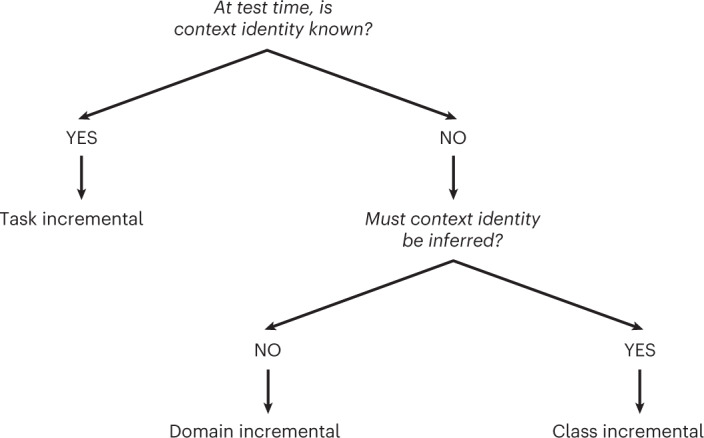
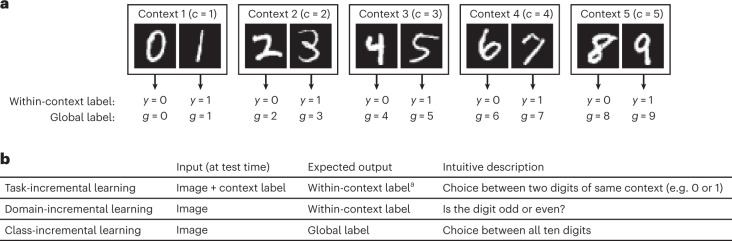
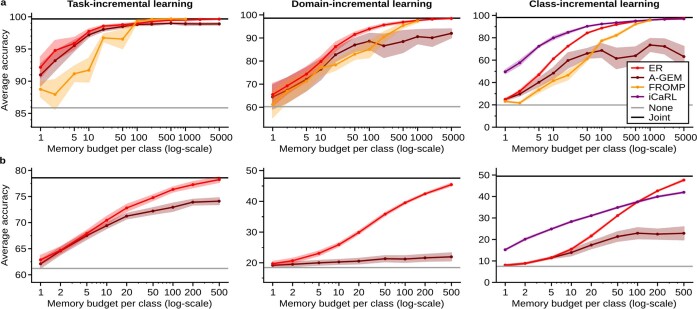
Incrementally learning new information from a non-stationary stream of data, referred to as ‘continual learning’, is a key feature of natural intelligence, but a challenging problem for deep neural networks. In recent years, numerous deep learning methods for continual learning have been proposed, but comparing their performances is difficult due to the lack of a common framework. To help address this, we describe three fundamental types, or ‘scenarios’, of continual learning: task-incremental, domain-incremental and class-incremental learning. Each of these scenarios has its own set of challenges. To illustrate this, we provide a comprehensive empirical comparison of currently used continual learning strategies, by performing the Split MNIST and Split CIFAR-100 protocols according to each scenario. We demonstrate substantial differences between the three scenarios in terms of difficulty and in terms of the effectiveness of different strategies. The proposed categorization aims to structure the continual learning field, by forming a key foundation for clearly defining benchmark problems.
Overview
The claims and statistics of this paper haven’t been checked yet.
Free: it reads the open-access text and checks the first 5 claims that cite a source we can check. Create a free account to check every claim.
Integrity signals
Registry
Cites
Statistics
Figures

Verification
Claims the paper makes
The claims and statistics of this paper haven’t been checked yet.
Free: it reads the open-access text and checks the first 5 claims that cite a source we can check. Create a free account to check every claim.
Claims other papers make about this one
Each is checked against this paper’s own text: does it say what the citing paper says it does?
The cited source says what the claim attributes to it.
In the citing paper
“To avert catastrophic forgetting, various algorithms[11, 48, 49] employ task-specific components or design separate networks for each task.”
From Few-Shot Class-Incremental Learning for Classification and Object Detection: A Survey (2025) · cites this paper as [11]
The cited source says what the claim attributes to it.
In the citing paper
“DIL is an ML problem designed to continuously adapt to data distribution from different domains while the structure of the problem is always the same [11].”
From Few-Shot Class-Incremental Learning for Classification and Object Detection: A Survey (2025) · cites this paper as [11]
The cited source says what the claim attributes to it.
In the citing paper
“TIL's primary challenge lies in identifying shared features across tasks to balance performance and computational complexity, using knowledge from one task to enhance performance in others [11].”
From Few-Shot Class-Incremental Learning for Classification and Object Detection: A Survey (2025) · cites this paper as [11]
Self-check
Percentages, sums and reported differences re-computed from the paper’s own numbers.
The self-check needs the paper’s full text.
Citations
Cites
Adam: A Method for Stochastic Optimization
Kingma, D. P., & Ba, J. (2014) · arXiv · doi:10.48550/arxiv.1412.6980 · Cited by 98,946
Gradient-based learning applied to document recognition
Lecun, Y., Bottou, L., Bengio, Y., & Haffner, P. (1998) · Proceedings of the IEEE · doi:10.1109/5.726791 · Cited by 58,805 · cited 1×
“For the Split MNIST protocol, the MNIST dataset 66 was split into five contexts, such that each context contained two digits.”
Auto-Encoding Variational Bayes
Kingma, D. P., & Welling, M. (2013) · arXiv · doi:10.48550/arxiv.1312.6114 · Cited by 20,067
Distilling the Knowledge in a Neural Network
Hinton, G., Vinyals, O., & Dean, J. (2015) · arXiv · doi:10.48550/arxiv.1503.02531 · Cited by 14,204
(2017) · Cited by 11,625
Overcoming catastrophic forgetting in neural networks
Kirkpatrick, J., Pascanu, R., Rabinowitz, N., Veness, J., Desjardins, G., Rusu, A. A., Milan, K., Quan, J., Ramalho, T., Grabska-Barwinska, A., et al. (2017) · Proceedings of the National Academy of Sciences · doi:10.1073/pnas.1611835114 · Cited by 7,899 · cited 9×
“A few years ago this scenario was regularly studied with Permuted MNIST 31,49,61 , but this protocol is not often used any-more as it is considered too artificial.”
InfluentialLi, Z., & Hoiem, D. (2018) · IEEE Transactions on Pattern Analysis and Machine Intelligence · doi:10.1109/tpami.2017.2773081 · Cited by 4,202
iCaRL: Incremental Classifier and Representation Learning
Rebuffi, S.-A., Kolesnikov, A., Sperl, G., & Lampert, C. H. (2017) · 2017 IEEE Conference on Computer Vision and Pattern Recognition (CVPR) · doi:10.1109/cvpr.2017.587 · Cited by 3,988
Catastrophic Interference in Connectionist Networks: The Sequential Learning Problem
McCloskey, M., & Cohen, N. J. (1989) · Psychology of Learning and Motivation · doi:10.1016/s0079-7421(08)60536-8 · Cited by 3,770
Catastrophic forgetting in connectionist networks
French, R. (1999) · Trends in Cognitive Sciences · doi:10.1016/s1364-6613(99)01294-2 · Cited by 2,311 · cited 16×
“During training on context K , the regularization term of FROMP was given by: with τ a hyperparameter controlling the regularization strength (which was set based on a grid search, see Supplementary Note 8) and ̂ θ ∗ the parameter vector with values as they were at the end of training on context K − 1.”
Influential
Research works printed but not linked: 16
- Chen Z Liu B Lifelong machine learning Synth. Lect. Artif. Intell. Mach. Learn. 2018 12 1 207
- Mundt, M., Lang, S., Delfosse, Q. & Kersting, K. CLEVA-compass: A continual learning evaluation assessment compass to promote research transparency and comparability. In International Conference on Learning Representations (2022).
- Ruvolo, P. & Eaton, E. ELLA: An efficient lifelong learning algorithm. In International Conference on Machine Learning 507–515 (PMLR, 2013).
- Ramesh, R. & Chaudhari, P. Model Zoo: A growing brain that learns continually. In International Conference on Learning Representations (2022).
- Lopez-Paz, D. & Ranzato, M. Gradient episodic memory for continual learning. In Advances in Neural Information Processing Systems Vol. 30, 6470–6479 (2017).
- Mirza, M. J., Masana, M., Possegger, H. & Bischof, H. An efficient domain-incremental learning approach to drive in all weather conditions. In Proceedings of the IEEE/CVF Conference on Computer Vision and Pattern Recognition (CVPR) Workshops 3001–3011 (2022).
- von Oswald, J., Henning, C., Sacramento, J. & Grewe, B. F. Continual learning with hypernetworks. In International Conference on Learning Representations (2020).
- Shin, H., Lee, J. K., Kim, J. & Kim, J. Continual learning with deep generative replay. In Advances in Neural Information Processing Systems Vol. 30, 2994–3003 (2017).
- Caccia, L., Belilovsky, E., Caccia, M. & Pineau, J. Online learned continual compression with adaptive quantization modules. In International Conference on Machine Learning 1240–1250 (PMLR, 2020).
- Lee, S., Ha, J., Zhang, D. & Kim, G.A neural dirichlet process mixture model for task-free continual learning. In International Conference on Learning Representations (2020).
- Jin, X., Sadhu, A., Du, J. & Ren, X. Gradient-based editing of memory examples for online task-free continual learning. In Advances in Neural Information Processing Systems Vol. 34, 29193–29205 (2021).
- Rolnick, D., Ahuja, A., Schwarz, J., Lillicrap, T. & Wayne, G. Experience replay for continual learning. In Advances in Neural Information Processing Systems Vol. 32 (2019).
- Aljundi, R. et al. Online continual learning with maximally interfered retrieval. In Advances in Neural Information Processing Systems Vol. 32 (2019). · DOI · Paper page
- Hess, T., Mundt, M., Pliushch, I. & Ramesh, V. A procedural world generation framework for systematic evaluation of continual learning. In Thirty-fifth Conference on Neural Information Processing Systems, Datasets and Benchmarks Track (2021).
- Ioffe, S. & Szegedy, C. Batch normalization: Accelerating deep network training by reducing internal covariate shift. In International Conference on Machine Learning 448–456 (PMLR, 2015).
- Rezende, D. & Mohamed, S. Variational inference with normalizing flows. In International Conference on Machine Learning 1530–1538 (PMLR, 2015).
Cited by
Items 201–300 of 770
Purified Distillation: Bridging Domain Shift and Category Gap in Incremental Object Detection
Jia, S., Wu, T., Fang, Y., Zeng, T., Zhang, G., & Li, Z. (2024) · ACM International Conference on Multimedia (ACM MM) · doi:10.1145/3664647.3681031 · Cited by 8
Adaptive Domain-Enhanced Transfer Learning for Welding Defect Classification
Dai, D., Mohan, A., Franciosa, P., Zhang, T., Chen, C. L. P., & Ceglarek, D. J. (2024) · Conference proceedings/Conference proceedings - IEEE International Conference on Systems, Man, and Cybernetics · doi:10.1109/smc54092.2024.10832066 · Cited by 9
Usamentiaga, R., Venegas, P., Сфарра, С., & Zhang, H. (2025) · Quantitative InfraRed Thermography Journal · doi:10.1080/17686733.2025.2464972 · Cited by 6
Dark Experience for Incremental Keyword Spotting
Peng, T., & Xiao, Y. (2025) · IEEE International Conference on Acoustics Speech and Signal Processing · doi:10.1109/icassp49660.2025.10890228 · Cited by 14
“It can be divided into task-incremental and class-incremental learning, depending on the presence of a task ID. Recent strategies like progressive continual learning [17] apply task-incremental continual learning to KWS, enabling models to adapt to new data while retaining previous knowledge.”
BackgroundLi, J., Qian, G., He, W., Zhu, H., & Zhou, G. (2025) · Applied Intelligence · doi:10.1007/s10489-025-06434-0 · Cited by 6
Yang, L., Yang, H., He, X., Huang, W., & Lv, C. (2025) · Knowledge-Based Systems · doi:10.1016/j.knosys.2025.113704 · Cited by 10
An unsupervised mixed-up differential replay mechanism for propagation detection of blade crack
Shen, J., Gao, E., Ma, T., & Xu, F. (2025) · Advanced Engineering Informatics · doi:10.1016/j.aei.2025.103732 · Cited by 6
Matsumoto, T., Ohata, W., & Tani, J. (2023) · Entropy · doi:10.3390/e25111506 · Cited by 8
“Incremental learning, also known as continual or life-long learning, is regarded as an essential part of the developmental process of natural intelligence [11].”
BackgroundDMTFS-FO: Dynamic multi-task feature selection based on flexible loss and orthogonal constraint
Zhang, Y., Shi, J., & Zhao, H. (2024) · Expert Systems with Applications · doi:10.1016/j.eswa.2024.124588 · Cited by 6
Deep learning-based prediction of initiation jet momentum ratio in jet-induced oblique detonations
Bao, Y., Qiu, R., Lou, J., Han, X. J., & You, Y. (2024) · Aerospace Science and Technology · doi:10.1016/j.ast.2024.109724 · Cited by 7
Overcoming catastrophic forgetting in tabular data classification: A pseudorehearsal-based approach
García-Santaclara, P., Fernández-Castro, B., & Redondo, R. P. D. (2025) · Engineering Applications of Artificial Intelligence · doi:10.1016/j.engappai.2025.110908 · Cited by 10
Wimpff, M., Aristimunha, B., Chevallier, S., & Yang, B. (2025) · Annual International Conference of the IEEE Engineering in Medicine and Biology Society (EMBC) · doi:10.1109/embc58623.2025.11253543 · Cited by 9
“Within the realm of deep learning, the process of gradually adapting to an incoming stream of data from different domains can be described as domain-incremental continual learning [21], [22].”
Continual learning approaches for single cell RNA sequencing data
Saygılı, G., & Yigin, B. Ö. (2023) · Scientific Reports · doi:10.1038/s41598-023-42482-7 · Cited by 8
From Yes-Men to Truth-Tellers: Addressing Sycophancy in Large Language Models with Pinpoint Tuning
Chen, W., Huang, Z., Xie, L., Lin, B., Li, H., Lu, L., Tian, X., Cai, D., Zhang, Y., Wang, W., et al. (2024) · arXiv · doi:10.48550/arxiv.2409.01658 · Cited by 5
“Continual learning There have been numerous efforts to tackle catastrophic forgetting in the continual learning community (Van de Ven et al., 2022; Kirkpatrick et al., 2016).”
BackgroundYang, H. L., Makkar, N., Laverdiere, M., & Rose, A. (2024) · IEEE Journal of Selected Topics in Applied Earth Observations and Remote Sensing · doi:10.1109/jstars.2024.3385380 · Cited by 5
“The batch mode active learning selects a subset of data from a fixed sample pool based on a query strategy and trains the model on that subset [40].”
BackgroundLi, Y., Xie, T., Liu, C., & Shi, Z. (2024) · IISE Transactions · doi:10.1080/24725854.2024.2428642 · Cited by 8
“…the great potential of these methods in various manufacturing processes such as additive manufacturing, injection molding, laser machining, and laser welding (McDonne et al ., 2021; Shi, Al Mamun, Kan, Tian, and Liu, 2022; Tercan et al ., 2022; McDonnell et al ., 2021; Ma et al ., 2022).”
Liu, Y., Jin, J., Zhao, H., Wang, Z., & Shen, Y. (2025) · The Astrophysical Journal Supplement Series · doi:10.3847/1538-4365/ad9dec · Cited by 5
Wu, J., Wang, S., Sun, Y., Yin, B., & Huang, Q. (2025) · IEEE Transactions on Image Processing · doi:10.1109/tip.2025.3551918 · Cited by 5
Kanoga, S., Tsukiji, Y., & Karakida, R. (2025) · Expert Systems with Applications · doi:10.1016/j.eswa.2025.127469 · Cited by 5
Context-dependent carbon mitigation potential using long-term onshore wind turbine datasets in China
Yang, P., Zou, Z., Ding, Q., Xu, C., & Yang, W. (2025) · Resources Conservation and Recycling · doi:10.1016/j.resconrec.2025.108350 · Cited by 7
Predict before You Precipitate: Learning Templating Effects in Hybrid Antimony and Bismuth Halides
Blahusch, J., Jakob, K. S., Margraf, J. T., Reuter, K., & Lotsch, B. V. (2025) · Chemistry of Materials · doi:10.1021/acs.chemmater.5c00350 · Cited by 5
Continual Learning Inspired by Brain Functionality: A Comprehensive Survey
Aslam, M. A., Hamza, M. A., Shuangtong, Z., Hu, H., Wei, X., Irfan, M., Jiangbin, Z., & Aslam, S. (2025) · International Journal of Intelligent Systems · doi:10.1155/int/3145236 · Cited by 6
“In this scenario, input data distribution, environment, and the context may change [155, 255].”
Ullah, Z., & Kim, J. (2025) · Mathematics · doi:10.3390/math13182988 · Cited by 6
Wang, G., Liu, Z., Zhang, X., Chen, Y., Zhang, Y., Zhu, J., & Jiao, L. (2025) · IEEE Transactions on Neural Networks and Learning Systems · doi:10.1109/tnnls.2025.3615307 · Cited by 6
“Restrictions apply. typical DIL setup [9], [10], all domains share the same set of modulation schemes but have di ff erent distributions, i.e., p ( X i ) (cid:44) p ( X j )and Y i = Y j .”
InfluentialDeveloping continuous toxicity detection against increasing types of perturbed toxic text
Kang, H., Chen, J., Li, Y., Miao, X., Xu, M., Zhou, S., Zhong, M. J., Zhu, Y., & Qian, T. (2025) · Information Processing & Management · doi:10.1016/j.ipm.2025.104470 · Cited by 7
Elmecker-Plakolm, L., Fasterling, P., Sosnin, P., Tsay, C., & Wicker, M. (2026) · IEEE Conference on Secure and Trustworthy Machine Learning (SaTML) · doi:10.1109/satml68715.2026.00044 · Cited by 6
“…in safety-critical contexts. b) Catastrophic Forgetting in Continual Learning: Ensuring that training updates do not degrade prior model capabilities (as seen in Figure 1), an issue termed catastrophic forgetting [7], [12], [34], has been widely studied within the continual learning community [8].”
InfluentialA selective Kalman filtering approach to online neural network updating under system drift
Hammond, J. E., Soderstrom, T. A., Korgel, B. A., & Bâldea, M. (2025) · Scientific Reports · doi:10.1038/s41598-025-24558-8 · Cited by 8
Lee, M., Zhu, Y., Hu, Y., Pan, Y., Chen, J., Yao, Y., Yang, G., & Zhou, X. (2025) · IEEE Transactions on Intelligent Transportation Systems · doi:10.1109/tits.2025.3618724 · Cited by 5
“Some progress has been achieved to enable computer vision applications [18], [19] and natural language processing [20].”
Continual Learning With Siamese Neural Networks for Sustainable Network Management
Yaacoub, K. E., Stenhammar, O., İckin, S., & Vandikas, K. (2024) · IEEE Transactions on Network and Service Management · doi:10.1109/tnsm.2024.3368928 · Cited by 9
“ER optimizes a weighted loss function based on the standard classification loss on the replayed data, L replay , added to the standard classification loss on the current data/context, L current , weighted by the number of contexts N c [12].”
MethodEnhancing SOC estimation accuracy via incremental learning techniques for second-life batteries
Gotz, J. D., de Souza, P. H. G., Galvão, J. R., Corrêa, F. C., Badin, A. A., Viana, E. R., & Borsato, M. (2024) · Sustainable Energy Technologies and Assessments · doi:10.1016/j.seta.2024.103753 · Cited by 10
Learn to Update Digital Twins with Incremental Scenarios
Lee, M., Hu, Y., Zhu, Y., Zhou, X., Yue, Z., & Zhou, X. (2024) · doi:10.1145/3662004.3663551 · Cited by 5
Continual learning approaches to hand–eye calibration in robots
Bahadir, O., Siebert, J. P., & Aragón-Camarasa, G. (2024) · Machine Vision and Applications · doi:10.1007/s00138-024-01572-w · Cited by 6
“CL approaches can be categorised as task-incremental , domain-incremental , and class-incremental learning [30].”
Rehearsal-free continual few-shot relation extraction via contrastive weighted prompts
Yang, F., Ren, M., Kong, D., Liu, S., & Fu, Z. (2025) · Neurocomputing · doi:10.1016/j.neucom.2025.129741 · Cited by 5
Xiang, Y., Han, L., Wu, J., & Niu, B. (2025) · Transportation Safety and Environment · doi:10.1093/tse/tdaf020 · Cited by 6
Singampalli, A., Gufran, D., & Pasricha, S. (2025) · IEEE Access · doi:10.1109/access.2025.3561103 · Cited by 5
“CL scenarios are typically categorized into three types [12] based on how input ( x ) and output ( y ) distributions evolve over time: 1) Domain-Incremental Learning (DIL): Here for f ( x ) = y , x evolves but y remains fixed [34], [35].”
Continual Learning Strategies for 3D Engineering Regression Problems: A Benchmarking Study
Samuel, K., & Ahmed, F. (2025) · Journal of Computing and Information Science in Engineering · doi:10.1115/1.4069113 · Cited by 6
Rodrigues, E. C., Thompson, R. L., Oliveira, D. A. B., & Ausas, R. F. (2025) · Engineering Applications of Artificial Intelligence · doi:10.1016/j.engappai.2025.111788 · Cited by 13
Continual Learning Through the Lens of Adaptive Filtering: A mathematical tutorial
Peng, L., & Vidal, R. (2026) · IEEE Signal Processing Magazine · doi:10.1109/msp.2026.3657516 · Cited by 5
SimpleViTFi: A Lightweight Vision Transformer Model for Wi-Fi-Based Person Identification
Bian, J., Zheng, M., Liu, H., Mao, J., Li, H., & Tan, C. B. (2024) · IEICE Transactions on Communications · doi:10.23919/transcom.2023ebp3102 · Cited by 5
Defending Network IDS against Adversarial Examples with Continual Learning
Kozal, J., Zwolińska, J., Klonowski, M., & Woźniak, M. (2023) · IEEE ... International Conference on Data Mining workshops · doi:10.1109/icdmw60847.2023.00017 · Cited by 8
UniGrad-FS: Unified Gradient Projection With Flatter Sharpness for Continual Learning
Li, W., Feng, T., Yuan, H., Bian, A., Du, G., Liang, S., Gan, J., & Liu, Z. (2024) · IEEE Transactions on Industrial Informatics · doi:10.1109/tii.2024.3435499 · Cited by 7
“CL, also referred to as lifelong learning or incremental learning [20], [21], [22], is dedicated to strike a balance between acquiring new knowledge and retaining old knowledge.”
Adiabatic replay for continual learning
Krawczyk, A., & Gepperth, A. (2024) · International Joint Conference on Neural Networks (IJCNN) · doi:10.1109/ijcnn60899.2024.10651381 · Cited by 10
Domain Incremental Lifelong Learning in an Open World
Dai, Y. Q., Lang, H., Zheng, Y., Yu, B., Huang, F., & Li, Y. (2023) · Findings of the Association for Computational Linguistics: ACL (Findings of ACL) · doi:10.18653/v1/2023.findings-acl.361 · Cited by 10
Chen, C., Wang, K. I., Li, P., & Sakurai, K. (2023) · International Symposium on Computing and Networking · doi:10.1109/candar60563.2023.00009 · Cited by 7
“Continual Learning paradigms can be broadly classified into three scenarios, as delineated by [21]: Task Incremental Learning (Task-IL), Domain Incremental Learning (Domain-IL), and Class Incremental Learning (Class-IL).”
BackgroundMoodley, D., & Seebregts, C. J. (2023) · arXiv (Cornell University) · doi:10.48550/arxiv.2306.01772 · Cited by 6
“Continual learning, also known as incremental learning or lifelong learning, is an increasingly relevant area of study that asks how artificial systems might learn sequentially, as biological systems do, from a continuous stream of data [23, 40, 41].”
BackgroundAhrens, K., Lehmann, H. H., Lee, J. H., & Wermter, S. (2024) · Transactions on machine learning research · doi:10.48550/arxiv.2312.08888 · Cited by 10
“Continual learning with pre-trained models builds on the assumption that a large all-purpose feature extractor provides strong knowledge transfer capabilities and great robustness to catastrophic forgetting [39] during incremental adaptation to downstream tasks.”
BackgroundKang, S., Han, C., Wang, B., Wang, Y., & Liu, D. (2025) · IEEE Sensors Journal · doi:10.1109/jsen.2025.3562935 · Cited by 4
“Anomaly detection models built offline often struggle to adapt to these changing distributions, resulting in model mismatches, which, in turn, reduces the accuracy of anomaly detection [20].”
DeepART: Deep gradient-free local learning with adaptive resonance
Petrenko, S. A., da Silva, L. E. B., & Wunsch, D. C. (2025) · Neural Networks · doi:10.1016/j.neunet.2025.107580 · Cited by 6
Liu, S., Tian, J., Dai, Y., Ji, Z., & Banerjee, A. (2025) · Applied Energy · doi:10.1016/j.apenergy.2025.126390 · Cited by 6
Cross-Domain Continual Learning for Edge Intelligence in Wireless ISAC Networks
Hu, J., Li, X., Su, Z., & Luo, J. (2025) · IEEE Transactions on Wireless Communications · doi:10.1109/twc.2025.3588914 · Cited by 7
“In contrast, herding [45] and clustering-based [46] exemplar selection are more computationally efficient while achieving comparable performance [39]; yet, each of them have its own strengths and limitations.”
ErrorEraser: Unlearning Data Bias for Improved Continual Learning
Cao, X., Gu, H., Yang, X., Wei, B., Liang, H., Wang, X., & Li, T. (2025) · ACM SIGKDD Conference on Knowledge Discovery and Data Mining (KDD) · doi:10.1145/3711896.3736941 · Cited by 10
Karaouli, N., Coquenet, D., Fromont, É., Mermillod, M., & Reyboz, M. (2026) · Lecture notes in computer science · doi:10.1007/978-3-032-41086-3_38 · Cited by 4
Situ, Y., Chen, Y., Li, W., Qiao, Z., Ding, L., & Yang, Q. (2025) · Chemical Engineering Journal · doi:10.1016/j.cej.2025.169314 · Cited by 4
Regression-Aware Continual Learning for Android Malware Detection
Ghiani, D., Angioni, D., Piras, G., Sotgiu, A., Minnei, L., Gupta, S., Pintor, M., Roli, F., & Biggio, B. (2026) · IEEE Transactions on Information Forensics and Security · doi:10.1109/tifs.2026.3714132 · Cited by 4
“The CL literature distinguishes three main settings: (i) domain-incremental , (ii) class-incremental , and task-incremental learning [14].”
IL-IDS: an incremental learning approach with confined data streams for intrusion detection
Li, J., Wang, Y., Jia, Y., Zeng, L., Feng, W., Jing, X., Luo, C., Gu, Z., & Fang, B. (2025) · Cybersecurity · doi:10.1186/s42400-025-00359-4 · Cited by 5
“Van de Ven et al (2022) firstly divided incremental learning into three kinds: task-incremental learning (TIL), domain-incremental learning (DIL) and class-incremen-tal learning (CIL).”
InfluentialIncremental Learning for Patient-Specific EEG-Based Seizure Detection
Deng, Z., Li, C., Zhao, G., & Chen, X. (2025) · IEEE Transactions on Neural Systems and Rehabilitation Engineering · doi:10.1109/tnsre.2025.3628907 · Cited by 4
Cheng, M., Jiang, X., Zhang, H., Pi, X., Yang, D., & Deng, T. (2025) · Applied Physics Letters · doi:10.1063/5.0298852 · Cited by 6
Leite, D. F. (2026) · Neurocomputing · doi:10.1016/j.neucom.2026.132665 · Cited by 5
Blockchain Anomaly Transaction Detection Method Based on Graph Continual Learning
Shen, X., Xu, C. L., & Zhu, L. (2026) · IEEE Transactions on Network Science and Engineering · doi:10.1109/tnse.2026.3653459 · Cited by 6
“…extensive comparisons, and Wang et al. [22] summarized objectives, taxonomies, and practical applications of CL. Foundational perspectives are also offered by Liu’s lifelong learning paradigm [121] and van de Ven et al.’s definitions of scenarios (task, domain, and class-incremental) [130], [131].”
Robust incremental learning of visual concepts without catastrophic forgetting
Barari, N., Lian, X., & MacLellan, C. J. (2026) · Cognitive Systems Research · doi:10.1016/j.cogsys.2026.101447 · Cited by 4
Zhou, Y., Lei, Z., Wen, G., Chen, Z., Jiang, H., Zhang, X., & Chen, X. (2026) · Robotics and Computer-Integrated Manufacturing · doi:10.1016/j.rcim.2026.103335 · Cited by 4
Modular Learning: Agile Development of Robust Traffic Sign Recognition
Lin, Y., & Wang, Y. (2023) · IEEE Transactions on Intelligent Vehicles · doi:10.1109/tiv.2023.3322407 · Cited by 5
“There are three fundamental types of incremental learning (i.e., class, task, domain) as shown in the study [6].”
BackgroundHe, X., Ding, C., Qiao, F., & Shi, J. (2024) · Conference proceedings/Conference proceedings - IEEE International Conference on Systems, Man, and Cybernetics · doi:10.1109/smc54092.2024.10831026 · Cited by 4
“Within these domains, incremental learning can be categorised into task-incremental, category-incremental, and domain-incremental, depending on scenarios[13].”
Zebrafish identification with deep CNN and ViT architectures using a rolling training window
Puchalla, J., Serianni, A., & Deng, B. (2025) · Scientific Reports · doi:10.1038/s41598-025-86351-x · Cited by 6
Molina-Moreno, M., Schilling, M. P., Reischl, M., & Mikut, R. (2025) · IEEE Access · doi:10.1109/access.2025.3555020 · Cited by 5
“We contemplate two different strategies to mitigate this shortcoming: 1) class-incremental learning [72], to incorporate the knowledge of the new datasets incrementally, reducing the computational cost without compromising the learned information from previous datasets; and 2) few-shot learning…”
HINT: Hypernetwork approach to training weight interval regions in continual learning
Krukowski, P., Bielawska, A., Książek, K., Wawrzyński, P., Batorski, P., & Spurek, P. (2025) · Information Sciences · doi:10.1016/j.ins.2025.122261 · Cited by 7
Teng, F., Shi, W., Lei, Y., Jin, H., Pan, B., & Wang, Y. (2025) · IEEE Transactions on Cognitive Communications and Networking · doi:10.1109/tccn.2025.3569554 · Cited by 4
“IL can be categorized into task IL and class IL according to the learning environment and task type [36], as shown in Fig.”
Zhou, N., Zhou, M., Wang, X., Chen, D., Shi, W., Zhu, Y., Liu, J., & Sui, H. (2025) · IEEE Transactions on Geoscience and Remote Sensing · doi:10.1109/tgrs.2025.3572373 · Cited by 5
“The potential of SDI from natural image processing fields has been explored in remote sensing [36], [37], [38].”
Fang, P., Wu, Y., He, Y., Li, H., Guan, Z., Wang, X., Chen, T., & Shen, J. (2025) · The Visual Computer · doi:10.1007/s00371-025-03977-8 · Cited by 8
Incremental learning research for webshell detection
Wang, Z., Wang, H., Yuan, S., & Tian, Z. (2025) · Journal of King Saud University - Computer and Information Sciences · doi:10.1007/s44443-025-00235-8 · Cited by 6
“Incremental Learning or Continual Learning (Van de Van et al. 2022) offers a solution.”
InfluentialEfficient Adaptive Incremental Learning for Fruit and Vegetable Classification
Guo, K., Chen, H., Zheng, Y., Liu, Q., Ren, S., Hu, H., & Liang, J. (2024) · Agronomy · doi:10.3390/agronomy14061275 · Cited by 5
Chen, C., Wang, K. I., Li, P., & Sakurai, K. (2024) · International Journal of Networking and Computing · doi:10.15803/ijnc.14.2_123 · Cited by 4
“The domain of continual learning is categorized into three distinct scenarios: Task Incremental Learning (Task-IL), Domain Incremental Learning (Domain-IL), and Class Incremental Learning (Class-IL), each defined by unique challenges, data distribution variations, and specific constraints [24].”
BackgroundContinual Learning for Robust Gate Detection under Dynamic Lighting in Autonomous Drone Racing
Qiao, Z., Pham, H. X., Ramasamy, S., Jiang, X., Kayacan, E., & Sarabakha, A. (2024) · International Joint Conference on Neural Networks (IJCNN) · doi:10.1109/ijcnn60899.2024.10649903 · Cited by 4
Continual learning in the presence of repetition
Hemati, H., Pellegrini, L., Duan, X., Zhao, Z., Xia, F., Masana, M., Tscheschner, B., Veas, E. E., Zheng, Y., Zhao, S., et al. (2024) · Neural Networks · doi:10.1016/j.neunet.2024.106920 · Cited by 14
“(The terms task, domain-and class-incremental learning are sometimes even interpreted as excluding the possibility of repetition, but see van de Ven, Tuytelaars, and Tolias (2022).)”
Deep Generative Replay-based Class-incremental Continual Learning in sEMG-based Pattern Recognition
Kanoga, S., Karakida, R., Hoshino, T., Okawa, Y., & Tada, M. (2024) · Annual International Conference of the IEEE Engineering in Medicine and Biology Society (EMBC) · doi:10.1109/embc53108.2024.10781686 · Cited by 7
Boosting total electron content forecasting based on deep learning toward an operational service
Molina, M. G., Namour, J. H., Cesaroni, C., Spogli, L., Argüelles, N. B., & Asamoah, E. N. (2025) · Journal of Atmospheric and Solar-Terrestrial Physics · doi:10.1016/j.jastp.2025.106427 · Cited by 4
Oskolkov, B., Chen, K., Tian, W., Law, A. C. C., & Liu, C. (2025) · Journal of Computing and Information Science in Engineering · doi:10.1115/1.4067736 · Cited by 7
A Two-Stage Class Incremental Learning Approach for Network Intrusion Detection
Wang, Y., & Cao, S. (2024) · Globecom · doi:10.1109/globecom52923.2024.10901809 · Cited by 5
Joint Class and Domain Continual Learning for Decentralized Federated Processes
Lanza, C., Tuytelaars, T., Miozzo, M., Angelats, E., & Dini, P. (2025) · IEEE Access · doi:10.1109/access.2025.3555750 · Cited by 4
“CL can be classified into three categories [6]: task-incremental learning 1 (Task-IL), Class-IL, and Domain-IL, depending on whether the new experiences contain new tasks, new classes, or different data distributions, respectively.”
Self-citationSemi-Supervised Generalized Source-Free Domain Adaptation (SSG-SFDA)
An, J., Zhao, C., & Wu, D. (2023) · International Joint Conference on Neural Networks (IJCNN) · doi:10.1109/ijcnn54540.2023.10191761 · Cited by 4
“Continual learning has three scenarios [3]:”
DIRA: Dynamic Incremental Regularised Adaptation
Ghobrial, A., Zheng, X., Hond, D., Asgari, H., & Eder, K. (2024) · IEEE Conference on Artificial Intelligence (CAI) · doi:10.1109/cai59869.2024.00090 · Cited by 4
Revisiting Supervision for Continual Representation Learning
Marczak, D., Cygert, S., Trzcinski, T. P., & Twardowski, B. (2024) · Lecture notes in computer science · doi:10.1007/978-3-031-72658-3_11 · Cited by 10
Continual Diffuser (CoD): Mastering Continual Offline RL With Experience Rehearsal
Hu, J., Shen, L., Huang, S., Yang, Z., Chen, H., Sun, L., Chang, Y., & Tao, D. (2025) · IEEE Transactions on Neural Networks and Learning Systems · doi:10.1109/tnnls.2025.3598928 · Cited by 5
“Aligning with the traditional definition of various CL settings [68], this benchmark supports constructing task-incremental CORL (TICORL), domain-incremental CORL (DICORL), and class-incremental CORL (CICORL) settings.”
Sun, W., Li, Q., Zhang, S., Wang, W., & Geng, Y. (2025) · Pattern Recognition · doi:10.1016/j.patcog.2025.112948 · Cited by 5
Wang, T., Hu, Z., Wang, Y., Li, M., Liu, Z., & Wang, X. V. (2024) · Advanced Engineering Informatics · doi:10.1016/j.aei.2024.102967 · Cited by 3
Li, X., Ma, X., Zhang, H., & Yuan, D. (2024) · China Automation Congress (CAC) · doi:10.1109/cac63892.2024.10865632 · Cited by 4
Wang, C., Zhang, Q., & Deng, L. (2025) · Measurement Science and Technology · doi:10.1088/1361-6501/adb640 · Cited by 3
FMDL: Enhancing Open-World Object Detection with foundation models and dynamic learning
Huang, Y., Hu, J., & Luo, R. (2025) · Expert Systems with Applications · doi:10.1016/j.eswa.2025.127050 · Cited by 4
Deng, Z., Luo, C., Tang, Z., Pu, X., & Luo, Y. (2025) · IEEE Transactions on Cognitive Communications and Networking · doi:10.1109/tccn.2025.3585680 · Cited by 3
“Incremental learning offers an effective strategy for adapting models over time and is typically categorized into domain-incremental, task-incremental, and class-incremental learning [19], [20].”
Uncertainty aware domain incremental learning for cross domain depression detection
Lifelo, Z., Ding, J., Ning, H., & Dhelim, S. (2025) · Scientific Reports · doi:10.1038/s41598-025-10917-y · Cited by 3
“This approach is particularly valuable in dynamic environments where data distributions evolve continuously, closely mirroring human learning processes 32 .”
SALLM: Open world object detection empowered by self adaptive learning and large model
Huang, Y., Ye, L., & Luo, R. (2025) · Expert Systems with Applications · doi:10.1016/j.eswa.2025.129375 · Cited by 3
Activating Sparse Part Concepts for 3D Class Incremental Learning
Tian, Z., Xiao, J., Liu, L., & Jiang, H. (2025) · IEEE Computer Society Conference on Computer Vision and Pattern Recognition/Proceedings - IEEE Computer Society Conference on Computer Vision and Pattern Recognition/Proceedings · doi:10.1109/cvpr52734.2025.02825 · Cited by 3
“This ability is crucial for 3D recognition in robotics and autonomous driving and mirrors Class-Incremental Learning (CIL) in machine learning [35, 36].”
Dahdal, S., Cavicchi, S., Gilli, A., Poltronieri, F., Tortonesi, M., Suri, N., & Stefanelli, C. (2025) · Journal of Network and Computer Applications · doi:10.1016/j.jnca.2025.104322 · Cited by 3
Embodied Intelligence for Micro‐Integrated Energy Systems: Key Technologies and Applications
Liu, D., & Wang, Y. (2025) · IET Smart Energy Systems · doi:10.1049/ses2.70012 · Cited by 4
Replay-Based Domain Incremental Learning for Cross-User Gesture Recognition in Robot Task Allocation
Podder, K. K., Dutta, P., & Zhang, J. (2025) · Electronics · doi:10.3390/electronics14193946 · Cited by 4
XAI ‐Guided Continual Learning: Rationale, Methods, and Future Directions
Proietti, M., Ragno, A., & Capobianco, R. (2025) · Wiley Interdisciplinary Reviews Data Mining and Knowledge Discovery · doi:10.1002/widm.70046 · Cited by 6
“Many works identify three classes: task-incremental, class-incremental, and domain-incremental learning (van de Ven et al. 2022), though terms are often used inconsistently.”
Continual Learning for Agrifood: A Systematic Review
Dimitri, G. M., Kocian, A., Scarselli, F., Gori, M., & Chessa, S. (2025) · IEEE Transactions on AgriFood Electronics · doi:10.1109/tafe.2025.3616733 · Cited by 5
“Such a characteristic can be actually obtained for two main reasons: either the task identity is explicitly given, or the tasks are so clearly different that the algorithm can easily distinguish between them [15].”
InfluentialContrastive Consolidation of Top-Down Modulations Achieves Sparsely Supervised Continual Learning
Tran, V. A., Neftci, E., & Wybo, W. A. M. (2025) · neural information processing systems · doi:10.52202/085713-5030 · Cited by 4
Exemplar-Free Class Incremental Learning for Traffic Sign Classification
Liu, M., Ma, J., Kang, Q., Zhou, M., & Albeshri, A. A. (2025) · IEEE Transactions on Vehicular Technology · doi:10.1109/tvt.2025.3606740 · Cited by 4
“From [4], [31], distillation-based methods without exemplars can perform well in a Task-IL scenario, but struggle in handling a Class-IL scenario, especially when facing complex datasets.”
InfluentialCai, Z., Guo, X., He, M., Li, C., Qi, H., Bai, R., Yang, J., & Zhang, C. (2026) · Journal of Food Composition and Analysis · doi:10.1016/j.jfca.2026.108885 · Cited by 3
Metadata
- Authors
- van de Ven, G. M., Tuytelaars, T., & Tolias, A. S.
- Affiliations
- Baylor College of Medicine (US)
- KU Leuven (BE)
- Corresponding author
- van de Ven, Gido M.
- Venue
- Nature Machine Intelligence
- Published
- 2022-12-05
- Volume
- 4
- Issue
- 12
- Pages
- 1185-1197
- ISSN
- 2522-5839 (ISSN-L)
- PMC
- PMC9771807
- OpenAlex
- W4312210066
- Cited by
- 665
- References
- 43
- Citations by year
- 2026: 173 · 2025: 258 · 2024: 172 · 2023: 60 · 2022: 2
- FWCI
- 40.48
- Type
- journal article
- Language
- en
- Open access
- hybrid
- doi.org
- Licence
- cc-by
- creativecommons.org/licenses/by/4.0 (tdm)
- creativecommons.org/licenses/by/4.0 (vor)
- Locations
- Nature Machine Intelligence (publishedVersion, cc-by)
- PubMed Central (publishedVersion, cc-by)
- PubMed (publishedVersion)
- Lirias (KU Leuven) (submittedVersion, cc-by)
- Rice Research Repository (Rice University) (submittedVersion, cc-by)
- Apollo (University of Cambridge) (submittedVersion, cc-by)
- Apollo
- Funders
- International Brain Research Organization
- National Institutes of Health
- Defense Advanced Research Projects Agency (HR0011, HR0011-18-2-0025)
- Advanced Research Projects Agency
- Intelligence Advanced Research Projects Activity (D16PC00003)
- Interior Business Center
- National Institute of Mental Health (R01MH109556)
- National Eye Institute (P30EY002520)
- H2020 European Research Council (101021347)
- Topics
- Physical Sciences › Computer Science › Artificial Intelligence › Domain Adaptation and Few-Shot Learning
- Physical Sciences › Computer Science › Artificial Intelligence › Data Stream Mining Techniques
- Physical Sciences › Computer Science › Computer Vision and Pattern Recognition › Advanced Neural Network Applications
- Keywords
- continual learning, incremental learning, task-incremental learning, domain-incremental learning, class-incremental learning, catastrophic forgetting, non-stationary data streams, deep neural network
About these checks
Registry, retraction, Cites and statistics results are computed, not judged, with one exception: a printed reference that no index lists is read once by a model before it counts as a citation error. Claims are extracted by a model and kept only when their quote appears verbatim in the text; each cited source is then checked, with a model’s help, for whether it says what the claim relies on. Those verdicts can be wrong — read the claim’s quote and the cited source before relying on one.
Statistics and arithmetic are recomputed, not judged.
Confidence bands are shown only for fields calibrated on our annotated test set. None is calibrated yet, so no band is shown.
What counts as a claim ›How we measure confidence ›How we check this ›
Are you an author, or do you see a problem with this page? Request a review
Data sources
Bibliographic data: Semantic Scholar, OpenAlex, Crossref.
Contains information from the Semantic Scholar Academic Graph Datasets, made available under the ODC Attribution License (ODC-BY 1.0).
Semantic Scholar’s data is described in: Kinney, R., et al. (2023). The Semantic Scholar Open Data Platform. arXiv:2301.10140.
