

Three types of incremental learning
Open accessThe DOI matches its Crossref record; 59 of the 59 references it cites were found in a registry or an index.
Abstract
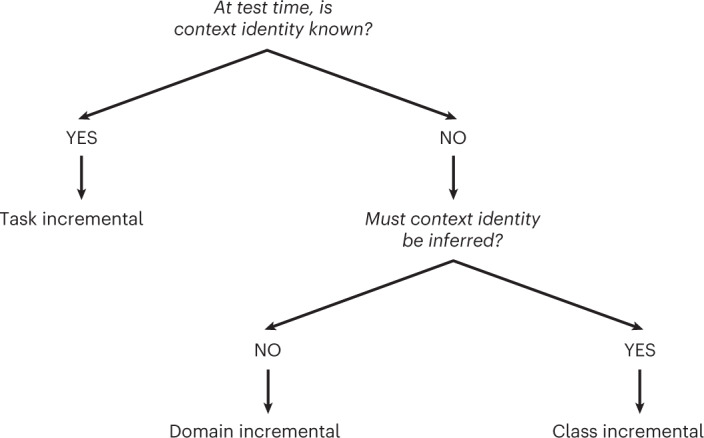
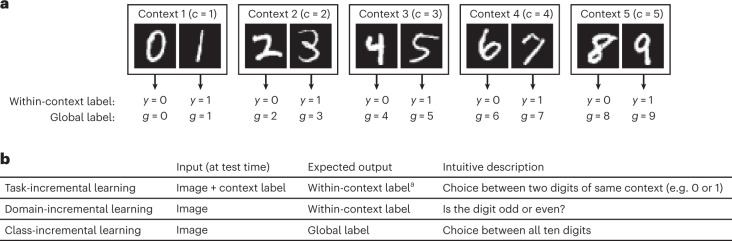
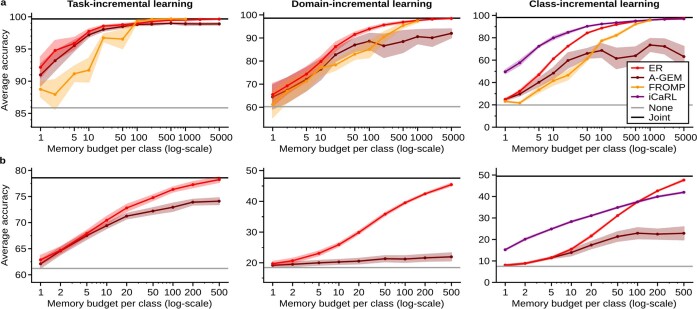
Incrementally learning new information from a non-stationary stream of data, referred to as ‘continual learning’, is a key feature of natural intelligence, but a challenging problem for deep neural networks. In recent years, numerous deep learning methods for continual learning have been proposed, but comparing their performances is difficult due to the lack of a common framework. To help address this, we describe three fundamental types, or ‘scenarios’, of continual learning: task-incremental, domain-incremental and class-incremental learning. Each of these scenarios has its own set of challenges. To illustrate this, we provide a comprehensive empirical comparison of currently used continual learning strategies, by performing the Split MNIST and Split CIFAR-100 protocols according to each scenario. We demonstrate substantial differences between the three scenarios in terms of difficulty and in terms of the effectiveness of different strategies. The proposed categorization aims to structure the continual learning field, by forming a key foundation for clearly defining benchmark problems.
Overview
The claims and statistics of this paper haven’t been checked yet.
Free: it reads the open-access text and checks the first 5 claims that cite a source we can check. Create a free account to check every claim.
Integrity signals
Registry
Cites
Statistics
Figures

Verification
Claims the paper makes
The claims and statistics of this paper haven’t been checked yet.
Free: it reads the open-access text and checks the first 5 claims that cite a source we can check. Create a free account to check every claim.
Claims other papers make about this one
Each is checked against this paper’s own text: does it say what the citing paper says it does?
The cited source says what the claim attributes to it.
In the citing paper
“To avert catastrophic forgetting, various algorithms[11, 48, 49] employ task-specific components or design separate networks for each task.”
From Few-Shot Class-Incremental Learning for Classification and Object Detection: A Survey (2025) · cites this paper as [11]
The cited source says what the claim attributes to it.
In the citing paper
“DIL is an ML problem designed to continuously adapt to data distribution from different domains while the structure of the problem is always the same [11].”
From Few-Shot Class-Incremental Learning for Classification and Object Detection: A Survey (2025) · cites this paper as [11]
The cited source says what the claim attributes to it.
In the citing paper
“TIL's primary challenge lies in identifying shared features across tasks to balance performance and computational complexity, using knowledge from one task to enhance performance in others [11].”
From Few-Shot Class-Incremental Learning for Classification and Object Detection: A Survey (2025) · cites this paper as [11]
Self-check
Percentages, sums and reported differences re-computed from the paper’s own numbers.
The self-check needs the paper’s full text.
Citations
Cites
Adam: A Method for Stochastic Optimization
Kingma, D. P., & Ba, J. (2014) · arXiv · doi:10.48550/arxiv.1412.6980 · Cited by 98,946
Gradient-based learning applied to document recognition
Lecun, Y., Bottou, L., Bengio, Y., & Haffner, P. (1998) · Proceedings of the IEEE · doi:10.1109/5.726791 · Cited by 58,805 · cited 1×
“For the Split MNIST protocol, the MNIST dataset 66 was split into five contexts, such that each context contained two digits.”
Auto-Encoding Variational Bayes
Kingma, D. P., & Welling, M. (2013) · arXiv · doi:10.48550/arxiv.1312.6114 · Cited by 20,067
Distilling the Knowledge in a Neural Network
Hinton, G., Vinyals, O., & Dean, J. (2015) · arXiv · doi:10.48550/arxiv.1503.02531 · Cited by 14,204
(2017) · Cited by 11,625
Overcoming catastrophic forgetting in neural networks
Kirkpatrick, J., Pascanu, R., Rabinowitz, N., Veness, J., Desjardins, G., Rusu, A. A., Milan, K., Quan, J., Ramalho, T., Grabska-Barwinska, A., et al. (2017) · Proceedings of the National Academy of Sciences · doi:10.1073/pnas.1611835114 · Cited by 7,899 · cited 9×
“A few years ago this scenario was regularly studied with Permuted MNIST 31,49,61 , but this protocol is not often used any-more as it is considered too artificial.”
InfluentialLi, Z., & Hoiem, D. (2018) · IEEE Transactions on Pattern Analysis and Machine Intelligence · doi:10.1109/tpami.2017.2773081 · Cited by 4,202
iCaRL: Incremental Classifier and Representation Learning
Rebuffi, S.-A., Kolesnikov, A., Sperl, G., & Lampert, C. H. (2017) · 2017 IEEE Conference on Computer Vision and Pattern Recognition (CVPR) · doi:10.1109/cvpr.2017.587 · Cited by 3,988
Catastrophic Interference in Connectionist Networks: The Sequential Learning Problem
McCloskey, M., & Cohen, N. J. (1989) · Psychology of Learning and Motivation · doi:10.1016/s0079-7421(08)60536-8 · Cited by 3,770
Catastrophic forgetting in connectionist networks
French, R. (1999) · Trends in Cognitive Sciences · doi:10.1016/s1364-6613(99)01294-2 · Cited by 2,311 · cited 16×
“During training on context K , the regularization term of FROMP was given by: with τ a hyperparameter controlling the regularization strength (which was set based on a grid search, see Supplementary Note 8) and ̂ θ ∗ the parameter vector with values as they were at the end of training on context K − 1.”
Influential
Research works printed but not linked: 16
- Chen Z Liu B Lifelong machine learning Synth. Lect. Artif. Intell. Mach. Learn. 2018 12 1 207
- Mundt, M., Lang, S., Delfosse, Q. & Kersting, K. CLEVA-compass: A continual learning evaluation assessment compass to promote research transparency and comparability. In International Conference on Learning Representations (2022).
- Ruvolo, P. & Eaton, E. ELLA: An efficient lifelong learning algorithm. In International Conference on Machine Learning 507–515 (PMLR, 2013).
- Ramesh, R. & Chaudhari, P. Model Zoo: A growing brain that learns continually. In International Conference on Learning Representations (2022).
- Lopez-Paz, D. & Ranzato, M. Gradient episodic memory for continual learning. In Advances in Neural Information Processing Systems Vol. 30, 6470–6479 (2017).
- Mirza, M. J., Masana, M., Possegger, H. & Bischof, H. An efficient domain-incremental learning approach to drive in all weather conditions. In Proceedings of the IEEE/CVF Conference on Computer Vision and Pattern Recognition (CVPR) Workshops 3001–3011 (2022).
- von Oswald, J., Henning, C., Sacramento, J. & Grewe, B. F. Continual learning with hypernetworks. In International Conference on Learning Representations (2020).
- Shin, H., Lee, J. K., Kim, J. & Kim, J. Continual learning with deep generative replay. In Advances in Neural Information Processing Systems Vol. 30, 2994–3003 (2017).
- Caccia, L., Belilovsky, E., Caccia, M. & Pineau, J. Online learned continual compression with adaptive quantization modules. In International Conference on Machine Learning 1240–1250 (PMLR, 2020).
- Lee, S., Ha, J., Zhang, D. & Kim, G.A neural dirichlet process mixture model for task-free continual learning. In International Conference on Learning Representations (2020).
- Jin, X., Sadhu, A., Du, J. & Ren, X. Gradient-based editing of memory examples for online task-free continual learning. In Advances in Neural Information Processing Systems Vol. 34, 29193–29205 (2021).
- Rolnick, D., Ahuja, A., Schwarz, J., Lillicrap, T. & Wayne, G. Experience replay for continual learning. In Advances in Neural Information Processing Systems Vol. 32 (2019).
- Aljundi, R. et al. Online continual learning with maximally interfered retrieval. In Advances in Neural Information Processing Systems Vol. 32 (2019). · DOI · Paper page
- Hess, T., Mundt, M., Pliushch, I. & Ramesh, V. A procedural world generation framework for systematic evaluation of continual learning. In Thirty-fifth Conference on Neural Information Processing Systems, Datasets and Benchmarks Track (2021).
- Ioffe, S. & Szegedy, C. Batch normalization: Accelerating deep network training by reducing internal covariate shift. In International Conference on Machine Learning 448–456 (PMLR, 2015).
- Rezende, D. & Mohamed, S. Variational inference with normalizing flows. In International Conference on Machine Learning 1530–1538 (PMLR, 2015).
Cited by
Items 301–400 of 770
A survey on AI-empowered task-oriented sensing, communication, and computation in 6G networks
Zhang, Y., Wang, X., Luo, X., Pei, X., Li, F., Han, D., & Li, T. (2026) · Computer Science Review · doi:10.1016/j.cosrev.2026.100899 · Cited by 4
Książek, K., Jastrzębski, H., Pniaczek, K., Trojan, B., Karp, M., & Tabor, J. (2026) · Knowledge-Based Systems · doi:10.1016/j.knosys.2026.115479 · Cited by 3
Feature-Foundation Model Evolution for Low-Latency Semantic Communication
Zhang, H., Di, B., Zhang, H., Niyato, D. T., & Song, L. (2026) · IEEE Transactions on Wireless Communications · doi:10.1109/twc.2026.3659294 · Cited by 5
“In this paper, we focus on object classes , an important type of semantic feature [33].”
SeedStudio: A unified system for automated seed imaging and continual classification
Luo, Y., Xu, S., Yuan, H., Liu, S., Xue, H., & Sun, G. (2026) · Computers and Electronics in Agriculture · doi:10.1016/j.compag.2026.111713 · Cited by 3
Trovato, M., Prist, M., Cicconi, P., Bonci, A., Pompei, G., & Longarini, L. (2026) · The International Journal of Advanced Manufacturing Technology · doi:10.1007/s00170-026-18080-y · Cited by 6
SLE-FNO: Single-layer extensions for task-agnostic continual learning in Fourier neural operators
Elhadidy, M., D’Souza, R., & Arzani, A. (2026) · Physica Scripta · doi:10.1088/1402-4896/ae6bdd · Cited by 4
“As noted in prior work, their strong performance often reflects the quality of frozen representations rather than effective mitigation of catastrophic forgetting, making direct comparison potentially misleading [40, 41].”
Learning continually with representational drift
van der Veldt, S., van de Ven, G. M., Moorman, S., & Etter, G. (2026) · Trends Open · doi:10.1016/j.treopn.2026.04.013 · Cited by 3
Calibration‐Free Single‐Frame Super‐Resolution Fluorescence Microscopy
Dostálová, A., Vašinka, D., Stárek, R., & Ježek, M. (2026) · Laser & Photonics Review · doi:10.1002/lpor.71690 · Cited by 3
HIPPP: Health Information Portal for Patients and Public
Brandon, C., Doherty, A. J., Kelly, D., Leddin, D. J., & Margaria, T. (2023) · Applied Sciences · doi:10.3390/app13169453 · Cited by 3
Exploring Continual Learning and Self-learning for Historical Digit Recognition
Kharrat, A., Drira, F., Lebourgeois, F., & García, C. (2023) · International Conference on Cyberworlds (CW) · doi:10.1109/cw58918.2023.00089 · Cited by 3
“However, in this work, we adopted the single-head configuration where the model utilizes a shared output layer and does not require task-id to predict across all classes (0-9) [3].”
BackgroundMethodConcept Accumulation and Gradient-Guided Adaption for continual learning in evolving streaming
Xiong, L., Chen, S., Zhou, H. Y., & Xiong, H. (2024) · Neurocomputing · doi:10.1016/j.neucom.2024.128194 · Cited by 3
Lin, S., Yan, H., Zhou, S., Qiao, Z., & Chen, J. (2024) · Sensors · doi:10.3390/s24155033 · Cited by 4
Transfer Learning in CNC Milling Machines for Chatter Detection using LSTM-AutoEncoders
Li, E., Bedi, S. S., & Melek, W. (2024) · IEEE International Conference on Advanced Intelligent Mechatronics (AIM) · doi:10.1109/aim55361.2024.10637111 · Cited by 4
“Incremental learning, as the name implies, allows the network to continually grow and learn as more data is presented [35].”
BackgroundCertainty-Based Neural Network Architecture Selection Framework for TinyML Systems
Komorniczak, J., Puślecki, T., Ksieniewicz, P., & Walkowiak, K. M. (2024) · IEEE Access · doi:10.1109/access.2024.3482111 · Cited by 4
“At the same time, the structure of the problem remains constant [19], which gives rise to the possibility of adjusting the degree of complexity of the method to the current domain.”
BackgroundImportance-aware Shared Parameter Subspace Learning for Domain Incremental Learning
Wang, S., Li, C., Tang, J., Xing, G., Yuan, Y., & Wang, G. (2024) · ACM International Conference on Multimedia (ACM MM) · doi:10.1145/3664647.3681411 · Cited by 6
Zhang, X., Li, T., Sun, M., Zhang, L., Zhang, C., & Zhang, Y. (2024) · Sensors · doi:10.3390/s24227198 · Cited by 3
Scalable Multi-Facility Workflows for Artificial Intelligence Applications in Climate Research
Kurihana, T., Skluzacek, T. J., da Silva, R. F., & Anantharaj, V. G. (2024) · International Conference for High Performance Computing, Networking, Storage and Analysis (SC) · doi:10.1109/scw63240.2024.00266 · Cited by 3
“The enduring nature of earth observation missions requires continuous training with new data to understand how the Earth system responds to a changing climate, while avoiding catastrophic forgetting in previously trained models [23].”
Incremental data modeling based on neural ordinary differential equations
Chen, Z., Bian, H., & Zhu, W. Q. (2025) · Complex & Intelligent Systems · doi:10.1007/s40747-025-01793-0 · Cited by 3
Enhancing and Optimizing User-Machine Closed-Loop Co-Adaptation in Dynamic Myoelectric Interface
Li, W., Shi, P. A., Li, S., & Yu, H. (2025) · IEEE Transactions on Neural Systems and Rehabilitation Engineering · doi:10.1109/tnsre.2025.3558687 · Cited by 6
“Combined with domain adversarial training, the approach can progressively promote knowledge transfer and realize multi-source domain adaptation [32], [33].”
Temporal Dynamics in Visual Data: Analyzing the Impact of Time on Classification Accuracy
Pégeot, T., Feillet, E., Popescu, A., Kucher, I., & Delezoide, B. (2025) · IEEE Winter Conference on Applications of Computer Vision · doi:10.1109/wacv61041.2025.00674 · Cited by 5
A Reality Check on Pre-training for Exemplar-free Class-Incremental Learning
Feillet, E., Popescu, A., & Hudelot, C. (2025) · IEEE Winter Conference on Applications of Computer Vision · doi:10.1109/wacv61041.2025.00741 · Cited by 5
Yoo, J., Choi, S. H., Yang, Y., Kim, S., Choi, J., Lim, Y., Lim, Y., Joo, H. J., Kim, D. J., Park, R. W., et al. (2025) · Computers in Biology and Medicine · doi:10.1016/j.compbiomed.2025.110239 · Cited by 4
“Domain incremental learning was experimented under PPDL restriction, a type of continual learning [67] to learn the same task on different datasets.”
InfluentialEnhancing few-shot class-incremental learning through prototype optimization
Jiang, M., Fan, J., & Li, F. (2025) · Applied Intelligence · doi:10.1007/s10489-025-06605-z · Cited by 3
H2ST: Hierarchical Two-Sample Tests for Continual Out-of-Distribution Detection
Liu, Y., Zhao, W., & Guo, Y. (2025) · IEEE Computer Society Conference on Computer Vision and Pattern Recognition/Proceedings - IEEE Computer Society Conference on Computer Vision and Pattern Recognition/Proceedings · doi:10.1109/cvpr52734.2025.01436 · Cited by 9
“Task incremental learning (TIL) [8, 21, 50] is a specific form of CL. Existing TIL methods [5, 23, 25, 37] operate under the closed-world assumption, where test data is assumed to be drawn i.i.d. from the same distribution as the training data, known as in-distribution (ID).”
A study on Few-shot Learning approach for Intrusion Detection System with Class Incremental Learning
Cao, Q. P. X., Tran, D. D., Ngo, S. T. T., Khoa, N. H., Duy, P. T., & Pham, V.-H. (2025) · International Conference on Intelligent Information Technology (ICIIT) · doi:10.1145/3731763.3731795 · Cited by 4
Video Domain Incremental Learning for Human Action Recognition in Home Environments
Hu, Y., Hou, J., Liu, X., Sun, X., & Guo, W. (2025) · Lecture notes in computer science · doi:10.1007/978-981-95-3393-0_26 · Cited by 3
VPT-NSP 2 ++: Importance-Aware Visual Prompt Tuning in Null Space for Continual Learning
Zhang, S., Lu, Y., Cheng, D., Xing, Y., Wang, N., Wang, P., & Zhang, Y. (2025) · IEEE Transactions on Pattern Analysis and Machine Intelligence · doi:10.1109/tpami.2025.3642298 · Cited by 3
“We focus on the class-incremental learning scenario [60], [61], [62]: the label space Y t of task T t is disjoint with other tasks, i.e. , Y t (cid:2) Y t = ∅ for t (cid:4) = t (cid:2) .”
Magistri, S., Trinci, T., Soutif--Cormerais, A., van de Weijer, J., & Bagdanov, A. D. (2026) · International Journal of Computer Vision · doi:10.1007/s11263-026-03018-4 · Cited by 4
“The class-incremental scenario is distinguished from the task-incremental one in that no task information is available at test time and thus is more challenging (Van De Ven et al., 2022; De Lange et al., 2022).”
DOLFIN: Balancing Stability and Plasticity in Federated Continual Learning
Moussadek, O., Salami, R., & Calderara, S. (2026) · Lecture notes in computer science · doi:10.1007/978-3-032-11381-8_15 · Cited by 3
Sit Back and Relax: Learning to Drive Incrementally in All Weather Conditions
Leitner, S., Mirza, M. J., Lin, W. T., Micorek, J., Masana, M., Koziński, M., Possegger, H., & Bischof, H. (2023) · IEEE Intelligent Vehicles Symposium · doi:10.1109/iv55152.2023.10186818 · Cited by 4
On the link between generative semi-supervised learning and generative open-set recognition
Engelbrecht, E. R., & du Preez, J. A. (2023) · Scientific African · doi:10.1016/j.sciaf.2023.e01903 · Cited by 7
“By detecting multiple novel category types, practitioners could discover new and interesting patterns under a combined framework of class-incremental learning and co-operative artificial intelligence [43, 9].”
BackgroundKhorrami, K., Blandón, M. A. C., Virtanen, T. I., & Räsänen, O. J. (2023) · European Signal Processing Conference (EUSIPCO) · doi:10.23919/eusipco58844.2023.10290051 · Cited by 3
“While catastrophic forgetting is a main challenge in domain-incremental learning, the major problem with the task-incremental learning is to obtain the knowledge that can be transferred across tasks [16].”
BackgroundZhang, J., Guo, L., Gao, S., Li, M., Hao, C., Li, X., & Song, L. (2024) · Applied Sciences · doi:10.3390/app14104139 · Cited by 3
Imran, M., Akram, M. U., Tiwana, M. I., Salam, A. A., Hassan, T., & Greco, D. (2024) · Image and Vision Computing · doi:10.1016/j.imavis.2024.105147 · Cited by 5
de Giuli, L. B., Bella, A. L., Nicolao, G. D., & Scattolini, R. (2024) · European Control Conference (ECC) · doi:10.23919/ecc64448.2024.10591040 · Cited by 3
Active Data Collection and Management for Real-World Continual Learning via Pretrained Oracle
Chavan, V., Koch, P., Schlüter, M., Briese, C., & Krüger, J. (2024) · IEEE/CVF Conference on Computer Vision and Pattern Recognition Workshops (CVPRW) · doi:10.1109/cvprw63382.2024.00412 · Cited by 6
“Figure 5 supplements Figure 5 and §3.3 in the paper and shows the feature distribution for the DIMO dataset, extracted using DeiT-S + DINO, ResNet50 + DINO and Su-pervised ResNt50.”
InfluentialRetinal Image Classification by using Continual Learning
Kumar, P., Krishna, C. N., & Lukka, S. L. (2024) · International Conference on Smart Electronics and Communication (ICOSEC) · doi:10.1109/icosec61587.2024.10722085 · Cited by 3
“EWC is instrumental in enhancing model performance by stabilizing learning and preventing catastrophic forgetting in deep neural networks [10].”
BackgroundLiu, Y., Yi, Z., Fang, S., Zhang, Y., Wan, F., Yang, Z.-X., Lu, X., & Wu, X. (2024) · IEEE Transactions on Automation Science and Engineering · doi:10.1109/tase.2024.3516378 · Cited by 6
“Humans do not forget previous knowledge when learning new skills continually, but when a neural network learns a new task, it tends to forget the previously learned tasks, a phenomenon known as catastrophic forgetting [25].”
RegCL: Compact Continual SAM Adaptation for Visual Grounding in Multi-Sensorial Media
Shu, Y.-C., Lin, Z., Zhou, X., & Wang, Y. (2026) · doi:10.1145/3841456.3841509 · Cited by 4
From lab to pocket: A novel continual learning-based mobile application for screening COVID-19
Falero, D., Kabir, M. A., & Homaira, N. (2025) · Engineering Applications of Artificial Intelligence · doi:10.1016/j.engappai.2025.112960 · Cited by 4
Parallel Unlearning in Inherited Model Networks
Liu, X., Li, M., Yu, G., Li, L., Peng, H., & Liu, R. P. (2025) · IEEE Transactions on Information Forensics and Security · doi:10.1109/tifs.2025.3627869 · Cited by 4
“Although FL [17], DDPL [8], IL [9], and TL [10] have addressed challenges such as data privacy [18], training e ffi - ciency [19], knowledge retention and unlearning [20], and cross-domain knowledge transfer [21], systematic exploration combining these frameworks is limited.”
Adaptive Class Learning to Screen Diabetic Disorders in Fundus Images of Eye
Dey, S., Dutta, P., Bhattacharyya, R., Pal, S., Mitra, S., & Raman, R. (2024) · Lecture notes in computer science · doi:10.1007/978-3-031-78104-9_9 · Cited by 2
From stars to molecules: AI guided device-agnostic super-resolution imaging
Vašinka, D., Juráň, F., Běhal, J., & Ježek, M. (2026) · Nature Communications · doi:10.1038/s41467-026-75584-7 · Cited by 2
“Subsequently, we utilized incremental learning techniques [39] for the model to acquire knowledge about the widest possible parameter combinations.”
Exploring continual learning in code intelligence with domain-wise distilled prompts
Liu, S., Keung, J., Yang, Z., Liu, F., Zhang, F., & Sun, Y. (2025) · Information and Software Technology · doi:10.1016/j.infsof.2025.107775 · Cited by 2
Incremental and Decremental Continual Learning for Privacy-Preserving Video Recognition
Caselli, L., Magistri, S., Bianconcini, T., Benericetti, A., de Andrade, D. C., & Bagdanov, A. D. (2025) · Lecture notes in computer science · doi:10.1007/978-3-031-92648-8_20 · Cited by 2
Real-Time Parameter Identification for Model Predictive Control of PMSM Using Incremental LSTM
Zhang, D., Sun, M., Lin, X., Huang, H., & Zhang, Q. (2025) · Asia Energy and Electrical Engineering Symposium (AEEES) · doi:10.1109/aeees64634.2025.11019590 · Cited by 2
CLIP-based autonomous visual prompting for unsupervised domain incremental learning
Yu, J., Yang, M., Yan, J., & Deng, C. D. (2025) · Neurocomputing · doi:10.1016/j.neucom.2025.131019 · Cited by 3
Continual Deep Active Learning for Medical Imaging: Replay-Based Architecture for Context Adaptation
Daniel, R., Verdelho, M. R., Barata, C., & Santiago, C. (2025) · Lecture notes in computer science · doi:10.1007/978-3-031-99568-2_9 · Cited by 4
Su, Z. B., Dai, S., & Zhang, X. (2025) · ACM SIGKDD Conference on Knowledge Discovery and Data Mining (KDD) · doi:10.1145/3711896.3737105 · Cited by 2
Rethinking softmax in incremental learning
Zhai, Z., Zhang, J., Wang, H., Wu, M., Yang, K., Qiao, X., & Sun, Q. (2025) · Neural Networks · doi:10.1016/j.neunet.2025.108017 · Cited by 2
Zhang, Y., Shen, C., Yang, H., Wang, D., Shi, J., & Huang, W. (2025) · IEEE Transactions on Instrumentation and Measurement · doi:10.1109/tim.2025.3612645 · Cited by 2
“Inspired by this process, scholars developed the concept of IL to enable ML models to learn in a human-like manner by mimicking the natural learning process [21].”
Ou, M., Yu, S., Li, G., Gao, D., Xu, P., Luo, B., & Zhu, H. (2025) · IEEE Transactions on Geoscience and Remote Sensing · doi:10.1109/tgrs.2025.3614734 · Cited by 2
“Currently, there are relatively few studies in oceanic parameter prediction; some explorations have occurred on other domains [41], [42], [43].”
Kou, G., Tang, X., Chen, X., Wang, X., & Chang, J. (2025) · 中国科学基金 · doi:10.3724/bnsfc-2025.07.14.0001 · Cited by 2
Continual learning with a predictive coding based classifier
Qiu, S., Bhattacharyya, S., Coyle, D., & Dora, S. (2025) · Applied Soft Computing · doi:10.1016/j.asoc.2025.114265 · Cited by 3
Iman, A. N., Kamal, I. M., Kim, D., & Bae, H. (2025) · IEEE Access · doi:10.1109/access.2025.3636194 · Cited by 2
“We treated PPM as a domain-incremental learning problem [12], where the model must handle predictions across various process states without knowing in advance when process patterns change.”
Li, J., She, Y., He, X., Qian, T., & Zheng, W. (2025) · Fuzzy Sets and Systems · doi:10.1016/j.fss.2025.109705 · Cited by 2
Qin, T., Cheng, G., Zhou, Y., Chen, Z., & Luan, X. (2025) · Computer Networks · doi:10.1016/j.comnet.2025.111960 · Cited by 3
Herrmann, J.-P., Tackenberg, S. M., Srirajan, T. P., & Nitsch, V. (2025) · Journal of Manufacturing Systems · doi:10.1016/j.jmsy.2025.12.020 · Cited by 2
Tang, K., Wang, D., Song, S., Xiao, H., & Xiao, H. (2026) · Applied Thermal Engineering · doi:10.1016/j.applthermaleng.2026.130191 · Cited by 2
Kim, S., Hwang, D., Woo, S., & Singh, R. (2025) · IEEE International Conference on Computer Vision Workshops · doi:10.1109/iccvw69036.2025.00546 · Cited by 5
“This raises a fundamental question: If access to previous data is allowed, is it better to retrain a model us-5244”
An active learning multi-fidelity metamodel method considering arbitrary fidelity level
Ren, C., Wang, B., Li, C., & Xiong, F. (2026) · Aerospace Science and Technology · doi:10.1016/j.ast.2026.112054 · Cited by 2
Continual health prognosis of machines via hypergraph topology-aware knowledge preserving and replay
Zhang, Y., Su, C., & Xia, M. (2026) · Advanced Engineering Informatics · doi:10.1016/j.aei.2026.104552 · Cited by 2
CLIP-Driven Lifelong multi-view clustering
Ouyang, S., Yuan, H., Wang, D., Sun, Y., Ren, Z., & Li, X. (2026) · Pattern Recognition · doi:10.1016/j.patcog.2026.113425 · Cited by 2
LibraGen: Playing a Balance Game in Subject-Driven Video Generation
Zhu, J., Lao, S., Liu, L., Li, G., Qi, T., Han, W., Li, B., Liu, F., Chen, Z., Ma, T., et al. (2026) · Lecture notes in computer science · doi:10.1007/978-3-032-37271-0_18 · Cited by 2
Deconfounded Lifelong Learning for Autonomous Driving via Dynamic Knowledge Spaces
Du, J., Song, Y., Zhao, Y., Pan, X., Lian, J., Lu, Y., Wang, L., Liu, C., & Chen, Q. (2026) · Lecture notes in computer science · doi:10.1007/978-3-032-37041-9_10 · Cited by 2
EARL: Embracing amnesic replay for learning with noisy labels
Millunzi, M., Bonicelli, L., Porrello, A., Credi, J., Kolm, P. N., & Calderara, S. (2026) · Pattern Recognition · doi:10.1016/j.patcog.2026.113514 · Cited by 2
Apeiranthitis, S., Drosos, C., Chatzopoulos, A., Papoutsidakis, M. G., & Pallis, E. (2026) · Machines · doi:10.3390/machines14040412 · Cited by 2
COOL: continual online on-device learning for human activity recognition enhanced by KANs
Liu, M., Bian, S., Rey, V. F., Geißler, D., Kang, P., Zhou, B., & Lukowicz, P. (2026) · CCF Transactions on Pervasive Computing and Interaction · doi:10.1007/s42486-026-00229-z · Cited by 4
Addressing catastrophic forgetting in class-incremental learning—a survey
Bako, J., & Kalita, J. K. (2026) · Artificial Intelligence Review · doi:10.1007/s10462-026-11575-w · Cited by 2
Khan, B., Zhou, Y., & Cohen, Y. (2026) · Water Research · doi:10.1016/j.watres.2026.126552 · Cited by 2
Huang, Z., Ma, G., Zhang, Y., Zhang, G., Ai, Z., Cui, Y., & Zhou, W. (2026) · Computer-Aided Civil and Infrastructure Engineering · doi:10.1016/j.cacaie.2026.100169 · Cited by 2
iBRAHIMOĞLU, N., Demirezen, M. U., & Yıldız, F. (2026) · Cluster Computing · doi:10.1007/s10586-026-06537-4 · Cited by 3
Pang, T., Li, S., & Yang, T. (2023) · Asia Conference on Power and Electrical Engineering (ACPEE) · doi:10.1109/acpee56931.2023.10135638 · Cited by 2
Toward Digits Recognition Using Continual Learning
Kharrat, A., Drira, F., Lebourgeois, F., & García, C. (2023) · IEEE International Workshop on Multimedia Signal Processing (MMSP) · doi:10.1109/mmsp59012.2023.10337747 · Cited by 2
Continual Learning with Deep Streaming Regularized Discriminant Analysis
Khawand, J., Hanappe, P., & Colliaux, D. (2023) · IEEE International Conference on Computer Vision Workshops · doi:10.1109/iccvw60793.2023.00370 · Cited by 2
“Traditionally, the bulk of research [45] in continual learning has primarily concentrated on batch learning ap-1 https://github.com/SonyCSLParis/Deep_SRDA.git proaches, which process data in fixed batches.”
BackgroundXie, Y., Meisel, J. D., Meisel, C. A., Betancourt-Lozano, J., Yan, J., & Bugiolacchi, R. (2024) · Applied Sciences · doi:10.3390/app14209461 · Cited by 2
A sEMG-based gesture recognition framework for cross-time tasks
Zhang, X., Li, T., Zhang, Y., Sun, M., Zhang, C., & Zhou, J. (2024) · Measurement Science and Technology · doi:10.1088/1361-6501/ad93f2 · Cited by 2
Recommendation of Data-Free Class-Incremental Learning Algorithms by Simulating Future Data
Feillet, E., Popescu, A., & Hudelot, C. (2024) · Lecture notes in computer science · doi:10.1007/978-3-031-78395-1_21 · Cited by 3
Deep learning-driven prediction of chemical addition patterns for carboncones and fullerenes
Li, Z., Chen, X., & Wang, Y. (2025) · Physical Chemistry Chemical Physics · doi:10.1039/d4cp03238a · Cited by 2
Oskolkova, A., Oskolkov, B., Liu, T., & Liu, C. (2024) · Annual International Conference of the IEEE Engineering in Medicine and Biology Society (EMBC) · doi:10.1109/embc53108.2024.10782548 · Cited by 2
“The main reason for that is catastrophic forgetting [7], a phenomenon in which a model "forgets" previously gained knowledge about old classes or conditions.”
InfluentialChen, C., Lian, Z., Su, C., & Sakurai, K. (2024) · International Symposium on Computing and Networking · doi:10.1109/candar64496.2024.00023 · Cited by 3
Enhancing Generative Class Incremental Learning Performance With a Model Forgetting Approach
Togo, T., Togo, R., Maeda, K., Ogawa, T., & Haseyama, M. (2025) · IEEE Open Journal of Signal Processing · doi:10.1109/ojsp.2025.3528900 · Cited by 2
Incremental Wavelet-Capsules: A Cross-Environment Solution for WiFi Identification
Zhou, Z., Lu, X., Wang, L., Tian, Y., Chen, Y., & Lu, B. (2025) · IEEE Transactions on Mobile Computing · doi:10.1109/tmc.2025.3544836 · Cited by 2
“Restrictions apply. strategies [11] to counteract catastrophic forgetting.”
A Modified Incremental SVM for Data Stream Classification
Vidhya, M., & Aleena, V. S. (2025) · International Conference on Multi-Agent Systems for Collaborative Intelligence (ICMSCI) · doi:10.1109/icmsci62561.2025.10894493 · Cited by 2
BID-Net: Balanced Incremental Distillation Network for Fair Dermatological Disease Diagnosis
Luo, Y., Gu, T., Hao, F., & Chang, L. (2025) · IEEE International Conference on Acoustics Speech and Signal Processing · doi:10.1109/icassp49660.2025.10887813 · Cited by 2
“In fact, domain incremental learning follows this principle, where the method continuously learns and adapts to new information and aggregates new knowledge without affecting the ability of previously acquired information, allowing them to balance learning across different domains [15], [16].”
AI-Driven Acceleration of Computational Fluid Dynamic Simulations
Barberá, A. G., Luis-Gómez, J., Martínez-Cuenca, R., & Chiva, S. (2025) · Lecture notes in computer science · doi:10.1007/978-3-031-85703-4_7 · Cited by 2
Towards Unbiased Continual Learning: Avoiding Forgetting in the Presence of Spurious Correlations
Capitani, G., Bonicelli, L., Porrello, A., Bolelli, F., Calderara, S., & Ficarra, E. (2025) · IEEE Winter Conference on Applications of Computer Vision · doi:10.1109/wacv61041.2025.00251 · Cited by 3
Time Series Class-Incremental Learning with Residual Mamba Encoder
Zhang, B., & Zhou, K. (2024) · International Conference on Computers and Artificial Intelligence Technology (CAIT) · doi:10.1109/cait64506.2024.10963184 · Cited by 3
Wang, T., & Li, H. (2025) · IEEE Transactions on Instrumentation and Measurement · doi:10.1109/tim.2025.3563052 · Cited by 2
“At the same time, incremental learning has been proven to be an effective way to solve time-varying dynamics of complex systems [20].”
A Quantitative Analysis of Catastrophic Forgetting in Quantized Spiking Neural Networks
Kembay, A., Aguilar, K., & Eshraghian, J. K. (2025) · IEEE International Symposium on Circuits and Systems proceedings · doi:10.1109/iscas56072.2025.11043413 · Cited by 2
Towards low-cost surface inspection using artificial vision in practical industrial environments
Usamentiaga, R., Menendez, F., Pérez, L., & Elvira, P. (2025) · IEEE Industry Applications Society Annual Meeting (IAS) · doi:10.1109/ias62731.2025.11061523 · Cited by 2
Model-Free Privacy Preserving Power Flow Analysis in Distribution Networks
Liu, D., Giraldo, J. S., Pálenský, P., & Vergara, P. P. (2025) · IEEE Transactions on Smart Grid · doi:10.1109/tsg.2025.3593249 · Cited by 2
“IL strategies can be broadly categorized into three clusters: Architecture-based, Regularization-based, and Rehearsal-based [29], [30].”
Ma, M., Tang, K., Li, H., Teng, F., Zhang, D., & Li, T. (2025) · ACM SIGKDD Conference on Knowledge Discovery and Data Mining (KDD) · doi:10.1145/3711896.3736854 · Cited by 5
DALdex: A DPU-Accelerated Persistent Learned Index via Incremental Learning
Tong, A., Hua, Y., & Chen, M. (2025) · International Conference on Supercomputing · doi:10.1145/3721145.3725750 · Cited by 3
Towards Reliable Prediction: A Bayesian Continual Learning Approach for Clinical Time-Series Data
Cao, Z., Jun, J. P. W., Guo, Y., Gautam, C., Nambiar, M., Chia, S. Y., Salim, N. N. M., Lee, S., Oh, H. C., Bee, Y. M., et al. (2025) · IEEE Journal of Biomedical and Health Informatics · doi:10.1109/jbhi.2025.3598718 · Cited by 2
“However, there is limited work on domain incremental learning settings that are common in clinical applications, where the marginal and conditional distributions of the data evolve without any change in the output classes [36].”
Continual Learning for Multimodal Data Fusion of a Soft Gripper
Kushawaha, N., & Falotico, E. (2025) · Advanced Robotics Research · doi:10.1002/adrr.202500126 · Cited by 3
Chen, C., Hu, C., Si, X., Wang, Z., & Pei, H. (2025) · IEEE Transactions on Instrumentation and Measurement · doi:10.1109/tim.2025.3628426 · Cited by 5
“Catastrophic forgetting has long been recognized as a critical challenge in the field of deep learning [10].”
InfluentialRICO: Two Realistic Benchmarks and an In-Depth Analysis for Incremental Learning in Object Detection
Neuwirth-Trapp, M., Bieshaar, M., Paudel, D. P., & Goo, L. V. (2025) · IEEE International Conference on Computer Vision Workshops · doi:10.1109/iccvw69036.2025.00543 · Cited by 6
“These findings align with [79, 83, 86, 102].”
PoseAdapt: Sustainable Human Pose Estimation via Continual Learning Benchmarks and Toolkit
Khan, M. S. U., & Stricker, D. (2026) · IEEE Winter Conference on Applications of Computer Vision · doi:10.1109/wacv61042.2026.00661 · Cited by 2
Chen, C., Wang, K. I., Li, P., & Sakurai, K. (2023) · Lecture notes in computer science · doi:10.1007/978-3-031-41181-6_40 · Cited by 2
Metadata
- Authors
- van de Ven, G. M., Tuytelaars, T., & Tolias, A. S.
- Affiliations
- Baylor College of Medicine (US)
- KU Leuven (BE)
- Corresponding author
- van de Ven, Gido M.
- Venue
- Nature Machine Intelligence
- Published
- 2022-12-05
- Volume
- 4
- Issue
- 12
- Pages
- 1185-1197
- ISSN
- 2522-5839 (ISSN-L)
- PMC
- PMC9771807
- OpenAlex
- W4312210066
- Cited by
- 665
- References
- 43
- Citations by year
- 2026: 173 · 2025: 258 · 2024: 172 · 2023: 60 · 2022: 2
- FWCI
- 40.48
- Type
- journal article
- Language
- en
- Open access
- hybrid
- doi.org
- Licence
- cc-by
- creativecommons.org/licenses/by/4.0 (tdm)
- creativecommons.org/licenses/by/4.0 (vor)
- Locations
- Nature Machine Intelligence (publishedVersion, cc-by)
- PubMed Central (publishedVersion, cc-by)
- PubMed (publishedVersion)
- Lirias (KU Leuven) (submittedVersion, cc-by)
- Rice Research Repository (Rice University) (submittedVersion, cc-by)
- Apollo (University of Cambridge) (submittedVersion, cc-by)
- Apollo
- Funders
- International Brain Research Organization
- National Institutes of Health
- Defense Advanced Research Projects Agency (HR0011, HR0011-18-2-0025)
- Advanced Research Projects Agency
- Intelligence Advanced Research Projects Activity (D16PC00003)
- Interior Business Center
- National Institute of Mental Health (R01MH109556)
- National Eye Institute (P30EY002520)
- H2020 European Research Council (101021347)
- Topics
- Physical Sciences › Computer Science › Artificial Intelligence › Domain Adaptation and Few-Shot Learning
- Physical Sciences › Computer Science › Artificial Intelligence › Data Stream Mining Techniques
- Physical Sciences › Computer Science › Computer Vision and Pattern Recognition › Advanced Neural Network Applications
- Keywords
- continual learning, incremental learning, task-incremental learning, domain-incremental learning, class-incremental learning, catastrophic forgetting, non-stationary data streams, deep neural network
About these checks
Registry, retraction, Cites and statistics results are computed, not judged, with one exception: a printed reference that no index lists is read once by a model before it counts as a citation error. Claims are extracted by a model and kept only when their quote appears verbatim in the text; each cited source is then checked, with a model’s help, for whether it says what the claim relies on. Those verdicts can be wrong — read the claim’s quote and the cited source before relying on one.
Statistics and arithmetic are recomputed, not judged.
Confidence bands are shown only for fields calibrated on our annotated test set. None is calibrated yet, so no band is shown.
What counts as a claim ›How we measure confidence ›How we check this ›
Are you an author, or do you see a problem with this page? Request a review
Data sources
Bibliographic data: Semantic Scholar, OpenAlex, Crossref.
Contains information from the Semantic Scholar Academic Graph Datasets, made available under the ODC Attribution License (ODC-BY 1.0).
Semantic Scholar’s data is described in: Kinney, R., et al. (2023). The Semantic Scholar Open Data Platform. arXiv:2301.10140.
