

Three types of incremental learning
Open accessThe DOI matches its Crossref record; 59 of the 59 references it cites were found in a registry or an index.
Abstract
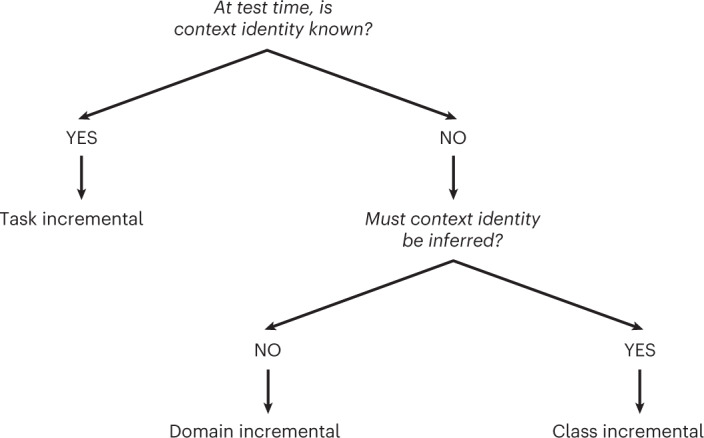
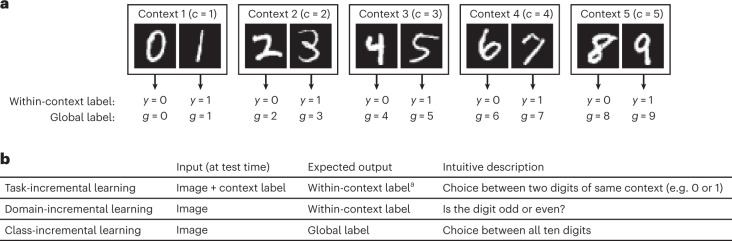
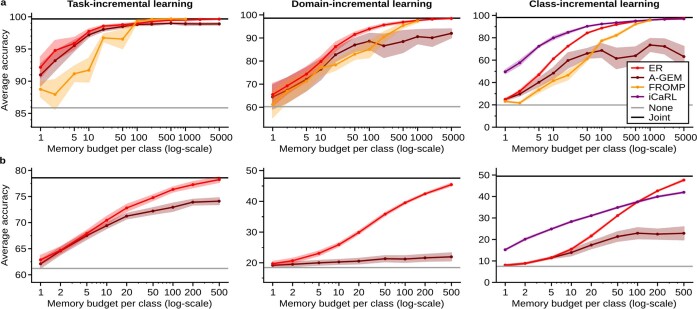
Incrementally learning new information from a non-stationary stream of data, referred to as ‘continual learning’, is a key feature of natural intelligence, but a challenging problem for deep neural networks. In recent years, numerous deep learning methods for continual learning have been proposed, but comparing their performances is difficult due to the lack of a common framework. To help address this, we describe three fundamental types, or ‘scenarios’, of continual learning: task-incremental, domain-incremental and class-incremental learning. Each of these scenarios has its own set of challenges. To illustrate this, we provide a comprehensive empirical comparison of currently used continual learning strategies, by performing the Split MNIST and Split CIFAR-100 protocols according to each scenario. We demonstrate substantial differences between the three scenarios in terms of difficulty and in terms of the effectiveness of different strategies. The proposed categorization aims to structure the continual learning field, by forming a key foundation for clearly defining benchmark problems.
Overview
The claims and statistics of this paper haven’t been checked yet.
Free: it reads the open-access text and checks the first 5 claims that cite a source we can check. Create a free account to check every claim.
Integrity signals
Registry
Cites
Statistics
Figures

Verification
Claims the paper makes
The claims and statistics of this paper haven’t been checked yet.
Free: it reads the open-access text and checks the first 5 claims that cite a source we can check. Create a free account to check every claim.
Claims other papers make about this one
Each is checked against this paper’s own text: does it say what the citing paper says it does?
The cited source says what the claim attributes to it.
In the citing paper
“To avert catastrophic forgetting, various algorithms[11, 48, 49] employ task-specific components or design separate networks for each task.”
From Few-Shot Class-Incremental Learning for Classification and Object Detection: A Survey (2025) · cites this paper as [11]
The cited source says what the claim attributes to it.
In the citing paper
“DIL is an ML problem designed to continuously adapt to data distribution from different domains while the structure of the problem is always the same [11].”
From Few-Shot Class-Incremental Learning for Classification and Object Detection: A Survey (2025) · cites this paper as [11]
The cited source says what the claim attributes to it.
In the citing paper
“TIL's primary challenge lies in identifying shared features across tasks to balance performance and computational complexity, using knowledge from one task to enhance performance in others [11].”
From Few-Shot Class-Incremental Learning for Classification and Object Detection: A Survey (2025) · cites this paper as [11]
Self-check
Percentages, sums and reported differences re-computed from the paper’s own numbers.
The self-check needs the paper’s full text.
Citations
Cites
Adam: A Method for Stochastic Optimization
Kingma, D. P., & Ba, J. (2014) · arXiv · doi:10.48550/arxiv.1412.6980 · Cited by 98,946
Gradient-based learning applied to document recognition
Lecun, Y., Bottou, L., Bengio, Y., & Haffner, P. (1998) · Proceedings of the IEEE · doi:10.1109/5.726791 · Cited by 58,805 · cited 1×
“For the Split MNIST protocol, the MNIST dataset 66 was split into five contexts, such that each context contained two digits.”
Auto-Encoding Variational Bayes
Kingma, D. P., & Welling, M. (2013) · arXiv · doi:10.48550/arxiv.1312.6114 · Cited by 20,067
Distilling the Knowledge in a Neural Network
Hinton, G., Vinyals, O., & Dean, J. (2015) · arXiv · doi:10.48550/arxiv.1503.02531 · Cited by 14,204
(2017) · Cited by 11,625
Overcoming catastrophic forgetting in neural networks
Kirkpatrick, J., Pascanu, R., Rabinowitz, N., Veness, J., Desjardins, G., Rusu, A. A., Milan, K., Quan, J., Ramalho, T., Grabska-Barwinska, A., et al. (2017) · Proceedings of the National Academy of Sciences · doi:10.1073/pnas.1611835114 · Cited by 7,899 · cited 9×
“A few years ago this scenario was regularly studied with Permuted MNIST 31,49,61 , but this protocol is not often used any-more as it is considered too artificial.”
InfluentialLi, Z., & Hoiem, D. (2018) · IEEE Transactions on Pattern Analysis and Machine Intelligence · doi:10.1109/tpami.2017.2773081 · Cited by 4,202
iCaRL: Incremental Classifier and Representation Learning
Rebuffi, S.-A., Kolesnikov, A., Sperl, G., & Lampert, C. H. (2017) · 2017 IEEE Conference on Computer Vision and Pattern Recognition (CVPR) · doi:10.1109/cvpr.2017.587 · Cited by 3,988
Catastrophic Interference in Connectionist Networks: The Sequential Learning Problem
McCloskey, M., & Cohen, N. J. (1989) · Psychology of Learning and Motivation · doi:10.1016/s0079-7421(08)60536-8 · Cited by 3,770
Catastrophic forgetting in connectionist networks
French, R. (1999) · Trends in Cognitive Sciences · doi:10.1016/s1364-6613(99)01294-2 · Cited by 2,311 · cited 16×
“During training on context K , the regularization term of FROMP was given by: with τ a hyperparameter controlling the regularization strength (which was set based on a grid search, see Supplementary Note 8) and ̂ θ ∗ the parameter vector with values as they were at the end of training on context K − 1.”
Influential
Research works printed but not linked: 16
- Chen Z Liu B Lifelong machine learning Synth. Lect. Artif. Intell. Mach. Learn. 2018 12 1 207
- Mundt, M., Lang, S., Delfosse, Q. & Kersting, K. CLEVA-compass: A continual learning evaluation assessment compass to promote research transparency and comparability. In International Conference on Learning Representations (2022).
- Ruvolo, P. & Eaton, E. ELLA: An efficient lifelong learning algorithm. In International Conference on Machine Learning 507–515 (PMLR, 2013).
- Ramesh, R. & Chaudhari, P. Model Zoo: A growing brain that learns continually. In International Conference on Learning Representations (2022).
- Lopez-Paz, D. & Ranzato, M. Gradient episodic memory for continual learning. In Advances in Neural Information Processing Systems Vol. 30, 6470–6479 (2017).
- Mirza, M. J., Masana, M., Possegger, H. & Bischof, H. An efficient domain-incremental learning approach to drive in all weather conditions. In Proceedings of the IEEE/CVF Conference on Computer Vision and Pattern Recognition (CVPR) Workshops 3001–3011 (2022).
- von Oswald, J., Henning, C., Sacramento, J. & Grewe, B. F. Continual learning with hypernetworks. In International Conference on Learning Representations (2020).
- Shin, H., Lee, J. K., Kim, J. & Kim, J. Continual learning with deep generative replay. In Advances in Neural Information Processing Systems Vol. 30, 2994–3003 (2017).
- Caccia, L., Belilovsky, E., Caccia, M. & Pineau, J. Online learned continual compression with adaptive quantization modules. In International Conference on Machine Learning 1240–1250 (PMLR, 2020).
- Lee, S., Ha, J., Zhang, D. & Kim, G.A neural dirichlet process mixture model for task-free continual learning. In International Conference on Learning Representations (2020).
- Jin, X., Sadhu, A., Du, J. & Ren, X. Gradient-based editing of memory examples for online task-free continual learning. In Advances in Neural Information Processing Systems Vol. 34, 29193–29205 (2021).
- Rolnick, D., Ahuja, A., Schwarz, J., Lillicrap, T. & Wayne, G. Experience replay for continual learning. In Advances in Neural Information Processing Systems Vol. 32 (2019).
- Aljundi, R. et al. Online continual learning with maximally interfered retrieval. In Advances in Neural Information Processing Systems Vol. 32 (2019). · DOI · Paper page
- Hess, T., Mundt, M., Pliushch, I. & Ramesh, V. A procedural world generation framework for systematic evaluation of continual learning. In Thirty-fifth Conference on Neural Information Processing Systems, Datasets and Benchmarks Track (2021).
- Ioffe, S. & Szegedy, C. Batch normalization: Accelerating deep network training by reducing internal covariate shift. In International Conference on Machine Learning 448–456 (PMLR, 2015).
- Rezende, D. & Mohamed, S. Variational inference with normalizing flows. In International Conference on Machine Learning 1530–1538 (PMLR, 2015).
Cited by
Items 401–500 of 770
Recall-Oriented Continual Learning with Generative Adversarial Meta-Model
Kang, H., & Choi, D.-W. (2024) · Proceedings of the AAAI Conference on Artificial Intelligence · doi:10.1609/aaai.v38i12.29202 · Cited by 3
Interpretability Index Based on Balanced Volumes for Transparent Models and Agnostic Explainers
Leite, D. F., Sharma, A., Demir, C., & Ngomo, A.-C. N. (2024) · IEEE International Conference on Fuzzy Systems (FUZZ-IEEE) · doi:10.1109/fuzz-ieee60900.2024.10611937 · Cited by 2
“Currently, the key concerns in learning from data streams [17] [18] are: ( i ) sustaining or enhancing prediction accuracy over time, even in the face of concept drifts and shifts [19]; and ( ii ) ensuring model interpretability or providing subsequent explainability [5].”
BackgroundOkawa, Y., Kanoga, S., Hoshino, T., & Ishikawa, S.-N. (2024) · Advanced Biomedical Engineering · doi:10.14326/abe.13.363 · Cited by 2
CL-MASR: A Continual Learning Benchmark for Multilingual ASRPreprint
Libera, L. D., Mousavi, P., Zaiem, S., Subakan, C., & Ravanelli, M. (2023) · doi:10.36227/techrxiv.24430876.v1 · Cited by 4
Forklift: An Extensible Neural LifterPreprint
Armengol-Estapé, J., Rocha, R. C. O., Woodruff, J., Minervini, P., & O’boyle, M. F. P. (2024) · arXiv (Cornell University) · doi:10.48550/arxiv.2404.16041 · Cited by 2
“In incremental learning (van de Ven et al., 2022; Wang et al., 2024) settings, the machine learning system is explicitly designed to incrementally support new tasks, classification tasks, or domains as the system requirements are updated.”
BackgroundRegulação da inteligência artificial na saúde
Dourado, D. D. A. (2024) · Digital Library of Theses and Dissertations (Universidade de São Paulo) · doi:10.11606/t.5.2024.tde-23042024-111255 · Cited by 11
How to descend a rocky slope : numerical techniques for the solution of noisy optimization problems
Irwin, B. (2023) · cIRcle (University of British Columbia) · doi:10.14288/1.0436950 · Cited by 3
Self-Attention-Based Contextual Modulation Improves Neural System Identification
Lin, I. Z., Wang, T., Gao, S., Tang, S., & Lee, T. S. (2025) · International Conference on Learning Representations · doi:10.48550/arxiv.2406.07843 · Cited by 3
“…context of neural prediction, the underlying assumption is that the closer a model can replicate the neural computation mechanisms responsible for a real neuron’s response, the more accurate the model’s predictive capabilities become (Pogoncheff et al., 2023; Willeke et al., 2023; Li et al., 2019).”
From Order to Distribution: An Exact Operator Framework for Forgetting in Continual LearningPreprint
Xu, Z., & Ma, X. (2026) · arXiv (Cornell University) · doi:10.48550/arxiv.2604.13460 · Cited by 3
“Catastrophic forgetting has been widely studied across task, domain, and class-incremental continual learning settings; broad overviews appear in Parisi et al. [2019], Delange et al. [2022], Wang et al. [2024], van de Ven et al. [2022], Mai et al. [2022].”
Dynamic Mixture of Latent Memories for Self-Evolving AgentsPreprint
Yu, D., Zhang, V., Wang, H., Chen, Y., Hu, M., Xu, W., Chen, S., Torr, P., Yin, Z., & King, I. (2026) · arXiv (Cornell University) · doi:10.48550/arxiv.2605.21951 · Cited by 2
“We consider the domain-incremental learning setting [21] in its more realistic, task-ID-agnostic form: the task identity is not provided at inference time, and the model must operate without an external task label.”
Recent Advances in Class-Incremental Learning
Yang, D., Zheng, M., Wang, W., Li, S., & Liu, Y. (2023) · Lecture notes in computer science · doi:10.1007/978-3-031-46308-2_18 · Cited by 3
Towards Low-resource Language Generation with Limited Supervision
Maurya, K. K., & Desarkar, M. S. (2023) · doi:10.18653/v1/2023.bigpicture-1.7 · Cited by 1
Enhanced Experience Replay for Class Incremental Continual Learning
Hao, J., Phung, S. L., Di, Y., Le, H. T., & Bouzerdoum, A. (2023) · International Conference on Digital Image Computing: Techniques and Applications (DICTA) · doi:10.1109/dicta60407.2023.00043 · Cited by 1
“Based on the evolution of data aspects and their correlation with the learnable function, Gido et al. [27] classified CL into three categories, including Task Incremental Learning (Task-IL), Class Incremental Learning (Class-IL), and Domain Incremental Learning (Domain-IL).”
MethodShahin, A. (2024) · International Conference on Artificial Intelligence, Computer, Data Sciences and Applications (ACDSA) · doi:10.1109/acdsa59508.2024.10467896 · Cited by 1
“However, they can be concluded in three main types: task-IL, domain-IL, and class-IL [17].”
BackgroundRealistic continual learning approach using pre-trained models
Nasri, N., Gutiérrez-Álvarez, C., Lafuente-Arroyo, S., Maldonado-Bascón, S., & López-Sastre, R. J. (2026) · Journal of Visual Communication and Image Representation · doi:10.1016/j.jvcir.2026.104970 · Cited by 1
A Novel Sleep Mechanism Inspired Continual Learning Algorithm
Han, Y., Li, X., Jia, T., Wang, Q., Fan, C., & Wu, X. (2024) · Guidance Navigation and Control · doi:10.1142/s2737480724410036 · Cited by 2
Comparing Incremental Learning Approaches for a Growing Sign Language Dictionary
Huamani-Malca, J., & Bejarano, G. (2024) · Communications in computer and information science · doi:10.1007/978-3-031-63616-5_7 · Cited by 3
Dynamic Continual Learning: Harnessing Parameter Uncertainty for Improved Network Adaptation
Angelini, C. F., & Bouaynaya, N. C. (2024) · International Joint Conference on Neural Networks (IJCNN) · doi:10.1109/ijcnn60899.2024.10650205 · Cited by 1
U-Tell: Unsupervised Task Expert Lifelong Learning
Solomon, I., Aung, A. P. P., Kumar, U., & Senthilnath, J. (2024) · Proceedings - International Conference on Image Processing · doi:10.1109/icip51287.2024.10647977 · Cited by 4
Exploring Wearable Emotion Recognition with Transformer-Based Continual Learning
Rizza, F., Bellitto, G., Calcagno, S., & Palazzo, S. (2024) · Lecture notes in computer science · doi:10.1007/978-3-031-73483-0_8 · Cited by 1
Incremental Object 6D Pose Estimation
Tian, L., Sorrenti, A., Pang, Y. L., Bellitto, G., Palazzo, S., Spampinato, C., & Oh, C. (2024) · Lecture notes in computer science · doi:10.1007/978-3-031-78395-1_22 · Cited by 1
Continual Developmental Neurosimulation Using Embodied Computational Agents
Alicea, B., Chakrabarty, R., Dvoretskii, S., Gopiiswaminathan, A., Lim, A., & Parent, J. (2024) · IOP Conference Series Materials Science and Engineering · doi:10.1088/1757-899x/1321/1/012013 · Cited by 8
“In both cases, plasticity and regeneration on a late developmental network can play a role consistent with these strategies.”
de Aguiar, E. J., Traina, A. J. M., & Helal, S. (2024) · IEEE International Conference on Big Data (BigData) · doi:10.1109/bigdata62323.2024.10826044 · Cited by 1
“This includes strategies for injecting backdoors, defending against attacks on FL clients’ datasets, and assessing the long-term vulnerability of models to these threats [2].”
InfluentialTong, 朱. Z., Haimiao, 张. Z., & Jun, 邱. Q. (2024) · Laser & Optoelectronics Progress · doi:10.3788/lop241031 · Cited by 1
Rahman, M. M., & Mamun, Q. (2024) · IEEE International Conference on Future Machine Learning and Data Science (FMLDS) · doi:10.1109/fmlds63805.2024.00033 · Cited by 2
Ströbel, R., Kader, H., Hutt, L., Zhou, H., Mau, M., Puchta, A., Noack, B., & Fleischer, J. (2025) · Zeitschrift für wirtschaftlichen Fabrikbetrieb · doi:10.1515/zwf-2024-0154 · Cited by 1
Open-World Class Incremental Learning with Adaptive Threshold
Luo, H. (2025) · Jisuanji shenghuojia. · doi:10.54097/e3fv8w77 · Cited by 1
Li, W., Shao, J., Shi, P. A., Li, S., & Yu, H. (2025) · IEEE Journal of Biomedical and Health Informatics · doi:10.1109/jbhi.2025.3567713 · Cited by 2
“This progressive strategy promotes incremental knowledge transfer and enables effective multi-source domain adaptation [26], [27].”
Nasim, A., Khan, S. M., Salam, A. A., Shaukat, A., Hassan, T., Syed, A. M., & Akram, M. U. (2025) · IEEE Access · doi:10.1109/access.2025.3574919 · Cited by 1
“Class incremental learning is by far most complex type of incremental learning due to its ability to learn new classes in every step [24].”
Implications From the Analogous Relationship Between Evolutionary and Learning Processes
Leong, J. C. K., Imaizumi, M., Innan, H., & Irie, N. (2025) · BioEssays · doi:10.1002/bies.70027 · Cited by 1
“Although it was once thought of as a difficult task in machine learning becauseoldermodelsoftenforgetpreviouslylearnedtasksrapidly when being trained to learn new tasks [66], emerging strategies have started to provide promising solutions to overcome this difficulty [67, 68].”
Tan, H., Loo, C. K., & Seng, W. C. (2025) · IEEE Access · doi:10.1109/access.2025.3578358 · Cited by 1
An attention-based knowledge fusion dual-stream network for intelligent machinery fault diagnosis
Bai, Y., Jiang, H., Zeng, T., & Wang, X. (2025) · Measurement Science and Technology · doi:10.1088/1361-6501/ade554 · Cited by 1
Sample Difficulty-Aware Pre-trained Models for Class-Incremental Learning
Li, S. X., Xu, S. J., Wu, S., Wu, X., & Niu, X. (2025) · Communications in computer and information science · doi:10.1007/978-981-96-6969-1_14 · Cited by 1
CrossACL: Analytic Continual Learning via Feature Cross for Hyperspectral Image Classification
Yan, Y., Ji, J., Cheng, Y., Liu, Y., Xiong, P., & Zhuang, H. (2025) · IEEE Geoscience and Remote Sensing Letters · doi:10.1109/lgrs.2025.3587593 · Cited by 1
“CrossACL focuses on class-incremental learning (CIL) [15] but is also suitable for other continual learning scenarios with the help of the GACL techniques [16].”
Devi, S. P., & Kotecha, R. (2025) · OPJU International Technology Conference on Smart Computing for Innovation and Advancement in Industry (OTCON) · doi:10.1109/otcon65728.2025.11070622 · Cited by 1
“Gradient Episodic Memory (GEM) updates the model while ensuring that the optimization step aligns with constraints derived from gradients of past tasks [41-45].”
An incremental recognition method of hypersonic targets based on radiation spectral features
Qiang, P. A. N., Shi, L., Li, F., Yao, B., Du, Y., Wang, S., & Chen, Z. (2025) · Chinese Journal of Aeronautics · doi:10.1016/j.cja.2025.103740 · Cited by 1
Class Incremental Learning for Algorithm Selection
Nemeth, M. B., Hart, E., Sim, K., & Renau, Q. (2025) · Genetic and Evolutionary Computation Conference Companion (GECCO Companion) · doi:10.1145/3712255.3726623 · Cited by 1
Continual Crater Detection With Similarity Distillation
Yang, S., Guo, Y., & Cai, Z. (2025) · IEEE Transactions on Geoscience and Remote Sensing · doi:10.1109/tgrs.2025.3601399 · Cited by 1
“Consequently, a model capable of continual learning from multiple datasets is crucial [6].”
Khazaei, E., & Hatzinakos, D. (2025) · IEEE/CVF Conference on Computer Vision and Pattern Recognition Workshops (CVPRW) · doi:10.1109/cvprw67362.2025.00167 · Cited by 2
“CL can be categorized into different types [30], such as task incremental learning, where each task comes with a unique identifier, making it easier to distinguish among tasks; domain incremental learning, where the same set of classes is observed across different domains; and class incremental…”
A supervised learning approach to dynamic weighted fusion in multi-source ordered decision systems
Zhang, X., & Lin, J. (2025) · Knowledge-Based Systems · doi:10.1016/j.knosys.2025.114485 · Cited by 1
FDA’s PCCP: Opportunities and Gaps
Babendererde, N., Ranem, A., Fuchs, M., González, C., Krumb, H., & Mukhopadhyay, A. (2025) · Lecture notes in computer science · doi:10.1007/978-3-032-05663-4_6 · Cited by 1
Universal Computational Super-Resolution Framework for Imaging of Quantum Dots
Vašinka, D., Lee, J., Stalker, C., Mitryakhin, V. N., Solovev, I. A., Stephan, S., Höfling, S., Eilenberger, F. X., Tongay, S. A., Schneider, C., et al. (2026) · ACS Nanoscience Au · doi:10.1021/acsnanoscienceau.5c00198 · Cited by 1
The Unreasonable Effectiveness of Randomized Representations in Online Continual Graph Learning
Donghi, G., Zambon, D., Pasa, L., Alippi, C., & Navarin, N. (2026) · Machine Learning · doi:10.1007/s10994-026-07128-5 · Cited by 1
“Fixed feature extraction for CL Some works in the CL literature for image classification suggest the use of a frozen CNN backbone, pre-trained on a different dataset, and then training continually only a classifier such a simple MLP (Van De Ven et al., 2022; Mehta et al., 2023).”
Convergent multi-modular architecturefor adaptive learning in Drosophila and artificial intelligence
Wang, L., & Li, Q. (2025) · iScience · doi:10.1016/j.isci.2025.113799 · Cited by 3
Hierarchical incremental learning deciphers molecular arrangements in multi-component materials
Zhang, H., Lin, N., Evans, A. M., Wang, T., Pratik, S. M., Brédas, J., & Li, H. (2025) · Nature Communications · doi:10.1038/s41467-025-64372-4 · Cited by 1
“Here,weproposetoadoptanincrementallearning 46 methodologyand feedthesedatasetssequentiallyintoamodelthatlearnsthefeaturesin a step-wise manner.”
Balanced Contrast Class‐Incremental Learning
Yu, S., Lin, L., & Yu, Y. (2025) · CAAI Transactions on Intelligence Technology · doi:10.1049/cit2.70060 · Cited by 1
Lifelong Learning for Fault Prognostics in Predictive Maintenance with Bayesian Neural Networks
Xuan, Q. L., Munderloh, M., & Östermann, J. (2025) · IEEE International Conference on Software Quality, Reliability and Security Companion (QRS-C) · doi:10.1109/qrs-c65679.2025.00066 · Cited by 1
Class-Weighted Prompting for rehearsal-free class-incremental learning
Ma, H., Wang, S., Wei, F., Sun, Y., & Yin, B. (2025) · Displays · doi:10.1016/j.displa.2025.103274 · Cited by 1
Zeng, W., Zhang, Y., Yi, G., Zhang, S., Wang, Z., Ji, Y., & Wang, H. (2025) · Concurrency and Computation Practice and Experience · doi:10.1002/cpe.70406 · Cited by 1
An optimized incremental learning strategy for efficient intrusion detection
Arun, K., Aji, S., & Data, M. (2025) · Peer-to-Peer Networking and Applications · doi:10.1007/s12083-025-02153-y · Cited by 2
Incremental 2D self-labelling for effective 3D medical volume segmentation with minimal annotations
Anderson, M., Habib, M., STEEL, D. H., & Obara, B. (2025) · BMC Medical Imaging · doi:10.1186/s12880-025-01991-9 · Cited by 1
“Incremental learning involves acquiring knowledge or skills step by step while building on existing knowledge and is a key feature of natural intelligence [17].”
Alex, A. R., Subramanian, M., R, J. J., T, K. T. T. K., & Mukherjee, T. (2025) · Edelweiss Applied Science and Technology · doi:10.55214/2576-8484.v9i11.10905 · Cited by 1
Scalable Object Detection in Mixed Reality Using Incremental Re-Training and One-Shot 3D Annotation
Taheritajar, A., Benson, J., Gibson, A., Wilburn, B., Zhao, J. L., & Orlosky, J. (2025) · Proceedings - International Symposium on Mixed and Augmented Reality, ISMAR · doi:10.1109/ismar67309.2025.00040 · Cited by 1
A Transfer Learning-Driven Methodology for Efficient and Sustainable Indoor Localization Using VLC
Jan, M., Njima, W., Zhang, X., & Artemenko, A. (2025) · IEEE Internet of Things Journal · doi:10.1109/jiot.2025.3633511 · Cited by 1
“Recent surveys, such as [44], provide empirical evaluations and categorization frameworks for CL strategies.”
Exploring Cross-Stage Adversarial Transferability in Class-Incremental Continual Learning
Kim, J., & Lee, J. (2025) · IEEE International Workshop on Multimedia Signal Processing (MMSP) · doi:10.1109/mmsp64401.2025.11324099 · Cited by 1
A Theoretical Perspective on Streaming Noisy Data With Distribution Shift
Luo, W., Chen, S., Zhou, T., & Gong, C. (2025) · IEEE Transactions on Pattern Analysis and Machine Intelligence · doi:10.1109/tpami.2025.3643174 · Cited by 3
“Existing continual learning methods can be roughly classi-fied into three categories, namely regularization-based methods, optimization-based methods, and replay-based methods [12], [43].”
AugGen: a generative framework for continual generalized zero-shot learning
Han, N., Chen, H., Chen, B., Zhang, L., Huang, Y., Luo, Q., & Fang, X. (2025) · Neurocomputing · doi:10.1016/j.neucom.2025.132187 · Cited by 1
Yang, L., Tan, Y., Liang, L., Xu, H., Wu, T., Huang, Z., Li, X., & Tang, Y. (2025) · Expert Systems with Applications · doi:10.1016/j.eswa.2025.130911 · Cited by 2
Towards Adaptive Network Defense: A Self-evolving Threat Detection Framework
Guo, C., & Zhang, D. (2026) · Lecture notes in computer science · doi:10.1007/978-981-95-6203-9_16 · Cited by 1
MixTTE: Multi-Level Mixture-of-Experts for Scalable and Adaptive Travel Time Estimation
Jiang, W., Han, J., Han, R., & Liu, H. (2026) · ACM SIGKDD Conference on Knowledge Discovery and Data Mining (KDD) · doi:10.1145/3770854.3783940 · Cited by 2
Key-value pair-free continual learner via task-specific prompt-prototype
Luo, H., Ran, X., Li, Z., Xue, H., Jiang, T., Shen, J., Kärkkäinen, T., Xu, Q., & Cong, F. (2026) · Neural Networks · doi:10.1016/j.neunet.2026.108576 · Cited by 2
“Moreover, unlike Task-Incremental Learning (TIL) and Domain-Incremental Learning (DIL), in CIL the task id is unknown during testing, and the model needs to directly infer the class to which the data belongs, making it more closely aligned with real-world scenarios (Ven et al., 2022).”
NetTTT: Online Self-Adaptation Inference via Test-Time Training for Encrypted Traffic Classification
Liu, L., Song, X., Hu, N., Gu, Z., Tian, Z., & Jia, Y. (2026) · IEEE Internet of Things Journal · doi:10.1109/jiot.2026.3652996 · Cited by 1
“Although incremental learning [34] and domain adaptation techniques [35] have been proposed to address this challenge, they typically require labeled data or full-model updates, which are impractical for real-time adaptation.”
Zhang, A., Chen, Z., Wang, H., Wang, D., & Zhang, Y. (2026) · Additive Manufacturing Frontiers · doi:10.1016/j.amf.2026.200300 · Cited by 1
Wang, S., Wei, F., Ma, H., Sun, Y., & Yin, B. (2026) · ACM Transactions on Multimedia Computing Communications and Applications · doi:10.1145/3787858 · Cited by 1
Adiabatic Reinforcement Learning
Osinenko, P., Yaremenko, G., Belov, D., & Gepperth, A. (2025) · International Conference on Advanced Robotics · doi:10.1109/icar65334.2025.11338705
Prewired static visual receptive fields for environment-agnostic perception
Kang, M., Baek, S., & Paik, S.-B. (2026) · Patterns · doi:10.1016/j.patter.2025.101475 · Cited by 1
“5,6 When presented with data from a new distribution, DNNs frequently fail to recognize previously learned objects, resulting in a significant loss of performance 5,7,8 (Figure 1B, bottom).”
Self-Adaptive PV Power Forecasting with PROCEED-Informer Under PV Capacity Loss Scenarios
Jiang, K., Li, Y., Zhao, Y., Guo, Y., Liu, S., & Li, W. (2025) · IEEE International Conference on Energy Technologies for Future Grids (ETFG) · doi:10.1109/etfg61999.2025.11402620 · Cited by 1
“These methods enable models to continuously adapt to evolving data distributions while avoiding the cost of full retraining [12].”
InfluentialUnified adversarial learning framework for incremental malware classification
Tariq, M. A., Sargano, A. B., & Habib, Z. (2026) · Journal of Computer Virology and Hacking Techniques · doi:10.1007/s11416-026-00609-0 · Cited by 1
Prototype distance ratio sampling for generalised few shot object detection
Lekkas, A., Roper, M., & Abel, A. K. (2026) · Pattern Recognition Letters · doi:10.1016/j.patrec.2026.03.014 · Cited by 1
Ambiguity of Nonverbal Signals
Johnson, D., & Tchappi, I. (2025) · Springer eBooks · doi:10.1007/978-981-96-5290-7_21 · Cited by 1
Multi-Label Incremental Learning for State Prediction of Actuator Devices in Smart Homes
Oliveira, M. D. S., da Silva, E. F., Boaventura, D. R. D., Pires, J. M., Copque, I. S., da Silva, D. C., Rios, R., Machado, I., Prazeres, C. V. S., Peixoto, M. L. M., et al. (2026) · IEEE Open Journal of the Computer Society · doi:10.1109/ojcs.2026.3675959 · Cited by 1
“When trained on new tasks or changing data distributions, traditional deep learning models commonly lose previously acquired knowledge, a phenomenon known as catastrophic forgetting [15].”
Yang, Y., Yi, C., Zhu, H., Gong, S., Kang, J., & Niyato, D. T. (2026) · IEEE Transactions on Mobile Computing · doi:10.1109/tmc.2026.3677210 · Cited by 2
“…behavior observed in practical DT models [43], [44], together with the weight regularization method in existing continual learning studies [45], [46], ε n,k ( t ) and σ n,k ( t ) can be measured by the quadratic form of the biases, i.e., where θ n,j ( t ) ∈ [0 , 1] stands for the current…”
Yanni, G. S., Rashad, H. S., & Maghraby, F. A. (2026) · Data Mining and Knowledge Discovery · doi:10.1007/s10618-026-01191-1 · Cited by 1
“An incremental learning approach—also referred to as continual learning (van de Ven et al. 2022 )—involves a continuous process of model adaptation as new data becomes available.”
Li, Y., & Chen, T. (2026) · Food Control · doi:10.1016/j.foodcont.2026.112191 · Cited by 1
Pirhadi, F., Seifi, H., & Delkhosh, H. (2026) · Computers & Electrical Engineering · doi:10.1016/j.compeleceng.2026.111167 · Cited by 1
Liu, Y., Po, L.-M., Hung, F., Wang, Z., Wu, H., Jiang, Z., Li, K., Xu, X., & Cheung, K.-W. (2026) · Pattern Recognition · doi:10.1016/j.patcog.2026.113782 · Cited by 2
Dynamic grey box modeling of decanter centrifuges via continual learning
Zhai, O., Reppich, H. R., Nirschl, H., & Gleiß, M. (2026) · Separation and Purification Technology · doi:10.1016/j.seppur.2026.137951 · Cited by 1
ilLog: Incremental Learning Based Anomaly Detection From Evolving System Logs
Tian, J., Li, M., Wang, Z., Chen, L., Qin, J., & Gan, J. (2026) · IEEE Transactions on Dependable and Secure Computing · doi:10.1109/tdsc.2026.3690744 · Cited by 1
“Incremental learning is capable of processing continuous streams of information, retaining and integrating prior knowledge while absorbing new knowledge [37].”
Toward Energy Efficiency in O-RAN: A Digital Twin for Carbon-Aware 6G Networks
Ak, E., Canberk, B., Shin, H., & Duong, T. Q. (2026) · IEEE Communications Magazine · doi:10.1109/mcom.001.2500687 · Cited by 1
Log-based anomaly detection for evolving software: An incremental deep-learning approach
Wei, X., Sun, C., Zhang, X., & Towey, D. (2026) · Information and Software Technology · doi:10.1016/j.infsof.2026.108199 · Cited by 1
AFCL-CSC: Asynchronous Federated Continual Learning with Client–Server Cooperative optimization
He, D., Bao, W., Wang, J., Zhong, Z., Zhang, X., He, J., & Dong, C. (2026) · Displays · doi:10.1016/j.displa.2026.103554 · Cited by 1
Demrozi, F. (2026) · IEEE Access · doi:10.1109/access.2026.3699033 · Cited by 1
“Continual learning [19], [20], incremental learning [21], [22], [23], and online learning [24] are among the most widely studied approaches for enabling such adaptive behavior in machine learning systems.”
Quyen, N. H., Pham, V.-H., & Duy, P. T. (2026) · Expert Systems with Applications · doi:10.1016/j.eswa.2026.133417 · Cited by 1
Liu, S., Jin, X., Bai, Y., Yu, X., & Liu, Y. (2026) · Artificial Intelligence in Agriculture · doi:10.1016/j.aiia.2026.06.006 · Cited by 2
Tunable band-stop photodetection with machine learning-enabled broadband spectral adaptation
Yu, H., Lian, Y., Jia, S., Ma, W., Fu, J., Liu, X., Zhu, X., Zhang, L., Han, T., Lan, C., et al. (2026) · Nature Sensors · doi:10.1038/s44460-026-00098-0 · Cited by 1
“25).”
Holographic Beamforming for Semantic Communication
Zeng, S., Zhang, H., Wang, S., Di, B., Zhang, H., Han, Z., Poor, H. V., & Song, L. (2026) · IEEE Transactions on Wireless Communications · doi:10.1109/twc.2026.3707475 · Cited by 2
“2) Semantic Importance Acquisition: In this paper, we focus on the class of objects, an important type of semantic features [18], and the semantic importance of a subfigure is characterized by the number of pixels l ( k ) j within the sub-image whose classes belong to the set C of desired classes,…”
Jia, C., Tang, J., & Shen, J. (2026) · Measurement · doi:10.1016/j.measurement.2026.122456 · Cited by 1
Li, J., Wang, Y., Zhao, A., Yan, H., Gu, Z., & Jia, Y. (2026) · IEEE Internet of Things Journal · doi:10.1109/jiot.2026.3710860 · Cited by 2
“IL methods are primarily used to address distribution shift and concept drift problems in real-world IoT scenarios. van de Ven et al. [69] divided IL into three types, and Wang et al. [70] conducted a comprehensive review about the theory, meth-ods, and applications of IL. Shi and Tan [71] proposed…”
Khan, A. B., Zhang, Y., Zhang, R., Dong, Z. Y., Sun, Y., & Ambia, M. N. (2026) · Applied Energy · doi:10.1016/j.apenergy.2026.128346 · Cited by 1
Developing an open-source and Europe-wide wind power forecasting platform
Peters, A., Pinson, P., Banovic, O., Bouchkati, S., & Ulbig, A. (2026) · Electric Power Systems Research · doi:10.1016/j.epsr.2026.113733 · Cited by 1
Fault diagnosis in incremental learning: an overview of technologies and industrial practices
Zhang, C., Li, C., & Guo, Z. (2026) · Computing · doi:10.1007/s00607-026-01725-x · Cited by 1
Evolving Dictionary Representation for Few-Shot Class-Incremental Learning
Xue-jun, H., & Guo, Y. (2023) · Frontiers in artificial intelligence and applications · doi:10.3233/faia230370 · Cited by 1
Object Detection Method for Autonomous Vehicles in Adverse Weather
Su, H., Wang, X., Gao, H., & Zheng, X. (2023) · IEEE International Conference on Unmanned Systems (ICUS) · doi:10.1109/icus58632.2023.10318422 · Cited by 2
“Domain-IL requires the algorithm to learn the same class of problems in the context of domain shifts [15] (where the input distribution changes).”
MotGen: a closed-loop bacterial motility control framework using generative adversarial networks
Seo, B., Lee, D., Jeon, H. J., Ha, J., & Suh, S. (2024) · Bioinformatics · doi:10.1093/bioinformatics/btae170 · Cited by 1
Preliminary exploration of data incremental learning method
Yu, M., Ding, M., Xi, Z., & Huang, T. (2024) · SPIE Medical Imaging: Image Processing · doi:10.1117/12.3005495 · Cited by 1
“In order to establish a unified framework capable of evaluating incremental learning algorithms more efficiently 20,26,27 , Ven et al. have categorized incremental learning into three fundamental types (or "scenarios") 27 : task incremental learning, domain incremental learning, and class…”
BackgroundEfficient Few-Shot Incremental Training for Landmark Recognition
Neuschmied, H., & Bailer, W. (2024) · ACM International Conference on Interactive Media Experiences · doi:10.1145/3672406.3672414 · Cited by 1
Alleviating Catastrophic Forgetting in Facial Expression Recognition with Emotion-Centered Models
Laurensi, I. A., Britto, A. D. S., Barddal, J. P., & Koerich, A. L. (2024) · Lecture notes in computer science · doi:10.1007/978-3-031-78189-6_14 · Cited by 1
Poly Instance Recurrent Neural Network for Real-time Lifelong Learning at the Low-power Edge
Al-Ameen, S., Sudharsan, B., Vijayakumar, T., Szydło, T., Shah, T., & Ranjan, R. K. (2024) · IEEE International Conference on Big Data (BigData) · doi:10.1109/bigdata62323.2024.10825026 · Cited by 2
Continual learning of conjugated visual representations through higher-order motion flows
Marullo, S., Tiezzi, M., Gori, M., & Melacci, S. (2025) · Neural Networks · doi:10.1016/j.neunet.2025.107296 · Cited by 1
Improving Rumor Detection Performance by Using Bias Attributes
Shi, D., & Zeng, J. (2025) · IEEE Transactions on Computational Social Systems · doi:10.1109/tcss.2025.3550170 · Cited by 1
“Techniques such as incremental learning [80] and adaptive sampling [81] can further reduce resource requirements, ensuring the approach remains efficient and sustainable over time.”
Metadata
- Authors
- van de Ven, G. M., Tuytelaars, T., & Tolias, A. S.
- Affiliations
- Baylor College of Medicine (US)
- KU Leuven (BE)
- Corresponding author
- van de Ven, Gido M.
- Venue
- Nature Machine Intelligence
- Published
- 2022-12-05
- Volume
- 4
- Issue
- 12
- Pages
- 1185-1197
- ISSN
- 2522-5839 (ISSN-L)
- PMC
- PMC9771807
- OpenAlex
- W4312210066
- Cited by
- 665
- References
- 43
- Citations by year
- 2026: 173 · 2025: 258 · 2024: 172 · 2023: 60 · 2022: 2
- FWCI
- 40.48
- Type
- journal article
- Language
- en
- Open access
- hybrid
- doi.org
- Licence
- cc-by
- creativecommons.org/licenses/by/4.0 (tdm)
- creativecommons.org/licenses/by/4.0 (vor)
- Locations
- Nature Machine Intelligence (publishedVersion, cc-by)
- PubMed Central (publishedVersion, cc-by)
- PubMed (publishedVersion)
- Lirias (KU Leuven) (submittedVersion, cc-by)
- Rice Research Repository (Rice University) (submittedVersion, cc-by)
- Apollo (University of Cambridge) (submittedVersion, cc-by)
- Apollo
- Funders
- International Brain Research Organization
- National Institutes of Health
- Defense Advanced Research Projects Agency (HR0011, HR0011-18-2-0025)
- Advanced Research Projects Agency
- Intelligence Advanced Research Projects Activity (D16PC00003)
- Interior Business Center
- National Institute of Mental Health (R01MH109556)
- National Eye Institute (P30EY002520)
- H2020 European Research Council (101021347)
- Topics
- Physical Sciences › Computer Science › Artificial Intelligence › Domain Adaptation and Few-Shot Learning
- Physical Sciences › Computer Science › Artificial Intelligence › Data Stream Mining Techniques
- Physical Sciences › Computer Science › Computer Vision and Pattern Recognition › Advanced Neural Network Applications
- Keywords
- continual learning, incremental learning, task-incremental learning, domain-incremental learning, class-incremental learning, catastrophic forgetting, non-stationary data streams, deep neural network
About these checks
Registry, retraction, Cites and statistics results are computed, not judged, with one exception: a printed reference that no index lists is read once by a model before it counts as a citation error. Claims are extracted by a model and kept only when their quote appears verbatim in the text; each cited source is then checked, with a model’s help, for whether it says what the claim relies on. Those verdicts can be wrong — read the claim’s quote and the cited source before relying on one.
Statistics and arithmetic are recomputed, not judged.
Confidence bands are shown only for fields calibrated on our annotated test set. None is calibrated yet, so no band is shown.
What counts as a claim ›How we measure confidence ›How we check this ›
Are you an author, or do you see a problem with this page? Request a review
Data sources
Bibliographic data: Semantic Scholar, OpenAlex, Crossref.
Contains information from the Semantic Scholar Academic Graph Datasets, made available under the ODC Attribution License (ODC-BY 1.0).
Semantic Scholar’s data is described in: Kinney, R., et al. (2023). The Semantic Scholar Open Data Platform. arXiv:2301.10140.
