

Three types of incremental learning
Open accessThe DOI matches its Crossref record; 59 of the 59 references it cites were found in a registry or an index.
Abstract
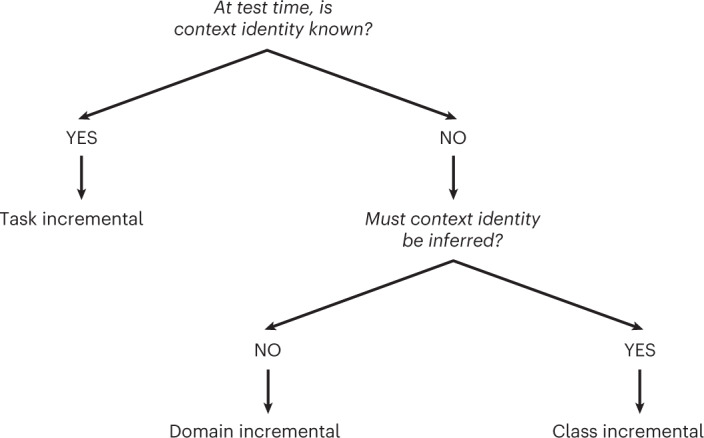
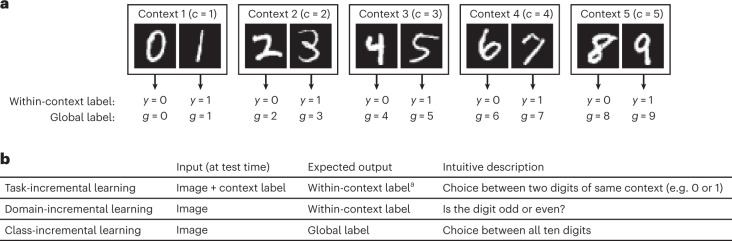
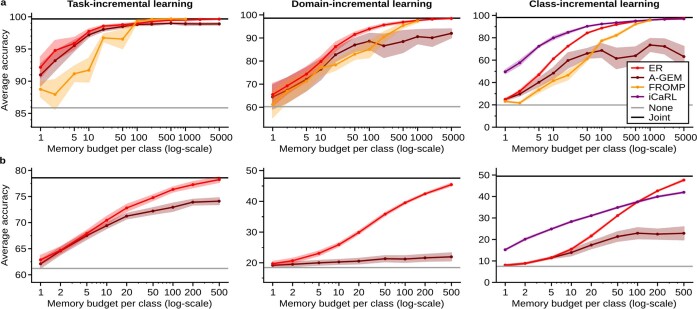
Incrementally learning new information from a non-stationary stream of data, referred to as ‘continual learning’, is a key feature of natural intelligence, but a challenging problem for deep neural networks. In recent years, numerous deep learning methods for continual learning have been proposed, but comparing their performances is difficult due to the lack of a common framework. To help address this, we describe three fundamental types, or ‘scenarios’, of continual learning: task-incremental, domain-incremental and class-incremental learning. Each of these scenarios has its own set of challenges. To illustrate this, we provide a comprehensive empirical comparison of currently used continual learning strategies, by performing the Split MNIST and Split CIFAR-100 protocols according to each scenario. We demonstrate substantial differences between the three scenarios in terms of difficulty and in terms of the effectiveness of different strategies. The proposed categorization aims to structure the continual learning field, by forming a key foundation for clearly defining benchmark problems.
Overview
The claims and statistics of this paper haven’t been checked yet.
Free: it reads the open-access text and checks the first 5 claims that cite a source we can check. Create a free account to check every claim.
Integrity signals
Registry
Cites
Statistics
Figures

Verification
Claims the paper makes
The claims and statistics of this paper haven’t been checked yet.
Free: it reads the open-access text and checks the first 5 claims that cite a source we can check. Create a free account to check every claim.
Claims other papers make about this one
Each is checked against this paper’s own text: does it say what the citing paper says it does?
The cited source says what the claim attributes to it.
In the citing paper
“To avert catastrophic forgetting, various algorithms[11, 48, 49] employ task-specific components or design separate networks for each task.”
From Few-Shot Class-Incremental Learning for Classification and Object Detection: A Survey (2025) · cites this paper as [11]
The cited source says what the claim attributes to it.
In the citing paper
“DIL is an ML problem designed to continuously adapt to data distribution from different domains while the structure of the problem is always the same [11].”
From Few-Shot Class-Incremental Learning for Classification and Object Detection: A Survey (2025) · cites this paper as [11]
The cited source says what the claim attributes to it.
In the citing paper
“TIL's primary challenge lies in identifying shared features across tasks to balance performance and computational complexity, using knowledge from one task to enhance performance in others [11].”
From Few-Shot Class-Incremental Learning for Classification and Object Detection: A Survey (2025) · cites this paper as [11]
Self-check
Percentages, sums and reported differences re-computed from the paper’s own numbers.
The self-check needs the paper’s full text.
Citations
Cites
Adam: A Method for Stochastic Optimization
Kingma, D. P., & Ba, J. (2014) · arXiv · doi:10.48550/arxiv.1412.6980 · Cited by 98,946
Gradient-based learning applied to document recognition
Lecun, Y., Bottou, L., Bengio, Y., & Haffner, P. (1998) · Proceedings of the IEEE · doi:10.1109/5.726791 · Cited by 58,805 · cited 1×
“For the Split MNIST protocol, the MNIST dataset 66 was split into five contexts, such that each context contained two digits.”
Auto-Encoding Variational Bayes
Kingma, D. P., & Welling, M. (2013) · arXiv · doi:10.48550/arxiv.1312.6114 · Cited by 20,067
Distilling the Knowledge in a Neural Network
Hinton, G., Vinyals, O., & Dean, J. (2015) · arXiv · doi:10.48550/arxiv.1503.02531 · Cited by 14,204
(2017) · Cited by 11,625
Overcoming catastrophic forgetting in neural networks
Kirkpatrick, J., Pascanu, R., Rabinowitz, N., Veness, J., Desjardins, G., Rusu, A. A., Milan, K., Quan, J., Ramalho, T., Grabska-Barwinska, A., et al. (2017) · Proceedings of the National Academy of Sciences · doi:10.1073/pnas.1611835114 · Cited by 7,899 · cited 9×
“A few years ago this scenario was regularly studied with Permuted MNIST 31,49,61 , but this protocol is not often used any-more as it is considered too artificial.”
InfluentialLi, Z., & Hoiem, D. (2018) · IEEE Transactions on Pattern Analysis and Machine Intelligence · doi:10.1109/tpami.2017.2773081 · Cited by 4,202
iCaRL: Incremental Classifier and Representation Learning
Rebuffi, S.-A., Kolesnikov, A., Sperl, G., & Lampert, C. H. (2017) · 2017 IEEE Conference on Computer Vision and Pattern Recognition (CVPR) · doi:10.1109/cvpr.2017.587 · Cited by 3,988
Catastrophic Interference in Connectionist Networks: The Sequential Learning Problem
McCloskey, M., & Cohen, N. J. (1989) · Psychology of Learning and Motivation · doi:10.1016/s0079-7421(08)60536-8 · Cited by 3,770
Catastrophic forgetting in connectionist networks
French, R. (1999) · Trends in Cognitive Sciences · doi:10.1016/s1364-6613(99)01294-2 · Cited by 2,311 · cited 16×
“During training on context K , the regularization term of FROMP was given by: with τ a hyperparameter controlling the regularization strength (which was set based on a grid search, see Supplementary Note 8) and ̂ θ ∗ the parameter vector with values as they were at the end of training on context K − 1.”
Influential
Research works printed but not linked: 16
- Chen Z Liu B Lifelong machine learning Synth. Lect. Artif. Intell. Mach. Learn. 2018 12 1 207
- Mundt, M., Lang, S., Delfosse, Q. & Kersting, K. CLEVA-compass: A continual learning evaluation assessment compass to promote research transparency and comparability. In International Conference on Learning Representations (2022).
- Ruvolo, P. & Eaton, E. ELLA: An efficient lifelong learning algorithm. In International Conference on Machine Learning 507–515 (PMLR, 2013).
- Ramesh, R. & Chaudhari, P. Model Zoo: A growing brain that learns continually. In International Conference on Learning Representations (2022).
- Lopez-Paz, D. & Ranzato, M. Gradient episodic memory for continual learning. In Advances in Neural Information Processing Systems Vol. 30, 6470–6479 (2017).
- Mirza, M. J., Masana, M., Possegger, H. & Bischof, H. An efficient domain-incremental learning approach to drive in all weather conditions. In Proceedings of the IEEE/CVF Conference on Computer Vision and Pattern Recognition (CVPR) Workshops 3001–3011 (2022).
- von Oswald, J., Henning, C., Sacramento, J. & Grewe, B. F. Continual learning with hypernetworks. In International Conference on Learning Representations (2020).
- Shin, H., Lee, J. K., Kim, J. & Kim, J. Continual learning with deep generative replay. In Advances in Neural Information Processing Systems Vol. 30, 2994–3003 (2017).
- Caccia, L., Belilovsky, E., Caccia, M. & Pineau, J. Online learned continual compression with adaptive quantization modules. In International Conference on Machine Learning 1240–1250 (PMLR, 2020).
- Lee, S., Ha, J., Zhang, D. & Kim, G.A neural dirichlet process mixture model for task-free continual learning. In International Conference on Learning Representations (2020).
- Jin, X., Sadhu, A., Du, J. & Ren, X. Gradient-based editing of memory examples for online task-free continual learning. In Advances in Neural Information Processing Systems Vol. 34, 29193–29205 (2021).
- Rolnick, D., Ahuja, A., Schwarz, J., Lillicrap, T. & Wayne, G. Experience replay for continual learning. In Advances in Neural Information Processing Systems Vol. 32 (2019).
- Aljundi, R. et al. Online continual learning with maximally interfered retrieval. In Advances in Neural Information Processing Systems Vol. 32 (2019). · DOI · Paper page
- Hess, T., Mundt, M., Pliushch, I. & Ramesh, V. A procedural world generation framework for systematic evaluation of continual learning. In Thirty-fifth Conference on Neural Information Processing Systems, Datasets and Benchmarks Track (2021).
- Ioffe, S. & Szegedy, C. Batch normalization: Accelerating deep network training by reducing internal covariate shift. In International Conference on Machine Learning 448–456 (PMLR, 2015).
- Rezende, D. & Mohamed, S. Variational inference with normalizing flows. In International Conference on Machine Learning 1530–1538 (PMLR, 2015).
Cited by
Items 701–770 of 770
Federated Class-Incremental Object Detection
Pijarowski, M., Rapp, M., Wolpert, A., & Heckmann, M. (2026) · Lecture notes in computer science · doi:10.1007/978-3-032-31452-9_8
Domain-Incremental Learning for UAV Traffic Video Anomaly Detection
Doan, D., & Nguyen, K.-D. (2026) · Communications in computer and information science · doi:10.1007/978-981-92-2590-3_46
Cuzzocrea, A., & Hafsaoui, A. (2026) · Big Data and Cognitive Computing · doi:10.3390/bdcc10080255
“…scaling to larger workloads will require further architectural enhancements, including the adoption of distributed computing frameworks (e.g., Apache Spark, Hadoop) and the implementation of incremental learning algorithms that can update models without retraining from scratch (e.g., [82,83]).”
Flexible Knowledge Distillation for Class-Incremental Learning via Structural Knowledge Transfer
Seo, S. M., Youn, J., Bae, J., & Choi, J. (2026) · Lecture notes in computer science · doi:10.1007/978-3-032-31583-0_16
Modern Continual Learning with Foundation Models, Evaluation Challenges, and Future Directions
Ullah, Z., Hong, M., & Kim, J. (2026) · Mathematics · doi:10.3390/math14152774 · Cited by 1
Graph continual prototype learning for replay-free class-incremental vibration diagnosisPreprint
hu, Q. (2026) · SSRN Electronic Journal · doi:10.2139/ssrn.7230759
Continual Learning of Feedback-Based Molecular Communication
Setia, S., Suzuki, J., & Nakano, T. (2026) · Lecture notes of the Institute for Computer Sciences, Social Informatics and Telecommunications Engineering · doi:10.1007/978-3-032-27585-1_9
Self-adaptive Low-Rank Adaptation for Class-Incremental Learning
Song, Y., Duan, Q., Sun, L., Shen, Y., Zhou, G., & Shi, Y. (2026) · Lecture notes in computer science · doi:10.1007/978-3-032-31438-3_32
In-Context Collapse in Vision-Language Models and How to Mitigate it?Preprint
Rostami, M. (2026) · arXiv (Cornell University) · doi:10.48550/arxiv.2608.02830 · Cited by 1
Slowing Down Forgetting in Continual Learning: Evidence from Manufacturing
Janetzky, P., Schlagenhauf, T., Klar, M., & Feuerriegel, S. (2026) · ACM SIGKDD Conference on Knowledge Discovery and Data Mining (KDD) · doi:10.1145/3770855.3818481
Jader, U. H., Kurda, R., & Muhamad, S. (2026) · Annals of Telecommunications · doi:10.1007/s12243-026-01204-6 · Cited by 1
Optimal Training-Time Scaling in Gradual AdaptationPreprint
Xu, Z., & Harish, K. (2026) · arXiv (Cornell University) · doi:10.48550/arxiv.2608.04927
“We use gradual adaptation for this setting of sequential learning over nearby tasks, which also falls within the broader scope of continual learning (Parisi et al., 2019; De Lange et al., 2022; van de Ven et al., 2022).”
Continual Learning Method for image classification in computer vision
Крещенко, Т. (2024) · Electronic Kyiv-Mohyla Academy Institutional Repository (National University of Kyiv-Mohyla Academy)
A Six-Dimensional Taxonomy of Post-Training Adaptation Techniques with Applications in AI GovernancePreprint
Afdideh, F., Seoane, F., & Abtahi, F. (2026) · arXiv (Cornell University) · doi:10.48550/arxiv.2608.06246
CD-IMM: A Bayesian non-parametric classifier for continual learning
Castellana, D., & Carta, A. (2026) · Neurocomputing · doi:10.1016/j.neucom.2026.134751
Li, W., Zhang, J., Lei, H., Wang, D., & Tang, J. (2026) · Information Sciences · doi:10.1016/j.ins.2026.124006
Incremental calibration for portable NIR spectral analysis: Iron content quantification in bauxite
Lei, M., Fu, C., Ren, K., Xu, Z., Zhao, R., & Zou, L. (2026) · Microchemical Journal · doi:10.1016/j.microc.2026.119290
Online Gradient-based ClassificationPreprint
Jamil, W., & Bouchachia, A. (2026) · SSRN Electronic Journal · doi:10.2139/ssrn.7287389
Temporal Conformal Contracts for Uncertainty-Tolerant Class-Incremental LearningPreprint
Feng, K., Gao, X., Qiu, X., & Guo, R. (2026) · SSRN Electronic Journal · doi:10.2139/ssrn.7309608
hu, Q. (2026) · SSRN Electronic Journal · doi:10.2139/ssrn.7315097
Ye, Q., Wang, S., Sun, Y., Xie, J., & Yin, B. (2026) · Neurocomputing · doi:10.1016/j.neucom.2026.134834
Towards continual stance detection via Dual Prototype Aware Mixture of Experts Network
Ding, Y., Peng, Y., He, K., Zheng, L., Li, B., Teng, C., Li, F., & Ji, D. (2026) · Information Processing & Management · doi:10.1016/j.ipm.2026.105103 · Cited by 1
Smith, B., Kuhlmann, L., Roy, K., & Kowadlo, G. (2026) · arXiv (Cornell University) · doi:10.48550/arxiv.2608.19514
“To evaluate 4MAS under the Class-IL constraint, we employ Split-MNIST [40, 15] and Split-Fashion-MNIST [41, 42], shown in Figure 2.”
InfluentialGe, H., Ren, B., Guo, J., Wang, X., Zhao, X., Liu, X., Yang, C., Hou, B., & Jiao, L. (2026) · IEEE Transactions on Geoscience and Remote Sensing · doi:10.1109/tgrs.2026.3725659
“The core challenge in this field is catastrophic forgetting, where the model overwrites previously encoded knowledge when sequentially learning and updating parameters to adapt to new tasks [10], [26].”
Complementary Asymmetric Representation Learning for Exemplar-Free Class-Incremental Learning
Chen, R., Jing, X., & Jia, X. (2026) · ACM Transactions on Multimedia Computing Communications and Applications · doi:10.1145/3843217
Xu, F., Jin, L., Sun, Y., & Li, Z. (2026) · IEEE Transactions on Image Processing · doi:10.1109/tip.2026.3725649
Hu, J., & Li, X. (2026) · IEEE Journal of Selected Topics in Applied Earth Observations and Remote Sensing · doi:10.1109/jstars.2026.3729604
“Nevertheless, the substantial distribution discrepancies and feature shifts across domains make DIL particularly susceptible to decision boundary drift during the acquisition of new knowledge [15], [16], [17].”
Deng, J., Mei, C., & Jiang, H. (2026) · Microchemical Journal · doi:10.1016/j.microc.2026.119566
Wang, M., Liu, B., Ji, J., Yan, C., Zhang, X., & Yi, W. (2026) · Measurement Science and Technology · doi:10.1088/1361-6501/aea23f
Variational Inference Based Probabilistic Prompt for Rehearsal-Free Continual Learning
Du, X., Yang, S., Duivesteijn, W., & Pechenizkiy, M. (2026) · Lecture notes in computer science · doi:10.1007/978-3-032-37673-2_36
Alnaim, A. K., & Alwakeel, A. M. (2026) · Electronics · doi:10.3390/electronics15173995
Human-guided continual learning for multifaceted improvement of self-driving vehicles
Yang, H., Zhou, Y., Hu, X., Liu, H., Chen, C., & Lv, C. (2026) · Nature Communications · doi:10.1038/s41467-026-77370-x · Cited by 1
“This is one characteristic of continual learning in SVs ’ behavior planning compared to vision tasks 31,38 and control tasks 39 , i.e., the agent may reinforce, rather than merely forget, prior capabilities after incrementally learning from new data.”
A Physical Adaptive Material Motor Unit Neural Network: A Hygromorph Composite Material Machine
de Kergariou, C. M. Y., Häuser, H., & Correa, D. (2026) · Advanced Science · doi:10.1002/advs.77473
“The average is calculated from the five actuators of the specimen.”
Drift-Aware Federated Continual Learning for Privacy-Preserving Android Malware Intrusion Detection
Khreasat, M. K., & González, G. V. (2026) · IEEE Access · doi:10.1109/access.2026.3732173
“FL-CL-IDS targets task-IL (fixed label set, shifting distributions) [32], eliminates both raw-data and model-level retention, and operates within the standard FedAvg pattern, the strictest no-data, no-model-retention constraint class.”
Discrete synaptic states and context-modulated readouts support continual learningPreprint
Gao, Y., Mihalaş, Ş., & Turcu, D. (2026) · bioRxiv (Cold Spring Harbor Laboratory) · doi:10.64898/2026.09.11.750704
Xi, X., Song, Z., Ma, Z., Chen, Y., Jiang, X., Li, Q., & Cao, G. (2026) · Expert Systems with Applications · doi:10.1016/j.eswa.2026.134475
Task-aware prompt-enhanced knowledge transfer for open-world continual learning
Li, Y., Wu, H., Wang, X., Wang, H., Bonsangue, M., Li, T., & Yang, X. (2026) · Pattern Recognition · doi:10.1016/j.patcog.2026.114960
A Dual-Loop Task-Orthogonal Framework for Sequential Multitask Learning in Echo State Networks
Zareen, S. S., Wang, J., Wang, H., Wang, W., Wang, Y., Liu, X., & Kang, Y. (2026) · International Journal of Neural Systems · doi:10.1142/s0129065727500274
Drift-diffusion dynamics of hippocampal replay
Wu, Z., & Wei, X.-X. (2026) · PLoS Computational Biology · doi:10.1371/journal.pcbi.1014761 · Cited by 1
The Sequential Price of Continual LearningPreprint
Xu, Z., & Ma, X. (2026) · arXiv (Cornell University) · doi:10.48550/arxiv.2609.29674
“The distinctions among continual-learning scenarios and evaluation protocols are further developed in prior work (van de Ven et al., 2022; Mai et al., 2022; Lesort et al., 2023).”
Ugriumov, N., & Lovkis, V. (2026) · SSRN Electronic Journal · doi:10.2139/ssrn.7531318
Authority Before Utility: Non-Compensatory Control for Persistent LLM MemoryPreprint
Shu, W. (2026) · arXiv (Cornell University) · doi:10.48550/arxiv.2609.37474
“Elastic weight consolidation made catastrophic forgetting a prominent modern benchmark problem (Kirkpatrick et al., 2017), and major reviews organize the resulting methods and scenarios ( Parisi et al., 2019; De Lange et al., 2022; van de Ven et al., 2022).”
A Comprehensive Review on Federated and Incremental Learning in Spatial Crowdsourcing Systems
Rahman, M. M., Mamun, Q., Bewong, M., & Islam, M. Z. (2026) · Wiley Interdisciplinary Reviews Data Mining and Knowledge Discovery · doi:10.1002/widm.70128
Dual-Generalization-Aware Minimization for Continual Fine-Tuning of Vision-Language Models
Chen, Y., Gong, T., Lyu, Y., Zhang, Y., & Zhang, W. (2026) · Lecture notes in computer science · doi:10.1007/978-3-032-37258-1_37
Continual Learning in Medical Image Analysis: Appropriate Use and Lifecycle Governance
Yoo, M. K., & Park, Y. R. (2026) · Journal of the Korean Society of Radiology · doi:10.3348/jksr.2026.0135
“Class-incremental learning refers to scenarios in which new classes are introduced sequentially, requiring the model to recognize previously learned and newly introduced classes (8, 11).”
InfluentialHofmann, M., & Mäder, P. (2026) · arXiv (Cornell University) · doi:10.48550/arxiv.2610.09621
“With four class orders and two seeds this gives 56 runs; the setting is class-incremental in the sense of van de Ven et al. (2022).”
Nguyen, K. D. G., Ziabari, S. S. M., & Alsahag, A. M. M. (2026) · arXiv (Cornell University) · doi:10.48550/arxiv.2610.08315
Continual Learning without Continual TrainingPreprint
Narayanan, N., Majumdarr, R., & Parbhoo, S. (2026) · arXiv (Cornell University) · doi:10.48550/arxiv.2610.10379
“Regularisation methods e.g. Elastic Weight Consolidation [Kirkpatrick et al., 2017], Synaptic Intelligence [Zenke et al., 2017] penalise changes to parameters deemed important for previous tasks, but largely fail when no task identity is given at test time [van de Ven et al., 2022].”
Verma, R., & Das, S. (2026) · Image and Vision Computing · doi:10.1016/j.imavis.2026.106241
Felicissimo, E., Parrillo, M., & Laura, L. (2026) · Electronics · doi:10.3390/electronics15204682
Rao, V. M., Chen, E., Saenz, A., Banerjee, O., Marklund, H., Bijnens, L., Kim, S. E., Zucker, E. J., Shelmerdine, S. C., Palacio, J. R., et al. (2026) · Nature Biomedical Engineering · doi:10.1038/s41551-026-01812-6
Aryal, S. K. (2026) · arXiv (Cornell University) · doi:10.48550/arxiv.2610.14258
Kumar, N., & Srivastava, S. (2026) · SSRN Electronic Journal · doi:10.2139/ssrn.7615680
Wu, H., Chen, X., Yan, S., Wang, M., Wang, A., & Molnár, G. (2026) · IEEE Journal of Selected Topics in Applied Earth Observations and Remote Sensing · doi:10.1109/jstars.2026.3744031
Dual-Prompt Based Electrical Fault Diagnosis of Locomotive Traction Systems
Chi, P., Wang, C., Wang, H., & Lu, F. (2026) · International Conference on Energy, Power and Electrical Technology (ICEPET) · doi:10.1109/icepet70032.2026.11725633
Reznichenko, A., Zhilicheva, A. N., Владимирович, П. В., Валерьевна, П. Г., Chubarov, V. M., & Кирсанов, Д. (2026) · SSRN Electronic Journal · doi:10.2139/ssrn.7635820
Kim, S., & Im, S. (2026) · SSRN Electronic Journal · doi:10.2139/ssrn.7634987
Guo, G., Shen, C., Ye, X., Chen, L., Zhu, Z., & Huang, W. (2026) · Applied Soft Computing · doi:10.1016/j.asoc.2026.116638
Xiao, Y., Wang, T., Wang, L., Norton, T., & Cui, M. (2026) · Information Processing in Agriculture · doi:10.1016/j.inpa.2026.10.006
Modular Hybrid Model for Efficient Data Fusion in Sensor Systems
Kovács, S. (2026) · ELTE Digital Institutional Repository (EDIT) (Eötvös Loránd University) · doi:10.15476/elte.2026.024
Incremental Feature Learning for Cybersecurity under Evolving Feature Spaces
Lemos, R. S., Ribeiro, D. S., da Ponte, F. R. P., Mattos, C. L. C., & Rodrigues, E. B. (2026) · Simpósio Brasileiro de Cibersegurança (SBSeg) · doi:10.5753/sbseg.2026.26941
“To address this structural evolution without the prohibitive cost of retraining, Incremental Learning (IL) emerges as a flexible paradigm [Van de Ven et al. 2022].”
Multimodal continual federated learning for human activity recognition: Trends and challenges
Conde, A. L. S., Meneguette, R. I., Grande, R. E. D., & Ranieri, C. M. (2026) · Applied Intelligence · doi:10.1007/s10489-026-07562-x
Dong, H., Sun, X., Liu, Y., Dong, Z., Yang, H., Mu, S., Zhao, H., Zhang, W., & Qu, S. (2026) · Proceedings of the Institution of Mechanical Engineers Part C Journal of Mechanical Engineering Science · doi:10.1177/09544062261495618
WiMoT: Replay-Free Continual Wi-Fi Sensing via Moment TransportPreprint
Yang, C., Cao, Y., & Chen, Z. (2026) · arXiv (Cornell University) · doi:10.48550/arxiv.2610.32660
“A deployed sensing node therefore has to absorb each new acquisition condition while keeping its recognition of earlier ones, a domain-incremental setting with a fixed activity vocabulary [3].”
Mourad, I. (2026) · Frontiers in Neuroergonomics · doi:10.3389/fnrgo.2026.1909443
Lost, then found: transient forgetting in humans and machines
Maldegem, M. V., de Beeck, H. P. O., Taatgen, N., Tuytelaars, T., & van de Ven, G. M. (2026) · Trends in Cognitive Sciences · doi:10.1016/j.tics.2026.10.004
Self-citationShang, D., Lu, Y., Li, Z., Li, G., Zhang, L., & Qiao, H. (2026) · Neural Networks · doi:10.1016/j.neunet.2026.109855
Continual Learning in Large Language Models: A Survey of Evidence, Metrics, and Trade-offsPreprint
Partohaghighi, M. (2026) · SSRN Electronic Journal · doi:10.2139/ssrn.7676366
Zeng, L., Qin, H., & Sun, J. (2026) · Aerospace Science and Technology · doi:10.1016/j.ast.2026.114220
Dombos, M., Békési, G. B., Zawiasa, B., Flórián, N., Gergócs, V., Sipőcz, L., Tóth, Z., Newbert, M. J., & Vasileiadis, V. (2026) · Methods in Ecology and Evolution · doi:10.1111/2041-210x.70433
Metadata
- Authors
- van de Ven, G. M., Tuytelaars, T., & Tolias, A. S.
- Affiliations
- Baylor College of Medicine (US)
- KU Leuven (BE)
- Corresponding author
- van de Ven, Gido M.
- Venue
- Nature Machine Intelligence
- Published
- 2022-12-05
- Volume
- 4
- Issue
- 12
- Pages
- 1185-1197
- ISSN
- 2522-5839 (ISSN-L)
- PMC
- PMC9771807
- OpenAlex
- W4312210066
- Cited by
- 665
- References
- 43
- Citations by year
- 2026: 173 · 2025: 258 · 2024: 172 · 2023: 60 · 2022: 2
- FWCI
- 40.48
- Type
- journal article
- Language
- en
- Open access
- hybrid
- doi.org
- Licence
- cc-by
- creativecommons.org/licenses/by/4.0 (tdm)
- creativecommons.org/licenses/by/4.0 (vor)
- Locations
- Nature Machine Intelligence (publishedVersion, cc-by)
- PubMed Central (publishedVersion, cc-by)
- PubMed (publishedVersion)
- Lirias (KU Leuven) (submittedVersion, cc-by)
- Rice Research Repository (Rice University) (submittedVersion, cc-by)
- Apollo (University of Cambridge) (submittedVersion, cc-by)
- Apollo
- Funders
- International Brain Research Organization
- National Institutes of Health
- Defense Advanced Research Projects Agency (HR0011, HR0011-18-2-0025)
- Advanced Research Projects Agency
- Intelligence Advanced Research Projects Activity (D16PC00003)
- Interior Business Center
- National Institute of Mental Health (R01MH109556)
- National Eye Institute (P30EY002520)
- H2020 European Research Council (101021347)
- Topics
- Physical Sciences › Computer Science › Artificial Intelligence › Domain Adaptation and Few-Shot Learning
- Physical Sciences › Computer Science › Artificial Intelligence › Data Stream Mining Techniques
- Physical Sciences › Computer Science › Computer Vision and Pattern Recognition › Advanced Neural Network Applications
- Keywords
- continual learning, incremental learning, task-incremental learning, domain-incremental learning, class-incremental learning, catastrophic forgetting, non-stationary data streams, deep neural network
About these checks
Registry, retraction, Cites and statistics results are computed, not judged, with one exception: a printed reference that no index lists is read once by a model before it counts as a citation error. Claims are extracted by a model and kept only when their quote appears verbatim in the text; each cited source is then checked, with a model’s help, for whether it says what the claim relies on. Those verdicts can be wrong — read the claim’s quote and the cited source before relying on one.
Statistics and arithmetic are recomputed, not judged.
Confidence bands are shown only for fields calibrated on our annotated test set. None is calibrated yet, so no band is shown.
What counts as a claim ›How we measure confidence ›How we check this ›
Are you an author, or do you see a problem with this page? Request a review
Data sources
Bibliographic data: Semantic Scholar, OpenAlex, Crossref.
Contains information from the Semantic Scholar Academic Graph Datasets, made available under the ODC Attribution License (ODC-BY 1.0).
Semantic Scholar’s data is described in: Kinney, R., et al. (2023). The Semantic Scholar Open Data Platform. arXiv:2301.10140.
