

Three types of incremental learning
Open accessThe DOI matches its Crossref record; 59 of the 59 references it cites were found in a registry or an index.
Abstract
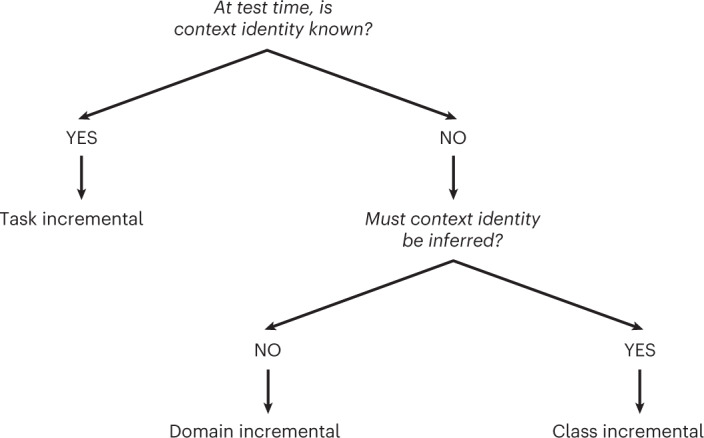
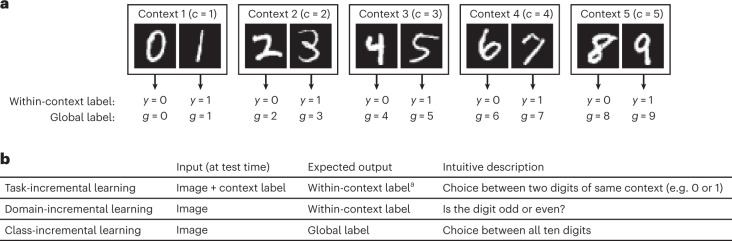
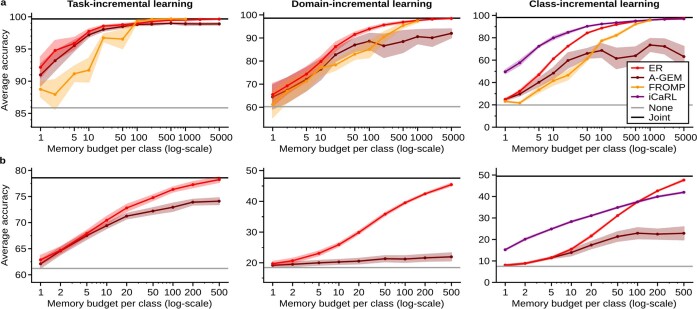
Incrementally learning new information from a non-stationary stream of data, referred to as ‘continual learning’, is a key feature of natural intelligence, but a challenging problem for deep neural networks. In recent years, numerous deep learning methods for continual learning have been proposed, but comparing their performances is difficult due to the lack of a common framework. To help address this, we describe three fundamental types, or ‘scenarios’, of continual learning: task-incremental, domain-incremental and class-incremental learning. Each of these scenarios has its own set of challenges. To illustrate this, we provide a comprehensive empirical comparison of currently used continual learning strategies, by performing the Split MNIST and Split CIFAR-100 protocols according to each scenario. We demonstrate substantial differences between the three scenarios in terms of difficulty and in terms of the effectiveness of different strategies. The proposed categorization aims to structure the continual learning field, by forming a key foundation for clearly defining benchmark problems.
Overview
The claims and statistics of this paper haven’t been checked yet.
Free: it reads the open-access text and checks the first 5 claims that cite a source we can check. Create a free account to check every claim.
Integrity signals
Registry
Cites
Statistics
Figures

Verification
Claims the paper makes
The claims and statistics of this paper haven’t been checked yet.
Free: it reads the open-access text and checks the first 5 claims that cite a source we can check. Create a free account to check every claim.
Claims other papers make about this one
Each is checked against this paper’s own text: does it say what the citing paper says it does?
The cited source says what the claim attributes to it.
In the citing paper
“To avert catastrophic forgetting, various algorithms[11, 48, 49] employ task-specific components or design separate networks for each task.”
From Few-Shot Class-Incremental Learning for Classification and Object Detection: A Survey (2025) · cites this paper as [11]
The cited source says what the claim attributes to it.
In the citing paper
“DIL is an ML problem designed to continuously adapt to data distribution from different domains while the structure of the problem is always the same [11].”
From Few-Shot Class-Incremental Learning for Classification and Object Detection: A Survey (2025) · cites this paper as [11]
The cited source says what the claim attributes to it.
In the citing paper
“TIL's primary challenge lies in identifying shared features across tasks to balance performance and computational complexity, using knowledge from one task to enhance performance in others [11].”
From Few-Shot Class-Incremental Learning for Classification and Object Detection: A Survey (2025) · cites this paper as [11]
Self-check
Percentages, sums and reported differences re-computed from the paper’s own numbers.
The self-check needs the paper’s full text.
Citations
Cites
Adam: A Method for Stochastic Optimization
Kingma, D. P., & Ba, J. (2014) · arXiv · doi:10.48550/arxiv.1412.6980 · Cited by 98,946
Gradient-based learning applied to document recognition
Lecun, Y., Bottou, L., Bengio, Y., & Haffner, P. (1998) · Proceedings of the IEEE · doi:10.1109/5.726791 · Cited by 58,805 · cited 1×
“For the Split MNIST protocol, the MNIST dataset 66 was split into five contexts, such that each context contained two digits.”
Auto-Encoding Variational Bayes
Kingma, D. P., & Welling, M. (2013) · arXiv · doi:10.48550/arxiv.1312.6114 · Cited by 20,067
Distilling the Knowledge in a Neural Network
Hinton, G., Vinyals, O., & Dean, J. (2015) · arXiv · doi:10.48550/arxiv.1503.02531 · Cited by 14,204
(2017) · Cited by 11,625
Overcoming catastrophic forgetting in neural networks
Kirkpatrick, J., Pascanu, R., Rabinowitz, N., Veness, J., Desjardins, G., Rusu, A. A., Milan, K., Quan, J., Ramalho, T., Grabska-Barwinska, A., et al. (2017) · Proceedings of the National Academy of Sciences · doi:10.1073/pnas.1611835114 · Cited by 7,899 · cited 9×
“A few years ago this scenario was regularly studied with Permuted MNIST 31,49,61 , but this protocol is not often used any-more as it is considered too artificial.”
InfluentialLi, Z., & Hoiem, D. (2018) · IEEE Transactions on Pattern Analysis and Machine Intelligence · doi:10.1109/tpami.2017.2773081 · Cited by 4,202
iCaRL: Incremental Classifier and Representation Learning
Rebuffi, S.-A., Kolesnikov, A., Sperl, G., & Lampert, C. H. (2017) · 2017 IEEE Conference on Computer Vision and Pattern Recognition (CVPR) · doi:10.1109/cvpr.2017.587 · Cited by 3,988
Catastrophic Interference in Connectionist Networks: The Sequential Learning Problem
McCloskey, M., & Cohen, N. J. (1989) · Psychology of Learning and Motivation · doi:10.1016/s0079-7421(08)60536-8 · Cited by 3,770
Catastrophic forgetting in connectionist networks
French, R. (1999) · Trends in Cognitive Sciences · doi:10.1016/s1364-6613(99)01294-2 · Cited by 2,311 · cited 16×
“During training on context K , the regularization term of FROMP was given by: with τ a hyperparameter controlling the regularization strength (which was set based on a grid search, see Supplementary Note 8) and ̂ θ ∗ the parameter vector with values as they were at the end of training on context K − 1.”
Influential
Research works printed but not linked: 16
- Chen Z Liu B Lifelong machine learning Synth. Lect. Artif. Intell. Mach. Learn. 2018 12 1 207
- Mundt, M., Lang, S., Delfosse, Q. & Kersting, K. CLEVA-compass: A continual learning evaluation assessment compass to promote research transparency and comparability. In International Conference on Learning Representations (2022).
- Ruvolo, P. & Eaton, E. ELLA: An efficient lifelong learning algorithm. In International Conference on Machine Learning 507–515 (PMLR, 2013).
- Ramesh, R. & Chaudhari, P. Model Zoo: A growing brain that learns continually. In International Conference on Learning Representations (2022).
- Lopez-Paz, D. & Ranzato, M. Gradient episodic memory for continual learning. In Advances in Neural Information Processing Systems Vol. 30, 6470–6479 (2017).
- Mirza, M. J., Masana, M., Possegger, H. & Bischof, H. An efficient domain-incremental learning approach to drive in all weather conditions. In Proceedings of the IEEE/CVF Conference on Computer Vision and Pattern Recognition (CVPR) Workshops 3001–3011 (2022).
- von Oswald, J., Henning, C., Sacramento, J. & Grewe, B. F. Continual learning with hypernetworks. In International Conference on Learning Representations (2020).
- Shin, H., Lee, J. K., Kim, J. & Kim, J. Continual learning with deep generative replay. In Advances in Neural Information Processing Systems Vol. 30, 2994–3003 (2017).
- Caccia, L., Belilovsky, E., Caccia, M. & Pineau, J. Online learned continual compression with adaptive quantization modules. In International Conference on Machine Learning 1240–1250 (PMLR, 2020).
- Lee, S., Ha, J., Zhang, D. & Kim, G.A neural dirichlet process mixture model for task-free continual learning. In International Conference on Learning Representations (2020).
- Jin, X., Sadhu, A., Du, J. & Ren, X. Gradient-based editing of memory examples for online task-free continual learning. In Advances in Neural Information Processing Systems Vol. 34, 29193–29205 (2021).
- Rolnick, D., Ahuja, A., Schwarz, J., Lillicrap, T. & Wayne, G. Experience replay for continual learning. In Advances in Neural Information Processing Systems Vol. 32 (2019).
- Aljundi, R. et al. Online continual learning with maximally interfered retrieval. In Advances in Neural Information Processing Systems Vol. 32 (2019). · DOI · Paper page
- Hess, T., Mundt, M., Pliushch, I. & Ramesh, V. A procedural world generation framework for systematic evaluation of continual learning. In Thirty-fifth Conference on Neural Information Processing Systems, Datasets and Benchmarks Track (2021).
- Ioffe, S. & Szegedy, C. Batch normalization: Accelerating deep network training by reducing internal covariate shift. In International Conference on Machine Learning 448–456 (PMLR, 2015).
- Rezende, D. & Mohamed, S. Variational inference with normalizing flows. In International Conference on Machine Learning 1530–1538 (PMLR, 2015).
Cited by
Items 101–200 of 770
Exploring the Intersection Between Neural Architecture Search and Continual Learning
Shahawy, M., Benkhelifa, E., & White, D. (2024) · IEEE Transactions on Neural Networks and Learning Systems · doi:10.1109/tnnls.2024.3453973 · Cited by 18
“To address this problem, the field of continual learning (CL) was introduced (sometimes referred to as lifelong learning [12], [13], [14], (task-/domain-/class)incremental learning [9], [15], [16], [17], and sequential learning [10], [18]).”
Wang, L., Deng, R., Zhang, R., Luo, Y., & Deng, S. (2024) · Chemical Engineering Journal · doi:10.1016/j.cej.2024.156435 · Cited by 18
Theories of synaptic memory consolidation and intelligent plasticity for continual learning
Zenke, F., & Laborieux, A. (2025) · Elsevier eBooks · doi:10.1016/b978-0-443-15754-7.00070-5 · Cited by 18
Cross-lingual Continual Learning
M’hamdi, M., Ren, X., & May, J. (2023) · Proceedings of the conference - Association for Computational Linguistics. Meeting · doi:10.18653/v1/2023.acl-long.217 · Cited by 27
“Following that, our regularization term is computed as, based on the formulation in van de Ven et al. (2022): where θ are the parameters of the Transformer model in addition to the downstream prediction heads, N p is the total number of parameters, and ˜ F ( i − 1) jj is the Fisher information…”
MethodAddressing data heterogeneity in distributed medical imaging with heterosync learning
Hu, H.-T., Li, M., Lin, X.-X., Cai, M.-Y., Liu, S., Wu, S., Tong, W., Ye, F.-Y., Hu, J., Ke, W.-P., et al. (2025) · Nature Communications · doi:10.1038/s41467-025-64459-y · Cited by 15
“By incorporating continuous or incremental learning approaches, HSL could adapt to evolving data patterns or shifts in underlying distributions (e.g., changes in disease prevalence) without needing to retrain from scratch 40,41 .”
Chen, G. M., Jain, A., Gering, D. T., Satulovsky, J., Datta, S., Lai, P., Karar, J., Gonzalez, V. E., Alexander, K., Chew, A., et al. (2026) · Nature Biomedical Engineering · doi:10.1038/s41551-026-01633-7 · Cited by 18
Multi-Scale Feature Alignment for Continual Learning of Unlabeled Domains
Thandiackal, K., Piccinelli, L., Gupta, R., Pati, P., & Göksel, O. (2024) · IEEE Transactions on Medical Imaging · doi:10.1109/tmi.2024.3368365 · Cited by 21
“The above-described problem setting was introduced in [17] as continual UDA, which lies at the intersection of UDA and continual learning (CL) [18], [19], [20].”
BackgroundDing, F., Xu, C. G., Liu, H., Zhou, B., & Zhou, H. (2024) · Information Sciences · doi:10.1016/j.ins.2024.120710 · Cited by 17
Automated Detection of Misinformation: A Hybrid Approach for Fake News Detection
Mohsen, F., Chaushi, B., Abdelhaq, H., Karastoyanova, D., & Wang, K. (2024) · Future Internet · doi:10.3390/fi16100352 · Cited by 18
Huang, W., Ding, M., & Deng, F. (2024) · IEEE Transactions on Geoscience and Remote Sensing · doi:10.1109/tgrs.2024.3481875 · Cited by 20
“Incremental learning consists of three primary scenarios: task-incremental learning (TIL), DIL, and class-incremental learning (CIL) [38].”
BackgroundExperimental demonstration of quantum continual learning with superconducting qubits
Zhang, C., Lu, Z., Zhao, L., Xu, S., Li, W., Wang, K., Chen, J., Wu, Y., Jin, F., Zhu, X., et al. (2026) · npj Quantum Information · doi:10.1038/s41534-025-01174-y · Cited by 17
Domain-incremental learning without forgetting based on random vector functional link networks
Liu, C., Wang, Y., Li, D., & Wang, X. (2024) · Pattern Recognition · doi:10.1016/j.patcog.2024.110430 · Cited by 16
Never‐Ending Learning for Explainable Brain Computing
Kuai, H., Chen, J., Tao, X., Cai, L., Imamura, K., Matsumoto, H., Liang, P., & Zhong, N. (2024) · Advanced Science · doi:10.1002/advs.202307647 · Cited by 15
Telescopic broad Bayesian learning for big data stream
Yuen, K., & Kuok, S. (2024) · Computer-Aided Civil and Infrastructure Engineering · doi:10.1111/mice.13305 · Cited by 15
“Van de Ven et al. (2022) provided an empirical comparison of different incremental learning strategies.”
Li, K., Zhu, Y., Yu, L., & Heng, P. (2024) · IEEE Transactions on Medical Imaging · doi:10.1109/tmi.2024.3364240 · Cited by 17
“Incremental learning is an emerging topic in medical image analysis, which aims to iteratively upgrade and progressively improve the model to embrace advanced needs and requirements [47].”
BackgroundModeling Inner- and Cross-Task Contrastive Relations for Continual Image Classification
Luo, Y., Cong, R., Liu, X., Ip, H. H. S., & Kwong, S. (2024) · IEEE Transactions on Multimedia · doi:10.1109/tmm.2024.3414277 · Cited by 18
“In other words, the core is to achieve the balance between learning from new tasks and retaining stable performance on previous tasks, leading to extensive exploration of existing methods [23], [24], [25], [26].”
Latent spectral regularization for continual learning
Frascaroli, E., Benaglia, R., Boschini, M., Moschella, L., Fiorini, C., Rodolà, E., & Calderara, S. (2024) · Pattern Recognition Letters · doi:10.1016/j.patrec.2024.06.020 · Cited by 15
“These methods are evaluated by dividing a classification dataset into disjoint subsets of classes, called tasks, letting the model fit one task at a time and evaluating it on all previously seen data [45].”
MethodEconomical Electric Vehicle Charging Scheduling via Deep Imitation Learning
Huang, Z.-H., Wang, J., Fan, X., Yue, R., Xiang, C., & Gao, S. (2024) · IEEE Transactions on Intelligent Transportation Systems · doi:10.1109/tits.2024.3434734 · Cited by 16
Bayesian Parameter-Efficient Fine-Tuning for Overcoming Catastrophic Forgetting
Chen, H., & Garner, P. N. (2024) · IEEE/ACM Transactions on Audio Speech and Language Processing · doi:10.1109/taslp.2024.3463395 · Cited by 19
“[40] categorizes continual learning into three types: task, domain, and class-incremental learning.”
Anti-Forgetting Adaptation for Unsupervised Person Re-Identification
Chen, H., Brémond, F., Sebe, N., & Zhang, S. S. (2024) · IEEE Transactions on Pattern Analysis and Machine Intelligence · doi:10.1109/tpami.2024.3490777 · Cited by 15
“LifelongpersonReIDiscloselyre-latedtoincremental(orcontinuous)learning[9].”
Lithium Battery Digital Twin Model with Incremental Learning
Wang, X., Li, J., Wang, R., & Wu, Y. T. (2024) · CHAIN · doi:10.23919/chain.2024.100002 · Cited by 13
Wan, X., Cen, L., Chen, X., Xie, Y., & Gui, W. (2025) · IEEE Transactions on Industrial Informatics · doi:10.1109/tii.2024.3523595 · Cited by 13
“Becausereplay-basedmethodsperformthebestindomain-IL scenario[15],replay-basedstrategiesareemployedinthisstudy.”
InfluentialA data-efficient active learning architecture for anomaly detection in industrial time series data
Holtz, D., Kaymakci, C., Leuthe, D., Wenninger, S., & Sauer, A. (2025) · Flexible Services and Manufacturing Journal · doi:10.1007/s10696-024-09588-0 · Cited by 20
“…can close the gap to live system implementation by evaluating various options to retrain, such as considering retraining-based active learning (Yang and Loog 2018) or approaches provided in recent literature reviews on continual and incremental learning (Losing et al. 2018; van de Ven et al. 2022).”
Wang, Q., & Li, H. (2025) · Big Data and Cognitive Computing · doi:10.3390/bdcc9030050 · Cited by 17
“There are three CL settings [63]: (i) task-incremental learning (TIL), where each task has a clear identifier and the model is always informed about which task needs to be performed; (ii) domain-incremental learning (DIL), where new tasks involve different data distributions but share the same…”
Building Intelligent Agents with Neuro-Symbolic Concepts
Mao, J., Tenenbaum, J. B., & Wu, J. (2026) · Communications of the ACM · doi:10.1145/3715316 · Cited by 17
Dual memory model for experience-once task-incremental lifelong learning
Ma, G., Jiang, R., Wang, L., & Tang, H. (2023) · Neural Networks · doi:10.1016/j.neunet.2023.07.009 · Cited by 13
Wang, S., Chen, H., Zhang, Z., & Su, B. (2023) · Measurement · doi:10.1016/j.measurement.2023.113997 · Cited by 13
CL-MASR: A Continual Learning Benchmark for Multilingual ASR
Libera, L. D., Mousavi, P., Zaiem, S., Subakan, C., & Ravanelli, M. (2024) · IEEE/ACM Transactions on Audio Speech and Language Processing · doi:10.1109/taslp.2024.3487410 · Cited by 24
“These studies focus primarily on examining the effects of CL methods in DIL scenarios, leaving room for further exploration of CL techniques in settings such as multilingual ASR, where the data label space for each task may differ [56].”
Progressive Adapting and Pruning: Domain-Incremental Learning for Saliency Prediction
Yang, K., Han, J., Guo, G., Fang, C., Fan, Y., Cheng, L., & Zhang, D. (2024) · ACM Transactions on Multimedia Computing Communications and Applications · doi:10.1145/3661312 · Cited by 15
Huang, Y., & Ma, M. (2024) · IEEE Transactions on Intelligent Transportation Systems · doi:10.1109/tits.2024.3510584 · Cited by 12
Shi, Y., Shi, Y., Yao, D., Lu, M., & Liang, Y. (2025) · Electric Power Systems Research · doi:10.1016/j.epsr.2025.111450 · Cited by 14
Shen, X., Zhang, T., Wu, H., Qiao, X., Du, Y., & Gui, G. (2025) · IEEE Transactions on Information Forensics and Security · doi:10.1109/tifs.2025.3552034 · Cited by 14
“To solve the above problems, researchers have introduced incremental learning (IL) [13], which can learn new knowledge from newly acquired data while retaining and even integrating and optimizing old knowledge.”
Trends in motion prediction toward deployable and generalizable autonomy: a revisit and perspectives
Wang, L., Lavoie, M.-A., Papais, S., Nisar, B., Chen, Y., Ding, W., Ivanovic, B., Shao, H., Abuduweili, A., Cook, E. D., et al. (2026) · Foundations and Trends in Robotics · doi:10.1108/ftrob-05-2025-0079 · Cited by 15
Chavan, V., Koch, P., Schlüter, M., & Briese, C. (2023) · IEEE/CVF International Conference on Computer Vision (ICCV) · doi:10.1109/iccv51070.2023.01057 · Cited by 27
“CIL implementations generally focus heavily on the Top-1 and Top-5 accuracy in standardised benchmarking settings [5,47,60,73].”
BackgroundIncremental Recognition of Multi-Style Tibetan Character Based on Transfer Learning
Zhao, G., Wang, W., Wang, X., Bao, X., Li, H., & Liu, M. (2024) · IEEE Access · doi:10.1109/access.2024.3381039 · Cited by 14
“Incremental recognition is mainly implemented using incremental learning, which consists of three basic types: task incremental, domain incremental, and class incremental [28].”
MethodCCSI: Continual Class-Specific Impression for data-free class incremental learning
Ayromlou, S., Tsang, T. S. M., Abolmaesumi, P., & Li, X. (2024) · Medical Image Analysis · doi:10.1016/j.media.2024.103239 · Cited by 15
An Experimental Survey of Incremental Transfer Learning for Multicenter Collaboration
Huang, Y., Bert, C., Gomaa, A., Fietkau, R., Maier, A., & Putz, F. (2024) · IEEE Access · doi:10.1109/access.2024.3431885 · Cited by 13
“According to application scenarios, three types of continual learning are investigated [18]: task-incremental learning [17], class-incremental learning [19], and domain-incremental learning [18].”
BackgroundMethodInfluentialDynaMMo: Dynamic Model Merging for Efficient Class Incremental Learning for Medical Images
Qazi, M. A., Almakky, I., Hashmi, A. U. R., Sanjeev, S., & Yaqub, M. K. (2024) · Lecture notes in computer science · doi:10.1007/978-3-031-66955-2_17 · Cited by 16
Automate, Illuminate, Predict: A Universal Framework for Integrating Wearable Sensors in Healthcare
O’Brien, M. K., Hohl, K., Lieber, R. L., & Jayaraman, A. (2024) · Digital Biomarkers · doi:10.1159/000540492 · Cited by 13
“Online or incremental learning should be used to mitigate these concerns and continuously fi ne-tune performance over time [74, 75].”
BackgroundPhotonic data analysis in 2050
Ryabchykov, O., Guo, S., & Bocklitz, T. W. (2024) · Vibrational Spectroscopy · doi:10.1016/j.vibspec.2024.103685 · Cited by 13
A synapse-specific refractory period for plasticity at individual dendritic spines
Flores, J. C., Sarkar, D., & Zito, K. (2025) · Proceedings of the National Academy of Sciences · doi:10.1073/pnas.2410433122 · Cited by 11
Boosting incremental intrusion detection system with adversarial samples
Wu, X., Jin, Z., Chen, X., Zhou, J., & Liu, K. (2025) · Expert Systems with Applications · doi:10.1016/j.eswa.2025.126632 · Cited by 12
Hyperdimensional Representation Learning for Node Classification and Link Prediction
Dalvi, A., & Honavar, V. (2025) · ACM International Conference on Web Search and Data Mining (WSDM) · doi:10.1145/3701551.3703492 · Cited by 14
Trinci, T., Magistri, S., Verdecchia, R., & Bagdanov, A. D. (2025) · Lecture notes in computer science · doi:10.1007/978-3-031-92089-9_19 · Cited by 11
Smart Grid Intrusion Detection System Based on Incremental Learning
Ni, X., Jiang, S. Y., Yu, K. H., An, C., Zhang, Y., & Huang, H. (2025) · Electronics · doi:10.3390/electronics14193820 · Cited by 11
A survey on large language models unlearning: taxonomy, evaluations, and future directions
Le-Khac, U. N., & Truong, V. (2025) · Artificial Intelligence Review · doi:10.1007/s10462-025-11376-7 · Cited by 16
“Incremental unlearning (Van de Ven et al. 2022) is another potential pathway to optimise the parameter update for unlearning.”
Online Continual Learning for Robust Indoor Object Recognition
Michieli, U., & Özay, M. (2023) · IEEE/RSJ International Conference on Intelligent Robots and Systems (IROS) · doi:10.1109/iros55552.2023.10341474 · Cited by 14
“Along all these definitions, three main scenarios have been considered [30]: 1) class-incremental (CI) where new classes are introduced to models over time; 2) domain-incremental (DI) where the same problem is learned in different contexts ( e.g ., with a fixed set of classes); and 3)…”
BackgroundYu, C.-C., Chen, T.-Y., Hsu, C.-W., & Cheng, H.-Y. (2024) · Electronics · doi:10.3390/electronics13030583 · Cited by 11
Shi, K., Li, Q., Xu, P., Zhang, B., & Zhu, H. (2024) · Applied Ocean Research · doi:10.1016/j.apor.2024.104383 · Cited by 11
Yusuyin, S., Ma, T., Huang, H., Zhao, W., & Ou, Z. (2025) · IEEE Transactions on Audio Speech and Language Processing · doi:10.1109/taslpro.2025.3550683 · Cited by 32
“Meanwhile, it is worthwhile to investigate how to incrementally learn from new languages with a non-stationary stream Continual learning methods such as based on prompt pool [65], [66] could be incorporated into MCL-ASR.”
On Sequential Bayesian Inference for Continual Learning
Kessler, S., Cobb, A. D., Rudner, T. G. J., Zohren, S., & Roberts, S. (2023) · Entropy · doi:10.3390/e25060884 · Cited by 19
“The domain incremental setting is also simpler [18] than the class-incremental setting and thus a good starting point when attempting to perform exact sequential Bayesian inference.”
MethodFostering new vertical and horizontal IoT applications with intelligence everywhere
Cao, H., Wachowicz, M., Richard, R., & Hsu, C. (2023) · Collective Intelligence · doi:10.1177/26339137231208966 · Cited by 14
“Many learning mechanisms might fit into our learning paradigm, but there are two most feasible options to consider: federated learning Mawuli et al. (2023) and incremental learning van de Ven et al. (2022), as shown in Table 1.”
BackgroundContinual Learning for Time Series Forecasting: A First Survey
Besnard, Q., & Ragot, N. (2024) · doi:10.3390/engproc2024068049 · Cited by 25
Liu, S., Radway, R. M., Wang, X., Moro, F., Nodin, J.-F., Jana, K., Yan, L., Du, S., Upton, L. R., Chen, W.-C., et al. (2025) · IEEE Transactions on Electron Devices · doi:10.1109/ted.2025.3556113 · Cited by 12
“Continual learning [6], [7] can accumulate knowledge without catastrophic forgetting, which is particularly beneficial for edge devices that frequently interact with and learn from environmental data.”
Artificial Intelligence and Corruption: Opportunities and Challenges in the Health Sector
Rey-Puech, P. D., Balabanova, D., & McKee, M. (2025) · The International Journal of Health Planning and Management · doi:10.1002/hpm.70002 · Cited by 11
Rao, M., Yang, X., Chen, Y., Zuo, M. J., Bu, Z., Jin, Y., & Chu, F. (2025) · Mechanical Systems and Signal Processing · doi:10.1016/j.ymssp.2025.113447 · Cited by 10
Mei, L.-F., & Yan, W. (2025) · Advanced Engineering Informatics · doi:10.1016/j.aei.2025.103926 · Cited by 10
Yan, Z., Wang, Z., Hao, P., Nardello, M., Brunelli, D., & Wen, H. (2026) · IEEE Transactions on Instrumentation and Measurement · doi:10.1109/tim.2026.3662894 · Cited by 15
“1 Incremental learning is generally categorized into three scenarios: task-incremental, domain-incremental, and class-incremental learning (CIL) [16].”
Rohlfing, K. J., Främling, K., Lim, B., Alpsancar, S., & Thommes, K. (2026) · Springer eBooks · doi:10.1007/978-981-96-5290-7 · Cited by 10
Continual Learning of Unsupervised Monocular Depth from Videos
Chawla, H., Varma, A., Arani, E., & Zonooz, B. (2024) · IEEE Winter Conference on Applications of Computer Vision · doi:10.1109/wacv57701.2024.00823 · Cited by 17
“This is equivalent to ER (which has already been shown to outperform most other rehearsal-based methods for classification [51]).”
MethodSemantic Residual Prompts for Continual Learning
Menabue, M., Frascaroli, E., Boschini, M., Sangineto, E., Bonicelli, L., Porrello, A., & Calderara, S. (2024) · Lecture notes in computer science · doi:10.1007/978-3-031-73030-6_1 · Cited by 29
Chanra, V., Chudzinska, A., Braniewska, N., Silski, B., Holst, B., Sauvigny, T., Stodieck, S. R. G., Pelzl, S., & House, P. M. (2024) · Epilepsy Research · doi:10.1016/j.eplepsyres.2024.107357 · Cited by 9
Explainable incremental learning for high-impedance fault detection in distribution networks
Bai, H., Gao, J., Liu, T., Guo, Z., & Guo, M. (2024) · Computers & Electrical Engineering · doi:10.1016/j.compeleceng.2024.110006 · Cited by 11
IDEAL: Interpretable-by-Design ALgorithms for learning from foundation feature spaces
Angelov, P. P., Kangin, D., & Zhang, Z. (2025) · Neurocomputing · doi:10.1016/j.neucom.2025.129464 · Cited by 10
“Continual learning models solve a number of related problems (van de Ven et al. (2022)).”
Task-specific parameter decoupling for class incremental learning
Chen, R., Jing, X., Wu, F., Zheng, W., & Hao, Y. (2023) · Information Sciences · doi:10.1016/j.ins.2023.119731 · Cited by 11
Incremental learning of LSTM-autoencoder anomaly detection in three-axis CNC machines
Li, E., Li, Y., Bedi, S. S., Melek, W., & Gray, P. (2023) · The International Journal of Advanced Manufacturing Technology · doi:10.1007/s00170-023-12713-2 · Cited by 10
Characterizing continual learning scenarios and strategies for audio analysis
Bhatt, R., Kumari, P., Mahapatra, D., Saddik, A. E., Thekkila, P. P., & Saini, M. K. (2026) · EURASIP Journal on Audio Speech and Music Processing · doi:10.1186/s13636-026-00452-7 · Cited by 10
“An example of class-incremental learning in real-world monitoring is to identify a cat and dog in one episode and then a cow and horse in the other episode [52].”
BackgroundAtitallah, S. B., Rabah, C. B., Driss, M., Boulila, W., & Koubâa, A. (2025) · Computers in Biology and Medicine · doi:10.1016/j.compbiomed.2025.109874 · Cited by 17
Example forgetting and rehearsal in continual learning
Benkő, B. (2024) · Pattern Recognition Letters · doi:10.1016/j.patrec.2024.01.021 · Cited by 14
Wake-Sleep Consolidated Learning
Sorrenti, A., Bellitto, G., Salanitri, F. P., Pennisi, M., Palazzo, S., & Spampinato, C. (2024) · IEEE Transactions on Neural Networks and Learning Systems · doi:10.1109/tnnls.2024.3458440 · Cited by 10
“While current solutions help reduce forgetting, real-world application proves difficult, as typical CL evaluations are carried out on oversimplistic benchmarks [21], [22].”
Toward Deep Semi-Supervised Continual Learning: A Unified Survey for Scalable and Adaptive AI
Jalal, M. E., & Elmaghraby, A. S. (2025) · IEEE Access · doi:10.1109/access.2025.3556569 · Cited by 9
“Continual learning is traditionally categorized into three distinct scenarios based on how a model processes and adapts to new tasks and data over time: Task-Incremental Learning (Task-IL), Domain-Incremental Learning (Domain-IL), and Class-Incremental Learning (Class-IL) [132].”
InfluentialLiu, Z., Cheng, Y., Chen, C., Hu, J. F., Fu, R., & Zhang, D. (2025) · IEEE Transactions on Parallel and Distributed Systems · doi:10.1109/tpds.2025.3577796 · Cited by 9
“To address these problems, model retraining and incremental learning techniques [57] can be integrated with ISACPP to improve overall prediction performance and reduce profiling overhead.”
Incremental Multi-Step Learning MLP Model for Online Soft Sensor Modeling
Wang, Y., Tao, J., & Zhao, L. Y. (2025) · Sensors · doi:10.3390/s25144303 · Cited by 8
Huang, L., Zuo, Y., Guo, C., Wang, B., & Tian, K. (2025) · Progress in Aerospace Sciences · doi:10.1016/j.paerosci.2025.101145 · Cited by 9
A Survey of Crop Disease Recognition Methods Based on Spectral and RGB Images
Dong, H., Huang, Y., Xia, P., Tang, K., Qian, Y., Lu, Y., & Qin, Y. (2026) · Journal of Imaging · doi:10.3390/jimaging12020066 · Cited by 8
Secure and Efficient Continuous Learning Model for Traffic Flow Prediction
Le, J., Zhang, D., Yang, F., Xiang, T., & Liao, X. (2024) · IEEE Transactions on Network and Service Management · doi:10.1109/tnsm.2024.3407959 · Cited by 8
“The schemes EWC, LwF and iCaRL are commonly used continuous learning models, and the experimental codes of these models are cited in [33].”
MethodZhang, Z., Liu, M., & Liu, W. (2024) · Journal of Systems Science and Complexity · doi:10.1007/s11424-024-3449-9 · Cited by 8
“Humans possess the remarkable ability to process a constant stream of information in the real world, effectively retaining and integrating previous knowledge while assimilating new knowledge [47] .”
Active Dendrites Enable Efficient Continual Learning in Time-To-First-Spike Neural Networks
Pes, L., Luiken, R., Corradi, F., & Frenkel, C. (2024) · IEEE International Conference on Artificial Intelligence Circuits and Systems (AICAS) · doi:10.1109/aicas59952.2024.10595872 · Cited by 17
“However, as opposed to the approach from Iyer et al. that necessitates a dedicated k WTA layer, we can exploit dead neurons in our TTFS-encoded network to intrinsically implement a gating mechanism.”
MethodResultKushawaha, N., Fruzzetti, L., Donato, E., & Falotico, E. (2024) · IEEE Transactions on Neural Networks and Learning Systems · doi:10.1109/tnnls.2024.3446171 · Cited by 10
“At the computational level, supervised CL can be classified into three primary types or “scenarios” [6].”
Probabilistic metaplasticity for continual learning with memristors in spiking networks
Zohora, F. T., Karia, V., Soures, N., & Kudithipudi, D. (2024) · Scientific Reports · doi:10.1038/s41598-024-78290-w · Cited by 10
“Energy analysis during the parameter update phase considering bilinear metaplasticity function shows that shared parameters lead to upto ∼ 35 × reduction in energy consumption per sample (Figure 5a.).”
Domain-Incremental Learning Framework for Continual Motor Imagery EEG Classification Task
Li, D., Shin, H.-B., Yin, K., & Lee, S. (2024) · Annual International Conference of the IEEE Engineering in Medicine and Biology Society (EMBC) · doi:10.1109/embc53108.2024.10781886 · Cited by 8
“In domain-incremental learning [19], domains are presented sequentially, each being associated with a dataset and a corresponding domain label.”
A Domain Incremental Learning Framework for PCB Continuous Defect Detection
Yan, Z., Hao, R., Huang, B., Zhu, L., & Hui, P. (2025) · IEEE Transactions on Instrumentation and Measurement · doi:10.1109/tim.2025.3550210 · Cited by 15
“This learning paradigm simulates the human learning process, where new knowledge is accumulated without losing existing knowledge [37].”
Latent Distillation for Continual Object Detection at the Edge
Pasti, F., Ceccon, M., Pezze, D. D., Paissan, F., Farella, E., Susto, G. A., & Bellotto, N. (2025) · Lecture notes in computer science · doi:10.1007/978-3-031-91979-4_21 · Cited by 9
HyperMask: Adaptive hypernetwork-based masks for continual learning
Książek, K., & Spurek, P. (2025) · Neural Networks · doi:10.1016/j.neunet.2025.107736 · Cited by 10
Quantum Artificial Intelligence: Some Strategies and Perspectives
Baioletti, M., Fagiolo, F., Loglisci, C. A. A. M. D., Losavio, V. N., Oddi, A., Rasconi, R., & Gentili, P. L. (2025) · AI · doi:10.3390/ai6080175 · Cited by 10
An unsupervised framework for drift-aware anomaly detection in streaming time series
Li, D., Nair, N. C., & Wang, K. I. (2025) · Applied Soft Computing · doi:10.1016/j.asoc.2025.113903 · Cited by 9
Continual deep multi-view clustering via contrastive knowledge replay
Liang, H., Wei, B., Cao, X., Liu, J., Ouyang, X., Qiu, J., Wang, H., Yang, X., & Li, T. (2025) · Pattern Recognition · doi:10.1016/j.patcog.2025.112548 · Cited by 10
What neuroscience can tell AI about learning in continuously changing environments
Durstewitz, D., Averbeck, B. B., & Koppe, G. (2025) · Nature Machine Intelligence · doi:10.1038/s42256-025-01146-z · Cited by 12
“43,44).”
Tian, S., Wu, Z., & Zhang, D. (2024) · Measurement Science and Technology · doi:10.1088/1361-6501/ad3390 · Cited by 7
Promise and Peril of Collaborative Code Generation Models: Balancing Effectiveness and Memorization
Chen, Z., & Jiang, L. (2024) · IEEE/ACM International Conference on Automated Software Engineering (ASE) · doi:10.1145/3691620.3695021 · Cited by 12
Incremental and Zero-Shot Machine Learning for Vietnamese Medicinal Plant Image Classification
Tran, T. P., Din, F. U., Branković, L., Sanín, C., Hester, S. M., & Le, M. D. H. (2024) · Procedia Computer Science · doi:10.1016/j.procs.2024.09.469 · Cited by 10
Liu, Y., & Ren, Q. (2025) · Energy · doi:10.1016/j.energy.2025.135840 · Cited by 8
A Continual Learning System with Self Domain Shift Adaptation for Fake News Detection
Basterrech, S., Kasprzak, A., Platoš, J., & Woźniak, M. (2023) · IEEE International Conference on Data Science and Advanced Analytics (DSAA) · doi:10.1109/dsaa60987.2023.10302539 · Cited by 9
“Likely, the most popular one distinguished among [7]: · Task-incremental learning assumes the model has access to task labels.”
BackgroundMulti-Beam Beamforming-Based ML Algorithm to Optimize the Routing of Drone Swarms
Myers, R. J., Perera, S. M., McLewee, G., Huang, D., & Song, H. (2024) · Drones · doi:10.3390/drones8020057 · Cited by 8
A Survey: Navigating the Landscape of Incremental Learning Techniques and Trends
Li, Y., Wu, W., Luo, X., Zheng, M., Zhang, Y., & Peng, B. (2023) · International Conference on Intelligent Systems and Knowledge Engineering (ISKE) · doi:10.1109/iske60036.2023.10481497 · Cited by 8
“Therefore, Task-IL’s objective should extend beyond mitigating catastrophic forgetting and aim to achieve a positive forward or even backward transfer of knowledge between tasks [35], [41].”
BackgroundNICE: Neurogenesis Inspired Contextual Encoding for Replay-free Class Incremental Learning
Gürbüz, M. B., Moorman, J. M., & Dovrolis, C. (2024) · IEEE Computer Society Conference on Computer Vision and Pattern Recognition/Proceedings - IEEE Computer Society Conference on Computer Vision and Pattern Recognition/Proceedings · doi:10.1109/cvpr52733.2024.02233 · Cited by 14
“However, they primarily work in TIL and perform poorly in CIL settings [31, 36, 67], as their training does not enforce discrimination across classes that appear at different time points.”
Wang, J., Fan, L., Jing, W., Di, D., Song, Y. S., Liu, S., & Cong, C. (2025) · Lecture notes in computer science · doi:10.1007/978-3-032-05141-7_28 · Cited by 7
Incremental Learning-Based Algorithm for Anomaly Detection Using Computed Tomography Data
Gabbar, H. A., Adegboro, O. G., Chahid, A., & Ren, J. (2023) · Computation · doi:10.3390/computation11070139 · Cited by 7
Incremental Learning and Ambiguity Rejection for Document Classification
Pham, T.-C., Coustaty, M., Joseph, A., d’Andecy, V. P., Visani, M., & Sidère, N. (2023) · Lecture notes in computer science · doi:10.1007/978-3-031-41734-4_2 · Cited by 6
Multi-Agent Lifelong Implicit Neural Learning
Kolouri, S., Abbasi, A., Koohpayegani, S. A., Nooralinejad, P., & Pirsiavash, H. (2023) · IEEE Signal Processing Letters · doi:10.1109/lsp.2023.3338092 · Cited by 6
“Integrating continual learning [14], [15], [16], [17], [18], [19], [20], [21], [22], [23], [24], [25] with INRs presents a notable challenge for a single agent [26].”
Background
Metadata
- Authors
- van de Ven, G. M., Tuytelaars, T., & Tolias, A. S.
- Affiliations
- Baylor College of Medicine (US)
- KU Leuven (BE)
- Corresponding author
- van de Ven, Gido M.
- Venue
- Nature Machine Intelligence
- Published
- 2022-12-05
- Volume
- 4
- Issue
- 12
- Pages
- 1185-1197
- ISSN
- 2522-5839 (ISSN-L)
- PMC
- PMC9771807
- OpenAlex
- W4312210066
- Cited by
- 665
- References
- 43
- Citations by year
- 2026: 173 · 2025: 258 · 2024: 172 · 2023: 60 · 2022: 2
- FWCI
- 40.48
- Type
- journal article
- Language
- en
- Open access
- hybrid
- doi.org
- Licence
- cc-by
- creativecommons.org/licenses/by/4.0 (tdm)
- creativecommons.org/licenses/by/4.0 (vor)
- Locations
- Nature Machine Intelligence (publishedVersion, cc-by)
- PubMed Central (publishedVersion, cc-by)
- PubMed (publishedVersion)
- Lirias (KU Leuven) (submittedVersion, cc-by)
- Rice Research Repository (Rice University) (submittedVersion, cc-by)
- Apollo (University of Cambridge) (submittedVersion, cc-by)
- Apollo
- Funders
- International Brain Research Organization
- National Institutes of Health
- Defense Advanced Research Projects Agency (HR0011, HR0011-18-2-0025)
- Advanced Research Projects Agency
- Intelligence Advanced Research Projects Activity (D16PC00003)
- Interior Business Center
- National Institute of Mental Health (R01MH109556)
- National Eye Institute (P30EY002520)
- H2020 European Research Council (101021347)
- Topics
- Physical Sciences › Computer Science › Artificial Intelligence › Domain Adaptation and Few-Shot Learning
- Physical Sciences › Computer Science › Artificial Intelligence › Data Stream Mining Techniques
- Physical Sciences › Computer Science › Computer Vision and Pattern Recognition › Advanced Neural Network Applications
- Keywords
- continual learning, incremental learning, task-incremental learning, domain-incremental learning, class-incremental learning, catastrophic forgetting, non-stationary data streams, deep neural network
About these checks
Registry, retraction, Cites and statistics results are computed, not judged, with one exception: a printed reference that no index lists is read once by a model before it counts as a citation error. Claims are extracted by a model and kept only when their quote appears verbatim in the text; each cited source is then checked, with a model’s help, for whether it says what the claim relies on. Those verdicts can be wrong — read the claim’s quote and the cited source before relying on one.
Statistics and arithmetic are recomputed, not judged.
Confidence bands are shown only for fields calibrated on our annotated test set. None is calibrated yet, so no band is shown.
What counts as a claim ›How we measure confidence ›How we check this ›
Are you an author, or do you see a problem with this page? Request a review
Data sources
Bibliographic data: Semantic Scholar, OpenAlex, Crossref.
Contains information from the Semantic Scholar Academic Graph Datasets, made available under the ODC Attribution License (ODC-BY 1.0).
Semantic Scholar’s data is described in: Kinney, R., et al. (2023). The Semantic Scholar Open Data Platform. arXiv:2301.10140.
