

Three types of incremental learning
Open accessThe DOI matches its Crossref record; 59 of the 59 references it cites were found in a registry or an index.
Abstract
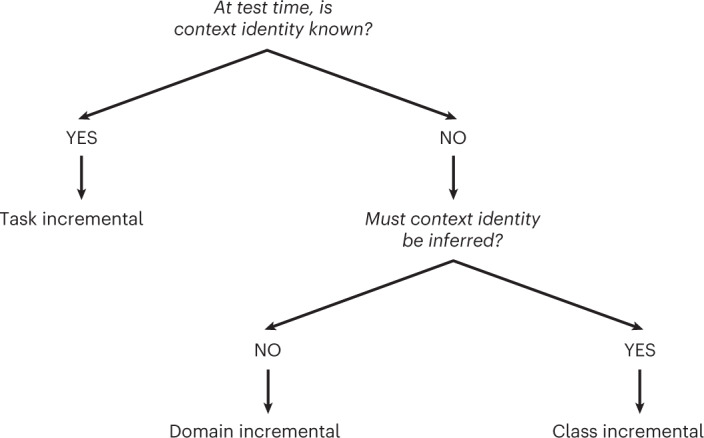
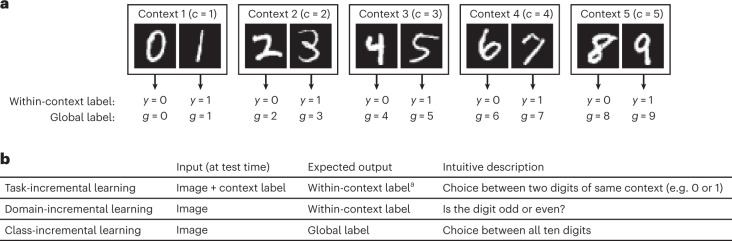
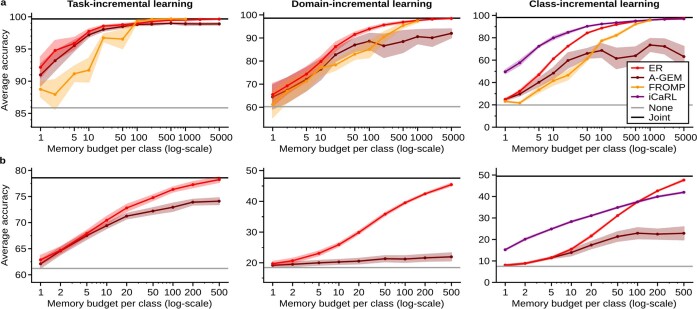
Incrementally learning new information from a non-stationary stream of data, referred to as ‘continual learning’, is a key feature of natural intelligence, but a challenging problem for deep neural networks. In recent years, numerous deep learning methods for continual learning have been proposed, but comparing their performances is difficult due to the lack of a common framework. To help address this, we describe three fundamental types, or ‘scenarios’, of continual learning: task-incremental, domain-incremental and class-incremental learning. Each of these scenarios has its own set of challenges. To illustrate this, we provide a comprehensive empirical comparison of currently used continual learning strategies, by performing the Split MNIST and Split CIFAR-100 protocols according to each scenario. We demonstrate substantial differences between the three scenarios in terms of difficulty and in terms of the effectiveness of different strategies. The proposed categorization aims to structure the continual learning field, by forming a key foundation for clearly defining benchmark problems.
Overview
The claims and statistics of this paper haven’t been checked yet.
Free: it reads the open-access text and checks the first 5 claims that cite a source we can check. Create a free account to check every claim.
Integrity signals
Registry
Cites
Statistics
Figures

Verification
Claims the paper makes
The claims and statistics of this paper haven’t been checked yet.
Free: it reads the open-access text and checks the first 5 claims that cite a source we can check. Create a free account to check every claim.
Claims other papers make about this one
Each is checked against this paper’s own text: does it say what the citing paper says it does?
The cited source says what the claim attributes to it.
In the citing paper
“To avert catastrophic forgetting, various algorithms[11, 48, 49] employ task-specific components or design separate networks for each task.”
From Few-Shot Class-Incremental Learning for Classification and Object Detection: A Survey (2025) · cites this paper as [11]
The cited source says what the claim attributes to it.
In the citing paper
“DIL is an ML problem designed to continuously adapt to data distribution from different domains while the structure of the problem is always the same [11].”
From Few-Shot Class-Incremental Learning for Classification and Object Detection: A Survey (2025) · cites this paper as [11]
The cited source says what the claim attributes to it.
In the citing paper
“TIL's primary challenge lies in identifying shared features across tasks to balance performance and computational complexity, using knowledge from one task to enhance performance in others [11].”
From Few-Shot Class-Incremental Learning for Classification and Object Detection: A Survey (2025) · cites this paper as [11]
Self-check
Percentages, sums and reported differences re-computed from the paper’s own numbers.
The self-check needs the paper’s full text.
Citations
Cites
Adam: A Method for Stochastic Optimization
Kingma, D. P., & Ba, J. (2014) · arXiv · doi:10.48550/arxiv.1412.6980 · Cited by 98,946
Gradient-based learning applied to document recognition
Lecun, Y., Bottou, L., Bengio, Y., & Haffner, P. (1998) · Proceedings of the IEEE · doi:10.1109/5.726791 · Cited by 58,805 · cited 1×
“For the Split MNIST protocol, the MNIST dataset 66 was split into five contexts, such that each context contained two digits.”
Auto-Encoding Variational Bayes
Kingma, D. P., & Welling, M. (2013) · arXiv · doi:10.48550/arxiv.1312.6114 · Cited by 20,067
Distilling the Knowledge in a Neural Network
Hinton, G., Vinyals, O., & Dean, J. (2015) · arXiv · doi:10.48550/arxiv.1503.02531 · Cited by 14,204
(2017) · Cited by 11,625
Overcoming catastrophic forgetting in neural networks
Kirkpatrick, J., Pascanu, R., Rabinowitz, N., Veness, J., Desjardins, G., Rusu, A. A., Milan, K., Quan, J., Ramalho, T., Grabska-Barwinska, A., et al. (2017) · Proceedings of the National Academy of Sciences · doi:10.1073/pnas.1611835114 · Cited by 7,899 · cited 9×
“A few years ago this scenario was regularly studied with Permuted MNIST 31,49,61 , but this protocol is not often used any-more as it is considered too artificial.”
InfluentialLi, Z., & Hoiem, D. (2018) · IEEE Transactions on Pattern Analysis and Machine Intelligence · doi:10.1109/tpami.2017.2773081 · Cited by 4,202
iCaRL: Incremental Classifier and Representation Learning
Rebuffi, S.-A., Kolesnikov, A., Sperl, G., & Lampert, C. H. (2017) · 2017 IEEE Conference on Computer Vision and Pattern Recognition (CVPR) · doi:10.1109/cvpr.2017.587 · Cited by 3,988
Catastrophic Interference in Connectionist Networks: The Sequential Learning Problem
McCloskey, M., & Cohen, N. J. (1989) · Psychology of Learning and Motivation · doi:10.1016/s0079-7421(08)60536-8 · Cited by 3,770
Catastrophic forgetting in connectionist networks
French, R. (1999) · Trends in Cognitive Sciences · doi:10.1016/s1364-6613(99)01294-2 · Cited by 2,311 · cited 16×
“During training on context K , the regularization term of FROMP was given by: with τ a hyperparameter controlling the regularization strength (which was set based on a grid search, see Supplementary Note 8) and ̂ θ ∗ the parameter vector with values as they were at the end of training on context K − 1.”
Influential
Research works printed but not linked: 16
- Chen Z Liu B Lifelong machine learning Synth. Lect. Artif. Intell. Mach. Learn. 2018 12 1 207
- Mundt, M., Lang, S., Delfosse, Q. & Kersting, K. CLEVA-compass: A continual learning evaluation assessment compass to promote research transparency and comparability. In International Conference on Learning Representations (2022).
- Ruvolo, P. & Eaton, E. ELLA: An efficient lifelong learning algorithm. In International Conference on Machine Learning 507–515 (PMLR, 2013).
- Ramesh, R. & Chaudhari, P. Model Zoo: A growing brain that learns continually. In International Conference on Learning Representations (2022).
- Lopez-Paz, D. & Ranzato, M. Gradient episodic memory for continual learning. In Advances in Neural Information Processing Systems Vol. 30, 6470–6479 (2017).
- Mirza, M. J., Masana, M., Possegger, H. & Bischof, H. An efficient domain-incremental learning approach to drive in all weather conditions. In Proceedings of the IEEE/CVF Conference on Computer Vision and Pattern Recognition (CVPR) Workshops 3001–3011 (2022).
- von Oswald, J., Henning, C., Sacramento, J. & Grewe, B. F. Continual learning with hypernetworks. In International Conference on Learning Representations (2020).
- Shin, H., Lee, J. K., Kim, J. & Kim, J. Continual learning with deep generative replay. In Advances in Neural Information Processing Systems Vol. 30, 2994–3003 (2017).
- Caccia, L., Belilovsky, E., Caccia, M. & Pineau, J. Online learned continual compression with adaptive quantization modules. In International Conference on Machine Learning 1240–1250 (PMLR, 2020).
- Lee, S., Ha, J., Zhang, D. & Kim, G.A neural dirichlet process mixture model for task-free continual learning. In International Conference on Learning Representations (2020).
- Jin, X., Sadhu, A., Du, J. & Ren, X. Gradient-based editing of memory examples for online task-free continual learning. In Advances in Neural Information Processing Systems Vol. 34, 29193–29205 (2021).
- Rolnick, D., Ahuja, A., Schwarz, J., Lillicrap, T. & Wayne, G. Experience replay for continual learning. In Advances in Neural Information Processing Systems Vol. 32 (2019).
- Aljundi, R. et al. Online continual learning with maximally interfered retrieval. In Advances in Neural Information Processing Systems Vol. 32 (2019). · DOI · Paper page
- Hess, T., Mundt, M., Pliushch, I. & Ramesh, V. A procedural world generation framework for systematic evaluation of continual learning. In Thirty-fifth Conference on Neural Information Processing Systems, Datasets and Benchmarks Track (2021).
- Ioffe, S. & Szegedy, C. Batch normalization: Accelerating deep network training by reducing internal covariate shift. In International Conference on Machine Learning 448–456 (PMLR, 2015).
- Rezende, D. & Mohamed, S. Variational inference with normalizing flows. In International Conference on Machine Learning 1530–1538 (PMLR, 2015).
Cited by
Items 601–700 of 770
Leung, Y. (2026) · Advances in spatial science · doi:10.1007/978-3-032-07966-4_11
Incremental Bearing Fault Diagnosis Using Dynamic Fault-Diagnostic Convolutional Neural Network
Zhou, H., Luo, Q., Li, Q., & Li, Z. (2025) · International Conference on Sensing, Diagnostics, Prognostics, and Control (SDPC) · doi:10.1109/sdpc68151.2025.11347680
“Class-incremental learning requires models to dynamically expand to new categories while retaining old class knowledge and distinguishing between new and old categories[1].”
Advancing Weather Forecasting Using Incremental Learning Techniques
Devi, S. (2026) · International Journal for Research in Engineering Application & Management · doi:10.35291/icets2025/0010
Adaptive Neural Network for Real-World Dynamic Learning Environment
Wu, Y., Chi, Y., Zi, R., & Li, Y. (2026) · AIAA SciTech Forum · doi:10.2514/6.2026-0574
A Photovoltaic Power Prediction Method Based on Improved Transformer and Continual Learning
Geng, K., Lv, B., Liu, F., Chen, W., & Zheng, C. (2025) · International Conference on Electrical Engineering and Control Science (IC2ECS) · doi:10.1109/ic2ecs68700.2025.11361787
Feature-Foundation Model Evolution: Toward Large-Model-Empowered Low-Latency Semantic Communication
Zhang, H., Di, B., Zhang, H., Niyato, D. T., Han, Z., & Song, L. (2026) · IEEE Vehicular Technology Magazine · doi:10.1109/mvt.2026.3653098
“We used an incremental learning technique in the model update step to learn new features and avoid forgetting previously learned features [9] at the same time.”
Li, J., Yan, Z., Diao, W., Zhang, Y., Zhu, Z., Tian, Y., & Sun, X. (2026) · Remote Sensing · doi:10.3390/rs18030464 · Cited by 1
Multi-subspace SVD Generators for Continual Learning
Lamers, C., Belbachir, A. N., Bäck, T., & van Stein, B. (2026) · Communications in computer and information science · doi:10.1007/978-3-032-15638-9_42
Xu, Y., Wang, J., Chen, Y., Wang, J., Sun, H., & Fang, Z. (2026) · Applied Soft Computing · doi:10.1016/j.asoc.2026.114806 · Cited by 1
Survey of Online Continual LearningPreprint
Lee, A., Gomes, H. M., Zhang, Y., & Kleijn, W. B. (2026) · SSRN Electronic Journal · doi:10.2139/ssrn.6237666
DELNet+: Dynamic Expert Library Image Continual Restoration Network
Liu, S., Zuo, K., & Xiao, H. (2026) · Image and Vision Computing · doi:10.1016/j.imavis.2026.105917 · Cited by 2
Knowledge Consolidation via Balanced Coreset Construction in Continual Learning
Tran, T. A., & Vargas, D. V. (2025) · doi:10.1109/icrai68431.2025.11396722
Liu, Y., Zheng, S., & Zhong, J. (2026) · International Conference on Big Data, Computational Intelligence, and Applications (BDCIA) · doi:10.1117/12.3105891
“This strategy is consistent with conceptual frameworks for incremental learning that distinguish task, domain-and class-incremental scenarios and propose generic mechanisms to control forgetting [26].”
Duan, C., Zhou, F., Liu, Z., Gopalakrishnan, B., & Wu, D. (2026) · npj Advanced Manufacturing · doi:10.1038/s44334-025-00065-6
“Incremental learning is an ML strategy that continuously updates model parameters as new data becomes available, rather than retraining from scratch 29,30 .”
Incremental Rough-PCA Integrated Framework for Adaptive Malware Detection and Classification
Pradhan, S., Dash, S., & Acharya, A. A. (2025) · OITS International Conference on Information Technology (OCIT) · doi:10.1109/ocit66168.2025.11399983
It's About Time!: Exploiting Timing Variance for IoT Device-Type Fingerprinting
Bar-on, M., Alqobaisi, A., Bezawada, B., Ray, I., & Ray, I. (2025) · IEEE International Conference on Trust, Privacy and Security in Intelligent Systems and Applications (TPS-ISA) · doi:10.1109/tps-isa67132.2025.00022
Chen, M., Cheng, J., Zhuang, Z., & Wei, Z. (2025) · IEEE International Conference on Big Data (BigData) · doi:10.1109/bigdata66926.2025.11401691
“Unlike the task-incremental setting [6], which provides task boundaries and allows independent classifiers per task, CIL requires a single task-agnostic classifier to generalize across all observed classes.”
Continual Causal Effect Estimation for Dataset Shifting Streams in Marketing Optimization
Chen, B., Zhang, Y., Han, Y., Zhang, R., Du, R., Zhou, Z., Zhu, Z., Liu, X., & Guo, J. (2025) · IEEE International Conference on Big Data (BigData) · doi:10.1109/bigdata66926.2025.11401623
“Specifically, ICE-PKD extends the Disentangled Representations for CounterFactual Regression (DR-CFR) framework [19] into multiple treatments and draws inspiration from class-incremental methods in computer vision [20], [21], such as functional regularization [22] and relay-based techniques [23].”
Mitigating Catastrophic Forgetting Using Improved Clustering-Based Episodic Memory
Beabout, O., Dodd, A., Murphy, T., & Lu, E. (2025) · IEEE ... International Conference on Data Mining workshops · doi:10.1109/icdmw69685.2025.00364
Enhancing Replay-Based Continual Learning via Predictive Uncertainty Controller
Ding, C., Lu, A., Fan, J., & Sun, Y. (2026) · Lecture notes in computer science · doi:10.1007/978-981-95-7075-1_24
LUNCH: adaptive balancing of continual learning via hyperparameter uncertainty
Pan, Q., Wang, L., Zhang, J., & Zhu, J. (2026) · Science China Information Sciences · doi:10.1007/s11432-024-4570-7 · Cited by 1
DF-PEM: Dual-Flow Prompt-Expert Mamba for Multimodal Remote Sensing Incremental Classification
Li, J., Wu, H., Yuan, X., Xu, H., Song, R., & Du, Q. (2026) · IEEE Transactions on Geoscience and Remote Sensing · doi:10.1109/tgrs.2026.3674175
“To address this critical challenge, incremental learning [27], [28], [29] has emerged as a promising solution, enabling models to continuously acquire new knowledge while preserving previously learned information.”
Condition Monitoring of Rotating Machinery Under Time-Varying Conditions Based on Continual Learning
Zhou, Y., Rao, M., Jin, Y., Ma, Y., & Zuo, M. (2025) · Global Reliability and Prognostics and Health Management Conference (PHM) · doi:10.1109/phm-xian66756.2025.11427621
Sim, A. K. X., Wang, Z., Ng, A. B., See, S. C. W., & Byeon, W. (2025) · doi:10.1145/3783862.3783907
Gagaoua, I. C. (2026) · Lecture notes on data engineering and communications technologies · doi:10.1007/978-981-95-4423-3_42
Adaptive Store-and-Recall Memory for Domain Continual Learning
Zhang, S., Li, C., & Wang, G. (2025) · International Conference on Big Data and Data Mining (BDDM) · doi:10.1109/bddm68348.2025.11442058
Adaptive Store-and-Recall Memory for Domain Continual Learning
Zhang, S., Li, C., & Wang, G. (2025) · International Conference on Big Data and Data Mining (BDDM) · doi:10.1109/bddm68348.2025.11442046
Xue, Q., Yu, Y., yan, Y., Zhang, J., & Li, Z. (2026) · Applied Soft Computing · doi:10.1016/j.asoc.2026.115112
Class Incremental Learning and Auxiliary Unlabelled Data: The Importance of Neutral Examples
Sieradzki, I., Struski, Ł., Podolak, I. T., & Janik, R. A. (2026) · Machine Learning · doi:10.1007/s10994-026-07009-x
“Most of the early CL research involves dealing with the simplest scenario, Task-Incre-mental Learning (Task-IL) (van de Ven et al., 2022).”
InfluentialAnalysis and Recommendation Methods for Class-Incremental Learning
Feillet, E. (2024) · theses.fr (ABES) · doi:10.70675/6a2efeadzbf0cz4783z8c67z0d5e86d6cb48
Continual learning across data arrival scenarios, a step towards real-life applications
Mainsant, M. (2023) · theses.fr (ABES) · doi:10.70675/bde56ef6z5c94z4930z8653zcbc5229bb834
Efficient Transfer Learning Towards Constrained Environments
Pégeot, T. (2024) · theses.fr (ABES) · doi:10.70675/c709ae89ze5eaz4101z849fz6a74d59944f6 · Cited by 1
Online Continuous Image Classification with Memory-based Methods : Application to YouTube data
Michel, N. (2024) · theses.fr (ABES) · doi:10.70675/9afc967az785ez438dzb3fcz74648d8f9fbd
ContiGuard: A Framework for Continual Toxicity Detection Against Evolving Evasive Perturbations
Kang, H., Miao, X., Chen, J., Wen, J., Xu, M., Zhang, W., Lü, W., & Qian, T. (2026) · International World Wide Web Conference (WWW) · doi:10.1145/3774904.3792545
Distributed Rehearsal Buffers for Continual Learning at Scale
Bouvier, T. (2024) · theses.fr (ABES) · doi:10.70675/8cddaf62z4662z4848zb9e1z45041507de78 · Cited by 1
Yan, J., & Huang, F. (2026) · Future Technology · doi:10.55670/fpll.futech.5.2.9
Unified adaptive open-set incremental learning for industrial human action recognition
Yu, B., Wang, P., & Yan, J. (2026) · Journal of Manufacturing Systems · doi:10.1016/j.jmsy.2026.04.021
A Data-Based Approach for Aging Estimation of Railway Vehicles Propulsion Batteries
Kwon, D.-H., Na, S.-J., Kim, B.-J., & Cho, I. (2026) · IEEE Access · doi:10.1109/access.2026.3685321
“Inthispaper, to overcome these limitations and address the operational characteristics of railway vehicles, a Combined Learning (CL) method is proposed that integrates Transfer Learning [17] and Continual Learning [18].”
FS-LoRA: Fast and Slow Low-Rank Adaptation for Class Incremental Learning
Hou, Y., Tong, X., & Mu, K. (2026) · IEEE International Conference on Acoustics Speech and Signal Processing · doi:10.1109/icassp55912.2026.11463466
Generating What Matters: Dual-Level Utility-Guided Generative Replay for Class-Incremental LearningPreprint
Wang, W., Zheng, J., Yan, B., Yue, W., & Zhang, N. (2026) · SSRN Electronic Journal · doi:10.2139/ssrn.6635085
A Chunk-Wise Learning Evolving Autonomous Fuzzy System for Intelligent Data Stream Prediction
Gu, X., Ni, Q., & Shen, Q. (2026) · IEEE Transactions on Emerging Topics in Computational Intelligence · doi:10.1109/tetci.2026.3683101
“There are two major types of online learning algorithms, namely, 1) incremental [8] and 2) evolving [9], [10].”
Generating What Matters: Dual-Level Utility-Guided Generative Replay for Class-Incremental LearningPreprint
Wang, W., Zheng, J., Yan, B., Yue, W., & Zhang, N. (2026) · SSRN Electronic Journal · doi:10.2139/ssrn.6635084
Oskolkov, B., Shi, Z., Tian, W., & Liu, C. (2026) · Journal of Manufacturing Systems · doi:10.1016/j.jmsy.2026.04.011
Qin, X., Luan, S., Yang, C., & Li, Z. (2026) · arXiv (Cornell University) · doi:10.48550/arxiv.2604.26689
“…catastrophic-forgetting tradition (elastic-weight consolidation, Kirkpatrick et al. 61) and the incremental-learning taxonomy of van de Ven et al. [62]: our cross-version-swap protocol corresponds most closely to task-incremental learning, where the task identity (the phase) is fixed but the…”
Tang, H., Wang, C., Liu, L., & Chen, X. (2026) · IEEE Transactions on Dependable and Secure Computing · doi:10.1109/tdsc.2026.3688247
“Integrating incremental learning mechanisms [75] into the existing scheme could be a viable solution, which enables accurate adaptation to the dynamic changes of user behavior.”
Dorsey, T., & Huggins, K. L. (2026) · arXiv (Cornell University) · doi:10.48550/arxiv.2605.02106
“…without retraining has been studied extensively in the continual learning literature under the rubric of catastrophic forgetting and the stability-plasticity tradeoff (Kirkpatrick et al. 2017; Lange et al. 2021; Ring 1998; Thrun and Mitchell 1995; Van De Ven et al. 2022; Wang et al. 2024).”
Exploring Continual Learning and NeuroEvolution for Decentralized Continual Learning
Lavorel, A., Kabachi, N., & Benkhelifa, E. (2026) · International Conference on Advances in Artificial Intelligence and Machine Learning (AAIML) · doi:10.1109/aaiml67890.2026.11498072
“This developmental phenomenon has profoundly influenced various research domains, including Incremental Learning [7], Curriculum Learning [3], Continual Learning [1], Online Learning [2], Artificial Neural Networks in general[4], and Federated Learning [5].”
Beyond the kick: A structured review of advances in automated fetal movement monitoring
Mikolasova, M. P., Barnova, K., Martinek, R., & Kahankova, R. V. (2026) · Journal of Applied Biomedicine · doi:10.1016/j.bbe.2026.04.003
Zhu, Y., Ma, Z., Wu, Z., Wang, L., & Zhang, Z. (2026) · Biosystems Engineering · doi:10.1016/j.biosystemseng.2026.104445
SEDLA: Feature-incremental learning with deep neural networks for functional regression
Shen, Y., Zou, B., Bu, Y., & Zhou, Y. (2026) · Expert Systems with Applications · doi:10.1016/j.eswa.2026.132728
Wang, L., Wei, Z., Li, B., Fu, Y., & Zhang, R. (2026) · IEEE Transactions on Vehicular Technology · doi:10.1109/tvt.2026.3693944
“To isolate the effect of the incremental learning strategy, KG-TGN is adopted as the common backbone (cid:2) Direct Fine-tuning (DF): strategy serves as a naive sequential learning baseline and is often regarded as a performancelowerboundinincrementallearning[32].”
InfluentialIncreTTP: An Incremental TTPs Classification Model
Liu, Y., Wang, J., & Ge, W. (2026) · Lecture notes of the Institute for Computer Sciences, Social Informatics and Telecommunications Engineering · doi:10.1007/978-3-032-23450-6_2
ГІБРИДНИЙ ПІДХІД ДО ВИРІШЕННЯ ПРОБЛЕМИ КАТАСТРОФІЧНОГО ЗАБУВАННЯ У МОДЕЛЯХ З ВЕЛИКИМИ МОВАМИ
Шаповалова, С. І., & Титаренко, О. (2026) · Таврійський науковий вісник Серія Технічні науки · doi:10.32782/tnv-tech.2026.2.1.44
Kim, D. (2026) · IEEE Access · doi:10.1109/access.2026.3695715
“Toolkits like Avalanche [41] and taxonomies from Van de Ven et al. [7] further standardize evaluation across task, class, and domain-incremental learning.”
DVQE: Discrete variational quantum eigensolver for memory allocation in continual learning
Zheng, Y., Xie, C., Fang, C., Zhou, Y., Pan, W., & Shi, H. (2026) · Neurocomputing · doi:10.1016/j.neucom.2026.134086 · Cited by 1
Cross-Area Transfer Learning for VLC-Based Indoor Localization With a Transfer Efficiency Score
Jan, M., Njima, W., Zhang, X., & Artemenko, A. (2026) · IEEE Internet of Things Journal · doi:10.1109/jiot.2026.3697560
“It enables collaborative model training across edge devices without transferring raw data, thereby reducing communication overhead and preserving user privacy [35], [36].”
Continual Model Routing in Evolving Model HubsPreprint
Bell, J., Carfì, G., Gramaglia, G., & Lomonaco, V. (2026) · arXiv (Cornell University) · doi:10.48550/arxiv.2605.28577
“As in classic class-incremental settings, data arrive as experiences { E t } Tt =1 (van de Ven et al., 2022), where each E t provides supervised samples ( q i , m i , d i ) comprising a query q i , a target model identifier (ID) m i ∈ M t , and an optional domain label d i .”
Dual-Asynchronous Federated Continual Learning: Gated Aggregation for Staleness and MismatchPreprint
Ren, S., Ye, H., Cao, J., Tang, Z., Zhao, S., Zeng, S., Chen, X., Wang, S., & Han, S. (2026) · SSRN Electronic Journal · doi:10.2139/ssrn.6853605
Tian, J., Li, H., & Lv, S. (2026) · PLoS ONE · doi:10.1371/journal.pone.0350182
“Furthermore, the underlying distribution or context of the data may evolve dynamically [38].”
Prototype-Enhanced Experience Replay for Domain Incremental Sleep Stage Classification
Huang, L., Deng, Z., Chen, X., & Li, C. (2026) · IEEE Transactions on Medical Robotics and Bionics · doi:10.1109/tmrb.2026.3699224
“This kind of approach is known as incremental learning [9].”
Estimating difficulty for the open-ended reading comprehension questions via Large Language Models
Chen, J., Wu, S., He, W., Yang, Z., & Zhou, W. (2026) · Engineering Applications of Artificial Intelligence · doi:10.1016/j.engappai.2026.115268
Zhang, Y., Yang, H., Shen, C., Wang, D., Shi, J. J., & Zhu, Z. (2026) · Structural Health Monitoring · doi:10.1177/14759217261452574
Pan, J., Lin, H., & Wu, J. (2026) · International Journal of Rock Mechanics and Mining Sciences · doi:10.1016/j.ijrmms.2026.106610
Balanced Online Class-Incremental Learning via Dual Classifiers
Wen, S., Heinis, T., & Choi, D.-W. (2026) · ACM Symposium on Applied Computing · doi:10.1145/3748522.3779821
Amnesia: A Stealthy Replay Attack on Continual Learning Dreams
Sharshar, A., Kummari, N. K., & Guizani, M. (2026) · Transactions on machine learning research · doi:10.48550/arxiv.2606.12655
“…al., 2023; Kumari et al., 2022); and (iv) distribution/scheduling attacks that adversarially order tasks to exacerbate interference and forgetting, exploiting order sensitivity and the difficulty of the class-incremental regime (van de Ven et al., 2022; De Lange et al., 2022; Cossu et al., 2022).”
InfluentialXian, Y., Yu, H. Z., Xie, Y., & Wang, G. (2026) · Information Processing & Management · doi:10.1016/j.ipm.2026.104977
CoDC: Unified Diffusion and Classification for Enhanced Class-Incremental Learning
Chen, J., Wen, J., Wang, S., & Zhu, Q. (2026) · Applied Sciences · doi:10.3390/app16126035
Device-Algorithm Co-Design with FeFETs for On-device Continual Learning
Zohora, F. T., Ramos, N., Geethaikrishnan, A., Li, H. H., & Kudithipudi, D. (2026) · ACM Great Lakes Symposium on VLSI (GLSVLSI) · doi:10.1145/3787109.3815275
A new fault diagnosis and incremental learning method for wind turbine gearbox operation stream data
Lin, S., & Zhao, H. (2026) · Engineering Applications of Artificial Intelligence · doi:10.1016/j.engappai.2026.115455
Du, S., Wang, C., & Zhang, H. (2026) · IEEE Transactions on Cognitive Communications and Networking · doi:10.1109/tccn.2026.3706698
“Future work will explore advanced strategies (e.g., incremental learning [48]) to fundamentally resolve model mismatch and achieve seamless continual domain adaptation.”
Thi, Q.-T. P., Nguyen, D., Nguyen, A.-D. T., Nguyen, H.-D., Nguyen, T.-T., Ha, Q.-T., & Dang, T. H. (2026) · Vietnam Journal of Computer Science · doi:10.1142/s2196888826500132
Ströbel, R., Büttner, A., Kader, H., Puchta, A., Noack, B., & Fleischer, J. (2026) · IEEE Access · doi:10.1109/access.2026.3708218 · Cited by 1
“[7, 8] IL can be divided into three groups: Task-IL, Domain-IL, and Class-IL [9].”
Ломакин, А. С., & Makarov, A. (2026) · Lecture notes in computer science · doi:10.1007/978-3-032-30494-0_19
Sample-Aware Knowledge Association and Enhancement for Open-Vocabulary Continual Learning
Zhu, Z., Ma, Z., Wang, Y., Song, Y., Wang, Y., & Hong, X. (2026) · International Journal of Computer Vision · doi:10.1007/s11263-026-02907-y · Cited by 1
“Early CL methods primarily focus on task-incremental learning (Hsu et al., 2018; Van de Ven et al., 2022), where task identifiers are provided during testing.”
Dual-Selective Network for Domain-Incremental Change Detection
He, Y., Huang, J., Wu, H., & Qu, J. (2026) · Lecture notes in computer science · doi:10.1007/978-3-032-38404-1_50
Incremental learning for diagnosis of premature ventricular contraction via counterfactual data
Zhu, J., Cao, Y., Zhang, Y., & Kong, D. (2026) · Biomedical Signal Processing and Control · doi:10.1016/j.bspc.2026.110915
Utilizing Incremental Learning-Based EfficientNet for Chest X-Ray Classification
Zhan, Z., & Ruhaiyem, N. I. R. (2026) · Communications in computer and information science · doi:10.1007/978-981-95-8368-3_27
Non-invasive Blood Glucose Estimation from Wearable Physiological SignalsPreprint
Zhang, Z., Li, J., Wang, Y., Yang, K., & Lei, T. (2026) · arXiv (Cornell University) · doi:10.48550/arxiv.2607.04414
“These two phenomena, namely catastrophic forgetting and overfitting, stem from non-stationary data streams in the real world (Van de Ven et al., 2022; Tian et al., 2024).”
An Improved Generative Replay-Based Incremental Learning for Spindle Thermal Displacement Prediction
Liu, Y., & Lai, Q.-M. (2026) · The International Journal of Advanced Manufacturing Technology · doi:10.1007/s00170-026-18402-0
“Furthermore, Van de Ven et al. [29] categorized continual learning into task, domain, and class-incremental scenarios and demonstrated that generative replay methods achieve strong performance across different settings.”
Dynamic Elastic Weight Consolidation for Continual Learning in Spiking Neural Networks
Liu, J., Li, P., Fu, Q., Luo, Y., Qin, S., & Ouyang, X. (2026) · Lecture notes in computer science · doi:10.1007/978-981-92-2856-0_46
HERO: A Heterogeneity-Aware Benchmark Library for Federated Continual LearningPreprint
Nguyen, T. T. H., Nguyen, L.-T. D., Nguyen, M.-D., Trinh, N., Nguyet, A. T. N., Le, D. D., & Wong, K.-S. (2026) · arXiv (Cornell University) · doi:10.48550/arxiv.2607.08784
“Class-IL is especially difficult because the label space grows and task identity is unavailable at inference [14, 33, 34, 16].”
ASBR-CL: Stage-Aware Balanced Replay for Memory-Limited Continual Fault Diagnosis
Li, J., & Zhu, G. (2026) · Sensors · doi:10.3390/s26144416
“…as direct mechanisms for reducing forgetting in connectionist networks [7], and modern surveys distinguish task, domain, and class-incremental settings while organizing methods around regularization, distillation, replay, dynamic architectures, and exemplar-free adaptation [5,6,19].”
Tran, T. P., Din, F. U., Branković, L., Sanín, C., & Hester, S. M. (2026) · IoT · doi:10.3390/iot7030057
A class-incremental learning-based spectral fingerprint framework for rice germplasm conservation
Gao, K., Yan, T., Fu, X., Liu, W., Xiao, Y., Zhang, X., Wu, X., Qi, H., & Zhang, C. (2026) · Engineering Applications of Artificial Intelligence · doi:10.1016/j.engappai.2026.115614
Estimating Representation Drift for Prompt-Based Class-Incremental Learning
Hou, Y., Zhu, R., Liu, J., & Mu, K. (2026) · Lecture notes in computer science · doi:10.1007/978-981-92-2759-4_6
Incremental Learning-Based Open-Set Classification of Unknown UAVs via RF Signal Semantics
Liu, J., Meer, I. A., Çavdar, Ç., & Özger, M. (2026) · IEEE International Conference on Communications workshops · doi:10.1109/iccworkshops63917.2026.11586670
“A natural extension is incremental learning (IL), which incorporates newly discovered classes while preserving previously learned knowledge [14].”
Polu, L. K., Vaida, M. L., & Syal, A. (2026) · Machine Learning and Knowledge Extraction · doi:10.3390/make8070212
Towards Automatic Incremental Learning: A Self-adaptive Framework for Continual Instruction Tuning
Lin, P., Zhang, F., Niu, K., Lam, S.-K., & Fu, H. (2026) · Lecture notes in computer science · doi:10.1007/978-981-92-3426-4_4
Continual Video-MLLM Adaptation over Evolving Domains
Cheng, R., Shi, M., Cai, Y., Guo, J., Yin, J., & Chen, Z. X. (2026) · ACM International Conference on Multimedia (ACM MM) · doi:10.1145/3767308.3835385
Regularization-Enhanced Federated Class-Incremental Learning with Generative Replay for Smart Edge
Zhou, Y., Hu, J. W., Min, G., & Deen, M. J. (2026) · ACM Transactions on Autonomous and Adaptive Systems · doi:10.1145/3830014
Navigating parameter space: mitigating catastrophic forgetting in continual learning
Huang, H. (2026) · Journal of High School Science · doi:10.64336/001c.165645
A bio-inspired hybrid lifelong learning based on self-selective memristorsPreprint
Zhang, Y., Fan, X., Zhang, G. L., Zhang, Z., Mei, X., Wang, Z., Zhou, W., Sun, D., Deng, L., Xu, M., et al. (2026) · Research Square · doi:10.21203/rs.3.rs-10432387/v1
Li, J. D., Shen, C., Ye, X., Chen, L., Shi, J. J., & Zhu, Z. (2026) · Engineering Applications of Artificial Intelligence · doi:10.1016/j.engappai.2026.115761
Rahmat, M. G., Vejdanparast, S., fard, A. B., & Jalilvand, A. (2026) · International Interdisciplinary Conference on Artificial Intelligence: Engineering, Health, Finance and Humanities (IICAI) · doi:10.1109/iicai70155.2026.11620695
“Under strict sequential training, however, deep neural networks tend to overwrite earlier representations as soon as new tasks are introduced, leading to catastrophic forgetting [3], [4].”
Prabhu, K. K., Vijaiprabhu, G., Sen, S. S., Sheeja, S., -, S. P., Naveenkumar, R., Kumar, P. R., & Manimekalai, J. (2026) · International Journal of Artificial Intelligence and Machine Learning · doi:10.51483/ijaiml.6.5s.2026.456-465
Physics-Informed Dataset Optimization for CNC Axis-Current Prediction
Ströbel, R., Hofmann, K. N., Kader, H., Baumgärtner, J., Puchta, A., Noack, B., & Fleischer, J. (2026) · IEEE Access · doi:10.1109/access.2026.3718352 · Cited by 1
“IL can be categorized into three main types: Task-IL, domain-IL, and class-IL [7].”
InfluentialResearch on Deep Learning-Based Method for Bearing Fault Diagnosis in TENG Under Wear Conditions
Li, Z., Tang, W., Duan, Q., Li, X., & Wang, M. (2026) · Micromachines · doi:10.3390/mi17080918
Millian, M., & Matsubara, E. T. (2026) · SSRN Electronic Journal · doi:10.2139/ssrn.7205584
Metadata
- Authors
- van de Ven, G. M., Tuytelaars, T., & Tolias, A. S.
- Affiliations
- Baylor College of Medicine (US)
- KU Leuven (BE)
- Corresponding author
- van de Ven, Gido M.
- Venue
- Nature Machine Intelligence
- Published
- 2022-12-05
- Volume
- 4
- Issue
- 12
- Pages
- 1185-1197
- ISSN
- 2522-5839 (ISSN-L)
- PMC
- PMC9771807
- OpenAlex
- W4312210066
- Cited by
- 665
- References
- 43
- Citations by year
- 2026: 173 · 2025: 258 · 2024: 172 · 2023: 60 · 2022: 2
- FWCI
- 40.48
- Type
- journal article
- Language
- en
- Open access
- hybrid
- doi.org
- Licence
- cc-by
- creativecommons.org/licenses/by/4.0 (tdm)
- creativecommons.org/licenses/by/4.0 (vor)
- Locations
- Nature Machine Intelligence (publishedVersion, cc-by)
- PubMed Central (publishedVersion, cc-by)
- PubMed (publishedVersion)
- Lirias (KU Leuven) (submittedVersion, cc-by)
- Rice Research Repository (Rice University) (submittedVersion, cc-by)
- Apollo (University of Cambridge) (submittedVersion, cc-by)
- Apollo
- Funders
- International Brain Research Organization
- National Institutes of Health
- Defense Advanced Research Projects Agency (HR0011, HR0011-18-2-0025)
- Advanced Research Projects Agency
- Intelligence Advanced Research Projects Activity (D16PC00003)
- Interior Business Center
- National Institute of Mental Health (R01MH109556)
- National Eye Institute (P30EY002520)
- H2020 European Research Council (101021347)
- Topics
- Physical Sciences › Computer Science › Artificial Intelligence › Domain Adaptation and Few-Shot Learning
- Physical Sciences › Computer Science › Artificial Intelligence › Data Stream Mining Techniques
- Physical Sciences › Computer Science › Computer Vision and Pattern Recognition › Advanced Neural Network Applications
- Keywords
- continual learning, incremental learning, task-incremental learning, domain-incremental learning, class-incremental learning, catastrophic forgetting, non-stationary data streams, deep neural network
About these checks
Registry, retraction, Cites and statistics results are computed, not judged, with one exception: a printed reference that no index lists is read once by a model before it counts as a citation error. Claims are extracted by a model and kept only when their quote appears verbatim in the text; each cited source is then checked, with a model’s help, for whether it says what the claim relies on. Those verdicts can be wrong — read the claim’s quote and the cited source before relying on one.
Statistics and arithmetic are recomputed, not judged.
Confidence bands are shown only for fields calibrated on our annotated test set. None is calibrated yet, so no band is shown.
What counts as a claim ›How we measure confidence ›How we check this ›
Are you an author, or do you see a problem with this page? Request a review
Data sources
Bibliographic data: Semantic Scholar, OpenAlex, Crossref.
Contains information from the Semantic Scholar Academic Graph Datasets, made available under the ODC Attribution License (ODC-BY 1.0).
Semantic Scholar’s data is described in: Kinney, R., et al. (2023). The Semantic Scholar Open Data Platform. arXiv:2301.10140.
