

Three types of incremental learning
Open accessThe DOI matches its Crossref record; 59 of the 59 references it cites were found in a registry or an index.
Abstract
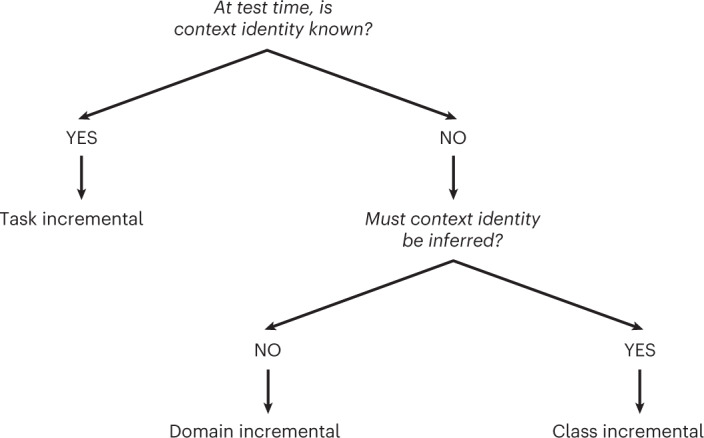
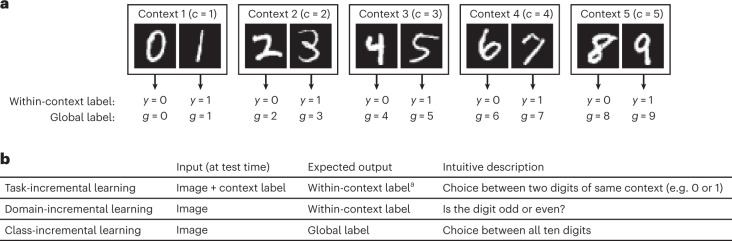
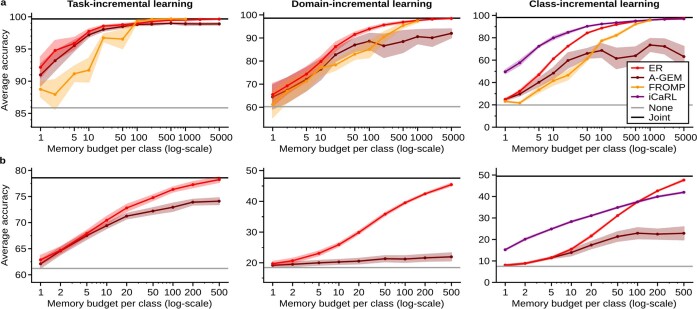
Incrementally learning new information from a non-stationary stream of data, referred to as ‘continual learning’, is a key feature of natural intelligence, but a challenging problem for deep neural networks. In recent years, numerous deep learning methods for continual learning have been proposed, but comparing their performances is difficult due to the lack of a common framework. To help address this, we describe three fundamental types, or ‘scenarios’, of continual learning: task-incremental, domain-incremental and class-incremental learning. Each of these scenarios has its own set of challenges. To illustrate this, we provide a comprehensive empirical comparison of currently used continual learning strategies, by performing the Split MNIST and Split CIFAR-100 protocols according to each scenario. We demonstrate substantial differences between the three scenarios in terms of difficulty and in terms of the effectiveness of different strategies. The proposed categorization aims to structure the continual learning field, by forming a key foundation for clearly defining benchmark problems.
Overview
The claims and statistics of this paper haven’t been checked yet.
Free: it reads the open-access text and checks the first 5 claims that cite a source we can check. Create a free account to check every claim.
Integrity signals
Registry
Cites
Statistics
Figures

Verification
Claims the paper makes
The claims and statistics of this paper haven’t been checked yet.
Free: it reads the open-access text and checks the first 5 claims that cite a source we can check. Create a free account to check every claim.
Claims other papers make about this one
Each is checked against this paper’s own text: does it say what the citing paper says it does?
The cited source says what the claim attributes to it.
In the citing paper
“To avert catastrophic forgetting, various algorithms[11, 48, 49] employ task-specific components or design separate networks for each task.”
From Few-Shot Class-Incremental Learning for Classification and Object Detection: A Survey (2025) · cites this paper as [11]
The cited source says what the claim attributes to it.
In the citing paper
“DIL is an ML problem designed to continuously adapt to data distribution from different domains while the structure of the problem is always the same [11].”
From Few-Shot Class-Incremental Learning for Classification and Object Detection: A Survey (2025) · cites this paper as [11]
The cited source says what the claim attributes to it.
In the citing paper
“TIL's primary challenge lies in identifying shared features across tasks to balance performance and computational complexity, using knowledge from one task to enhance performance in others [11].”
From Few-Shot Class-Incremental Learning for Classification and Object Detection: A Survey (2025) · cites this paper as [11]
Self-check
Percentages, sums and reported differences re-computed from the paper’s own numbers.
The self-check needs the paper’s full text.
Citations
Cites
Adam: A Method for Stochastic Optimization
Kingma, D. P., & Ba, J. (2014) · arXiv · doi:10.48550/arxiv.1412.6980 · Cited by 98,946
Gradient-based learning applied to document recognition
Lecun, Y., Bottou, L., Bengio, Y., & Haffner, P. (1998) · Proceedings of the IEEE · doi:10.1109/5.726791 · Cited by 58,805 · cited 1×
“For the Split MNIST protocol, the MNIST dataset 66 was split into five contexts, such that each context contained two digits.”
Auto-Encoding Variational Bayes
Kingma, D. P., & Welling, M. (2013) · arXiv · doi:10.48550/arxiv.1312.6114 · Cited by 20,067
Distilling the Knowledge in a Neural Network
Hinton, G., Vinyals, O., & Dean, J. (2015) · arXiv · doi:10.48550/arxiv.1503.02531 · Cited by 14,204
(2017) · Cited by 11,625
Overcoming catastrophic forgetting in neural networks
Kirkpatrick, J., Pascanu, R., Rabinowitz, N., Veness, J., Desjardins, G., Rusu, A. A., Milan, K., Quan, J., Ramalho, T., Grabska-Barwinska, A., et al. (2017) · Proceedings of the National Academy of Sciences · doi:10.1073/pnas.1611835114 · Cited by 7,899 · cited 9×
“A few years ago this scenario was regularly studied with Permuted MNIST 31,49,61 , but this protocol is not often used any-more as it is considered too artificial.”
InfluentialLi, Z., & Hoiem, D. (2018) · IEEE Transactions on Pattern Analysis and Machine Intelligence · doi:10.1109/tpami.2017.2773081 · Cited by 4,202
iCaRL: Incremental Classifier and Representation Learning
Rebuffi, S.-A., Kolesnikov, A., Sperl, G., & Lampert, C. H. (2017) · 2017 IEEE Conference on Computer Vision and Pattern Recognition (CVPR) · doi:10.1109/cvpr.2017.587 · Cited by 3,988
Catastrophic Interference in Connectionist Networks: The Sequential Learning Problem
McCloskey, M., & Cohen, N. J. (1989) · Psychology of Learning and Motivation · doi:10.1016/s0079-7421(08)60536-8 · Cited by 3,770
Catastrophic forgetting in connectionist networks
French, R. (1999) · Trends in Cognitive Sciences · doi:10.1016/s1364-6613(99)01294-2 · Cited by 2,311 · cited 16×
“During training on context K , the regularization term of FROMP was given by: with τ a hyperparameter controlling the regularization strength (which was set based on a grid search, see Supplementary Note 8) and ̂ θ ∗ the parameter vector with values as they were at the end of training on context K − 1.”
Influential
Research works printed but not linked: 16
- Chen Z Liu B Lifelong machine learning Synth. Lect. Artif. Intell. Mach. Learn. 2018 12 1 207
- Mundt, M., Lang, S., Delfosse, Q. & Kersting, K. CLEVA-compass: A continual learning evaluation assessment compass to promote research transparency and comparability. In International Conference on Learning Representations (2022).
- Ruvolo, P. & Eaton, E. ELLA: An efficient lifelong learning algorithm. In International Conference on Machine Learning 507–515 (PMLR, 2013).
- Ramesh, R. & Chaudhari, P. Model Zoo: A growing brain that learns continually. In International Conference on Learning Representations (2022).
- Lopez-Paz, D. & Ranzato, M. Gradient episodic memory for continual learning. In Advances in Neural Information Processing Systems Vol. 30, 6470–6479 (2017).
- Mirza, M. J., Masana, M., Possegger, H. & Bischof, H. An efficient domain-incremental learning approach to drive in all weather conditions. In Proceedings of the IEEE/CVF Conference on Computer Vision and Pattern Recognition (CVPR) Workshops 3001–3011 (2022).
- von Oswald, J., Henning, C., Sacramento, J. & Grewe, B. F. Continual learning with hypernetworks. In International Conference on Learning Representations (2020).
- Shin, H., Lee, J. K., Kim, J. & Kim, J. Continual learning with deep generative replay. In Advances in Neural Information Processing Systems Vol. 30, 2994–3003 (2017).
- Caccia, L., Belilovsky, E., Caccia, M. & Pineau, J. Online learned continual compression with adaptive quantization modules. In International Conference on Machine Learning 1240–1250 (PMLR, 2020).
- Lee, S., Ha, J., Zhang, D. & Kim, G.A neural dirichlet process mixture model for task-free continual learning. In International Conference on Learning Representations (2020).
- Jin, X., Sadhu, A., Du, J. & Ren, X. Gradient-based editing of memory examples for online task-free continual learning. In Advances in Neural Information Processing Systems Vol. 34, 29193–29205 (2021).
- Rolnick, D., Ahuja, A., Schwarz, J., Lillicrap, T. & Wayne, G. Experience replay for continual learning. In Advances in Neural Information Processing Systems Vol. 32 (2019).
- Aljundi, R. et al. Online continual learning with maximally interfered retrieval. In Advances in Neural Information Processing Systems Vol. 32 (2019). · DOI · Paper page
- Hess, T., Mundt, M., Pliushch, I. & Ramesh, V. A procedural world generation framework for systematic evaluation of continual learning. In Thirty-fifth Conference on Neural Information Processing Systems, Datasets and Benchmarks Track (2021).
- Ioffe, S. & Szegedy, C. Batch normalization: Accelerating deep network training by reducing internal covariate shift. In International Conference on Machine Learning 448–456 (PMLR, 2015).
- Rezende, D. & Mohamed, S. Variational inference with normalizing flows. In International Conference on Machine Learning 1530–1538 (PMLR, 2015).
Cited by
Items 501–600 of 770
Outsmarting Spam: Resilient Model for Concept Drift and Evolving Threats
Yanni, G. S., Salah, H., & Maghraby, F. A. (2024) · International Conference on Computer Theory and Applications (ICCTA) · doi:10.1109/iccta64612.2024.10974776 · Cited by 1
Zeng, H., Shen, W., Wu, H., Dong, M., Lin, W., & Chen, C. L. P. (2025) · Future Generation Computer Systems · doi:10.1016/j.future.2025.108021 · Cited by 1
Exemplar sampling algorithm for instance incremental learning on imbalanced document datasets
Pham, T.-C., Coustaty, M., Joseph, A., Deloin, G., d’Andecy, V. P., & Doucet, A. (2025) · International Journal on Document Analysis and Recognition (IJDAR) · doi:10.1007/s10032-025-00549-3 · Cited by 1
“There are two popular types of IL [13]: 1) Class Incremental Learning (CIL), which discriminates between incrementally observed categories or classes; 2) Instance Incremental Learning (or Domain Incremental Learning) to solve the same problem in different contexts.”
S 2 IL : Structurally Stable Incremental Learning
Balasubramanian, S., Krishna, P. Y., Sriram, T. S., Sai Subramaniam, M., Sai, M. P. P., & Mukkamala, R. (2025) · IEEE Access · doi:10.1109/access.2025.3642464 · Cited by 1
Family of Move-to-Data Methods for Online Continual Learning for Deep Neural NetworksPreprint
Ayyar, M. P., Poursanidis, M., Benois‐Pineau, J., Zemmari, A., Mansencal, B., & de Rugy, A. (2023) · SSRN Electronic Journal · doi:10.2139/ssrn.4659402 · Cited by 1
Distal Interference: Exploring the Limits of Model-Based Continual LearningPreprint
van Deventer, H., & Bosman, A. S. (2024) · arXiv (Cornell University) · doi:10.48550/arxiv.2402.08255 · Cited by 2
“The challenge of continual (incremental or life-long) learning is exacerbated by the unavailability of data from old tasks while training on new tasks (Parisi et al., 2019; Chen et al., 2018; Delange et al., 2021; van de Ven et al., 2022).”
BackgroundPermutation Invariant Learning with High-Dimensional Particle FiltersPreprint
Boopathy, A., Muppidi, A., Yang, P., Iyer, A., Yue, W., & Fiete, I. (2024) · arXiv (Cornell University) · doi:10.48550/arxiv.2410.22695 · Cited by 1
“This is known as catastrophic forgetting , where new information erases prior knowledge, severely degrading performance on earlier tasks (Kim & Han, 2023; van de Ven et al., 2022).”
BackgroundInferring non-coding RNA regulatory network from transcriptomic data and curated databasesPreprint
Ke, H., Ye, Z., Li, F., Xu, Z., Pan, R., Li, E., Qi, J., Chen, S., Liang, M., & Ma, T. (2025) · bioRxiv (Cold Spring Harbor Laboratory) · doi:10.1101/2025.04.10.648218 · Cited by 1
“We borrowed the idea from incremental learning 21 and proposed a computationally scalable algorithm to detect differential ncRNA regulatory network by first constructing an initial network from the reference condition and then updating to a new network using data from the other condition (see…”
Generative Network Correction to Promote Incremental Learning
Leo, J., & Kalita, J. K. (2025) · IEEE Transactions on Emerging Topics in Computational Intelligence · doi:10.1109/tetci.2025.3543370 · Cited by 1
“This continuous process however brings in more error to the model and impacts task accuracy [4], [5].”
What Neuroscience Can Teach AI About Learning in Continuously Changing EnvironmentsPreprint
Durstewitz, D., Averbeck, B. B., & Koppe, G. (2025) · arXiv (Cornell University) · doi:10.48550/arxiv.2507.02103 · Cited by 1
“For example, ML/AI algorithms for continual learning have so far been benchmarked mostly with incremental classification tasks, like task-incremental CIFAR (e.g. 33,34 ).”
Peire, N., Li, Y., & Schuller, B. W. (2026) · arXiv (Cornell University) · doi:10.48550/arxiv.2601.07858 · Cited by 1
Shao, X., Yan, Z., Sun, L., He, M., Chen, C., Zhang, J., Li, C., & Meng, Z. (2026) · arXiv (Cornell University) · doi:10.48550/arxiv.2604.09038 · Cited by 1
Revisiting Catastrophic Forgetting in Continual Knowledge Graph EmbeddingPreprint
Pons, G., Escolano, C., Bilalli, B., & Queralt, A. (2026) · arXiv (Cornell University) · doi:10.48550/arxiv.2604.19401 · Cited by 1
“Various studies have proposed taxonomies to categorize the different scenarios addressed in continual learning [24, 20].”
Machine learning models in anaesthesiology: bridging the gap from model training to implementation
King, C. R., & Fritz, B. A. (2026) · British Journal of Anaesthesia · doi:10.1016/j.bja.2026.03.022 · Cited by 1
On The Statistical Limits of Self-Improving Agents
Wang, C. L., Dorchen, K., & Jin, P. (2025) · arXiv · doi:10.48550/arxiv.2510.04399 · Cited by 6
“Continual learning addresses sequential task acquisition while mitigating catastrophic forgetting Kirkpatrick et al. 2017; Parisi et al. 2019; Van de Ven and Tolias 2022.”
Continual Learning for Classification Tasks
Xue-jun, H. (2023) · Carleton University's Institutional Repository (MacOdrum Library, Carleton University) · doi:10.22215/etd/2023-15555
Norman-Tenazas, R., Western, I., Vallabha, G. K., Roos, M. J., Johnson, E. C., & Robinson, B. S. (2023) · International Conference on Neuromorphic Systems (ICONS) · doi:10.1145/3589737.3605985
Evaluation of Continual Learning Methods for Object Hardness Recognition
Liu, Y., Fang, S., Liu, C., Wang, J., Mai, K., Zhang, Y., Yi, Z., & Wu, X. (2023) · IEEE International Conference on Real-time Computing and Robotics (RCAR) · doi:10.1109/rcar58764.2023.10249594
“The performance of different continual learning algorithms in this scenario has been investigated in [16], [21].”
BackgroundInfluentialAutonomous evolutionary learning for unmanned mobile platforms: Research progress and prospects
Zhang, Y., Wang, P., Zhang, L., & Yan, Q. (2023) · Chinese Science Bulletin (Chinese Version) · doi:10.1360/tb-2023-0811
Ahc-Rf-Svm: An Adaptive Short-Term Power Load Forecasting Method Based on Concept DriftsPreprint
Wan, Y., & Lv, S. (2024) · SSRN Electronic Journal · doi:10.2139/ssrn.4795204
Reducing calibration effort for brain-computer interfaces
Smedemark-Margulies, N. (2024) · Digital Repository Service (Northeastern University) · doi:10.17760/d20653003
Multi-style textile defect detection using distillation adaptation and representative sampling
Jiang, H., Huang, S., Jin, Z., Zhang, M., Chen, J., & Miao, X. (2024) · Journal of Electronic Imaging · doi:10.1117/1.jei.33.3.033025
Imran, M., Akram, M. U., Tiwana, M. I., Salam, A. A., & Greco, D. (2024) · Image and Vision Computing · doi:10.1016/j.imavis.2024.105098
Towards recognition of open-set speech forgery algorithms by using prototype learning
Zhao, Z., Zhang, H., Min, H., & Chen, Y. (2024) · International Conference on Algorithms, Microchips, and Network Applications (AMNA) · doi:10.1117/12.3031938
“Therefore, the model should have the ability to continuously learn new knowledge, i.e., incremental learning [7].”
BackgroundA Pipeline for Monitoring and Maintaining a Text Classification Tool in Production
Ohata, E. F., Mattos, C. L. C., & Rêgo, P. A. L. (2024) · Anais do Seminário Integrado de Software e Hardware (SEMISH) · doi:10.5753/semish.2024.2438 · Cited by 1
“It is also worth mentioning that in the case of massive data regimes, one should undersam-ple the training data, possibly with a bias towards newer instances, or pursue incremental learning strategies to update the model without fully retraining it [van de Ven et al. 2022].”
BackgroundOn-Chip Incremental Learning based on Unsupervised STDP Implementation
Chen, G., Cao, J., Feng, S., Wang, Z., Zhong, Y., Li, Q., Zhao, X., Zhang, X., & Wang, Y. (2024) · IEEE International Conference on Artificial Intelligence Circuits and Systems (AICAS) · doi:10.1109/aicas59952.2024.10595970
“This work was supported by the Beijing Aerospace Automatic Control There are three fundamental scenario settings in incremental learning: domain incremental learning, class incremental learning and task incremental learning [9].”
MethodBoum, M.-A., Herbin, S., Fournier, P., & Lassalle, P. (2024) · IEEE International Geoscience and Remote Sensing Symposium (IGARSS) · doi:10.1109/igarss53475.2024.10640659 · Cited by 1
Simione, R. L. (2024) · arXiv (Cornell University) · doi:10.48550/arxiv.2408.13624
Continual integration of single-cell multimodal data with MIRACLE
Zhou, J., Wang, J., Hu, S., Kan, T., Feng, C., Qiang, X., Dong, G., Shi, J., Liu, R., Bo, X., et al. (2026) · Nature Computational Science · doi:10.1038/s43588-026-01030-9 · Cited by 2
“CL enables models to incrementally incorporate new data while preserving previously acquired knowledge 17,18 .”
Multi-site Class-Incremental Learning with Weighted Experts in Echocardiography
Bransby, K. M., Kim, W.-J. C., OLIVEIRA, J. C., Thorley, A., Beqiri, A., Gómez, A., & Chartsias, A. (2024) · Lecture notes in computer science · doi:10.1007/978-3-031-73647-6_15
Incremental Learning for Salient Object Detection Using Data Withvaried Annotation GranularitiesPreprint
Zhang, H., Liu, T., Shang, Y., Ding, H., & Shao, Z. (2024) · SSRN Electronic Journal · doi:10.2139/ssrn.4978369
Adapt and Refine: A Few-Shot Class-Incremental Learner via Pre-Trained Models
Qiang, S., Xiong, Z., Liang, Y., Wan, J., & Zhang, D. (2024) · Lecture notes in computer science · doi:10.1007/978-981-97-8487-5_30
Adaptive Margin Global Classifier for Exemplar-Free Class-Incremental Learning
Yao, Z., & Chang, X. (2024) · Lecture notes in computer science · doi:10.1007/978-981-97-8487-5_33
Choi, Y. J., Yoo, M. K., & Park, Y. R. (2024) · arXiv (Cornell University) · doi:10.48550/arxiv.2411.05846
Balancing efficiency and accuracy: incremental learning as a key to big data processing
Talakh, M., Ushenko, Y., Kaduk, O., & Maksymovych, M. (2024) · Optoelectronic Information-Power Technologies · doi:10.31649/1681-7893-2024-48-2-45-57
Nimmagadda, Y. (2024) · Wiley eBooks · doi:10.1002/9781394219230.ch11
Su, S., Chen, Z., Liang, G., Zhang, S., & Zhang, Y. (2024) · Lecture notes in computer science · doi:10.1007/978-3-031-78189-6_3
Joint Event Detection with Dynamic Adaptation and Semantic Relevance
Zeng, X., Luo, G., & Qin, K. (2025) · Electronics · doi:10.3390/electronics14020234
“Incremental learning (IL) [18–22] has been widely employed to address issues re-lated to evolving and expanding datasets.”
Improving Recall in Sparse Associative Memories That Use Neurogenesis
Warr, K., Hare, J. S., & Thomas, D. (2025) · Neural Computation · doi:10.1162/neco_a_01732
Explainable AI in Time-Sensitive Scenarios: Prefetched Offline Explanation Model
Russo, F. M., Metta, C., Monreale, A., Rinzivillo, S., & Pinelli, F. (2025) · Lecture notes in computer science · doi:10.1007/978-3-031-78980-9_11 · Cited by 2
“Techniques such as incremental learning models [17] have also been adapted to provide explanations on-the-fly.”
Hingmire, A. (2024) · Advances in Nonlinear Variational Inequalities · doi:10.52783/anvi.v28.2930
“Incremental learning allows the model to change over time while keeping previously learned information, in contrast to classical learning, which necessitates retraining the model from scratch [22].”
Enabling Domain Experts to Train Efficient Few-Shot Incremental Landmark Recognition
Neuschmied, H., & Bailer, W. (2024) · International Workshop on Content-Based Multimedia Indexing (CBMI) · doi:10.1109/cbmi62980.2024.10859238
Generalization challenges and strategies in tunnel boring machine performance prediction
Huang, S., Korfiatis, G. P., & Sousa, R. L. (2025) · Civil Engineering Design · doi:10.1002/cend.202400047
Incremental Learning with Pseudo Labels for Enhanced Glomeruli Segmentation Using SAM
Liu, X., Peng, B., Zhu, X., Iwasaki, T., Sato, A., Kazama, J. J., & Huang, J. (2024) · IEEE International Conference on e-Health Networking, Applications and Services (Healthcom) · doi:10.1109/healthcom60970.2024.10880797
“2) Incremental learning with Pseudo labels: Incremental learning progressively trains a model by incorporating new data, allowing continuous improvement without complete re-training [16].”
An Attention-Based Representation Distillation Baseline for Multi-label Continual Learning
Menabue, M., Frascaroli, E., Boschini, M., Bonicelli, L., Porrello, A., & Calderara, S. (2025) · Lecture notes in computer science · doi:10.1007/978-3-031-82481-4_15
A Domain Incremental Continual Learning Benchmark for ICU Time Series Model Transportability
King, R., Krueger, C., Veselka, E., Yang, T., & Mortazavi, B. J. (2024) · IEEE-EMBS International Conference on Biomedical and Health Informatics (BHI ...) · doi:10.1109/bhi62660.2024.10913656
“…loss (BCE or CE) on random samples from the memory buffer for the respective benchmark task; the model trains on a random sample from the memory buffer for each sample trained from the current source and the respective losses are weighted proportionally to the number of sources seen so far [7].”
BackgroundMethodFeTT: Class-Incremental Learning with Feature Transformation Tuning
Qiang, S., & Liang, Y. (2025) · Mathematics · doi:10.3390/math13071095
Edge Exemplars Enhanced Incremental Learning Model for Tor-Obfuscated Traffic Identification
Lv, S., Wang, Z., Sun, Y., Wang, C., & Wang, B. (2025) · Electronics · doi:10.3390/electronics14081589
Continual Learning Based on Multi-Teacher Knowledge Distillation
Zai, G., Wu, Y., Li, Y., Wang, H., & Liu, Y. (2025) · International Conference on Consumer Electronics and Computer Engineering (ICCECE) · doi:10.1109/iccece65250.2025.10984626
“Continual learning, including Task-Incremental Learning (TIL), Domain-Incremental Learning (DIL), and Class-Incremental Learning (CIL) [4] , helps address challenges in dynamic environments where data distributions shift.”
A System 1 and System 2 Perspective on Continual Learning for Practical Implementation
Chavan, V., Heimann, O., & Krüger, J. (2025) · Lecture notes in computer science · doi:10.1007/978-3-031-91578-9_25 · Cited by 1
A brain-inspired projection contrastive learning network for instantaneous learning
Yang, Y. (2025) · Engineering Applications of Artificial Intelligence · doi:10.1016/j.engappai.2025.111524
Conclusions and Remaining Challenges
Wang, D., Shang, L., & Zhang, Y. (2025) · Springer eBooks · doi:10.1007/978-3-031-90080-8_11
Dedicated Class Subnetworks for SNN Class Incremental Learning
Warr, K., Hare, J. S., & Thomas, D. B. (2025) · Neuro Inspired Computational Elements Conference (NICE) · doi:10.1109/nice65350.2025.11064919
“The contribution of this work is the exploration of an unconventional approach to learning that results in a model: ) [19].”
Research on Cloud-Edge Collaborative Fall Detection Methods for Personalized Applications
Li, B., & Yuan, P. (2025) · International Conference on Sensor-Cloud and Edge Computing System (SCECS) · doi:10.1109/scecs65243.2025.11065748
CLOFAI: A Dataset of Real And Fake Image Classification Tasks for Continual Learning
Doherty, W. O. S., Lee, A., & Gomes, H. M. (2025) · Communications in computer and information science · doi:10.1007/978-981-96-6688-1_24 · Cited by 1
ILSPP: A Multi-Layer Security Level Phishing URL Detection Model
Liu, Y., Wang, Y., Zhou, L., & Wang, T. (2025) · Communications in computer and information science · doi:10.1007/978-981-95-0017-8_42
Incremental learning based fuzzy reasoning approach for diagnosis of thyroid disease
Ramanathan, T. T., & Hossen, M. J. (2025) · Bulletin of Electrical Engineering and Informatics · doi:10.11591/eei.v14i4.9140
IoT-ILDI: Incremental Learning for Device Identification in IoT
Li, X., Chen, Y., & Tang, Z. (2025) · Lecture notes of the Institute for Computer Sciences, Social Informatics and Telecommunications Engineering · doi:10.1007/978-3-031-93254-0_14
Learning strategies for optimised fitness in a model of cyclic dominance
Yu, H., & Jack, R. L. (2025) · New Journal of Physics · doi:10.1088/1367-2630/adfd05
Brain Generative Replay for Continual Learning
Zhou, J., Liu, D., & Kong, W. (2025) · Lecture notes in computer science · doi:10.1007/978-3-032-04558-4_15
Jangde, K., & Pandey, R. (2024) · Journal of Carcinogenesis · doi:10.64149/j.carcinog.24.4s.295-303
Empowering Scalable Fraud Detection Using Graph Neural Networks and Incremental Learning
Kumar, M. R., Gumasthi, N., Sangani, K., Singla, S., & Rao, S. N. (2025) · Lecture notes in computer science · doi:10.1007/978-3-032-02728-3_11 · Cited by 1
Incremental Learning for Object Detection of Unmanned Ariel Vehicles
Haq, Q. M. U., Chandrasekaran, N., & Sohail, M. A. (2025) · International Conference on Image, Video and Signal Processing (IVSP) · doi:10.1145/3749859.3749865
Accurate Online Data Application
Zhu, X., Liu, Y., & Wang, C. (2025) · SpringerBriefs in computer science · doi:10.1007/978-981-96-9385-6_5
Dong, M., Li, R., & Liu, F. (2025) · Applied Sciences · doi:10.3390/app151910757
Ngo, H. P., Vi, B. N., Phan, H., & Nguyen, C. C. (2025) · Journal of Military Science and Technology · doi:10.54939/1859-1043.j.mst.106.2025.129-136
Incremental Spatiotemporal Disentangled Learning for Uncertain Ocean Temperature Fields
Lei, L., Wen, J., Yang, G., Chen, X., & Chen, B. M. (2025) · Chinese Control Conference (CCC) · doi:10.23919/ccc64809.2025.11178292
The Naïve Bayes Classifier++ as an Out-of-Distribution Detector of Novel TaxaPreprint
Ramjattun, K., & ROSEN, G. L. (2025) · bioRxiv (Cold Spring Harbor Laboratory) · doi:10.1101/2025.10.18.683227
SR-ML: A Sequence-level Routing with Mixed Low-rank Experts Framework for Continual Learning
Zheng, T., & Li, S.-Y. (2025) · doi:10.1145/3746260.3762127
DLLM: Enhancing Open-World Object Detection with Dynamic Learning and Large Models
Huang, Y., Xi, X., & Luo, R. (2025) · IEEE International Conference on Multimedia and Expo (ICME) · doi:10.1109/icme59968.2025.11209937 · Cited by 2
Lock the look: Recommending trendy looks for fashion products using natural language processing
Mallik, M., Thakur, T., & Chowdhury, C. (2025) · Entertainment Computing · doi:10.1016/j.entcom.2025.101049
Caption, Create, Continue: Continual Learning with Pre-trained Generative Vision-Language Models
Solomon, I., Aung, A. P. P., Kumar, U., & Senthilnath, J. (2025) · ACM International Conference on Information and Knowledge Management (CIKM) · doi:10.1145/3746252.3760926
Sung, C.-C., Hsin, C.-H., Shiah, Y.-A., Lin, B.-J., Lai, Y.-X., Lee, C., Wang, Y.-T., Su, B., & Tsao, Y. (2026) · IEEE Transactions on Neural Systems and Rehabilitation Engineering · doi:10.1109/tnsre.2026.3694178 · Cited by 1
“Our approach integrates three complementary learning paradigms to develop a personalized classification framework for alpha-band EEG activity: self-supervised learning (SSL) [65], [66], [67], incremental learning (IL) [68], [69], and fine-tuning (F-T) [70], [71], [72].”
Bayle, R., Mermillod, M., & French, R. M. (2025) · arXiv (Cornell University) · doi:10.48550/arxiv.2511.08226
Tactile-Visual Class-Continual Learning via Temporal Attention Interaction
Wei, L., Ma, Y., Lin, Z., Ying, X., Jin, C., & Wang, F. (2025) · International Joint Conference on Neural Networks (IJCNN) · doi:10.1109/ijcnn64981.2025.11228945
On Sequential Maximum a Posteriori Inference for Continual Learning
Zhu, M. W. W., & Kuruoğlu, E. E. (2025) · International Joint Conference on Neural Networks (IJCNN) · doi:10.1109/ijcnn64981.2025.11227930
Position Paper: A new Perspective on Online Continual Learning
Navarin, N., Betti, A., & Gori, M. (2025) · International Joint Conference on Neural Networks (IJCNN) · doi:10.1109/ijcnn64981.2025.11228303
Dynamic gain neuromodulation attenuates stability gaps during continual joint training
Rodriguez-Garcia, A., Ghosh, A., & Ramaswamy, S. (2026) · Neural Networks · doi:10.1016/j.neunet.2026.109767 · Cited by 1
“Continual learning (CL) in artificial neural networks aims to emulate lifelong adaptability observed in biology, where networks continuously acquire new data without catastrophically overwriting knowledge from past examples (van de Ven et al., 2022; Kudithipudi et al., 2022; Mei et al., 2026).”
InfluentialFine-tuning Deep Convolutional Neural Networks on Caltech-101: An Application of Transfer Learning
Christopherson, I., Combs, K., & Soriano, K. (2025) · IEEE National Aerospace and Electronics Conference (NAECON) · doi:10.1109/naecon65708.2025.11235477
“Due to computational resources and time limitations, it is infeasible for artificial intelligence (AI) systems to train on every possible scenario they may encounter [1, 2].”
Operational Evaluation of Algorithms for Online Streaming Continual Multi-Label Classification
Peuzet, H., Kuntz, P., Meyer, F., Lemaire, V., & Mau, K. L. (2025) · IEEE International Conference on Data Science and Advanced Analytics (DSAA) · doi:10.1109/dsaa65442.2025.11247971
“From the concepts introduced in multi-label streaming classification [34] and in continual learning [22], [35], we here propose a new formalization that is a prerequisite for the construction of an evaluation protocol.”
Batch self-organizing memory neural network for continual supervised learning
Niu, J., & Ma, X. (2025) · Neural Networks · doi:10.1016/j.neunet.2025.108390 · Cited by 1
Halfpap, I., & Djurovic, Z. (2025) · Journal of Scientific & Industrial Research · doi:10.56042/jsir.v84i10.18406
Balancing Specialization and Generalization Trade-Off for Speech Recognition Models
Cygert, S., Despot-Mładanowicz, P., & Czyżewski, A. (2025) · Electronics · doi:10.3390/electronics14244792
Meng, F., Zhan, Y., Zhang, J., Wang, Z., & Xia, Y. (2025) · ACM International Conference on Multimedia in Asia (MMAsia) · doi:10.1145/3743093.3771068 · Cited by 1
BiSDA: Bidirectional Self-Refining Domain Adaptation for Streaming-Evolving Industrial Soft Sensing
Chen, G., Gao, W., Yang, Z., Chen, X., Li, J., & Luo, C. (2025) · IEEE Transactions on Industrial Electronics · doi:10.1109/tie.2025.3637394
“Traditional domain adaptation-based methods [10], [11] typically perform one-off adaptation with preaccessed data and are not suited for incremental domain shift in industrial streams [8].”
Regulation of Plasticity at Individual Dendritic Spine Synapses
Flores, J. C. (2024) · eScholarship (California Digital Library)
Incremental Learning Approaches for Flood Detection in Dynamic River Environments
Coletti, O. F., Neves, S. M., Ranieri, C. M., Ramachandran, G. S., Jurdak, R., & Ueyama, J. (2025) · doi:10.5753/eniac.2025.12389
“Using the terminology defined in [van de Ven et al. 2022], our problem is best characterized as a domain-incremental learning (Domain-IL) scenario.”
Heads collapse, features stay: Why Replay needs big buffers
Lanzillotta, G., Meier, D., & Hofmann, T. (2026) · International Conference on Learning Representations · doi:10.48550/arxiv.2512.07400
Advances in Continual Graph Learning for Anti‐Money Laundering Systems
Deprez, B., Wei, W., Verbeke, W., Baesens, B., Mets, K., & Verdonck, T. (2025) · Lirias
Tekstil tabanlı basınç sensörü dizisinde hareket algılama ve kişiselleştirme
Çelik, İ. (2024) · Istanbul Technical University Academic Open Archive (Istanbul Technical University)
Zhao, J., Feng, J., Feng, B., Dong, L., & Ge, R. (2025) · International Conference on Power System Technology (POWERCON) · doi:10.1109/powercon66300.2025.11295511
“Also known as continual learning, this machine learning paradigm enables models to efficiently acquire new knowledge from streaming data while preventing catastrophic forgetting-constituting its core objective [11].”
Multi-fidelity aerodynamic reduced-order model based on gating mechanism
Huailu, L. I., Yu, Z. H. U. O., Wang, X., & ZHANG, W. (2025) · Chinese Journal of Aeronautics · doi:10.1016/j.cja.2025.104055
Replay or Regret: Evaluating Continual Learning Methods for Robust Intrusion Detection
Costagliola, N. U., Ekinci, G., Bastian, N. D., Fiondella, L., & Kul, G. (2025) · IEEE Military Communications Conference (MILCOM) · doi:10.1109/milcom64451.2025.11310341
Abdula, C., Nishimwe, A., Batamuliza, J., António, V., & Bakunzibake, P. (2026) · Lecture notes in networks and systems · doi:10.1007/978-981-96-9048-0_51
Class Incremental Learning for Algorithm Selection in Continuous Optimisation
Nemeth, M. B., Hart, E., Sim, K., & Renau, Q. (2026) · Advances in intelligent systems and computing · doi:10.1007/978-3-032-07938-1_3
Maathuis, J., Veldhuis, A., Egbers, J. B., Geerdink, J., Karapinar‐Çarkit, F., van den Bemt, P. M. L. A., Hulshof, E. C., & Kingma, J. S. (2026) · International Journal of Clinical Pharmacy · doi:10.1007/s11096-025-02076-x
“In incremental learning the models are continuously updated with new training data, allowing the model to adapt over time and therefore potentially preventing AI drift (i.e. performance degradation due to shifts in clinical practice or population characteristics) [15, 16].”
Incremental Learning-Based Fault Diagnosis for Shipboard Power Systems
Lv, J., Lu, F., Guo, J., Mu, Y., & Ling, C. (2025) · International Conference on Electrical Machines and Systems (ICEMS) · doi:10.23919/icems66262.2025.11317336
“The core idea of incremental learning is to replicate the way humans learn continuously[5].”
Liu, M. X., Fang, Q., Gao, J., & Yang, Y. (2026) · Lecture notes in computer science · doi:10.1007/978-981-95-4987-0_20
Metadata
- Authors
- van de Ven, G. M., Tuytelaars, T., & Tolias, A. S.
- Affiliations
- Baylor College of Medicine (US)
- KU Leuven (BE)
- Corresponding author
- van de Ven, Gido M.
- Venue
- Nature Machine Intelligence
- Published
- 2022-12-05
- Volume
- 4
- Issue
- 12
- Pages
- 1185-1197
- ISSN
- 2522-5839 (ISSN-L)
- PMC
- PMC9771807
- OpenAlex
- W4312210066
- Cited by
- 665
- References
- 43
- Citations by year
- 2026: 173 · 2025: 258 · 2024: 172 · 2023: 60 · 2022: 2
- FWCI
- 40.48
- Type
- journal article
- Language
- en
- Open access
- hybrid
- doi.org
- Licence
- cc-by
- creativecommons.org/licenses/by/4.0 (tdm)
- creativecommons.org/licenses/by/4.0 (vor)
- Locations
- Nature Machine Intelligence (publishedVersion, cc-by)
- PubMed Central (publishedVersion, cc-by)
- PubMed (publishedVersion)
- Lirias (KU Leuven) (submittedVersion, cc-by)
- Rice Research Repository (Rice University) (submittedVersion, cc-by)
- Apollo (University of Cambridge) (submittedVersion, cc-by)
- Apollo
- Funders
- International Brain Research Organization
- National Institutes of Health
- Defense Advanced Research Projects Agency (HR0011, HR0011-18-2-0025)
- Advanced Research Projects Agency
- Intelligence Advanced Research Projects Activity (D16PC00003)
- Interior Business Center
- National Institute of Mental Health (R01MH109556)
- National Eye Institute (P30EY002520)
- H2020 European Research Council (101021347)
- Topics
- Physical Sciences › Computer Science › Artificial Intelligence › Domain Adaptation and Few-Shot Learning
- Physical Sciences › Computer Science › Artificial Intelligence › Data Stream Mining Techniques
- Physical Sciences › Computer Science › Computer Vision and Pattern Recognition › Advanced Neural Network Applications
- Keywords
- continual learning, incremental learning, task-incremental learning, domain-incremental learning, class-incremental learning, catastrophic forgetting, non-stationary data streams, deep neural network
About these checks
Registry, retraction, Cites and statistics results are computed, not judged, with one exception: a printed reference that no index lists is read once by a model before it counts as a citation error. Claims are extracted by a model and kept only when their quote appears verbatim in the text; each cited source is then checked, with a model’s help, for whether it says what the claim relies on. Those verdicts can be wrong — read the claim’s quote and the cited source before relying on one.
Statistics and arithmetic are recomputed, not judged.
Confidence bands are shown only for fields calibrated on our annotated test set. None is calibrated yet, so no band is shown.
What counts as a claim ›How we measure confidence ›How we check this ›
Are you an author, or do you see a problem with this page? Request a review
Data sources
Bibliographic data: Semantic Scholar, OpenAlex, Crossref.
Contains information from the Semantic Scholar Academic Graph Datasets, made available under the ODC Attribution License (ODC-BY 1.0).
Semantic Scholar’s data is described in: Kinney, R., et al. (2023). The Semantic Scholar Open Data Platform. arXiv:2301.10140.
