

Consciousness and cortical responsiveness: a within-state study during non-rapid eye movement sleep
Open accessThe DOI matches its Crossref record; 52 of the 52 references it cites were found in a registry or an index.
Abstract
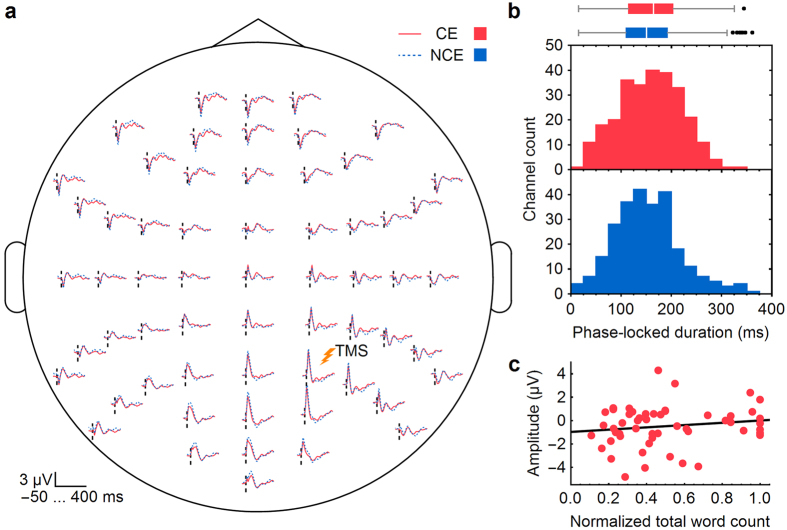
When subjects become unconscious, there is a characteristic change in the way the cerebral cortex responds to perturbations, as can be assessed using transcranial magnetic stimulation and electroencephalography (TMS–EEG). For instance, compared to wakefulness, during non-rapid eye movement (NREM) sleep TMS elicits a larger positive–negative wave, fewer phase-locked oscillations and an overall simpler response. However, many physiological variables also change when subjects go from wake to sleep, anesthesia, or coma. To avoid these confounding factors, we focused on NREM sleep only and measured TMS-evoked EEG responses before awakening the subjects and asking them if they had been conscious (dreaming) or not. As shown here, when subjects reported no conscious experience upon awakening, TMS evoked a larger negative deflection and a shorter phase-locked response compared to when they reported a dream. Moreover, the amplitude of the negative deflection—a hallmark of neuronal bistability according to intracranial studies—was inversely correlated with the length of the dream report (i.e., total word count). These findings suggest that variations in the level of consciousness within the same physiological state are associated with changes in the underlying bistability in cortical circuits.
Overview
The claims and statistics of this paper haven’t been checked yet.
Free: it reads the open-access text and checks the first 5 claims that cite a source we can check. Create a free account to check every claim.
Integrity signals
Registry
Cites
Statistics
Figures


Verification
Claims the paper makes
The claims and statistics of this paper haven’t been checked yet.
Free: it reads the open-access text and checks the first 5 claims that cite a source we can check. Create a free account to check every claim.
Claims other papers make about this one
Each is checked against this paper’s own text: does it say what the citing paper says it does?
The check wasn’t confident either way, so it gives no verdict — never disputed.
In the citing paper
“However, sleep strongly affected auditory-induced alpha–beta (10–30 Hz) desynchronization, which might reflect a lack of top-down attention, perhaps similar to what happens in neglect163.”
From Consciousness and sleep (2024) · cites this paper as [163]
Experimental — accuracy not yet measured
Self-check
Percentages, sums and reported differences re-computed from the paper’s own numbers.
The self-check needs the paper’s full text.
Citations
Cites
The Pittsburgh Sleep Quality Index: a new instrument for psychiatric practice and research
Buysse, D. J., Reynolds, C. F., Monk, T. H., Berman, S. R., & Kupfer, D. J. (1989) · Psychiatry Research · doi:10.1016/0165-1781(89)90047-4 · Cited by 35,234
Delorme, A., & Makeig, S. (2004) · Journal of Neuroscience Methods · doi:10.1016/j.jneumeth.2003.10.009 · Cited by 24,371
Cook, R. J., Dickens, B. M., & Fathalla, M. F. (2003) · Reproductive Health and Human Rights · doi:10.1093/acprof:oso/9780199241323.003.0025 · Cited by 10,769
Nonparametric statistical testing of EEG- and MEG-data
Maris, E., & Oostenveld, R. (2007) · Journal of Neuroscience Methods · doi:10.1016/j.jneumeth.2007.03.024 · Cited by 8,496
(2007) · Cited by 6,530
Mapping the structural core of human cerebral cortex
Hagmann, P., Cammoun, L., Gigandet, X., Meuli, R., Honey, C. J., Wedeen, V. J., & Sporns, O. (2008) · PLoS Biology · doi:10.1371/journal.pbio.0060159 · Cited by 4,173
Wassermann, E. M. (1998) · Electroencephalography and Clinical Neurophysiology/Evoked Potentials Section · doi:10.1016/s0168-5597(97)00096-8 · Cited by 2,293
Neural correlates of consciousness: progress and problems
Koch, C., Massimini, M., Boly, M., & Tononi, G. (2016) · Nature Reviews Neuroscience · doi:10.1038/nrn.2016.22 · Cited by 1,600
Self-citationCellular and network mechanisms of rhythmic recurrent activity in neocortex
Sanchez-Vives, M. V., & McCormick, D. A. (2000) · Nature Neuroscience · doi:10.1038/79848 · Cited by 1,539
Breakdown of cortical effective connectivity during sleep
Massimini, M., Ferrarelli, F., Huber, R., Esser, S. K., Singh, H., & Tononi, G. (2005) · Science · doi:10.1126/science.1117256 · Cited by 1,534
Self-citationNatural waking and sleep states: a view from inside neocortical neurons
Steriade, M., Timofeev, I., & Grenier, F. (2001) · Journal of Neurophysiology · doi:10.1152/jn.2001.85.5.1969 · Cited by 1,296
A theoretically based index of consciousness independent of sensory processing and behavior
Casali, A. G., Gosseries, O., Rosanova, M., Boly, M., Sarasso, S., Casali, K. R., Casarotto, S., Bruno, M.-A., Laureys, S., Tononi, G., et al. (2013) · Science Translational Medicine · doi:10.1126/scitranslmed.3006294 · Cited by 1,246
Self-citationThe sleep slow oscillation as a traveling wave
Massimini, M., Huber, R., Ferrarelli, F., Hill, S., & Tononi, G. (2004) · The Journal of Neuroscience · doi:10.1523/jneurosci.1318-04.2004 · Cited by 1,221
Self-citationFrom the phenomenology to the mechanisms of consciousness: integrated information theory 3.0
Oizumi, M., Albantakis, L., & Tononi, G. (2014) · PLoS Computational Biology · doi:10.1371/journal.pcbi.1003588 · Cited by 1,128
Self-citationvan Kerkoerle, T., Self, M. W., Dagnino, B., Gariel-Mathis, M.-A., Poort, J., van der Togt, C., & Roelfsema, P. R. (2014) · Proceedings of the National Academy of Sciences · doi:10.1073/pnas.1402773111 · Cited by 918
The neural correlates of dreaming
Siclari, F., Baird, B., Perogamvros, L., Bernardi, G., LaRocque, J. J., Riedner, B., Boly, M., Postle, B. R., & Tononi, G. (2017) · Nature Neuroscience · doi:10.1038/nn.4545 · Cited by 758
Self-citationMichalareas, G., Vezoli, J., van Pelt, S., Schoffelen, J.-M., Kennedy, H., & Fries, P. (2016) · Neuron · doi:10.1016/j.neuron.2015.12.018 · Cited by 696
Natural Frequencies of Human Corticothalamic Circuits
Rosanova, M., Casali, A., Bellina, V., Resta, F., Mariotti, M., & Massimini, M. (2009) · Journal of Neuroscience · doi:10.1523/jneurosci.0445-09.2009 · Cited by 695
Self-citationPhase Synchrony among Neuronal Oscillations in the Human Cortex
Palva, J. M., Palva, S., & Kaila, K. (2005) · The Journal of Neuroscience · doi:10.1523/jneurosci.4250-04.2005 · Cited by 659
Dreaming and the brain: from phenomenology to neurophysiology
Nir, Y., & Tononi, G. (2010) · Trends in Cognitive Sciences · doi:10.1016/j.tics.2009.12.001 · Cited by 595
Self-citationDream reports from different stages of sleep
Foulkes, W. D. (1962) · The Journal of Abnormal and Social Psychology · doi:10.1037/h0040431 · Cited by 563
Breakdown in cortical effective connectivity during midazolam-induced loss of consciousness
Ferrarelli, F., Massimini, M., Sarasso, S., Casali, A., Riedner, B. A., Angelini, G., Tononi, G., & Pearce, R. A. (2010) · Proceedings of the National Academy of Sciences · doi:10.1073/pnas.0913008107 · Cited by 554
Self-citationNielsen, T. A. (2000) · Behavioral and Brain Sciences · doi:10.1017/s0140525x0000399x · Cited by 521
Neural decoding of visual imagery during sleep
Horikawa, T., Tamaki, M., Miyawaki, Y., & Kamitani, Y. (2013) · Science · doi:10.1126/science.1234330 · Cited by 498
Triggering sleep slow waves by transcranial magnetic stimulation
Massimini, M., Ferrarelli, F., Esser, S. K., Riedner, B. A., Huber, R., Murphy, M., Peterson, M. J., & Tononi, G. (2007) · Proceedings of the National Academy of Sciences · doi:10.1073/pnas.0702495104 · Cited by 489
Self-citationHow neuroscience will change our view on consciousness
Lamme, V. A. F. (2010) · Cognitive Neuroscience · doi:10.1080/17588921003731586 · Cited by 487
Recovery of cortical effective connectivity and recovery of consciousness in vegetative patients
Rosanova, M., Gosseries, O., Casarotto, S., Boly, M., Casali, A. G., Bruno, M.-A., Mariotti, M., Boveroux, P., Tononi, G., Laureys, S., et al. (2012) · Brain · doi:10.1093/brain/awr340 · Cited by 457 · cited 2×
“The stimulation and recording procedures were similar to our previous experiments 7,10 (see also Methods).”
Self-citationConsciousness and Complexity during Unresponsiveness Induced by Propofol, Xenon, and Ketamine
Sarasso, S., Boly, M., Napolitani, M., Gosseries, O., Charland-Verville, V., Casarotto, S., Rosanova, M., Casali, A. G., Brichant, J.-F., Boveroux, P., et al. (2015) · Current Biology · doi:10.1016/j.cub.2015.10.014 · Cited by 399
Self-citationIntegrated information theory of consciousness: an updated account.
(2012) · PubMed · doi:10.4449/aib.v149i5.1388 · Cited by 370
Self-citationThe precuneus and consciousness
Cavanna, A. E. (2007) · CNS Spectrums · doi:10.1017/s1092852900021295 · Cited by 363
The role of the coil click in TMS assessed with simultaneous EEG
Nikouline, V., Ruohonen, J., & Ilmoniemi, R. J. (1999) · Clinical Neurophysiology · doi:10.1016/s1388-2457(99)00070-x · Cited by 269
Casarotto, S., Romero Lauro, L. J., Bellina, V., Casali, A. G., Rosanova, M., Pigorini, A., Defendi, S., Mariotti, M., & Massimini, M. (2010) · PLoS ONE · doi:10.1371/journal.pone.0010281 · Cited by 222
Self-citationBergmann, T. O., Mölle, M., Schmidt, M. A., Lindner, C., Marshall, L., Born, J., & Siebner, H. R. (2012) · The Journal of Neuroscience · doi:10.1523/jneurosci.4792-11.2012 · Cited by 204
Cortical reactivity and effective connectivity during REM sleep in humans
Massimini, M., Ferrarelli, F., Murphy, M. J., Huber, R., Riedner, B. A., Casarotto, S., & Tononi, G. (2010) · Cognitive Neuroscience · doi:10.1080/17588921003731578 · Cited by 202
Self-citationBistability breaks-off deterministic responses to intracortical stimulation during non-REM sleep
Pigorini, A., Sarasso, S., Proserpio, P., Szymanski, C., Arnulfo, G., Casarotto, S., Fecchio, M., Rosanova, M., Mariotti, M., Lo Russo, G., et al. (2015) · NeuroImage · doi:10.1016/j.neuroimage.2015.02.056 · Cited by 200
Self-citationSiclari, F., Bernardi, G., Riedner, B. A., LaRocque, J. J., Benca, R. M., & Tononi, G. (2014) · Sleep · doi:10.5665/sleep.4070 · Cited by 181
Self-citationAssessing sleep consciousness within subjects using a serial awakening paradigm
Siclari, F., LaRocque, J. J., Postle, B. R., & Tononi, G. (2013) · Frontiers in Psychology · doi:10.3389/fpsyg.2013.00542 · Cited by 178
Self-citationThe Effect of Stimulus Parameters on TMS–EEG Muscle Artifacts
Mutanen, T., Mäki, H., & Ilmoniemi, R. J. (2013) · Brain Stimulation · doi:10.1016/j.brs.2012.07.005 · Cited by 146
Why Does Consciousness Fade in Early Sleep?
Tononi, G., & Massimini, M. (2008) · Annals of the New York Academy of Sciences · doi:10.1196/annals.1417.024 · Cited by 130
Self-citationRagazzoni, A., Pirulli, C., Veniero, D., Feurra, M., Cincotta, M., Giovannelli, F., Chiaramonti, R., Lino, M., Rossi, S., & Miniussi, C. (2013) · PLoS ONE · doi:10.1371/journal.pone.0057069 · Cited by 120
Brain-mind states: reciprocal variation in thoughts and hallucinations
Fosse, R., Stickgold, R., & Hobson, J. A. (2001) · Psychological Science · doi:10.1111/1467-9280.00306 · Cited by 116
Recovering TMS-evoked EEG responses masked by muscle artifacts
Mutanen, T. P., Kukkonen, M., Nieminen, J. O., Stenroos, M., Sarvas, J., & Ilmoniemi, R. J. (2016) · NeuroImage · doi:10.1016/j.neuroimage.2016.05.028 · Cited by 111
Self-citationExperimental Characterization of the Electric Field Distribution Induced by TMS Devices
Nieminen, J. O., Koponen, L. M., & Ilmoniemi, R. J. (2015) · Brain Stimulation · doi:10.1016/j.brs.2015.01.004 · Cited by 109
Self-citationCortical mechanisms of loss of consciousness: insight from TMS/EEG studies.
Massimini, M., Ferrarelli, F., Sarasso, S., & Tononi, G. (2013) · PubMed · doi:10.4449/aib.v150i2.1361 · Cited by 99
Self-citationOn the Cerebral Origin of EEG Responses to TMS: Insights From Severe Cortical Lesions
Gosseries, O., Sarasso, S., Casarotto, S., Boly, M., Schnakers, C., Napolitani, M., Bruno, M., Ledoux, D., Tshibanda, J., Massimini, M., et al. (2014) · Brain stimulation · doi:10.1016/j.brs.2014.10.008 · Cited by 97
Self-citationMcNamara, P., Johnson, P., McLaren, D., Harris, E., Beauharnais, C., & Auerbach, S. (2010) · International review of neurobiology · doi:10.1016/s0074-7742(10)92004-7 · Cited by 92
Consciousness lost and found: Subjective experiences in an unresponsive state
Noreika, V., Jylhänkangas, L., Móró, L., Valli, K., Kaskinoro, K., Aantaa, R., Scheinin, H., & Revonsuo, A. (2011) · Brain and Cognition · doi:10.1016/j.bandc.2011.09.002 · Cited by 77
Cortical activation patterns herald successful dream recall after NREM and REM sleep
Chellappa, S. L., Frey, S., Knoblauch, V., & Cajochen, C. (2011) · Biological Psychology · doi:10.1016/j.biopsycho.2011.03.004 · Cited by 75
Early-night serial awakenings as a new paradigm for studies on NREM dreaming
Noreika, V., Valli, K., Lahtela, H., & Revonsuo, A. (2009) · International Journal of Psychophysiology · doi:10.1016/j.ijpsycho.2009.06.002 · Cited by 63
Methodological issues affecting the collection of dreams
WATERMAN, D., ELTON, M., & KENEMANS, J. L. (1993) · Journal of Sleep Research · doi:10.1111/j.1365-2869.1993.tb00053.x · Cited by 35
The neural correlates of dreamingPreprint
Siclari, F., Baird, B., Perogamvros, L., et al. (2014) · bioRxiv (Cold Spring Harbor Laboratory) · doi:10.1101/012443 · Cited by 21
Self-citation
Cited by
State-dependent effects of neural stimulation on brain function and cognition
Bradley, C., Nydam, A. S., Dux, P. E., & Mattingley, J. B. (2022) · Nature Reviews Neuroscience · doi:10.1038/s41583-022-00598-1 · Cited by 238
TMS combined with EEG: Recommendations and open issues for data collection and analysis
Hernandez-Pavon, J. C., Veniero, D., Bergmann, T. O., Belardinelli, P., Bortoletto, M., Casarotto, S., Casula, E. P., Farzan, F., Fecchio, M., Julkunen, P., et al. (2023) · Brain Stimulation · doi:10.1016/j.brs.2023.02.009 · Cited by 238
“The sourceinformed reconstruction (SIR) allows for interpolation of the channels based on the cortical current estimates based on the noncontaminated channels [218,224].”
Vucic, S., Stanley Chen, K.-H., Kiernan, M. C., Hallett, M., Benninger, D. H., Di Lazzaro, V., Rossini, P. M., Benussi, A., Berardelli, A., Currà, A., et al. (2023) · Clinical Neurophysiology · doi:10.1016/j.clinph.2023.03.010 · Cited by 212
Self-citationLocal aspects of sleep and wakefulness
Siclari, F., & Tononi, G. (2017) · Current Opinion in Neurobiology · doi:10.1016/j.conb.2017.05.008 · Cited by 207
Self-citationThe cognitive neuroscience of lucid dreaming
Baird, B., Mota-Rolim, S. A., & Dresler, M. (2019) · Neuroscience & Biobehavioral Reviews · doi:10.1016/j.neubiorev.2019.03.008 · Cited by 192
Metadata
- Authors
- Nieminen, J. O., Gosseries, O., Massimini, M., Saad, E., Sheldon, A. D., Boly, M., Siclari, F., Postle, B. R., & Tononi, G.
- Affiliations
- University of Wisconsin–Madison (US)
- University of Milan (IT)
- Corresponding author
- Tononi, Giulio
- ORCID
- Venue
- Scientific Reports
- Published
- 2016-08-05
- Volume
- 6
- Issue
- 1
- Pages
- 30932-30932
- ISSN
- 2045-2322 (ISSN-L)
- PMC
- PMC4974655
- OpenAlex
- W2482192283
- Cited by
- 61
- References
- 52
- Citations by year
- 2026: 2 · 2025: 6 · 2024: 3 · 2023: 6 · 2022: 5 · 2021: 6 · 2020: 7 · 2019: 10 · 2018: 5 · 2017: 10 · 2016: 1
- FWCI
- 5.50
- Type
- journal article
- Language
- en
- Open access
- gold
- doi.org
- Licence
- cc-by
- creativecommons.org/licenses/by/4.0 (tdm)
- creativecommons.org/licenses/by/4.0 (vor)
- Locations
- Scientific Reports (publishedVersion, cc-by)
- PubMed Central (publishedVersion, cc-by)
- PubMed (publishedVersion)
- IRIS (submittedVersion, cc-by)
- Aaltodoc (Aalto University) (submittedVersion, cc-by)
- Archivio Istituzionale della Ricerca (Universita Degli Studi Di Milano) (submittedVersion, other-oa)
- ORBi (University of Liège) (submittedVersion, other-oa)
- SERVAL (Université de Lausanne) (submittedVersion, other-oa)
- Funders
- National Science Foundation
- Schweizerischer Nationalfonds zur Förderung der Wissenschaftlichen Forschung (145763, 151743, 139778, 145571)
- Academy of Finland (265680)
- Fonds De La Recherche Scientifique - FNRS
- Wallonie-Bruxelles International
- National Institutes of Health (5p20mh077967-04, 5p01ns083514-05, 686764)
- National Institute of Mental Health (R01MH099231, R01MH064498, P20MH-077967, R01MH095984)
- National Institute of General Medical Sciences (T32GM007507, T32GM008692)
- National Institute of Neurological Disorders and Stroke (P01 NS-083514)
- Topics
- Life Sciences › Neuroscience › Cognitive Neuroscience › Sleep and Wakefulness Research
- Life Sciences › Neuroscience › Neurology › Transcranial Magnetic Stimulation Studies
- Life Sciences › Neuroscience › Cognitive Neuroscience › Neural dynamics and brain function
- Keywords
- consciousness, NREM sleep, transcranial magnetic stimulation, dream narrative, phase-locked oscillations, sleep-wake transition
- MeSH terms
- Cerebral Cortex, Consciousness, Dreams, Electroencephalography, Female, Humans, Male, Synaptic Transmission, Neuronal Plasticity, Sleep, Sleep, REM, Wakefulness, Transcranial Magnetic Stimulation
About these checks
Registry, retraction, Cites and statistics results are computed, not judged, with one exception: a printed reference that no index lists is read once by a model before it counts as a citation error. Claims are extracted by a model and kept only when their quote appears verbatim in the text; each cited source is then checked, with a model’s help, for whether it says what the claim relies on. Those verdicts can be wrong — read the claim’s quote and the cited source before relying on one.
Statistics and arithmetic are recomputed, not judged.
Confidence bands are shown only for fields calibrated on our annotated test set. None is calibrated yet, so no band is shown.
What counts as a claim ›How we measure confidence ›How we check this ›
Are you an author, or do you see a problem with this page? Request a review
Data sources
Bibliographic data: Semantic Scholar, OpenAlex, Crossref.
Contains information from the Semantic Scholar Academic Graph Datasets, made available under the ODC Attribution License (ODC-BY 1.0).
Semantic Scholar’s data is described in: Kinney, R., et al. (2023). The Semantic Scholar Open Data Platform. arXiv:2301.10140.
