

Innovation, organizational capabilities, and the born-global firm
Open accessThe DOI matches its Crossref record; 107 of the 107 references it cites were found in a registry or an index; none of the 100 sources its claims cite is checked for support yet.
Overview
CoChat Summary
## TL;DR
This study argues that born-global firms succeed because early internationalization is supported by an innovative culture and a distinctive set of organizational capabilities. Using qualitative case studies followed by a survey of 203 usable responses, the authors find that several capability links are significant and that these capabilities are associated with performance in international markets.
## Key findings
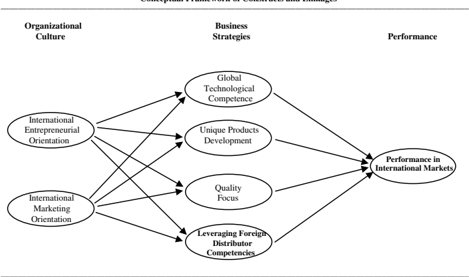
- The survey analysis found that international entrepreneurial orientation significantly predicted global technological competence with a standardized coefficient of 0.28; the link from international marketing orientation to global technological competence was not significant.
- Unique products development was significantly predicted by both international entrepreneurial orientation (0.19) and international marketing orientation (0.24).
- Quality focus was significantly predicted by both international entrepreneurial orientation (0.23) and international marketing orientation (0.35).
- Leveraging foreign distributor competences was significantly predicted by international marketing orientation (0.26) but not by international entrepreneurial orientation; these strategy variables were also significant drivers of performance in international markets: global technological competence (0.21), unique products development (0.14), quality focus (0.30), and leveraging foreign distributor competences (0.18).
## Methods
- The paper uses a two-phase design: first qualitative interviews/case studies to develop constructs and hypotheses, then a cross-industry field survey to test them.
- The qualitative phase included 33 professionals: 24 senior managers at early internationalizing firms, 6 scholars, and 3 international trade experts; the firms were mostly founded after 1985, sold half or more of their sales abroad, and had entered foreign markets within 3 years of founding.
- The survey was mailed to a random sample of 900 manufacturing firms in the United States founded in 1980 or later and exporting at least 25% of total production; 203 usable surveys were returned (about 23% response rate). The main analysis used LISREL8 path analysis, with exploratory factor analysis and confirmatory factor analysis for scale purification and validity checks.
## Limitations
- The paper states that “little empirical work” had been attempted on born globals and that there had been “almost no empirical research” on the factors driving their superior international performance.
- The study itself is focused on U.S. manufacturing firms that were selected using a 25% export threshold, so the evidence is tied to that sample and entry-mode context; this is evident from the text.
- The paper notes that the survey results are based on self-reported measures from responding firms; this is evident from the questionnaire-based design, though the paper does not frame it explicitly as a limitation.
Model-written summary. Check it against the paper before relying on it.
Integrity signals
Registry
Cites
Statistics
Figures
Verification
Claims the paper makes
0 Valid · 0 Not valid · 53 Not checked · 112 Own results and interpretations
A result the paper reports from its own data — it cites no other source for it, so there is none to check. The quote shows it is in the paper.
In the paper
“Despite the scarce resources typical of young firms, our findings reveal that born-global firms leverage a distinctive mix of orientations and strategies that allow them to succeed in diverse international markets.”
plainstates a cause- Asserted: passes — The authors put it forward as true.
- Checkable: passes — It can be checked against evidence.
- Load-bearing: passes — The paper’s conclusions depend on it.
- Based: passes — The paper gives a reason why it holds.
- Rests on an assumption not shown here.
A result the paper reports from its own data — it cites no other source for it, so there is none to check. The quote shows it is in the paper.
In the paper
“The critical role of marketing prowess overseas was also strongly emphasized by virtually all interviewees in the case studies.”
boosted- Asserted: passes — The authors put it forward as true.
- Checkable: passes — It can be checked against evidence.
- Load-bearing: unclear — It is unclear whether the paper’s conclusions depend on it.
- Based: passes — The paper gives a reason why it holds.
A result the paper states — it cites no source for it, so there is none to check. The quote shows it is in the paper.
In the paper
“Most interviewed firms exhibited strong technological capabilities in their respective product or industry categories.”
plain- Asserted: passes — The authors put it forward as true.
- Checkable: passes — It can be checked against evidence.
- Load-bearing: unclear — It is unclear whether the paper’s conclusions depend on it.
- Based: passes — The paper gives a reason why it holds.
A result the paper reports from its own data — it cites no other source for it, so there is none to check. The quote shows it is in the paper.
In the paper
“In general, the qualitative phase of the study revealed that born globals are likely to be formed by entrepreneurs who pursue foreign ventures with a strong marketing orientation.”
hedgedstates an association- Asserted: passes — The authors put it forward as true.
- Checkable: passes — It can be checked against evidence.
- Load-bearing: passes — The paper’s conclusions depend on it.
- Based: passes — The paper gives a reason why it holds.
A result the paper states — it cites no source for it, so there is none to check. The quote shows it is in the paper.
In the paper
“In contrast, born globals leverage a collection of fundamental intangible knowledge-based capabilities in the cultivation of foreign markets early in their evolution.”
plainstates a cause- Asserted: passes — The authors put it forward as true.
- Checkable: passes — It can be checked against evidence.
- Load-bearing: passes — The paper’s conclusions depend on it.
- Based: unclear — It is unclear why the paper says it holds.
- Rests on an assumption not shown here.
84 more claims
Create a free account to see all 165 claims and to verify the 3 references still open.
- It may state two separate claims as one. 33
- Probably not a substantial claim. 54
Citations
Cites
Evaluating Structural Equation Models with Unobservable Variables and Measurement Error
Fornell, C., & Larcker, D. F. (1981) · Journal of Marketing Research · doi:10.2307/3151312 · Cited by 109,314 · cited 2×
“Composite reliability was calculated using the procedures outlined by Fornell and Larcker (1981).”
MethodInfluentialEvaluating structural equation models with unobservable variables and measurement error
Fornell, C., & Larcker, D. F. (1981) · Journal of Marketing Research · doi:10.1177/002224378101800104 · Cited by 109,190
Firm Resources and Sustained Competitive Advantage
Barney, J. (1991) · Journal of Management · doi:10.1177/014920639101700108 · Cited by 48,334
(1994) · Journal of the American Dietetic Association · doi:10.1016/0002-8223(94)92216-0 · Cited by 45,910
Firm resources and sustained competitive advantage
Barney, J. B. (2004) · Advances in Strategic Management · doi:10.1016/s0742-3322(00)17018-4 · Cited by 38,152
Absorptive Capacity: A New Perspective on Learning and Innovation
Cohen, W. M., & Levinthal, D. A. (1990) · Administrative Science Quarterly · doi:10.2307/2393553 · Cited by 35,728
A resource‐based view of the firm
Wernerfelt, B. (1984) · Strategic Management Journal · doi:10.1002/smj.4250050207 · Cited by 25,635
The Theory of Economic Development
Schumpeter, J., & Backhaus, U. (2006) · The European Heritage in Economics and the Social Sciences · doi:10.1007/0-306-48082-4_3 · Cited by 22,506
An Evolutionary Theory of Economic Change.
Loasby, B. J., Nelson, R. R., & Winter, S. G. (1983) · The Economic Journal · doi:10.2307/2232409 · Cited by 21,366
A Dynamic Theory of Organizational Knowledge Creation
Nonaka, I. (1994) · Organization Science · doi:10.1287/orsc.5.1.14 · Cited by 17,809
Research works printed but not linked: 5
- Nikkei Sangyoo Shimbun (1995) Benchaa Shin Sedai (New Generation Ventures) , Nihon Keizai Shimbun: Tokyo.
- Nunnally, J.C. (1978) Psychometric Theory
- Porter, M.E. (1980) Competitive Strategy , The Free Press: New York.
- Rennie, M. (1993) 'Born global', McKinsey Quarterly (4): 45-52. Rosson, P. and Ford, I.D. (1982) 'Manufacturer-overseas distributor relations and export performance', Journal of International Business Studies 13 (2): 57-72.
- Schumpeter, J. (1939) Business Cycles , Vol. 1 McGraw-Hill: New York.
Cited by
Items 2,001–2,100 of 3,020
DO EXPORT MARKETS SELECT THE MOST INNOVATIVE PRODUCERS? THE MODERATING ROLE OF PRODUCTIVITY
Monreal-Pérez, J., Aragón-Sánchez, A., & Marín, G. S. (2015) · International Journal of Innovation Management · doi:10.1142/s1363919615500309 · Cited by 2
The strategic use of American cyberlaw and cyberspace jurisprudence
Ware, R. (2006) · International Journal of Law and Management · doi:10.1108/03090550610674662 · Cited by 2
Kuvykaitė, R., & Alimienė, M. (2012) · ECONOMICS AND MANAGEMENT · doi:10.5755/j01.em.17.3.2130 · Cited by 2
Nair, S., & Skaggs, B. C. (2012) · International Journal of Business and Emerging Markets · doi:10.1504/ijbem.2012.047780 · Cited by 2
“This could be particularly amenable to the legitimacy management strategies for ‘born global’ firms, which are firms (especially in the high-tech industry) that from their very inception target global markets (Knight and Cavusgil, 2004).”
BackgroundAction research on high-tech SMEs entering the US market
Paulin, W. L., Belt, P., Möttönen, M., Härkönen, J., & Haapasalo, H. J. O. (2012) · International Journal of Entrepreneurship and Innovation Management · doi:10.1504/ijeim.2012.051901 · Cited by 2
“Firms must possess specific knowledge-based internal organisational capabilities supporting success in foreign markets (Knight and Cavusgil, 2004; Madhok, 1997).”
BackgroundThe early development of Born Global firms in the software industry
Wren, J., & Gabrielsson, M. (2011) · International Journal of Technology Transfer and Commercialisation · doi:10.1504/ijttc.2011.040894 · Cited by 2
“The early development of Born Global firms in the software industry 333 1 Introduction A Born Global is defined as ‘a business organisation that, from inception, seeks to derive significant competitive advantage from the use of resources and the sale of output in multiple countries’ [Oviatt and McDougall, (1994), p.”
BackgroundInfluentialPreconditions for Born Global Internationalization: Network Approach
Morkertaite, R., & Sekliuckienė, J. (2015) · Social Sciences · doi:10.5755/j01.ss.86.4.9260 · Cited by 2
Krishna, A. (2013) · Cross Connect (Southern Cross University) · Cited by 5
Could Innovation be Driven by Globalization?
Soliman, F. (2012) · OPUS - Open Publications of UTS Scholars (University of Technology Sydney) · Cited by 2
Wu, C.-S., & Hsu, C. (2013) · Journal of Enterprising Culture · doi:10.1142/s0218495813500088 · Cited by 2
“, 2004), which is a competitive advantage and a key factor in their success (Knight and Cavusgil, 2004).”
BackgroundTriple helix interaction: Importance of spin-off firms networks and the university as partner
van Geenhuizen, Taheri, M., & Soetanto, D. P. (2014) · Data Archiving and Networked Services (DANS) · Cited by 2
Global marketing strategy: past, present, and future
Douglas, S. P., & Craig, C. S. (2010) · Advances in international management · doi:10.1108/s1571-5027(2010)00000230024 · Cited by 5
Kazlauskaitė, R., Abramavičius, Š., Šarapovas, T., et al. (2015) · European Journal of Business and Economics · doi:10.12955/ejbe.v9i2.548 · Cited by 2
“…factor which has received much attention in internationalization process research, especially, focusing on INVs and Born Globals, is international experience of the founders and rich social capital that the founders bring to the firm and its internationalization efforts (Knight & Cavusgil, 2004).”
BackgroundLes Grands Auteurs en Management International
Valax, M., & Beddi, H. (2014) · EMS Editions eBooks · doi:10.3917/ems.mayrh.2014.01.0027 · Cited by 2
Introduction: Three Organizational Challenges for Multinational Enterprises
Drogendijk, R. H., van Tulder, R. J. M., & Verbeke, A. C. (2015) · Progress in international business research · doi:10.1108/s1745-886220150000010001 · Cited by 2
Foreign Market-Entry into Central and Eastern Europe
Reid, I., & Freeman, S. (2006) · Journal of East-West Business · doi:10.1300/j097v12n02_06 · Cited by 2
“Furthermore, certain issues discovered within the interview process could be systematically investigated, for instance, the implications of rapid firm internationalisation (born-global firms) (Knight and Cavusgil, 2004) into transitional markets.”
Background원동환 (2016) · Journal of Distribution Science · doi:10.15722/jds.14.2.201602.135 · Cited by 3
Uluslararası girişimciliğin proaktiflik boyutu: Küresel doğan işletmeler üzerine nitel bir araştırma
ÜNER, F. E. (2015) · Ankara Üniversitesi SBF Dergisi · doi:10.1501/sbfder_0000002378 · Cited by 2
The new ventures’ international result. A relational view associated to network market orientation
Monferrer, D., & Guillén, M. E. (2016) · Cuadernos de Gestión · doi:10.5295/cdg.150521dm · Cited by 2
The Future of Global Marketing Strategy
Schlegelmilch, B. B. (2016) · Management for professionals · doi:10.1007/978-3-319-26279-6_11 · Cited by 2
Naidoo, V., Donovan, J. D., Milner, T., et al. (2016) · Palgrave Macmillan US eBooks · doi:10.1057/978-1-137-54291-5_3 · Cited by 2
Entrepreneurship, Firm Internationalization and Regional Development
Gonçalves, T. M. V., Gouveia, S., & Teixeira, M. S. (2016) · International Business · doi:10.4018/978-1-4666-9814-7.ch021 · Cited by 2
“Knight and Cavusgil (2004) consider that entry into foreign markets requires a proactive and innovative attitude and a willingness to take risks, given the higher probability of failure in a more competitive and unknown environment (Ripollés-Meliá et al., 2007).”
BackgroundHashai, N. (2011) · Research in global strategic management · doi:10.1108/s1064-4857(2011)0000015019 · Cited by 2
Internationalization and Financial Performance: A success case in Portugal
Teixeira, N. M., Rafael, B., & Pardal, P. N. (2015) · Advances in electronic government, digital divide, and regional development book series · doi:10.4018/978-1-4666-9567-2.ch005 · Cited by 2
Dai, O., & Liu, X. (2009) · Palgrave Macmillan UK eBooks · doi:10.1057/9780230237322_12 · Cited by 2
Discovering the Nexus between Market Orientation and Open Innovation: A Grounded Theory Approach
Şakar, G. D., Çetin, Ç. K., & Saatçıoğlu, Ö. Y. (2013) · Advances in marketing, customer relationship management, and e-services book series · doi:10.4018/978-1-4666-4749-7.ch001 · Cited by 3
Les PME face à l’achat d’offres low-cost : une approche exploratoire par la valeur perçue
Bonneveux, É., & Rivière, A. (2016) · Revue internationale P M E Économie et gestion de la petite et moyenne entreprise · doi:10.7202/1037926ar · Cited by 2
DETERMINANTS OF SUCCESSFUL COMPLETION OF DONOR FUNDED PROJECTS IN KENYA: A CASE OF TURKANA COUNTY
KISILU, R. N. (2016) · Strategic Journal of Business & Change Management · doi:10.61426/sjbcm.v3i4.338 · Cited by 2
Raghunath, S., & Balaraman, K. K. (2016) · Palgrave Macmillan UK eBooks · doi:10.1057/978-1-137-54468-1_9 · Cited by 2
Transaction Costs And Export Intensification – The Cases Of Poland And Hungary
Mroczek‐Dąbrowska, K. (2016) · Comparative Economic Research Central and Eastern Europe · doi:10.1515/cer-2016-0033 · Cited by 2
İsmail, D. (2016) · Jurnal Pengurusan · doi:10.17576/pengurusan-2016-46-08 · Cited by 5
Kowalik, I. (2016) · Marketing i Rynek · Cited by 4
The internationalization of SMEs in emergingmarkets: Case Russia
Nieminen, S. (2011) · Cited by 2
Pomiar internacjonalizacji przedsiębiorstwa z perspektywy przedsiębiorczości międzynarodowej
Wach, K. (2016) · Przedsiebiorczosc i Zarzadzanie · Cited by 2
Challenges in Conducting International Market Research
Engélen, A., Engelen, M., & Craig, C. S. (2016) · Springer eBooks · doi:10.1007/978-3-319-05542-8_6-1 · Cited by 3
Hybridization Revisited: New Insights from the Evolutionary Approach
Olejniczak, T., & Itohisa, M. (2017) · Central European Management Journal · doi:10.7206/jmba.ce.2450-7814.195 · Cited by 2
Israeli, Born Global, Knowledge-intensive Firms: An Empirical Inquiry
Almor, T., & Sperling, G. (2008) · Edward Elgar Publishing eBooks · doi:10.4337/9781848441309.00027 · Cited by 2
Facilitating Entrepreneurship, Internationalization, and Innovation in Global Business
Kasemsap, K. (2017) · Advances in business strategy and competitive advantage book series · doi:10.4018/978-1-5225-3525-6.ch005 · Cited by 2
Torkkeli, L., Uzhegova, M., Salojärvi, H., & Saarenketo, S. (2017) · Emerald Group Publishing Limited eBooks · doi:10.1108/978-1-78714-501-620171026 · Cited by 3
Simultaneous effects between innovativeness and export behavior in small firms: evidence from Spain
Martins, I., Rialp, A., & Vaillant, Y. (2015) · Edward Elgar Publishing eBooks · doi:10.4337/9781783471584.00017 · Cited by 2
From Past to Present Born Global Phenomenon: a Thematic Analysis
Berber, Ş., Köle, M., Tasci, M. E., & Can, E. (2018) · Economics and Business Review/The Poznań University of Economics Review · doi:10.18559/ebr.2018.2.5 · Cited by 2
“…band is the ability of the firm to conceive new ways of thinking, processes and services but is also strongly tied to its capabilities; bo nded to a culture that supports all these factors [Knight & Cavusgil, 2004; Hughes et al., 2010; Khavul et al., 2010a; Kim et al., 2011; Carvalho et al., 2014].”
BackgroundMethodThe Role of Support Services During the Internationalisation of Finnish Software SMEs
Kuivalainen, O., Lindqvist, J., Ruokonen, M., & Saarenketo, S. (2018) · Emerald Group Publishing Limited eBooks · doi:10.1108/s1876-066x20180000034006 · Cited by 4
Intelektinis potencialas: globalizacija ir žiniomis grindžiamos visuomenės kūrimas
Melnikas, B., Banelienė, R., Chlivickas, E., Jakubavičius, A., Лобанова, Л., & Žemaitis, E. (2018) · doi:10.20334/2018-032-m · Cited by 2
The digital future of Telcos: Dumb pipesor crucial partners in innovation of new business models?
Elter, F., Gooderham, P. N., Dasí, À., & Pedersen, T. (2018) · Beta · doi:10.18261/issn.1504-3134-2018-02-01 · Cited by 2
Machado, M. A., & Azambuja, A. L. V. (2018) · Internext · doi:10.18568/1980-4865.1331-13 · Cited by 2
Building a Strong Foundation for a High-Functioning Culture of Creativity and Innovation
Lasrado, F. (2019) · Springer eBooks · doi:10.1007/978-3-319-99121-4_1 · Cited by 2
Capability determinants of information & communications technology services (ICTS) sector
Ramachandran, R. (2013) · International Conference on Theory and Practice of Electronic Governance · doi:10.1145/2591888.2591907 · Cited by 2
Mais, I., de Carvalho, L. C., Amal, M., et al. (2010) · RAI revista de administração e inovação · doi:10.5585/rai.v7i1.286 · Cited by 2
Mathew, N. (2019) · EngagedScholarship @ Cleveland State University (Cleveland State University) · Cited by 3
The Internationalization of Early Stage Social Enterprises
Ritvala, T. A.-M., & Riikkinen, R. (2019) · Emerald Group Publishing Limited eBooks · doi:10.1108/s1745-886220190000014019 · Cited by 3
Du, J., & Ding, S. (2019) · Asian Journal of Technology Innovation · doi:10.1080/19761597.2019.1678391 · Cited by 2
“The most influential paper for born-global firms is Knight and Cavusgil (2004), namely, ‘innovation, organizational capabilities and the born-global firm’.”
BackgroundLearning by exporting: lessons from high-technology SMEs
Love, J. H. (2013) · Development in Learning Organizations An International Journal · doi:10.1108/dlo.2013.08127caa.012 · Cited by 2
International entrepreneurship in small family firms: a cross-case analysis
Floris, M., Dessì, C., & Dettori, A. (2020) · Sinergie Italian Journal of Management · doi:10.7433/s112.2020.03 · Cited by 2
“…various forms of international learning (Schwens and Kabst, 2009; Bruneel et al., 2010; Bunz et al., 2017), including international adaptation (Domurath et al., 2020), and the firm’s market orientation (Knight and Cavusgil, 2004) together with entrepreneurial orientation (Kuivalainen et al., 2007).”
BackgroundYen, I.-F., & Lin, H. (2020) · Chinese Management Studies · doi:10.1108/cms-12-2019-0441 · Cited by 4
Educating the Global-Minded Business Professional and Manager
Bolívar, L. M. (2020) · Emerald Group Publishing Limited eBooks · doi:10.1108/978-1-80043-392-220201013 · Cited by 2
Born global: la cuarta perspectiva de la internacionalización
Parra-Acosta, J. F., Oliva, E. J. D., & Romero, C. A. R. (2021) · Innovar · doi:10.15446/innovar.v32n83.99920 · Cited by 2
“…búsqueda de recursos o teorías relacionadas con el conocimiento o el aprendizaje organizacional (Autio et al., 2000), la visión basada en recursos (Knight & Cavusgil, 2004), el enfoque de las capacidades dinámicas (Weerawardena et al., 2007) y la visión basada en conocimientos (Gassmann & Keupp,…”
BackgroundUluslararası Girişimsel Yönelim Üzerine Eleştirel Bir Literatür İncelemesi
Urfa, A. M., & Arslantaş, C. (2022) · Anadolu Üniversitesi Sosyal Bilimler Dergisi · doi:10.18037/ausbd.1095147 · Cited by 2
Yuliati, U., Fitriasari, F., & Mergans, M. (2022) · Routledge eBooks · doi:10.1201/9781003263586-33 · Cited by 2
Knowledge Sharing in International Business: A Literature Review Study
Abdullah, B., & Alqarni, A. A. (2022) · Tehnički glasnik · doi:10.31803/tg-20220305124542 · Cited by 9
“Until the emergence of networks as a modern phenomenon [18, 25], global corporations [29], modern international corporations, and multinational corporations in emerging countries [13, 26], few theories emerged at the end of the 1980s.”
Determination of SME’s Internationalization in Malaysian Context
Foghani, S., Mahadi, B., & Mohammadi, P. (2023) · Business Management and Strategy · doi:10.5296/bms.v14i1.20783 · Cited by 5
Factors Influencing the Firm Performance of Digital Merchandising Businesses in Thailand
Siriyotha, S., & Lekcharoen, S. (2024) · Journal of Ecohumanism · doi:10.62754/joe.v3i8.5386 · Cited by 1
“Previous research indicates that MO positively influences MC as it helps firms to be more responsive and adaptable to dynamic market dynamics (Knight & Cavusgil, 2004).”
Small exporters : a unifying framework of their internationalisation paths
Fry, R. A., & Freeman, S. (2005) · Cited by 2
Cristóbal, J. V. B., & Baleix, J. M. (2009) · Economía industrial · Cited by 2
Prystupa-Rządca, K. (2014) · Problemy Zarządzania - Management Issues · doi:10.7172/1644-9584.47.2 · Cited by 2
Roxas, B., & Chadee, D. D. (2011) · Cited by 2
Organizational Identity and International Firm Growth: Some Theoretical Considerations
Dörrenbächer, C., & Lappe, C. (2017) · Palgrave Macmillan UK eBooks · doi:10.1057/978-1-137-57724-5_6
Dimensions on born-global firms' case studies
Pimenta, A. C., Joswig, M., Oliveira, M. D. M., & Sbragia, R. (2017) · Internext · doi:10.18568/1980-4865.12148-61 · Cited by 3
Tonial, G., & Rossetto, C. R. (2017) · Journal of Business · doi:10.21678/jb.2017.821 · Cited by 2
“Knight and Cavusgil (2004) observed that IEO is also particularly relevant to strategies based on specific innovations that, in turn, drive superior international performance.”
BackgroundMethodInfluentialThe Internationalization Process of a Born Global
Moreira, A. C., Ramos, M., Ferraz, L. F., et al. (2018) · Advances in business strategy and competitive advantage book series · doi:10.4018/978-1-5225-6942-8.ch003 · Cited by 2
Business Strategy and Financial Performance
Teixeira, N. M., Lisboa, I. M. C., Costa, T. G., & Godinho, T. (2019) · Advances in business strategy and competitive advantage book series · doi:10.4018/978-1-5225-8479-7.ch001 · Cited by 3
Dynamic networks in early international agrobusiness
Méndez-Lazarte, C. (2019) · Cadernos EBAPE BR · doi:10.1590/1679-395174077x · Cited by 2
“Unlike multinational companies, newly established ones with “scarce resources,” such as Born Globals or INVs, tend to favor exporting as their primary entry mode because of the high degree of international business flexibility (KNIGHT and CAVUSGIL, 2004).”
BackgroundSuh, Y., Mitomi, Y., & Sato, H. (2019) · Annals of Business Administrative Science · doi:10.7880/abas.0190817a · Cited by 2
The microfoundations of innovation processes in Latin American firms
Barrera, J. I., Torres, J. P., & Valdés, G. (2019) · Academia Revista Latinoamericana de Administración · doi:10.1108/arla-07-2018-0155 · Cited by 2
Path Dependence and Innovation: A Dichotomy in Internationalization
Scherrer, S. M., & de Vasconcellos, S. L. (2019) · Revista de Negócios · doi:10.7867/1980-4431.2019v24n4p37-54 · Cited by 2
“…business literature with regard to the relevance of innovation (Gudlavalleti, Gupta, & Narayanan, 2013; Kafouros, Buckley, Sharp, & Wang, 2008; Knight & Cavusgil, 2004) and of path dependence to the decision-making process (Barney, 1999; Koch, Eisend, & Petermann, 2009; Mahoney, 2000, and…”
Rossato, G. D., Floriani, D. E., & Amal, M. (2020) · Redalyc (Universidad Autónoma del Estado de México) · Cited by 2
Ambidextrous Learning and Survival of Early International Firms-The Role of Social Media Usage
Appiah, E. K. (2021) · Hawaii International Conference on System Sciences (HICSS) · doi:10.24251/hicss.2021.337 · Cited by 3
“Early internationalizing firms are business entities that make an early leap into foreign markets to seek significant competitive advantage from the use of resources and the sale of output in multiple countries [36].”
BackgroundKnow your audience: how language complexity affects impact in entrepreneurship science
Lampe, H. W., & Reerink, J. (2021) · Journal of Business Economics · doi:10.1007/s11573-020-01027-4 · Cited by 3
Borderless Firms e a configuração global do empreendimento: estudo de caso
da Fonseca, L. N. M., & da Rocha, Â. (2021) · Revista da Micro e Pequena Empresa · doi:10.48099/1982-2537/2021v15n1p144158 · Cited by 2
Lang, T., Graffenberger, M., & Vonnahme, L. (2019) · De Gruyter eBooks · doi:10.1515/9783110632873 · Cited by 3
The Influence of Network Competence on Internationalization of SMEs
Torkkeli, L. (2013) · LUTPub (LUT University) · Cited by 8
Organizational Routines Development and the Timing and Pace of Early Stage InternationalizationPreprint
Kotosaka, M. (2013) · SSRN Electronic Journal · doi:10.2139/ssrn.2204940 · Cited by 2
Export-Driven New Ventures and Economic Growth
Hessels, J., & van Stel, A. J. (2009) · Institutional Repositories DataBase (IRDB) · Cited by 2
Internacionalização do varejo: um estudo com empresas brasileiras por meio de análise de conteúdo
Madeira, A. B. (2009) · doi:10.11606/t.12.2009.tde-05102009-102024 · Cited by 2
Electronic commerce and internationalisation in New Zealand SMEs
Jia, J. (2009) · Tuwhera (Auckland University of Technology) · Cited by 2
ORSI, A. (2010) · Digital Library of Theses and Dissertations (Universidade de São Paulo) · doi:10.11606/t.12.2010.tde-27082010-093943 · Cited by 2
Zimmermann, J., Grimpe, C., & Sofka, W. (2009) · RePEc: Research Papers in Economics · Cited by 2
Kazlova, A., & Ullmann, B. (2010) · DiVA (Linnaeus University) · Cited by 2
Entrepreneurial Timing Theory: Time Entrepreneurship and Time StrategyPreprint
Forouharfar, A., Yaghoubi, N. M., & Motamedifar, M. (2014) · SSRN Electronic Journal · Cited by 2
Marketing de lugares: estudo de impactos do recife artificial multifuncional
Ocke, M. A. D. M. (2015) · Digital Library of Theses and Dissertations (Universidade de São Paulo) · doi:10.11606/t.12.2015.tde-11112015-162619 · Cited by 2
Internationale Stellenbesetzungspolitik in Early Internationalizers: Jenseits inkrementeller Pfade?
Kabst, R., & Steinbach, S. (2006) · German Journal of Human Resource Management Zeitschrift für Personalforschung · doi:10.1177/239700220602000402 · Cited by 2
Chahabadi, D. (2016) · Macquarie University · doi:10.25949/19431023 · Cited by 3
International competitiveness of SMEs : a case of Ghanaian non-traditional horticultural exporters
Appiah, K. (2016) · University of Bedfordshire Repository (University of Bedfordshire) · Cited by 3
Growth phases and survival of born globals - Case: Finnish software firms
Hashimoto, S. (2011) · Aaltodoc (Aalto University) · Cited by 2
Fang, T. (2012) · International Business Review · doi:10.1016/j.ibusrev.2012.02.005 · Cited by 2
Internationalization Technology and IPO Firm Growth
Ji, F. X., & Zhou, S. B. (2014) · IGI Global eBooks · doi:10.4018/978-1-4666-5202-6.ch120 · Cited by 2
Dynamic Bundle of Capabilities and Firm’s International Performance: A Configurational Analysis
Jie, S., & Harms, R. (2019) · Academy of Management Proceedings · doi:10.5465/ambpp.2019.17294abstract · Cited by 2
Venture Creation Decision Models: Cognitive ApproachPreprint
Brahim, A. H., Brahmi, H., & Missaoui, I. (2019) · SSRN Electronic Journal · doi:10.2139/ssrn.3353830 · Cited by 3
Tekin, I. H. (2000) · doi:10.15760/etd.1814 · Cited by 2
Metadata
- Authors
- Knight, G. A., & Cavusgil, S. T.
- Affiliations
- Florida State University (US)
- Corresponding author
- Knight, Gary A
- ORCID
- Knight, Gary A
- Venue
- Journal of International Business Studies
- Published
- 2004-01-08
- Volume
- 35
- Issue
- 2
- Pages
- 124-141
- ISSN
- 0047-2506 (ISSN-L)
- 1478-6990
- OpenAlex
- W2127709152
- Semantic Scholar
- d24960b5342d0dd3b86be002ab18a80e7b6fb5c9
- Cited by
- 4,295
- References
- 102
- Citations by year
- 2026: 261 · 2025: 233 · 2024: 216 · 2023: 242 · 2022: 227 · 2021: 274 · 2020: 286 · 2019: 260 · 2018: 291 · 2017: 258 · 2016: 290 · 2015: 246 · 2014: 234 · 2013: 215 · 2012: 171
- FWCI
- 115.46
- Type
- journal article
- Language
- en
- Update notices
- correction (2004-07-16)
- Open access
- bronze
- doi.org
- Licence
- www.springer.com/tdm (tdm)
- Locations
- Journal of International Business Studies (publishedVersion)
- Research Explorer (The University of Manchester) (publishedVersion)
- RePEc: Research Papers in Economics (submittedVersion)
- Funders
- Michigan State University
- College of Engineering, Michigan State University
- Topics
- Social Sciences › Business, Management and Accounting › Strategy and Management › International Business and FDI
- Social Sciences › Business, Management and Accounting › Strategy and Management › Innovation and Knowledge Management
- Social Sciences › Communication › International Student and Expatriate Challenges
- Keywords
- born global firms, early internationalization, organizational capabilities, innovation, innovation culture, international business strategy, international success, young firms, internationalization of firms
About these checks
Registry, retraction, Cites and statistics results are computed, not judged, with one exception: a printed reference that no index lists is read once by a model before it counts as a citation error. Claims are extracted by a model and kept only when their quote appears verbatim in the text; each cited source is then checked, with a model’s help, for whether it says what the claim relies on. Those verdicts can be wrong — read the claim’s quote and the cited source before relying on one.
A language model drew the claims from the paper on 2026-10-10, under version 3 of the claim definition (model deepseek-v4.1-flash, prompt extract-v3).
A second model labelled each claim on 2026-10-10 (model jev-1.13-20260917, definition revision gold-guideline-v0.2).
Statistics and arithmetic are recomputed, not judged.
Confidence bands are shown only for fields calibrated on our annotated test set. None is calibrated yet, so no band is shown.
What counts as a claim ›How we measure confidence ›How we check this ›
Are you an author, or do you see a problem with this page? Request a review
Data sources
Bibliographic data: Semantic Scholar, OpenAlex, Crossref.
Contains information from the Semantic Scholar Academic Graph Datasets, made available under the ODC Attribution License (ODC-BY 1.0).
Semantic Scholar’s data is described in: Kinney, R., et al. (2023). The Semantic Scholar Open Data Platform. arXiv:2301.10140.
