

Innovation, organizational capabilities, and the born-global firm
Open accessThe DOI matches its Crossref record; 106 of the 106 references it cites were found in a registry or an index; none of the 100 sources its claims cite is checked for support yet.
Overview
CoChat Summary
## TL;DR
This study argues that born-global firms succeed because early internationalization is supported by an innovative culture and a distinctive set of organizational capabilities. Using qualitative case studies followed by a survey of 203 usable responses, the authors find that several capability links are significant and that these capabilities are associated with performance in international markets.
## Key findings
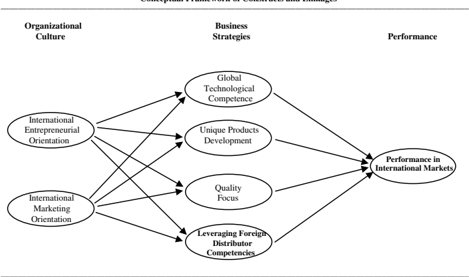
- The survey analysis found that international entrepreneurial orientation significantly predicted global technological competence with a standardized coefficient of 0.28; the link from international marketing orientation to global technological competence was not significant.
- Unique products development was significantly predicted by both international entrepreneurial orientation (0.19) and international marketing orientation (0.24).
- Quality focus was significantly predicted by both international entrepreneurial orientation (0.23) and international marketing orientation (0.35).
- Leveraging foreign distributor competences was significantly predicted by international marketing orientation (0.26) but not by international entrepreneurial orientation; these strategy variables were also significant drivers of performance in international markets: global technological competence (0.21), unique products development (0.14), quality focus (0.30), and leveraging foreign distributor competences (0.18).
## Methods
- The paper uses a two-phase design: first qualitative interviews/case studies to develop constructs and hypotheses, then a cross-industry field survey to test them.
- The qualitative phase included 33 professionals: 24 senior managers at early internationalizing firms, 6 scholars, and 3 international trade experts; the firms were mostly founded after 1985, sold half or more of their sales abroad, and had entered foreign markets within 3 years of founding.
- The survey was mailed to a random sample of 900 manufacturing firms in the United States founded in 1980 or later and exporting at least 25% of total production; 203 usable surveys were returned (about 23% response rate). The main analysis used LISREL8 path analysis, with exploratory factor analysis and confirmatory factor analysis for scale purification and validity checks.
## Limitations
- The paper states that “little empirical work” had been attempted on born globals and that there had been “almost no empirical research” on the factors driving their superior international performance.
- The study itself is focused on U.S. manufacturing firms that were selected using a 25% export threshold, so the evidence is tied to that sample and entry-mode context; this is evident from the text.
- The paper notes that the survey results are based on self-reported measures from responding firms; this is evident from the questionnaire-based design, though the paper does not frame it explicitly as a limitation.
Model-written summary. Check it against the paper before relying on it.
Integrity signals
Registry
Cites
Statistics
Figures
Verification
Claims the paper makes
0 Valid · 0 Not valid · 53 Not checked · 112 Own results and interpretations
A result the paper reports from its own data — it cites no other source for it, so there is none to check. The quote shows it is in the paper.
In the paper
“Despite the scarce resources typical of young firms, our findings reveal that born-global firms leverage a distinctive mix of orientations and strategies that allow them to succeed in diverse international markets.”
plainstates a cause- Asserted: passes — The authors put it forward as true.
- Checkable: passes — It can be checked against evidence.
- Load-bearing: passes — The paper’s conclusions depend on it.
- Based: passes — The paper gives a reason why it holds.
- Rests on an assumption not shown here.
A result the paper reports from its own data — it cites no other source for it, so there is none to check. The quote shows it is in the paper.
In the paper
“The critical role of marketing prowess overseas was also strongly emphasized by virtually all interviewees in the case studies.”
boosted- Asserted: passes — The authors put it forward as true.
- Checkable: passes — It can be checked against evidence.
- Load-bearing: unclear — It is unclear whether the paper’s conclusions depend on it.
- Based: passes — The paper gives a reason why it holds.
A result the paper states — it cites no source for it, so there is none to check. The quote shows it is in the paper.
In the paper
“Most interviewed firms exhibited strong technological capabilities in their respective product or industry categories.”
plain- Asserted: passes — The authors put it forward as true.
- Checkable: passes — It can be checked against evidence.
- Load-bearing: unclear — It is unclear whether the paper’s conclusions depend on it.
- Based: passes — The paper gives a reason why it holds.
A result the paper reports from its own data — it cites no other source for it, so there is none to check. The quote shows it is in the paper.
In the paper
“In general, the qualitative phase of the study revealed that born globals are likely to be formed by entrepreneurs who pursue foreign ventures with a strong marketing orientation.”
hedgedstates an association- Asserted: passes — The authors put it forward as true.
- Checkable: passes — It can be checked against evidence.
- Load-bearing: passes — The paper’s conclusions depend on it.
- Based: passes — The paper gives a reason why it holds.
A result the paper states — it cites no source for it, so there is none to check. The quote shows it is in the paper.
In the paper
“In contrast, born globals leverage a collection of fundamental intangible knowledge-based capabilities in the cultivation of foreign markets early in their evolution.”
plainstates a cause- Asserted: passes — The authors put it forward as true.
- Checkable: passes — It can be checked against evidence.
- Load-bearing: passes — The paper’s conclusions depend on it.
- Based: unclear — It is unclear why the paper says it holds.
- Rests on an assumption not shown here.
84 more claims
Create a free account to see all 165 claims and to verify the 3 references still open.
- It may state two separate claims as one. 33
- Probably not a substantial claim. 54
Citations
Cites
Evaluating Structural Equation Models with Unobservable Variables and Measurement Error
Fornell, C., & Larcker, D. F. (1981) · Journal of Marketing Research · doi:10.2307/3151312 · Cited by 109,314 · cited 2×
“Composite reliability was calculated using the procedures outlined by Fornell and Larcker (1981).”
MethodInfluentialEvaluating structural equation models with unobservable variables and measurement error
Fornell, C., & Larcker, D. F. (1981) · Journal of Marketing Research · doi:10.1177/002224378101800104 · Cited by 109,190
Firm Resources and Sustained Competitive Advantage
Barney, J. (1991) · Journal of Management · doi:10.1177/014920639101700108 · Cited by 48,334
(1994) · Journal of the American Dietetic Association · doi:10.1016/0002-8223(94)92216-0 · Cited by 45,910
Firm resources and sustained competitive advantage
Barney, J. B. (2004) · Advances in Strategic Management · doi:10.1016/s0742-3322(00)17018-4 · Cited by 38,152
Absorptive Capacity: A New Perspective on Learning and Innovation
Cohen, W. M., & Levinthal, D. A. (1990) · Administrative Science Quarterly · doi:10.2307/2393553 · Cited by 35,728
A resource‐based view of the firm
Wernerfelt, B. (1984) · Strategic Management Journal · doi:10.1002/smj.4250050207 · Cited by 25,635
The Theory of Economic Development
Schumpeter, J., & Backhaus, U. (2006) · The European Heritage in Economics and the Social Sciences · doi:10.1007/0-306-48082-4_3 · Cited by 22,506
An Evolutionary Theory of Economic Change.
Loasby, B. J., Nelson, R. R., & Winter, S. G. (1983) · The Economic Journal · doi:10.2307/2232409 · Cited by 21,366
A Dynamic Theory of Organizational Knowledge Creation
Nonaka, I. (1994) · Organization Science · doi:10.1287/orsc.5.1.14 · Cited by 17,809
Research works printed but not linked: 5
- Nikkei Sangyoo Shimbun (1995) Benchaa Shin Sedai (New Generation Ventures) , Nihon Keizai Shimbun: Tokyo.
- Nunnally, J.C. (1978) Psychometric Theory
- Porter, M.E. (1980) Competitive Strategy , The Free Press: New York.
- Rennie, M. (1993) 'Born global', McKinsey Quarterly (4): 45-52. Rosson, P. and Ford, I.D. (1982) 'Manufacturer-overseas distributor relations and export performance', Journal of International Business Studies 13 (2): 57-72.
- Schumpeter, J. (1939) Business Cycles , Vol. 1 McGraw-Hill: New York.
Cited by
Items 1,901–2,000 of 3,020
Mustafa, M., & Scholes, L. (2021) · Springer eBooks · doi:10.1007/978-3-030-75894-3_2 · Cited by 3
Ferreira, T. M. C. (2019) · Advances in human resources management and organizational development book series · doi:10.4018/978-1-7998-2007-9.ch001 · Cited by 3
Learning Processes During Re-internationalization: A Case Study of Chinese SMEs
Yu, H., Fletcher, M. A., & Buck, T. (2022) · Emerald Group Publishing Limited eBooks · doi:10.1108/s1745-886220220000016010 · Cited by 3
Bariery internacjonalizacji organizacji
Winkler, R. (2007) · Zeszyty Naukowe / Akademia Ekonomiczna w Krakowie · Cited by 3
The Role of Equity Investors in the Internationalization Strategies of Infant Technology-based Firms
Zucchella, A., & Ramusino, E. C. (2008) · Palgrave Macmillan UK eBooks · doi:10.1057/9780230285743_6 · Cited by 3
Arroyo-Cañada, F.-J., Sánchez-Torres, J. A., & Solé-Moro, M. L. (2017) · Contabilidad y Negocios · doi:10.18800/contabilidad.201701.004 · Cited by 3
The Role of Culture in Responsible Business Practice: An Exploration of Finnish and Russian SMEs
Uzhegova, M., Torkkeli, L., & Ivanova-Gongne, M. (2019) · The Academy of International Business · doi:10.1007/978-3-030-03931-8_9 · Cited by 3
SME Internationalization in Latin America: Evidence from Mexico and Peru
Ricaldi, P. A., López-Lira, A., & Giraldo-Mejia, W. (2019) · Emerald Group Publishing Limited eBooks · doi:10.1108/978-1-78973-159-020191008 · Cited by 3
From clipboards to annual reports: innovations in sport for development fact management
Webb, A., Richelieu, A., & Cloutier, A. (2019) · Managing Sport and Leisure · doi:10.1080/23750472.2019.1684838 · Cited by 3
Arslan, A., Naughton, S., Tabas, A. M., & Puhakka, V. J. (2019) · Emerald Group Publishing Limited eBooks · doi:10.1108/s2040-724620190000010010 · Cited by 3
Sustentabilidad de los Emprendimientos a través de la Innovación en el Ecuador
Leal, S. (2020) · Espíritu Emprendedor TES · doi:10.33970/eetes.v4.n4.2020.232 · Cited by 4
O processo de internacionalização de uma multinacional brasileira
Urban, T. P. (2006) · Digital Library of Theses and Dissertations (Universidade de São Paulo) · doi:10.11606/d.12.2006.tde-06122006-192435 · Cited by 15
How can Firms from Emerging Economies Enhance their CSR-Supported Export Strategies?Preprint
Boehe, D. M., Cruz, L. B., & Ogasavara, M. H. (2010) · RePEc: Research Papers in Economics · Cited by 4
Gerschewski, S. (2011) · ResearchArchive–Te Puna Rangahau (Victoria University of Wellington) · Cited by 8
Internationalization Processes of Chinese Firms: the Role of Knowledge
Zhang, X. (2013) · DSpace repository (University of Tartu) · Cited by 3
Firms' global patent strategies in an emerging technology
Fernández‐Ribas, A. (2009) · Atlanta Conference on Science and Innovation Policy · doi:10.1109/acsip.2009.5367863 · Cited by 3
Internationalization of European SMEs towards Emerging MarketsPreprint
Hessels, J., & Kemna, M. (2008) · RePEc: Research Papers in Economics · Cited by 3
Cross-border venture capital and the development of portfolio companies
Devigne, D., Vanacker, T. R., Manigart, S., & Paeleman, I. (2011) · Ghent University Academic Bibliography (Ghent University) · Cited by 5
Hassan, R. S. (2016) · Aston Publications Explorer (Aston University) · doi:10.48780/publications.aston.ac.uk.00028740 · Cited by 4
The determinants and performance of international new ventures: Three studies
Jiang, G. (2013) · TUScholarShare (Temple University) · Cited by 3
Gaber, H. (2013) · UWSpace (University of Waterloo) · Cited by 3
Competence modelling for export performance improvement in Ethiopia
Birru, W. T. (2016) · doi:10.18174/388093 · Cited by 5
“Knight and Cavusgil (2004) USA Born-global SMEs 203 Survey Mixed Evolutionary economics Market share, sales growth, profitability, and total return on investment 44.”
BackgroundMethodInfluentialInternationalization: Patterns in Business Firms
Zander, I. (2015) · Elsevier eBooks · doi:10.1016/b978-0-08-097086-8.73008-x · Cited by 3
Challenges in Coding Qualitative Data
Heracleous, L., & Fernandes, O. (2019) · SAGE Publications Ltd eBooks · doi:10.4135/9781526476210 · Cited by 3
On the Way to Being a Micromultinational – Hindrances and Success Factors
Ratajczak‐Mrozek, M. (2015) · Progress in international business research · doi:10.1108/s1745-886220150000010016 · Cited by 3
International Opportunity Discovery of Born Global Firms: The Role of Institutions
Romanello, R., Karami, M., Gerschewski, S., Evers, N., & He, C. X. (2020) · Academy of Management Proceedings · doi:10.5465/ambpp.2020.20660abstract · Cited by 4
Explaining Internet Companies’ Internationalization: An Approach of CompetencesPreprint
Cahen, F. R., & Borini, F. M. (2019) · SSRN Electronic Journal · doi:10.2139/ssrn.3383189 · Cited by 4
Chaston, I. (2014) · doi:10.1007/978-1-137-32601-0_13 · Cited by 3
Figueiredo, M., Ferreira, J. J., & Vrontis, D. (2023) · SSRN Electronic Journal · doi:10.2139/ssrn.4482545 · Cited by 3
Editorial: A tribute to Dr Todd Morgan’s research on the marketing/entrepreneurship interface
Crick, J. M., & Jones, R. (2024) · Journal of Research in Marketing and Entrepreneurship · doi:10.1108/jrme-03-2024-167 · Cited by 3
Born-global: The case of four Vietnamese SMEs
Thai, M. T. T., & Chong, L. C. (2008) · Journal of International Entrepreneurship · doi:10.1007/s10843-008-0021-y · Cited by 136
“…capabilities needed for early internationalization and superior performance in diverse international markets for innovative activities, as these activities can facilitate the opening of new markets and a reinvention of operations to serve those markets optimally (Knight and Cavusgil 2004).”
InfluentialWu, X., & Lei, L. (2021) · Springer eBooks · doi:10.1007/978-3-030-65451-1_11 · Cited by 2
Poulis, K., & Christodoulou, I. (2024) · Marketing Theory · doi:10.1177/14705931241230046 · Cited by 2
“However, an award-winning article raises questions associated with ontological presuppositions that remain unanswered (Knight and Cavusgil, 2004).”
BackgroundConfiguring an MNE’s subsidiary capabilities for performance in China
Roh, T., Park, B. I., & Xiao, S. S. (2024) · Chinese Management Studies · doi:10.1108/cms-04-2022-0132 · Cited by 4
Leveraging temporary teams for international opportunity creation on digital platforms
Kryzhanivska, K., Tuomisalo, T., Blomqvist, K., & Kuivalainen, O. (2025) · Information and Organization · doi:10.1016/j.infoandorg.2024.100554 · Cited by 6
The Evolution of Early Internationalization: A Systematic Literature Review
Romanello, R., & Chiarvesio, M. (2024) · International series in advanced management studies · doi:10.1007/978-3-031-80128-0_2 · Cited by 3
Does overconfidence of CEOs increase startup performance? The role of marketing capability
Byun, K. J., & Yoo, S. (2025) · European Journal of Marketing · doi:10.1108/ejm-01-2024-0085 · Cited by 2
Alkhalailah, A. M., Galdeano-Gómez, E., & Sorroche‐del‐Rey, Y. (2025) · Journal of Family Business Management · doi:10.1108/jfbm-05-2025-0126 · Cited by 7
How technological path of internationalization matters? A dynamic capability perspective
Wang, Z., & Tan, Z. (2025) · The Journal of Technology Transfer · doi:10.1007/s10961-025-10269-9 · Cited by 3
“While INV research has typically emphasized the speed and scope of internationalization (e.g., Zahra et al., 2000; Knight & Cavusgil, 2004), our study introduces a new path-based dimension: how heterogeneous global technological sequences influence long-term performance.”
Divrik, B., Karakaya, T., & Yaşar, O. (2025) · Buildings · doi:10.3390/buildings15183392 · Cited by 2
Large Language Models in International Business Research: Opportunities, Challenges, and Prospects
Yan, L., Cheng, C., Zhang, Y., & Miao, Z. (2025) · Management International Review · doi:10.1007/s11575-025-00601-8 · Cited by 4
“Unlike born global firms, which rely on entrepreneurial vision and knowledge-based capabilities to internationalize despite resource con - straints (Knight & Cavusgil, 2004 ), or born digital firms that scale through plat - form infrastructures yet require local ecosystem embedding to ensure…”
The role of entrepreneurial ecosystems in the internationalization of early-stage born globals
Efrat, K., & Wald, A. E. (2025) · Journal of Organizational Change Management · doi:10.1108/jocm-02-2025-0143 · Cited by 2
Yang, Y., Chung, H. F. L., & Elms, J. (2025) · Journal of Business and Industrial Marketing · doi:10.1108/jbim-02-2024-0119 · Cited by 2
Rosa, J. G., Agredano, F., & Mejia-Morelos, J. H. (2025) · International Journal of Innovation Science · doi:10.1108/ijis-05-2025-0271 · Cited by 2
Tan, Y., Tang, H., & Chen, J. (2025) · Journal of Global Information Technology Management · doi:10.1080/1097198x.2025.2604991 · Cited by 2
“Economic globalization drives greater SME participation in CBEC, creating borderless competition that compels firms to increase R&D investments and enhance technological innovation (Knight & Cavusgil, 2004).”
Hang, T. T. B., & Nguyệt, N. T. M. (2026) · International Journal of Asian Business and Information Management · doi:10.4018/ijabim.397325 · Cited by 2
E-commerce platform dependence: a double-edged sword for born global firms?
Ciaburri, M., Savio, R., Ferri, S., & Tiscini, R. (2026) · International Entrepreneurship and Management Journal · doi:10.1007/s11365-026-01205-w · Cited by 4
“Relying on strategic networks and alliances, BGFs can reduce uncertainty and encourage international commitment decisions (Freeman et al., 2006; Johanson & Vahlne, 2009; Knight & Cavusgil, 2004; Madsen & Servais, 2017; Moen & Ser - vais, 2002).”
AInternationalization Strategy of Korean New Venture Firms in China
Chen, X., & KANGTAEKOO (2012) · The Journal of International Trade & Commerce · doi:10.16980/jitc.8.4.201212.45 · Cited by 2
Swoboda, B. S. (2016) · Springer eBooks · doi:10.1007/978-3-658-09599-4_3 · Cited by 2
Yıldırım, M., & Erdem, A. T. (2016) · İktisadi İdari ve Siyasal Araştırmalar Dergisi · doi:10.25204/iktisad.292102 · Cited by 3
Lin, H., & Huang, C. S. (2019) · International Journal of Social Welfare · doi:10.1111/ijsw.12409 · Cited by 2
Ethnic and Immigrant Businesses Taxonomy and Its Impacts Towards Entrepreneurial Education
Cruz, E. P., & Falcão, R. P. D. Q. (2020) · Advances in educational marketing, administration, and leadership book series · doi:10.4018/978-1-7998-2925-6.ch004 · Cited by 3
Social Network and Social Commerce
Ala, M., Rasul, T., & Nair, S. (2020) · Advances in electronic commerce (AEC) book series/Advances in electronic commerce series · doi:10.4018/978-1-7998-5823-2.ch009 · Cited by 3
Independent or Interdependent Innovation: The Case of Huawei
Liang, X., & Xu, Y. (2020) · Palgrave studies of internationalization in emerging markets · doi:10.1007/978-3-030-47564-2_12 · Cited by 2
Pre-Internationalization and Performance Conditions of First-Time Exporting SMEs
Meschi, P., Ricard-Hibon, A., & Moore, E. T. (2021) · M n gement · doi:10.37725/mgmt.v24i1.4507 · Cited by 2
“Consistent with empirical papers on this issue (Crick, 2009; Knight & Cavusgil, 2004; Kuivalainen, Sundqvist, & Servais, 2007; Sullivan Mort & Weerawardena, 2006; Zucchella, Palamara, & Denicolai, 2007), we used a 3-year threshold following inception to distinguish between early-internationalizing…”
MethodWibisono, Y. Y., & Sitorus, H. M. (2021) · International Journal of Industrial Management · doi:10.15282/ijim.12.1.2021.6808 · Cited by 2
“The comprehension of internationalization orientation can be traced to the idea of Knight and Cavusgil (2004) that describes internationalization orientation as the innovativeness of enterprise in pursuing the international market (Acosta et al., 2018).”
BackgroundEntrepreneurial Exit Literature at the Individual Level of Analysis: A Bibliometric Review
Sanguineti, F. (2022) · International Journal of Business and Management · doi:10.5539/ijbm.v17n9p53 · Cited by 3
“The peculiarities and backgrounds of founding entrepreneurs of born global firms (Knight & Cavusgil, 2004) or international firms more in general can be studied among potential determinants of the exit choice, which has not been considered yet.”
BackgroundMessina, L., Miller, K., Cunningham, J. A., et al. (2022) · Studies in Higher Education · doi:10.1080/03075079.2022.2122660 · Cited by 2
“Our findings build on and add to research within the general SME internationalisation literature (see Knight and Cavusgil 2004; Oviatt and McDougall 2005) which highlights the importance of having a clear competitive advantage to succeed in international markets.”
BackgroundResultZhang, Y., Kim, M., & Chen, W. (2022) · Journal of Management and Sustainability · doi:10.5539/jms.v12n2p67 · Cited by 2
“In an important finding about BGs, research has revealed Ethat these rapidly internationalized start-ups achieve their international market goals by controlling intangible knowledge capabilities (Knight & Cavusgil, 2004).”
BackgroundMethodInfluentialZwerg‐Villegas, A. M., Torres, C. A. B., Thoene, U., Camacho, F., Guzmán-Ibarra, L. E., & Chávez, E. T. (2022) · Global Business Review · doi:10.1177/09721509221129680 · Cited by 2
“Idiosyncratic knowledge foments organizational capabilities (Knight & Cavusgil, 2004).”
Zulu, M., Pretorius, M. W., & van der Lingen, E. (2022) · IEEE International Conference on Industrial Engineering and Engineering Management (IEEM) · doi:10.1109/ieem55944.2022.9989897 · Cited by 3
“It has been postulated that organizational capabilities and competitiveness affect organizational creativeness, organizational flexibility, organizational innovation, business competitiveness, and company’s success [13].”
BackgroundBorn global in 1847: International entrepreneurship at Siemens
Schmidt, H. M., & Santamaria‐Alvarez, S. M. (2023) · Canadian Journal of Administrative Sciences / Revue Canadienne des Sciences de l Administration · doi:10.1002/cjas.1715 · Cited by 4
Innovations in global sports brand management: the case of FC Barcelona’s Barça Museum
Webb, A., Cloutier, A., & Brouard, F. (2023) · Managing Sport and Leisure · doi:10.1080/23750472.2023.2200491 · Cited by 2
“Thus, understanding the relationships between all forms of innovation, including social innovation, knowledge production, and the organizational capabilities of sports brands is critical (Knight & Cavusgil, 2004).”
Kalaycıoğlu, O. (2023) · Doğuş Üniversitesi Dergisi · doi:10.31671/doujournal.1238320 · Cited by 2
Using Qualitative Meta-Synthesis to Develop a Risk and Internationalization Framework
Radael, W. H., Abib, G., & Takahashi, A. R. W. (2022) · The Qualitative Report · doi:10.46743/2160-3715/2023.5296 · Cited by 2
Who Climbs Up the Income Ladder? An Analysis of Intergenerational Income Mobility in France
Sicsic, M. (2023) · Economie et Statistique / Economics and Statistics · doi:10.24187/ecostat.2023.540.2100 · Cited by 6
International Digital Competencies Maximizing Lean Internationalization In Healthcare Startups
de Noronha, M. E. S., Lyra, L. U., Souza, L. J., Silva, R. D. S. V., & Cahen, F. R. (2023) · International Journal of Health Management Review · doi:10.37497/ijhmreview.v9i00.334 · Cited by 3
Núñez, N. A., & Barrios, M. (2023) · TEM Journal · doi:10.18421/tem124-47 · Cited by 8
Catanzaro, A., & Omri, W. (2023) · Journal of Enterprising Culture · doi:10.1142/s0218495823500127 · Cited by 2
Internationalization of SME: A systematic Literature Review
Aulianda, M., Sudarmiatin, S., & Sumarsono, H. (2024) · Golden Ratio of Marketing and Applied Psychology of Business · doi:10.52970/grmapb.v4i1.282 · Cited by 2
“Internationalization refers to the process through which firms expand their operations beyond domestic borders to engage in various forms of international business activities (Knight & Cavusgil, 2004).”
BackgroundThe effect of restructuring internationalized companies on performance: Evidence from European firms
Forcadell, F. J., Romero‐Jordán, D., Riofrío, A. M. S., & Martín, L. Á. G. (2024) · European Management Review · doi:10.1111/emre.12672 · Cited by 6
Pathways to Scaling International Impact: Exploring Capabilities in B Corps
Taylor, K. M., Ciulli, F., & Bals, L. (2024) · Journal of Social Entrepreneurship · doi:10.1080/19420676.2024.2413074 · Cited by 2
“…(IB) and international entrepreneurship (IE) research has rarely studied the impact dimension of scaling, as its focus has been mainly on how ventures scale their profitability as they expand (e.g. via sales growth) into new geographies (Knight and Cavusgil 2004; Oviatt and McDougall 1994).”
Internationalisation patterns of academic spin-offs
Camelo‐Ordaz, C., Diánez‐González, J. P., Franco‐Leal, N., & Ginel, E. S. (2025) · Journal of International Entrepreneurship · doi:10.1007/s10843-025-00373-0 · Cited by 2
“Following the RBV, a key resource that may affect ASOs’ interna-tionalisation patterns is their global technological competence or their technological ability relative to cohort firms in their industry (Knight and Cavusgil 2004).”
Don’t stop believing: The manifestations of coopetition in export markets
Crick, J. M., & Crick, D. (2025) · International Business Review · doi:10.1016/j.ibusrev.2025.102397 · Cited by 5
Mondal, A., & Sinha, I. (2025) · Management Decision · doi:10.1108/md-01-2024-0165 · Cited by 5
Mukhopadhyay, S., Chauhan, S., Paul, M., Bhattacharyya, S., Upadhyay, P., & Sinha, S. K. (2025) · Information Systems Frontiers · doi:10.1007/s10796-025-10603-4 · Cited by 8
“The employee digital capability construct of Proksch et al. (2021) was based on the adaptation of items from the technological competence construct (Knight & Cavusgil, 2004; Ritter & Gemünden, 2004) and IT competencies construct (Bassellier et al., 2001).”
Innovation and valuation of Chinese born-global firms
Cai, R., Zhang, C., Xie, Y., & Kim, M. (2025) · PLoS ONE · doi:10.1371/journal.pone.0325214 · Cited by 2
“This view emphasizes that BG firms, characterized by their rapid internationalization from inception, must develop and reconfigure their innovation capabilities bases to maintain competitive advantage in dynamic global markets [8,24].”
InfluentialDo airports create jobs? Evidence from online job sites
Zuo, W., & Chen, F. (2025) · Cities · doi:10.1016/j.cities.2025.106383 · Cited by 2
Grimstad, S. M. F., Glavee-Geo, R., Fiskerstrand, S. M., & Vattøy, A. (2025) · Journal of International Entrepreneurship · doi:10.1007/s10843-025-00397-6 · Cited by 6
“In that the early internationalizing firms such as the so-called born globals (Knight and Cavusgil 2004) and international new ventures (McDou-gall 1989; McDougall, et al. 1994) are firms that reach a high degree of internation-alization or even globalization very soon after start-up, measured as…”
Poblete, C., & Aktaş, A. (2025) · Cogent Business & Management · doi:10.1080/23311975.2025.2560651 · Cited by 4
“…innovation inherently involves elements of novelty, risk and uncertainty. this fundamental characteristic suggests that innovative entrepreneurs naturally exhibit greater risk tolerance, potentially making them more inclined toward international expansion (Gabriel, 1998; Knight & cavusgil, 2004).”
InfluentialModelos comportamentais de internacionalização de empresas
de Mello, R. C., & Alves, L. A. (2015) · Elsevier eBooks · doi:10.1016/b978-85-352-7930-6.50014-5 · Cited by 1
Scherer, F. L., Carpes, A. D. M., Hahn, I. S., & Pivetta, N. P. (2016) · Revista Economia & Gestão · doi:10.5752/p.1984-6606.2016v16n44p192 · Cited by 11
Roadmap para empresas familiares mapeamento, profissionalização e inovação
Marques, A. P. (2018) · doi:10.21814/1822.56256 · Cited by 6
Małys, Ł., & Fonfara, K. (2019) · Olsztyn Economic Journal · doi:10.31648/oej.3972 · Cited by 2
“In reference to companies, the share of actors with relatively small experience in international exchanges and the appearance of born globals are demonstrated (Knight & Cavusgil, 2004).”
Réseaux et processus d’internationalisation dans le secteur des sciences du vivant
Angué, K. (2019) · Management international · doi:10.7202/1062497ar · Cited by 2
“Ainsi, de nom-breuses études montrent que les entreprises de haute technologie, qu’elles soient petites (comme c’est majoritairement le cas dans ce secteur) ou plus importantes, s’internationalisent plus rapidement que celles œuvrant dans des secteurs plus traditionnels (Knight et Cavusgil, 2004) .”
BackgroundThe Relevance of “Born Global” Definition in the Research Process
Vaivode, I., & Ščeulovs, D. (2019) · Trends Economics and Management · doi:10.13164/trends.2019.34.113 · Cited by 2
Business Group Affiliation and Export Propensity in New Ventures
Eduardsen, J. S., Marinova, S. T., Vlačić, B., & González‐Loureiro, M. (2021) · Emerald Group Publishing Limited eBooks · doi:10.1108/s1745-886220210000015009 · Cited by 2
Mitić, S., & Rakita, B. (2020) · Market-Tržište · doi:10.22598/mt/2020.32.1.47 · Cited by 2
López, A. R., García, A. N., & Pineda, J. M. B. (2021) · Economic Research-Ekonomska Istraživanja · doi:10.1080/1331677x.2021.2012497 · Cited by 3
“The criterion most often mentioned is 25% of total turnover (Knight & Cavusgil, 1996, 2004; Kuivalainen et al., 2007, 2012; Madsen et al., 2000; Moen, 2002).”
InfluentialThe Moderating Effect of Family Firm on SME Innovativeness and Internationalization
Theodoraki, C., Audretsch, D. B., & Pastelakos, E. (2022) · Revue de l’Entrepreneuriat · doi:10.3917/entre.pr.0046 · Cited by 2
Maciejewski, M., Wach, K., & Głodowska, A. (2023) · Studies of the Industrial Geography Commission of the Polish Geographical Society · doi:10.24917/20801653.371.5 · Cited by 2
Vásquez, A., Hernández, N. G. H., & Sánchez, Y. (2023) · VISIÓN GERENCIAL · doi:10.53766/vigeren/2023.01.01.07 · Cited by 1
Wider die Zersplitterung der Theorie der Unternehmensinternationalisierung – Ein Integrationsversuch
Engelhard, J., Horzetzky, J., Moelgen, M., & Renker, L.-C. (2011) · Physica-Verlag eBooks · doi:10.1007/978-3-7908-2728-6_4 · Cited by 3
The Dodecagon of Internationalisation: A Theoretical Integration Model
Oskar (2010) · EUROPEAN RESEARCH STUDIES JOURNAL · doi:10.35808/ersj/254 · Cited by 3
SON LAS NUEVAS EMPRESAS INTERNACIONALES MÁS EFICIENTES QUE LAS DOMÉSTICAS EN UN PERÍODO DE CRISIS
Prior, D., Rialp, A., Criado, J. R., & Urbano, D. (2013) · ICE Revista de Economía · Cited by 2
Internationalization of Manufacturing SMEs in Central and Eastern Europe: Which Capabilities Matter?
Kriauciunas, A. P., Mockaitis, A. I., & Bahl, M. (2010) · Purdue e-Pubs (Purdue University System) · Cited by 2
Information And Communications Technology: A Comparative View Of Technological Determinism
Gabberty, J. W., & Vambery, R. G. (2011) · Journal of Applied Business Research (JABR) · doi:10.19030/jabr.v23i3.1387 · Cited by 3
“(Knight and Cavusgil, 2004).”
Okoroafo, S. C., Gammoh, B. S., Koh, A. C., & Williams, M. (2014) · International Business Research · doi:10.5539/ibr.v8n1p97 · Cited by 2
“…markets from its inception—relies on networks of business partners because of the needs of customers in that market and lack of financial and human resources to build its own sales, distribution, and manufacturing facilities in the international markets (Chetty et al., 2004, Knight et al., 2004).”
Background
Metadata
- Authors
- Knight, G. A., & Cavusgil, S. T.
- Affiliations
- Florida State University (US)
- Corresponding author
- Knight, Gary A
- ORCID
- Knight, Gary A
- Venue
- Journal of International Business Studies
- Published
- 2004-01-08
- Volume
- 35
- Issue
- 2
- Pages
- 124-141
- ISSN
- 0047-2506 (ISSN-L)
- 1478-6990
- OpenAlex
- W2127709152
- Semantic Scholar
- d24960b5342d0dd3b86be002ab18a80e7b6fb5c9
- Cited by
- 3,013
- References
- 102
- Citations by year
- 2026: 121 · 2025: 123 · 2024: 157 · 2023: 154 · 2022: 182 · 2021: 196 · 2020: 189 · 2019: 180 · 2018: 199 · 2017: 172 · 2016: 188 · 2015: 187 · 2014: 178 · 2013: 167 · 2012: 129
- FWCI
- 137.12
- Type
- journal article
- Language
- en
- Update notices
- correction (2004-07-16)
- Open access
- bronze
- doi.org
- Licence
- www.springer.com/tdm (tdm)
- Locations
- Journal of International Business Studies (publishedVersion)
- RePEc: Research Papers in Economics (submittedVersion)
- Funders
- Michigan State University
- College of Engineering, Michigan State University
- Topics
- Social Sciences › Business, Management and Accounting › Strategy and Management › International Business and FDI
- Social Sciences › Business, Management and Accounting › Strategy and Management › Innovation and Knowledge Management
- Social Sciences › Communication › International Student and Expatriate Challenges
- Keywords
- born global firms, early internationalization, organizational capabilities, innovation, innovation culture, international business strategy, international success, young firms, internationalization of firms
About these checks
Registry, retraction, Cites and statistics results are computed, not judged, with one exception: a printed reference that no index lists is read once by a model before it counts as a citation error. Claims are extracted by a model and kept only when their quote appears verbatim in the text; each cited source is then checked, with a model’s help, for whether it says what the claim relies on. Those verdicts can be wrong — read the claim’s quote and the cited source before relying on one.
A language model drew the claims from the paper on 2026-10-10, under version 3 of the claim definition (model deepseek-v4.1-flash, prompt extract-v3).
A second model labelled each claim on 2026-10-10 (model jev-1.13-20260917, definition revision gold-guideline-v0.2).
Statistics and arithmetic are recomputed, not judged.
Confidence bands are shown only for fields calibrated on our annotated test set. None is calibrated yet, so no band is shown.
What counts as a claim ›How we measure confidence ›How we check this ›
Are you an author, or do you see a problem with this page? Request a review
Data sources
Bibliographic data: Semantic Scholar, OpenAlex, Crossref.
Contains information from the Semantic Scholar Academic Graph Datasets, made available under the ODC Attribution License (ODC-BY 1.0).
Semantic Scholar’s data is described in: Kinney, R., et al. (2023). The Semantic Scholar Open Data Platform. arXiv:2301.10140.
