

Innovation, organizational capabilities, and the born-global firm
Open accessThe DOI matches its Crossref record; 106 of the 106 references it cites were found in a registry or an index; none of the 100 sources its claims cite is checked for support yet.
Overview
CoChat Summary
## TL;DR
This study argues that born-global firms succeed because early internationalization is supported by an innovative culture and a distinctive set of organizational capabilities. Using qualitative case studies followed by a survey of 203 usable responses, the authors find that several capability links are significant and that these capabilities are associated with performance in international markets.
## Key findings
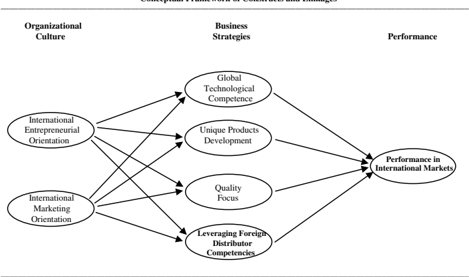
- The survey analysis found that international entrepreneurial orientation significantly predicted global technological competence with a standardized coefficient of 0.28; the link from international marketing orientation to global technological competence was not significant.
- Unique products development was significantly predicted by both international entrepreneurial orientation (0.19) and international marketing orientation (0.24).
- Quality focus was significantly predicted by both international entrepreneurial orientation (0.23) and international marketing orientation (0.35).
- Leveraging foreign distributor competences was significantly predicted by international marketing orientation (0.26) but not by international entrepreneurial orientation; these strategy variables were also significant drivers of performance in international markets: global technological competence (0.21), unique products development (0.14), quality focus (0.30), and leveraging foreign distributor competences (0.18).
## Methods
- The paper uses a two-phase design: first qualitative interviews/case studies to develop constructs and hypotheses, then a cross-industry field survey to test them.
- The qualitative phase included 33 professionals: 24 senior managers at early internationalizing firms, 6 scholars, and 3 international trade experts; the firms were mostly founded after 1985, sold half or more of their sales abroad, and had entered foreign markets within 3 years of founding.
- The survey was mailed to a random sample of 900 manufacturing firms in the United States founded in 1980 or later and exporting at least 25% of total production; 203 usable surveys were returned (about 23% response rate). The main analysis used LISREL8 path analysis, with exploratory factor analysis and confirmatory factor analysis for scale purification and validity checks.
## Limitations
- The paper states that “little empirical work” had been attempted on born globals and that there had been “almost no empirical research” on the factors driving their superior international performance.
- The study itself is focused on U.S. manufacturing firms that were selected using a 25% export threshold, so the evidence is tied to that sample and entry-mode context; this is evident from the text.
- The paper notes that the survey results are based on self-reported measures from responding firms; this is evident from the questionnaire-based design, though the paper does not frame it explicitly as a limitation.
Model-written summary. Check it against the paper before relying on it.
Integrity signals
Registry
Cites
Statistics
Figures
Verification
Claims the paper makes
0 Valid · 0 Not valid · 53 Not checked · 112 Own results and interpretations
A result the paper reports from its own data — it cites no other source for it, so there is none to check. The quote shows it is in the paper.
In the paper
“Despite the scarce resources typical of young firms, our findings reveal that born-global firms leverage a distinctive mix of orientations and strategies that allow them to succeed in diverse international markets.”
plainstates a cause- Asserted: passes — The authors put it forward as true.
- Checkable: passes — It can be checked against evidence.
- Load-bearing: passes — The paper’s conclusions depend on it.
- Based: passes — The paper gives a reason why it holds.
- Rests on an assumption not shown here.
A result the paper reports from its own data — it cites no other source for it, so there is none to check. The quote shows it is in the paper.
In the paper
“The critical role of marketing prowess overseas was also strongly emphasized by virtually all interviewees in the case studies.”
boosted- Asserted: passes — The authors put it forward as true.
- Checkable: passes — It can be checked against evidence.
- Load-bearing: unclear — It is unclear whether the paper’s conclusions depend on it.
- Based: passes — The paper gives a reason why it holds.
A result the paper states — it cites no source for it, so there is none to check. The quote shows it is in the paper.
In the paper
“Most interviewed firms exhibited strong technological capabilities in their respective product or industry categories.”
plain- Asserted: passes — The authors put it forward as true.
- Checkable: passes — It can be checked against evidence.
- Load-bearing: unclear — It is unclear whether the paper’s conclusions depend on it.
- Based: passes — The paper gives a reason why it holds.
A result the paper reports from its own data — it cites no other source for it, so there is none to check. The quote shows it is in the paper.
In the paper
“In general, the qualitative phase of the study revealed that born globals are likely to be formed by entrepreneurs who pursue foreign ventures with a strong marketing orientation.”
hedgedstates an association- Asserted: passes — The authors put it forward as true.
- Checkable: passes — It can be checked against evidence.
- Load-bearing: passes — The paper’s conclusions depend on it.
- Based: passes — The paper gives a reason why it holds.
A result the paper states — it cites no source for it, so there is none to check. The quote shows it is in the paper.
In the paper
“In contrast, born globals leverage a collection of fundamental intangible knowledge-based capabilities in the cultivation of foreign markets early in their evolution.”
plainstates a cause- Asserted: passes — The authors put it forward as true.
- Checkable: passes — It can be checked against evidence.
- Load-bearing: passes — The paper’s conclusions depend on it.
- Based: unclear — It is unclear why the paper says it holds.
- Rests on an assumption not shown here.
84 more claims
Create a free account to see all 165 claims and to verify the 3 references still open.
- It may state two separate claims as one. 33
- Probably not a substantial claim. 54
Citations
Cites
Evaluating Structural Equation Models with Unobservable Variables and Measurement Error
Fornell, C., & Larcker, D. F. (1981) · Journal of Marketing Research · doi:10.2307/3151312 · Cited by 109,314 · cited 2×
“Composite reliability was calculated using the procedures outlined by Fornell and Larcker (1981).”
MethodInfluentialEvaluating structural equation models with unobservable variables and measurement error
Fornell, C., & Larcker, D. F. (1981) · Journal of Marketing Research · doi:10.1177/002224378101800104 · Cited by 109,190
Firm Resources and Sustained Competitive Advantage
Barney, J. (1991) · Journal of Management · doi:10.1177/014920639101700108 · Cited by 48,334
(1994) · Journal of the American Dietetic Association · doi:10.1016/0002-8223(94)92216-0 · Cited by 45,910
Firm resources and sustained competitive advantage
Barney, J. B. (2004) · Advances in Strategic Management · doi:10.1016/s0742-3322(00)17018-4 · Cited by 38,152
Absorptive Capacity: A New Perspective on Learning and Innovation
Cohen, W. M., & Levinthal, D. A. (1990) · Administrative Science Quarterly · doi:10.2307/2393553 · Cited by 35,728
A resource‐based view of the firm
Wernerfelt, B. (1984) · Strategic Management Journal · doi:10.1002/smj.4250050207 · Cited by 25,635
The Theory of Economic Development
Schumpeter, J., & Backhaus, U. (2006) · The European Heritage in Economics and the Social Sciences · doi:10.1007/0-306-48082-4_3 · Cited by 22,506
An Evolutionary Theory of Economic Change.
Loasby, B. J., Nelson, R. R., & Winter, S. G. (1983) · The Economic Journal · doi:10.2307/2232409 · Cited by 21,366
A Dynamic Theory of Organizational Knowledge Creation
Nonaka, I. (1994) · Organization Science · doi:10.1287/orsc.5.1.14 · Cited by 17,809
Research works printed but not linked: 5
- Nikkei Sangyoo Shimbun (1995) Benchaa Shin Sedai (New Generation Ventures) , Nihon Keizai Shimbun: Tokyo.
- Nunnally, J.C. (1978) Psychometric Theory
- Porter, M.E. (1980) Competitive Strategy , The Free Press: New York.
- Rennie, M. (1993) 'Born global', McKinsey Quarterly (4): 45-52. Rosson, P. and Ford, I.D. (1982) 'Manufacturer-overseas distributor relations and export performance', Journal of International Business Studies 13 (2): 57-72.
- Schumpeter, J. (1939) Business Cycles , Vol. 1 McGraw-Hill: New York.
Cited by
Items 1,801–1,900 of 3,020
Conceptual framework on Internet Born Global’s internationalization
Wang, F., & Rahim, Z. B. A. (2025) · International Studies of Management and Organization · doi:10.1080/00208825.2025.2515685 · Cited by 5
“…significant academic attention over the past decades as they challenge traditional theories of how firms should approach international expansion strategies (Braunerhjelm and Halldin 2019; Knight and Cavusgil 2004; McDougall, Shane, and Oviatt 1994; Ojala, Evers, and Rialp 2018; Oliva et al. 2022).”
InfluentialHerath, H. M. T. S., & Surangi, H. A. K. N. S. (2025) · International Journal of Asian Business and Information Management · doi:10.4018/ijabim.383945 · Cited by 3
Doru, Ö., Altun, İ., & Kurnaz, G. (2025) · Karamanoğlu Mehmetbey Üniversitesi Sosyal Ve Ekonomik Araştırmalar Dergisi · doi:10.18493/kmusekad.1496886 · Cited by 3
Corporate governance and business outcomes in digital merchandising businesses
Siriyotha, S., & Lekcharoen, S. (2025) · Journal of Governance and Regulation · doi:10.22495/jgrv14i4siart4 · Cited by 4
Giacomin, V., & Romagnoli, F. (2025) · Journal of Management Studies · doi:10.1111/joms.70033 · Cited by 3
Faroque, A. R., Gabrielsson, P., Seppälä, T., Gabrielsson, M., & Partanen, J. P. (2025) · International Business Review · doi:10.1016/j.ibusrev.2025.102555 · Cited by 5
Ponce-Gómez, J. E., Vara-Horna, A., Mañé, A. V., & Dornberger, U. (2022) · Frontiers in Psychology · doi:10.3389/fpsyg.2022.950807 · Cited by 5
“Given that small enterprises have limited resources developing positive relationships with foreign partners plays a crucial role in competing in international markets (Knight and Cavusgil, 2004; Lages et al., 2009).”
BackgroundCAPITAL STRUCTURE OF ENTERPRISES IN THE PROCESS OF INTERNATIONALIZATION
RÓŻAŃSKI, J., & Bogołębska, J. (2022) · Scientific Papers of Silesian University of Technology Organization and Management Series · doi:10.29119/1641-3466.2022.157.26 · Cited by 3
Supply chain strategy under VUCA world for Sustainable of the Tea Entrepreneur in Thailand
Jantapoon, K., & Saenchaiyathon, K. (2023) · E3S Web of Conferences · doi:10.1051/e3sconf/202344006006 · Cited by 5
Širec, K., Samsami, M., & Schøtt, T. (2023) · Organizacija · doi:10.2478/orga-2023-0023 · Cited by 5
Speed of the internationalisation process. The role of objective vs. subjective perceptions of time
Bueno, J. C. C., Moreno, A. M., Acedo, F. J., & Hidalgo, E. R. (2024) · Journal of International Entrepreneurship · doi:10.1007/s10843-024-00360-x · Cited by 4
“…for the international business field due to its effect on some of the core assumptions that seem to differentiate the stage model of the internation‑ alisation approach (Johanson and Vahlne 1977, 1990) from that of the international entrepreneurship literature (Knight and Cavusgil 2004).”
Johanson, M., Oliveira, L., & Fleury, A. (2024) · Journal of Business Research · doi:10.1016/j.jbusres.2024.114943 · Cited by 6
“Considering Born Globals as firms that internationalize within three years of inception and obtain at least 25 % of their revenues from abroad (Knight & Cavusgil, 2004; Paul & Rosado-Serrano, 2019), we find that 374 firms in our sample (approximately 44 % of the sample) qualify as born global.”
BackgroundCiasullo, M. V., Cassia, F., Ferrara, M., & Rosa, A. (2024) · Knowledge Management Research & Practice · doi:10.1080/14778238.2024.2421937 · Cited by 4
The Social Innovation of Academic Spin‐Offs From a Multilevel Approach
Camelo‐Ordaz, C., Diánez‐González, J. P., Franco‐Leal, N., & Ginel, E. S. (2025) · Corporate Social Responsibility and Environmental Management · doi:10.1002/csr.3126 · Cited by 3
Determinants of Chinese Exporters' Online De-Internationalization
Jean, R. “., Kim, D., Cavusgil, S. T., & Chen, C. (2025) · Management and Organization Review · doi:10.1017/mor.2024.65 · Cited by 3
“For example, the prior international business and exporting literature (Knight & Cavusgil, 2004; Knight & Kim, 2009; Weerawardena, Mort, Salunke, Knight, & Liesch, 2014) highlighted certain critical resources and capabilities, such as international marketing orientation, international orientation,…”
Self-citationSheppard, M. (2025) · International Marketing Review · doi:10.1108/imr-11-2024-0464 · Cited by 3
Harmanci, H., Khalik, M., & Godinez, J. (2025) · Journal of International Management · doi:10.1016/j.intman.2025.101281 · Cited by 9
Torkkeli, L. (2014) · International Journal of Procurement Management · doi:10.1504/ijpm.2014.064972 · Cited by 5
“While studies on SME internationalisation have repeatedly indicated business networks as enablers of smaller firms to enter their first foreign markets (e.g., Madsen and Servais, 1997; Holmlund and Kock, 1998; Chetty and Blankenburg-Holm, 2000; Chetty and Campbell-Hunt, 2003; Knight and Cavusgil, 2004; Coviello, 2006)…”
BackgroundKhan, G. M. (2012) · International Journal of Business and Management · doi:10.5539/ijbm.v7n8p33 · Cited by 3
“These include Knight and Cavusgil (1996, 2004), Masen and Servais (1997), and Chetty and Campbell-Hunt (2004).”
BackgroundCyberspace: A Paradigm Shift for International Entrepreneurs’ Relationships?
Sigfusson, T., & Harris, S. (2012) · Palgrave Macmillan UK eBooks · doi:10.1057/9781137007742_11 · Cited by 3
A Study on the Export Performance of Korean SMEs and Venture Businesses mediated by Korea-ASEAN FTA
심재권, Yoo, W., & Cheol-Gyu, L. (2012) · The e-Business Studies · doi:10.15719/geba.13.5.201212.121 · Cited by 3
Determinants of international expansion strategy for spanish franchises
García, A. N. (2012) · ESIC MARKET Economic and Business Journal · doi:10.7200/esicm.143.0433.1i · Cited by 3
“Thus, it is considered that internationalization speed can create important competitive advantages over competitors who develop internationalization processes more slowly, impacting positively on the ability of international growth of the organization (Knight and Cavusgil, 2004).”
BackgroundSundqvist, S., Kuivalainen, O., & Cadogan, J. W. (2011) · Palgrave Macmillan UK eBooks · doi:10.1057/9780230305106_10 · Cited by 7
Exploring Choices of Software Sourcing Methods Among Start-Ups
Johansson, B., Deliallisi, B., & Walraven, P. (2016) · Lecture notes in business information processing · doi:10.1007/978-3-319-47009-2_11 · Cited by 3
Noticing and Capturing Growth Opportunities in International Markets: A Real Options Perspective
Ahi, A., & Kuivalainen, O. (2017) · Springer eBooks · doi:10.1007/978-3-319-48851-6_11 · Cited by 3
Global Doğan Firmalar Üzerine Sistematik Literatür İncelemesi
Nardalı, S. (2017) · Yönetim ve Ekonomi Dergisi · doi:10.18657/yonveek.335267 · Cited by 6
Magyar „nemzetközi új vállalatok”. Piacválasztás és a hálózatok szerepe a korai nemzetköziesedésben
Kozma, M., & Sass, M. (2019) · Vezetéstudomány / Budapest Management Review · doi:10.14267/veztud.2019.03.06 · Cited by 3
THE BORN GLOBAL FIRMS IN BRAZIL AND THE ROLE OF EXPORT- PROMOTION PROGRAMS
Machado, M. A., & Bischoff, V. (2018) · Revista Alcance · doi:10.14210/alcance.v25n1(jan/abr).p003-019 · Cited by 2
“Chandra et al. (2012), Dib et al. (2010), Johnson (2004), Knight and Cavusgil (1996, 2004, 2005), Loane v Bell (2006), Pla-Barber and EscribáEsteve (2006), Rialp et al. (2005), and Zahra (2005).”
YALÇIN, A., & Uner, M. M. (2019) · Hacettepe Üniversitesi İktisadi ve İdari Bilimler Fakültesi Dergisi · doi:10.17065/huniibf.454560 · Cited by 8
A Produção Científica em Born Globals nos Periódicos e Encontros Científicos Brasileiros
de Sousa, T. A. V., Rocha, T. N., & Forte, S. H. A. C. (2020) · Internext · doi:10.18568/internext.v15i2.525 · Cited by 3
“As BG, em sua maior parte, baseiam o seu modo de funcionamento nas novas tecnologias de informação, principalmente a internet, se estruturando de formas alternativas, com foco em recursos baseados em conhecimento e inovação nas suas operações (Knight & Cavusgil, 2004; Ribeiro & Pimentel, 2009).”
BackgroundEffects of Internationalization on Innovation in the Service Industry: Evidence from Korea
Lee, J., Lee, J., & Choi, B. (2014) · East Asian Economic Review · doi:10.11644/kiep.jeai.2014.18.4.285 · Cited by 3
The strategic decision-making process for the internationalization of family businesses
Musso, F., & Francioni, B. (2020) · Sinergie Italian Journal of Management · doi:10.7433/s112.2020.02 · Cited by 4
“, and on the relevance of international operations (Moen 2002; Rasmussen and Madsen, 2002; Moen and Servais 2002; Chetty and Campbell-Hunt, 2004; Knight and Cavusgil 2004; Mort and Weerawardena 2006).”
BackgroundInfluentialMuharam, H., Rita, M. R., Sadalia, I., et al. (2020) · International Journal of Financial Research · doi:10.5430/ijfr.v11n5p376 · Cited by 3
Chronic corporate performance in media-tech firms: a new perspective
Oliver, J. (2021) · Journal of Media Business Studies · doi:10.1080/16522354.2021.1964191 · Cited by 3
“For example, a cultural dimension can be drawn from Ruef (2002), O'Reilly and Tushman (2004), Knight and Cavusgil (2004), Langerak et al. (2004), and McKelvey and Saemundsson (2018), and Oliver (2019) who argued that culturally, firms were either more open, or resistant, to the idea of innovation…”
BackgroundAgyeman, F. O., Ma, Z., Li, M., & Sampene, A. K. (2021) · EPRA International Journal of Economics Business and Management Studies · doi:10.36713/epra7300 · Cited by 6
“Furthermore, if your goods are regarded as special or creative in other countries, your earnings will skyrocket in no time (Knight & Cavusgil, 2004).”
BackgroundTheoretical aspects of innovation management
Fedulov, D., & Pobedin, A. A. (2021) · SHS Web of Conferences · doi:10.1051/shsconf/202111600034 · Cited by 3
The Future of International Entrepreneurship Post-COVID-19
Torkkeli, L., Faroque, A. R., & Velt, H. (2022) · Contributions to economics · doi:10.1007/978-3-030-89996-7_3 · Cited by 6
Duli, Y. M., Jaya, W. K., Saleh, S., & Pangaribowo, E. H. (2022) · Cogent Economics & Finance · doi:10.1080/23322039.2022.2037251 · Cited by 5
“Second, many companies can expand into the global market since they are born-global firms (Knight & Cavusgil, 2004).”
BackgroundInvestigating the driving forces of the formation of Chinese born global firms
Chen, X. (2022) · AFRICAN JOURNAL OF BUSINESS MANAGEMENT · doi:10.5897/ajbm2021.9322 · Cited by 3
“Entrepreneurial orientation We used the measurement of Knight (1997), Moen and Servais (2002) and Knight and Cavusgil (2004).”
BackgroundMethodInfluentialTransnational immigrant entrepreneurs in the context of dual entrepreneurial ecosystem
Duan, C. (2022) · International Journal of Business Ecosystem and Strategy (2687-2293) · doi:10.36096/ijbes.v4i4.364 · Cited by 8
“Immigrant Entrepreneurship in America: Evidence from The Survey of Business Owners 2007 & 2012. Retrieved from https://www.nber.org/papers/w22385 Knight, G. A., & Cavusgil, S. T. (2004). Innovation, organizational capabilities, and the born-global firm. Journal of International Business Studies, 35(2), 124-141. https:…”
BackgroundInfluentialEscandón‐Barbosa, D., Aristizábal, G. C., Ramírez-Urraya, A., & Ayala, A. H. (2022) · Journal of Global Marketing · doi:10.1080/08911762.2022.2156420 · Cited by 3
“…accessibility of resources in developing nations, in addition to other challenges like economic, cultural, and other barriers (Falahat et al., 2018; Knight & Cavusgil, 2004; Escandon-Barbosa & Estrada-Ochoa, 2021) The challenges faced by young, small businesses in developing markets include…”
BackgroundEmpreendedorismo Internacional: Mapeamento Temático e Proposta de Agenda de Pesquisa
Ortiz-Rojo, R. A., & Lacruz, A. J. (2023) · Organizações & Sociedade · doi:10.1590/1984-92302023v30n0010pt · Cited by 10
Nabi, M. N. U., Nyaoro, B., & Zohora, F. T. (2023) · Journal of Research in Marketing and Entrepreneurship · doi:10.1108/jrme-05-2021-0057 · Cited by 4
Koval, M., Iurkov, V., & Benito, G. R. G. (2023) · Journal of World Business · doi:10.1016/j.jwb.2023.101500 · Cited by 5
Chinese early internationalizing firms: A review and research agenda
Jie, S., Singh, D. A., Ma, H., & Li, C. (2024) · Asia Pacific Journal of Management · doi:10.1007/s10490-023-09942-0 · Cited by 3
“…on CEIFs covers several types of firms, such as international new ventures (Khavul et al., 2010a; Ovi-att & Mcdougall, 1994), born global firms (Knight & Cavusgil, 2004; Zhou et al., 2007), global startups ( Oviatt & McDougall, 1995), and early internationalizing firms (EIFs) (Rialp et al.,…”
A Path Forward for Research on Born Global Firms
Knight, G., & Cavusgil, S. T. (2024) · JIBS special collections · doi:10.1007/978-3-031-17366-0_3 · Cited by 5
Self-citationFaroque, A. R., Shimul, A. S., Xu, H., Kuivalainen, O., Murshed, F., & Sundqvist, S. (2025) · International Business Review · doi:10.1016/j.ibusrev.2025.102428 · Cited by 5
Grama‐Vigouroux, S., & Royer, I. (2014) · Revue de l’Entrepreneuriat · doi:10.3917/entre.123.0033 · Cited by 8
Small Firm Specialisation in Global Value Chains: Evidence from the Cut Flower Industry
Benson‐Rea, M., & Stringer, C. A. (2015) · RePEc: Research Papers in Economics · Cited by 3
International Opportunities and Value Creation in International Entrepreneurship
Mainela, T., Puhakka, V. J., & Wakkee, I. A. M. (2016) · Springer eBooks · doi:10.1007/978-3-319-39369-8_3 · Cited by 3
Transnational Entrepreneurs and Their Global Market Entry Modes
Ekanem, I., & Uwajeh, N. J. (2016) · Advances in business strategy and competitive advantage book series · doi:10.4018/978-1-5225-1991-1.ch008 · Cited by 3
Li, J. Y., Cao, J. X., & Liu, Y. Q. (2017) · Eurasia Journal of Mathematics Science and Technology Education · doi:10.12973/eurasia.2017.00832a · Cited by 3
Internationalization Process and Entry Strategy of Turkish Furniture SMEs: Bursa-Inegol Sample
Nooshabadi, J. E., & ÖZŞAHİN, M. (2017) · Journal of Business Research - Turk · doi:10.20491/isarder.2017.360 · Cited by 3
“Born Global: According to the definition, a firm can be Born Global or international new venture if the firm pursues a vision of becoming a global actor rapidly from or near its inception without any preceding long-term domestic operation (Knight & Cavusgil, 2004; Oviatt & McDougall, 1994).”
BackgroundInstitutional drivers of born-public ventures
DeGhetto, K., Sutton, T., & Zorn, M. L. (2018) · Journal of Entrepreneurship and Public Policy · doi:10.1108/jepp-d-17-00012 · Cited by 4
Ji, F. X., Axinn, C. N., & de Campos, L. A. G. (2018) · International Studies of Management and Organization · doi:10.1080/00208825.2018.1443740 · Cited by 4
“The literature argues that these young firms follow a more radical approach to internationalization than traditional Multinational Corporations (MNCs) (Zahra, Ireland, and Hitt 2000; Knight and Cavusgil 2004; Oviatt and McDougall 2005).”
BackgroundMarket Entry Strategies, Innovation and Performance of SMEs in the Service Sector
Hofer, K. M., & Baba, A. (2018) · Emerald Group Publishing Limited eBooks · doi:10.1108/s1876-066x20180000034009 · Cited by 10
Uthamaputhran, S. A. L. (2018) · International journal of entrepreneurship · Cited by 3
Management control in born-global firms: a case study
Roque, A. F., Alves, M. D. C. G., & Raposo, M. L. B. (2020) · Estudios Gerenciales · doi:10.18046/j.estger.2020.154.3499 · Cited by 6
“BGs’ expansion is due to the growth of information and communication technology and to globalisation (Knight & Cavusgil, 2004).”
BackgroundInfluentialFood Innovation and Sustainable Development: A Bioeconomics Perception
Kifordu, A. A., Adetunji, C. O., Odiwo, W. O., et al. (2020) · Springer eBooks · doi:10.1007/978-981-15-6121-4_1 · Cited by 3
The competitive repositioning of SMEs within the process of international competition
Marcone, M. R. (2009) · RePEc: Research Papers in Economics · Cited by 3
La expansión internacional de la franquicia española: descripción del momento actual
Graciá, V. B. (2008) · ABACUS. Repositorio de Producción Científica (Universidad Europea) · Cited by 3
ViDũng, N., Janssen, F., & Jacquemin, A. (2013) · Revue de l’Entrepreneuriat · doi:10.3917/entre.113.0085 · Cited by 4
D’Angelo, A., & Warner, K. (2010) · Palgrave Macmillan UK eBooks · doi:10.1057/9780230278028_16 · Cited by 3
Dinámica exportadora de las empresas born global en Colombia.
Escandón‐Barbosa, D., Ayala, A. H., & López, C. A. C. (2013) · Revista Finanzas y Política Económica · doi:10.14718/revfinanzpolitecon.v5.n1.2013.456 · Cited by 15
Neto, J. S., & Alcântara, R. L. C. (2013) · Revista Produção Online · doi:10.14488/1676-1901.v13i1.1107 · Cited by 3
Redes, inovação e desempenho exportador: uma abordagem institucional
Mais, I., de Carvalho, L. C., & Amal, M. (2014) · Revista de Administração Contemporânea · doi:10.1590/1982-7849rac20141043 · Cited by 9
“O acesso a novos mercados é um dos efeitos frequentemente atribuídos às inovações (Filipescu et al., 2009; Knight & Cavusgil, 2004; Roper & Love, 2002), bem como a propensão das empresas a exportar (Nguyen, Quang Pham, Nguyen, & Nguyen, 2008; Roper & Love, 2002).”
BackgroundExport Entrepreneurship and Export Performance. A Resource and Competitive Perspective
García, A. N., & Peris‐Ortiz, M. (2014) · Springer eBooks · doi:10.1007/978-3-319-08888-4_1 · Cited by 3
Osman, M. H. M., Roudini, A., & Heidarzadagan, A. (2013) · Jurnal Teknologi · doi:10.11113/jt.v64.2274 · Cited by 3
Veilleux, S., Haskell, N. A., & Pons, F. (2011) · International Journal of Business and Globalisation · doi:10.1504/ijbg.2011.038485 · Cited by 3
“All these factors call for early internationalization (Chetty and Campbell-Hunt 2004; Knight and Cavusgil 2004; McDougall 1989; McDougall et al. 2003).”
BackgroundLesage, X., & Ronteau, S. (2012) · International Business Research · doi:10.5539/ibr.v5n6p62 · Cited by 3
“On the other hand, the same considerations are observed in context of “born global” organizations (Rialp et al., 2005; Knight & Cavusgil, 2004; Sharma & Blomstermo, 2003).”
BackgroundRibeiro, F. C. F., Oliveira, M., & Paulo, S. (2012) · Cited by 3
Strategic logic and marketing resources: A case analysis approach to emerging market success
Johansen, D. (2014) · Cited by 3
Sustained competitive advantage of born global ventures: A conceptual framework
Jafri, S. K. A., Ismail, K., & Shahid, W. (2014) · World Applied Sciences Journal · doi:10.5829/idosi.wasj.2014.30.10.161 · Cited by 3
“relatively low in small countries with plenty of small Briefly, the basic purpose of the conceptual paper is to international firms [4, 39, 40].”
BackgroundInfluentialHofer, K. M. (2015) · RePEc: Research Papers in Economics · Cited by 3
Exploring the link between innovation capability and financial performance
Yeşil, S., & Kaya, A. (2015) · Cited by 3
Innovations of Insurance Companies and Investment Funds
Njegomir, V., & Demko-Rihter, J. (2013) · Management Journal of Sustainable Business and Management Solutions in Emerging Economies · doi:10.7595/management.fon.2013.0014 · Cited by 3
Roh, D.-H., & Park, H.-Y. (2015) · Journal of the Korea society of IT services · doi:10.9716/kits.2015.14.1.023 · Cited by 3
BORN GLOBALS IN INTERACTIVE BRANDING ENVIRONMENT: A CASE OF THE BONALIVE
Koporčić, N. (2016) · doi:10.20472/bmc.2016.003.011 · Cited by 3
“More and more research is being done, as a result of globalization and growth of an international exchange system, in which companies regardless of experience, size, age, or resources, can become a part of an international business world (Knight and Cavusgil, 2004).”
InfluentialBorn-Global Firms from China and Norway: A Comparison
Karlsen, S. M. F., Zhao, Y., & Lunnan, R. (2012) · Palgrave Macmillan UK eBooks · doi:10.1057/9780230363663_6 · Cited by 3
Sainio, L., Saarenketo, S., Nummela, N., & Eriksson, T. (2011) · Palgrave Macmillan UK eBooks · doi:10.1057/9780230305106_11 · Cited by 3
Masango, S. G., & Marinova, S. T. (2012) · Palgrave Macmillan UK eBooks · doi:10.1057/9781137032546_14 · Cited by 3
From Local Information Systems to Global Customer Relationship Management
Akküçük, U. (2013) · Advances in electronic government, digital divide, and regional development book series · doi:10.4018/978-1-4666-4639-1.ch023 · Cited by 3
“It has also been argued that the growth of the “born global” firms serving niche markets worldwide has been fueled by the developments in the international information systems (Knight & Cavusgil, 2004).”
BackgroundImpacts of Global Mindset and Psychic Distance on the Performance of Brazilian Subsidiaries
Reis, G. G., Fleury, M. T. L., & Fleury, A. (2012) · Palgrave Macmillan UK eBooks · doi:10.1057/9781137032546_7 · Cited by 3
Kasemsap, K. (2016) · International Journal of Sustainable Entrepreneurship and Corporate Social Responsibility · doi:10.4018/ijsecsr.2016010103 · Cited by 3
Early Internationalisation of New and Small Indian Firms: An Exploratory Study
Arte, P., & Barron, A. (2016) · Emerald Group Publishing Limited eBooks · doi:10.1108/s1745-886220160000011027 · Cited by 6
Kim, Y. C. (2012) · Journal of the Economic Geographical Society of Korea · doi:10.23841/egsk.2012.15.1.1 · Cited by 3
isoketsu, J. B. (2017) · Marché et organisations · doi:10.3917/maorg.028.0105 · Cited by 3
Ezepue, P. O., & Ochinanwata, N. (2017) · Journal of Advances in Management Sciences & Information Systems · doi:10.6000/2371-1647.2017.03.02 · Cited by 7
“Born-global firms (BGFs) are defined as companies that seek superior global performance from early stages in their development, for example Facebook, Apple, WhatsApp, Snapchat, Google and Uber [1-4].”
BackgroundDeterminanty tempa internacjonalizacji przedsiębiorstw ze szczególnym uwzględnieniem born globals
Daszkiewicz, N. (2016) · Cited by 3
Drašković, N., Marković, M., & Hruskar, D. (2017) · Annals of DAAAM for ... & proceedings of the ... International DAAAM Symposium · doi:10.2507/28th.daaam.proceedings.124 · Cited by 3
“Internet of Things” Firms and New Patterns of Internationalization
Veglio, V. (2017) · Emerald Group Publishing Limited eBooks · doi:10.1108/978-1-78714-501-620171009 · Cited by 3
Laurens, P., Bas, C. L., Schoen, A., et al. (2018) · Management international · doi:10.7202/1043074ar · Cited by 3
Zhang, M. (2018) · Journal of Asia-Pacific Business · doi:10.1080/10599231.2018.1419045 · Cited by 4
“It thus provides the foundation from which the firm interacts with diverse foreign markets (Knight & Cavusgil, 2004).”
BackgroundChallenging the Theoretical Lenses of Internationalization
Pinto, L. S., Ribeiro, M. M., & Moreira, A. C. (2018) · Advances in logistics, operations, and management science book series · doi:10.4018/978-1-5225-5360-1.ch005 · Cited by 3
Revisiting Uppsala through the Lenses of New Ventures: A Longitudinal Study of Norwegian Firms
Gripsrud, G., Hunneman, A., & Solberg, C. A. (2015) · Emerald Group Publishing Limited eBooks · doi:10.1108/s1474-797920150000026001 · Cited by 6
From competitiveness to sustainability: Is the innovativeness the answer?
Lagumdžija, Z., Kapo, A., & Turulja, L. (2019) · BH Ekonomski forum · doi:10.5937/bhekofor1902025l · Cited by 3
“In order to become competitive, the newly created global companies believe that a crucial ingredient is an innovative culture, as well as knowledge and skills in this unique breed of an international, entrepreneurial firm (Knight & Cavusgil, 2004).”
BackgroundMexico, U. A. D. N. L., SAUCEDO, F., VASQUEZ, M. A., Mexico, U. A. D. N. L., LOPEZ, A., & Mexico, U. A. D. N. L. (2020) · ESPACIOS · doi:10.48082/espacios-a20v41n50p08 · Cited by 3
“Dentro de los enfoques que permiten encontrar aquellas características distintivas que permiten a las ENG alcanzar una rápida internacionalización, se puede mencionar la perspectiva de Visión Basada en Recursos (VBR), han buscado dar explicación al éxito en los resultados empresariales de las nacidas globales (Rodrigu…”
BackgroundInfluentialSMEs' heterogeneity at the extensive margin and within the intensive margin of trade
Aronica, M., Fazio, G., & Piacentino, D. (2021) · Journal of International Trade & Economic Development · doi:10.1080/09638199.2021.1875024 · Cited by 5
“Here, however, we rely on the more popular approach suggested by Knight and Cavusgil (2004).”
BackgroundMethodInfluentialDesenvolvimento de Competências Digitais e Internacionais em Startups via Aceleradoras de Negócios
de Noronha, M. E. S., Rodrigues, C. D., Mello, C., et al. (2022) · Internext · doi:10.18568/internext.v17i1.641 · Cited by 3
Metadata
- Authors
- Knight, G. A., & Cavusgil, S. T.
- Affiliations
- Florida State University (US)
- Corresponding author
- Knight, Gary A
- ORCID
- Knight, Gary A
- Venue
- Journal of International Business Studies
- Published
- 2004-01-08
- Volume
- 35
- Issue
- 2
- Pages
- 124-141
- ISSN
- 0047-2506 (ISSN-L)
- 1478-6990
- OpenAlex
- W2127709152
- Semantic Scholar
- d24960b5342d0dd3b86be002ab18a80e7b6fb5c9
- Cited by
- 3,013
- References
- 102
- Citations by year
- 2026: 121 · 2025: 123 · 2024: 157 · 2023: 154 · 2022: 182 · 2021: 196 · 2020: 189 · 2019: 180 · 2018: 199 · 2017: 172 · 2016: 188 · 2015: 187 · 2014: 178 · 2013: 167 · 2012: 129
- FWCI
- 137.12
- Type
- journal article
- Language
- en
- Update notices
- correction (2004-07-16)
- Open access
- bronze
- doi.org
- Licence
- www.springer.com/tdm (tdm)
- Locations
- Journal of International Business Studies (publishedVersion)
- RePEc: Research Papers in Economics (submittedVersion)
- Funders
- Michigan State University
- College of Engineering, Michigan State University
- Topics
- Social Sciences › Business, Management and Accounting › Strategy and Management › International Business and FDI
- Social Sciences › Business, Management and Accounting › Strategy and Management › Innovation and Knowledge Management
- Social Sciences › Communication › International Student and Expatriate Challenges
- Keywords
- born global firms, early internationalization, organizational capabilities, innovation, innovation culture, international business strategy, international success, young firms, internationalization of firms
About these checks
Registry, retraction, Cites and statistics results are computed, not judged, with one exception: a printed reference that no index lists is read once by a model before it counts as a citation error. Claims are extracted by a model and kept only when their quote appears verbatim in the text; each cited source is then checked, with a model’s help, for whether it says what the claim relies on. Those verdicts can be wrong — read the claim’s quote and the cited source before relying on one.
A language model drew the claims from the paper on 2026-10-10, under version 3 of the claim definition (model deepseek-v4.1-flash, prompt extract-v3).
A second model labelled each claim on 2026-10-10 (model jev-1.13-20260917, definition revision gold-guideline-v0.2).
Statistics and arithmetic are recomputed, not judged.
Confidence bands are shown only for fields calibrated on our annotated test set. None is calibrated yet, so no band is shown.
What counts as a claim ›How we measure confidence ›How we check this ›
Are you an author, or do you see a problem with this page? Request a review
Data sources
Bibliographic data: Semantic Scholar, OpenAlex, Crossref.
Contains information from the Semantic Scholar Academic Graph Datasets, made available under the ODC Attribution License (ODC-BY 1.0).
Semantic Scholar’s data is described in: Kinney, R., et al. (2023). The Semantic Scholar Open Data Platform. arXiv:2301.10140.
