

The DOI matches its Crossref record; 34 of the 36 references it cites were found in a registry or an index; none of the 24 sources its claims cite is checked for support yet.
Dietary species richness as a measure of food biodiversity and nutritional quality of diets
Open accessAbstract
Significance: Current research linking biodiversity and human diets has used metrics without justification from a nutritional point of view. Diet species richness, or a count of the number of different species consumed per day, assesses both nutritional adequacy and food biodiversity of diets for women and children in rural areas. The positive association of food species richness with dietary quality was observed in both the wet and the dry season. Food biodiversity contributes to diet quality in vulnerable populations in areas with high biodiversity. Reporting the number of species consumed during dietary assessment provides a unique opportunity to cut across two critical dimensions of sustainable development—human and environmental health—and complements existing indicators for healthy and sustainable diets.
Overview
AI snapshot
Written from the paper’s full text.
TL;DR
Dietary species richness (DSR), a count of species consumed per day, was positively associated with micronutrient adequacy in women and children in seven low- and middle-income countries. The authors recommend DSR as a simple cross-cutting indicator linking food biodiversity and diet quality.
Key findings
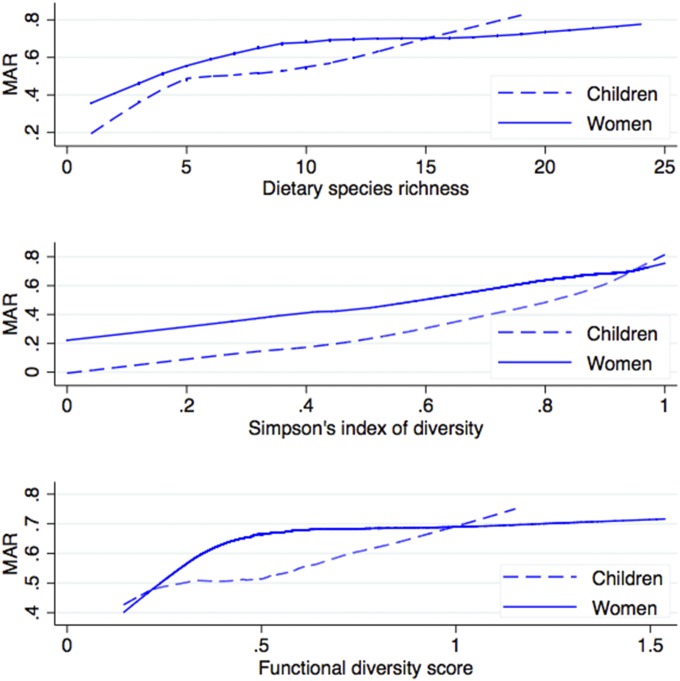
- All three food biodiversity indicators were positively associated with mean adequacy ratio (MAR): per z-score increase, MAR rose by 0.03 for species richness (SR), 0.70 for Simpson’s index (D), and 0.52 for functional diversity (FD); standardized coefficients were 0.10, 0.08, and 0.06, respectively (all P < 0.001).
- SR showed stronger and more consistent associations with diet quality than D or FD; mean SR was lower in children than women (8.24 ± 1.17 vs. 10.19 ± 3.52; P < 0.001).
- A total of 234 species were consumed; 94% of energy intake was identified at species level. In the wet season, nine species consumed in all countries provided 61% of energy, 10% of vitamin A, 24% of vitamin C, 42% of folate, 51% of iron, 65% of zinc, and 35% of calcium.
- Adding SR to dietary diversity score (DDS) improved detection of higher nutrient adequacy in women: DDS × SR ≥24 gave sensitivity 81% and specificity 60%, versus DDS ≥5 with sensitivity 42% and specificity 96%.
Methods
- Existing dietary datasets were identified through a systematic literature review and selected if they used quantitative, comparable 24-h recalls, identified foods/drinks to at least species level, and assessed women and/or children. Wet-season data came from rural Benin, Cameroon, Democratic Republic of Congo, Ecuador, Kenya, Sri Lanka, and Vietnam; dry-season data also came from Vietnam, Kenya, and Benin; data were collected July 2009–April 2015.
- Dietary intake data were obtained for n = 3,449 and n = 2,777 participants in wet and dry seasons, respectively; the sample included n = 2,188 women and n = 4,038 children.
- The study calculated SR, Simpson’s D, and FD from species consumed; MAR from vitamin A, vitamin C, folate, calcium, iron, and zinc; and DDS. Associations were modeled with random-effects linear regression (season fixed, country random), with energy adjustment by the residual method, and cutoffs assessed with ROC curves.
Limitations
- Stated: nutrient-composition data were missing for some foods, species, and varieties, so values from similar foods were substituted; a single 24-h recall per subject does not capture within-person variability or usual intake; data came from rural areas of middle-income countries where locally produced food dominates, so validity in urban, high-income, or highly processed-food diets is uncertain; food-source information (own production, market, wild) was not included, so the relative contribution of agricultural versus wild biodiversity could not be assessed.
- Stated: previous studies have misidentified 6–10% of species, and species-level identification can be challenging.
- Evident from the text: the analysis is observational and cross-sectional, so the positive associations cannot establish causality.
Model-written summary. Check it against the paper before relying on it.
Integrity signals
Registry
Cites
Statistics
Figures
Verification
Claims the paper makes
41 Own result · 22 Not checked yet · 12 Own method · 12 Own interpretation · 7 No basis given
A result the paper reports from its own data — it cites no other source for it, so there is none to check. The quote shows it is in the paper.
In the paper
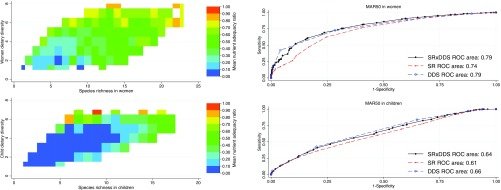
“The area under the curve for DDS, SR, and DDS × SR to define MAR ≥50% was comparable for both women and children (Fig. 4).”
§ Dietary species richness as a measure of food biodiversity and nutritional quality of diets > Results
plain- Asserted: passes — The authors put it forward as true.
- Checkable: passes — It can be checked against evidence.
- Load-bearing: unclear — It is unclear whether the paper’s conclusions depend on it.
- Based: passes — The paper gives a reason why it holds.
A result the paper reports from its own data — it cites no other source for it, so there is none to check. The quote shows it is in the paper.
In the paper
“MAR was comparable for children and women (0.61 ± 0.09 vs. 0.63 ± 0.06; P = 0.85; Table 1).”
§ Dietary species richness as a measure of food biodiversity and nutritional quality of diets > Results
plain- Asserted: passes — The authors put it forward as true.
- Checkable: passes — It can be checked against evidence.
- Load-bearing: unclear — It is unclear whether the paper’s conclusions depend on it.
- Based: passes — The paper gives a reason why it holds.
A result the paper reports from its own data — it cites no other source for it, so there is none to check. The quote shows it is in the paper.
In the paper
“mean SR was lower in children than in women (8.24 ± 1.17 vs. 10.19 ± 3.52; P < 0.001)”
§ Dietary species richness as a measure of food biodiversity and nutritional quality of diets > Results
plain- Asserted: passes — The authors put it forward as true.
- Checkable: passes — It can be checked against evidence.
- Load-bearing: unclear — It is unclear whether the paper’s conclusions depend on it.
- Based: passes — The paper gives a reason why it holds.
A result the paper reports from its own data — it cites no other source for it, so there is none to check. The quote shows it is in the paper.
In the paper
“All three food biodiversity indicators were positively associated with MAR (Fig. 1).”
- Also stated in: § Discussion · plain
“All three biodiversity indicators assessed food biodiversity in the diet and were positively associated with micronutrient adequacy.”
§ Dietary species richness as a measure of food biodiversity and nutritional quality of diets > Results
plaincorrelationaln = 6,226 ·- Asserted: passes — The authors put it forward as true.
- Checkable: passes — It can be checked against evidence.
- Load-bearing: passes — The paper’s conclusions depend on it.
- Based: passes — The paper gives a reason why it holds.
- Also stated in: § Discussion · plain
A result the paper reports from its own data — it cites no other source for it, so there is none to check. The quote shows it is in the paper.
In the paper
“The best cutoff to define a diet with higher nutrient adequacy was an MAR of 50% (SI Appendix, Table S7).”
§ Dietary species richness as a measure of food biodiversity and nutritional quality of diets > Results
plaincorrelational- Asserted: passes — The authors put it forward as true.
- Checkable: passes — It can be checked against evidence.
- Load-bearing: passes — The paper’s conclusions depend on it.
- Based: passes — The paper gives a reason why it holds.
A result the paper reports from its own data — it cites no other source for it, so there is none to check. The quote shows it is in the paper.
In the paper
“The associations of MAR and DDS with Simpson’s index and FD, however, were less consistent (SI Appendix, Figs. S3 and S4).”
§ Dietary species richness as a measure of food biodiversity and nutritional quality of diets > Results
plaincorrelational- Asserted: passes — The authors put it forward as true.
- Checkable: passes — It can be checked against evidence.
- Load-bearing: unclear — It is unclear whether the paper’s conclusions depend on it.
- Based: passes — The paper gives a reason why it holds.
A result the paper reports from its own data — it cites no other source for it, so there is none to check. The quote shows it is in the paper.
In the paper
“Diets were particularly inadequate with regard to iron (SI Appendix, Table S3).”
§ Dietary species richness as a measure of food biodiversity and nutritional quality of diets > Results
plain- Asserted: passes — The authors put it forward as true.
- Checkable: passes — It can be checked against evidence.
- Load-bearing: unclear — It is unclear whether the paper’s conclusions depend on it.
- Based: passes — The paper gives a reason why it holds.
A result the paper reports from its own data — it cites no other source for it, so there is none to check. The quote shows it is in the paper.
In the paper
“In the wet season, nine species [Arachis hypogaea L., Bos taurus Linnaeus, 1758, Glycine max (L.) Merr, Manihot esculenta Crantz, Oryza sativa L., Solanum lycopersicum L., Solanum tuberosum L., Sus scrofa Linnaeus, 1758, and Zea mays L.] were consumed in all countries”
§ Dietary species richness as a measure of food biodiversity and nutritional quality of diets > Results
plain- Asserted: passes — The authors put it forward as true.
- Checkable: passes — It can be checked against evidence.
- Load-bearing: unclear — It is unclear whether the paper’s conclusions depend on it.
- Based: passes — The paper gives a reason why it holds.
A result the paper reports from its own data — it cites no other source for it, so there is none to check. The quote shows it is in the paper.
In the paper
“In brief, adding SR to DDS considerably increased the ability to identify higher-quality diets in women.”
§ Dietary species richness as a measure of food biodiversity and nutritional quality of diets > Results
plaindirect- Asserted: passes — The authors put it forward as true.
- Checkable: passes — It can be checked against evidence.
- Load-bearing: passes — The paper’s conclusions depend on it.
- Based: passes — The paper gives a reason why it holds.
A result the paper reports from its own data — it cites no other source for it, so there is none to check. The quote shows it is in the paper.
In the paper
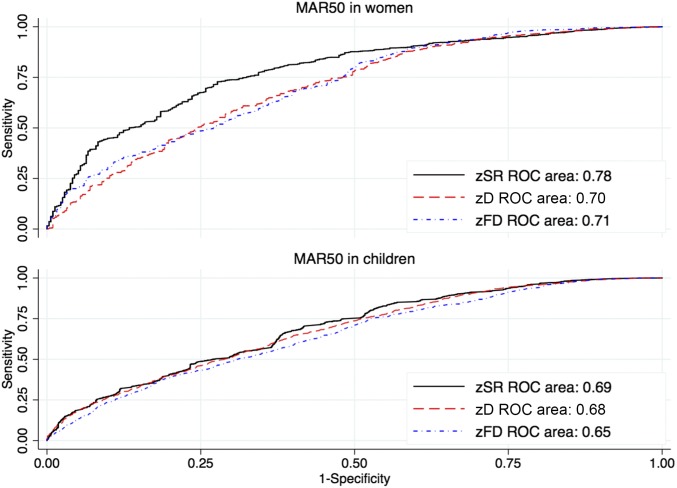
“Compared with the other food biodiversity indicators, ROC analysis also indicated a slightly higher ability for SR to define higher nutrient-adequate diets (Fig. 2).”
§ Dietary species richness as a measure of food biodiversity and nutritional quality of diets > Results
hedgedcorrelationaln = 6,226- Asserted: passes — The authors put it forward as true.
- Checkable: passes — It can be checked against evidence.
- Load-bearing: passes — The paper’s conclusions depend on it.
- Based: passes — The paper gives a reason why it holds.
A result the paper reports from its own data — it cites no other source for it, so there is none to check. The quote shows it is in the paper.
In the paper
“The average quantity of pulses, dark-green leafy vegetables, and vitamin A-rich vegetables consumed was notably higher (>15 g) in the dry season than in the wet season (SI Appendix, Table S2).”
§ Dietary species richness as a measure of food biodiversity and nutritional quality of diets > Results
plaincorrelational- Asserted: passes — The authors put it forward as true.
- Checkable: passes — It can be checked against evidence.
- Load-bearing: unclear — It is unclear whether the paper’s conclusions depend on it.
- Based: passes — The paper gives a reason why it holds.
A result the paper reports from its own data — it cites no other source for it, so there is none to check. The quote shows it is in the paper.
In the paper
“The standardized coefficients indicate that SR has a slightly stronger association with MAR than D and FD.”
§ Dietary species richness as a measure of food biodiversity and nutritional quality of diets > Results
hedgedcorrelationaln = 6,226- Asserted: passes — The authors put it forward as true.
- Checkable: passes — It can be checked against evidence.
- Load-bearing: unclear — It is unclear whether the paper’s conclusions depend on it.
- Based: passes — The paper gives a reason why it holds.
A result the paper reports from its own data — it cites no other source for it, so there is none to check. The quote shows it is in the paper.
In the paper
“Less than one-third of species were consumed in more than one country.”
§ Dietary species richness as a measure of food biodiversity and nutritional quality of diets > Results
plain- Asserted: passes — The authors put it forward as true.
- Checkable: passes — It can be checked against evidence.
- Load-bearing: unclear — It is unclear whether the paper’s conclusions depend on it.
- Based: passes — The paper gives a reason why it holds.
A result the paper reports from its own data — it cites no other source for it, so there is none to check. The quote shows it is in the paper.
In the paper
“The average number of species consumed per food group was comparable in the dry and wet season (SI Appendix, Table S4).”
§ Dietary species richness as a measure of food biodiversity and nutritional quality of diets > Results
plain- Asserted: passes — The authors put it forward as true.
- Checkable: passes — It can be checked against evidence.
- Load-bearing: unclear — It is unclear whether the paper’s conclusions depend on it.
- Based: passes — The paper gives a reason why it holds.
A result the paper reports from its own data — it cites no other source for it, so there is none to check. The quote shows it is in the paper.
In the paper
“MAR, DDS, and food biodiversity indicators were comparable across seasons when only the countries with data on the two seasons were used (P = 0.90, P = 0.93, and P = 0.51, respectively; Table 1).”
§ Dietary species richness as a measure of food biodiversity and nutritional quality of diets > Results
plain- Asserted: passes — The authors put it forward as true.
- Checkable: passes — It can be checked against evidence.
- Load-bearing: unclear — It is unclear whether the paper’s conclusions depend on it.
- Based: passes — The paper gives a reason why it holds.
A result the paper reports from its own data — it cites no other source for it, so there is none to check. The quote shows it is in the paper.
In the paper
“A total of 234 different species were consumed by participants”
§ Dietary species richness as a measure of food biodiversity and nutritional quality of diets > Results
plain- Asserted: passes — The authors put it forward as true.
- Checkable: passes — It can be checked against evidence.
- Load-bearing: unclear — It is unclear whether the paper’s conclusions depend on it.
- Based: passes — The paper gives a reason why it holds.
A result the paper reports from its own data — it cites no other source for it, so there is none to check. The quote shows it is in the paper.
In the paper
“In the dry season, 19 species (including all species that were common to all countries in the wet season except for S. tuberosum L.) were common to all three countries with dry season data and provided 87%, 35%, 31%, 51%, 74%, 85%, and 45% of the energy, vitamin A, vitamin C, folic acid, iron, zinc, and calcium intakes on a daily basis, respectively.”
§ Dietary species richness as a measure of food biodiversity and nutritional quality of diets > Results
plain- Asserted: passes — The authors put it forward as true.
- Checkable: passes — It can be checked against evidence.
- Load-bearing: passes — The paper’s conclusions depend on it.
- Based: passes — The paper gives a reason why it holds.
A result the paper reports from its own data — it cites no other source for it, so there is none to check. The quote shows it is in the paper.
In the paper
“An average of 1.73 ± 0.94 species were consumed per food group.”
§ Dietary species richness as a measure of food biodiversity and nutritional quality of diets > Results
plain- Asserted: passes — The authors put it forward as true.
- Checkable: passes — It can be checked against evidence.
- Load-bearing: unclear — It is unclear whether the paper’s conclusions depend on it.
- Based: passes — The paper gives a reason why it holds.
A result the paper reports from its own data — it cites no other source for it, so there is none to check. The quote shows it is in the paper.
In the paper
“The positive association of food species richness with dietary quality was observed in both the wet and the dry season.”
§ Dietary species richness as a measure of food biodiversity and nutritional quality of diets > Abstract
plaincorrelational- Asserted: passes — The authors put it forward as true.
- Checkable: passes — It can be checked against evidence.
- Load-bearing: passes — The paper’s conclusions depend on it.
- Based: passes — The paper gives a reason why it holds.
A result the paper reports from its own data — it cites no other source for it, so there is none to check. The quote shows it is in the paper.
In the paper
“SR showed stronger and more consistent associations with diet quality indicators (MAR and DDS) than Simpson’s index of D index and FD.”
§ Dietary species richness as a measure of food biodiversity and nutritional quality of diets > Discussion
boostedcorrelational- Asserted: passes — The authors put it forward as true.
- Checkable: passes — It can be checked against evidence.
- Load-bearing: passes — The paper’s conclusions depend on it.
- Based: passes — The paper gives a reason why it holds.
The paper states this without a source or data behind it here, so there is nothing to check it against. The quote shows it is in the paper.
In the paper
“We report a positive association between DSR and DDS.”
§ Dietary species richness as a measure of food biodiversity and nutritional quality of diets > Discussion
plaincorrelational- Asserted: passes — The authors put it forward as true.
- Checkable: passes — It can be checked against evidence.
- Load-bearing: passes — The paper’s conclusions depend on it.
- Based: passes — The paper gives a reason why it holds.
A result the paper reports from its own data — it cites no other source for it, so there is none to check. The quote shows it is in the paper.
In the paper
“The majority of species consumed were unique to each study site, highlighting the importance of local food biodiversity to diets.”
§ Dietary species richness as a measure of food biodiversity and nutritional quality of diets > Discussion
plain- Asserted: passes — The authors put it forward as true.
- Checkable: passes — It can be checked against evidence.
- Load-bearing: unclear — It is unclear whether the paper’s conclusions depend on it.
- Based: passes — The paper gives a reason why it holds.
The paper states this without a source or data behind it here, so there is nothing to check it against. The quote shows it is in the paper.
In the paper
“Foods not classified in a DDS food group for women essentially contained species consumed as condiments or spices, or that were consumed in small quantities.”
§ Dietary species richness as a measure of food biodiversity and nutritional quality of diets > Discussion
plain- Asserted: passes — The authors put it forward as true.
- Checkable: passes — It can be checked against evidence.
- Load-bearing: unclear — It is unclear whether the paper’s conclusions depend on it.
- Based: passes — The paper gives a reason why it holds.
The paper states this without a source or data behind it here, so there is nothing to check it against. The quote shows it is in the paper.
In the paper
“Micronutrient adequacy and DSR were similar in both seasons despite seasonal changes in the local production system and increased food availability associated with the dry season.”
§ Dietary species richness as a measure of food biodiversity and nutritional quality of diets > Discussion
plain- Asserted: passes — The authors put it forward as true.
- Checkable: passes — It can be checked against evidence.
- Load-bearing: passes — The paper’s conclusions depend on it.
- Based: passes — The paper gives a reason why it holds.
The paper states this without a source or data behind it here, so there is nothing to check it against. The quote shows it is in the paper.
In the paper
“The combined application of both DDS and DSR as a minimum cutoff combining food biodiversity and food group diversity concepts improved the ability to detect diets with higher nutrient adequacy in women.”
§ Dietary species richness as a measure of food biodiversity and nutritional quality of diets > Discussion
plaindirect- Asserted: passes — The authors put it forward as true.
- Checkable: passes — It can be checked against evidence.
- Load-bearing: passes — The paper’s conclusions depend on it.
- Based: passes — The paper gives a reason why it holds.
The paper states this without a source or data behind it here, so there is nothing to check it against. The quote shows it is in the paper.
In the paper
“The positive association found between DSR and MAR was consistent across countries, populations, and both seasons.”
§ Dietary species richness as a measure of food biodiversity and nutritional quality of diets > Discussion
plaincorrelational- Asserted: passes — The authors put it forward as true.
- Checkable: passes — It can be checked against evidence.
- Load-bearing: passes — The paper’s conclusions depend on it.
- Based: passes — The paper gives a reason why it holds.
A result the paper reports from its own data — it cites no other source for it, so there is none to check. The quote shows it is in the paper.
In the paper
“SR showed stronger and more consistent associations with diet quality indicators (MAR and DDS) than Simpson’s index of D index and FD.”
§ Dietary species richness as a measure of food biodiversity and nutritional quality of diets > Discussion
boostedcorrelational- Asserted: passes — The authors put it forward as true.
- Checkable: passes — It can be checked against evidence.
- Load-bearing: passes — The paper’s conclusions depend on it.
- Based: passes — The paper gives a reason why it holds.
The paper states this without a source or data behind it here, so there is nothing to check it against. The quote shows it is in the paper.
In the paper
“DSR was more strongly associated with MAR in the dry season, suggesting that it may be easier to increase nutrient adequacy in the dry season.”
§ Dietary species richness as a measure of food biodiversity and nutritional quality of diets > Discussion
plaincorrelational- Asserted: passes — The authors put it forward as true.
- Checkable: passes — It can be checked against evidence.
- Load-bearing: passes — The paper’s conclusions depend on it.
- Based: passes — The paper gives a reason why it holds.
A result the paper reports from its own data — it cites no other source for it, so there is none to check. The quote shows it is in the paper.
In the paper
“Diets with higher nutrient adequacy were observed when both DSR and diet diversity were maximal.”
§ Dietary species richness as a measure of food biodiversity and nutritional quality of diets > Discussion
plaincorrelational- Asserted: passes — The authors put it forward as true.
- Checkable: passes — It can be checked against evidence.
- Load-bearing: passes — The paper’s conclusions depend on it.
- Based: passes — The paper gives a reason why it holds.
What the paper did — it cites no source for this, so there is none to check. The quote shows it is in the paper.
In the paper
“Of foods included in the DDS, >93% were identified at the species level.”
§ Dietary species richness as a measure of food biodiversity and nutritional quality of diets > Results
plain- Asserted: passes — The authors put it forward as true.
- Checkable: passes — It can be checked against evidence.
- Load-bearing: passes — The paper’s conclusions depend on it.
- Based: passes — The paper gives a reason why it holds.
In the paper
“Evidence within the context of sustainable diets is particularly limited when it comes to human diet and biodiversity (17).”
§ Dietary species richness as a measure of food biodiversity and nutritional quality of diets > Abstract
What the sources say
- Not checked yetcites [17] Garnett T 2016 Plating up solutions Science 353 1202 1204 27634509 source
plain- Asserted: passes — The authors put it forward as true.
- Checkable: passes — It can be checked against evidence.
- Load-bearing: passes — The paper’s conclusions depend on it.
- Based: passes — The paper gives a reason why it holds.
In the paper
“Research linking biodiversity, agricultural production diversity, and human diets has used multiple metrics without validation from a dietary point of view (18).”
- Also stated in: § Abstract · plain
“Current research linking biodiversity and human diets has used metrics without justification from a nutritional point of view.”
§ Dietary species richness as a measure of food biodiversity and nutritional quality of diets > Abstract
What the sources say
- Not checked yetcites [18] Jones AD 2017 Critical review of the emerging research evidence on agricultural biodiversity, diet diversity, and nutritional status in low- and middle-income countries Nutr Rev 75 769 782 29028270 PMC5914317 source
plain- Asserted: passes — The authors put it forward as true.
- Checkable: passes — It can be checked against evidence.
- Load-bearing: passes — The paper’s conclusions depend on it.
- Based: passes — The paper gives a reason why it holds.
- Also stated in: § Abstract · plain
What the paper did — it cites no source for this, so there is none to check. The quote shows it is in the paper.
In the paper
“Adjusting the models for total energy intake did not modify the findings.”
§ Dietary species richness as a measure of food biodiversity and nutritional quality of diets > Results
plainn = 6,226- Asserted: passes — The authors put it forward as true.
- Checkable: passes — It can be checked against evidence.
- Load-bearing: unclear — It is unclear whether the paper’s conclusions depend on it.
- Based: passes — The paper gives a reason why it holds.
A conclusion the paper draws from its own results — it cites no other source for it, so there is none to check. The quote shows it is in the paper.
In the paper
“Diet species richness, or a count of the number of different species consumed per day, assesses both nutritional adequacy and food biodiversity of diets for women and children in rural areas.”
§ Dietary species richness as a measure of food biodiversity and nutritional quality of diets > Abstract
plaincorrelational- Asserted: passes — The authors put it forward as true.
- Checkable: passes — It can be checked against evidence.
- Load-bearing: passes — The paper’s conclusions depend on it.
- Based: passes — The paper gives a reason why it holds.
A conclusion the paper draws from its own results — it cites no other source for it, so there is none to check. The quote shows it is in the paper.
In the paper
“Food biodiversity contributes to diet quality in vulnerable populations in areas with high biodiversity.”
§ Dietary species richness as a measure of food biodiversity and nutritional quality of diets > Abstract
plaindirect- Asserted: passes — The authors put it forward as true.
- Checkable: passes — It can be checked against evidence.
- Load-bearing: passes — The paper’s conclusions depend on it.
- Based: passes — The paper gives a reason why it holds.
What the paper did — it cites no source for this, so there is none to check. The quote shows it is in the paper.
In the paper
“On average, 94% of the energy intake was identified at the species level.”
§ Dietary species richness as a measure of food biodiversity and nutritional quality of diets > Results
plain- Asserted: passes — The authors put it forward as true.
- Checkable: passes — It can be checked against evidence.
- Load-bearing: passes — The paper’s conclusions depend on it.
- Based: passes — The paper gives a reason why it holds.
A conclusion the paper draws from its own results — it cites no other source for it, so there is none to check. The quote shows it is in the paper.
In the paper
“The present study provides evidence on the role of nonstaple foods to both energy and micronutrient intakes in rural areas.”
§ Dietary species richness as a measure of food biodiversity and nutritional quality of diets > Discussion
plaincorrelational- Asserted: passes — The authors put it forward as true.
- Checkable: passes — It can be checked against evidence.
- Load-bearing: passes — The paper’s conclusions depend on it.
- Based: passes — The paper gives a reason why it holds.
A conclusion the paper draws from its own results — it cites no other source for it, so there is none to check. The quote shows it is in the paper.
In the paper
“The present findings demonstrate a wide species diversity consumed by rural populations in low- and middle-income countries.”
§ Dietary species richness as a measure of food biodiversity and nutritional quality of diets > Discussion
boosted- Asserted: passes — The authors put it forward as true.
- Checkable: passes — It can be checked against evidence.
- Load-bearing: unclear — It is unclear whether the paper’s conclusions depend on it.
- Based: passes — The paper gives a reason why it holds.
In the paper
“However, none of these reviewed studies considered the consumption of underutilized, wild, or semiwild foods.”
§ Dietary species richness as a measure of food biodiversity and nutritional quality of diets > Discussion
What the sources say
- Not checked yetcites [38] Phalkey RK Aranda-Jan C Marx S Höfle B Sauerborn R 2015 Systematic review of current efforts to quantify the impacts of climate change on undernutrition Proc Natl Acad Sci USA 112 E4522 E4529 26216952 PMC4547305 source
plain- Asserted: passes — The authors put it forward as true.
- Checkable: passes — It can be checked against evidence.
- Load-bearing: passes — The paper’s conclusions depend on it.
- Based: passes — The paper gives a reason why it holds.
What the paper did — it cites no source for this, so there is none to check. The quote shows it is in the paper.
In the paper
“Our study therefore does not reveal the contribution of agricultural vs. wild biodiversity in the diet.”
§ Dietary species richness as a measure of food biodiversity and nutritional quality of diets > Discussion
plain- Asserted: passes — The authors put it forward as true.
- Checkable: passes — It can be checked against evidence.
- Load-bearing: passes — The paper’s conclusions depend on it.
- Based: passes — The paper gives a reason why it holds.
A conclusion the paper draws from its own results — it cites no other source for it, so there is none to check. The quote shows it is in the paper.
In the paper
“The joint use of DSR and DDS ensures that complementary dimensions of diet quality and diversity are included during dietary assessments.”
§ Dietary species richness as a measure of food biodiversity and nutritional quality of diets > Discussion
plaindirect- Asserted: passes — The authors put it forward as true.
- Checkable: passes — It can be checked against evidence.
- Load-bearing: passes — The paper’s conclusions depend on it.
- Based: passes — The paper gives a reason why it holds.
- Rests on an assumption: DDS is a common measure to assess diversity and diet quality and is widely applied in population surveys.
A conclusion the paper draws from its own results — it cites no other source for it, so there is none to check. The quote shows it is in the paper.
In the paper
“DSR was more strongly associated with MAR in the dry season, suggesting that it may be easier to increase nutrient adequacy in the dry season.”
§ Dietary species richness as a measure of food biodiversity and nutritional quality of diets > Discussion
hedgedconditional- Asserted: passes — The authors put it forward as true.
- Checkable: passes — It can be checked against evidence.
- Load-bearing: passes — The paper’s conclusions depend on it.
- Based: passes — The paper gives a reason why it holds.
In the paper
“As is the case with other studies (42), a limitation of the present work is a lack of nutrient-composition data of some foods, species, and varieties consumed.”
§ Dietary species richness as a measure of food biodiversity and nutritional quality of diets > Discussion
What the sources say
- Not checked yetcites [42] Ruth Charrondière U 2013 FAO/INFOODS food composition database for biodiversity Food Chem 140 408 412 23601383 source
plain- Asserted: passes — The authors put it forward as true.
- Checkable: passes — It can be checked against evidence.
- Load-bearing: unclear — It is unclear whether the paper’s conclusions depend on it.
- Based: passes — The paper gives a reason why it holds.
In the paper
“The contribution of wild biodiversity to the dietary quality is less clear (9).”
§ Dietary species richness as a measure of food biodiversity and nutritional quality of diets > Discussion
What the sources say
- Not checked yetcites [9] Powell B 2015 Improving diets with wild and cultivated biodiversity from across the landscape Food Secur 7 535 554 source
plain- Asserted: passes — The authors put it forward as true.
- Checkable: passes — It can be checked against evidence.
- Load-bearing: passes — The paper’s conclusions depend on it.
- Based: passes — The paper gives a reason why it holds.
A conclusion the paper draws from its own results — it cites no other source for it, so there is none to check. The quote shows it is in the paper.
In the paper
“The majority of species consumed were unique to each study site, highlighting the importance of local food biodiversity to diets.”
§ Dietary species richness as a measure of food biodiversity and nutritional quality of diets > Discussion
plaincorrelational- Asserted: passes — The authors put it forward as true.
- Checkable: passes — It can be checked against evidence.
- Load-bearing: unclear — It is unclear whether the paper’s conclusions depend on it.
- Based: passes — The paper gives a reason why it holds.
- Probably not a substantial claim. 31
- It may state two separate claims as one. 24
A result the paper reports from its own data — it cites no other source for it, so there is none to check. The quote shows it is in the paper.
In the paper
“Dietary intake data were obtained for n = 3,449 (55%) and n = 2,777 participants during the wet and dry season, respectively.”
§ Dietary species richness as a measure of food biodiversity and nutritional quality of diets > Results
plainn = 3,449- Asserted: passes — The authors put it forward as true.
- Checkable: passes — It can be checked against evidence.
- Load-bearing: fails — The paper’s conclusions may not depend on it.
- Based: passes — The paper gives a reason why it holds.
Probably not a substantial claim. The paper’s conclusions may not depend on it. It may state two separate claims as one.
A result the paper reports from its own data — it cites no other source for it, so there is none to check. The quote shows it is in the paper.
In the paper
“Overall, 58% (n = 143) and 40% (n = 98) of species were consumed only in a single country in the wet and dry season, respectively.”
§ Dietary species richness as a measure of food biodiversity and nutritional quality of diets > Results
plainn = 143- Asserted: passes — The authors put it forward as true.
- Checkable: passes — It can be checked against evidence.
- Load-bearing: unclear — It is unclear whether the paper’s conclusions depend on it.
- Based: passes — The paper gives a reason why it holds.
It may state two separate claims as one.
A result the paper reports from its own data — it cites no other source for it, so there is none to check. The quote shows it is in the paper.
In the paper
“Of all species, 53% (n = 125) were consumed during both seasons and 40% (n = 93) and 7% (n = 16) of the species were unique to the wet or dry season, respectively.”
§ Dietary species richness as a measure of food biodiversity and nutritional quality of diets > Results
plainn = 125- Asserted: passes — The authors put it forward as true.
- Checkable: passes — It can be checked against evidence.
- Load-bearing: unclear — It is unclear whether the paper’s conclusions depend on it.
- Based: passes — The paper gives a reason why it holds.
It may state two separate claims as one.
A result the paper reports from its own data — it cites no other source for it, so there is none to check. The quote shows it is in the paper.
In the paper
“The quantity of staple food consumption was only marginally higher in the dry season.”
§ Dietary species richness as a measure of food biodiversity and nutritional quality of diets > Results
plain- Asserted: passes — The authors put it forward as true.
- Checkable: passes — It can be checked against evidence.
- Load-bearing: fails — The paper’s conclusions may not depend on it.
- Based: passes — The paper gives a reason why it holds.
Probably not a substantial claim. The paper’s conclusions may not depend on it.
A result the paper reports from its own data — it cites no other source for it, so there is none to check. The quote shows it is in the paper.
In the paper
“Per increase in SR, D, or FD z score, MAR increased, on average, by 0.03, 0.7, and 0.52, respectively (Table 2).”
§ Dietary species richness as a measure of food biodiversity and nutritional quality of diets > Results
plaindirectn = 6,226 ·- Asserted: passes — The authors put it forward as true.
- Checkable: passes — It can be checked against evidence.
- Load-bearing: passes — The paper’s conclusions depend on it.
- Based: passes — The paper gives a reason why it holds.
It may state two separate claims as one.
A result the paper reports from its own data — it cites no other source for it, so there is none to check. The quote shows it is in the paper.
In the paper
“Those foods that were not assigned to a food group of the DDS were consumed in small quantities (∼5 g/d) (SI Appendix, Table S2).”
§ Dietary species richness as a measure of food biodiversity and nutritional quality of diets > Results
plain- Asserted: passes — The authors put it forward as true.
- Checkable: passes — It can be checked against evidence.
- Load-bearing: fails — The paper’s conclusions may not depend on it.
- Based: passes — The paper gives a reason why it holds.
Probably not a substantial claim. The paper’s conclusions may not depend on it.
A result the paper reports from its own data — it cites no other source for it, so there is none to check. The quote shows it is in the paper.
In the paper
“For vitamin A, vitamin C, folate, and calcium, nutrient adequacy increased by 0.07 and for iron and zinc by 0.02 and 0.05, respectively (all P < 0.001) per additional species consumed.”
§ Dietary species richness as a measure of food biodiversity and nutritional quality of diets > Results
plaindirectn = 6,226 ·- Asserted: passes — The authors put it forward as true.
- Checkable: passes — It can be checked against evidence.
- Load-bearing: passes — The paper’s conclusions depend on it.
- Based: passes — The paper gives a reason why it holds.
It may state two separate claims as one.
A result the paper reports from its own data — it cites no other source for it, so there is none to check. The quote shows it is in the paper.
In the paper
“NAR were also comparable, except for vitamin A, which was particularly higher in the wet season (SI Appendix, Table S3).”
§ Dietary species richness as a measure of food biodiversity and nutritional quality of diets > Results
plain- Asserted: passes — The authors put it forward as true.
- Checkable: passes — It can be checked against evidence.
- Load-bearing: unclear — It is unclear whether the paper’s conclusions depend on it.
- Based: passes — The paper gives a reason why it holds.
It may state two separate claims as one.
A result the paper reports from its own data — it cites no other source for it, so there is none to check. The quote shows it is in the paper.
In the paper
“The dry season and being a woman were associated with an average increase of 0.03 and 0.01 (both P < 0.001) in MAR per additional species consumed, respectively.”
§ Dietary species richness as a measure of food biodiversity and nutritional quality of diets > Results
plaincorrelationaln = 6,226 ·- Asserted: passes — The authors put it forward as true.
- Checkable: passes — It can be checked against evidence.
- Load-bearing: unclear — It is unclear whether the paper’s conclusions depend on it.
- Based: passes — The paper gives a reason why it holds.
It may state two separate claims as one.
A result the paper reports from its own data — it cites no other source for it, so there is none to check. The quote shows it is in the paper.
In the paper
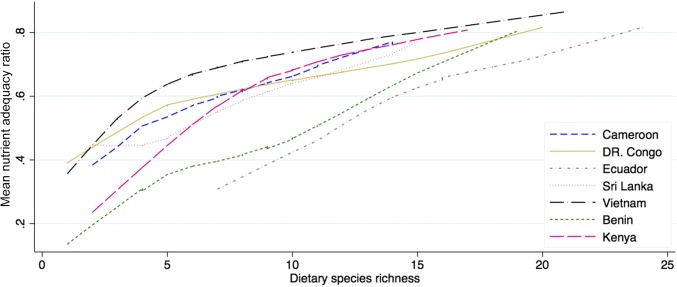
“The positive association with nutrient adequacy was consistent between the countries for SR (Fig. 3) and FD (SI Appendix, Fig. S1) but less apparent for Simpson’s index (SI Appendix, Fig. S2).”
§ Dietary species richness as a measure of food biodiversity and nutritional quality of diets > Results
plaincorrelational- Asserted: passes — The authors put it forward as true.
- Checkable: passes — It can be checked against evidence.
- Load-bearing: passes — The paper’s conclusions depend on it.
- Based: passes — The paper gives a reason why it holds.
It may state two separate claims as one.
A result the paper reports from its own data — it cites no other source for it, so there is none to check. The quote shows it is in the paper.
In the paper
“Women (n = 2,188; 34%) were mainly of childbearing age (mean age: 31.0 ± 11.7 y).”
§ Dietary species richness as a measure of food biodiversity and nutritional quality of diets > Results
plainn = 2,188- Asserted: passes — The authors put it forward as true.
- Checkable: passes — It can be checked against evidence.
- Load-bearing: fails — The paper’s conclusions may not depend on it.
- Based: passes — The paper gives a reason why it holds.
Probably not a substantial claim. The paper’s conclusions may not depend on it. It may state two separate claims as one.
A result the paper reports from its own data — it cites no other source for it, so there is none to check. The quote shows it is in the paper.
In the paper
“provided, on average, 61%, 10%, 24%, 42%, 51%, 65%, and 35% of the total energy, vitamin A, vitamin C, folic acid, iron, zinc, and calcium intakes, respectively.”
§ Dietary species richness as a measure of food biodiversity and nutritional quality of diets > Results
plain- Asserted: passes — The authors put it forward as true.
- Checkable: passes — It can be checked against evidence.
- Load-bearing: passes — The paper’s conclusions depend on it.
- Based: passes — The paper gives a reason why it holds.
It may state two separate claims as one.
A result the paper reports from its own data — it cites no other source for it, so there is none to check. The quote shows it is in the paper.
In the paper
“Apart from n = 32 Kenyan children, all children (n = 4,038) were between 6 and 24 months old.”
§ Dietary species richness as a measure of food biodiversity and nutritional quality of diets > Results
plainn = 4,038- Asserted: passes — The authors put it forward as true.
- Checkable: passes — It can be checked against evidence.
- Load-bearing: fails — The paper’s conclusions may not depend on it.
- Based: passes — The paper gives a reason why it holds.
Probably not a substantial claim. The paper’s conclusions may not depend on it.
A result the paper reports from its own data — it cites no other source for it, so there is none to check. The quote shows it is in the paper.
In the paper
“Although test Se of a DDS × SR cutoff was lower compared with MDD, overall acceptable Se and Sp estimates were obtained in children (Table 3).”
§ Dietary species richness as a measure of food biodiversity and nutritional quality of diets > Results
plain- Asserted: passes — The authors put it forward as true.
- Checkable: passes — It can be checked against evidence.
- Load-bearing: passes — The paper’s conclusions depend on it.
- Based: passes — The paper gives a reason why it holds.
It may state two separate claims as one.
A result the paper reports from its own data — it cites no other source for it, so there is none to check. The quote shows it is in the paper.
In the paper
“MAR increased with both the SR and DDS (Fig. 4).”
§ Dietary species richness as a measure of food biodiversity and nutritional quality of diets > Results
plaindirectn = 6,226- Asserted: passes — The authors put it forward as true.
- Checkable: passes — It can be checked against evidence.
- Load-bearing: passes — The paper’s conclusions depend on it.
- Based: passes — The paper gives a reason why it holds.
It may state two separate claims as one.
A result the paper reports from its own data — it cites no other source for it, so there is none to check. The quote shows it is in the paper.
In the paper
“For processed food specifically, only five foods accounting for 0.04% of total energy from food were not identified.”
§ Dietary species richness as a measure of food biodiversity and nutritional quality of diets > Results
plain- Asserted: passes — The authors put it forward as true.
- Checkable: passes — It can be checked against evidence.
- Load-bearing: fails — The paper’s conclusions may not depend on it.
- Based: passes — The paper gives a reason why it holds.
Probably not a substantial claim. The paper’s conclusions may not depend on it.
A result the paper reports from its own data — it cites no other source for it, so there is none to check. The quote shows it is in the paper.
In the paper
“Compared with the MDD, a cutoff of 24 DDS × SR increased Se by 39% in women, with an acceptable Sp (SI Appendix, Tables S8 and S9).”
§ Dietary species richness as a measure of food biodiversity and nutritional quality of diets > Results
plaindirect- Asserted: passes — The authors put it forward as true.
- Checkable: passes — It can be checked against evidence.
- Load-bearing: passes — The paper’s conclusions depend on it.
- Based: passes — The paper gives a reason why it holds.
It may state two separate claims as one.
A result the paper reports from its own data — it cites no other source for it, so there is none to check. The quote shows it is in the paper.
In the paper
“The improvement in test diagnostic properties, however, was small and not observed in children.”
§ Dietary species richness as a measure of food biodiversity and nutritional quality of diets > Discussion
plain- Asserted: passes — The authors put it forward as true.
- Checkable: passes — It can be checked against evidence.
- Load-bearing: passes — The paper’s conclusions depend on it.
- Based: passes — The paper gives a reason why it holds.
It may state two separate claims as one.
The paper states this without a source or data behind it here, so there is nothing to check it against. The quote shows it is in the paper.
In the paper
“Neither of these indicators specifically captures the biological contribution of diverse plant and animal species to human diets.”
§ Dietary species richness as a measure of food biodiversity and nutritional quality of diets > Abstract
plain- Asserted: passes — The authors put it forward as true.
- Checkable: passes — It can be checked against evidence.
- Load-bearing: passes — The paper’s conclusions depend on it.
- Based: passes — The paper gives a reason why it holds.
It may state two separate claims as one.
In the paper
“While hunger, food security, and sustainability are addressed in the Sustainable Development Goals (SDGs), the current indicators used for SDGs 2 and 15 capture nutritional status, sustainable management of terrestrial ecosystems, and agricultural sustainability dimensions separately and do not consider diet quality or food biodiversity loss (16).”
§ Dietary species richness as a measure of food biodiversity and nutritional quality of diets > Abstract
What the sources say
- Not checked yetcites [16] United Nations 2017 Report of the Inter-Agency and Expert Group on Sustainable Development Goal indicators. E/CN.3/2017/2. Available at https://unstats.un.org/unsd/statcom/48th-session/documents/2017-2-IAEG-SDGs-E.pdf. Accessed July 14, 2017
plain- Asserted: passes — The authors put it forward as true.
- Checkable: passes — It can be checked against evidence.
- Load-bearing: passes — The paper’s conclusions depend on it.
- Based: passes — The paper gives a reason why it holds.
It may state two separate claims as one.
In the paper
“Existing diet diversity indicators such as the diet diversity score (DDS) or food variety score are used as proxies for dietary quality and measure the diversity of unique food groups and food items consumed, respectively (19).”
§ Dietary species richness as a measure of food biodiversity and nutritional quality of diets > Abstract
What the sources say
- Not checked yetcites [19] Steyn NP Nel JH Nantel G Kennedy G Labadarios D 2006 Food variety and dietary diversity scores in children: Are they good indicators of dietary adequacy? Public Health Nutr 9 644 650 16923296 source
plain- Asserted: passes — The authors put it forward as true.
- Checkable: passes — It can be checked against evidence.
- Load-bearing: passes — The paper’s conclusions depend on it.
- Based: passes — The paper gives a reason why it holds.
Probably not a substantial claim. It may state two separate claims as one.
None of the sources cited for this claim have been checked yet.
In the paper
“Adjustments for bioavailability were considered as per previous protocols for calcium (29), iron (30), and zinc (31).”
§ Dietary species richness as a measure of food biodiversity and nutritional quality of diets > Methods > Nutritional Indicators.
What the sources say
- Not checked yetcites [29] Kennedy G Nantel G 2006 Basic Guidelines for Validation of a Simple Dietary Diversity Score as an Indicator of Dietary Nutrient Adequacy for Non-Breastfeeding Children 2-6 Years FAO Rome
- Not checked yetcites [30] FAO/WHO 2004 Human Vitamin and Mineral Requirements FAO Rome 2nd Ed
- Not checked yetcites [31] Brown KH International Zinc Nutrition Consultative Group (IZiNCG) 2004 Assessment of the risk of zinc deficiency in populations and options for its control Food Nutr Bull 25 Suppl 2 S99 S203, IZiNCG Technical Document 1 18046856
plain- Asserted: passes — The authors put it forward as true.
- Checkable: passes — It can be checked against evidence.
- Load-bearing: fails — The paper’s conclusions may not depend on it.
- Based: passes — The paper gives a reason why it holds.
Probably not a substantial claim. The paper’s conclusions may not depend on it.
In the paper
“Foods and drinks were identified at the species level following best-practice guidelines (27) using local taxonomical references and technical expertise.”
§ Dietary species richness as a measure of food biodiversity and nutritional quality of diets > Methods > Food Biodiversity Indicators.
What the sources say
- Not checked yetcites [27] Nesbitt M McBurney RPH Broin M Beentje HJ 2010 Linking biodiversity, food and nutrition: The importance of plant identification and nomenclature J Food Compost Anal 23 486 498 source
plain- Asserted: passes — The authors put it forward as true.
- Checkable: passes — It can be checked against evidence.
- Load-bearing: passes — The paper’s conclusions depend on it.
- Based: passes — The paper gives a reason why it holds.
Probably not a substantial claim.
What the paper did — it cites no source for this, so there is none to check. The quote shows it is in the paper.
In the paper
“All data were collected between July 2009 and April 2015, and samples were representative of the village population.”
§ Dietary species richness as a measure of food biodiversity and nutritional quality of diets > Methods > Data Sources.
plain- Asserted: passes — The authors put it forward as true.
- Checkable: passes — It can be checked against evidence.
- Load-bearing: passes — The paper’s conclusions depend on it.
- Based: fails — The paper may give no reason why it holds.
Probably not a substantial claim. The paper may give no reason why it holds.
In the paper
“Food systems are a key driver of biodiversity loss worldwide (1).”
§ Dietary species richness as a measure of food biodiversity and nutritional quality of diets > Abstract
What the sources say
- Not checked yetcites [1] Maxwell SL Fuller RA Brooks TM Watson JE 2016 Biodiversity: The ravages of guns, nets and bulldozers Nature 536 143 145 27510207 source
plaindirect- Asserted: passes — The authors put it forward as true.
- Checkable: passes — It can be checked against evidence.
- Load-bearing: fails — The paper’s conclusions may not depend on it.
- Based: passes — The paper gives a reason why it holds.
Probably not a substantial claim. The paper’s conclusions may not depend on it.
In the paper
“Sustainable management of food biodiversity—the diversity of plants, animals, and other organisms used for food, both cultivated and from the wild—is essential for sustainable food systems (15).”
§ Dietary species richness as a measure of food biodiversity and nutritional quality of diets > Abstract
What the sources say
- Not checked yetcites [15] FAO and Bioversity International 2017 Guidelines on Assessing Biodiverse Foods in Dietary Intake Surveys (FAO, Rome). Available at www.fao.org/3/a-i6717e.pdf. Accessed June 20, 2017
plain- Asserted: passes — The authors put it forward as true.
- Checkable: fails — It may be too vague to check against evidence.
- Load-bearing: fails — The paper’s conclusions may not depend on it.
- Based: passes — The paper gives a reason why it holds.
Probably not a substantial claim. It may be too vague to check against evidence. The paper’s conclusions may not depend on it.
In the paper
“Luckett et al. (20) applied the nutritional functional diversity score to diets, but within the context of measuring the contribution of different food source outlets to diet diversity and without validating the nutritional adequacy of the measure.”
§ Dietary species richness as a measure of food biodiversity and nutritional quality of diets > Abstract
What the sources say
- Not checked yetcites [20] Luckett BG DeClerck FA Fanzo J Mundorf AR Rose D 2015 Application of the nutrition functional diversity indicator to assess food system contributions to dietary diversity and sustainable diets of Malawian households Public Health Nutr 18 2479 2487 26027595 PMC10271332 source
plain- Asserted: passes — The authors put it forward as true.
- Checkable: passes — It can be checked against evidence.
- Load-bearing: unclear — It is unclear whether the paper’s conclusions depend on it.
- Based: passes — The paper gives a reason why it holds.
It may state two separate claims as one.
In the paper
“Reduced biodiversity of both wild and agricultural species can have detrimental effects for diet quality and environmental sustainability by reducing availability and access to nutritious, seasonal foods and loss of ecosystem functions (14).”
§ Dietary species richness as a measure of food biodiversity and nutritional quality of diets > Abstract
What the sources say
- Not checked yetcites [14] Myers SS 2013 Human health impacts of ecosystem alteration Proc Natl Acad Sci USA 110 18753 18760 24218556 PMC3839693 source
plaindirect- Asserted: passes — The authors put it forward as true.
- Checkable: passes — It can be checked against evidence.
- Load-bearing: passes — The paper’s conclusions depend on it.
- Based: passes — The paper gives a reason why it holds.
It may state two separate claims as one.
In the paper
“The diversity of species used in agricultural and livelihood systems is essential for human nutrition and sustainable food systems (9).”
§ Dietary species richness as a measure of food biodiversity and nutritional quality of diets > Abstract
What the sources say
- Not checked yetcites [9] Powell B 2015 Improving diets with wild and cultivated biodiversity from across the landscape Food Secur 7 535 554 source
plaindirect- Asserted: passes — The authors put it forward as true.
- Checkable: passes — It can be checked against evidence.
- Load-bearing: passes — The paper’s conclusions depend on it.
- Based: passes — The paper gives a reason why it holds.
Probably not a substantial claim.
What the paper did — it cites no source for this, so there is none to check. The quote shows it is in the paper.
In the paper
“The present analysis was approved by the Ethics Committee of Ghent University (NR B670201422403).”
§ Dietary species richness as a measure of food biodiversity and nutritional quality of diets > Methods > Nutritional Indicators.
plain- Asserted: passes — The authors put it forward as true.
- Checkable: passes — It can be checked against evidence.
- Load-bearing: fails — The paper’s conclusions may not depend on it.
- Based: passes — The paper gives a reason why it holds.
Probably not a substantial claim. The paper’s conclusions may not depend on it.
What the paper did — it cites no source for this, so there is none to check. The quote shows it is in the paper.
In the paper
“Except in Sri Lanka where the protocol was exempted from clearance, all studies were approved by an ethics committee.”
§ Dietary species richness as a measure of food biodiversity and nutritional quality of diets > Methods > Nutritional Indicators.
plain- Asserted: passes — The authors put it forward as true.
- Checkable: passes — It can be checked against evidence.
- Load-bearing: fails — The paper’s conclusions may not depend on it.
- Based: passes — The paper gives a reason why it holds.
Probably not a substantial claim. The paper’s conclusions may not depend on it.
What the paper did — it cites no source for this, so there is none to check. The quote shows it is in the paper.
In the paper
“Because not all studies had a repeated recall, only the first day was included.”
§ Dietary species richness as a measure of food biodiversity and nutritional quality of diets > Methods > Data Sources.
plaindirect- Asserted: passes — The authors put it forward as true.
- Checkable: passes — It can be checked against evidence.
- Load-bearing: fails — The paper’s conclusions may not depend on it.
- Based: passes — The paper gives a reason why it holds.
Probably not a substantial claim. The paper’s conclusions may not depend on it.
In the paper
“Adequate management and use of biodiversity can help to restore ecosystems and address micronutrient deficiencies in vulnerable populations (11).”
§ Dietary species richness as a measure of food biodiversity and nutritional quality of diets > Abstract
What the sources say
- Not checked yetcites [11] Ruel MT Alderman H Maternal and Child Nutrition Study Group 2013 Nutrition-sensitive interventions and programmes: How can they help to accelerate progress in improving maternal and child nutrition? Lancet 382 536 551 23746780 source
plainconditional- Asserted: passes — The authors put it forward as true.
- Checkable: passes — It can be checked against evidence.
- Load-bearing: fails — The paper’s conclusions may not depend on it.
- Based: passes — The paper gives a reason why it holds.
Probably not a substantial claim. The paper’s conclusions may not depend on it. It may state two separate claims as one.
What the paper did — it cites no source for this, so there is none to check. The quote shows it is in the paper.
In the paper
“As a result, it is not possible to perform a more in-depth analysis of the exact role markets or wild foods played in the diet.”
§ Dietary species richness as a measure of food biodiversity and nutritional quality of diets > Discussion
plain- Asserted: passes — The authors put it forward as true.
- Checkable: passes — It can be checked against evidence.
- Load-bearing: fails — The paper’s conclusions may not depend on it.
- Based: passes — The paper gives a reason why it holds.
Probably not a substantial claim. The paper’s conclusions may not depend on it.
A conclusion the paper draws from its own results — it cites no other source for it, so there is none to check. The quote shows it is in the paper.
In the paper
“The DSR thus captures both the dimension of biodiversity as well as diet diversity.”
§ Dietary species richness as a measure of food biodiversity and nutritional quality of diets > Discussion
plaincorrelational- Asserted: passes — The authors put it forward as true.
- Checkable: passes — It can be checked against evidence.
- Load-bearing: passes — The paper’s conclusions depend on it.
- Based: passes — The paper gives a reason why it holds.
It may state two separate claims as one.
What the paper did — it cites no source for this, so there is none to check. The quote shows it is in the paper.
In the paper
“Although this method is appropriate to estimate population average intakes, it does not allow accounting for within-person variability and estimation of usual dietary intake.”
§ Dietary species richness as a measure of food biodiversity and nutritional quality of diets > Discussion
plain- Asserted: passes — The authors put it forward as true.
- Checkable: passes — It can be checked against evidence.
- Load-bearing: unclear — It is unclear whether the paper’s conclusions depend on it.
- Based: passes — The paper gives a reason why it holds.
It may state two separate claims as one.
What the paper did — it cites no source for this, so there is none to check. The quote shows it is in the paper.
In the paper
“Unfortunately, information on food sources (own production, market, wild) was not included in the analysis.”
§ Dietary species richness as a measure of food biodiversity and nutritional quality of diets > Discussion
plain- Asserted: passes — The authors put it forward as true.
- Checkable: passes — It can be checked against evidence.
- Load-bearing: passes — The paper’s conclusions depend on it.
- Based: passes — The paper gives a reason why it holds.
Probably not a substantial claim.
In the paper
“On the other hand, assessing DSR can be challenging, because it was estimated that previous studies misidentified between 6% and 10% of species (39).”
§ Dietary species richness as a measure of food biodiversity and nutritional quality of diets > Discussion
What the sources say
- Not checked yetcites [39] Łuczaj LJ 2010 Plant identification credibility in ethnobotany: A closer look at Polish ethnographic studies J Ethnobiol Ethnomed 6 36 21167056 PMC3022638 source
hedged- Asserted: passes — The authors put it forward as true.
- Checkable: passes — It can be checked against evidence.
- Load-bearing: fails — The paper’s conclusions may not depend on it.
- Based: passes — The paper gives a reason why it holds.
Probably not a substantial claim. The paper’s conclusions may not depend on it.
In the paper
“In addition, international food security efforts have hence focused on the production of a handful of staple foods (mostly cereals) to meet human energy needs (6).”
§ Dietary species richness as a measure of food biodiversity and nutritional quality of diets > Discussion
What the sources say
- Not checked yetcites [6] FAO 2010 Second Report on the State of the World’s Plant Genetic Resources for Food and Agriculture (FAO, Rome). Available at www.fao.org/3/a-i4465e.pdf
plain- Asserted: passes — The authors put it forward as true.
- Checkable: passes — It can be checked against evidence.
- Load-bearing: fails — The paper’s conclusions may not depend on it.
- Based: passes — The paper gives a reason why it holds.
Probably not a substantial claim. The paper’s conclusions may not depend on it.
What the paper did — it cites no source for this, so there is none to check. The quote shows it is in the paper.
In the paper
“The composition of various indigenous, wild, neglected, or underutilized species was often not available and was substituted with values from similar foods.”
§ Dietary species richness as a measure of food biodiversity and nutritional quality of diets > Discussion
plain- Asserted: passes — The authors put it forward as true.
- Checkable: passes — It can be checked against evidence.
- Load-bearing: fails — The paper’s conclusions may not depend on it.
- Based: passes — The paper gives a reason why it holds.
Probably not a substantial claim. The paper’s conclusions may not depend on it.
A conclusion the paper draws from its own results — it cites no other source for it, so there is none to check. The quote shows it is in the paper.
In the paper
“We used DSR, which captures both agricultural and wild food biodiversity.”
§ Dietary species richness as a measure of food biodiversity and nutritional quality of diets > Discussion
plain- Asserted: passes — The authors put it forward as true.
- Checkable: passes — It can be checked against evidence.
- Load-bearing: passes — The paper’s conclusions depend on it.
- Based: passes — The paper gives a reason why it holds.
Probably not a substantial claim.
In the paper
“This was unexpected, because an earlier systematic literature review (38) reported considerable intra-annual variations in diet quality.”
§ Dietary species richness as a measure of food biodiversity and nutritional quality of diets > Discussion
What the sources say
- Not checked yetcites [38] Phalkey RK Aranda-Jan C Marx S Höfle B Sauerborn R 2015 Systematic review of current efforts to quantify the impacts of climate change on undernutrition Proc Natl Acad Sci USA 112 E4522 E4529 26216952 PMC4547305 source
plain- Asserted: passes — The authors put it forward as true.
- Checkable: passes — It can be checked against evidence.
- Load-bearing: fails — The paper’s conclusions may not depend on it.
- Based: passes — The paper gives a reason why it holds.
Probably not a substantial claim. The paper’s conclusions may not depend on it.
In the paper
“Guidelines were recently prepared to adequately record species during food-intake studies (15).”
§ Dietary species richness as a measure of food biodiversity and nutritional quality of diets > Discussion
What the sources say
- Not checked yetcites [15] FAO and Bioversity International 2017 Guidelines on Assessing Biodiverse Foods in Dietary Intake Surveys (FAO, Rome). Available at www.fao.org/3/a-i6717e.pdf. Accessed June 20, 2017
plain- Asserted: passes — The authors put it forward as true.
- Checkable: passes — It can be checked against evidence.
- Load-bearing: fails — The paper’s conclusions may not depend on it.
- Based: passes — The paper gives a reason why it holds.
Probably not a substantial claim. The paper’s conclusions may not depend on it.
In the paper
“Scholars have called for dietary indicators that consider multiple dimensions to provide more comprehensive assessments of diet quality (18).”
§ Dietary species richness as a measure of food biodiversity and nutritional quality of diets > Discussion
What the sources say
- Not checked yetcites [18] Jones AD 2017 Critical review of the emerging research evidence on agricultural biodiversity, diet diversity, and nutritional status in low- and middle-income countries Nutr Rev 75 769 782 29028270 PMC5914317 source
plain- Asserted: passes — The authors put it forward as true.
- Checkable: passes — It can be checked against evidence.
- Load-bearing: passes — The paper’s conclusions depend on it.
- Based: passes — The paper gives a reason why it holds.
Probably not a substantial claim.
In the paper
“Earlier research showed that DDS is positively associated with farm production diversity as well as with market access (18).”
§ Dietary species richness as a measure of food biodiversity and nutritional quality of diets > Discussion
What the sources say
- Not checked yetcites [18] Jones AD 2017 Critical review of the emerging research evidence on agricultural biodiversity, diet diversity, and nutritional status in low- and middle-income countries Nutr Rev 75 769 782 29028270 PMC5914317 source
plaincorrelational- Asserted: passes — The authors put it forward as true.
- Checkable: passes — It can be checked against evidence.
- Load-bearing: fails — The paper’s conclusions may not depend on it.
- Based: passes — The paper gives a reason why it holds.
Probably not a substantial claim. The paper’s conclusions may not depend on it. It may state two separate claims as one.
A conclusion the paper draws from its own results — it cites no other source for it, so there is none to check. The quote shows it is in the paper.
In the paper
“The large number of foods consumed, but not captured by the DDS, highlights the contribution of these biodiverse foods that are consumed in small serving sizes, but with likely nutritional benefits.”
§ Dietary species richness as a measure of food biodiversity and nutritional quality of diets > Discussion
hedgedconditional- Asserted: passes — The authors put it forward as true.
- Checkable: passes — It can be checked against evidence.
- Load-bearing: fails — The paper’s conclusions may not depend on it.
- Based: fails — The paper may give no reason why it holds.
Probably not a substantial claim. The paper’s conclusions may not depend on it. The paper may give no reason why it holds.
A conclusion the paper draws from its own results — it cites no other source for it, so there is none to check. The quote shows it is in the paper.
In the paper
“Monitoring the contribution of species in the diet enables identifying species with the greatest potential to improve diets in different local contexts and provides additional granularity to assess the importance of food diversity in ensuring diet quality.”
§ Dietary species richness as a measure of food biodiversity and nutritional quality of diets > Discussion
plaindirect- Asserted: passes — The authors put it forward as true.
- Checkable: fails — It may be too vague to check against evidence.
- Load-bearing: passes — The paper’s conclusions depend on it.
- Based: passes — The paper gives a reason why it holds.
Probably not a substantial claim. It may be too vague to check against evidence. It may state two separate claims as one.
A conclusion the paper draws from its own results — it cites no other source for it, so there is none to check. The quote shows it is in the paper.
In the paper
“Identifying foods consumed at the species level adds information that supports both conservation and sustainable food system initiatives.”
§ Dietary species richness as a measure of food biodiversity and nutritional quality of diets > Discussion
plaindirect- Asserted: passes — The authors put it forward as true.
- Checkable: fails — It may be too vague to check against evidence.
- Load-bearing: passes — The paper’s conclusions depend on it.
- Based: passes — The paper gives a reason why it holds.
Probably not a substantial claim. It may be too vague to check against evidence.
In the paper
“Nutrition-sensitive agricultural and ecosystem conservation interventions, specifically those related to diversification, clearly have an untapped potential to address global hunger and micronutrient deficiencies (11).”
§ Dietary species richness as a measure of food biodiversity and nutritional quality of diets > Discussion
What the sources say
- Not checked yetcites [11] Ruel MT Alderman H Maternal and Child Nutrition Study Group 2013 Nutrition-sensitive interventions and programmes: How can they help to accelerate progress in improving maternal and child nutrition? Lancet 382 536 551 23746780 source
boostedconditional- Asserted: passes — The authors put it forward as true.
- Checkable: fails — It may be too vague to check against evidence.
- Load-bearing: fails — The paper’s conclusions may not depend on it.
- Based: passes — The paper gives a reason why it holds.
Probably not a substantial claim. It may be too vague to check against evidence. The paper’s conclusions may not depend on it.
The paper relies on this without support.
Every sample was considered equally representative.
“Because every sample was considered equally representative, the overall summary statistics were calculated averages for women and children separately, per country and across countries.”
The authors state this as an assumption.
No previous studies have applied common measures of biodiversity to measure levels of food biodiversity in the diet.
“To our knowledge, no previous studies have applied common measures of biodiversity to measure levels of food biodiversity in the diet.”
The paper relies on this without support.
SR can more easily be calculated in comparison with D and FD.
“Given that SR can more easily be calculated in comparison with D and FD, we recommend Dietary Species Richness (DSR) as the most appropriate measure of food biodiversity in diets.”
The paper relies on this without support.
Communities are not entirely composed of subsistence farmers.
“Communities are not entirely composed of subsistence farmers.”
The paper relies on this without support.
The availability of legumes, vitamin A-rich fruits and vegetables, and dark-green leafy vegetables is highly seasonal.
“The availability of these foods is highly seasonal.”
The paper relies on this without support.
Food systems in (peri)urban areas and high-income countries have a higher degree of complexity than in rural areas and middle-income countries.
“Food systems in (peri)urban areas and high-income countries have a higher degree of complexity than in rural areas and middle-income countries.”
The paper relies on this without support.
This complexity is mainly caused by the consumption of processed foods that have often not been locally produced but have been obtained from retail outlets or urban markets.
“This complexity is mainly caused by the consumption of processed foods that have often not been locally produced but have been obtained from retail outlets or urban markets.”
The paper relies on this without support.
Global datasets such as FAOSTAT identify general food items or food groups and do not facilitate valorization of the full range of food biodiversity.
“Global datasets such as FAOSTAT identify general food items or food groups and do not facilitate valorization of the full range of food biodiversity.”
The paper relies on this without support.
DDS is a common measure to assess diversity and diet quality and is widely applied in population surveys.
“DDS is a common measure to assess diversity and diet quality and is widely applied in population surveys.”
Claims other papers make about this one
Each is checked against this paper’s own text: does it say what the citing paper says it does?
The source backs part of the claim, not all of it — or backs it for a different population, condition or comparison.
In the citing paper
“For example, species richness on farm, one measure of biodiversity, has been found to be highly correlated with micronutrient adequacy in human diets (Lachat et al., 2018).”
From Assessing Transitions to Sustainable Agricultural and Food Systems: A Tool for Agroecology Performance Evaluation (TAPE) (2020) · cites this paper as Lachat et al., 2018
Experimental — accuracy not yet measured
Self-check
Percentages, sums and reported differences re-computed from the paper’s own numbers.
Each contradiction between two passages listed here was confirmed by an independent check.
Rated minor: it would not touch a result — a value no result rests on, a p-value that stays on the same side of the significance level, or a conflict that is clerical, resolved elsewhere in the paper, or outside its own findings.
In the paper
§ Dietary species richness as a measure of food biodiversity and nutritional quality of diets > Results
“| D | 0.70 | 0.02 | 0.08 | 0.08 |”
§ Dietary species richness as a measure of food biodiversity and nutritional quality of diets > Results
“All β coefficients are P < 0.001.”
Rated minor: it would not touch a result — a value no result rests on, a p-value that stays on the same side of the significance level, or a conflict that is clerical, resolved elsewhere in the paper, or outside its own findings.
In the paper
§ Dietary species richness as a measure of food biodiversity and nutritional quality of diets > Results
“Per increase in SR, D, or FD z score, MAR increased, on average, by 0.03, 0.7, and 0.52, respectively (Table 2).”
§ Dietary species richness as a measure of food biodiversity and nutritional quality of diets > Results
“| Biodiversity measures | Unstandardized β | Unstandardized SE | Standardized β | Standardized SE | | --- | --- | --- | --- | --- | | SR | 0.03 | 0.001 | 0.10 | 0.003 | | D | 0.70 | 0.02 | 0.08 | 0.08 | | FD | 0.52 | 0.02 | 0.06 | 0.002 |”
Citations
Cites
Biodiversity hotspots for conservation priorities
Myers, N., Mittermeier, R. A., Mittermeier, C. G., da Fonseca, G. A. B., & Kent, J. (2000) · Nature · doi:10.1038/35002501 · Cited by 31,710 · cited 1×
“Surprisingly, the world’s wild and agricultural biodiversity hot spots often coincide with low-income areas with high poverty levels, ecosystem degradation, and malnutrition (12, 13).”
BackgroundAdjustment for total energy intake in epidemiologic studies
Willett, W. C., Howe, G., & Kushi, L. H. (1997) · American Journal of Clinical Nutrition · doi:10.1093/ajcn/65.4.1220s · Cited by 3,805 · cited 1×
“Because intake of species is potentially associated with total dietary energy intake, we also performed the analysis after adjusting the food biodiversity indicators for energy intake using the residual method (36).”
MethodGlobal diets link environmental sustainability and human health
Tilman, D., & Clark, M. (2014) · Nature · doi:10.1038/nature13959 · Cited by 3,026
Gakidou, E., Afshin, A., Abajobir, A. A., Abate, K. H., Abbafati, C., Abbas, K. M., Abd-Allah, F., Abdulle, A. M., Abera, S. F., Aboyans, V., et al. (2017) · The Lancet · doi:10.1016/s0140-6736(17)32366-8 · Cited by 2,406 · cited 1×
“Low-quality diets are the leading risk factor for ill health worldwide (7) and are determined by socioeconomic and political factors including income, education, social cohesion, gender empowerment, and inequality (8).”
BackgroundBiodiversity: The ravages of guns, nets and bulldozers
Maxwell, S. L., Fuller, R. A., Brooks, T. M., & Watson, J. E. M. (2016) · Nature · doi:10.1038/536143a · Cited by 1,979 · cited 1×
“F systems are a key driver of biodiversity loss worldwide (1).”
BackgroundRuel, M. T., & Alderman, H. (2013) · The Lancet · doi:10.1016/s0140-6736(13)60843-0 · Cited by 1,820
The nutrition transition: new trends in the global diet
Drewnowski, A., & Popkin, B. M. (2009) · Nutrition Reviews · doi:10.1111/j.1753-4887.1997.tb01593.x · Cited by 1,440 · cited 1×
“As a result, human diets that used to be composed of a wide variety of plants and animals have gradually shifted to a diet composed of mostly processed foods and comprising a limited number of species (5).”
BackgroundDarmon, N., & Drewnowski, A. (2015) · Nutrition Reviews · doi:10.1093/nutrit/nuv027 · Cited by 1,258 · cited 1×
“Low-quality diets are the leading risk factor for ill health worldwide (7) and are determined by socioeconomic and political factors including income, education, social cohesion, gender empowerment, and inequality (8).”
BackgroundBrown, K. H., Rivera, J. A., Bhutta, Z. A., Gibson, R. S., King, J. C., Lönnerdal, B. L., Ruel, M. T., Sandtröm, B., Wasantwisut, E., & Hotz, C. (2004) · PubMed · Cited by 1,069
Human vitamin and mineral requirements
eng, N. D., Fao, J., Vitamin, W. E. C. O. H., Bangkok, M. R. E. S., & Who, G. E. (2002) · Cited by 993
Research works printed but not linked: 3
- ; FAO The Second International Conference on Nutrition: Committing to a future free of malnutrition. Available at www.fao.org/3/a-ml542e.pdf. Accessed January 24 2017. (2015).
- G Kennedy, G Nantel Basic Guidelines for Validation of a Simple Dietary Diversity Score as an Indicator of Dietary Nutrient Adequacy for Non-Breastfeeding Children 2-6 Years (FAO, Rome, 2006).
- ; Institute of Medicine Dietary Reference Intakes: The Essential Guide to Nutrient Requirements (Natl Acad Press Washington DC) p 560. Available at nap.edu/11537. Accessed October 27 2016. (2006).
Cited by
Sorted by citations
Wezel, A., Herren, B. G., Kerr, R. B., Barrios, E., Gonçalves, A. L. R., & Sinclair, F. (2020) · Agronomy for Sustainable Development · doi:10.1007/s13593-020-00646-z · Cited by 926
“Application of the social values and dietary principle (9) impact nutrition directly, supported by maintaining and enhancing biodiversity (5) on fields and farms (Bellon et al. 2016; Bezner Kerr et al. 2019b; Demeke et al. 2017; Jones et al. 2014; Lachat et al. 2018; Powell et al. 2015).”
BackgroundOur future in the Anthropocene biosphere
Folke, C., Polasky, S., Rockström, J., Galaz, V., Westley, F. R., Lamont, M., Scheffer, M., Österblom, H., Carpenter, S. R., Chapin, F. S., et al. (2021) · AMBIO · doi:10.1007/s13280-021-01544-8 · Cited by 863
Social-ecological outcomes of agricultural intensification
Rasmussen, L. V., Coolsaet, B., Martin, A., Mertz, O., Pascual, U., Corbera, E., Dawson, N. M., Fisher, J., Franks, P., & Ryan, C. M. (2018) · Nature Sustainability · doi:10.1038/s41893-018-0070-8 · Cited by 337
Barrios, E., Gemmill-Herren, B., Bicksler, A., Siliprandi, E., Brathwaite, R., Moller, S., Batello, C., & Tittonell, P. (2020) · Ecosystems and People · doi:10.1080/26395916.2020.1808705 · Cited by 293
“By empowering women and supporting diversified diets, agroecology can contribute to food and nutrition security while maintaining the health of ecosystems and their agro-biodiversity (Jones et al. 2014; Lachat et al. 2018).”
BackgroundBiodiversity’s contributions to sustainable development
Blicharska, M., SMITHERS, R. J., Mikusiński, G., Rönnbäck, P., Harrison, P. A., Nilsson, M., & Sutherland, W. J. (2019) · Nature Sustainability · doi:10.1038/s41893-019-0417-9 · Cited by 258
Metadata
- Authors
- Lachat, C., Raneri, J. E., Smith, K. W., Kolsteren, P., Van Damme, P., Verzelen, K., Penafiel, D., Vanhove, W., Kennedy, G., Hunter, D., Odhiambo, F. O., Ntandou-Bouzitou, G., De Baets, B., Ratnasekera, D., Ky, H. T., Remans, R., & Termote, C.
- Affiliations
- Ghent University (BE)
- Alliance Bioversity International - CIAT (IT)
- Laboratory of Tropical and Subtropical Agronomy and Ethnobotany, Faculty of Bioscience Engineering, Ghent University, 9000 Ghent, Belgium;
- KERMIT, Department of Mathematical Modeling, Statistics, and Bioinformatics, Faculty of Bioscience Engineering, Ghent University, 9000 Ghent, Belgium;
- University of Ruhuna (LK)
- HealthBridge Foundation of Canada (CA)
- Corresponding author
- Lachat, Carl
- ORCID
- Venue
- Proceedings of the National Academy of Sciences
- Publisher
- National Academy of Sciences
- Published
- 2017-12-18
- Volume
- 115
- Issue
- 1
- Pages
- 127-132
- ISSN
- 0027-8424 (ISSN-L)
- 1091-6490
- PMC
- PMC5776793
- OpenAlex
- W2776954001
- Semantic Scholar
- bc9e24cd03970b13349c909942fe54516b59bd63
- Cited by
- 248
- References
- 36
- Citations by year
- 2026: 22 · 2025: 38 · 2024: 36 · 2023: 32 · 2022: 30 · 2021: 27 · 2020: 29 · 2019: 23 · 2018: 10
- FWCI
- 15.90
- Type
- journal article
- Language
- en
- Open access
- hybrid
- doi.org
- Licence
- Locations
- Proceedings of the National Academy of Sciences (publishedVersion, cc-by-nc-nd)
- Europe PMC (PubMed Central) (publishedVersion, cc-by-nc-nd)
- PubMed Central (publishedVersion, cc-by-nc-nd)
- PubMed (publishedVersion)
- Ghent University Academic Bibliography (Ghent University) (submittedVersion, cc-by)
- CGSPace A Repository of Agricultural Research Outputs (Consultative Group for International Agricultural Research) (submittedVersion, other-oa)
- Funders
- Ministry of Foreign Affairs Finland (FoodAfrica 29891501)
- Vlaamse Interuniversitaire Raad (ICP PhD 2010-012)
- Global environmental facility (Biodiversity for food and nutrition project GFL-2328-2715-4B07)
- Daniel and Nina Carasso Foundation (PG008608)
- International institute for Tropical Agriculture and Bioversity International (Humidtropics A4NH: CRP4-002)
- Topics
- Health Sciences › Medicine › Public Health, Environmental and Occupational Health › Nutritional Studies and Diet
- Health Sciences › Nursing › Nutrition and Dietetics › Child Nutrition and Water Access
- Physical Sciences › Environmental Science › Ecology › Agriculture Sustainability and Environmental Impact
- Keywords
- food biodiversity, diet quality, nutritional adequacy, women and children, rural population, seasonal variation, healthy eating, sustainable diets
- MeSH terms
- Child, Child, Preschool, Eating, Female, Food Preferences, Humans, Infant, Male, Nutritive Value, Rural Population, Micronutrients
About these checks
Registry, retraction, Cites and statistics results are computed, not judged, with one exception: a printed reference that no index lists is read once by a model before it counts as a citation error. Claims are extracted by a model and kept only when their quote appears verbatim in the text; each cited source is then checked, with a model’s help, for whether it says what the claim relies on. Those verdicts can be wrong — read the claim’s quote and the cited source before relying on one.
A language model drew the claims from the paper on 2026-10-09, under version 3 of the claim definition (model deepseek-v4.1-flash, prompt extract-v3).
A second model labelled each claim on 2026-10-09 (model jev-1.13-20260917, definition revision gold-guideline-v0.2).
Statistics and arithmetic are recomputed, not judged.
Confidence bands are shown only for fields calibrated on our annotated test set. None is calibrated yet, so no band is shown.
What counts as a claim ›How we measure confidence ›How we check this ›
Are you an author, or do you see a problem with this page? Request a review
