

The DOI matches its Crossref record; 32 of the 32 references it cites were found in a registry or an index.
Psychological targeting as an effective approach to digital mass persuasion
Open accessAbstract
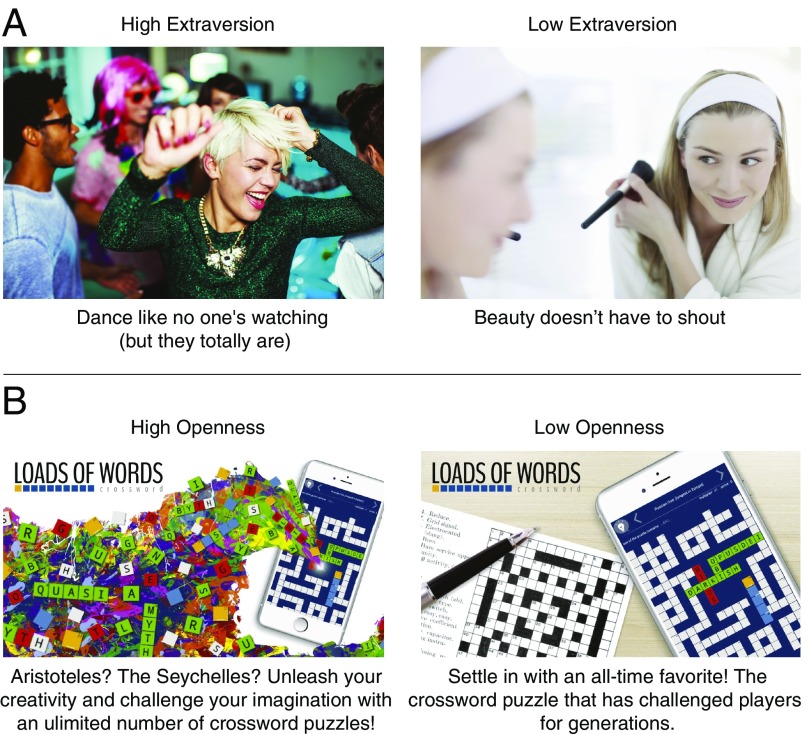
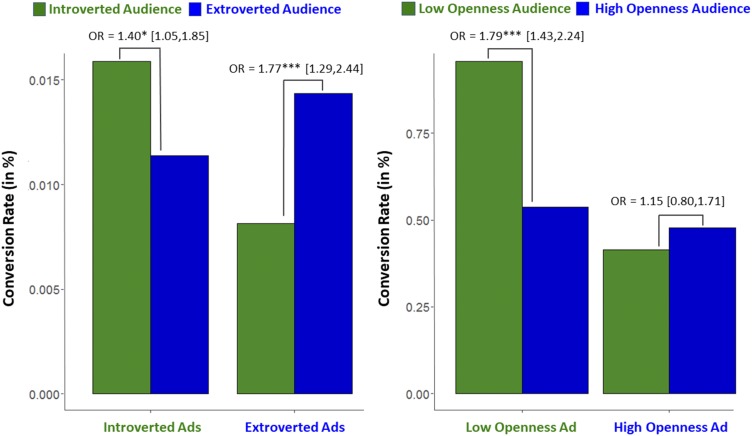
People are exposed to persuasive communication across many different contexts: Governments, companies, and political parties use persuasive appeals to encourage people to eat healthier, purchase a particular product, or vote for a specific candidate. Laboratory studies show that such persuasive appeals are more effective in influencing behavior when they are tailored to individuals' unique psychological characteristics. However, the investigation of large-scale psychological persuasion in the real world has been hindered by the questionnaire-based nature of psychological assessment. Recent research, however, shows that people's psychological characteristics can be accurately predicted from their digital footprints, such as their Facebook Likes or Tweets. Capitalizing on this form of psychological assessment from digital footprints, we test the effects of psychological persuasion on people's actual behavior in an ecologically valid setting. In three field experiments that reached over 3.5 million individuals with psychologically tailored advertising, we find that matching the content of persuasive appeals to individuals' psychological characteristics significantly altered their behavior as measured by clicks and purchases. Persuasive appeals that were matched to people's extraversion or openness-to-experience level resulted in up to 40% more clicks and up to 50% more purchases than their mismatching or unpersonalized counterparts. Our findings suggest that the application of psychological targeting makes it possible to influence the behavior of large groups of people by tailoring persuasive appeals to the psychological needs of the target audiences. We discuss both the potential benefits of this method for helping individuals make better decisions and the potential pitfalls related to manipulation and privacy.
Overview
The claims and statistics of this paper haven’t been checked yet.
Run the check — free, no account needed. It reads the open-access text and checks the sources it cites.
Integrity signals
Registry
Cites
Statistics
Figures
Verification
Claims the paper makes
The claims and statistics of this paper haven’t been checked yet.
Run the check — free, no account needed. It reads the open-access text and checks the sources it cites.
Claims other papers make about this one
Each is checked against this paper’s own text: does it say what the citing paper says it does?
The source backs part of the claim, not all of it — or backs it for a different population, condition or comparison.
In the citing paper
“Matz et al. (2017) reflect on their (Kosinski and Stillwell) decade-long research program on infering personality traits from social media users and its potential for mass manipulation, as evidenced in the adoption of similar techniques in the manipulation of elections.28”
From Social Data: Biases, Methodological Pitfalls, and Ethical Boundaries (2019) · cites this paper as Matz et al., 2017
Experimental — accuracy not yet measuredThe cited source says what the claim attributes to it.
In the citing paper
“Personality matching has been shown to increase the effectiveness of real-life persuasive communication59.”
From A psychometric framework for evaluating and shaping personality traits in large language models (2025) · cites this paper as [59]
In the citing paper
“companies report an increase in sales if salespersons demonstrate high extraversion and openness [38]”
From Interacting with a Chatbot-Based Advising System: Understanding the Effect of Chatbot Personality and User Gender on Behavior (2022) · cites this paper as [38]
In the citing paper
“and matching a message to an audience's personality improves its effectiveness [36 ].”
From Two social lives: how differences between online and offline interaction influence social outcomes (2020) · cites this paper as [36]
Self-check
Percentages, sums and reported differences re-computed from the paper’s own numbers.
The self-check needs the paper’s full text.
Citations
Cites
Self-Reports in Organizational Research: Problems and Prospects
Podsakoff, P. M., & Organ, D. W. (1986) · Journal of Management · doi:10.1177/014920638601200408 · Cited by 17,102
An Introduction to the Five‐Factor Model and Its Applications
McCrae, R. R., & John, O. P. (1992) · Journal of Personality · doi:10.1111/j.1467-6494.1992.tb00970.x · Cited by 6,835
Interaction terms in logit and probit models
Ai, C., & Norton, E. C. (2003) · Economics Letters · doi:10.1016/s0165-1765(03)00032-6 · Cited by 4,599
Lazer, D., Pentland, A., Adamic, L., Aral, S., Barabási, A.-L., Brewer, D., Christakis, N., Contractor, N., Fowler, J., Gutmann, M., et al. (2009) · Science · doi:10.1126/science.1167742 · Cited by 3,365
The Role of Emotions in Marketing
Bagozzi, R. P., Gopinath, M., & Nyer, P. U. (1999) · Journal of the Academy of Marketing Science · doi:10.1177/0092070399272005 · Cited by 3,349
The international personality item pool and the future of public-domain personality measures
Goldberg, L. R., Johnson, J. A., Eber, H. W., Hogan, R., Ashton, M. C., Cloninger, C. R., & Gough, H. G. (2006) · Journal of Research in Personality · doi:10.1016/j.jrp.2005.08.007 · Cited by 3,185
Private traits and attributes are predictable from digital records of human behavior
Kosinski, M., Stillwell, D., & Graepel, T. (2013) · Proceedings of the National Academy of Sciences · doi:10.1073/pnas.1218772110 · Cited by 2,829
Self-citationWhat Do Laboratory Experiments Measuring Social Preferences Reveal About the Real World?
Levitt, S. D., & List, J. A. (2007) · Journal of Economic Perspectives · doi:10.1257/jep.21.2.153 · Cited by 2,668
Does tailoring matter? Meta-analytic review of tailored print health behavior change interventions
Noar, S. M., Benac, C. N., & Harris, M. S. (2007) · Psychological Bulletin · doi:10.1037/0033-2909.133.4.673 · Cited by 2,136
Personality, Gender, and Age in the Language of Social Media: The Open-Vocabulary Approach
Schwartz, H. A., Eichstaedt, J. C., Kern, M. L., Dziurzynski, L., Ramones, S. M., Agrawal, M., Shah, A., Kosinski, M., Stillwell, D., Seligman, M. E. P., et al. (2013) · PLoS ONE · doi:10.1371/journal.pone.0073791 · Cited by 1,700
Self-citation
Cited by
Sorted by citations
Items 301–400 of 890
Person Perception Biases Exposed: Revisiting the First Impressions Dataset
Jacques, J. C. S., Lapedriza, À., Palmero, C., Baró, X., & Escalera, S. (2021) · IEEE/CVF Winter Conference on Applications of Computer Vision Workshops (WACVW) · doi:10.1109/wacvw52041.2021.00006 · Cited by 14
Smillie, L. D., Ruby, M. B., Tan, N. P., Stollard, L., & Bastian, B. B. (2023) · Journal of Personality · doi:10.1111/jopy.12866 · Cited by 12
Smart advertising and online dictionary usefulness
Dziemianko, A. (2020) · International Journal of Lexicography · doi:10.1093/ijl/ecaa017 · Cited by 14
Scaling the Security Staircase
Carr, S. C., Hopner, V., Hakim, M. A., Hodgetts, D., Chamberlain, K., Nelson, N., Ball, R., & Jones, H. (2020) · Political Psychology · doi:10.1111/pops.12715 · Cited by 14
Interpretable Representation Learning for Personality Detection
Kazemeini, A., Roy, S. S., Mercer, R. E., & Cambria, E. (2021) · IEEE ... International Conference on Data Mining workshops · doi:10.1109/icdmw53433.2021.00026 · Cited by 14
Automatic Personality Prediction using Deep Learning Based on Social Media Profile Picture and Posts
Jeremy, N. H., Christian, G., Kamal, M. F., Suhartono, D., & Suryaningrum, K. M. (2021) · International Seminar on Research of Information Technology and Intelligent Systems (ISRITI) · doi:10.1109/isriti54043.2021.9702873 · Cited by 12
Zero Sales Resistance: The Dark Side of Big Data and Artificial Intelligence
Riva, G., Wiederhold, B. K., & Sauro Succi, A. (2022) · Cyberpsychology Behavior and Social Networking · doi:10.1089/cyber.2022.0035 · Cited by 12
González-Cabañas, J., Cuevas, √., Cuevas, R., López-Fernández, J., & García, D. (2021) · ACM Internet Measurement Conference (IMC) · doi:10.1145/3487552.3487861 · Cited by 12
Socialni odnosi, animizem, antropomorfizem in interakcija z UI
Babić, N. Č. (2022) · doi:10.18690/um.ff.11.2022.12 · Cited by 10
Personality, self‐knowledge, and meat reduction intentions
Hopwood, C. J., Stahlmann, A. G., Bleidorn, W., & Thielmann, I. (2023) · Journal of Personality · doi:10.1111/jopy.12864 · Cited by 13
Jansen, M., & Krämer, N. C. (2023) · PLoS ONE · doi:10.1371/journal.pone.0295329 · Cited by 12
The confrontation effect: When users engage more with ideology-inconsistent content online
Daniel Mochon, B., & Schwartz, J. A. (2024) · Organizational Behavior and Human Decision Processes · doi:10.1016/j.obhdp.2024.104366 · Cited by 20
Sattar, A. A., Haq, J. U., Saleem, A., & Ahmad, W. (2024) · Psychology and Marketing · doi:10.1002/mar.22166 · Cited by 11
Who Complies and Who Defies? Personality and Public Health Compliance
Blais, J., Chen, P. G., & Pruysers, S. (2021) · Frontiers in Political Science · doi:10.3389/fpos.2021.660911 · Cited by 11
Rommetveit, K. (2021) · Routledge eBooks · doi:10.4324/9780429053061 · Cited by 13
Baumeister, H., & Montag, C. (2022) · Studies in neuroscience, psychology and behavioral economics · doi:10.1007/978-3-030-98546-2_1 · Cited by 12
Palnau, J.-F., Ziegler, M. D., & Lämmle, L. (2022) · International Journal of Environmental Research and Public Health · doi:10.3390/ijerph19159354 · Cited by 13
Assessing the kid's behaviour with factors of social media advertising: DEMATEL application
Bandil, D., Agrawal, V., & Mohanty, R. P. (2023) · Journal of Advances in Management Research · doi:10.1108/jamr-07-2022-0130 · Cited by 11
The Architecture of Algorithm-driven Persuasion
Rose, J., & MacGregor, O. (2021) · Journal of Information Architecture · doi:10.55135/1015060901/211.009/2.037 · Cited by 12
Opportunities and Challenges in Using Social Media in Organ Donation
Ayorinde, J., Saeb‐Parsy, K., & Hossain, A. (2020) · JAMA Surgery · doi:10.1001/jamasurg.2020.0791 · Cited by 11
Mediennutzung in Zeiten von Corona
Spitzer, M. (2020) · Nervenheilkunde · doi:10.1055/a-1193-8248 · Cited by 12
Sindermann, C., Mõttus, R., Rozgonjuk, D., & Montag, C. (2021) · Personality Science · doi:10.5964/ps.6017 · Cited by 14
A multidisciplinary definition of privacy labels
Johansen, J., Pedersen, T., Fischer‐Hübner, S., Johansen, C., Schneider, G., Roosendaal, A., Zwingelberg, H., Sivesind, A. J., & Noll, J. (2022) · Information and Computer Security · doi:10.1108/ics-06-2021-0080 · Cited by 12
Fear of a Yellow Planet: The Gilets Jaunes and the End of the Modern World-System
Wilkin, P. (2020) · Journal of World-Systems Research · doi:10.5195/jwsr.2020.902 · Cited by 11
Honka, A. M., Nieminen, H., Similä, H., Kaartinen, J., & van Gils, M. (2022) · IEEE Access · doi:10.1109/access.2022.3218776 · Cited by 11
Algorithmic Exploitation in Social Media Human Trafficking and Strategies for Regulation
Moore, D. M. (2024) · Laws · doi:10.3390/laws13030031 · Cited by 10
Stahlmann, A. G., Hopwood, C. J., & Bleidorn, W. (2024) · Appetite · doi:10.1016/j.appet.2024.107701 · Cited by 10
Autonomy and AI Nudges: Distinguishing Concepts and Highlighting AI’s Advantages
Calboli, S. (2025) · Philosophy & Technology · doi:10.1007/s13347-025-00940-2 · Cited by 10
Otterbring, T., Festila, A., & Folwarczny, M. (2021) · Current Research in Ecological and Social Psychology · doi:10.1016/j.cresp.2021.100023 · Cited by 10
Wrongful Rational Persuasion Online
Mitchell, T. J., & Douglas, T. (2024) · Philosophy & Technology · doi:10.1007/s13347-024-00725-z · Cited by 11
The effect of stereotypical music on the customer selection of wine in an online environment
Damen, M., van Hest, I., & Wernaart, B. F. W. (2021) · Journal of Innovations in Digital Marketing · doi:10.51300/jidm-2021-35 · Cited by 10
Science in the Spotlight: A Crisis of Confidence?
Feine, J. S., & Jakubovics, N. S. (2020) · JDR Clinical & Translational Research · doi:10.1177/2380084420976358 · Cited by 10
Elmer, T. (2023) · EPJ Data Science · doi:10.1140/epjds/s13688-023-00434-1 · Cited by 12
The search for the missing link between health misinformation & health disparities
Osude, N., O'Brien, E. C., & Bosworth, H. B. (2024) · Patient Education and Counseling · doi:10.1016/j.pec.2024.108386 · Cited by 10
The role of social media ads for election outcomes: Evidence from the 2021 German election
Bär, D., Pröllochs, N., & Feuerriegel, S. (2025) · PNAS Nexus · doi:10.1093/pnasnexus/pgaf073 · Cited by 13
Montag, C., & Elhai, J. D. (2025) · Addictive Behaviors Reports · doi:10.1016/j.abrep.2025.100613 · Cited by 11
Otterbring, T., Bhatnagar, R., & Folwarczny, M. (2022) · The Journal of Social Psychology · doi:10.1080/00224545.2022.2036670 · Cited by 11
Using Natural Language Processing to Identify Effective Influencers
Fang, X., & Wang, T. (2022) · International Journal of Market Research · doi:10.1177/14707853221101565 · Cited by 17
Artificial intelligence marketing and customer satisfaction: An employee job security threat review
Eshiett, I. O., & Eshiett, O. E. (2024) · World Journal of Advanced Research and Reviews · doi:10.30574/wjarr.2024.21.1.2655 · Cited by 25
A cultural exploration of the social media manipulators
Sample, C., McAlaney, J., Bakdash, J. Z., & Thackray, H. (2018) · Bournemouth University Research Online (Bournemouth University) · Cited by 9
Should we engage variety seeking customers?
Gupta, A. K., & Pandey, S. K. (2021) · Journal of Asia Business Studies · doi:10.1108/jabs-12-2020-0483 · Cited by 12
Liu, L., Workman, M. H. W., & Hayes, S. E. (2022) · Energy Policy · doi:10.1016/j.enpol.2022.112803 · Cited by 9
Personality Prediction from Social Media Posts using Text Embedding and Statistical Features
Majima, S., & Markov, K. (2022) · Annals of Computer Science and Information Systems · doi:10.15439/2022f133 · Cited by 10
Emmert‐Streib, F., & Dehmer, M. (2021) · Frontiers in Big Data · doi:10.3389/fdata.2021.591749 · Cited by 12
Autonomy, Evidence-Responsiveness, and the Ethics of Influence
Niker, F., Felsen, G., Nagel, S. K., & Reiner, P. B. (2021) · Springer eBooks · doi:10.1007/978-3-030-84494-3_6 · Cited by 9
What Is a Subliminal Technique? An Ethical Perspective on AI-Driven Influence
Bermúdez, J. P., Nyrup, R., Deterding, S., Moradbakhti, L., Mougenot, C., You, F., & Calvo, R. A. (2023) · IEEE International Symposium on Ethics in Engineering, Science, and Technology (ETHICS) · doi:10.1109/ethics57328.2023.10155039 · Cited by 8
A sustainable and healthy diet: Personality, motives, and sociodemographics
Ardebili, A. T., & Rickertsen, K. (2024) · Heliyon · doi:10.1016/j.heliyon.2024.e31326 · Cited by 12
Secondary Market Monetization and Willingness to Share Personal Data
Wu, J. (2022) · Management Science · doi:10.1287/mnsc.2022.03423 · Cited by 9
Zhou, Y., Li, H., & Yin, P. (2025) · Industrial Management & Data Systems · doi:10.1108/imds-05-2024-0440 · Cited by 10
Personality effects on WoM and eWoM susceptibilty – a cross-country perspective
König, T. M., Clarke, I., Hellenthal, M. V., & Clarke, I. (2022) · International Marketing Review · doi:10.1108/imr-11-2020-0272 · Cited by 11
Grisse, K. (2023) · The International library of ethics, law and technology · doi:10.1007/978-3-031-34804-4_6 · Cited by 8
MANIPULATIVE TACTICS IN MODERN ENGLISH-LANGUAGE MEDIA DISCOURSE
Mialkovska, L., Yanovets, A., Sternichuk, V., Nykoliuk, T., Honchar, K., & Khnykina, О. (2023) · Conhecimento & Diversidade · doi:10.18316/rcd.v15i38.11077 · Cited by 8
Epstein, R., Newland, A., & Tang, L. (2025) · Computers in Human Behavior · doi:10.1016/j.chb.2025.108578 · Cited by 8
Connotative Meanings of Sustainable Mobility: A Segmentation Approach Using Cultural Sentiments
Wolf, I., & Schröder, T. (2019) · Transportation Research Part A Policy and Practice · doi:10.1016/j.tra.2019.06.002 · Cited by 11
Guitton, M. J. (2019) · The International Journal of Intelligence Security and Public Affairs · doi:10.1080/23800992.2019.1649122 · Cited by 8
Digital Phenotyping - A Case for Cognitive Functions and Dementia?
Montag, C., & Elhai, J. D. (2020) · Digital Psychology · doi:10.24989/dp.v1i1.1810 · Cited by 8
Gligorić, K., Lifchits, G., West, R., & Anderson, A. (2021) · PLoS ONE · doi:10.1371/journal.pone.0257091 · Cited by 8
Disseminating Evidence to Policymakers: Accounting for Audience Heterogeneity
Purtle, J. (2021) · Springer eBooks · doi:10.1007/978-3-030-78755-4_2 · Cited by 9
Understanding Consumer Digital Consumption Behaviour in the Edge of Social Media Platforms
Yassin, C. A. (2021) · Open Journal of Social Sciences · doi:10.4236/jss.2021.910028 · Cited by 8
Tan, N. P., Bastian, B. B., & Smillie, L. D. (2022) · Appetite · doi:10.1016/j.appet.2022.106358 · Cited by 7
Data-Driven Campaigning as a Disruptive Force
Gibson, R. (2023) · Political Communication · doi:10.1080/10584609.2023.2207486 · Cited by 8
Recommender Systems: Legal and Ethical Issues
Genovesi, S., Kaesling, K., & Robbins, S. (2023) · The International library of ethics, law and technology · doi:10.1007/978-3-031-34804-4 · Cited by 10
Delving Into the Security & Privacy of the Metaverse Matrix
Salloum, S. A., Tahat, K. M., Tahat, D. N., Mansoori, A. S., & Alfaisal, R. (2023) · International Conference on Social Networks Analysis, Management and Security (SNAMS) · doi:10.1109/snams60348.2023.10375463 · Cited by 8
Ares, G., Antúnez, L., Alcaire, F., Natero, V., & Otterbring, T. (2024) · Public Health Nutrition · doi:10.1017/s1368980024000533 · Cited by 8
The Banality of Cynicism: Foucault and the Limits of Authentic Parrhēsia
Hull, G. (2018) · Foucault Studies · doi:10.22439/fs.v0i25.5583 · Cited by 9
Formação em Psicologia: Estágios e Avaliação Psicológica
Soligo, Â. F., de Oliveira, I. T., Muniz, M., & Zanini, D. S. (2020) · Psicologia Ciência e Profissão · doi:10.1590/1982-3703003243432 · Cited by 8
Algorithmic and human prediction of success in human collaboration from visual features
Saveski, M., Awad, E., Rahwan, I., & Cebrián, M. (2021) · Scientific Reports · doi:10.1038/s41598-021-81145-3 · Cited by 9
Cwalina, W., & Drzewiecka, M. (2019) · Political campaigning and communication · doi:10.1007/978-3-030-27693-5_10 · Cited by 8
Khwaja, M. K., Vaid, S. S., Zannone, S., Harari, G. M., Faisal, A. A., & Matic, A. (2019) · arXiv (Cornell University) · doi:10.48550/arxiv.1908.04617 · Cited by 8
An, J., Kwak, H., Qureshi, H. M., & Weber, I. G. (2021) · JMIR Formative Research · doi:10.2196/33922 · Cited by 8
Ciriello, R., Marx, J., Cheong, M., Müller-Bloch, C., & Mathiassen, L. (2025) · Business & Information Systems Engineering · doi:10.1007/s12599-025-00952-4 · Cited by 9
A prediction-focused approach to personality modeling
Lavi, G., Rosenblatt, J., & Gilead, M. (2022) · Scientific Reports · doi:10.1038/s41598-022-16108-3 · Cited by 10
Noetzel, S., Binder, A., & Matthes, J. (2024) · International Journal of Advertising · doi:10.1080/02650487.2024.2390760 · Cited by 7
A Study on Effect of Big Five Personality Traits on Ad Targeting and Creative Design
Kobayashi, A., Ishikawa, Y., & Minamikawa, A. (2019) · Lecture notes in computer science · doi:10.1007/978-3-030-17287-9_21 · Cited by 8
Walker, C., O'Neill, S., & Lee, D.-W. (2020) · Experimental Results · doi:10.1017/exp.2020.43 · Cited by 3
Reber, M., Krafft, T. D., Krafft, R., Zweig, K. A., & Couturier, A. (2020) · IEEE Symposium Series on Computational Intelligence (SSCI) · doi:10.1109/ssci47803.2020.9308420 · Cited by 7
Modelling and predicting an individual’s perception of advertising appeal
Ishikawa, Y., Kobayashi, A., & Kamisaka, D. (2021) · User Modeling and User-Adapted Interaction · doi:10.1007/s11257-020-09287-z · Cited by 10
Use of Technological Means and Personal Data in Electoral Activities: Persuasive Voters
Casas, R. M. R. (2021) · Smart innovation, systems and technologies · doi:10.1007/978-981-16-5792-4_23 · Cited by 7
Kang, H., Park, Y., Shin, Y., Choi, H., & Kim, S.-T. (2022) · Frontiers in Psychology · doi:10.3389/fpsyg.2021.678803 · Cited by 9
Prediction of Eudaimonic and Hedonic Orientation of Movie Watchers
Motamedi, E., Barile, F., & Tkalčič, M. (2022) · Applied Sciences · doi:10.3390/app12199500 · Cited by 8
Whitton, C., Wong, Y. H. M., Lau, J., Chua, X. H., Müller, A. M., Tan, C. S., van Dam, R. M., Müller‐Riemenschneider, F., & Rebello, S. A. (2024) · Appetite · doi:10.1016/j.appet.2024.107338 · Cited by 7
Borgefalk, G., & de Leon, N. (2019) · Lecture notes in computer science · doi:10.1007/978-3-030-17287-9_13 · Cited by 7
Personalized Multimedia Item and Key Frame Recommendation
Wu, L., Chen, L., Yang, Y., Hong, R., Ge, Y., Xie, X., & Wang, M. (2019) · International Joint Conference on Artificial Intelligence · doi:10.24963/ijcai.2019/198 · Cited by 7
Full-scale Personality Prediction on VKontakte Social Network and its Applications
Titov, S., Novikov, P., & Mararitsa, L. V. (2019) · Conference of Open Innovations Association (FRUCT) · doi:10.23919/fruct48121.2019.8981513 · Cited by 7
Online Behavioural Advertising and Unfair Manipulation Between the GDPR and the UCPD
Galli, F. (2020) · Data science, machine intelligence, and law · doi:10.1007/978-3-030-50559-2_6 · Cited by 7
Kent, M. P., Pauzé, E., Bagnato, M., Guimarães, J. S., Pinto, A., Remedios, L., Pritchard, M., L’Abbé, M. R., Mulligan, C., Vergeer, L., et al. (2022) · Applied Physiology, Nutrition, and Metabolism · doi:10.1139/apnm-2022-0219 · Cited by 7
Boosting people’s ability to detect microtargeted advertisingPreprint
Lorenz-Spreen, P., Geers, M., Pachur, T., Hertwig, R., Lewandowsky, S., & Herzog, S. M. (2020) · doi:10.31234/osf.io/ea28z · Cited by 7
Computational Personality Assessment - An Overview and PerspectivePreprint
Stachl, C., Boyd, R. L., Horstmann, K. T., Khambatta, P., Matz, S., & Harari, G. M. (2021) · doi:10.31234/osf.io/ck2bj · Cited by 7
Self-citationThe Opportunities and Costs of AI in Behavioural SciencePreprint
Mills, S., Costa, S., & Sunstein, C. R. (2023) · SSRN Electronic Journal · doi:10.2139/ssrn.4490597 · Cited by 7
Corbett, G., & Moerman, S. (2024) · Open Book Publishers · doi:10.11647/obp.0403 · Cited by 9
Massey, P. M., Murray, R. M., Chiang, S. C., Russell, A. M., & Yudell, M. (2023) · JMIR Public Health and Surveillance · doi:10.2196/49881 · Cited by 11
Suh, Y. J., & Kim, H. S. (2024) · Communication Research · doi:10.1177/00936502241263941 · Cited by 7
Jones, D. Z. E., & Chandrasekharan, E. (2024) · Proceedings of the ACM on Human-Computer Interaction · doi:10.1145/3687001 · Cited by 9
Twenty Years of Personality Computing: Threats, Challenges and Future Directions
Celli, F., Kartelj, A., Dordevič, M., Suhartono, D., Filipović, V., Milutinović, V. M., Spathoulas, G. P., Vinciarelli, A., Kosiński, M., & Lepri, B. (2026) · ACM Computing Surveys · doi:10.1145/3806009 · Cited by 16
Reuter, K., MacLennan, A., Le, N., Unger, J. B., Kaiser, E. M., & Angyan, P. (2019) · JMIR Public Health and Surveillance · doi:10.2196/11263 · Cited by 6
Quantifying the Links Between Personality Sub-traits and the Basic Emotions
Donovan, R., Johnson, A., Róiste, Á. D., & O’Reilly, R. (2020) · Lecture notes in computer science · doi:10.1007/978-3-030-58802-1_37 · Cited by 8
Crowley, K., DUGAS, M. A., Gao, G. G., Burn, L., Igumbor, K., Njapha, D., Piper, J. M., Veronese, F. D. M., & Agarwal, R. (2021) · Health Marketing Quarterly · doi:10.1080/07359683.2021.2007587 · Cited by 6
Propuesta y validación de instrumento de medición del comportamiento climático en las universidades
Jasso, A. F. R., Jasso, L. D. J. R., Limón, M. L. S., & Rivas, J. G. D. (2023) · Acta Universitaria · doi:10.15174/au.2023.3775 · Cited by 6
Nuss, T., Chen, Y. J. M., Scully, M. L., Hickey, K., Martin, J. E., & Morley, B. (2023) · Health Promotion Journal of Australia · doi:10.1002/hpja.755 · Cited by 8
Wen, Y., Walker, E., & Yue, L. Q. (2024) · Academy of Management Discoveries · doi:10.5465/amd.2023.0152 · Cited by 5
Metadata
- Authors
- Matz, S. C., Kosinski, M., Nave, G., & Stillwell, D. J.
- Affiliations
- Columbia University (US)
- Graduate School of Business, Stanford University, Stanford, CA 94305;
- University of Pennsylvania (US)
- University of Cambridge (GB)
- Corresponding author
- Matz, S. C.
- Venue
- Proceedings of the National Academy of Sciences
- Publisher
- National Academy of Sciences
- Published
- 2017-11-13
- Volume
- 114
- Issue
- 48
- Pages
- 12714-12719
- ISSN
- 0027-8424 (ISSN-L)
- 1091-6490
- PMC
- PMC5715760
- OpenAlex
- W2768262152
- Cited by
- 892
- References
- 32
- Citations by year
- 2026: 86 · 2025: 127 · 2024: 113 · 2023: 105 · 2022: 125 · 2021: 110 · 2020: 115 · 2019: 72 · 2018: 39
- FWCI
- 48.48
- Type
- journal article
- Language
- en
- Open access
- hybrid
- doi.org
- Licence
- Locations
- Proceedings of the National Academy of Sciences (publishedVersion, cc-by-nc-nd)
- PubMed Central (publishedVersion, cc-by-nc-nd)
- PubMed (publishedVersion)
- Apollo (University of Cambridge) (submittedVersion, cc-by-nc-nd)
- Apollo
- Columbia Academic Commons (Columbia University)
- Topics
- Social Sciences › Decision Sciences › General Decision Sciences › Decision-Making and Behavioral Economics
- Social Sciences › Psychology › Social Psychology › Psychology of Social Influence
- Social Sciences › Business, Management and Accounting › Marketing › Digital Marketing and Social Media
- Keywords
- personalized advertising, persuasive appeals, digital footprint, personality prediction, extraversion, openness to experience, behavioral influence, online purchase, click behavior, manipulation, privacy
- MeSH terms
- Direct-to-Consumer Advertising, Extraversion, Psychological, Humans, Individuality, Introversion, Psychological, Mass Behavior, Persuasive Communication, Psychometrics, Behavior Control, Social Media
About these checks
Registry, retraction, Cites and statistics results are computed, not judged, with one exception: a printed reference that no index lists is read once by a model before it counts as a citation error. Claims are extracted by a model and kept only when their quote appears verbatim in the text; each cited source is then checked, with a model’s help, for whether it says what the claim relies on. Those verdicts can be wrong — read the claim’s quote and the cited source before relying on one.
Statistics and arithmetic are recomputed, not judged.
Confidence bands are shown only for fields calibrated on our annotated test set. None is calibrated yet, so no band is shown.
What counts as a claim ›How we measure confidence ›How we check this ›
Are you an author, or do you see a problem with this page? Request a review
