

The DOI matches its Crossref record; 32 of the 32 references it cites were found in a registry or an index.
Psychological targeting as an effective approach to digital mass persuasion
Open accessAbstract
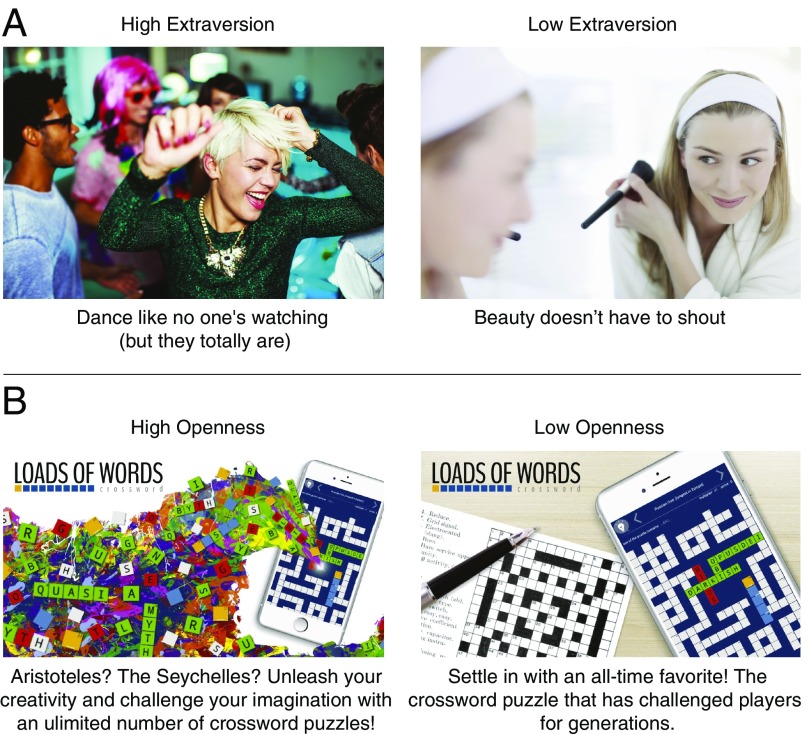
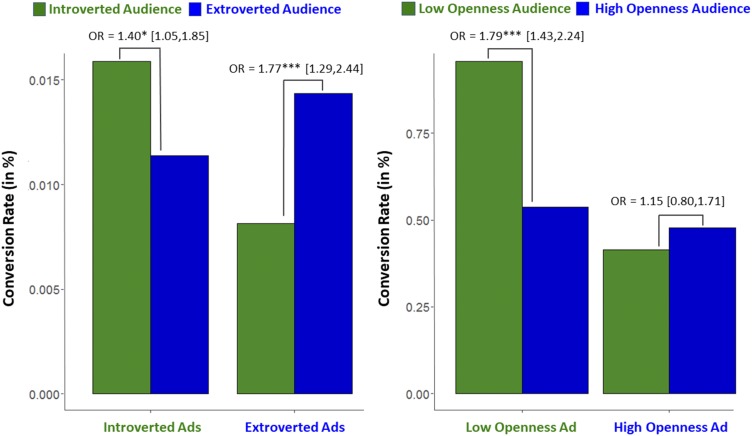
People are exposed to persuasive communication across many different contexts: Governments, companies, and political parties use persuasive appeals to encourage people to eat healthier, purchase a particular product, or vote for a specific candidate. Laboratory studies show that such persuasive appeals are more effective in influencing behavior when they are tailored to individuals' unique psychological characteristics. However, the investigation of large-scale psychological persuasion in the real world has been hindered by the questionnaire-based nature of psychological assessment. Recent research, however, shows that people's psychological characteristics can be accurately predicted from their digital footprints, such as their Facebook Likes or Tweets. Capitalizing on this form of psychological assessment from digital footprints, we test the effects of psychological persuasion on people's actual behavior in an ecologically valid setting. In three field experiments that reached over 3.5 million individuals with psychologically tailored advertising, we find that matching the content of persuasive appeals to individuals' psychological characteristics significantly altered their behavior as measured by clicks and purchases. Persuasive appeals that were matched to people's extraversion or openness-to-experience level resulted in up to 40% more clicks and up to 50% more purchases than their mismatching or unpersonalized counterparts. Our findings suggest that the application of psychological targeting makes it possible to influence the behavior of large groups of people by tailoring persuasive appeals to the psychological needs of the target audiences. We discuss both the potential benefits of this method for helping individuals make better decisions and the potential pitfalls related to manipulation and privacy.
Overview
The claims and statistics of this paper haven’t been checked yet.
Run the check — free, no account needed. It reads the open-access text and checks the sources it cites.
Integrity signals
Registry
Cites
Statistics
Figures
Verification
Claims the paper makes
The claims and statistics of this paper haven’t been checked yet.
Run the check — free, no account needed. It reads the open-access text and checks the sources it cites.
Claims other papers make about this one
Each is checked against this paper’s own text: does it say what the citing paper says it does?
The source backs part of the claim, not all of it — or backs it for a different population, condition or comparison.
In the citing paper
“Matz et al. (2017) reflect on their (Kosinski and Stillwell) decade-long research program on infering personality traits from social media users and its potential for mass manipulation, as evidenced in the adoption of similar techniques in the manipulation of elections.28”
From Social Data: Biases, Methodological Pitfalls, and Ethical Boundaries (2019) · cites this paper as Matz et al., 2017
Experimental — accuracy not yet measuredThe cited source says what the claim attributes to it.
In the citing paper
“Personality matching has been shown to increase the effectiveness of real-life persuasive communication59.”
From A psychometric framework for evaluating and shaping personality traits in large language models (2025) · cites this paper as [59]
In the citing paper
“companies report an increase in sales if salespersons demonstrate high extraversion and openness [38]”
From Interacting with a Chatbot-Based Advising System: Understanding the Effect of Chatbot Personality and User Gender on Behavior (2022) · cites this paper as [38]
In the citing paper
“and matching a message to an audience's personality improves its effectiveness [36 ].”
From Two social lives: how differences between online and offline interaction influence social outcomes (2020) · cites this paper as [36]
Self-check
Percentages, sums and reported differences re-computed from the paper’s own numbers.
The self-check needs the paper’s full text.
Citations
Cites
Self-Reports in Organizational Research: Problems and Prospects
Podsakoff, P. M., & Organ, D. W. (1986) · Journal of Management · doi:10.1177/014920638601200408 · Cited by 17,102
An Introduction to the Five‐Factor Model and Its Applications
McCrae, R. R., & John, O. P. (1992) · Journal of Personality · doi:10.1111/j.1467-6494.1992.tb00970.x · Cited by 6,835
Interaction terms in logit and probit models
Ai, C., & Norton, E. C. (2003) · Economics Letters · doi:10.1016/s0165-1765(03)00032-6 · Cited by 4,599
Lazer, D., Pentland, A., Adamic, L., Aral, S., Barabási, A.-L., Brewer, D., Christakis, N., Contractor, N., Fowler, J., Gutmann, M., et al. (2009) · Science · doi:10.1126/science.1167742 · Cited by 3,365
The Role of Emotions in Marketing
Bagozzi, R. P., Gopinath, M., & Nyer, P. U. (1999) · Journal of the Academy of Marketing Science · doi:10.1177/0092070399272005 · Cited by 3,349
The international personality item pool and the future of public-domain personality measures
Goldberg, L. R., Johnson, J. A., Eber, H. W., Hogan, R., Ashton, M. C., Cloninger, C. R., & Gough, H. G. (2006) · Journal of Research in Personality · doi:10.1016/j.jrp.2005.08.007 · Cited by 3,185
Private traits and attributes are predictable from digital records of human behavior
Kosinski, M., Stillwell, D., & Graepel, T. (2013) · Proceedings of the National Academy of Sciences · doi:10.1073/pnas.1218772110 · Cited by 2,829
Self-citationWhat Do Laboratory Experiments Measuring Social Preferences Reveal About the Real World?
Levitt, S. D., & List, J. A. (2007) · Journal of Economic Perspectives · doi:10.1257/jep.21.2.153 · Cited by 2,668
Does tailoring matter? Meta-analytic review of tailored print health behavior change interventions
Noar, S. M., Benac, C. N., & Harris, M. S. (2007) · Psychological Bulletin · doi:10.1037/0033-2909.133.4.673 · Cited by 2,136
Personality, Gender, and Age in the Language of Social Media: The Open-Vocabulary Approach
Schwartz, H. A., Eichstaedt, J. C., Kern, M. L., Dziurzynski, L., Ramones, S. M., Agrawal, M., Shah, A., Kosinski, M., Stillwell, D., Seligman, M. E. P., et al. (2013) · PLoS ONE · doi:10.1371/journal.pone.0073791 · Cited by 1,700
Self-citation
Cited by
Sorted by citations
Items 401–500 of 890
Batista, M., Fernandes, A. L., Ribeiro, L. P., Alturas, B., & Costa, C. P. (2020) · Iberian Conference on Information Systems and Technologies (CISTI) · doi:10.23919/cisti49556.2020.9140835 · Cited by 6
Beware of 'algorithmic regulation'Preprint
Delacroix, S. (2019) · SSRN Electronic Journal · doi:10.2139/ssrn.3327191 · Cited by 6
Surfing the Third Wave of Computing: Consumer Contracting With eObjects in AustraliaPreprint
Manwaring, K. (2019) · SSRN Electronic Journal · doi:10.2139/ssrn.3890503 · Cited by 6
Zettler, I., & Strandsbjerg, C. F. (2025) · Current Opinion in Psychology · doi:10.1016/j.copsyc.2025.102147 · Cited by 5
Problem of Toxic Leadership Instead of Modern Leadership at New Age in the 21st Century
Hossain, K. A. (2025) · Open Journal of Leadership · doi:10.4236/ojl.2025.144026 · Cited by 5
Autonomous AI Agents for Multi-Platform Social Media Marketing: A Simultaneous Deployment Study
Ahn, J., & Kim, M. (2025) · Electronics · doi:10.3390/electronics14214161 · Cited by 8
Smoliński, P. R., Januszewicz, J., & Winiarski, J. (2023) · Proceedings of the International Conference on Information Systems Development · doi:10.62036/isd.2023.60 · Cited by 7
Leveraging Large Language Models for Personalized Public Messaging
Das, A. K., Xiong, C., & Mueller, K. D. (2025) · CHI Conference Extended Abstracts on Human Factors in Computing Systems (CHI EA) · doi:10.1145/3706599.3720018 · Cited by 5
Aimen, T. (2025) · Cambridge Forum on AI Law and Governance · doi:10.1017/cfl.2025.4 · Cited by 8
Online kereskedelmi gyakorlatok tisztességtelensége a Booking.com döntés tükrében
Pusztahelyi, R., & Czibrik, E. (2022) · Miskolci Jogi Szemle · doi:10.32980/mjsz.2022.1.1939 · Cited by 5
Brehm, J., & Gruhl, H. (2024) · Environmental Research Letters · doi:10.1088/1748-9326/ad5d0a · Cited by 5
Vergeer, L., Soto, C., Bagnato, M., Pauzé, E., Amson, A., Ramsay, T., Olstad, D. L., Welch, V. A., & Kent, M. P. (2025) · BMC Nutrition · doi:10.1186/s40795-025-01019-z · Cited by 8
Role of Apps in Undoing of Privacy Policies on Facebook
Patil, V., Jatain, N., & Shyamasundar, R. K. (2018) · Lecture notes in computer science · doi:10.1007/978-3-319-95729-6_6 · Cited by 5
Influenciando atitudes e comportamentos com anúncios publicitários: articulando teoria e prática
Pereira, J. J. D. S., & Iglesias, F. (2020) · Intercom Revista Brasileira de Ciências da Comunicação · doi:10.1590/1809-5844202024 · Cited by 5
Kapitel 5 Vulnerabilitätsraum: Soziale Medien
Sindermann, C., Ebner, F. A., Montag, C., Scholz, R. W., Ostendorf, S., Freytag, P., & Thull, B. (2021) · Nomos Verlagsgesellschaft mbH & Co. KG eBooks · doi:10.5771/9783748924111-05 · Cited by 4
Media społecznościowe a funkcjonowanie wiedzy historycznej w Polsce. Raport z badań
Werner, W. (2019) · Przegląd Archiwalno-Historyczny · doi:10.4467/2391-890xpah.19.013.14942 · Cited by 5
van Steen, T., Müller, B. C. N., Li, S., Loman, J. G. B., & Buijzen, M. (2022) · Journal of Media Psychology Theories Methods and Applications · doi:10.1027/1864-1105/a000346 · Cited by 5
The correlation between the Big Five personality traits and political information exposure
Yang, Z. (2022) · Chinese Public Administration Review · doi:10.1177/15396754221129707 · Cited by 6
Kannen, C., Sindermann, C., & Montag, C. (2024) · Heliyon · doi:10.1016/j.heliyon.2024.e28840 · Cited by 5
Effects of coherence on speaker preference and rule-following
Bianchi, P. H., Perez, W. F., Harte, C., & Barnes-Holmes, D. (2021) · Perspectivas em Análise do Comportamento · doi:10.18761/pac.2021.v12.rft.07 · Cited by 8
Neyazi, T. A., Ee, T. K., & Kuru, O. (2025) · Social Science Computer Review · doi:10.1177/08944393251362247 · Cited by 4
Chen, Z., Liu, C., Ren, Y., Song, G., & Zhang, X. (2025) · Computers in Human Behavior Reports · doi:10.1016/j.chbr.2025.100827 · Cited by 5
An integrative cognitive model for multisensory design: benefits and risks of AI-personalization
Bartoletti, R. L., & Corveleyn, X. (2025) · Frontiers in Computer Science · doi:10.3389/fcomp.2025.1652537 · Cited by 4
Jones, C., & Bergen, B. K. (2026) · Artificial Intelligence Review · doi:10.1007/s10462-026-11517-6 · Cited by 48
Digital Therapeutic Cultures and Their New Regime of Psychological Truth
Fabián, R. D. L. (2024) · Sociological Research Online · doi:10.1177/13607804241228458 · Cited by 4
Habib, F., Ali, Z., Azam, A., Kamran, K., & Pasha, F. M. (2024) · Frontiers in Big Data · doi:10.3389/fdata.2024.1387325 · Cited by 5
The transaction test: An experimental method for assessing online interfaces
Bogliacino, F., Pejsachowicz, L., Liva, G., & Lupiáñez‐Villanueva, F. (2026) · Journal of Economic Behavior & Organization · doi:10.1016/j.jebo.2026.107469 · Cited by 4
Influence and personality: relationships among superdiffuser traits and big five traits
Carpenter, C. J., Levine, T., Serota, K. B., & Docan-Morgan, T. (2022) · Communication Quarterly · doi:10.1080/01463373.2021.2021260 · Cited by 4
Błachnio, A., Przepiórka, A., Gorbaniuk, O., McNeill, M., Bendayan, R., Durak, M., Şenol-Durak, E., Ben‐Ezra, M., Benvenuti, M., Angeluci, A. C. B., et al. (2022) · Frontiers research topics · doi:10.3389/978-2-88974-249-3 · Cited by 4
Condie, J., Northstone, K., Major‐Smith, D., & Halstead, I. N. (2024) · Vaccine · doi:10.1016/j.vaccine.2024.03.018 · Cited by 4
The Impact of Cloaking Digital Footprints on User Privacy and Personalization
Goethals, S., Matz, S., Provost, F. J., Martens, D., & Ramon, Y. (2025) · Big Data · doi:10.1089/big.2024.0036 · Cited by 4
Self-citationTargeted advertising, concentration, and consumer welfare
Pepall, L., & Richards, D. J. (2025) · Information Economics and Policy · doi:10.1016/j.infoecopol.2025.101128 · Cited by 5
Predicting Advertising Appeal from Receiver's Psychological Traits and Ad Design Features
Ishikawa, Y., Kobayashi, A., & Minamikawa, A. (2019) · ACM Conference on User Modeling, Adaptation and Personalization (UMAP) · doi:10.1145/3314183.3324979 · Cited by 4
Demographics and Personality Discovery on Social Media: A Machine Learning Approach
Tuomchomtam, S., & Soonthornphisaj, N. (2021) · Information · doi:10.3390/info12090353 · Cited by 4
Predicting time preference from social media behavior
Kurz, C., & König, A. (2021) · Future Generation Computer Systems · doi:10.1016/j.future.2021.12.017 · Cited by 4
Social media, emergent manipulation, and political legitimacy
Pham, A., Rubel, A., & Castro, C. (2022) · Routledge eBooks · doi:10.4324/9781003205425-21 · Cited by 4
From Outside In: Profiling, Persuasion and Political Opinion in the Age of Big Data
Dhawan, S., & Hegelich, S. (2022) · Studies in neuroscience, psychology and behavioral economics · doi:10.1007/978-3-030-98546-2_10 · Cited by 6
Management of Digital Communications with Target Groups by Leading Russian Universities
Brodovskaya, E., Dombrovskaya, A. Y., & Lukushin, V. A. (2022) · Высшее образование в России · doi:10.31992/0869-3617-2022-31-10-9-24 · Cited by 4
Political Communication as a Tragedy of the Commons
Farrer, B. D. (2022) · Political Studies · doi:10.1177/00323217221138414 · Cited by 6
Dimensões subjetivas na Saúde Digital
Gonçalves, L. H. D. N., Castro, L., Rachid, R., Penteado, B. E., & Fornazin, M. (2022) · Liinc em Revista · doi:10.18617/liinc.v18i2.6053 · Cited by 4
Wolfe, M. T., & Patel, P. C. (2023) · Small Business Economics · doi:10.1007/s11187-023-00784-0 · Cited by 4
Instaworthy? Examining the Effects of (Targeted) Civic Education Ads on Instagram
Errenst, E., Remoortere, A. V., Vermeer, S. A. M., & Kruikemeier, S. (2023) · Media and Communication · doi:10.17645/mac.v11i3.6614 · Cited by 5
Faus, M., Alonso, F., Fernández, C., & Useche, S. A. (2024) · Frontiers in Sustainable Cities · doi:10.3389/frsc.2023.1295516 · Cited by 4
Eye-tracking study of the celebrity effect on microblogging browsing: an example from Sina microblog
Pang, H., Ge, Y., Hu, J., & Zhang, L. (2020) · Behaviour and Information Technology · doi:10.1080/0144929x.2020.1771417 · Cited by 4
Hopf, G. (2020) · Springer eBooks · doi:10.1007/978-3-658-29995-8_4 · Cited by 4
www (WeltWeite Werbung) und die Folgen
Spitzer, M. (2018) · Nervenheilkunde · doi:10.1055/s-0038-1651939 · Cited by 4
Social big data and its integrity
Benson, V., & Buchanan, T. (2019) · Elsevier eBooks · doi:10.1016/b978-0-12-819204-7.00008-7 · Cited by 5
Identifying the domains of ideological similarities and differences in attitudes
Kubin, E., & Brandt, M. J. (2020) · Comprehensive Results in Social Psychology · doi:10.1080/23743603.2020.1756242 · Cited by 4
Psychological targeting in the age of Big Data
Appel, R. E., & Matz, S. (2021) · Elsevier eBooks · doi:10.1016/b978-0-12-819200-9.00015-6 · Cited by 4
Self-citationMining Facebook Data for Personality Prediction: An Overview
Marengo, D., & Settanni, M. (2022) · Studies in neuroscience, psychology and behavioral economics · doi:10.1007/978-3-030-98546-2_8 · Cited by 4
Reply to Sharp et al.: Psychological targeting produces robust effects
Matz, S. C., Kosiński, M., Nave, G., & Stillwell, D. J. (2018) · Proceedings of the National Academy of Sciences · doi:10.1073/pnas.1811106115 · Cited by 4
Self-citation“Impulsiveness and urgency:” Gambling advertising and the 2018 soccer World CupPreprint
Newall, P. W. S., Ankush, T., Walasek, L., & Meyer, C. (2018) · doi:10.31234/osf.io/3uc9s · Cited by 4
Cognitive Reflection and the 2016 US Presidential ElectionPreprint
Pennycook, G., & Rand, D. G. (2018) · SSRN Electronic Journal · doi:10.2139/ssrn.3110929 · Cited by 5
Personalizing LLM Responses to Combat Political Misinformation
Proma, A. M., Pate, N., Druckman, J. N., Ghoshal, G., & Hoque, M. E. (2025) · ACM Conference on User Modeling, Adaptation and Personalization (UMAP) · doi:10.1145/3699682.3728349 · Cited by 7
Choi, S., & THOMPSON, L. A. (2025) · Journal of Applied Security Research · doi:10.1080/19361610.2025.2547204 · Cited by 6
Perception Management Through Implicit Learning in Digital Media
Saroğlu, Z. C. (2025) · IGI Global eBooks · doi:10.4018/979-8-3373-2459-3.ch008 · Cited by 4
Big Five personality traits and voting: A systematic review, meta-analysis, and mega-analysis
Stahlmann, A. G., Hopwood, C. J., Orth, U., Smillie, L. D., & Bleidorn, W. (2025) · European Journal of Personality · doi:10.1177/08902070251383955 · Cited by 3
Li, J., Xu, J., Lin, D., Li, H., & Xu, L. (2025) · International Journal of Human-Computer Interaction · doi:10.1080/10447318.2025.2580551 · Cited by 3
AI and the Crisis in Communication Discipline
Fung, A. Y. H. (2025) · Global Media and China · doi:10.1177/20594364251395273 · Cited by 3
Sáez-Linero, C., Rodríguez‐de‐Dios, I., & Morales, M. J. (2026) · Technology in Society · doi:10.1016/j.techsoc.2026.103287 · Cited by 5
Shah, H., Verma, S., & Srivastava, V. (2026) · Journal of Promotion Management · doi:10.1080/10496491.2026.2672505 · Cited by 3
HARPO: Learning to Subvert Online Behavioral Advertising
Zhang, J., Psounis, K., Haroon, M., & Shafiq, Z. (2022) · Network and Distributed System Security Symposium · doi:10.14722/ndss.2022.23062 · Cited by 3
Ni, Y., & Cheng, Q. (2022) · Sustainability · doi:10.3390/su142012983 · Cited by 3
Bofa, M. I., Budi, D. W., & Sudirman, A. (2022) · Hasanuddin Journal of International Affairs · doi:10.31947/hjirs.v2i2.22686 · Cited by 3
Identifying a broad range of psychological characteristics associated with unsafe driving behaviors
Wood, D., Harms, P. D., & Adanu, E. K. (2024) · Transportation Research Part F Traffic Psychology and Behaviour · doi:10.1016/j.trf.2024.10.024 · Cited by 3
Hauser, O., Greene, M. A., & DeCelles, K. A. (2025) · Behavioural Public Policy · doi:10.1017/bpp.2024.50 · Cited by 3
Course “Fundamentals of Russian Statehood” in Universities: Socio-Political Effects in Social Media
Brodovskaya, E., Тюков, Н. А., Lukushin, V. A., & Романович, Н. Е. (2025) · Высшее образование в России · doi:10.31992/0869-3617-2025-34-2-136-157 · Cited by 3
Vergeer, L., Soto, C., Bagnato, M., Pauzé, E., Amson, A., Ramsay, T., Olstad, D. L., Welch, V. A., & Kent, M. P. (2025) · BMC Nutrition · doi:10.1186/s40795-025-01148-5 · Cited by 5
Technologies for Development and Social Change
Dutta, M. J. (2020) · Palgrave studies in communication for social change · doi:10.1007/978-3-030-26470-3_5 · Cited by 3
The Use of Psychometrics and Artificial Intelligence in Alternative Finance
Romero, P., & Fitz, S. (2021) · Springer eBooks · doi:10.1007/978-3-030-65117-6_21 · Cited by 4
Five Psycholinguistic Characteristics for Better Interaction with Users
Štajner, S., Yenikent, S., & Franco-Salvador, M. (2021) · International Conference on Behavioral, Economic, and Socio-Cultural Computing · doi:10.1109/besc53957.2021.9635267 · Cited by 4
Selbstbestimmung, Privatheit und Datenschutz
Friedewald, M., Kreutzer, M., & Hansen, M. (2022) · DuD-Fachbeiträge · doi:10.1007/978-3-658-33306-5 · Cited by 6
Vloga umetne inteligence v izobraževanju in za izobraževanje
Pesek, I., & Krašna, M. (2022) · doi:10.18690/um.ff.11.2022.13 · Cited by 3
A model of coercive control in higher education: a qualitative study
Jakovljević, M., & Nkopodi, N. (2023) · F1000Research · doi:10.12688/f1000research.121595.2 · Cited by 3
Nurek, M., Michalski, R., Ližardo, O., & Rizoiu, M.-A. (2023) · IEEE Access · doi:10.1109/access.2023.3238970 · Cited by 5
Strategien zur Einstellungs- und Verhaltensänderung
Stroebe, W. (2023) · Springer eBooks · doi:10.1007/978-3-662-65297-8_7 · Cited by 3
Reconciling Governmental Use of Online Targeting With Democracy
Andric, K., & Kasirzadeh, A. (2023) · ACM Conference on Fairness, Accountability, and Transparency (FAccT) · doi:10.1145/3593013.3594133 · Cited by 3
Zarouali, B. (2025) · Journal of Broadcasting & Electronic Media · doi:10.1080/08838151.2025.2511894 · Cited by 3
Datenbasierte Sichtbarkeit: Gesellschaftsstrukturelle Bedingungen zeitgenössischer Technikgestaltung
Ochs, C. (2022) · DuD-Fachbeiträge · doi:10.1007/978-3-658-33306-5_3 · Cited by 3
Прогнозирование психологических характеристик человека на основании его цифровых следов
Латынов, В. В., & Овсянникова, В. В. (2020) · Психология Журнал Высшей школы экономики · doi:10.17323/1813-8918-2020-1-166-180 · Cited by 3
Sordid genealogies: a conjectural history of Cambridge Analytica’s eugenic roots
Wintroub, M. (2020) · Humanities and Social Sciences Communications · doi:10.1057/s41599-020-0505-5 · Cited by 4
A Development of Personality Recognition Model from Conversation Voice in Call Center Context
Srinarong, N., & Mongkolnavin, J. (2021) · Advances in Information Technology · doi:10.1145/3468784.3469180 · Cited by 3
A model of coercive control in higher education: a qualitative study
Jakovljević, M., & Nkopodi, N. (2022) · F1000Research · doi:10.12688/f1000research.121595.1 · Cited by 3
Sentence-Level BERT and Multi-Task Learning of Age and Gender in Social MediaPreprint
Abdul-Mageed, M., Zhang, C., Rajendran, A. K., Elmadany, A., Przystupa, M., & Ungar, L. (2019) · arXiv (Cornell University) · doi:10.48550/arxiv.1911.00637 · Cited by 10
Wenn Algorithmen für uns entscheiden: Chancen und Risiken der künstlichen Intelligenz
Christen, M., Mader, C., Čas, J., Abou‐Chadi, T., Bernstein, A., Binder, N. B., Dell’Aglio, D., Fabbian, L., George, D., Gohdes, A., et al. (2020) · vdf Hochschulverlag AG an der ETH Zürich eBooks · doi:10.1553/10.3218/4002-9 · Cited by 13
Valz, D. (2023) · SSRN Electronic Journal · doi:10.2139/ssrn.4468899 · Cited by 7
Jeon, Y. A. (2024) · Internet Research · doi:10.1108/intr-08-2022-0635 · Cited by 2
Hershberger, S., Shaw, B. R., Moen, S., Johnson, T., & Gorby, T. A. (2024) · Journal of Agriculture Food Systems and Community Development · doi:10.5304/jafscd.2024.134.012 · Cited by 2
Individual differences in responses to hedonic versus utilitarian advertisements
Gupta, S. V., & Green, M. C. (2025) · The Journal of Social Psychology · doi:10.1080/00224545.2025.2501536 · Cited by 2
Jansen, M., Meier, Y., & Krämer, N. C. (2025) · Behaviour and Information Technology · doi:10.1080/0144929x.2025.2551578 · Cited by 4
Li, H., Wang, Q., & Wu, Y. (2025) · Mathematics · doi:10.3390/math13193062 · Cited by 4
Sampaio, J. A. L., & Costa, A. C. M. T. (2025) · Opinión Jurídica · doi:10.22395/ojum.a4542 · Cited by 2
Mahimkar, A. (2025) · Journal of Retailing and Consumer Services · doi:10.1016/j.jretconser.2025.104674 · Cited by 2
Personality pairing improves human–AI collaboration
Ju, H., & Aral, S. (2026) · Proceedings of the National Academy of Sciences · doi:10.1073/pnas.2530627123 · Cited by 12
The influence of sports influencer attributes and content quality on consumer purchase intentions
Araujo, S. V. I. D., Dhaigude, A. S., Kamath, G. B., Pai, R. R., & Nayak, S. (2025) · Cogent Business & Management · doi:10.1080/23311975.2025.2608418 · Cited by 2
Xu, S., Zhou, Z.-L., & Zhao, N. (2026) · Frontiers in Psychiatry · doi:10.3389/fpsyt.2026.1756792 · Cited by 2
Emerging threats in AI: a detailed review of misuses and risks across modern AI technologies
Seghid, N., Iqbal, F., Al-Room, K., & MacDermott, Á. (2026) · Frontiers in Communications and Networks · doi:10.3389/frcmn.2025.1727425 · Cited by 5
Yeung, S. K., Tong, A. C. Y., Zhao, H., & Mak, W. W. S. (2026) · Journal of Medical Internet Research · doi:10.2196/80662 · Cited by 2
Personalisierter Wahlkampf 2.0?
Kusche, I. (2020) · Ars digitalis · doi:10.1007/978-3-658-27852-6_6 · Cited by 2
The Autonomous Choice Architect
Mills, S. (2022) · CRC Press eBooks · doi:10.1201/9781003203315-4 · Cited by 2
Metadata
- Authors
- Matz, S. C., Kosinski, M., Nave, G., & Stillwell, D. J.
- Affiliations
- Columbia University (US)
- Graduate School of Business, Stanford University, Stanford, CA 94305;
- University of Pennsylvania (US)
- University of Cambridge (GB)
- Corresponding author
- Matz, S. C.
- Venue
- Proceedings of the National Academy of Sciences
- Publisher
- National Academy of Sciences
- Published
- 2017-11-13
- Volume
- 114
- Issue
- 48
- Pages
- 12714-12719
- ISSN
- 0027-8424 (ISSN-L)
- 1091-6490
- PMC
- PMC5715760
- OpenAlex
- W2768262152
- Cited by
- 892
- References
- 32
- Citations by year
- 2026: 86 · 2025: 127 · 2024: 113 · 2023: 105 · 2022: 125 · 2021: 110 · 2020: 115 · 2019: 72 · 2018: 39
- FWCI
- 48.48
- Type
- journal article
- Language
- en
- Open access
- hybrid
- doi.org
- Licence
- Locations
- Proceedings of the National Academy of Sciences (publishedVersion, cc-by-nc-nd)
- PubMed Central (publishedVersion, cc-by-nc-nd)
- PubMed (publishedVersion)
- Apollo (University of Cambridge) (submittedVersion, cc-by-nc-nd)
- Apollo
- Columbia Academic Commons (Columbia University)
- Topics
- Social Sciences › Decision Sciences › General Decision Sciences › Decision-Making and Behavioral Economics
- Social Sciences › Psychology › Social Psychology › Psychology of Social Influence
- Social Sciences › Business, Management and Accounting › Marketing › Digital Marketing and Social Media
- Keywords
- personalized advertising, persuasive appeals, digital footprint, personality prediction, extraversion, openness to experience, behavioral influence, online purchase, click behavior, manipulation, privacy
- MeSH terms
- Direct-to-Consumer Advertising, Extraversion, Psychological, Humans, Individuality, Introversion, Psychological, Mass Behavior, Persuasive Communication, Psychometrics, Behavior Control, Social Media
About these checks
Registry, retraction, Cites and statistics results are computed, not judged, with one exception: a printed reference that no index lists is read once by a model before it counts as a citation error. Claims are extracted by a model and kept only when their quote appears verbatim in the text; each cited source is then checked, with a model’s help, for whether it says what the claim relies on. Those verdicts can be wrong — read the claim’s quote and the cited source before relying on one.
Statistics and arithmetic are recomputed, not judged.
Confidence bands are shown only for fields calibrated on our annotated test set. None is calibrated yet, so no band is shown.
What counts as a claim ›How we measure confidence ›How we check this ›
Are you an author, or do you see a problem with this page? Request a review
