

The DOI matches its Crossref record; 32 of the 32 references it cites were found in a registry or an index.
Psychological targeting as an effective approach to digital mass persuasion
Open accessAbstract
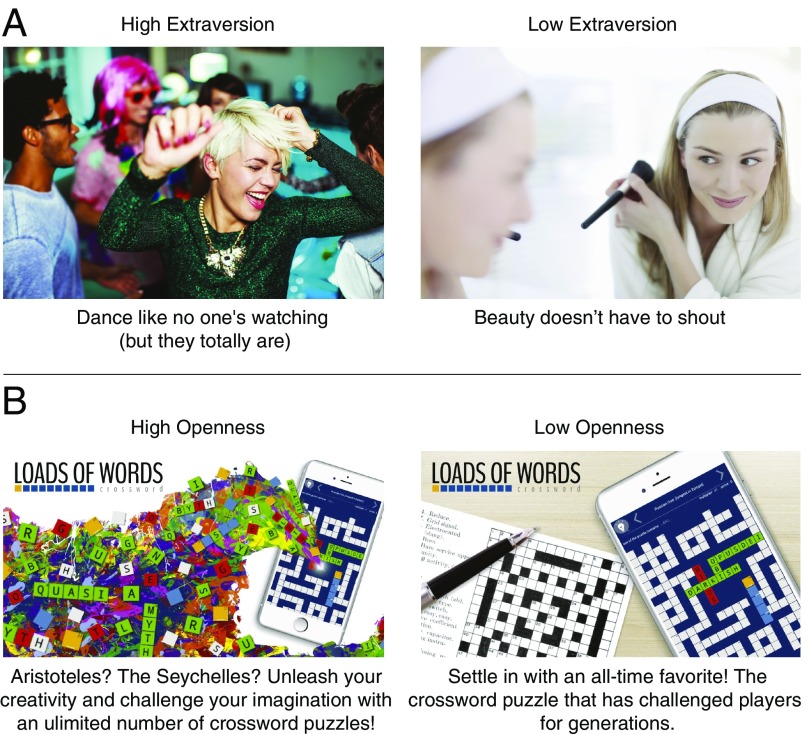
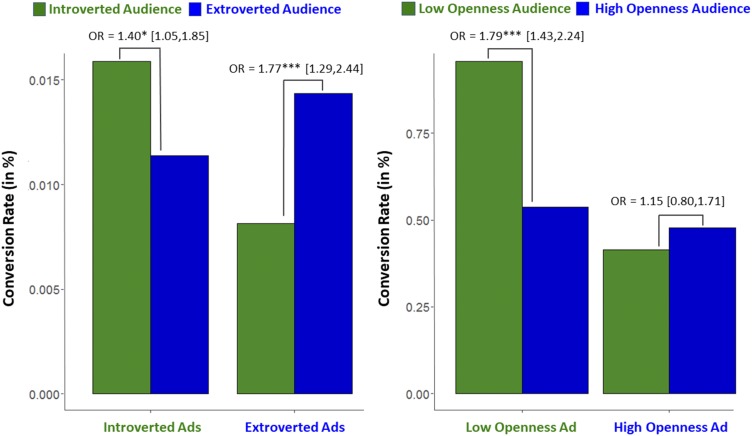
People are exposed to persuasive communication across many different contexts: Governments, companies, and political parties use persuasive appeals to encourage people to eat healthier, purchase a particular product, or vote for a specific candidate. Laboratory studies show that such persuasive appeals are more effective in influencing behavior when they are tailored to individuals' unique psychological characteristics. However, the investigation of large-scale psychological persuasion in the real world has been hindered by the questionnaire-based nature of psychological assessment. Recent research, however, shows that people's psychological characteristics can be accurately predicted from their digital footprints, such as their Facebook Likes or Tweets. Capitalizing on this form of psychological assessment from digital footprints, we test the effects of psychological persuasion on people's actual behavior in an ecologically valid setting. In three field experiments that reached over 3.5 million individuals with psychologically tailored advertising, we find that matching the content of persuasive appeals to individuals' psychological characteristics significantly altered their behavior as measured by clicks and purchases. Persuasive appeals that were matched to people's extraversion or openness-to-experience level resulted in up to 40% more clicks and up to 50% more purchases than their mismatching or unpersonalized counterparts. Our findings suggest that the application of psychological targeting makes it possible to influence the behavior of large groups of people by tailoring persuasive appeals to the psychological needs of the target audiences. We discuss both the potential benefits of this method for helping individuals make better decisions and the potential pitfalls related to manipulation and privacy.
Overview
The claims and statistics of this paper haven’t been checked yet.
Run the check — free, no account needed. It reads the open-access text and checks the sources it cites.
Integrity signals
Registry
Cites
Statistics
Figures
Verification
Claims the paper makes
The claims and statistics of this paper haven’t been checked yet.
Run the check — free, no account needed. It reads the open-access text and checks the sources it cites.
Claims other papers make about this one
Each is checked against this paper’s own text: does it say what the citing paper says it does?
The source backs part of the claim, not all of it — or backs it for a different population, condition or comparison.
In the citing paper
“Matz et al. (2017) reflect on their (Kosinski and Stillwell) decade-long research program on infering personality traits from social media users and its potential for mass manipulation, as evidenced in the adoption of similar techniques in the manipulation of elections.28”
From Social Data: Biases, Methodological Pitfalls, and Ethical Boundaries (2019) · cites this paper as Matz et al., 2017
Experimental — accuracy not yet measuredThe cited source says what the claim attributes to it.
In the citing paper
“Personality matching has been shown to increase the effectiveness of real-life persuasive communication59.”
From A psychometric framework for evaluating and shaping personality traits in large language models (2025) · cites this paper as [59]
In the citing paper
“companies report an increase in sales if salespersons demonstrate high extraversion and openness [38]”
From Interacting with a Chatbot-Based Advising System: Understanding the Effect of Chatbot Personality and User Gender on Behavior (2022) · cites this paper as [38]
In the citing paper
“and matching a message to an audience's personality improves its effectiveness [36 ].”
From Two social lives: how differences between online and offline interaction influence social outcomes (2020) · cites this paper as [36]
Self-check
Percentages, sums and reported differences re-computed from the paper’s own numbers.
The self-check needs the paper’s full text.
Citations
Cites
Self-Reports in Organizational Research: Problems and Prospects
Podsakoff, P. M., & Organ, D. W. (1986) · Journal of Management · doi:10.1177/014920638601200408 · Cited by 17,102
An Introduction to the Five‐Factor Model and Its Applications
McCrae, R. R., & John, O. P. (1992) · Journal of Personality · doi:10.1111/j.1467-6494.1992.tb00970.x · Cited by 6,835
Interaction terms in logit and probit models
Ai, C., & Norton, E. C. (2003) · Economics Letters · doi:10.1016/s0165-1765(03)00032-6 · Cited by 4,599
Lazer, D., Pentland, A., Adamic, L., Aral, S., Barabási, A.-L., Brewer, D., Christakis, N., Contractor, N., Fowler, J., Gutmann, M., et al. (2009) · Science · doi:10.1126/science.1167742 · Cited by 3,365
The Role of Emotions in Marketing
Bagozzi, R. P., Gopinath, M., & Nyer, P. U. (1999) · Journal of the Academy of Marketing Science · doi:10.1177/0092070399272005 · Cited by 3,349
The international personality item pool and the future of public-domain personality measures
Goldberg, L. R., Johnson, J. A., Eber, H. W., Hogan, R., Ashton, M. C., Cloninger, C. R., & Gough, H. G. (2006) · Journal of Research in Personality · doi:10.1016/j.jrp.2005.08.007 · Cited by 3,185
Private traits and attributes are predictable from digital records of human behavior
Kosinski, M., Stillwell, D., & Graepel, T. (2013) · Proceedings of the National Academy of Sciences · doi:10.1073/pnas.1218772110 · Cited by 2,829
Self-citationWhat Do Laboratory Experiments Measuring Social Preferences Reveal About the Real World?
Levitt, S. D., & List, J. A. (2007) · Journal of Economic Perspectives · doi:10.1257/jep.21.2.153 · Cited by 2,668
Does tailoring matter? Meta-analytic review of tailored print health behavior change interventions
Noar, S. M., Benac, C. N., & Harris, M. S. (2007) · Psychological Bulletin · doi:10.1037/0033-2909.133.4.673 · Cited by 2,136
Personality, Gender, and Age in the Language of Social Media: The Open-Vocabulary Approach
Schwartz, H. A., Eichstaedt, J. C., Kern, M. L., Dziurzynski, L., Ramones, S. M., Agrawal, M., Shah, A., Kosinski, M., Stillwell, D., Seligman, M. E. P., et al. (2013) · PLoS ONE · doi:10.1371/journal.pone.0073791 · Cited by 1,700
Self-citation
Cited by
Sorted by citations
Items 601–700 of 890
13. Music in Christian Services as a Means to Induce Religious Feelings
Wald‐Fuhrmann, M. (2024) · Open Book Publishers · doi:10.11647/obp.0403.13 · Cited by 1
Bouteneff, P. C. (2024) · Open Book Publishers · doi:10.11647/obp.0403.02 · Cited by 1
Arnold, J. (2024) · Open Book Publishers · doi:10.11647/obp.0403.14 · Cited by 1
Martínez, J. M. G. (2024) · Hipertextos · doi:10.24215/23143924e090 · Cited by 1
Suppressing the Endogenous Negative Influence Through Node Intervention in Social Networks
Furutani, S., Aoshima, T., Shibahara, T., Akiyama, M., & Aida, M. (2024) · IEEE Access · doi:10.1109/access.2024.3523036 · Cited by 1
Vergeer, L., Mulligan, C., Jeong, H., Khan, A., & L’Abbé, M. R. (2025) · Public Health Nutrition · doi:10.1017/s1368980024002659
Kareem, J. A. H., & Muhammad, F. H. (2025) · Journal of Manufacturing Technology Management · doi:10.1108/jmtm-08-2024-0419 · Cited by 1
Entrepreneurial and Sustainable Academic Leadership: An Introduction
Striełkowski, W. (2019) · Springer proceedings in business and economics · doi:10.1007/978-3-030-15495-0_1 · Cited by 1
Social Media-Addiction: Personality traits and human biology in the Facebook-age
Kutschera, U. (2019) · Mental Health and Addiction Research · doi:10.15761/mhar.1000179 · Cited by 1
Data-Based User’s Personality in Personalizing Smart Services
Krzemińska, I. (2019) · Lecture notes in business information processing · doi:10.1007/978-3-030-36691-9_57 · Cited by 1
Direitos Humanos, inteligência artificial e privacidade
Cassino, J. F., Avelino, R. D. S., & da Silveira, S. A. (2019) · Monções Revista de Relações Internacionais da UFGD · doi:10.30612/rmufgd.v8i15.11546 · Cited by 1
Kowalik, K. (2020) · Roczniki Kulturoznawcze · doi:10.18290/rkult.2019.10.4-2 · Cited by 1
Brownlie, E. (2020) · Victoria University of Wellington Law Review · doi:10.26686/vuwlr.v51i1.6515 · Cited by 1
O nascimento do saber infodemiológico
Fogliano, A. (2021) · Liinc em Revista · doi:10.18617/liinc.v17i1.5711 · Cited by 1
Burhamzah, M., Nelly, N., & Alamsyah, A. (2021) · Al-Qalam · doi:10.31969/alq.v27i2.967 · Cited by 1
Rubel, A., Castro, C., & Pham, A. (2021) · Cambridge University Press eBooks · doi:10.1017/9781108895057.010 · Cited by 1
Leutner, F., Akhtar, R., & Chamorro‐Premuzic, T. (2022) · Emerald Group Publishing Limited eBooks · doi:10.1108/978-1-83867-559-220221004 · Cited by 1
Process Ontology Approach to Military Influence Operations
Sartonen, M., Huhtinen, A., Hanley, M., & Simola, P. E. (2022) · Computational methods in applied sciences · doi:10.1007/978-3-030-91293-2_6 · Cited by 1
de Lisboa, I. I. U., Batista, M., Fernandes, A. L., de Lisboa, I. I. U., Sabino, A., Ribeiro, L. P., & Departamento de Direito, F. D. S. (2021) · RISTI - Revista Ibérica de Sistemas e Tecnologias de Informação · doi:10.17013/risti.43.75-92 · Cited by 1
Zornić, N., & Marković, A. (2022) · JUCS - Journal of Universal Computer Science · doi:10.3897/jucs.73924 · Cited by 1
Loffredo, A. M., Wenrich, R., Axelsson, C., Kröger, W., & Al., E. (2022) · transcript Verlag eBooks · doi:10.14361/9783839461358 · Cited by 2
Bowling alone in the autonomous vehicle: the ethics of well-being in the driverless car
Ferdman, A. (2022) · AI & Society · doi:10.1007/s00146-022-01565-1 · Cited by 1
Decker, H., & Feier, A. (2023) · Hawaii International Conference on System Sciences (HICSS) · doi:10.24251/hicss.2023.281 · Cited by 1
Reality Mining: Privacy and Data Protection Dilemmas in the World of Perpetual Behavioral MonitoringPreprint
Ntokos, I. (2018) · SSRN Electronic Journal · doi:10.2139/ssrn.3230139 · Cited by 1
Aichholzer, G., & Rose, G. (2019) · doi:10.1553/10.1007/978-3-030-27184-8 · Cited by 1
Wang, S., Wang, T., He, C., & Hu, Y. J. (2022) · SSRN Electronic Journal · doi:10.2139/ssrn.4018741 · Cited by 1
The Predictive Five: a Supervised Learning Approach to Personality PsychologyPreprint
Gilead, M., Lavi, G., & Rosenblatt, J. D. (2022) · Research Square · doi:10.21203/rs.3.rs-1185402/v1 · Cited by 1
Sindermann, C., Mõttus, R., Löchner, D., & Montag, C. (2020) · OSF Preprints (OSF Preprints) · doi:10.31219/osf.io/795xd · Cited by 1
Social media, marketing, and five-factor personality: A review and synthesis of the literaturePreprint
Bowden-Green, T., Hinds, J. M., & Joinson, A. (2023) · doi:10.31234/osf.io/k7vm4 · Cited by 1
The Transaction TestPreprint
Bogliacino, F., Pejsachowicz, L., Liva, G., & Lupiáñez‐Villanueva, F. (2023) · doi:10.31235/osf.io/sqt3j · Cited by 1
Rocha, P. (2023) · Preprints.org · doi:10.20944/preprints202312.2081.v1
Testing for Manipulation: Experimental Evidence on Dark PatternsPreprint
Bogliacino, F., Pejsachowicz, L., Liva, G., & Lupiáñez‐Villanueva, F. (2024) · SSRN Electronic Journal · doi:10.2139/ssrn.4755295 · Cited by 1
Wodajo, K. K. (2024) · SSRN Electronic Journal · doi:10.2139/ssrn.4754468 · Cited by 1
The effect of social media ads on election outcomesPreprint
Bär, D., Pröllochs, N., & Feuerriegel, S. (2024) · OSF Preprints (OSF Preprints) · doi:10.31219/osf.io/q8mxj · Cited by 3
Through the Digital Maze: Media Regulation for Ethical Journalism in a Disinformation AgePreprint
Sharma, R., & Rout, A. (2024) · SSRN Electronic Journal · doi:10.2139/ssrn.4799566 · Cited by 1
Don't Kill the Baby: The Case for AI in ArbitrationPreprint
Mei, Y., & Broyde, M. J. (2024) · SSRN Electronic Journal · doi:10.2139/ssrn.4936638 · Cited by 1
Schilling, T., & Sergeeva, A. (2025) · SSRN Electronic Journal · doi:10.2139/ssrn.5298257 · Cited by 1
How AI bots spread misinformation online and undermine democratic politics
Ricciardone, S. M. (2024) · doi:10.64628/aam.9jn5as9hu · Cited by 1
Modeling and analysis of deviant behavior of minors
Narushev, I. R., Кубасов, И. А., & Kulichenko, A. Y. (2019) · International Scientific and Practical Conference Modern Management Trends and the Digital Economy: from Regional Development to Global Economic Growth (MTDE) · doi:10.2991/mtde-19.2019.58
Montag, C. (2019) · Springer eBooks · doi:10.1007/978-3-658-22954-2_13
Psychometrics, Model Generation, and Data
Madsen, J. K. (2019) · Springer eBooks · doi:10.1007/978-3-030-22145-4_7
Pubblicità comportamentale, GDPR e rischi di discriminazione
Banterle, F. (2018) · Ledizioni eBooks · doi:10.4000/books.ledizioni.3943
Selfie w medialnych digitalnych platformach - ukierunkowanie komunikacji marketingowej
Fichnová, K., & Wojciechowski, Ł. P. (2018) · Annales Universitatis Paedagogicae Cracoviensis Studia de Cultura · doi:10.24917/20837275.10.4.7
Managing Data in Digital Marketing
Szymkowiak, A. (2019) · Bogucki Wydawnictwo Naukowe eBooks · doi:10.12657/9788379862788
Влияние психологических характеристик объекта воздействия на эффективность воздействия
Латынов, В. В. (2020) · Познание · doi:10.37882/2223-2982.2020.04.13
Persönlichkeitsbasierte Personalisierung von Service-Apps
Arz, S., & Mann, A. (2020) · Forum Dienstleistungsmanagement · doi:10.1007/978-3-658-30166-8_11
Digital Trace Data: The End of Empirical Sociology?
Sedláček, J. (2020) · Czech Sociological Review · doi:10.13060/csr.2020.015 · Cited by 1
Buying what people like you buy: Personality Homophily and Well-being in Consumer BehaviourPreprint
Lavelle-Hill, R. E., Skatova, A., Goulding, J., Bibby, P. A., & Clarke, D. (2020) · doi:10.31219/osf.io/nxsy9
The Importance of the Person’s Assertiveness in Persuasive Human-Robot Interactions
Paradeda, R. B., Ferreira, M. J., Martinho, C., & Paiva, A. (2020) · Lecture notes in computer science · doi:10.1007/978-3-030-62056-1_43
Юрьевна, П. О., & Pankova, I. (2020) · Scientific Research and Development Modern Communication Studies · doi:10.12737/2587-9103-2020-67-73
Science in the Spotlight: A Crisis of Confidence?
Feine, J. S., & Jakubovics, N. S. (2020) · Journal of Dental Research · doi:10.1177/0022034520978153
Hull, G. (2021) · SSRN Electronic Journal · doi:10.2139/ssrn.3771595
Kefford, G. (2021) · Political campaigning and communication · doi:10.1007/978-3-030-68234-7_3
Do personality traits drive online commitment to vote in social networks
Wood, M. A. (2019) · Minerva Access (University of Melbourne)
Polarization and toxicity in political discourse online
Saveski, M. (2020) · DSpace@MIT (Massachusetts Institute of Technology)
Muggleton, N., Quispe-Torreblanca, E. G., Leake, D., Gathergood, J., & Stewart, N. (2020) · doi:10.31234/osf.io/qabgm
Incorporating Textual Information on User Behavior for Personality Prediction
Yamada, K. C., Sasano, R., & Takeda, K. (2020) · Transactions of the Japanese Society for Artificial Intelligence · doi:10.1527/tjsai.b-k22
Folwarczny, M., & Otterbring, T. (2021) · doi:10.31234/osf.io/sh7gt
Exploring individual differences through network topologyPreprint
Samoilov-Katz, Y., Louzoun, Y., Muchnik, L., & Zaidel, A. (2021) · arXiv (Cornell University) · doi:10.48550/arxiv.2106.13672
Scharmer, A. (2021) · University of Minnesota Digital Conservancy (University of Minnesota)
Cognitive Contagion: How to model (and potentially counter) the spread of fake news.Preprint
Rabb, N., Cowen, L., de Ruiter, J. P., & Scheutz, M. J. (2021) · arXiv (Cornell University)
NOVA CAMADA DE ENCOBRIMENTO DO MUNDO DA VIDA
Cadena, N. B. D. L. (2021) · Revista Fragmentos de Cultura - Revista Interdisciplinar de Ciências Humanas · doi:10.18224/frag.v31i1.8628
Do Consumers Purchase Fresh Produce Differently to Packaged Goods? Evidence From the United StatesPreprint
Anesbury, Z. W., Talbot, D., Day, C. A., Bogomolov, T., & Bogomolova, S. (2018) · SSRN Electronic Journal · doi:10.2139/ssrn.3252849
Tracing networked infrastructures for post-truth
van Dijk, N. (2021) · Routledge eBooks · doi:10.4324/9780429053061-9
Латынов, В. В., & Vanin, A. V. (2021) · IFAC-PapersOnLine · doi:10.1016/j.ifacol.2021.10.438
Detecting Effects of Misinformation Through Emotion and Trace BehaviorPreprint
Sussman, K. L. (2021) · SSRN Electronic Journal · doi:10.2139/ssrn.3911984
Introducing the Systems Approach and the Statutory Duty of Care
Woods, L. (2021) · Nomos Verlagsgesellschaft mbH & Co. KG eBooks · doi:10.5771/9783748929789-77
Fox in the Henhouse: The Delegation of Regulatory and Privacy Enforcement to Big Tech
Bendix, W., & Mackay, J. (2022) · Hawaii International Conference on System Sciences (HICSS) · doi:10.24251/hicss.2022.320
The Condividual Interface: From the Filter Bubble to the Shared Reputation
Deseriis, M. (2021) · Springer eBooks · doi:10.1007/978-3-030-65497-9_18
Beierle, F. (2021) · T-labs series in telecommunication services · doi:10.1007/978-3-030-68840-0_3
Beierle, F. (2021) · T-labs series in telecommunication services · doi:10.1007/978-3-030-68840-0_1
The Past, Present, and Future of Recruitment
Leutner, F., Akhtar, R., & Chamorro‐Premuzic, T. (2022) · Emerald Group Publishing Limited eBooks · doi:10.1108/978-1-83867-559-220221001
Noor, M. N. M., Aziz, A. A., Harun, Y. R., Aminudin, N., Zakariah, Z., & Wangsa, I. H. S. (2022) · International Journal of Service Management and Sustainability · doi:10.24191/ijsms.v7i1.17781
Rola mikrotargetingu w komunikacji marketingowej w polityce oraz innych branżach
Robaczyński, J. (2022) · Studenckie Prace Prawnicze Administratywistyczne i Ekonomiczne · doi:10.19195/1733-5779.39.9
Obschonka, M., Fritsch, M., & Stuetzer, M. (2021) · Edward Elgar Publishing eBooks · doi:10.4337/9781788973380.00013
ALGORITMOS ELEITORAIS: IMPACTO DA MINERAÇÃO DE DADOS DE UMA DEMOCRACIA
PINHEIRO, C. R. P. (2018) · doi:10.17771/pucrio.acad.37222
AI and the persuasion industry: Eroding the policy entrepreneurial resources and skills of citizens
Duberry, J. (2022) · Edward Elgar Publishing eBooks · doi:10.4337/9781788977319.00010
Instigator and Proxy Liability in the Context of Information OperationsPreprint
Sharp, C. (2022) · SSRN Electronic Journal · doi:10.2139/ssrn.4091799
Tamiosso, D., & Jaques, P. A. (2022) · Revista Brasileira de Computação Aplicada · doi:10.5335/rbca.v14i2.12755
Ke, B., Qiu, L., Qu, T., Gay, E., Chan, S. H. M., & Yong, J. C. (2022) · doi:10.31234/osf.io/tve8k
Smillie, L. D., Ruby, M. B., Tan, N. P., Stollard, L., & Bastian, B. B. (2022) · doi:10.31234/osf.io/62k3w
A Field Experiment Using Social Media Ads to Encourage COVID-19 VaccinationPreprint
Çat, O., Chang, J., Hlatky, R., Li, H., & Nielson, D. (2022) · Research Square · doi:10.21203/rs.3.rs-2319578/v1
Musil, B., & Plohl, N. (2022) · doi:10.18690/um.ff.11.2022.11 · Cited by 1
Umetna inteligenca in eksistenčno tveganje
Lipuš, A. (2022) · doi:10.18690/um.ff.11.2022.10
Borstner, B., & Šetar, N. (2022) · doi:10.18690/um.ff.11.2022.5
Transformacija 'inteligence roja' {Swarm Intelligence} na umetno inteligenco
Martinc, U., Aberšek, B., & Borstner, B. (2022) · doi:10.18690/um.ff.11.2022.9
Ochs, C. (2022) · Velbrück Wissenschaft eBooks · doi:10.5771/9783748914877-524
Les guerres de l'information à l'ère numérique
Cull, N. J., & Chervaux, M. (2021) · Presses Universitaires de France eBooks · doi:10.3917/puf.maran.2021.01.0231
Masłowska, E. (2023) · Oxford University Press eBooks · doi:10.1093/obo/9780199756841-0284
What Really Matters is not just Knowing “What”, “Where” and “When” but also Knowing “How”
Bordogna, G. (2023) · Springer eBooks · doi:10.1007/978-3-031-23717-1_2
Metadata
- Authors
- Matz, S. C., Kosinski, M., Nave, G., & Stillwell, D. J.
- Affiliations
- Columbia University (US)
- Graduate School of Business, Stanford University, Stanford, CA 94305;
- University of Pennsylvania (US)
- University of Cambridge (GB)
- Corresponding author
- Matz, S. C.
- Venue
- Proceedings of the National Academy of Sciences
- Publisher
- National Academy of Sciences
- Published
- 2017-11-13
- Volume
- 114
- Issue
- 48
- Pages
- 12714-12719
- ISSN
- 0027-8424 (ISSN-L)
- 1091-6490
- PMC
- PMC5715760
- OpenAlex
- W2768262152
- Cited by
- 892
- References
- 32
- Citations by year
- 2026: 86 · 2025: 127 · 2024: 113 · 2023: 105 · 2022: 125 · 2021: 110 · 2020: 115 · 2019: 72 · 2018: 39
- FWCI
- 48.48
- Type
- journal article
- Language
- en
- Open access
- hybrid
- doi.org
- Licence
- Locations
- Proceedings of the National Academy of Sciences (publishedVersion, cc-by-nc-nd)
- PubMed Central (publishedVersion, cc-by-nc-nd)
- PubMed (publishedVersion)
- Apollo (University of Cambridge) (submittedVersion, cc-by-nc-nd)
- Apollo
- Columbia Academic Commons (Columbia University)
- Topics
- Social Sciences › Decision Sciences › General Decision Sciences › Decision-Making and Behavioral Economics
- Social Sciences › Psychology › Social Psychology › Psychology of Social Influence
- Social Sciences › Business, Management and Accounting › Marketing › Digital Marketing and Social Media
- Keywords
- personalized advertising, persuasive appeals, digital footprint, personality prediction, extraversion, openness to experience, behavioral influence, online purchase, click behavior, manipulation, privacy
- MeSH terms
- Direct-to-Consumer Advertising, Extraversion, Psychological, Humans, Individuality, Introversion, Psychological, Mass Behavior, Persuasive Communication, Psychometrics, Behavior Control, Social Media
About these checks
Registry, retraction, Cites and statistics results are computed, not judged, with one exception: a printed reference that no index lists is read once by a model before it counts as a citation error. Claims are extracted by a model and kept only when their quote appears verbatim in the text; each cited source is then checked, with a model’s help, for whether it says what the claim relies on. Those verdicts can be wrong — read the claim’s quote and the cited source before relying on one.
Statistics and arithmetic are recomputed, not judged.
Confidence bands are shown only for fields calibrated on our annotated test set. None is calibrated yet, so no band is shown.
What counts as a claim ›How we measure confidence ›How we check this ›
Are you an author, or do you see a problem with this page? Request a review
