

The DOI matches its Crossref record; 32 of the 32 references it cites were found in a registry or an index.
Psychological targeting as an effective approach to digital mass persuasion
Open accessAbstract
People are exposed to persuasive communication across many different contexts: Governments, companies, and political parties use persuasive appeals to encourage people to eat healthier, purchase a particular product, or vote for a specific candidate. Laboratory studies show that such persuasive appeals are more effective in influencing behavior when they are tailored to individuals' unique psychological characteristics. However, the investigation of large-scale psychological persuasion in the real world has been hindered by the questionnaire-based nature of psychological assessment. Recent research, however, shows that people's psychological characteristics can be accurately predicted from their digital footprints, such as their Facebook Likes or Tweets. Capitalizing on this form of psychological assessment from digital footprints, we test the effects of psychological persuasion on people's actual behavior in an ecologically valid setting. In three field experiments that reached over 3.5 million individuals with psychologically tailored advertising, we find that matching the content of persuasive appeals to individuals' psychological characteristics significantly altered their behavior as measured by clicks and purchases. Persuasive appeals that were matched to people's extraversion or openness-to-experience level resulted in up to 40% more clicks and up to 50% more purchases than their mismatching or unpersonalized counterparts. Our findings suggest that the application of psychological targeting makes it possible to influence the behavior of large groups of people by tailoring persuasive appeals to the psychological needs of the target audiences. We discuss both the potential benefits of this method for helping individuals make better decisions and the potential pitfalls related to manipulation and privacy.
Overview
The claims and statistics of this paper haven’t been checked yet.
Run the check — free, no account needed. It reads the open-access text and checks the sources it cites.
Integrity signals
Registry
Cites
Statistics
Figures
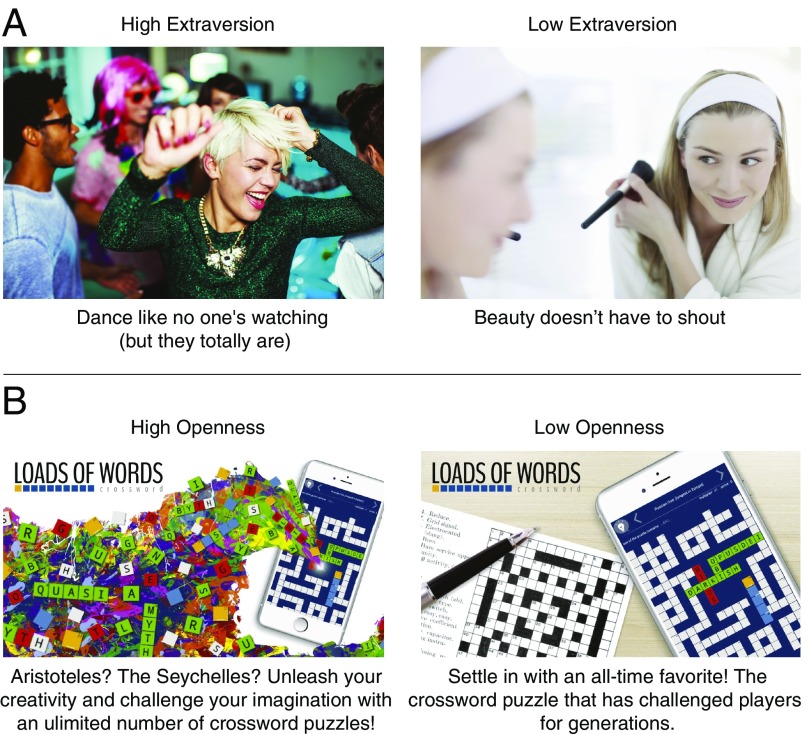
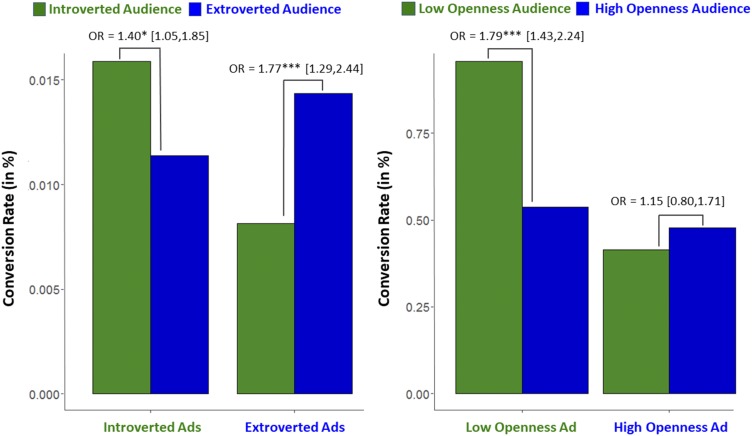
Verification
Claims the paper makes
The claims and statistics of this paper haven’t been checked yet.
Run the check — free, no account needed. It reads the open-access text and checks the sources it cites.
Claims other papers make about this one
Each is checked against this paper’s own text: does it say what the citing paper says it does?
The source backs part of the claim, not all of it — or backs it for a different population, condition or comparison.
In the citing paper
“Matz et al. (2017) reflect on their (Kosinski and Stillwell) decade-long research program on infering personality traits from social media users and its potential for mass manipulation, as evidenced in the adoption of similar techniques in the manipulation of elections.28”
From Social Data: Biases, Methodological Pitfalls, and Ethical Boundaries (2019) · cites this paper as Matz et al., 2017
Experimental — accuracy not yet measuredThe cited source says what the claim attributes to it.
In the citing paper
“Personality matching has been shown to increase the effectiveness of real-life persuasive communication59.”
From A psychometric framework for evaluating and shaping personality traits in large language models (2025) · cites this paper as [59]
In the citing paper
“companies report an increase in sales if salespersons demonstrate high extraversion and openness [38]”
From Interacting with a Chatbot-Based Advising System: Understanding the Effect of Chatbot Personality and User Gender on Behavior (2022) · cites this paper as [38]
In the citing paper
“and matching a message to an audience's personality improves its effectiveness [36 ].”
From Two social lives: how differences between online and offline interaction influence social outcomes (2020) · cites this paper as [36]
Self-check
Percentages, sums and reported differences re-computed from the paper’s own numbers.
The self-check needs the paper’s full text.
Citations
Cites
Self-Reports in Organizational Research: Problems and Prospects
Podsakoff, P. M., & Organ, D. W. (1986) · Journal of Management · doi:10.1177/014920638601200408 · Cited by 17,102
An Introduction to the Five‐Factor Model and Its Applications
McCrae, R. R., & John, O. P. (1992) · Journal of Personality · doi:10.1111/j.1467-6494.1992.tb00970.x · Cited by 6,835
Interaction terms in logit and probit models
Ai, C., & Norton, E. C. (2003) · Economics Letters · doi:10.1016/s0165-1765(03)00032-6 · Cited by 4,599
Lazer, D., Pentland, A., Adamic, L., Aral, S., Barabási, A.-L., Brewer, D., Christakis, N., Contractor, N., Fowler, J., Gutmann, M., et al. (2009) · Science · doi:10.1126/science.1167742 · Cited by 3,365
The Role of Emotions in Marketing
Bagozzi, R. P., Gopinath, M., & Nyer, P. U. (1999) · Journal of the Academy of Marketing Science · doi:10.1177/0092070399272005 · Cited by 3,349
The international personality item pool and the future of public-domain personality measures
Goldberg, L. R., Johnson, J. A., Eber, H. W., Hogan, R., Ashton, M. C., Cloninger, C. R., & Gough, H. G. (2006) · Journal of Research in Personality · doi:10.1016/j.jrp.2005.08.007 · Cited by 3,185
Private traits and attributes are predictable from digital records of human behavior
Kosinski, M., Stillwell, D., & Graepel, T. (2013) · Proceedings of the National Academy of Sciences · doi:10.1073/pnas.1218772110 · Cited by 2,829
Self-citationWhat Do Laboratory Experiments Measuring Social Preferences Reveal About the Real World?
Levitt, S. D., & List, J. A. (2007) · Journal of Economic Perspectives · doi:10.1257/jep.21.2.153 · Cited by 2,668
Does tailoring matter? Meta-analytic review of tailored print health behavior change interventions
Noar, S. M., Benac, C. N., & Harris, M. S. (2007) · Psychological Bulletin · doi:10.1037/0033-2909.133.4.673 · Cited by 2,136
Personality, Gender, and Age in the Language of Social Media: The Open-Vocabulary Approach
Schwartz, H. A., Eichstaedt, J. C., Kern, M. L., Dziurzynski, L., Ramones, S. M., Agrawal, M., Shah, A., Kosinski, M., Stillwell, D., Seligman, M. E. P., et al. (2013) · PLoS ONE · doi:10.1371/journal.pone.0073791 · Cited by 1,700
Self-citation
Cited by
Sorted by citations
Items 501–600 of 890
Tensions between Privacy and Targeted Advertising
Batista, M., Fernandes, A. L., Ribeiro, L. P., Alturas, B., & Costa, C. P. (2023) · Scientific Journal of Applied Social and Clinical Science · doi:10.22533/at.ed.2163142316067 · Cited by 2
Fogel, J., & Ewen, A. (2023) · Delaware Journal of Public Health · doi:10.32481/djph.2023.06.023 · Cited by 2
The Wholly Alliance: Psychographics Ethics and the Internet of Things
Schoenherr, J. R. (2022) · IEEE International Symposium on Technology and Society (ISTAS) · doi:10.1109/istas55053.2022.10227096 · Cited by 2
Coincidental brand origins influence persuasion based on need for cognition
Cheng, Y., & Orazi, D. C. (2023) · European Journal of Marketing · doi:10.1108/ejm-09-2022-0681 · Cited by 2
Deep Targeting: Zur Steigerung der Eingriffstiefe in die Erfahrungsspielräume des Sozialen
Ochs, C. (2024) · Zeitschrift für Soziologie · doi:10.1515/zfsoz-2024-2007 · Cited by 2
7. From the Sacred to the Ordinary through the Lens of Psychological Science
Greenberg, D. M. (2024) · Open Book Publishers · doi:10.11647/obp.0403.07 · Cited by 2
5. Religion, Science, and Music
Zon, B. M. (2024) · Open Book Publishers · doi:10.11647/obp.0403.05 · Cited by 2
Çat, O., Chang, J., Hlatky, R., Li, H., & Nielson, D. (2024) · PNAS Nexus · doi:10.1093/pnasnexus/pgae189 · Cited by 2
Effects of personality and gender on nudgeability for mental health-related behaviors
Wagler, K., & Wells, T. T. (2024) · Current Opinion in Psychology · doi:10.1016/j.copsyc.2024.101938 · Cited by 2
On the Use of Proxies in Political Ad Targeting
Sapieżyński, P., Kaplan, L., Mislove, A. E., & Korolova, A. (2024) · Proceedings of the ACM on Human-Computer Interaction · doi:10.1145/3686917 · Cited by 2
Increasing support for economic freedom: responses in a representative sample of US adults
Krouse, M. D., & Zak, P. J. (2024) · Public Choice · doi:10.1007/s11127-024-01212-x · Cited by 2
Mining Digital Ad Contents: Finding the Sweet Spot of Authenticity via Personality Profiling
Guan, C., Liu, W., Cheng, Y.-C., & Heng, B. (2025) · Journal of Current Issues & Research in Advertising · doi:10.1080/10641734.2024.2448138 · Cited by 2
How does service description contribute to peer-to-peer service satisfaction? Consumer clout matters
Zhu, L., Lin, Y., Cheng, M., & Cen, J. (2025) · Journal of Services Marketing · doi:10.1108/jsm-07-2024-0325 · Cited by 2
Shrirao, V., Parihar, B. S., Rakesh, N., Gulhane, M., Choudhary, S., & Agrawal, P. K. (2024) · International Conference on Information Science and Communications Technologies (ICISCT) · doi:10.1109/icisct64202.2024.10957151 · Cited by 2
LLM anthropomorphization: balancing ethics and business value
Reusens, M., & Baesens, B. (2025) · Journal of Business Analytics · doi:10.1080/2573234x.2025.2551951 · Cited by 2
Political Science: Moving from Numbers to Words in the Case of Brexit
Fredén, A. (2020) · Springer eBooks · doi:10.1007/978-3-030-37250-7_15 · Cited by 2
Żytomirski, M. (2021) · Acta Univeristatis Lodziensis Folia Librorum · doi:10.18778/0860-7435.32.05 · Cited by 2
Unique on Facebook: Formulation and Evidence of (Nano)targeting Individual Users with non-PII Data
González-Cabañas, J., Cuevas, √., Cuevas, R., López-Fernández, J., & García, D. (2021) · KOPS (University of Konstanz) · doi:10.48550/arxiv.2110.06636 · Cited by 2
Латынов, В. В. (2022) · Познание · doi:10.37882/2500-3682.2022.01.04 · Cited by 2
The Effects of Modern Data Analytics in Electoral Politics
Oddleifson, E. (2020) · Political Science Undergraduate Review · doi:10.29173/psur130 · Cited by 2
Siyasal İkna: 23 Haziran 2019 İstanbul Yerel Seçiminde Adayların Facebook Kullanımı
Akdal, T. (2020) · Journal of Turkish Studies · doi:10.29228/turkishstudies.42088 · Cited by 2
Tucaković, L., & Bojić, L. (2022) · Srpska politička misao · doi:10.22182/spm.7442021.10 · Cited by 2
Personality Based Data-Driven Personalization as an Integral Part of the Mobile Application
Krzemińska, I., & Szmydt, M. (2022) · Lecture notes in business information processing · doi:10.1007/978-3-031-04216-4_15 · Cited by 2
El gobierno de los públicos en la era de los big data: pistas a partir del "caso Kosinski"
Mónaco, J. A. (2022) · Intersecciones en Comunicación · doi:10.51385/ic.v1i16.145 · Cited by 2
Dagum, P., & Montag, C. (2022) · Studies in neuroscience, psychology and behavioral economics · doi:10.1007/978-3-030-98546-2_3 · Cited by 2
mercancía audiencia en la era de las plataformas
Mónaco, J. A. (2022) · Hipertextos · doi:10.24215/23143924e058 · Cited by 2
Zarouali, B., & Schreuder, J. (2023) · European Advertising Academy · doi:10.1007/978-3-658-40429-1_13 · Cited by 2
Auclair, S. (2023) · Éthique Publique · doi:10.4000/ethiquepublique.7979 · Cited by 2
Dehumanisation and the future of technology
Oldfield, M. (2023) · IET conference proceedings. · doi:10.1049/icp.2023.2566 · Cited by 2
Werner, K. (2019) · Philosophia · doi:10.1007/s11406-019-00074-8 · Cited by 2
Big Data is watching you: Persönlichkeitsanalyse und Microtargeting auf Social Media
Prietzel, F. (2019) · Springer eBooks · doi:10.1007/978-3-662-58695-2_8 · Cited by 2
PRIME biases of the digital age: A conceptual model for navigation and survival
Dowd, J. (2020) · Explorations in Media Ecology · doi:10.1386/eme_00058_1 · Cited by 2
Hongpanarak, T., & Mongkolnavin, J. (2021) · Advances in Information Technology · doi:10.1145/3468784.3469854 · Cited by 2
Utopian Impulse: An Individual-differences Approach to Transformative Social ChangePreprint
Bassó, F., & Krpan, D. (2020) · PsyArXiv (OSF Preprints) · doi:10.31234/osf.io/nvm2j · Cited by 3
Braun, M. I., & Schwartz, E. M. (2021) · SSRN Electronic Journal · doi:10.2139/ssrn.3896024 · Cited by 2
Exploring Personality and Online Social Engagement: An Investigation of MBTI Users on TwitterPreprint
Kadambi, P. (2021) · arXiv (Cornell University) · doi:10.48550/arxiv.2109.06402 · Cited by 5
Nudging or Nagging: The Perils of PersuasionPreprint
Guido, A., Tverskoi, D., Sergey Gavrilets, B., Sánchez, A., & Andrighetto, G. (2023) · SSRN Electronic Journal · doi:10.2139/ssrn.4404960 · Cited by 2
Faraji‐Rad, A., Tamaddoni, A., & Jebeli, A. (2024) · PsyArXiv (OSF Preprints) · doi:10.31234/osf.io/hjtfn · Cited by 2
Can large language models detect PII in code?Preprint
Gurjar, A., Camp, L. J., Ringenberg, T. R., Ma, X., & Chaora, A. C. (2024) · SSRN Electronic Journal · doi:10.2139/ssrn.4619112 · Cited by 5
Faulhaber, M. E. (2023) · doi:10.31274/td-20240617-356 · Cited by 2
Discussing Facebook Algorithm and Ads in the Context of Political Manipulation and Negative Campaign
ÇEÇEN, A. F. (2019) · Advances in marketing, customer relationship management, and e-services book series · doi:10.4018/978-1-5225-9790-2.ch021 · Cited by 1
Bing, S., Wang, J., Shi, J., Tan, C., & Hu, T. (2022) · Journal of Marketing Communications · doi:10.1080/13527266.2022.2098519 · Cited by 1
Galli, F. (2022) · Law, governance and technology series · doi:10.1007/978-3-031-13603-0_5 · Cited by 1
Schirpke, A.-K., & Ahrens, K. (2023) · Europäische Kulturen in der Wirtschaftskommunikation · doi:10.1007/978-3-658-38937-6_15 · Cited by 1
Beyond the Targeted Customer: Spillover Effect through Social Influence
Wang, Z.-Z., Zhu, Z., Xu, X.-K., & Chao, N.-P. (2023) · Journal of Advertising Research · doi:10.2501/jar-2023-016
User-Centered Privacy to Improve User Quantification using Smartphone Sensing
Bemmann, F. (2023) · International Conference on Human-Computer Interaction with Mobile Devices and Services (MobileHCI) · doi:10.1145/3565066.3609737 · Cited by 1
The social life of digital methods in psychology: Situating digital methods in the new data politics
Yen, J. (2023) · Social and Personality Psychology Compass · doi:10.1111/spc3.12923 · Cited by 2
Brand Management and Metaverse: A Data Mining Exploratory Approach
Ferreira, R. P., Brandão, A., & Veloso, B. (2024) · Smart innovation, systems and technologies · doi:10.1007/978-981-97-1552-7_31 · Cited by 1
8. An Inquiry into Musical Trance
TURAN, D. (2024) · Open Book Publishers · doi:10.11647/obp.0403.08 · Cited by 1
9. An Ethnomusicology of Spiritual Realities
Engelhardt, J. (2024) · Open Book Publishers · doi:10.11647/obp.0403.09 · Cited by 1
15. Listening to the Lived Experiences of Worshippers
Manders, E. (2024) · Open Book Publishers · doi:10.11647/obp.0403.15 · Cited by 1
Montaño, A. G. (2024) · Sintaxis · doi:10.36105/stx.2024n13.04 · Cited by 1
Personality and Meat Consumption Among Romantic Partners in Daily Life
Tan, N. P., Trenkenschuh, M., Ackermann, D., Betancourt, L. A. R., Bleidorn, W., & Hopwood, C. J. (2024) · Journal of Personality · doi:10.1111/jopy.12992 · Cited by 1
Guadagno, R. E. (2025) · Elsevier eBooks · doi:10.1016/b978-0-12-811320-2.00001-0 · Cited by 1
Targeted Abortion Frames Do Not Mobilize Political Action-Taking
Hernandez, N., Ottone, N., & Kalla, J. (2025) · American Politics Research · doi:10.1177/1532673x251324137 · Cited by 1
Politically-targeted intergroup interventions promote social equality and engagement
Nir, N., & Halperin, E. (2025) · Communications Psychology · doi:10.1038/s44271-025-00228-3 · Cited by 1
Algorithmic Price Discrimination
Bar‐Gill, O., & Sunstein, C. R. (2025) · Oxford University Press eBooks · doi:10.1093/oso/9780197778197.003.0002 · Cited by 1
Sunstein, C. R., & Bar‐Gill, O. (2025) · doi:10.1093/oso/9780197778197.001.0001 · Cited by 4
A Critical Review of Mobile Device-to-Device Communication
Desauw, L., Luxey, A., Raes, R., Rouvoy, R., Ruas, O., & Rudametkin, W. (2025) · Lecture notes in computer science · doi:10.1007/978-3-031-95728-4_1 · Cited by 1
Making online polls more accurate: statistical methods explained
Arletti, A., Tanturri, M. L., & Paccagnella, O. (2025) · Frontiers in Political Science · doi:10.3389/fpos.2025.1592589 · Cited by 1
Yildirim, E. O., & Hyzen, A. (2025) · Frontiers in Communication · doi:10.3389/fcomm.2025.1562368 · Cited by 1
Venturing Beyond the Vote: Routes to Feeling Represented through Unelected Representation
Vik, A., de Wilde, P., Treib, O., & Aarøe, L. (2025) · British Journal of Political Science · doi:10.1017/s0007123425000080 · Cited by 1
Tüketiyorum, Öyleyse Varım: Pazarlama - Gereklilik ya da Manipülasyon? (2) Psikososyal Yansımalar
Yüksel, A. (2025) · Seyahat ve Otel İşletmeciliği Dergisi · doi:10.24010/soid.1663327 · Cited by 1
Navigating the AI revolution in customer service: a bibliometric analysis
Khanna, A., Sarasan, S., & Sunil, M. P. (2025) · Spanish Journal of Marketing - ESIC · doi:10.1108/sjme-08-2024-0228 · Cited by 3
Efficacy of Personality-Labeled Prompts in Generating Trait-Specific Persuasive Messages
Xu, S., & Zhao, N. (2025) · Lecture notes in electrical engineering · doi:10.1007/978-981-95-2113-5_15 · Cited by 1
Cho, H. J., Lim, S., Saenz, M., & Schmälzle, R. (2025) · Journal of Communication · doi:10.1093/joc/jqaf048 · Cited by 1
Reveal the Prevalence and Emotional Landscape of Online Hate and Offensive Language Beyond Words
Ziaulla, M., & Biradar, A. (2025) · International Conference on Computation System and Information Technology for Sustainable Solutions (CSITSS) · doi:10.1109/csitss67709.2025.11293997 · Cited by 1
The power of loss: message framing, climate anxiety, and engagement in personal carbon trading
Li, T., Yang, Y., Liu, X., & Zeng, S. (2025) · BMC Psychology · doi:10.1186/s40359-025-03713-w · Cited by 1
Otterbring, T., Folwarczny, M., & Sigurðsson, V. (2025) · Personality and Individual Differences · doi:10.1016/j.paid.2025.113629 · Cited by 1
Schlicht, J. A., van Woudenberg, T. J., Blok, D. J., Simoski, B., & Buijzen, M. (2026) · Health Communication · doi:10.1080/10410236.2026.2613120 · Cited by 1
Abbas, J., Batool, I., Batool, H., Pilař, L., & Al‐Sulaiti, K. I. (2026) · Kybernetes · doi:10.1108/k-05-2024-1393 · Cited by 1
Jerez-Villota, E., Jurado, F., & Moreno–Llorena, J. (2026) · ACM Transactions on the Web · doi:10.1145/3787206 · Cited by 1
From alienated organs to alienated minds: understanding AI through the lens of somatic alienation
Kabadayı, B. K. (2026) · AI & Society · doi:10.1007/s00146-025-02838-1 · Cited by 1
Alkadhi, B., Hendley, R., & Rami Bahsoon, A. (2026) · Interacting with Computers · doi:10.1093/iwc/iwag003 · Cited by 2
Theories to Advance Dark Patterns Research
Schilling, T. (2026) · International Journal of Human-Computer Interaction · doi:10.1080/10447318.2026.2639823 · Cited by 2
New parameters of power: On LLM-based manipulation and control and the spectre of strategic AI
Chaudhary, Y., & Penn, J. (2026) · Big Data & Society · doi:10.1177/20539517261426450 · Cited by 19
Beyond behavioral intention: HEXACO-driven market segmentation and trust mechanisms in V2G adoption
Lien, C.-S., Liang, J.-K., Wang, J., & Lu, C.-C. (2026) · Research in Transportation Business & Management · doi:10.1016/j.rtbm.2026.101652 · Cited by 1
Pei, D., Ogunnaike, A., Ni, W., Foster, J. D., Adeniji, F. I. P., Mallory, V., Kodriati, N., Petillo, S. L., Henderson, K. C., Juris, A. J., et al. (2026) · Tobacco Control · doi:10.1136/tc-2025-059995 · Cited by 1
The Epistemic Costs of Super-Persuasive AI
Deller, A. (2026) · Philosophy & Technology · doi:10.1007/s13347-026-01106-4 · Cited by 2
Gahn, C., & Kruschinski, S. (2026) · Information Communication & Society · doi:10.1080/1369118x.2026.2652497 · Cited by 1
Li, J., Wu, Y., Li, H., & Xu, L. (2026) · International Journal of Human-Computer Interaction · doi:10.1080/10447318.2026.2674290 · Cited by 1
AI meets politics: Examining the effects of different targeting strategies across 15 countries
Kruikemeier, S., Schäfer, S., Hamilton, A., Guldemond, P., Vrielink, J., Dymanus, C., Remoortere, A. V., Tamboer, S. L., Vliegenthart, R., Vermeer, S. A. M., et al. (2026) · New Media & Society · doi:10.1177/14614448261445063 · Cited by 1
The Ethical Interaction Trilogy Among Companies, Customers, and AI-Chatbots
Ragab, F. A., & Belal, M. (2026) · Advances in computational intelligence and robotics book series · doi:10.4018/979-8-3373-3361-8.ch005 · Cited by 1
Beyond one-size-fits-all: Personalising health communication to drive real behaviour change
Avenel, J., Chevallier, C., & Dubourg, E. (2026) · La Presse Médicale · doi:10.1016/j.lpm.2026.104370 · Cited by 1
Hsu, K. L., & Hung, W.-H. J. (2026) · Journal of theoretical and applied electronic commerce research · doi:10.3390/jtaer21070221 · Cited by 1
Informed consent and AI driven depression screening systems
Costanzo, J., & Hällström, H. J. (2026) · AI and Ethics · doi:10.1007/s43681-026-01365-z · Cited by 1
Orwat, C., & Schankin, A. (2018) · Repository KITopen (Karlsruhe Institute of Technology) · doi:10.5445/ksp/1000086677 · Cited by 1
Marketing mit neuen Technologien: Das ungeklärte Verhältnis zu Manipulation
Klarmann, M. (2020) · Springer eBooks · doi:10.1007/978-3-658-31563-4_32 · Cited by 1
Democratic Obligations and Technological Threats to Legitimacy
Rubel, A., Castro, C., & Pham, A. (2021) · Cambridge University Press eBooks · doi:10.1017/9781108895057.008 · Cited by 1
DUGAS, M. A., Crowley, K., Gao, G. G., McHarry, L., Kenmuir, L., Piper, J. M., Veronese, F. D. M., & Agarwal, R. (2021) · Social Marketing Quarterly · doi:10.1177/15245004211030965 · Cited by 1
Mythili, R., & Kiruthiga, V. (2022) · International Journal of Health Sciences · doi:10.53730/ijhs.v6ns3.6175 · Cited by 1
Sodobne perspektive družbe: Umetna inteligenca na stičišču znanosti
Bregant, J., Aberšek, B., & Borstner, B. (2022) · doi:10.18690/um.ff.11.2022 · Cited by 8
Unfair commercial practices and vulnerability of consumers in the digital marketplace
Pusztahelyi, R. (2022) · Multidiszciplináris Tudományok · doi:10.35925/j.multi.2022.3.1 · Cited by 1
Profiling, Targeting and the Increasing Optimisation of Emotional Life
Bakir, V., & McStay, A. (2022) · Springer eBooks · doi:10.1007/978-3-031-13551-4_6 · Cited by 1
Personal Predictors of Students’ Normative Informational Behavior
Grishina, A., Abakumova, I., Zvezdina, G., & Проненко, Е. А. (2023) · Lecture notes in networks and systems · doi:10.1007/978-3-031-21432-5_298 · Cited by 1
Paradigm shifts in digital personalization
Vaid, S. S. (2023) · Nature Reviews Psychology · doi:10.1038/s44159-023-00202-y · Cited by 1
Local language in the context of political divides
Mendoza, R. U., Domingo, C. L., Mendoza, G. A. S., & Yap, J. K. (2023) · Journal of Asian Pacific Communication · doi:10.1075/japc.00105.men · Cited by 1
Evaluation of Prospect and Challenges of Artificial Intelligence (AI) and Preparation for Future
Hossain, K. A. (2023) · American Journal of Computer Science and Technology · doi:10.11648/j.ajcst.20230604.13 · Cited by 1
Alshakhsi, S. A. A., Babiker, A., Sindermann, C., Al‐Thani, D., Montag, C., & Ali, R. (2024) · Frontiers in Computer Science · doi:10.3389/fcomp.2024.1387681 · Cited by 1
Metadata
- Authors
- Matz, S. C., Kosinski, M., Nave, G., & Stillwell, D. J.
- Affiliations
- Columbia University (US)
- Graduate School of Business, Stanford University, Stanford, CA 94305;
- University of Pennsylvania (US)
- University of Cambridge (GB)
- Corresponding author
- Matz, S. C.
- Venue
- Proceedings of the National Academy of Sciences
- Publisher
- National Academy of Sciences
- Published
- 2017-11-13
- Volume
- 114
- Issue
- 48
- Pages
- 12714-12719
- ISSN
- 0027-8424 (ISSN-L)
- 1091-6490
- PMC
- PMC5715760
- OpenAlex
- W2768262152
- Cited by
- 892
- References
- 32
- Citations by year
- 2026: 86 · 2025: 127 · 2024: 113 · 2023: 105 · 2022: 125 · 2021: 110 · 2020: 115 · 2019: 72 · 2018: 39
- FWCI
- 48.48
- Type
- journal article
- Language
- en
- Open access
- hybrid
- doi.org
- Licence
- Locations
- Proceedings of the National Academy of Sciences (publishedVersion, cc-by-nc-nd)
- PubMed Central (publishedVersion, cc-by-nc-nd)
- PubMed (publishedVersion)
- Apollo (University of Cambridge) (submittedVersion, cc-by-nc-nd)
- Apollo
- Columbia Academic Commons (Columbia University)
- Topics
- Social Sciences › Decision Sciences › General Decision Sciences › Decision-Making and Behavioral Economics
- Social Sciences › Psychology › Social Psychology › Psychology of Social Influence
- Social Sciences › Business, Management and Accounting › Marketing › Digital Marketing and Social Media
- Keywords
- personalized advertising, persuasive appeals, digital footprint, personality prediction, extraversion, openness to experience, behavioral influence, online purchase, click behavior, manipulation, privacy
- MeSH terms
- Direct-to-Consumer Advertising, Extraversion, Psychological, Humans, Individuality, Introversion, Psychological, Mass Behavior, Persuasive Communication, Psychometrics, Behavior Control, Social Media
About these checks
Registry, retraction, Cites and statistics results are computed, not judged, with one exception: a printed reference that no index lists is read once by a model before it counts as a citation error. Claims are extracted by a model and kept only when their quote appears verbatim in the text; each cited source is then checked, with a model’s help, for whether it says what the claim relies on. Those verdicts can be wrong — read the claim’s quote and the cited source before relying on one.
Statistics and arithmetic are recomputed, not judged.
Confidence bands are shown only for fields calibrated on our annotated test set. None is calibrated yet, so no band is shown.
What counts as a claim ›How we measure confidence ›How we check this ›
Are you an author, or do you see a problem with this page? Request a review
