

The DOI matches its Crossref record; 32 of the 32 references it cites were found in a registry or an index.
Psychological targeting as an effective approach to digital mass persuasion
Open accessAbstract
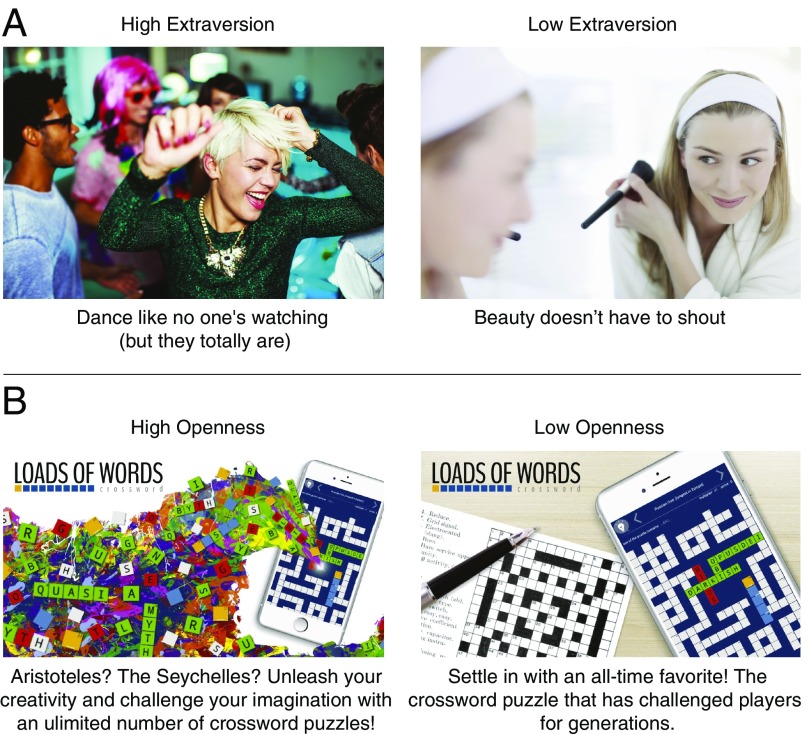
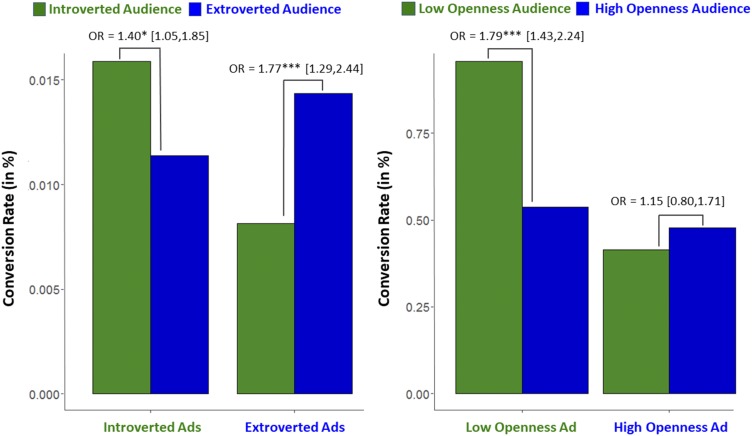
People are exposed to persuasive communication across many different contexts: Governments, companies, and political parties use persuasive appeals to encourage people to eat healthier, purchase a particular product, or vote for a specific candidate. Laboratory studies show that such persuasive appeals are more effective in influencing behavior when they are tailored to individuals' unique psychological characteristics. However, the investigation of large-scale psychological persuasion in the real world has been hindered by the questionnaire-based nature of psychological assessment. Recent research, however, shows that people's psychological characteristics can be accurately predicted from their digital footprints, such as their Facebook Likes or Tweets. Capitalizing on this form of psychological assessment from digital footprints, we test the effects of psychological persuasion on people's actual behavior in an ecologically valid setting. In three field experiments that reached over 3.5 million individuals with psychologically tailored advertising, we find that matching the content of persuasive appeals to individuals' psychological characteristics significantly altered their behavior as measured by clicks and purchases. Persuasive appeals that were matched to people's extraversion or openness-to-experience level resulted in up to 40% more clicks and up to 50% more purchases than their mismatching or unpersonalized counterparts. Our findings suggest that the application of psychological targeting makes it possible to influence the behavior of large groups of people by tailoring persuasive appeals to the psychological needs of the target audiences. We discuss both the potential benefits of this method for helping individuals make better decisions and the potential pitfalls related to manipulation and privacy.
Overview
The claims and statistics of this paper haven’t been checked yet.
Run the check — free, no account needed. It reads the open-access text and checks the sources it cites.
Integrity signals
Registry
Cites
Statistics
Figures
Verification
Claims the paper makes
The claims and statistics of this paper haven’t been checked yet.
Run the check — free, no account needed. It reads the open-access text and checks the sources it cites.
Claims other papers make about this one
Each is checked against this paper’s own text: does it say what the citing paper says it does?
The source backs part of the claim, not all of it — or backs it for a different population, condition or comparison.
In the citing paper
“Matz et al. (2017) reflect on their (Kosinski and Stillwell) decade-long research program on infering personality traits from social media users and its potential for mass manipulation, as evidenced in the adoption of similar techniques in the manipulation of elections.28”
From Social Data: Biases, Methodological Pitfalls, and Ethical Boundaries (2019) · cites this paper as Matz et al., 2017
Experimental — accuracy not yet measuredThe cited source says what the claim attributes to it.
In the citing paper
“Personality matching has been shown to increase the effectiveness of real-life persuasive communication59.”
From A psychometric framework for evaluating and shaping personality traits in large language models (2025) · cites this paper as [59]
In the citing paper
“companies report an increase in sales if salespersons demonstrate high extraversion and openness [38]”
From Interacting with a Chatbot-Based Advising System: Understanding the Effect of Chatbot Personality and User Gender on Behavior (2022) · cites this paper as [38]
In the citing paper
“and matching a message to an audience's personality improves its effectiveness [36 ].”
From Two social lives: how differences between online and offline interaction influence social outcomes (2020) · cites this paper as [36]
Self-check
Percentages, sums and reported differences re-computed from the paper’s own numbers.
The self-check needs the paper’s full text.
Citations
Cites
Self-Reports in Organizational Research: Problems and Prospects
Podsakoff, P. M., & Organ, D. W. (1986) · Journal of Management · doi:10.1177/014920638601200408 · Cited by 17,102
An Introduction to the Five‐Factor Model and Its Applications
McCrae, R. R., & John, O. P. (1992) · Journal of Personality · doi:10.1111/j.1467-6494.1992.tb00970.x · Cited by 6,835
Interaction terms in logit and probit models
Ai, C., & Norton, E. C. (2003) · Economics Letters · doi:10.1016/s0165-1765(03)00032-6 · Cited by 4,599
Lazer, D., Pentland, A., Adamic, L., Aral, S., Barabási, A.-L., Brewer, D., Christakis, N., Contractor, N., Fowler, J., Gutmann, M., et al. (2009) · Science · doi:10.1126/science.1167742 · Cited by 3,365
The Role of Emotions in Marketing
Bagozzi, R. P., Gopinath, M., & Nyer, P. U. (1999) · Journal of the Academy of Marketing Science · doi:10.1177/0092070399272005 · Cited by 3,349
The international personality item pool and the future of public-domain personality measures
Goldberg, L. R., Johnson, J. A., Eber, H. W., Hogan, R., Ashton, M. C., Cloninger, C. R., & Gough, H. G. (2006) · Journal of Research in Personality · doi:10.1016/j.jrp.2005.08.007 · Cited by 3,185
Private traits and attributes are predictable from digital records of human behavior
Kosinski, M., Stillwell, D., & Graepel, T. (2013) · Proceedings of the National Academy of Sciences · doi:10.1073/pnas.1218772110 · Cited by 2,829
Self-citationWhat Do Laboratory Experiments Measuring Social Preferences Reveal About the Real World?
Levitt, S. D., & List, J. A. (2007) · Journal of Economic Perspectives · doi:10.1257/jep.21.2.153 · Cited by 2,668
Does tailoring matter? Meta-analytic review of tailored print health behavior change interventions
Noar, S. M., Benac, C. N., & Harris, M. S. (2007) · Psychological Bulletin · doi:10.1037/0033-2909.133.4.673 · Cited by 2,136
Personality, Gender, and Age in the Language of Social Media: The Open-Vocabulary Approach
Schwartz, H. A., Eichstaedt, J. C., Kern, M. L., Dziurzynski, L., Ramones, S. M., Agrawal, M., Shah, A., Kosinski, M., Stillwell, D., Seligman, M. E. P., et al. (2013) · PLoS ONE · doi:10.1371/journal.pone.0073791 · Cited by 1,700
Self-citation
Cited by
Sorted by citations
Items 101–200 of 890
Montag, C., Baumeister, H., Kannen, C., Sariyska, R., Meßner, E.-M., & Brand, M. (2019) · J — Multidisciplinary Scientific Journal · doi:10.3390/j2020008 · Cited by 72
Digital Food Marketing to Young People: A Substantial Public Health Challenge
Boyland, E. J., Thivel, D., Mazur, A., Ring‐Dimitriou, S., Frelut, M., Weghuber, D., & On behalf of the European Childhood Obesity Group (2020) · Annals of Nutrition and Metabolism · doi:10.1159/000506413 · Cited by 72
Who complies with COVID-19 transmission mitigation behavioral guidelines?
Nofal, A. M., Cacciotti, G., & Lee, N. J. (2020) · PLoS ONE · doi:10.1371/journal.pone.0240396 · Cited by 66
Toward the data-driven dissemination of findings from psychological science.
Purtle, J., Marzalik, J. S., Halfond, R. W., Bufka, L. F., Teachman, B. A., & Aarons, G. A. (2020) · American Psychologist · doi:10.1037/amp0000721 · Cited by 66
The effect of spokesperson attribution on public health message sharing during the COVID-19 pandemic
Abu-Akel, A. M., Spitz, A., & West, R. (2021) · PLoS ONE · doi:10.1371/journal.pone.0245100 · Cited by 71
Digital Phenotyping of Big Five Personality via Facebook Data Mining: A Meta-Analysis
Marengo, D., & Montag, C. (2020) · Digital Psychology · doi:10.24989/dp.v1i1.1823 · Cited by 71
Generative AIPreprint
Feuerriegel, S., Hartmann, J., Janiesch, C., & Zschech, P. (2023) · SSRN Electronic Journal · doi:10.2139/ssrn.4443189 · Cited by 65
Multitask learning for emotion and personality traits detection
Li, Y., Kazemeini, A., Mehta, Y., & Cambria, E. (2022) · Neurocomputing · doi:10.1016/j.neucom.2022.04.049 · Cited by 93
Montag, C., Elhai, J. D., & Dagum, P. (2021) · Frontiers in Psychiatry · doi:10.3389/fpsyt.2021.740292 · Cited by 63
The Philosophy of Online Manipulation
Jongepier, F., & Klenk, M. (2022) · Routledge eBooks · doi:10.4324/9781003205425 · Cited by 75
Konuk, F. A., & Otterbring, T. (2023) · Journal of Retailing and Consumer Services · doi:10.1016/j.jretconser.2023.103531 · Cited by 68
Kuhail, M. A., Thomas, J., Alramlawi, S., Shah, S. J. H., & Thornquist, E. (2022) · Informatics · doi:10.3390/informatics9040081 · Cited by 59
Marengo, D., Sindermann, C., Elhai, J. D., & Montag, C. (2020) · Frontiers in Psychology · doi:10.3389/fpsyg.2020.00936 · Cited by 68
Social media interventions for precision public health: promises and risks
Dunn, A. G., Mandl, K. D., & Coiera, E. W. (2018) · npj Digital Medicine · doi:10.1038/s41746-018-0054-0 · Cited by 62
Multi-Document Transformer for Personality Detection
Yang, F., Quan, X., Yang, Y., & Yu, J. (2021) · Proceedings of the AAAI Conference on Artificial Intelligence · doi:10.1609/aaai.v35i16.17673 · Cited by 58
Boosting people’s ability to detect microtargeted advertising
Lorenz-Spreen, P., Geers, M., Pachur, T., Hertwig, R., Lewandowsky, S., & Herzog, S. M. (2021) · Scientific Reports · doi:10.1038/s41598-021-94796-z · Cited by 58
Artificial Intelligence and Democracy
Duberry, J. (2022) · Edward Elgar Publishing eBooks · doi:10.4337/9781788977319 · Cited by 68
What’s Wrong with Automated Influence
Benn, C., & Lazar, S. (2021) · Canadian Journal of Philosophy · doi:10.1017/can.2021.23 · Cited by 55
Ebert, T., Götz, F. M., Gladstone, J. J., Müller, S. R., & Matz, S. (2020) · Journal of Personality and Social Psychology · doi:10.1037/pspp0000344 · Cited by 61
Self-citationBreuer, J., Bishop, L., & Kinder-Kurlanda, K. E. (2020) · New Media & Society · doi:10.1177/1461444820924622 · Cited by 70
Leveraging Digital Advertising Platforms for Consumer Research
Braun, M. I., de Langhe, B., Puntoni, S., & Schwartz, E. M. (2023) · Journal of Consumer Research · doi:10.1093/jcr/ucad058 · Cited by 54
Montag, C., & Elhai, J. D. (2023) · Current Addiction Reports · doi:10.1007/s40429-023-00494-3 · Cited by 66
Inter-individual differences in attitude content: Cognition, affect, and attitudes
Haddock, G., & Maio, G. R. (2018) · Advances in experimental social psychology · doi:10.1016/bs.aesp.2018.10.002 · Cited by 61
What data are smartphone users willing to share with researchers?
Beierle, F., Tran, V. T., Allemand, M., Neff, P. K. A., Schlee, W., Probst, T., Zimmermann, J., & Pryss, R. C. (2019) · Journal of Ambient Intelligence and Humanized Computing · doi:10.1007/s12652-019-01355-6 · Cited by 54
What generative AI means for trust in health communications
Dunn, A. G., Shih, I., Ayre, J., & Spallek, H. (2023) · Journal of Communications In Healthcare · doi:10.1080/17538068.2023.2277489 · Cited by 51
How to Trick AI: Users' Strategies for Protecting Themselves from Automatic Personality Assessment
Völkel, S. T., Häuslschmid, R., Werner, A., Hußmann, H., & Butz, A. M. (2020) · CHI Conference on Human Factors in Computing Systems · doi:10.1145/3313831.3376877 · Cited by 53
Let’s get personal: Which elements elicit perceived personalization in social media advertising?
Keyzer, F. D., Dens, N., & Pelsmacker, P. D. (2022) · Electronic Commerce Research and Applications · doi:10.1016/j.elerap.2022.101183 · Cited by 50
Zarouali, B., Boerman, S. C., Voorveld, H. A. M., & van Noort, G. (2022) · Internet Research · doi:10.1108/intr-01-2021-0049 · Cited by 67
Lee, A., Inceoglu, I., Hauser, O., & Greene, M. (2022) · The Leadership Quarterly · doi:10.1016/j.leaqua.2020.101426 · Cited by 48
The scant science behind Cambridge Analytica’s controversial marketing techniques
Gibney, E. (2018) · Nature · doi:10.1038/d41586-018-03880-4 · Cited by 48
Live-odds gambling advertising and consumer protection
Newall, P. W. S., Ankush, T., Walasek, L., & Meyer, C. (2019) · PLoS ONE · doi:10.1371/journal.pone.0216876 · Cited by 54
Aghajari, Z., Baumer, E. P. S., & DiFranzo, D. J. (2023) · Proceedings of the ACM on Human-Computer Interaction · doi:10.1145/3579520 · Cited by 57
From the Digital Data Revolution toward a Digital Society: Pervasiveness of Artificial Intelligence
Emmert‐Streib, F. (2021) · Machine Learning and Knowledge Extraction · doi:10.3390/make3010014 · Cited by 58
Artificial Intelligence and Autonomy: On the Ethical Dimension of Recommender Systems
Bonicalzi, S., De, M., & Giovanola, B. (2023) · Topoi · doi:10.1007/s11245-023-09922-5 · Cited by 59
Matz, S. C. (2021) · Journal of Personality and Social Psychology · doi:10.1037/pspp0000324 · Cited by 52
Self-citationPersonality associations with Facebook use and tendencies towards Facebook Use Disorder
Sindermann, C., Duke, É., & Montag, C. (2020) · Addictive Behaviors Reports · doi:10.1016/j.abrep.2020.100264 · Cited by 50
Hazari, S., & Sethna, B. N. (2022) · Journal of Promotion Management · doi:10.1080/10496491.2022.2163033 · Cited by 76
Lim, H. S., Bouchacourt, L., & Brown‐Devlin, N. (2020) · Journal of Consumer Behaviour · doi:10.1002/cb.1898 · Cited by 44
The Personality Panorama: Conceptualizing Personality through Big Behavioural Data
Boyd, R. L., Pasca, P., & Lanning, K. (2020) · European Journal of Personality · doi:10.1002/per.2254 · Cited by 52
Cognitive cascades: How to model (and potentially counter) the spread of fake news
Rabb, N., Cowen, L., de Ruiter, J. P., & Scheutz, M. J. (2022) · PLoS ONE · doi:10.1371/journal.pone.0261811 · Cited by 46
Harnessing Artificial Intelligence for Health Message Generation: The Folic Acid Message Engine
Schmälzle, R., & Wilcox, S. (2022) · Journal of Medical Internet Research · doi:10.2196/28858 · Cited by 43
Re-start social media, but how?
Dhawan, S., Hegelich, S., Sindermann, C., & Montag, C. (2022) · Telematics and Informatics Reports · doi:10.1016/j.teler.2022.100017 · Cited by 46
Ramon, Y., Farrokhnia, R. A., Matz, S., & Martens, D. (2021) · Information · doi:10.3390/info12120518 · Cited by 50
Self-citationBraun, M. I., & Schwartz, E. M. (2024) · Journal of Marketing · doi:10.1177/00222429241275886 · Cited by 45
How Behavioral Interventions Can Reduce the Climate Impact of Energy Use
Nielsen, K. S., van der Linden, S., & Stern, P. C. (2020) · Joule · doi:10.1016/j.joule.2020.07.008 · Cited by 41
Digital Technology, Politics, and Policy-Making
Gilardi, F. (2022) · Cambridge University Press eBooks · doi:10.1017/9781108887304 · Cited by 44
Data Is What Data Does: Regulating Based on Harm and Risk Instead of Sensitive Data
Solove, D. J. (2023) · doi:10.2139/ssrn.4322198 · Cited by 39
A product-centric data mining algorithm for targeted promotions
Moodley, R., Chiclana, F., Caraffini, F., & Carter, J. (2019) · Journal of Retailing and Consumer Services · doi:10.1016/j.jretconser.2019.101940 · Cited by 42
Cipriani, E., Frumento, S., Gemignani, A., & Menicucci, D. (2024) · Journal of Environmental Psychology · doi:10.1016/j.jenvp.2024.102277 · Cited by 44
Halperin, E., & Schori‐Eyal, N. (2020) · Social and Personality Psychology Compass · doi:10.1111/spc3.12527 · Cited by 38
Matz, S., Beck, E. D., Atherton, O. E., White, M. J. D., Rauthmann, J. F., Mroczek, D. K., Kim, M.-H., & Bogg, T. (2023) · Perspectives on Psychological Science · doi:10.1177/17456916231191774 · Cited by 45
Self-citationOtterbring, T., & Folwarczny, M. (2023) · Journal of Retailing and Consumer Services · doi:10.1016/j.jretconser.2023.103612 · Cited by 39
Pop-ups, Ephemerality, and Consumer Experience: The Centrality of Buzz
Robertson, T. S., Gatignon, H., & Cesareo, L. (2018) · Journal of the Association for Consumer Research · doi:10.1086/698434 · Cited by 41
Computational personality assessment
Stachl, C., Boyd, R. L., Horstmann, K. T., Khambatta, P., Matz, S., & Harari, G. M. (2021) · Personality Science · doi:10.5964/ps.6115 · Cited by 48
Self-citationModeling Personality vs. Modeling Personalidad
Khwaja, M. K., Vaid, S. S., Zannone, S., Harari, G. M., Faisal, A. A., & Matic, A. (2019) · Proceedings of the ACM on Interactive Mobile Wearable and Ubiquitous Technologies · doi:10.1145/3351246 · Cited by 35
PsyCoT: Psychological Questionnaire as Powerful Chain-of-Thought for Personality Detection
Yang, T., Shi, T., Wan, F., Quan, X., Wang, Q., Wu, B., & Wu, J. (2023) · Findings of the Association for Computational Linguistics: EMNLP (Findings of EMNLP) · doi:10.18653/v1/2023.findings-emnlp.216 · Cited by 50
Bringing Back the Person into Behavioural Personality Science Using Big Data
Renner, K., Klee, S., & von Oertzen, T. (2020) · European Journal of Personality · doi:10.1002/per.2303 · Cited by 37
JPP&M 's Global Perspective and Impact: An Agenda for Research on Marketing and Public Policy
Shultz, C. J., Hoek, J. A., Lee, L., Leong, W. Y., Srinivasan, R., Viswanathan, M., & Wertenbroch, K. (2021) · Journal of Public Policy & Marketing · doi:10.1177/07439156211049216 · Cited by 42
An, J., Kwak, H., Qureshi, H. M., & Weber, I. G. (2021) · JMIR Formative Research · doi:10.2196/22313 · Cited by 37
Strycharz, J., & Duivenvoorde, B. B. (2021) · Internet Policy Review · doi:10.14763/2021.4.1585 · Cited by 44
Boyland, E. J., Backholer, K., Kent, M. P., Bragg, M. A., Sing, F., Karupaiah, T., & Kelly, B. (2024) · Annual Review of Nutrition · doi:10.1146/annurev-nutr-062322-014102 · Cited by 37
How Does Personification Impact Ad Performance and Empathy? An Experiment with Online Advertising
Salminen, J. O., Kaate, I., Kamel, A. M., Jung, S., & Jansen, B. J. J. (2020) · International Journal of Human-Computer Interaction · doi:10.1080/10447318.2020.1809246 · Cited by 33
Measuring Automated Influence: Between Empirical Evidence and Ethical Values
Susser, D., & Grimaldi, V. (2021) · Proceedings of the AAAI/ACM Conference on AI Ethics and Society · doi:10.1145/3461702.3462532 · Cited by 33
Abbott, R., Sin, R., Pedersen, C., Harris, T., Beck, T., Nilsson, S., Dong, T., Wang, Y., & Li, Y. (2023) · Journal of Consumer Behaviour · doi:10.1002/cb.2208 · Cited by 34
Expanding the measurement of culture with a sample of two billion humans
Obradovich, N., Özak, Ö., Martín, I., Ortuño-Ortín, I., Awad, E., Cebrián, M., Cuevas, R., Desmet, K., Rahwan, I., & Cuevas, Á. (2022) · Journal of The Royal Society Interface · doi:10.1098/rsif.2022.0085 · Cited by 30
Bruns, H., Dessart, F. J., Krawczyk, M. W., Lewandowsky, S., Pantazi, M., Pennycook, G., Schmid, P., & Smillie, L. (2024) · Scientific Reports · doi:10.1038/s41598-024-71599-6 · Cited by 34
A Survey of Automatic Personality Detection from Texts
Štajner, S., & Yenikent, S. (2020) · International Conference on Computational Linguistics · doi:10.18653/v1/2020.coling-main.553 · Cited by 38
Finding the ‘nudge’ in hypernudge
Mills, S. (2022) · Technology in Society · doi:10.1016/j.techsoc.2022.102117 · Cited by 41
Marengo, D., Elhai, J. D., & Montag, C. (2023) · Journal of Personality · doi:10.1111/jopy.12817 · Cited by 36
Intergroup psychological interventions: The motivational challenge.
Landry, A., & Halperin, E. (2023) · American Psychologist · doi:10.1037/amp0001289 · Cited by 31
You Are What You Post: What the Content of Instagram Pictures Tells About Users’ Personality
Ferwerda, B., & Tkalčič, M. (2018) · Jonkoping University Library (Jönköping University) · Cited by 31
A psychometric framework for evaluating and shaping personality traits in large language models
Serapio-García, G., Safdari, M., Crepy, C., Sun, L., Fitz, S., Romero, P., Abdulhai, M., Faust, A., & Matarić, M. (2025) · Nature Machine Intelligence · doi:10.1038/s42256-025-01115-6 · Cited by 30
The Effects of Content Ephemerality on Information Processing
Barnea, U., Meyer, R. J., & Nave, G. (2020) · Journal of Marketing Research · doi:10.1177/00222437221131047 · Cited by 32
Self-citationHow Data Can Be Used Against People: A Classification of Personal Data MisusesPreprint
Kröger, J. L., Miceli, M., & Müller, F. (2021) · SSRN Electronic Journal · doi:10.2139/ssrn.3887097 · Cited by 30
Shalaby, A. (2024) · Digital Economy and Sustainable Development · doi:10.1007/s44265-024-00042-5 · Cited by 46
Ethical Considerations of Digital Phenotyping from the Perspective of a Healthcare Practitioner
Dagum, P., & Montag, C. (2019) · Studies in neuroscience, psychology and behavioral economics · doi:10.1007/978-3-030-31620-4_2 · Cited by 30
Susceptibility to social influence predicts behavior on Facebook
Stöckli, S., & Hofer, D. (2020) · PLoS ONE · doi:10.1371/journal.pone.0229337 · Cited by 33
Odachi, R., Takahashi, S., Sugawara, D., Tabata, M., Kajiwara, T., Hironishi, M., & Buyo, M. (2022) · PLoS ONE · doi:10.1371/journal.pone.0276803 · Cited by 32
Dirty Data Labeled Dirt Cheap: Epistemic Injustice in Machine Learning Systems
Hull, G. (2022) · Ethics and Information Technology · doi:10.1007/s10676-023-09712-y · Cited by 32
From privacy to anti-discrimination in times of machine learning
Hagendorff, T. (2019) · Ethics and Information Technology · doi:10.1007/s10676-019-09510-5 · Cited by 30
Neuroticism as a Marker of Vulnerability to COVID-19 Infection
Khosravi, M. (2020) · Psychiatry Investigation · doi:10.30773/pi.2020.0199 · Cited by 28
Inferring psychological traits from spending categories and dynamic consumption patterns
Tovanich, N., Centellegher, S., Seghouani, N. B., Gladstone, J. J., Matz, S., & Lepri, B. (2021) · EPJ Data Science · doi:10.1140/epjds/s13688-021-00281-y · Cited by 32
Self-citationDo Humans Prefer Debiased AI Algorithms? A Case Study in Career Recommendation
Wang, C., Wang, K., Bian, A., Islam, R., Keya, K. N., Foulds, J. R., & Pan, S. (2022) · ACM International Conference on Intelligent User Interfaces (IUI) · doi:10.1145/3490099.3511108 · Cited by 29
Anesbury, Z. W., Talbot, D., Day, C. A., Bogomolov, T., & Bogomolova, S. (2019) · Journal of Retailing and Consumer Services · doi:10.1016/j.jretconser.2019.101976 · Cited by 27
Technology and democracy: a paradox wrapped in a contradiction inside an irony
Lewandowsky, S., & Pomerantsev, P. (2021) · Memory Mind & Media · doi:10.1017/mem.2021.7 · Cited by 28
Persuasion profiles to promote pedestrianism: Effective targeting of active travel messages
Pangbourne, K., Bennett, S., & Baker, A. (2020) · Travel Behaviour and Society · doi:10.1016/j.tbs.2020.04.004 · Cited by 26
An inclusive, real-world investigation of persuasion in language and verbal behavior
Ta, V. P., Boyd, R. L., Seraj, S., Keller, A., Griffith, C., Loggarakis, A., & Medema, L. (2021) · Journal of Computational Social Science · doi:10.1007/s42001-021-00153-5 · Cited by 38
Engl, E., Smittenaar, P., & Sgaier, S. K. (2019) · Gates Open Research · doi:10.12688/gatesopenres.13029.2 · Cited by 24
Mõttus, R., Wood, D., Condon, D. M., Back, M. D., Baumert, A., Costantini, G., Epskamp, S., Greiff, S., Johnson, W., Lukaszewski, A. W., et al. (2020) · PsyArXiv (OSF Preprints) · doi:10.31234/osf.io/hvk5p · Cited by 28
Consumer vulnerability in the digital age
OECD (2023) · OECD digital economy papers · doi:10.1787/4d013cc5-en · Cited by 46
Systematic discrepancies in the delivery of political ads on Facebook and Instagram
Bär, D., Pierri, F., Morales, G. D. F., & Feuerriegel, S. (2024) · PNAS Nexus · doi:10.1093/pnasnexus/pgae247 · Cited by 30
Avaliação Psicológica no Século XXI: de Onde Viemos e para Onde Vamos
Primi, R. (2018) · Psicologia Ciência e Profissão · doi:10.1590/1982-3703000209814 · Cited by 37
SNEFL: Social network explicit fuzzy like dataset and its application for Incel detection
Hajarian, M., Bastanfard, A., Mohammadzadeh, J., & Khalilian, M. (2019) · Multimedia Tools and Applications · doi:10.1007/s11042-019-08057-3 · Cited by 25
Dodoo, N. A., & Padovano, C. M. (2020) · Journal of Promotion Management · doi:10.1080/10496491.2020.1719954 · Cited by 32
Pride and prejudice: Unraveling and mitigating domestic country bias
Fischer, P. M., Zeugner‐Roth, K. P., Katsikeas, C. S., & Pandelaere, M. (2022) · Journal of International Business Studies · doi:10.1057/s41267-021-00496-1 · Cited by 25
The High Cost of Free Services
Landwehr, M., Borning, A. H., & Wulf, V. (2019) · Workshop on Computing within Limits (LIMITS) · doi:10.1145/3338103.3338106 · Cited by 25
Child and adolescent exposure to unhealthy food marketing across digital platforms in Canada
Kent, M. P., Bagnato, M., Remedios, L., Guimarães, J. S., Gillis, G., Soto, C., Hatoum, F., & Pritchard, M. (2024) · BMC Public Health · doi:10.1186/s12889-024-19094-5 · Cited by 24
AI Loyalty: A New Paradigm for Aligning Stakeholder Interests
Aguirre, A. N., Dempsey, G., Surden, H., & Reiner, P. B. (2020) · IEEE Transactions on Technology and Society · doi:10.1109/tts.2020.3013490 · Cited by 24
Gal, D., & Simonson, I. (2020) · Consumer Psychology Review · doi:10.1002/arcp.1068 · Cited by 25
Folwarczny, M., & Otterbring, T. (2021) · Personality and Individual Differences · doi:10.1016/j.paid.2021.111154 · Cited by 24
Metadata
- Authors
- Matz, S. C., Kosinski, M., Nave, G., & Stillwell, D. J.
- Affiliations
- Columbia University (US)
- Graduate School of Business, Stanford University, Stanford, CA 94305;
- University of Pennsylvania (US)
- University of Cambridge (GB)
- Corresponding author
- Matz, S. C.
- Venue
- Proceedings of the National Academy of Sciences
- Publisher
- National Academy of Sciences
- Published
- 2017-11-13
- Volume
- 114
- Issue
- 48
- Pages
- 12714-12719
- ISSN
- 0027-8424 (ISSN-L)
- 1091-6490
- PMC
- PMC5715760
- OpenAlex
- W2768262152
- Cited by
- 892
- References
- 32
- Citations by year
- 2026: 86 · 2025: 127 · 2024: 113 · 2023: 105 · 2022: 125 · 2021: 110 · 2020: 115 · 2019: 72 · 2018: 39
- FWCI
- 48.48
- Type
- journal article
- Language
- en
- Open access
- hybrid
- doi.org
- Licence
- Locations
- Proceedings of the National Academy of Sciences (publishedVersion, cc-by-nc-nd)
- PubMed Central (publishedVersion, cc-by-nc-nd)
- PubMed (publishedVersion)
- Apollo (University of Cambridge) (submittedVersion, cc-by-nc-nd)
- Apollo
- Columbia Academic Commons (Columbia University)
- Topics
- Social Sciences › Decision Sciences › General Decision Sciences › Decision-Making and Behavioral Economics
- Social Sciences › Psychology › Social Psychology › Psychology of Social Influence
- Social Sciences › Business, Management and Accounting › Marketing › Digital Marketing and Social Media
- Keywords
- personalized advertising, persuasive appeals, digital footprint, personality prediction, extraversion, openness to experience, behavioral influence, online purchase, click behavior, manipulation, privacy
- MeSH terms
- Direct-to-Consumer Advertising, Extraversion, Psychological, Humans, Individuality, Introversion, Psychological, Mass Behavior, Persuasive Communication, Psychometrics, Behavior Control, Social Media
About these checks
Registry, retraction, Cites and statistics results are computed, not judged, with one exception: a printed reference that no index lists is read once by a model before it counts as a citation error. Claims are extracted by a model and kept only when their quote appears verbatim in the text; each cited source is then checked, with a model’s help, for whether it says what the claim relies on. Those verdicts can be wrong — read the claim’s quote and the cited source before relying on one.
Statistics and arithmetic are recomputed, not judged.
Confidence bands are shown only for fields calibrated on our annotated test set. None is calibrated yet, so no band is shown.
What counts as a claim ›How we measure confidence ›How we check this ›
Are you an author, or do you see a problem with this page? Request a review
