

The biomass distribution on Earth
Open accessThe DOI matches its Crossref record; 263 of the 263 references it cites were found in a registry or an index; 11 of the 41 sources its claims cite were checked for support.
Abstract
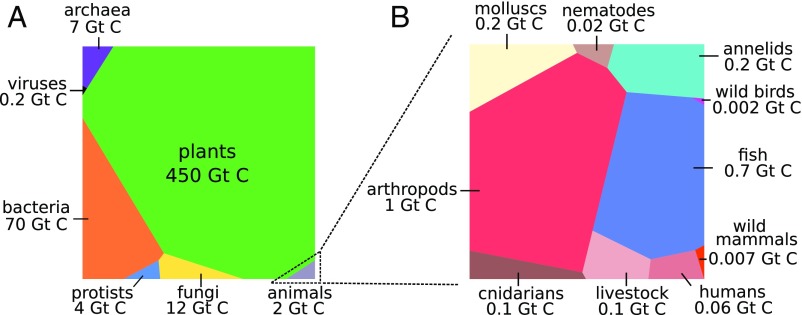
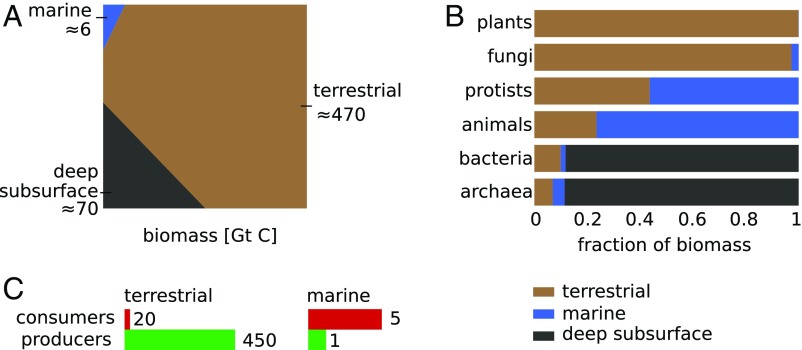
A census of the biomass on Earth is key for understanding the structure and dynamics of the biosphere. However, a global, quantitative view of how the biomass of different taxa compare with one another is still lacking. Here, we assemble the overall biomass composition of the biosphere, establishing a census of the ≈550 gigatons of carbon (Gt C) of biomass distributed among all of the kingdoms of life. We find that the kingdoms of life concentrate at different locations on the planet; plants (≈450 Gt C, the dominant kingdom) are primarily terrestrial, whereas animals (≈2 Gt C) are mainly marine, and bacteria (≈70 Gt C) and archaea (≈7 Gt C) are predominantly located in deep subsurface environments. We show that terrestrial biomass is about two orders of magnitude higher than marine biomass and estimate a total of ≈6 Gt C of marine biota, doubling the previous estimated quantity. Our analysis reveals that the global marine biomass pyramid contains more consumers than producers, thus increasing the scope of previous observations on inverse food pyramids. Finally, we highlight that the mass of humans is an order of magnitude higher than that of all wild mammals combined and report the historical impact of humanity on the global biomass of prominent taxa, including mammals, fish, and plants.
Overview
CoChat Summary
TL;DR
The paper assembles a global census of biomass across all kingdoms of life, estimating Earth’s total biomass at ≈550 Gt C, dominated by plants. It also compares biomass across environments and trophic modes, highlighting large uncertainties and human impacts on the biosphere.
Key findings
- Total global biomass is ≈550 Gt C, with plants ≈450 Gt C (≈80%), bacteria ≈70 Gt C (≈15%), fungi ≈12 Gt C, archaea ≈7 Gt C, protists ≈4 Gt C, animals ≈2 Gt C, and viruses ≈0.2 Gt C.
- Land biomass (≈470 Gt C) is about two orders of magnitude higher than marine biomass (≈6 Gt C); the deep subsurface holds ≈15% of total biomass, chiefly bacteria and archaea.
- In the ocean, ≈1 Gt C of primary producers supports ≈5 Gt C of consumer biomass, an inverted standing biomass distribution; marine biomass is ≈70% microbes, mainly bacteria and protists.
- Human-associated biomass is large relative to wild vertebrates: humans ≈0.06 Gt C, livestock ≈0.1 Gt C, wild mammals ≈0.007 Gt C, domesticated poultry ≈0.005 Gt C versus wild birds ≈0.002 Gt C; total plant biomass has declined approximately twofold relative to pre-human civilization.
Methods
- The authors synthesize hundreds of studies and generate estimates for major taxonomic groups, reporting biomass as gigatons of carbon (Gt C) and using a kingdom-level framework plus viruses.
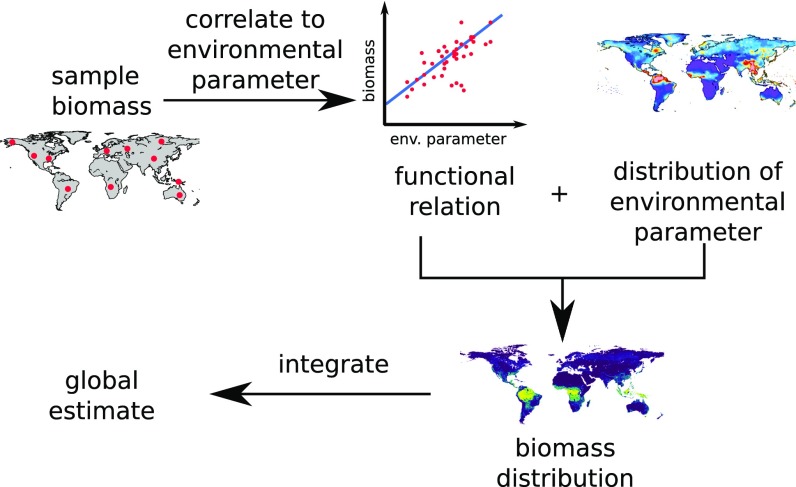
- For many taxa, local biomass samples are extrapolated globally by correlating biomass density with environmental parameters known at global scale; best estimates often use a geometric mean of independent estimates.
- Uncertainty is reported as multiplicative fold-change projections akin to 95% confidence intervals, incorporating intrastudy, interstudy, and intermethod variation; data and code are open-sourced.
Limitations
- The paper states that most datasets rely on fragmentary sampling, causing large uncertainties; sampling is scarce in the deep ocean (usually deeper than 200 m) and deep soil (usually deeper than 1 m), and some estimates may be biased by sampling toward high-abundance areas.
- The paper states that deep subsurface environments have particularly high uncertainty and unknown systematic biases, including unresolved distribution of biomass between aquifer fluids and rocks and among microbial taxa.
- The paper states that current and prehuman vertebrate biomass estimates are only a crude first step, amphibians remain poorly characterized, and parasite biomass is not resolved from hosts; evident from the text, kingdom-level grouping was chosen because much data lack finer taxonomic detail, and some uncertainty projections rely on analogous taxa or expert consultation.
Model-written summary. Check it against the paper before relying on it.
Integrity signals
Registry
Cites
Statistics
Figures
Verification
Claims the paper makes
9 Valid · 7 Not valid · 16 Not checked · 53 Own results and interpretations
Every source the paper cites for this claim was checked and supports it.
In the paper
“The biomass of amphibians, which are experiencing a dramatic population decline (42), remains poorly characterized.”
§ The biomass distribution on Earth > Discussion
What the sources say
- Supportedcites [42] Wake DB Vredenburg VT 2008 Colloquium paper: Are we in the midst of the sixth mass extinction? A view from the world of amphibians Proc Natl Acad Sci USA 105 11466 11473 18695221 PMC2556420 source
The citation is attached to the clause about amphibian population decline, not the separate statement that their biomass is poorly characterized. The passage reporting the Global Amphibian Assessment (labeled Abstract in our copy) says that 43% of amphibian species have declining populations. (LLM, conf=0.92)
plain- Asserted: passes — The authors put it forward as true.
- Checkable: passes — It can be checked against evidence.
- Load-bearing: unclear — It is unclear whether the paper’s conclusions depend on it.
- Based: passes — The paper gives a reason why it holds.
- Supported
Every source the paper cites for this claim was checked and supports it.
In the paper
“In the case of prokaryotes, some major improvements were recently realized, with global estimates of marine deep subsurface prokaryote biomass reduced by about two orders of magnitude due to an increased diversity of sampling locations (7).”
§ The biomass distribution on Earth > Discussion
What the sources say
- Supportedcites [7] Kallmeyer J Pockalny R Adhikari RR Smith DC D’Hondt S 2012 Global distribution of microbial abundance and biomass in subseafloor sediment Proc Natl Acad Sci USA 109 16213 16216 22927371 PMC3479597 source
The Discussion reports a revised subseafloor microbial biomass estimate of 4.1 Pg C versus a previous estimate of 303 Pg C—about a 74-fold reduction. It also identifies a more geographically diverse sampling database, including low-abundance ocean gyres, as a reason the new estimate is lower. The paper identifies other contributing factors as well. (LLM, conf=0.88)
plainstates a cause- Asserted: passes — The authors put it forward as true.
- Checkable: passes — It can be checked against evidence.
- Load-bearing: unclear — It is unclear whether the paper’s conclusions depend on it.
- Based: passes — The paper gives a reason why it holds.
- Supported
The sources with a verdict support this claim; the rest weren’t checked yet, have no full text we could read, or their verdicts aren’t rated yet.
In the paper
“Such inverted biomass distributions can occur when primary producers have a rapid turnover of biomass [on the order of days (34)], while consumer biomass turns over much more slowly [a few years in the case of mesopelagic fish (35)].”
§ The biomass distribution on Earth > Results > The Distribution of Biomass Across Environments and Trophic Modes.
What the sources say
- Supportedcites [34] Zubkov MV 2014 Faster growth of the major prokaryotic versus eukaryotic CO2 fixers in the oligotrophic ocean Nat Commun 5 3776 24777140 PMC4015317 source
The Results (Comparison of the growth rates of the CO2 fixers; page unavailable) report growth rates of 0.1–0.6 per day for the studied oceanic primary producers, consistent with biomass turnover on the order of days. The few-years estimate for mesopelagic fish is assigned to a different citation, not this source. (LLM, conf=0.91)
- Not checked — no full text of the sourcecites [35] Catul V Gauns M Karuppasamy PK 2011 A review on mesopelagic fishes belonging to family Myctophidae Rev Fish Biol Fish 21 339 354 source
plainstates a possible cause- Asserted: passes — The authors put it forward as true.
- Checkable: passes — It can be checked against evidence.
- Load-bearing: passes — The paper’s conclusions depend on it.
- Based: passes — The paper gives a reason why it holds.
- Supported
The cited sources support only part of this claim — read each source’s verdict below.
In the paper
“Combining data from independent sources such as these enables a robust assessment of the total plant biomass (17).”
§ The biomass distribution on Earth > Results > The Uncertainty Associated with Global Biomass Estimates.
What the sources say
- Partly supportedcites [17] Erb K-H 2017 Unexpectedly large impact of forest management and grazing on global vegetation biomass Nature 553 73 76 29258288 PMC5756473 sourceExperimental — accuracy not yet measured
The Methods describe combining multiple datasets and types of evidence to estimate global vegetation biomass stocks. But the paper also says global stocks remain uncertain, reports uncertainty ranges around 35% of the median estimate, and describes more robust estimates as a future prospect. It therefore supports the use of independent sources for an assessment, but not the unqualified characterization of that assessment as robust. (LLM, conf=0.84)
plainstates a cause- Asserted: passes — The authors put it forward as true.
- Checkable: passes — It can be checked against evidence.
- Load-bearing: passes — The paper’s conclusions depend on it.
- Based: passes — The paper gives a reason why it holds.
- Partly supported
A result the paper states — it cites no source for it, so there is none to check. The quote shows it is in the paper.
In the paper
“Plant biomass includes ≈70% stems and tree trunks, which are mostly woody, and thus relatively metabolically inert.”
§ The biomass distribution on Earth > Results > The Biomass Distribution of the Biosphere by Kingdom.
plain- Asserted: passes — The authors put it forward as true.
- Checkable: passes — It can be checked against evidence.
- Load-bearing: unclear — It is unclear whether the paper’s conclusions depend on it.
- Based: passes — The paper gives a reason why it holds.
27 more claims
Create a free account to see all 85 claims and to verify the 2 references still open.
- It may state two separate claims as one. 32
- Probably not a substantial claim. 28
Claims other papers make about this one
Each is checked against this paper’s own text: does it say what the citing paper says it does?
The cited source doesn’t support the claim as written.
In the citing paper
“and less than 10% that of the world ' s current human population ( 52 ).”
From Pervasive human-driven decline of life on Earth points to the need for transformative change (2019) · cites this paper as [52]
Checked by a reasoning model — may be wrong.
Experimental — accuracy not yet measuredThe cited source says what the claim attributes to it.
In the citing paper
“Approximately 450 Gt of C is bound up in terrestrial biota, primarily in plants (86), while only ~6 Gt of C is found in ocean biota (87).”
From Earth beyond six of nine planetary boundaries (2023) · cites this paper as [87]
The cited source says what the claim attributes to it.
In the citing paper
“The amount of metabolic energy available to a biosphere powered by O 2 is vast, such that the O 2 -rich ocean-atmosphere system of the modern Earth supports staggering levels of standing biomass (Bar-On et al. 2018), energy flow (Falkowski et al. 2008), and ecological complexity (Steele 1974).”
From The History of Ocean Oxygenation (2022) · cites this paper as Bar-On et al. 2018
In the citing paper
“Global populations of domestic ruminants (cattle, sheep, and goats) (Ripple et al. 2013) poultry, and pigs (Bennett et al. 2018) used to feed the growing human population now exceed 100 million tons of carbon (Bar-On et al. 2018), and livestock populations are growing rapidly.”
From Scientists’ warning to humanity on the freshwater biodiversity crisis (2021) · cites this paper as Bar-On et al. 2018
Citations
Cites
The worldwide leaf economics spectrum
Wright, I. J., Reich, P. B., Westoby, M., Ackerly, D. D., Baruch, Z., Bongers, F., Cavender-Bares, J., Chapin, T., Cornelissen, J. H. C., Diemer, M., et al. (2004) · Nature · doi:10.1038/nature02403 · Cited by 9,021 · cited 1×
“We then convert the total area of leaves to an estimate of the total dry mass of leaves by using the Glopnet database (24), which measured leaf mass per area (LMA) for ≈2500 plant species.”
MethodA large and persistent carbon sink in the world’s forests
Pan, Y., Birdsey, R. A., Fang, J., Houghton, R., Kauppi, P. E., Kurz, W. A., Phillips, O. L., Shvidenko, A., Lewis, S. L., Canadell, J. G., et al. (2011) · Science · doi:10.1126/science.1201609 · Cited by 8,458
Soil Sampling and Methods of Analysis
(2007) · CRC Press eBooks · doi:10.1201/9781420005271 · Cited by 6,469
Primary production of the biosphere: Integrating terrestrial and oceanic components
Field, C. B., Behrenfeld, M. J., Randerson, J. T., & Falkowski, P. (1998) · Science · doi:10.1126/science.281.5374.237 · Cited by 6,371
Prokaryotes: The unseen majority
Whitman, W. B., Coleman, D. C., & Wiebe, W. J. (1998) · Proceedings of the National Academy of Sciences · doi:10.1073/pnas.95.12.6578 · Cited by 4,871
Global effects of land use on local terrestrial biodiversity
Newbold, T., Hudson, L. N., Hill, S. L. L., Contu, S., Lysenko, I., Senior, R. A., Börger, L., Bennett, D. J., Choimes, A., Collen, B., et al. (2015) · Nature · doi:10.1038/nature14324 · Cited by 4,352
Belowground biodiversity and ecosystem functioning
Bardgett, R. D., & van der Putten, W. H. (2014) · Nature · doi:10.1038/nature13855 · Cited by 3,990 · cited 4×
“This was recommended by experts in the field for estimation of arbuscular mycorrhizal fungi abundance (117).”
BackgroundInfluentialMangroves among the most carbon-rich forests in the tropics
Donato, D. C., Kauffman, J. B., Murdiyarso, D., Kurnianto, S., Stidham, M., & Kanninen, M. (2011) · Nature Geoscience · doi:10.1038/ngeo1123 · Cited by 3,374
Poorter, H., Niklas, K. J., Reich, P. B., Oleksyn, J., Poot, P., & Mommer, L. (2012) · New Phytologist · doi:10.1111/j.1469-8137.2011.03952.x · Cited by 3,163 · cited 1×
“The first relies on a meta-analysis of the biomass allocation to different plant compartments across biomes (19).”
BackgroundA global analysis of root distributions for terrestrial biomes
Jackson, R. B., Canadell, J., Ehleringer, J. R., Mooney, H. A., Sala, O. E., & Schulze, E. D. (1996) · Oecologia · doi:10.1007/bf00333714 · Cited by 3,071 · cited 4×
“assumed the distribution of microbial biomass with depth follows the biomass density versus depth profile of root biomass (21).”
BackgroundMethodInfluential
Research works printed but not linked: 1
- Chapman AD 2009 Numbers of Living Species in Australia and the World Australian Biological Resources Study Canberra, Australia
Cited by
Items 1,801–1,900 of 3,742
Yu, C., Mao, J.-H., Huang, X., & Zhang, Y. (2024) · Environmental and Sustainability Indicators · doi:10.1016/j.indic.2024.100358 · Cited by 8
Common animals: sedentary pastoralism and the emergence of the commons as an institution
Kanne, K. S., Haughton, M., & Lash, R. (2024) · Frontiers in Human Dynamics · doi:10.3389/fhumd.2024.1389009 · Cited by 8
Alternative climatic steady states near the Permian–Triassic Boundary
Ragon, C., Vérard, C., Kasparian, J., & Brunetti, M. (2024) · Scientific Reports · doi:10.1038/s41598-024-76432-8 · Cited by 10
Rooting students in their botanical history: A method to engage students in botany and herbaria
Krosnick, S. E., & Moore, K. (2024) · Plants People Planet · doi:10.1002/ppp3.10595 · Cited by 13
Jo, S., Kim, S.-H., Heo, S., Cho, H., Esfahani, I. J., & Park, S. (2025) · Biomaterials Research · doi:10.34133/bmr.0154 · Cited by 8
“%) of all life on Earth [ 6 ].”
InfluentialHigher Sensitivity of L‐Band Vegetation Optical Depth to Foliage Than Total Aboveground Biomass
Yang, T., Gong, H., & Zhang, Y. (2025) · Geophysical Research Letters · doi:10.1029/2025gl115437 · Cited by 8
Microbes are life, the biological core of One Health and Health in All Policies
Timmis, K. N., Baquero, F., Timmis, J. K., & Douglas, M. (2025) · microLife · doi:10.1093/femsml/uqaf012 · Cited by 5
“…ganisms intimately associated with higher organisms, the total biomass (about 80 gigatons of carbon) of all tiny free-living microorganisms on Earth—the micr obiospher e—is at least 50 times higher than the biomass of all animals on Earth, most of these being marine animals (Bar-On et al. 2018 ).”
Plant-thickening mechanisms revealed
Wolf, S., & Lohmann, J. U. (2019) · Nature · doi:10.1038/d41586-018-07880-2 · Cited by 5
Nema, P., Paul, D., Karmalkar, N. R., & Shouche, Y. S. (2019) · Geomicrobiology Journal · doi:10.1080/01490451.2019.1654041 · Cited by 5
“Global biomass estimates suggest that a significant fraction of living biomass on Earth consists of microbial flora residing in the deep biosphere (Bar-On et al. 2018).”
BackgroundYavuz, M., & Oliva, P. H. (2020) · Teorie vědy / Theory of Science · doi:10.46938/tv.2020.478 · Cited by 5
Critical assessment of biomass material for power generation in Punjab, India
Singh, M., Brar, Y. S., & Singh, H. (2021) · Materials Today Proceedings · doi:10.1016/j.matpr.2021.04.414 · Cited by 7
Plant Disease Management Through Microbiome Modulation
Ali, S., & Imran, A. (2022) · Springer eBooks · doi:10.1007/978-3-030-87512-1_5 · Cited by 5
Gómez‐Letona, M., Arístegui, J., Hernández‐Hernández, N., Pérez‐Lorenzo, M., Álvarez–Salgado, X. A., Teira, E., & Sebastián, M. (2022) · Limnology and Oceanography · doi:10.1002/lno.12248 · Cited by 5
Nimmo, R. (2022) · Oxford University Press eBooks · doi:10.1093/oxfordhb/9780192848185.013.3 · Cited by 7
Socio-Economic Impact of the Imposed Lockdowns in Food Chains: A Case Study in Cyprus
Koumoulides, D., Katsenios, N., Kasimatis, C.-N., Xydis, G. A., & Efthimiadou, Α. (2022) · Environments · doi:10.3390/environments9110137 · Cited by 5
“Humans represent 36% of the mammals’ biomass globally [46], and we interact with almost all ecosystems around the world [47].”
BackgroundSingh, R. K., Fukuda, S., & Wang, S. (2022) · International Journal of Energy for a Clean Environment · doi:10.1615/interjenercleanenv.2022044290 · Cited by 5
Hennicke, F., Fleckenstein, L., Bässler, C., et al. (2022) · Journal of Fungi · doi:10.3390/jof9010007 · Cited by 5
“On Earth, terrestrial biomass is mainly composed of lignocellulose from plant material that chiefly consists of lignin, cellulose, and hemicellulose [1].”
BackgroundLos derechos de la naturaleza: ¿el camino hacia la paz ecológica?
Pentinat, S. B., & Sanchez, M. M. (2022) · Revista Catalana de Dret Ambiental · doi:10.17345/rcda3371 · Cited by 5
The evolution of in vitro tracheary element systems from annual to perennial plant species
Keret, R., Hills, P. N., & Drew, D. M. (2023) · Plant Cell Tissue and Organ Culture (PCTOC) · doi:10.1007/s11240-023-02478-7 · Cited by 5
“The vascular tissues form structures that are essential for transportation of water, nutrients and other assimilates, all of which contribute to the accumulation of biomass (Bar-On et al. 2018).”
BackgroundXia, W., Grueter, C. C., Zhang, C., Zhuang, H., Hu, J., Krzton, A., & Li, D. (2023) · Global Ecology and Conservation · doi:10.1016/j.gecco.2023.e02499 · Cited by 6
Vilović, I., Schulze-Makuch, D., & Heller, R. (2023) · Scientific Reports · doi:10.1038/s41598-023-39716-z · Cited by 5
“%) of the faunal (i.e. animal) biomass today is of marine origin 41 .”
Following the feeder: A global synthesis of disturbance‐based foraging associations of birds
Dominguez, J. S., Hauber, M. E., Tarwater, C. E., Williams, E. J., MacDonald, S. E., Strejc, B., & Pollock, H. S. (2023) · Journal of Animal Ecology · doi:10.1111/1365-2656.14024 · Cited by 5
Murray, M. G. (2023) · Journal for Nature Conservation · doi:10.1016/j.jnc.2023.126541 · Cited by 6
Dunlap, J., & Schramski, J. R. (2023) · Ecological Modelling · doi:10.1016/j.ecolmodel.2023.110598 · Cited by 5
Panyako, P. M., Ommeh, S. C., Kuria, S. N., et al. (2024) · International Journal of Microbiology · doi:10.1155/2024/8054338 · Cited by 5
“Te current poultry biomass, for instance, accounts for approximately 70% of the total biomass of birds worldwide [6, 7].”
Meyer, N. R., Morono, Y., & Dekas, A. (2024) · Applied and Environmental Microbiology · doi:10.1128/aem.00446-24 · Cited by 8
“O ver 80% of the planet’s bacterial and archaeal biomass is estimated to be found within the global subsurface (1).”
BackgroundTracing DOM in the ocean with UV-visible spectroscopy
Stedmon, C. A., & Yamashita, Y. (2024) · Elsevier eBooks · doi:10.1016/b978-0-443-13858-4.00005-8 · Cited by 8
Singhal, K., Boy, R., Abdullah, A. M., et al. (2024) · npj Materials Sustainability · doi:10.1038/s44296-024-00035-7 · Cited by 5
Soil Microbes and Climate Change Mitigation
Babaniyi, B. R., Olaide, T. H., Apara, I. B., Ajibola, O. K., Olaoluwa, D. O., & Bisi-Omotosho, A. (2024) · Springer eBooks · doi:10.1007/978-3-031-71844-1_9 · Cited by 12
Yang, J., Xin, X., Zhang, X., Zhong, X., Yang, W., & Zhu, A. (2024) · Journal of Soils and Sediments · doi:10.1007/s11368-024-03923-6 · Cited by 6
“…interact with phosphate solubilizing bacteria through mycelial extension to increase phosphatase activity and mobilize organic P. Fungi occupy more biomass in agro-ecosystems and are more resilient to external environmental disturbances compared with bacteria (Bar-On et al. 2018; Gao et al. 2020).”
Abbaszade, G., Stückrath, K., & Müller, S. (2025) · Methods in Ecology and Evolution · doi:10.1111/2041-210x.70022 · Cited by 3
“Microorganisms constitute the largest biomass on Earth (Bar-On et al., 2018 ).”
Conservation of Wildlife Populations
Mills, L. S., Whiteley, A. R., & Tourani, M. (2025) · doi:10.1093/oso/9780192898166.001.0001 · Cited by 8
Cryo-EM resolves the structure of the archaeal dsDNA virus HFTV1 from head to tail
Zhang, D. X., Isupov, M. N., Davies, R. M., Schwarzer, S., McLaren, M., Stuart, W. S., Gold, V. A. M., Oksanen, H. M., Quax, T. E. F., & Daum, B. (2025) · Science Advances · doi:10.1126/sciadv.adx1178 · Cited by 16
The oral gland, a new exocrine organ of termites
Synek, J., Beránková, T., Stiblík, P., et al. (2019) · Arthropod Structure & Development · doi:10.1016/j.asd.2019.100876 · Cited by 5
Endolithic Microbial Carbon Cycling in East Antarctica
Tyler, N. A., & Ziolkowski, L. A. (2020) · Astrobiology · doi:10.1089/ast.2019.2109 · Cited by 5
“Antarctic endoliths were previously thought to be some of the slowest growing ( e.g ., geological timescales) microbial communities on Earth due to climatic extremes, including desiccation, katabatic winds, and freezing temperatures.”
InfluentialToward Donut‐Centered Design: A Design Research Toolkit for the 21st Century
GOLIAS, C. A. (2019) · Ethnographic Praxis in Industry Conference Proceedings · doi:10.1111/1559-8918.2019.01317 · Cited by 6
Alternative methods for chitin and chitosan preparation, characterization, and application
Hall, G. M., Barrera, C. H., & Shirai, K. (2020) · Elsevier eBooks · doi:10.1016/b978-0-12-817970-3.00008-0 · Cited by 9
Zhang, X., Li, H., Feng-ge, Z., Cui, X., Ye, F., & He, L. (2020) · Green Chemical Engineering · doi:10.1016/j.gce.2020.09.011 · Cited by 5
A Transparent and Intuitive Modeling Framework and Software for Efficient Land Allocation
Gallo, J., Aplet, G. H., Greene, R., Thomson, J., & Lombard, A. T. (2020) · Land · doi:10.3390/land9110444 · Cited by 5
“Since Homo sapiens became a species, about 83% of the biomass of wild mammals has been lost [2], with the rate accelerating.”
BackgroundConstraints and variation in food web link-species space
Gibert, J. P., & Wieczynski, D. J. (2021) · Biology Letters · doi:10.1098/rsbl.2021.0109 · Cited by 5
“inverted biomass pyramids [58,59]), potentially leading to more omnivory and interactions.”
BackgroundWe Should Search for Extant Life on Mars in this Decade
Stoker, C. R., Blank, J. G., Boston, P. J., Chou, L., DasSarma, S., Eigenbrode, J. L., Grefenstette, N. M., Northup, D. E., Schuerger, A. C., Schulze‐Makuch, D., et al. (2021) · doi:10.3847/25c2cfeb.36ef5e33 · Cited by 9
OPEN THEISM AND RISK MANAGEMENT: A PHILOSOPHICAL AND BIOLOGICAL PERSPECTIVE
Mullins, R. T., & Sani, E. (2021) · Zygon® · doi:10.1111/zygo.12723 · Cited by 8
Biyotekstillerin Yenilikçi Malzeme Olarak Kullanımı
BAYDEMİR, A., & BIYIKLI, N. E. (2021) · Art-e Sanat Dergisi · doi:10.21602/sduarte.896555 · Cited by 5
Wilms, S. N. (2021) · Frontiers in Marine Science · doi:10.3389/fmars.2021.692538 · Cited by 6
Global marine phytoplankton revealed by the Tara Oceans expedition
Vincent, F., Ibarbalz, F. M., & Bowler, C. (2021) · Elsevier eBooks · doi:10.1016/b978-0-12-822861-6.00024-8 · Cited by 8
Animals as and on Resource Frontiers
Weis, T. (2021) · Commodity Frontiers · doi:10.18174/cf.2021a18154 · Cited by 6
“…terms of weight with a converse dynamic to that of de-faunation, as livestock now comprise the majority of all mammalian and bird biomass on earth (Bar-On et al. 2018; Smil 2013), and systems of industrial production also bear heavily on future risks of zoonotic disease evolution (Wallace 2020;…”
BackgroundBiomass Availability And Biomass-Based Generating Units In North India: A Review
Kumar, P., Pawar, R., & Dhundhara, S. (2021) · IEEE International Conference on Electrical Power and Energy Systems (ICEPES) · doi:10.1109/icepes52894.2021.9699499 · Cited by 5
Li, W., Wang, F., Jiang, S., Pan, B., Liu, Q., & Xu, Q. (2022) · Frontiers in Cell and Developmental Biology · doi:10.3389/fcell.2022.987409 · Cited by 7
“As the most successful group of animals on the planet, arthropods account for the highest biomass and species diversity (Bar-On et al., 2018).”
BackgroundTurzynski, V., Griesdorn, L., Moraru, C., Soares, A., Simon, S. A., Stach, T. L., Rahlff, J., Esser, S. P., & Probst, A. J. (2023) · Viruses · doi:10.3390/v15040910 · Cited by 5
Blasiak, R., Wynberg, R., Grorud-Colvert, K., Thambisetty, S., Bandarra, N. M., Canário, A. V. M., da Silva, J., Duarte, C. M., Jaspars, M., Rogers, A. D., et al. (2023) · Springer eBooks · doi:10.1007/978-3-031-16277-0_4 · Cited by 8
Planetary Scale Information Transmission in the Biosphere and Technosphere: Limits and Evolution
Lingam, M., Frank, A., & Balbi, A. (2023) · Life · doi:10.3390/life13091850 · Cited by 8
“The total biomass of eukaryotes is probably ∼ 6 times greater than that of prokaryotes ([56], Figure 1), but the mean volume, and consequently the average mass, of a single eukaryotic cell is ∼ 104 times greater than its prokaryotic counterpart (refer to de Duve [57] and Milo and Phillips [58]).”
BackgroundTorres‐Porras, J., Miras, J. J. R., & Alcántara‐Manzanares, J. (2024) · Journal of Biological Education · doi:10.1080/00219266.2024.2365668 · Cited by 14
“%) of all of them (Bar-On, Phillips, and Milo 2018).”
Fight Not Flight: Parasites Drive the Bacterial Evolution of Resistance, Not Escape
Blazanin, M., Moore, J. P., Olsen, S., & Travisano, M. (2024) · The American Naturalist · doi:10.1086/733414 · Cited by 4
A Modern Synthesis of Mammal Conservation Genetics
Koepfli, K., & Gooley, R. M. (2020) · Springer eBooks · doi:10.1007/978-3-030-33334-8_1 · Cited by 5
Ecological complexity effects on thermal signature of different Madeira island ecosystems
Avelar, D., Garrett, P., Ulm, F., Hobson, P., & Penha‐Lopes, G. (2020) · Ecological Complexity · doi:10.1016/j.ecocom.2020.100837 · Cited by 7
Jiménez‐Carmona, F., Carpintero, S., & Reyes-López, J. L. (2020) · Sociobiology · doi:10.13102/sociobiology.v67i2.4895 · Cited by 6
Biomass Fractionation Based on Enzymatic Hydrolysis for Biorefinery Systems
Zamora, H. D. Z., de Freitas, C., Bueno, D., Shimizu, F. L., Contiero, J., & Brienzo, M. (2020) · Clean Energy Production Technologies · doi:10.1007/978-981-15-9593-6_9 · Cited by 6
What is the elephant in the room when considering new therapies for fungal diseases?
Chaves, A. F. A., Xander, P. B., Romera, L. M. D., Fonseca, F. L. A., & Batista, W. L. (2021) · Critical Reviews in Microbiology · doi:10.1080/1040841x.2021.1876632 · Cited by 5
“Fungi represent the third greatest source of biomass on earth (12 gigatons of carbon) across all taxa (Bar-On et al. 2018), from which approximately only 100 000 species have been described (Tibayrenc et al. 2017).”
BackgroundThe New Meatways and Sustainability
Kanerva, M. (2021) · transcript Verlag eBooks · doi:10.1515/9783839454336 · Cited by 5
Hobohm, C. (2021) · Environmental challenges and solutions · doi:10.1007/978-3-030-57710-0_1 · Cited by 5
Plant defense resistance in natural enemies of a specialist insect herbivorePreprint
Zhang, X., van Doan, C., Arce, C. C. M., Hu, L., Grünig, S., Parisod, C., Hibbard, B. E., Hervé, M. R., Robert, C. A. M., Machado, R. A. R., et al. (2019) · bioRxiv (Cold Spring Harbor Laboratory) · doi:10.1101/710681 · Cited by 5
Exploring a natural baseline for large herbivore biomassPreprint
Fløjgaard, C., Pedersen, P. B. M., Sandom, C. J., Svenning, J., & Ejrnæs, R. (2020) · bioRxiv (Cold Spring Harbor Laboratory) · doi:10.1101/2020.02.27.968461 · Cited by 5
Air Pollution and Climate Change: Sustainability, Restoration, and Ethical Implications
Chen, J., Dahlin, M. J., Luuppala, L., Bickford, D., Boljka, L., Burns, V., & Johnson, M. S. (2020) · Springer eBooks · doi:10.1007/978-1-4939-2493-6_1082-1 · Cited by 5
Osburn, M. R., Casar, C. P., Kruger, B. R., Momper, L., Flynn, T. M., & Amend, J. P. (2020) · bioRxiv (Cold Spring Harbor Laboratory) · doi:10.1101/2020.09.15.298141 · Cited by 6
“…the biomass of this realm have been continually refined with new data and now suggest that it is one of the largest ecosystems on the planet, constituting 15-23 Pg of carbon (Whitman et al., 1998; McMahon and Parnell, 2013; Magnabosco et al., 2018; Bar-On et al., 2018; Flemming and Wuertz, 2019).”
BackgroundFungi are colder than their surroundingsPreprint
Cordero, R. J. B., Mattoon, E. R., & Casadevall, A. (2020) · bioRxiv · doi:10.1101/2020.05.09.085969 · Cited by 2
Quantifying bacterial evolution in the wild: a birthday problem for Campylobacter lineagesPreprint
Calland, J. K., Pascoe, B., Bayliss, S., et al. (2020) · bioRxiv (Cold Spring Harbor Laboratory) · doi:10.1101/2020.12.02.407999 · Cited by 5
Arbi, N. E., Schürholz, A.-K., Schiffner, A., Hidalgo, I., Böhme, F., Wenzl, C., Zhao, X., Zeng, J., Lohmann, J. U., & Wolf, S. (2021) · bioRxiv (Cold Spring Harbor Laboratory) · doi:10.1101/2021.02.05.429893 · Cited by 5
Towards a Semiotics of the TechnospherePreprint
Hartley, J., & Herrmann‐Pillath, C. (2019) · SSRN Electronic Journal · doi:10.2139/ssrn.3308002 · Cited by 9
Momper, L., Casar, C., & Osburn, M. (2021) · bioRxiv · doi:10.1101/2021.05.06.442964 · Cited by 6
“3 sequestered in resident microbes (Whitman et al., 1998; McMahon and Parnell, 2013; 44 Magnabosco et al., 2018; Bar-On et al., 2018; Flemming and Wuertz, 2019).”
BackgroundBiard, T. (2022) · Wiley eBooks · doi:10.1002/9780470015902.a0029469 · Cited by 8
Crop management shapes the diversity and activity of DNA and RNA viruses in the rhizospherePreprint
Muscatt, G., Hilton, S. L., Raguideau, S., Teakle, G. R., Lidbury, I. D. E. A., Wellington, E. M. H., Quince, C., Millard, A. D., Bending, G. D., & Jameson, E. (2022) · bioRxiv (Cold Spring Harbor Laboratory) · doi:10.1101/2022.04.22.488307 · Cited by 5
Tarasova, O., & Gulevets, D. (2022) · Encyclopedia of the UN sustainable development goals · doi:10.1007/978-3-319-95846-0_103 · Cited by 5
Fungi-based Biomimetic Approach to Address Plastic Pollution: A Developing Nation's PerspectivePreprint
Kundanati, L. (2022) · Preprints.org · doi:10.20944/preprints202209.0255.v1 · Cited by 6
Dube, T. J., Dube, T. J., Dube, T., et al. (2023) · SSRN Electronic Journal · doi:10.2139/ssrn.4460389 · Cited by 5
Hidden but discoverable diversity in the global microbiomePreprint
K., V., Maistrenko, O. M., Fullam, A., Mende, D. R., Kartal, E., Coelho, L. P., Spang, A., Peer Bork, B., & Schmidt, T. (2025) · bioRxiv (Cold Spring Harbor Laboratory) · doi:10.1101/2025.06.26.661807 · Cited by 5
Cathepsin X is a conserved cell death protein involved in algal response to environmental stress
Mizrachi, A., Sadeh, M., Ben-Dor, S., Dym, O., Ku, C., Feldmesser, E., Zarfin, A., Brunson, J. K., Allen, A. E., Jinkerson, R. E., et al. (2024) · doi:10.1101/2024.05.15.594278 · Cited by 5
Cathepsin X is a conserved cell death protein involved in algal response to environmental stress
Mizrachi, A., Sadeh, M., Ben-Dor, S., Dym, O., Ku, C., Feldmesser, E., Zarfin, A., Brunson, J. K., Allen, A. E., Jinkerson, R. E., et al. (2025) · Current Biology · doi:10.1016/j.cub.2025.03.045 · Cited by 5
Douchet, P., Haegeman, B., Allienne, J., Boissier, J., Senghor, B., & Rey, O. (2024) · Infectious Diseases of Poverty · doi:10.1186/s40249-024-01232-1 · Cited by 6
“On one hand, while some populations/species are expanding, including humans and all domesticated species upon which human societies rely, an important amount of wildlife is in decline [5, 6].”
BackgroundPaul, A., & Bhatia, A. (2025) · Water science and technology library · doi:10.1007/978-3-031-76532-2_9 · Cited by 4
Mallioris, P., Stefanopoulou, M., Luiken, R. E. C., Wagenaar, J. A., Stegeman, A., & Mughini‐Gras, L. (2025) · Preventive Veterinary Medicine · doi:10.1016/j.prevetmed.2025.106535 · Cited by 7
Development of an in vitro conservation protocol for the endemic species Pyrus regelii
Dyussembekova, D., Nurtaza, A., Magzumova, G., et al. (2025) · Plant Cell Tissue and Organ Culture (PCTOC) · doi:10.1007/s11240-025-03127-x · Cited by 4
“The biomass of all plants from pre-human times has reduced by 50% across millennia due to human activities (Bar-On et al. 2018), and 39% of vascular plants are threatened with extinction (Nic Lughadha, 2020).”
Biomarker evidence of a serpentinite chemosynthetic biosphere at the Mariana forearc
Kumawat, P., Albers, E., Bach, W., Klein, F., Menapace, W., Vogt, C., & Schubotz, F. (2025) · Communications Earth & Environment · doi:10.1038/s43247-025-02667-6 · Cited by 5
Ishizawa, H., Noguchi, S., Kito, M., Nomura, Y., Kimura, K., & Takeo, M. (2025) · The ISME Journal · doi:10.1093/ismejo/wraf236 · Cited by 4
“Microbial communities constitute a significant proportion of Earth’s total biomass ( ∼ 90 Gt-C) [1], encompassing diverse, interacting species.”
Understanding Aerosol-Mediated Disease Transmission
Dommer, A. C., Amaro, R. E., & Prather, K. A. (2025) · ACS Central Science · doi:10.1021/acscentsci.5c00364 · Cited by 4
A novel UAV lidar-derived shrub structural index for estimating above-ground biomass
Wu, J., Wang, Y., Hong, L., Sun, B., He, Z., Li, Z., & Ma, Z. (2025) · Remote Sensing of Environment · doi:10.1016/j.rse.2025.115189 · Cited by 8
Sublimity in Miniature: Aesthetic Viewing and the Miniature Forests of Cape Horn
Thompson, M. (2026) · Ecology and ethics · doi:10.1007/978-3-032-04830-1_16 · Cited by 4
Pabba, M., Shah, A. M., Salim, M. H., Mettu, S., Talukder, M. M. R., & Puniredd, S. R. (2026) · Industrial & Engineering Chemistry Research · doi:10.1021/acs.iecr.5c04697 · Cited by 7
Hu, Q., Li, J., & Wang, B. (2026) · Journal of Integrative Plant Biology · doi:10.1111/jipb.70310 · Cited by 6
“This process is not only crucial for the mechanical strength and stress resistance in crops but also determines wood production, which is the world's most vital renewable resource and carbon storage reservoir (Spicer and Groover, 2010; Miyashima et al., 2013; Bar ‐”
Barros, M. F., Jardim, M. A. G., Soares, V. F. S., Menezes, P. M. D. M., Vieira, I. C. G., & Tabarelli, M. (2023) · Land Degradation and Development · doi:10.1002/ldr.4903 · Cited by 10
“As human populations continue to grow, particularly across tropical countries (Bar-On et al., 2018), pressure on tropical forest lands and products is likely to escalate, largely limiting the achievement of the Global Sustainable Goals.”
BackgroundClimate as a Driver of Aboveground Biomass Density Variation: A Study of Ten Pine Species in Mexico
Girón-Gutiérrez, D., Méndez-González, J., Osorno-Sánchez, T., Cerano‐Paredes, J., Soto-Correa, J. C., & Cambrón-Sandoval, V. H. (2024) · Forests · doi:10.3390/f15071160 · Cited by 6
Manjarrez-Quintero, J. P., Valdez-Baro, O., García‐Estrada, R. S., Contreras‐Angulo, L. A., Bastidas-Bastidas, P. D. J., Heredia, J. B., Cabanillas-Bojórquez, L. Á., & Gutiérrez‐Grijalva, E. P. (2024) · Processes · doi:10.3390/pr12071525 · Cited by 5
“Considering this, it is important to minimize the environmental impact of these residues through processes that utilize their content [2].”
BackgroundSiva, N., & Anderson, C. T. (2024) · Food Science & Nutrition · doi:10.1002/fsn3.4358 · Cited by 4
“Plants comprise over 82% of the earth's biomass, embodying roughly 225 Gt of cellulose (Bar-On et al., 2018; Bengtsson et al., 2020), a major component of the plant cell wall.”
BackgroundAssessing patterns of metazoans in the global ocean using environmental DNA
Geraldi, N. R., Acinas, S. G., Alam, I. S., Gasol, J. M., Fernández-de-Puelles, M. L., Giner, C. R., Hernández‐León, S., Logares, R., Massana, R., Sánchez, P., et al. (2024) · Royal Society Open Science · doi:10.1098/rsos.240724 · Cited by 5
“A global estimate of ocean biomass found that arthropods (1.0 Gigatons of Carbon (Gt C)) and fish (0.7 Gt C) had the greatest biomass, followed by gelatinous cnidarians, mollusks and nematodes (0.04, 0.02 and 0.01 Gt C, respectively; [60]).”
BackgroundInfluentialEstimation of fast pyrolysis product yields of different biomasses by artificial neural networks
Sezgin, İ. V., & Merdun, H. (2025) · Chemical Engineering Research and Design · doi:10.1016/j.cherd.2025.01.009 · Cited by 6
A method to quantify the ecological benefits of river treatment projects with monetary values
Zhang, Y., Li, Z., Ge, W., Wang, J., & Wang, H. (2025) · Journal of Environmental Management · doi:10.1016/j.jenvman.2025.124653 · Cited by 6
Small Commercial Fish Biomass Limits the Catch Potential in the High Seas
Guiet, J., Bianchi, D., Scherrer, K., Heneghan, R., & Galbraith, E. D. (2025) · Earth s Future · doi:10.1029/2024ef004571 · Cited by 8
Uncovering patterns of cattle intensification across South America’s dry diagonal
Kuemmerle, T., Fernández, P. D., Baumann, M., & Burton, J. (2025) · Environmental Research Letters · doi:10.1088/1748-9326/addc81 · Cited by 5
Macroevolutionary coupling of marine biomass and biodiversity across the Phanerozoic
Singh, P., Ferré, J., Thrasher, B. L., Monarrez, P. M., Al-Ramadan, K. A., Cantrell, D. L., Lehrmann, D. J., Morsilli, M., & Payne, J. L. (2025) · Current Biology · doi:10.1016/j.cub.2025.06.006 · Cited by 10
Bisot, C., Gálvez, L. O., Kahane, F., van Son, M., Turcu, B., Broekman, R., Lin, K.-K., Bontenbal, P., Winter, M. K., Kokkoris, V., et al. (2026) · Proceedings of the National Academy of Sciences · doi:10.1073/pnas.2512182123 · Cited by 9
Thinking about the future of health and cities in the Anthropocene
Hancock, T., & Bezold, C. (2020) · Cities & Health · doi:10.1080/23748834.2020.1765301 · Cited by 5
Metadata
- Authors
- Bar-On, Y. M., Phillips, R., & Milo, R.
- Affiliations
- Department of Plant and Environmental Sciences, Weizmann Institute of Science, 76100 Rehovot, Israel;
- California Institute of Technology (US)
- Weizmann Institute of Science (IL)
- Corresponding author
- Milo, Ron
- Venue
- Proceedings of the National Academy of Sciences
- Publisher
- National Academy of Sciences
- Published
- 2018-05-21
- Volume
- 115
- Issue
- 25
- Pages
- 6506-6511
- ISSN
- 0027-8424 (ISSN-L)
- 1091-6490
- PMC
- PMC6016768
- OpenAlex
- W2804910112
- Cited by
- 3,723
- References
- 263
- Citations by year
- 2026: 349 · 2025: 450 · 2024: 589 · 2023: 617 · 2022: 498 · 2021: 498 · 2020: 419 · 2019: 246 · 2018: 49
- FWCI
- 239.98
- Type
- journal article
- Language
- en
- Open access
- hybrid
- doi.org
- Licence
- Locations
- Proceedings of the National Academy of Sciences (publishedVersion, cc-by-nc-nd)
- Europe PMC (PubMed Central) (publishedVersion, cc-by-nc-nd)
- PubMed Central (publishedVersion, cc-by-nc-nd)
- PubMed (publishedVersion)
- CaltechAUTHORS (California Institute of Technology) (submittedVersion, cc-by-nc-nd)
- Funders
- National Institutes of Health (5r35gm118043-07)
- National Institute of General Medical Sciences (R35 GM118043)
- Topics
- Physical Sciences › Environmental Science › Nature and Landscape Conservation › Ecology and Vegetation Dynamics Studies
- Physical Sciences › Environmental Science › Global and Planetary Change › Earth Systems and Cosmic Evolution
- Life Sciences › Agricultural and Biological Sciences › Soil Science › Soil Carbon and Nitrogen Dynamics
- Keywords
- biomass allocation, biomass carbon, terrestrial biomass, marine biomass, bacteria, archaea, food pyramid, wild mammals, fish biomass, plant biomass
- MeSH terms
- Animals, Archaea, Bacteria, Carbon, Humans, Plants, Ecosystem, Biomass, Earth, Planet, Biota
About these checks
Registry, retraction, Cites and statistics results are computed, not judged, with one exception: a printed reference that no index lists is read once by a model before it counts as a citation error. Claims are extracted by a model and kept only when their quote appears verbatim in the text; each cited source is then checked, with a model’s help, for whether it says what the claim relies on. Those verdicts can be wrong — read the claim’s quote and the cited source before relying on one.
The claim verdicts this report counts are experimental: their accuracy is not yet measured.
A language model drew the claims from the paper on 2026-10-10, under version 3 of the claim definition (model deepseek-v4.1-flash, prompt extract-v3).
A second model labelled each claim on 2026-10-10 (model jev-1.13-20260917, definition revision gold-guideline-v0.2).
Cited sources are checked with a language model’s help (gpt-6-sol).
Statistics and arithmetic are recomputed, not judged.
Confidence bands are shown only for fields calibrated on our annotated test set. None is calibrated yet, so no band is shown.
What counts as a claim ›How we measure confidence ›How we check this ›
Are you an author, or do you see a problem with this page? Request a review
Data sources
Bibliographic data: Semantic Scholar, OpenAlex, Crossref.
Contains information from the Semantic Scholar Academic Graph Datasets, made available under the ODC Attribution License (ODC-BY 1.0).
Semantic Scholar’s data is described in: Kinney, R., et al. (2023). The Semantic Scholar Open Data Platform. arXiv:2301.10140.
