

The biomass distribution on Earth
Open accessThe DOI matches its Crossref record; 263 of the 263 references it cites were found in a registry or an index; 11 of the 41 sources its claims cite were checked for support.
Abstract
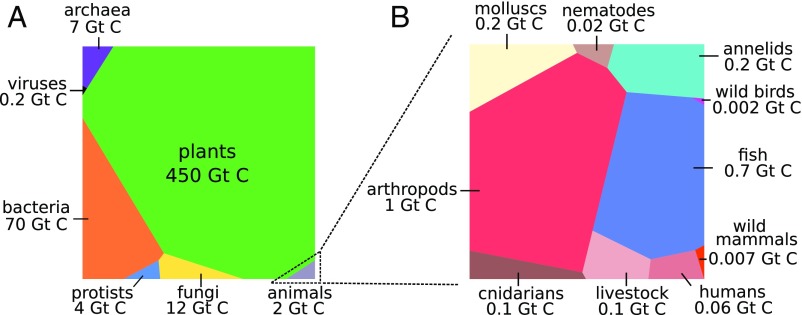
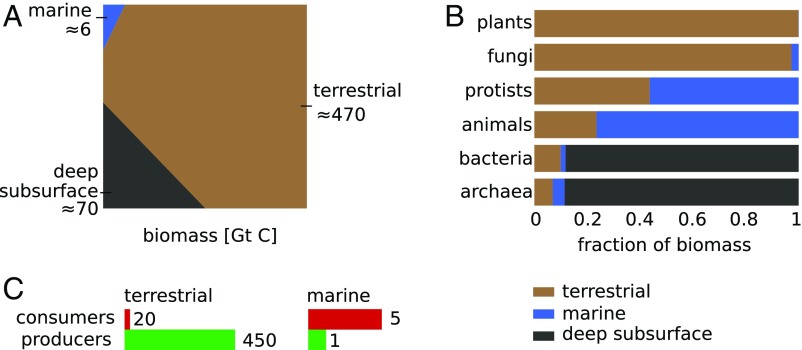
A census of the biomass on Earth is key for understanding the structure and dynamics of the biosphere. However, a global, quantitative view of how the biomass of different taxa compare with one another is still lacking. Here, we assemble the overall biomass composition of the biosphere, establishing a census of the ≈550 gigatons of carbon (Gt C) of biomass distributed among all of the kingdoms of life. We find that the kingdoms of life concentrate at different locations on the planet; plants (≈450 Gt C, the dominant kingdom) are primarily terrestrial, whereas animals (≈2 Gt C) are mainly marine, and bacteria (≈70 Gt C) and archaea (≈7 Gt C) are predominantly located in deep subsurface environments. We show that terrestrial biomass is about two orders of magnitude higher than marine biomass and estimate a total of ≈6 Gt C of marine biota, doubling the previous estimated quantity. Our analysis reveals that the global marine biomass pyramid contains more consumers than producers, thus increasing the scope of previous observations on inverse food pyramids. Finally, we highlight that the mass of humans is an order of magnitude higher than that of all wild mammals combined and report the historical impact of humanity on the global biomass of prominent taxa, including mammals, fish, and plants.
Overview
CoChat Summary
TL;DR
The paper assembles a global census of biomass across all kingdoms of life, estimating Earth’s total biomass at ≈550 Gt C, dominated by plants. It also compares biomass across environments and trophic modes, highlighting large uncertainties and human impacts on the biosphere.
Key findings
- Total global biomass is ≈550 Gt C, with plants ≈450 Gt C (≈80%), bacteria ≈70 Gt C (≈15%), fungi ≈12 Gt C, archaea ≈7 Gt C, protists ≈4 Gt C, animals ≈2 Gt C, and viruses ≈0.2 Gt C.
- Land biomass (≈470 Gt C) is about two orders of magnitude higher than marine biomass (≈6 Gt C); the deep subsurface holds ≈15% of total biomass, chiefly bacteria and archaea.
- In the ocean, ≈1 Gt C of primary producers supports ≈5 Gt C of consumer biomass, an inverted standing biomass distribution; marine biomass is ≈70% microbes, mainly bacteria and protists.
- Human-associated biomass is large relative to wild vertebrates: humans ≈0.06 Gt C, livestock ≈0.1 Gt C, wild mammals ≈0.007 Gt C, domesticated poultry ≈0.005 Gt C versus wild birds ≈0.002 Gt C; total plant biomass has declined approximately twofold relative to pre-human civilization.
Methods
- The authors synthesize hundreds of studies and generate estimates for major taxonomic groups, reporting biomass as gigatons of carbon (Gt C) and using a kingdom-level framework plus viruses.
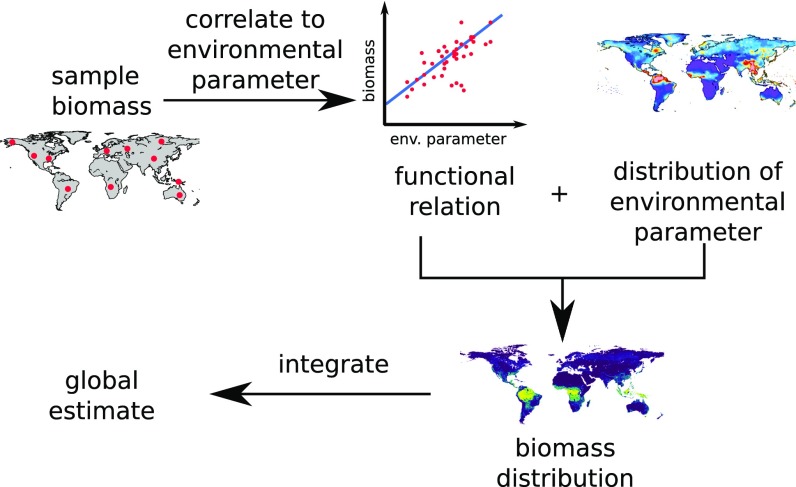
- For many taxa, local biomass samples are extrapolated globally by correlating biomass density with environmental parameters known at global scale; best estimates often use a geometric mean of independent estimates.
- Uncertainty is reported as multiplicative fold-change projections akin to 95% confidence intervals, incorporating intrastudy, interstudy, and intermethod variation; data and code are open-sourced.
Limitations
- The paper states that most datasets rely on fragmentary sampling, causing large uncertainties; sampling is scarce in the deep ocean (usually deeper than 200 m) and deep soil (usually deeper than 1 m), and some estimates may be biased by sampling toward high-abundance areas.
- The paper states that deep subsurface environments have particularly high uncertainty and unknown systematic biases, including unresolved distribution of biomass between aquifer fluids and rocks and among microbial taxa.
- The paper states that current and prehuman vertebrate biomass estimates are only a crude first step, amphibians remain poorly characterized, and parasite biomass is not resolved from hosts; evident from the text, kingdom-level grouping was chosen because much data lack finer taxonomic detail, and some uncertainty projections rely on analogous taxa or expert consultation.
Model-written summary. Check it against the paper before relying on it.
Integrity signals
Registry
Cites
Statistics
Figures
Verification
Claims the paper makes
9 Valid · 7 Not valid · 16 Not checked · 53 Own results and interpretations
Every source the paper cites for this claim was checked and supports it.
In the paper
“The biomass of amphibians, which are experiencing a dramatic population decline (42), remains poorly characterized.”
§ The biomass distribution on Earth > Discussion
What the sources say
- Supportedcites [42] Wake DB Vredenburg VT 2008 Colloquium paper: Are we in the midst of the sixth mass extinction? A view from the world of amphibians Proc Natl Acad Sci USA 105 11466 11473 18695221 PMC2556420 source
The citation is attached to the clause about amphibian population decline, not the separate statement that their biomass is poorly characterized. The passage reporting the Global Amphibian Assessment (labeled Abstract in our copy) says that 43% of amphibian species have declining populations. (LLM, conf=0.92)
plain- Asserted: passes — The authors put it forward as true.
- Checkable: passes — It can be checked against evidence.
- Load-bearing: unclear — It is unclear whether the paper’s conclusions depend on it.
- Based: passes — The paper gives a reason why it holds.
- Supported
Every source the paper cites for this claim was checked and supports it.
In the paper
“In the case of prokaryotes, some major improvements were recently realized, with global estimates of marine deep subsurface prokaryote biomass reduced by about two orders of magnitude due to an increased diversity of sampling locations (7).”
§ The biomass distribution on Earth > Discussion
What the sources say
- Supportedcites [7] Kallmeyer J Pockalny R Adhikari RR Smith DC D’Hondt S 2012 Global distribution of microbial abundance and biomass in subseafloor sediment Proc Natl Acad Sci USA 109 16213 16216 22927371 PMC3479597 source
The Discussion reports a revised subseafloor microbial biomass estimate of 4.1 Pg C versus a previous estimate of 303 Pg C—about a 74-fold reduction. It also identifies a more geographically diverse sampling database, including low-abundance ocean gyres, as a reason the new estimate is lower. The paper identifies other contributing factors as well. (LLM, conf=0.88)
plainstates a cause- Asserted: passes — The authors put it forward as true.
- Checkable: passes — It can be checked against evidence.
- Load-bearing: unclear — It is unclear whether the paper’s conclusions depend on it.
- Based: passes — The paper gives a reason why it holds.
- Supported
The sources with a verdict support this claim; the rest weren’t checked yet, have no full text we could read, or their verdicts aren’t rated yet.
In the paper
“Such inverted biomass distributions can occur when primary producers have a rapid turnover of biomass [on the order of days (34)], while consumer biomass turns over much more slowly [a few years in the case of mesopelagic fish (35)].”
§ The biomass distribution on Earth > Results > The Distribution of Biomass Across Environments and Trophic Modes.
What the sources say
- Supportedcites [34] Zubkov MV 2014 Faster growth of the major prokaryotic versus eukaryotic CO2 fixers in the oligotrophic ocean Nat Commun 5 3776 24777140 PMC4015317 source
The Results (Comparison of the growth rates of the CO2 fixers; page unavailable) report growth rates of 0.1–0.6 per day for the studied oceanic primary producers, consistent with biomass turnover on the order of days. The few-years estimate for mesopelagic fish is assigned to a different citation, not this source. (LLM, conf=0.91)
- Not checked — no full text of the sourcecites [35] Catul V Gauns M Karuppasamy PK 2011 A review on mesopelagic fishes belonging to family Myctophidae Rev Fish Biol Fish 21 339 354 source
plainstates a possible cause- Asserted: passes — The authors put it forward as true.
- Checkable: passes — It can be checked against evidence.
- Load-bearing: passes — The paper’s conclusions depend on it.
- Based: passes — The paper gives a reason why it holds.
- Supported
The cited sources support only part of this claim — read each source’s verdict below.
In the paper
“Combining data from independent sources such as these enables a robust assessment of the total plant biomass (17).”
§ The biomass distribution on Earth > Results > The Uncertainty Associated with Global Biomass Estimates.
What the sources say
- Partly supportedcites [17] Erb K-H 2017 Unexpectedly large impact of forest management and grazing on global vegetation biomass Nature 553 73 76 29258288 PMC5756473 sourceExperimental — accuracy not yet measured
The Methods describe combining multiple datasets and types of evidence to estimate global vegetation biomass stocks. But the paper also says global stocks remain uncertain, reports uncertainty ranges around 35% of the median estimate, and describes more robust estimates as a future prospect. It therefore supports the use of independent sources for an assessment, but not the unqualified characterization of that assessment as robust. (LLM, conf=0.84)
plainstates a cause- Asserted: passes — The authors put it forward as true.
- Checkable: passes — It can be checked against evidence.
- Load-bearing: passes — The paper’s conclusions depend on it.
- Based: passes — The paper gives a reason why it holds.
- Partly supported
A result the paper states — it cites no source for it, so there is none to check. The quote shows it is in the paper.
In the paper
“Plant biomass includes ≈70% stems and tree trunks, which are mostly woody, and thus relatively metabolically inert.”
§ The biomass distribution on Earth > Results > The Biomass Distribution of the Biosphere by Kingdom.
plain- Asserted: passes — The authors put it forward as true.
- Checkable: passes — It can be checked against evidence.
- Load-bearing: unclear — It is unclear whether the paper’s conclusions depend on it.
- Based: passes — The paper gives a reason why it holds.
27 more claims
Create a free account to see all 85 claims and to verify the 2 references still open.
- It may state two separate claims as one. 32
- Probably not a substantial claim. 28
Claims other papers make about this one
Each is checked against this paper’s own text: does it say what the citing paper says it does?
The cited source doesn’t support the claim as written.
In the citing paper
“and less than 10% that of the world ' s current human population ( 52 ).”
From Pervasive human-driven decline of life on Earth points to the need for transformative change (2019) · cites this paper as [52]
Checked by a reasoning model — may be wrong.
Experimental — accuracy not yet measuredThe cited source says what the claim attributes to it.
In the citing paper
“Approximately 450 Gt of C is bound up in terrestrial biota, primarily in plants (86), while only ~6 Gt of C is found in ocean biota (87).”
From Earth beyond six of nine planetary boundaries (2023) · cites this paper as [87]
The cited source says what the claim attributes to it.
In the citing paper
“The amount of metabolic energy available to a biosphere powered by O 2 is vast, such that the O 2 -rich ocean-atmosphere system of the modern Earth supports staggering levels of standing biomass (Bar-On et al. 2018), energy flow (Falkowski et al. 2008), and ecological complexity (Steele 1974).”
From The History of Ocean Oxygenation (2022) · cites this paper as Bar-On et al. 2018
In the citing paper
“Global populations of domestic ruminants (cattle, sheep, and goats) (Ripple et al. 2013) poultry, and pigs (Bennett et al. 2018) used to feed the growing human population now exceed 100 million tons of carbon (Bar-On et al. 2018), and livestock populations are growing rapidly.”
From Scientists’ warning to humanity on the freshwater biodiversity crisis (2021) · cites this paper as Bar-On et al. 2018
Citations
Cites
The worldwide leaf economics spectrum
Wright, I. J., Reich, P. B., Westoby, M., Ackerly, D. D., Baruch, Z., Bongers, F., Cavender-Bares, J., Chapin, T., Cornelissen, J. H. C., Diemer, M., et al. (2004) · Nature · doi:10.1038/nature02403 · Cited by 9,021 · cited 1×
“We then convert the total area of leaves to an estimate of the total dry mass of leaves by using the Glopnet database (24), which measured leaf mass per area (LMA) for ≈2500 plant species.”
MethodA large and persistent carbon sink in the world’s forests
Pan, Y., Birdsey, R. A., Fang, J., Houghton, R., Kauppi, P. E., Kurz, W. A., Phillips, O. L., Shvidenko, A., Lewis, S. L., Canadell, J. G., et al. (2011) · Science · doi:10.1126/science.1201609 · Cited by 8,458
Soil Sampling and Methods of Analysis
(2007) · CRC Press eBooks · doi:10.1201/9781420005271 · Cited by 6,469
Primary production of the biosphere: Integrating terrestrial and oceanic components
Field, C. B., Behrenfeld, M. J., Randerson, J. T., & Falkowski, P. (1998) · Science · doi:10.1126/science.281.5374.237 · Cited by 6,371
Prokaryotes: The unseen majority
Whitman, W. B., Coleman, D. C., & Wiebe, W. J. (1998) · Proceedings of the National Academy of Sciences · doi:10.1073/pnas.95.12.6578 · Cited by 4,871
Global effects of land use on local terrestrial biodiversity
Newbold, T., Hudson, L. N., Hill, S. L. L., Contu, S., Lysenko, I., Senior, R. A., Börger, L., Bennett, D. J., Choimes, A., Collen, B., et al. (2015) · Nature · doi:10.1038/nature14324 · Cited by 4,352
Belowground biodiversity and ecosystem functioning
Bardgett, R. D., & van der Putten, W. H. (2014) · Nature · doi:10.1038/nature13855 · Cited by 3,990 · cited 4×
“This was recommended by experts in the field for estimation of arbuscular mycorrhizal fungi abundance (117).”
BackgroundInfluentialMangroves among the most carbon-rich forests in the tropics
Donato, D. C., Kauffman, J. B., Murdiyarso, D., Kurnianto, S., Stidham, M., & Kanninen, M. (2011) · Nature Geoscience · doi:10.1038/ngeo1123 · Cited by 3,374
Poorter, H., Niklas, K. J., Reich, P. B., Oleksyn, J., Poot, P., & Mommer, L. (2012) · New Phytologist · doi:10.1111/j.1469-8137.2011.03952.x · Cited by 3,163 · cited 1×
“The first relies on a meta-analysis of the biomass allocation to different plant compartments across biomes (19).”
BackgroundA global analysis of root distributions for terrestrial biomes
Jackson, R. B., Canadell, J., Ehleringer, J. R., Mooney, H. A., Sala, O. E., & Schulze, E. D. (1996) · Oecologia · doi:10.1007/bf00333714 · Cited by 3,071 · cited 4×
“assumed the distribution of microbial biomass with depth follows the biomass density versus depth profile of root biomass (21).”
BackgroundMethodInfluential
Research works printed but not linked: 1
- Chapman AD 2009 Numbers of Living Species in Australia and the World Australian Biological Resources Study Canberra, Australia
Cited by
Items 1,901–2,000 of 3,743
Nyamasija, F. N., Julius, W. N., & Eivin, R. (2020) · International Journal of Biodiversity and Conservation · doi:10.5897/ijbc2020.1394 · Cited by 5
“) has drastically declined over previous decades (Bar-on et al., 2018).”
BackgroundZhang, Y., Wang, A., Yuan, F., et al. (2021) · Environmental Earth Sciences · doi:10.1007/s12665-021-09639-x · Cited by 4
Corsini, M., & Zanello, P. (2022) · Inorganics · doi:10.3390/inorganics10010014 · Cited by 4
Oliver, C. (2022) · Environment and History · doi:10.3197/096734022x16470180631406 · Cited by 4
Thomsen, M. R. (2022) · Journal of World Literature · doi:10.1163/24056480-00701002 · Cited by 4
Application of biomass adsorbents in the treatment of heavy metals in wastewater: a review
Shan, J., Li, C., Zhang, Z., Zhang, J., Wang, X., & Huang, X. (2022) · Desalination and Water Treatment · doi:10.5004/dwt.2022.28691 · Cited by 7
“Biomass has a wide distribution, many types, and sufficient resources, including all living substances (animals, plants, microorganisms) and their excreta and metabolites [26].”
BackgroundThakur, H., Agarwal, S., Hradecký, J., et al. (2023) · Journal of Chemical Ecology · doi:10.1007/s10886-023-01447-w · Cited by 4
“Termites are the most prominent decomposers at the global scale, with a total biomass comparable to ants, the other eusocial insect dominating the Earth (Bar-on et al. 2018; Tůma et al. 2020).”
Induction and Characterisation of Lignocellulolytic Activities from Novel Deep-Sea Fungal Secretomes
Dowd, B., & Tuohy, M. G. (2023) · Fermentation · doi:10.3390/fermentation9090780 · Cited by 4
ÜRKMEZ, H. İ., & Gülsoy, S. (2023) · Turkish Journal of Forestry | Türkiye Ormancılık Dergisi · doi:10.18182/tjf.1336614 · Cited by 4
Mori, F., Ijiri, A., Nishimura, T., Wakamatsu, T., Katsuki, N., & Morono, Y. (2023) · Microbes and Environments · doi:10.1264/jsme2.me23055 · Cited by 4
“Whitman et al. (1998) reported that marine water contains an estimated 1.2×10 29 cells, while the deep subseafloor harbors 2.9–5.4×10 29 cells (Kallmeyer et al. , 2012; Parkes et al. , 2014; Bar-On et al. , 2018).”
InfluentialKaufmann, L., Wiedenhofer, D., Cao, Z., Theurl, M. C., Lauk, C., Baumgart, A., Gingrich, S., & Haberl, H. (2024) · Environmental Research Letters · doi:10.1088/1748-9326/ad236b · Cited by 7
“…of C stocks in concrete, and estimated the reduction of C stocks in bitumen Human population 50 Conversion to dry matter assuming 70% water content [47] Livestock 50 Conversion to dry matter assuming 70% water content [47] due to outgassing induced by temperature and sun-light exposure (figure…”
BackgroundMethodInfluentialERF111/ABR1: An AP2 Domain Transcription Factor Serving as a Hub for Multiple Signaling Pathways
Sanyal, S. K., & Pandey, G. K. (2024) · Journal of Plant Growth Regulation · doi:10.1007/s00344-023-11225-3 · Cited by 4
“Plants are the most dominant species on Earth in terms of their contribution to the Earth’s biomass (Bar-On et al. 2018).”
Yanuka‐Golub, K., Belkin, N., Weber, N., Mayyani, M., Levy, Y., Reznik, I. J., Rubin‐Blum, M., Rahav, E., & Kiro, Y. (2024) · Journal of Geophysical Research Biogeosciences · doi:10.1029/2023jg007610 · Cited by 6
“The terrestrial subsurface is one of the largest habitats for microorganisms on Earth (Bar‐”
BackgroundSynthesis and Characterizations of Nanocarbon
Lobato-Peralta, D. R., Ayala-Cortés, A., Duque-Brito, E., & Okoye, P. U. (2024) · Engineering materials · doi:10.1007/978-981-99-9935-4_2 · Cited by 5
Better to be a Pig Dissatisfied than a Plant Satisfied
Terrill, E. C., & Veit, W. (2024) · Journal of Agricultural and Environmental Ethics · doi:10.1007/s10806-024-09922-4 · Cited by 5
“Third, how should moral agents φ given unknown units of aggregate welfare comparison, especially since plants far outweigh animals in terms of biomass and number (Bar-On et al., 2018)?”
BackgroundChapter 6: The Breadth and Limits of Life on Earth
Thweatt, J. L., Harman, C. E., Araújo, M. N., Marlow, J. J., Oliver, G. C., Sabuda, M. C., Sevgen, S., & Wilpiszeki, R. L. (2024) · Astrobiology · doi:10.1089/ast.2021.0131 · Cited by 7
“Earth’s biosphere is supported by autotrophy (Bar-On et al., 2018).”
Moore, C. J., Bornemann, T. L. V., Figueroa-Gonzalez, P. A., Esser, S. P., Moraru, C., Soares, A., Hinzke, T., Trautwein‐Schult, A., Maaß, S., Becher, D., et al. (2024) · microLife · doi:10.1093/femsml/uqae011 · Cited by 4
“Terr estrial subsurface envir onments contribute 12%–20% to global biomass, yet r emain poorl y c har acterized compar ed to marine and soil biomes (Bar-On et al. 2018 , Soares et al. 2023 ).”
BackgroundXiao, X., Tian, X., Li, J., Yang, F., Bai, R. X., & Zhao, F. (2024) · Nano Research · doi:10.1007/s12274-024-6597-2 · Cited by 5
The Pigment World: Life’s Origins as Photon-Dissipating Pigments
Michaelian, K. (2024) · Life · doi:10.3390/life14070912 · Cited by 7
“Animals compose less than 5% of the biomass of the biosphere [102] and do not absorb and dissipate significant quantities of photons.”
BackgroundMetabolic adaptations underpin high productivity rates in relict subsurface water
Atencio, B., Geisler, E., Rubin‐Blum, M., Bar‐Zeev, E., Adar, E., Ram, R., & Ronen, Z. (2024) · Scientific Reports · doi:10.1038/s41598-024-68868-9 · Cited by 5
Genomic stasis over millions of years in subseafloor sediment
Garber, A. I., Ramírez, G. A., & D'Hondt, S. L. (2024) · Environmental Microbiology · doi:10.1111/1462-2920.16674 · Cited by 6
New insights to be gained from a Virtual Ecosystem
Ewers, R. M., Cook, J., Daniel, O. Z., Orme, C. D. L., Groner, V. P., Joshi, J., Rallings, A. M., Rallings, T., & Amarasekare, P. (2024) · Ecological Modelling · doi:10.1016/j.ecolmodel.2024.110866 · Cited by 7
Hydrodynamic scaling of metachronal swimming
Garayev, K., & Murphy, D. W. (2024) · Physical Review Fluids · doi:10.1103/physrevfluids.9.l111101 · Cited by 4
Oehlert, A. M., Walls, S., Arista, K., Garza, J., Folkerts, E. J., Vitek, B. E., Masoule, M. S. T., Pollier, C., Duchâtellier, G., Stieglitz, J. D., et al. (2024) · Global Biogeochemical Cycles · doi:10.1029/2024gb008176 · Cited by 6
Beyond Efficiency: The Social and Ecological Costs of Plant Factories in Urban Farming—A Review
Csambalik, L., Gál, I., Madaras, K., Tóbiás, A., & Pusztai, P. (2024) · Urban Science · doi:10.3390/urbansci8040210 · Cited by 5
Kabengele, K., Turner, W. C., Turner, P. E., & Ogbunugafor, C. B. (2024) · Virus Evolution · doi:10.1093/ve/veae105 · Cited by 5
Atlas of Interactions Between Decoration Proteins and Major Capsid Proteins of Coliphage N4
McJarrow-Keller, K., Eruera, A.-R., Crowe, A. J. M., Kumaran, R. S., Hyun, J., & Bostina, M. (2024) · Viruses · doi:10.3390/v17010019 · Cited by 4
“Phages outnumber bacteria tenfold, shaping bacterial evolution and displaying vast structural and genetic diversity [4,5].”
Ohnstad, H., Burnett, J., & Hardege, J. D. (2025) · Animals · doi:10.3390/ani15040464 · Cited by 6
“Depleting resources lead to competition (both between species and interspecies)—a ‘survival of the fittest’ driving biodiversity extinction rates [3] and leaving over 1 million species facing extinction in the near future [5,6].”
Mays, C., Amores, M., & Mays, A. (2025) · PLoS ONE · doi:10.1371/journal.pone.0320887 · Cited by 5
Large differences in the distribution of pelagic biomass as a result of sonar frequency choice
Izard, L., Ariza, A., Fonvieille, N., Goberville, É., Djian, V., Kristiansen, A. M. I., Charrassin, J., & Cotté, C. (2025) · Proceedings of the Royal Society B Biological Sciences · doi:10.1098/rspb.2024.2991 · Cited by 6
Snapshots of Coral Reef Biodiversity
Pellerin, F., Espel, D., Ballard, J., Salaün, J., Kayal, E., Zubia, M., Lasne, G., Pichon, M., Bosserelle, P., Wickel, J., et al. (2025) · Coral reefs of the world · doi:10.1007/978-3-031-98584-3_10 · Cited by 6
Two types of cellulose synthesis complex knit the plant cell wall together
Haigler, C. H. (2018) · Proceedings of the National Academy of Sciences · doi:10.1073/pnas.1808423115 · Cited by 4
The globalized thought process in relation to natural resources
Swing, K. (2019) · Anais da Academia Brasileira de Ciências · doi:10.1590/0001-3765201920190236 · Cited by 4
ANTROPOCEN, WIELKIE PRZYSPIESZENIE I INSEKTAGEDON
Ptaszyńska, A. A. (2020) · Kosmos · doi:10.36921/kos.2019_2570 · Cited by 7
Quorum sensing: the microbial linguistic
Kumar, V., & Rawat, J. (2020) · Elsevier eBooks · doi:10.1016/b978-0-12-821265-3.00010-4 · Cited by 6
Introduction to Lignocellulosic Ethanol
Sharma, D., & Saini, A. (2020) · Springer eBooks · doi:10.1007/978-981-15-4573-3_1 · Cited by 6
Symbiotic Interactions of Phototrophic Microbes: Engineering Synthetic Consortia for Biotechnology
Fedeson, D. T., & Ducat, D. C. (2021) · Microorganisms for sustainability · doi:10.1007/978-981-15-9912-5_2 · Cited by 5
Duffy, M. E., Neibauer, J. A., Adams, J. C., Lundeen, R. A., Rocap, G., Ingalls, A. E., Fuchsman, C. A., & Keil, R. G. (2022) · Limnology and Oceanography · doi:10.1002/lno.12012 · Cited by 7
A Thermodynamic Atlas of Proteomes Reveals Energetic Innovation across the Tree of Life
Chin, A. F., Wrabl, J. O., & Hilser, V. J. (2022) · Molecular Biology and Evolution · doi:10.1093/molbev/msac010 · Cited by 4
Beránková, T., Buček, A., Bourguignon, T., et al. (2022) · Arthropod Structure & Development · doi:10.1016/j.asd.2021.101136 · Cited by 4
TOWARD AN INTEGRATIVE HUMAN HISTORICAL SCIENCE OF THE MIND, BODY AND MATERIAL
Matsumoto, N. (2021) · PSYCHOLOGIA · doi:10.2117/psysoc.2021-b021 · Cited by 6
de-meatification imperative: To what end?
Weis, T., & Ellis, R. (2022) · Canadian Food Studies / La Revue canadienne des études sur l alimentation · doi:10.15353/cfs-rcea.v9i1.511 · Cited by 12
Latin America and The Botanical Turn
de León, A. P. (2022) · Journal of Latin American Cultural Studies · doi:10.1080/13569325.2022.2057456 · Cited by 4
“Keywords: multispecies studies; environmental humanities; posthumanism; Anthropocene studies; critical plant studies; botanical turn Plants comprise most of the Earth’s biomass (Bar-On, Phillips, and Milo 2018).”
BackgroundRobinson, A., Defrenne, C. E., Roach, W. J., Dymond, C. C., Pickles, B. J., & Simard, S. W. (2022) · Frontiers in Forests and Global Change · doi:10.3389/ffgc.2022.934067 · Cited by 6
“, 2018) and they store approximately 70% of aboveground plant C and 70% of terrestrial soil C (Sedjo, 1993; Dixon et al., 1994; Goodale et al., 2002; Bar-On et al., 2018).”
BackgroundA systematized spatial review of global protected area soundscape research
Gale, T., Adiego, A., Ednie, A. J., Beeftink, K., & Báez, A. (2022) · Biodiversity and Conservation · doi:10.1007/s10531-022-02478-7 · Cited by 4
Outdoor Cats: Science, Ethics, and Politics
Lynn, W. S., & Santiago‐Ávila, F. J. (2022) · Society and Animals · doi:10.1163/15685306-bja10115 · Cited by 5
Cataracts Across the Tree of Life: A Roadmap for Prevention and Biomedical Innovation
Natterson-Horowitz, B., Moore, B. A., Reynolds, A., Espericueta, L., Head, J. M., Lam, D., Turner, R., Williams, D. M., & Blumstein, D. T. (2023) · American Journal of Ophthalmology · doi:10.1016/j.ajo.2023.01.007 · Cited by 5
El análisis seminal en la agricultura de precisión en el siglo XXI
Soler, C., & Valverde, A. (2023) · Agronomía Mesoamericana · doi:10.15517/am.v34i2.51957 · Cited by 8
A Circumpolar Perspective on the Contribution of Trees to the Boreal Forest Carbon Balance
Pappas, C., Babst, F., Fatichi, S., Klesse, S., Paschalis, A., & Peters, R. L. (2023) · Advances in global change research · doi:10.1007/978-3-031-15988-6_10 · Cited by 9
Mousa, A. K., Mohammed, I., Al-Dulaimi, S., et al. (2023) · Iraqi Geological Journal · doi:10.46717/igj.56.1c.7ms-2023-3-18 · Cited by 4
Luo, W., Li, Y., Zhang, H., et al. (2023) · Plant and Soil · doi:10.1007/s11104-023-06033-3 · Cited by 4
Rogers, A. D., Miloslavich, P., Obura, D. O., & Aburto‐Oropeza, O. (2023) · Cambridge University Press eBooks · doi:10.1017/9781108758826.013 · Cited by 5
Cady, S. M., Londe, D. W., Fuhlendorf, S. D., Davis, C. A., Kanz, A. J., Kauffman, K. L., Knutson, J., Barnes, A. G., McMillan, N. A., & Neumann, L. K. (2023) · Global Ecology and Conservation · doi:10.1016/j.gecco.2023.e02544 · Cited by 7
Jarvis, J., Xu, H., Li, Y., Li, Z., Li, W., Meng, S., Chang, L., Liu, L., & Song, H. (2023) · Chemical Engineering Journal · doi:10.1016/j.cej.2023.146052 · Cited by 4
(2023) · doi:10.53349/oa.2023.a1.210 · Cited by 10
Tendu, A. A., Kane, Y., Li, R., et al. (2023) · One Health · doi:10.1016/j.onehlt.2023.100641 · Cited by 4
“Arthropods are among the most abundant animals, making up the majority of global animal biomass [1,2].”
BackgroundDimov, S., Doytchinov, V. V., Neykov, N., Muleshkova, T., Kenderov, L., Ilieva, R., Miteva, D., Kitanova, M., Peykov, S. Z., & Iliev, M. (2024) · Diversity · doi:10.3390/d16010056 · Cited by 4
“However, they also represent a substantial percentage of the earth’s biomass—12.7% [7 ]—and show tremendous species diversity and functional roles in almost all ecosystems [8].”
BackgroundInfluentialClimate change and human health: Primary, secondary, and tertiary effects
Butler, C. D. (2024) · Elsevier eBooks · doi:10.1016/b978-0-443-18515-1.00007-1 · Cited by 8
Kalvelage, J., Wöhlbrand, L., Senkler, J., Schumacher, J., Ditz, N., Bischof, K., Winklhofer, M., Klingl, A., Braun, H., & Rabus, R. (2024) · PLANT PHYSIOLOGY · doi:10.1093/plphys/kiae052 · Cited by 4
“Although phytoplankton members account for only 1% of the photosynthetic biomass on earth (Bar-On et al. 2018; Bar-On and Milo 2019), they drive multiple bio-geochemical cycles and are responsible for ∼ 45% of the global net primary production (Field et al. 1998).”
BackgroundChapter 5: Major Biological Innovations in the History of Life on Earth
Bozdag, G. O., Szeinbaum, N., Conlin, P. L., Chen, I. K., Fos, S. M., Garcia, A. K., Penev, P. I., Schaible, G. A., & Trubl, G. (2024) · Astrobiology · doi:10.1089/ast.2021.0119 · Cited by 5
“Finally,as we will see in Chapter 6, while most of the biomass on Earth is produced by macroscopic multicellular organisms (especially plants) (Bar-On et al., 2018), the organisms most successful at colonizing a more diverse set of conditions, particularly extreme conditions, are microbial…”
Acceleration of Deep Subsurface Fluid Fluxes in the Anthropocene
Ferguson, G., Bailey, L. R., Kim, J., Osburn, M. R., Reiners, P. W., Drake, H., Stevenson, B. S., & McIntosh, J. C. (2024) · Earth s Future · doi:10.1029/2024ef004496 · Cited by 6
“The upper temperature limit for life (80–121°C) (Bar‐”
BackgroundMapping analysis of biomass potential on Java Island for supporting power plant: A review
Triani, M., Nurfanani, A., Aditya, I. A., Widayat, W., Susanty, A., Kristianingsih, I., Hasibuan, P. S., Dalanta, F., & Silviana, S. (2024) · E3S Web of Conferences · doi:10.1051/e3sconf/202451902012 · Cited by 7
Łyczakowski, J. J., & Wightman, R. (2024) · New Phytologist · doi:10.1111/nph.19983 · Cited by 4
Porcar, M. (2019) · Life · doi:10.3390/life9010005 · Cited by 4
“Machines are typically in the scale of g to kg, which is interestingly in the same range of the most abundant (by mass) organisms on Earth: Plants.”
BackgroundClimate change is real: fungal perspective!
Bajpai, A., & Johri, B. N. (2019) · Kavaka · doi:10.36460/kavaka/53/2019/12-21 · Cited by 5
El coronavirus expone brutalmente las falacias de la economía neoclásica y la globalización
Keen, S. (2020) · Revista de Economía Institucional · doi:10.18601/01245996.v22n43.02 · Cited by 4
UNIVERSAL PATTERNS OF MATTER AND ENERGY FLUXES IN LAND AND OCEAN ECOSYSTEMS
Nefiodov, A. V. (2020) · Russian Journal of Ecosystem Ecology · doi:10.21685/2500-0578-2020-2-6 · Cited by 4
Wiebers, D. O., & Feigin, V. L. (2021) · Animal Sentience · doi:10.51291/2377-7478.1671 · Cited by 5
“An astounding statistic exposes the existential situation in stark relief: recent estimates (Bar-On et al. 2018) are that the total biomass of all the remaining wild mammals on Earth is equal to no more than about 4% of the biomass of humans plus our domesticated food animals.”
BackgroundRook, G. A. W. (2021) · Advances in environmental microbiology · doi:10.1007/978-3-030-63512-1_18 · Cited by 5
Allievi, F., Massari, S., Recanati, F., et al. (2021) · Elsevier eBooks · doi:10.1016/b978-0-12-817821-8.00014-x · Cited by 4
Biomass Related Highly Porous Metal Free Carbon for Gas Storage and Electrocatalytic Applications
Andrade, S. K. S., Bakos, I., Dobos, G., Farkas, A., Kiss, G., Klébert, S., Madarász, J., & László, K. (2021) · Materials · doi:10.3390/ma14133488 · Cited by 4
“The estimated carbon content in the overall biomass composition of the biosphere is ≈550 gigatonnes and is distributed among various segments of life [1].”
BackgroundEnsuring area-based conservation meets the twin challenges of biodiversity loss and climate change
Woodley, S. J., Jarvis, J. B., & Rhodes, A. (2021) · Parks Stewardship Forum · doi:10.5070/p537354729 · Cited by 7
“(BarOn et al. 2018).”
BackgroundMartins, M. F. D. O., Nickele, M. A., Feitosa, R. M., Pie, M. R., & Filho, W. R. (2021) · Papéis Avulsos de Zoologia · doi:10.11606/1807-0205/2021.61.81 · Cited by 4
“Invertebrates constitute the greatest part of the tropical forest biomass corresponding to approximately 75% of the terrestrial biomass (Fittkau & Klinge, 1973; Bar-On et al., 2018).”
BackgroundInfluenza virus-flow from insects to humans as causative for influenza seasonality
Pfäfflin, A. (2020) · Biology Direct · doi:10.1186/s13062-020-00272-5 · Cited by 4
Halogenated compound secreted by marine bacteria halts larval urchin development
Akkipeddi, S. M. K., Xu, M., & Chan, K. Y. K. (2021) · Journal of Experimental Marine Biology and Ecology · doi:10.1016/j.jembe.2021.151540 · Cited by 4
Gorman, A. (2020) · Open Book Publishers · doi:10.11647/obp.0193.27 · Cited by 4
Kumawat, K. C., Nagpal, S., Chattopadhyay, A., & Sharma, P. (2022) · Springer eBooks · doi:10.1007/978-981-16-7759-5_16 · Cited by 6
The Evolution of Intelligence: Reconstructing the Pathway to the Human Mind
Bates, L. A., & Byrne, R. W. (2019) · Cambridge University Press eBooks · doi:10.1017/9781108770422.019 · Cited by 4
GCND per il pianeta. Un forte invito ad agire per tutti: medici, infermieri e pazienti
Lombardi, M., & Bergesio, F. (2021) · Giornale di Clinica Nefrologica e Dialisi · doi:10.33393/gcnd.2021.2231 · Cited by 4
Shapiro, K. J., & Lynn, W. S. (2019) · Society and Animals · doi:10.1163/15685306-12341604 · Cited by 5
Yeo, D. C. J., Srivathsan, A., & Meier, R. (2019) · bioRxiv (Cold Spring Harbor Laboratory) · doi:10.1101/594952 · Cited by 5
“This impediment is particularly severe for “invertebrates” that collectively contribute much of the animal biomass (e.g., Stork et al. 2015; Bar-On et al. 2018).”
BackgroundJevons' paradox and a tax on aviation to prevent the next pandemicPreprint
Pueyo, S. (2020) · SocArXiv (OSF Preprints) · doi:10.31235/osf.io/vb5q3 · Cited by 6
Visualizing active viral infection reveals diverse cell fates in synchronized algal bloom demisePreprint
Vincent, F., Sheyn, U., Porat, Z., et al. (2020) · bioRxiv (Cold Spring Harbor Laboratory) · doi:10.1101/2020.06.28.176719 · Cited by 4
Hiding in the deep : online animal activity recognition using motion sensors and machine learning
Kamminga, J. W. (2020) · doi:10.3990/1.9789036550550 · Cited by 5
Simple traits predict complex temperature responses across scalesPreprint
Wieczynski, D. J., Singla, P., Doan, A., et al. (2021) · Research Square · doi:10.21203/rs.3.rs-116110/v1 · Cited by 4
Halbritter, A. H., Boeck, H. J. D., Vandvik, V., & E, A. E. E. S. R. D. A. R. S. V. B. B. C. T. C. M. E. J. M. G. R. G. K. H. A. J. H. L. S. L. J. M. J. P. I. K. S. (2020) · doi:10.5194/egusphere-egu2020-16136 · Cited by 4
Protozoan Diversity and Biogeography
Pearson, L. A., & Neilan, B. A. (2021) · Wiley eBooks · doi:10.1002/9780470015902.a0029329 · Cited by 5
Natural Selection is Unlikely to Explain Why Species Get a Thin Slice of πPreprint
Buffalo, V. (2021) · bioRxiv (Cold Spring Harbor Laboratory) · doi:10.1101/2021.02.03.429633 · Cited by 4
“Future work might also use other ecological in374 formation, such as total biomass, or species distribution modeling to improve census size estimates 375 (Bar-On et al. 2018; Mora et al. 2011).”
MethodGolzar, F. S., Ferguson, G. C., & Hendrickson, H. L. (2021) · bioRxiv (Cold Spring Harbor Laboratory) · doi:10.1101/2021.07.12.452127 · Cited by 4
Presence and Role of Prokaryotic Viruses in Groundwater Environments
Schweichhart, J. S., Pleyer, D., Winter, C., Retter, A., & Griebler, C. (2021) · Elsevier eBooks · doi:10.1016/b978-0-12-819166-8.00161-4 · Cited by 10
Knowledge Gaps, Obstacles, and Research Frontiers in Groundwater Microbial Ecology
Griebler, C., Fillinger, L., Karwautz, C., & Hose, G. C. (2022) · Elsevier eBooks · doi:10.1016/b978-0-12-819166-8.00200-0 · Cited by 10
Dynamic cybergenetic control of bacterial co-culture composition via optogenetic feedbackPreprint
Gutiérrez, J., Kumar, S., & Khammash, M. (2022) · bioRxiv (Cold Spring Harbor Laboratory) · doi:10.1101/2022.06.13.495893 · Cited by 4
Revising the global biogeography of plant life cyclesPreprint
Poppenwimer, T. L., Mayrose, I., & DeMalach, N. (2022) · bioRxiv (Cold Spring Harbor Laboratory) · doi:10.1101/2022.09.13.507878 · Cited by 4
“Despite being a minor part of global biomass (15), annual species are the 15”
BackgroundKhannous‐Lleiffe, O., & Gabaldón, T. (2025) · Research Square · doi:10.21203/rs.3.rs-6766778/v1 · Cited by 5
De novo gene birth and the conundrum of ORFan genes in bacteria
uz‐Zaman, M. H., & Ochman, H. (2025) · Genome Research · doi:10.1101/gr.280157.124 · Cited by 6
Henderson, G., Gudyś, A., Baharav, T. Z., Sundaramurthy, P., Kokot, M., Wang, P., Deorowicz, S., Carey, A. F., & Salzman, J. (2024) · bioRxiv (Cold Spring Harbor Laboratory) · doi:10.1101/2024.01.18.576133 · Cited by 4
The importance of terrestrial carbon sequestration during Termination 1
Jacobson, G. L., Norton, S. A., & Maasch, K. A. (2023) · Journal of Quaternary Science · doi:10.1002/jqs.3579 · Cited by 4
“In a global estimate of current biomass on Earth, Bar ‐”
BackgroundDatta, D., Sarkar, S., Laha, D., Bhangar, P., Das, S. K., & Das, B. (2024) · Springer eBooks · doi:10.1007/978-981-97-5057-3_17 · Cited by 5
Can a plant biologist fix a thermostat?
Michael, T. P. (2025) · New Phytologist · doi:10.1111/nph.20382 · Cited by 3
Mazac, R., Sahlin, K. R., Hyypiä, I., Keränen, F., Niva, M., Berglund, N., & Herzon, I. (2025) · Agriculture and Human Values · doi:10.1007/s10460-025-10707-2 · Cited by 9
Metadata
- Authors
- Bar-On, Y. M., Phillips, R., & Milo, R.
- Affiliations
- Department of Plant and Environmental Sciences, Weizmann Institute of Science, 76100 Rehovot, Israel;
- California Institute of Technology (US)
- Weizmann Institute of Science (IL)
- Corresponding author
- Milo, Ron
- Venue
- Proceedings of the National Academy of Sciences
- Publisher
- National Academy of Sciences
- Published
- 2018-05-21
- Volume
- 115
- Issue
- 25
- Pages
- 6506-6511
- ISSN
- 0027-8424 (ISSN-L)
- 1091-6490
- PMC
- PMC6016768
- OpenAlex
- W2804910112
- Cited by
- 3,723
- References
- 263
- Citations by year
- 2026: 349 · 2025: 450 · 2024: 589 · 2023: 617 · 2022: 498 · 2021: 498 · 2020: 419 · 2019: 246 · 2018: 49
- FWCI
- 239.98
- Type
- journal article
- Language
- en
- Open access
- hybrid
- doi.org
- Licence
- Locations
- Proceedings of the National Academy of Sciences (publishedVersion, cc-by-nc-nd)
- Europe PMC (PubMed Central) (publishedVersion, cc-by-nc-nd)
- PubMed Central (publishedVersion, cc-by-nc-nd)
- PubMed (publishedVersion)
- CaltechAUTHORS (California Institute of Technology) (submittedVersion, cc-by-nc-nd)
- Funders
- National Institutes of Health (5r35gm118043-07)
- National Institute of General Medical Sciences (R35 GM118043)
- Topics
- Physical Sciences › Environmental Science › Nature and Landscape Conservation › Ecology and Vegetation Dynamics Studies
- Physical Sciences › Environmental Science › Global and Planetary Change › Earth Systems and Cosmic Evolution
- Life Sciences › Agricultural and Biological Sciences › Soil Science › Soil Carbon and Nitrogen Dynamics
- Keywords
- biomass allocation, biomass carbon, terrestrial biomass, marine biomass, bacteria, archaea, food pyramid, wild mammals, fish biomass, plant biomass
- MeSH terms
- Animals, Archaea, Bacteria, Carbon, Humans, Plants, Ecosystem, Biomass, Earth, Planet, Biota
About these checks
Registry, retraction, Cites and statistics results are computed, not judged, with one exception: a printed reference that no index lists is read once by a model before it counts as a citation error. Claims are extracted by a model and kept only when their quote appears verbatim in the text; each cited source is then checked, with a model’s help, for whether it says what the claim relies on. Those verdicts can be wrong — read the claim’s quote and the cited source before relying on one.
The claim verdicts this report counts are experimental: their accuracy is not yet measured.
A language model drew the claims from the paper on 2026-10-10, under version 3 of the claim definition (model deepseek-v4.1-flash, prompt extract-v3).
A second model labelled each claim on 2026-10-10 (model jev-1.13-20260917, definition revision gold-guideline-v0.2).
Cited sources are checked with a language model’s help (gpt-6-sol).
Statistics and arithmetic are recomputed, not judged.
Confidence bands are shown only for fields calibrated on our annotated test set. None is calibrated yet, so no band is shown.
What counts as a claim ›How we measure confidence ›How we check this ›
Are you an author, or do you see a problem with this page? Request a review
Data sources
Bibliographic data: Semantic Scholar, OpenAlex, Crossref.
Contains information from the Semantic Scholar Academic Graph Datasets, made available under the ODC Attribution License (ODC-BY 1.0).
Semantic Scholar’s data is described in: Kinney, R., et al. (2023). The Semantic Scholar Open Data Platform. arXiv:2301.10140.
