

The biomass distribution on Earth
Open accessThe DOI matches its Crossref record; 263 of the 263 references it cites were found in a registry or an index; 11 of the 41 sources its claims cite were checked for support.
Abstract
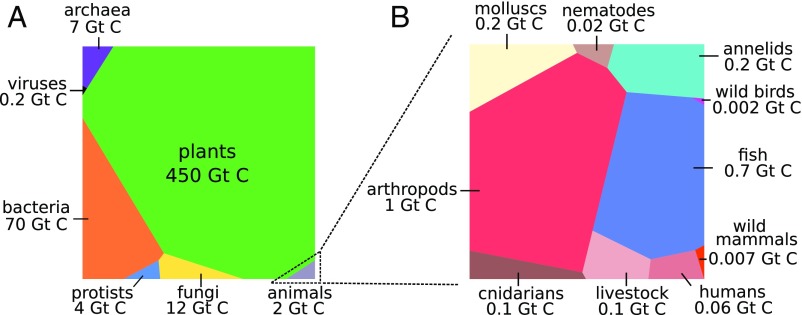
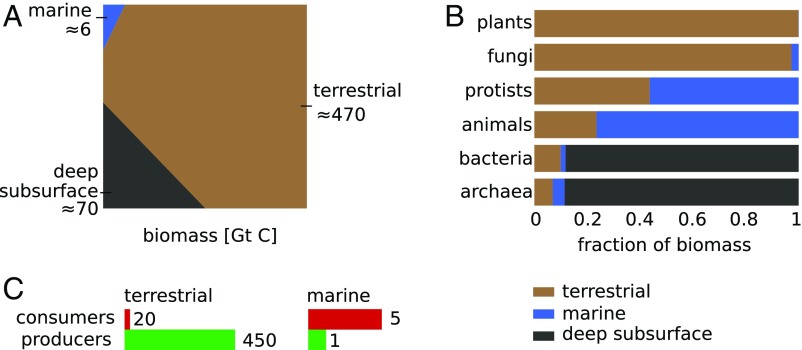
A census of the biomass on Earth is key for understanding the structure and dynamics of the biosphere. However, a global, quantitative view of how the biomass of different taxa compare with one another is still lacking. Here, we assemble the overall biomass composition of the biosphere, establishing a census of the ≈550 gigatons of carbon (Gt C) of biomass distributed among all of the kingdoms of life. We find that the kingdoms of life concentrate at different locations on the planet; plants (≈450 Gt C, the dominant kingdom) are primarily terrestrial, whereas animals (≈2 Gt C) are mainly marine, and bacteria (≈70 Gt C) and archaea (≈7 Gt C) are predominantly located in deep subsurface environments. We show that terrestrial biomass is about two orders of magnitude higher than marine biomass and estimate a total of ≈6 Gt C of marine biota, doubling the previous estimated quantity. Our analysis reveals that the global marine biomass pyramid contains more consumers than producers, thus increasing the scope of previous observations on inverse food pyramids. Finally, we highlight that the mass of humans is an order of magnitude higher than that of all wild mammals combined and report the historical impact of humanity on the global biomass of prominent taxa, including mammals, fish, and plants.
Overview
CoChat Summary
TL;DR
The paper assembles a global census of biomass across all kingdoms of life, estimating Earth’s total biomass at ≈550 Gt C, dominated by plants. It also compares biomass across environments and trophic modes, highlighting large uncertainties and human impacts on the biosphere.
Key findings
- Total global biomass is ≈550 Gt C, with plants ≈450 Gt C (≈80%), bacteria ≈70 Gt C (≈15%), fungi ≈12 Gt C, archaea ≈7 Gt C, protists ≈4 Gt C, animals ≈2 Gt C, and viruses ≈0.2 Gt C.
- Land biomass (≈470 Gt C) is about two orders of magnitude higher than marine biomass (≈6 Gt C); the deep subsurface holds ≈15% of total biomass, chiefly bacteria and archaea.
- In the ocean, ≈1 Gt C of primary producers supports ≈5 Gt C of consumer biomass, an inverted standing biomass distribution; marine biomass is ≈70% microbes, mainly bacteria and protists.
- Human-associated biomass is large relative to wild vertebrates: humans ≈0.06 Gt C, livestock ≈0.1 Gt C, wild mammals ≈0.007 Gt C, domesticated poultry ≈0.005 Gt C versus wild birds ≈0.002 Gt C; total plant biomass has declined approximately twofold relative to pre-human civilization.
Methods
- The authors synthesize hundreds of studies and generate estimates for major taxonomic groups, reporting biomass as gigatons of carbon (Gt C) and using a kingdom-level framework plus viruses.
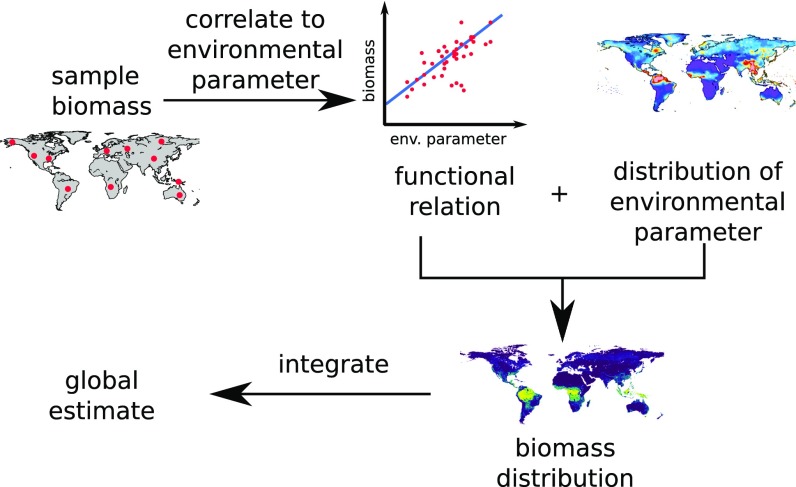
- For many taxa, local biomass samples are extrapolated globally by correlating biomass density with environmental parameters known at global scale; best estimates often use a geometric mean of independent estimates.
- Uncertainty is reported as multiplicative fold-change projections akin to 95% confidence intervals, incorporating intrastudy, interstudy, and intermethod variation; data and code are open-sourced.
Limitations
- The paper states that most datasets rely on fragmentary sampling, causing large uncertainties; sampling is scarce in the deep ocean (usually deeper than 200 m) and deep soil (usually deeper than 1 m), and some estimates may be biased by sampling toward high-abundance areas.
- The paper states that deep subsurface environments have particularly high uncertainty and unknown systematic biases, including unresolved distribution of biomass between aquifer fluids and rocks and among microbial taxa.
- The paper states that current and prehuman vertebrate biomass estimates are only a crude first step, amphibians remain poorly characterized, and parasite biomass is not resolved from hosts; evident from the text, kingdom-level grouping was chosen because much data lack finer taxonomic detail, and some uncertainty projections rely on analogous taxa or expert consultation.
Model-written summary. Check it against the paper before relying on it.
Integrity signals
Registry
Cites
Statistics
Figures
Verification
Claims the paper makes
9 Valid · 7 Not valid · 16 Not checked · 53 Own results and interpretations
Every source the paper cites for this claim was checked and supports it.
In the paper
“The biomass of amphibians, which are experiencing a dramatic population decline (42), remains poorly characterized.”
§ The biomass distribution on Earth > Discussion
What the sources say
- Supportedcites [42] Wake DB Vredenburg VT 2008 Colloquium paper: Are we in the midst of the sixth mass extinction? A view from the world of amphibians Proc Natl Acad Sci USA 105 11466 11473 18695221 PMC2556420 source
The citation is attached to the clause about amphibian population decline, not the separate statement that their biomass is poorly characterized. The passage reporting the Global Amphibian Assessment (labeled Abstract in our copy) says that 43% of amphibian species have declining populations. (LLM, conf=0.92)
plain- Asserted: passes — The authors put it forward as true.
- Checkable: passes — It can be checked against evidence.
- Load-bearing: unclear — It is unclear whether the paper’s conclusions depend on it.
- Based: passes — The paper gives a reason why it holds.
- Supported
Every source the paper cites for this claim was checked and supports it.
In the paper
“In the case of prokaryotes, some major improvements were recently realized, with global estimates of marine deep subsurface prokaryote biomass reduced by about two orders of magnitude due to an increased diversity of sampling locations (7).”
§ The biomass distribution on Earth > Discussion
What the sources say
- Supportedcites [7] Kallmeyer J Pockalny R Adhikari RR Smith DC D’Hondt S 2012 Global distribution of microbial abundance and biomass in subseafloor sediment Proc Natl Acad Sci USA 109 16213 16216 22927371 PMC3479597 source
The Discussion reports a revised subseafloor microbial biomass estimate of 4.1 Pg C versus a previous estimate of 303 Pg C—about a 74-fold reduction. It also identifies a more geographically diverse sampling database, including low-abundance ocean gyres, as a reason the new estimate is lower. The paper identifies other contributing factors as well. (LLM, conf=0.88)
plainstates a cause- Asserted: passes — The authors put it forward as true.
- Checkable: passes — It can be checked against evidence.
- Load-bearing: unclear — It is unclear whether the paper’s conclusions depend on it.
- Based: passes — The paper gives a reason why it holds.
- Supported
The sources with a verdict support this claim; the rest weren’t checked yet, have no full text we could read, or their verdicts aren’t rated yet.
In the paper
“Such inverted biomass distributions can occur when primary producers have a rapid turnover of biomass [on the order of days (34)], while consumer biomass turns over much more slowly [a few years in the case of mesopelagic fish (35)].”
§ The biomass distribution on Earth > Results > The Distribution of Biomass Across Environments and Trophic Modes.
What the sources say
- Supportedcites [34] Zubkov MV 2014 Faster growth of the major prokaryotic versus eukaryotic CO2 fixers in the oligotrophic ocean Nat Commun 5 3776 24777140 PMC4015317 source
The Results (Comparison of the growth rates of the CO2 fixers; page unavailable) report growth rates of 0.1–0.6 per day for the studied oceanic primary producers, consistent with biomass turnover on the order of days. The few-years estimate for mesopelagic fish is assigned to a different citation, not this source. (LLM, conf=0.91)
- Not checked — no full text of the sourcecites [35] Catul V Gauns M Karuppasamy PK 2011 A review on mesopelagic fishes belonging to family Myctophidae Rev Fish Biol Fish 21 339 354 source
plainstates a possible cause- Asserted: passes — The authors put it forward as true.
- Checkable: passes — It can be checked against evidence.
- Load-bearing: passes — The paper’s conclusions depend on it.
- Based: passes — The paper gives a reason why it holds.
- Supported
The cited sources support only part of this claim — read each source’s verdict below.
In the paper
“Combining data from independent sources such as these enables a robust assessment of the total plant biomass (17).”
§ The biomass distribution on Earth > Results > The Uncertainty Associated with Global Biomass Estimates.
What the sources say
- Partly supportedcites [17] Erb K-H 2017 Unexpectedly large impact of forest management and grazing on global vegetation biomass Nature 553 73 76 29258288 PMC5756473 sourceExperimental — accuracy not yet measured
The Methods describe combining multiple datasets and types of evidence to estimate global vegetation biomass stocks. But the paper also says global stocks remain uncertain, reports uncertainty ranges around 35% of the median estimate, and describes more robust estimates as a future prospect. It therefore supports the use of independent sources for an assessment, but not the unqualified characterization of that assessment as robust. (LLM, conf=0.84)
plainstates a cause- Asserted: passes — The authors put it forward as true.
- Checkable: passes — It can be checked against evidence.
- Load-bearing: passes — The paper’s conclusions depend on it.
- Based: passes — The paper gives a reason why it holds.
- Partly supported
A result the paper states — it cites no source for it, so there is none to check. The quote shows it is in the paper.
In the paper
“Plant biomass includes ≈70% stems and tree trunks, which are mostly woody, and thus relatively metabolically inert.”
§ The biomass distribution on Earth > Results > The Biomass Distribution of the Biosphere by Kingdom.
plain- Asserted: passes — The authors put it forward as true.
- Checkable: passes — It can be checked against evidence.
- Load-bearing: unclear — It is unclear whether the paper’s conclusions depend on it.
- Based: passes — The paper gives a reason why it holds.
27 more claims
Create a free account to see all 85 claims and to verify the 2 references still open.
- It may state two separate claims as one. 32
- Probably not a substantial claim. 28
Claims other papers make about this one
Each is checked against this paper’s own text: does it say what the citing paper says it does?
The cited source doesn’t support the claim as written.
In the citing paper
“and less than 10% that of the world ' s current human population ( 52 ).”
From Pervasive human-driven decline of life on Earth points to the need for transformative change (2019) · cites this paper as [52]
Checked by a reasoning model — may be wrong.
Experimental — accuracy not yet measuredThe cited source says what the claim attributes to it.
In the citing paper
“Approximately 450 Gt of C is bound up in terrestrial biota, primarily in plants (86), while only ~6 Gt of C is found in ocean biota (87).”
From Earth beyond six of nine planetary boundaries (2023) · cites this paper as [87]
The cited source says what the claim attributes to it.
In the citing paper
“The amount of metabolic energy available to a biosphere powered by O 2 is vast, such that the O 2 -rich ocean-atmosphere system of the modern Earth supports staggering levels of standing biomass (Bar-On et al. 2018), energy flow (Falkowski et al. 2008), and ecological complexity (Steele 1974).”
From The History of Ocean Oxygenation (2022) · cites this paper as Bar-On et al. 2018
In the citing paper
“Global populations of domestic ruminants (cattle, sheep, and goats) (Ripple et al. 2013) poultry, and pigs (Bennett et al. 2018) used to feed the growing human population now exceed 100 million tons of carbon (Bar-On et al. 2018), and livestock populations are growing rapidly.”
From Scientists’ warning to humanity on the freshwater biodiversity crisis (2021) · cites this paper as Bar-On et al. 2018
Citations
Cites
The worldwide leaf economics spectrum
Wright, I. J., Reich, P. B., Westoby, M., Ackerly, D. D., Baruch, Z., Bongers, F., Cavender-Bares, J., Chapin, T., Cornelissen, J. H. C., Diemer, M., et al. (2004) · Nature · doi:10.1038/nature02403 · Cited by 9,021 · cited 1×
“We then convert the total area of leaves to an estimate of the total dry mass of leaves by using the Glopnet database (24), which measured leaf mass per area (LMA) for ≈2500 plant species.”
MethodA large and persistent carbon sink in the world’s forests
Pan, Y., Birdsey, R. A., Fang, J., Houghton, R., Kauppi, P. E., Kurz, W. A., Phillips, O. L., Shvidenko, A., Lewis, S. L., Canadell, J. G., et al. (2011) · Science · doi:10.1126/science.1201609 · Cited by 8,458
Soil Sampling and Methods of Analysis
(2007) · CRC Press eBooks · doi:10.1201/9781420005271 · Cited by 6,469
Primary production of the biosphere: Integrating terrestrial and oceanic components
Field, C. B., Behrenfeld, M. J., Randerson, J. T., & Falkowski, P. (1998) · Science · doi:10.1126/science.281.5374.237 · Cited by 6,371
Prokaryotes: The unseen majority
Whitman, W. B., Coleman, D. C., & Wiebe, W. J. (1998) · Proceedings of the National Academy of Sciences · doi:10.1073/pnas.95.12.6578 · Cited by 4,871
Global effects of land use on local terrestrial biodiversity
Newbold, T., Hudson, L. N., Hill, S. L. L., Contu, S., Lysenko, I., Senior, R. A., Börger, L., Bennett, D. J., Choimes, A., Collen, B., et al. (2015) · Nature · doi:10.1038/nature14324 · Cited by 4,352
Belowground biodiversity and ecosystem functioning
Bardgett, R. D., & van der Putten, W. H. (2014) · Nature · doi:10.1038/nature13855 · Cited by 3,990 · cited 4×
“This was recommended by experts in the field for estimation of arbuscular mycorrhizal fungi abundance (117).”
BackgroundInfluentialMangroves among the most carbon-rich forests in the tropics
Donato, D. C., Kauffman, J. B., Murdiyarso, D., Kurnianto, S., Stidham, M., & Kanninen, M. (2011) · Nature Geoscience · doi:10.1038/ngeo1123 · Cited by 3,374
Poorter, H., Niklas, K. J., Reich, P. B., Oleksyn, J., Poot, P., & Mommer, L. (2012) · New Phytologist · doi:10.1111/j.1469-8137.2011.03952.x · Cited by 3,163 · cited 1×
“The first relies on a meta-analysis of the biomass allocation to different plant compartments across biomes (19).”
BackgroundA global analysis of root distributions for terrestrial biomes
Jackson, R. B., Canadell, J., Ehleringer, J. R., Mooney, H. A., Sala, O. E., & Schulze, E. D. (1996) · Oecologia · doi:10.1007/bf00333714 · Cited by 3,071 · cited 4×
“assumed the distribution of microbial biomass with depth follows the biomass density versus depth profile of root biomass (21).”
BackgroundMethodInfluential
Research works printed but not linked: 1
- Chapman AD 2009 Numbers of Living Species in Australia and the World Australian Biological Resources Study Canberra, Australia
Cited by
Items 1,701–1,800 of 3,743
Zheng, F. Y., Tang, M., Gao, J., Guo, X., Zhu, D., Yang, X., & Chen, B. (2024) · Applied Soil Ecology · doi:10.1016/j.apsoil.2024.105491 · Cited by 7
Hüppe, L., Bahlburg, D., Busack, M., Lemburg, J., Payton, L., Reinhard, N., Rieger, D., Helfrich‐Förster, C., & Meyer, B. (2024) · Scientific Reports · doi:10.1038/s41598-024-67999-3 · Cited by 4
Bieber, P., Darwish, G. H., Algar, W. R., & Borduas‐Dedekind, N. (2024) · The Journal of Chemical Physics · doi:10.1063/5.0213171 · Cited by 10
Samaniego, L. V. B., Scandelau, S. L., Silva, C. R., Pratavieira, S., Pellegrini, V. D. O. A., Dabul, A. N. G., Esmerino, L. A., Neto, M. D. O., Hernandes, R. T., Segato, F., et al. (2024) · Scientific Reports · doi:10.1038/s41598-024-70144-9 · Cited by 7
The subseafloor crustal biosphere: Ocean’s hidden biogeochemical reactor
Robador, A. (2024) · Frontiers in Microbiology · doi:10.3389/fmicb.2024.1495895 · Cited by 9
Advancements in energy storage applications: harnessing the potential of fish industry waste
Rajput, V. S., Naik, B., Kumar, V., Kumar, V., Bhatt, S. C., & Rustagi, S. (2024) · Discover Materials · doi:10.1007/s43939-024-00161-y · Cited by 8
“Furthermore, it has been demonstrated that chitin derived from the shells of fish and crabs, exhibit commendable performance as materials for fuel cells based on LSBs, polymer electrolytes LIBs, supercapacitors, and polymer-electrolyte based fuel cells [12].”
Xu, Z., Chen, J., Liang, W., Chen, Z. L., Wu, W., Xia, X., Bingzhang Chen, A., He, D., & Liu, H. (2025) · ISME Communications · doi:10.1093/ismeco/ycaf002 · Cited by 6
“Microeukaryotes (or microbial eukaryotes, mainly including protists and fungi), representing the eukaryotic part of microbes, are diverse and abundant in most ecosystems [17, 18].”
Rodríguez-Barreiro, I., Santos, A. A., Villanueva‐Amadoz, U., Hernández, J. M., McLoughlin, S., & Diez, J. B. (2025) · Cretaceous Research · doi:10.1016/j.cretres.2025.106086 · Cited by 6
Dynamic land-plant carbon sources in marine sediments inferred from ancient DNA
Herzschuh, U., Weiß, J. F., Stoof‐Leichsenring, K. R., Harms, L., Nürnberg, D., & Müller, J. (2025) · Communications Earth & Environment · doi:10.1038/s43247-025-02014-9 · Cited by 9
Adams, A. D., Colose, C. M., Merrelli, A. J., Turnbull, M., & Kane, S. R. (2025) · The Astrophysical Journal · doi:10.3847/1538-4357/ada3c8 · Cited by 9
Alien plants and novel ecosystems in the Greater Tropics
Mungi, N. A., Galetti, M., Ratnam, J., Chala, D., Sanín, M. J., & Svenning, J. (2025) · Nature Reviews Biodiversity · doi:10.1038/s44358-025-00068-3 · Cited by 11
“Irrespective of biomes, vascular plants serve as the foundational structure in most ecosystems, regulating biogeochemical cycles 14 .”
Cameron, L. (2018) · Journal of Bacteriology & Mycology Open Access · doi:10.15406/jbmoa.2018.06.00216 · Cited by 6
On the Future: A Keynote Address
Rees, M. J. (2019) · Engineering · doi:10.1016/j.eng.2019.12.009 · Cited by 5
“We have already skewed things enormously: there is now more biomass in chickens and turkeys than in all the world’s wild birds [6], and the combined biomass of humans and livestock is about 20 times that of all wild mammals put together [7].”
BackgroundAucott, M. L., & Parker, R. A. (2020) · Conservation Biology · doi:10.1111/cobi.13566 · Cited by 6
The weight of it all: symbiotic dinoflagellates in Caribbean reef-building corals
Kemp, D. W., Kempf, S. C., & Fitt, W. K. (2020) · Marine Biology · doi:10.1007/s00227-020-03737-3 · Cited by 6
Stephanie Kelton, The Deficit Myth: Modern Monetary Theory and the Birth of the People’s Economy
Burnham, T. C. (2020) · Journal of Bioeconomics · doi:10.1007/s10818-020-09302-8 · Cited by 6
Bio-management of Fusarium spp. associated with fruit crops
Nehra, S., Gothwal, R. K., Varshney, A. K., Solanki, P. S., Chandra, S., Meena, P., Trivedi, P. C., & Ghosh, P. (2020) · Elsevier eBooks · doi:10.1016/b978-0-12-821394-0.00019-6 · Cited by 11
Musah, B. I., Peng, L., & Xu, Y. (2020) · Environmental Engineering Science · doi:10.1089/ees.2020.0190 · Cited by 6
“It is also important to note that bacteria are the second dominant species of life form after plants on the earth (Bar-On et al. , 2018).”
Metals Alter Membership but Not Diversity of a Headwater Stream Microbiome
Wolff, B. A., Clements, W. H., & Hall, E. K. (2021) · Applied and Environmental Microbiology · doi:10.1128/aem.02635-20 · Cited by 6
“99%) (19, 20); (ii) many stream macroinvertebrates spend a significant portion of their FIG 1 Map of the study area in the Upper Arkansas River, CO, USA.”
BackgroundEye contact and sociability data suggests that Australian dingoes were never domesticated
Ballard, J. W. O., Gardner, C., Ellem, L., Yadav, S., & Kemp, R. I. (2021) · Current Zoology · doi:10.1093/cz/zoab024 · Cited by 5
“Domestic mammals account for around 60% of mammalian biomass, double the amount of humans, and 15 times wild animals (Bar-On et al. 2018).”
BackgroundMori, F., Nishimura, T., Wakamatsu, T., Terada, T., & Morono, Y. (2021) · Microbes and Environments · doi:10.1264/jsme2.me21031 · Cited by 6
“harbors a remarkable microbial population that comprises 12–45% of the total microbial biomass or ~0.6–2% of the total living biomass on Earth (Bar-On et al. , 2018; Magnabosco et al. , 2018).”
InfluentialBacterial Consumption of T4 Phages
Godon, J., Bize, A., Ngo, V. Q. H., Cauquil, L., Almeida, M., Petit, M., & Zemb, O. (2021) · Microorganisms · doi:10.3390/microorganisms9091852 · Cited by 8
Chance and Necessity in the Evolution of Matter to Life: A Comprehensive Hypothesis
Davankov, V. A. (2021) · Symmetry · doi:10.3390/sym13101918 · Cited by 7
MEMÓRIA OU METAMEMÓRIA DAS ORIGENS?
Candau, J. (2020) · Caderno de Letras · doi:10.15210/cdl.v0i37.19531 · Cited by 17
Analyzing structural features of proteins from deep‐sea organisms
Sieg, J., Sandmeier, C. C., Lieske, J., Meents, A., Lemmen, C., Streit, W. R., & Rarey, M. (2022) · Proteins Structure Function and Bioinformatics · doi:10.1002/prot.26337 · Cited by 7
Cohen, I. R., & Marron, A. (2020) · F1000Research · doi:10.12688/f1000research.24447.1 · Cited by 6
Liu, Q., Chen, C., Ji, G., & Li, A. (2022) · Biomass Conversion and Biorefinery · doi:10.1007/s13399-022-02900-8 · Cited by 6
“Rice husk (RH) and rice straw (RS) are important biomass accounting for 2% of the total plant biomass [7].”
Le renouveau des territoires par la bioéconomie
Callois, J.-M. (2022) · Éditions Quæ eBooks · doi:10.35690/978-2-7592-3492-9 · Cited by 10
Leveraging Earth Hydrosphere Science in the Search for Life on Ocean Worlds
Hoehler, T. M., Bowman, J. S., Craft, K. L., Willis, P. A., & Winebrenner, D. P. (2022) · Oceanography · doi:10.5670/oceanog.2021.412 · Cited by 8
“…equal (Field et al., 1998), the standing photosynthetic biomass in the ocean is estimated to be about 500-fold smaller than that on land (Bar-on et al., 2018)—a difference attributable primarily to rapid grazing and the relatively fast growth rates of microbial primary producers in the…”
BackgroundMakesh, M., Kotakonda, M., Prabaharan, D., Balasubramaniyan, S., & Prasad, S. (2022) · Current Pharmaceutical Biotechnology · doi:10.2174/1389201023666220801090810 · Cited by 10
Soil Microbiome: A Key Player in Conservation of Soil Health Under Changing Climatic Conditions
Patel, H. K., Kalaria, R. K., Vasava, D. K., & Bhalani, H. N. (2022) · Springer eBooks · doi:10.1007/978-981-16-9001-3_3 · Cited by 8
Wright, A., Hudson, L. A., & Garcia, W. L. (2023) · Israel Journal of Chemistry · doi:10.1002/ijch.202200099 · Cited by 6
Zhi-gang, Y., Dayananda, B., Popović, I., et al. (2023) · Ecological Informatics · doi:10.1016/j.ecoinf.2023.102008 · Cited by 6
Huang, L., Yao, S., Jin, Y., Xue, W., Lei, N., Chen, J., & Yu, F. (2023) · Restoration Ecology · doi:10.1111/rec.13898 · Cited by 5
“Soil houses a large fraction of biodiversity on Earth, playing a crucial role in ecosystem functions and services (Barrios 2007; Bar-On et al. 2018; Geisen et al. 2019).”
BackgroundParapatric speciation of Meiothermus in serpentinite-hosted aquifers in Oman
Munro‐Ehrlich, M., Nothaft, D. B., Fones, E. M., Matter, J., Templeton, A. S., & Boyd, E. S. (2023) · Frontiers in Microbiology · doi:10.3389/fmicb.2023.1138656 · Cited by 6
“The terrestrial subsurface is host to an abundant and active microbial biosphere (McMahon and Parnell, 2014; Bar-On et al., 2018; Magnabosco et al., 2018) that comprises populations of cells inhabiting the pore spaces and (micro)fractures of rocks (Goordial et al.”
BackgroundElevated compositional change in plant assemblages linked to invasion
Kortz, A. R., Moyes, F., Pivello, V. R., Pyšek, P., Dornelas, M., Visconti, P., & Magurran, A. E. (2023) · Proceedings of the Royal Society B Biological Sciences · doi:10.1098/rspb.2022.2450 · Cited by 7
Amiar, D., Leandro, C., Courtial, C., & Pétillon, J. (2023) · Entomologia Experimentalis et Applicata · doi:10.1111/eea.13371 · Cited by 6
Building references for nature conservation
Robert, A. (2024) · Conservation Biology · doi:10.1111/cobi.14202 · Cited by 7
“…is explained by the increase of the biomass of humanity and its livestock; biomass of wild mammals has declined by a factor of 6 over this period (Bar-On et al., 2018); and biomass of other groups, such as insects, has exhibited an even more drastic decrease (Hallmann et al., 2017 ; but see…”
BackgroundObject Counting from Aerial Remote Sensing Images: Application to Wildlife and Marine Mammals
Singh, T., Gangloff, H., & Pham, M. (2023) · IEEE International Geoscience and Remote Sensing Symposium (IGARSS) · doi:10.1109/igarss52108.2023.10282150 · Cited by 13
“Notably, our model outperformed the count-ception approach [15]”
MethodThe gills and skin microbiota of five pelagic fish species from the Atlantic Ocean
Varela, J. L., Nikouli, E., Medina, A., et al. (2024) · International Microbiology · doi:10.1007/s10123-024-00524-8 · Cited by 6
“Considering the high number of wild fish species and the importance of fish biomass in the ocean’s animal biomass (Bar-On et al. 2018), the taxonomic and functional microbiome diversity of the various fish tissue/organs remains practically untapped.”
Tracing the Digital Plant Humanities: Narratives of Botanical Life and Human‐Flora Relations
Arthur, P. L., & Ryan, J. C. (2024) · Future Humanities · doi:10.1002/fhu2.15 · Cited by 6
Cabello‐Hurtado, F., & Amrani, A. E. (2024) · Plants · doi:10.3390/plants13121692 · Cited by 6
Swain, A., Azevedo‐Schmidt, L., Maccracken, S. A., Currano, E. D., Meineke, E. K., Pierce, N. E., Fagan, W. F., & Labandeira, C. C. (2024) · The American Naturalist · doi:10.1086/731995 · Cited by 6
Introduction to Cellular Agriculture
Farzana, W., & George, G. S. (2024) · Advances in environmental engineering and green technologies book series · doi:10.4018/979-8-3693-4115-5.ch001 · Cited by 6
Evolutionary conservation and metabolic significance of autophagy in algae.
Laude, J., Scarsini, M., Nef, C., & Bowler, C. (2024) · PubMed Central · doi:10.1098/rstb.2023.0368 · Cited by 9
Katayama, T., Yoshioka, H., Yamanaka, T., Sakata, S., & Hanamura, Y. (2024) · Biogeosciences · doi:10.5194/bg-21-4273-2024 · Cited by 6
Ahn, H.-G., Lee, J. E., Kim, H., Jung, H. J., Oh, K. K., Heo, S. H., & Kim, J. S. (2024) · Polysaccharides · doi:10.3390/polysaccharides5040035 · Cited by 7
Australian corticolous myxomycetes: models of distribution and development
Wellman, P. (2020) · Australian Journal of Botany · doi:10.1071/bt19155 · Cited by 6
Assessing the evolutionary persistence of ecological relationships: A review and preview
Hecht, L., Thompson, P. C., & Rosenthal, B. M. (2020) · Infection Genetics and Evolution · doi:10.1016/j.meegid.2020.104441 · Cited by 8
“The biomass of our livestock outweighs our own biomass, and together outweigh all other vertebrates (excepting fish) by over twenty times; the globe's chickens collectively weigh more than three times the globe's wild birds (Bar-On et al., 2018).”
Rich dynamics of a simple delay host-pathogen model of cell-to-cell infection for plant virus
Phan, T., Pell, B., Kendig, A. E., Borer, E. T., & Kuang, Y. (2020) · Discrete and Continuous Dynamical Systems - B · doi:10.3934/dcdsb.2020261 · Cited by 6
“Plants comprise the majority of biomass on Earth [5] and many are infected with viruses [11, 39].”
BackgroundWyatt, T., Friedman, K. J., & Hutchinson, A. (2021) · Liverpool Law Review · doi:10.1007/s10991-021-09285-0 · Cited by 6
González-Poggini, S., Consuegra, G. L., Kracht, W., et al. (2021) · Metallurgical and Materials Transactions B · doi:10.1007/s11663-021-02267-7 · Cited by 6
Single-atom catalysts for biomass-derived drop-in chemicals
Kumar, P., Khan, M. A., Hu, J., & Kibria, M. G. (2021) · Elsevier eBooks · doi:10.1016/b978-0-12-823827-1.00009-2 · Cited by 8
The Deep Rocky Biosphere: New Geomicrobiological Insights and Prospects
Takamiya, H., Kouduka, M., & Suzuki, Y. (2021) · Frontiers in Microbiology · doi:10.3389/fmicb.2021.785743 · Cited by 7
Strategies for Sustainability of the Earth System
Wilderer, P. 1. (2021) · Strategies for sustainability · doi:10.1007/978-3-030-74458-8 · Cited by 6
Wu, L., Wang, B., Wu, Y., & Chen, D. (2022) · CATENA · doi:10.1016/j.catena.2022.106180 · Cited by 8
Mammals in São Paulo State: diversity, distribution, ecology, and conservation
Galetti, M., Carmignotto, A. P., Percequillo, A. R., Santos, M. C. D. O., Ferraz, K. M. P. M. D. B., Lima, F., Vancine, M. H., Muylaert, R. L., Bonfim, F. C. G., Magioli, M., et al. (2022) · Biota Neotropica · doi:10.1590/1676-0611-bn-2022-1363 · Cited by 14
Self-assembly and biophysical properties of archaeal lipids
Bhattacharya, A. (2022) · Emerging Topics in Life Sciences · doi:10.1042/etls20220062 · Cited by 6
Osbeck, C. M. G., Lundin, D., Karlsson, C., Teikari, J. E., Moran, M. A., & Pinhassi, J. (2022) · PLoS ONE · doi:10.1371/journal.pone.0243406 · Cited by 5
“This carbon turnover occurs at a rate that is orders of magnitude higher in the sea than in terrestrial ecosystems [7, 8], particularly so in coastal environments and inland seas where nutrient concentrations do not limit microbial activities to the same extent as in the open ocean.”
BackgroundSiddique, M., Soomro, S. A., Ahmad, H., et al. (2021) · Journal of Chemistry and Nutritional Biochemistry · doi:10.48185/jcnb.v2i2.408 · Cited by 6
Distinct spread of DNA and RNA viruses among mammals amid prominent role of domestic speciesPreprint
Wells, K., Morand, S., Wardeh, M., & Baylis, M. (2018) · bioRxiv (Cold Spring Harbor Laboratory) · doi:10.1101/421511 · Cited by 6
Towards a Physically Motivated Planetary Accounting FrameworkPreprint
Barbosa, M., Orfeu Bertolami, A., & Francisco, F. (2019) · arXiv (Cornell University) · doi:10.48550/arxiv.1907.10535 · Cited by 6
“Estimates indicate that the amount of living biomass has dropped from 750 × 1012 kg in 1800, to 660 × 1012 kg in 1900, and to 550 × 1012 kg in 2000 [13, 14].”
BackgroundEstimating the quality of eukaryotic genomes recovered from metagenomic analysisPreprint
Saary, P., Mitchell, A., & Finn, R. D. (2019) · bioRxiv (Cold Spring Harbor Laboratory) · doi:10.1101/2019.12.19.882753 · Cited by 6
“Within the microbial eukaryotic biomass, the genetically diverse unicellular organisms known as protists account for as much as ∼ 25 % (Bar-On et al. 2018).”
BackgroundMetaGenomic analysis of short and long readsPreprint
Manske, F., Grundmann, N., & Makałowski, W. (2020) · bioRxiv (Cold Spring Harbor Laboratory) · doi:10.1101/2020.03.13.991190 · Cited by 6
“%) as measured by mass of carbon (Bar-On et al. 2018).”
MethodDisentangling temporal associations in marine microbial networksPreprint
Deutschmann, I. M., Krabberød, A. K., Benites, L., Latorre, F., Delage, E., Marrasé, C., Balagué, V., Gasol, J. M., Massana, R., Eveillard, D., et al. (2021) · Research Square · doi:10.21203/rs.3.rs-404332/v1 · Cited by 6
Harnessing Solar‐Powered Oxic N 2 ‐fixing Cyanobacteria for the BioNitrogen Economy
Young, J. S., Gu, L., Gibbons, W. R., & Zhou, R. (2021) · Wiley eBooks · doi:10.1002/9783527824908.ch13 · Cited by 11
The effect of anthropogenic heat emissions on global warmingPreprint
Karamanev, D. G. (2022) · doi:10.5194/egusphere-2022-5 · Cited by 6
Engel, A. S. (2019) · Elsevier eBooks · doi:10.1016/b978-0-12-814124-3.00083-2 · Cited by 6
Lazić, D., Geßner, C., Liepe, K. J., Lesur, I., Mäder, M., Blanc-Jolivet, C., Gömöry, D., Liesebach, M., González‐Martínez, S. C., Fladung, M., et al. (2023) · bioRxiv (Cold Spring Harbor Laboratory) · doi:10.1101/2023.05.11.540382 · Cited by 6
Environmental sustainability in basic research: a perspective from HECAP+
Banerjee, S. (2023) · OSTI OAI (U.S. Department of Energy Office of Scientific and Technical Information) · doi:10.2172/1984950 · Cited by 7
Barrett, M. (2024) · OSF Preprints (OSF Preprints) · doi:10.31219/osf.io/qem7f · Cited by 7
Peng, J., Liu, X., Wang, J., Meng, N., Cai, R., Peng, Y., Han, Y., Liao, J., Li, C., Rubin-Blum, M., et al. (2025) · Microbiome · doi:10.1186/s40168-025-02280-x · Cited by 6
Analysis of methane emission characteristics and environmental response in natural wetlands
Li, J., Hao, T., Yang, M., Chen, Z., Zhu, J., Wang, Q., & Yu, G. (2024) · Atmospheric Environment · doi:10.1016/j.atmosenv.2024.120696 · Cited by 9
Fetsiukh, A., Päll, T., & Timmusk, S. (2024) · Scientific Reports · doi:10.1038/s41598-024-68123-1 · Cited by 6
“The rhizosphere microbiome is an environmentally friendly renewable resource, and activation of the resource restores soil and plant health 3,17,18 .”
BackgroundWenting, E., Eikelboom, J. A. J., Siepel, H., Broekhuis, F., & van Langevelde, F. (2024) · Ecology and Evolution · doi:10.1002/ece3.70424 · Cited by 5
Kilbride, J. B., & Kennedy, R. E. (2024) · Remote Sensing · doi:10.3390/rs16234586 · Cited by 6
“Most terrestrial carbon is stored in forests, but precisely quantifying aboveground biomass (AGB) densities is challenging due to the scarcity of direct biomass measurements and the expense of acquiring ground truth data [3,4].”
Unveiling plasmid diversity and functionality in pristine groundwater
Pérez-Carrascal, O. M., Pratama, A. A., Sullivan, M. B., & Küsel, K. (2025) · Environmental Microbiome · doi:10.1186/s40793-025-00703-8 · Cited by 7
“Groundwater microbiomes constitute a significant fraction Earth´s microbial life, encompassing an estimated 5 × 10 27 cells globally, which accounts for approximately 10% of the planet´s total microbial biomass [21, 34].”
Sentinels tracking viruses in various ecosystems: Towards a One Health approach
Blondet, L., Sounda, A. M., Fritz, M., Filloux, D., Yvon, M., Blanc, S., Varsani, A., Niama, R. F., Leroy, E. M., & Roumagnac, P. (2025) · PLoS Pathogens · doi:10.1371/journal.ppat.1013141 · Cited by 4
“Viruses are widely regarded as the most abundant and genetically diverse biological entity on Earth, with multiple studies converging towards an estimated number of viral particles present globally on the order of 10 31 [1,2].”
MacLeod, K. G., Huber, B. T., Tabor, C., Mitra, S., Wheatley, R., Harrison, C., Tessler, M. E., Bardeen, C., Lovenduski, N. S., Sepúlveda, J., et al. (2025) · Global and Planetary Change · doi:10.1016/j.gloplacha.2025.104924 · Cited by 9
Chen, Y., Huang, S., Lü, X., Ji, L., Shen, Q., Yang, S., Liu, Y., Wang, X., Wu, P., Yang, H., et al. (2025) · BMC Microbiology · doi:10.1186/s12866-025-04281-0 · Cited by 5
Protists with Uncertain Phylogenetic Affiliations for Resolving the Deep Tree of Eukaryotes
Yazaki, E., Shiratori, T., & Inagaki, Y. (2025) · Microorganisms · doi:10.3390/microorganisms13081926 · Cited by 6
The Marine Organic Sulfur Cycle
Raven, M. R. (2025) · Annual Review of Marine Science · doi:10.1146/annurev-marine-040124-105229 · Cited by 9
Aquatic fungal diversity assessment through metagenomics is still limited to current databases
Sanyal, A., Kluge, M., Redondo, M. Á., Buck, M., Mehrshad, M., Garcia, S. L., Bertilsson, S., & Peura, S. (2025) · Limnology and Oceanography · doi:10.1002/lno.70205 · Cited by 8
“Fungi are found in almost all habitats on Earth, from the human body to sediments in Antarctica, (Huffnagle and Noverr 2013; Selbmann et al. 2015) and have been estimated to contribute approximately 2% of global biomass (Bar-On et al. 2018).”
Biodiversity conservation depends on the expansion of taxonomy and systematics research
Ruedas, L. A., & Gardner, S. L. (2025) · Journal of Mammalogy · doi:10.1093/jmammal/gyaf067 · Cited by 10
“…in between (Ceballos et al. 2020), with an emphatically unnatural distribution of species numbers and mass vastly favoring domestic animals (Bar-On et al. 2018; Greenspoon et al. 2023) and an enormous loss of functional diversity (Hedberg et al. 2022; Shupinski et al. 2024), resulting in…”
Spatio‐Temporal Variation in Aerial Arthropod Abundance Revealed by Weather Radars
Mungee, M., Lukach, M., Shortall, C. R., Bell, J. R., Duncan, E. J., Addison, F. I., Brown, L. E., Kunin, W. E., Hassall, C., & Neely, R. R. (2025) · Global Change Biology · doi:10.1111/gcb.70425 · Cited by 9
Zhang, C., Zhang, X., Wang, F., Li, G., Ding, J., Cao, Y., Wang, H., Wu, S., Shang, X., Wei, K., et al. (2025) · Microbial Ecology · doi:10.1007/s00248-025-02644-8 · Cited by 6
Mechanisms underlying phenotypic plasticity in response to environmental change
Seebacher, F., & Little, A. G. (2025) · Biological reviews/Biological reviews of the Cambridge Philosophical Society · doi:10.1111/brv.70100 · Cited by 14
Uddin, N., Ullah, M. W., Zhu, D., Li, X., Yang, S., & Xie, X. (2025) · Biotechnology Advances · doi:10.1016/j.biotechadv.2025.108772 · Cited by 8
Exo-Geoscience Perspectives Beyond Habitability
Spohn, T., Roberge, A., Way, M. J., Duarte, J. C., Miozzi, F., Baumeister, P., Byrne, P. K., & Lineweaver, C. H. (2026) · Space Science Reviews · doi:10.1007/s11214-026-01265-y · Cited by 7
“GOE denotes the great oxdation event and NEO the Neoproterozoic oxidation event is 2/3 of the total (Bar-On et al. 2018).”
Golgi‐localized mannanases sustain hemicellulose biosynthesis
Jacobson, T., Edwards, M., Qiande, M., Robert, M., Moncrieff, J., & Voiniciuc, C. (2026) · New Phytologist · doi:10.1111/nph.70875 · Cited by 6
Land Use Change Reshapes Climate‐Driven Diversity Patterns of Tropical Arbuscular Mycorrhizal Fungi
Stewart, J. D., Ramírez-Villacis, D. X., León-Reyes, A., Barriga-Medina, N., Llerena-Llerena, S., Manley, B. F., Carpintero-Salvador, N., Ruiz-Urigüen, M., Raaijmakers, J. M., Kiers, E. T., et al. (2026) · Molecular Ecology · doi:10.1111/mec.70253 · Cited by 9
Hydrocarbon resources resulting from plant terrestrialization: A review
Liu, Y., Feng, J., Wang, C., Mao, L., & Shen, Z. (2026) · Earth-Science Reviews · doi:10.1016/j.earscirev.2026.105457 · Cited by 8
Xie, S. (2026) · Food Chemistry · doi:10.1016/j.foodchem.2026.149479 · Cited by 8
Tekwa, E. W., Catalano, K. A., Bazzicalupo, A., O’Connor, M. I., & Pinsky, M. L. (2023) · PLoS ONE · doi:10.1371/journal.pone.0283020 · Cited by 10
“Biomass and uncertainty are from [30] unless indicated.”
BackgroundMethodResultInfluentialKisaka, S. M. B., & Tumwebaze, F. K. (2023) · Journal of Pharmaceutical Policy and Practice · doi:10.1186/s40545-023-00569-6 · Cited by 6
“It is therefore not a surprise that the global biomass of livestock is estimated to be twice that of human populations [1, 4, 5].”
BackgroundQuantitative Low‐Field 19F Nuclear Magnetic Resonance Analysis of Carbonyl Groups in Pyrolysis Oils
Tang, B., Chong, K. J., Ragauskas, A. J., & Evans, R. (2023) · ChemSusChem · doi:10.1002/cssc.202300625 · Cited by 5
Rodríguez-Ramos, J. A., Oliverio, A., Borton, M., Danczak, R., Mueller, B. M., Schulz, H. D., Ellenbogen, J., Flynn, R. M., Daly, R. A., Schopflin, L., et al. (2023) · Frontiers in Microbiomes · doi:10.3389/frmbi.2023.1199766 · Cited by 10
Wolf–Dog–Human: Companionship Based on Common Social Tools
Kotrschal, K. M. (2023) · Animals · doi:10.3390/ani13172729 · Cited by 10
Bellanger, M., Visscher, P. T., & White, R. A., III (2023) · Applied and Environmental Microbiology · doi:10.1128/aem.01744-23 · Cited by 7
“biomass estimates (6) suggest more measurements and method developments are still needed.”
BackgroundSpecialized metabolites degradation by microorganisms
Kumano, T. (2024) · Bioscience Biotechnology and Biochemistry · doi:10.1093/bbb/zbad184 · Cited by 5
Metadata
- Authors
- Bar-On, Y. M., Phillips, R., & Milo, R.
- Affiliations
- Department of Plant and Environmental Sciences, Weizmann Institute of Science, 76100 Rehovot, Israel;
- California Institute of Technology (US)
- Weizmann Institute of Science (IL)
- Corresponding author
- Milo, Ron
- Venue
- Proceedings of the National Academy of Sciences
- Publisher
- National Academy of Sciences
- Published
- 2018-05-21
- Volume
- 115
- Issue
- 25
- Pages
- 6506-6511
- ISSN
- 0027-8424 (ISSN-L)
- 1091-6490
- PMC
- PMC6016768
- OpenAlex
- W2804910112
- Cited by
- 3,723
- References
- 263
- Citations by year
- 2026: 349 · 2025: 450 · 2024: 589 · 2023: 617 · 2022: 498 · 2021: 498 · 2020: 419 · 2019: 246 · 2018: 49
- FWCI
- 239.98
- Type
- journal article
- Language
- en
- Open access
- hybrid
- doi.org
- Licence
- Locations
- Proceedings of the National Academy of Sciences (publishedVersion, cc-by-nc-nd)
- Europe PMC (PubMed Central) (publishedVersion, cc-by-nc-nd)
- PubMed Central (publishedVersion, cc-by-nc-nd)
- PubMed (publishedVersion)
- CaltechAUTHORS (California Institute of Technology) (submittedVersion, cc-by-nc-nd)
- Funders
- National Institutes of Health (5r35gm118043-07)
- National Institute of General Medical Sciences (R35 GM118043)
- Topics
- Physical Sciences › Environmental Science › Nature and Landscape Conservation › Ecology and Vegetation Dynamics Studies
- Physical Sciences › Environmental Science › Global and Planetary Change › Earth Systems and Cosmic Evolution
- Life Sciences › Agricultural and Biological Sciences › Soil Science › Soil Carbon and Nitrogen Dynamics
- Keywords
- biomass allocation, biomass carbon, terrestrial biomass, marine biomass, bacteria, archaea, food pyramid, wild mammals, fish biomass, plant biomass
- MeSH terms
- Animals, Archaea, Bacteria, Carbon, Humans, Plants, Ecosystem, Biomass, Earth, Planet, Biota
About these checks
Registry, retraction, Cites and statistics results are computed, not judged, with one exception: a printed reference that no index lists is read once by a model before it counts as a citation error. Claims are extracted by a model and kept only when their quote appears verbatim in the text; each cited source is then checked, with a model’s help, for whether it says what the claim relies on. Those verdicts can be wrong — read the claim’s quote and the cited source before relying on one.
The claim verdicts this report counts are experimental: their accuracy is not yet measured.
A language model drew the claims from the paper on 2026-10-10, under version 3 of the claim definition (model deepseek-v4.1-flash, prompt extract-v3).
A second model labelled each claim on 2026-10-10 (model jev-1.13-20260917, definition revision gold-guideline-v0.2).
Cited sources are checked with a language model’s help (gpt-6-sol).
Statistics and arithmetic are recomputed, not judged.
Confidence bands are shown only for fields calibrated on our annotated test set. None is calibrated yet, so no band is shown.
What counts as a claim ›How we measure confidence ›How we check this ›
Are you an author, or do you see a problem with this page? Request a review
Data sources
Bibliographic data: Semantic Scholar, OpenAlex, Crossref.
Contains information from the Semantic Scholar Academic Graph Datasets, made available under the ODC Attribution License (ODC-BY 1.0).
Semantic Scholar’s data is described in: Kinney, R., et al. (2023). The Semantic Scholar Open Data Platform. arXiv:2301.10140.
