

The biomass distribution on Earth
Open accessThe DOI matches its Crossref record; 263 of the 263 references it cites were found in a registry or an index; 11 of the 41 sources its claims cite were checked for support.
Abstract
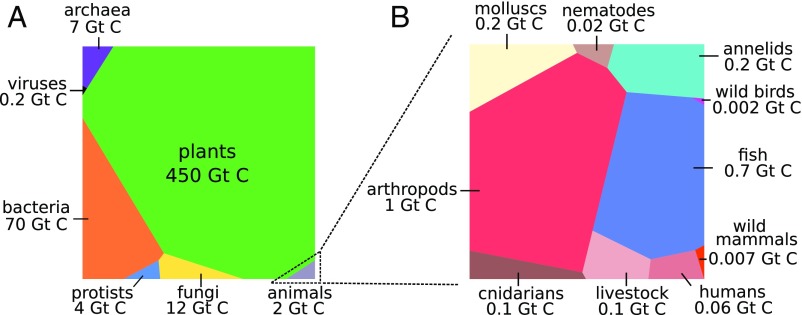
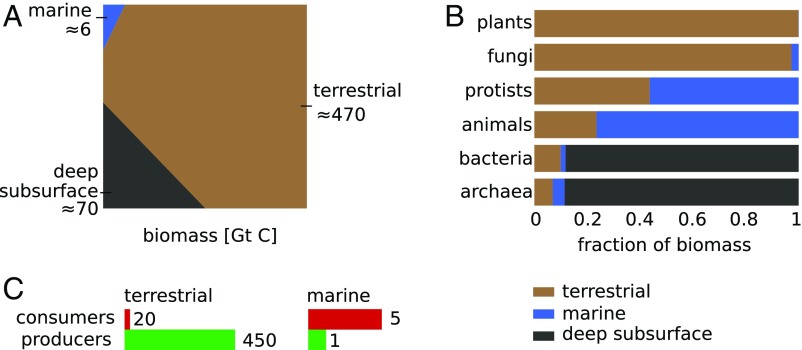
A census of the biomass on Earth is key for understanding the structure and dynamics of the biosphere. However, a global, quantitative view of how the biomass of different taxa compare with one another is still lacking. Here, we assemble the overall biomass composition of the biosphere, establishing a census of the ≈550 gigatons of carbon (Gt C) of biomass distributed among all of the kingdoms of life. We find that the kingdoms of life concentrate at different locations on the planet; plants (≈450 Gt C, the dominant kingdom) are primarily terrestrial, whereas animals (≈2 Gt C) are mainly marine, and bacteria (≈70 Gt C) and archaea (≈7 Gt C) are predominantly located in deep subsurface environments. We show that terrestrial biomass is about two orders of magnitude higher than marine biomass and estimate a total of ≈6 Gt C of marine biota, doubling the previous estimated quantity. Our analysis reveals that the global marine biomass pyramid contains more consumers than producers, thus increasing the scope of previous observations on inverse food pyramids. Finally, we highlight that the mass of humans is an order of magnitude higher than that of all wild mammals combined and report the historical impact of humanity on the global biomass of prominent taxa, including mammals, fish, and plants.
Overview
CoChat Summary
TL;DR
The paper assembles a global census of biomass across all kingdoms of life, estimating Earth’s total biomass at ≈550 Gt C, dominated by plants. It also compares biomass across environments and trophic modes, highlighting large uncertainties and human impacts on the biosphere.
Key findings
- Total global biomass is ≈550 Gt C, with plants ≈450 Gt C (≈80%), bacteria ≈70 Gt C (≈15%), fungi ≈12 Gt C, archaea ≈7 Gt C, protists ≈4 Gt C, animals ≈2 Gt C, and viruses ≈0.2 Gt C.
- Land biomass (≈470 Gt C) is about two orders of magnitude higher than marine biomass (≈6 Gt C); the deep subsurface holds ≈15% of total biomass, chiefly bacteria and archaea.
- In the ocean, ≈1 Gt C of primary producers supports ≈5 Gt C of consumer biomass, an inverted standing biomass distribution; marine biomass is ≈70% microbes, mainly bacteria and protists.
- Human-associated biomass is large relative to wild vertebrates: humans ≈0.06 Gt C, livestock ≈0.1 Gt C, wild mammals ≈0.007 Gt C, domesticated poultry ≈0.005 Gt C versus wild birds ≈0.002 Gt C; total plant biomass has declined approximately twofold relative to pre-human civilization.
Methods
- The authors synthesize hundreds of studies and generate estimates for major taxonomic groups, reporting biomass as gigatons of carbon (Gt C) and using a kingdom-level framework plus viruses.
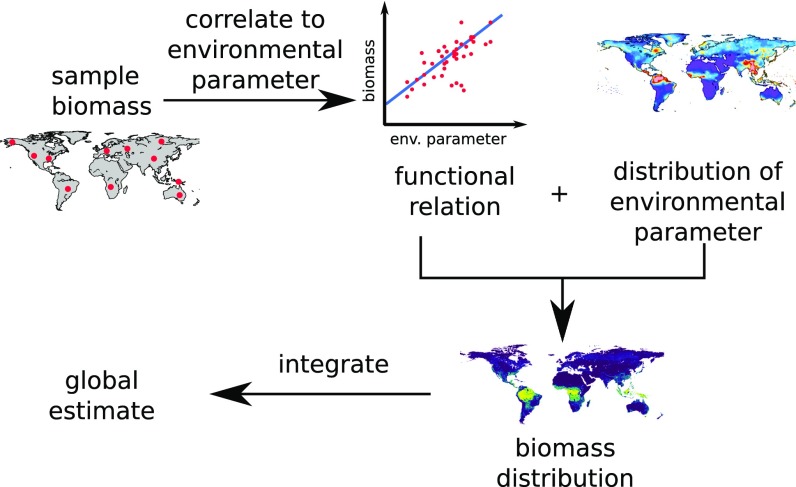
- For many taxa, local biomass samples are extrapolated globally by correlating biomass density with environmental parameters known at global scale; best estimates often use a geometric mean of independent estimates.
- Uncertainty is reported as multiplicative fold-change projections akin to 95% confidence intervals, incorporating intrastudy, interstudy, and intermethod variation; data and code are open-sourced.
Limitations
- The paper states that most datasets rely on fragmentary sampling, causing large uncertainties; sampling is scarce in the deep ocean (usually deeper than 200 m) and deep soil (usually deeper than 1 m), and some estimates may be biased by sampling toward high-abundance areas.
- The paper states that deep subsurface environments have particularly high uncertainty and unknown systematic biases, including unresolved distribution of biomass between aquifer fluids and rocks and among microbial taxa.
- The paper states that current and prehuman vertebrate biomass estimates are only a crude first step, amphibians remain poorly characterized, and parasite biomass is not resolved from hosts; evident from the text, kingdom-level grouping was chosen because much data lack finer taxonomic detail, and some uncertainty projections rely on analogous taxa or expert consultation.
Model-written summary. Check it against the paper before relying on it.
Integrity signals
Registry
Cites
Statistics
Figures
Verification
Claims the paper makes
9 Valid · 7 Not valid · 16 Not checked · 53 Own results and interpretations
Every source the paper cites for this claim was checked and supports it.
In the paper
“The biomass of amphibians, which are experiencing a dramatic population decline (42), remains poorly characterized.”
§ The biomass distribution on Earth > Discussion
What the sources say
- Supportedcites [42] Wake DB Vredenburg VT 2008 Colloquium paper: Are we in the midst of the sixth mass extinction? A view from the world of amphibians Proc Natl Acad Sci USA 105 11466 11473 18695221 PMC2556420 source
The citation is attached to the clause about amphibian population decline, not the separate statement that their biomass is poorly characterized. The passage reporting the Global Amphibian Assessment (labeled Abstract in our copy) says that 43% of amphibian species have declining populations. (LLM, conf=0.92)
plain- Asserted: passes — The authors put it forward as true.
- Checkable: passes — It can be checked against evidence.
- Load-bearing: unclear — It is unclear whether the paper’s conclusions depend on it.
- Based: passes — The paper gives a reason why it holds.
- Supported
Every source the paper cites for this claim was checked and supports it.
In the paper
“In the case of prokaryotes, some major improvements were recently realized, with global estimates of marine deep subsurface prokaryote biomass reduced by about two orders of magnitude due to an increased diversity of sampling locations (7).”
§ The biomass distribution on Earth > Discussion
What the sources say
- Supportedcites [7] Kallmeyer J Pockalny R Adhikari RR Smith DC D’Hondt S 2012 Global distribution of microbial abundance and biomass in subseafloor sediment Proc Natl Acad Sci USA 109 16213 16216 22927371 PMC3479597 source
The Discussion reports a revised subseafloor microbial biomass estimate of 4.1 Pg C versus a previous estimate of 303 Pg C—about a 74-fold reduction. It also identifies a more geographically diverse sampling database, including low-abundance ocean gyres, as a reason the new estimate is lower. The paper identifies other contributing factors as well. (LLM, conf=0.88)
plainstates a cause- Asserted: passes — The authors put it forward as true.
- Checkable: passes — It can be checked against evidence.
- Load-bearing: unclear — It is unclear whether the paper’s conclusions depend on it.
- Based: passes — The paper gives a reason why it holds.
- Supported
The sources with a verdict support this claim; the rest weren’t checked yet, have no full text we could read, or their verdicts aren’t rated yet.
In the paper
“Such inverted biomass distributions can occur when primary producers have a rapid turnover of biomass [on the order of days (34)], while consumer biomass turns over much more slowly [a few years in the case of mesopelagic fish (35)].”
§ The biomass distribution on Earth > Results > The Distribution of Biomass Across Environments and Trophic Modes.
What the sources say
- Supportedcites [34] Zubkov MV 2014 Faster growth of the major prokaryotic versus eukaryotic CO2 fixers in the oligotrophic ocean Nat Commun 5 3776 24777140 PMC4015317 source
The Results (Comparison of the growth rates of the CO2 fixers; page unavailable) report growth rates of 0.1–0.6 per day for the studied oceanic primary producers, consistent with biomass turnover on the order of days. The few-years estimate for mesopelagic fish is assigned to a different citation, not this source. (LLM, conf=0.91)
- Not checked — no full text of the sourcecites [35] Catul V Gauns M Karuppasamy PK 2011 A review on mesopelagic fishes belonging to family Myctophidae Rev Fish Biol Fish 21 339 354 source
plainstates a possible cause- Asserted: passes — The authors put it forward as true.
- Checkable: passes — It can be checked against evidence.
- Load-bearing: passes — The paper’s conclusions depend on it.
- Based: passes — The paper gives a reason why it holds.
- Supported
The cited sources support only part of this claim — read each source’s verdict below.
In the paper
“Combining data from independent sources such as these enables a robust assessment of the total plant biomass (17).”
§ The biomass distribution on Earth > Results > The Uncertainty Associated with Global Biomass Estimates.
What the sources say
- Partly supportedcites [17] Erb K-H 2017 Unexpectedly large impact of forest management and grazing on global vegetation biomass Nature 553 73 76 29258288 PMC5756473 sourceExperimental — accuracy not yet measured
The Methods describe combining multiple datasets and types of evidence to estimate global vegetation biomass stocks. But the paper also says global stocks remain uncertain, reports uncertainty ranges around 35% of the median estimate, and describes more robust estimates as a future prospect. It therefore supports the use of independent sources for an assessment, but not the unqualified characterization of that assessment as robust. (LLM, conf=0.84)
plainstates a cause- Asserted: passes — The authors put it forward as true.
- Checkable: passes — It can be checked against evidence.
- Load-bearing: passes — The paper’s conclusions depend on it.
- Based: passes — The paper gives a reason why it holds.
- Partly supported
A result the paper states — it cites no source for it, so there is none to check. The quote shows it is in the paper.
In the paper
“Plant biomass includes ≈70% stems and tree trunks, which are mostly woody, and thus relatively metabolically inert.”
§ The biomass distribution on Earth > Results > The Biomass Distribution of the Biosphere by Kingdom.
plain- Asserted: passes — The authors put it forward as true.
- Checkable: passes — It can be checked against evidence.
- Load-bearing: unclear — It is unclear whether the paper’s conclusions depend on it.
- Based: passes — The paper gives a reason why it holds.
27 more claims
Create a free account to see all 85 claims and to verify the 2 references still open.
- It may state two separate claims as one. 32
- Probably not a substantial claim. 28
Claims other papers make about this one
Each is checked against this paper’s own text: does it say what the citing paper says it does?
The cited source doesn’t support the claim as written.
In the citing paper
“and less than 10% that of the world ' s current human population ( 52 ).”
From Pervasive human-driven decline of life on Earth points to the need for transformative change (2019) · cites this paper as [52]
Checked by a reasoning model — may be wrong.
Experimental — accuracy not yet measuredThe cited source says what the claim attributes to it.
In the citing paper
“Approximately 450 Gt of C is bound up in terrestrial biota, primarily in plants (86), while only ~6 Gt of C is found in ocean biota (87).”
From Earth beyond six of nine planetary boundaries (2023) · cites this paper as [87]
The cited source says what the claim attributes to it.
In the citing paper
“The amount of metabolic energy available to a biosphere powered by O 2 is vast, such that the O 2 -rich ocean-atmosphere system of the modern Earth supports staggering levels of standing biomass (Bar-On et al. 2018), energy flow (Falkowski et al. 2008), and ecological complexity (Steele 1974).”
From The History of Ocean Oxygenation (2022) · cites this paper as Bar-On et al. 2018
In the citing paper
“Global populations of domestic ruminants (cattle, sheep, and goats) (Ripple et al. 2013) poultry, and pigs (Bennett et al. 2018) used to feed the growing human population now exceed 100 million tons of carbon (Bar-On et al. 2018), and livestock populations are growing rapidly.”
From Scientists’ warning to humanity on the freshwater biodiversity crisis (2021) · cites this paper as Bar-On et al. 2018
Citations
Cites
The worldwide leaf economics spectrum
Wright, I. J., Reich, P. B., Westoby, M., Ackerly, D. D., Baruch, Z., Bongers, F., Cavender-Bares, J., Chapin, T., Cornelissen, J. H. C., Diemer, M., et al. (2004) · Nature · doi:10.1038/nature02403 · Cited by 9,021 · cited 1×
“We then convert the total area of leaves to an estimate of the total dry mass of leaves by using the Glopnet database (24), which measured leaf mass per area (LMA) for ≈2500 plant species.”
MethodA large and persistent carbon sink in the world’s forests
Pan, Y., Birdsey, R. A., Fang, J., Houghton, R., Kauppi, P. E., Kurz, W. A., Phillips, O. L., Shvidenko, A., Lewis, S. L., Canadell, J. G., et al. (2011) · Science · doi:10.1126/science.1201609 · Cited by 8,458
Soil Sampling and Methods of Analysis
(2007) · CRC Press eBooks · doi:10.1201/9781420005271 · Cited by 6,469
Primary production of the biosphere: Integrating terrestrial and oceanic components
Field, C. B., Behrenfeld, M. J., Randerson, J. T., & Falkowski, P. (1998) · Science · doi:10.1126/science.281.5374.237 · Cited by 6,371
Prokaryotes: The unseen majority
Whitman, W. B., Coleman, D. C., & Wiebe, W. J. (1998) · Proceedings of the National Academy of Sciences · doi:10.1073/pnas.95.12.6578 · Cited by 4,871
Global effects of land use on local terrestrial biodiversity
Newbold, T., Hudson, L. N., Hill, S. L. L., Contu, S., Lysenko, I., Senior, R. A., Börger, L., Bennett, D. J., Choimes, A., Collen, B., et al. (2015) · Nature · doi:10.1038/nature14324 · Cited by 4,352
Belowground biodiversity and ecosystem functioning
Bardgett, R. D., & van der Putten, W. H. (2014) · Nature · doi:10.1038/nature13855 · Cited by 3,990 · cited 4×
“This was recommended by experts in the field for estimation of arbuscular mycorrhizal fungi abundance (117).”
BackgroundInfluentialMangroves among the most carbon-rich forests in the tropics
Donato, D. C., Kauffman, J. B., Murdiyarso, D., Kurnianto, S., Stidham, M., & Kanninen, M. (2011) · Nature Geoscience · doi:10.1038/ngeo1123 · Cited by 3,374
Poorter, H., Niklas, K. J., Reich, P. B., Oleksyn, J., Poot, P., & Mommer, L. (2012) · New Phytologist · doi:10.1111/j.1469-8137.2011.03952.x · Cited by 3,163 · cited 1×
“The first relies on a meta-analysis of the biomass allocation to different plant compartments across biomes (19).”
BackgroundA global analysis of root distributions for terrestrial biomes
Jackson, R. B., Canadell, J., Ehleringer, J. R., Mooney, H. A., Sala, O. E., & Schulze, E. D. (1996) · Oecologia · doi:10.1007/bf00333714 · Cited by 3,071 · cited 4×
“assumed the distribution of microbial biomass with depth follows the biomass density versus depth profile of root biomass (21).”
BackgroundMethodInfluential
Research works printed but not linked: 1
- Chapman AD 2009 Numbers of Living Species in Australia and the World Australian Biological Resources Study Canberra, Australia
Cited by
Items 2,001–2,100 of 3,743
Seasons of sustenance: unveiling the dietary patterns of Mongolian saiga and livestock
Chuluunbat, B., Batbayar, N., Buuveibaatar, B., Batsaikhan, N., Ochirjav, M., Bayandonoi, G., & Bayartogtokh, B. (2025) · Mammalian Biology · doi:10.1007/s42991-025-00482-2 · Cited by 5
“However, live-stock now dominate terrestrial mammal biomass (Bar-On et al. 2018), placing significant pressure on the ecosystem services and functions that these animals provide (Hempson et al. 2017).”
Oliveira, L. Z., McRoberts, R. E., Vibrans, A. C., et al. (2025) · Forestry An International Journal of Forest Research · doi:10.1093/forestry/cpaf008 · Cited by 3
Shear and Bulk Viscosities of Water up to 1.6 GPa and Anomaly in the Structural Relaxation Time
Eichler, J., Stefanski, J., Martín‐Roca, J., Daniel, I., Issenmann, B., Valeriani, C., & Caupin, F. (2025) · Physical Review Letters · doi:10.1103/physrevlett.134.134101 · Cited by 7
“[6] (empty blue circles), [9] (empty green squares), [10] (filled orange diamonds), and the curves equations from Refs.”
InfluentialMulti‐host pathogen transmission and the disease–diversity relationship
Toorians, M. E. M., Davies, T. J., & MacPherson, A. (2025) · Biological reviews/Biological reviews of the Cambridge Philosophical Society · doi:10.1111/brv.70027 · Cited by 6
Schroer, H. W., Markland, K. M., Ling, F., & Just, C. L. (2025) · Environmental Science & Technology · doi:10.1021/acs.est.5c03155 · Cited by 4
Schröer, L., Balcaen, T., Folens, K., et al. (2025) · Water Research · doi:10.1016/j.watres.2025.124152 · Cited by 3
Ромаданова, Н. В., Altayeva, N. A., Zemtsova, A. S., Artimovich, N. A., Shevtsov, A., Kakimzhanova, A., Nurtaza, A., Tolegen, A. B., Kushnarenko, S. V., & Bettoni, J. C. (2025) · Plants · doi:10.3390/plants14152333 · Cited by 3
“According to Bar-On et al. [18], approximately 40% of the planet’s total biomass (around 220 gigatons of carbon biomass) has been lost in the last few thousand years.”
Cicada as a food for mammals: a global review and implications for mammal behaviour and populations
Tomita, K. (2025) · Wildlife Biology · doi:10.1002/wlb3.01496 · Cited by 3
Carbon drawdown by algal blooms during Antarctic Cold Reversal from sedimentary ancient DNA
Weiß, J. F., Herzschuh, U., Müller, J., Liang, J., Vorrath, M.-E., Perfumo, A., & Stoof‐Leichsenring, K. R. (2025) · Nature Geoscience · doi:10.1038/s41561-025-01761-w · Cited by 6
“45,46 .”
Kang, H. S., Tong, X., Mariette, A., Leong, M., Beahan, C. T., Flores‐Sandoval, E., Pedersen, G. B., Rautengarten, C., Bowman, J. L., Ebert, B., et al. (2025) · The Plant Journal · doi:10.1111/tpj.70439 · Cited by 6
“It is the most abundant source of biomass on Earth and is important as a source of food, and fuel (Bar-On et al., 2018).”
Effect of Process Parameters and Biomass Type on Properties of Carbon Produced by Pyrolysis
Chakraborty, S., Aktay, N., Alptekin, F. M., Çeliktaş, M. S., & Dunford, N. T. (2025) · Biomass · doi:10.3390/biomass5030052 · Cited by 5
Musciano, M. D., Zannini, P., Testolin, R., Sabatini, F. M., Santovito, D., Jiménez‐Alfaro, B., Jansen, F., Chytrý, M., Ricci, L., Agrillo, E., et al. (2025) · Conservation Biology · doi:10.1111/cobi.70158 · Cited by 8
“Among the different components of biodiversity, plants deserve particular attention because they account for the vast majority of Earth’s biomass (Bar-On et al., 2018), form the base of nearly all food webs, and are critical to ecosystem functioning and the delivery of essential ecosystem services,…”
On the plant growth versus defense antagonism: Past, present and future
Campos, M. L. (2025) · Acta Botanica Brasilica · doi:10.1590/1677-941x-abb-2025-0002 · Cited by 3
Single-particle genomics uncovers abundant non-canonical marine viruses from nanolitre volumes
Weinheimer, A., Brown, J. M., Thompson, B., Leonavičienė, G., Kiseliovas, V., Jocys, S., Munson-McGee, J. H., Gavelis, G. S., Mascena, C. J., Mažutis, L., et al. (2025) · Nature Microbiology · doi:10.1038/s41564-025-02167-5 · Cited by 8
The use of “whose” with nonhuman animals: an ecolinguistic exploration
Zhu, C., Jacobs, G. M., Cao, X., Tatin, I. A. G., Li, L., Li, H., & Chau, M. H. (2025) · Language Sciences · doi:10.1016/j.langsci.2025.101772 · Cited by 5
Dijkstra, J. P., Søreide, J. E., Schott, L., Thomsen, N., Reinardy, H. C., Lutier, M., & Dinh, K. V. (2026) · Global Change Biology Communications · doi:10.1002/gcb4.70022 · Cited by 5
Aging of Phosphorylated Cellulose Nanofibers under Moist-Heat Conditions
Sakiyama, A., Saito, T., Moores, A., et al. (2025) · Biomacromolecules · doi:10.1021/acs.biomac.5c01635 · Cited by 3
Vita, N., Holmière, M., Mejia-Otalvaro, F., Debard, F., Degeilh, L., Gagnot, S., Crônier, D., Habrant, A., Pion, F., Denis, Y., et al. (2025) · Communications Biology · doi:10.1038/s42003-025-09287-y · Cited by 4
Challenges of the Demographic Transition in the Twenty-First Century
Vial, J. C. (2026) · Integrated science · doi:10.1007/978-3-032-12263-6_5 · Cited by 4
Chen, P., Taylor, J. W., & Gao, C. (2026) · iMetaOmics. · doi:10.1002/imo2.70087 · Cited by 3
Rodríguez, P. P. I., Odelius, K., & Hakkarainen, M. (2026) · Biomacromolecules · doi:10.1021/acs.biomac.5c02467 · Cited by 4
Atypical endo-β-1,4-mannanases are necessary for normal glucomannan synthesis in Arabidopsis
Kikuchi, A., Sato, E., Yoshimi, Y., et al. (2026) · PLANT PHYSIOLOGY · doi:10.1093/plphys/kiag174 · Cited by 3
“Understanding the mechanism for their synthesis is thus indispensable for their efficient production and utilization (Bar-on et al. 2018).”
Ramón‐Laca, A., Nichols, K. M., Parsons, K. M., Gallego, R., Vieites, D. R., Doadrio, I., & Riesgo, A. (2026) · Journal of Fish Biology · doi:10.1111/jfb.70484 · Cited by 3
“In the case of environmental samples from fisheries sampling campaigns, these non-target species will be mainly microbial (mostly bacteria and among the small fraction of eukaryotic DNA, phytoplankton is the most abundant source of DNA) (Bar-On et al., 2018; Stat et al., 2017).”
Recent advances in the structural biology of photosystem II
Murray, J. W. (2026) · The Plant Journal · doi:10.1111/tpj.70925 · Cited by 9
Global density and biomass of arbuscular mycorrhizal fungal networks
Stewart, J. D., Bisot, C., Cargill, R. I. M., Nuland, M. E. V., Hawkins, H., Gálvez, L. O., Klein, M., van Son, M., Terry, V., Paré, L., et al. (2026) · Science · doi:10.1126/science.adu4373 · Cited by 11
PlantCAD2: A DNA foundation model for interpreting genomes across flowering plants
Zhai, J., Gokaslan, A., Hsu, S.-K., Chen, S.-P., Liu, Z.-Y., Marroquin, E., Czech, E., Cannon, B. R., Berthel, A., Romay, M. C., et al. (2026) · Cell Genomics · doi:10.1016/j.xgen.2026.101329 · Cited by 31
Chronic Postoperative Pain and Microorganisms: The Good, the Bad, and the Ugly
Wang, E. J., & Cohen, S. P. (2022) · Anesthesia & Analgesia · doi:10.1213/ane.0000000000005769 · Cited by 3
Grabowska, K., Bukowska, A., Siuda, W., et al. (2022) · Aquatic Microbial Ecology · doi:10.3354/ame01988 · Cited by 3
Nuppunen-Puputti, M., Kietäväinen, R., Kukkonen, I., & Bomberg, M. (2023) · Frontiers in Microbiology · doi:10.3389/fmicb.2023.1054084 · Cited by 4
Electron transfer processes between microbes and electrodes in bioelectrochemical reactors
Conners, E. M., Davenport, E. J., Gallagher, B. M., III, & Bose, A. (2023) · Elsevier eBooks · doi:10.1016/b978-0-323-95124-1.00017-6 · Cited by 3
Potential dependence of gluconic acid to glucose electroreduction on silver
Wolfsgruber, M., Patil, P., Pichler, C. M., Bischof, R. H., Budnyk, S., Paulik, C., Rodrigues, B. V. M., & Slabon, A. (2023) · Catalysis Science & Technology · doi:10.1039/d3cy00897e · Cited by 3
Dynamics and drivers of fungal communities in a multipartite ant-plant association
Barrajon-Santos, V., Nepel, M., Hausmann, B., Voglmayr, H., Woebken, D., & Mayer, V. E. (2024) · BMC Biology · doi:10.1186/s12915-024-01897-y · Cited by 5
Biomass: Potential Sources, Abundance, and Distribution
Anju, T. R., Theresa, M., & Lazar, L. (2024) · Springer eBooks · doi:10.1007/978-981-99-6727-8_2 · Cited by 4
Penitentiaries: Bringing microbiological literacy to the fringes of society
de Lorenzo, V. (2024) · Microbial Biotechnology · doi:10.1111/1751-7915.70052 · Cited by 4
“The talk typically progresses by presenting data on the percentage of microbial biomass (i.e. live agency) on the globe (Bar-On et al., 2018) leading to the conclusion that Earth is fundamentally a microbial sphere and we humans are but a recent, transient accident in planetary history.”
Dynamics and resilience of earthworm fecal microbiomes under distinct feeding regimes
Pan, Z., Hědenec, P., Lin, Q., Li, L., Alias, A., Deng, F., & Frouz, J. (2024) · Applied Soil Ecology · doi:10.1016/j.apsoil.2024.105846 · Cited by 3
Cassales, G. W., Salekin, S., Lim, N., Meason, D. F., Bifet, A., Pfahringer, B., & Frank, E. (2025) · Ecological Informatics · doi:10.1016/j.ecoinf.2025.103014 · Cited by 6
Linking plant genes to arthropod community dynamics: current progress and future challenges
Barbour, M. A., & Pérez-López, C. B. (2025) · Plant and Cell Physiology · doi:10.1093/pcp/pcaf015 · Cited by 6
“Plants comprise the majority of biomass on Earth (Bar-On et al. 2018) and form the base of diverse terrestrial food webs.”
Birhanu, M. Z., Tadesse, M. G., Bachheti, R. K., Ahmed, I. N., & Bachheti, A. (2025) · Journal of Chemistry · doi:10.1155/joch/1053700 · Cited by 6
Atencio, B., Malavin, S., Rubin‐Blum, M., Ram, R., Adar, E., & Ronen, Z. (2025) · Frontiers in Microbiology · doi:10.3389/fmicb.2025.1533115 · Cited by 3
Kumar, V., SANDHU, S. S., Kaur, P., Kaur, S., Walia, S. S., & Gill, K. K. (2025) · Journal of Agronomy and Crop Science · doi:10.1111/jac.70063 · Cited by 4
Sea‐Ice Retreat From the Northeast Greenland Continental Shelf Triggers a Marine Trophic Cascade
Laverick, J. H., Speirs, D. C., & Heath, M. R. (2025) · Global Change Biology · doi:10.1111/gcb.70189 · Cited by 4
“Once again this is in keeping with broader theory (Heath et al. 2014; Libralato et al. 2014) as well as observations on the distribution of mass (Bar-On et al. 2018; Burgess and Gaines 2018) and bottom-up trophic cascades in other systems (Kagata and Ohgushi 2006).”
Below the leaves: Integrating above‐ and below‐ground phenology for earth‐system predictability
Morris, K. A., & Nair, R. K. F. (2025) · Functional Ecology · doi:10.1111/1365-2435.70057 · Cited by 6
Dating the Origin and Spread of Plastids and Chromatophores
Pietluch, F., Mackiewicz, P., Sidorczuk, K., & Gagat, P. (2025) · International Journal of Molecular Sciences · doi:10.3390/ijms26125569 · Cited by 5
Collins, J. R., Cape, M., Boenish, R., Benitez‐Nelson, C. R., Doney, S. C., Fujita, R. M., Gaines, S. D., Gruby, R. L., Jin, D., Kim, H., et al. (2025) · Global Biogeochemical Cycles · doi:10.1029/2024gb008393 · Cited by 9
Filamentous fungi control multiphase flow and fluid distribution in porous media
Lee, S. H., Moura, M., Srivastava, S., Santelli, C. M., & Kang, P. K. (2025) · Nature Physics · doi:10.1038/s41567-025-03020-6 · Cited by 5
A genetic toolbox for marine protists
Brown, M. W., & Tice, A. K. (2020) · Nature Methods · doi:10.1038/s41592-020-0794-z · Cited by 2
Hernández, N., & Cochran, E. W. (2020) · ACS symposium series · doi:10.1021/bk-2020-1372.ch002 · Cited by 3
IMPACTOS SOCIOAMBIENTAIS E A PANDEMIA DO NOVO CORONAVÍRUS
Nascimento, R. C. D., Amaral, A. R. P., & SILVA, M. R. D. O. (2020) · Holos · doi:10.15628/holos.2020.11015 · Cited by 29
Sharma, V., Malla, M. A., Kori, R. K., Yadav, R. S., & Azam, Z. (2021) · The Open Microbiology Journal · doi:10.2174/1874285802115010177 · Cited by 7
Cryptic metabolisms in anoxic subseafloor sediment
Garber, A. I., Ramírez, G. A., McAllister, S. M., Orsi, W. D., & D'Hondt, S. L. (2021) · Environmental Microbiology Reports · doi:10.1111/1758-2229.12983 · Cited by 3
Human-Made Risks and Climate Change with Global Heating
Adams, J. C., & Engel, J. (2021) · Springer eBooks · doi:10.1007/978-3-030-59075-8_8 · Cited by 3
Average Utilitarianism Implies Solipsistic Egoism
Tarsney, C. J. (2021) · Australasian Journal of Philosophy · doi:10.1080/00048402.2021.1962375 · Cited by 3
Developmental instability in domesticated mammals
Wilson, L. A. B. (2021) · Journal of Experimental Zoology Part B Molecular and Developmental Evolution · doi:10.1002/jez.b.23108 · Cited by 3
Aresta, M. (2022) · Molecules · doi:10.3390/molecules27072223 · Cited by 4
“Atmospheric CO2 750 Biosphere [4] 550–560 Plants 450–460 Animals 2 (Humans 0.06) Bacteria 70 Archaea 7 Fungi 12 Protists 4 Viruses 0.2 Carbonate rocks a (sediments) [5] 1.8 × 10⁹ Fossil carbon [1] Coal 607 Oil 167 Natural Gas 167 CO2 deposits (degas rate 0.1 GtC/y) 30,000 Ocean deep floor [6] 37,000 a During the Phane…”
InfluentialSoil Inorganic Carbon Stocks in Terrestrial Biomes
Lorenz, K. E., & Lal, R. (2022) · Springer eBooks · doi:10.1007/978-3-030-95193-1_4 · Cited by 4
Phototrophic microbial fuel cells
Greenman, J., Walter, X. A., Gajda, I., You, J., Mendis, A., & Ieropoulos, I. A. (2022) · Elsevier eBooks · doi:10.1016/b978-0-323-90971-6.00007-3 · Cited by 4
Marine Biomaterials: Resources, Categories, and Applications
Ibrahim, H. A. H., El-Sayed, W. M. M., & El-Sheekh, M. M. (2022) · Springer eBooks · doi:10.1007/978-981-16-5374-2_1 · Cited by 12
Pentinat, S. B. (2023) · Revista iberoamericana de estudios de desarrollo = Iberoamerican journal of development studies · doi:10.26754/ojs_ried/ijds.737 · Cited by 8
Comparison of Biomass of Exotic and Native Mammals Between Temperate and Tropical Forests of Mexico
Munguía‐Carrara, M., Schmidt, M. F., Sierra, R., López, J. C., & Valenzuela‐Galván, D. (2023) · Springer eBooks · doi:10.1007/978-3-031-17277-9_23 · Cited by 3
Mexican Terrestrial Mammals in the Anthropocene
Lara‐Díaz, N. E., Díaz, J. L. R., Hidalgo‐Mihart, M. G., & González, C. A. L. (2023) · Springer eBooks · doi:10.1007/978-3-031-17277-9_10 · Cited by 4
Observations on phenomenological changes in Klebsiella Pneumoniae under fluidic stresses
Jain, S., Singh, A., Tiwari, N., Naik, A., Chatterjee, R., Chakravortty, D., & Basu, S. (2023) · Soft Matter · doi:10.1039/d3sm01521a · Cited by 4
Harnessing Plant Sugar Metabolism for Glycoengineering
Tang, S. N., Barnum, C. R., Szarzanowicz, M. J., Sirirungruang, S., & Shih, P. M. (2023) · Biology · doi:10.3390/biology12121505 · Cited by 4
The Violent Narrowing of Animal Life
Weis, T. (2023) · Animal studies journal · doi:10.14453/asj/v12i2.7 · Cited by 3
Phytoplasma Diseases of Trees: A Comprehensive Review
Mall, S., Gaur, R. K., Vishwakarma, R., & Marcone, C. (2026) · RASSA Journal of Science for Society · doi:10.5958/2583-3715.2026.00003.1 · Cited by 2
de Araújo, E. A., Cortez, A. A., Pellegrini, V. D. O. A., Vacilotto, M. M., Cruz, A. F., Batista, P. R., & Polikarpov, I. (2024) · Carbohydrate Polymers · doi:10.1016/j.carbpol.2023.121739 · Cited by 3
da Costa, M. G., Soares, L. M. D. S., Araújo, M. D. F. V., de Oliveira, R. R., & da Conceição, G. M. (2024) · Revista de Gestão Social e Ambiental · doi:10.24857/rgsa.v18n4-074 · Cited by 3
Considerations for Detecting Organic Indicators of Metabolism on Enceladus
Barge, L. M., & Fournier, G. P. (2024) · Astrobiology · doi:10.1089/ast.2023.0074 · Cited by 7
“Such life could have grown heterotrophically (the way most marine biomass does on Earth today) (Bar-On et al ., 2018) or via partial C fixation pathways, taking up C sources where reduction to an organic form was enzymatically easier than the multiple reductive steps from CO 2 .”
Eating beside Ourselves: Thresholds of Foods and Bodies
Paxson, H., & Duke University (2023) · Duke University Press eBooks · doi:10.1515/9781478093114 · Cited by 10
Jones, A., McCulloch, S., & Reiss, M. J. (2024) · Research in Science & Technological Education · doi:10.1080/02635143.2024.2335229 · Cited by 5
“As such, we are now in a situation where farmed animals account for 60% of all mammals by mass (Bar-On, Phillips, and Milo 2018), with the collective mass of wild mammals having declined by 80% since 1970 (IPBES 2019).”
Insight into the autoproteolysis mechanism of the RsgI9 anti‐σ factor from Clostridium thermocellum
Takayesu, A., Mahoney, B. J., Goring, A. K., et al. (2024) · Proteins Structure Function and Bioinformatics · doi:10.1002/prot.26690 · Cited by 3
Donner, E., Magalhães, R. J. S., Barnes, A. C., Jex, A. R., Jarocki, V. M., Drigo, B., Djordjevic, S. P., & Ashbolt, N. J. (2024) · Microbiology Australia · doi:10.1071/ma24021 · Cited by 3
Earth system carbon cycle dynamics through time
Hain, M. P., Allen, K. A., & Turner, S. K. (2024) · Elsevier eBooks · doi:10.1016/b978-0-323-99762-1.00080-2 · Cited by 8
Prosser, R. S., & Brain, R. A. (2024) · Environmental Science and Pollution Research · doi:10.1007/s11356-024-34349-9 · Cited by 3
“With an estimated biodiversity of ~ 500,000 species (Corlett 2016), kingdom Plantae (angiosperms, gymnosperms, ferns, lycophytes, and bryophytes) represents approximately 80% of the biomass on Earth (Bar-On et al. 2018).”
BackgroundBattistelli, A., Proietti, S., Paglialunga, G., Mattioni, M., Nazzaro, F., Fratianni, F., Colla, G., Cardarelli, M., Bianco, M. D., & Moscatello, S. (2025) · Heliyon · doi:10.1016/j.heliyon.2025.e42112 · Cited by 6
Hohmann‐Marriott, M. F. (2025) · PLoS ONE · doi:10.1371/journal.pone.0313598 · Cited by 3
Browning, H., & Veit, W. (2025) · doi:10.1093/9780191979972.003.0028 · Cited by 3
Balucani, N. (2019) · Physics of Life Reviews · doi:10.1016/j.plrev.2019.03.006 · Cited by 3
Scientist Warning on Why you Should Consume Less; Even if Wider Society Doesn’t
Haswell, P. M. (2021) · Nature and Culture · doi:10.3167/nc.2021.160302 · Cited by 4
Auffret, A. G., Ekholm, A., Hämäläinen, A., et al. (2021) · AoB Plants · doi:10.1093/aobpla/plab079 · Cited by 3
Richardson, K., & Rosing, M. T. (2023) · Mathematics online first collections · doi:10.1007/16618_2023_70 · Cited by 3
Evolution of placentation in cattle and antelopes.
Carter, A. M. (2020) · PubMed Central · doi:10.21451/1984-3143-ar2018-00145 · Cited by 3
“Cattle, buffaloes, sheep and goats account for around 80% of livestock (Bar-On, Phillips, and Milo, 2018) and are of great cultural and economic importance (Clutton-Brock, 2012).”
BackgroundInfluentialBiotransformation and Potential Adverse Effects of Rare Earth Oxide Nanoparticles
Hwang, R., Chang, C. H., Zhu, Y., & Xia, T. (2019) · Springer eBooks · doi:10.1007/978-3-662-59600-5_2 · Cited by 3
Estudio de un proceso de aprendizaje en ciencias experimentales a partir de la Teoría del Caos
Pacheco, P. R. (2020) · Formación universitaria · doi:10.4067/s0718-50062020000300077 · Cited by 4
“…de la inventiva, la técnica y el consumo asociado, ha terminado adquiriendo una impronta de sobre exigencia extrema para el ecosistema del planeta (Mock 2013; Espirito-Santo et al., 2014; Moffitt et al., 2015; Paolo et al., 2015;Bar-On et al., 2018) al no sopesar su conectividad entrópica.”
BackgroundHow Thermodynamics Illuminates Population Interactions in Microbial Communities
Seto, M., & Iwasa, Y. (2020) · Frontiers in Ecology and Evolution · doi:10.3389/fevo.2020.602809 · Cited by 4
Animals and Nature: The Co-modification of the Sentient Biosphere
Brügger, P. (2020) · Emerald Group Publishing Limited eBooks · doi:10.1108/s0161-723020200000035003 · Cited by 3
Inspiration of wrinkles in layered material for the mechanism study of several geological activities
Xu, H. X., Yuan, Z., Huang, T., et al. (2020) · Acta Physica Sinica · doi:10.7498/aps.69.20190122 · Cited by 3
Negro, J. J., Blázquez, M. C., Fernández-Alés, R., & Vicente, Á. M. (2021) · Animal Biodiversity and Conservation · doi:10.32800/abc.2021.44.0109 · Cited by 3
“Currently, the biomass of livestock is larger for both mammals (such as cattle, sheep, goats, horses and pigs) and birds (poultry) than for all wild mammals and birds combined (Bar–On et al., 2018).”
BackgroundEcosystem structure and function
Schowalter, T. D. (2022) · Elsevier eBooks · doi:10.1016/b978-0-323-85673-7.00004-6 · Cited by 4
Zonations and oscillations via heterotrophic processes in tidal unvegetated aquifers
Yao, Y., Kong, J., Zhang, C., Tang, Z., Shen, C., Luo, Z., Lu, C., Feng, X., & Sun, Y. (2022) · Hydrological Processes · doi:10.1002/hyp.14654 · Cited by 3
“The estimates of all microbial biomass can be generated by multiplying the total number of cells by the characteristic carbon content per cell (Bar-On et al., 2018).”
BackgroundThe Root Causes of Our Environmental Crises We Ignore
Hindin, D. A. (2022) · World-systems evolution and global futures · doi:10.1007/978-3-031-16477-4_1 · Cited by 4
Asefa, A., Reuber, V. M., Miehe, G., Wraase, L., Wube, T., Schabo, D. G., & Farwig, N. (2023) · Ecology and Evolution · doi:10.1002/ece3.10337 · Cited by 2
What Can We Know About That Which We Cannot Even Imagine?
Wolpert, D. H. (2024) · Springer eBooks · doi:10.1007/978-3-031-61187-2_15 · Cited by 6
Iudicone, D. (2020) · Nature Geoscience · doi:10.1038/s41561-020-0535-z · Cited by 3
Chase, W. R., Zhaxybayeva, O., Rocha, J., et al. (2019) · bioRxiv (Cold Spring Harbor Laboratory) · doi:10.1101/637728 · Cited by 3
“Identifying expansin genes in 356 such a phylogenetically and ecologically diverse set of microbial species – including many 357 which have not yet been described as interacting with plants or algae – suggests that the immense 358 amount of global cellulose biomass (1) is an under-recognized selective pressure driving…”
BackgroundCapdevila, P., Beger, M., Blomberg, S. P., et al. (2019) · bioRxiv (Cold Spring Harbor Laboratory) · doi:10.1101/764464 · Cited by 3
“This finding is congruent with the higher species richness 362 (Costello & Chaudhary, 2017) and larger range of species biomass housed in 363 the terrestrial realm (Bar-On et al., 2018).”
ResultMicrobial residents of the Atlantis Massif’s shallow serpentinite subsurfacePreprint
Motamedi, S., Orcutt, B. N., Früh‐Green, G. L., et al. (2019) · bioRxiv (Cold Spring Harbor Laboratory) · doi:10.1101/870956 · Cited by 3
Paul, V. G., & Mormile, M. R. (2020) · Wiley eBooks · doi:10.1002/9781119593096.ch14 · Cited by 6
Predation by protists influences the temperature response of microbial communitiesPreprint
Rocca, J. D., Yammine, A., Simonin, M., & Gibert, J. P. (2021) · bioRxiv (Cold Spring Harbor Laboratory) · doi:10.1101/2021.04.08.439073 · Cited by 3
“However, with a global biomass 200 times larger than that of nematodes (Bar-On et al., 2018), unicellular eukaryotes - collectively known as ‘protists’ - likely play a major role in regulating microbial communities at global scales (Oliverio et al., 2020) through bacterivory (Erktan et al., 2020;…”
BackgroundInfluentialDryden, H., & Duncan, D. (2021) · SSRN Electronic Journal · doi:10.2139/ssrn.3860950 · Cited by 4
Seeber, P. A., von Hippel, B., Kauserud, H., et al. (2021) · bioRxiv (Cold Spring Harbor Laboratory) · doi:10.1101/2021.11.02.462738 · Cited by 3
“Fungi constitute the third-largest kingdom on Earth in terms of biomass, after plants and bacteria (Bar-On et al., 2018), and they have considerable effects on structure and functioning of most ecosystems.”
Background
Metadata
- Authors
- Bar-On, Y. M., Phillips, R., & Milo, R.
- Affiliations
- Department of Plant and Environmental Sciences, Weizmann Institute of Science, 76100 Rehovot, Israel;
- California Institute of Technology (US)
- Weizmann Institute of Science (IL)
- Corresponding author
- Milo, Ron
- Venue
- Proceedings of the National Academy of Sciences
- Publisher
- National Academy of Sciences
- Published
- 2018-05-21
- Volume
- 115
- Issue
- 25
- Pages
- 6506-6511
- ISSN
- 0027-8424 (ISSN-L)
- 1091-6490
- PMC
- PMC6016768
- OpenAlex
- W2804910112
- Cited by
- 3,723
- References
- 263
- Citations by year
- 2026: 349 · 2025: 450 · 2024: 589 · 2023: 617 · 2022: 498 · 2021: 498 · 2020: 419 · 2019: 246 · 2018: 49
- FWCI
- 239.98
- Type
- journal article
- Language
- en
- Open access
- hybrid
- doi.org
- Licence
- Locations
- Proceedings of the National Academy of Sciences (publishedVersion, cc-by-nc-nd)
- Europe PMC (PubMed Central) (publishedVersion, cc-by-nc-nd)
- PubMed Central (publishedVersion, cc-by-nc-nd)
- PubMed (publishedVersion)
- CaltechAUTHORS (California Institute of Technology) (submittedVersion, cc-by-nc-nd)
- Funders
- National Institutes of Health (5r35gm118043-07)
- National Institute of General Medical Sciences (R35 GM118043)
- Topics
- Physical Sciences › Environmental Science › Nature and Landscape Conservation › Ecology and Vegetation Dynamics Studies
- Physical Sciences › Environmental Science › Global and Planetary Change › Earth Systems and Cosmic Evolution
- Life Sciences › Agricultural and Biological Sciences › Soil Science › Soil Carbon and Nitrogen Dynamics
- Keywords
- biomass allocation, biomass carbon, terrestrial biomass, marine biomass, bacteria, archaea, food pyramid, wild mammals, fish biomass, plant biomass
- MeSH terms
- Animals, Archaea, Bacteria, Carbon, Humans, Plants, Ecosystem, Biomass, Earth, Planet, Biota
About these checks
Registry, retraction, Cites and statistics results are computed, not judged, with one exception: a printed reference that no index lists is read once by a model before it counts as a citation error. Claims are extracted by a model and kept only when their quote appears verbatim in the text; each cited source is then checked, with a model’s help, for whether it says what the claim relies on. Those verdicts can be wrong — read the claim’s quote and the cited source before relying on one.
The claim verdicts this report counts are experimental: their accuracy is not yet measured.
A language model drew the claims from the paper on 2026-10-10, under version 3 of the claim definition (model deepseek-v4.1-flash, prompt extract-v3).
A second model labelled each claim on 2026-10-10 (model jev-1.13-20260917, definition revision gold-guideline-v0.2).
Cited sources are checked with a language model’s help (gpt-6-sol).
Statistics and arithmetic are recomputed, not judged.
Confidence bands are shown only for fields calibrated on our annotated test set. None is calibrated yet, so no band is shown.
What counts as a claim ›How we measure confidence ›How we check this ›
Are you an author, or do you see a problem with this page? Request a review
Data sources
Bibliographic data: Semantic Scholar, OpenAlex, Crossref.
Contains information from the Semantic Scholar Academic Graph Datasets, made available under the ODC Attribution License (ODC-BY 1.0).
Semantic Scholar’s data is described in: Kinney, R., et al. (2023). The Semantic Scholar Open Data Platform. arXiv:2301.10140.
