

Trajectories of the Earth System in the Anthropocene
Open accessThe DOI matches its Crossref record; 89 of the 92 references it cites were found in a registry or an index.
Abstract
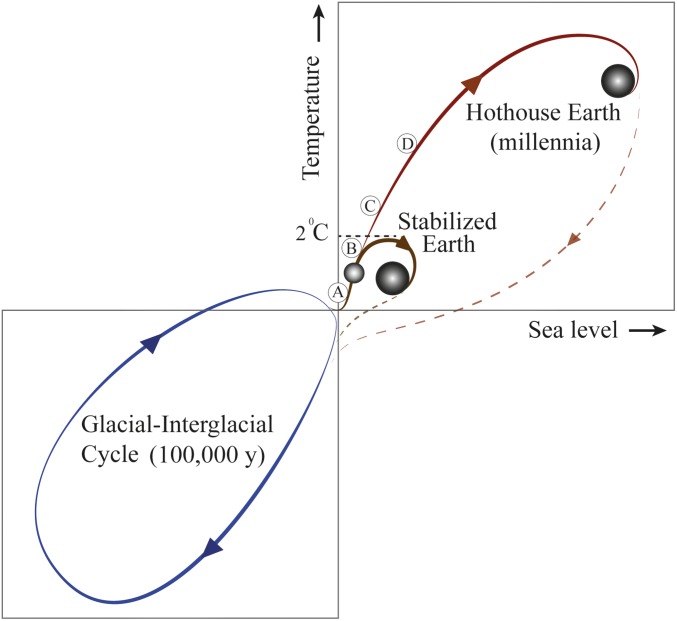
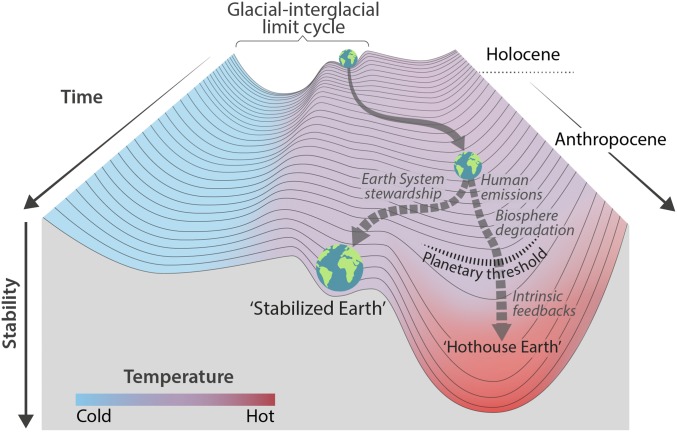
We explore the risk that self-reinforcing feedbacks could push the Earth System toward a planetary threshold that, if crossed, could prevent stabilization of the climate at intermediate temperature rises and cause continued warming on a “Hothouse Earth” pathway even as human emissions are reduced. Crossing the threshold would lead to a much higher global average temperature than any interglacial in the past 1.2 million years and to sea levels significantly higher than at any time in the Holocene. We examine the evidence that such a threshold might exist and where it might be. If the threshold is crossed, the resulting trajectory would likely cause serious disruptions to ecosystems, society, and economies. Collective human action is required to steer the Earth System away from a potential threshold and stabilize it in a habitable interglacial-like state. Such action entails stewardship of the entire Earth System—biosphere, climate, and societies—and could include decarbonization of the global economy, enhancement of biosphere carbon sinks, behavioral changes, technological innovations, new governance arrangements, and transformed social values.
Overview
The claims and statistics of this paper haven’t been checked yet.
Free: it reads the open-access text and checks the first 5 claims that cite a source we can check. Create a free account to check every claim.
Integrity signals
Registry
Cites
Statistics
Figures
Verification
Claims the paper makes
The claims and statistics of this paper haven’t been checked yet.
Free: it reads the open-access text and checks the first 5 claims that cite a source we can check. Create a free account to check every claim.
Claims other papers make about this one
Each is checked against this paper’s own text: does it say what the citing paper says it does?
The source backs part of the claim, not all of it — or backs it for a different population, condition or comparison.
In the citing paper
“Triggering positive feedback, uncontrolled emissions will lead to a major climate change that would durably lock the planet into a hot system where glaciers would go extinct(Steffen et al., 2018;McKay et al., 2022).”
From Future emergence of new ecosystems caused by glacial retreat (2023) · cites this paper as Steffen et al., 2018
Experimental — accuracy not yet measuredIn the citing paper
“Our journey into the future of cold regions shows that deglaciation over the 21 st century is expected to occur over 181,000 ± 55,000 to 372,000 ± 99,000 km 2 outside the Greenland and Antarctic ice sheets (Fig. 3) and may reach unprecedented levels in recent Earth's history”
From Future emergence of new ecosystems caused by glacial retreat (2023) · cites this paper as Steffen et al., 2018
In the citing paper
“yet it remains unknown whether human social dynamics will yield such responses”
From Stewardship of global collective behavior (2021) · cites this paper as [14]
In the citing paper
“Human collective dynamics are critical to the wellbeing of people and ecosystems in the present and will set the stage for how we face global challenges with impacts that will last centuries (14, 15, 64).”
From Stewardship of global collective behavior (2021) · cites this paper as [14]
Self-check
Percentages, sums and reported differences re-computed from the paper’s own numbers.
The self-check needs the paper’s full text.
Citations
Cites
(2014) · Cambridge University Press eBooks · doi:10.1017/cbo9781107415379 · Cited by 11,249
(2007) · Medical Entomology and Zoology · Cited by 9,612
Crutzen, P. J. (2002) · Nature · doi:10.1038/415023a · Cited by 4,788
Tipping elements in the Earth’s climate system
Lenton, T. M., Held, H., Kriegler, E., Hall, J. W., Lucht, W., Rahmstorf, S., & Schellnhuber, H. J. (2008) · Proceedings of the National Academy of Sciences · doi:10.1073/pnas.0705414105 · Cited by 3,982
Self-citationThe trajectory of the Anthropocene: The Great Acceleration
Steffen, W., Broadgate, W., Deutsch, L., Gaffney, O., & Ludwig, C. (2015) · The Anthropocene Review · doi:10.1177/2053019614564785 · Cited by 3,935
Self-citationGriscom, B. W., Adams, J., Ellis, P. W., Houghton, R. A., Lomax, G., Miteva, D. A., Schlesinger, W. H., Shoch, D., Siikamäki, J. V., Smith, P., et al. (2017) · Proceedings of the National Academy of Sciences · doi:10.1073/pnas.1710465114 · Cited by 3,481
Eight glacial cycles from an Antarctic ice core
members, E. C. (2004) · Nature · doi:10.1038/nature02599 · Cited by 2,415
The Anthropocene is functionally and stratigraphically distinct from the Holocene
Waters, C. N., Zalasiewicz, J., Summerhayes, C., Barnosky, A. D., Poirier, C., Gałuszka, A., Cearreta, A., Edgeworth, M., Ellis, E. C., Ellis, M., et al. (2016) · Science · doi:10.1126/science.aad2622 · Cited by 2,375
Self-citationContribution of Antarctica to past and future sea-level rise
DeConto, R. M., & Pollard, D. (2016) · Nature · doi:10.1038/nature17145 · Cited by 2,044
Research works printed but not linked: 3
- Stocker TF 2013 Technical summary Climate Change 2013: The Physical Science Basis. Contribution of Working Group I to the Fifth Assessment Report of the Intergovernmental Panel on Climate Change Stocker TF Cambridge Univ Press Cambridge, UK
- Ciais P 2013 Carbon and other biogeochemical cycles Climate Change 2013: The Physical Science Basis, Contribution of Working Group I to the Fifth Assessment Report of the Intergovernmental Panel on Climate Change Stocker TF Cambridge Univ Press Cambridge, UK 465 570
- Latorre C Wilmshurst J von Gunten L 2016 Climate change and cultural evolution PAGES (Past Global Changes) Magazine 24 1 32
Cited by
Items 901–1,000 of 1,000
Climate Change as Political Catastrophe: Before Collapse
Mittiga, R. A. (2024) · doi:10.1093/oso/9780192868879.001.0001 · Cited by 21
Scheffran, J. (2025) · The anthropocene: Politik - economics - society - science · doi:10.1007/978-3-031-71807-6_8 · Cited by 36
de Bortoli, A., Chanel, A., Chabas, C., Greffe, T., & Louineau, E. (2025) · Renewable and Sustainable Energy Reviews · doi:10.1016/j.rser.2025.115924 · Cited by 30
Angheloiu, C., Sheldrick, L., Tennant, M., & Chaudhuri, G. (2019) · World Futures Review · doi:10.1177/1946756719844050 · Cited by 23
“Active stewardship of the Earth System will require transitioning our current unsustainable lifestyles, socioeconomic system, and social practices through new methods, tools, and narratives (Steffen et al. 2018).”
BackgroundLazurko, A., Alamenciak, T., Hill, L. S., Muhl, E., Osei, A. K., Pomezanski, D., Schang, K. A., & Sharmin, D. F. (2020) · World Futures Review · doi:10.1177/1946756720976710 · Cited by 23
Institutions and inequality interplay shapes the impact of economic growth on biodiversity loss
Mirza, M. U., Richter, A. P., van Nes, E. H., & Scheffer, M. (2020) · Ecology and Society · doi:10.5751/es-12078-250439 · Cited by 19
Self-citationBamutaze, Y., Meadows, M. E., Mwanjalolo, M., & Musinguzi, P. (2021) · CATENA · doi:10.1016/j.catena.2021.105343 · Cited by 18
Unsustainable Borders: Globalization in a Climate-Disrupted World
Dalby, S. (2021) · Borders in Globalization Review · doi:10.18357/bigr22202120051 · Cited by 26
Preiser, R., Biggs, R., Hamann, M., Sitas, N., Selomane, O., Waddell, J., Clements, H. S., & Hichert, T. N. (2021) · Systems Research and Behavioral Science · doi:10.1002/sres.2815 · Cited by 21
Mohammed, A., Yimer, E., Gobie, B. G., & Feleke, E. (2022) · Environmental and Sustainability Indicators · doi:10.1016/j.indic.2022.100185 · Cited by 18
Greening Keynes? Productivist lineages of the Green New Deal
Green, J. (2022) · The Anthropocene Review · doi:10.1177/20530196221128369 · Cited by 26
“The cumulative impact of these processes is provoking a rapid and unstable transformation of the Earth System with perilous consequences (Steffen et al., 2018).”
BackgroundMalm, A. (2022) · Historical Materialism · doi:10.1163/1569206x-20222369 · Cited by 34
Ji, P., Chen, J., Zhou, A., Chen, R., Ding, G., Wang, H., Chen, S., & Chen, F. (2022) · Journal of Hazardous Materials · doi:10.1016/j.jhazmat.2023.130972 · Cited by 20
Code Red for Humanity: The Role of Business Ethics as We Transgress Planetary Thresholds
Nilsen, H. R. (2023) · Journal of Business Ethics · doi:10.1007/s10551-023-05402-3 · Cited by 21
“The persistent and substantial transgression of either of the two core boundaries can push the Earth system towards an irreversible state shift (Steffen et al., 2018; Wang-Erlandsson et al., 2022).”
Anderies, J. M., Barfuß, W., Donges, J. F., Fetzer, I., Heitzig, J., & Rockström, J. (2023) · Environmental Research Letters · doi:10.1088/1748-9326/ace91d · Cited by 25
Self-citationBeyond borders: Assessing global sustainability through interconnected systems
Zhang, J., Skene, K. R., Wang, S., Ji, Q., Zheng, H., Zhou, C., Tian, K., Pradhan, P., Meadows, M. E., & Fu, B. (2024) · Sustainable Development · doi:10.1002/sd.3218 · Cited by 23
RUSSELL REVIEW Soil carbon stewardship: Thinking in circles
Janzen, H. H. (2024) · European Journal of Soil Science · doi:10.1111/ejss.13536 · Cited by 24
Mäder, S. (2019) · Mitigation and Adaptation Strategies for Global Change · doi:10.1007/s11027-019-09875-4 · Cited by 19
Løvschal, M. (2020) · Journal of the Royal Anthropological Institute · doi:10.1111/1467-9655.13252 · Cited by 20
“For example, recent studies show how human-driven, self-perpetuating feedback in Earth System dynamics, including the biological and geophysical sphere, can lead to temperature rises (Steffen et al. 2018 : 8255 ).”
Towards a physically motivated planetary accounting framework
Barbosa, M., Bertolami, O., & Francisco, F. (2020) · The Anthropocene Review · doi:10.1177/2053019620909659 · Cited by 28
“Clearly, this means an increase in the global temperature which can lead to a chain failure of the main regulatory ecosystems of the ES, that already show tipping point features [9].”
BackgroundMethodThe regenerative turn: on the re-emergence of reciprocity embedded in living ecologies
Egmose, J., Jacobsen, S. G., Hauggaard-Nielsen, H., & Hulgård, L. (2021) · Globalizations · doi:10.1080/14747731.2021.1911508 · Cited by 18
Bertelsen, N., Paardekooper, S., & Mathiesen, B. V. (2021) · Energy Efficiency · doi:10.1007/s12053-021-09975-8 · Cited by 18
“The scale and potentially harmful consequences of climate change (Steffen et al., 2018) are one of society’s great contemporary challenges.”
BackgroundManaging the risks of missing international climate targets
Taylor, G., & Vink, S. M. (2021) · Climate Risk Management · doi:10.1016/j.crm.2021.100379 · Cited by 29
Dorninger, C., Menéndez, L. P., & Caniglia, G. (2023) · Philosophical Transactions of the Royal Society B Biological Sciences · doi:10.1098/rstb.2022.0431 · Cited by 26
Activism for End Times: Millenarian Belief in an Age of Climate Emergency
Skrimshire, S. (2019) · Political Theology · doi:10.1080/1462317x.2019.1637993 · Cited by 15
Elements of a Planetary Emergency: Environment of Peace (Part 1)
Smith, D. J. B., Bell, N., Faller, J., Galaz, V., Norström, A. V., Pattison, C., & Queiroz, C. (2022) · doi:10.55163/mdeb4357 · Cited by 20
“Human activities and the Great Acceleration are rapidly changing the internal dynamics and driving feedbacks of TEs, with subsequent effects on the stability of the climate system as a whole (Steffen et al. 2018).”
BackgroundInfluentialSome Theological Reflections Regarding Multi-disciplinary Discourse on the “Anthropocene”
Conradie, E. M. (2023) · Scriptura · doi:10.7833/121-1-2076 · Cited by 21
Paleobiogeographic insights gained from ecological niche models: progress and continued challenges
Blois, J. L., Bellvé, A. M., Jarzyna, M. A., Saupe, E. E., & Syverson, V. J. P. (2025) · Paleobiology · doi:10.1017/pab.2024.16 · Cited by 20
“Thus, biodiversity is, and has always been, a key regulator of planetary homeostasis (Mace et al. 2014; Steffen et al. 2018; Talukder et al. 2022).”
Das Thema Klimawandel und seine Bedeutung im Gesundheitssektor: Entwicklung, Akteure, Meilensteine
Lehmkuhl, D. (2019) · Bundesgesundheitsblatt - Gesundheitsforschung - Gesundheitsschutz · doi:10.1007/s00103-019-02935-9 · Cited by 17
Falayi, M., Gambiza, J., & Schoon, M. (2020) · Land · doi:10.3390/land9070227 · Cited by 22
“Contemporary research shows that humanity is facing daunting environmental challenges that are increasingly dynamic and complex [1,2].”
BackgroundGeoethics for Nudging Human Practices in Times of Pandemics
Marone, E., & Bohle, M. (2020) · Sustainability · doi:10.3390/su12187271 · Cited by 18
Democracy and the (missing) politics in environmental education
Orr, D. W. (2020) · The Journal of Environmental Education · doi:10.1080/00958964.2020.1753004 · Cited by 23
Ethics, Energy Transition, and Ecological Citizenship
Bourban, M. (2020) · Elsevier eBooks · doi:10.1016/b978-0-12-819727-1.00030-3 · Cited by 20
Ecological global citizenship education: a reframing
Jenkins, A. (2021) · International Journal of Development Education and Global Learning · doi:10.14324/ijdegl.13.2.03 · Cited by 28
REA, R. (2022) · Revista de Estudios Andaluces · doi:10.12795/rea.2022.i43 · Cited by 44
Transformation Literacy: Pathways to Regenerative Civilizations
Künkel, P., & Ragnarsdottir, K. V. (2022) · Springer eBooks · doi:10.1007/978-3-030-93254-1 · Cited by 43
Governing the diverse forest: Polycentric climate governance in the Amazon
de Wit, F., & Mourato, J. M. (2022) · World Development · doi:10.1016/j.worlddev.2022.105955 · Cited by 24
Juling, D. (2022) · Journal of advanced military studies · doi:10.21140/mcuj.20221301010 · Cited by 32
Kopnina, H., Muhammad, N. Z., & Olaleru, F. (2022) · Biological Conservation · doi:10.1016/j.biocon.2022.109645 · Cited by 28
“To address this ecological degradation, the Half-Earth vision suggests generous protection for terrestrial, freshwater, and marine biodiversity (Steffen et al., 2018) by setting aside at least half the planet for non-human species (Wilson, 2016).”
BackgroundEnvironing media and cultural techniques: From the history of agriculture to AI-driven smart farming
Wickberg, A. (2022) · International Journal of Cultural Studies · doi:10.1177/13678779221144762 · Cited by 18
“This essentially means that environing impacted the Earth system already, thousands of years ago, but the current trend is based on an exponential growth of subsistence and population which is now set to radically transform the state of the Earth system (Steffen et al., 2018).”
BackgroundManlosa, A. O., Partelow, S., Jiren, T. S., Riechers, M., & Paramita, A. O. (2022) · Ecosystems and People · doi:10.1080/26395916.2022.2146753 · Cited by 17
“The unsustainable trajectory that humanity is currently on, is an outcome of transformation processes that were set into motion long before the present generation, but were accelerated during our lifetime (Steffen et al. 2018).”
Background“Beyond being analysts of doom”: scientists on the frontlines of climate action
Artico, D., Durham, S., Horn, L., Mezzenzana, F., Morrison, M., & Norberg, A. (2023) · Frontiers in Sustainability · doi:10.3389/frsus.2023.1155897 · Cited by 20
“This politicization has largely led to gridlock, with hard-to-pass legislation, while business as usual continues to push us beyond our planetary boundaries (Rockström et al., 2009; Steffen et al., 2018; Persson et al., 2022).”
BackgroundZhang, X., Zhou, S., Liu, W., Zhou, Z., & Yang, Y. (2023) · Journal of Energy Storage · doi:10.1016/j.est.2023.108078 · Cited by 18
Towards a Globalised Vision of Aquatic Competence
Fonseca-Pinto, R., & Murcia, J. A. M. (2023) · International Journal of Aquatic Research and Education · doi:10.25035/ijare.14.01.11 · Cited by 21
Eickhoff, H. (2024) · Humanities and Social Sciences Communications · doi:10.1057/s41599-024-02815-x · Cited by 24
“Hothouse Earth pathways loom on the horizon (Steffen et al., 2018) and disruptive behaviors of the Earth system are not science fi ction anymore but a real prospect (Bernardini et al., 2022).”
Samet, J. M., & Woodward, A. J. (2019) · American Journal of Epidemiology · doi:10.1093/aje/kwy279 · Cited by 21
A Global Overview of Future Energy
Breyer, C. (2020) · Elsevier eBooks · doi:10.1016/b978-0-08-102886-5.00034-7 · Cited by 21
Architectures of Earth System Governance: Setting the Stage
Biermann, F., & Kim, R. E. (2020) · Cambridge University Press eBooks · doi:10.1017/9781108784641.001 · Cited by 28
From Moore's Law to the Carbon Law
Pargman, D. S., Biørn-Hansen, A., Eriksson, E., Laaksolahti, J., & Robèrt, M. (2020) · International Conference on ICT for Sustainability (ICT4S) · doi:10.1145/3401335.3401825 · Cited by 22
Climate Change, Credit Risk and Financial Stability
Oguntuase, O. J. (2020) · IntechOpen eBooks · doi:10.5772/intechopen.93304 · Cited by 27
Liu, C., & Nie, G. (2021) · Sustainability · doi:10.3390/su13116147 · Cited by 18
Making investments in natural capital count
Blignaut, J. N. (2019) · Ecosystem Services · doi:10.1016/j.ecoser.2019.100927 · Cited by 18
Synthetic soil crusts against green-desert transitions: a spatial model
Vidiella, B., Sardanyés, J., & Solé, R. V. (2020) · Royal Society Open Science · doi:10.1098/rsos.200161 · Cited by 18
Global disparity of camera trap research allocation and defaunation risk of terrestrial mammals
Mugerwa, B., Niedballa, J., Planillo, A., Sheil, D., Kramer‐Schadt, S., & Wilting, A. (2023) · Remote Sensing in Ecology and Conservation · doi:10.1002/rse2.360 · Cited by 23
“Our findings indicate low levels of camera trap research in these regions despite their key role in climate regulation (Griscom et al., 2017; Mitchard, 2018; Steffen et al., 2018) and biodiversity conservation (Edwards et al., 2019; IPBES, 2019; Watson et al., 2018).”
BackgroundSelf-limited tidal heating and prolonged magma oceans in the L 98-59 system
Nicholls, H., Guimond, C. M., Hay, H. C. F. C., Chatterjee, R. D., Lichtenberg, T., & Pierrehumbert, R. T. (2025) · Monthly Notices of the Royal Astronomical Society · doi:10.1093/mnras/staf1167 · Cited by 28
Iyankumar, R., Murali, A. P., Sadeq, A. M., Shajahan, M. I., Selvakumar, K., Shankar, K. V., Giri, J. P., & Sabeur, H. (2025) · Energy Science & Engineering · doi:10.1002/ese3.70235 · Cited by 18
“According to researchers, if fossil fuels remain the primary source of energy, global temperatures might increase by 3°C or more by the century's end [8, 9].”
Climate change enforces to look beyond the plant – the example of pollinators
Christmann, S. (2019) · Current Opinion in Plant Biology · doi:10.1016/j.pbi.2019.11.001 · Cited by 17
Peace Ecology in the Anthropocene
Brauch, H. G. (2021) · The anthropocene: Politik - economics - society - science · doi:10.1007/978-3-030-62316-6_2 · Cited by 20
Philanthrocapitalism and Global Health
Wilson, J. (2021) · Cambridge University Press eBooks · doi:10.1017/9781108692137.035 · Cited by 20
Subseasonal to seasonal Arctic sea-ice prediction: A grand challenge of climate science
Wei, K., Liu, J., Bao, Q., He, B., Ma, J., Li, M., Song, M., & Zhu, Z. (2021) · Atmospheric and Oceanic Science Letters · doi:10.1016/j.aosl.2021.100052 · Cited by 16
Bertini, L., & Tjiputra, J. F. (2022) · Journal of Geophysical Research Oceans · doi:10.1029/2021jc017929 · Cited by 23
Taberna, A., Filatova, T., Andrea Roventini, B., & Lamperti, F. (2022) · Ecological Economics · doi:10.1016/j.ecolecon.2022.107588 · Cited by 17
“There is significant evidence that human activities have pushed the planetary system close to a climate tipping point (the so-called “Hothouse Earth”) (Steffen et al., 2018; Lenton et al., 2008).”
BackgroundBuchtmann, M., Wise, R. M., O’Connell, D., Crosweller, M., & Edwards, J. (2022) · Disaster Prevention and Management An International Journal · doi:10.1108/dpm-08-2022-0168 · Cited by 16
Climate tipping points and expert judgment
Lam, V., & Majszak, M. (2022) · Wiley Interdisciplinary Reviews Climate Change · doi:10.1002/wcc.805 · Cited by 23
“On the other hand, expert-based claims about (for instance) a global tipping point for the entire Earth system ( “ planetary threshold ” ) irreversibly leading to a “ Hothouse Earth ” (Steffen et al., 2018), result from the investigations of a rather small group of scientists and thus may possess a more speculative ep…”
BackgroundInfluentialTipping points ahead? How laypeople respond to linear versus nonlinear climate change predictions
Formanski, F. J., Pein, M. M., Loschelder, D. D., Engler, J., Husen, O., & Majer, J. M. (2022) · Climatic Change · doi:10.1007/s10584-022-03459-z · Cited by 18
“Passing certain tipping points could lead to relatively abrupt changes in the climate system, which would have drastic and potentially irreversible impacts (Alley et al. 2003; Lenton et al. 2008; Mitchell et al. 2006; Steffen et al. 2018).”
BackgroundAwandu, W., Ruff, R., Wiesemann, J.-U., & Lehmann, B. (2022) · Energies · doi:10.3390/en15239004 · Cited by 24
Lamperti, F., & Roventini, A. (2022) · European Journal of Economics and Economic Policies Intervention · doi:10.4337/ejeep.2022.0096 · Cited by 33
Veiga, S. F., Nobre, P., Giarolla, E., Capistrano, V., SILVA, M. B. D., Casagrande, F., Soares, H. C., Kubota, P. Y., Figueroa, S. N., Bottino, M. J., et al. (2023) · Journal of South American Earth Sciences · doi:10.1016/j.jsames.2023.104598 · Cited by 23
Carmona, R., Reed, G., Ford, J. D., Thorsell, S., Yon, R., Carril, F., & Pickering, K. (2023) · AMBIO · doi:10.1007/s13280-023-01922-4 · Cited by 30
“In contrast, states’ efforts to address the climate crisis have so far proven to be widely insufficient, as we rapidly move beyond planetary boundaries (Steffen et al. 2018; Arm-strong McKay et al. 2022).”
BackgroundInvestigating permafrost carbon dynamics in Alaska with artificial intelligence
Gay, B. A., Züfle, A. E., Pastick, N. J., Armstrong, A., Watts, J. D., Dirmeyer, P. A., Miner, K. R., Wessels, K., Qu, J. J., & Miller, C. E. (2023) · Environmental Research Letters · doi:10.1088/1748-9326/ad0607 · Cited by 21
“…anthropogenic-induced warming— coupled with permafrost degradation and soil carbon release—may trigger a positive carbon-climate feed-back and sustain a warmer, inhospitable equilibrium for hundreds of thousands of years (Koven et al 2011, McGuire et al 2018, Steffen et al 2018, Wang et al 2023).”
BackgroundWu, Y., Al-Duais, Z. A. M., & Peng, B. (2023) · Humanities and Social Sciences Communications · doi:10.1057/s41599-023-02233-5 · Cited by 25
Simoni, M. U., Drielsma, J. A., Ericsson, M., Gunn, A. G., Heiberg, S., Heldal, T. A., Nassar, N. T., Petavratzi, E., & Müller, D. B. (2024) · Environmental Science & Technology · doi:10.1021/acs.est.3c03088 · Cited by 20
Catastrophic climate change, population ethics and intergenerational equity
Méjean, A., Pottier, A., Fleurbaey, M., & Zuber, S. (2020) · Climatic Change · doi:10.1007/s10584-020-02899-9 · Cited by 26
Financial benefits of reimagined, sustainable, agrifood supply networks
Holt, T. V., Delaroche, M., Atz, U., & Eckerle, K. (2021) · Journal of International Business Policy · doi:10.1057/s42214-020-00096-0 · Cited by 20
Jones, E.-A., & Stafford, R. (2021) · Earth · doi:10.3390/earth2020019 · Cited by 16
“Climate and biosphere integrity are also described as core planetary boundaries, which can reach a tipping point, pushing the earth system into a new state, such as a significantly warmer “hot house Earth” if exceeded with sufficient magnitude and for sufficient time [6].”
BackgroundCritical realism for a time of crisis? Buch-Hansen and Nielsen’s twenty-first century CR
Morgan, J. (2021) · Journal of Critical Realism · doi:10.1080/14767430.2021.1958280 · Cited by 16
Morris, D. W. (2021) · PLoS ONE · doi:10.1371/journal.pone.0258087 · Cited by 18
Saijo, T. (2019) · Studies in economic design · doi:10.1007/978-3-030-18050-8_35 · Cited by 16
Crona, B., & Sundström, E. (2023) · Springer eBooks · doi:10.1007/978-981-19-4460-4_6 · Cited by 29
Social innovation that connects people to coasts in the Anthropocene
Celliers, L., Costa, M. M., Rölfer, L., Aswani, S., & Ferse, S. C. A. (2023) · Cambridge Prisms Coastal Futures · doi:10.1017/cft.2023.12 · Cited by 18
“This change is resulting in impacts from both slow onset changes and extreme events across the Earth system (see, e.g., Steffen et al., 2018; Folke et al., 2021).”
BackgroundInterconnected geoscience for international development
Petterson, M. G. (2019) · Episodes · doi:10.18814/epiiugs/2019/019018 · Cited by 17
Unity in diversity? When advocacy coalitions and policy beliefs grow trees in South Africa
Malkamäki, A., Ylä‐Anttila, T., Brockhaus, M., Toppinen, A., & Wagner, P. M. (2021) · Land Use Policy · doi:10.1016/j.landusepol.2021.105283 · Cited by 22
“These coalitions are in line with those that Tewari (2001) identified in the aftermath of the changes that took place in South Africa in the nineties.”
BackgroundMethodResultInfluentialSeeing a global web of connected systems
Scheffer, M., & van Nes, E. H. (2018) · Science · doi:10.1126/science.aav8478 · Cited by 15
Self-citationHow to Pay for Saving the World: Modern Monetary Theory for a Degrowth TransitionPreprint
Olk, C., Schneider, C., & Hickel, J. (2022) · SSRN Electronic Journal · doi:10.2139/ssrn.4172005 · Cited by 16
Exploring the Interface Between Planetary Boundaries and Palaeoecology
Gillson, L., Seddon, A. W. R., Mottl, O., Zhang, K., Kirsten, K. L., Gell, P., Marchant, R., Schwörer, C., Razanatsoa, E., Lane, P. J., et al. (2025) · Global Change Biology · doi:10.1111/gcb.70017 · Cited by 17
Exploring Societal Intersections of Geoethical Thinking
Bohle, M., & Preiser, R. (2019) · Springer eBooks · doi:10.1007/978-3-030-12010-8_3 · Cited by 21
Landslide Hazard Induced by Climate Changes in North-Eastern Romania
Niculiță, M. (2020) · Climate change management · doi:10.1007/978-3-030-37425-9_13 · Cited by 17
The Anthropozoic era revisited
Rull, V. (2020) · Lethaia · doi:10.1111/let.12408 · Cited by 19
Bloom, D. E., & Cadarette, D. (2021) · Cambridge University Press eBooks · doi:10.1017/9781108692137.004 · Cited by 18
Performance of Socially Responsible Investment Funds in China: A Comparison with Traditional Funds
Fateh Saci, N. A., Jasimuddin, S. M., & Hasan, M. (2022) · Sustainability · doi:10.3390/su14031476 · Cited by 30
“For scholars [10,11], the transition toward sustainable development allows for a rapid restructuring of institutions toward more effective governance and with a stronger emphasis on planetary concerns in investments, which shows how much the role of finance has changed.”
BackgroundTechnical Note: Past and future warming – direct comparison on multi-century timescales
Kaufman, D. S., & McKay, N. P. (2022) · Climate of the past · doi:10.5194/cp-18-911-2022 · Cited by 24
We Must Stop Fossil Fuel Emissions to Protect Permafrost Ecosystems
Abbott, B. W., Brown, M., Carey, J. C., Ernakovich, J. G., Frederick, J., Guo, L., Hugelius, G., Lee, R. M., Loranty, M. M., Macdonald, R. W., et al. (2022) · Frontiers in Environmental Science · doi:10.3389/fenvs.2022.889428 · Cited by 18
“Likewise, collaboratively expanding conservation of intact ecosystems enhances biosphere integrity and can restore rights of Indigenous and immigrant peoples of the permafrost domain (Steffen et al., 2018; Watson et al., 2018; Díaz et al., 2019; Bergstrom et al., 2021; Chapin et al., 2022).”
BackgroundBucht, C., Mess, F., Bachner, J., & Spengler, S. (2022) · Frontiers in Education · doi:10.3389/feduc.2022.1017099 · Cited by 24
“Scientists agree on the dramatic status that the earth is heating up and is predicted to heat up further as a result of human actions (Powell, 2016; Steffen et al., 2018; Timothy et al., 2019).”
BackgroundUnderstanding Socio-metabolic Inequalities Using Consumption Data from Germany
Schuster, A., & Otto, I. M. (2022) · Capitalism Nature Socialism · doi:10.1080/10455752.2022.2140066 · Cited by 19
Åström, S. (2022) · Environmental Impact Assessment Review · doi:10.1016/j.eiar.2022.106941 · Cited by 21
Integrating deep-time palaeontology in conservation prioritisation
Pimiento, C., & Antonelli, A. (2022) · Frontiers in Ecology and Evolution · doi:10.3389/fevo.2022.959364 · Cited by 19
“…today’s biodiversity and climate crises, not only because global temperatures are approaching the maximum experienced in the last 1.2 million years (Steffen et al., 2018) but also because many drastic environmental changes taking place today are comparable in at least one aspect with events…”
BackgroundInfluentialDiverse anthropogenic disturbances shift Amazon forests along a structural spectrum
Smith, M. N., Stark, S. C., Taylor, T. C., Schietti, J., de Almeida, D. R. A., Aragón, S., Torralvo, K., LIMA, A. P., de Oliveira, G., Assis, R. L., et al. (2023) · Frontiers in Ecology and the Environment · doi:10.1002/fee.2590 · Cited by 17
Schill, C., & Rocha, J. (2019) · Ecological Economics · doi:10.1016/j.ecolecon.2022.107695 · Cited by 29
Are Energy Reductions Compatible with Economic Growth?
Moriarty, P., & Honnery, D. (2023) · Sustainability · doi:10.3390/su15108043 · Cited by 17
Sari, R. R., Priyadarshini, R., Rozendaal, D. M. A., Saputra, D. D., Hairiah, K., & van Noordwijk, M. (2023) · Sustainability Science · doi:10.1007/s11625-023-01400-6 · Cited by 27
“…magnitude and frequency, ‘natural’ shocks (including tectonic activity, volcanic eruptions and ash deposition) have in specific environments since long been a challenge to the sustainability and resilience of social–ecological systems (Folke et al. 2004; Steffen et al. 2018; Yi and Jackson 2021).”
Background
Metadata
- Authors
- Steffen, W., Rockström, J., Richardson, K., Lenton, T. M., Folke, C., Liverman, D., Summerhayes, C. P., Barnosky, A. D., Cornell, S. E., Crucifix, M., Donges, J. F., Fetzer, I., Lade, S. J., Scheffer, M., Winkelmann, R., & Schellnhuber, H. J.
- Affiliations
- Australian National University (AU)
- Stockholm Resilience Centre (SE)
- University of Copenhagen (DK)
- University of Exeter (GB)
- Royal Swedish Academy of Sciences (SE)
- University of Arizona (US)
- University of Cambridge (GB)
- Stanford University (US)
- Fund for Scientific Research (BE)
- Wageningen University & Research (NL)
- University of Potsdam (DE)
- Corresponding author
- Steffen, Will
- ORCID
- Venue
- Proceedings of the National Academy of Sciences
- Publisher
- National Academy of Sciences
- Published
- 2018-08-06
- Volume
- 115
- Issue
- 33
- Pages
- 8252-8259
- ISSN
- 0027-8424 (ISSN-L)
- 1091-6490
- PMC
- PMC6099852
- OpenAlex
- W2886281704
- Cited by
- 3,139
- References
- 92
- Citations by year
- 2026: 185 · 2025: 279 · 2024: 346 · 2023: 414 · 2022: 450 · 2021: 596 · 2020: 446 · 2019: 360 · 2018: 56
- FWCI
- 213.48
- Type
- journal article
- Language
- en
- Open access
- hybrid
- doi.org
- Licence
- Locations
- Proceedings of the National Academy of Sciences (publishedVersion, cc-by-nc-nd)
- Europe PMC (PubMed Central) (publishedVersion, cc-by-nc-nd)
- PubMed Central (publishedVersion, cc-by-nc-nd)
- Research at the University of Copenhagen (University of Copenhagen) (publishedVersion, other-oa)
- PubMed (publishedVersion)
- Open Research Exeter (University of Exeter) (publishedVersion, cc-by-nc-nd)
- Socio-Environmental Systems Modeling (acceptedVersion, cc-by-nc-nd)
- Digital Access to Libraries (submittedVersion, other-oa)
- Figshare (submittedVersion)
- publish.UP (University of Potsdam) (submittedVersion, cc-by-nc-nd)
- RENATE (submittedVersion, cc-by-nc-nd)
- ANU Open Research (Australian National University) (submittedVersion, cc-by-nc-nd)
- Publication Database PIK (Potsdam Institute for Climate Impact Research (PIK)) (submittedVersion)
- Data Archiving and Networked Services (DANS) (submittedVersion, cc-by-nc-nd)
- RENATE
- Funders
- National Science Foundation (1243125)
- Familjen Erling-Perssons Stiftelse
- European Commission (743080)
- Svenska Forskningsrådet Formas (2012-742, 2014-589)
- Vetenskapsrådet
- Earth League
- Stordalen Foundation
- Leibniz-Gemeinschaft
- Topics
- Physical Sciences › Environmental Science › Global and Planetary Change › Climate variability and models
- Physical Sciences › Environmental Science › Global and Planetary Change › Earth Systems and Cosmic Evolution
- Physical Sciences › Environmental Science › Global and Planetary Change › Ecosystem dynamics and resilience
- Keywords
- Hothouse Earth, self-reinforcing feedback, climate stabilization, global warming, sea level rise, decarbonization, carbon sink, Anthropocene, climate tipping points
About these checks
Registry, retraction, Cites and statistics results are computed, not judged, with one exception: a printed reference that no index lists is read once by a model before it counts as a citation error. Claims are extracted by a model and kept only when their quote appears verbatim in the text; each cited source is then checked, with a model’s help, for whether it says what the claim relies on. Those verdicts can be wrong — read the claim’s quote and the cited source before relying on one.
Statistics and arithmetic are recomputed, not judged.
Confidence bands are shown only for fields calibrated on our annotated test set. None is calibrated yet, so no band is shown.
What counts as a claim ›How we measure confidence ›How we check this ›
Are you an author, or do you see a problem with this page? Request a review
Data sources
Bibliographic data: Semantic Scholar, OpenAlex, Crossref.
Contains information from the Semantic Scholar Academic Graph Datasets, made available under the ODC Attribution License (ODC-BY 1.0).
Semantic Scholar’s data is described in: Kinney, R., et al. (2023). The Semantic Scholar Open Data Platform. arXiv:2301.10140.
