

Trajectories of the Earth System in the Anthropocene
Open accessThe DOI matches its Crossref record; 89 of the 92 references it cites were found in a registry or an index.
Abstract
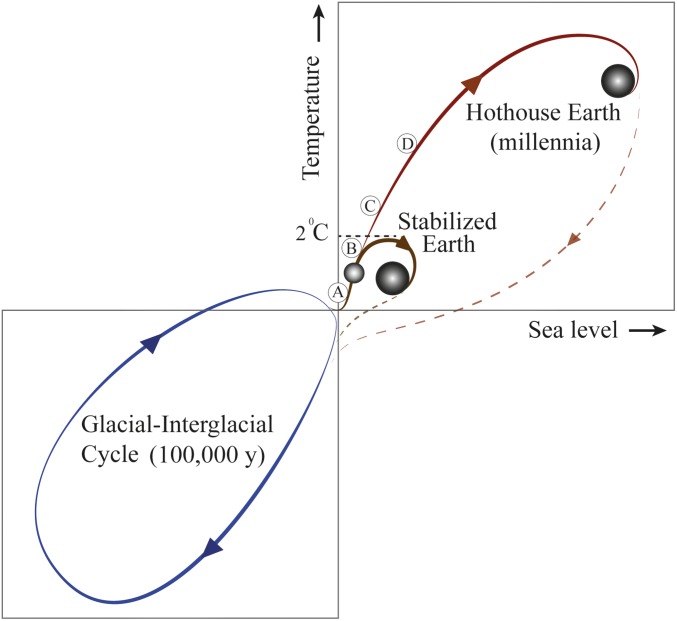
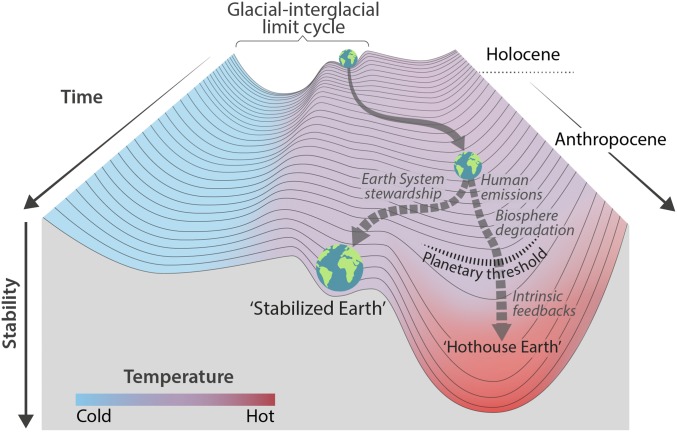
We explore the risk that self-reinforcing feedbacks could push the Earth System toward a planetary threshold that, if crossed, could prevent stabilization of the climate at intermediate temperature rises and cause continued warming on a “Hothouse Earth” pathway even as human emissions are reduced. Crossing the threshold would lead to a much higher global average temperature than any interglacial in the past 1.2 million years and to sea levels significantly higher than at any time in the Holocene. We examine the evidence that such a threshold might exist and where it might be. If the threshold is crossed, the resulting trajectory would likely cause serious disruptions to ecosystems, society, and economies. Collective human action is required to steer the Earth System away from a potential threshold and stabilize it in a habitable interglacial-like state. Such action entails stewardship of the entire Earth System—biosphere, climate, and societies—and could include decarbonization of the global economy, enhancement of biosphere carbon sinks, behavioral changes, technological innovations, new governance arrangements, and transformed social values.
Overview
The claims and statistics of this paper haven’t been checked yet.
Free: it reads the open-access text and checks the first 5 claims that cite a source we can check. Create a free account to check every claim.
Integrity signals
Registry
Cites
Statistics
Figures
Verification
Claims the paper makes
The claims and statistics of this paper haven’t been checked yet.
Free: it reads the open-access text and checks the first 5 claims that cite a source we can check. Create a free account to check every claim.
Claims other papers make about this one
Each is checked against this paper’s own text: does it say what the citing paper says it does?
The source backs part of the claim, not all of it — or backs it for a different population, condition or comparison.
In the citing paper
“Triggering positive feedback, uncontrolled emissions will lead to a major climate change that would durably lock the planet into a hot system where glaciers would go extinct(Steffen et al., 2018;McKay et al., 2022).”
From Future emergence of new ecosystems caused by glacial retreat (2023) · cites this paper as Steffen et al., 2018
Experimental — accuracy not yet measuredIn the citing paper
“Our journey into the future of cold regions shows that deglaciation over the 21 st century is expected to occur over 181,000 ± 55,000 to 372,000 ± 99,000 km 2 outside the Greenland and Antarctic ice sheets (Fig. 3) and may reach unprecedented levels in recent Earth's history”
From Future emergence of new ecosystems caused by glacial retreat (2023) · cites this paper as Steffen et al., 2018
In the citing paper
“yet it remains unknown whether human social dynamics will yield such responses”
From Stewardship of global collective behavior (2021) · cites this paper as [14]
In the citing paper
“Human collective dynamics are critical to the wellbeing of people and ecosystems in the present and will set the stage for how we face global challenges with impacts that will last centuries (14, 15, 64).”
From Stewardship of global collective behavior (2021) · cites this paper as [14]
Self-check
Percentages, sums and reported differences re-computed from the paper’s own numbers.
The self-check needs the paper’s full text.
Citations
Cites
(2014) · Cambridge University Press eBooks · doi:10.1017/cbo9781107415379 · Cited by 11,249
(2007) · Medical Entomology and Zoology · Cited by 9,612
Crutzen, P. J. (2002) · Nature · doi:10.1038/415023a · Cited by 4,788
Tipping elements in the Earth’s climate system
Lenton, T. M., Held, H., Kriegler, E., Hall, J. W., Lucht, W., Rahmstorf, S., & Schellnhuber, H. J. (2008) · Proceedings of the National Academy of Sciences · doi:10.1073/pnas.0705414105 · Cited by 3,982
Self-citationThe trajectory of the Anthropocene: The Great Acceleration
Steffen, W., Broadgate, W., Deutsch, L., Gaffney, O., & Ludwig, C. (2015) · The Anthropocene Review · doi:10.1177/2053019614564785 · Cited by 3,935
Self-citationGriscom, B. W., Adams, J., Ellis, P. W., Houghton, R. A., Lomax, G., Miteva, D. A., Schlesinger, W. H., Shoch, D., Siikamäki, J. V., Smith, P., et al. (2017) · Proceedings of the National Academy of Sciences · doi:10.1073/pnas.1710465114 · Cited by 3,481
Eight glacial cycles from an Antarctic ice core
members, E. C. (2004) · Nature · doi:10.1038/nature02599 · Cited by 2,415
The Anthropocene is functionally and stratigraphically distinct from the Holocene
Waters, C. N., Zalasiewicz, J., Summerhayes, C., Barnosky, A. D., Poirier, C., Gałuszka, A., Cearreta, A., Edgeworth, M., Ellis, E. C., Ellis, M., et al. (2016) · Science · doi:10.1126/science.aad2622 · Cited by 2,375
Self-citationContribution of Antarctica to past and future sea-level rise
DeConto, R. M., & Pollard, D. (2016) · Nature · doi:10.1038/nature17145 · Cited by 2,044
Research works printed but not linked: 3
- Stocker TF 2013 Technical summary Climate Change 2013: The Physical Science Basis. Contribution of Working Group I to the Fifth Assessment Report of the Intergovernmental Panel on Climate Change Stocker TF Cambridge Univ Press Cambridge, UK
- Ciais P 2013 Carbon and other biogeochemical cycles Climate Change 2013: The Physical Science Basis, Contribution of Working Group I to the Fifth Assessment Report of the Intergovernmental Panel on Climate Change Stocker TF Cambridge Univ Press Cambridge, UK 465 570
- Latorre C Wilmshurst J von Gunten L 2016 Climate change and cultural evolution PAGES (Past Global Changes) Magazine 24 1 32
Cited by
Westerhold, T., Marwan, N., Drury, A. J., Liebrand, D., Agnini, C., Anagnostou, E., Barnet, J. S. K., Bohaty, S. M., De Vleeschouwer, D., Florindo, F., et al. (2020) · Science · doi:10.1126/science.aba6853 · Cited by 1,946
Climate tipping points — too risky to bet against
Lenton, T. M., Rockström, J., Gaffney, O., Rahmstorf, S., Richardson, K., Steffen, W., & Schellnhuber, H. J. (2019) · Nature · doi:10.1038/d41586-019-03595-0 · Cited by 2,142
Self-citationExceeding 1.5°C global warming could trigger multiple climate tipping points
Armstrong McKay, D. I., Staal, A., Abrams, J. F., Winkelmann, R., Sakschewski, B., Loriani, S., Fetzer, I., Cornell, S. E., Rockström, J., & Lenton, T. M. (2022) · Science · doi:10.1126/science.abn7950 · Cited by 1,931
“In the worst case scenario, interactions might produce a global CTP ( 3 ).”
InfluentialSelf-citationPrinciples for knowledge co-production in sustainability research
Norström, A. V., Cvitanovic, C., Löf, M. F., West, S., Wyborn, C., Balvanera, P., Bednarek, A. T., Bennett, E. M., Biggs, R., de Bremond, A., et al. (2020) · Nature Sustainability · doi:10.1038/s41893-019-0448-2 · Cited by 1,620
Self-citationA Global Assessment: Can Renewable Energy Replace Fossil Fuels by 2050?
Holechek, J. L., Geli, H. M. E., Sawalhah, M. N., & Valdez, R. (2022) · Sustainability · doi:10.3390/su14084792 · Cited by 1,432
“With continued reliance on fossil fuels as the primary energy source, a 3 ◦C or more temperature increase is predicted by the end of this century [1,10].”
BackgroundInfluentialSafe and just Earth system boundaries
Rockström, J., Gupta, J., Qin, D., Lade, S. J., Abrams, J. F., Andersen, L. S., Armstrong McKay, D. I., Bai, X., Bala, G., Bunn, S. E., et al. (2023) · Nature · doi:10.1038/s41586-023-06083-8 · Cited by 1,400
Self-citationVegetation fires in the Anthropocene
Bowman, D. M. J. S., Kolden, C. A., Abatzoglou, J. T., Johnston, F. H., van der Werf, G. R., & Flannigan, M. (2020) · Nature Reviews Earth & Environment · doi:10.1038/s43017-020-0085-3 · Cited by 1,094
George, G., Merrill, R. K., & Schillebeeckx, S. J. D. (2021) · Entrepreneurship Theory and Practice · doi:10.1177/1042258719899425 · Cited by 1,066
“Perhaps the foremost challenge facing humanity is a three-pronged overshooting of planetary boundaries beyond which sustaining life as we know it becomes precipitously untenable (Rockström et al., 2009; Steffen et al., 2018 ).”
BackgroundSocial tipping dynamics for stabilizing Earth’s climate by 2050
Otto, I. M., Donges, J. F., Cremades, R., Bhowmik, A., Hewitt, R. J., Lucht, W., Rockström, J., Allerberger, F., McCaffrey, M., Doe, S. S. P., et al. (2020) · Proceedings of the National Academy of Sciences · doi:10.1073/pnas.1900577117 · Cited by 958
“P dangerous climate change and its devastating consequences is a defining task for humanity (1, 2).”
BackgroundSelf-citationPhanerozoic paleotemperatures: The earth’s changing climate during the last 540 million years
Scotese, C. R., Song, H., Mills, B. J. W., & van der Meer, D. G. (2021) · Earth-Science Reviews · doi:10.1016/j.earscirev.2021.103503 · Cited by 795
Climate Endgame: Exploring catastrophic climate change scenarios
Kemp, L., Xu, C., Depledge, J., Ebi, K. L., Gibbins, G., Kohler, T. A., Rockström, J., Scheffer, M., Schellnhuber, H. J., Steffen, W., et al. (2022) · Proceedings of the National Academy of Sciences · doi:10.1073/pnas.2108146119 · Cited by 791
“This means mapping different “Hothouse Earth” scenarios (21) or other extreme scenarios, such as alternative circulation regimes or large, irreversible changes in ice cover and sea level.”
BackgroundSelf-citationA Global Deal For Nature: Guiding principles, milestones, and targets
Dinerstein, E., Vynne, C., Sala, E., Joshi, A. R., Fernando, S., Lovejoy, T. E., Mayorga, J., Olson, D., Asner, G. P., Baillie, J. E. M., et al. (2019) · Science Advances · doi:10.1126/sciadv.aaw2869 · Cited by 792
“Additionally, human migrations, triggered by climate change–induced droughts and sealevel rise in combination with extreme weather events, could displace more than 100 million people by 2050, mostly in the southern hemisphere (12, 13).”
Fire and biodiversity in the Anthropocene
Kelly, L. T., Giljohann, K. M., Duane, A., Aquilué, N., Archibald, S., Batllori, E., Bennett, A. F., Buckland, S. T., Canelles, Q., Clarke, M. F., et al. (2020) · Science · doi:10.1126/science.abb0355 · Cited by 709
“Among the profound consequences of the Anthropocene is the acceleration of Earth toward a hotter climate and a markedly different biosphere (27).”
BackgroundOur future in the Anthropocene biosphere
Folke, C., Polasky, S., Rockström, J., Galaz, V., Westley, F., Lamont, M., Scheffer, M., Österblom, H., Carpenter, S. R., Chapin, F. S., et al. (2021) · Ambio · doi:10.1007/s13280-021-01544-8 · Cited by 696
Self-citationWorld Scientists’ Warning of a Climate Emergency
Ripple, W. J., Wolf, C., Newsome, T. M., Barnard, P., & Moomaw, W. R. (2019) · BioScience · doi:10.1093/biosci/biz088 · Cited by 596
Status and perspectives on 100% renewable energy systems
Hansen, K., Breyer, C., & Lund, H. (2019) · Energy · doi:10.1016/j.energy.2019.03.092 · Cited by 681
“The total cumulative emissions up to that time represent a key to achieving this target and it has been estimated that stabilizing atmospheric greenhouse gas concentrations would result in continued warming [1,3].”
BackgroundClimate risks and financial stability
Battiston, S., Dafermos, Y., & Monasterolo, I. (2021) · Journal of Financial Stability · doi:10.1016/j.jfs.2021.100867 · Cited by 636
“4 addressed, it can lead to tipping points in the ecosystem that can generate prolonged socio-ecological and economic crises and hysteresis effects that prevent the system to return to its pre-crisis status (Steffen et al., 2018; Lenton et al., 2019), with profound implications for financial stability.”
BackgroundRadical transformation pathway towards sustainable electricity via evolutionary steps
Bogdanov, D., Farfan, J., Sadovskaia, K., Aghahosseini, A., Child, M., Gulagi, A., Oyewo, A. S., de Souza Noel Simas Barbosa, L., & Breyer, C. (2019) · Nature Communications · doi:10.1038/s41467-019-08855-1 · Cited by 649
Hillslope Hydrology in Global Change Research and Earth System Modeling
Fan, Y., Clark, M., Lawrence, D. M., Swenson, S., Band, L. E., Brantley, S. L., Brooks, P. D., Dietrich, W. E., Flores, A., Grant, G., et al. (2019) · Water Resources Research · doi:10.1029/2018wr023903 · Cited by 637
“More than ever, we are aware of humanity's power in shaping the future trajectory of this planet (Steffen et al., 2018).”
BackgroundPliocene and Eocene provide best analogs for near-future climates
Burke, K. D., Williams, J. W., Chandler, M. A., Haywood, A. M., Lunt, D. J., & Otto-Bliesner, B. L. (2018) · Proceedings of the National Academy of Sciences · doi:10.1073/pnas.1809600115 · Cited by 624
“Calls to keep the Earth within a “safe operating space” seek to keep Earth’s climates in the range of those experienced during the Holocene, which encompasses the time of development of agriculture and the emergence of the complexly linked global economy (10, 11).”
BackgroundGlobal polycrisis: the causal mechanisms of crisis entanglement
Lawrence, M., Homer-Dixon, T., Janzwood, S., Rockström, J., Renn, O., & Donges, J. F. (2024) · Global Sustainability · doi:10.1017/sus.2024.1 · Cited by 597
“…The Earth environmental system is leaving its Holocene equilibrium and entering a period of instability due to anthropogenic perturbation of the climate and other physical and ecological systems (Armstrong McKay et al., 2022; Barnosky et al., 2012; Rockström et al., 2021; Steffen et al., 2018).”
Self-citationYumashev, D., Hope, C., Schaefer, K., Riemann-Campe, K., Iglesias-Suarez, F., Jafarov, E., Burke, E. J., Young, P. J., Elshorbany, Y., & Whiteman, G. (2019) · Nature Communications · doi:10.1038/s41467-019-09863-x · Cited by 606
Dancing the Supply Chain: Toward Transformative Supply Chain Management
Wieland, A. (2021) · Journal of Supply Chain Management · doi:10.1111/jscm.12248 · Cited by 596
“Ice core data reveal that for the last 10,000 years, planet Earth has remained in a relatively stable climate, an era labeled the Holocene (Folke et al., 2010).”
BackgroundInfluentialPreiser, R., Biggs, R., De Vos, A., & Folke, C. (2018) · Ecology and Society · doi:10.5751/es-10558-230446 · Cited by 575
Self-citationThree Decades of Climate Mitigation: Why Haven't We Bent the Global Emissions Curve?
Stoddard, I., Anderson, K., Capstick, S., Carton, W., Depledge, J., Facer, K., Gough, C., Hache, F., Hoolohan, C., Hultman, M., et al. (2021) · Annual Review of Environment and Resources · doi:10.1146/annurev-environ-012220-011104 · Cited by 574
“One increasingly common way to relate to this predicament, across disciplinary domains, is through the lens of the Anthropocene.”
InfluentialThe emergence and evolution of Earth System Science
Steffen, W., Richardson, K., Rockström, J., Schellnhuber, H. J., Dube, O. P., Dutreuil, S., Lenton, T. M., & Lubchenco, J. (2020) · Nature Reviews Earth & Environment · doi:10.1038/s43017-019-0005-6 · Cited by 566
Self-citationOswald, Y., Owen, A., & Steinberger, J. K. (2020) · Nature Energy · doi:10.1038/s41560-020-0579-8 · Cited by 536
Gender equality in science, medicine, and global health: where are we at and why does it matter?
Shannon, G., Jansen, M., Williams, K., Cáceres, C., Motta, A., Odhiambo, A., Eleveld, A., & Mannell, J. (2019) · The Lancet · doi:10.1016/s0140-6736(18)33135-0 · Cited by 534
World Scientists’ Warning of a Climate Emergency 2021
Ripple, W. J., Wolf, C., Newsome, T. M., Gregg, J. W., Lenton, T. M., Palomo, I., Eikelboom, J. A. J., Law, B. E., Huq, S., Duffy, P. B., et al. (2021) · BioScience · doi:10.1093/biosci/biab079 · Cited by 530
Self-citationUnderestimating the Challenges of Avoiding a Ghastly Future
Bradshaw, C. J. A., Ehrlich, P. R., Beattie, A., Ceballos, G., Crist, E., Diamond, J., Dirzo, R., Ehrlich, A. H., Harte, J., Harte, M. E., et al. (2021) · Frontiers in Conservation Science · doi:10.3389/fcosc.2020.615419 · Cited by 526
A sustainable livelihoods framework for the 21st century
Natarajan, N., Newsham, A., Rigg, J., & Suhardiman, D. (2022) · World Development · doi:10.1016/j.worlddev.2022.105898 · Cited by 498
Global Groundwater Sustainability, Resources, and Systems in the Anthropocene
Gleeson, T., Cuthbert, M., Ferguson, G., & Perrone, D. (2020) · Annual Review of Earth and Planetary Sciences · doi:10.1146/annurev-earth-071719-055251 · Cited by 502
Machine learning and artificial intelligence to aid climate change research and preparedness
Huntingford, C., Jeffers, E. S., Bonsall, M. B., Christensen, H. M., Lees, T., & Yang, H. (2019) · Environmental Research Letters · doi:10.1088/1748-9326/ab4e55 · Cited by 469
“The most commonly suggested are tipping points (Lenton et al 2008), where the Earth System changes disproportionately for small atmospheric GHG increases, even potentially triggering runaway climate change (Steffen et al 2018).”
BackgroundAcid rain and air pollution: 50 years of progress in environmental science and policy
Grennfelt, P., Engleryd, A., Forsius, M., Hov, Ø., Rodhe, H., & Cowling, E. (2020) · Ambio · doi:10.1007/s13280-019-01244-4 · Cited by 451
Prompt rewetting of drained peatlands reduces climate warming despite methane emissions
(2020) · doi:10.1038/s41467-020-15499-z · Cited by 459
“An ampli fi cation of peak warming increases the risk of reaching major tipping points in the Earth ’ s climate system 13,14 .”
BackgroundPlanet-proofing the global food system
Rockström, J., Edenhofer, O., Gaertner, J., & DeClerck, F. (2020) · Nature Food · doi:10.1038/s43016-019-0010-4 · Cited by 447
Self-citationThe semiconducting principle of monetary and environmental values exchange
Vuong, Q.-H. (2021) · Economics and Business Letters · doi:10.17811/ebl.10.3.2021.284-290 · Cited by 443
Cascading regime shifts within and across scales
Rocha, J. C., Peterson, G., Bodin, Ö., & Levin, S. (2018) · Science · doi:10.1126/science.aat7850 · Cited by 430
The black box of power in polycentric environmental governance
Morrison, T. H., Adger, W. N., Brown, K., Lemos, M. C., Huitema, D., Phelps, J., Evans, L., Cohen, P., Song, A. M., Turner, R., et al. (2019) · Global Environmental Change · doi:10.1016/j.gloenvcha.2019.101934 · Cited by 430
Human impacts on planetary boundaries amplified by Earth system interactions
Lade, S. J., Steffen, W., de Vries, W., Carpenter, S. R., Donges, J. F., Gerten, D., Hoff, H., Newbold, T., Richardson, K., & Rockström, J. (2019) · Nature Sustainability · doi:10.1038/s41893-019-0454-4 · Cited by 431
Self-citationInteracting tipping elements increase risk of climate domino effects under global warming
Wunderling, N., Donges, J. F., Kurths, J., & Winkelmann, R. (2021) · Earth System Dynamics · doi:10.5194/esd-12-601-2021 · Cited by 413
Self-citationBogdanov, D., Gulagi, A., Fasihi, M., & Breyer, C. (2021) · Applied Energy · doi:10.1016/j.apenergy.2020.116273 · Cited by 421
What does degrowth mean? A few points of clarification
Hickel, J. (2021) · Globalizations · doi:10.1080/14747731.2020.1812222 · Cited by 401
The social shortfall and ecological overshoot of nations
Fanning, A. L., O’Neill, D. W., Hickel, J., & Roux, N. (2021) · Nature Sustainability · doi:10.1038/s41893-021-00799-z · Cited by 393
Many risky feedback loops amplify the need for climate action
Ripple, W. J., Wolf, C., Lenton, T. M., Gregg, J. W., Natali, S. M., Duffy, P. B., Rockström, J., & Schellnhuber, H. J. (2023) · One Earth · doi:10.1016/j.oneear.2023.01.004 · Cited by 382
“In the worst case, if positive feedbacks are sufficiently strong, this could result in tragic climate change outside the control of humans.(5) Based on our compilation of numerous and potentially risky climate warming feedback loops, we call for immediate concurrent changes to both (1) climate research and (2) climate…”
BackgroundSelf-citationClimate change, ecosystems and abrupt change: science priorities
Turner, M. G., Calder, W. J., Cumming, G. S., Hughes, T. P., Jentsch, A., LaDeau, S. L., Lenton, T. M., Shuman, B. N., Turetsky, M. R., Ratajczak, Z., et al. (2020) · Philosophical Transactions of the Royal Society B: Biological Sciences · doi:10.1098/rstb.2019.0105 · Cited by 382
“Furthermore, the potential for tipping cascades , where tipping one system increases the likelihood of tipping another, potentially to where it becomes inevitable, has been recognized in the climate system [152,154,155] and for social – ecological systems [153].”
BackgroundSelf-citationThe 2024 state of the climate report: Perilous times on planet Earth
Ripple, W. J., Wolf, C., Gregg, J. W., Rockström, J., Mann, M. E., Oreskes, N., Lenton, T. M., Rahmstorf, S., Newsome, T. M., Xu, C., et al. (2024) · BioScience · doi:10.1093/biosci/biae087 · Cited by 368
Self-citationThe carbon footprint of household energy use in the United States
Goldstein, B., Gounaridis, D., & Newell, J. P. (2020) · Proceedings of the National Academy of Sciences · doi:10.1073/pnas.1922205117 · Cited by 363
“This lack of progress undermines the substantial emission reductions needed to mitigate climate change (7).”
BackgroundA planetary boundary for green water
Wang-Erlandsson, L., Tobian, A., van der Ent, R. J., Fetzer, I., te Wierik, S., Porkka, M., Staal, A., Jaramillo, F., Dahlmann, H., Singh, C., et al. (2022) · Nature Reviews Earth & Environment · doi:10.1038/s43017-022-00287-8 · Cited by 366
“Notably, persistent and substantial boundary transgression of either of the two core boundaries — those for ‘Biosphere integrity’ and ‘Climate change’ — can push the Earth system towards an irreversible state shift 3 .”
BackgroundSelf-citationSustainability Science: Toward a Synthesis
Clark, W. C., & Harley, A. G. (2020) · Annual Review of Environment and Resources · doi:10.1146/annurev-environ-012420-043621 · Cited by 365
(2023) · Climate Change 2021 – The Physical Science Basis · doi:10.1017/9781009157896.003 · Cited by 298
Dietz, T., Shwom, R. L., & Whitley, C. T. (2020) · Annual Review of Sociology · doi:10.1146/annurev-soc-121919-054614 · Cited by 334
“41:277–92 Steg (2016).”
BackgroundInfluentialDeveloping multiscale and integrative nature–people scenarios using the Nature Futures Framework
Pereira, L. M., Davies, K. K., den Belder, E., Ferrier, S., Karlsson‐Vinkhuyzen, S., Kim, H., Kuiper, J. J., Okayasu, S., Palomo, M. G., Pereira, H. M., et al. (2020) · People and Nature · doi:10.1002/pan3.10146 · Cited by 342
Anatomy and resilience of the global production ecosystem
Nyström, M., Jouffray, J.-B., Norström, A. V., Crona, B., Søgaard Jørgensen, P., Carpenter, S. R., Bodin, Ö., Galaz, V., & Folke, C. (2019) · Nature · doi:10.1038/s41586-019-1712-3 · Cited by 343
Self-citationRestoring forests as a means to many ends
Chazdon, R., & Brancalion, P. (2019) · Science · doi:10.1126/science.aax9539 · Cited by 336
Oliveira, R. S., Eller, C. B., Barros, F. D. V., Hirota, M., Brum, M., & Bittencourt, P. (2021) · New Phytologist · doi:10.1111/nph.17266 · Cited by 334
World Scientists’ Warning of a Climate Emergency 2022
Ripple, W. J., Wolf, C., Gregg, J. W., Levin, K., Rockström, J., Newsome, T. M., Betts, M. G., Huq, S., Law, B. E., Kemp, L., et al. (2022) · BioScience · doi:10.1093/biosci/biac083 · Cited by 328
Self-citationThe development of molecular water oxidation catalysts
Matheu, R., Garrido-Barros, P., Gil-Sepulcre, M., Ertem, M. Z., Sala, X., Gimbert-Suriñach, C., & Llobet, A. (2019) · Nature Reviews Chemistry · doi:10.1038/s41570-019-0096-0 · Cited by 327
Climate Change and the Financial System
Monasterolo, I. (2020) · Annual Review of Resource Economics · doi:10.1146/annurev-resource-110119-031134 · Cited by 309
Indigenous knowledge and the shackles of wilderness
Fletcher, M.-S., Hamilton, R., Dressler, W., & Palmer, L. (2021) · Proceedings of the National Academy of Sciences · doi:10.1073/pnas.2022218118 · Cited by 318
Responding to the impacts of the climate crisis on children and youth
Sanson, A. V., Van Hoorn, J., & Burke, S. E. L. (2019) · Child Development Perspectives · doi:10.1111/cdep.12342 · Cited by 320
Boström, M., Andersson, E., Berg, M., Gustafsson, K., Gustavsson, E., Hysing, E., Lidskog, R., Löfmarck, E., Ojala, M., Olsson, J., et al. (2018) · Sustainability · doi:10.3390/su10124479 · Cited by 311
“The problems of continued unsustainability and surpassed planetary boundaries [2,3], require not only scientific and technological advances but also deep and enduring social and cultural changes.”
BackgroundEvasion of tipping in complex systems through spatial pattern formation
Rietkerk, M., Bastiaansen, R., Banerjee, S., van de Koppel, J., Baudena, M., & Doelman, A. (2021) · Science · doi:10.1126/science.abj0359 · Cited by 311
The costs and benefits of environmental sustainability
Ekins, P., & Zenghelis, D. (2021) · Sustainability Science · doi:10.1007/s11625-021-00910-5 · Cited by 307
Syvitski, J., Waters, C. N., Day, J., Milliman, J. D., Summerhayes, C., Steffen, W., Zalasiewicz, J., Cearreta, A., Gałuszka, A., Hajdas, I., et al. (2020) · Communications Earth & Environment · doi:10.1038/s43247-020-00029-y · Cited by 306
Self-citationEvaluating climate geoengineering proposals in the context of the Paris Agreement temperature goals
Lawrence, M. G., Schäfer, S., Muri, H., Scott, V., Oschlies, A., Vaughan, N. E., Boucher, O., Schmidt, H., Haywood, J., & Scheffran, J. (2018) · Nature Communications · doi:10.1038/s41467-018-05938-3 · Cited by 305
Protecting irrecoverable carbon in Earth’s ecosystems
Goldstein, A., Turner, W. R., Spawn, S. A., Anderson-Teixeira, K. J., Cook-Patton, S., Fargione, J., Gibbs, H. K., Griscom, B., Hewson, J. H., Howard, J. F., et al. (2020) · Nature Climate Change · doi:10.1038/s41558-020-0738-8 · Cited by 298
Self-citationTransnational corporations and the challenge of biosphere stewardship
Folke, C., Österblom, H., Jouffray, J.-B., Lambin, E. F., Adger, W. N., Scheffer, M., Crona, B. I., Nyström, M., Levin, S. A., Carpenter, S. R., et al. (2019) · Nature Ecology & Evolution · doi:10.1038/s41559-019-0978-z · Cited by 290
Self-citationStewardship of global collective behavior
Bak-Coleman, J. B., Alfano, M., Barfuss, W., Bergstrom, C. T., Centeno, M. A., Couzin, I. D., Donges, J. F., Galesic, M., Gersick, A. S., Jacquet, J., et al. (2021) · Proceedings of the National Academy of Sciences · doi:10.1073/pnas.2025764118 · Cited by 289
Self-citationPolicy design for the Anthropocene
Sterner, T., Barbier, E. B., Bateman, I., van den Bijgaart, I., Crépin, A.-S., Edenhofer, O., Fischer, C., Habla, W., Hassler, J., Johansson-Stenman, O., et al. (2019) · Nature Sustainability · doi:10.1038/s41893-018-0194-x · Cited by 271
Self-citationCircular economy and resilience: A research agenda
Kennedy, S., & Linnenluecke, M. K. (2022) · Business Strategy and the Environment · doi:10.1002/bse.3004 · Cited by 269
Climate Change, Physical Activity and Sport: A Systematic Review
Bernard, P., Chevance, G., Kingsbury, C., Baillot, A., Romain, A.-J., Molinier, V., Gadais, T., & Dancause, K. N. (2021) · Sports Medicine · doi:10.1007/s40279-021-01439-4 · Cited by 261
Overshooting tipping point thresholds in a changing climate
Ritchie, P. D. L., Clarke, J. J., Cox, P. M., & Huntingford, C. (2021) · Nature · doi:10.1038/s41586-021-03263-2 · Cited by 263
“Although the thresholds for climate tipping points are highly uncertain, we have assumed the central estimates published by Steffen et al.(11) and focused specifically on the impact of timescales on top of these prescribed thresholds.”
BackgroundInfluentialFranzke, C. L. E., Ciullo, A., Gilmore, E. A., Matias, D. M., Nagabhatla, N., Orlov, A., Paterson, S. K., Scheffran, J., & Sillmann, J. (2022) · Environmental Research Letters · doi:10.1088/1748-9326/ac42fd · Cited by 260
Galli, A., Iha, K., Moreno Pires, S., Mancini, M. S., Alves, A., Zokai, G., Lin, D., Murthy, A., & Wackernagel, M. (2020) · Cities · doi:10.1016/j.cities.2019.102442 · Cited by 249
Rivers across the Siberian Arctic unearth the patterns of carbon release from thawing permafrost
Wild, B., Andersson, A., Bröder, L., Vonk, J., Hugelius, G., McClelland, J. W., Song, W., Raymond, P. A., & Gustafsson, Ö. (2019) · Proceedings of the National Academy of Sciences · doi:10.1073/pnas.1811797116 · Cited by 246
“Changes might be even larger if tipping points in Arctic permafrost thawing are passed, as indicated in a recent study (48).”
Security implications of climate change: A decade of scientific progress
von Uexkull, N., & Buhaug, H. (2021) · Journal of Peace Research · doi:10.1177/0022343320984210 · Cited by 247
(Un)Sustainability and Organization Studies: Towards a Radical Engagement
Ergene, S., Banerjee, S. B., & Hoffman, A. J. (2021) · Organization Studies · doi:10.1177/0170840620937892 · Cited by 243
“More recently, scientists are considering a “hothouse Earth” scenario when ecological changes create selfreinforcing effects that may intensify the disruption at a much faster rate than current predictions (Steffen et al., 2018).”
Radical changes are needed for transformations to a good Anthropocene
McPhearson, T., M. Raymond, C., Gulsrud, N., Albert, C., Coles, N., Fagerholm, N., Nagatsu, M., Olafsson, A. S., Soininen, N., & Vierikko, K. (2021) · npj Urban Sustainability · doi:10.1038/s42949-021-00017-x · Cited by 240
Responsible consumer and lifestyle: Sustainability insights
Lubowiecki-Vikuk, A., Dąbrowska, A., & Machnik, A. (2021) · Sustainable Production and Consumption · doi:10.1016/j.spc.2020.08.007 · Cited by 241
Biermann, F., & Kim, R. E. (2020) · Annual Review of Environment and Resources · doi:10.1146/annurev-environ-012320-080337 · Cited by 238
Transforming Sustainability Science to Generate Positive Social and Environmental Change Globally
Shrivastava, P., Stafford Smith, M., O’Brien, K., & Zsolnai, L. (2020) · One Earth · doi:10.1016/j.oneear.2020.04.010 · Cited by 235
“330 One Earth 2, April 24, 2020 longer assured.(14) The global economy and functioning Earth system are on a collision course that will ultimately have dire consequences for humans and the biosphere; we need an urgent course correction, and current research paradigms are not meeting this challenge.”
The Anthropocene as a Geological Time Unit: A Guide to the Scientific Evidence and Current Debate
(2019) · Cambridge University Press eBooks · doi:10.1017/9781108621359 · Cited by 232
Self-citationHuman impacts outpace natural processes in the Amazon
Albert, J. S., Carnaval, A. C., Flantua, S. G. A., Lohmann, L. G., Ribas, C. C., Riff, D., Carrillo, J. D., Fan, Y., Figueiredo, J. J. P., Guayasamin, J. M., et al. (2023) · Science · doi:10.1126/science.abo5003 · Cited by 234
“Given the outsized role of the Amazon in our planetary hydrological cycle, large-scale deforestation threatens to push thewhole Earth system across a critical threshold to a qualitatively different global climate regime (13).”
Climate change: Strategies for mitigation and adaptation
Wang, F., Harindintwali, J. D., Wei, K., Shan, Y., Mi, Z., Costello, M. J., Grunwald, S., Feng, Z., Wang, F., Guo, Y., et al. (2023) · The Innovation Geoscience · doi:10.59717/j.xinn-geo.2023.100015 · Cited by 231
Hansson, J., Månsson, S., Brynolf, S., & Grahn, M. (2019) · Biomass and Bioenergy · doi:10.1016/j.biombioe.2019.05.008 · Cited by 233
Integrating climate adaptation and biodiversity conservation in the global ocean
Tittensor, D. P., Beger, M., Boerder, K., Boyce, D. G., Cavanagh, R. D., Cosandey-Godin, A., Crespo, G. O., Dunn, D. C., Ghiffary, W., Grant, S. M., et al. (2019) · Science Advances · doi:10.1126/sciadv.aay9969 · Cited by 232
“They are also interlinked, with bidirectional feedback mechanisms and the potential for tipping points that may destabilize the Earth system, leading to unprecedented consequences for human societies (3).”
BackgroundIlluminating water cycle modifications and Earth system resilience in the Anthropocene
Gleeson, T., Wang‐Erlandsson, L., Porkka, M., Zipper, S. C., Jaramillo, F., Gerten, D., Fetzer, I., Cornell, S. E., Piemontese, L., Gordon, L. J., et al. (2020) · Water Resources Research · doi:10.1029/2019wr024957 · Cited by 232
“Evidence of local to regional regime shifts is ample, and can potentially lead to non-linear disruptions of the Earth System functions of water related to hydroclimatic and hydroecological regulation and storage through cross-scale interactions and cascading effects (Rocha et al., 2018; Steffen et al., 2018).”
BackgroundInfluentialSelf-citationRole of economics in analyzing the environment and sustainable development
Polasky, S., Kling, C. L., Levin, S. A., Carpenter, S. R., Daily, G. C., Ehrlich, P. R., Heal, G. M., & Lubchenco, J. (2019) · Proceedings of the National Academy of Sciences · doi:10.1073/pnas.1901616116 · Cited by 232
Symbiotic Root-Endophytic Soil Microbes Improve Crop Productivity and Provide Environmental Benefits
Harman, G. E., & Uphoff, N. (2019) · Scientifica · doi:10.1155/2019/9106395 · Cited by 228
“Under the “hothouse Earth” scenario, sea levels would rise dramatically [160], and significant portions of the Earth would be rendered unhospitable to human life [161].”
BackgroundThe appallingly bad neoclassical economics of climate change
Keen, S. (2021) · Globalizations · doi:10.1080/14747731.2020.1807856 · Cited by 225
Hickel, J., O’Neill, D. W., Fanning, A. L., & Zoomkawala, H. (2022) · The Lancet Planetary Health · doi:10.1016/s2542-5196(22)00044-4 · Cited by 229
A transition to sustainable ocean governance
Brodie Rudolph, T., Ruckelshaus, M., Swilling, M., Allison, E. H., Österblom, H., Gelcich, S., & Mbatha, P. (2020) · Nature Communications · doi:10.1038/s41467-020-17410-2 · Cited by 222
Using paleo-archives to safeguard biodiversity under climate change
Fordham, D. A., Jackson, S. T., Brown, S. C., Huntley, B., Brook, B. W., Dahl-Jensen, D., Gilbert, M. T. P., Otto-Bliesner, B. L., Svensson, A., Theodoridis, S., et al. (2020) · Science · doi:10.1126/science.abc5654 · Cited by 221
“As climate change intensifies in the coming decades, safe-guarding biodiversity and the services that ecosystems provide to nature and people must remain high on the international policy agenda ( 1 – 5 ).”
More is different ... and complex! the case for agent-based macroeconomics
Dosi, G., & Roventini, A. (2019) · Journal of Evolutionary Economics · doi:10.1007/s00191-019-00609-y · Cited by 222
“…possess all the information required to attain the equilibrium of the whole economy (Caballero, 2010), this applies even more so in periods of strong structural transformation, like the Great Recession, that require policies never tried before (e.g. quantitative easing, see Stiglitz, 2011, 2015).”
BackgroundInfluentialEarth Observations for Monitoring Marine Coastal Hazards and Their Drivers
Melet, A., Teatini, P., Le Cozannet, G., Jamet, C., Conversi, A., Benveniste, J., & Almar, R. (2020) · Surveys in Geophysics · doi:10.1007/s10712-020-09594-5 · Cited by 221
Accounting and accountability in the Anthropocene
Bebbington, J., Österblom, H., Crona, B., Jouffray, J.-B., Larrinaga, C., Russell, S., & Scholtens, B. (2019) · Accounting, Auditing & Accountability Journal · doi:10.1108/aaaj-11-2018-3745 · Cited by 216
The scientific challenge of understanding and estimating climate change
Palmer, T., & Stevens, B. (2019) · Proceedings of the National Academy of Sciences · doi:10.1073/pnas.1906691116 · Cited by 215
From planetary to societal boundaries: an argument for collectively defined self-limitation
Brand, U., Muraca, B., Pineault, É., Sahakian, M., Schaffartzik, A., Novy, A., Streissler, C., Haberl, H., Asara, V., Dietz, K., et al. (2021) · Sustainability: Science, Practice and Policy · doi:10.1080/15487733.2021.1940754 · Cited by 214
What Sustainability? Higher Education Institutions’ Pathways to Reach the Agenda 2030 Goals
Ruiz-Mallén, I., & Heras, M. (2020) · Sustainability · doi:10.3390/su12041290 · Cited by 213
“In the coming decades, a “point of no return” could be reached unless greenhouse gas emissions will be reduced, and responsible environmental stewardship will be promoted at a global scale [1].”
Background
Metadata
- Authors
- Steffen, W., Rockström, J., Richardson, K., Lenton, T. M., Folke, C., Liverman, D., Summerhayes, C. P., Barnosky, A. D., Cornell, S. E., Crucifix, M., Donges, J. F., Fetzer, I., Lade, S. J., Scheffer, M., Winkelmann, R., & Schellnhuber, H. J.
- Affiliations
- Australian National University (AU)
- Stockholm Resilience Centre (SE)
- University of Copenhagen (DK)
- University of Exeter (GB)
- Royal Swedish Academy of Sciences (SE)
- University of Arizona (US)
- University of Cambridge (GB)
- Stanford University (US)
- Fund for Scientific Research (BE)
- Wageningen University & Research (NL)
- University of Potsdam (DE)
- Corresponding author
- Steffen, Will
- ORCID
- Venue
- Proceedings of the National Academy of Sciences
- Publisher
- National Academy of Sciences
- Published
- 2018-08-06
- Volume
- 115
- Issue
- 33
- Pages
- 8252-8259
- ISSN
- 0027-8424 (ISSN-L)
- 1091-6490
- PMC
- PMC6099852
- OpenAlex
- W2886281704
- Cited by
- 3,139
- References
- 92
- Citations by year
- 2026: 185 · 2025: 279 · 2024: 346 · 2023: 414 · 2022: 450 · 2021: 596 · 2020: 446 · 2019: 360 · 2018: 56
- FWCI
- 213.48
- Type
- journal article
- Language
- en
- Open access
- hybrid
- doi.org
- Licence
- Locations
- Proceedings of the National Academy of Sciences (publishedVersion, cc-by-nc-nd)
- Europe PMC (PubMed Central) (publishedVersion, cc-by-nc-nd)
- PubMed Central (publishedVersion, cc-by-nc-nd)
- Research at the University of Copenhagen (University of Copenhagen) (publishedVersion, other-oa)
- PubMed (publishedVersion)
- Open Research Exeter (University of Exeter) (publishedVersion, cc-by-nc-nd)
- Socio-Environmental Systems Modeling (acceptedVersion, cc-by-nc-nd)
- Digital Access to Libraries (submittedVersion, other-oa)
- Figshare (submittedVersion)
- publish.UP (University of Potsdam) (submittedVersion, cc-by-nc-nd)
- RENATE (submittedVersion, cc-by-nc-nd)
- ANU Open Research (Australian National University) (submittedVersion, cc-by-nc-nd)
- Publication Database PIK (Potsdam Institute for Climate Impact Research (PIK)) (submittedVersion)
- Data Archiving and Networked Services (DANS) (submittedVersion, cc-by-nc-nd)
- RENATE
- Funders
- National Science Foundation (1243125)
- Familjen Erling-Perssons Stiftelse
- European Commission (743080)
- Svenska Forskningsrådet Formas (2012-742, 2014-589)
- Vetenskapsrådet
- Earth League
- Stordalen Foundation
- Leibniz-Gemeinschaft
- Topics
- Physical Sciences › Environmental Science › Global and Planetary Change › Climate variability and models
- Physical Sciences › Environmental Science › Global and Planetary Change › Earth Systems and Cosmic Evolution
- Physical Sciences › Environmental Science › Global and Planetary Change › Ecosystem dynamics and resilience
- Keywords
- Hothouse Earth, self-reinforcing feedback, climate stabilization, global warming, sea level rise, decarbonization, carbon sink, Anthropocene, climate tipping points
About these checks
Registry, retraction, Cites and statistics results are computed, not judged, with one exception: a printed reference that no index lists is read once by a model before it counts as a citation error. Claims are extracted by a model and kept only when their quote appears verbatim in the text; each cited source is then checked, with a model’s help, for whether it says what the claim relies on. Those verdicts can be wrong — read the claim’s quote and the cited source before relying on one.
Statistics and arithmetic are recomputed, not judged.
Confidence bands are shown only for fields calibrated on our annotated test set. None is calibrated yet, so no band is shown.
What counts as a claim ›How we measure confidence ›How we check this ›
Are you an author, or do you see a problem with this page? Request a review
Data sources
Bibliographic data: Semantic Scholar, OpenAlex, Crossref.
Contains information from the Semantic Scholar Academic Graph Datasets, made available under the ODC Attribution License (ODC-BY 1.0).
Semantic Scholar’s data is described in: Kinney, R., et al. (2023). The Semantic Scholar Open Data Platform. arXiv:2301.10140.
