

Trajectories of the Earth System in the Anthropocene
Open accessThe DOI matches its Crossref record; 89 of the 92 references it cites were found in a registry or an index.
Abstract
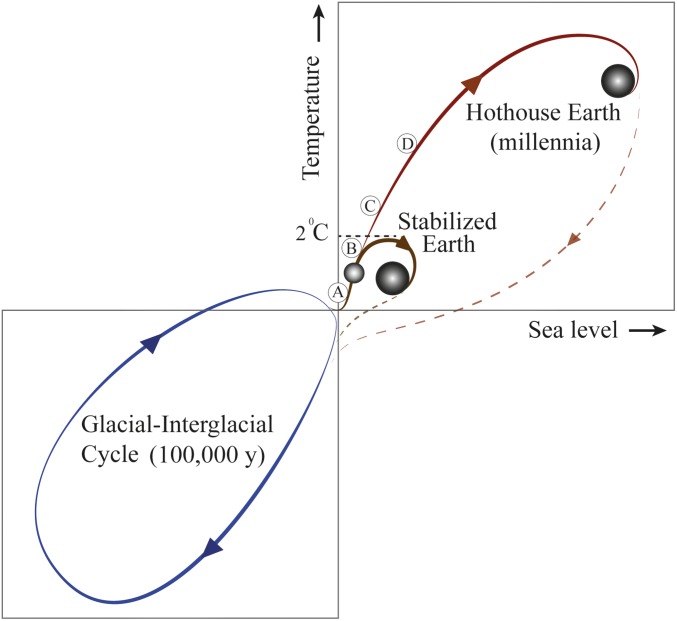
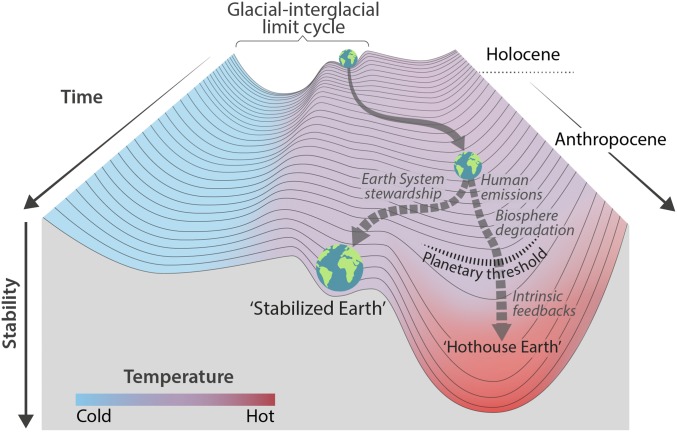
We explore the risk that self-reinforcing feedbacks could push the Earth System toward a planetary threshold that, if crossed, could prevent stabilization of the climate at intermediate temperature rises and cause continued warming on a “Hothouse Earth” pathway even as human emissions are reduced. Crossing the threshold would lead to a much higher global average temperature than any interglacial in the past 1.2 million years and to sea levels significantly higher than at any time in the Holocene. We examine the evidence that such a threshold might exist and where it might be. If the threshold is crossed, the resulting trajectory would likely cause serious disruptions to ecosystems, society, and economies. Collective human action is required to steer the Earth System away from a potential threshold and stabilize it in a habitable interglacial-like state. Such action entails stewardship of the entire Earth System—biosphere, climate, and societies—and could include decarbonization of the global economy, enhancement of biosphere carbon sinks, behavioral changes, technological innovations, new governance arrangements, and transformed social values.
Overview
The claims and statistics of this paper haven’t been checked yet.
Free: it reads the open-access text and checks the first 5 claims that cite a source we can check. Create a free account to check every claim.
Integrity signals
Registry
Cites
Statistics
Figures
Verification
Claims the paper makes
The claims and statistics of this paper haven’t been checked yet.
Free: it reads the open-access text and checks the first 5 claims that cite a source we can check. Create a free account to check every claim.
Claims other papers make about this one
Each is checked against this paper’s own text: does it say what the citing paper says it does?
The source backs part of the claim, not all of it — or backs it for a different population, condition or comparison.
In the citing paper
“Triggering positive feedback, uncontrolled emissions will lead to a major climate change that would durably lock the planet into a hot system where glaciers would go extinct(Steffen et al., 2018;McKay et al., 2022).”
From Future emergence of new ecosystems caused by glacial retreat (2023) · cites this paper as Steffen et al., 2018
Experimental — accuracy not yet measuredIn the citing paper
“Our journey into the future of cold regions shows that deglaciation over the 21 st century is expected to occur over 181,000 ± 55,000 to 372,000 ± 99,000 km 2 outside the Greenland and Antarctic ice sheets (Fig. 3) and may reach unprecedented levels in recent Earth's history”
From Future emergence of new ecosystems caused by glacial retreat (2023) · cites this paper as Steffen et al., 2018
In the citing paper
“yet it remains unknown whether human social dynamics will yield such responses”
From Stewardship of global collective behavior (2021) · cites this paper as [14]
In the citing paper
“Human collective dynamics are critical to the wellbeing of people and ecosystems in the present and will set the stage for how we face global challenges with impacts that will last centuries (14, 15, 64).”
From Stewardship of global collective behavior (2021) · cites this paper as [14]
Self-check
Percentages, sums and reported differences re-computed from the paper’s own numbers.
The self-check needs the paper’s full text.
Citations
Cites
(2014) · Cambridge University Press eBooks · doi:10.1017/cbo9781107415379 · Cited by 11,249
(2007) · Medical Entomology and Zoology · Cited by 9,612
Crutzen, P. J. (2002) · Nature · doi:10.1038/415023a · Cited by 4,788
Tipping elements in the Earth’s climate system
Lenton, T. M., Held, H., Kriegler, E., Hall, J. W., Lucht, W., Rahmstorf, S., & Schellnhuber, H. J. (2008) · Proceedings of the National Academy of Sciences · doi:10.1073/pnas.0705414105 · Cited by 3,982
Self-citationThe trajectory of the Anthropocene: The Great Acceleration
Steffen, W., Broadgate, W., Deutsch, L., Gaffney, O., & Ludwig, C. (2015) · The Anthropocene Review · doi:10.1177/2053019614564785 · Cited by 3,935
Self-citationGriscom, B. W., Adams, J., Ellis, P. W., Houghton, R. A., Lomax, G., Miteva, D. A., Schlesinger, W. H., Shoch, D., Siikamäki, J. V., Smith, P., et al. (2017) · Proceedings of the National Academy of Sciences · doi:10.1073/pnas.1710465114 · Cited by 3,481
Eight glacial cycles from an Antarctic ice core
members, E. C. (2004) · Nature · doi:10.1038/nature02599 · Cited by 2,415
The Anthropocene is functionally and stratigraphically distinct from the Holocene
Waters, C. N., Zalasiewicz, J., Summerhayes, C., Barnosky, A. D., Poirier, C., Gałuszka, A., Cearreta, A., Edgeworth, M., Ellis, E. C., Ellis, M., et al. (2016) · Science · doi:10.1126/science.aad2622 · Cited by 2,375
Self-citationContribution of Antarctica to past and future sea-level rise
DeConto, R. M., & Pollard, D. (2016) · Nature · doi:10.1038/nature17145 · Cited by 2,044
Research works printed but not linked: 3
- Stocker TF 2013 Technical summary Climate Change 2013: The Physical Science Basis. Contribution of Working Group I to the Fifth Assessment Report of the Intergovernmental Panel on Climate Change Stocker TF Cambridge Univ Press Cambridge, UK
- Ciais P 2013 Carbon and other biogeochemical cycles Climate Change 2013: The Physical Science Basis, Contribution of Working Group I to the Fifth Assessment Report of the Intergovernmental Panel on Climate Change Stocker TF Cambridge Univ Press Cambridge, UK 465 570
- Latorre C Wilmshurst J von Gunten L 2016 Climate change and cultural evolution PAGES (Past Global Changes) Magazine 24 1 32
Cited by
Items 401–500 of 1,000
Adaptive capacity beyond the household: a systematic review of empirical social-ecological research
Vallury, S., Smith, A. P., Chaffin, B. C., Nesbitt, H. K., Lohani, S., Gulab, S., Banerjee, S., Floyd, T. M., Metcalf, A. L., Metcalf, E. C., et al. (2022) · Environmental Research Letters · doi:10.1088/1748-9326/ac68fb · Cited by 71
Global soil organic carbon–climate interactions: Why scales matter
Jungkunst, H. F., Göpel, J., Horvath, T., Ott, S., & Brunn, M. (2022) · Wiley Interdisciplinary Reviews Climate Change · doi:10.1002/wcc.780 · Cited by 68
Feedback in tropical forests of the Anthropocene
Flores, B. M., & Staal, A. (2022) · Global Change Biology · doi:10.1111/gcb.16293 · Cited by 59
Mainstreaming regenerative dynamics for sustainability
Fischer, J., Farny, S., Abson, D. J., Zeidler, V. Z., von Salisch, M., Schaltegger, S., Martín‐López, B., Temperton, V. M., & Kümmerer, K. (2024) · Nature Sustainability · doi:10.1038/s41893-024-01368-w · Cited by 77
“The global sustainability crisis is driven by rapid changes in social and ecological relationships 1 , including numerous reinforcing feedback cycles 2,3 .”
Subsistence protection and mitigation ambition: Necessities, economic and climatic
Shue, H. (2019) · The British Journal of Politics and International Relations · doi:10.1177/1369148118819071 · Cited by 59
“…of mitigation does not take into account the growing fear expressed by sober leading scientists that less aggressive mitigation will allow accumulating emissions to tip the planet into an unstoppable cascade of self-reinforcing feedbacks towards a ‘Hothouse Earth’ (Steffen et al., 2018).”
BackgroundInfluentialWicked Problems of Smart Cities
Colding, J., Barthel, S., & Sörqvist, P. (2019) · Smart Cities · doi:10.3390/smartcities2040031 · Cited by 75
A planetary boundary-based environmental footprint family: From impacts to boundaries
Wu, L., Huang, K., Ridoutt, B. G., Yu, Y., & Chen, Y. (2021) · The Science of The Total Environment · doi:10.1016/j.scitotenv.2021.147383 · Cited by 63
Postapocalyptic narratives in climate activism: their place and impact in five European cities
de Moor, J. (2021) · Environmental Politics · doi:10.1080/09644016.2021.1959123 · Cited by 88
Commentary : Resilience and Social-Ecological Systems: A Handful of Frontiers
Folke, C., Haider, L. J., Lade, S. J., Norström, A. V., & Rocha, J. (2021) · Global Environmental Change · doi:10.1016/j.gloenvcha.2021.102400 · Cited by 85
Self-citationLessons from COVID-19 for managing transboundary climate risks and building resilience
Ringsmuth, A. K., Otto, I. M., van den Hurk, B., Lahn, G., Reyer, C., Carter, T. R., Magnuszewski, P., Monasterolo, I., Aerts, J. C. J. H., Benzie, M., et al. (2022) · Climate Risk Management · doi:10.1016/j.crm.2022.100395 · Cited by 73
A resilience approach to corporate biodiversity impact measurement
Kennedy, S., Fuchs, M., van Ingen, W., & Schoenmaker, D. (2022) · Business Strategy and the Environment · doi:10.1002/bse.3140 · Cited by 67
Barriers to institutional social sustainability
Filho, W. L., Salvia, A. L., de Vasconcelos, C. R. P., Anholon, R., Rampasso, I. S., Eustachio, J. H. P. P., Liakh, O., Dinis, M. A. P., Cementina-Olpoc, R., Bandanaa, J., et al. (2022) · Sustainability Science · doi:10.1007/s11625-022-01204-0 · Cited by 80
Climate action now: Energy industry restructuring to accelerate the renewable energy transition
de Lange, D. E. (2024) · Journal of Cleaner Production · doi:10.1016/j.jclepro.2024.141018 · Cited by 62
Generative AI tools can enhance climate literacy but must be checked for biases and inaccuracies
Atkins, C., Girgente, G., Shirzaei, M., & Kim, J. (2024) · Communications Earth & Environment · doi:10.1038/s43247-024-01392-w · Cited by 58
The 2025 state of the climate report: a planet on the brink
Ripple, W. J., Wolf, C., MANN, M. E., Rockström, J., Gregg, J. W., Xu, C., Wunderling, N., Perkins-Kirkpatrick, S. E., Schaeffer, R., Broadgate, W. J., et al. (2025) · BioScience · doi:10.1093/biosci/biaf149 · Cited by 104
Self-citationFedele, G., Donatti, C. I., Harvey, C. A., Hannah, L., & Hole, D. G. (2020) · Ecology and Society · doi:10.5751/es-11381-250125 · Cited by 72
Harwatt, H. (2018) · Climate Policy · doi:10.1080/14693062.2018.1528965 · Cited by 68
“There are numerous challenges with NETs, including the large land requirements and competition for water resources, potentially threatening food security and biodiversity; the unproven and undeveloped nature of the technologies at the scale required; the risk of reversal/emissions release post-implementation (Larkin,…”
BackgroundRosinger, A. Y., Brewis, A., Wutich, A., Jepson, W. E., Staddon, C., Stoler, J. B., & Young, S. L. (2020) · Global Environmental Change · doi:10.1016/j.gloenvcha.2020.102148 · Cited by 64
“Moreover, the challenging conditions faced by vulnerable households are likely to be worsened by projected changes to water availability through climate change and population growth (Konapala et al., 2020; Steffen et al., 2018).”
BackgroundEffect of climate change on marine ecosystems
Williamson, P. C., & Guinder, V. A. (2021) · Elsevier eBooks · doi:10.1016/b978-0-12-822373-4.00024-0 · Cited by 78
Technological innovation enables low cost climate change mitigation
Creutzig, F., Hilaire, J., Nemet, G. F., Müller-Hansen, F., & Minx, J. C. (2023) · Energy Research & Social Science · doi:10.1016/j.erss.2023.103276 · Cited by 74
No respite from permafrost-thaw impacts in the absence of a global tipping point
Nitzbon, J., von Deimling, T. S., Aliyeva, M., Chadburn, S., Grosse, G., Laboor, S., Lee, H., Lohmann, G., Steinert, N. J., Stuenzi, S. M., et al. (2024) · Nature Climate Change · doi:10.1038/s41558-024-02011-4 · Cited by 87
“Permafrost loss or ‘collapse’ has repeatedly been brought up as a potential climate tipping element 11,14,15 , and was included in a recent assessment of CTPs 16 .”
InfluentialEconomics of the disintegration of the Greenland ice sheet
Nordhaus, W. D. (2019) · Proceedings of the National Academy of Sciences · doi:10.1073/pnas.1814990116 · Cited by 63
“Continued warming threatens to push large-scale earth systems beyond tipping points (2, 5, 6).”
The work after “It's too late” (to prevent dangerous climate change)
Moser, S. C. (2019) · Wiley Interdisciplinary Reviews Climate Change · doi:10.1002/wcc.606 · Cited by 73
“Consider, for example, the widely reported Hothouse Earth article on tipping points in the Earth system (Steffen et al., 2018); or the publication of the Deep Adaptation paper (Bendell, 2018) having gone viral in the United Kingdom.”
BackgroundPhilanthrocapitalism: Promoting Global Health but Failing Planetary Health
Butler, C. D. (2019) · Challenges · doi:10.3390/challe10010024 · Cited by 61
“But the absence, so far, of BMGF investment in ecological public health (or planetary health), suggests that it does not yet see Earth system change as having the potential to cripple global health, on a planetary scale.”
BackgroundInfluentialCustodio, H. M., Hadjikakou, M., & Bryan, B. A. (2022) · Ecological Economics · doi:10.1016/j.ecolecon.2022.107608 · Cited by 75
Multidimensional partisanship shapes climate policy support and behaviours
Mayer, A., & Smith, E. K. (2023) · Nature Climate Change · doi:10.1038/s41558-022-01548-6 · Cited by 73
Quantifying Global Greenhouse Gas Emissions in Human Deaths to Guide Energy Policy
Pearce, J. M., & Parncutt, R. (2023) · Energies · doi:10.3390/en16166074 · Cited by 66
“Warming of well over 2 ◦ C, however, could indeed cause natural climate feedbacks to get out of control, leading eventually to human extinction [66].”
BackgroundHuman Rights and Precautionary Principle: Limits to Geoengineering, SRM, and IPCC Scenarios
Wieding, J., Stubenrauch, J., & Ekardt, F. (2020) · Sustainability · doi:10.3390/su12218858 · Cited by 62
Marcantonio, R. A., Javeline, D., Field, S., & Fuentes, A. (2021) · PLoS ONE · doi:10.1371/journal.pone.0254060 · Cited by 61
“Some have argued that the challenges presented by human-produced pollution may be nearing tipping points past which returning to the ecological niche representative of most of human history will become unattainable [3,28].”
BackgroundDemocracy and the Challenge of Climate Change
Lindvall, D. (2021) · doi:10.31752/idea.2021.88 · Cited by 67
Can Sustainable Development Save Mangroves?
Ferreira, A. C., Borges, R., & de Lacerda, L. D. (2022) · Sustainability · doi:10.3390/su14031263 · Cited by 79
“There is no doubt that we need a radical, global system change, and that the transition from a capital-oriented world to another societal organization needs also social and cultural transformation [12].”
BackgroundBioeconomy – present status and future needs of industrial value chains
Kircher, M. (2020) · New Biotechnology · doi:10.1016/j.nbt.2020.09.005 · Cited by 66
Nakagawa, T., Tarasov, P., Staff, R., Bronk Ramsey, C., Marshall, M., Schlolaut, G., Bryant, C., Brauer, A., Lamb, H., Haraguchi, T., et al. (2021) · Global and Planetary Change · doi:10.1016/j.gloplacha.2021.103493 · Cited by 45
Barron, A. R., Domeshek, M., Metz, L. E., Draucker, L., & Strong, A. (2021) · One Earth · doi:10.1016/j.oneear.2021.08.014 · Cited by 66
The Multi-hub Academic Conference: Global, Inclusive, Culturally Diverse, Creative, Sustainable
Parncutt, R., Lindborg, P., Meyer‐Kahlen, N., & Timmers, R. (2021) · Frontiers in Research Metrics and Analytics · doi:10.3389/frma.2021.699782 · Cited by 68
Fragmented tipping in a spatially heterogeneous world
Bastiaansen, R., Dijkstra, H. A., & von der Heydt, A. S. (2022) · Environmental Research Letters · doi:10.1088/1748-9326/ac59a8 · Cited by 67
Comparative capitalisms in the Anthropocene: a research agenda for green transition
Green, J. (2022) · New Political Economy · doi:10.1080/13563467.2022.2109611 · Cited by 74
“Dryzek and Pickering (2018, p. 23) describe these processes as ‘pathological path dependency’ – disconnecting human institutions from Earth System dynamics by privileging economic imperatives over ecological awareness.”
BackgroundInfluentialChemical Mixtures and Multiple Stressors: Same but Different?
Schäfer, R. B., Jackson, M. C., Juvigny‐Khenafou, N. P. D., Osakpolor, S. E., Posthuma, L., Schneeweiss, A., Spaak, J. W., & Vinebrooke, R. D. (2023) · Environmental Toxicology and Chemistry · doi:10.1002/etc.5629 · Cited by 66
“The pervasive footprint of human activities has resulted in substantial losses of biodiversity and is affecting the functioning of ecosystems, making them potentially less hospitable for life (Barnosky et al., 2012; Steffen et al., 2018; 2018).”
TURNEY, C. S. M., Jones, R. T., McKay, N. P., van Sebille, E., Thomas, Z., Hillenbrand, C., & Fogwill, C. J. (2020) · Earth system science data · doi:10.5194/essd-12-3341-2020 · Cited by 69
Basińska, A., Reczuga, M., Gąbka, M., Stróżecki, M., Łuców, D., Samson, M., Urbaniak, M., Leśny, J., Chojnicki, B. H., Gilbert, D., et al. (2020) · Ecological Indicators · doi:10.1016/j.ecolind.2019.106059 · Cited by 58
Climate Dipoles as Continental Drivers of Plant and Animal Populations
Zuckerberg, B., Strong, C., LaMontagne, J. M., George, S. S., Betancourt, J. L., & Koenig, W. D. (2020) · Trends in Ecology & Evolution · doi:10.1016/j.tree.2020.01.010 · Cited by 58
Cold Seeps in a Warming Arctic: Insights for Benthic Ecology
Åström, E. K. L., Sen, A., Carroll, M. L., & Carroll, J. (2020) · Frontiers in Marine Science · doi:10.3389/fmars.2020.00244 · Cited by 54
“Even if global actions to reduce emissions are implemented immediately, climate change impacts will continue for at least the next few decades due to the time lag of effects (Steffen et al., 2018).”
BackgroundSwingedouw, D., Speranza, C. I., Bartsch, A., Durand, G., Jamet, C., Beaugrand, G., & Conversi, A. (2020) · Surveys in Geophysics · doi:10.1007/s10712-020-09604-6 · Cited by 67
“Loss of permafrost carbon is one of the expected changes which are irreversible on time scales that matter to contemporary societies (Steffen et al. 2018).”
BackgroundPiłatowska, M., & Geise, A. (2021) · Energies · doi:10.3390/en14040812 · Cited by 57
“In this situation, there is a need for urgent global actions, which climate researchers have been promoting for many years [2,3].”
BackgroundCoastal management and the political-legal geographies of climate change adaptation in Australia
O’Donnell, T. (2019) · Ocean & Coastal Management · doi:10.1016/j.ocecoaman.2019.03.022 · Cited by 62
“Adaptation is necessary due to the locked-in effect of greenhouse gas emissions and consequential global warming (Steffen et al., 2018).”
Co-existing climate attractors in a coupled aquaplanet
Brunetti, M., Kasparian, J., & Verard, C. (2019) · Archive ouverte UNIGE (University of Geneva) · Cited by 53
Kim, Y. J., & Brown, M. A. (2019) · Energy Policy · doi:10.1016/j.enpol.2019.01.032 · Cited by 59
“A recent U.S. National Academies report suggests that feedback forces could push the Earth System toward a self-reinforcing condition of continued global warming (Steffen et al., 2018).”
Environmental sustainability in veterinary anaesthesia
JONES, R. S., & West, E. (2019) · Veterinary Anaesthesia and Analgesia · doi:10.1016/j.vaa.2018.12.008 · Cited by 60
Dahlmann, F., Stubbs, W., Griggs, D., & Morrell, K. (2019) · The Anthropocene Review · doi:10.1177/2053019619848217 · Cited by 73
“…et al., 2004; 2015) towards a planet whose state is quantitatively and qualitatively different (Rockström et al., 2009; Steffen et al., 2011; Steffen et al., 2018), ‘Earth System Governance’ (ESG) provides a framework for developing new insights into governing this coupled socio-ecological…”
BackgroundSolar geoengineering may lead to excessive cooling and high strategic uncertainty
Abatayo, A. L., Bosetti, V., Casari, M., Ghidoni, R., & Tavoni, M. (2020) · Proceedings of the National Academy of Sciences · doi:10.1073/pnas.1916637117 · Cited by 52
“Recent literature has highlighted negative economic impacts resulting from climate change (9) and the fast-approaching tipping point to be higher than previously expected (10).”
BackgroundFerretti, F., & Fattorini, N. (2020) · Integrative Zoology · doi:10.1111/1749-4877.12470 · Cited by 55
Socialising tourism after COVID-19: reclaiming tourism as a social force?
Higgins‐Desbiolles, F., Bigby, B. C., & Doering, A. (2021) · Journal of Tourism Futures · doi:10.1108/jtf-03-2021-0058 · Cited by 64
Qiao, B., Yang, H., Cao, X., Zhou, B., & Wang, N. (2025) · Ecological Indicators · doi:10.1016/j.ecolind.2025.113342 · Cited by 59
Donges, J., Heitzig, J., Barfuss, W., Wiedermann, M., Kassel, J., Kittel, T., Kolb, J., Kolster, T., Müller-Hansen, F., Otto, I., et al. (2020) · Publication Database PIK (Potsdam Institute for Climate Impact Research (PIK)) · Cited by 52
Self-citationRyberg, M. W., Bjerre, T. K., Nielsen, P. H., & Hauschild, M. Z. (2020) · Journal of Industrial Ecology · doi:10.1111/jiec.13075 · Cited by 68
“Moreover, CFs related to emissions of N and P from the WWTPs were lacking in the original PB-LCIA, but were added to the method based on material flow analyses (MFAs) of the flow of P (Suh & Yee, 2011) and N (Antikainen et al., 2005).”
MethodIntergenerational sustainability is enhanced by taking the perspective of future generations
Shahen, M. E., Kotani, K., & Saijo, T. (2021) · Scientific Reports · doi:10.1038/s41598-021-81835-y · Cited by 61
Adaptive multi-paddock grazing improves water infiltration in Canadian grassland soils
Döbert, T. F., Bork, E. W., Apfelbaum, S. I., Carlyle, C. N., Chang, S. X., Khatri‐Chhetri, U., Sobrinho, L. S., Thompson, R., & Boyce, M. S. (2021) · Geoderma · doi:10.1016/j.geoderma.2021.115314 · Cited by 65
Diminishing Opportunities for Sustainability of Coastal Cities in the Anthropocene: A Review
Day, J. W., Gunn, J. D., & Burger, J. R. (2021) · Frontiers in Environmental Science · doi:10.3389/fenvs.2021.663275 · Cited by 70
“This is especially apparent in the second half of the 20th century, the so-called exponential century or Great Acceleration (Steffen et al., 2018).”
BackgroundInfluentialMoullec, F., Barrier, N., Drira, S., Guilhaumon, F., Hattab, T., Peck, M. A., & Shin, Y. (2021) · Ecological Modelling · doi:10.1016/j.ecolmodel.2021.109826 · Cited by 57
“…anthropogenic pressures on ecosystems such as exploitation, pollution, habitat fragmentation and loss, and biological invasions are expected to intensify in the future, especially in a business-as-usual scenario (Bellard et al., 2012; Leadley et al., 2010; Shin et al., 2019; Steffen et al., 2018).”
Lin, Q., Zhang, K., Giguet‐Covex, C., Arnaud, F., McGowan, S., Gielly, L., Capo, É., Huang, S., Ficetola, G. F., Shen, J., et al. (2024) · Proceedings of the National Academy of Sciences · doi:10.1073/pnas.2321303121 · Cited by 59
The future extent of the Anthropocene epoch: A synthesis
Summerhayes, C., Zalasiewicz, J., Head, M., Syvitski, J., Barnosky, A., Cearreta, A., Fiałkiewicz-Kozieł, B., Grinevald, J., Leinfelder, R., McCarthy, F., et al. (2024) · Apollo (University of Cambridge) · doi:10.17863/cam.112342 · Cited by 44
Self-citationKeller, L., Stötter, J., Oberrauch, A., Kuthe, A., Körfgen, A., & Hüfner, K. (2019) · GAIA - Ecological Perspectives for Science and Society · doi:10.14512/gaia.28.1.10 · Cited by 73
Desing, H., Widmer, R., Beloin‐Saint‐Pierre, D., Hischier, R., & Wäger, P. A. (2019) · Energies · doi:10.3390/en12244723 · Cited by 53
“However, crossing these thresholds runs the increasingly higher risk of triggering fast and irreversible environmental change towards new and likely less hospitable states [31].”
BackgroundLohrmann, A., Child, M., & Breyer, C. (2021) · Energy · doi:10.1016/j.energy.2021.121098 · Cited by 60
Donges, J. F., Lucht, W., Cornell, S., Heitzig, J., Barfuß, W., Lade, S. J., & Schlüter, M. (2021) · Earth System Dynamics · doi:10.5194/esd-12-1115-2021 · Cited by 79
“Furthermore, as it becomes clearer that palaeoclimate models can play a vital role in “deep future” studies of human-controlled processes in the Anthropocene, Earth system dynamics operating on longer time-scales are relevant (Zeebe and Zachos, 2013; Steffen et al., 2018).”
BackgroundInfluentialSelf-citationFalkenmark, M., & Wang‐Erlandsson, L. (2021) · One Earth · doi:10.1016/j.oneear.2021.01.009 · Cited by 58
Protecting Half the Planet and Transforming Human Systems Are Complementary Goals
Crist, E. L., Kopnina, H., Cafaro, P., Gray, J., Ripple, W. J., Safina, C., Davis, J., DellaSala, D. A., Noss, R. F., Washington, H., et al. (2021) · Frontiers in Conservation Science · doi:10.3389/fcosc.2021.761292 · Cited by 66
“The speed with which average surface temperature is rising is heading the planet toward hothouse conditions (Steffen et al., 2018; Ripple et al., 2020).”
BackgroundPlanetary Boundaries and the Doughnut frameworks: A review of their local operability
Ferretto, A., Matthews, R., Brooker, R. W., & Smith, P. (2022) · Anthropocene · doi:10.1016/j.ancene.2022.100347 · Cited by 83
“The only way to avoid this outcome is a strong transformation of our societies, able to direct us towards a “ Stabilised Earth ” which would keep us below dangerous thresholds that could trigger cascade effects impossible to revert (Steffen et al., 2018).”
BackgroundSchwinger, J., Asaadi, A., Steinert, N. J., & Lee, H. (2022) · Earth System Dynamics · doi:10.5194/esd-13-1641-2022 · Cited by 75
Transition pathways to sustainability in greater than 2 °C climate futures of Europe
Frantzeskaki, N., Hölscher, K., Holman, I., Pedde, S., Jaeger, J., Kok, K. I., & Harrison, P. A. (2019) · Regional Environmental Change · doi:10.1007/s10113-019-01475-x · Cited by 59
The oxygen cycle and a habitable Earth
Huang, J., Liu, X., Shen, S., Shen, S., Hou, Z., Li, S., Li, C., Yao, L., & Huang, J. (2021) · Science China Earth Sciences · doi:10.1007/s11430-020-9747-1 · Cited by 59
International Politics in the Age of Existential Threats
Sears, N. A. (2020) · Journal of Global Security Studies · doi:10.1093/jogss/ogaa027 · Cited by 57
Higgins‐Desbiolles, F., Blanchard, L., & Urbain, Y. (2021) · Journal of Sustainable Tourism · doi:10.1080/09669582.2021.1952420 · Cited by 49
Transboundary Water Governance Scholarship: A Critical Review
Varady, R. G., Albrecht, T. R., Modak, S., Wilder, M., & Gerlak, A. K. (2023) · Environments · doi:10.3390/environments10020027 · Cited by 81
Boehm, S., Jeffery, M. L., Hecke, J., Schumer, C., Jaeger, J., Fyson, C. L., Levin, K., Nilsson, A. E., Naimoli, S., Daly, E., et al. (2023) · doi:10.46830/wrirpt.23.00010 · Cited by 121
Sporchia, F., Antonelli, M., Aguilar, A., Bach-Faig, A., Caro, D., Davis, K. F., Sonnino, R., & Galli, A. (2024) · Sustainable Earth Reviews · doi:10.1186/s42055-024-00078-7 · Cited by 86
“The 2030 time horizon is not just a politically set deadline, but also the time-frame beyond which the destabilization of multiple Earth System processes might become irreversible [51].”
BackgroundDifferent effects of alpine woody plant expansion on domestic and wild ungulates
Espunyes, J., Lurgi, M., Büntgen, U., Bartolomé, J., Calleja, J. A., Gálvez‐Cerón, A., Peñuelas, J., López, B. C., & Serrano, E. (2019) · Global Change Biology · doi:10.1111/gcb.14587 · Cited by 57
“for the future of these environments (Steffen et al., 2018).”
BackgroundClimate change adaptation narratives: Linking climate knowledge and future thinking
Coulter, L., Serrao-Neumann, S., & Coiacetto, E. (2019) · Futures · doi:10.1016/j.futures.2019.05.004 · Cited by 58
Cibulka, S., & Giljum, S. (2020) · Sustainability · doi:10.3390/su12114734 · Cited by 56
“This integrated perspective is relevant, as the urgency of challenges currently faced by humanity [44,45] demands identifying systemic solutions that avoid burden shifting between environmental and social domains.”
BackgroundPotential greenhouse gas reductions from Natural Climate Solutions in Oregon, USA
Graves, R. A., Haugo, R. D., Holz, A., Nielsen‐Pincus, M., Jones, A., Kellogg, B., Macdonald, C., Popper, K. J., & Schindel, M. (2020) · PLoS ONE · doi:10.1371/journal.pone.0230424 · Cited by 56
Downing, A. S., Kumar, M., Andersson, A., Causevic, A., Gustafsson, Ö., Joshi, N. U., Krishnamurthy, C. K. B., Scholtens, B., & Crona, B. (2022) · Ecological Economics · doi:10.1016/j.ecolecon.2022.107364 · Cited by 66
Mapping the Circular Economy Concept and the Global South
dos Muchangos, L. S. (2021) · Circular Economy and Sustainability · doi:10.1007/s43615-021-00095-0 · Cited by 66
Impacts of Low Oxygen on Marine Life: Neglected, but a Crucial Priority for Research
Borges, F. O., Sampaio, E., Santos, C. P., & Rosa, R. (2022) · Biological Bulletin · doi:10.1086/721468 · Cited by 51
“…civilization (Friedlingstein et al., 2019; MassonDelmotte and Moufouma-Okia, 2019; Talukder et al., 2022), because of their interlinked potential for destabilizing Earth’s biosphere, fueling unprecedented consequences for both natural systems and human societies (Steffen et al., 2018; IPCC, 2021).”
BackgroundUnderstanding and governing global systemic crises in the 21st century: A complexity perspective
Wernli, D., Böttcher, L., Vanackere, F., Kaspiarovich, Y., Masood, M., & Levrat, N. (2023) · Global Policy · doi:10.1111/1758-5899.13192 · Cited by 83
Engineering climate debt: temperature overshoot and peak-shaving as risky subprime mortgage lending
Asayama, S., & Hulme, M. (2019) · Climate Policy · doi:10.1080/14693062.2019.1623165 · Cited by 60
“Some may argue that the strategy of temperature overshoot and peak-shaving can offer a safe passage away from dangerous climate change (see Steffen et al., 2018).”
BackgroundGame Changer in Soil Science. The Anthropocene in soil science and pedology.
Richter, D. D. (2019) · Journal of Plant Nutrition and Soil Science · doi:10.1002/jpln.201900320 · Cited by 54
“From many perspectives, what is most of interest is that human forcings are altering Earth’s many systems (Steffen et al., 2018) and that many of these alterations will persist throughout the coming millennia as they become written into”
BackgroundIntegrate Risk From Climate Change in China Under Global Warming of 1.5 and 2.0 °C.
Wu, S., Liu, L., Gao, J., & Wang, W. (2019) · Earth s Future · doi:10.1029/2019ef001194 · Cited by 51
“Steffen et al. (2018) found that if a planetary threshold (around 2.0 °C above preindustrial temperature) is exceeded, it will cause continued warming on a Hothouse Earth pathway.”
BackgroundInfluentialMoreau, L., Boué, P., Serripierri, A., Weiss, J., Hollis, D., Pondaven, I., Vial, B., Garambois, S., Larose, É., Helmstetter, A., et al. (2020) · Journal of Geophysical Research Oceans · doi:10.1029/2019jc015709 · Cited by 48
Evaluating the efficacy and equity of environmental stopgap measures
Buck, H. J., Martin, L. J., Geden, O., Kareiva, P., Koslov, L., Krantz, W., Kravitz, B., Noel, J. R., Parson, E. A., Preston, C. J., et al. (2020) · Nature Sustainability · doi:10.1038/s41893-020-0497-6 · Cited by 55
Five Organizational Features That Enable Successful Interdisciplinary Marine Research
Blythe, J. L., & Cvitanovic, C. (2020) · Frontiers in Marine Science · doi:10.3389/fmars.2020.539111 · Cited by 58
Towards integrated essential variables for sustainability
Lehmann, A., Masó, J., Nativi, S., & Giuliani, G. (2020) · International Journal of Digital Earth · doi:10.1080/17538947.2019.1636490 · Cited by 52
“Approaches such as the planetary boundaries (Rockstrom et al. 2009; Steffen et al. 2018), ecological footprints (Fang, Heijungs, and De Snoo 2015), nexus and socio-ecological system metabolism (Giampietro, Mayumi, and Ramos-Martin 2009) are aiming to explicitly link environmental, social and…”
BackgroundBioengineering horizon scan 2020
Kemp, L., Adam, L., Boehm, C. R., Breitling, R., Casagrande, R. J., Dando, M., Djikeng, A., Evans, N. G., Hammond, R., Hills, K., et al. (2020) · eLife · doi:10.7554/elife.54489 · Cited by 59
Evaluation and analysis of the projected population of China
Dai, K., Shen, S., & Cheng, C. (2022) · Scientific Reports · doi:10.1038/s41598-022-07646-x · Cited by 58
“(2)) to indicate the population projection accuracy and projection bias, respectively46.”
BackgroundReduced CO2 uptake and growing nutrient sequestration from slowing overturning circulation
Liu, Y., Moore, J. K., Primeau, F., & Wang, W. (2022) · Nature Climate Change · doi:10.1038/s41558-022-01555-7 · Cited by 70
Effects of multi-observations uncertainty and models similarity on climate change projections
Pathak, R., Dasari, H. P., Ashok, K., & Hoteit, I. (2023) · npj Climate and Atmospheric Science · doi:10.1038/s41612-023-00473-5 · Cited by 74
“Climate change is a serious concern for modern civilization because of its unforeseeable consequences for human societies and ecosystems and its destabilization effect in the case of various earth systems and processes 1,2 .”
BackgroundClimate gating: A case study of emerging responses to Anthropocene Risks
Simpson, N. P., Shearing, C. D., & Dupont, B. (2019) · Climate Risk Management · doi:10.1016/j.crm.2019.100196 · Cited by 55
Ecological changes with minor effect initiate evolution to delayed regime shifts
Chaparro‐Pedraza, P. C., & de Roos, A. M. (2020) · Nature Ecology & Evolution · doi:10.1038/s41559-020-1110-0 · Cited by 53
Polar amplification of Pliocene climate by elevated trace gas radiative forcing
Hopcroft, P. O., Ramstein, G., Pugh, T. A. M., Hunter, S. J., Murguía‐Flores, F., Quiquet, A., Sun, Y., Tan, N., & Valdes, P. J. (2020) · Proceedings of the National Academy of Sciences · doi:10.1073/pnas.2002320117 · Cited by 48
Planetary good governance after the Paris Agreement: The case for a global greenhouse gas tax
Morgan, J., & Patomäki, H. (2021) · Journal of Environmental Management · doi:10.1016/j.jenvman.2021.112753 · Cited by 55
Dynamical landscape and multistability of a climate model
(16738296), G. M., (18055690), T. G., (18055693), A. L., & (16183628), V. L. (2025) · Figshare · Cited by 47
Metadata
- Authors
- Steffen, W., Rockström, J., Richardson, K., Lenton, T. M., Folke, C., Liverman, D., Summerhayes, C. P., Barnosky, A. D., Cornell, S. E., Crucifix, M., Donges, J. F., Fetzer, I., Lade, S. J., Scheffer, M., Winkelmann, R., & Schellnhuber, H. J.
- Affiliations
- Australian National University (AU)
- Stockholm Resilience Centre (SE)
- University of Copenhagen (DK)
- University of Exeter (GB)
- Royal Swedish Academy of Sciences (SE)
- University of Arizona (US)
- University of Cambridge (GB)
- Stanford University (US)
- Fund for Scientific Research (BE)
- Wageningen University & Research (NL)
- University of Potsdam (DE)
- Corresponding author
- Steffen, Will
- ORCID
- Venue
- Proceedings of the National Academy of Sciences
- Publisher
- National Academy of Sciences
- Published
- 2018-08-06
- Volume
- 115
- Issue
- 33
- Pages
- 8252-8259
- ISSN
- 0027-8424 (ISSN-L)
- 1091-6490
- PMC
- PMC6099852
- OpenAlex
- W2886281704
- Cited by
- 3,139
- References
- 92
- Citations by year
- 2026: 185 · 2025: 279 · 2024: 346 · 2023: 414 · 2022: 450 · 2021: 596 · 2020: 446 · 2019: 360 · 2018: 56
- FWCI
- 213.48
- Type
- journal article
- Language
- en
- Open access
- hybrid
- doi.org
- Licence
- Locations
- Proceedings of the National Academy of Sciences (publishedVersion, cc-by-nc-nd)
- Europe PMC (PubMed Central) (publishedVersion, cc-by-nc-nd)
- PubMed Central (publishedVersion, cc-by-nc-nd)
- Research at the University of Copenhagen (University of Copenhagen) (publishedVersion, other-oa)
- PubMed (publishedVersion)
- Open Research Exeter (University of Exeter) (publishedVersion, cc-by-nc-nd)
- Socio-Environmental Systems Modeling (acceptedVersion, cc-by-nc-nd)
- Digital Access to Libraries (submittedVersion, other-oa)
- Figshare (submittedVersion)
- publish.UP (University of Potsdam) (submittedVersion, cc-by-nc-nd)
- RENATE (submittedVersion, cc-by-nc-nd)
- ANU Open Research (Australian National University) (submittedVersion, cc-by-nc-nd)
- Publication Database PIK (Potsdam Institute for Climate Impact Research (PIK)) (submittedVersion)
- Data Archiving and Networked Services (DANS) (submittedVersion, cc-by-nc-nd)
- RENATE
- Funders
- National Science Foundation (1243125)
- Familjen Erling-Perssons Stiftelse
- European Commission (743080)
- Svenska Forskningsrådet Formas (2012-742, 2014-589)
- Vetenskapsrådet
- Earth League
- Stordalen Foundation
- Leibniz-Gemeinschaft
- Topics
- Physical Sciences › Environmental Science › Global and Planetary Change › Climate variability and models
- Physical Sciences › Environmental Science › Global and Planetary Change › Earth Systems and Cosmic Evolution
- Physical Sciences › Environmental Science › Global and Planetary Change › Ecosystem dynamics and resilience
- Keywords
- Hothouse Earth, self-reinforcing feedback, climate stabilization, global warming, sea level rise, decarbonization, carbon sink, Anthropocene, climate tipping points
About these checks
Registry, retraction, Cites and statistics results are computed, not judged, with one exception: a printed reference that no index lists is read once by a model before it counts as a citation error. Claims are extracted by a model and kept only when their quote appears verbatim in the text; each cited source is then checked, with a model’s help, for whether it says what the claim relies on. Those verdicts can be wrong — read the claim’s quote and the cited source before relying on one.
Statistics and arithmetic are recomputed, not judged.
Confidence bands are shown only for fields calibrated on our annotated test set. None is calibrated yet, so no band is shown.
What counts as a claim ›How we measure confidence ›How we check this ›
Are you an author, or do you see a problem with this page? Request a review
Data sources
Bibliographic data: Semantic Scholar, OpenAlex, Crossref.
Contains information from the Semantic Scholar Academic Graph Datasets, made available under the ODC Attribution License (ODC-BY 1.0).
Semantic Scholar’s data is described in: Kinney, R., et al. (2023). The Semantic Scholar Open Data Platform. arXiv:2301.10140.
