

Trajectories of the Earth System in the Anthropocene
Open accessThe DOI matches its Crossref record; 89 of the 92 references it cites were found in a registry or an index.
Abstract
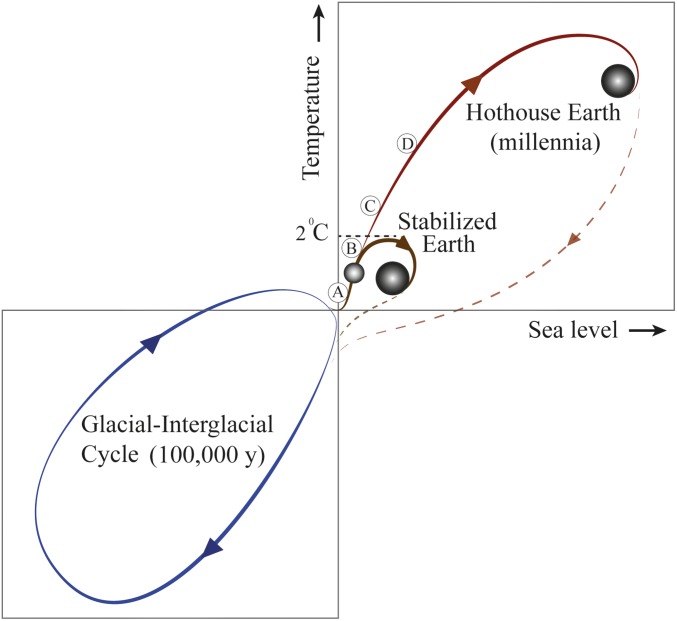
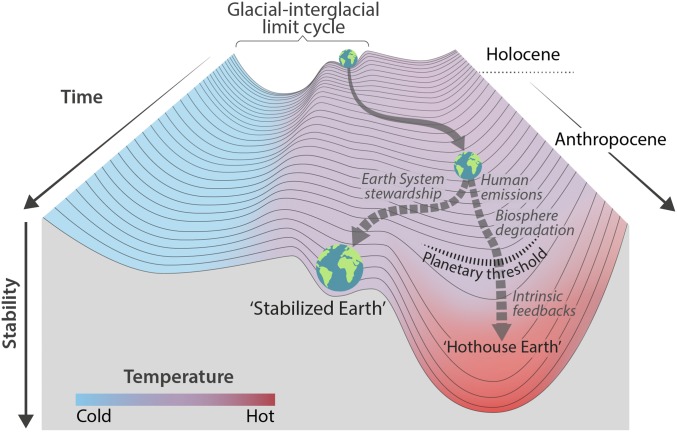
We explore the risk that self-reinforcing feedbacks could push the Earth System toward a planetary threshold that, if crossed, could prevent stabilization of the climate at intermediate temperature rises and cause continued warming on a “Hothouse Earth” pathway even as human emissions are reduced. Crossing the threshold would lead to a much higher global average temperature than any interglacial in the past 1.2 million years and to sea levels significantly higher than at any time in the Holocene. We examine the evidence that such a threshold might exist and where it might be. If the threshold is crossed, the resulting trajectory would likely cause serious disruptions to ecosystems, society, and economies. Collective human action is required to steer the Earth System away from a potential threshold and stabilize it in a habitable interglacial-like state. Such action entails stewardship of the entire Earth System—biosphere, climate, and societies—and could include decarbonization of the global economy, enhancement of biosphere carbon sinks, behavioral changes, technological innovations, new governance arrangements, and transformed social values.
Overview
The claims and statistics of this paper haven’t been checked yet.
Free: it reads the open-access text and checks the first 5 claims that cite a source we can check. Create a free account to check every claim.
Integrity signals
Registry
Cites
Statistics
Figures
Verification
Claims the paper makes
The claims and statistics of this paper haven’t been checked yet.
Free: it reads the open-access text and checks the first 5 claims that cite a source we can check. Create a free account to check every claim.
Claims other papers make about this one
Each is checked against this paper’s own text: does it say what the citing paper says it does?
The source backs part of the claim, not all of it — or backs it for a different population, condition or comparison.
In the citing paper
“Triggering positive feedback, uncontrolled emissions will lead to a major climate change that would durably lock the planet into a hot system where glaciers would go extinct(Steffen et al., 2018;McKay et al., 2022).”
From Future emergence of new ecosystems caused by glacial retreat (2023) · cites this paper as Steffen et al., 2018
Experimental — accuracy not yet measuredIn the citing paper
“Our journey into the future of cold regions shows that deglaciation over the 21 st century is expected to occur over 181,000 ± 55,000 to 372,000 ± 99,000 km 2 outside the Greenland and Antarctic ice sheets (Fig. 3) and may reach unprecedented levels in recent Earth's history”
From Future emergence of new ecosystems caused by glacial retreat (2023) · cites this paper as Steffen et al., 2018
In the citing paper
“yet it remains unknown whether human social dynamics will yield such responses”
From Stewardship of global collective behavior (2021) · cites this paper as [14]
In the citing paper
“Human collective dynamics are critical to the wellbeing of people and ecosystems in the present and will set the stage for how we face global challenges with impacts that will last centuries (14, 15, 64).”
From Stewardship of global collective behavior (2021) · cites this paper as [14]
Self-check
Percentages, sums and reported differences re-computed from the paper’s own numbers.
The self-check needs the paper’s full text.
Citations
Cites
(2014) · Cambridge University Press eBooks · doi:10.1017/cbo9781107415379 · Cited by 11,249
(2007) · Medical Entomology and Zoology · Cited by 9,612
Crutzen, P. J. (2002) · Nature · doi:10.1038/415023a · Cited by 4,788
Tipping elements in the Earth’s climate system
Lenton, T. M., Held, H., Kriegler, E., Hall, J. W., Lucht, W., Rahmstorf, S., & Schellnhuber, H. J. (2008) · Proceedings of the National Academy of Sciences · doi:10.1073/pnas.0705414105 · Cited by 3,982
Self-citationThe trajectory of the Anthropocene: The Great Acceleration
Steffen, W., Broadgate, W., Deutsch, L., Gaffney, O., & Ludwig, C. (2015) · The Anthropocene Review · doi:10.1177/2053019614564785 · Cited by 3,935
Self-citationGriscom, B. W., Adams, J., Ellis, P. W., Houghton, R. A., Lomax, G., Miteva, D. A., Schlesinger, W. H., Shoch, D., Siikamäki, J. V., Smith, P., et al. (2017) · Proceedings of the National Academy of Sciences · doi:10.1073/pnas.1710465114 · Cited by 3,481
Eight glacial cycles from an Antarctic ice core
members, E. C. (2004) · Nature · doi:10.1038/nature02599 · Cited by 2,415
The Anthropocene is functionally and stratigraphically distinct from the Holocene
Waters, C. N., Zalasiewicz, J., Summerhayes, C., Barnosky, A. D., Poirier, C., Gałuszka, A., Cearreta, A., Edgeworth, M., Ellis, E. C., Ellis, M., et al. (2016) · Science · doi:10.1126/science.aad2622 · Cited by 2,375
Self-citationContribution of Antarctica to past and future sea-level rise
DeConto, R. M., & Pollard, D. (2016) · Nature · doi:10.1038/nature17145 · Cited by 2,044
Research works printed but not linked: 3
- Stocker TF 2013 Technical summary Climate Change 2013: The Physical Science Basis. Contribution of Working Group I to the Fifth Assessment Report of the Intergovernmental Panel on Climate Change Stocker TF Cambridge Univ Press Cambridge, UK
- Ciais P 2013 Carbon and other biogeochemical cycles Climate Change 2013: The Physical Science Basis, Contribution of Working Group I to the Fifth Assessment Report of the Intergovernmental Panel on Climate Change Stocker TF Cambridge Univ Press Cambridge, UK 465 570
- Latorre C Wilmshurst J von Gunten L 2016 Climate change and cultural evolution PAGES (Past Global Changes) Magazine 24 1 32
Cited by
Items 101–200 of 1,000
Anderson, K., Broderick, J. F., & Stoddard, I. (2020) · Climate Policy · doi:10.1080/14693062.2020.1728209 · Cited by 214
Identifying a Safe and Just Corridor for People and the Planet
Rockström, J., Gupta, J., Lenton, T. M., Qin, D., Lade, S. J., Abrams, J. F., Jacobson, L., Rocha, J. C., Zimm, C., Bai, X., et al. (2021) · Earth's Future · doi:10.1029/2020ef001866 · Cited by 213
“…3 million years, a geological period (the Quaternary) when global mean temperatures never exceeded 2°C of global warming above pre-industrial levels (Steffen et al., 2018); nine tipping elements that regulate the state of the Earth system have known tipping points that show worrying signs of…”
InfluentialSelf-citationThe COVID-19 lockdowns: a window into the Earth System
Diffenbaugh, N. S., Field, C. B., Appel, E. A., Azevedo, I. L., Baldocchi, D. D., Burke, M., Burney, J. A., Ciais, P., Davis, S. J., Fiore, A. M., et al. (2020) · Nature Reviews Earth & Environment · doi:10.1038/s43017-020-0079-1 · Cited by 212
Social tipping processes towards climate action: A conceptual framework
Winkelmann, R., Donges, J. F., Smith, E. K., Milkoreit, M., Eder, C., Heitzig, J., Katsanidou, A., Wiedermann, M., Wunderling, N., & Lenton, T. M. (2022) · Ecological Economics · doi:10.1016/j.ecolecon.2021.107242 · Cited by 209
Self-citationViewpoint – Ocean plastic pollution: A convenient but distracting truth?
Stafford, R., & Jones, P. J. S. (2019) · Marine Policy · doi:10.1016/j.marpol.2019.02.003 · Cited by 208
“the 'complacency' view, at a crucial window in time for the more radical actions that are urgently needed to mitigate climate change [26, 27].”
Sciarelli, M., Cosimato, S., Landi, G., & Iandolo, F. (2021) · The TQM Journal · doi:10.1108/tqm-08-2020-0180 · Cited by 207
Estimating the global risk of anthropogenic climate change
Magnan, A. K., Pörtner, H.-O., Duvat, V. K. E., Garschagen, M., Guinder, V. A., Zommers, Z., Hoegh-Guldberg, O., & Gattuso, J.-P. (2021) · Nature Climate Change · doi:10.1038/s41558-021-01156-w · Cited by 208
The private sector’s climate change risk and adaptation blind spots
Goldstein, A., Turner, W. R., Gladstone, J., & Hole, D. G. (2019) · Nature Climate Change · doi:10.1038/s41558-018-0340-5 · Cited by 207
Equity, climate justice and fossil fuel extraction: principles for a managed phase out
Muttitt, G., & Kartha, S. (2020) · Climate Policy · doi:10.1080/14693062.2020.1763900 · Cited by 202
“Though ambitious, even 1.5-2°C may pose catastrophic risks, such as from ice-sheet collapse causing sea level rise of many meters (IPCC 2018), or from tipping the earth into an unstable state of upward-spiralling feedbacks (Steffen et al. 2018).”
BackgroundInfluentialReviewing the Use of Resilience Concepts in Forest Sciences
Nikinmaa, L., Lindner, M., Cantarello, E., Jump, A. S., Seidl, R., Winkel, G., & Muys, B. (2020) · Current Forestry Reports · doi:10.1007/s40725-020-00110-x · Cited by 205
Inception of a global atlas of sea levels since the Last Glacial Maximum
Khan, N. S., Horton, B. P., Engelhart, S., Rovere, A., Vacchi, M., Ashe, E. L., Törnqvist, T. E., Dutton, A., Hijma, M. P., & Shennan, I. (2019) · Quaternary Science Reviews · doi:10.1016/j.quascirev.2019.07.016 · Cited by 204
Planetary Boundaries guide humanity’s future on Earth
Rockström, J., Donges, J. F., Fetzer, I., Martin, M. A., Wang-Erlandsson, L., & Richardson, K. (2024) · Nature Reviews Earth & Environment · doi:10.1038/s43017-024-00597-z · Cited by 197
Self-citationClimate Change, Health and Existential Risks to Civilization: A Comprehensive Review (1989–2013)
Butler, C. D. (2018) · International Journal of Environmental Research and Public Health · doi:10.3390/ijerph15102266 · Cited by 200
“There is also growing evidence of greenhouse effect-intensifying feedbacks in the Earth system [36] that might release enormous quantities of carbon dioxide and methane, independent of fossil fuel combustion, agriculture or deforestation, from sources including warming tundra and increased fires, both of peat and fore…”
BackgroundLenton, T. M. (2020) · Philosophical Transactions of the Royal Society B: Biological Sciences · doi:10.1098/rstb.2019.0123 · Cited by 201
Self-citationHysteresis of tropical forests in the 21st century
Staal, A., Fetzer, I., Wang-Erlandsson, L., Bosmans, J. H. C., Dekker, S. C., van Nes, E. H., Rockström, J., & Tuinenburg, O. A. (2020) · Nature Communications · doi:10.1038/s41467-020-18728-7 · Cited by 200
Self-citationClimate Change and Children’s Mental Health: A Developmental Perspective
Vergunst, F., & Berry, H. L. (2022) · Clinical Psychological Science · doi:10.1177/21677026211040787 · Cited by 197
Endophytic strains of Trichoderma increase plants’ photosynthetic capability
Harman, G. E., Doni, F., Khadka, R. B., & Uphoff, N. (2021) · Journal of Applied Microbiology · doi:10.1111/jam.14368 · Cited by 196
“Otherwise, feedback loops become operative that could lead to a ‘hothouse Earth’ in which large areas of the planet become inhospitable to human life (Steffan et al. 2018).”
BackgroundFuture emergence of new ecosystems caused by glacial retreat
Bosson, J. B., Huss, M., Cauvy-Fraunié, S., Clément, J. C., Costes, G., Fischer, M., Poulenard, J., & Arthaud, F. (2023) · Nature · doi:10.1038/s41586-023-06302-2 · Cited by 197
Gupta, J., Bai, X., Liverman, D. M., Rockström, J., Qin, D., Stewart-Koster, B., Rocha, J. C., Jacobson, L., Abrams, J. F., Andersen, L. S., et al. (2024) · The Lancet Planetary Health · doi:10.1016/s2542-5196(24)00042-1 · Cited by 197
Self-citationGlobal warming overshoots increase risks of climate tipping cascades in a network model
Wunderling, N., Winkelmann, R., Rockström, J., Loriani, S., Armstrong McKay, D. I., Ritchie, P. D. L., Sakschewski, B., & Donges, J. F. (2023) · Nature Climate Change · doi:10.1038/s41558-022-01545-9 · Cited by 193
Self-citationGlobal Climate Emergency: after COP24, climate science, urgency, and the threat to humanity
Gills, B., & Morgan, J. (2020) · Globalizations · doi:10.1080/14747731.2019.1669915 · Cited by 195
“…and non-linearity for the interaction of anthropogenic effects and the natural system could lead to changes pushing the planet irreversibly into the ‘hothouse Earth’ trajectory set out by Steffen et al. (2018), even if emissions were reduced to levels currently consistent with 1.5–2°C warming.”
BackgroundInfluentialThe semiconducting principle of monetary and environmental values exchange
Vuong, Q.-H. (2020) · doi:10.31219/osf.io/nv3yz · Cited by 194
“In that period, countless studies have warned of the disastrous consequences of a warming Earth and put forth proposals for global sustainability (Christensen & Olhoff, 2019; Lenton et al., 2020; Ripple et al., 2019; Steffen et al., 2015; Steffen et al., 2018).”
BackgroundBelcher, O., Bigger, P., Neimark, B., & Kennelly, C. (2020) · Transactions of the Institute of British Geographers · doi:10.1111/tran.12319 · Cited by 167
“While incremental changes can indeed amount to radical reconfigurations, there is no shortage of evidence that the climate is on the brink of irreversible tipping points (Steffen et al. 2018).”
BackgroundZalasiewicz, J., Waters, C. N., Ellis, E. C., Head, M. J., Vidas, D., Steffen, W., Thomas, J. A., Horn, E., Summerhayes, C. P., Leinfelder, R., et al. (2021) · Earth's Future · doi:10.1029/2020ef001896 · Cited by 192
“, 2020), whose ultimate state is yet to be determined by a combination of human actions and Earth System responses (Lenton et al., 2019; Steffen et al., 2018).”
BackgroundSelf-citationMatheu, R., Ertem, M. Z., Gimbert-Suriñach, C., Sala, X., & Llobet, A. (2019) · Chemical Reviews · doi:10.1021/acs.chemrev.8b00537 · Cited by 190
Hinz, R., Sulser, T. B., Huefner, R., Mason‐D’Croz, D., Dunston, S., Nautiyal, S., Ringler, C., Schuengel, J., Tikhile, P., Wimmer, F., et al. (2020) · Earth's Future · doi:10.1029/2019ef001287 · Cited by 188
“The cyclical monsoon system has been identified as one tipping element of the global climate system, which means that strong climate change might drastically change atmospheric circulation patterns globally (Lenton et al., 2008; Steffen et al., 2018).”
BackgroundLau, J. D., Hicks, C. C., Gurney, G. G., & Cinner, J. E. (2019) · Ecosystem Services · doi:10.1016/j.ecoser.2018.12.012 · Cited by 188
Poverty, Livelihoods and Sustainable Development
(IPCC), I. P. O. C. C. (2023) · Cambridge University Press eBooks · doi:10.1017/9781009325844.010 · Cited by 296
The quiet crossing of ocean tipping points
Heinze, C., Blenckner, T., Martins, H., Rusiecka, D., Döscher, R., Gehlen, M., Gruber, N., Holland, E., Hov, Ø., Joos, F., et al. (2021) · Proceedings of the National Academy of Sciences · doi:10.1073/pnas.2008478118 · Cited by 182
Tisserant, A., & Cherubini, F. (2019) · Land · doi:10.3390/land8120179 · Cited by 186
“Crossing the boundary for climate change is a major concern as global climate feedbacks could push toward a “Hothouse Earth” pathway and could deeply affect the biosphere and society globally [2].”
BackgroundPast abrupt changes, tipping points and cascading impacts in the Earth system
Brovkin, V., Brook, E., Williams, J. W., Bathiany, S., Lenton, T. M., Barton, M., DeConto, R. M., Donges, J. F., Ganopolski, A., McManus, J., et al. (2021) · Nature Geoscience · doi:10.1038/s41561-021-00790-5 · Cited by 187
Self-citationSnihur, Y., & Bocken, N. (2022) · Long Range Planning · doi:10.1016/j.lrp.2022.102182 · Cited by 183
Communicating sentiment and outlook reverses inaction against collective risks
Wang, Z., Jusup, M., Guo, H., Shi, L., Geček, S., Anand, M., Perc, M., Bauch, C. T., Kurths, J., Boccaletti, S., et al. (2020) · Proceedings of the National Academy of Sciences · doi:10.1073/pnas.1922345117 · Cited by 185
“Since the Industrial Age, human environmental impacts have become so widespread that we are now in the Anthropocene geological era (1) and, more alarmingly, in the process of exceeding key boundaries of the planetary climate system (2, 3).”
BackgroundSelf-citationVicious Circles: Violence, Vulnerability, and Climate Change
Buhaug, H., & von Uexkull, N. (2021) · Annual Review of Environment and Resources · doi:10.1146/annurev-environ-012220-014708 · Cited by 187
Dorninger, C., Abson, D. J., Apetrei, C. I., Derwort, P., Ives, C. D., Klaniecki, K., Lam, D. P. M., Langsenlehner, M., Riechers, M., Spittler, N., et al. (2020) · Ecological Economics · doi:10.1016/j.ecolecon.2019.106570 · Cited by 183
Provisioning systems for a good life within planetary boundaries
Fanning, A. L., O'Neill, D. W., & Büchs, M. (2020) · Global Environmental Change · doi:10.1016/j.gloenvcha.2020.102135 · Cited by 181
“2), while the third was chosen based on the need to achieve transformative systemic changes to live within planetary boundaries (Steffen et al., 2018).”
The Role of Hydrocarbons in the Global Energy Agenda: The Focus on Liquefied Natural Gas
Litvinenko, V. (2020) · Resources · doi:10.3390/resources9050059 · Cited by 183
“The main concern is that human activity may lead to the passing of a tipping point, after which climate stabilization will become impossible, even if the emissions of technogenic greenhouse gases were to be reduced [22].”
BackgroundConsumer behavior and climate change: consumers need considerable assistance
Thøgersen, J. (2021) · Current Opinion in Behavioral Sciences · doi:10.1016/j.cobeha.2021.02.008 · Cited by 182
Cvitanovic, C., Shellock, R. J., Mackay, M., van Putten, E. I., Karcher, D. B., Dickey-Collas, M., & Ballesteros, M. (2021) · Environmental Science & Policy · doi:10.1016/j.envsci.2021.05.020 · Cited by 181
Future recovery of baleen whales is imperiled by climate change
Tulloch, V. J. D., Plagányi, É. E., Brown, C., Richardson, A. J., & Matear, R. (2019) · Global Change Biology · doi:10.1111/gcb.14573 · Cited by 178
“On the other hand, our projections may be too conservative if as Steffen et al. (2018) note, self-reinforcing feedbacks push the planet on a much more severe “hothouse trajectory”, with melting of the East Antarctic ice sheet identified as one potential tipping element.”
BackgroundA review of measuring ecosystem resilience to disturbance
Yi, C., & Jackson, N. (2021) · Environmental Research Letters · doi:10.1088/1748-9326/abdf09 · Cited by 173
Hydrogen Energy as Sustainable Energy Resource for Carbon-Neutrality Realization
Mehtab, A., Ali, S. A., Sadiq, I., Shaheen, S., Khan, H., Fazil, M., Pandit, N. A., Naaz, F., & Ahmad, T. (2024) · ACS Sustainable Resource Management · doi:10.1021/acssusresmgt.4c00039 · Cited by 173
Knupfer, H., Neureiter, A., & Matthes, J. (2023) · Computers in Human Behavior · doi:10.1016/j.chb.2022.107527 · Cited by 173
“Scientists view a global warming of 1.5 ◦ C, compared to pre-industrial temperatures, as a climate tipping point (Steffen et al., 2018).”
BackgroundInfluentialUnderstanding of water resilience in the Anthropocene
Falkenmark, M., Wang-Erlandsson, L., & Rockström, J. (2019) · Journal of Hydrology X · doi:10.1016/j.hydroa.2018.100009 · Cited by 175
Self-citationStatistical physics approaches to the complex Earth system
Fan, J., Meng, J., Ludescher, J., Chen, X., Ashkenazy, Y., Kurths, J., Havlin, S., & Schellnhuber, H. J. (2021) · Publication Database PIK (Potsdam Institute for Climate Impact Research (PIK)) · Cited by 175
Self-citationAschemann-Witzel, J., & Stangherlin, I. D. C. (2021) · Technological Forecasting and Social Change · doi:10.1016/j.techfore.2021.120749 · Cited by 174
Statistical physics approaches to the complex Earth system
Fan, J., Meng, J., Ludescher, J., Chen, X., Ashkenazy, Y., Kurths, J., Havlin, S., & Schellnhuber, H. J. (2021) · Physics Reports · doi:10.1016/j.physrep.2020.09.005 · Cited by 172
“Some new concepts and theory have indeed arisen from the evolution of ESS, including the emerging concept of sustainability [21], Anthropocene [22], tipping elements [23], planetary boundaries framework [24], such as planetary thresholds and state shifts [25], etc.”
Self-citationClimate tipping point interactions and cascades: a review
Wunderling, N., von der Heydt, A. S., Aksenov, Y., Barker, S., Bastiaansen, R., Brovkin, V., Brunetti, M., Couplet, V., Kleinen, T., Lear, C. H., et al. (2024) · Earth System Dynamics · doi:10.5194/esd-15-41-2024 · Cited by 166
“…not available, we need to rely on (iii) paleoclimatic data, which are inherently sparse in availability Due to these uncertainties, the potential of a tipping cascade that could lead to a global reorganization of the climate system (Steffen et al., 2018; Hughes et al., 2013) remains speculative.”
BackgroundInfluentialSelf-citationMobilizing the past to shape a better Anthropocene
Boivin, N., & Crowther, A. (2021) · Nature Ecology & Evolution · doi:10.1038/s41559-020-01361-4 · Cited by 170
Natural climate solutions are not enough
Anderson, C. M., DeFries, R. S., Litterman, R., Matson, P. A., Nepstad, D. C., Pacala, S., Schlesinger, W. H., Shaw, M. R., Smith, P., Weber, C., et al. (2019) · Science · doi:10.1126/science.aaw2741 · Cited by 165
Native biodiversity collapse in the eastern Mediterranean
Albano, P. G., Steger, J., Bošnjak, M., Dunne, B., Guifarro, Z., Turapova, E., Hua, Q., Kaufman, D. S., Rilov, G., & Zuschin, M. (2021) · Proceedings of the Royal Society B: Biological Sciences · doi:10.1098/rspb.2020.2469 · Cited by 165
“The unprecedented speed of global warming recorded in the last few decades and the projections for the near future are an increasing threat to marine biodiversity [1,2].”
BackgroundKreinin, H., & Aigner, E. (2022) · Empirica · doi:10.1007/s10663-021-09526-5 · Cited by 163
Demand, Services and Social Aspects of Mitigation
(IPCC), I. P. O. C. C. (2023) · Cambridge University Press eBooks · doi:10.1017/9781009157926.007 · Cited by 283
The Ecology of Tropical East Asia
Corlett, R. T. (2019) · doi:10.1093/oso/9780198817017.001.0001 · Cited by 164
Transforming cities for sustainability: A health perspective
Crane, M., Lloyd, S., Haines, A., Ding, D., Hutchinson, E., Belesova, K., Davies, M., Osrin, D., Zimmermann, N., Capon, A., et al. (2021) · Environment International · doi:10.1016/j.envint.2020.106366 · Cited by 162
Svartzman, R., Bolton, P., Despres, M., Pereira Da Silva, L. A., & Samama, F. (2021) · Climate Policy · doi:10.1080/14693062.2020.1862743 · Cited by 160
“Climate and Earth scientists have shown not only that tipping points remain difficult to estimate with precision (IPCC, 2018; Lenton et al., 2019), but also that crossing them can generate tipping cascades of other biogeochemical processes (Steffen et al., 2018).”
BackgroundCarbon sequestration and biodiversity co‐benefits of preserving forests in the western United States
Buotte, P. C., Law, B. E., Ripple, W. J., & Berner, L. T. (2020) · Ecological Applications · doi:10.1002/eap.2039 · Cited by 159
“Missing this target could desta-bilize Earth ’ s climate, terrestrial, and aquatic systems (Steffen et al. 2018) with catastrophic consequences for biodiversity (Davis et al. 2018), ecosystem services, and humans (Barnosky et al. 2012).”
Risk of tipping the overturning circulation due to increasing rates of ice melt
Lohmann, J., & Ditlevsen, P. D. (2021) · Proceedings of the National Academy of Sciences · doi:10.1073/pnas.2017989118 · Cited by 159
Meerhoff, M., Audet, J., Davidson, T. A., De Meester, L., Hilt, S., Kosten, S., Liu, Z., Mazzeo, N., Paerl, H., Scheffer, M., et al. (2022) · Inland Waters · doi:10.1080/20442041.2022.2029317 · Cited by 159
“Also in the last decade, the idea of feedback and thresholds for a system to experience a shift or critical transition has upscaled from individual ecosystems (Scheffer et al. 1993, Folke 2016) to the planet itself (Steffen et al. 2018).”
BackgroundSelf-citationPrioritizing India’s landscapes for biodiversity, ecosystem services and human well-being
Srivathsa, A., Vasudev, D., Nair, T., Chakrabarti, S., Chanchani, P., DeFries, R., Deomurari, A., Dutta, S., Ghose, D., Goswami, V. R., et al. (2023) · Nature Sustainability · doi:10.1038/s41893-023-01063-2 · Cited by 193
“Siloed management approaches to meet conservation targets that ignore this interplay have failed to yield equitable and sustainable progress 10,11 .”
BackgroundScience skepticism in times of COVID-19
Rutjens, B. T., van der Linden, S., & van der Lee, R. (2021) · Group Processes & Intergroup Relations · doi:10.1177/1368430220981415 · Cited by 191
Global warming due to loss of large ice masses and Arctic summer sea ice
Wunderling, N., Willeit, M., Donges, J. F., & Winkelmann, R. (2020) · Nature Communications · doi:10.1038/s41467-020-18934-3 · Cited by 189
Self-citationWang, R., Wang, Q., Dong, L., & Zhang, J. (2021) · Journal of Environmental Management · doi:10.1016/j.jenvman.2021.112096 · Cited by 180
Current and future threats to human health in the Anthropocene
Tong, S., Bambrick, H., Beggs, P. J., Chen, L., Hu, Y., Ma, W., Steffen, W., & Tan, J. (2021) · Environment International · doi:10.1016/j.envint.2021.106892 · Cited by 193
Self-citationMEDEAS: a new modeling framework integrating global biophysical and socioeconomic constraints
Capellán‐Pérez, I., de Blas, I., Nieto, J., de Castro, C., Miguel, L. J., Carpintero, Ó., Mediavilla, M., Lobejón, L. F., Ferreras-Alonso, N., Rodrigo, P., et al. (2020) · Energy & Environmental Science · doi:10.1039/c9ee02627d · Cited by 205
Andersen, A. D., & Geels, F. W. (2023) · Energy Research & Social Science · doi:10.1016/j.erss.2023.103178 · Cited by 188
Galaz, V., Crona, B., Dauriach, A., Scholtens, B., & Steffen, W. (2018) · Global Environmental Change · doi:10.1016/j.gloenvcha.2018.09.008 · Cited by 154
Self-citationWhat is green infrastructure? A study of definitions in US city planning
Grabowski, Z. J., McPhearson, T., Matsler, A. M., Groffman, P., & Pickett, S. T. (2022) · Frontiers in Ecology and the Environment · doi:10.1002/fee.2445 · Cited by 152
Theoretical perspectives on organizations and organizing in a post-growth era
Banerjee, S. B., Jermier, J. M., Peredo, A. M., Perey, R., & Reichel, A. (2020) · Organization · doi:10.1177/1350508420973629 · Cited by 208
Monasterolo, I., Andrea Roventini, B., & Foxon, T. (2019) · Ecological Economics · doi:10.1016/j.ecolecon.2019.05.012 · Cited by 150
“fat-tailed distribution of impacts (Weitzman 2009, Ackerman 2017) and the non-linearity between anthropogenic action and ecosystems’ reaction, potentially leading to tipping points and domino effects, with catastrophic and irreversible effects (Steffen et al. 2018; Lamperti et al. 2018a).”
BackgroundEarlier collapse of Anthropocene ecosystems driven by multiple faster and noisier drivers
Willcock, S., Cooper, G. S., Addy, J., & Dearing, J. A. (2023) · Nature Sustainability · doi:10.1038/s41893-023-01157-x · Cited by 150
Wen, J., Wan, C., Ye, Q., Yan, J., & Li, W. (2023) · International Journal of Disaster Risk Science · doi:10.1007/s13753-023-00472-3 · Cited by 214
Advancing Coral Reef Governance into the Anthropocene
Morrison, T. H., Adger, W. N., Barnett, J., Brown, K. M., Possingham, H. P., & Hughes, T. P. (2020) · One Earth · doi:10.1016/j.oneear.2019.12.014 · Cited by 164
Ropert-Coudert, Y., Chiaradia, A., Ainley, D., Barbosa, A., Boersma, P. D., Brasso, R., Dewar, M., Ellenberg, U., García-Borboroglu, P., Emmerson, L., et al. (2019) · Frontiers in Marine Science · doi:10.3389/fmars.2019.00248 · Cited by 145
“Similarly, climate change is an ever-increasing threat, mitigation and adaptation to which is becoming more difficult than previously thought (Steffen et al., 2018) and requires urgent decision now (Rintoul et al.”
BackgroundClimate-Proofing Management Research
Nyberg, D., & Wright, C. (2020) · Academy of Management Perspectives · doi:10.5465/amp.2018.0183 · Cited by 172
Garske, B., Bau, A., & Ekardt, F. (2021) · Sustainability · doi:10.3390/su13094652 · Cited by 174
Impacts of climate change on cetacean distribution, habitat and migration
van Weelden, C., Towers, J. R., & Bosker, T. (2021) · Climate Change Ecology · doi:10.1016/j.ecochg.2021.100009 · Cited by 171
Galimova, T., Ram, M., Bogdanov, D., Fasihi, M., Khalili, S., Gulagi, A., Karjunen, H., Mensah, T. N. O., & Breyer, C. (2022) · Journal of Cleaner Production · doi:10.1016/j.jclepro.2022.133920 · Cited by 154
Keeping the global consumption within the planetary boundaries
Tian, P., Zhong, H., Chen, X., Feng, K., Sun, L., Zhang, N., Shao, X., Liu, Y., & Hubacek, K. (2024) · Nature · doi:10.1038/s41586-024-08154-w · Cited by 142
An integrated approach to quantifying uncertainties in the remaining carbon budget
Matthews, H. D., Tokarska, K. B., Rogelj, J., Smith, C., MacDougall, A. H., Haustein, K., Mengis, N., Sippel, S., Forster, P. M. D. F., & Knutti, R. (2021) · Communications Earth & Environment · doi:10.1038/s43247-020-00064-9 · Cited by 174
HealthcareLCA: an open-access living database of health-care environmental impact assessments
Drew, J., Christie, S., Rainham, D. G. C., & Rizan, C. (2022) · The Lancet Planetary Health · doi:10.1016/s2542-5196(22)00257-1 · Cited by 162
Trophic rewilding as a climate change mitigation strategy?
Cromsigt, J. P. G. M., Beest, M. T., Kerley, G. I. H., Landman, M., le Roux, E., & Smith, F. A. (2018) · Philosophical Transactions of the Royal Society B Biological Sciences · doi:10.1098/rstb.2017.0440 · Cited by 168
Kedward, K., Ryan‐Collins, J., & Chenet, H. (2022) · Climate Policy · doi:10.1080/14693062.2022.2107475 · Cited by 189
“From the physical risks perspective, the biophysical dynamics driving climate change and biodiversity loss are strongly interlinked and mutually reinforcing (Lade et al., 2020; Rockström et al., 2009; Ste ff en et al., 2018).”
BackgroundTeleconnections among tipping elements in the Earth system
Liu, T., Chen, D., Yang, L., Meng, J., Wang, Z., Ludescher, J., Fan, J., Yang, S., Chen, D., Kurths, J., et al. (2023) · Nature Climate Change · doi:10.1038/s41558-022-01558-4 · Cited by 191
“pointed out that tipping cascades could be formed when the global temperature reaches a threshold, affecting the trajectories of the Earth system in the Anthropocene [15].”
BackgroundSelf-citationBarthel, S., Isendahl, C., Vis, B. N., Drescher, A., Evans, D., & van Timmeren, A. (2019) · The Anthropocene Review · doi:10.1177/2053019619856672 · Cited by 174
“Increasing intensity levels in food production, converting uncultivated land for agriculture, and increasing food trade may combine to mitigate the effects of emerging land-use competition in urban contexts, but cascading effects on the Earth System and potential asymmetric effects on wealth and risk may follow, as di…”
BackgroundInfluentialLeveraging Nature‐based Solutions for transformation: Reconnecting people and nature
Welden, E. A., Chausson, A., & Melanidis, M. S. (2021) · People and Nature · doi:10.1002/pan3.10212 · Cited by 167
“Thus, transformation is often mentioned alongside NbS and deemed necessary to shift from an unsustainable status quo to jointly address the underlying drivers of the climate and biodiversity crises (Ehrenfeld, 2004; IPBES, 2019; Steffen et al., 2018).”
BackgroundIntegrating the Water Planetary Boundary With Water Management From Local to Global Scales
Zipper, S. C., Jaramillo, F., Wang‐Erlandsson, L., Cornell, S. E., Gleeson, T., Porkka, M., Häyhä, T., Crépin, A., Fetzer, I., Gerten, D., et al. (2020) · Earth's Future · doi:10.1029/2019ef001377 · Cited by 135
“Self‐amplifying land‐water interactions mean that deforestation may lead to regional forest dieback in areas such as the Amazon (Zemp et al., 2017) with potential cascading impacts on Earth System stability as a whole (Steffen et al., 2018).”
BackgroundSelf-citationGarske, B., Heyl, K., Ekardt, F., Weber, L., & Gradzka, W. (2020) · Land · doi:10.3390/land9070231 · Cited by 167
“At the same time, fossil fuels play a key role in almost all areas of life and the economy—including the agricultural sector—and a strict cap that removes fossil fuels within no more than two decades from the market, would also lead to higher production costs in the agricultural sector [16,46,79,137,138].”
BackgroundRichards, C. E., Lupton, R. C., & Allwood, J. M. (2021) · Climatic Change · doi:10.1007/s10584-021-02957-w · Cited by 134
“runaway global warming (Steffen et al. 2018), estimated at 8 °C or greater by 2100 (Schneider et al.”
BackgroundArbuscular mycorrhiza and soil organic nitrogen: network of players and interactions
Jansa, J., Forczek, S. T., Rozmoš, M., Püschel, D., Bukovská, P., & Hršelová, H. (2019) · Chemical and Biological Technologies in Agriculture · doi:10.1186/s40538-019-0147-2 · Cited by 151
Tropical and Boreal Forest – Atmosphere Interactions: A Review
Artaxo, P. E., Hansson, H., Andreae, M. O., Bäck, J. K., Alves, E. G., Barbosa, H. M. J., Bender, F. A. ‐., Bourtsoukidis, E., Carbone, S., Chi, J., et al. (2022) · Tellus B · doi:10.16993/tellusb.34 · Cited by 167
Pereira, L. M., Sitas, N., Ravera, F., Jiménez-Aceituno, A., & Merrie, A. (2019) · Elementa Science of the Anthropocene · doi:10.1525/elementa.374 · Cited by 186
“…challenges in the Anthropocene – i.e. the new geological era where human activities have become the dominant force shaping the planet (Steffen et al., 2018) – require new and integrated methods for conceptualizing and understanding alternative futures and co-designing…”
Transformation for sustainability: a deep leverage points approach
Davelaar, D. (2021) · Sustainability Science · doi:10.1007/s11625-020-00872-0 · Cited by 165
Resilience in hospitality and tourism: issues, synthesis and agenda
Hall, C. M., Safonov, A., & Koupaei, S. N. (2022) · International Journal of Contemporary Hospitality Management · doi:10.1108/ijchm-11-2021-1428 · Cited by 161
Wildland fire risk research in Canada
Johnston, L. M., Wang, X., Erni, S., Taylor, S. W., McFayden, C. B., Oliver, J. A., Stockdale, C., Christianson, A. C., Boulanger, Y., Gauthier, S., et al. (2020) · Environmental Reviews · doi:10.1139/er-2019-0046 · Cited by 149
The environmental consequences of climate-driven agricultural frontiers
Hannah, L., Roehrdanz, P. R., Krishna Bahadur, K. C., Fraser, E., Donatti, C. I., Sáenz, L., Wright, T. M., Hijmans, R. J., Mulligan, M. P., van den Berg, A. A., et al. (2020) · PLoS ONE · doi:10.1371/journal.pone.0228305 · Cited by 158
“This will accentuate the negative impact of what some scholars describe as “the Anthropocene” [61].”
BackgroundLearning to Live with Climate Change: From Anxiety to Transformation
Verlie, B. (2021) · doi:10.4324/9780367441265 · Cited by 67
How norms, needs, and power in science obstruct transformations towards sustainability
Lahsen, M., & Turnhout, E. (2021) · Environmental Research Letters · doi:10.1088/1748-9326/abdcf0 · Cited by 172
Mechanisms and Impacts of Earth System Tipping Elements
Wang, S., Foster, A. C., Lenz, E. A., Kessler, J. D., Stroeve, J. C., Anderson, L. O., Turetsky, M. R., Betts, R., Zou, S., Liu, W., et al. (2023) · Reviews of Geophysics · doi:10.1029/2021rg000757 · Cited by 164
(2019) · Cambridge University Press eBooks · Cited by 125
Self-citation
Metadata
- Authors
- Steffen, W., Rockström, J., Richardson, K., Lenton, T. M., Folke, C., Liverman, D., Summerhayes, C. P., Barnosky, A. D., Cornell, S. E., Crucifix, M., Donges, J. F., Fetzer, I., Lade, S. J., Scheffer, M., Winkelmann, R., & Schellnhuber, H. J.
- Affiliations
- Australian National University (AU)
- Stockholm Resilience Centre (SE)
- University of Copenhagen (DK)
- University of Exeter (GB)
- Royal Swedish Academy of Sciences (SE)
- University of Arizona (US)
- University of Cambridge (GB)
- Stanford University (US)
- Fund for Scientific Research (BE)
- Wageningen University & Research (NL)
- University of Potsdam (DE)
- Corresponding author
- Steffen, Will
- ORCID
- Venue
- Proceedings of the National Academy of Sciences
- Publisher
- National Academy of Sciences
- Published
- 2018-08-06
- Volume
- 115
- Issue
- 33
- Pages
- 8252-8259
- ISSN
- 0027-8424 (ISSN-L)
- 1091-6490
- PMC
- PMC6099852
- OpenAlex
- W2886281704
- Cited by
- 3,139
- References
- 92
- Citations by year
- 2026: 185 · 2025: 279 · 2024: 346 · 2023: 414 · 2022: 450 · 2021: 596 · 2020: 446 · 2019: 360 · 2018: 56
- FWCI
- 213.48
- Type
- journal article
- Language
- en
- Open access
- hybrid
- doi.org
- Licence
- Locations
- Proceedings of the National Academy of Sciences (publishedVersion, cc-by-nc-nd)
- Europe PMC (PubMed Central) (publishedVersion, cc-by-nc-nd)
- PubMed Central (publishedVersion, cc-by-nc-nd)
- Research at the University of Copenhagen (University of Copenhagen) (publishedVersion, other-oa)
- PubMed (publishedVersion)
- Open Research Exeter (University of Exeter) (publishedVersion, cc-by-nc-nd)
- Socio-Environmental Systems Modeling (acceptedVersion, cc-by-nc-nd)
- Digital Access to Libraries (submittedVersion, other-oa)
- Figshare (submittedVersion)
- publish.UP (University of Potsdam) (submittedVersion, cc-by-nc-nd)
- RENATE (submittedVersion, cc-by-nc-nd)
- ANU Open Research (Australian National University) (submittedVersion, cc-by-nc-nd)
- Publication Database PIK (Potsdam Institute for Climate Impact Research (PIK)) (submittedVersion)
- Data Archiving and Networked Services (DANS) (submittedVersion, cc-by-nc-nd)
- RENATE
- Funders
- National Science Foundation (1243125)
- Familjen Erling-Perssons Stiftelse
- European Commission (743080)
- Svenska Forskningsrådet Formas (2012-742, 2014-589)
- Vetenskapsrådet
- Earth League
- Stordalen Foundation
- Leibniz-Gemeinschaft
- Topics
- Physical Sciences › Environmental Science › Global and Planetary Change › Climate variability and models
- Physical Sciences › Environmental Science › Global and Planetary Change › Earth Systems and Cosmic Evolution
- Physical Sciences › Environmental Science › Global and Planetary Change › Ecosystem dynamics and resilience
- Keywords
- Hothouse Earth, self-reinforcing feedback, climate stabilization, global warming, sea level rise, decarbonization, carbon sink, Anthropocene, climate tipping points
About these checks
Registry, retraction, Cites and statistics results are computed, not judged, with one exception: a printed reference that no index lists is read once by a model before it counts as a citation error. Claims are extracted by a model and kept only when their quote appears verbatim in the text; each cited source is then checked, with a model’s help, for whether it says what the claim relies on. Those verdicts can be wrong — read the claim’s quote and the cited source before relying on one.
Statistics and arithmetic are recomputed, not judged.
Confidence bands are shown only for fields calibrated on our annotated test set. None is calibrated yet, so no band is shown.
What counts as a claim ›How we measure confidence ›How we check this ›
Are you an author, or do you see a problem with this page? Request a review
Data sources
Bibliographic data: Semantic Scholar, OpenAlex, Crossref.
Contains information from the Semantic Scholar Academic Graph Datasets, made available under the ODC Attribution License (ODC-BY 1.0).
Semantic Scholar’s data is described in: Kinney, R., et al. (2023). The Semantic Scholar Open Data Platform. arXiv:2301.10140.
