

Trajectories of the Earth System in the Anthropocene
Open accessThe DOI matches its Crossref record; 89 of the 92 references it cites were found in a registry or an index.
Abstract
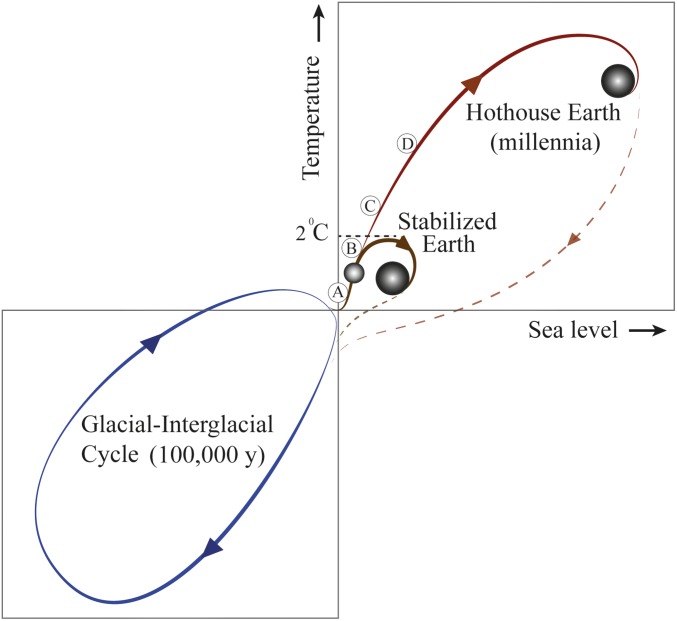
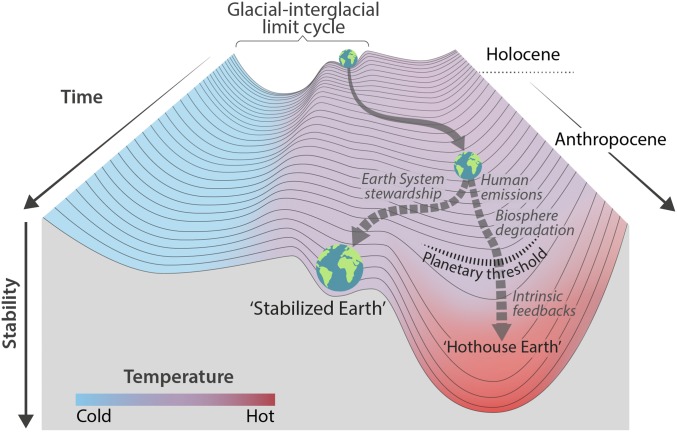
We explore the risk that self-reinforcing feedbacks could push the Earth System toward a planetary threshold that, if crossed, could prevent stabilization of the climate at intermediate temperature rises and cause continued warming on a “Hothouse Earth” pathway even as human emissions are reduced. Crossing the threshold would lead to a much higher global average temperature than any interglacial in the past 1.2 million years and to sea levels significantly higher than at any time in the Holocene. We examine the evidence that such a threshold might exist and where it might be. If the threshold is crossed, the resulting trajectory would likely cause serious disruptions to ecosystems, society, and economies. Collective human action is required to steer the Earth System away from a potential threshold and stabilize it in a habitable interglacial-like state. Such action entails stewardship of the entire Earth System—biosphere, climate, and societies—and could include decarbonization of the global economy, enhancement of biosphere carbon sinks, behavioral changes, technological innovations, new governance arrangements, and transformed social values.
Overview
The claims and statistics of this paper haven’t been checked yet.
Free: it reads the open-access text and checks the first 5 claims that cite a source we can check. Create a free account to check every claim.
Integrity signals
Registry
Cites
Statistics
Figures
Verification
Claims the paper makes
The claims and statistics of this paper haven’t been checked yet.
Free: it reads the open-access text and checks the first 5 claims that cite a source we can check. Create a free account to check every claim.
Claims other papers make about this one
Each is checked against this paper’s own text: does it say what the citing paper says it does?
The source backs part of the claim, not all of it — or backs it for a different population, condition or comparison.
In the citing paper
“Triggering positive feedback, uncontrolled emissions will lead to a major climate change that would durably lock the planet into a hot system where glaciers would go extinct(Steffen et al., 2018;McKay et al., 2022).”
From Future emergence of new ecosystems caused by glacial retreat (2023) · cites this paper as Steffen et al., 2018
Experimental — accuracy not yet measuredIn the citing paper
“Our journey into the future of cold regions shows that deglaciation over the 21 st century is expected to occur over 181,000 ± 55,000 to 372,000 ± 99,000 km 2 outside the Greenland and Antarctic ice sheets (Fig. 3) and may reach unprecedented levels in recent Earth's history”
From Future emergence of new ecosystems caused by glacial retreat (2023) · cites this paper as Steffen et al., 2018
In the citing paper
“yet it remains unknown whether human social dynamics will yield such responses”
From Stewardship of global collective behavior (2021) · cites this paper as [14]
In the citing paper
“Human collective dynamics are critical to the wellbeing of people and ecosystems in the present and will set the stage for how we face global challenges with impacts that will last centuries (14, 15, 64).”
From Stewardship of global collective behavior (2021) · cites this paper as [14]
Self-check
Percentages, sums and reported differences re-computed from the paper’s own numbers.
The self-check needs the paper’s full text.
Citations
Cites
(2014) · Cambridge University Press eBooks · doi:10.1017/cbo9781107415379 · Cited by 11,249
(2007) · Medical Entomology and Zoology · Cited by 9,612
Crutzen, P. J. (2002) · Nature · doi:10.1038/415023a · Cited by 4,788
Tipping elements in the Earth’s climate system
Lenton, T. M., Held, H., Kriegler, E., Hall, J. W., Lucht, W., Rahmstorf, S., & Schellnhuber, H. J. (2008) · Proceedings of the National Academy of Sciences · doi:10.1073/pnas.0705414105 · Cited by 3,982
Self-citationThe trajectory of the Anthropocene: The Great Acceleration
Steffen, W., Broadgate, W., Deutsch, L., Gaffney, O., & Ludwig, C. (2015) · The Anthropocene Review · doi:10.1177/2053019614564785 · Cited by 3,935
Self-citationGriscom, B. W., Adams, J., Ellis, P. W., Houghton, R. A., Lomax, G., Miteva, D. A., Schlesinger, W. H., Shoch, D., Siikamäki, J. V., Smith, P., et al. (2017) · Proceedings of the National Academy of Sciences · doi:10.1073/pnas.1710465114 · Cited by 3,481
Eight glacial cycles from an Antarctic ice core
members, E. C. (2004) · Nature · doi:10.1038/nature02599 · Cited by 2,415
The Anthropocene is functionally and stratigraphically distinct from the Holocene
Waters, C. N., Zalasiewicz, J., Summerhayes, C., Barnosky, A. D., Poirier, C., Gałuszka, A., Cearreta, A., Edgeworth, M., Ellis, E. C., Ellis, M., et al. (2016) · Science · doi:10.1126/science.aad2622 · Cited by 2,375
Self-citationContribution of Antarctica to past and future sea-level rise
DeConto, R. M., & Pollard, D. (2016) · Nature · doi:10.1038/nature17145 · Cited by 2,044
Research works printed but not linked: 3
- Stocker TF 2013 Technical summary Climate Change 2013: The Physical Science Basis. Contribution of Working Group I to the Fifth Assessment Report of the Intergovernmental Panel on Climate Change Stocker TF Cambridge Univ Press Cambridge, UK
- Ciais P 2013 Carbon and other biogeochemical cycles Climate Change 2013: The Physical Science Basis, Contribution of Working Group I to the Fifth Assessment Report of the Intergovernmental Panel on Climate Change Stocker TF Cambridge Univ Press Cambridge, UK 465 570
- Latorre C Wilmshurst J von Gunten L 2016 Climate change and cultural evolution PAGES (Past Global Changes) Magazine 24 1 32
Cited by
Items 201–300 of 1,000
Macroeconomic and Financial Policies for Climate Change Mitigation: A Review of the Literature
Krogstrup, S., & Oman, W. (2019) · IMF Working Paper · doi:10.5089/9781513511955.001 · Cited by 259
van Ginkel, K., Botzen, W. J. W., Haasnoot, M., Bachner, G., Steininger, K. W., Hinkel, J., Watkiss, P., Boere, E., Jeuken, A., de Murieta, E. S., et al. (2020) · Environmental Research Letters · doi:10.1088/1748-9326/ab6395 · Cited by 144
“Concerns have been expressed about passing critical thresholds of large-scale elements of the climate system (Lenton et al 2008, Steffen et al 2018), although there is high uncertainty about the temperature thresholds at which these events occur (Kriegler et al 2009, Levermann et al 2012).”
BackgroundOn the preconditions for large-scale collective action
Jagers, S. C., Harring, N., Löfgren, Å., Sjöstedt, M., Alpízar, F., Brülde, B., Langlet, D., Nilsson, A., Almroth, B. C., Dupont, S. T., et al. (2019) · AMBIO · doi:10.1007/s13280-019-01284-w · Cited by 155
Self-citationImproving Climate Change Mitigation Analysis: A Framework for Examining Feasibility
Nielsen, K. S., Stern, P. C., Dietz, T. M., Gilligan, J. M., van Vuuren, D. P., Figueroa, M. J., Folke, C., Gwozdz, W., Ivanova, D., Reisch, L. A., et al. (2020) · One Earth · doi:10.1016/j.oneear.2020.08.007 · Cited by 158
“These changes concern both activities directly influencing greenhouse gas emissions (GHG) and ones affecting context, such as the governance processes of the energy system, and other activities, such as agriculture and forestry.(3) Achieving climate change mitigation objectives entails unprecedented common-pool resour…”
BackgroundSelf-citationRöck, M., Baldereschi, E., Verellen, E., Passer, A., Sala, S., & Allacker, K. (2021) · Renewable and Sustainable Energy Reviews · doi:10.1016/j.rser.2021.111550 · Cited by 145
Zhang, D., Zhao, Y., & Wu, J. (2022) · Resources Conservation and Recycling · doi:10.1016/j.resconrec.2022.106748 · Cited by 122
Human agency in the Anthropocene
Otto, I. M., Wiedermann, M., Cremades, R., Donges, J. F., Auer, C., & Lucht, W. (2020) · Ecological Economics · doi:10.1016/j.ecolecon.2019.106463 · Cited by 121
Self-citationPiłatowska, M., Geise, A., & Włodarczyk, A. (2020) · Energies · doi:10.3390/en13092124 · Cited by 138
Sanderson, C. E., & Alexander, K. A. (2020) · Global Change Biology · doi:10.1111/gcb.15163 · Cited by 139
“While global changes in climate have occurred historically due to alterations in the Earth's orbit (Hays, Imbrie, & Shackleton, 1976), the current rapid rate of climate change from anthropogenic sources is of extreme concern (Steffen et al., 2018).”
BackgroundAdapting transformation and transforming adaptation to climate change using a pathways approach
Colloff, M. J., Gorddard, R., Abel, N., Locatelli, B., Wyborn, C. A., Butler, J., Lavorel, S., van Kerkhoff, L. E., Meharg, S., Múnera‐Roldán, C., et al. (2021) · Environmental Science & Policy · doi:10.1016/j.envsci.2021.06.014 · Cited by 159
Pickering, J., Hickmann, T., Bäckstrand, K., Kalfagianni, A. K., Bloomfield, M. J., Mert, A., Ransan‐Cooper, H., & Lo, A. Y. H. (2022) · Earth System Governance · doi:10.1016/j.esg.2021.100131 · Cited by 182
Potential ecological impacts of climate intervention by reflecting sunlight to cool Earth
Zarnetske, P. L., Gurevitch, J., Franklin, J., Groffman, P. M., Harrison, C. S., Hellmann, J. J., Hoffman, F. M., Kothari, S., Robock, A., Tilmes, S., et al. (2021) · Proceedings of the National Academy of Sciences · doi:10.1073/pnas.1921854118 · Cited by 119
Vanbergen, A. J., Aizen, M. A., Cordeau, S., Garibaldi, L. A., Garratt, M. P. D., Kovács‐Hostyánszki, A., Lécuyer, L., Ngo, H. T., Potts, S. G., Settele, J., et al. (2020) · Advances in ecological research/Advances in Ecological Research · doi:10.1016/bs.aecr.2020.08.002 · Cited by 165
Institutional navigation for polycentric sustainability governance
Lubell, M., & Morrison, T. H. (2021) · Nature Sustainability · doi:10.1038/s41893-021-00707-5 · Cited by 119
Zuccarini, P., Asensio, D., Ogaya, R., Sardans, J., & Peñuelas, J. (2020) · Global Change Biology · doi:10.1111/gcb.15077 · Cited by 126
“…effects must nonetheless be taken into account, because they represent one of the main mechanisms by which current climate change affects ecosystems, together with alterations of biotic interactions (Walther, 2010), chain reactions, and amplification of feedback processes (Steffen et al., 2018).”
BackgroundDisappearing World Heritage Glaciers as a Keystone of Nature Conservation in a Changing Climate
Bosson, J. ‐., Huss, M., & Osipova, E. (2019) · Earth's Future · doi:10.1029/2018ef001139 · Cited by 116
“…number of publications (e.g., Ceballos et al., 2017; Hughes et al., 2017; Intergovernmental Panel on Climate Change, 2018; Ripple et al., 2017; Steffen et al., 2018), the scientific community warns humanity against the critical state of climate, nature, and societies on Earth in the…”
BackgroundThe financial impact of fossil fuel divestment
Plantinga, A., & Scholtens, B. (2021) · Climate Policy · doi:10.1080/14693062.2020.1806020 · Cited by 116
The upper temperature thresholds of life
Asseng, S., Spänkuch, D., Hernández-Ochoa, I. M., & Laporta, J. (2021) · The Lancet Planetary Health · doi:10.1016/s2542-5196(21)00079-6 · Cited by 163
Trophic rewilding as a restoration approach under emerging novel biosphere conditions
Svenning, J., Buitenwerf, R., & le Roux, E. (2024) · Current Biology · doi:10.1016/j.cub.2024.02.044 · Cited by 145
Lehmann, S. (2021) · Sustainability · doi:10.3390/su13052932 · Cited by 173
“[70] in their paper “Trajectories of Earth System in the Anthropocene” and the World Cities Report 2020 “The Value of Sustainable Urbanization”, published by UN‐Habitat [10], all point in the same direction: our models of urbanization based on GDP growth and increased consumption will need to change, and the integrati…”
BackgroundRecent pronounced warming on the Mongolian Plateau boosted by internal climate variability
Cai, Q., Chen, W., Chen, S., Xie, S., Piao, J., Ma, T., & Lan, X. (2024) · Nature Geoscience · doi:10.1038/s41561-024-01377-6 · Cited by 141
“…that, in addition to the external forcing, the decadal variability of the Pacific and Atlantic is an important factor contributing to this exceptionally strong warming over the MP. Anthropogenic warming can cause regional climate change 20 and increase the risks of passing tipping points 48,49 .”
Ni/Y2O3–ZrO2 catalyst for hydrogen production through the glycerol steam reforming reaction
Charisiou, N. D., Siakavelas, G. I., Tzounis, L., Dou, B., Sebastián, V., Hinder, S. J., Baker, M., Polychronopoulou, K., & Goula, M. A. (2019) · International Journal of Hydrogen Energy · doi:10.1016/j.ijhydene.2019.04.237 · Cited by 116
Reduced resilience of terrestrial ecosystems locally is not reflected on a global scale
Feng, Y., Su, H., Tang, Z., Wang, S., Zhao, X., Zhang, H., Ji, C., Zhu, J., Xie, P., & Fang, J. (2021) · Communications Earth & Environment · doi:10.1038/s43247-021-00163-1 · Cited by 128
Ta 2 + -mediated ammonia synthesis from N 2 and H 2 at ambient temperature
Geng, C., Li, J., Weiske, T., & Schwarz, H. (2018) · Proceedings of the National Academy of Sciences · doi:10.1073/pnas.1814610115 · Cited by 119
“To slow down global warming (12), it would, therefore, be sensible, in addition to numerous other measures, to find a process for producing ammonia on an industrial scale from the molecular feedstock nitrogen and hydrogen in an economically viable and environmentally benign way.”
BackgroundPetersen-Rockney, M., Baur, P., Guzman, A., Bender, S. F., Calo, A. J., Castillo, F., Master, K. D., Dumont, A. M., Esquivel, K., Kremen, C., et al. (2021) · Frontiers in Sustainable Food Systems · doi:10.3389/fsufs.2021.564900 · Cited by 171
“In order to respond to ongoing and future climate change already incurred from past emissions, farmers must find long-term solutions suitable to new climatic norms (Steffen et al., 2018; IPCC, 2019).”
Background15 challenges for AI: Or what AI (currently) can’t do
Hagendorff, T., & Wezel, K. (2020) · AI & SOCIETY · doi:10.1007/s00146-019-00886-y · Cited by 113
“In view of current political and ecological developments, there is no guarantee that this infrastructure will maintain stable in the future (Steffen et al. 2018).”
BackgroundClimate Change and Water-Related Infectious Diseases
Nichols, G. L., LAKE, I. R., & Heaviside, C. (2018) · Atmosphere · doi:10.3390/atmos9100385 · Cited by 138
“However, there are potentially much larger risks over longer timescales, particularly if there is a substantial sea level rise, and prolonged periods with much-increased average and peak temperatures [19].”
BackgroundThe role of planetary boundaries in assessing absolute environmental sustainability across scales
Li, M., Wiedmann, T., Fang, K., & Hadjikakou, M. (2021) · Environment International · doi:10.1016/j.envint.2021.106475 · Cited by 141
Emotions and transformative learning for sustainability: a systematic review
Grund, J., Singer‐Brodowski, M., & Büssing, A. G. (2023) · Sustainability Science · doi:10.1007/s11625-023-01439-5 · Cited by 169
“Sustainable transformations of human societies are of utmost importance in the background of the transgression of planetary boundaries and the danger of reaching global tipping points (Steffen et al. 2018).”
Regime shifts occur disproportionately faster in larger ecosystems
Cooper, G. S., Willcock, S., & Dearing, J. A. (2020) · Nature Communications · doi:10.1038/s41467-020-15029-x · Cited by 137
Connecting Top-Down and Bottom-Up Approaches in Environmental Observing
Eicken, H. S., Danielsen, F., Sam, J.-M., Fidel, M., Johnson, N., Poulsen, M. K., Lee, O. A., Spellman, K. V., Iversen, L. M., Pulsifer, P., et al. (2021) · BioScience · doi:10.1093/biosci/biab018 · Cited by 155
Global Governance and the Emergence of Global Institutions for the 21st Century
López-Claros, A., Dahl, A. L., & Groff, M. Z. (2020) · Cambridge University Press eBooks · doi:10.1017/9781108569293 · Cited by 198
Carbon budgets for buildings: harmonising temporal, spatial and sectoral dimensions
Habert, G., Röck, M., Steininger, K. W., Lupíšek, A., Birgisdóttir, H., Desing, H., Chandrakumar, C., Pittau, F., Passer, A., Rovers, R., et al. (2020) · Buildings and Cities · doi:10.5334/bc.47 · Cited by 128
Getting to the heart of transformation
Vogel, C. H., & O’Brien, K. L. (2021) · Sustainability Science · doi:10.1007/s11625-021-01016-8 · Cited by 155
Exploring Alternative Futures in the Anthropocene
Cork, S. J., Alexandra, C., Álvarez-Romero, J. G., Bennett, E. M., Berbés‐Blázquez, M., Bohensky, E. L., Bok, B., Costanza, R., Hashimoto, S., Hill, R., et al. (2023) · Annual Review of Environment and Resources · doi:10.1146/annurev-environ-112321-095011 · Cited by 152
“The term Anthropocene is increasingly used to indicate a period in Earth’s geological history in which human activities are the strongest force affecting planetary processes.”
BackgroundInfluentialGalbreath, K. E., Hoberg, E. P., Cook, J. A., Armién, B., Bell, K. C., Campbell, M., Dunnum, J. L., Dursahinhan, A. T., Eckerlin, R. P., Gardner, S. L., et al. (2019) · Journal of Mammalogy · doi:10.1093/jmammal/gyz048 · Cited by 129
Greenspace, bluespace, and their interactive influence on urban thermal environments
Hu, L., & Li, Q. (2020) · Environmental Research Letters · doi:10.1088/1748-9326/ab6c30 · Cited by 115
Galli, A., Pires, S. M., Iha, K., Alves, A., Lin, D. H., Mancini, M. S., & Teles, F. (2020) · The Science of The Total Environment · doi:10.1016/j.scitotenv.2020.141307 · Cited by 129
“and the need is growing for unsustainable economic and social trends to be inverted (1-3).”
BackgroundAjibade, I. M., & Boateng, G. O. (2021) · Journal of Environmental Management · doi:10.1016/j.jenvman.2021.112538 · Cited by 120
Hagendorff, T. (2022) · AI and Ethics · doi:10.1007/s43681-021-00122-8 · Cited by 103
“Over-exploitation of ecosystems harms future generations [165], poor and already underprivileged people [166], animals [167], and many more.”
BackgroundEnvironmental Awareness and Air Quality: The Mediating Role of Environmental Protective Behaviors
Kousar, S., Afzal, M., Ahmed, F., & Bojnec, Š. (2022) · Sustainability · doi:10.3390/su14063138 · Cited by 179
“Human production and consumption activities are dominating the planet, causing the continuous emission of CO2 and leaving catastrophic impressions on humanity and other species of the planet [8].”
BackgroundEllenbeck, S., & Lilliestam, J. (2018) · Energy Research & Social Science · doi:10.1016/j.erss.2018.08.021 · Cited by 128
“5 °C being the threshold below which humanity almost certainly remains safe, whereas 2 °C may have regionally disastrous consequences, or even trigger tipping elements in the Earth system [72].”
BackgroundWorld scientists’ warning: The behavioural crisis driving ecological overshoot
Merz, J. J., Barnard, P., Rees, W. E., Smith, D. F., Maroni, M., Rhodes, C. J., Dederer, J. H., Bajaj, N., Joy, M., Wiedmann, T., et al. (2023) · Science Progress · doi:10.1177/00368504231201372 · Cited by 146
“10 We acknowledge that there are many other relevant behaviours and considerations, including genetic pre-dispositions to consume, the role of temporal, spatial and social discounting, socio-political factors (e.g. status hierarchies) and even addiction to conspicuous consumption.”
Garrido‐Barros, P., Moonshiram, D., Gil‐Sepulcre, M., Pelosin, P., Gimbert‐Suriñach, C., Benet‐Buchholz, J., & Llobet, A. (2020) · Journal of the American Chemical Society · doi:10.1021/jacs.0c06515 · Cited by 102
Social Policy Without Growth: Moving Towards Sustainable Welfare States
Koch, M. (2021) · Social Policy and Society · doi:10.1017/s1474746421000361 · Cited by 209
“Thresholds for biophysical processes such as climate, biodiversity and the nitrogen cycle are being approached or crossed (Steffen et al., 2018).”
BackgroundCreative (Climate) Communications: Productive Pathways for Science, Policy and Society
Boykoff, M. (2019) · Cambridge University Press eBooks · doi:10.1017/9781108164047 · Cited by 164
Hötte, K. (2019) · Energy Economics · doi:10.1016/j.eneco.2019.104565 · Cited by 119
“6Recent studies on climate change sufficiently indicate that the switch to green technologies is an existential question (IPCC, 2018; Steffen et al., 2018).”
BackgroundThe Anthropocene and the geo-political imagination: Re-writing Earth as political space
Lövbrand, E., Mobjörk, M., & Söder, R. (2020) · Earth System Governance · doi:10.1016/j.esg.2020.100051 · Cited by 128
Australian forests, megafires and the risk of dwindling carbon stocks
Bowman, D. M. J. S., Williamson, G. J., Price, O. F., Ndalila, M. N., & Bradstock, R. A. (2020) · Plant Cell & Environment · doi:10.1111/pce.13916 · Cited by 108
Winkler, H. (2020) · Energy Research & Social Science · doi:10.1016/j.erss.2020.101789 · Cited by 127
“At the same time, planetary boundaries are being reached and breached [79].”
BackgroundEvolution of the polycrisis: Anthropocene traps that challenge global sustainability
Jørgensen, P. S., Jansen, R. E. V., Avila-Ortega, D. I., Wang‐Erlandsson, L., Donges, J. F., Österblom, H., Olsson, P., Nyström, M., Lade, S. J., Hahn, T. P., et al. (2023) · Philosophical Transactions of the Royal Society B Biological Sciences · doi:10.1098/rstb.2022.0261 · Cited by 166
“In combination with tipping elements in the Earth system that, when crossed, further accelerate warming, such lags can potentially risk tip-ping the entire climate system to a new ‘ hothouse ’ state [57,117].”
BackgroundSelf-citationLawrence, J., Bell, R. G., & Stroombergen, A. (2019) · Sustainability · doi:10.3390/su11020406 · Cited by 102
“Deep uncertainty includes surprises, and irreducible uncertainties associated with how global emissions will evolve and the resulting climate-ocean feedbacks [3], particularly the spectre of polar ice-sheet instabilities.”
BackgroundIs Grassfed Meat and Dairy Better for Human and Environmental Health?
Provenza, F. D., Kronberg, S. L., & Gregorini, P. (2019) · Frontiers in Nutrition · doi:10.3389/fnut.2019.00026 · Cited by 123
Irrigation of biomass plantations may globally increase water stress more than climate change
Stenzel, F., Greve, P., Lucht, W., Tramberend, S., Wada, Y., & Gerten, D. (2021) · Nature Communications · doi:10.1038/s41467-021-21640-3 · Cited by 128
Climate change and the threat to civilization
Steel, D. P., DesRoches, C. T., & Mintz‐Woo, K. (2022) · Proceedings of the National Academy of Sciences · doi:10.1073/pnas.2210525119 · Cited by 127
Saijo, T. (2020) · Sustainability · doi:10.3390/su12166467 · Cited by 119
“Furthermore, they [4] found that there is a risk that the Earth system could be irreversibly pushed down a “Hothouse Earth” pathway despite the Paris Accord target being met.”
BackgroundThe State and Future of Antarctic Environments in a Global Context
Chown, S. L., & Brooks, C. M. (2019) · Annual Review of Environment and Resources · doi:10.1146/annurev-environ-101718-033236 · Cited by 120
“Indeed, in very much the same way that other international agreements must become more rapidly effective to avoid future planetary conditions of a form unknown in the evolutionary history of humans and with negative consequences for both us and the Earth’s other species and environments (132, 173).”
BackgroundCase, M. J., Johnson, B. G., Bartowitz, K. J., & Hudiburg, T. W. (2021) · Forest Ecology and Management · doi:10.1016/j.foreco.2020.118886 · Cited by 108
Children and youth in the climate crisis
Sanson, A. V., & Bellemo, M. (2021) · BJPsych Bulletin · doi:10.1192/bjb.2021.16 · Cited by 114
Sustainable Financial Products in the Latin America Banking Industry: Current Status and Insights
Mejia-Escobar, J. C., González-Ruiz, J. D., & Duque-Grisales, E. (2020) · Sustainability · doi:10.3390/su12145648 · Cited by 98
“Recent research suggests that, if this limit is exceeded, it could lead to continuous warming of the earth no matter what actions were taken by humans to reduce CO2 emissions [2].”
BackgroundThe Climate Change Crisis: A Review of Its Causes and Possible Responses
Gabric, A. J. (2023) · Atmosphere · doi:10.3390/atmos14071081 · Cited by 142
“To avoid the potential of such cataclysmic futures (e.g., a “hothouse” Earth scenario), Steffen et al. [69] suggest three possible categories of societal response: (i) reducing GHG emissions (mitigation), (ii) enhancing or creating new carbon sinks, i.e., enhancing negative emissions and (iii)…”
Conserving plants within and beyond protected areas – still problematic and future uncertain
Heywood, V. H. (2018) · Acta Botanica Yunnanica · doi:10.1016/j.pld.2018.10.001 · Cited by 112
Overcoming the Myths of Mainstream Economics to Enable a New Wellbeing Economy
Coscieme, L., Sutton, P., Mortensen, L. F., Ida Kubiszewski, A., Costanza, R., Trebeck, K., Pulselli, F. M., Giannetti, B. F., & Fioramonti, L. (2019) · Sustainability · doi:10.3390/su11164374 · Cited by 131
“This is pushing the Earth toward its planetary boundaries, affecting wellbeing of current and future generations [35].”
BackgroundAssessing climate change’s contribution to global catastrophic risk
Beard, S., Holt, L., Tzachor, A., Kemp, L., Avin, S., Torres, P., & Belfield, H. (2021) · Futures · doi:10.1016/j.futures.2020.102673 · Cited by 113
“Apart from being a planetary boundary in its own right, Steffen et al. (2015) point out that climate change is intimately connected with other aspects of the Earth system (see table 1).”
BackgroundThe Virtuous Circle of Sustainable Welfare as a Transformative Policy Idea
Hirvilammi, T. (2020) · Sustainability · doi:10.3390/su12010391 · Cited by 174
“The ostensibly virtuous circle is bounded within a trajectory that is leading us to “Hothouse Earth”, to conditions that would be inhospitable not just to current human societies but also to many other species [45] (p.”
BackgroundSames, B., Wagreich, M., Conrad, C. P., & Iqbal, S. (2020) · Geological Society London Special Publications · doi:10.1144/sp498-2019-105 · Cited by 111
“…boundaries tend to see the Earth System as currently shifting outside of its orbitally driven glacial–interglacial climate cycles of c. 100 kyr of the recent past, and insteadmoving into a new system phase of a future hothouse state (Steffen et al. 2015, 2016, 2018).”
BackgroundFuzzy Cognitive Map-Based Sustainable Socio-Economic Development Planning for Rural Communities
Papageorgiou, K., Singh, P. K., Papageorgiou, E. I., Chudasama, H., Bochtis, D., & Stamoulis, G. I. (2019) · Sustainability · doi:10.3390/su12010305 · Cited by 117
Green Nanofabrication Opportunities in the Semiconductor Industry: A Life Cycle Perspective
Mullen, E., & Morris, M. A. (2021) · Nanomaterials · doi:10.3390/nano11051085 · Cited by 119
“Humanities management of raw materials and resources requires deep transformation if we are to avoid crossing the planetary boundary threshold [208].”
BackgroundWe need biosphere stewardship that protects carbon sinks and builds resilience
Rockström, J., Beringer, T., Hole, D. G., Griscom, B. W., Mascia, M. B., Folke, C., & Creutzig, F. (2021) · Proceedings of the National Academy of Sciences · doi:10.1073/pnas.2115218118 · Cited by 120
Self-citationBarfuss, W., Donges, J. F., Vasconcelos, V. V., Kurths, J., & Levin, S. A. (2020) · Proceedings of the National Academy of Sciences · doi:10.1073/pnas.1916545117 · Cited by 87
“A timescale of a potential lock-in in the hothouse Earth for up to millennia (1) translates to a default value of the recovery leverage qr =0.”
BackgroundInfluentialSelf-citationEcological economics for humanity’s plague phase
Rees, W. E. (2019) · Ecological Economics · doi:10.1016/j.ecolecon.2019.106519 · Cited by 125
Gaitán‐Espitía, J. D., & Hobday, A. J. (2020) · Global Change Biology · doi:10.1111/gcb.15359 · Cited by 103
“…transgressing safety thresholds of planetary boundaries (sensu Rockström et al., 2009) that are fundamental for the resilience of major components of Earth system functioning as well as for human well-being, long-term social and economic development (Rockström et al., 2009; Steffen et al., 2018).”
BackgroundEvolutionary Responses to Warming
McGaughran, A., Laver, R. J., & Fraser, C. I. (2021) · Trends in Ecology & Evolution · doi:10.1016/j.tree.2021.02.014 · Cited by 98
Paleocene/Eocene carbon feedbacks triggered by volcanic activity
Kender, S., Bogus, K. A., Pedersen, G. K., Dybkjær, K., Mather, T. A., Mariani, E., Ridgwell, A. J., Riding, J. B., Wagner, T., Hesselbo, S. P., et al. (2021) · Nature Communications · doi:10.1038/s41467-021-25536-0 · Cited by 101
Can we live within environmental limits and still reduce poverty? Degrowth or decoupling?
Hickel, J., & Hallegatte, S. (2021) · Development Policy Review · doi:10.1111/dpr.12584 · Cited by 127
Hametner, M. (2022) · Ecological Economics · doi:10.1016/j.ecolecon.2022.107490 · Cited by 108
Epochs, events and episodes: Marking the geological impact of humans
Waters, C. N., Williams, M., Zalasiewicz, J., Turner, S. D., Barnosky, A. D., Head, M. J., Wing, S. L., Wagreich, M., Steffen, W., Summerhayes, C. P., et al. (2022) · Earth-Science Reviews · doi:10.1016/j.earscirev.2022.104171 · Cited by 101
“Quaternary peak warmth (Steffen et al., 2018).”
Self-citationCities and the SDGs: Realities and possibilities of local engagement in global frameworks
Leavesley, A., Trundle, A., & Oke, C. (2022) · AMBIO · doi:10.1007/s13280-022-01714-2 · Cited by 109
“In their current form cities are both unsustainable and inequitable, generating a disproportionate level of emissions and other forms of waste, whilst drawing heavily on resources from their hinterlands and beyond (Steffen et al. 2018).”
BackgroundStewarding Sustainability Transformations
Kuenkel, P. (2018) · Springer eBooks · doi:10.1007/978-3-030-03691-1 · Cited by 85
Fuhrman, J., McJeon, H. C., Doney, S. C., Shobe, W., & Clarens, A. F. (2019) · Frontiers in Climate · doi:10.3389/fclim.2019.00011 · Cited by 100
The Anthropocene reality of financial risk
Crona, B., Folke, C., & Galaz, V. (2021) · One Earth · doi:10.1016/j.oneear.2021.04.016 · Cited by 122
Self-citationAyugi, B. O., Shilenje, Z. W., Babaousmail, H., Sian, K. T. C. L. K., Mumo, R., Dike, V. N., Iyakaremye, V., Chehbouni, A., & Ongoma, V. (2022) · Natural Hazards · doi:10.1007/s11069-022-05341-8 · Cited by 101
The politics of enabling tipping points for sustainable development
Fesenfeld, L., Schmid, N., Finger, R., Mathys, A., & Schmidt, T. S. (2022) · One Earth · doi:10.1016/j.oneear.2022.09.004 · Cited by 102
Economic Growth and Carbon Emissions: The Road to “Hothouse Earth” is Paved with Good Intentions
Schröder, E., & Storm, S. (2020) · International Journal of Political Economy · doi:10.1080/08911916.2020.1778866 · Cited by 106
Ebi, K. L., Harris, F. M. A., Sioen, G. B., Wannous, C., Anyamba, A., Bi, P., Boeckmann, M., Bowen, K., Cissé, G., Dasgupta, P., et al. (2020) · International Journal of Environmental Research and Public Health · doi:10.3390/ijerph17238890 · Cited by 111
“The Anthropocene epoch is underway; human activities are profoundly changing the earth system [1,2].”
BackgroundEvaluation and projection of mean surface temperature using CMIP6 models over East Africa
Ayugi, B. O., Ngoma, H., Babaousmail, H., Karim, R., Iyakaremye, V., Sian, K. T. C. L. K., & Ongoma, V. (2021) · Journal of African Earth Sciences · doi:10.1016/j.jafrearsci.2021.104226 · Cited by 93
Under Pressure? The Link Between Mandatory Climate Reporting and Firms’ Carbon Performance
Bauckloh, T., Klein, C., Pioch, T., & Schiemann, F. (2022) · Organization & Environment · doi:10.1177/10860266221083340 · Cited by 99
“Given the serious consequences that are expected in a scenario of unmitigated climate change (Steffen et al., 2018), the international consensus is that all parties that contribute to it have a responsibility to mitigate their carbon emissions (World Commission on the Ethics of Scientific Knowledge and Technology, 201…”
BackgroundAdaptive emission reduction approach to reach any global warming target
Terhaar, J., Frölicher, T. L., Aschwanden, M. T., Friedlingstein, P., & Joos, F. (2022) · Nature Climate Change · doi:10.1038/s41558-022-01537-9 · Cited by 94
Lucarini, V., & Bódai, T. (2019) · Physical Review Letters · doi:10.1103/physrevlett.122.158701 · Cited by 82
Leroy, N., de Tombeur, F., Walgraffe, Y., Cornelis, J., & Verheggen, F. J. (2019) · Plants · doi:10.3390/plants8110444 · Cited by 100
“Understanding the drivers of Si accumulation as a natural plant defense is key because seven of the top 10 most widespread crops in the world are Si-accumulating Poaceae species [55], especially in the face of expected climate changes [56] and the lack of resilience of conventional agriculture [57].”
BackgroundCancelling March Madness exposes opportunities for a more sustainable sports tourism economy
Cooper, J. A., & Alderman, D. H. (2020) · Tourism Geographies · doi:10.1080/14616688.2020.1759135 · Cited by 103
Environmental parasitology: stressor effects on aquatic parasites
Sures, B., Nachev, M., Schwelm, J., Grabner, D. S., & Selbach, C. (2023) · Trends in Parasitology · doi:10.1016/j.pt.2023.03.005 · Cited by 103
“Global warming is probably the most drastic and far-reaching result of anthropogenic activity on our planet [38].”
BackgroundUnravelling Persistent Problems to Transformative Marine Governance
Kelly, C., Ellis, G., & Flannery, W. (2019) · Frontiers in Marine Science · doi:10.3389/fmars.2019.00213 · Cited by 103
“Similarly, recent evaluations of MSP suggest that it has been hampered by “power, exclusion and antagonism” (Tafon, 2017, p. 7), prioritisation of economic growth over environmental and social objectives (Qiu and Jones, 2013; Domínguez-Tejo et al., 2016; Jones et al., 2016), and tokenistic…”
BackgroundToward a New Common Sense: The Need for New Paradigms of Global Health Beyond the COVID-19 Emergency
Bakker, I., Gill, S. R., & Wamsley, D. (2021) · Cambridge University Press eBooks · doi:10.1017/9781108692137.040 · Cited by 83
Human-nature connectedness as leverage point
Riechers, M., Balázsi, Á., García‐Llorente, M., & Loos, J. (2021) · Ecosystems and People · doi:10.1080/26395916.2021.1912830 · Cited by 102
Hagedorn, G., Loew, T., Seneviratne, S. I., Lucht, W., Beck, M.-L., Hesse, J., Knutti, R., Quaschning, V., Schleimer, J.-H., Mattauch, L., et al. (2019) · GAIA - Ecological Perspectives for Science and Society · doi:10.14512/gaia.28.2.3 · Cited by 81
Scenarios for sustainable futures beyond GDP growth 2050
Svenfelt, Å., Alfredsson, E. C., Bradley, K., Fauré, E., Finnveden, G., Fuehrer, P., Gunnarsson-Östling, U., Isaksson, K., Malmaeus, M., Malmqvist, T., et al. (2019) · Futures · doi:10.1016/j.futures.2019.05.001 · Cited by 108
“Unless human societies manage to take critical decisions and actions that lead us on to sustainable paths, the earth system may become locked on pathways that could not be reversed, steered, or slowed (Steffen et al., 2018).”
BackgroundLotfipoor, A., Patidar, S., & Jenkins, D. P. (2023) · Expert Systems with Applications · doi:10.1016/j.eswa.2023.121355 · Cited by 95
Roles, J., Yarnold, J., Hussey, K., & Hankamer, B. (2021) · Biotechnology for Biofuels · doi:10.1186/s13068-021-01972-4 · Cited by 80
“Failure to deliver this is forecast to influence the future for centuries, if not millennia [46].”
BackgroundLaffoley, D., Baxter, J. M., Amon, D. J., Currie, D., Downs, C. A., Hall-Spencer, J. M., Harden‐Davies, H., Page, R., Reid, P. C., Roberts, C. M., et al. (2019) · Aquatic Conservation Marine and Freshwater Ecosystems · doi:10.1002/aqc.3182 · Cited by 93
“Properly implementing these policy opportunities and bringing these global efforts together must bear fruit as scientists warn that tipping points in ocean decline are now significantly more likely to happen if action is not taken (Beaugrand et al., in press; Steffen et al., 2018).”
Background
Metadata
- Authors
- Steffen, W., Rockström, J., Richardson, K., Lenton, T. M., Folke, C., Liverman, D., Summerhayes, C. P., Barnosky, A. D., Cornell, S. E., Crucifix, M., Donges, J. F., Fetzer, I., Lade, S. J., Scheffer, M., Winkelmann, R., & Schellnhuber, H. J.
- Affiliations
- Australian National University (AU)
- Stockholm Resilience Centre (SE)
- University of Copenhagen (DK)
- University of Exeter (GB)
- Royal Swedish Academy of Sciences (SE)
- University of Arizona (US)
- University of Cambridge (GB)
- Stanford University (US)
- Fund for Scientific Research (BE)
- Wageningen University & Research (NL)
- University of Potsdam (DE)
- Corresponding author
- Steffen, Will
- ORCID
- Venue
- Proceedings of the National Academy of Sciences
- Publisher
- National Academy of Sciences
- Published
- 2018-08-06
- Volume
- 115
- Issue
- 33
- Pages
- 8252-8259
- ISSN
- 0027-8424 (ISSN-L)
- 1091-6490
- PMC
- PMC6099852
- OpenAlex
- W2886281704
- Cited by
- 3,139
- References
- 92
- Citations by year
- 2026: 185 · 2025: 279 · 2024: 346 · 2023: 414 · 2022: 450 · 2021: 596 · 2020: 446 · 2019: 360 · 2018: 56
- FWCI
- 213.48
- Type
- journal article
- Language
- en
- Open access
- hybrid
- doi.org
- Licence
- Locations
- Proceedings of the National Academy of Sciences (publishedVersion, cc-by-nc-nd)
- Europe PMC (PubMed Central) (publishedVersion, cc-by-nc-nd)
- PubMed Central (publishedVersion, cc-by-nc-nd)
- Research at the University of Copenhagen (University of Copenhagen) (publishedVersion, other-oa)
- PubMed (publishedVersion)
- Open Research Exeter (University of Exeter) (publishedVersion, cc-by-nc-nd)
- Socio-Environmental Systems Modeling (acceptedVersion, cc-by-nc-nd)
- Digital Access to Libraries (submittedVersion, other-oa)
- Figshare (submittedVersion)
- publish.UP (University of Potsdam) (submittedVersion, cc-by-nc-nd)
- RENATE (submittedVersion, cc-by-nc-nd)
- ANU Open Research (Australian National University) (submittedVersion, cc-by-nc-nd)
- Publication Database PIK (Potsdam Institute for Climate Impact Research (PIK)) (submittedVersion)
- Data Archiving and Networked Services (DANS) (submittedVersion, cc-by-nc-nd)
- RENATE
- Funders
- National Science Foundation (1243125)
- Familjen Erling-Perssons Stiftelse
- European Commission (743080)
- Svenska Forskningsrådet Formas (2012-742, 2014-589)
- Vetenskapsrådet
- Earth League
- Stordalen Foundation
- Leibniz-Gemeinschaft
- Topics
- Physical Sciences › Environmental Science › Global and Planetary Change › Climate variability and models
- Physical Sciences › Environmental Science › Global and Planetary Change › Earth Systems and Cosmic Evolution
- Physical Sciences › Environmental Science › Global and Planetary Change › Ecosystem dynamics and resilience
- Keywords
- Hothouse Earth, self-reinforcing feedback, climate stabilization, global warming, sea level rise, decarbonization, carbon sink, Anthropocene, climate tipping points
About these checks
Registry, retraction, Cites and statistics results are computed, not judged, with one exception: a printed reference that no index lists is read once by a model before it counts as a citation error. Claims are extracted by a model and kept only when their quote appears verbatim in the text; each cited source is then checked, with a model’s help, for whether it says what the claim relies on. Those verdicts can be wrong — read the claim’s quote and the cited source before relying on one.
Statistics and arithmetic are recomputed, not judged.
Confidence bands are shown only for fields calibrated on our annotated test set. None is calibrated yet, so no band is shown.
What counts as a claim ›How we measure confidence ›How we check this ›
Are you an author, or do you see a problem with this page? Request a review
Data sources
Bibliographic data: Semantic Scholar, OpenAlex, Crossref.
Contains information from the Semantic Scholar Academic Graph Datasets, made available under the ODC Attribution License (ODC-BY 1.0).
Semantic Scholar’s data is described in: Kinney, R., et al. (2023). The Semantic Scholar Open Data Platform. arXiv:2301.10140.
