

Trajectories of the Earth System in the Anthropocene
Open accessThe DOI matches its Crossref record; 89 of the 92 references it cites were found in a registry or an index.
Abstract
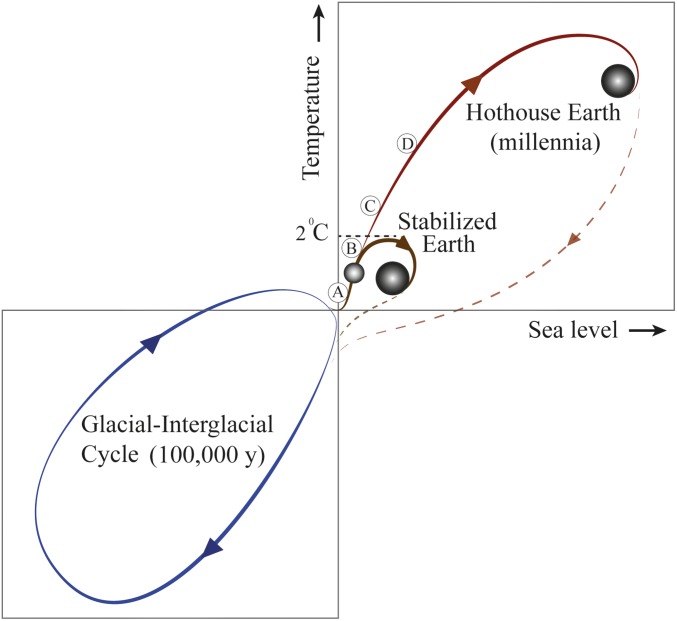
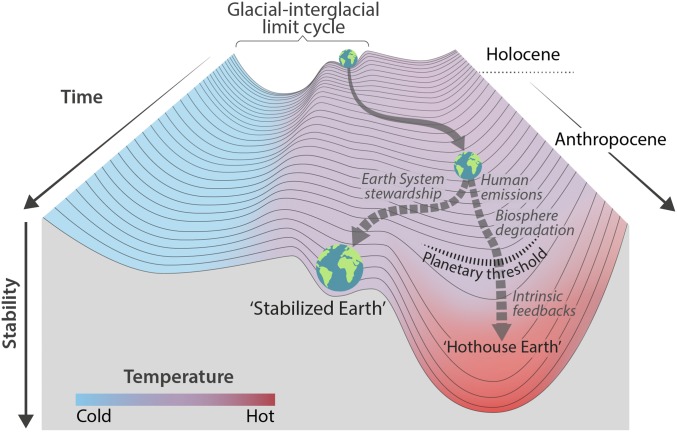
We explore the risk that self-reinforcing feedbacks could push the Earth System toward a planetary threshold that, if crossed, could prevent stabilization of the climate at intermediate temperature rises and cause continued warming on a “Hothouse Earth” pathway even as human emissions are reduced. Crossing the threshold would lead to a much higher global average temperature than any interglacial in the past 1.2 million years and to sea levels significantly higher than at any time in the Holocene. We examine the evidence that such a threshold might exist and where it might be. If the threshold is crossed, the resulting trajectory would likely cause serious disruptions to ecosystems, society, and economies. Collective human action is required to steer the Earth System away from a potential threshold and stabilize it in a habitable interglacial-like state. Such action entails stewardship of the entire Earth System—biosphere, climate, and societies—and could include decarbonization of the global economy, enhancement of biosphere carbon sinks, behavioral changes, technological innovations, new governance arrangements, and transformed social values.
Overview
The claims and statistics of this paper haven’t been checked yet.
Free: it reads the open-access text and checks the first 5 claims that cite a source we can check. Create a free account to check every claim.
Integrity signals
Registry
Cites
Statistics
Figures
Verification
Claims the paper makes
The claims and statistics of this paper haven’t been checked yet.
Free: it reads the open-access text and checks the first 5 claims that cite a source we can check. Create a free account to check every claim.
Claims other papers make about this one
Each is checked against this paper’s own text: does it say what the citing paper says it does?
The source backs part of the claim, not all of it — or backs it for a different population, condition or comparison.
In the citing paper
“Triggering positive feedback, uncontrolled emissions will lead to a major climate change that would durably lock the planet into a hot system where glaciers would go extinct(Steffen et al., 2018;McKay et al., 2022).”
From Future emergence of new ecosystems caused by glacial retreat (2023) · cites this paper as Steffen et al., 2018
Experimental — accuracy not yet measuredIn the citing paper
“Our journey into the future of cold regions shows that deglaciation over the 21 st century is expected to occur over 181,000 ± 55,000 to 372,000 ± 99,000 km 2 outside the Greenland and Antarctic ice sheets (Fig. 3) and may reach unprecedented levels in recent Earth's history”
From Future emergence of new ecosystems caused by glacial retreat (2023) · cites this paper as Steffen et al., 2018
In the citing paper
“yet it remains unknown whether human social dynamics will yield such responses”
From Stewardship of global collective behavior (2021) · cites this paper as [14]
In the citing paper
“Human collective dynamics are critical to the wellbeing of people and ecosystems in the present and will set the stage for how we face global challenges with impacts that will last centuries (14, 15, 64).”
From Stewardship of global collective behavior (2021) · cites this paper as [14]
Self-check
Percentages, sums and reported differences re-computed from the paper’s own numbers.
The self-check needs the paper’s full text.
Citations
Cites
(2014) · Cambridge University Press eBooks · doi:10.1017/cbo9781107415379 · Cited by 11,249
(2007) · Medical Entomology and Zoology · Cited by 9,612
Crutzen, P. J. (2002) · Nature · doi:10.1038/415023a · Cited by 4,788
Tipping elements in the Earth’s climate system
Lenton, T. M., Held, H., Kriegler, E., Hall, J. W., Lucht, W., Rahmstorf, S., & Schellnhuber, H. J. (2008) · Proceedings of the National Academy of Sciences · doi:10.1073/pnas.0705414105 · Cited by 3,982
Self-citationThe trajectory of the Anthropocene: The Great Acceleration
Steffen, W., Broadgate, W., Deutsch, L., Gaffney, O., & Ludwig, C. (2015) · The Anthropocene Review · doi:10.1177/2053019614564785 · Cited by 3,935
Self-citationGriscom, B. W., Adams, J., Ellis, P. W., Houghton, R. A., Lomax, G., Miteva, D. A., Schlesinger, W. H., Shoch, D., Siikamäki, J. V., Smith, P., et al. (2017) · Proceedings of the National Academy of Sciences · doi:10.1073/pnas.1710465114 · Cited by 3,481
Eight glacial cycles from an Antarctic ice core
members, E. C. (2004) · Nature · doi:10.1038/nature02599 · Cited by 2,415
The Anthropocene is functionally and stratigraphically distinct from the Holocene
Waters, C. N., Zalasiewicz, J., Summerhayes, C., Barnosky, A. D., Poirier, C., Gałuszka, A., Cearreta, A., Edgeworth, M., Ellis, E. C., Ellis, M., et al. (2016) · Science · doi:10.1126/science.aad2622 · Cited by 2,375
Self-citationContribution of Antarctica to past and future sea-level rise
DeConto, R. M., & Pollard, D. (2016) · Nature · doi:10.1038/nature17145 · Cited by 2,044
Research works printed but not linked: 3
- Stocker TF 2013 Technical summary Climate Change 2013: The Physical Science Basis. Contribution of Working Group I to the Fifth Assessment Report of the Intergovernmental Panel on Climate Change Stocker TF Cambridge Univ Press Cambridge, UK
- Ciais P 2013 Carbon and other biogeochemical cycles Climate Change 2013: The Physical Science Basis, Contribution of Working Group I to the Fifth Assessment Report of the Intergovernmental Panel on Climate Change Stocker TF Cambridge Univ Press Cambridge, UK 465 570
- Latorre C Wilmshurst J von Gunten L 2016 Climate change and cultural evolution PAGES (Past Global Changes) Magazine 24 1 32
Cited by
Items 601–700 of 1,000
Miami Beach forever? Urbanism in the back loop
Wakefield, S. (2019) · Geoforum · doi:10.1016/j.geoforum.2019.10.016 · Cited by 43
Koch, M. (2020) · Sustainability Science Practice and Policy · doi:10.1080/15487733.2020.1754693 · Cited by 72
“Max Weber became famous for his “methodological individualism,” even if he did not apply this perspective consequently in his empirical and historical work.(3) Finally, there are theories, which occupy a middle position (‘M’ in Figure 1) in the social structures/ individual action continuum. Corresponding theorists in…”
BackgroundNew Approaches for Ecological and Social Sustainability in a Post-Pandemic World
Moriarty, P., & Honnery, D. (2020) · World · doi:10.3390/world1030014 · Cited by 41
“[4] looked at set of 15 climate-related tipping points and classified their likelihood of tipping as global temperatures rose.”
BackgroundIslam, M. M., Pal, S., Hossain, M. M., Mozumder, M. M. H., & Schneider, P. (2020) · Journal of Marine Science and Engineering · doi:10.3390/jmse8100815 · Cited by 49
“For example, about 50% of salt marshes, 35% of mangroves, 29% of seagrasses, and 30% of coral reefs of the world have either been degraded or lost globally [5].”
BackgroundEugenio‐Gozalbo, M., Truchero, G. R., & Suárez‐López, R. (2021) · International Journal of Sustainability in Higher Education · doi:10.1108/ijshe-06-2020-0208 · Cited by 58
Blue Carbon Ecosystems in Brazil: Overview and an Urgent Call for Conservation and Restoration
Soares, M. D. O., Bezerra, L. E. A., Copertino, M., Diniz, B., Barros, K. V. D. S., Rocha-Barreira, C. D. A., Maia, R. C., Beloto, N., & Cotovicz, L. C., Jr. (2022) · Frontiers in Marine Science · doi:10.3389/fmars.2022.797411 · Cited by 46
“Global climate change is perhaps the greatest challenge of modern civilization, and several efforts are being made towards impact adaptation and mitigation of excessive greenhouse gases (Steffen et al., 2018; Bertram et al., 2021).”
BackgroundA Decision Theory Perspective on Wicked Problems, SDGs and Stakeholders: The Case of Deforestation
Alexander, A. E., Walker, H., & Delabre, I. (2022) · Journal of Business Ethics · doi:10.1007/s10551-022-05198-8 · Cited by 49
“It promoted the concepts of ‘systems thinking’ and related terms such as ‘systemic’, or ‘holistic’, and the notion of a need to be ‘in harmony with nature’ (Dearing et al., 2014; Nielsen et al., 2019; Steffen et al., 2018).”
(IPCC), I. P. O. C. C. (2023) · Cambridge University Press eBooks · doi:10.1017/9781009325844.016 · Cited by 76
Maier, L., Schönegge, M., Henn, S., Hering, D., & Müller, D. (2022) · Applied Energy · doi:10.1016/j.apenergy.2022.119894 · Cited by 42
Past climate change effects on human evolution
Timmermann, A., Raia, P., Mondanaro, A., Zollikofer, C. P. E., de León, M. S. P., Zeller, E., & Yun, K. (2024) · Nature Reviews Earth & Environment · doi:10.1038/s43017-024-00584-4 · Cited by 43
“An interesting question that remains to be addressed is whether the modelling frameworks described above can be further modified to describe the more complex bidirectional human–environmental interactions that characterize the Anthropocene 189 .”
Utilising portfolio theory in environmental research – New perspectives and considerations
Matthies, B. D., Jacobsen, J. B., Knoke, T., Paul, C., & Valsta, L. T. (2018) · Journal of Environmental Management · doi:10.1016/j.jenvman.2018.10.049 · Cited by 42
The Dangers of Decoupling: Earth System Crisis and the ‘Fourth Industrial Revolution’
Albert, M. J. (2020) · Global Policy · doi:10.1111/1758-5899.12791 · Cited by 40
Wunderling, N., Stumpf, B., Krönke, J., Staal, A., Tuinenburg, O. A., Winkelmann, R., & Donges, J. F. (2020) · Chaos An Interdisciplinary Journal of Nonlinear Science · doi:10.1063/1.5142827 · Cited by 35
Self-citationEconomic damages from on-going climate change imply deeper near-term emission cuts
Schultes, A., Piontek, F., Soergel, B., Rogelj, J., Baumstark, L., Kriegler, E., Edenhofer, O., & Luderer, G. (2021) · Environmental Research Letters · doi:10.1088/1748-9326/ac27ce · Cited by 43
“CEA is motivated in part by temperature guardrails beyond which the risk of climate impacts from passing tipping points in the Earth System rises rapidly [10, 11].”
BackgroundUpreti, K., Rivera‐Monroy, V. H., Maiti, K., Giblin, A. E., & Castañeda‐Moya, E. (2022) · The Science of The Total Environment · doi:10.1016/j.scitotenv.2022.152942 · Cited by 36
Conservation opportunities and challenges in Brazil’s roadless and railroad-less areas
Tisler, T. R., Teixeira, F. Z., & Nóbrega, R. A. D. A. (2022) · Science Advances · doi:10.1126/sciadv.abi5548 · Cited by 37
A safe and just operating space for human identity: a systems perspective
Oliver, T. H., Doherty, B., Dornelles, A. Z., Gilbert, N., Greenwell, M. P., Harrison, L. J., Jones, I. M., Lewis, A. C., Moller, S. J., Pilley, V., et al. (2022) · The Lancet Planetary Health · doi:10.1016/s2542-5196(22)00217-0 · Cited by 43
Bollen, M., & Kalkman, J. P. (2022) · Journal of advanced military studies · doi:10.21140/mcuj.20221301004 · Cited by 57
Governing the green economy in the Arctic
Garbis, Z., McCarthy, E. A., Orttung, R. W., Poelzer, G. A., Shaiman, M., & Tafrate, J. D. (2023) · Climatic Change · doi:10.1007/s10584-023-03506-3 · Cited by 51
“Rather than looking to off-set environmental damage through pricing and technological solutions, priority should be placed on decision-making that accounts for planetary boundaries (Steffen et al., 2018) and restoring environmental functions (Stål & Bonnedahl, 2016).”
BackgroundLimits to the Anthropocene: geopolitical conflict or cooperative governance?
Scheffran, J. (2023) · Frontiers in Political Science · doi:10.3389/fpos.2023.1190610 · Cited by 59
“Tipping points in the climate system and impact chains might lead to cataclysmic consequences in a “climate endgame” leading to “hot-house” earth (Steffen et al., 2018; Kemp et al., 2022).”
BackgroundLenton, T. M. (2023) · Springer eBooks · doi:10.1007/978-3-031-25910-4_139 · Cited by 35
Self-citationSustainable poverty alleviation through forests: Pathways and strategies
Wang, L., Wang, E., Mao, X., Benjamin, W., & Liu, Y. (2023) · The Science of The Total Environment · doi:10.1016/j.scitotenv.2023.167336 · Cited by 44
Reimagining Earth in the Earth System
Bonan, G. B., Lucier, O., Coen, D. R., Foster, A. C., Shuman, J. K., Laguë, M. M., Swann, A. L. S., Lombardozzi, D., Wieder, W. R., Dahlin, K. M., et al. (2024) · Journal of Advances in Modeling Earth Systems · doi:10.1029/2023ms004017 · Cited by 48
“Indeed, the Amazon is seen as a climate tipping point in which deforestation switches the region to a dry climate with savanna or dry seasonal forests (Lenton et al., 2008; Nobre & Borma, 2009; Oyama & Nobre, 2003; Steffen et al., 2018).”
Visualizing the Interconnections Among Climate Risks
Yokohata, T., Tanaka, K., Nishina, K., Takahashi, K., Emori, S., Kiguchi, M., Iseri, Y., Honda, Y., Okada, M., Masaki, Y., et al. (2019) · Earth s Future · doi:10.1029/2018ef000945 · Cited by 41
“The Earth system as a whole, a dense network of interrelated processes, may exhibit strongly nonlinear responses and unexpected behaviors (Lenton et al., 2008; Steffen et al., 2018).”
BackgroundCo-existing climate attractors in a coupled aquaplanet
Brunetti, M., Kasparian, J., & Vérard, C. (2019) · Climate Dynamics · doi:10.1007/s00382-019-04926-7 · Cited by 69
“Similarly, beside the glacial/interglacial cycle, another cycle is proposed for the present-day climate that includes a hot state toward which the Earth System is approaching under the effect of global warming (Steffen et al. 2018).”
BackgroundInfluentialSeven steps to make travel to scientific conferences more sustainable
Hamant, O., Saunders, T., & Viasnoff, V. (2019) · Nature · doi:10.1038/d41586-019-02747-6 · Cited by 39
Scientists call for renewed Paris pledges to transform agriculture
Harwatt, H., Ripple, W. J., Chaudhary, A., Betts, M. G., & Hayek, M. (2019) · The Lancet Planetary Health · doi:10.1016/s2542-5196(19)30245-1 · Cited by 42
Andersen, A. D., & Wicken, O. (2020) · Innovation and Development · doi:10.1080/2157930x.2020.1770975 · Cited by 39
Less climatic resilience in the Arctic
Overland, J. E. (2020) · Weather and Climate Extremes · doi:10.1016/j.wace.2020.100275 · Cited by 42
Gills, B. K., & Morgan, J. (2020) · Globalizations · doi:10.1080/14747731.2020.1808413 · Cited by 42
“Though there are alternative sources (Bacevic, 2020; Oreskes and Conway, 2010; Stevenson, 2020 and, for degrowth, Hickel & Kallis, 2020; Kallis et al., 2020; Koch & Buch-Hansen, 2020; Morgan, 2017; Spash, 2018), mainstream economic theory has been one of the main sources of authority responsible…”
BackgroundTHE ECONOMIC CONSEQUENCES OF CLIMATE CHANGE
Жилина, И. Ю. (2020) · Russia and the Contemporary World · doi:10.31249/rsm/2020.03.04 · Cited by 39
Economics and climate emergency
Gills, B., & Morgan, J. (2021) · Globalizations · doi:10.1080/14747731.2020.1841527 · Cited by 34
Korhonen, J. E., Koskivaara, A., Makkonen, T., Yakusheva, N., & Malkamäki, A. (2021) · Innovation The European Journal of Social Science Research · doi:10.1080/13511610.2020.1867518 · Cited by 52
“…is presently not only trespassing a number of critical biophysical boundaries, such as those in relation to carbon emissions and ecological footprint, but failing to achieve the minimum social thresholds to guarantee a ‘safe and just’ development space (O’Neill et al. 2018; Steffen et al. 2018).”
BackgroundThe risk of catastrophic climate change: Future energy implications
Moriarty, P., & Honnery, D. (2021) · Futures · doi:10.1016/j.futures.2021.102728 · Cited by 38
A techno-economic environmental cost model for Arctic shipping
Joseph, L., Thomas, G. A., Rehmatulla, N., & Smith, T. (2021) · Transportation Research Part A Policy and Practice · doi:10.1016/j.tra.2021.06.022 · Cited by 45
Transient and Quasi‐Equilibrium Climate States at 1.5°C and 2°C Global Warming
King, A. D., Borowiak, A. R., Brown, J. R., Frame, D. J., Harrington, L. J., Min, S., Pendergrass, A. G., Rugenstein, M. A. A., Sniderman, K., & Stone, D. A. (2021) · Earth s Future · doi:10.1029/2021ef002274 · Cited by 38
“It is possible that outlier models with unusual patterns of temperature difference may have passed climate “tipping points” that are physically realistic and important to consider in projections (Lenton et al., 2019; Steffen et al., 2018).”
BackgroundClimate Change: The Science Behind Greta Thunberg and Fridays for FuturePreprint
Kühne, R. W. (2019) · doi:10.31219/osf.io/2n6kj · Cited by 34
“2 million years and sea levels higher than at any time during the past 10,000 years [7].”
BackgroundFlowering Plants in the Anthropocene: A Political Agenda
Negrutiu, I., Frohlich, M. W., & Hamant, O. (2020) · Trends in Plant Science · doi:10.1016/j.tplants.2019.12.008 · Cited by 38
Hosseini, S. A. H., & Gills, B. K. (2020) · Globalizations · doi:10.1080/14747731.2020.1736852 · Cited by 35
Pereira, J. C., & Viola, E. (2020) · Journal of Latin American Studies · doi:10.1017/s0022216x20000577 · Cited by 67
Albert, M. J. (2021) · Review of International Political Economy · doi:10.1080/09692290.2021.1980418 · Cited by 36
“The stability of even rich states and global capitalism as a whole is threatened, and positive feedbacks risk being triggered that would push the earth down a ‘Hothouse’ trajectory (Steffen et al., 2018).”
BackgroundReyers, B., & Bennett, E. M. (2025) · Philosophical Transactions of the Royal Society B Biological Sciences · doi:10.1098/rstb.2023.0320 · Cited by 45
Recurrence plot analysis of irregularly sampled data
Ozken, I., Eroglu, D., Breitenbach, S. F. M., Marwan, N., Tan, L., Tırnaklı, U., & Kurths, J. (2018) · Physical review. E · doi:10.1103/physreve.98.052215 · Cited by 33
Catastrophic Climate Risk and Brazilian Amazonian Politics and Policies: A New Research Agenda
Pereira, J. C., & Viola, E. (2019) · Global Environmental Politics · doi:10.1162/glep_a_00499 · Cited by 42
Das, B. T., Huth, N. I., Probert, M. E., Condron, L. M., & Schmidt, S. (2019) · Journal of Environmental Quality · doi:10.2134/jeq2019.05.0201 · Cited by 43
Coerced regimes: management challenges in the Anthropocene
Angeler, D. G., Chaffin, B. C., Sundstrom, S. M., Garmestani, A. S., Pope, K. L., Uden, D. R., Twidwell, D., & Allen, C. R. (2020) · Ecology and Society · doi:10.5751/es-11286-250104 · Cited by 40
Extending Transition Path Theory: Periodically Driven and Finite-Time Dynamics
Helfmann, L., Borrell, E. R., Schütte, C., & Koltai, P. (2020) · Journal of Nonlinear Science · doi:10.1007/s00332-020-09652-7 · Cited by 36
Capacities for Transformative Climate Governance: A Conceptual Framework
Hölscher, K. (2020) · Palgrave studies in environmental transformation, transition and accountability · doi:10.1007/978-3-030-49040-9_2 · Cited by 42
Rossi, S., & Rizzo, L. (2020) · Springer eBooks · doi:10.1007/978-3-030-57054-5_11 · Cited by 48
Next generation impact assessment: Exploring the key components
Sinclair, A. J., Doelle, M., & Gibson, R. B. (2021) · Impact Assessment and Project Appraisal · doi:10.1080/14615517.2021.1945891 · Cited by 42
“…assessments is enormously richer in financial and technological capacities but also burdened by deeper concerns about unsustainable socio-economic and ecological trajectories, inequities, climate change, pandemics, and other shared vulnerabilities (e.g. Raworth 2017; Steffen et al. 2018; UN 2019).”
BackgroundChanges in perspective needed to forge ‘no‐regret’ forest‐based climate change mitigation strategies
Erb, K., Haberl, H., Noë, J. L., Tappeiner, U., Tasser, E., & Gingrich, S. (2022) · GCB Bioenergy · doi:10.1111/gcbb.12921 · Cited by 41
“A fundamental societal transformation will be necessary to avoid social and ecological detriments of unprecedented scale (Haberl et al., 2011; Otto et al., 2020; Steffen et al., 2018).”
BackgroundPublic perceptions of climate tipping points
Bellamy, R. (2023) · Public Understanding of Science · doi:10.1177/09636625231177820 · Cited by 39
“…cryosphere and biosphere systems), their capacity for cascading interactions between one another (Lenton et al., 2019) and their scale (nine represented different Earth subsystems, and one – the planetary ‘Hothouse Earth’ state – represented the Earth system as a whole (Steffen et al., 2018)).”
BackgroundInfluentialGiving voice to African thought in medical research ethics
Tangwa, G. B. (2017) · Metamedicine · doi:10.1007/s11017-017-9402-3 · Cited by 41
A Climate Risk Assessment of Sovereign Bonds' PortfolioPreprint
Battiston, S., & Monasterolo, I. (2019) · SSRN Electronic Journal · doi:10.2139/ssrn.3376218 · Cited by 33
“Then, in absence of mitigation measures, climate shocks could trigger tipping points (Vaks et al. 2013), beyond which the elements of a systems could change in a potentially irreversible way (Solomon et al. 2009; Steffen et al. 2018), leading to domino effects.”
BackgroundInfluentialGlobal Health: Ethical Challenges
Benatar, S. R., & Brock, G. (2020) · Cited by 34
Des pédagogies pour vivre en Anthropocène
Wallenhorst, N., & Hétier, R. (2020) · Annales des Mines - Responsabilité et environnement · doi:10.3917/re1.101.0048 · Cited by 37
Episodic deluges in simulated hothouse climates
Seeley, J. T., & Wordsworth, R. (2021) · RePEc: Research Papers in Economics · Cited by 32
Assessment of technologies and economics for carbon dioxide removal from a portfolio perspective
Mühlbauer, A., Keiner, D., Gerhards, C., Caldera, U., Sterner, M., & Breyer, C. (2025) · International journal of greenhouse gas control · doi:10.1016/j.ijggc.2024.104297 · Cited by 39
Environmental escalations to social inequities: Some reflections on the tumultuous state of Gaia
Rodrigue, M., & Romi, A. M. (2021) · Critical Perspectives on Accounting · doi:10.1016/j.cpa.2021.102321 · Cited by 40
Steering microbiomes by organic amendments towards climate-smart agricultural soils
Brenzinger, K., Costa, O. Y. A., Ho, A., Koorneef, G. J., Robroek, B. J. M., Molenaar, D., Korthals, G. W., & Bodelier, P. L. E. (2021) · Biology and Fertility of Soils · doi:10.1007/s00374-021-01599-5 · Cited by 38
Essential earth observation variables for high-level multi-scale indicators and policies
Lehmann, A., Mazzetti, P., Santoro, M., Nativi, S., Masó, J., Serral, I., Spengler, D., Niamir, A., Lacroix, P., Ambrosone, M., et al. (2022) · Environmental Science & Policy · doi:10.1016/j.envsci.2021.12.024 · Cited by 41
Panarchy theory for convergence
Sundstrom, S. M., Angeler, D. G., Bell, J. E., Hayes, M. J., Hodbod, J., Fard, B. J., Mahmood, R., VanWormer, E., & Allen, C. R. (2023) · Sustainability Science · doi:10.1007/s11625-023-01299-z · Cited by 37
Eco-Anxiety and the Responses of Ecological Citizenship and Mindfulness
Bourban, M. (2023) · Environmental Politics and Theory · doi:10.1007/978-3-031-14346-5_4 · Cited by 31
Identifying gaps in climate change education - a case study in Austrian schools
Feldbacher, E., Waberer, M., Campostrini, L., & Weigelhofer, G. (2023) · International Research in Geographical and Environmental Education · doi:10.1080/10382046.2023.2214042 · Cited by 51
“…and inequitable access to resources are, however, big challenges for our society and our educational system (already Berry, 1988; Lidstone & Stoltman, 2008; Steffen et al., 2018; Reid et al., 2021) and require the application of complex system thinking competences based on sound scientific results.”
BackgroundPotential sources of time lags in calibrating species distribution models
Essl, F., García‐Rodríguez, A., Lenzner, B., Alexander, J. M., Capinha, C., Gaüzère, P., Guisan, A., Kühn, I., Lenoir, J., Richardson, D. M., et al. (2023) · Journal of Biogeography · doi:10.1111/jbi.14726 · Cited by 42
“…plastic, pesticides; Halfwerk & Jerem, 2021; Sánchez-Bayo & Wyckhuys, 2019 ) and ocean acidification (Hoegh-Guldberg et al., 2007) are now acting everywhere, although with differing intensities and rates of change at different locations (e.g., Steffen et al., 2018 ; Wang-Erlandsson et al., 2022 ).”
BackgroundLarge-Scale Collective Action to Avoid an Amazon Tipping Point – Key Actors and Interventions
Lima, M. G. B., Harring, N., Jagers, S. C., Löfgren, Å., Persson, U. M., Sjöstedt, M., Brülde, B., Langlet, D., Steffen, W., & Alpízar, F. (2020) · Current Research in Environmental Sustainability · doi:10.1016/j.crsust.2021.100048 · Cited by 43
Self-citationWellbeing Economics Narratives for a Sustainable Future
Waddock, S. A. (2021) · Humanistic Management Journal · doi:10.1007/s41463-021-00107-z · Cited by 48
“It is increasingly clear from the transgression of planetary boundaries (Steffen et al. 2018; Steffen et al. 2015; Rockström et al. 2009) that humans cannot expect endless economic growth on a finite planet (Steffen et al. 2015).”
Background21st Century Global and Regional Surface Temperature Projections
Ma, N., Jiang, J. H., Hou, K., Lin, Y., Rosen, P. E., Vu, T., Gu, Y., & Fahy, K. A. (2022) · Earth and Space Science · doi:10.1029/2022ea002662 · Cited by 37
Including stewardship in ecosystem health assessment
Heller, N. E., McManus, K., Skybrook, D., & Barnosky, A. D. (2023) · Nature Sustainability · doi:10.1038/s41893-023-01096-7 · Cited by 36
Self-citationStrong time dependence of ocean acidification mitigation by atmospheric carbon dioxide removal
Hofmann, M., Mathesius, S., Kriegler, E., van Vuuren, D. P., & Schellnhuber, H. J. (2019) · Nature Communications · doi:10.1038/s41467-019-13586-4 · Cited by 35
Self-citationEngineering and Sustainability: Control and Care in Unfoldings of ModernityPreprint
Stirling, A. (2019) · SSRN Electronic Journal · doi:10.2139/ssrn.3336826 · Cited by 33
Fuchs, T. T., & Tan, Y. S. M. (2022) · Canadian Journal of Science Mathematics and Technology Education · doi:10.1007/s42330-022-00200-x · Cited by 35
Shackleton, S. E., Taylor, A., Gammage, L. C., Gillson, L., Sitas, N., Methner, N., Barmand, S., Thorn, J., McClure, A., Cobban, L., et al. (2023) · Ecosystems and People · doi:10.1080/26395916.2022.2164798 · Cited by 36
“Without sustainability and equity, development becomes self-destructive as it threatens to undermine the fundamental life-support system upon which humanity relies (Steffen et al. 2018; Lenton et al. 2019; Rockström et al. 2021; Armstrong McKay et al. 2022).”
BackgroundKilner, C. L., Carrell, A. A., Wieczynski, D. J., Votzke, S., DeWitt, K., Yammine, A., Shaw, A. J., Pelletier, D. A., Weston, D. J., & Gibert, J. P. (2024) · Global Change Biology · doi:10.1111/gcb.17203 · Cited by 40
The Low-Carbon Development Paradigm and Climate Change Risk Reduction Strategy for the Economy
Porfiriev, B. N. (2019) · Studies on Russian Economic Development · doi:10.1134/s1075700719020163 · Cited by 30
Drought-induced regime shift and resilience of a Sahelian ecohydrosystem
Wendling, V., Peugeot, C., Mayor, Á. G., Hiernaux, P., Mougin, É., Grippa, M., Kergoat, L., Walcker, R., Galle, S., & Lebel, T. (2019) · Environmental Research Letters · doi:10.1088/1748-9326/ab3dde · Cited by 35
“Global change might increase the potential for the tipping of some key elements of the Earth’s system (Lenton et al 2008, Barnosky et al 2012, Steffen et al 2018).”
Polycentric to monocentric governance: Power dynamics in Lake Victoria's fisheries
Mudliar, P. (2020) · Environmental Policy and Governance · doi:10.1002/eet.1917 · Cited by 39
Wunderling, N., Krönke, J., Wohlfarth, V., Köhler, J., Heitzig, J., Staal, A., Willner, S. N., Winkelmann, R., & Donges, J. F. (2021) · The European Physical Journal Special Topics · doi:10.1140/epjs/s11734-021-00155-4 · Cited by 40
Self-citationDong, H., Feng, Z., Yang, Y., Li, P., & You, Z. (2020) · Journal of Cleaner Production · doi:10.1016/j.jclepro.2020.125532 · Cited by 31
Exposure of mammal genetic diversity to mid‐21st century global change
Theodoridis, S., Rahbek, C., & Nogués‐Bravo, D. (2021) · Ecography · doi:10.1111/ecog.05588 · Cited by 31
“…of more than 2°C in annual temperature would significantly elevate species abrupt exposure (Trisos et al. 2020) and extinction risk (Urban 2015, Warren et al. 2018) and could trigger continued warming of the Earth system, causing serious disruptions to ecosystems globally (Steffen et al. 2018).”
BackgroundBurke, T., Rowland, C. S., Whyatt, D., Blackburn, G. A., & Abbatt, J. (2021) · Environmental Science & Policy · doi:10.1016/j.envsci.2021.06.023 · Cited by 38
“It has been suggested that Earth is approaching thresholds that if crossed could cause continued warming and a ‘Hothouse Earth’ scenario, with consequences for ecosystems, economies and society (Steffen et al., 2018).”
BackgroundAn Analysis of the Potential for the Formation of ‘Nodes of Persisting Complexity’
King, N., & Jones, A. W. (2021) · Sustainability · doi:10.3390/su13158161 · Cited by 34
“Modelling the complex feedback loops inherent to the interaction between theoretical ‘exo-civilisations’ (resource-harvesting technological civilisations equivalent to global human civilisation) provides a generalised context for the Anthropocene [99] which indicates that any civilisation intensively exploiting the re…”
BackgroundWorld scientists’ warnings into action, local to global
Barnard, P., Moomaw, W. R., Fioramonti, L., Laurance, W. F., Mahmoud, M. I., O’Sullivan, J., Rapley, C. G., Rees, W. E., Rhodes, C. J., Ripple, W. J., et al. (2021) · Science Progress · doi:10.1177/00368504211056290 · Cited by 48
“The food system is responsible for more than a quarter of GHG emissions,(61) around 70% of freshwater use, most deforestation and nutrient run-off leading to freshwater and coastal dead zones.(14) Nearly doubling food production would increase GHG emissions proportionately if current patterns of production and consump…”
BackgroundCircular biomanufacturing through harvesting solar energy and CO2
Sørensen, M., Andersen‐Ranberg, J., Hankamer, B. D., & Møller, B. L. (2022) · Trends in Plant Science · doi:10.1016/j.tplants.2022.03.001 · Cited by 34
Oh, J., An, S., Shin, J., & Kug, J. (2022) · Earth s Future · doi:10.1029/2022ef002804 · Cited by 38
“…any changes over the past 24,000 years (Osman et al., 2021), thus unexpected extreme climate events may occur (Seneviratne et al., 2012), and several climate components have potential risks exceeding the critical point (Lenton et al., 2008; Schellnhuber et al., 2016; Steffen et al., 2018).”
BackgroundSocial movements’ transformative climate change communication: extinction rebellion’s artivism
Stammen, L., & Meissner, M. (2022) · Social movement studies · doi:10.1080/14742837.2022.2122949 · Cited by 52
“While scientifically this is widely recognised (Masson-Delmotte et al., 2018, Steffen et al., 2018), most governments, businesses, and organizations are slow to act.”
BackgroundThe accelerated infectious disease risk in the Anthropocene: more outbreaks and wider global spreadPreprint
Morand, S., & Walther, B. A. (2020) · bioRxiv (Cold Spring Harbor Laboratory) · doi:10.1101/2020.04.20.049866 · Cited by 36
“The Anthropocene has also been nicknamed the 'Great Acceleration' because various socioeconomic and Earth-System related indicators experienced a continuous and often exponential growth after the Second World War (Steffen et al., 2015a; McNeill and Engelke, 2016; Steffen et al., 2018) .”
BackgroundInfluentialGilman, E. L., Antonelis, K., Drinkwin, J., Gorgin, S., Suuronen, P., Thomas, S. N., & Wilson, J. R. (2023) · Marine Policy · doi:10.1016/j.marpol.2023.105738 · Cited by 38
Disarray in Global Governance and Climate Change Chaos
Martine, G. R., & Alves, J. E. D. (2019) · Revista Brasileira de Estudos de População · doi:10.20947/s102-3098a0075 · Cited by 44
“Further violation of two “core” planetary boundaries – climate change and biodiversity integrity – would be particularly catastrophic and could lead to the collapse of civilization as we know it (ROCKSTROM et al., 2009; STEFFEN et al., 2015, 2018; BARNOSKY et al. 2012; GRIGGS et al., 2013).”
BackgroundInfluentialOver the horizon: Exploring the conditions of a post-growth world
Crownshaw, T., Morgan, C., Adams, A. B., Sers, M. R., dos Santos, N. B., Damiano, A., Gilbert, L. A., Haage, G. Y., & Greenford, D. H. (2018) · The Anthropocene Review · doi:10.1177/2053019618820350 · Cited by 42
Numerical bifurcation methods applied to climate models: analysis beyond simulation
Dijkstra, H. A. (2019) · Nonlinear processes in geophysics · doi:10.5194/npg-26-359-2019 · Cited by 30
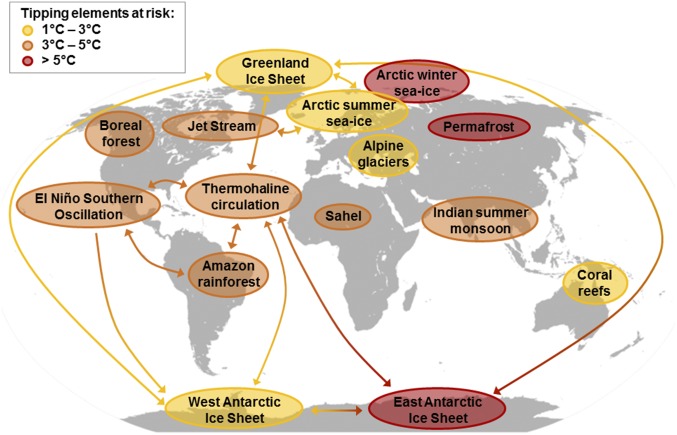
“An overview of possible tipping elements in the Earth’s system is given in Lenton et al. (2008) and Steffen et al. (2018) and includes the Arctic winter sea ice, the marine ice sheets (MISs), the Amazon rainforest and the Atlantic Meridional Overturning Circulation (AMOC).”
Climate Change and the Free Marketplace of Ideas?
Hodgetts, M., & McGravey, K. (2019) · Environmental Values · doi:10.3197/096327119x15579936382707 · Cited by 29
“In short, the negative impacts of climate change are already upon us and we are fast approaching a point where, by century’s end, if we have not acted, we will be living under extremely challenging conditions on a ‘Hothouse Earth’ (Steffen et al. 2018).”
BackgroundDynamic changes of the ecological footprint in the Beijing-Tianjin-Hebei region from 1996 to 2020
Liu, L., & Lei, Y. (2020) · Ecological Indicators · doi:10.1016/j.ecolind.2020.106142 · Cited by 29
Shaikh, M. A., Hadjikakou, M., & Bryan, B. A. (2020) · Ecological Indicators · doi:10.1016/j.ecolind.2020.106981 · Cited by 34
Yang, R., Wu, D., Li, Z., Yuan, Z., Niu, L., Zhang, H., Chen, J., & Zhou, A. (2021) · Journal of Paleolimnology · doi:10.1007/s10933-021-00193-x · Cited by 30
“Subsequently, the concept of the Anthropocene has attracted increasing attention and the term has been widely used (Crutzen 2002; Lewis and Maslin 2015; Ruddiman 2013; Waters et al. 2016; Steffen et al. 2018).”
MethodLuhas, J., Mikkilä, M. H., Kylkilahti, E., Miettinen, J., Malkamäki, A., Pätäri, S., Korhonen, J., Pekkanen, T., Tuppura, A., Lähtinen, K., et al. (2021) · Forest Policy and Economics · doi:10.1016/j.forpol.2021.102551 · Cited by 38
Seeking natural analogs to fast-forward the assessment of marine CO 2 removal
Bach, L. T., & Boyd, P. W. (2021) · Proceedings of the National Academy of Sciences · doi:10.1073/pnas.2106147118 · Cited by 42
Educating for a Holistic View of the Earth System: A Review
Ribeiro, T., & Orion, N. (2021) · Geosciences · doi:10.3390/geosciences11120485 · Cited by 46
Leverage points to address climate change risk in destinations
Loehr, J., & Becken, S. (2021) · Tourism Geographies · doi:10.1080/14616688.2021.2009017 · Cited by 38
“…essence, as scientists have argued that our global socio-economic system will reach a point where deliberate transformation is no longer possible as the system passes ecological tipping points where life on Earth as we know it may no longer be possible (Lenton et al., 2019; Steffen et al., 2018).”
BackgroundSerripierri, A., Moreau, L., Boué, P., Weiss, J., & Roux, P. (2022) · The Cryosphere · doi:10.5194/tc-16-2527-2022 · Cited by 29
Metadata
- Authors
- Steffen, W., Rockström, J., Richardson, K., Lenton, T. M., Folke, C., Liverman, D., Summerhayes, C. P., Barnosky, A. D., Cornell, S. E., Crucifix, M., Donges, J. F., Fetzer, I., Lade, S. J., Scheffer, M., Winkelmann, R., & Schellnhuber, H. J.
- Affiliations
- Australian National University (AU)
- Stockholm Resilience Centre (SE)
- University of Copenhagen (DK)
- University of Exeter (GB)
- Royal Swedish Academy of Sciences (SE)
- University of Arizona (US)
- University of Cambridge (GB)
- Stanford University (US)
- Fund for Scientific Research (BE)
- Wageningen University & Research (NL)
- University of Potsdam (DE)
- Corresponding author
- Steffen, Will
- ORCID
- Venue
- Proceedings of the National Academy of Sciences
- Publisher
- National Academy of Sciences
- Published
- 2018-08-06
- Volume
- 115
- Issue
- 33
- Pages
- 8252-8259
- ISSN
- 0027-8424 (ISSN-L)
- 1091-6490
- PMC
- PMC6099852
- OpenAlex
- W2886281704
- Cited by
- 3,139
- References
- 92
- Citations by year
- 2026: 185 · 2025: 279 · 2024: 346 · 2023: 414 · 2022: 450 · 2021: 596 · 2020: 446 · 2019: 360 · 2018: 56
- FWCI
- 213.48
- Type
- journal article
- Language
- en
- Open access
- hybrid
- doi.org
- Licence
- Locations
- Proceedings of the National Academy of Sciences (publishedVersion, cc-by-nc-nd)
- Europe PMC (PubMed Central) (publishedVersion, cc-by-nc-nd)
- PubMed Central (publishedVersion, cc-by-nc-nd)
- Research at the University of Copenhagen (University of Copenhagen) (publishedVersion, other-oa)
- PubMed (publishedVersion)
- Open Research Exeter (University of Exeter) (publishedVersion, cc-by-nc-nd)
- Socio-Environmental Systems Modeling (acceptedVersion, cc-by-nc-nd)
- Digital Access to Libraries (submittedVersion, other-oa)
- Figshare (submittedVersion)
- publish.UP (University of Potsdam) (submittedVersion, cc-by-nc-nd)
- RENATE (submittedVersion, cc-by-nc-nd)
- ANU Open Research (Australian National University) (submittedVersion, cc-by-nc-nd)
- Publication Database PIK (Potsdam Institute for Climate Impact Research (PIK)) (submittedVersion)
- Data Archiving and Networked Services (DANS) (submittedVersion, cc-by-nc-nd)
- RENATE
- Funders
- National Science Foundation (1243125)
- Familjen Erling-Perssons Stiftelse
- European Commission (743080)
- Svenska Forskningsrådet Formas (2012-742, 2014-589)
- Vetenskapsrådet
- Earth League
- Stordalen Foundation
- Leibniz-Gemeinschaft
- Topics
- Physical Sciences › Environmental Science › Global and Planetary Change › Climate variability and models
- Physical Sciences › Environmental Science › Global and Planetary Change › Earth Systems and Cosmic Evolution
- Physical Sciences › Environmental Science › Global and Planetary Change › Ecosystem dynamics and resilience
- Keywords
- Hothouse Earth, self-reinforcing feedback, climate stabilization, global warming, sea level rise, decarbonization, carbon sink, Anthropocene, climate tipping points
About these checks
Registry, retraction, Cites and statistics results are computed, not judged, with one exception: a printed reference that no index lists is read once by a model before it counts as a citation error. Claims are extracted by a model and kept only when their quote appears verbatim in the text; each cited source is then checked, with a model’s help, for whether it says what the claim relies on. Those verdicts can be wrong — read the claim’s quote and the cited source before relying on one.
Statistics and arithmetic are recomputed, not judged.
Confidence bands are shown only for fields calibrated on our annotated test set. None is calibrated yet, so no band is shown.
What counts as a claim ›How we measure confidence ›How we check this ›
Are you an author, or do you see a problem with this page? Request a review
Data sources
Bibliographic data: Semantic Scholar, OpenAlex, Crossref.
Contains information from the Semantic Scholar Academic Graph Datasets, made available under the ODC Attribution License (ODC-BY 1.0).
Semantic Scholar’s data is described in: Kinney, R., et al. (2023). The Semantic Scholar Open Data Platform. arXiv:2301.10140.
