

Trajectories of the Earth System in the Anthropocene
Open accessThe DOI matches its Crossref record; 89 of the 92 references it cites were found in a registry or an index.
Abstract
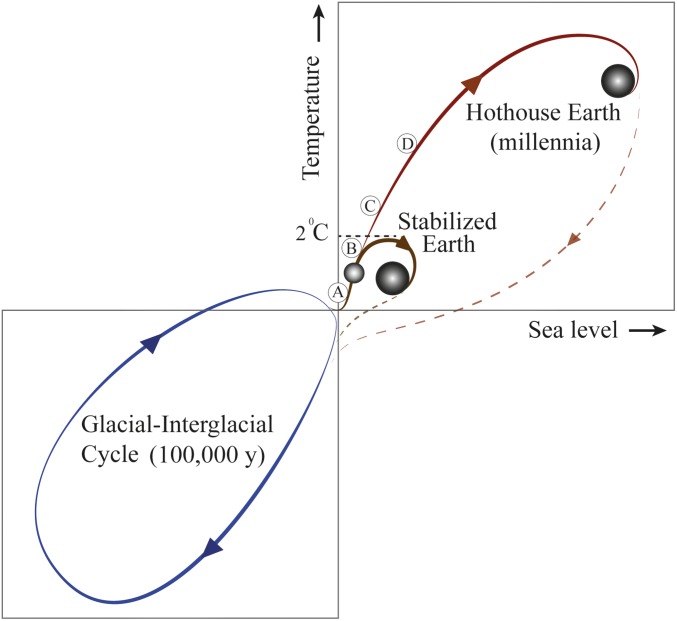
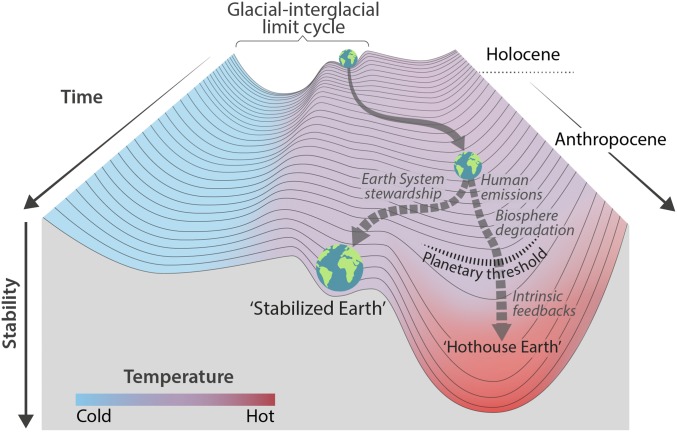
We explore the risk that self-reinforcing feedbacks could push the Earth System toward a planetary threshold that, if crossed, could prevent stabilization of the climate at intermediate temperature rises and cause continued warming on a “Hothouse Earth” pathway even as human emissions are reduced. Crossing the threshold would lead to a much higher global average temperature than any interglacial in the past 1.2 million years and to sea levels significantly higher than at any time in the Holocene. We examine the evidence that such a threshold might exist and where it might be. If the threshold is crossed, the resulting trajectory would likely cause serious disruptions to ecosystems, society, and economies. Collective human action is required to steer the Earth System away from a potential threshold and stabilize it in a habitable interglacial-like state. Such action entails stewardship of the entire Earth System—biosphere, climate, and societies—and could include decarbonization of the global economy, enhancement of biosphere carbon sinks, behavioral changes, technological innovations, new governance arrangements, and transformed social values.
Overview
The claims and statistics of this paper haven’t been checked yet.
Free: it reads the open-access text and checks the first 5 claims that cite a source we can check. Create a free account to check every claim.
Integrity signals
Registry
Cites
Statistics
Figures
Verification
Claims the paper makes
The claims and statistics of this paper haven’t been checked yet.
Free: it reads the open-access text and checks the first 5 claims that cite a source we can check. Create a free account to check every claim.
Claims other papers make about this one
Each is checked against this paper’s own text: does it say what the citing paper says it does?
The source backs part of the claim, not all of it — or backs it for a different population, condition or comparison.
In the citing paper
“Triggering positive feedback, uncontrolled emissions will lead to a major climate change that would durably lock the planet into a hot system where glaciers would go extinct(Steffen et al., 2018;McKay et al., 2022).”
From Future emergence of new ecosystems caused by glacial retreat (2023) · cites this paper as Steffen et al., 2018
Experimental — accuracy not yet measuredIn the citing paper
“Our journey into the future of cold regions shows that deglaciation over the 21 st century is expected to occur over 181,000 ± 55,000 to 372,000 ± 99,000 km 2 outside the Greenland and Antarctic ice sheets (Fig. 3) and may reach unprecedented levels in recent Earth's history”
From Future emergence of new ecosystems caused by glacial retreat (2023) · cites this paper as Steffen et al., 2018
In the citing paper
“yet it remains unknown whether human social dynamics will yield such responses”
From Stewardship of global collective behavior (2021) · cites this paper as [14]
In the citing paper
“Human collective dynamics are critical to the wellbeing of people and ecosystems in the present and will set the stage for how we face global challenges with impacts that will last centuries (14, 15, 64).”
From Stewardship of global collective behavior (2021) · cites this paper as [14]
Self-check
Percentages, sums and reported differences re-computed from the paper’s own numbers.
The self-check needs the paper’s full text.
Citations
Cites
(2014) · Cambridge University Press eBooks · doi:10.1017/cbo9781107415379 · Cited by 11,249
(2007) · Medical Entomology and Zoology · Cited by 9,612
Crutzen, P. J. (2002) · Nature · doi:10.1038/415023a · Cited by 4,788
Tipping elements in the Earth’s climate system
Lenton, T. M., Held, H., Kriegler, E., Hall, J. W., Lucht, W., Rahmstorf, S., & Schellnhuber, H. J. (2008) · Proceedings of the National Academy of Sciences · doi:10.1073/pnas.0705414105 · Cited by 3,982
Self-citationThe trajectory of the Anthropocene: The Great Acceleration
Steffen, W., Broadgate, W., Deutsch, L., Gaffney, O., & Ludwig, C. (2015) · The Anthropocene Review · doi:10.1177/2053019614564785 · Cited by 3,935
Self-citationGriscom, B. W., Adams, J., Ellis, P. W., Houghton, R. A., Lomax, G., Miteva, D. A., Schlesinger, W. H., Shoch, D., Siikamäki, J. V., Smith, P., et al. (2017) · Proceedings of the National Academy of Sciences · doi:10.1073/pnas.1710465114 · Cited by 3,481
Eight glacial cycles from an Antarctic ice core
members, E. C. (2004) · Nature · doi:10.1038/nature02599 · Cited by 2,415
The Anthropocene is functionally and stratigraphically distinct from the Holocene
Waters, C. N., Zalasiewicz, J., Summerhayes, C., Barnosky, A. D., Poirier, C., Gałuszka, A., Cearreta, A., Edgeworth, M., Ellis, E. C., Ellis, M., et al. (2016) · Science · doi:10.1126/science.aad2622 · Cited by 2,375
Self-citationContribution of Antarctica to past and future sea-level rise
DeConto, R. M., & Pollard, D. (2016) · Nature · doi:10.1038/nature17145 · Cited by 2,044
Research works printed but not linked: 3
- Stocker TF 2013 Technical summary Climate Change 2013: The Physical Science Basis. Contribution of Working Group I to the Fifth Assessment Report of the Intergovernmental Panel on Climate Change Stocker TF Cambridge Univ Press Cambridge, UK
- Ciais P 2013 Carbon and other biogeochemical cycles Climate Change 2013: The Physical Science Basis, Contribution of Working Group I to the Fifth Assessment Report of the Intergovernmental Panel on Climate Change Stocker TF Cambridge Univ Press Cambridge, UK 465 570
- Latorre C Wilmshurst J von Gunten L 2016 Climate change and cultural evolution PAGES (Past Global Changes) Magazine 24 1 32
Cited by
Items 301–400 of 1,000
Help restore Brazil’s governance of globally important ecosystem services
Levis, C., Flores, B. M., Mazzochini, G. G., Manhães, A. P., Campos-Silva, J. V., Borges de Amorim, P., Peroni, N., Hirota, M., & Clement, C. R. (2020) · Nature Ecology & Evolution · doi:10.1038/s41559-019-1093-x · Cited by 80
International business is contributing to environmental crises
Yu, H., Bansal, P., & Arjaliès, D. (2023) · Journal of International Business Studies · doi:10.1057/s41267-022-00590-y · Cited by 92
“Local environmental processes are nested within a dynamic equilibrium of global processes crucial for environmental integrity (Steffen et al., 2018).”
BackgroundShaping a resilient future in response to COVID-19
Rockström, J., Norström, A. V., Matthews, N., Biggs, R., Folke, C., Harikishun, A., Huq, S., Krishnan, N., Warszawski, L., & Nel, D. (2023) · Nature Sustainability · doi:10.1038/s41893-023-01105-9 · Cited by 101
Self-citationZhang, X., Zhong, J., Zhang, X., Zhang, D., Miao, C., Wang, D., & Guo, L. (2024) · Engineering · doi:10.1016/j.eng.2024.11.023 · Cited by 94
Water is a master variable: Solving for resilience in the modern era
Boltz, F., Poff, N. L., Folke, C., Kete, N., Brown, C., Freeman, S. S. G., Matthews, J. H., Martinez, A., & Rockström, J. (2019) · Water Security · doi:10.1016/j.wasec.2019.100048 · Cited by 95
Self-citationSaini, A., Sahu, N., Kumar, P., Nayak, S., Duan, W., Avtar, R., & Behera, S. K. (2020) · Atmosphere · doi:10.3390/atmos11111225 · Cited by 84
Boehm, S., Jeffery, M. L., Levin, K., Hecke, J., Schumer, C., Fyson, C. L., Majid, A., Jaeger, J., Nilsson, A. E., Naimoli, S., et al. (2022) · doi:10.46830/wrirpt.22.00028 · Cited by 137
Agriculture in a changing climate: Keeping our cool in the face of the hothouse
Thornton, P. K., Dinesh, D., Cramer, L. K., Loboguerrero, A. M., & Campbell, B. (2018) · Outlook on Agriculture · doi:10.1177/0030727018815332 · Cited by 94
“There are prospects for the planet that are much more dire: self-reinforcing feedbacks in the earth system that could cause continued warming on a ‘Hothouse Earth’ pathway, even as human emissions are reduced (Steffen et al., 2018).”
BackgroundCrausbay, S. D., Sofaer, H. R., Cravens, A. E., Chaffin, B. C., Clifford, K. R., Gross, J., Knapp, C. N., Lawrence, D. J., Magness, D. R., Miller‐Rushing, A. J., et al. (2021) · BioScience · doi:10.1093/biosci/biab102 · Cited by 89
Measuring the Doughnut: A good life for all is possible within planetary boundaries
Schlesier, H., Schäfer, M., & Desing, H. (2024) · Journal of Cleaner Production · doi:10.1016/j.jclepro.2024.141447 · Cited by 106
Matching scope, purpose and uses of planetary boundaries science
Downing, A. S., Bhowmik, A. K., Collste, D., Cornell, S., Donges, J. F., Fetzer, I., Häyhä, T., Hinton, J. B., Lade, S. J., & Mooij, W. M. (2019) · Environmental Research Letters · doi:10.1088/1748-9326/ab22c9 · Cited by 87
“…co-evolving and influencing each other within and across multiple scales (Watson 1999), thus leading to the global picture of a SOS that cannot be downscaled or disaggregated (Steffen et al 2015), andwhere Earth system thresholds are neither fixed nor predictable (Steffen et al 2018).”
BackgroundSelf-citationWater resilience and human life support - global outlook for the next half century
Falkenmark, M. (2020) · International Journal of Water Resources Development · doi:10.1080/07900627.2019.1693983 · Cited by 91
“Recent research in Earth System dynamics (Steffen et al., 2018) has clarified the risks involved in crossing the +2 °C limit; these results stress the fundamental importance of the Earth System remaining in the Holocene state.”
BackgroundClimate Change, Rangelands, and Sustainability of Ranching in the Western United States
Holechek, J. L., Geli, H. M. E., Cibils, A. F., & Sawalhah, M. N. (2020) · Sustainability · doi:10.3390/su12124942 · Cited by 88
Climatic changes and the fate of mountain herbivores
Lovari, S., Franceschi, S., Chiatante, G., Fattorini, L., Fattorini, N., & Ferretti, F. (2020) · Climatic Change · doi:10.1007/s10584-020-02801-7 · Cited by 86
Climate crisis and flying: social media analysis traces the rise of “flightshame”
Becken, S., Friedl, H. A., Stantić, B., Connolly, R. M., & Chen, J. (2020) · Journal of Sustainable Tourism · doi:10.1080/09669582.2020.1851699 · Cited by 110
Mustafa, S., Hao, T., Jamil, K., Qiao, Y., & Nawaz, M. M. (2022) · Frontiers in Environmental Science · doi:10.3389/fenvs.2022.955245 · Cited by 108
“As a result, societal change on all levels is required, including, but not limited to, changes in individual consumption (Steffen et al., 2018).”
BackgroundCritical heritage and the posthumanities: problems and prospects
Sterling, C. (2020) · International Journal of Heritage Studies · doi:10.1080/13527258.2020.1715464 · Cited by 103
Joanes, T., Gwozdz, W., & Klöckner, C. A. (2020) · Journal of Environmental Psychology · doi:10.1016/j.jenvp.2020.101396 · Cited by 92
“In order to reach this goal major transformative changes to current socioeconomic systems and consumption patterns are necessary, especially among consumers with high incomes and consumption levels (Steffen et al., 2018).”
BackgroundCrist, E. L. (2018) · Science · doi:10.1126/science.aau6026 · Cited by 86
Petersen, B., Stuart, D., & Gunderson, R. (2019) · Human Ecology Review · doi:10.22459/her.25.02.2019.08 · Cited by 90
“Despite overwhelming evidence and increasingly dire predictions, including the possibility of “Hothouse Earth” (Steffen et al., 2018), current policies and international agreements will fail to prevent warming to temperatures that will have severe impacts on ecosystems, society, and the economy (IPCC, 2018).”
BackgroundInfluentialAlthouse, J., Guarini, G., & Porcile, G. (2020) · Ecological Economics · doi:10.1016/j.ecolecon.2020.106628 · Cited by 103
“If implemented in full, established measures are still insufficient to prevent climate destabilization, pushing warming above 3 degrees Celsius (Steffen et al. 2018).”
BackgroundInfluentialHolst, J., Brock, A., Singer‐Brodowski, M., & de Haan, G. (2020) · Sustainability · doi:10.3390/su12104306 · Cited by 157
Circular economy, sustainability and teacher training in a higher education institution
Bugallo-Rodríguez, Á., & Vega-Marcote, P. (2020) · International Journal of Sustainability in Higher Education · doi:10.1108/ijshe-02-2020-0049 · Cited by 105
Framing the search for a theory of land use
Turner, B., Meyfroidt, P., Kuemmerle, T., Müller, D., & Chowdhury, R. R. (2020) · Journal of Land Use Science · doi:10.1080/1747423x.2020.1811792 · Cited by 86
“…however, the sheer scope of changes in the Earth system has spawned attention to questions of the sustainability of land systems, emphasizing integrated social-ecological systems (SESs) approaches for understanding the changes and informing solutions (Matson et al., 2016; Steffen et al., 2018).”
D’Orazio, P., & Dirks, M. W. (2021) · Environmental Science and Pollution Research · doi:10.1007/s11356-021-15655-y · Cited by 101
Ten key issues for ecological restoration of territorial space
Peng, J., Xu, D., Xu, Z., Tang, H., Jiang, H., Dong, J., & Liu, Y. (2024) · National Science Review · doi:10.1093/nsr/nwae176 · Cited by 86
Nassary, E. K., Msomba, B. H., Masele, W. E., Ndaki, P. M., & Kahangwa, C. A. (2022) · Journal of Environmental Management · doi:10.1016/j.jenvman.2022.114786 · Cited by 74
Roots, Riots, and Radical Change—A Road Less Travelled for Ecological Economics
Pirgmaier, E., & Steinberger, J. K. (2019) · Sustainability · doi:10.3390/su11072001 · Cited by 96
Informal Work and Sustainable Cities: From Formalization to Reparation
Tucker, J., & Anantharaman, M. (2020) · One Earth · doi:10.1016/j.oneear.2020.08.012 · Cited by 94
“Conclusions Today, life-sustaining earth systems are under existential threat.(169) As COVID-19 devastates informal livelihoods worldwide, mass layoffs plunge unprecedented numbers of workers into economic hardship.”
Emphasizing urgency of climate change is insufficient to increase policy support
Fesenfeld, L., & Rinscheid, A. (2021) · One Earth · doi:10.1016/j.oneear.2021.02.010 · Cited by 85
Cooper, J. A., & McCullough, B. P. (2021) · Journal of Cleaner Production · doi:10.1016/j.jclepro.2021.128475 · Cited by 84
Wolff, J. (2011) · Cambridge University Press eBooks · doi:10.1017/9781108692137.008 · Cited by 78
Climate and Conflict in Africa
Scheffran, J., Link, P. M., & Schilling, J. (2019) · Oxford University Press eBooks · doi:10.1093/acrefore/9780190228620.013.557 · Cited by 92
Bound to Fail? Exploring the Systemic Pathologies of CSR and Their Implications for CSR Research
Schneider, A. (2019) · Business & Society · doi:10.1177/0007650319856616 · Cited by 92
“Climate change (Steffen et al., 2018) and a rapid decrease in biodiversity (Lister & Garcia, 2018) illustrate the former, whereas a rapid increase in economic inequality (Piketty, 2014) and disregard for labor rights, both in developed and in developing countries (International Labour Office,…”
BackgroundInfluentialCovid-19 and climate change in the times of the Anthropocene
Heyd, T. (2020) · The Anthropocene Review · doi:10.1177/2053019620961799 · Cited by 95
“As a case in point, if we assume that climate change is the most prominent manifestation of the Anthropocene (Steffen et al., 2018; but see Thomas, 2019), it is noteworthy that greenhouse”
BackgroundEvaluating the Effectiveness of an Augmented Reality Game Promoting Environmental Action
Wang, K., Tekler, Z. D., Cheah, L. W., Herremans, D., & Blessing, L. T. M. (2021) · Sustainability · doi:10.3390/su132413912 · Cited by 104
“Even with the goals set in the 2015 Paris Agreement, the planet will still reach an average temperature increase of 2.8 ◦ C compared to the 1951 baseline by 2100 [1], which is far above the critical 2 ◦ C tipping point for self-reinforcing temperature-increase feedback in the carbon cycle [2].”
BackgroundInfluentialIncrease of internalized mental health symptoms among adolescents during the last three decades
Blomqvist, I., Henje, E., Hägglöf, B., & Hammarström, A. (2019) · European Journal of Public Health · doi:10.1093/eurpub/ckz028 · Cited by 94
Bioeconomy moving forward step by step – A global journey
Wohlgemuth, R., Twardowski, T., & Aguilar, A. (2020) · New Biotechnology · doi:10.1016/j.nbt.2020.11.006 · Cited by 79
Reduced-complexity model for the impact of anthropogenic CO 2 emissions on future glacial cycles
Talento, S., & Ganopolski, A. (2021) · Earth System Dynamics · doi:10.5194/esd-12-1275-2021 · Cited by 81
“Thus, our study demonstrates that, in spite of large uncertainties in model parameters, there is a qualitative difference in the long-term Earth system trajectories (Steffen et al., 2018) between cumulative emissions of 500 and 3000 Pg C.”
BackgroundIncorporating human behaviour into Earth system modelling
Beckage, B., Moore, F. C., & LaCasse, K. M. (2022) · Nature Human Behaviour · doi:10.1038/s41562-022-01478-5 · Cited by 102
Navigating the Polycrisis: Mapping the Futures of Capitalism and the Earth
Albert, M. J. (2024) · The MIT Press eBooks · doi:10.7551/mitpress/15041.001.0001 · Cited by 124
Climate change impacts on fisheries
Plagányi, É. E. (2019) · Science · doi:10.1126/science.aaw5824 · Cited by 72
Dynamics of tipping cascades on complex networks
Krönke, J., Wunderling, N., Winkelmann, R., Staal, A., Stumpf, B., Tuinenburg, O. A., & Donges, J. F. (2020) · Physical review. E · doi:10.1103/physreve.101.042311 · Cited by 80
Self-citationA coal elimination treaty 2030: Fast tracking climate change mitigation, global health and security
Burke, A., & Fishel, S. R. (2020) · Earth System Governance · doi:10.1016/j.esg.2020.100046 · Cited by 101
Simpson, G. B., Jewitt, G. P. W., Becker, W., Badenhorst, J., Masia, S., Neves, A. R., Rovira, P., & Pascual, V. (2022) · Frontiers in Water · doi:10.3389/frwa.2022.825854 · Cited by 91
Creativity for sustainability: An integrative literature review
Saleh, R., & Brem, A. (2023) · Journal of Cleaner Production · doi:10.1016/j.jclepro.2023.135848 · Cited by 98
Transnational corporations, biosphere stewardship, and sustainable futures
Österblom, H., Bebbington, J., Blasiak, R., Sobkowiak, M., & Folke, C. (2022) · Annual Review of Environment and Resources · doi:10.1146/annurev-environ-120120-052845 · Cited by 70
Self-citationColloff, M. J., Wise, R. M., Palomo, I., Lavorel, S., & Pascual, U. (2020) · Ecosystems and People · doi:10.1080/26395916.2020.1754919 · Cited by 75
“We may be approaching planetary thresholds for driver variables (Steffen et al. 2018), but discussions tend to focus on how to prevent transformation of social-ecological systems to undesirable states rather than what to do once thresholds are crossed.”
BackgroundMulti-Decadal Variability and Future Changes in Precipitation over Southern Africa
Sian, K. T. C. L. K., Wang, J., Ayugi, B. O., Nooni, I. K., & Ongoma, V. (2021) · Atmosphere · doi:10.3390/atmos12060742 · Cited by 78
Majava, A., Vadén, T., Toivanen, T., Järvensivu, P., Lähde, V., & Eronen, J. T. (2022) · Energy Strategy Reviews · doi:10.1016/j.esr.2022.100836 · Cited by 84
Winter, V., Kranz, J., & Möller, A. (2022) · Sustainability · doi:10.3390/su14106081 · Cited by 103
Fractal approaches to scaling transformations to sustainability
O’Brien, K. L., Carmona, R., Gram-Hanssen, I., Hochachka, G., Sygna, L., & Rosenberg, M. N. (2023) · AMBIO · doi:10.1007/s13280-023-01873-w · Cited by 103
“Current approaches do not appear to be effective in responding to the scale and urgency of sustainability challenges, and development trajectories are on track to surpass multiple tipping points and planetary boundaries (Steffen et al. 2018; Armstrong McKay et al. 2022).”
Donges, J. F., Heitzig, J., Barfuss, W., Wiedermann, M., Kassel, J. A., Kittel, T., Kolb, J. J., Kolster, T., Müller-Hansen, F., Otto, I. M., et al. (2020) · Earth System Dynamics · doi:10.5194/esd-11-395-2020 · Cited by 69
Self-citationLiao, Z., Zhang, L., Nobis, M. P., Wu, X., Pan, K., Wang, K., Dakhil, M. A., Du, M., Xiong, Q., Pandey, B., et al. (2019) · Diversity and Distributions · doi:10.1111/ddi.13018 · Cited by 72
“The human influences on climate-changing are significant and are dominated by the emissions into the atmosphere of greenhouse gases (IPCC, 2013; Neukom et al., 2019; Ripple et al., 2017; Steffen et al., 2018).”
BackgroundWhat do we mean, ‘tipping cascade’?
Klose, A. K., Wunderling, N., Winkelmann, R., & Donges, J. F. (2021) · Environmental Research Letters · doi:10.1088/1748-9326/ac3955 · Cited by 90
Self-citationThe political challenges of deep decarbonisation: towards a more integrated agenda
Jordan, A., Lorenzoni, I., Tosun, J., Enguer, J., Geese, L., Kenny, J., Saad, E. L., Moore, B., & Schaub, S. (2022) · Climate Action · doi:10.1007/s44168-022-00004-7 · Cited by 90
“Unfortunately, to quote the UN Secretary-General, Antonio Guterres, the problem—climate change—is ‘moving faster than we are’ (UN News 2018) (see also Steffen et al. 2018).”
BackgroundThatcher, A., Nayak, R., & Waterson, P. E. (2019) · Ergonomics · doi:10.1080/00140139.2019.1646925 · Cited by 80
“The widespread burning of fossil fuels for energy has led to the increase of atmospheric carbon dioxide to levels that are measurably affecting climate change with even larger changes expected in the coming decades (Rosenzweig et al. 2008; Sobel et al. 2016; Steffen et al. 2018).”
BackgroundIs it too late (to stop dangerous climate change)? An editorial
Hulme, M. (2019) · Wiley Interdisciplinary Reviews Climate Change · doi:10.1002/wcc.619 · Cited by 91
“The deadlines which underpin the fears of it being “too late” lean upon the moral power of absolutes, a dangerous even idolatrous force when left untempered by the political and human virtues of pragmatism and humility (Stenmark, 2015).”
BackgroundEcosystem antifragility: beyond integrity and resilience
Equihua, M., Aldama, M. E., Gershenson, C., López-Corona, O., Munguía‐Carrara, M., Pérez-Maqueo, O., & Ramírez-Carrillo, E. (2020) · PeerJ · doi:10.7717/peerj.8533 · Cited by 86
Existential Security: Towards a Security Framework for the Survival of Humanity
Sears, N. A. (2020) · Global Policy · doi:10.1111/1758-5899.12800 · Cited by 81
Paleoclimate-conditioning reveals a North Africa land–atmosphere tipping point
Hopcroft, P. O., & Valdes, P. J. (2021) · Proceedings of the National Academy of Sciences · doi:10.1073/pnas.2108783118 · Cited by 79
“This is therefore a critical research question, given the investment in GCM/ESM development and the potential for high-impact or catastrophic system changes in the future (4, 6).”
BackgroundSeven decades of climate change across Mexico
Tortarolo, G. N. M. (2020) · Atmósfera · doi:10.20937/atm.52803 · Cited by 67
“As a result of climate change, several components of the Earth system that provide key contributions to humanity are or will be impacted.”
BackgroundGarske, B., & Ekardt, F. (2021) · Environmental Sciences Europe · doi:10.1186/s12302-021-00499-7 · Cited by 81
Fostering ocean empathy through future scenarios
Blythe, J. L., Baird, J., Bennett, N. J., Dale, G., Nash, K. L., Pickering, G. J., & Wabnitz, C. C. C. (2021) · People and Nature · doi:10.1002/pan3.10253 · Cited by 80
Handling a complex agenda: A review and assessment of methods to analyse SDG entity interactions
Horvath, S.-M., Muhr, M. M., Kirchner, M., Toth, W., Germann, V., Hundscheid, L., Vacik, H., Scherz, M., Kreiner, H., Fehr, F., et al. (2022) · Environmental Science & Policy · doi:10.1016/j.envsci.2022.01.021 · Cited by 81
Head, M. J., Zalasiewicz, J., Waters, C. N., Turner, S. D., Williams, M., Barnosky, A. D., Steffen, W., Wagreich, M., Haff, P. K., Syvitski, J., et al. (2022) · Journal of Quaternary Science · doi:10.1002/jqs.3467 · Cited by 75
“…shows that human actions from the mid‐20th century onwards have driven the Earth System beyond the Holocene envelope of variability and into a new planetary state, the full extent of which will be determined by a combination of ongoing human pressures and planetary feedbacks (Steffen et al., 2018).”
Self-citationTo build or not to build? Capital stocks and climate policy∗
Baldwin, E., Cai, Y., & Kuralbayeva, K. (2019) · Journal of Environmental Economics and Management · doi:10.1016/j.jeem.2019.05.001 · Cited by 90
Molecular water oxidation catalysts based on first-row transition metal complexes
Gil‐Sepulcre, M., & Llobet, A. (2022) · Nature Catalysis · doi:10.1038/s41929-022-00750-1 · Cited by 66
Hejnowicz, A. P., Thorn, J., Giraudo, M. E., Sallach, J. B., Hartley, S. E., Grugel, J. B., Pueppke, S. G., & Emberson, L. D. (2022) · Earth s Future · doi:10.1029/2021ef002622 · Cited by 80
Why the social cost of carbon will always be disputed
Pezzey, J. C. V. (2018) · Wiley Interdisciplinary Reviews Climate Change · doi:10.1002/wcc.558 · Cited by 88
“…rapid pathway toward much hotter conditions...at a [threshold] temperature of 2.0 C above preindustrial... [whose] impacts...on human societies would likely be massive” (Steffen et al., 2018)—rather than explicit criticisms of any IAM damage function, in which they have no disciplinary expertise.”
BackgroundInfluentialKnowledge for a warmer world: A patent analysis of climate change adaptation technologies
Hötte, K., & Jee, S. J. (2022) · Technological Forecasting and Social Change · doi:10.1016/j.techfore.2022.121879 · Cited by 84
“However, not only is adaptation a necessity given the reality of climate change (Steffen et al., 2018; Boucher et al., 2016), but as our results show, adaptation can be a technological complement to mitigation.”
BackgroundRisk modelling of ESG (environmental, social, and governance), healthcare, and financial sectors
Chaudhry, S. M., Chen, X. H., Ahmed, R., & Nasir, M. A. (2023) · Risk Analysis · doi:10.1111/risa.14195 · Cited by 91
“Recent literature (Asefi-Najafabady et al., 2021; Chen et al., 2022; Galletta & Mazzù, 2023; Steffen et al., 2018) on ecological risks has highlighted the significance of the ongoing ESG debate, which has gained considerable attention from researchers and is having a significant impact on businesses…”
A Voluntary Simplicity Lifestyle: Values, Adoption, Practices and Effects
Osikominu, J., & Bocken, N. M. P. (2020) · Sustainability · doi:10.3390/su12051903 · Cited by 92
“Research highlights the post‐1950s acceleration in global resource use and negative impacts on the climate and ecosystems associated with this [4,5].”
BackgroundSectoral-based CO2 emissions of Pakistan: a novel Grey Relation Analysis (GRA) approach
Rehman, E., Ikram, M., Feng, M. T., & Rehman, S. (2020) · Environmental Science and Pollution Research · doi:10.1007/s11356-020-09237-7 · Cited by 64
Williams, A. N., Perego, P., & Whiteman, G. (2024) · Journal of Management Studies · doi:10.1111/joms.13150 · Cited by 82
(2019) · Advances in Ecological Research · doi:10.1016/bs.aecr.2019.02.003 · Cited by 63
Electric vehicles: the future we made and the problem of unmaking it
Morgan, J. (2020) · Cambridge Journal of Economics · doi:10.1093/cje/beaa022 · Cited by 71
Stress Testing the Capacity of Health Systems to Manage Climate Change-Related Shocks and Stresses
Ebi, K. L., Berry, P., Hayes, K., Boyer, C., Sellers, S., Enright, P. M., & Hess, J. J. (2018) · International Journal of Environmental Research and Public Health · doi:10.3390/ijerph15112370 · Cited by 63
“Possible futures include a “hothouse earth” if self-reinforcing feedbacks result in continued warming, despite reductions in greenhouse gas emissions [1].”
BackgroundPatchwork Earth: navigating pathways to just, thriving, and sustainable futures
Bennett, E. M., Biggs, R., Peterson, G., & Gordon, L. J. (2021) · One Earth · doi:10.1016/j.oneear.2021.01.004 · Cited by 72
Neubauer, T. A., Hauffe, T., Silvestro, D., Schauer, J., Kadolsky, D., Wesselingh, F. P., Harzhauser, M., & Wilke, T. (2021) · Communications Earth & Environment · doi:10.1038/s43247-021-00167-x · Cited by 74
Perspectives on adaptive dynamical systems
Sawicki, J., Berner, R., Loos, S. A. M., Anvari, M., Bader, R., Barfuß, W., Botta, N., Brede, N., Franović, I., Gauthier, D. J., et al. (2023) · Chaos An Interdisciplinary Journal of Nonlinear Science · doi:10.1063/5.0147231 · Cited by 84
Cities of the Anthropocene: urban sustainability in an eco-evolutionary perspective
Alberti, M. (2023) · Philosophical Transactions of the Royal Society B Biological Sciences · doi:10.1098/rstb.2022.0264 · Cited by 84
“…ecosystem processes for millennia, the emergence and rapid development of cities across the globe represents a major shift in human – nature relationships, leading to the relatively recent discontinuity in both the intensity and scale of planetary human-driven ecological transformation [1,2].”
BackgroundLauerburg, R. A. M., Diekmann, R., Blanz, B., Gee, K., Held, H., Kannen, A., Möllmann, C., Probst, W., Rambo, H., Cormier, R., et al. (2019) · The Science of The Total Environment · doi:10.1016/j.scitotenv.2019.135838 · Cited by 74
Toxic metals in East African agro-ecosystems: Key risks for sustainable food production
Mng’ong’o, M. E., Munishi, L. K., Ndakidemi, P. A., Blake, W. H., Comber, S. D. W., & Hutchinson, T. H. (2021) · Journal of Environmental Management · doi:10.1016/j.jenvman.2021.112973 · Cited by 72
“In most developing countries, despite the increased use of agrochemicals (Steffen et al., 2018), there is little training provided to farmers on application rate, best practices for agrochemicals uses and management.”
Living within a One Planet reality: the contribution of personal Footprint calculators
Collins, A., Galli, A., Hipwood, T., & Murthy, A. (2020) · Environmental Research Letters · doi:10.1088/1748-9326/ab5f96 · Cited by 76
“…have highlighted the role humans have played, and continue to play, in altering the biophysical dynamics of the planet, and the need for unsustainable economic and social trends to be inverted (e.g. Moore et al 2012, Barnosky et al 2016, Davis et al 2016, Bjørn et al 2018, Steffen et al 2018).”
BackgroundThe voices of youth in envisioning positive futures for nature and people
Rana, S., García, D. Á., Dib, V., Familia, L., Gerhardinger, L. C., Martin, E., Martins, P. I., Pompeu, J., Selomane, O., Tauli, J. I., et al. (2020) · Ecosystems and People · doi:10.1080/26395916.2020.1821095 · Cited by 71
“We are now in the age of the Anthropocene, where human activity is the prime force driving unprecedented environmental change (Steffen et al. 2018) and the recent COVID-19 pandemic further emphasises some important messages for humanity.”
BackgroundSystematic review of the uncertainty of coral reef futures under climate change
Klein, S. G., Roch, C., & Duarte, C. M. (2024) · Nature Communications · doi:10.1038/s41467-024-46255-2 · Cited by 84
Arheimer, B., Cudennec, C., Castellarin, A., Grimaldi, S., Heal, K. V., Lupton, C., Sarkar, A., Tian, F., Onema, J. K., Archfield, S. A., et al. (2024) · Hydrological Sciences Journal · doi:10.1080/02626667.2024.2355202 · Cited by 74
Conspiracy beliefs and science rejection
(2022) · doi:10.1016/j.copsyc.2022.101392 · Cited by 62
Subsea permafrost carbon stocks and climate change sensitivity estimated by expert assessment
Sayedi, S. S., Abbott, B. W., Thornton, B. F., Frederick, J., Vonk, J. E., Overduin, P. P., Schädel, C., Schuur, E. A. G., Bourbonnais, A., Demidov, N., et al. (2020) · Environmental Research Letters · doi:10.1088/1748-9326/abcc29 · Cited by 68
Yates, A. (2021) · New Zealand Geographer · doi:10.1111/nzg.12302 · Cited by 86
Levin, S. A., Anderies, J. M., Adger, W. N., Barrett, S. A., Bennett, E. M., Cárdenas, J.-C., Carpenter, S. R., Crépin, A., Ehrlich, P., Fischer, J., et al. (2021) · Ecosystems · doi:10.1007/s10021-021-00680-2 · Cited by 75
Self-citationManaged retreat and planned retreat: a systematic literature review
O’Donnell, T. (2022) · Philosophical Transactions of the Royal Society B Biological Sciences · doi:10.1098/rstb.2021.0129 · Cited by 84
“So, with climate tipping points now reached [6,41] and vulnerable areas including coastlines at the increasing risk of loss and damage in many locations around the world, we must explicitly acknowledge that not all of these locations can be saved through protect or accommodate options.”
BackgroundTipping elements and amplified polar warming during the Last Interglacial
Thomas, Z. A., Jones, R. T., Turney, C. S. M., Golledge, N., Fogwill, C., Bradshaw, C. J. A., Menviel, L., McKay, N. P., Bird, M., Palmer, J., et al. (2020) · Quaternary Science Reviews · doi:10.1016/j.quascirev.2020.106222 · Cited by 35
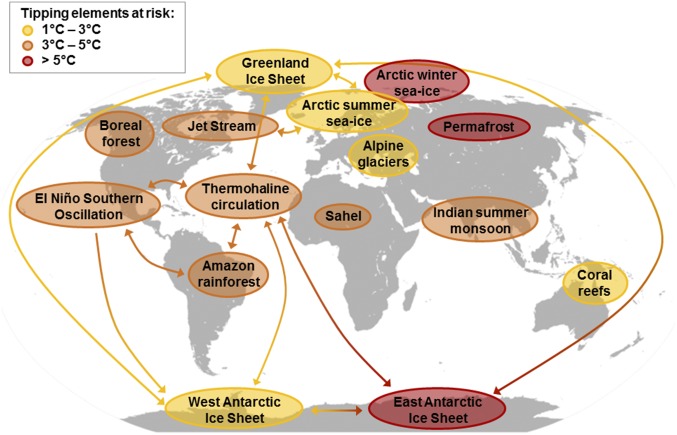
“the East Antarctic ice sheet at > 5 °C (although some sub-basins are vulnerable below this temperature) (Steffen et al., 2018).”
BackgroundGil‐Sepulcre, M., Lindner, J. O., Schindler, D., Velasco, L., Moonshiram, D., Rüdiger, O., DeBeer, S., Stepanenko, V., Solano, E., Würthner, F., et al. (2021) · Journal of the American Chemical Society · doi:10.1021/jacs.1c04738 · Cited by 60
Haskell, L., Bonnedahl, K. J., & Stål, H. I. (2021) · Journal of Cleaner Production · doi:10.1016/j.jclepro.2021.129316 · Cited by 90
Remote sensing and AI for building climate adaptation applications
Sırmaçek, B., & Vinuesa, R. (2022) · Results in Engineering · doi:10.1016/j.rineng.2022.100524 · Cited by 78
“[79] discussed that there are several temperature thresholds that will trigger climate events, which in turn will start triggering other climate events on another side of the Earth.”
BackgroundDoukas, H., Flamos, A., & Lieu, J. (2018) · Springer eBooks · doi:10.1007/978-3-030-03152-7 · Cited by 92
Scenarios of Good Anthropocenes in southern Africa
Hamann, M., Biggs, R., Pereira, L. M., Preiser, R., Hichert, T. N., Blanchard, R., Warrington-Coetzee, H., King, N., Merrie, A., Nilsson, W. O., et al. (2020) · Futures · doi:10.1016/j.futures.2020.102526 · Cited by 76
Key advantages of the leverage points perspective to shape human-nature relations
Riechers, M., Loos, J., Balázsi, Á., García‐Llorente, M., Bieling, C., Ayala, A. B., Chakroun, L., Mattijssen, T., Muhr, M. M., Pérez‐Ramírez, I., et al. (2021) · Ecosystems and People · doi:10.1080/26395916.2021.1912829 · Cited by 67
“Many years of effort towards averting the unsustainable trajectory of our world´s development prove that technological and short-term policy strategies are insufficient to achieve the internationally agreed sustainable development goals (Rockström et al. 2009; UN 2015; Steffen et al. 2018).”
Background
Metadata
- Authors
- Steffen, W., Rockström, J., Richardson, K., Lenton, T. M., Folke, C., Liverman, D., Summerhayes, C. P., Barnosky, A. D., Cornell, S. E., Crucifix, M., Donges, J. F., Fetzer, I., Lade, S. J., Scheffer, M., Winkelmann, R., & Schellnhuber, H. J.
- Affiliations
- Australian National University (AU)
- Stockholm Resilience Centre (SE)
- University of Copenhagen (DK)
- University of Exeter (GB)
- Royal Swedish Academy of Sciences (SE)
- University of Arizona (US)
- University of Cambridge (GB)
- Stanford University (US)
- Fund for Scientific Research (BE)
- Wageningen University & Research (NL)
- University of Potsdam (DE)
- Corresponding author
- Steffen, Will
- ORCID
- Venue
- Proceedings of the National Academy of Sciences
- Publisher
- National Academy of Sciences
- Published
- 2018-08-06
- Volume
- 115
- Issue
- 33
- Pages
- 8252-8259
- ISSN
- 0027-8424 (ISSN-L)
- 1091-6490
- PMC
- PMC6099852
- OpenAlex
- W2886281704
- Cited by
- 3,139
- References
- 92
- Citations by year
- 2026: 185 · 2025: 279 · 2024: 346 · 2023: 414 · 2022: 450 · 2021: 596 · 2020: 446 · 2019: 360 · 2018: 56
- FWCI
- 213.48
- Type
- journal article
- Language
- en
- Open access
- hybrid
- doi.org
- Licence
- Locations
- Proceedings of the National Academy of Sciences (publishedVersion, cc-by-nc-nd)
- Europe PMC (PubMed Central) (publishedVersion, cc-by-nc-nd)
- PubMed Central (publishedVersion, cc-by-nc-nd)
- Research at the University of Copenhagen (University of Copenhagen) (publishedVersion, other-oa)
- PubMed (publishedVersion)
- Open Research Exeter (University of Exeter) (publishedVersion, cc-by-nc-nd)
- Socio-Environmental Systems Modeling (acceptedVersion, cc-by-nc-nd)
- Digital Access to Libraries (submittedVersion, other-oa)
- Figshare (submittedVersion)
- publish.UP (University of Potsdam) (submittedVersion, cc-by-nc-nd)
- RENATE (submittedVersion, cc-by-nc-nd)
- ANU Open Research (Australian National University) (submittedVersion, cc-by-nc-nd)
- Publication Database PIK (Potsdam Institute for Climate Impact Research (PIK)) (submittedVersion)
- Data Archiving and Networked Services (DANS) (submittedVersion, cc-by-nc-nd)
- RENATE
- Funders
- National Science Foundation (1243125)
- Familjen Erling-Perssons Stiftelse
- European Commission (743080)
- Svenska Forskningsrådet Formas (2012-742, 2014-589)
- Vetenskapsrådet
- Earth League
- Stordalen Foundation
- Leibniz-Gemeinschaft
- Topics
- Physical Sciences › Environmental Science › Global and Planetary Change › Climate variability and models
- Physical Sciences › Environmental Science › Global and Planetary Change › Earth Systems and Cosmic Evolution
- Physical Sciences › Environmental Science › Global and Planetary Change › Ecosystem dynamics and resilience
- Keywords
- Hothouse Earth, self-reinforcing feedback, climate stabilization, global warming, sea level rise, decarbonization, carbon sink, Anthropocene, climate tipping points
About these checks
Registry, retraction, Cites and statistics results are computed, not judged, with one exception: a printed reference that no index lists is read once by a model before it counts as a citation error. Claims are extracted by a model and kept only when their quote appears verbatim in the text; each cited source is then checked, with a model’s help, for whether it says what the claim relies on. Those verdicts can be wrong — read the claim’s quote and the cited source before relying on one.
Statistics and arithmetic are recomputed, not judged.
Confidence bands are shown only for fields calibrated on our annotated test set. None is calibrated yet, so no band is shown.
What counts as a claim ›How we measure confidence ›How we check this ›
Are you an author, or do you see a problem with this page? Request a review
Data sources
Bibliographic data: Semantic Scholar, OpenAlex, Crossref.
Contains information from the Semantic Scholar Academic Graph Datasets, made available under the ODC Attribution License (ODC-BY 1.0).
Semantic Scholar’s data is described in: Kinney, R., et al. (2023). The Semantic Scholar Open Data Platform. arXiv:2301.10140.
