

Trajectories of the Earth System in the Anthropocene
Open accessThe DOI matches its Crossref record; 89 of the 92 references it cites were found in a registry or an index.
Abstract
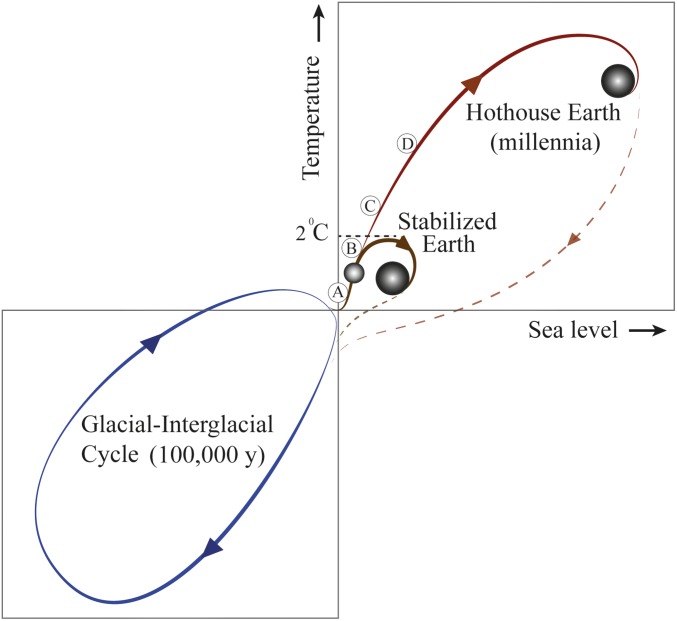
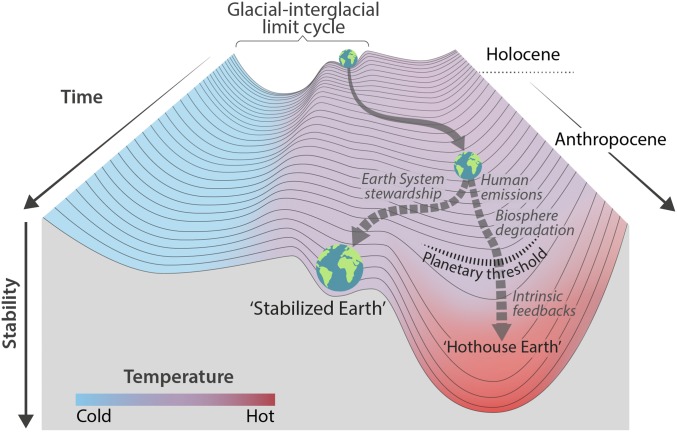
We explore the risk that self-reinforcing feedbacks could push the Earth System toward a planetary threshold that, if crossed, could prevent stabilization of the climate at intermediate temperature rises and cause continued warming on a “Hothouse Earth” pathway even as human emissions are reduced. Crossing the threshold would lead to a much higher global average temperature than any interglacial in the past 1.2 million years and to sea levels significantly higher than at any time in the Holocene. We examine the evidence that such a threshold might exist and where it might be. If the threshold is crossed, the resulting trajectory would likely cause serious disruptions to ecosystems, society, and economies. Collective human action is required to steer the Earth System away from a potential threshold and stabilize it in a habitable interglacial-like state. Such action entails stewardship of the entire Earth System—biosphere, climate, and societies—and could include decarbonization of the global economy, enhancement of biosphere carbon sinks, behavioral changes, technological innovations, new governance arrangements, and transformed social values.
Overview
The claims and statistics of this paper haven’t been checked yet.
Free: it reads the open-access text and checks the first 5 claims that cite a source we can check. Create a free account to check every claim.
Integrity signals
Registry
Cites
Statistics
Figures
Verification
Claims the paper makes
The claims and statistics of this paper haven’t been checked yet.
Free: it reads the open-access text and checks the first 5 claims that cite a source we can check. Create a free account to check every claim.
Claims other papers make about this one
Each is checked against this paper’s own text: does it say what the citing paper says it does?
The source backs part of the claim, not all of it — or backs it for a different population, condition or comparison.
In the citing paper
“Triggering positive feedback, uncontrolled emissions will lead to a major climate change that would durably lock the planet into a hot system where glaciers would go extinct(Steffen et al., 2018;McKay et al., 2022).”
From Future emergence of new ecosystems caused by glacial retreat (2023) · cites this paper as Steffen et al., 2018
Experimental — accuracy not yet measuredIn the citing paper
“Our journey into the future of cold regions shows that deglaciation over the 21 st century is expected to occur over 181,000 ± 55,000 to 372,000 ± 99,000 km 2 outside the Greenland and Antarctic ice sheets (Fig. 3) and may reach unprecedented levels in recent Earth's history”
From Future emergence of new ecosystems caused by glacial retreat (2023) · cites this paper as Steffen et al., 2018
In the citing paper
“yet it remains unknown whether human social dynamics will yield such responses”
From Stewardship of global collective behavior (2021) · cites this paper as [14]
In the citing paper
“Human collective dynamics are critical to the wellbeing of people and ecosystems in the present and will set the stage for how we face global challenges with impacts that will last centuries (14, 15, 64).”
From Stewardship of global collective behavior (2021) · cites this paper as [14]
Self-check
Percentages, sums and reported differences re-computed from the paper’s own numbers.
The self-check needs the paper’s full text.
Citations
Cites
(2014) · Cambridge University Press eBooks · doi:10.1017/cbo9781107415379 · Cited by 11,249
(2007) · Medical Entomology and Zoology · Cited by 9,612
Crutzen, P. J. (2002) · Nature · doi:10.1038/415023a · Cited by 4,788
Tipping elements in the Earth’s climate system
Lenton, T. M., Held, H., Kriegler, E., Hall, J. W., Lucht, W., Rahmstorf, S., & Schellnhuber, H. J. (2008) · Proceedings of the National Academy of Sciences · doi:10.1073/pnas.0705414105 · Cited by 3,982
Self-citationThe trajectory of the Anthropocene: The Great Acceleration
Steffen, W., Broadgate, W., Deutsch, L., Gaffney, O., & Ludwig, C. (2015) · The Anthropocene Review · doi:10.1177/2053019614564785 · Cited by 3,935
Self-citationGriscom, B. W., Adams, J., Ellis, P. W., Houghton, R. A., Lomax, G., Miteva, D. A., Schlesinger, W. H., Shoch, D., Siikamäki, J. V., Smith, P., et al. (2017) · Proceedings of the National Academy of Sciences · doi:10.1073/pnas.1710465114 · Cited by 3,481
Eight glacial cycles from an Antarctic ice core
members, E. C. (2004) · Nature · doi:10.1038/nature02599 · Cited by 2,415
The Anthropocene is functionally and stratigraphically distinct from the Holocene
Waters, C. N., Zalasiewicz, J., Summerhayes, C., Barnosky, A. D., Poirier, C., Gałuszka, A., Cearreta, A., Edgeworth, M., Ellis, E. C., Ellis, M., et al. (2016) · Science · doi:10.1126/science.aad2622 · Cited by 2,375
Self-citationContribution of Antarctica to past and future sea-level rise
DeConto, R. M., & Pollard, D. (2016) · Nature · doi:10.1038/nature17145 · Cited by 2,044
Research works printed but not linked: 3
- Stocker TF 2013 Technical summary Climate Change 2013: The Physical Science Basis. Contribution of Working Group I to the Fifth Assessment Report of the Intergovernmental Panel on Climate Change Stocker TF Cambridge Univ Press Cambridge, UK
- Ciais P 2013 Carbon and other biogeochemical cycles Climate Change 2013: The Physical Science Basis, Contribution of Working Group I to the Fifth Assessment Report of the Intergovernmental Panel on Climate Change Stocker TF Cambridge Univ Press Cambridge, UK 465 570
- Latorre C Wilmshurst J von Gunten L 2016 Climate change and cultural evolution PAGES (Past Global Changes) Magazine 24 1 32
Cited by
Items 801–900 of 1,000
Deliberating a Sustainable Welfare–Work Nexus
Lee, J., Koch, M., & Alkan-Olsson, J. (2023) · Politische Vierteljahresschrift · doi:10.1007/s11615-023-00454-6 · Cited by 39
Head, M. J., Waters, C. N., Zalasiewicz, J., Barnosky, A. D., Turner, S. D., Cearreta, A., Leinfelder, R., McCarthy, F. M. G., Richter, D. D. B., Rose, N. L., et al. (2023) · Journal of Quaternary Science · doi:10.1002/jqs.3513 · Cited by 25
“In all projections, this emerges as a climate state sharply different from the relative stability of the Holocene, or at best a human‐managed Earth pathway leading to a ‘super‐ Holocene’ state (Steffen et al., 2018).”
BackgroundSelf-citationTraversed dynamics of climate change and One Health
Shafique, M., Khurshid, M., Muzammil, S., Arshad, M. I., Malik, I. R., Rasool, M. H., Khalid, A., Khalid, R., Asghar, R., Baloch, Z., et al. (2024) · Environmental Sciences Europe · doi:10.1186/s12302-024-00931-8 · Cited by 29
“…sea levels, eutrophication, and changes in various climate-related aspects like species extinction, disruption of nutrient cycles, and the widespread use of harmful substances and materials that impact ecosystems and human services collectively contribute to overall environmental change [21].”
BackgroundHeritage, G., Entwistle, N., Milan, D. J., & Tooth, S. (2018) · Advances in Water Resources · doi:10.1016/j.advwatres.2018.11.006 · Cited by 23
“Against a backdrop of heightening concern and mounting evidence for increases in hydroclimatic extremes in a warming world (e.g. Hansen et al., 2016: Steffen et al., 2018), these are critical gaps that limit our ability to manage such dryland rivers.”
BackgroundMonk, W. A., Compson, Z. G., Choung, C. B., Korbel, K. L., Rideout, N. K., & Baird, D. J. (2019) · The Science of The Total Environment · doi:10.1016/j.scitotenv.2019.02.253 · Cited by 26
Contesting coal and climate change using scale: emergent topologies in the Adani mine controversy
Jolley, C., & RICKARDS, L. A. (2019) · Geographical Research · doi:10.1111/1745-5871.12376 · Cited by 23
‘The “Strongest” Climate Ruling Yet’: The Dutch Supreme Court’s Urgenda Judgment
Spier, J. (2020) · Netherlands International Law Review · doi:10.1007/s40802-020-00172-5 · Cited by 23
Brazilian climate policy (1992–2019): an exercise in strategic diplomatic failure
Pereira, J. C., & Viola, E. (2021) · Contemporary Politics · doi:10.1080/13569775.2021.1961394 · Cited by 29
“In fact, the core planetary boundary for climate change might have already been crossed – the planet may be closer to a potentially dangerous or even catastrophic level of climate change (Henley & King, 2017; Steffen et al., 2015, 2018).”
BackgroundRamprakash, B., & Incharoensakdi, A. (2024) · International Journal of Hydrogen Energy · doi:10.1016/j.ijhydene.2024.12.175 · Cited by 21
Leaving the “sustainability or collapse” narrative behind
Strunz, S., Marselle, M. R., & Schröter, M. (2019) · Sustainability Science · doi:10.1007/s11625-019-00673-0 · Cited by 28
Niefind, F., Karande, S., Frost, F., Abel, B., & Kahnt, A. (2019) · Nanoscale Advances · doi:10.1039/c9na00419j · Cited by 22
Revisiting climate ambition: The case for prioritizing current action over future intent
Dubash, N. K. (2019) · Wiley Interdisciplinary Reviews Climate Change · doi:10.1002/wcc.622 · Cited by 31
“science with evocative language that signals the possibility of an unsustainability threshold (Steffen et al., 2018).”
BackgroundInfluentialHuman Simulation and Sustainability: Ontological, Epistemological, and Ethical Reflections
Shults, F. L., & Wildman, W. J. (2020) · Sustainability · doi:10.3390/su122310039 · Cited by 26
“Over the decades, the accuracy, explanatory power, and insight-generating capacity of computational models of climate change have increased rapidly [13], as have the diversity of approaches to modeling human–environment interactions that address the growing challenges of the Anthropocene [14–17].”
BackgroundTen new insights in climate science 2020 – a horizon scan
Pihl, E., Alfredsson, E. C., Bengtsson, M., Bowen, K., Broto, V. C., Chou, K.-T., Cleugh, H., Ebi, K. L., Edwards, C. M., Fisher, E., et al. (2021) · Global Sustainability · doi:10.1017/sus.2021.2 · Cited by 28
Self-citationHonkaniemi, J., Rammer, W., & Seidl, R. (2021) · Environmental Modelling & Software · doi:10.1016/j.envsoft.2021.104977 · Cited by 23
Wagner, C. L., Lascu, I., Lippert, P. C., Egli, R., Livi, K. J. T., & Sears, H. B. (2021) · Paleoceanography and Paleoclimatology · doi:10.1029/2021pa004225 · Cited by 27
“Modern climate change affects both terrestrial and marine biota via habitat loss and mass extinction, but the full extent and timing of these effects throughout the modern Earth system remain unknown (Ceballos et al., 2015; Steffen et al., 2018; Zachos, Dickens, & Zeebe, 2008; Zeebe et al., 2016).”
BackgroundStuart, D., Petersen, B., & Gunderson, R. (2021) · Globalizations · doi:10.1080/14747731.2021.1943897 · Cited by 29
Thøgersen, J. B., Vatn, A., Aasen, M., Dunlap, R. E., Fisher, D. R., Hellevik, O., & Stern, P. C. (2021) · Energy Research & Social Science · doi:10.1016/j.erss.2021.102168 · Cited by 33
Pasquetti, F., Bini, M., Giaccio, B., Ratti, A., Vacchi, M., & Zanchetta, G. (2021) · Journal of Quaternary Science · doi:10.1002/jqs.3359 · Cited by 22
“The increasing concentration of greenhouse gases in the atmosphere is leading the Earth's climate towards warmer conditions with consequent sea‐level rise resulting from ice melting and ocean expansion (Clark et al., 2016; Steffen et al., 2018).”
BackgroundAdaptive Evolution Can Both Prevent Ecosystem Collapse and Delay Ecosystem Recovery
Chaparro‐Pedraza, P. C., Matthews, B., Meester, L. D., & Dakos, V. (2021) · The American Naturalist · doi:10.1086/716929 · Cited by 27
Kreuter, J., & Lederer, M. (2021) · Global Sustainability · doi:10.1017/sus.2021.24 · Cited by 26
Human well-being in the Anthropocene: limits to growth
Collste, D., Cornell, S., Randers, J., Rockström, J., & Stoknes, P. E. (2021) · Global Sustainability · doi:10.1017/sus.2021.26 · Cited by 25
“, 2020) or even trigger shifts in large-scale Earth system regime (Steffen et al., 2018).”
Self-citationContribution of Civil Protection to the Urban Economy: Evidence from a Small-Sized Greek City
Kalogiannidis, S., Toska, E., & Chatzitheodoridis, F. (2022) · Sustainability · doi:10.3390/su14020981 · Cited by 29
“Contrarily, there is a constant call to develop risk management strategies through incremental reorientation and adjustments leading to a fundamental transformation of both individual behavior, concerning values and the understanding and prioritization of needs, and the global society, concerning the way that institut…”
BackgroundZeug, W., Bezama, A., & Thrän, D. (2022) · The International Journal of Life Cycle Assessment · doi:10.1007/s11367-022-02098-x · Cited by 31
Zhang, Z., Licht, A., Vleeschouwer, D. D., Wang, Z., Li, Y., Kemp, D. B., Tan, L., Zhang, R., Qiang, X., & Huang, C. (2022) · Geophysical Research Letters · doi:10.1029/2022gl101280 · Cited by 22
“We apply a recurrence analysis measure of determinism (DET) to our record to identify individual climate states that share statistically distinctive dynamics (Steffen et al., 2018; (Westerhold et al., 2020).”
MethodSoil–vegetation moisture capacitor maintains dry season vegetation productivity over India
Sebastian, D. E., Murtugudde, R. G., & Ghosh, S. (2023) · Scientific Reports · doi:10.1038/s41598-022-27277-6 · Cited by 25
Climate change and the public health imperative for supporting migration as adaptation
Marcus, H., Hanna, L., Tait, P., Stone, S., & Wannous, C. (2023) · Journal of Migration and Health · doi:10.1016/j.jmh.2023.100174 · Cited by 31
Yue, Z., Liu, H., Xu, Z., & Wang, Y. (2023) · Ecological Indicators · doi:10.1016/j.ecolind.2023.110270 · Cited by 22
A phase space description of the Earth System in the Anthropocene
Orfeu Bertolami, A., & Francisco, F. (2019) · Europhysics Letters (EPL) · doi:10.1209/0295-5075/127/59001 · Cited by 24
Banggai cardinalfish conservation: priorities, opportunities, and risks
Ndobe, S., Moore, A. M., Yasir, I., & Jompa, J. (2019) · IOP Conference Series Earth and Environmental Science · doi:10.1088/1755-1315/253/1/012033 · Cited by 22
“Furthermore in this Anthropocene Epoch, it is vital to consider the likely short and long-term impacts of global change on this species.”
BackgroundInfluentialZapf, M., Pengg, H., & Weindl, C. (2019) · Energies · doi:10.3390/en12152983 · Cited by 22
“The risk of self-reinforcing feedbacks is explored, among other places, in [80].”
BackgroundWagreich, M., & Koukal, V. (2019) · Geological Society London Special Publications · doi:10.1144/sp498-2019-34 · Cited by 25
Holz, A., Wood, S. W., Ward, C., Veblen, T. T., & Bowman, D. M. J. S. (2020) · Global Change Biology · doi:10.1111/gcb.15031 · Cited by 22
“Abrupt ecological transitions can result from pervasive and amplified environmental changes, which have increased during the Anthropocene epoch (Steffen et al., 2018).”
BackgroundClimate Change and the Financial SystemPreprint
Monasterolo, I. (2019) · SSRN Electronic Journal · doi:10.2139/ssrn.3479380 · Cited by 33
Interconnected Disaster Risks 2023: Risk Tipping Points
Eberle, C., O’Connor, J., Narvaez, L., Benavides, M. M., & Sebesvári, Z. (2023) · UNU Collections (United Nations University) · doi:10.53324/wtwn2495 · Cited by 28
Schrot, O. G., Krimm, H., & Schinko, T. (2020) · Challenges in Sustainability · doi:10.12924/cis2020.08010030 · Cited by 23
“[2] Steffen W, Rockström J, Richardson K, Lenton TM, Folke C, Liverman D, et al.”
BackgroundThe social dynamics of basins of attraction
van der Leeuw, S., & Folke, C. (2021) · Ecology and Society · doi:10.5751/es-12289-260133 · Cited by 29
“To discuss the dynamics of categorization we will use a simplified model of categorization in relation to decision making under uncertainty (Tversky 1977, Tversky and Gati 1978, Kahnemann et al. 1982; Fig.”
MethodSelf-citationThreshold, budget and deadline: beyond the discourse of climate scarcity and control
Asayama, S. (2021) · Climatic Change · doi:10.1007/s10584-021-03185-y · Cited by 21
Stockholm to Stockholm: Achieving a safe Earth requires goals that incorporate a just approach
Rockström, J., Gupta, J., Qin, D., Pedde, S., Broadgate, W. J., & Warszawski, L. (2021) · One Earth · doi:10.1016/j.oneear.2021.08.012 · Cited by 22
Self-citationHui, E., Stafford, R., Matthews, I., & Smith, V. A. (2021) · Ecological Informatics · doi:10.1016/j.ecoinf.2021.101539 · Cited by 28
Brauch, H. G. (2021) · The anthropocene: Politik - economics - society - science · doi:10.1007/978-3-030-82202-6_22 · Cited by 27
The influence of Power’s audit society in environmental and sustainability accounting
Bebbington, J., & Larrínaga, C. (2022) · Qualitative Research in Accounting & Management · doi:10.1108/qram-01-2022-0007 · Cited by 32
Allen, K., Riede, F., Gouramanis, C., Keenan, B., Stoffel, M., Hu, A., & Ionita-Scholz, M. (2022) · Environmental Research Letters · doi:10.1088/1748-9326/ac6967 · Cited by 28
A review of frameworks, methods and models for the evaluation and engineering of factory life cycles
Dér, A., Hingst, L., Nyhuis, P., & Herrmann, C. A. (2022) · Advances in Industrial and Manufacturing Engineering · doi:10.1016/j.aime.2022.100083 · Cited by 28
Virtual tree, real impact: how simulated worlds associate with the perception of limited resources
Ho, M., Huyền, N. T. T., Nguyen, M., La, V., & Vuong, Q. (2022) · Humanities and Social Sciences Communications · doi:10.1057/s41599-022-01225-1 · Cited by 26
“Mounting evidence has shown that various environmental changes (e.g., biodiversity loss, climate change, and deforestation) are driven by rampant human population growth and unsustainable exploitation activities (Hedges et al. 2018; Steffen et al. 2018).”
BackgroundHollnaicher, S. (2022) · Global Sustainability · doi:10.1017/sus.2022.16 · Cited by 28
“, 2019), potentially leading to cascading positive feedback and uncontrollable climate change, affecting all future generations (Steffen et al., 2018).”
BackgroundKvale, K., Hunt, C. F., James, A., & Koeve, W. (2023) · Frontiers in Marine Science · doi:10.3389/fmars.2023.1111838 · Cited by 24
“, 2015) and will permit plastics researchers to exploit the rich literature on intolerable climate impacts (e.g. PetschelHeld et al., 1999; Kvale et al., 2012; Steffen et al., 2018) in defining such a boundary.”
BackgroundEpochal turns: Uncomfortable insights, uncertain outlooks
Spangenberg, J. H., & Kurz, R. (2023) · Sustainable Development · doi:10.1002/sd.2512 · Cited by 28
Bringing the political system (back) into social tipping relevant to sustainability
Eder, C., & Stadelmann‐Steffen, I. (2023) · Energy Policy · doi:10.1016/j.enpol.2023.113529 · Cited by 23
Chen, Y., Liu, Y., Hu, S., Wu, D., Zhang, M., & Cheng, Z. (2023) · The Science of The Total Environment · doi:10.1016/j.scitotenv.2023.169722 · Cited by 21
The Case for Studying Non-Market Food Systems
Bliss, S. (2019) · Sustainability · doi:10.3390/su11113224 · Cited by 28
“It is clear that extreme specialization will hinder societies’ ability to recover from, and react to, the global environmental changes and concomitant civilizational catastrophes that earth systems scientists foresee [140,141].”
BackgroundShared Patterns in Long-Term Dynamics of Commons as Institutions for Collective Action
Farjam, M., Moor, T. D., van Weeren, R., Forsman, A., Dehkordi, M. A. E., Ghorbani, A., & Bravo, G. (2020) · International Journal of the Commons · doi:10.5334/ijc.959 · Cited by 27
The Buying Time Argument within the Solar Radiation Management Discourse
Neuber, F., & Ott, K. (2020) · Applied Sciences · doi:10.3390/app10134637 · Cited by 29
“Cumulative GHG emissions have moved the global climate system forward into a highly critical state [8].”
BackgroundAssessing terrestrial biogeochemical feedbacks in a strategically geoengineered climate
Yang, C.-E., Hoffman, F. M., Ricciuto, D. M., Tilmes, S., Xia, L., MacMartin, D. G., Kravitz, B., Richter, J. H., Mills, M. J., & Fu, J. S. (2020) · Environmental Research Letters · doi:10.1088/1748-9326/abacf7 · Cited by 24
“Rising global mean surface temperature along with increasing anthropogenic greenhouse gas emissions have been observed since the last century (IPCC 2014), and future projections of increasing global mean surface temperature remain even if anthropogenic emissions are reduced (Steffen et al 2018).”
BackgroundThe World Ecology of Desalination: From Cold War Positioning to Financialization in the Capitalocene
O’Neill, B. (2020) · Journal of World-Systems Research · doi:10.5195/jwsr.2020.987 · Cited by 28
The Role of Uncertainty in Controlling Climate Change
Cai, Y. (2021) · Oxford University Press eBooks · doi:10.1093/acrefore/9780190625979.013.573 · Cited by 27
Climate transition spillovers and sovereign risk: Evidence from Indonesia
Gourdel, R., Monasterolo, I., & Gallagher, K. P. (2025) · Energy Economics · doi:10.1016/j.eneco.2025.108211 · Cited by 37
Humanistic Geosciences and the Planetary Human Niche
Bohle, M., & Marone, E. (2019) · Springer eBooks · doi:10.1007/978-3-030-12010-8_4 · Cited by 26
Geier, F., Barfuß, W., Wiedermann, M., Kurths, J., & Donges, J. F. (2019) · The European Physical Journal Special Topics · doi:10.1140/epjst/e2019-900120-4 · Cited by 25
Self-citationPotential feedbacks between loss of biosphere integrity and climate change
Lade, S. J., Norberg, J., Anderies, J. M., Beer, C., Cornell, S. E., Donges, J. F., Fetzer, I., Gasser, T., Richardson, K., Rockström, J., et al. (2019) · Global Sustainability · doi:10.1017/sus.2019.18 · Cited by 20
“A recent review by Steffen et al. (2018) found a potential loss of carbon due to Amazon and boreal dieback under 2°C warming of 25 PgC (uncertainty range 15 – 55 PgC) and 30 PgC (uncertainty range 10 – 40 PgC).”
InfluentialSelf-citationSun, M.-A., Sung, H. M., Kim, J., Lee, J.-H., Shim, S., Boo, K., Byun, Y., Marzin, C., & Kim, Y.-H. (2021) · Atmosphere · doi:10.3390/atmos12010072 · Cited by 21
Making sense of climate change—the lived experience of experts
Renouf, J. S. (2021) · Climatic Change · doi:10.1007/s10584-021-02986-5 · Cited by 35
Networks of climate change: connecting causes and consequences
Holme, P., & Rocha, J. (2023) · Applied Network Science · doi:10.1007/s41109-023-00536-9 · Cited by 35
Apostel, A., & O’Neill, D. W. (2022) · Ecological Economics · doi:10.1016/j.ecolecon.2022.107385 · Cited by 26
Stubenrauch, J., Garske, B., Ekardt, F., & Hagemann, K. (2022) · Sustainability · doi:10.3390/su14074365 · Cited by 27
“Furthermore, we have seen that both measurability and the prediction of the carbon storage capacity of forest ecosystems under future climatic conditions will be extremely challenging [84,87].”
BackgroundDerbyshire, J., & Morgan, J. (2022) · Technological Forecasting and Social Change · doi:10.1016/j.techfore.2022.121811 · Cited by 21
Hölscher, K., Frantzeskaki, N., Jäger, J., Holman, I., & Pedde, S. (2022) · Futures · doi:10.1016/j.futures.2022.103025 · Cited by 26
Celis-Ramírez, M., Quintero-Ángel, M., & Varela-M, R. E. (2022) · Journal of Environmental Management · doi:10.1016/j.jenvman.2022.116159 · Cited by 25
Laming, A., Fletcher, M., Romano, A., Mullett, R., Connor, S., Mariani, M., Maezumi, S. Y., & Gadd, P. (2022) · Fire · doi:10.3390/fire5060175 · Cited by 27
Michaiel, A. M., & Bernard, A. (2022) · Frontiers in Neural Circuits · doi:10.3389/fncir.2022.995354 · Cited by 26
“In more devastating scenarios, positive feedback loops in the carbon cycle may prevent stabilization of climate and trigger sudden and irreversible global warming in unpredictable and catastrophic ways (Steffen et al., 2018).”
BackgroundOosterhoff, H., Golsteijn, L., Laurent, A., & Ryberg, M. W. (2023) · Journal of Cleaner Production · doi:10.1016/j.jclepro.2023.136574 · Cited by 19
Returning to Evolved Nestedness, Wellbeing, and Mature Human Nature, an Ecological Imperative
Narvaez, D. F. (2024) · Review of General Psychology · doi:10.1177/10892680231224035 · Cited by 24
“Earth ’ s ecosphere has long supported life as we know it, but human interference is pushing the planet toward “ hothouse earth, ” a different equilibrium that will be less habitable (Richardson et al., 2023; Steffen et al., 2018).”
BackgroundCelermajer, D., Cardoso, M., Gowers, J., Indukuri, D., Khanna, P., Nair, R., Orlene, J., Sambhavi, V., Schlosberg, D., Shah, M., et al. (2024) · Environment and Planning E Nature and Space · doi:10.1177/25148486241230186 · Cited by 39
“In the face of a rapidly and harmfully changing climate driven by fossil fuelled forms of life (Rockstreom et al., 2009; Steffen et al., 2018), communities across the globe, particularly those most marginalised and damaged by systems of global capitalism, are confronting immediate and damaging…”
Fisher, J., Allen, S., Yetman, G., & Pistolesi, L. (2024) · Scientific Reports · doi:10.1038/s41598-024-61924-4 · Cited by 28
“It is well-recognized that biodiversity loss and climate change are interconnected crises that require urgent action 1,2 .”
BackgroundA holistic perspective on Earth system science
Zheng, Y., Guo, Z., Jiao, N., Mu, M., Piao, S. L., Fu, S., Yang, D., & Zhu, M. (2024) · Science China Earth Sciences · doi:10.1007/s11430-024-1409-8 · Cited by 22
Explaining long-term outcome trajectories in social–ecological systems
Rana, P., & Miller, D. C. (2019) · PLoS ONE · doi:10.1371/journal.pone.0215230 · Cited by 23
Northern Warning Lights: Ambiguities of Environmental Security in Finland and Sweden
Hakala, E., Lähde, V., Majava, A., Toivanen, T., Vadén, T., Järvensivu, P., & Eronen, J. T. (2019) · Sustainability · doi:10.3390/su11082228 · Cited by 32
“The focus on direct impacts and specific one-off mitigation actions runs the risk of neglecting the extent to which climate change and its prevention will influence production patterns, politics and societies as a whole [14,15].”
BackgroundShahmanesh, M., Harling, G., Coltart, C. E. M., Bailey, H., King, C., Gibbs, J., Seeley, J., Phillips, A. N., Sabin, C. A., Aldridge, R. W., et al. (2020) · The Lancet Infectious Diseases · doi:10.1016/s1473-3099(20)30136-5 · Cited by 24
Hercher-Pasteur, J., Loiseau, E., Sinfort, C., & Hélias, A. (2021) · Resources Conservation and Recycling · doi:10.1016/j.resconrec.2021.105502 · Cited by 26
Adler, T., Underwood, K. L., Rizzo, D. M., Harpold, A. A., Sterle, G., Li, L., Wen, H., Stinson, L., Bristol, C., Stewart, B., et al. (2021) · Frontiers in Water · doi:10.3389/frwa.2021.578608 · Cited by 24
“Disturbances such as land-cover transformation, amplification of biogeochemical flows, and climate disruption are triggering transitions in the Earth system that are unprecedented on human timescales (Steffen et al., 2018; Abbott et al., 2019).”
BackgroundGannon, W. J. F., & Dunnill, C. W. (2020) · International Journal of Hydrogen Energy · doi:10.1016/j.ijhydene.2020.06.029 · Cited by 20
Oen, A. M. P. (2019) · Integrated Environmental Assessment and Management · doi:10.1002/ieam.4203 · Cited by 20
Future Changes in Precipitation Extremes Over East Africa Based on CMIP6 ProjectionsPreprint
Ayugi, B. O., Dike, V. N., Ngoma, H., Babaousmail, H., & Ongoma, V. (2021) · Preprints.org · doi:10.20944/preprints202101.0112.v1 · Cited by 20
Márquez, I., Gutiérrez‐Tarriño, S., Portorreal-Bottier, A., del Río‐Rodríguez, J. L., Hernández-Salvador, S., Calvente, J. J., Oña‐Burgos, P., & Olloqui‐Sariego, J. L. (2024) · Catalysis Today · doi:10.1016/j.cattod.2024.115049 · Cited by 22
Measure or Management?—Resource Use Indicators for Policymakers Based on Microdata by Households
Buhl, J., Liedtke, C., Teubler, J., Bienge, K., & Schmidt, N. (2018) · Sustainability · doi:10.3390/su10124467 · Cited by 28
“Meeting the resource demand of a growing global consumer class increasingly affects the environment and places a burden on climate and ecosystems [1].”
BackgroundHawkins, I. W., Mangels, A. R., Goldman, R., & Wood, R. J. (2019) · Frontiers in Nutrition · doi:10.3389/fnut.2019.00123 · Cited by 23
“As the proposed modern-day geological era known as the Anthropocene demonstrates, humans are altering the Earth System in ways that may altogether change the Earth system and its ability to support humanity (31).”
BackgroundQuel type de citoyenneté en Anthropocène ?
Wallenhorst, N. (2020) · Le Télémaque · doi:10.3917/tele.058.0045 · Cited by 19
Addressing Students’ Eco-anxiety when Teaching Sustainability in Higher Education
Eriksson, E., Peters, A.-K., Pargman, D. S., Hedin, B., Thorslund, M. L., & Sjoo, S. (2022) · International Conference on ICT for Sustainability (ICT4S) · doi:10.1109/ict4s55073.2022.00020 · Cited by 32
Climate anxiety, fatalism and the capacity to act
Taylor, D. (2022) · Routledge eBooks · doi:10.4324/9781003331780-13 · Cited by 34
Methods for assessing social impacts of policies in relation to absolute boundaries
Desmoitier, N., Kolenda, M., Olsen, K. H., & Ryberg, M. W. (2023) · Environmental Impact Assessment Review · doi:10.1016/j.eiar.2023.107098 · Cited by 26
Subways and CO2 emissions: A global analysis with satellite data
Dasgupta, S., Lall, S. V., & Wheeler, D. R. (2023) · The Science of The Total Environment · doi:10.1016/j.scitotenv.2023.163691 · Cited by 24
Dorji, T., Morrison‐Saunders, A., & Blake, D. (2023) · Environmental Management · doi:10.1007/s00267-023-01833-w · Cited by 33
“These climate phenomena bring about global environmental changes and adversely impacts ecosystems disrupting services affecting human livelihood and wellbeing (Dietz et al. 2020; Steffen et al. 2018).”
BackgroundGünther, P., & Ekardt, F. (2023) · Frontiers in Climate · doi:10.3389/fclim.2023.1276606 · Cited by 20
Prospects for a sustainable and climate-resilient African economy post-COVID-19
Nhamo, G., & Chapungu, L. (2024) · Global Environmental Change · doi:10.1016/j.gloenvcha.2024.102836 · Cited by 24
Climate risk stress testing: A critical survey and classification
Reinders, H. J., Schoenmaker, D., & van Dijk, M. A. (2025) · Journal of Climate Finance · doi:10.1016/j.jclimf.2025.100061 · Cited by 25
Limits to Liberalism: Considerations for the Anthropocene
Creutzig, F. (2020) · Ecological Economics · doi:10.1016/j.ecolecon.2020.106763 · Cited by 21
Resolving ecological feedbacks on the ocean carbon sink in Earth system models
McKay, D. I. A., Cornell, S., Richardson, K., & Rockström, J. (2021) · Earth System Dynamics · doi:10.5194/esd-12-797-2021 · Cited by 23
Self-citationWoźniak, M., Badora, A., Kud, K., & Woźniak, L. (2021) · Energies · doi:10.3390/en15010045 · Cited by 19
Can transnational corporations leverage systemic change towards a ‘sustainable’ future?
Schneider, A., Hinton, J. B., Collste, D., González, T. S., Cortés-Calderón, S. V., & Aguiar, A. P. (2020) · Nature Ecology & Evolution · doi:10.1038/s41559-020-1143-4 · Cited by 21
Economic Growth and Carbon Emissions: The Road to ‘Hothouse Earth’ is Paved with Good IntentionsPreprint
Storm, S., & Schröder, E. (2018) · SSRN Electronic Journal · doi:10.2139/ssrn.3306271 · Cited by 36
“5°C (Grubb 2014; Steffen et al. 2018) and just accept whatever consequences this has in terms of economic growth (Ward et al.”
Influential
Metadata
- Authors
- Steffen, W., Rockström, J., Richardson, K., Lenton, T. M., Folke, C., Liverman, D., Summerhayes, C. P., Barnosky, A. D., Cornell, S. E., Crucifix, M., Donges, J. F., Fetzer, I., Lade, S. J., Scheffer, M., Winkelmann, R., & Schellnhuber, H. J.
- Affiliations
- Australian National University (AU)
- Stockholm Resilience Centre (SE)
- University of Copenhagen (DK)
- University of Exeter (GB)
- Royal Swedish Academy of Sciences (SE)
- University of Arizona (US)
- University of Cambridge (GB)
- Stanford University (US)
- Fund for Scientific Research (BE)
- Wageningen University & Research (NL)
- University of Potsdam (DE)
- Corresponding author
- Steffen, Will
- ORCID
- Venue
- Proceedings of the National Academy of Sciences
- Publisher
- National Academy of Sciences
- Published
- 2018-08-06
- Volume
- 115
- Issue
- 33
- Pages
- 8252-8259
- ISSN
- 0027-8424 (ISSN-L)
- 1091-6490
- PMC
- PMC6099852
- OpenAlex
- W2886281704
- Cited by
- 3,139
- References
- 92
- Citations by year
- 2026: 185 · 2025: 279 · 2024: 346 · 2023: 414 · 2022: 450 · 2021: 596 · 2020: 446 · 2019: 360 · 2018: 56
- FWCI
- 213.48
- Type
- journal article
- Language
- en
- Open access
- hybrid
- doi.org
- Licence
- Locations
- Proceedings of the National Academy of Sciences (publishedVersion, cc-by-nc-nd)
- Europe PMC (PubMed Central) (publishedVersion, cc-by-nc-nd)
- PubMed Central (publishedVersion, cc-by-nc-nd)
- Research at the University of Copenhagen (University of Copenhagen) (publishedVersion, other-oa)
- PubMed (publishedVersion)
- Open Research Exeter (University of Exeter) (publishedVersion, cc-by-nc-nd)
- Socio-Environmental Systems Modeling (acceptedVersion, cc-by-nc-nd)
- Digital Access to Libraries (submittedVersion, other-oa)
- Figshare (submittedVersion)
- publish.UP (University of Potsdam) (submittedVersion, cc-by-nc-nd)
- RENATE (submittedVersion, cc-by-nc-nd)
- ANU Open Research (Australian National University) (submittedVersion, cc-by-nc-nd)
- Publication Database PIK (Potsdam Institute for Climate Impact Research (PIK)) (submittedVersion)
- Data Archiving and Networked Services (DANS) (submittedVersion, cc-by-nc-nd)
- RENATE
- Funders
- National Science Foundation (1243125)
- Familjen Erling-Perssons Stiftelse
- European Commission (743080)
- Svenska Forskningsrådet Formas (2012-742, 2014-589)
- Vetenskapsrådet
- Earth League
- Stordalen Foundation
- Leibniz-Gemeinschaft
- Topics
- Physical Sciences › Environmental Science › Global and Planetary Change › Climate variability and models
- Physical Sciences › Environmental Science › Global and Planetary Change › Earth Systems and Cosmic Evolution
- Physical Sciences › Environmental Science › Global and Planetary Change › Ecosystem dynamics and resilience
- Keywords
- Hothouse Earth, self-reinforcing feedback, climate stabilization, global warming, sea level rise, decarbonization, carbon sink, Anthropocene, climate tipping points
About these checks
Registry, retraction, Cites and statistics results are computed, not judged, with one exception: a printed reference that no index lists is read once by a model before it counts as a citation error. Claims are extracted by a model and kept only when their quote appears verbatim in the text; each cited source is then checked, with a model’s help, for whether it says what the claim relies on. Those verdicts can be wrong — read the claim’s quote and the cited source before relying on one.
Statistics and arithmetic are recomputed, not judged.
Confidence bands are shown only for fields calibrated on our annotated test set. None is calibrated yet, so no band is shown.
What counts as a claim ›How we measure confidence ›How we check this ›
Are you an author, or do you see a problem with this page? Request a review
Data sources
Bibliographic data: Semantic Scholar, OpenAlex, Crossref.
Contains information from the Semantic Scholar Academic Graph Datasets, made available under the ODC Attribution License (ODC-BY 1.0).
Semantic Scholar’s data is described in: Kinney, R., et al. (2023). The Semantic Scholar Open Data Platform. arXiv:2301.10140.
