

Trajectories of the Earth System in the Anthropocene
Open accessThe DOI matches its Crossref record; 89 of the 92 references it cites were found in a registry or an index.
Abstract
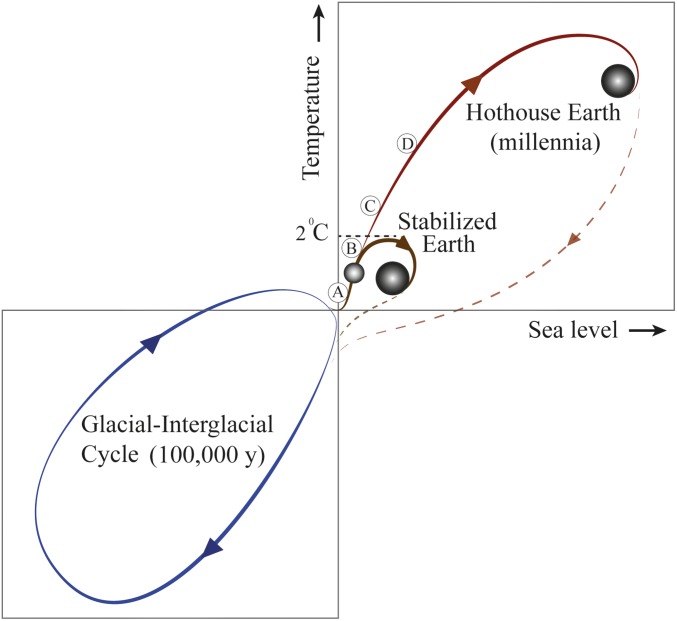
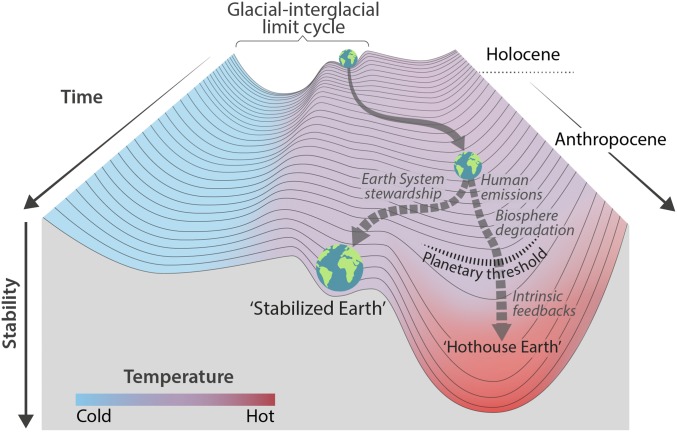
We explore the risk that self-reinforcing feedbacks could push the Earth System toward a planetary threshold that, if crossed, could prevent stabilization of the climate at intermediate temperature rises and cause continued warming on a “Hothouse Earth” pathway even as human emissions are reduced. Crossing the threshold would lead to a much higher global average temperature than any interglacial in the past 1.2 million years and to sea levels significantly higher than at any time in the Holocene. We examine the evidence that such a threshold might exist and where it might be. If the threshold is crossed, the resulting trajectory would likely cause serious disruptions to ecosystems, society, and economies. Collective human action is required to steer the Earth System away from a potential threshold and stabilize it in a habitable interglacial-like state. Such action entails stewardship of the entire Earth System—biosphere, climate, and societies—and could include decarbonization of the global economy, enhancement of biosphere carbon sinks, behavioral changes, technological innovations, new governance arrangements, and transformed social values.
Overview
The claims and statistics of this paper haven’t been checked yet.
Free: it reads the open-access text and checks the first 5 claims that cite a source we can check. Create a free account to check every claim.
Integrity signals
Registry
Cites
Statistics
Figures
Verification
Claims the paper makes
The claims and statistics of this paper haven’t been checked yet.
Free: it reads the open-access text and checks the first 5 claims that cite a source we can check. Create a free account to check every claim.
Claims other papers make about this one
Each is checked against this paper’s own text: does it say what the citing paper says it does?
The source backs part of the claim, not all of it — or backs it for a different population, condition or comparison.
In the citing paper
“Triggering positive feedback, uncontrolled emissions will lead to a major climate change that would durably lock the planet into a hot system where glaciers would go extinct(Steffen et al., 2018;McKay et al., 2022).”
From Future emergence of new ecosystems caused by glacial retreat (2023) · cites this paper as Steffen et al., 2018
Experimental — accuracy not yet measuredIn the citing paper
“Our journey into the future of cold regions shows that deglaciation over the 21 st century is expected to occur over 181,000 ± 55,000 to 372,000 ± 99,000 km 2 outside the Greenland and Antarctic ice sheets (Fig. 3) and may reach unprecedented levels in recent Earth's history”
From Future emergence of new ecosystems caused by glacial retreat (2023) · cites this paper as Steffen et al., 2018
In the citing paper
“yet it remains unknown whether human social dynamics will yield such responses”
From Stewardship of global collective behavior (2021) · cites this paper as [14]
In the citing paper
“Human collective dynamics are critical to the wellbeing of people and ecosystems in the present and will set the stage for how we face global challenges with impacts that will last centuries (14, 15, 64).”
From Stewardship of global collective behavior (2021) · cites this paper as [14]
Self-check
Percentages, sums and reported differences re-computed from the paper’s own numbers.
The self-check needs the paper’s full text.
Citations
Cites
(2014) · Cambridge University Press eBooks · doi:10.1017/cbo9781107415379 · Cited by 11,249
(2007) · Medical Entomology and Zoology · Cited by 9,612
Crutzen, P. J. (2002) · Nature · doi:10.1038/415023a · Cited by 4,788
Tipping elements in the Earth’s climate system
Lenton, T. M., Held, H., Kriegler, E., Hall, J. W., Lucht, W., Rahmstorf, S., & Schellnhuber, H. J. (2008) · Proceedings of the National Academy of Sciences · doi:10.1073/pnas.0705414105 · Cited by 3,982
Self-citationThe trajectory of the Anthropocene: The Great Acceleration
Steffen, W., Broadgate, W., Deutsch, L., Gaffney, O., & Ludwig, C. (2015) · The Anthropocene Review · doi:10.1177/2053019614564785 · Cited by 3,935
Self-citationGriscom, B. W., Adams, J., Ellis, P. W., Houghton, R. A., Lomax, G., Miteva, D. A., Schlesinger, W. H., Shoch, D., Siikamäki, J. V., Smith, P., et al. (2017) · Proceedings of the National Academy of Sciences · doi:10.1073/pnas.1710465114 · Cited by 3,481
Eight glacial cycles from an Antarctic ice core
members, E. C. (2004) · Nature · doi:10.1038/nature02599 · Cited by 2,415
The Anthropocene is functionally and stratigraphically distinct from the Holocene
Waters, C. N., Zalasiewicz, J., Summerhayes, C., Barnosky, A. D., Poirier, C., Gałuszka, A., Cearreta, A., Edgeworth, M., Ellis, E. C., Ellis, M., et al. (2016) · Science · doi:10.1126/science.aad2622 · Cited by 2,375
Self-citationContribution of Antarctica to past and future sea-level rise
DeConto, R. M., & Pollard, D. (2016) · Nature · doi:10.1038/nature17145 · Cited by 2,044
Research works printed but not linked: 3
- Stocker TF 2013 Technical summary Climate Change 2013: The Physical Science Basis. Contribution of Working Group I to the Fifth Assessment Report of the Intergovernmental Panel on Climate Change Stocker TF Cambridge Univ Press Cambridge, UK
- Ciais P 2013 Carbon and other biogeochemical cycles Climate Change 2013: The Physical Science Basis, Contribution of Working Group I to the Fifth Assessment Report of the Intergovernmental Panel on Climate Change Stocker TF Cambridge Univ Press Cambridge, UK 465 570
- Latorre C Wilmshurst J von Gunten L 2016 Climate change and cultural evolution PAGES (Past Global Changes) Magazine 24 1 32
Cited by
Items 701–800 of 1,000
Kotze, L. J., & Knappe, H. (2022) · Environmental Research Communications · doi:10.1088/2515-7620/acaa21 · Cited by 60
Making a difference: Doing leadership research that matters
Tourish, D. (2019) · Journal of Management & Organization · doi:10.1017/jmo.2019.6 · Cited by 29
“This risks a ‘hothouse’ effect in which global temperatures become permanently higher, and where practically nothing can then be done to bring them down (Steffen et al., 2018).”
BackgroundA Climate Risk Assessment of Sovereign Bonds’ PortfolioPreprint
Battiston, S., & Monasterolo, I. (2019) · SSRN Electronic Journal · doi:10.2139/ssrn.3464206 · Cited by 29
Integrating Ecological Knowledge into Regenerative Design: A Rapid Practice Review
Toner, J., Desha, C., Reis, K., Hes, D., & Hayes, S. (2023) · Sustainability · doi:10.3390/su151713271 · Cited by 67
Why academics should study the supply chains of individual corporations
Goldstein, B. P., & Newell, J. P. (2019) · Journal of Industrial Ecology · doi:10.1111/jiec.12932 · Cited by 32
“In a time of escalating environmental degradation (Steffen et al., 2018) and labor exploitation (International Labour Organization, 2017a, 2017b), academics need to explore all avenues inworking toward this elusive goal.”
BackgroundBurke, K., Williams, J. W., Brewer, S., Finsinger, W., Giesecke, T., Lorenz, D. J., & Ordóñez, A. (2019) · Philosophical Transactions of the Royal Society B Biological Sciences · doi:10.1098/rstb.2019.0218 · Cited by 29
“Atmospheric CO2 is now comparable to Pliocene levels [1] and, if rises continue, may lead to a hothouse future [2] the likes of which our planet has not experienced for tens of millions of years [3].”
BackgroundDeep-time organizations: Learning institutional longevity from history
Hanusch, F., & Biermann, F. (2019) · The Anthropocene Review · doi:10.1177/2053019619886670 · Cited by 32
“…result from humankind’s modern capacity to alter the planet, yet without having developed the concurrent institutions to ensure that this capacity is used responsibly and sustainably (Biermann, 2014; Johnson et al., 2014; Lenton et al., 2008; Schmidt et al., 2016; Steffen et al., 2015, 2018).”
BackgroundBhatt, R., Gill, M. J., Hamilton, H., Han, X., Linden, E., & Young, B. E. (2019) · Environmental Conservation · doi:10.1017/s0376892919000365 · Cited by 36
“The frightening acceleration of biodiversity loss being witnessed today (Grooten & Almond 2018, Díaz et al. 2019) calls for bold action to avert ecosystem collapse and the loss of natural support systems for human societies (Steffen et al. 2018).”
BackgroundTang, X., Cui, Y., Li, N., Fu, Y., Liu, X., Run, Y., Li, M., Zhao, G., & Dong, J. (2020) · Remote Sensing · doi:10.3390/rs12050837 · Cited by 29
“Human activity can not only directly change the type of land cover but can also indirectly affect the vegetation growth process by influencing the climate system [5,6].”
BackgroundCharacterisation of underwater operational sound of a tidal stream turbine
Risch, D., van Geel, N. C. F., Gillespie, D. M., & Wilson, B. (2020) · The Journal of the Acoustical Society of America · doi:10.1121/10.0001124 · Cited by 28
How humans may co-exist with Earth? The case for suboptimal systems
Grumbach, S., & Hamant, O. (2020) · Anthropocene · doi:10.1016/j.ancene.2020.100245 · Cited by 36
Corona and the climate: a comparison of two emergencies
Vinke, K. V., Gabrysch, S., Paoletti, E., Rockström, J., & Schellnhuber, H. J. (2020) · Global Sustainability · doi:10.1017/sus.2020.20 · Cited by 33
“The probability for such extreme impacts occurring as a result of higher global warming levels is close to 1 (certainty), given the wealth of evidence (Steffen et al., 2018).”
BackgroundSelf-citationEcological resource availability: a method to estimate resource budgets for a sustainable economy
Desing, H., Braun, G., & Hischier, R. (2020) · Global Sustainability · doi:10.1017/sus.2020.26 · Cited by 34
“…boundary values for nine crucial Earth system processes.3 When crossing the boundary values, fast and irreversible environmental change is expected to happen, leading to a new Earth system state being less hospitable for human civilizations and most other forms of life (Steffen et al., 2018).”
BackgroundAnticipation-induced social tipping: can the environment be stabilised by social dynamics?
Müller, P., Heitzig, J., Kurths, J., Lüdge, K., & Wiedermann, M. (2021) · Publication Database PIK (Potsdam Institute for Climate Impact Research (PIK)) · Cited by 28
Actions and leverage points for ecosystem-based adaptation pathways in the Alps
Bruley, E., Locatelli, B., Colloff, M. J., Salliou, N., Métris, T., & Lavorel, S. (2021) · Environmental Science & Policy · doi:10.1016/j.envsci.2021.07.023 · Cited by 35
“Given delays and prevailing resistance to climate change mitigation, it is now urgent for societies to adapt to maintain their quality of life and livelihoods (Steffen et al., 2018; IPCC, 2018).”
BackgroundVirtual carbon emissions in the big cities of middle-income countries
Hachaichi, M., & Baouni, T. (2021) · Urban Climate · doi:10.1016/j.uclim.2021.100986 · Cited by 29
Nonlinear time series analysis of palaeoclimate proxy records
Marwan, N., Donges, J. F., Donner, R. V., & Eroglu, D. (2021) · Quaternary Science Reviews · doi:10.1016/j.quascirev.2021.107245 · Cited by 33
Self-citationHook, K., & Marcantonio, R. A. (2022) · Small Wars and Insurgencies · doi:10.1080/09592318.2022.2035098 · Cited by 38
Recalibrating climate prospects
Lovins, A. B., Ürge-Vorsatz, D., Luis Mundaca, T., Kammen, D. M., & Glassman, J. W. (2019) · Environmental Research Letters · doi:10.1088/1748-9326/ab55ab · Cited by 32
“As insight and worry deepen, more climate scientists (e.g. Brown and Caldeira 2017, Schellnhuber 2018, Steffen et al 2018) are sharing profound concerns long kept mainly private.”
BackgroundIn search of plan(et) B: Irrational rationality, capitalist realism, and space colonization
Gunderson, R., Stuart, D., & Petersen, B. (2021) · Futures · doi:10.1016/j.futures.2021.102857 · Cited by 43
“Indeed, scientists are increasingly stating that climate change and biodiversity loss represent threats to our survival as a species (IPBES, 2019; Lenton et al., 2019; Ripple, Wolf, Newsome, Barnard, & Moomaw, 2019; Steffen et al., 2018).”
Sustainable matrix beyond GDP: investment for inclusive growth
Managi, S., Chen, S., Kumar, P., & Dasgupta, P. S. (2024) · Humanities and Social Sciences Communications · doi:10.1057/s41599-024-02659-5 · Cited by 46
Demand for nonprovisioning ecosystem services as a driver of change in the Canadian boreal zone1
Lamothe, K. A., Dong, H., Senar, O. E., Teichert, S., Creed, I. F., Kreutzweiser, D. P., Schmiegelow, F. K. A., & Venier, L. (2018) · Environmental Reviews · doi:10.1139/er-2018-0065 · Cited by 27
Lu, C., Qiu, Z., Zhu, Y., & Lin, B. (2019) · 中国科学通报:英文版 · doi:10.1016/j.scib.2019.04.032 · Cited by 25
From the urban metabolism to the urban immune system
Bristow, D. N., & Mohareb, E. A. (2019) · Journal of Industrial Ecology · doi:10.1111/jiec.12919 · Cited by 33
Mineral resources in the age of climate adaptation and resilience
Bleischwitz, R. (2019) · Journal of Industrial Ecology · doi:10.1111/jiec.12951 · Cited by 31
“Academia explores risks of self-reinforcing feedbacks that could put the Earth system towards a planetary threshold and would likely cause serious disruptions to ecosystems, society, and economies (Steffen et al., 2018).”
BackgroundAsayama, S., Emori, S., Sugiyama, M., Kasuga, F., & Watanabe, C. (2020) · Sustainability Science · doi:10.1007/s11625-020-00879-7 · Cited by 37
Novel synthesis of tailored Li4SiO4-based microspheres for ultrafast CO2 adsorption
Yang, Y., Yao, S. H., Liu, W., Hu, Y., Li, Q., Li, Z., Zhou, S., & Zhou, Z. (2020) · Fuel Processing Technology · doi:10.1016/j.fuproc.2020.106675 · Cited by 28
Sheehan, M. C., Freire, M., & Martínez, G. S. (2020) · Environmental Research · doi:10.1016/j.envres.2020.110435 · Cited by 43
Wayfinder: a new generation of resilience practice
Enfors, E., Järnberg, L., Quinlan, A., & Ryan, P. (2021) · Ecology and Society · doi:10.5751/es-12176-260239 · Cited by 37
“…Nations Development Programme 2019), and we face severe problems associated with the excessive use of natural resources, loss of biological diversity, pollution, and accelerating climate change (Foley et al. 2005, Millennium Ecosystem Assessment 2005, Rockström et al. 2009, Steffen et al. 2018).”
BackgroundHardt, J. N. (2021) · Politics and Governance · doi:10.17645/pag.v9i4.4573 · Cited by 27
Low-cost solar power enables a sustainable energy industry system
Breyer, C. (2021) · Proceedings of the National Academy of Sciences · doi:10.1073/pnas.2116940118 · Cited by 30
Novotný, V. (2022) · International Journal of Hydrogen Energy · doi:10.1016/j.ijhydene.2022.01.085 · Cited by 31
Sun, X., Wang, P., Ferris, T., Lin, H., Dreyfus, G., Gu, B., Zaelke, D., & Yi, W. A. N. G. (2022) · Advances in Climate Change Research · doi:10.1016/j.accre.2022.06.003 · Cited by 35
Cai, Y., Shi, Q., Xu, X., & Liu, X. (2023) · International Journal of Applied Earth Observation and Geoinformation · doi:10.1016/j.jag.2023.103226 · Cited by 41
Transitions to plant-based diets: the role of societal tipping points
Aschemann‐Witzel, J., & Schulze, M. (2023) · Current Opinion in Food Science · doi:10.1016/j.cofs.2023.101015 · Cited by 34
Nian, D., Bathiany, S., Ben‐Yami, M., Blaschke, L. L., Hirota, M., Rodrigues, R. R., & Boers, N. (2023) · Communications Earth & Environment · doi:10.1038/s43247-023-01123-7 · Cited by 40
“Global climate and land use changes have put the Amazon rainforest at increasing risk of dieback 1,5 – 7 , which would have severe impacts on regional to global scales 1,8 – 11 .”
BackgroundRautela, K. S., Singh, S., & Goyal, M. K. (2024) · Earth Systems and Environment · doi:10.1007/s41748-024-00421-0 · Cited by 29
“This epoch signifies a departure from the stable environmental conditions of the Holocene, spanning the past 12,000 years, during which Earth supported the development of human civilization (Steffen et al. 2018; Xu et al. 2020).”
Conceptualising Sustainability as the Pursuit of Life
Dahlmann, F. (2024) · Journal of Business Ethics · doi:10.1007/s10551-024-05617-y · Cited by 50
“While climate change undoubtedly remains one of the most urgent and complex challenges for our planet (Steffen et al., 2018), another equally critical (and ultimately interconnected) issue relates to the decline in species diversity on Earth (Pörtner et al., 2023; Williams et al., 2015).”
Sharma, M., Vadalkar, S., Antony, R., Chavan, G., & Tsagarakis, K. P. (2024) · Computers & Industrial Engineering · doi:10.1016/j.cie.2024.110238 · Cited by 34
Exploring the Potential of Quantum Dot‐Sensitized Solar Cells: Innovation and Insights
Singh, J., Thareja, R., & Malik, P. (2025) · ChemPhysChem · doi:10.1002/cphc.202400800 · Cited by 30
Aithal, P. S., & Ramanathan, S. (2025) · Poornaprajna International Journal of Basic & Applied Sciences (PIJBAS) · doi:10.64818/pijbas.3107.8478.0014 · Cited by 26
Shaping the Fate of Life on Earth: The Post‐2020 Global Biodiversity Framework
Erdelen, W. R. (2020) · Global Policy · doi:10.1111/1758-5899.12773 · Cited by 34
Convergence science in the Anthropocene: Navigating the known and unknown
Angeler, D. G., Allen, C. R., & Carnaval, A. C. (2020) · People and Nature · doi:10.1002/pan3.10069 · Cited by 33
“For instance the likelihood of the global climate shifting into a hothouse earth regime has been recently highlighted (Steffen et al., 2018).”
BackgroundLeeuwen, T. E. V., Dempson, J. B., Burke, C. M., Kelly, N. I., Robertson, M. J., Lennox, R. J., Havn, T. B., Svenning, M., Hinks, R., Guzzo, M. M., et al. (2020) · Canadian Journal of Fisheries and Aquatic Sciences · doi:10.1139/cjfas-2019-0400 · Cited by 26
López-Corona, O., & Magallanes-Guijón, G. (2020) · Frontiers in Ecology and Evolution · doi:10.3389/fevo.2020.00214 · Cited by 44
Basin stability and limit cycles in a conceptual model for climate tipping cascades
Wunderling, N., Gelbrecht, M., Winkelmann, R., Kurths, J., & Donges, J. F. (2020) · New Journal of Physics · doi:10.1088/1367-2630/abc98a · Cited by 32
Self-citationHobday, A. J., Boschetti, F., Moeseneder, C., Stephenson, R. L., Bessey, C., Bulman, C., Contardo, S., Cvitanovic, C., Dambacher, J. M., Dutra, L. X. C., et al. (2020) · One Earth · doi:10.1016/j.oneear.2020.10.015 · Cited by 27
Beyond planetary-scale feedback self-regulation: Gaia as an autopoietic system
Rubin, S., Veloz, T., & Maldonado, P. (2020) · Biosystems · doi:10.1016/j.biosystems.2020.104314 · Cited by 30
Cianconi, P., Hanife, B., Grillo, F., Zhang, K., & Janiri, L. (2021) · Life · doi:10.3390/life11090895 · Cited by 26
“Human activities are triggering biosphere tipping points, which in turn can activate a chain of events up to regime shift that can lead to the so-called “Hothouse Earth” [26].”
BackgroundA prototype Earth system impact metric that accounts for cross-scale interactions
Lade, S. J., Fetzer, I., Cornell, S., & Crona, B. (2021) · Environmental Research Letters · doi:10.1088/1748-9326/ac2db1 · Cited by 34
Self-citationEpisodic deluges in simulated hothouse climates
Seeley, J. T., & Wordsworth, R. (2021) · Nature · doi:10.1038/s41586-021-03919-z · Cited by 49
Burning Matters: Life, Labor, and E-Waste Pyropolitics in Ghana
Little, P. C. (2021) · doi:10.1093/oso/9780190934545.001.0001 · Cited by 46
Of kin and system: Rights of nature and the UN search for Earth jurisprudence
Schmidt, J. J. (2022) · Transactions of the Institute of British Geographers · doi:10.1111/tran.12538 · Cited by 40
Past, present and future of materials’ applications for CO2 capture: A bibliometric analysis
Naseer, M. N., Zaidi, A. A., Dutta, K., Wahab, Y. A., Jaafar, J., Nusrat, R., Ullah, I., & Kim, B. (2022) · Energy Reports · doi:10.1016/j.egyr.2022.02.301 · Cited by 29
Nudging for eco-friendly online shopping – Attraction effect curbs price sensitivity
Guath, M., Stikvoort, B., & Juslin, P. (2022) · Journal of Environmental Psychology · doi:10.1016/j.jenvp.2022.101821 · Cited by 38
Edmondson, D. E., Conroy, D. E., Romero‐Canyas, R., Tanenbaum, M. L., & Czajkowski, S. M. (2022) · Translational Behavioral Medicine · doi:10.1093/tbm/ibac030 · Cited by 36
Deriving decarbonization targets and pathways – A case study for the automotive industry
Poschmann, J., Bach, V., & Finkbeiner, M. (2023) · Journal of Cleaner Production · doi:10.1016/j.jclepro.2023.137256 · Cited by 35
Simpson, G. B., Jewitt, G. P. W., Becker, W., Badenhorst, J., Neves, A. R., Rovira, P., & Pascual, V. (2020) · OSF Preprints (OSF Preprints) · doi:10.31219/osf.io/tdhw5 · Cited by 34
Climate science for anaesthetists: PK/PD of volatile anaesthetics in the atmosphere
Kalmar, A. F., Verdonck, P., & Rex, S. (2024) · Best practice & research. Clinical anaesthesiology · doi:10.1016/j.bpa.2024.12.001 · Cited by 28
CO2 Decomposition in CO2 and CO2/H2 Spark‐like Plasma Discharges at Atmospheric Pressure
Kelly, S., & Sullivan, J. A. (2019) · ChemSusChem · doi:10.1002/cssc.201901744 · Cited by 25
Davis, A. L. V., & Scholtz, C. H. (2019) · Biodiversity and Conservation · doi:10.1007/s10531-019-01904-7 · Cited by 25
“Parallels have also been reported between the increased extent of Antarctic sea ice and enhancement of winter rainfall climate during the Quaternary (Stuut et al. 2004).”
BackgroundStrnad, F., Barfuß, W., Donges, J. F., & Heitzig, J. (2019) · Chaos An Interdisciplinary Journal of Nonlinear Science · doi:10.1063/1.5124673 · Cited by 35
Self-citationThe Earth System, the Great Acceleration and the Anthropocene
Steffen, W. (2021) · Springer eBooks · doi:10.1007/978-3-030-78795-0_2 · Cited by 35
Self-citationIdeas and perspectives: Emerging contours of a dynamic exogenous kerogen cycle
Blattmann, T. M. (2022) · Biogeosciences · doi:10.5194/bg-19-359-2022 · Cited by 32
Translating Planetary Health Principles Into Sustainable Primary Care Services
Holguera, J. G., Gaille, M., Carral, M. D. R., Steinberger, J. K., Marti, J., Bühler, N., Kaufmann, A., Chiapperino, L., Vicedo‐Cabrera, A. M., Schwarz, J., et al. (2022) · Frontiers in Public Health · doi:10.3389/fpubh.2022.931212 · Cited by 54
“(1) Theoretical: Redefining health in order to better integrate its dependence on natural environments and enhancing the biopsychosocial model to a “biopsychosocial and environmental model.”
BackgroundInfluentialClimate emergency and securitization politics: towards a climate politics of the extraordinary
Albert, M. J. (2022) · Globalizations · doi:10.1080/14747731.2022.2117501 · Cited by 39
“5°C and especially 2°C of global warming risks triggering a ‘domino-like cascade’ of tipping points that would push the earth to ever hotter temperatures (Steffen et al., 2018), creating an existential risk for humanity and the biosphere; and (2) ensuring that global temperatures are”
BackgroundEvaluating the effectiveness of sector-specific policies relative to the planetary boundaries
Ali, A.-R., & Ryberg, M. W. (2022) · Environmental Science & Policy · doi:10.1016/j.envsci.2022.11.009 · Cited by 28
Where should hydrology go? An early-career perspective on the next IAHS Scientific Decade: 2023–2032
van Hateren, T. C., Jongen, H., Al-Zawaidah, H., Beemster, J., Boekee, J., Bogerd, L., Gao, S., Kannen, C., van Meerveld, I., de Lange, S. I., et al. (2023) · Hydrological Sciences Journal · doi:10.1080/02626667.2023.2170754 · Cited by 29
Connecting distinct realms along multiple dimensions: A meta-ecosystem resilience perspective
Angeler, D. G., Heino, J., Rubio, J. L., & Casas, J. J. (2023) · The Science of The Total Environment · doi:10.1016/j.scitotenv.2023.164169 · Cited by 26
Life and death: Toward a human biology of water
Rosinger, A. Y., & Brewis, A. (2019) · American Journal of Human Biology · doi:10.1002/ajhb.23361 · Cited by 32
“…rainfall unpredictability, increased frequency of droughts, more flooding that brings contaminated water, and hotter temperatures that increase water needs and raise risks of dehydration, heat stroke, and other illnesses (Kenney, Craighead, & Alexander, 2014; Rosinger, 2015; Steffen et al., 2018).”
BackgroundHazards of extreme events in China under different global warming targets
Gao, J., Liu, L., & Wu, S. (2020) · Big Earth Data · doi:10.1080/20964471.2020.1769254 · Cited by 25
“The year when the 5-year moving average first exceeded the warming target was selected as the year of warming appearance; and 30 years (the year plus the past 29 years) was set as the warming period (Steffen et al., 2018).”
BackgroundWild Pedagogies: touchstones for re-negotiating education and the environment in the Anthropocene
Irwin, D. (2019) · Journal of Adventure Education & Outdoor Learning · doi:10.1080/14729679.2019.1592000 · Cited by 25
“Wild Pedagogies: touchstones for re-negotiating education and the environment in the Anthropocene, edited by Bob Jickling, Sean Blenkinsop, Nora Timmerman and Michael De Danann Sitka-Sage, Palgrave Macmillan, 2018, 138 pp., US $54.99 (ebook), ISBN: 978-3-319-90176-3 Wild Pedagogies is an unusual book.”
BackgroundInfluentialLaybourn‐Langton, L., Evans, J., & Dyke, J. G. (2023) · Earth System Dynamics · doi:10.5194/esd-14-1171-2023 · Cited by 35
Nyberg, D., & Wright, C. (2025) · Journal of Management Studies · doi:10.1111/joms.13198 · Cited by 28
Resilience, Adaptation, and Inertia: Lessons from Disaster Recovery in a Time of Climate Change
Plein, C. (2019) · Social Science Quarterly · doi:10.1111/ssqu.12658 · Cited by 31
Simpson, N. P., Shearing, C. D., & Dupont, B. (2020) · Climate Risk Management · doi:10.1016/j.crm.2020.100216 · Cited by 31
Achieving a fit between social and ecological systems in drylands for sustainability
Wang, S., Song, S., Zhang, J., Wu, X., & Fu, B. (2020) · Current Opinion in Environmental Sustainability · doi:10.1016/j.cosust.2020.09.008 · Cited by 24
Social Cost of Carbon Under Stochastic Tipping Points: When does Risk Play a Role?
Taconet, N., Guivarch, C., & Pottier, A. (2021) · Environmental and Resource Economics · doi:10.1007/s10640-021-00549-x · Cited by 30
Lévy noise versus Gaussian-noise-induced transitions in the Ghil–Sellers energy balance model
Lucarini, V., Serdukova, L., & Margazoglou, G. (2022) · Nonlinear processes in geophysics · doi:10.5194/npg-29-183-2022 · Cited by 37
Demand for provisioning ecosystem services as a driver of change in the Canadian boreal zone1
Erdozain, M., Freeman, E. C., Dallaire, C. O., Teichert, S., Nelson, H. W., & Creed, I. F. (2018) · Environmental Reviews · doi:10.1139/er-2018-0064 · Cited by 27
Scenarios for mitigating CO2 emissions from energy supply in the absence of CO2 removal
Diesendorf, M. O. (2022) · Climate Policy · doi:10.1080/14693062.2022.2061407 · Cited by 27
“C0 is C at 2021, assumed to be approximately the same as at 2019. points before zero emissions can be reached (IPCC, 2018, section 3.5; Steffen et al., 2018; Lenton et al., 2019).”
BackgroundInfluentialMonitoring erosion in tropical savannas from C-band radar coherence
Castellazzi, P., Khan, S., Walker, S. J., Bartley, R., Wilkinson, S. N., & Normand, J. C. L. (2023) · Remote Sensing of Environment · doi:10.1016/j.rse.2023.113546 · Cited by 23
Moisture origins of the Amazon carbon source region
Staal, A., Koren, G., Tejada, G., & Gatti, L. V. (2023) · Environmental Research Letters · doi:10.1088/1748-9326/acc676 · Cited by 31
“This would set in motion a positive feedback with global mean temperature that amplifies global warming [5, 6].”
BackgroundCheng, Y., Wu, H. X., & Yang, B. (2023) · Ecological Indicators · doi:10.1016/j.ecolind.2023.110799 · Cited by 27
Fueling protest? Climate change mitigation, fuel prices and protest onset
von Uexkull, N., Rød, E. G., & Svensson, I. (2024) · World Development · doi:10.1016/j.worlddev.2024.106536 · Cited by 31
“Climate change is one of the greatest threats human societies and ecosystems face (Steffen et al., 2018).”
BackgroundCrop Loss Evaluation Using Digital Surface Models from Unmanned Aerial Vehicles Data
Millan, V. E. G., Rankine, C., & Sánchez-Azofeifa, A. G. (2020) · Remote Sensing · doi:10.3390/rs12060981 · Cited by 24
Permafrost Microbial Community Structure Changes Across the Pleistocene-Holocene Boundary
Saidi‐Mehrabad, A., Neuberger, P., Hajihosseini, M., FROESE, D. G., & Lanoil, B. (2020) · Frontiers in Environmental Science · doi:10.3389/fenvs.2020.00133 · Cited by 32
Goldwert, D., Dev, A. S., Broos, H. C., Broad, K., & Timpano, K. R. (2023) · British Journal of Clinical Psychology · doi:10.1111/bjc.12441 · Cited by 38
“A large and growing pool of evidence suggests that anthropogenic greenhouse gases are unequivocally influencing the climate system (Intergovernmental Panel on Climate Change (IPCC), 2022a; Steffen et al., 2018).”
Untangling the threads of conservation: A closer look at restoration and preservation
Mori, A., & Isbell, F. (2023) · Journal of Applied Ecology · doi:10.1111/1365-2664.14552 · Cited by 26
Tipping point-induced abrupt shifts in East Asian hydroclimate since the Last Glacial Maximum
Lu, F., Lu, H., Gu, Y., Lin, P., Lu, Z., Zhang, Q., Zhang, H., Yang, F., Dong, X., Yi, S., et al. (2025) · Nature Communications · doi:10.1038/s41467-025-55888-w · Cited by 33
Deutloff, J., Held, H., & Lenton, T. M. (2025) · Earth System Dynamics · doi:10.5194/esd-16-565-2025 · Cited by 35
“data provided by Smith (2020)”
Self-citationMarine biology on a violated planet: from science to conscience
Bearzi, G. (2020) · Ethics in Science and Environmental Politics · doi:10.3354/esep00189 · Cited by 23
Mejia, S. A. (2020) · International Journal of Sociology · doi:10.1080/00207659.2020.1845011 · Cited by 23
Hands as Agents of Chemical Transport in the Indoor Environment
Diamond, M. L., Okeme, J. O., & Melymuk, L. E. (2021) · Environmental Science & Technology Letters · doi:10.1021/acs.estlett.0c01006 · Cited by 25
Environmental Education: Ecological Wisdom of Indigenous Peoples in Western Siberia
Zakharova, O. V., Suvorova, L. G., Bogdanova, M. V., Zakharov, A. V., Пермяков, А. В., & Malykh, I. Y. (2021) · Sustainability · doi:10.3390/su13074040 · Cited by 36
Towards an Intermedial Ecocriticism
Bruhn, J. (2020) · Springer eBooks · doi:10.1007/978-3-030-49683-8_5 · Cited by 41
Bueno, C. D. C., Alves, F. L., Pinheiro, L. M., Pérez, L., Agostini, V. O., Fernandes, E. H. L., Möller, O. O., Weschenfelder, J., Pinho, G. L. L., Wallner‐Kersanach, M., et al. (2021) · The Science of The Total Environment · doi:10.1016/j.scitotenv.2021.149664 · Cited by 30
Climate ethics and population policy: A review of recent philosophical work
Cafaro, P. (2021) · Wiley Interdisciplinary Reviews Climate Change · doi:10.1002/wcc.748 · Cited by 31
Who will be where: Climate driven redistribution of fish habitat in southern Germany
Basen, T., Ros, A. F. H., Chucholl, C., Oexle, S., & Brinker, A. (2022) · PLOS Climate · doi:10.1371/journal.pclm.0000006 · Cited by 26
“[26,55,70–72]) and the fact that detrimental effects of global warming scale with the magnitude of climate change [1,73].”
BackgroundBreaking the Ecosystem Balance Over the Tibetan Plateau
Han, D., Huang, J., Ding, L., Zhang, G., Liu, X., Li, C., & Yang, F. (2022) · Earth s Future · doi:10.1029/2022ef002890 · Cited by 29
“instance, warming the soil enhances microbial respiration, and emitting CO2 back into the atmosphere (Steffen et al., 2018).”
Background
Metadata
- Authors
- Steffen, W., Rockström, J., Richardson, K., Lenton, T. M., Folke, C., Liverman, D., Summerhayes, C. P., Barnosky, A. D., Cornell, S. E., Crucifix, M., Donges, J. F., Fetzer, I., Lade, S. J., Scheffer, M., Winkelmann, R., & Schellnhuber, H. J.
- Affiliations
- Australian National University (AU)
- Stockholm Resilience Centre (SE)
- University of Copenhagen (DK)
- University of Exeter (GB)
- Royal Swedish Academy of Sciences (SE)
- University of Arizona (US)
- University of Cambridge (GB)
- Stanford University (US)
- Fund for Scientific Research (BE)
- Wageningen University & Research (NL)
- University of Potsdam (DE)
- Corresponding author
- Steffen, Will
- ORCID
- Venue
- Proceedings of the National Academy of Sciences
- Publisher
- National Academy of Sciences
- Published
- 2018-08-06
- Volume
- 115
- Issue
- 33
- Pages
- 8252-8259
- ISSN
- 0027-8424 (ISSN-L)
- 1091-6490
- PMC
- PMC6099852
- OpenAlex
- W2886281704
- Cited by
- 3,139
- References
- 92
- Citations by year
- 2026: 185 · 2025: 279 · 2024: 346 · 2023: 414 · 2022: 450 · 2021: 596 · 2020: 446 · 2019: 360 · 2018: 56
- FWCI
- 213.48
- Type
- journal article
- Language
- en
- Open access
- hybrid
- doi.org
- Licence
- Locations
- Proceedings of the National Academy of Sciences (publishedVersion, cc-by-nc-nd)
- Europe PMC (PubMed Central) (publishedVersion, cc-by-nc-nd)
- PubMed Central (publishedVersion, cc-by-nc-nd)
- Research at the University of Copenhagen (University of Copenhagen) (publishedVersion, other-oa)
- PubMed (publishedVersion)
- Open Research Exeter (University of Exeter) (publishedVersion, cc-by-nc-nd)
- Socio-Environmental Systems Modeling (acceptedVersion, cc-by-nc-nd)
- Digital Access to Libraries (submittedVersion, other-oa)
- Figshare (submittedVersion)
- publish.UP (University of Potsdam) (submittedVersion, cc-by-nc-nd)
- RENATE (submittedVersion, cc-by-nc-nd)
- ANU Open Research (Australian National University) (submittedVersion, cc-by-nc-nd)
- Publication Database PIK (Potsdam Institute for Climate Impact Research (PIK)) (submittedVersion)
- Data Archiving and Networked Services (DANS) (submittedVersion, cc-by-nc-nd)
- RENATE
- Funders
- National Science Foundation (1243125)
- Familjen Erling-Perssons Stiftelse
- European Commission (743080)
- Svenska Forskningsrådet Formas (2012-742, 2014-589)
- Vetenskapsrådet
- Earth League
- Stordalen Foundation
- Leibniz-Gemeinschaft
- Topics
- Physical Sciences › Environmental Science › Global and Planetary Change › Climate variability and models
- Physical Sciences › Environmental Science › Global and Planetary Change › Earth Systems and Cosmic Evolution
- Physical Sciences › Environmental Science › Global and Planetary Change › Ecosystem dynamics and resilience
- Keywords
- Hothouse Earth, self-reinforcing feedback, climate stabilization, global warming, sea level rise, decarbonization, carbon sink, Anthropocene, climate tipping points
About these checks
Registry, retraction, Cites and statistics results are computed, not judged, with one exception: a printed reference that no index lists is read once by a model before it counts as a citation error. Claims are extracted by a model and kept only when their quote appears verbatim in the text; each cited source is then checked, with a model’s help, for whether it says what the claim relies on. Those verdicts can be wrong — read the claim’s quote and the cited source before relying on one.
Statistics and arithmetic are recomputed, not judged.
Confidence bands are shown only for fields calibrated on our annotated test set. None is calibrated yet, so no band is shown.
What counts as a claim ›How we measure confidence ›How we check this ›
Are you an author, or do you see a problem with this page? Request a review
Data sources
Bibliographic data: Semantic Scholar, OpenAlex, Crossref.
Contains information from the Semantic Scholar Academic Graph Datasets, made available under the ODC Attribution License (ODC-BY 1.0).
Semantic Scholar’s data is described in: Kinney, R., et al. (2023). The Semantic Scholar Open Data Platform. arXiv:2301.10140.
