

Trajectories of the Earth System in the Anthropocene
Open accessThe DOI matches its Crossref record; 89 of the 92 references it cites were found in a registry or an index.
Abstract
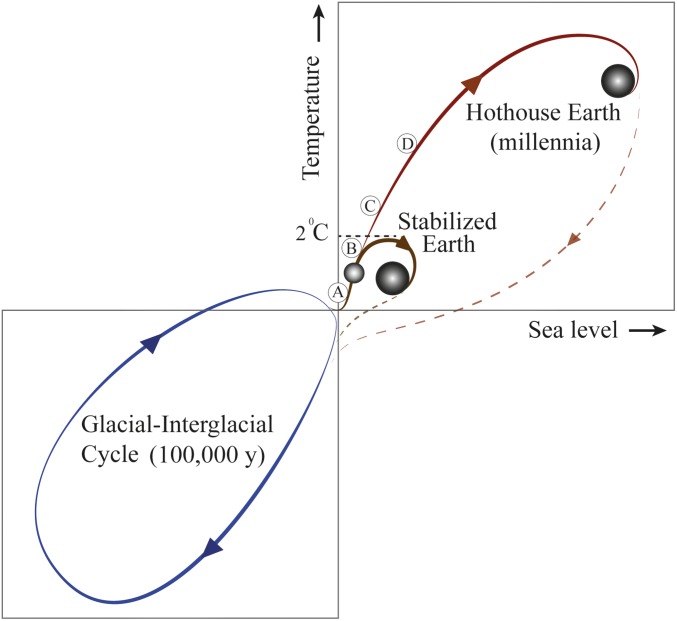
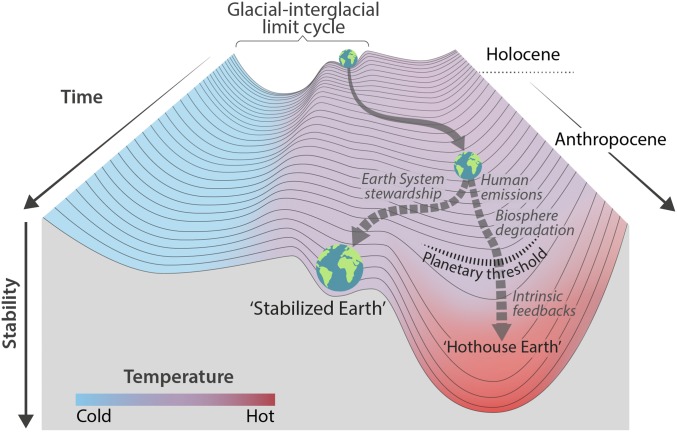
We explore the risk that self-reinforcing feedbacks could push the Earth System toward a planetary threshold that, if crossed, could prevent stabilization of the climate at intermediate temperature rises and cause continued warming on a “Hothouse Earth” pathway even as human emissions are reduced. Crossing the threshold would lead to a much higher global average temperature than any interglacial in the past 1.2 million years and to sea levels significantly higher than at any time in the Holocene. We examine the evidence that such a threshold might exist and where it might be. If the threshold is crossed, the resulting trajectory would likely cause serious disruptions to ecosystems, society, and economies. Collective human action is required to steer the Earth System away from a potential threshold and stabilize it in a habitable interglacial-like state. Such action entails stewardship of the entire Earth System—biosphere, climate, and societies—and could include decarbonization of the global economy, enhancement of biosphere carbon sinks, behavioral changes, technological innovations, new governance arrangements, and transformed social values.
Overview
The claims and statistics of this paper haven’t been checked yet.
Free: it reads the open-access text and checks the first 5 claims that cite a source we can check. Create a free account to check every claim.
Integrity signals
Registry
Cites
Statistics
Figures
Verification
Claims the paper makes
The claims and statistics of this paper haven’t been checked yet.
Free: it reads the open-access text and checks the first 5 claims that cite a source we can check. Create a free account to check every claim.
Claims other papers make about this one
Each is checked against this paper’s own text: does it say what the citing paper says it does?
The source backs part of the claim, not all of it — or backs it for a different population, condition or comparison.
In the citing paper
“Triggering positive feedback, uncontrolled emissions will lead to a major climate change that would durably lock the planet into a hot system where glaciers would go extinct(Steffen et al., 2018;McKay et al., 2022).”
From Future emergence of new ecosystems caused by glacial retreat (2023) · cites this paper as Steffen et al., 2018
Experimental — accuracy not yet measuredIn the citing paper
“Our journey into the future of cold regions shows that deglaciation over the 21 st century is expected to occur over 181,000 ± 55,000 to 372,000 ± 99,000 km 2 outside the Greenland and Antarctic ice sheets (Fig. 3) and may reach unprecedented levels in recent Earth's history”
From Future emergence of new ecosystems caused by glacial retreat (2023) · cites this paper as Steffen et al., 2018
In the citing paper
“yet it remains unknown whether human social dynamics will yield such responses”
From Stewardship of global collective behavior (2021) · cites this paper as [14]
In the citing paper
“Human collective dynamics are critical to the wellbeing of people and ecosystems in the present and will set the stage for how we face global challenges with impacts that will last centuries (14, 15, 64).”
From Stewardship of global collective behavior (2021) · cites this paper as [14]
Self-check
Percentages, sums and reported differences re-computed from the paper’s own numbers.
The self-check needs the paper’s full text.
Citations
Cites
(2014) · Cambridge University Press eBooks · doi:10.1017/cbo9781107415379 · Cited by 11,249
(2007) · Medical Entomology and Zoology · Cited by 9,612
Crutzen, P. J. (2002) · Nature · doi:10.1038/415023a · Cited by 4,788
Tipping elements in the Earth’s climate system
Lenton, T. M., Held, H., Kriegler, E., Hall, J. W., Lucht, W., Rahmstorf, S., & Schellnhuber, H. J. (2008) · Proceedings of the National Academy of Sciences · doi:10.1073/pnas.0705414105 · Cited by 3,982
Self-citationThe trajectory of the Anthropocene: The Great Acceleration
Steffen, W., Broadgate, W., Deutsch, L., Gaffney, O., & Ludwig, C. (2015) · The Anthropocene Review · doi:10.1177/2053019614564785 · Cited by 3,935
Self-citationGriscom, B. W., Adams, J., Ellis, P. W., Houghton, R. A., Lomax, G., Miteva, D. A., Schlesinger, W. H., Shoch, D., Siikamäki, J. V., Smith, P., et al. (2017) · Proceedings of the National Academy of Sciences · doi:10.1073/pnas.1710465114 · Cited by 3,481
Eight glacial cycles from an Antarctic ice core
members, E. C. (2004) · Nature · doi:10.1038/nature02599 · Cited by 2,415
The Anthropocene is functionally and stratigraphically distinct from the Holocene
Waters, C. N., Zalasiewicz, J., Summerhayes, C., Barnosky, A. D., Poirier, C., Gałuszka, A., Cearreta, A., Edgeworth, M., Ellis, E. C., Ellis, M., et al. (2016) · Science · doi:10.1126/science.aad2622 · Cited by 2,375
Self-citationContribution of Antarctica to past and future sea-level rise
DeConto, R. M., & Pollard, D. (2016) · Nature · doi:10.1038/nature17145 · Cited by 2,044
Research works printed but not linked: 3
- Stocker TF 2013 Technical summary Climate Change 2013: The Physical Science Basis. Contribution of Working Group I to the Fifth Assessment Report of the Intergovernmental Panel on Climate Change Stocker TF Cambridge Univ Press Cambridge, UK
- Ciais P 2013 Carbon and other biogeochemical cycles Climate Change 2013: The Physical Science Basis, Contribution of Working Group I to the Fifth Assessment Report of the Intergovernmental Panel on Climate Change Stocker TF Cambridge Univ Press Cambridge, UK 465 570
- Latorre C Wilmshurst J von Gunten L 2016 Climate change and cultural evolution PAGES (Past Global Changes) Magazine 24 1 32
Cited by
Items 501–600 of 1,000
Sensitivity of tropical monsoon precipitation to the latitude of stratospheric aerosol injections
Krishnamohan, K. S., & Bala, G. (2022) · Climate Dynamics · doi:10.1007/s00382-021-06121-z · Cited by 46
Ethics of Socially Disruptive Technologies: An Introduction
van de Poel, I., Frank, L. E., Hermann, J., Hopster, J. K. G., Lenzi, D., Nyholm, S. R., Taebi, B., & Ziliotti, E. (2023) · Open Book Publishers · doi:10.11647/obp.0366 · Cited by 65
International Relations in the Anthropocene: New Agendas, New Agencies and New Approaches
(2021) · Springer eBooks · doi:10.1007/978-3-030-53014-3 · Cited by 85
A New Ocean State After Nuclear War
Harrison, C. S., Rohr, T. W., DuVivier, A. K., Maroon, E. A., Bachman, S., Bardeen, C., Coupe, J., Garza, V., Heneghan, R., Lovenduski, N. S., et al. (2022) · AGU Advances · doi:10.1029/2021av000610 · Cited by 64
“…al., 2020), as in the asymmetry of the climate response to increasing then decreasing CO 2 , a temporal lag largely caused by the slow adjustment timescales of the ocean physical and biogeochemical state (Hofmann et al., 2019; Jeltsch-Thömmes et al., 2020; Steffen et al., 2018; Yang & Zhu, 2011).”
BackgroundSanson, A. V., Malca, K. P., Hoorn, J. L. V., & Burke, S. E. L. (2022) · Cambridge University Press eBooks · doi:10.1017/9781009118705 · Cited by 51
Li4SiO4 adsorbent derived from industrial biomass fly ash for high-temperature CO2 capture
Yang, Y., Chen, Z., Sun, X., Yao, S. H., Zhang, X., & Liu, W. (2022) · Fuel · doi:10.1016/j.fuel.2022.126853 · Cited by 49
Resilience Meets the Water–Energy–Food Nexus: Mapping the Research Landscape
Hogeboom, R. J., Borsje, B. W., Deribe, M. M., van der Meer, F. D., Mehvar, S., Meyer, M. A., Özerol, G., Hoekstra, A. Y., & Nelson, A. D. (2021) · Frontiers in Environmental Science · doi:10.3389/fenvs.2021.630395 · Cited by 64
“Both the negative environmental impacts and insecurity of water, energy and food supply are expected to worsen in the near future, driven by population growth, increasingly resourceintensive lifestyles and vulnerabilities to disruptive shocks including climate change (Hoekstra and Wiedmann, 2014; Steffen et al., 2018).”
BackgroundParticipatory collective farming as a leverage point for fostering human-nature connectedness
Pérez‐Ramírez, I., García‐Llorente, M., de la Portilla, C. S., Benito, A., & Castro, A. A. (2021) · Ecosystems and People · doi:10.1080/26395916.2021.1912185 · Cited by 54
“The structure and functioning of ecosystems have been exponentially modified by human activities during the last decades (Steffen et al. 2018).”
BackgroundFitzgerald, J. B. (2021) · Energy Research & Social Science · doi:10.1016/j.erss.2021.102385 · Cited by 55
Planetary Health: Safeguarding Human Health and the Environment in the Anthropocene
Haines, A., & Frumkin, H. (2021) · Cambridge University Press eBooks · doi:10.1017/9781108698054 · Cited by 65
Forest mosaics, not savanna corridors, dominated in Southeast Asia during the Last Glacial Maximum
Hamilton, R., Amano, N., Bradshaw, C. J. A., Saltré, F., Patalano, R., Penny, D., Stevenson, J., Wolfhagen, J., & Roberts, P. (2023) · Proceedings of the National Academy of Sciences · doi:10.1073/pnas.2311280120 · Cited by 55
“Savannization could disrupt patterns of biodiversity (17) and push the Earth system onto a new, self - reinforcing trajectory towards long - term hot and dry climates (18).”
Wang, R., Liu, L., Tao, Z., Wan, B., Wang, Y., Tang, X., Li, Y., & Li, X. (2024) · Journal of Environmental Management · doi:10.1016/j.jenvman.2023.119980 · Cited by 45
Kraak, V. I., & Aschemann‐Witzel, J. (2024) · Annual Review of Public Health · doi:10.1146/annurev-publhealth-060722-032021 · Cited by 64
Pathways of learning about biodiversity and sustainability in private urban gardens
Diduck, A. P., Raymond, C. M., Rodela, R., Moquin, R., & Boerchers, M. (2019) · Journal of Environmental Planning and Management · doi:10.1080/09640568.2019.1633288 · Cited by 50
“Land-cover change, loss of habitat and vegetation biomass, and other anthropogenic factors, and the self-reinforcing feedbacks among them, are contributing to reduced species, functional, structural and ecosystem diversity (e.g. Pickett et al. 2011; Seto, G€uneralp, and Hutyra 2012; Steffen et al. 2018).”
BackgroundMonios, J., & Wilmsmeier, G. (2020) · Maritime Policy & Management · doi:10.1080/03088839.2020.1752947 · Cited by 61
“See Stopford (2009) for an interesting discussion of the industry outcry that preceded this policy.”
BackgroundLeverage points to foster human–nature connectedness in cultural landscapes
Riechers, M., Duse, I. A., & Balázsi, Á. (2021) · AMBIO · doi:10.1007/s13280-021-01504-2 · Cited by 52
Reimagining international environmental law for the Anthropocene: An earth system law perspective
du Toit, L., & Kotze, L. J. (2022) · Earth System Governance · doi:10.1016/j.esg.2022.100132 · Cited by 66
“…(as an episteme, practice and discipline) with an earth system perspective, or with the understanding of the Earth as a complex system, consisting of interconnected and interacting components, which have the potential to transform in abrupt, nonlinear and irreversible ways (Steffen et al., 2018).”
Govigli, V. M., Rois-Díaz, M., den Herder, M., Bryce, R., Tuomasjukka, D., & Górriz‐Mifsud, E. (2022) · Environmental Policy and Governance · doi:10.1002/eet.2019 · Cited by 66
Psychological Distance to Science as a Predictor of Science Skepticism Across Domains
Većkalov, B., Zarzeczna, N., McPhetres, J., van Harreveld, F., & Rutjens, B. T. (2022) · Personality and Social Psychology Bulletin · doi:10.1177/01461672221118184 · Cited by 51
“…individual and environmental health, for example, when it leads to a lack of public support for action in the case of climate change (Gifford, 2011; Steffen et al., 2018; van der Linden et al., 2015) and insufficient vaccination rates (Betsch et al., 2010; Roozenbeek et al., 2020; van Panhuis et…”
BackgroundTowards a global sustainable development agenda built on social–ecological resilience
Scown, M., Craig, R. K., Allen, C. R., Gunderson, L., Angeler, D. G., García, J. H., & Garmestani, A. S. (2023) · Global Sustainability · doi:10.1017/sus.2023.8 · Cited by 51
International risk of food insecurity and mass mortality in a runaway global warming scenario
Richards, C. E., Gauch, H. L., & Allwood, J. M. (2023) · Futures · doi:10.1016/j.futures.2023.103173 · Cited by 57
Nitrogen addition delays the emergence of an aridity-induced threshold for plant biomass
Li, H., Terrer, C., Berdugo, M., Maestre, F. T., Zhu, Z., Peñuelas, J., Yu, K., Luo, L. G., Gong, J.-Y., & Ye, J. (2023) · National Science Review · doi:10.1093/nsr/nwad242 · Cited by 49
“Moreover, irreversible changes might occur once these thresholds are crossed, potentially causing widespread ecosystem degradation [ 4 , 9 , 10 ].”
Invoking indigenous wisdom for management learning
Pio, E., & Waddock, S. A. (2020) · Management Learning · doi:10.1177/1350507620963956 · Cited by 49
“…climate change, unsustainability, and species extinction sets limits to economic and material growth (Diaz et al., 2019; IPCC, 2018; Ripple et al., 2019; Scrutton, 2020; Steffen et al., 2018; WWF, 2018), with the world in dire trouble, even putting the human species at risk if things do not change.”
BackgroundHigh-temperature CO2 adsorption by one-step fabricated Nd-doped Li4SiO4 pellets
Yang, Y., Yao, S. H., Hu, Y., Sun, J., Li, Q., Li, Z., Zhou, S., & Liu, W. (2020) · Chemical Engineering Journal · doi:10.1016/j.cej.2020.128346 · Cited by 44
Comparative Life-Cycle Assessment of restoration and renovation of a traditional Danish farmer house
Serrano, T., Kampmann, T. H., & Ryberg, M. W. (2022) · Building and Environment · doi:10.1016/j.buildenv.2022.109174 · Cited by 52
Analysis of the Scale of Global Human Needs and Opportunities for Sustainable Catalytic Technologies
Taseska, T., Yu, W., Wilsey, M. K., Cox, C. P., Meng, Z., Ngarnim, S. S., & Müller, A. M. (2023) · Topics in Catalysis · doi:10.1007/s11244-023-01799-3 · Cited by 56
Climate change and resilience: Developmental science perspectives
Sanson, A. V., & Masten, A. S. (2023) · International Journal of Behavioral Development · doi:10.1177/01650254231186332 · Cited by 65
Dancing on the volcano: social exploration in times of discontent
Carpenter, S. R., Folke, C., Scheffer, M., & Westley, F. R. (2019) · Ecology and Society · doi:10.5751/es-10839-240123 · Cited by 54
Self-citationGasparin, M., Brown, S. D., Green, W., Hugill, A., Lilley, S., Quinn, M., Schınckus, C., Williams, M., & Zalasiewicz, J. (2020) · Academy of Management Learning and Education · doi:10.5465/amle.2019.0199 · Cited by 48
“The Anthropocene is defined by a new and dangerous climate state brought about through the dominance of a single species (Homo sapiens) breaking through the photosynthetic energy barrier, the human-directed evolution of other species and the increasing interaction of the biosphere with technology (e.g. Zalasiewicz et…”
BackgroundMoving toward a new era of ecosystem science
Yu, G., Piao, S. L., Zhang, Y., Liu, L., Peng, J., & Niu, S. (2021) · Geography and sustainability · doi:10.1016/j.geosus.2021.06.004 · Cited by 59
Adapting risk assessments for a complex future
Wassénius, E., & Crona, B. (2022) · One Earth · doi:10.1016/j.oneear.2021.12.004 · Cited by 60
La datation de l’entrée dans l’Anthropocène: Synthèse d’un débat à destination des enseignants
Wallenhorst, N. (2021) · Recherches & éducations · doi:10.4000/rechercheseducations.11539 · Cited by 50
Resilience Analysis Framework for a Water–Energy–Food Nexus System Under Climate Change
Ioannou, A. E., & Laspidou, C. (2022) · Frontiers in Environmental Science · doi:10.3389/fenvs.2022.820125 · Cited by 45
“Both environmental burden and lack of the combined WEF security are expected to deteriorate in the next decades, driven by overpopulation, increasingly resource-intensive lifestyles, and susceptibility to disturbances under climate change (Hoekstra and Wiedmann, 2014; Steffen et al., 2018).”
BackgroundResilience theory and coerced resilience in agriculture
Sundstrom, S. M., Angeler, D. G., & Allen, C. R. (2023) · Agricultural Systems · doi:10.1016/j.agsy.2023.103612 · Cited by 53
1991–2020 climate normal in the European Alps: focus on high-elevation environments
Nigrelli, G., & Chiarle, M. (2023) · Journal of Mountain Science · doi:10.1007/s11629-023-7951-7 · Cited by 63
“Yes, but this mainly depends on current anthropogenic emissions (Steffen et al. 2018).”
BackgroundTwo types of AI existential risk: decisive and accumulative
Kasirzadeh, A. (2025) · Philosophical Studies · doi:10.1007/s11098-025-02301-3 · Cited by 115
“The situation is compounded by AI systems that enable discriminatory profiling and unwarranted scrutiny of individuals.”
Captured Futures: Rethinking the Drama of Environmental Politics
Hajer, M. A., & Oomen, J. (2025) · doi:10.1093/9780198955382.001.0001 · Cited by 69
Range expansion of an already widespread bee under climate change
Dew, R. M., Silva, D. P., & Rehan, S. M. (2019) · Global Ecology and Conservation · doi:10.1016/j.gecco.2019.e00584 · Cited by 54
A perspective on the role of uncertainty in sustainability science and engineering
Diwekar, U. M., Amekudzi-Kennedy, A., Bakshi, B. R., Baumgartner, R. J., Boumans, R. M. J., Burger, P., Cabezas, H., Egler, M., Farley, J., Fath, B. D., et al. (2020) · Resources Conservation and Recycling · doi:10.1016/j.resconrec.2020.105140 · Cited by 47
“A recent article in PNAS (Steffen et al., 2018) argued that the "social”
Wabnitz, K. J. P., Galle, S., Hegge, L., Masztalerz, O., Schwienhorst-Stich, E., & Eichinger, M. (2021) · Bundesgesundheitsblatt - Gesundheitsforschung - Gesundheitsschutz · doi:10.1007/s00103-021-03289-x · Cited by 45
State of Climate Action 2021: Systems Transformations Required to Limit Global Warming to 1.5°C
Boehm, S., Lebling, K., Levin, K., Fekete, H., Jaeger, J., Waite, R., Nilsson, A. E., Thwaites, J., Wilson, R., Geiges, A., et al. (2021) · doi:10.46830/wrirpt.21.00048 · Cited by 74
Chistov, V., Carrillo‐Hermosilla, J., & Aramburu, N. (2023) · Journal of Open Innovation Technology Market and Complexity · doi:10.1016/j.joitmc.2023.100049 · Cited by 48
Shifting echo chambers in US climate policy networks
Jasny, L., Dewey, A. M., Robertson, A. G., Yagatich, W., Dubin, A. H., Waggle, J. M., & Fisher, D. R. (2018) · PLoS ONE · doi:10.1371/journal.pone.0203463 · Cited by 41
Metamorphic oxygen-evolving molecular Ru and Ir catalysts
Vereshchuk, N., Gil‐Sepulcre, M., Ghaderian, A., Holub, J., Gimbert‐Suriñach, C., & Llobet, A. (2022) · Chemical Society Reviews · doi:10.1039/d2cs00463a · Cited by 41
Resource nexus perspectives in the Blue Economy of India: The case of sand mining in Kerala
Matovu, B., Brouwer, F., Bleischwitz, R., Janabi, F. A., & Alkoyak-Yildiz, M. (2023) · Environmental Science & Policy · doi:10.1016/j.envsci.2023.103617 · Cited by 48
Evolution and prospects of Earth system models: Challenges and opportunities
Pan, X., Chen, D., Pan, B., Huang, X., Yang, K., Piao, S. L., Zhou, T., Dai, Y., Chen, F., & Li, X. (2024) · Earth-Science Reviews · doi:10.1016/j.earscirev.2024.104986 · Cited by 57
Bacterial nitrous oxide respiration: electron transport chains and copper transfer reactions.
Hein, S., & Simon, J. (2019) · Advances in Microbial Physiology · doi:10.1016/bs.ampbs.2019.07.001 · Cited by 31
The methane footprint of nations: Stylized facts from a global panel dataset
Fernández‐Amador, O., François, J., Oberdabernig, D. A., & Tomberger, P. (2019) · Ecological Economics · doi:10.1016/j.ecolecon.2019.106528 · Cited by 45
“This would gain time for technological breakthroughs or behavioral changes necessary for decarbonization, which may take many years—or decades—despite global efforts (Steffen et al., 2018).”
Long‐term projections of sea‐level rise from ice sheets
Golledge, N. R. (2020) · Wiley Interdisciplinary Reviews Climate Change · doi:10.1002/wcc.634 · Cited by 49
“The environmental drivers and systemic feedbacks described above may under certain circumstances give rise to thresholds or tipping points in the ice sheet and sea level system beyond which more rapid and potentially irreversible changes may take place (Steffen et al., 2018; Z. A. Thomas, 2016).”
BackgroundWoldeyohannes, A. B., Accotto, C., Desta, E. A., Gebrehawaryat, Y., Fadda, C., Pè, M. E., & Dell’Acqua, M. (2020) · Agriculture Ecosystems & Environment · doi:10.1016/j.agee.2020.107020 · Cited by 51
Yokohata, T., Saitô, K., Ito, A., Ohno, H., Tanaka, K., Hajima, T., & Iwahana, G. (2020) · Progress in Earth and Planetary Science · doi:10.1186/s40645-020-00366-8 · Cited by 49
“…from permafrost thawing is very likely to accelerate changes in the climate system (Schaefer et al. 2014; Koven et al. 2015; MacDougall et al. 2015; Schneider von Deimling et al. 2015; MacDougall and Knutti 2016; Steffen et al. 2018; Gasser et al. 2018; McGuire et al. 2018; Kawamiya et al. 2020).”
BackgroundFraming and Context of the Report
(IPCC), I. P. O. C. C. (2022) · Cambridge University Press eBooks · doi:10.1017/9781009157964.003 · Cited by 61
Retranslating Resilience Theory in Archaeology
Løvschal, M. (2022) · Annual Review of Anthropology · doi:10.1146/annurev-anthro-041320-011705 · Cited by 46
Global city densities: Re-examining urban scaling theory
Burger, J. R., Okie, J. G., Hatton, I. A., Weinberger, V. P., Shrestha, M., Liedtke, K. J., Be, T., Cruz, A. R., Feng, X., Hinojo‐Hinojo, C., et al. (2022) · Frontiers in Conservation Science · doi:10.3389/fcosc.2022.879934 · Cited by 46
“, 2015) that are so tightly related to the uncertainties behind the global change and the future Anthropocene era scenarios and our survival as species (Barnosky et al., 2012; Steffen et al., 2018).”
Impacts of Urban Blue-Green Space on Residents’ Health: A Bibliometric Review
Wang, K., Sun, Z., Cai, M., Liu, L., Wu, H., & Peng, Z. (2022) · International Journal of Environmental Research and Public Health · doi:10.3390/ijerph192316192 · Cited by 50
“As the main places of human habitation, cities are the bridge between energy, climate, and mankind, and are one of the most important forms of land use and land cover (LULC) change on the world’s surface [1].”
BackgroundMahalik, M. K., Pal, S., Le, T., & Mishra, S. (2023) · Environmental Science and Pollution Research · doi:10.1007/s11356-023-31134-y · Cited by 49
“Preserving the environment has taken on paramount importance, akin to safeguarding our own survival, as the degradation of our surroundings to a critical point could ultimately lead to the extinction of humanity (Steffen et al. 2018).”
Norton, C., & Hulme, M. (2019) · Geoforum · doi:10.1016/j.geoforum.2019.01.017 · Cited by 67
Climate change: Disruption, risk and opportunity
Woodward, A. J. (2019) · Global Transitions · doi:10.1016/j.glt.2019.02.001 · Cited by 43
Odontocete Adaptations to Human Impact and Vice Versa
Bearzi, G., Piwetz, S., & Reeves, R. R. (2019) · Ethology and behavioral ecology of marine mammals · doi:10.1007/978-3-030-16663-2_10 · Cited by 45
Zeng, T., Mlonka-Mędrala, A., Lenz, V., & Nelles, M. (2019) · Biomass Conversion and Biorefinery · doi:10.1007/s13399-019-00494-2 · Cited by 41
Oppermann, E., Walker, G. P., & Brearley, M. B. (2019) · Geoforum · doi:10.1016/j.geoforum.2019.09.012 · Cited by 49
Energy Accounting for a Renewable Energy Future
Moriarty, P., & Honnery, D. (2019) · Energies · doi:10.3390/en12224280 · Cited by 41
“[17] adopted a figure of 350 ppm for CO2 in the atmosphere as the safe ‘planetary boundary’.”
BackgroundThe business of rapid transition
Newell, P. J. (2020) · Wiley Interdisciplinary Reviews Climate Change · doi:10.1002/wcc.670 · Cited by 49
“What has driven this change is an acknowledgement that we are now in a climate emergency, as the IPCC SR15 (2018) and many other scientific studies have highlighted (Steffen et al., 2018).”
BackgroundTURNEY, C. S. M., Becerra‐Valdivia, L., Sookdeo, A., Thomas, Z., Palmer, J., Haines, H. A., Cadd, H., Wacker, L., Baker, A., Andersen, M. S., et al. (2021) · Radiocarbon · doi:10.1017/rdc.2021.23 · Cited by 43
“As the planet faces unprecedented rates of global environmental and societal change in the Anthropocene, there is an urgent need to improve our understanding of the Earth System (Lewis and Maslin 2015; Steffen et al. 2015, 2018).”
BackgroundDynamical landscape and multistability of a climate model
Margazoglou, G., Grafke, T., Laio, A., & Lucarini, V. (2021) · Proceedings of the Royal Society A Mathematical Physical and Engineering Sciences · doi:10.1098/rspa.2021.0019 · Cited by 70
Applications of large deviation theory in geophysical fluid dynamics and climate science
Gálfi, V. M., Lucarini, V., Ragone, F., & Wouters, J. (2021) · Rivista Del Nuovo Cimento · doi:10.1007/s40766-021-00020-z · Cited by 52
Ten new insights in climate science 2021: a horizon scan
Martin, M. A., Alcaraz, O., Bastos, A., Bauer, N., Bertram, C., Blenckner, T., Bowen, K., Brando, P. M., Rudolph, T. B., Büchs, M., et al. (2021) · Global Sustainability · doi:10.1017/sus.2021.25 · Cited by 53
“…layer of risk has emerged: Interactions among tipping elements can produce cascading non-linear transitions, that is, one tipping event actually leading to the tipping of another element (Brovkin et al., 2021; Lenton et al., 2019; Rocha et al., 2018; Steffen et al., 2018; Thomas et al., 2020).”
Self-citationSteffen, W., & Morgan, J. (2021) · Globalizations · doi:10.1080/14747731.2021.1940070 · Cited by 49
“(Steffen et al., 2018, p. 3).”
Self-citationThe Human Ecology of Overshoot: Why a Major ‘Population Correction’ Is Inevitable
Rees, W. E. (2023) · World · doi:10.3390/world4030032 · Cited by 53
Automatically discovering ordinary differential equations from data with sparse regression
Egan, K., Li, W., & Carvalho, R. (2024) · Communications Physics · doi:10.1038/s42005-023-01516-2 · Cited by 62
Identifying regime shifts, transients and late warning signals for proactive ecosystem management
Sardanyés, J., Ivančić, F., & Vidiella, B. (2024) · Biological Conservation · doi:10.1016/j.biocon.2023.110433 · Cited by 49
The moral geography of the Earth system
Schmidt, J. J. (2019) · Transactions of the Institute of British Geographers · doi:10.1111/tran.12308 · Cited by 45
“Beyond its stark warning, the argument of Steffen et al. (2018) shifts sustainability along three areas of concern to moral geography (cf. Smith, 1997): First, it describes practices that have moral dimensions because they lead to harms or goods.”
BackgroundMethodShrestha, P., Ouellette, D., Lee, J., Ge, N., Wong, A. K. C., Muirhead, D., Liu, H., Banerjee, R., & Bazylak, A. (2019) · Advanced Materials Interfaces · doi:10.1002/admi.201901157 · Cited by 40
Substantial understory contribution to the C sink of a European temperate mountain forest landscape
Dirnböck, T., Kraus, D., Grote, R., Klatt, S., Kobler, J., Schindlbacher, A., Seidl, R., Thom, D., & Kiese, R. (2020) · Landscape Ecology · doi:10.1007/s10980-019-00960-2 · Cited by 43
Spectral Irradiance Influence on Solar Cells Efficiency
Leitão, D., Torres, J. P. N., & Fernandes, J. F. P. (2020) · Energies · doi:10.3390/en13195017 · Cited by 39
“The quest to satisfy the demand for energy is one of the main causes of global warming which is increasing the amount of gases in the atmosphere [1], and therefore causing a significant environmental impact, unbalancing the ecosystems, and affecting human activity in their lifestyle and economically [2].”
BackgroundBeyond continuationism: climate change, economic growth, and the future of world (dis)order
Albert, M. J. (2020) · Cambridge Review of International Affairs · doi:10.1080/09557571.2020.1825334 · Cited by 52
“However, given the likely conservatism of IPCC projections, which do not consider positive carbon-cycle feedbacks (Steffen et al. 2018), there is good reason to be sceptical that 3-4 percent annual decarbonisation would be sufficient to meet even the 2 C target.”
BackgroundInfluentialCunillera‐Montcusí, D., Borthagaray, A. I., Boix, D., Gascón, S., Sala, J., Tornero, I., Quintana, X. D., & Arim, M. (2021) · Ecography · doi:10.1111/ecog.05347 · Cited by 43
Boakye, A., Yu, K., Asinyo, B. K., Chai, H., Raza, T., Xu, T., Zhang, G., & Qu, L. (2022) · Langmuir · doi:10.1021/acs.langmuir.2c01908 · Cited by 39
Sevenfold variation in global feeding capacity depends on diets, land use and nitrogen management
Chatzimpiros, P., & Harchaoui, S. (2023) · Nature Food · doi:10.1038/s43016-023-00741-w · Cited by 48
Climate extremes and conflict dynamics
Scheffran, J. (2019) · Elsevier eBooks · doi:10.1016/b978-0-12-814895-2.00016-1 · Cited by 52
Analysing corporate forest disclosure: How does business value biodiversity?
Anthony, S., & Morrison‐Saunders, A. (2022) · Business Strategy and the Environment · doi:10.1002/bse.3164 · Cited by 38
Characteristics of Transformational Adaptation in Climate-Land-Society Interactions
Warner, K., Zommers, Z. A., Wreford, A., Hurlbert, M., Viner, D., Scantlan, J., Halsey, K., Halsey, K., & Tamang, C. (2019) · Sustainability · doi:10.3390/su11020356 · Cited by 48
“At 2 ◦C the Earth may irreversibly enter a “hothouse Earth pathway” [1].”
BackgroundRhodes, C. J. (2019) · Science Progress · doi:10.1177/0036850418823397 · Cited by 49
Rossi, S., Isla, E., Bosch‐Belmar, M., Galli, G., Gori, A., Gristina, M., Ingrosso, G., Milisenda, G., Piraino, S., Rizzo, L., et al. (2019) · ICES Journal of Marine Science · doi:10.1093/icesjms/fsz147 · Cited by 45
McIntosh, M. M., Holechek, J. L., Spiegal, S. A., Cibils, A. F., & Estell, R. E. (2019) · Rangeland Ecology & Management · doi:10.1016/j.rama.2019.06.002 · Cited by 42
“By 2040 this will put the global temperature increase at the 1.5 C threshold, above which there is high risk of climatic catastrophe (USGCRP, 2017, 2018; IPCC, 2018; Steffen et al., 2018).”
BackgroundInfluentialLearning from generations of sustainability concepts
Downing, A. S., Chang, M., Kuiper, J. J., Campennì, M., Häyhä, T., Cornell, S., Svedin, U., & Mooij, W. M. (2020) · Environmental Research Letters · doi:10.1088/1748-9326/ab7766 · Cited by 38
Self-citationModel improvement and future projection of permafrost processes in a global land surface model
Yokohata, T., Saitô, K., Takata, K., Nitta, T., Satoh, Y., Hajima, T., Sueyoshi, T., & Iwahana, G. (2020) · Progress in Earth and Planetary Science · doi:10.1186/s40645-020-00380-w · Cited by 38
“The six physical properties of soil (volumetric specific heat, thermal conductivity, porosity, saturated matrix potential, saturated hydraulic conductivity, void size distribution index) are then set according to the soil type (Takata et al. 2003; Saito 2011).”
BackgroundMethodTavory, I., & Wagner-Pacifici, R. (2021) · Poetics · doi:10.1016/j.poetic.2021.101600 · Cited by 32
Asayama, S., Sugiyama, M., Ishii, A., & Kosugi, T. (2019) · The Anthropocene Review · doi:10.1177/2053019619843678 · Cited by 41
Climate Reporting Related to the TCFD Framework: An Exploration of the Air Transport Sector
David, B., & Giordano-Spring, S. (2021) · Social and Environmental Accountability Journal · doi:10.1080/0969160x.2021.2007784 · Cited by 48
“‘This requires that humans take deliberate, integral, and adaptive steps to reduce dangerous impacts on the Earth System, effectively monitoring and changing behaviour to form feedback loops that stabilize this intermediate state’ (Steffen et al. 2018, 8256).”
BackgroundLong-term microclimate study of a peatland in Central Europe to understand microrefugia
Słowińska, S., Słowiński, M., Marcisz, K., & Lamentowicz, M. (2022) · International Journal of Biometeorology · doi:10.1007/s00484-022-02240-2 · Cited by 41
“The trajectory of the earth system is currently changing as a result of dramatic human-driven climate changes (Steffen et al. 2018).”
BackgroundPartner or perish: tree microbiomes and climate change
Addison, S. L., Rúa, M. A., Smaill, S. J., Singh, B. K., & Wakelin, S. A. (2024) · Trends in Plant Science · doi:10.1016/j.tplants.2024.03.008 · Cited by 35
Extreme Sensitivity and Climate Tipping Points
Ashwin, P., & von der Heydt, A. S. (2019) · Journal of Statistical Physics · doi:10.1007/s10955-019-02425-x · Cited by 39
“Abrupt climate shifts have occurred in the past climate system and therefore seem likely to occur in the future for a variety of reasons [27,35].”
BackgroundRinscheid, A., Pianta, S., & Weber, E. U. (2019) · Climate Policy · doi:10.1080/14693062.2019.1677550 · Cited by 43
“Introduction To mitigate the effects of anthropogenic climate change, rapid and comprehensive mitigation measures are required (IPCC, 2018; Rockström et al., 2017; Steffen et al., 2018).”
Backgroundvan der Heide, T., Angelini, C., de Fouw, J., & Eklöf, J. (2020) · Ecology and Evolution · doi:10.1002/ece3.7044 · Cited by 41
“Since the Industrial Revolution, humans have been altering environmental conditions at an unprecedented pace and scale (Kareiva et al., 2007; Steffen et al., 2018).”
BackgroundLonger days enable higher diurnal activity for migratory birds
Pokrovsky, I. G., Kölzsch, A., Sherub, S., Fiedler, W., Глазов, П. М., Kulikova, O., Wikelski, M. C., & Flack, A. (2021) · Journal of Animal Ecology · doi:10.1111/1365-2656.13484 · Cited by 37
Characterizing and predicting person-specific, day-to-day, fluctuations in walking behavior
Chevance, G., Baretta, D., Heino, M. T. J., Perski, O., Olthof, M., Klasnja, P., Hekler, E. B., & Godino, J. (2021) · PLoS ONE · doi:10.1371/journal.pone.0251659 · Cited by 48
“Numerous examples of sudden gains and losses in complex systems exist in the literature, from asthma attacks [25], shifts in motivational flow [26], improvements or aggravations of symptoms in individuals with depression, mood and/or anxiety disorders [27], and, at a broader level, forms of societal collapse [28] or c…”
BackgroundGeoethics to Start Up a Pedagogical and Political Path towards Future Sustainable Societies
Peppoloni, S., & Capua, G. D. (2021) · Sustainability · doi:10.3390/su131810024 · Cited by 50
Souza, R. J. D., Casisi, M., Micheli, D., & Reini, M. (2021) · Energies · doi:10.3390/en14175338 · Cited by 45
“There is plenty of evidence regarding climate change effects all around the world as for temperature deviations [8], impacts on sea and land ecosystems [9,10], and unusual rainy seasons [11].”
BackgroundFoster, N. M., Ison, R. L., Blackmore, C., & Collins, K. (2019) · Policy Studies · doi:10.1080/01442872.2019.1618816 · Cited by 42
“Whether this is enough in the Anthropocene is, of course, the question.”
BackgroundInfluential
Metadata
- Authors
- Steffen, W., Rockström, J., Richardson, K., Lenton, T. M., Folke, C., Liverman, D., Summerhayes, C. P., Barnosky, A. D., Cornell, S. E., Crucifix, M., Donges, J. F., Fetzer, I., Lade, S. J., Scheffer, M., Winkelmann, R., & Schellnhuber, H. J.
- Affiliations
- Australian National University (AU)
- Stockholm Resilience Centre (SE)
- University of Copenhagen (DK)
- University of Exeter (GB)
- Royal Swedish Academy of Sciences (SE)
- University of Arizona (US)
- University of Cambridge (GB)
- Stanford University (US)
- Fund for Scientific Research (BE)
- Wageningen University & Research (NL)
- University of Potsdam (DE)
- Corresponding author
- Steffen, Will
- ORCID
- Venue
- Proceedings of the National Academy of Sciences
- Publisher
- National Academy of Sciences
- Published
- 2018-08-06
- Volume
- 115
- Issue
- 33
- Pages
- 8252-8259
- ISSN
- 0027-8424 (ISSN-L)
- 1091-6490
- PMC
- PMC6099852
- OpenAlex
- W2886281704
- Cited by
- 3,139
- References
- 92
- Citations by year
- 2026: 185 · 2025: 279 · 2024: 346 · 2023: 414 · 2022: 450 · 2021: 596 · 2020: 446 · 2019: 360 · 2018: 56
- FWCI
- 213.48
- Type
- journal article
- Language
- en
- Open access
- hybrid
- doi.org
- Licence
- Locations
- Proceedings of the National Academy of Sciences (publishedVersion, cc-by-nc-nd)
- Europe PMC (PubMed Central) (publishedVersion, cc-by-nc-nd)
- PubMed Central (publishedVersion, cc-by-nc-nd)
- Research at the University of Copenhagen (University of Copenhagen) (publishedVersion, other-oa)
- PubMed (publishedVersion)
- Open Research Exeter (University of Exeter) (publishedVersion, cc-by-nc-nd)
- Socio-Environmental Systems Modeling (acceptedVersion, cc-by-nc-nd)
- Digital Access to Libraries (submittedVersion, other-oa)
- Figshare (submittedVersion)
- publish.UP (University of Potsdam) (submittedVersion, cc-by-nc-nd)
- RENATE (submittedVersion, cc-by-nc-nd)
- ANU Open Research (Australian National University) (submittedVersion, cc-by-nc-nd)
- Publication Database PIK (Potsdam Institute for Climate Impact Research (PIK)) (submittedVersion)
- Data Archiving and Networked Services (DANS) (submittedVersion, cc-by-nc-nd)
- RENATE
- Funders
- National Science Foundation (1243125)
- Familjen Erling-Perssons Stiftelse
- European Commission (743080)
- Svenska Forskningsrådet Formas (2012-742, 2014-589)
- Vetenskapsrådet
- Earth League
- Stordalen Foundation
- Leibniz-Gemeinschaft
- Topics
- Physical Sciences › Environmental Science › Global and Planetary Change › Climate variability and models
- Physical Sciences › Environmental Science › Global and Planetary Change › Earth Systems and Cosmic Evolution
- Physical Sciences › Environmental Science › Global and Planetary Change › Ecosystem dynamics and resilience
- Keywords
- Hothouse Earth, self-reinforcing feedback, climate stabilization, global warming, sea level rise, decarbonization, carbon sink, Anthropocene, climate tipping points
About these checks
Registry, retraction, Cites and statistics results are computed, not judged, with one exception: a printed reference that no index lists is read once by a model before it counts as a citation error. Claims are extracted by a model and kept only when their quote appears verbatim in the text; each cited source is then checked, with a model’s help, for whether it says what the claim relies on. Those verdicts can be wrong — read the claim’s quote and the cited source before relying on one.
Statistics and arithmetic are recomputed, not judged.
Confidence bands are shown only for fields calibrated on our annotated test set. None is calibrated yet, so no band is shown.
What counts as a claim ›How we measure confidence ›How we check this ›
Are you an author, or do you see a problem with this page? Request a review
Data sources
Bibliographic data: Semantic Scholar, OpenAlex, Crossref.
Contains information from the Semantic Scholar Academic Graph Datasets, made available under the ODC Attribution License (ODC-BY 1.0).
Semantic Scholar’s data is described in: Kinney, R., et al. (2023). The Semantic Scholar Open Data Platform. arXiv:2301.10140.
