

Anthropogenic drivers of 2013–2017 trends in summer surface ozone in China
Open accessThe DOI matches its Crossref record; 45 of the 45 references it cites were found in a registry or an index.
Abstract
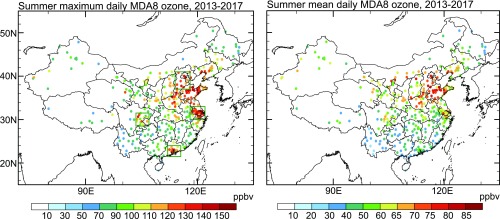
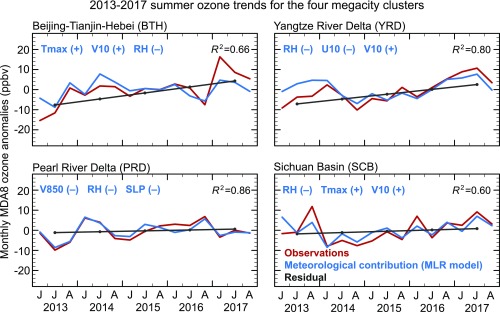
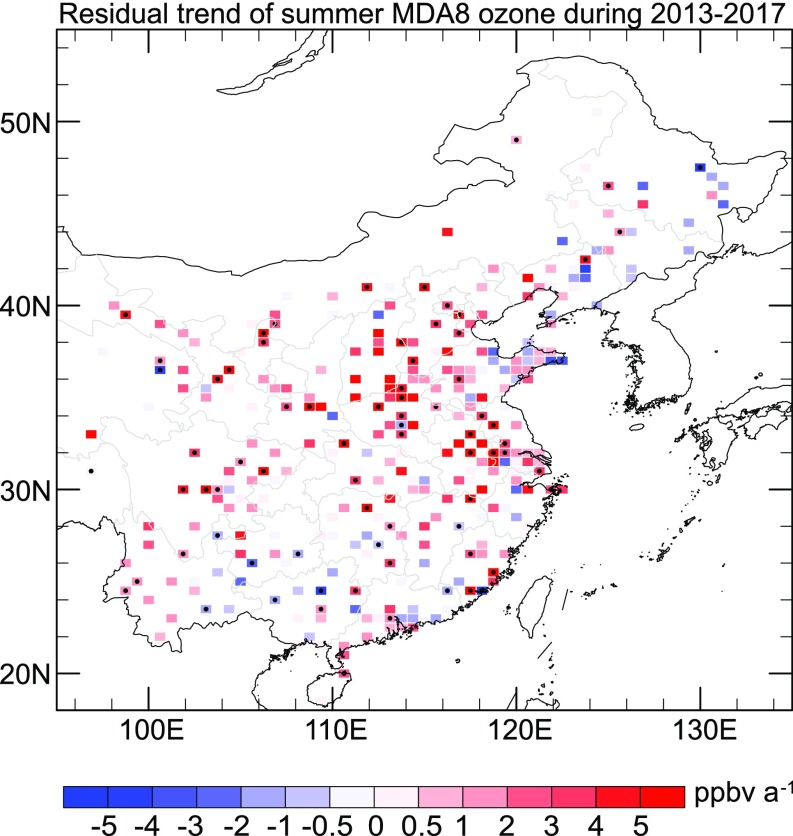
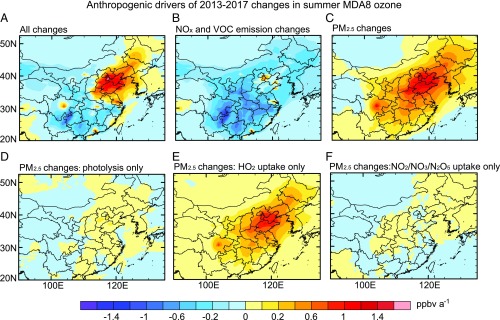
Significance: Drastic air pollution control in China since 2013 has achieved sharp decreases in fine particulate matter (PM 2.5 ), but ozone pollution has not improved. After removing the effect of meteorological variability, we find that surface ozone has increased in megacity clusters of China, notably Beijing and Shanghai. The increasing trend cannot be simply explained by changes in anthropogenic precursor [NO x and volatile organic compound (VOC)] emissions, particularly in North China Plain (NCP). The most important cause of the increasing ozone in NCP appears to be the decrease in PM 2.5 , slowing down the sink of hydroperoxy radicals and thus speeding up ozone production. Decreasing ozone in the future will require a combination of NO x and VOC emission controls to overcome the effect of decreasing PM 2.5 .
Overview
The claims and statistics of this paper haven’t been checked yet.
Free: it reads the open-access text and checks the first 5 claims that cite a source we can check. Create a free account to check every claim.
Integrity signals
Registry
Cites
Statistics
Figures
Verification
Claims the paper makes
The claims and statistics of this paper haven’t been checked yet.
Free: it reads the open-access text and checks the first 5 claims that cite a source we can check. Create a free account to check every claim.
Claims other papers make about this one
Each is checked against this paper’s own text: does it say what the citing paper says it does?
The cited source doesn’t support the claim as written.
In the citing paper
“a recent analysis of ground-level ozone concentrations measured at nearly 1,000 sites across China also found an increasing trend of summertime ozone in northeastern China from 2013 to 2017 (6).”
From Ozone pollution: A Major health hazard worldwide (2019) · cites this paper as [6]
Checked by a reasoning model — may be wrong.
Experimental — accuracy not yet measuredThe source backs part of the claim, not all of it — or backs it for a different population, condition or comparison.
In the citing paper
“Simulations with numerical models show several possible reasons including increases in UV radiation [31, 33–39], shifts in the VOC/NOx chemical regime resulting in increased production of O3 efficiency [35, 40], higher emissions of biogenic VOC due to rising temperatures [30], and decreased competition for gas-phase radicals by aerosol surfaces [34, 40], with reality likely being a combination of”
From Changes in tropospheric air quality related to the protection of stratospheric ozone in a changing climate (2023) · cites this paper as [34]
Experimental — accuracy not yet measuredThe source backs part of the claim, not all of it — or backs it for a different population, condition or comparison.
In the citing paper
“This increase was attributed to changes in anthropogenic emissions of ozone precursors as well as reductions in PM2.5 concentrations as described earlier.”
From Ozone pollution: A Major health hazard worldwide (2019) · cites this paper as [6]
Experimental — accuracy not yet measuredThe source backs part of the claim, not all of it — or backs it for a different population, condition or comparison.
In the citing paper
“anthropogenic emissions of NOx have decreased substantially in most urban areas of China (a 21% nationwide reduction) from 2013 to 2017 (6).”
From Ozone pollution: A Major health hazard worldwide (2019) · cites this paper as [6]
Experimental — accuracy not yet measuredThe cited source says what the claim attributes to it.
In the citing paper
“A recent study showed that a 40% reduction in PM2.5 from 2013 to 2017 in the North China Plain was partly responsible for an increasing ozone trend (at 1–3 ppb per year) during the period of 2013–2017 observed in megacity clusters of eastern China (6).”
From Ozone pollution: A Major health hazard worldwide (2019) · cites this paper as [6]
2 more claims about this paper
Create a free account to see every claim other papers make about this one.
Self-check
Percentages, sums and reported differences re-computed from the paper’s own numbers.
The self-check needs the paper’s full text.
Citations
Cites
Modern Applied Statistics with S
Venables, W. N., & Ripley, B. D. (2002) · Statistics and Computing · doi:10.1007/978-0-387-21706-2 · Cited by 24,305
The Modern-Era Retrospective Analysis for Research and Applications, Version 2 (MERRA-2)
Gelaro, R., McCarty, W., Suárez, M. J., Todling, R., Molod, A., Takacs, L., Randles, C. A., Darmenov, A., Bosilovich, M. G., Reichle, R., et al. (2017) · Journal of Climate · doi:10.1175/jcli-d-16-0758.1 · Cited by 9,010 · cited 2×
“Meteorological data from the NASA MERRA-2 reanalysis (23) with 0.”
MethodTrends in China's anthropogenic emissions since 2010 as the consequence of clean air actions
Zheng, B., Tong, D., Li, M., Liu, F., Hong, C., Geng, G., Li, H., Li, X., Peng, L., Qi, J., et al. (2018) · Atmospheric Chemistry and Physics · doi:10.5194/acp-18-14095-2018 · Cited by 2,916 · cited 9×
“The MEIC emission inventory is developed and managed by researchers at Tsinghua University.”
BackgroundMethodInfluentialSelf-citationModern Applied Statistics with S,
Kemp, F. (2003) · Journal of the Royal Statistical Society: Series D (The Statistician) · doi:10.1046/j.1467-9884.2003.t01-19-00383_22.x · Cited by 2,320
Effect of climate change on air quality
Jacob, D. J., & Winner, D. A. (2009) · Atmospheric Environment · doi:10.1016/j.atmosenv.2008.09.051 · Cited by 1,979 · cited 1×
“These variables are frequently observed to be correlated with ozone air quality (24) and can be viewed as general indicators of stagnation.”
BackgroundSelf-citationWang, T., Xue, L., Brimblecombe, P., Lam, Y. F., Li, L., & Zhang, L. (2017) · Science of The Total Environment · doi:10.1016/j.scitotenv.2016.10.081 · Cited by 1,876 · cited 5×
“A number of previous studies have examined meteorological influences on ozone variability in China (4, 9, 39, 40), On the basis of these studies we considered the correlation of MDA8 ozone across China with a large number of candidate meteorological variables from the MERRA-2 archive (SI Appendix, Table S3 and Fig.”
BackgroundInfluentialLi, M., Zhang, Q., Kurokawa, J.-I., Woo, J.-H., He, K., Lu, Z., Ohara, T., Song, Y., Streets, D. G., Carmichael, G. R., et al. (2017) · Atmospheric Chemistry and Physics · doi:10.5194/acp-17-935-2017 · Cited by 1,616
Self-citationHeterogeneous chemistry and tropospheric ozone
Jacob, D. (2000) · Atmospheric Environment · doi:10.1016/s1352-2310(99)00462-8 · Cited by 1,289 · cited 3×
“The relevant aerosol chemistry involves reactive uptake of the gaseous precursors to ozone formation, as described in GEOS-Chem by firstorder reactive uptake coefficients γ (32).”
BackgroundMethodInfluentialSelf-citationTai, A. P. K., Mickley, L. J., & Jacob, D. J. (2010) · Atmospheric Environment · doi:10.1016/j.atmosenv.2010.06.060 · Cited by 1,048
Self-citationSevere Surface Ozone Pollution in China: A Global Perspective
Lu, X., Hong, J., Zhang, L., Cooper, O. R., Schultz, M. G., Xu, X., Wang, T., Gao, M., Zhao, Y., & Zhang, Y. (2018) · Environmental Science & Technology Letters · doi:10.1021/acs.estlett.8b00366 · Cited by 1,040 · cited 1×
“5) concentration has decreased significantly since then, but ozone pollution has not decreased and is seemingly getting worse (8, 16).”
Background
Cited by
Items 501–600 of 1,003
Dai, H., Liao, H., Wang, Y., & Qian, J. (2024) · The Science of The Total Environment · doi:10.1016/j.scitotenv.2024.171687 · Cited by 34
Self-citationLarge potential of strengthening the land carbon sink in China through anthropogenic interventions
Yue, X., Zhou, H., Cao, Y., Liao, H., Lu, X., Yu, Z., Yuan, W., Liu, Z., Lei, Y., Sitch, S. A., et al. (2024) · Science Bulletin · doi:10.1016/j.scib.2024.05.037 · Cited by 35
Self-citationZhang, L., Lin, M., Langford, A. O., Horowitz, L. W., Senff, C. J., Klovenski, E., Wang, Y., Alvarez, R. J., Petropavlovskikh, I. V., Cullis, P., et al. (2020) · Atmospheric chemistry and physics · doi:10.5194/acp-20-10379-2020 · Cited by 33
Wei, W., Zang, J., Wang, X., & Cheng, S. (2020) · Atmospheric Research · doi:10.1016/j.atmosres.2020.105106 · Cited by 32
Synoptic weather and surface ozone concentration in South Korea
Kim, H. C., Lee, D., Ngan, F., Kim, B.-U., Kim, S., Bae, C., & Yoon, J. (2020) · Atmospheric Environment · doi:10.1016/j.atmosenv.2020.117985 · Cited by 34
Taiwan ozone trend in response to reduced domestic precursors and perennial transboundary influence
Chen, S., Liu, W.-T., Hsieh, H., & Wang, J. (2021) · Environmental Pollution · doi:10.1016/j.envpol.2021.117883 · Cited by 35
Tropospheric Ozone in Tehran, Iran, during the last 20 years
Borhani, F., Motlagh, M. S., Stohl, A., Rashidi, Y., & Ehsani, A. H. (2021) · Environmental Geochemistry and Health · doi:10.1007/s10653-021-01117-4 · Cited by 36
Han, Y., Zhao, W., & Pereira, P. A. D. S. (2021) · Environmental Research · doi:10.1016/j.envres.2021.112249 · Cited by 36
Significant contribution of lightning NOx to summertime surface O3 on the Tibetan Plateau
Li, M., Mao, J., Chen, S., Bian, J., Bai, Z., Wang, X., Chen, W., & Yu, P. (2022) · The Science of The Total Environment · doi:10.1016/j.scitotenv.2022.154639 · Cited by 32
Yin, H., Sun, Y., Notholt, J., Palm, M., & Liu, C. (2022) · Atmospheric chemistry and physics · doi:10.5194/acp-22-4167-2022 · Cited by 36
Zou, C., Cao, T., Li, M., Song, J., Jiang, B., Jia, W., Li, J., Ding, X., Yu, Z., Zhang, G., et al. (2023) · Atmospheric chemistry and physics · doi:10.5194/acp-23-963-2023 · Cited by 32
Zheng, Z., Li, K., Xu, B., Dou, J., Li, L., Zhang, G., Li, S., Geng, C., Yang, W., Azzi, M., et al. (2023) · Atmospheric chemistry and physics · doi:10.5194/acp-23-2649-2023 · Cited by 30
“D box model (implemented with different gas-phase chemical mechanisms) with diversified patterns of timescale in many places in China The observational period in most previous studies was short term (i.e., less than one month), while medium-term (i.e., from one to 3 3 China, limiting the present understanding of O –pre…”
InfluentialSelf-citationMa, D., Wang, T., Wu, H., Qu, Y., Liu, J., Liu, J. J., Li, S., Zhuang, B., Li, M., & Xie, M. (2023) · Atmospheric chemistry and physics · doi:10.5194/acp-23-6525-2023 · Cited by 32
“As it is vital to air quality and climate change, tropospheric O 3 has received extensive attention over the past decades (Duan et al., 2017; Li et al., 2019; Ashmore and Bell, 1991; Lu et al., 2018).”
BackgroundNi, J., Jin, J., Wang, Y., Li, B., Wu, Q., Chen, Y., Du, S., Li, Y., & He, C. (2023) · Geography and sustainability · doi:10.1016/j.geosus.2023.09.008 · Cited by 31
Chen, M., Liu, J., Chu, B., Zhao, D., Li, R., Chen, T., Ma, Q., Wang, Y., Zhang, P., Li, H., et al. (2025) · Environment International · doi:10.1016/j.envint.2025.109536 · Cited by 31
Shao, P. H., Xu, X., Zhang, X., Xu, J. X., Wang, Y., & Ma, Z. (2020) · Atmospheric Environment · doi:10.1016/j.atmosenv.2020.117629 · Cited by 31
Ye, T., Guo, S., Xie, Y., Chen, Z., Abramson, M. J., Heyworth, J. S., Hales, S., Woodward, A. J., Bell, M. L., Guo, Y., et al. (2021) · Ecotoxicology and Environmental Safety · doi:10.1016/j.ecoenv.2021.112481 · Cited by 36
Huang, C. Y., An, J., Wang, H., Liu, Q., Tian, J., Wang, Q., Hu, Q., Yan, R., Shen, Y., Duan, Y., et al. (2021) · Environmental Science & Technology Letters · doi:10.1021/acs.estlett.1c00600 · Cited by 31
Yin, S. (2022) · The Science of The Total Environment · doi:10.1016/j.scitotenv.2022.155334 · Cited by 33
Yeo, M. J., & Kim, Y. P. (2022) · Journal of Environmental Management · doi:10.1016/j.jenvman.2022.115458 · Cited by 34
Plants and related carbon cycling under elevated ground-level ozone: A mini review
Zhang, Y. L., Han, Z., Li, X., Zhang, H., Yuan, X., Feng, Z., Wang, P., Mu, Z., Song, W., Blake, D. R., et al. (2022) · Applied Geochemistry · doi:10.1016/j.apgeochem.2022.105400 · Cited by 32
Suthar, G., Singhal, R. P., Khandelwal, S., Kaul, N., Parmar, V., & Singh, A. P. (2023) · Environment Development and Sustainability · doi:10.1007/s10668-023-03495-4 · Cited by 35
“Thus, low tropospheric O 3 concentrations were formed (Li et al., 2019; Ou et al., 2022).”
The impacts of ship emissions on ozone in eastern China
Fu, X., Chen, D., Wang, X., Li, Y., Lang, J., Zhou, Y. C., & Guo, X. (2023) · The Science of The Total Environment · doi:10.1016/j.scitotenv.2023.166252 · Cited by 31
Jiang, C., Pei, C., Cheng, C., Shen, H., Zhang, Q., Lian, X., Xiong, X., Gao, W., Liu, M., Wang, Z., et al. (2022) · The Science of The Total Environment · doi:10.1016/j.scitotenv.2023.161758 · Cited by 32
Self-citationLu, X. H., Liu, Y., Su, J., Weng, X., Ansari, T. U., Zhang, Y., He, G., Zhu, Y., Wang, H., Zeng, G., et al. (2025) · Atmospheric chemistry and physics · doi:10.5194/acp-25-7991-2025 · Cited by 38
Self-citationShi, X., Qiu, X., Cheng, Z., Chen, Q., Rudich, Y., & Zhu, T. (2019) · Environmental Science & Technology · doi:10.1021/acs.est.9b05818 · Cited by 30
Wang, Y., Zhao, Y., Zhang, L., Zhang, J., & Liu, Y. (2020) · The Science of The Total Environment · doi:10.1016/j.scitotenv.2020.138703 · Cited by 30
Li, X., Peng, Z., Wang, D., Li, B., Huangfu, Y., Fan, G., Wang, H., & Lou, S. (2020) · Atmospheric Pollution Research · doi:10.1016/j.apr.2020.09.016 · Cited by 30
Sulaymon, I. D., Zhang, Y., Hopke, P. K., Hu, J., Rupakheti, D., Xie, X., Zhang, Y., Ajibade, F. O., Hua, J., & She, Y. (2021) · Journal of Cleaner Production · doi:10.1016/j.jclepro.2021.129641 · Cited by 30
Wei, W., Wang, X., Wang, X., Li, R. S., Zhou, C., & Cheng, S. (2021) · The Science of The Total Environment · doi:10.1016/j.scitotenv.2021.152589 · Cited by 30
Pan, W., Gong, S., Lu, K., Zhang, L., Xie, S., Liu, Y., Ke, H., Zhang, X., & Zhang, Y. (2022) · The Science of The Total Environment · doi:10.1016/j.scitotenv.2022.159592 · Cited by 31
Insights from ozone and particulate matter pollution control in New York City applied to Beijing
Zhang, J., Wang, J., Sun, Y., Li, J., Ninneman, M., Ye, J., Li, K., Crandall, B. A., Mao, J., Xu, W., et al. (2022) · npj Climate and Atmospheric Science · doi:10.1038/s41612-022-00309-8 · Cited by 34
Self-citationZhu, S., Ma, J., Wang, S., Sun, S., Wang, P., & Zhang, H. (2023) · Journal of Geophysical Research Atmospheres · doi:10.1029/2022jd038373 · Cited by 33
He, L., Duan, Y., Zhang, Y., Qi, Y., Huo, J., Chen, J., Cui, H., Li, Y., & Ma, W. (2023) · The Science of The Total Environment · doi:10.1016/j.scitotenv.2023.167503 · Cited by 33
Impact of HO 2 aerosol uptake on radical levels and O 3 production during summertime in Beijing
Alden, J., Whalley, L. K., Slater, E. J., Woodward-Massey, R., Ye, C., Lee, J. D., Squires, F., Hopkins, J. R., Dunmore, R. E., Shaw, M., et al. (2023) · Atmospheric chemistry and physics · doi:10.5194/acp-23-5679-2023 · Cited by 34
“GEOS-Chem by Li et al. (2018) suggested the increase in O across in PM , with changes in PM being a more important driver of increasing O trends than NO and VOC emissions for the period studied It was proposed that a decrease in PM emissions had led to a decrease in loss of HO via aerosol uptake…”
Gopikrishnan, G. P., & Kuttippurath, J. (2024) · Sustainable Cities and Society · doi:10.1016/j.scs.2024.105207 · Cited by 29
Model analysis of meteorology and emission impacts on springtime surface ozone in Shandong
Li, J., Cai, J., Zhang, M., Liu, H., Xiao, H., Cai, X., & Xu, Y. (2021) · The Science of The Total Environment · doi:10.1016/j.scitotenv.2020.144784 · Cited by 31
Caicedo, Y. C., Mantilla-Romo, L. C., & Bolaño-Ortiz, T. R. (2021) · Applied Sciences · doi:10.3390/app11041458 · Cited by 31
“5, because the sinking of hydroperoxy radicals is slowed down, and therefore, ozone production accelerates [73].”
BackgroundZhang, Z., Guan, H., Xiao, H., Liang, Y., Zheng, N., Luo, L., Liu, C., Fang, X., & Xiao, H. (2021) · Environmental Pollution · doi:10.1016/j.envpol.2021.116708 · Cited by 31
Zhang, W., Liu, J., Hu, D., Li, L., Cui, L., Xu, J., Wang, W., Deng, F., & Guo, X. (2021) · Environmental Pollution · doi:10.1016/j.envpol.2021.118247 · Cited by 29
Ou‐Yang, C., Babu, S. R., Lee, J.-R., Yen, M., Griffith, S. M., Lin, C.-C., Chang, S.-C., & Lin, N. (2021) · Atmospheric Environment · doi:10.1016/j.atmosenv.2021.118779 · Cited by 29
Long time series ozone prediction in China: A novel dynamic spatiotemporal deep learning approach
Mao, W., Jiao, L., & Wang, W. (2022) · Building and Environment · doi:10.1016/j.buildenv.2022.109087 · Cited by 29
Ou, R., Chang, C. Y., Zeng, Y., Zhang, X., Fu, M., Fan, L., Chen, P., & Ye, D. (2022) · Chemosphere · doi:10.1016/j.chemosphere.2022.135469 · Cited by 32
Shi, S., Zhu, B., Tang, G., Liu, C., An, J., Liu, D., Xu, J., Xu, H., Liao, H., & Zhang, Y. (2022) · Geophysical Research Letters · doi:10.1029/2022gl099274 · Cited by 29
“However, an opposite trend has been observed in the concentrations of surface ozone over China, which have rapidly increased (Li et al., 2019; Lu, Zhang, 2020).”
BackgroundSelf-citationWang, W., Yuan, B., Su, H., Cheng, Y., Qi, J., Wang, S., Song, W., Wang, X., Xue, C., Ma, C., et al. (2024) · Atmospheric chemistry and physics · doi:10.5194/acp-24-4017-2024 · Cited by 33
Chen, W., Xu, X., & Liu, W. (2024) · Atmospheric Environment · doi:10.1016/j.atmosenv.2024.120714 · Cited by 28
Wang, M. Y., Yim, S. H. L., Dong, G., Ho, K., & Wong, D. C. (2019) · Atmospheric Environment · doi:10.1016/j.atmosenv.2019.117026 · Cited by 29
“5 shows a decreasing trend, O3 pollution is increasing due to NOx emission reduction (Li et al., 2018).”
BackgroundMethodInfluentialZhang, Y., Xue, L., Li, H., Chen, T., Mu, J., Dong, C., Sun, L., Liu, H., Zhao, Y., Wu, D., et al. (2021) · Journal of Geophysical Research Atmospheres · doi:10.1029/2020jd033519 · Cited by 30
Zhang, Z., Zhu, W., Hu, M., Liu, K., Wang, H., Tang, R., Shen, R., Yu, Y., Tan, R., Song, K., et al. (2021) · Atmospheric chemistry and physics · doi:10.5194/acp-21-15221-2021 · Cited by 30
Ramachandran, S., & Rupakheti, M. (2021) · Gondwana Research · doi:10.1016/j.gr.2021.09.016 · Cited by 28
Leng, X., Zhong, S., & Kang, Y. (2021) · The Science of The Total Environment · doi:10.1016/j.scitotenv.2021.151521 · Cited by 36
Increasing but Variable Trend of Surface Ozone in the Yangtze River Delta Region of China
Tang, K., Zhang, H., Feng, W., Liao, H., Hu, J., & Li, N. (2022) · Frontiers in Environmental Science · doi:10.3389/fenvs.2022.836191 · Cited by 36
Self-citationA Health Impact and Economic Loss Assessment of O3 and PM2.5 Exposure in China From 2015 to 2020
Zhang, X., Cheng, C., & Zhao, H. (2022) · GeoHealth · doi:10.1029/2021gh000531 · Cited by 29
“5 in recent years has enhanced surface photochemical reactions, thereby exacerbated O3 pollution (Li et al., 2019).”
BackgroundWang, J., Gao, J. G., Che, F., Wang, Y., Lin, P., & Zhang, Y. (2022) · The Science of The Total Environment · doi:10.1016/j.scitotenv.2022.157621 · Cited by 29
Bi, Z., Ye, Z., He, C., & Li, Y. (2022) · Atmospheric Pollution Research · doi:10.1016/j.apr.2022.101523 · Cited by 28
Impact of Clean Air Policy on Criteria Air Pollutants and Health Risks Across China During 2013–2021
Li, R., Gao, Y., Xu, J., Cui, L., & Wang, G. (2023) · Journal of Geophysical Research Atmospheres · doi:10.1029/2023jd038939 · Cited by 27
Wang, T., Gao, T., Zhang, H., Ge, M., Lei, H., Zhang, P., Zhang, P., Lu, C., Liu, C., Zhang, H., et al. (2019) · Science China Earth Sciences · doi:10.1007/s11430-019-9536-1 · Cited by 28
Self-citationAssessment of long tubing in measuring atmospheric trace gases: applications on tall towers
Li, X., Zhang, C., Liu, A., Yuan, B., Yang, H., Liu, C., Wang, S., Huangfu, Y., Qi, J., Liu, Z., et al. (2023) · Environmental Science Atmospheres · doi:10.1039/d2ea00110a · Cited by 30
Urbanization exacerbated the rapid growth of summer cooling demands in China from 1980 to 2023
Jiang, S., & Wei, Z. (2024) · Sustainable Cities and Society · doi:10.1016/j.scs.2024.105382 · Cited by 27
Feng, H., Xie, P., Xu, J., Lv, Y., Zhang, Z., Zheng, J., & Tian, X. (2024) · Journal of Environmental Sciences · doi:10.1016/j.jes.2024.07.017 · Cited by 27
Reversal of Aerosol Properties in Eastern China with Rapid Decline of Anthropogenic Emissions
Tao, M., Wang, L., Chen, L., Wang, Z., & Tao, J. (2020) · Remote Sensing · doi:10.3390/rs12030523 · Cited by 27
“By contrast, the surface ozone (O3) level exhibits a remarkable increase trend [20].”
BackgroundInfluentialWilkins, J. L., de Foy, B., Thompson, A. M., Peterson, D. A., Hyer, E. J., Graves, C. E., Fishman, J., & Morris, G. A. (2020) · Journal of Geophysical Research Atmospheres · doi:10.1029/2020jd032454 · Cited by 32
“For example, Li et al. (2019) using ~1,000 surface ozone sites over a 5‐year period (2013–2017) showed that East Asian concentrations are continuing at +1 to 3 ppbv per year.”
MethodThe casual effects of COVID-19 lockdown on air quality and short-term health impacts in China
Li, Y., Li, S., Ling, H., Ziyi, L., Yonghui, Z., Li, L., Yangjun, W., & Lv, K. (2021) · Environmental Pollution · doi:10.1016/j.envpol.2021.117988 · Cited by 30
Gao, L., Wang, T., Ren, X., Ma, D., Zhuang, B., Li, S., Xie, M., Li, M., & Yang, X. (2021) · Atmospheric Environment · doi:10.1016/j.atmosenv.2021.118704 · Cited by 27
Zhang, X., Yan, B., Zhou, Y., Osei, F., Li, Y., Zhao, H., Cheng, C., & Stein, A. (2022) · The Science of The Total Environment · doi:10.1016/j.scitotenv.2022.157588 · Cited by 27
Which aerosol type dominate the impact of aerosols on ozone via changing photolysis rates?
Gao, J., Li, Y., Xie, Z., Wang, L., Hu, B., & Bao, F. (2022) · The Science of The Total Environment · doi:10.1016/j.scitotenv.2022.158580 · Cited by 29
Luo, Y., Xu, L., Li, Z., Zhou, X., Zhang, X., Wang, F., Peng, J., Cui, C., Chen, Z., & Yu, H. (2023) · Environmental Science and Pollution Research · doi:10.1007/s11356-023-25757-4 · Cited by 29
Bae, M., Kang, Y., Kim, E., Kim, S., & Kim, S. (2023) · The Science of The Total Environment · doi:10.1016/j.scitotenv.2023.163309 · Cited by 27
Ke, Y., Wang, H., Wu, Z., Liu, S., Zhao, T., & Yin, Y. (2023) · Atmospheric Environment · doi:10.1016/j.atmosenv.2023.119860 · Cited by 30
Li, X., Ren, J., Huang, R., Chen, L., Li, Y., Qiao, X., Cheng, Y., Zhao, B., Yin, D., Gao, D., et al. (2023) · Geophysical Research Letters · doi:10.1029/2023gl103242 · Cited by 30
Zhang, L., Wang, L., Liu, B., Tang, G., Liu, B., Li, X., Sun, Y., Li, M., Chen, X., Wang, Y., et al. (2023) · The Science of The Total Environment · doi:10.1016/j.scitotenv.2023.166182 · Cited by 29
Wang, Z., Wang, C., Wang, B., Wang, X., Li, J., Wu, J., & Liu, L. (2020) · Environmental Pollution · doi:10.1016/j.envpol.2020.114076 · Cited by 27
Wang, Y., Wang, H., & Wang, W. (2020) · Atmosphere · doi:10.3390/atmos11020164 · Cited by 27
“Ozone pollution episodes have been reported frequently in eastern China, and ozone pollution is now a serious issue in China [6,7,9].”
BackgroundInfluentialYao, T., Ye, H., Wang, Y., Zhang, J., Guo, J., & Li, J. (2024) · The Science of The Total Environment · doi:10.1016/j.scitotenv.2024.175093 · Cited by 26
Yan, Y., Zheng, H., Kong, S., Lin, J., Yao, L., Wu, F., Cheng, Y., Niu, Z., Zheng, S., Zeng, X. M., et al. (2020) · Atmospheric Environment · doi:10.1016/j.atmosenv.2020.118005 · Cited by 26
Lei, X., Cheng, H., Peng, J., Jiang, H., Lyu, X., Zeng, P., Wang, Z., & Guo, H. (2020) · Atmospheric Environment · doi:10.1016/j.atmosenv.2020.118093 · Cited by 28
Zhang, X., Yan, B., Du, C., Cheng, C., & Zhao, H. (2021) · Atmospheric Pollution Research · doi:10.1016/j.apr.2021.101248 · Cited by 26
Xu, J. X., Li, J., Zhao, X., Zhang, Z., Pan, Y., & Li, Q. (2021) · Atmospheric Environment · doi:10.1016/j.atmosenv.2021.118840 · Cited by 26
Shao, P. H., Xin, J., Zhang, X., Gong, C., Ma, Y., Wang, Y., Wang, S., Hu, B., Ren, X., & Wang, B. (2021) · Atmospheric Research · doi:10.1016/j.atmosres.2021.105963 · Cited by 26
Estimation of secondary PM 2.5 in China and the United States using a multi-tracer approach
Zhang, H., Li, N., Tang, K., Liao, H., Shi, C., Huang, C. Y., Wang, H., Guo, S., Hu, M., Ge, X., et al. (2022) · Atmospheric chemistry and physics · doi:10.5194/acp-22-5495-2022 · Cited by 26
Self-citationLuo, H., Tang, X., Wu, H., Kong, L., Wu, Q., Cao, K., Song, Y., Luo, X., Wang, Y., Zhu, J., et al. (2022) · Advances in Atmospheric Sciences · doi:10.1007/s00376-022-1346-5 · Cited by 28
“5, CO, PM10, and NO2 have decreased but the concentration of O3 has increased (Guo et al., 2019; Li et al., 2019a; Fan et al., 2020; Liu et al., 2020).”
BackgroundMethodInfluentialLiu, Z., Dong, M., Xue, W., Ni, X., Qi, Z., Shao, J., Guo, Y., Ma, M., Zhang, Q., & Jinnan, W. (2022) · Environmental Science & Technology · doi:10.1021/acs.est.2c01966 · Cited by 26
Self-citationAgathokleous, S., Saitanis, C. J., Savvides, C., Sicard, P., Agathokleous, E., & Marco, A. D. (2022) · Journal of Forestry Research · doi:10.1007/s11676-022-01520-2 · Cited by 28
“It can also adversely affect plants and natural ecosystems, resulting in lower yields and productivity (De Marco 2009; Li et al. 2018; Feng et al. 2022; Ryalls et al. 2022), visible foliar O3 injury (Sicard et al.”
BackgroundHa, P. T. M., Matsuda, R., Kanaya, Y., Taketani, F., & Sudo, K. (2021) · Geoscientific model development · doi:10.5194/gmd-14-3813-2021 · Cited by 27
“Indeed, the O 3 responses are controlled by several mechanisms including heterogeneous effects of HO 2 and N 2 O 5 onto aerosols (Kanaya et al., 2009; Li et al., 2019; Liu and Wang, 2020; Taketani et al., 2012).”
BackgroundResultShu, Z., Zhao, T., Chen, Y., Liu, Y., Yang, F., Jiang, Y., He, G., Yang, Q., & Zhang, Y. (2023) · Environmental Pollution · doi:10.1016/j.envpol.2023.122622 · Cited by 28
Wang, Z., Zhang, H., Shi, C., Ji, X., Zhu, Y., Xia, C., Sun, X., Zhang, M., Lin, X., Yan, S., et al. (2025) · npj Climate and Atmospheric Science · doi:10.1038/s41612-024-00855-3 · Cited by 25
“Thedifferencesinmeteorological conditions between O 3 pollution days and clean days have been revealed by a large number of studies 3,5,22 .”
Ma, W., Feng, Z., Chen, X., Xia, M., Liu, Y., Zhang, Y., Liu, Y., Wang, Y., Zheng, F., Hua, C., et al. (2025) · Environmental Science & Technology · doi:10.1021/acs.est.4c10618 · Cited by 25
An interpretable physics-informed deep learning model for estimating multiple air pollutants
Chen, B., Hu, J., Wang, Y., Feng, T., Sun, W., Feng, Z., Yang, G., & Wang, H. (2025) · GIScience & Remote Sensing · doi:10.1080/15481603.2025.2482272 · Cited by 28
“Models such as the mixed effects model (MEM, Unnithan and Gnanappazham 2020) generalized additive model (GAM, Shtein et al. 2020), RF (Li and Zhang 2019), geographically and temporally weighted regression (GTWR, Liu et al. 2020), DNN, Yang, Yuan, et al. 2023), and generalized regression neural…”
Qiu, Y., Ma, Z., Lin, W., Quan, W., Pu, W., Li, Y., Zhou, L., & Shi, Q. (2020) · Frontiers of Environmental Science & Engineering · doi:10.1007/s11783-020-1250-0 · Cited by 25
“Recently, some studies using long-term O3 observation data in the NCP reported that the O3 concentration in this area has experienced increases in recent years before 2017 (Ma et al., 2016; Li et al., 2019).”
BackgroundLiu, Y., Li, C., Zhang, C., Liu, X., Qu, Y., An, J., Ma, D., Feng, M., & Tan, Q. (2021) · Environmental Advances · doi:10.1016/j.envadv.2021.100034 · Cited by 26
Liu, X., Yan, F., Hua, H., & Yuan, Z. (2021) · Journal of Environmental Management · doi:10.1016/j.jenvman.2021.112419 · Cited by 25
Li, Z., Yu, S., Li, M., Chen, X., Zhang, Y., Song, Z., Li, J., Jiang, Y., Liu, W., Li, P., et al. (2021) · Atmosphere · doi:10.3390/atmos13010026 · Cited by 25
“5 reductions but that decreases in NOx led to unexpected rises in the surface O3 level in China [18,19].”
BackgroundLiu, X., Zhu, B., Zhu, T., & Liao, H. (2022) · Geophysical Research Letters · doi:10.1029/2021gl095878 · Cited by 32
“Similar MLR methods have been successfully applied to quantify the meteorological effect on other air pollutants (K. Li et al., 2019; Otero et al., 2018).”
MethodSelf-citationDecisive role of ozone formation control in winter PM2.5 mitigation in Shenzhen, China
Tang, M., Huang, X., Sun, T.-L., Cheng, Y., Luo, Y., Chen, Z., Lin, X., Cao, L., Zhai, Y., & He, L. (2022) · Environmental Pollution · doi:10.1016/j.envpol.2022.119027 · Cited by 27
Mitigating China’s Ozone Pollution with More Balanced Health Benefits
Liu, Z., Lei, Y., Xue, W., Liu, X., Jiang, Y., Shi, X., Zheng, Y., Zhang, Q., & Jinnan, W. (2022) · Environmental Science & Technology · doi:10.1021/acs.est.2c00114 · Cited by 25
Self-citationComparison of the Impact of Ship Emissions in Northern Europe and Eastern China
Schwarzkopf, D. A., Petrik, R., Matthias, V., Quante, M., Yu, G., & Zhang, Y. (2022) · Atmosphere · doi:10.3390/atmos13060894 · Cited by 25
“Furthermore, an increased aerosol load was able to take up gaseous precursors relevant for ozone formation [88].”
BackgroundSummer ozone pollution in China affected by the intensity of Asian monsoon systems
Zhou, Y., Yang, Y., Wang, H., Wang, J., Li, M., Li, H., Wang, P., Zhu, J., Li, K., & Liao, H. (2022) · The Science of The Total Environment · doi:10.1016/j.scitotenv.2022.157785 · Cited by 25
Self-citationZhang, Z., Zhu, W., Hu, M., Wang, H., Tang, L., Hu, S., Shen, R., Yu, Y., Song, K., Tan, R., et al. (2022) · The Science of The Total Environment · doi:10.1016/j.scitotenv.2022.159340 · Cited by 28
Impacts of Agricultural Soil NOx Emissions on O3 Over Mainland China
Shen, Y., Xiao, Z., Wang, Y., Xiao, W., Yao, L., & Zhou, C. (2023) · Journal of Geophysical Research Atmospheres · doi:10.1029/2022jd037986 · Cited by 30
“of O3 concentrations is also determined by various meteorological conditions in mainland China (Ding et al., 2013; Han et al., 2011; Li et al., 2019).”
BackgroundAir pollutant concentration trends in China: correlations between solar radiation, PM2.5, and O3
Zhou, L., Sun, L., Luo, Y. M., Xin, X., Huang, L., Liao, Z., & Yan, X. (2023) · Air Quality Atmosphere & Health · doi:10.1007/s11869-023-01368-3 · Cited by 25
Metadata
- Authors
- Li, K., Jacob, D. J., Liao, H., Shen, L., Zhang, Q., & Bates, K. H.
- Affiliations
- Harvard University (US)
- Nanjing University of Information Science and Technology (CN)
- Tsinghua University (CN)
- Corresponding author
- Jacob, Daniel J.
- Liao, Hong
- Venue
- Proceedings of the National Academy of Sciences
- Publisher
- National Academy of Sciences
- Published
- 2018-12-31
- Volume
- 116
- Issue
- 2
- Pages
- 422-427
- ISSN
- 0027-8424 (ISSN-L)
- 1091-6490
- PMC
- PMC6329973
- OpenAlex
- W2908510209
- Cited by
- 1,804
- References
- 45
- Citations by year
- 2026: 164 · 2025: 191 · 2024: 203 · 2023: 263 · 2022: 348 · 2021: 326 · 2020: 224 · 2019: 80 · 2018: 1
- FWCI
- 76.82
- Type
- journal article
- Language
- en
- Open access
- hybrid
- doi.org
- Licence
- Locations
- Proceedings of the National Academy of Sciences (publishedVersion, cc-by-nc-nd)
- Europe PMC (PubMed Central) (publishedVersion, cc-by-nc-nd)
- PubMed Central (publishedVersion, cc-by-nc-nd)
- PubMed (publishedVersion)
- Funders
- National Natural Science Foundation of China (91744311)
- Topics
- Physical Sciences › Earth and Planetary Sciences › Atmospheric Science › Atmospheric chemistry and aerosols
- Physical Sciences › Earth and Planetary Sciences › Atmospheric Science › Atmospheric Ozone and Climate
- Physical Sciences › Environmental Science › Global and Planetary Change › COVID-19 impact on air quality
- Keywords
- surface ozone trends, anthropogenic factors, PM2.5 reduction, NOx emissions, volatile organic compounds, hydroperoxyl radical, ozone sink, ozone formation, North China Plain, air pollution control, weather variability, Beijing, Shanghai
- MeSH terms
- Air, Air Pollutants, Air Pollution, China, Humans, Ozone, Urban Renewal, Volatile Organic Compounds
About these checks
Registry, retraction, Cites and statistics results are computed, not judged, with one exception: a printed reference that no index lists is read once by a model before it counts as a citation error. Claims are extracted by a model and kept only when their quote appears verbatim in the text; each cited source is then checked, with a model’s help, for whether it says what the claim relies on. Those verdicts can be wrong — read the claim’s quote and the cited source before relying on one.
Statistics and arithmetic are recomputed, not judged.
Confidence bands are shown only for fields calibrated on our annotated test set. None is calibrated yet, so no band is shown.
What counts as a claim ›How we measure confidence ›How we check this ›
Are you an author, or do you see a problem with this page? Request a review
Data sources
Bibliographic data: Semantic Scholar, OpenAlex, Crossref.
Contains information from the Semantic Scholar Academic Graph Datasets, made available under the ODC Attribution License (ODC-BY 1.0).
Semantic Scholar’s data is described in: Kinney, R., et al. (2023). The Semantic Scholar Open Data Platform. arXiv:2301.10140.
