

Anthropogenic drivers of 2013–2017 trends in summer surface ozone in China
Open accessThe DOI matches its Crossref record; 45 of the 45 references it cites were found in a registry or an index.
Abstract
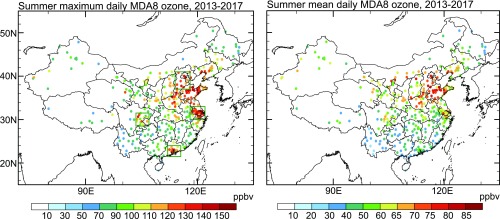
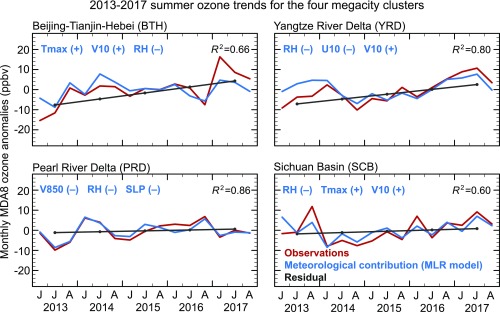
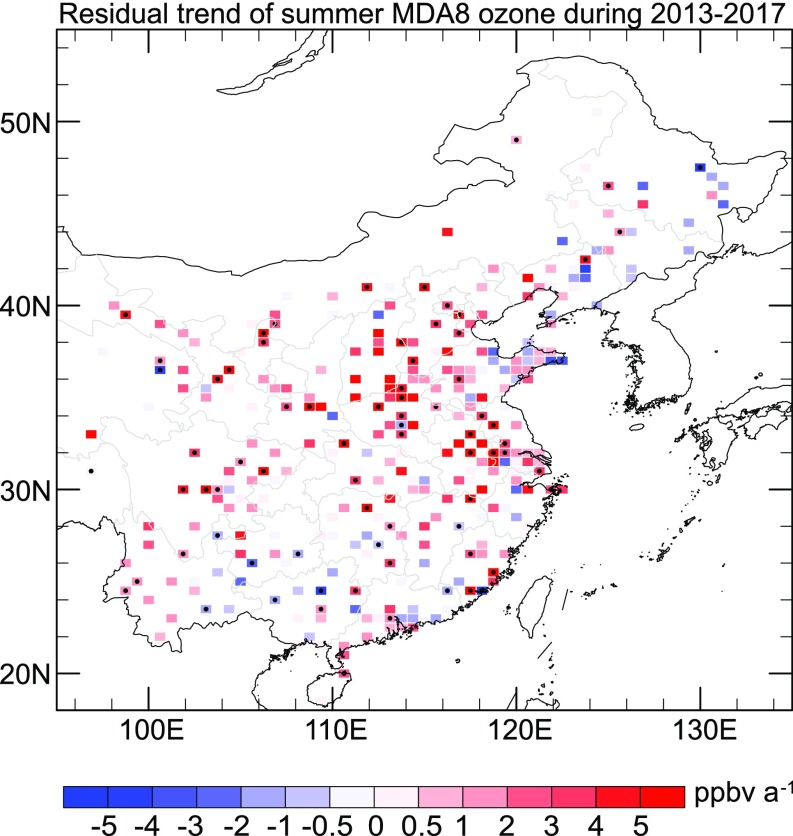
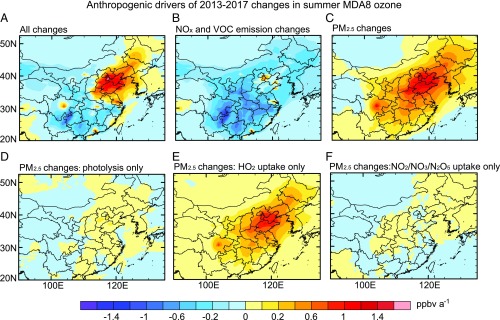
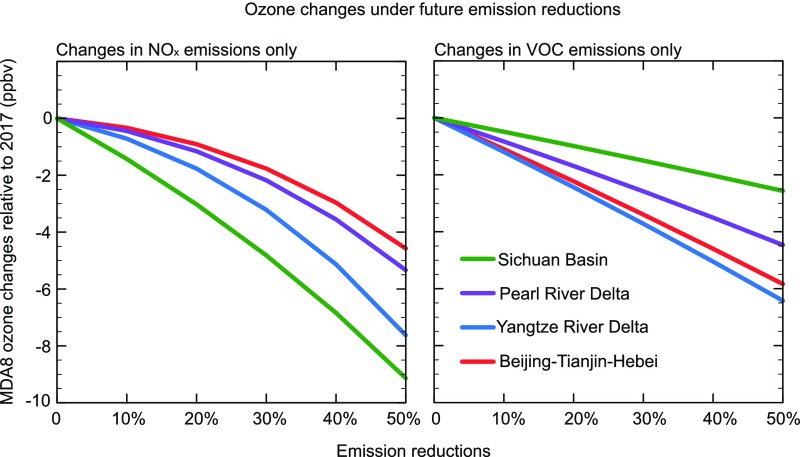
Significance: Drastic air pollution control in China since 2013 has achieved sharp decreases in fine particulate matter (PM 2.5 ), but ozone pollution has not improved. After removing the effect of meteorological variability, we find that surface ozone has increased in megacity clusters of China, notably Beijing and Shanghai. The increasing trend cannot be simply explained by changes in anthropogenic precursor [NO x and volatile organic compound (VOC)] emissions, particularly in North China Plain (NCP). The most important cause of the increasing ozone in NCP appears to be the decrease in PM 2.5 , slowing down the sink of hydroperoxy radicals and thus speeding up ozone production. Decreasing ozone in the future will require a combination of NO x and VOC emission controls to overcome the effect of decreasing PM 2.5 .
Overview
The claims and statistics of this paper haven’t been checked yet.
Free: it reads the open-access text and checks the first 5 claims that cite a source we can check. Create a free account to check every claim.
Integrity signals
Registry
Cites
Statistics
Figures
Verification
Claims the paper makes
The claims and statistics of this paper haven’t been checked yet.
Free: it reads the open-access text and checks the first 5 claims that cite a source we can check. Create a free account to check every claim.
Claims other papers make about this one
Each is checked against this paper’s own text: does it say what the citing paper says it does?
The cited source doesn’t support the claim as written.
In the citing paper
“a recent analysis of ground-level ozone concentrations measured at nearly 1,000 sites across China also found an increasing trend of summertime ozone in northeastern China from 2013 to 2017 (6).”
From Ozone pollution: A Major health hazard worldwide (2019) · cites this paper as [6]
Checked by a reasoning model — may be wrong.
Experimental — accuracy not yet measuredThe source backs part of the claim, not all of it — or backs it for a different population, condition or comparison.
In the citing paper
“Simulations with numerical models show several possible reasons including increases in UV radiation [31, 33–39], shifts in the VOC/NOx chemical regime resulting in increased production of O3 efficiency [35, 40], higher emissions of biogenic VOC due to rising temperatures [30], and decreased competition for gas-phase radicals by aerosol surfaces [34, 40], with reality likely being a combination of”
From Changes in tropospheric air quality related to the protection of stratospheric ozone in a changing climate (2023) · cites this paper as [34]
Experimental — accuracy not yet measuredThe source backs part of the claim, not all of it — or backs it for a different population, condition or comparison.
In the citing paper
“This increase was attributed to changes in anthropogenic emissions of ozone precursors as well as reductions in PM2.5 concentrations as described earlier.”
From Ozone pollution: A Major health hazard worldwide (2019) · cites this paper as [6]
Experimental — accuracy not yet measuredThe source backs part of the claim, not all of it — or backs it for a different population, condition or comparison.
In the citing paper
“anthropogenic emissions of NOx have decreased substantially in most urban areas of China (a 21% nationwide reduction) from 2013 to 2017 (6).”
From Ozone pollution: A Major health hazard worldwide (2019) · cites this paper as [6]
Experimental — accuracy not yet measuredThe cited source says what the claim attributes to it.
In the citing paper
“A recent study showed that a 40% reduction in PM2.5 from 2013 to 2017 in the North China Plain was partly responsible for an increasing ozone trend (at 1–3 ppb per year) during the period of 2013–2017 observed in megacity clusters of eastern China (6).”
From Ozone pollution: A Major health hazard worldwide (2019) · cites this paper as [6]
2 more claims about this paper
Create a free account to see every claim other papers make about this one.
Self-check
Percentages, sums and reported differences re-computed from the paper’s own numbers.
The self-check needs the paper’s full text.
Citations
Cites
Modern Applied Statistics with S
Venables, W. N., & Ripley, B. D. (2002) · Statistics and Computing · doi:10.1007/978-0-387-21706-2 · Cited by 24,305
The Modern-Era Retrospective Analysis for Research and Applications, Version 2 (MERRA-2)
Gelaro, R., McCarty, W., Suárez, M. J., Todling, R., Molod, A., Takacs, L., Randles, C. A., Darmenov, A., Bosilovich, M. G., Reichle, R., et al. (2017) · Journal of Climate · doi:10.1175/jcli-d-16-0758.1 · Cited by 9,010 · cited 2×
“Meteorological data from the NASA MERRA-2 reanalysis (23) with 0.”
MethodTrends in China's anthropogenic emissions since 2010 as the consequence of clean air actions
Zheng, B., Tong, D., Li, M., Liu, F., Hong, C., Geng, G., Li, H., Li, X., Peng, L., Qi, J., et al. (2018) · Atmospheric Chemistry and Physics · doi:10.5194/acp-18-14095-2018 · Cited by 2,916 · cited 9×
“The MEIC emission inventory is developed and managed by researchers at Tsinghua University.”
BackgroundMethodInfluentialSelf-citationModern Applied Statistics with S,
Kemp, F. (2003) · Journal of the Royal Statistical Society: Series D (The Statistician) · doi:10.1046/j.1467-9884.2003.t01-19-00383_22.x · Cited by 2,320
Effect of climate change on air quality
Jacob, D. J., & Winner, D. A. (2009) · Atmospheric Environment · doi:10.1016/j.atmosenv.2008.09.051 · Cited by 1,979 · cited 1×
“These variables are frequently observed to be correlated with ozone air quality (24) and can be viewed as general indicators of stagnation.”
BackgroundSelf-citationWang, T., Xue, L., Brimblecombe, P., Lam, Y. F., Li, L., & Zhang, L. (2017) · Science of The Total Environment · doi:10.1016/j.scitotenv.2016.10.081 · Cited by 1,876 · cited 5×
“A number of previous studies have examined meteorological influences on ozone variability in China (4, 9, 39, 40), On the basis of these studies we considered the correlation of MDA8 ozone across China with a large number of candidate meteorological variables from the MERRA-2 archive (SI Appendix, Table S3 and Fig.”
BackgroundInfluentialLi, M., Zhang, Q., Kurokawa, J.-I., Woo, J.-H., He, K., Lu, Z., Ohara, T., Song, Y., Streets, D. G., Carmichael, G. R., et al. (2017) · Atmospheric Chemistry and Physics · doi:10.5194/acp-17-935-2017 · Cited by 1,616
Self-citationHeterogeneous chemistry and tropospheric ozone
Jacob, D. (2000) · Atmospheric Environment · doi:10.1016/s1352-2310(99)00462-8 · Cited by 1,289 · cited 3×
“The relevant aerosol chemistry involves reactive uptake of the gaseous precursors to ozone formation, as described in GEOS-Chem by firstorder reactive uptake coefficients γ (32).”
BackgroundMethodInfluentialSelf-citationTai, A. P. K., Mickley, L. J., & Jacob, D. J. (2010) · Atmospheric Environment · doi:10.1016/j.atmosenv.2010.06.060 · Cited by 1,048
Self-citationSevere Surface Ozone Pollution in China: A Global Perspective
Lu, X., Hong, J., Zhang, L., Cooper, O. R., Schultz, M. G., Xu, X., Wang, T., Gao, M., Zhao, Y., & Zhang, Y. (2018) · Environmental Science & Technology Letters · doi:10.1021/acs.estlett.8b00366 · Cited by 1,040 · cited 1×
“5) concentration has decreased significantly since then, but ozone pollution has not decreased and is seemingly getting worse (8, 16).”
Background
Cited by
Items 401–500 of 1,003
Temporal trends of atmospheric PAHs: Implications for the influence of the clean air action
Zhu, F.-J., Ma, W.-L., Hu, P.-T., Zhang, Z.-F., & Li, Y.-F. (2021) · Journal of Cleaner Production · doi:10.1016/j.jclepro.2021.126494 · Cited by 43
Embedding of spatial equity in a rapidly urbanising area: Walkability and air pollution exposure
Yu, P., Chen, Y., Xu, Q., Zhang, S., Yung, E. H. K., & Chan, E. H. W. (2022) · Cities · doi:10.1016/j.cities.2022.103942 · Cited by 45
Yin, Z., Zhou, B., Chen, H., & Li, Y. (2020) · The Science of The Total Environment · doi:10.1016/j.scitotenv.2020.143017 · Cited by 42
Yin, Z., & Ma, X. (2020) · Environmental Research Letters · doi:10.1088/1748-9326/abc915 · Cited by 41
Zhao, X., Zhang, Z., Xu, J. X., Gao, J., Cheng, S., Zhao, X., Xia, X., & Hu, B. (2023) · Atmospheric Environment · doi:10.1016/j.atmosenv.2023.119948 · Cited by 41
Wang, L., Yang, X., Dong, J., Yang, Y., Ma, P., & Zhao, W. (2023) · Environmental Pollution · doi:10.1016/j.envpol.2023.122725 · Cited by 45
Kong, L., Tang, X. L., Wang, Z., Zhu, J., Li, J., Wu, H., Wu, Q., Chen, H., Zhu, L., Wang, W., et al. (2024) · Earth system science data · doi:10.5194/essd-16-4351-2024 · Cited by 50
Surface Ozone‐Meteorology Relationships: Spatial Variations and the Role of the Jet Stream
Kerr, G. H., Waugh, D. W., Steenrod, S. D., Strode, S. A., & Strahan, S. E. (2020) · Journal of Geophysical Research Atmospheres · doi:10.1029/2020jd032735 · Cited by 43
“For China we use observations from the Chinese Ministry of Ecology and Environ-193 ment (MEE) for summers 2016 2017 (Li et al., 2019).”
MethodResultInfluence of aerosol copper on HO 2 uptake: a novel parameterized equation
Song, H., Chen, X., Lu, K., Zou, Q., Tan, Z., Fuchs, H., Wiedensohler, A., Moon, D. R., Heard, D. E., Baeza-Romero, M.-T., et al. (2020) · Atmospheric chemistry and physics · doi:10.5194/acp-20-15835-2020 · Cited by 43
Zhang, Y., Shindell, D. T., Seltzer, K. M., Shen, L., Lamarque, J., Zhang, Q., Zheng, B., Xing, J., Jiang, Z., & Zhang, L. (2021) · Atmospheric chemistry and physics · doi:10.5194/acp-21-16051-2021 · Cited by 48
Self-citationLi, S., Yu, X., Dang, X., Wang, P., Meng, X., Wang, Q., & Hou, H. (2022) · Journal of Cleaner Production · doi:10.1016/j.jclepro.2022.130774 · Cited by 42
A systematic assessment of city-level climate change mitigation and air quality improvement in China
Zhang, L., Wu, P., Niu, M., Zheng, Y., Wang, J., Dong, G., Zhang, Z., Xie, Z., Du, M., Jiang, H., et al. (2022) · The Science of The Total Environment · doi:10.1016/j.scitotenv.2022.156274 · Cited by 44
Sun, H. Z., van Daalen, K. R., Morawska, L., Guillas, S., Giorio, C., Di, Q., Kan, H., Loo, E. X.-L., Shek, L. P., Watts, N., et al. (2024) · One Earth · doi:10.1016/j.oneear.2024.08.018 · Cited by 41
Chen, Z., Xie, Y., Liu, J. J., Shen, L., Cheng, X., Han, H., Yang, M., Shen, Y., Zhao, T., & Hu, J. Y. (2023) · The Science of The Total Environment · doi:10.1016/j.scitotenv.2023.162423 · Cited by 43
Self-citationGu, C., Zhang, L., Xu, Z., Xia, S., Wang, Y., Li, L., Wang, Z., Zhao, Q., Wang, H., & Zhao, Y. (2023) · Atmospheric chemistry and physics · doi:10.5194/acp-23-4247-2023 · Cited by 43
“Although less reduction in PM 2 .”
MethodDeciphering decadal urban ozone trends from historical records since 1980
Wang, H., Lu, X. H., Palmer, P. I., Zhang, L., Lu, K., Li, K., Nagashima, T., Koo, J., Tanimoto, H., Wang, H., et al. (2024) · National Science Review · doi:10.1093/nsr/nwae369 · Cited by 43
Self-citationRapid increase in spring ozone in the Pearl River Delta, China during 2013-2022
Cao, T., Wang, H., Chen, X., Li, L., Lu, X. H., Lu, K., & Fan, S. (2024) · npj Climate and Atmospheric Science · doi:10.1038/s41612-024-00847-3 · Cited by 49
The spatiotemporal characteristics of the air pollutants in China from 2015 to 2019
Guo, P., Умарова, А. Б., & Luan, Y. (2020) · PLoS ONE · doi:10.1371/journal.pone.0227469 · Cited by 41
“5 over the 2013–2017 period, which slowed down the aerosol sink of HO2 radicals and stimulated O3 production [41].”
BackgroundZhang, X., Zhao, W., Nie, L., Shao, X., Dang, H., Zhang, W., & Wang, D. (2020) · Environmental Pollution · doi:10.1016/j.envpol.2020.115868 · Cited by 41
Optimizing the Gas–Solid Photocatalytic Reactions for Air Purification
Cui, W. Q., Li, J., & Dong, F. (2022) · ACS ES&T Engineering · doi:10.1021/acsestengg.1c00503 · Cited by 42
Variation characteristics of air combined pollution in Beijing City
Wu, X., Xin, J., Zhang, W., Gao, W., Ma, Y., Ma, Y., Wen, T., Liu, Z., Hu, B., Wang, Y., et al. (2022) · Atmospheric Research · doi:10.1016/j.atmosres.2022.106197 · Cited by 40
Niu, Y., Yan, Y., Chai, J., Zhang, X., Xu, Y., Duan, X., Wu, J., & Peng, L. (2022) · The Science of The Total Environment · doi:10.1016/j.scitotenv.2022.155465 · Cited by 40
Jaffe, D. A., Ninneman, M., & Chan, H. C. (2022) · Journal of Geophysical Research Atmospheres · doi:10.1029/2021jd036385 · Cited by 39
Wang, X., Yao, F., Zhu, W., Wang, Y., Jiao, Y., Huang, H., & Ye, D. (2022) · Chemical Engineering Journal · doi:10.1016/j.cej.2022.138070 · Cited by 51
The Lack of HONO Measurement May Affect the Accurate Diagnosis of Ozone Production Sensitivity
Liu, P., Xue, C., Ye, C., Liu, C., Zhang, C., Wang, J., Zhang, Y., Liu, J., & Mu, Y. (2022) · ACS Environmental Au · doi:10.1021/acsenvironau.2c00048 · Cited by 41
Chen, X., Wang, N., Wang, G., Wang, Z., Chen, H., Cheng, C., Li, M., Zheng, L., Wu, L., Zhang, Q., et al. (2022) · Journal of Geophysical Research Atmospheres · doi:10.1029/2022jd037121 · Cited by 43
Self-citationShen, Y., Jiang, F., Feng, S., Xia, Z., Zheng, Y., Lyu, X., Zhang, L., & Lou, C. (2022) · The Science of The Total Environment · doi:10.1016/j.scitotenv.2022.159767 · Cited by 42
Increasing ambient surface ozone levels over the UK accompanied by fewer extreme events
Finch, D., & Palmer, P. I. (2020) · Atmospheric Environment · doi:10.1016/j.atmosenv.2020.117627 · Cited by 43
Wang, Y., Li, Z., Wang, Q., Jin, X., Peng, Y., Cribb, M. C., Li, Y., Yuan, C., Wu, H., Wu, T., et al. (2021) · Atmospheric chemistry and physics · doi:10.5194/acp-21-915-2021 · Cited by 48
Cao, J., Qiu, X., Liu, Y., Yan, X., Gao, J. G., & Peng, L. (2022) · Environmental Pollution · doi:10.1016/j.envpol.2022.118912 · Cited by 41
Co‐Occurrence of Surface O3, PM2.5 Pollution, and Tropical Cyclones in China
Shao, M., Yang, J., Wang, J., Chen, P., Liu, B., & Dai, Q. (2022) · Journal of Geophysical Research Atmospheres · doi:10.1029/2021jd036310 · Cited by 40
“5 concentration over most regions in China (Ding et al., 2019; Li et al., 2019; Zhai et al., 2019).”
BackgroundReducing Soil-Emitted Nitrous Acid as a Feasible Strategy for Tackling Ozone Pollution
Xue, C., Ye, C., Lu, K., Liu, P., Zhang, C., Su, H., Bao, F., Cheng, Y., Wang, W., Liu, Y., et al. (2024) · Environmental Science & Technology · doi:10.1021/acs.est.4c01070 · Cited by 40
Silver, B. J., Conibear, L., Reddington, C. L. S., Knote, C., Arnold, S. R., & Spracklen, D. V. (2020) · Atmospheric chemistry and physics · doi:10.5194/acp-20-11683-2020 · Cited by 39
Cao, B., & Yin, Z. (2020) · The Science of The Total Environment · doi:10.1016/j.scitotenv.2020.140645 · Cited by 39
Zanin, A., Magro, C. B. D., Bugalho, D. K., Bugalho, F. M., Afonso, P., & Sztando, A. (2020) · Sustainability · doi:10.3390/su12156038 · Cited by 44
Unexpected enhancement of ozone exposure and health risks during National Day in China
Wang, P., Shen, J., Xia, M., Sun, S., Zhang, Y. L., Zhang, H., & Wang, X. (2021) · Atmospheric chemistry and physics · doi:10.5194/acp-21-10347-2021 · Cited by 42
Han, L., Zhao, J., & Gu, Z. (2021) · Sustainable Cities and Society · doi:10.1016/j.scs.2021.102934 · Cited by 41
Fractal analysis of impact of PM2.5 on surface O3 sensitivity regime based on field observations
Liu, C., Liang, J., Li, Y., & Shi, K. (2022) · The Science of The Total Environment · doi:10.1016/j.scitotenv.2022.160136 · Cited by 39
Liu, Y., Zhao, Q., Hao, X., Zhao, J., Zhang, Y., Yang, X., Fu, Q., Xu, X., Wang, X., Huo, J., et al. (2020) · Environmental Pollution · doi:10.1016/j.envpol.2020.114847 · Cited by 38
Huang, H., Wang, Z., Dai, C., Hai, W., Guo, J., Wang, C., & Zhang, X. (2022) · Journal of Environmental Sciences · doi:10.1016/j.jes.2022.08.035 · Cited by 37
Wang, H., Ke, Y., Tan, Y., Zhu, B., Zhao, T., & Yin, Y. (2023) · Chemosphere · doi:10.1016/j.chemosphere.2023.138548 · Cited by 40
Understanding sources of fine particulate matter in China
Zheng, M., Yan, C., & Zhu, T. (2020) · Philosophical Transactions of the Royal Society A Mathematical Physical and Engineering Sciences · doi:10.1098/rsta.2019.0325 · Cited by 42
“5, NO2 and SO2 have been successfully reduced in recent years in China [75,85].”
BackgroundYan, X., Zang, Z., Zhao, C., & Letu, H. (2021) · Environment International · doi:10.1016/j.envint.2021.106392 · Cited by 39
Mechanisms and Pathways for Coordinated Control of Fine Particulate Matter and Ozone
Ojha, N., Soni, M., Kumar, M., Gunthe, S. S., Chen, Y., & Ansari, T. U. (2022) · Current Pollution Reports · doi:10.1007/s40726-022-00229-4 · Cited by 40
“5 conditions, which can also contribute to the enhanced O3 pollution [29, 30].”
BackgroundBhattarai, H., Tai, A. P. K., Martin, M. V., & Yung, D. H. Y. (2023) · The Science of The Total Environment · doi:10.1016/j.scitotenv.2023.167759 · Cited by 40
A decade of China’s air quality monitoring data suggests health impacts are no longer declining
Silver, B. J., Reddington, C. L. S., Chen, Y., & Arnold, S. R. (2025) · Environment International · doi:10.1016/j.envint.2025.109318 · Cited by 49
Yin, Z., & Zhang, Y. (2020) · The Science of The Total Environment · doi:10.1016/j.scitotenv.2020.138514 · Cited by 37
Significant contribution of spring northwest transport to volatile organic compounds in Beijing
Yao, D., Tang, G., Wang, Y., Yang, Y., Wang, L., Chen, T., He, H., & Wang, Y. (2020) · Journal of Environmental Sciences · doi:10.1016/j.jes.2020.11.023 · Cited by 37
Zhang, Y., Liu, X., Zhang, L., Tang, A., Goulding, K. W. T., & Collett, J. L. (2021) · Environmental Pollution · doi:10.1016/j.envpol.2021.117027 · Cited by 37
New Insights for Tracking Global and Local Trends in Exposure to Air Pollutants
Wolf, M. J., Esty, D. C., Kim, H., Bell, M. L., Brigham, S., Nortonsmith, Q., Zaharieva, S., Wendling, Z. A., de Sherbinin, A., & Emerson, J. W. (2022) · Environmental Science & Technology · doi:10.1021/acs.est.1c08080 · Cited by 48
Yao, Y., Wang, W., Ma, K., Tan, H., Zhang, Y., Fang, F., & He, C. (2023) · Journal of Environmental Management · doi:10.1016/j.jenvman.2022.117105 · Cited by 36
Health risks and sources of trace elements and black carbon in PM2.5 from 2019 to 2021 in Beijing
Hua, C., Ma, W., Zheng, F., Zhang, Y., Xie, J., Ma, L., Song, B., Yan, C., Li, H., Liu, Z. Q., et al. (2023) · Journal of Environmental Sciences · doi:10.1016/j.jes.2023.05.023 · Cited by 40
Yao, L., Yan, H., Qi, X., Huang, D., Che, H., Long, X., Du, Y., Meng, L., Yao, X., Zhang, L., et al. (2024) · The Science of The Total Environment · doi:10.1016/j.scitotenv.2024.173193 · Cited by 36
Ahmad, N., Lin, C., Lau, A. K. H., Kim, J., Zhang, T., Yu, F., Li, C., Li, Y., Fung, J. C. H., & Lao, X. Q. (2024) · Atmospheric chemistry and physics · doi:10.5194/acp-24-9645-2024 · Cited by 36
“…pose potential health risks (Xue et al., 2023) Additionally, it serves as an essential precursor to the formation of secondary particles and ozone (Li et al., 2019) The origins of NO 2 are multifarious and intricate, stemming from diverse sources such as fossil-fuel-fired power plants, vehicular…”
Lin, H., Wang, M., Duan, Y., Fu, Q., Ji, W., Cui, H., Jin, D., Lin, Y., & Hu, K. (2020) · Atmosphere · doi:10.3390/atmos11030295 · Cited by 39
“Additionally, a significant increase in O3 concentrations in these three regions was reported by previous studies [2].”
ResultMa, Q., Qi, Y., Shan, Q., Liu, S., & He, H. (2020) · Environmental Research · doi:10.1016/j.envres.2020.109949 · Cited by 37
Li, Y., Ma, J., Li, X., He, G., Zhang, C., & He, H. (2020) · Catalysis Science & Technology · doi:10.1039/d0cy01298j · Cited by 36
Li, X., Fan, G., Lou, S., Yuan, B., Wang, X., & Shao, M. (2020) · Environmental Pollution · doi:10.1016/j.envpol.2020.115804 · Cited by 36
Kalsoom, U., Wang, T., Ma, C., Shu, L., Huang, C., & Gao, L. (2020) · Atmospheric Environment · doi:10.1016/j.atmosenv.2020.117989 · Cited by 35
Dynamic model to predict the association between air quality, COVID-19 cases, and level of lockdown
Tadano, Y. D. S., Potgieter-Vermaak, S. S., Kachba, Y. R., Chiroli, D. M. D. G., Casacio, L., dos Santos-Silva, J. C., Moreira, C. A. B., Machado, V., Alves, T. A., Siqueira, H. V., et al. (2020) · Environmental Pollution · doi:10.1016/j.envpol.2020.115920 · Cited by 36
Zhong, H., Huang, R., Chang, Y., Duan, J., Lin, C., & Yang, C. (2021) · The Science of The Total Environment · doi:10.1016/j.scitotenv.2021.144947 · Cited by 36
“Besides, considering the effect of aerosol sink for O3 precursors (Li et al., 2018) and aerosol radiative effect on the O3 formation”
BackgroundObservations of atmospheric oxidation and ozone production in South Korea
Brune, W. H., Miller, D. O., Thames, A. B., Brosius, A. L., Barletta, B., Blake, D. R., Blake, N. J., Chen, G., Choi, Y., Crawford, J. H., et al. (2021) · Atmospheric Environment · doi:10.1016/j.atmosenv.2021.118854 · Cited by 36
“Thus, it is unlikely that O3 increased in China between 2013 and 2017 because aerosol amount decreased, resulting in less HO2 uptake, more gas-phase HO2, and therefore more O3 production (Li et al., 2018).”
BackgroundChen, W., Guenther, A., Jia, S., Mao, J., Yan, F., Wang, X., & Shao, M. (2022) · The Science of The Total Environment · doi:10.1016/j.scitotenv.2022.154218 · Cited by 39
Wang, F., Wang, W., Wang, Z., Zhang, Z., Feng, Y., Russell, A. G., & Shi, G. (2022) · 中国科学通报:英文版 · doi:10.1016/j.scib.2022.08.016 · Cited by 36
Vertical characteristics of NO2 and HCHO, and the ozone formation regimes in Hefei, China
Ren, B., Xie, P., Xu, J., Li, A., Qin, M., Hu, R., Zhang, T., Fan, G., Tian, X., Zhu, W., et al. (2022) · The Science of The Total Environment · doi:10.1016/j.scitotenv.2022.153425 · Cited by 35
Narrowing Differences in Urban and Nonurban Surface Ozone in the Northern Hemisphere Over 1990–2020
Han, H., Zhang, L., Liu, Z., Yue, X., Shu, L., Wang, X., & Zhang, Y. (2023) · Environmental Science & Technology Letters · doi:10.1021/acs.estlett.3c00105 · Cited by 36
Hu, W., Zhao, Y., Lu, N., Wang, X., Zheng, B., Henze, D. K., Zhang, L., Fu, T., & Zhai, S. (2023) · Environmental Science & Technology · doi:10.1021/acs.est.3c05049 · Cited by 35
Synergies of air pollution control policies: A review
Feng, T., Shi, Y., Wang, X., Wan, X., & Mi, Z. (2025) · Journal of Environmental Management · doi:10.1016/j.jenvman.2025.124655 · Cited by 41
The influence of aerosols on the NO2 photolysis rate in a suburban site in North China
Zhao, S., Hu, B., Liu, H., Du, C., Xia, X., & Wang, Y. (2021) · The Science of The Total Environment · doi:10.1016/j.scitotenv.2020.144788 · Cited by 36
Lin, Y., Zhang, Y., Xie, F., Fan, M., & Liu, X. (2021) · Environmental Pollution · doi:10.1016/j.envpol.2021.116615 · Cited by 35
“5 concentration might be another reason for enhancements of O3 levels (Li et al., 2019).”
BackgroundHuang, L., Sun, J., Jin, L., Brown, N. J., & Hu, J. (2021) · Atmospheric Research · doi:10.1016/j.atmosres.2021.105633 · Cited by 35
Lv, D., Lü, S., He, S., Song, K., Shao, M., Xie, S., & Gong, Y. (2021) · Chemosphere · doi:10.1016/j.chemosphere.2021.130653 · Cited by 36
Lee, Y. R., Huey, L. G., Wang, Y., Qu, H., Zhang, R., Ji, Y., Tanner, D. J., Wang, X., Tang, J., Song, W., et al. (2021) · Journal of Geophysical Research Atmospheres · doi:10.1029/2021jd035296 · Cited by 36
Chen, C., Qiu, Y., Xu, W., He, Y., Li, Z., Sun, J., Ma, N., Xu, W., Pan, X., Fu, P., et al. (2022) · Journal of Geophysical Research Atmospheres · doi:10.1029/2021jd035430 · Cited by 39
Quantifying the drivers of surface ozone anomalies in the urban areas over the Qinghai-Tibet Plateau
Yin, H., Sun, Y., Notholt, J., Palm, M., Ye, C., & Liu, C. (2022) · Atmospheric chemistry and physics · doi:10.5194/acp-22-14401-2022 · Cited by 33
Feng, T., Bei, N., Zhao, S., Wu, J., Liu, S., Li, X., Liu, L., Wang, R., Zhang, X., Tie, X., et al. (2020) · Atmospheric Environment · doi:10.1016/j.atmosenv.2020.117995 · Cited by 36
Yang, L., Yuan, Z., Luo, H., Wang, Y., Xu, Y., Duan, Y., & Fu, Q. (2020) · The Science of The Total Environment · doi:10.1016/j.scitotenv.2020.143401 · Cited by 34
Chen, K., Wang, P., Zhao, H., Wang, P., Gao, A., Myllyvirta, L., & Zhang, H. (2020) · Atmospheric Environment · doi:10.1016/j.atmosenv.2020.118087 · Cited by 35
Wang, F., Du, W., Lv, S., Ding, Z., & Wang, G. (2021) · Advances in Atmospheric Sciences · doi:10.1007/s00376-021-0317-6 · Cited by 35
An analysis and review on the global NO 2 emission during lockdowns in COVID-19 period
Hoang, A. T., Huynh, T. T., Nguyễn, X. P., Nguyen, T. K. T., & Le, T. H. (2021) · Energy Sources Part A Recovery Utilization and Environmental Effects · doi:10.1080/15567036.2021.1902431 · Cited by 53
“More interestingly, the decrease of NO 2 emissions was believed to make more sunlight passing through atmosphere, promoting the photochemical activity occurring more and more to raise the O 3 production (Li et al. 2019).”
Kim, H. C., Kim, S., Cohen, M., Bae, C., Lee, D., Saylor, R., Bae, M., Kim, E., Kim, B.-U., Yoon, J., et al. (2021) · Atmospheric chemistry and physics · doi:10.5194/acp-21-10065-2021 · Cited by 34
“While the CREATE inventory is based on the latest information, including the 2016 KORUSAQ campaign (https://espo.nasa.gov/korus-aq, last access: 25 June 2021), the MIX inventory has been tested in many diverse applications (J. Li et al., 2019; K. Li et al., 2019; Zhang et al., 2017).”
MethodSynergistic degradation of NO and C7H8 for inhibition of O3 generation
Li, K., Wang, H., Chen, L., Li, J., & Dong, F. (2022) · Applied Catalysis B: Environmental · doi:10.1016/j.apcatb.2022.121423 · Cited by 34
Self-citationAir quality change and public perception during the COVID-19 lockdown in India
Sekar, A., Jasna, R. S., Binoy, B. V., Mohan, P., & Varghese, G. K. (2022) · Gondwana Research · doi:10.1016/j.gr.2022.04.023 · Cited by 34
Zhang, X., Xu, W., Zhang, G., Lin, W., Zhao, H., Ren, S., Zhou, G., Chen, J., & Xu, X. (2022) · The Science of The Total Environment · doi:10.1016/j.scitotenv.2022.160520 · Cited by 35
Gao, J., Li, Y., Xie, Z., Hu, B., Wang, L., Bao, F., & Fan, S. (2022) · Science of The Total Environment · doi:10.1016/j.scitotenv.2022.153197 · Cited by 33
Surface ozone pollution in China: Trends, exposure risks, and drivers
He, C., Wu, Q., Li, B., Liu, J., Gong, X., & Zhang, L. (2023) · Frontiers in Public Health · doi:10.3389/fpubh.2023.1131753 · Cited by 36
“(41) attributed the significant positive correlation between O3 concentration and wind speed in the North China Plain region to the influence of”
BackgroundZhang, C., Jiang, Z., Liu, M., Dong, Y., & Li, J. (2023) · Atmospheric Research · doi:10.1016/j.atmosres.2023.106892 · Cited by 33
Yan, D., Zhang, Z., Jin, Z., Li, M., Sheridan, S. C., & Wang, T. (2023) · Atmospheric Pollution Research · doi:10.1016/j.apr.2023.101843 · Cited by 33
Developing a statistical model to explain the observed decline of atmospheric mercury
Wu, Q., Tang, Y., Wang, S., Li, L., Deng, K., Tang, G., Liu, K., Ding, D., & Zhang, H. (2020) · Atmospheric Environment · doi:10.1016/j.atmosenv.2020.117868 · Cited by 37
Tropospheric aerosol hygroscopicity in China
Peng, C., Wang, Y., Wu, Z., Chen, L., Huang, R., Wang, W., Wang, Z., Hu, W., Zhang, G., Ge, M., et al. (2020) · Atmospheric chemistry and physics · doi:10.5194/acp-20-13877-2020 · Cited by 35
“3, several studies (Liu et al., 2014; Wu et al., 2016; Cai et al., 2018; Hong et al., 2018; X. Li et al., 2019; Kuang et al., 2020; Jin et al., 2020) suggested that organics contributed substantially to aerosol water uptake, while some studies also indicated that the contribution of aerosol…”
BackgroundBai, H., Gao, W., Zhang, Y., & Wang, L. (2021) · Journal of Environmental Sciences · doi:10.1016/j.jes.2021.01.022 · Cited by 35
Air pollution perception in ten countries during the COVID-19 pandemic
Lou, B., Barbieri, D. M., Passavanti, M., Hui, C., Gupta, A., Hoff, I., Lessa, D. A., Sikka, G., Chang, K. N., Fang, K., et al. (2021) · AMBIO · doi:10.1007/s13280-021-01574-2 · Cited by 35
Dufour, G., Hauglustaine, D. A., Zhang, Y., Eremenko, M., Cohen, Y., Gaudel, A., Siour, G., Lachâtre, M., Bense, A., Bessagnet, B., et al. (2021) · Atmospheric chemistry and physics · doi:10.5194/acp-21-16001-2021 · Cited by 34
Shang, B., Fu, R., Agathokleous, E., Dai, L., Zhang, G., Wu, R., & Feng, Z. (2021) · The Science of The Total Environment · doi:10.1016/j.scitotenv.2021.151341 · Cited by 33
Zong, Z., Tian, C., Sun, Z., Tan, Y., Shi, Y., Liu, X., Li, J., Fang, Y., Chen, Y., Ma, Y., et al. (2022) · Journal of Geophysical Research Atmospheres · doi:10.1029/2022jd036567 · Cited by 36
Han, W., He, T., Tang, Z., Wang, M., Jones, D. B. A., & Jiang, Z. (2022) · Geoscientific model development · doi:10.5194/gmd-15-4225-2022 · Cited by 33
Is atmospheric oxidation capacity better in indicating tropospheric O3 formation?
Wang, P., Zhu, S., Vrekoussis, M., Brasseur, G. P., Wang, S., & Zhang, H. (2022) · Frontiers of Environmental Science & Engineering · doi:10.1007/s11783-022-1544-5 · Cited by 39
“Liu et al. (2021) calculated the AOC based on electron transfer during the secondary pollutants formation process.”
MethodWang, W., Fang, H., Zhang, Y., Ding, Y., Hua, F., Wu, T. H., & Yan, Y. (2023) · Chemosphere · doi:10.1016/j.chemosphere.2023.138609 · Cited by 33
Deep Learning‐Based Ensemble Forecasts and Predictability Assessments for Surface Ozone Pollution
Zhang, A., Fu, T., Xu, F., Guo, J., Liu, C., Chen, J., Mo, J., Zhang, X., Wang, X., Wu, W., et al. (2023) · Geophysical Research Letters · doi:10.1029/2022gl102611 · Cited by 34
What caused large ozone variabilities in three megacity clusters in eastern China during 2015–2020?
Hu, T., Lin, Y., Liu, R., Xu, Y., Ouyang, S., Wang, B., Zhang, Y., & Liu, S. C. (2024) · Atmospheric chemistry and physics · doi:10.5194/acp-24-1607-2024 · Cited by 34
Metadata
- Authors
- Li, K., Jacob, D. J., Liao, H., Shen, L., Zhang, Q., & Bates, K. H.
- Affiliations
- Harvard University (US)
- Nanjing University of Information Science and Technology (CN)
- Tsinghua University (CN)
- Corresponding author
- Jacob, Daniel J.
- Liao, Hong
- Venue
- Proceedings of the National Academy of Sciences
- Publisher
- National Academy of Sciences
- Published
- 2018-12-31
- Volume
- 116
- Issue
- 2
- Pages
- 422-427
- ISSN
- 0027-8424 (ISSN-L)
- 1091-6490
- PMC
- PMC6329973
- OpenAlex
- W2908510209
- Cited by
- 1,804
- References
- 45
- Citations by year
- 2026: 164 · 2025: 191 · 2024: 203 · 2023: 263 · 2022: 348 · 2021: 326 · 2020: 224 · 2019: 80 · 2018: 1
- FWCI
- 76.82
- Type
- journal article
- Language
- en
- Open access
- hybrid
- doi.org
- Licence
- Locations
- Proceedings of the National Academy of Sciences (publishedVersion, cc-by-nc-nd)
- Europe PMC (PubMed Central) (publishedVersion, cc-by-nc-nd)
- PubMed Central (publishedVersion, cc-by-nc-nd)
- PubMed (publishedVersion)
- Funders
- National Natural Science Foundation of China (91744311)
- Topics
- Physical Sciences › Earth and Planetary Sciences › Atmospheric Science › Atmospheric chemistry and aerosols
- Physical Sciences › Earth and Planetary Sciences › Atmospheric Science › Atmospheric Ozone and Climate
- Physical Sciences › Environmental Science › Global and Planetary Change › COVID-19 impact on air quality
- Keywords
- surface ozone trends, anthropogenic factors, PM2.5 reduction, NOx emissions, volatile organic compounds, hydroperoxyl radical, ozone sink, ozone formation, North China Plain, air pollution control, weather variability, Beijing, Shanghai
- MeSH terms
- Air, Air Pollutants, Air Pollution, China, Humans, Ozone, Urban Renewal, Volatile Organic Compounds
About these checks
Registry, retraction, Cites and statistics results are computed, not judged, with one exception: a printed reference that no index lists is read once by a model before it counts as a citation error. Claims are extracted by a model and kept only when their quote appears verbatim in the text; each cited source is then checked, with a model’s help, for whether it says what the claim relies on. Those verdicts can be wrong — read the claim’s quote and the cited source before relying on one.
Statistics and arithmetic are recomputed, not judged.
Confidence bands are shown only for fields calibrated on our annotated test set. None is calibrated yet, so no band is shown.
What counts as a claim ›How we measure confidence ›How we check this ›
Are you an author, or do you see a problem with this page? Request a review
Data sources
Bibliographic data: Semantic Scholar, OpenAlex, Crossref.
Contains information from the Semantic Scholar Academic Graph Datasets, made available under the ODC Attribution License (ODC-BY 1.0).
Semantic Scholar’s data is described in: Kinney, R., et al. (2023). The Semantic Scholar Open Data Platform. arXiv:2301.10140.
