

Anthropogenic drivers of 2013–2017 trends in summer surface ozone in China
Open accessThe DOI matches its Crossref record; 45 of the 45 references it cites were found in a registry or an index.
Abstract
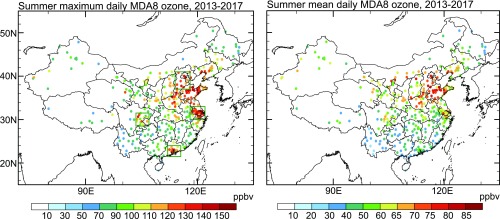
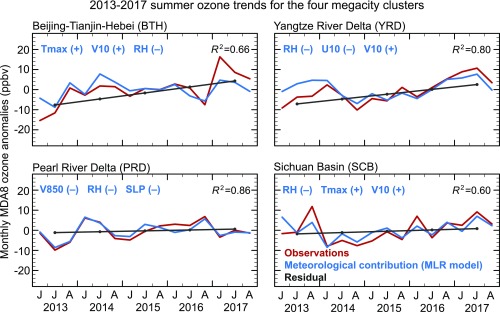
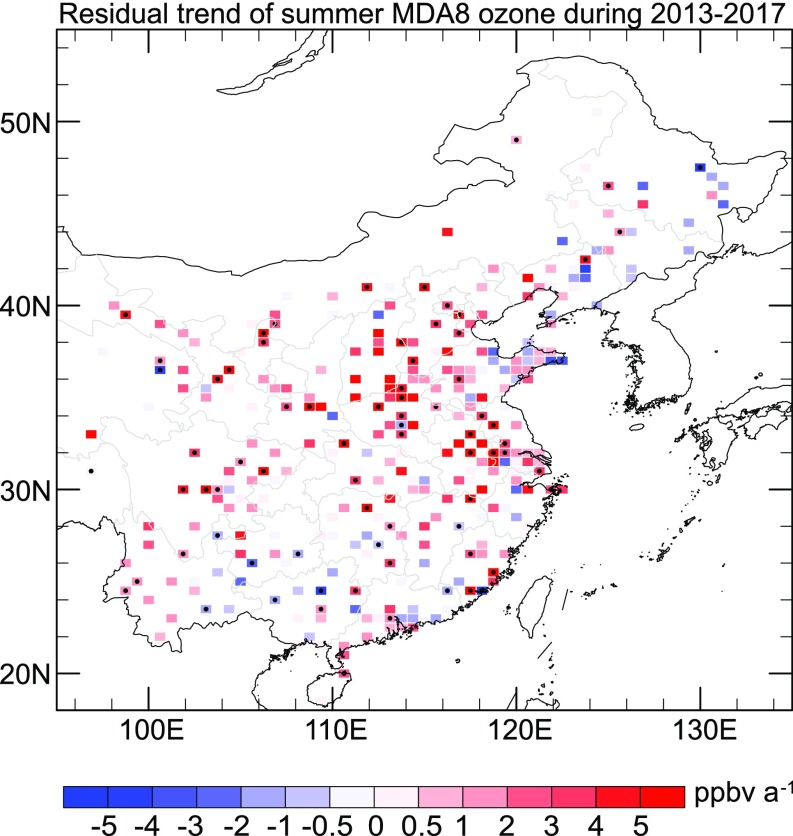
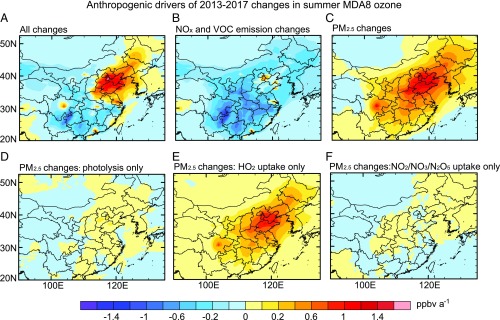
Significance: Drastic air pollution control in China since 2013 has achieved sharp decreases in fine particulate matter (PM 2.5 ), but ozone pollution has not improved. After removing the effect of meteorological variability, we find that surface ozone has increased in megacity clusters of China, notably Beijing and Shanghai. The increasing trend cannot be simply explained by changes in anthropogenic precursor [NO x and volatile organic compound (VOC)] emissions, particularly in North China Plain (NCP). The most important cause of the increasing ozone in NCP appears to be the decrease in PM 2.5 , slowing down the sink of hydroperoxy radicals and thus speeding up ozone production. Decreasing ozone in the future will require a combination of NO x and VOC emission controls to overcome the effect of decreasing PM 2.5 .
Overview
The claims and statistics of this paper haven’t been checked yet.
Free: it reads the open-access text and checks the first 5 claims that cite a source we can check. Create a free account to check every claim.
Integrity signals
Registry
Cites
Statistics
Figures
Verification
Claims the paper makes
The claims and statistics of this paper haven’t been checked yet.
Free: it reads the open-access text and checks the first 5 claims that cite a source we can check. Create a free account to check every claim.
Claims other papers make about this one
Each is checked against this paper’s own text: does it say what the citing paper says it does?
The cited source doesn’t support the claim as written.
In the citing paper
“a recent analysis of ground-level ozone concentrations measured at nearly 1,000 sites across China also found an increasing trend of summertime ozone in northeastern China from 2013 to 2017 (6).”
From Ozone pollution: A Major health hazard worldwide (2019) · cites this paper as [6]
Checked by a reasoning model — may be wrong.
Experimental — accuracy not yet measuredThe source backs part of the claim, not all of it — or backs it for a different population, condition or comparison.
In the citing paper
“Simulations with numerical models show several possible reasons including increases in UV radiation [31, 33–39], shifts in the VOC/NOx chemical regime resulting in increased production of O3 efficiency [35, 40], higher emissions of biogenic VOC due to rising temperatures [30], and decreased competition for gas-phase radicals by aerosol surfaces [34, 40], with reality likely being a combination of”
From Changes in tropospheric air quality related to the protection of stratospheric ozone in a changing climate (2023) · cites this paper as [34]
Experimental — accuracy not yet measuredThe source backs part of the claim, not all of it — or backs it for a different population, condition or comparison.
In the citing paper
“This increase was attributed to changes in anthropogenic emissions of ozone precursors as well as reductions in PM2.5 concentrations as described earlier.”
From Ozone pollution: A Major health hazard worldwide (2019) · cites this paper as [6]
Experimental — accuracy not yet measuredThe source backs part of the claim, not all of it — or backs it for a different population, condition or comparison.
In the citing paper
“anthropogenic emissions of NOx have decreased substantially in most urban areas of China (a 21% nationwide reduction) from 2013 to 2017 (6).”
From Ozone pollution: A Major health hazard worldwide (2019) · cites this paper as [6]
Experimental — accuracy not yet measuredThe cited source says what the claim attributes to it.
In the citing paper
“A recent study showed that a 40% reduction in PM2.5 from 2013 to 2017 in the North China Plain was partly responsible for an increasing ozone trend (at 1–3 ppb per year) during the period of 2013–2017 observed in megacity clusters of eastern China (6).”
From Ozone pollution: A Major health hazard worldwide (2019) · cites this paper as [6]
2 more claims about this paper
Create a free account to see every claim other papers make about this one.
Self-check
Percentages, sums and reported differences re-computed from the paper’s own numbers.
The self-check needs the paper’s full text.
Citations
Cites
Modern Applied Statistics with S
Venables, W. N., & Ripley, B. D. (2002) · Statistics and Computing · doi:10.1007/978-0-387-21706-2 · Cited by 24,305
The Modern-Era Retrospective Analysis for Research and Applications, Version 2 (MERRA-2)
Gelaro, R., McCarty, W., Suárez, M. J., Todling, R., Molod, A., Takacs, L., Randles, C. A., Darmenov, A., Bosilovich, M. G., Reichle, R., et al. (2017) · Journal of Climate · doi:10.1175/jcli-d-16-0758.1 · Cited by 9,010 · cited 2×
“Meteorological data from the NASA MERRA-2 reanalysis (23) with 0.”
MethodTrends in China's anthropogenic emissions since 2010 as the consequence of clean air actions
Zheng, B., Tong, D., Li, M., Liu, F., Hong, C., Geng, G., Li, H., Li, X., Peng, L., Qi, J., et al. (2018) · Atmospheric Chemistry and Physics · doi:10.5194/acp-18-14095-2018 · Cited by 2,916 · cited 9×
“The MEIC emission inventory is developed and managed by researchers at Tsinghua University.”
BackgroundMethodInfluentialSelf-citationModern Applied Statistics with S,
Kemp, F. (2003) · Journal of the Royal Statistical Society: Series D (The Statistician) · doi:10.1046/j.1467-9884.2003.t01-19-00383_22.x · Cited by 2,320
Effect of climate change on air quality
Jacob, D. J., & Winner, D. A. (2009) · Atmospheric Environment · doi:10.1016/j.atmosenv.2008.09.051 · Cited by 1,979 · cited 1×
“These variables are frequently observed to be correlated with ozone air quality (24) and can be viewed as general indicators of stagnation.”
BackgroundSelf-citationWang, T., Xue, L., Brimblecombe, P., Lam, Y. F., Li, L., & Zhang, L. (2017) · Science of The Total Environment · doi:10.1016/j.scitotenv.2016.10.081 · Cited by 1,876 · cited 5×
“A number of previous studies have examined meteorological influences on ozone variability in China (4, 9, 39, 40), On the basis of these studies we considered the correlation of MDA8 ozone across China with a large number of candidate meteorological variables from the MERRA-2 archive (SI Appendix, Table S3 and Fig.”
BackgroundInfluentialLi, M., Zhang, Q., Kurokawa, J.-I., Woo, J.-H., He, K., Lu, Z., Ohara, T., Song, Y., Streets, D. G., Carmichael, G. R., et al. (2017) · Atmospheric Chemistry and Physics · doi:10.5194/acp-17-935-2017 · Cited by 1,616
Self-citationHeterogeneous chemistry and tropospheric ozone
Jacob, D. (2000) · Atmospheric Environment · doi:10.1016/s1352-2310(99)00462-8 · Cited by 1,289 · cited 3×
“The relevant aerosol chemistry involves reactive uptake of the gaseous precursors to ozone formation, as described in GEOS-Chem by firstorder reactive uptake coefficients γ (32).”
BackgroundMethodInfluentialSelf-citationTai, A. P. K., Mickley, L. J., & Jacob, D. J. (2010) · Atmospheric Environment · doi:10.1016/j.atmosenv.2010.06.060 · Cited by 1,048
Self-citationSevere Surface Ozone Pollution in China: A Global Perspective
Lu, X., Hong, J., Zhang, L., Cooper, O. R., Schultz, M. G., Xu, X., Wang, T., Gao, M., Zhao, Y., & Zhang, Y. (2018) · Environmental Science & Technology Letters · doi:10.1021/acs.estlett.8b00366 · Cited by 1,040 · cited 1×
“5) concentration has decreased significantly since then, but ozone pollution has not decreased and is seemingly getting worse (8, 16).”
Background
Cited by
Items 101–200 of 1,003
A data-driven method of traffic emissions mapping with land use random forest models
Wen, Y., Wu, R., Zhou, Z., Zhang, S., Yang, S., Wallington, T. J., Shen, W., Tan, Q., Deng, Y., & Wu, Y. (2021) · Applied Energy · doi:10.1016/j.apenergy.2021.117916 · Cited by 147
Correcting model biases of CO in East Asia: impact on oxidant distributions during KORUS-AQ
Gaubert, B., Emmons, L. K., Raeder, K., Tilmes, S., Miyazaki, K., Arellano, A. F., Elguindi, N., Granier, C., Tang, W., Barré, J., et al. (2020) · Atmospheric chemistry and physics · doi:10.5194/acp-20-14617-2020 · Cited by 143
Weng, X., Forster, G. L., & Nowack, P. J. (2022) · Atmospheric chemistry and physics · doi:10.5194/acp-22-8385-2022 · Cited by 146
Maji, K. J., Li, V. O. K., & Lam, J. C. K. (2020) · Chemosphere · doi:10.1016/j.chemosphere.2020.127572 · Cited by 137
Xu, J., Huang, X., Wang, N., Li, Y., & Ding, A. (2020) · The Science of The Total Environment · doi:10.1016/j.scitotenv.2020.141928 · Cited by 138
“However, ozone pollution is getting increasingly severe and arouses the concerns from both the government and the public, particularly in developed regions like the Yangtze River Delta (YRD) region (Huang et al., 2020a; Li et al., 2018; Wang et al., 2020).”
Sensitivity of PM2.5 and O3 pollution episodes to meteorological factors over the North China Plain
Ma, S., Shao, M., Zhang, Y., Dai, Q., & Xie, M. (2021) · The Science of The Total Environment · doi:10.1016/j.scitotenv.2021.148474 · Cited by 139
Yuan, Q., Qi, B., Hu, D., Wang, J., Zhang, J., Yang, H., Zhang, S., Liu, L., Xu, L., & Li, W. (2020) · The Science of The Total Environment · doi:10.1016/j.scitotenv.2020.141820 · Cited by 129
UK surface NO 2 levels dropped by 42 % during the COVID-19 lockdown: impact on surface O 3
Lee, J. D., Drysdale, W. S., Finch, D., Wilde, S. E., & Palmer, P. I. (2020) · Atmospheric chemistry and physics · doi:10.5194/acp-20-15743-2020 · Cited by 129
Long-term trend of ozone in southern China reveals future mitigation strategy for air pollution
Li, X., Yuan, B., Parrish, D. D., Chen, D., Song, Y., Yang, S., Liu, Z., & Shao, M. (2021) · Atmospheric Environment · doi:10.1016/j.atmosenv.2021.118869 · Cited by 135
Shao, M., Wang, W., Yuan, B., Parrish, D. D., Li, X., Lu, K., Wu, L., Wang, X., Mo, Z., Yang, S., et al. (2021) · The Science of The Total Environment · doi:10.1016/j.scitotenv.2021.147712 · Cited by 129
DeLang, M. N., Becker, J. S., Chang, K.-L., Serre, M. L., Cooper, O. R., Schultz, M. G., Schröder, S., Lu, X., Zhang, L., Deushi, M., et al. (2021) · Environmental Science & Technology · doi:10.1021/acs.est.0c07742 · Cited by 114
Typhoon-boosted biogenic emission aggravates cross-regional ozone pollution in China
Wang, N., Huang, X., Xu, J., Wang, T., Tan, Z., & Ding, A. (2022) · Science Advances · doi:10.1126/sciadv.abl6166 · Cited by 141
“However, despite that strict measures have been widely implemented to cut down anthropogenic emissions in the past decades, increases in groundlevel O3 pollution have been witnessed in many places of the Northern Hemisphere (19, 20).”
BackgroundInfluentialWang, N., Xu, J., Pei, C., Tang, R., Zhou, D., Chen, Y., Li, M., Deng, X., Deng, T., Huang, X., et al. (2021) · Environmental Science & Technology · doi:10.1021/acs.est.0c08383 · Cited by 133
Zheng, H., Cai, S., Wang, S., Zhao, B., Chang, X., & Hao, J. (2019) · Atmospheric chemistry and physics · doi:10.5194/acp-19-3447-2019 · Cited by 135
Liu, P., Song, H., Wang, T., Wang, F., Li, X., Miao, C., & Zhao, H. (2020) · Environmental Pollution · doi:10.1016/j.envpol.2020.114366 · Cited by 123
Bernhard, G. H., Neale, R. E., Barnes, P. W., Neale, P. J., Zepp, R. G., Wilson, S. R., Andrady, A. L., Bais, A. F., McKenzie, R. L., Aucamp, P. J., et al. (2020) · Photochemical & Photobiological Sciences · doi:10.1039/d0pp90011g · Cited by 122
Liu, J., Wang, L., Li, M., Liao, Z., Sun, Y., Song, T., Gao, W., Wang, Y., Li, Y., Ji, D., et al. (2019) · Atmospheric chemistry and physics · doi:10.5194/acp-19-14477-2019 · Cited by 124
Wu, C., Zhang, S., Wang, G., Lv, S., Li, D., Liu, L., Li, J., Liu, S., Du, W., Meng, J., et al. (2020) · Environmental Science & Technology · doi:10.1021/acs.est.0c04544 · Cited by 123
Qu, H., Wang, Y., Zhang, R., Liu, X., Huey, L. G., Sjostedt, S. J., Zeng, L., Lu, K., Wu, Y., Shao, M., et al. (2021) · Environmental Science & Technology · doi:10.1021/acs.est.1c04489 · Cited by 120
Buysse, C. E., Kaulfus, A. S., Nair, U. S., & Jaffe, D. A. (2019) · Environmental Science & Technology · doi:10.1021/acs.est.9b05241 · Cited by 131
The impact of volatile organic compounds on ozone formation in the suburban area of Shanghai
Zhang, K., Li, L., Huang, L., Wang, Y., Huo, J., Duan, Y., Wang, Y., & Fu, Q. (2020) · Atmospheric Environment · doi:10.1016/j.atmosenv.2020.117511 · Cited by 120
Understanding the impact of meteorology on ozone in 334 cities of China
Hu, C., Kang, P., Jaffe, D. A., Li, C., Zhang, X., Wu, K., & Zhou, M. (2021) · Atmospheric Environment · doi:10.1016/j.atmosenv.2021.118221 · Cited by 120
Gong, S., Zhang, L., Liu, C., Lu, S., Pan, W., & Zhang, Y. (2022) · The Science of The Total Environment · doi:10.1016/j.scitotenv.2022.153847 · Cited by 122
Hazardous volatile organic compounds in ambient air of China
Lyu, X., Guo, H. F., Wang, Y., Zhang, F., Nie, K., Dang, J., Liang, Z., Dong, S., Zeren, Y., Zhou, B., et al. (2019) · Chemosphere · doi:10.1016/j.chemosphere.2019.125731 · Cited by 127
Wang, H., Wu, Q., Guenther, A., Yang, X., Wang, L., Xiao, T., Li, J., Feng, J., Xu, Q., & Cheng, H. (2021) · Atmospheric chemistry and physics · doi:10.5194/acp-21-4825-2021 · Cited by 129
Long-term changes of regional ozone in China: implications for human health and ecosystem impacts
Xu, X., Lin, W., Xu, W., Jin, J., Wang, Y., Zhang, G., Zhang, X., Ma, Z., Yuanzhen, D., Ma, Q., et al. (2020) · Elementa Science of the Anthropocene · doi:10.1525/elementa.409 · Cited by 121
Persistent ozone pollution episodes in North China exacerbated by regional transport
Gong, C., Liao, H., Zhang, L., Yue, X., Dang, R., & Yang, Y. (2020) · Environmental Pollution · doi:10.1016/j.envpol.2020.115056 · Cited by 119
Self-citationChen, X., Jiang, Z., Shen, Y., Li, R. S., Fu, Y., Liu, J. J., Han, H., Liao, H., Cheng, X., Jones, D. B. A., et al. (2021) · Geophysical Research Letters · doi:10.1029/2021gl092816 · Cited by 123
“5), the observed short-term variability in surface O3 is also affected by natural processes such as changes in meteorology conditions (Dang et al., 2021; Han et al., 2020; Li et al., 2019).”
BackgroundSelf-citationWang, Z., Li, J., & Liang, L. (2019) · Environmental Pollution · doi:10.1016/j.envpol.2019.113419 · Cited by 119
“, 2018), while the North China Plain is the most polluted area in China (Li et al., 2019).”
BackgroundMa, X., Huang, J., Zhao, T., Liu, C., Zhao, K., Xing, J., & Xiao, W. (2021) · Atmospheric Chemistry and Physics · doi:10.5194/acp-21-1-2021 · Cited by 112
Chen, L., Zhu, J., Liao, H., Gao, Y., Qiu, Y., Zhang, M., Liu, Z., Li, N., & Wang, Y. (2019) · Atmospheric chemistry and physics · doi:10.5194/acp-19-10845-2019 · Cited by 114
“5 concentration in China has been decreasing in recent years; however, this decrease in fine particulate matter could stimulate ozone production (K. Li et al., 2019; Zhu et al., 2019).”
BackgroundSelf-citationGlobal net climate effects of anthropogenic reactive nitrogen
Gong, C., Tian, H., Liao, H., Pan, N., Pan, S., Ito, A., Jain, A. K., Kou‐Giesbrecht, S., Joos, F., Sun, Q., et al. (2024) · Nature · doi:10.1038/s41586-024-07714-4 · Cited by 138
“O x – hydrocarbon–aerosol chemistry mechanism 57–60 to simulate NH 3 and NO x concentration and associated aerosol loadings and O 3 at a horizontal resolution of 2° latitude × 2.5° longitude and a vertical resolution of 47 layers from surface to 0.1 hPa level.”
MethodInfluentialSelf-citationYin, H., Lu, X. H., Sun, Y., Li, K., Gao, M. C., Zheng, B., & Liu, C. (2021) · Environmental Research Letters · doi:10.1088/1748-9326/ac3e22 · Cited by 116
Self-citationMa, M., Gao, Y., Ding, A., Su, H., Liao, H., Wang, S., Wang, X., Zhao, B., Zhang, S., Fu, P., et al. (2021) · Environmental Science & Technology · doi:10.1021/acs.est.1c06170 · Cited by 128
Self-citationButler, T. M., Lupaşcu, A., & Nalam, A. (2020) · Atmospheric chemistry and physics · doi:10.5194/acp-20-10707-2020 · Cited by 121
“Increasing trends in the local production of ozone during summer over East Asia (e.g. Li et al., 2018) should be associated with the increased oxidation of reactive carbon and, thus, potentially less export of reactive carbon into the Northern Hemisphere background during summer.”
BackgroundLiu, J., Yin, H., Tang, X., Zhu, T., Zhang, Q., Liu, Z., Tang, X., & Yi, H. (2021) · Environmental Pollution · doi:10.1016/j.envpol.2021.116770 · Cited by 115
Self-citationImpact of clean air action on PM2.5 pollution in China
Zhang, Q., & Geng, G. (2019) · Science China Earth Sciences · doi:10.1007/s11430-019-9531-4 · Cited by 112
“In the meanwhile, absence of NMVOC emission control measures has potentially contributed to the worsened surface ozone pollution during 2013–2017 under VOC-limited condition (Li et al., 2019a).”
BackgroundSelf-citationShen, L., Jacob, D. J., Liu, X., Huang, G., Li, K., Liao, H., & Wang, T. (2019) · Atmospheric chemistry and physics · doi:10.5194/acp-19-6551-2019 · Cited by 117
“Observations in eastern China have reported increasing ozone trends of 1–3 ppb a−1 over the past decade (Sun et al., 2016; Gao et al., 2017; Ma et al., 2017; Li et al., 2019).”
BackgroundSelf-citationHealth benefits of on-road transportation pollution control programs in China
Wang, H., He, X., Liang, X., Choma, E. F., Liu, Y., Li, S., Zheng, H., Zhang, S., Nielsen, C., Wang, S., et al. (2020) · Proceedings of the National Academy of Sciences · doi:10.1073/pnas.1921271117 · Cited by 119
“, hydroperoxy radical, HO2) that occur on particle surfaces, facilitating the HO2+NO reaction and thus promoting O3 formation (29).”
BackgroundMao, J., Wang, L., Lu, C., Liu, J., Li, M., Tang, G., Ji, D., Zhang, N., & Wang, Y. (2020) · Journal of Environmental Sciences · doi:10.1016/j.jes.2020.02.019 · Cited by 109
Observations and modeling of OH and HO2 radicals in Chengdu, China in summer 2019
Yang, X., Lu, K., Ma, X., Liu, Y., Wang, H., Hu, R., Li, X., Lou, S., Chen, S., Dong, H., et al. (2021) · The Science of The Total Environment · doi:10.1016/j.scitotenv.2020.144829 · Cited by 109
Song, S., Nenes, A., Gao, M. C., Zhang, Y., Liu, P. F., Shao, J., Ye, D., Xu, W., Lei, L., Sun, Y., et al. (2019) · Environmental Science & Technology Letters · doi:10.1021/acs.estlett.9b00621 · Cited by 111
Wang, M., Chen, W., Zhang, L., Qin, W., Zhang, Y., Zhang, X., & Xie, X. (2020) · Journal of Environmental Sciences · doi:10.1016/j.jes.2020.02.027 · Cited by 112
Evolution of anthropogenic air pollutant emissions in Guangdong Province, China, from 2006 to 2015
Bian, Y., Huang, Z., Ou, J., Zhong, Z., Xu, Y., Zhang, Z., Xiao, X., Xiao, Y., Wu, Y., Yin, X., et al. (2019) · Atmospheric chemistry and physics · doi:10.5194/acp-19-11701-2019 · Cited by 112
“GD is one of the first areas to compile its own emission inventories in China (Zhong et al., 2013).”
MethodInfluentialPolicy-driven changes in the health risk of PM2.5 and O3 exposure in China during 2013–2018
Wang, F., Qiu, X., Cao, J., Peng, L., Zhang, N., Yan, Y., & Li, R. (2020) · The Science of The Total Environment · doi:10.1016/j.scitotenv.2020.143775 · Cited by 109
Diverse response of surface ozone to COVID-19 lockdown in China
Liu, Y., Wang, T., Stavrakou, T., Elguindi, N., Doumbia, T., Granier, C., Bouarar, I., Gaubert, B., & Brasseur, G. P. (2021) · The Science of The Total Environment · doi:10.1016/j.scitotenv.2021.147739 · Cited by 112
“10j-o) through the weakening of aerosol effects (Li et al., 2019a; Liu and Wang, 2020b), but their impacts were much smaller and were insignificant (< 1 ppbv) due to the smaller reductions, compared with NOx and VOCs.”
BackgroundResultNorth China Plain as a hot spot of ozone pollution exacerbated by extreme high temperatures
Wang, P., Yang, Y., Li, H., Chen, L., Dang, R., Xue, D., Liao, H., Tang, J., Leung, L.-Y. R., & Liao, H. (2022) · Atmospheric chemistry and physics · doi:10.5194/acp-22-4705-2022 · Cited by 110
Self-citationIvatt, P. D., & Evans, M. J. (2020) · Atmospheric chemistry and physics · doi:10.5194/acp-20-8063-2020 · Cited by 110
Exploring the drivers of the increased ozone production in Beijing in summertime during 2005–2016
Wang, W., Parrish, D. D., Li, X., Shao, M., Liu, Y., Mo, Z., Lü, S., Hu, M., Fang, X., Wu, Y., et al. (2020) · Atmospheric chemistry and physics · doi:10.5194/acp-20-15617-2020 · Cited by 105
“(Li et al., 2019a).”
BackgroundResultInfluentialKang, M., Zhang, J., Zhang, H., & Ying, Q. (2021) · Environmental Science & Technology Letters · doi:10.1021/acs.estlett.1c00036 · Cited by 102
Cao, J., & Cui, L. (2021) · Journal of Geophysical Research Atmospheres · doi:10.1029/2020jd034472 · Cited by 109
Butler, T., Lupascu, A., & Nalam, A. (2020) · doi:10.5194/acp-2020-436 · Cited by 101
Influence of COVID-19 Event on Air Quality and their Association in Mainland China
Chen, Q., Huang, C.-L., Yuan, Y., & Tan, H.-P. (2020) · Aerosol and Air Quality Research · doi:10.4209/aaqr.2020.05.0224 · Cited by 102
“The low PM 2.5 concentration in the afternoon is generally due to that the height of boundary layer in the afternoon is the highest of the day, so the concentration is correspondingly decreased to the lowest value (Guo et al. , 2017; Li et al. , 2019b).”
InfluentialIntroductory lecture: air quality in megacities
Molina, L. T. (2021) · Faraday Discussions · doi:10.1039/d0fd00123f · Cited by 116
Cui, L., Wu, D., Wang, S., Xu, Q., Hu, R., & Hao, J. (2022) · Atmospheric chemistry and physics · doi:10.5194/acp-22-11931-2022 · Cited by 102
In situ ozone production is highly sensitive to volatile organic compounds in Delhi, India
Nelson, B. S., Stewart, G. J., Drysdale, W. S., Newland, M. J., Vaughan, A., Dunmore, R. E., Edwards, P. M., Lewis, A. C., Hamilton, J. F., Acton, W. J. F., et al. (2021) · Atmospheric chemistry and physics · doi:10.5194/acp-21-13609-2021 · Cited by 109
“This is explained by an increasing emission of VOC species with higher OFPs, such as toluene and xylenes, driven by solvent use and industrial processes (Li et al., 2019b).”
InfluentialMitigation of PM 2.5 and ozone pollution in Delhi: a sensitivity study during the pre-monsoon period
Chen, Y., Wild, O., Ryan, E., Sahu, S. K., Lowe, D., Archer‐Nicholls, S., Wang, Y., McFiggans, G. B., Ansari, T. U., Singh, V., et al. (2020) · Atmospheric chemistry and physics · doi:10.5194/acp-20-499-2020 · Cited by 105
Gao, J., Li, Y., Zhu, B., Hu, B., Wang, L., & Bao, F. (2020) · Atmospheric Chemistry and Physics · doi:10.5194/acp-20-10831-2020 · Cited by 89
Shen, H., Liu, Y., Zhao, M., Li, J., Zhang, Y., Yang, J., Jiang, Y., Chen, T., Chen, M., Huang, X., et al. (2020) · The Science of The Total Environment · doi:10.1016/j.scitotenv.2020.144031 · Cited by 100
Wang, X., Fu, T., Zhang, L., Cao, H., Zhang, Q., Ma, H., Shen, L., Evans, M. J., Ivatt, P. D., Lu, X. H., et al. (2021) · Environmental Science & Technology · doi:10.1021/acs.est.1c00131 · Cited by 98
Self-citationObserved dependence of surface ozone on increasing temperature in Shanghai, China
Gu, Y., Li, K., Xu, J., Liao, H., & Zhou, G. (2019) · Atmospheric Environment · doi:10.1016/j.atmosenv.2019.117108 · Cited by 97
Self-citationContributions of World Regions to the Global Tropospheric Ozone Burden Change From 1980 to 2010
Zhang, Y., West, J. J., Emmons, L. K., Flemming, J., Jonson, J. E., Lund, M. T., Sekiya, T., Sudo, K., Gaudel, A., Chang, K., et al. (2021) · Geophysical Research Letters · doi:10.1029/2020gl089184 · Cited by 104
Maji, K. J., & Namdeo, A. K. (2020) · Environmental Pollution · doi:10.1016/j.envpol.2020.116183 · Cited by 97
Qin, Y., Li, J., Gong, K., Wu, Z., Chen, M., Qin, M., Huang, L. Q., & Hu, J. (2021) · The Science of The Total Environment · doi:10.1016/j.scitotenv.2021.148349 · Cited by 97
Prospects for ozone pollution control in China: An epidemiological perspective
Li, A., Zhou, Q., & Xu, Q. (2021) · Environmental Pollution · doi:10.1016/j.envpol.2021.117670 · Cited by 97
Yin, H., Liu, C., Hu, Q., Liu, T., Wang, S., Gao, M. C., Xu, S., Zhang, C., & Su, W. (2021) · Environmental Pollution · doi:10.1016/j.envpol.2021.117899 · Cited by 100
Gao, Y., Ma, M., Yan, F., Su, H., Wang, S., Liao, H., Zhao, B., Wang, X., Sun, Y., Hopkins, J. R., et al. (2021) · The Science of The Total Environment · doi:10.1016/j.scitotenv.2021.152654 · Cited by 99
Self-citationEvaluating the effects of surface O3 on three main food crops across China during 2015–2018
Zhao, H., Zheng, Y., Zhang, Y., & Li, T. (2019) · Environmental Pollution · doi:10.1016/j.envpol.2019.113794 · Cited by 93
Miao, Y., Che, H., Zhang, X., & Liu, S. (2020) · Environmental Pollution · doi:10.1016/j.envpol.2020.115775 · Cited by 96
Li, C., Liu, Y., Cheng, B., Zhang, Y., Liu, X., Qu, Y., An, J., Kong, L., Zhang, Y., Zhang, C., et al. (2021) · The Science of The Total Environment · doi:10.1016/j.scitotenv.2021.150247 · Cited by 94
Ouyang, S., Deng, T., Liu, R., Chen, J., He, G., Leung, J. C., Wang, N., & Liu, S. C. (2022) · Atmospheric chemistry and physics · doi:10.5194/acp-22-10751-2022 · Cited by 94
Effects of Anthropogenic Chlorine on PM2.5 and Ozone Air Quality in China
Wang, X., Jacob, D. J., Fu, X., Wang, T., Breton, M. L., Hallquist, M., Liu, Z., McDuffie, E. E., & Liao, H. (2020) · Environmental Science & Technology · doi:10.1021/acs.est.0c02296 · Cited by 97
Self-citationZhang, L., Wang, L., Ji, D., Xia, Z., Nan, P., Zhang, J., Li, K., Qi, B., Du, R., Sun, Y., et al. (2024) · The Science of The Total Environment · doi:10.1016/j.scitotenv.2024.171295 · Cited by 98
Self-citationPerformance and application of air quality models on ozone simulation in China – A review
Yang, J., & Zhao, Y. (2022) · Atmospheric Environment · doi:10.1016/j.atmosenv.2022.119446 · Cited by 101
Fu, Y., Liao, H., & Yang, Y. (2019) · Advances in Atmospheric Sciences · doi:10.1007/s00376-019-8216-9 · Cited by 97
Self-citationGao, J., Li, Y., Zhu, B., Hu, B., Wang, L., & Bao, F. (2020) · doi:10.5194/acp-2020-140 · Cited by 89
Estimating Ground-Level Ozone Concentrations in Eastern China Using Satellite-Based Precursors
Zhang, X., Zhao, L., Cheng, M., & Chen, D. (2020) · IEEE Transactions on Geoscience and Remote Sensing · doi:10.1109/tgrs.2020.2966780 · Cited by 89
“structure with two peaks from April to June and from July to October [49], and the annual O3 concentrations have increased since 2013 [8], [60].”
BackgroundZheng, H., Kong, S., He, Y., Song, C., Cheng, Y., Yao, L., Chen, N., & Zhu, B. (2023) · Atmospheric Environment · doi:10.1016/j.atmosenv.2023.119701 · Cited by 94
Trend analysis of surface ozone at suburban Guangzhou, China
Yin, C., Deng, X., Zou, Y., Solmon, F., Li, F., & Deng, T. (2019) · The Science of The Total Environment · doi:10.1016/j.scitotenv.2019.133880 · Cited by 88
Feng, Z., Kobayashi, K., Li, P., Xu, Y., Tang, H., Guo, A., Paoletti, E., & Calatayud, V. (2019) · Atmospheric Environment · doi:10.1016/j.atmosenv.2019.116945 · Cited by 89
Nie, D., Shen, F., Wang, J., Ma, X., Li, Z., Ge, P., Ou, Y., Jiang, Y., Chen, M., Chen, M., et al. (2020) · Atmospheric Research · doi:10.1016/j.atmosres.2020.105328 · Cited by 98
Sun, Z., Shin, Y. M., Xia, M., Ke, S., Wan, M. W. L., Yuan, L., Guo, Y., & Archibald, A. T. (2021) · Environmental Science & Technology · doi:10.1021/acs.est.1c04797 · Cited by 91
Wang, H., Wu, K., Liu, Y., Sheng, B., Lu, X. H., He, Y., Xie, J., Wang, H., & Fan, S. (2021) · Journal of Geophysical Research Atmospheres · doi:10.1029/2020jd034317 · Cited by 97
Chemical drivers of ozone change in extreme temperatures in eastern China
Meng, X., Jiang, J., Chen, T., Zhang, Z., Lu, B., Liu, C., Xue, L., Chen, J., Herrmann, H., & Li, X. (2023) · The Science of The Total Environment · doi:10.1016/j.scitotenv.2023.162424 · Cited by 90
Impact of western Pacific subtropical high on ozone pollution over eastern China
Jiang, Z., Li, J., Lu, X. H., Gong, C., Zhang, L., & Liao, H. (2021) · Atmospheric chemistry and physics · doi:10.5194/acp-21-2601-2021 · Cited by 91
“In China, the problem of tropospheric ozone pollution is severe in most urban areas, such as the North China Plain (NCP), the Yangtze River Delta (YRD), and Pearl River Delta (PRD) (Li et al., 2019; Lu et al., 2018; Silver et al., 2018; Yin et al., 2019).”
BackgroundSelf-citationAvoiding high ozone pollution in Delhi, India
Chen, Y., Beig, G., Archer‐Nicholls, S., Drysdale, W. S., Acton, W. J. F., Lowe, D., Nelson, B. S., Lee, J. D., Ran, L., Wang, Y., et al. (2021) · Faraday Discussions · doi:10.1039/d0fd00079e · Cited by 88
Lin, C., Lau, A. K. H., Fung, J. C. H., Song, Y., Li, Y., Tao, M., Lu, X., Ma, J., & Lao, X. Q. (2021) · The Science of The Total Environment · doi:10.1016/j.scitotenv.2021.148575 · Cited by 85
Zong, L., Yang, Y., Xia, H., Gao, M. C., Sun, Z., Zheng, Z., Li, X., Ning, G., Li, Y., & Lolli, S. (2022) · Atmospheric chemistry and physics · doi:10.5194/acp-22-6523-2022 · Cited by 94
Xu, J., Tie, X., Gao, W., Lin, Y., & Fu, Q. (2019) · Atmospheric chemistry and physics · doi:10.5194/acp-19-9017-2019 · Cited by 84
“5 mass concentration over the 74 major cites decreased by 40 % from 2013 to 2017, whereas the maximum daily 8 h average O3 concentration in summer exceeds the Chinese National Ambient Air Quality Stand (GB3095-2012) over most of eastern China (Li et al., 2019).”
BackgroundRamachandran, S., Rupakheti, M., & Lawrence, M. G. (2020) · Scientific Reports · doi:10.1038/s41598-020-76936-z · Cited by 84
Bae, M., Kim, B.-U., Kim, H. C., Kim, J., & Kim, S. (2020) · Environmental Pollution · doi:10.1016/j.envpol.2020.116233 · Cited by 84
Yuan, R., Ma, Q., Zhang, Q., Yuan, X., Wang, Q., & Luo, C. (2022) · The Science of The Total Environment · doi:10.1016/j.scitotenv.2022.156482 · Cited by 84
Self-citationPhotochemical ozone pollution in five Chinese megacities in summer 2018
Liu, X., Guo, H., Zeng, L., Lyu, X., Wang, Y., Zeren, Y., Yang, J. A., Zhang, L., Zhao, S., Li, J., et al. (2021) · The Science of The Total Environment · doi:10.1016/j.scitotenv.2021.149603 · Cited by 86
Why is ozone in South Korea and the Seoul metropolitan area so high and increasing?
Colombi, N. K., Jacob, D. J., Yang, L. H., Zhai, S., Shah, V. P., Grange, S. K., Yantosca, R. M., Kim, S., & Liao, H. (2023) · Atmospheric chemistry and physics · doi:10.5194/acp-23-4031-2023 · Cited by 89
Self-citationDominant patterns of summer ozone pollution in eastern China and associated atmospheric circulations
Yin, Z., Cao, B., & Wang, H. (2019) · Atmospheric chemistry and physics · doi:10.5194/acp-19-13933-2019 · Cited by 83
“Employing the GEOS-Chem chemical transport model, Li et al. (2018) found that rapid decreases in fine particulate matter levels significantly stimulated ozone production in NC by slowing down the aerosol sink of hydro-peroxy radicals.”
BackgroundMethodInfluentialIslam, M. S., Tusher, T. R., Roy, S., & Rahman, M. (2020) · Air Quality Atmosphere & Health · doi:10.1007/s11869-020-00940-5 · Cited by 90
Zhou, W. Q., Chen, C., Lei, L., Fu, P., & Sun, Y. (2020) · Environmental Pollution · doi:10.1016/j.envpol.2020.116031 · Cited by 86
Low-NO atmospheric oxidation pathways in a polluted megacity
Newland, M. J., Bryant, D. J., Dunmore, R. E., Bannan, T. J., Acton, W. J. F., Langford, B., Hopkins, J. R., Squires, F., Dixon, W., Drysdale, W. S., et al. (2021) · Atmospheric chemistry and physics · doi:10.5194/acp-21-1613-2021 · Cited by 84
“…lead to increases in ozone, as has occurred in other major cities (Air Quality Expert Group, 2009), while a recent modelling study (Li et al., 2019) has suggested that reducing PM has led to increases in ozone in China, although a recent experimental study (Tan et al., 2020) in…”
Guo, Q., Wang, Z., He, Z., Li, X., Meng, J., Hou, Z., & Yang, J. (2021) · Aerosol and Air Quality Research · doi:10.4209/aaqr.210270 · Cited by 86
“The negative relationship between O 3 and the PM 2.5 mass can be attributed to the aerosol radiative effect on the photochemistry production and the decreased precursors of O 3 (Li et al. , 2019a; Wu et al. , 2020).”
InfluentialEvolution of Ozone Pollution in China: What Track Will It Follow?
Guo, J., Zhang, X., Gao, Y., Wang, Z., Zhang, M., Xue, W., Herrmann, H., Brasseur, G. P., Wang, Z., & Wang, Z. (2022) · Environmental Science & Technology · doi:10.1021/acs.est.2c08205 · Cited by 82
Metadata
- Authors
- Li, K., Jacob, D. J., Liao, H., Shen, L., Zhang, Q., & Bates, K. H.
- Affiliations
- Harvard University (US)
- Nanjing University of Information Science and Technology (CN)
- Tsinghua University (CN)
- Corresponding author
- Jacob, Daniel J.
- Liao, Hong
- Venue
- Proceedings of the National Academy of Sciences
- Publisher
- National Academy of Sciences
- Published
- 2018-12-31
- Volume
- 116
- Issue
- 2
- Pages
- 422-427
- ISSN
- 0027-8424 (ISSN-L)
- 1091-6490
- PMC
- PMC6329973
- OpenAlex
- W2908510209
- Cited by
- 1,804
- References
- 45
- Citations by year
- 2026: 164 · 2025: 191 · 2024: 203 · 2023: 263 · 2022: 348 · 2021: 326 · 2020: 224 · 2019: 80 · 2018: 1
- FWCI
- 76.82
- Type
- journal article
- Language
- en
- Open access
- hybrid
- doi.org
- Licence
- Locations
- Proceedings of the National Academy of Sciences (publishedVersion, cc-by-nc-nd)
- Europe PMC (PubMed Central) (publishedVersion, cc-by-nc-nd)
- PubMed Central (publishedVersion, cc-by-nc-nd)
- PubMed (publishedVersion)
- Funders
- National Natural Science Foundation of China (91744311)
- Topics
- Physical Sciences › Earth and Planetary Sciences › Atmospheric Science › Atmospheric chemistry and aerosols
- Physical Sciences › Earth and Planetary Sciences › Atmospheric Science › Atmospheric Ozone and Climate
- Physical Sciences › Environmental Science › Global and Planetary Change › COVID-19 impact on air quality
- Keywords
- surface ozone trends, anthropogenic factors, PM2.5 reduction, NOx emissions, volatile organic compounds, hydroperoxyl radical, ozone sink, ozone formation, North China Plain, air pollution control, weather variability, Beijing, Shanghai
- MeSH terms
- Air, Air Pollutants, Air Pollution, China, Humans, Ozone, Urban Renewal, Volatile Organic Compounds
About these checks
Registry, retraction, Cites and statistics results are computed, not judged, with one exception: a printed reference that no index lists is read once by a model before it counts as a citation error. Claims are extracted by a model and kept only when their quote appears verbatim in the text; each cited source is then checked, with a model’s help, for whether it says what the claim relies on. Those verdicts can be wrong — read the claim’s quote and the cited source before relying on one.
Statistics and arithmetic are recomputed, not judged.
Confidence bands are shown only for fields calibrated on our annotated test set. None is calibrated yet, so no band is shown.
What counts as a claim ›How we measure confidence ›How we check this ›
Are you an author, or do you see a problem with this page? Request a review
Data sources
Bibliographic data: Semantic Scholar, OpenAlex, Crossref.
Contains information from the Semantic Scholar Academic Graph Datasets, made available under the ODC Attribution License (ODC-BY 1.0).
Semantic Scholar’s data is described in: Kinney, R., et al. (2023). The Semantic Scholar Open Data Platform. arXiv:2301.10140.
