

Anthropogenic drivers of 2013–2017 trends in summer surface ozone in China
Open accessThe DOI matches its Crossref record; 45 of the 45 references it cites were found in a registry or an index.
Abstract
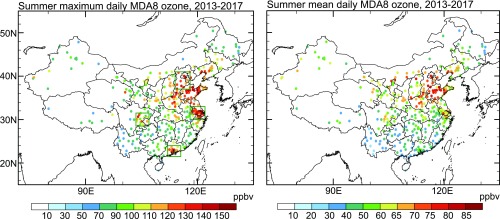
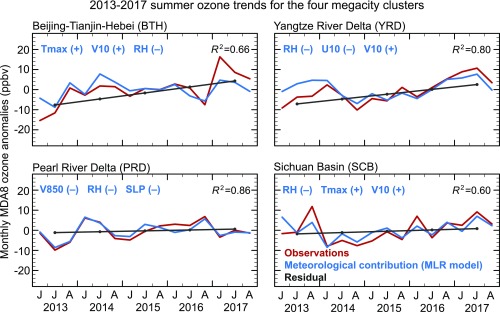
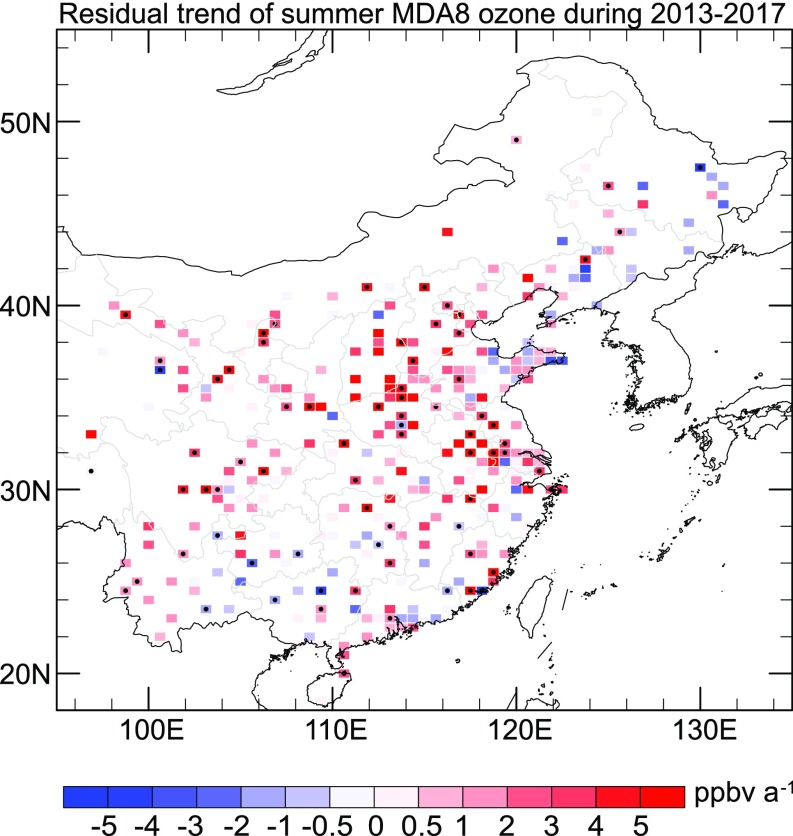
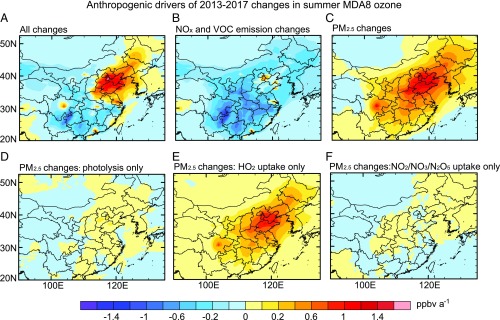
Significance: Drastic air pollution control in China since 2013 has achieved sharp decreases in fine particulate matter (PM 2.5 ), but ozone pollution has not improved. After removing the effect of meteorological variability, we find that surface ozone has increased in megacity clusters of China, notably Beijing and Shanghai. The increasing trend cannot be simply explained by changes in anthropogenic precursor [NO x and volatile organic compound (VOC)] emissions, particularly in North China Plain (NCP). The most important cause of the increasing ozone in NCP appears to be the decrease in PM 2.5 , slowing down the sink of hydroperoxy radicals and thus speeding up ozone production. Decreasing ozone in the future will require a combination of NO x and VOC emission controls to overcome the effect of decreasing PM 2.5 .
Overview
The claims and statistics of this paper haven’t been checked yet.
Free: it reads the open-access text and checks the first 5 claims that cite a source we can check. Create a free account to check every claim.
Integrity signals
Registry
Cites
Statistics
Figures
Verification
Claims the paper makes
The claims and statistics of this paper haven’t been checked yet.
Free: it reads the open-access text and checks the first 5 claims that cite a source we can check. Create a free account to check every claim.
Claims other papers make about this one
Each is checked against this paper’s own text: does it say what the citing paper says it does?
The cited source doesn’t support the claim as written.
In the citing paper
“a recent analysis of ground-level ozone concentrations measured at nearly 1,000 sites across China also found an increasing trend of summertime ozone in northeastern China from 2013 to 2017 (6).”
From Ozone pollution: A Major health hazard worldwide (2019) · cites this paper as [6]
Checked by a reasoning model — may be wrong.
Experimental — accuracy not yet measuredThe source backs part of the claim, not all of it — or backs it for a different population, condition or comparison.
In the citing paper
“Simulations with numerical models show several possible reasons including increases in UV radiation [31, 33–39], shifts in the VOC/NOx chemical regime resulting in increased production of O3 efficiency [35, 40], higher emissions of biogenic VOC due to rising temperatures [30], and decreased competition for gas-phase radicals by aerosol surfaces [34, 40], with reality likely being a combination of”
From Changes in tropospheric air quality related to the protection of stratospheric ozone in a changing climate (2023) · cites this paper as [34]
Experimental — accuracy not yet measuredThe source backs part of the claim, not all of it — or backs it for a different population, condition or comparison.
In the citing paper
“This increase was attributed to changes in anthropogenic emissions of ozone precursors as well as reductions in PM2.5 concentrations as described earlier.”
From Ozone pollution: A Major health hazard worldwide (2019) · cites this paper as [6]
Experimental — accuracy not yet measuredThe source backs part of the claim, not all of it — or backs it for a different population, condition or comparison.
In the citing paper
“anthropogenic emissions of NOx have decreased substantially in most urban areas of China (a 21% nationwide reduction) from 2013 to 2017 (6).”
From Ozone pollution: A Major health hazard worldwide (2019) · cites this paper as [6]
Experimental — accuracy not yet measuredThe cited source says what the claim attributes to it.
In the citing paper
“A recent study showed that a 40% reduction in PM2.5 from 2013 to 2017 in the North China Plain was partly responsible for an increasing ozone trend (at 1–3 ppb per year) during the period of 2013–2017 observed in megacity clusters of eastern China (6).”
From Ozone pollution: A Major health hazard worldwide (2019) · cites this paper as [6]
2 more claims about this paper
Create a free account to see every claim other papers make about this one.
Self-check
Percentages, sums and reported differences re-computed from the paper’s own numbers.
The self-check needs the paper’s full text.
Citations
Cites
Modern Applied Statistics with S
Venables, W. N., & Ripley, B. D. (2002) · Statistics and Computing · doi:10.1007/978-0-387-21706-2 · Cited by 24,305
The Modern-Era Retrospective Analysis for Research and Applications, Version 2 (MERRA-2)
Gelaro, R., McCarty, W., Suárez, M. J., Todling, R., Molod, A., Takacs, L., Randles, C. A., Darmenov, A., Bosilovich, M. G., Reichle, R., et al. (2017) · Journal of Climate · doi:10.1175/jcli-d-16-0758.1 · Cited by 9,010 · cited 2×
“Meteorological data from the NASA MERRA-2 reanalysis (23) with 0.”
MethodTrends in China's anthropogenic emissions since 2010 as the consequence of clean air actions
Zheng, B., Tong, D., Li, M., Liu, F., Hong, C., Geng, G., Li, H., Li, X., Peng, L., Qi, J., et al. (2018) · Atmospheric Chemistry and Physics · doi:10.5194/acp-18-14095-2018 · Cited by 2,916 · cited 9×
“The MEIC emission inventory is developed and managed by researchers at Tsinghua University.”
BackgroundMethodInfluentialSelf-citationModern Applied Statistics with S,
Kemp, F. (2003) · Journal of the Royal Statistical Society: Series D (The Statistician) · doi:10.1046/j.1467-9884.2003.t01-19-00383_22.x · Cited by 2,320
Effect of climate change on air quality
Jacob, D. J., & Winner, D. A. (2009) · Atmospheric Environment · doi:10.1016/j.atmosenv.2008.09.051 · Cited by 1,979 · cited 1×
“These variables are frequently observed to be correlated with ozone air quality (24) and can be viewed as general indicators of stagnation.”
BackgroundSelf-citationWang, T., Xue, L., Brimblecombe, P., Lam, Y. F., Li, L., & Zhang, L. (2017) · Science of The Total Environment · doi:10.1016/j.scitotenv.2016.10.081 · Cited by 1,876 · cited 5×
“A number of previous studies have examined meteorological influences on ozone variability in China (4, 9, 39, 40), On the basis of these studies we considered the correlation of MDA8 ozone across China with a large number of candidate meteorological variables from the MERRA-2 archive (SI Appendix, Table S3 and Fig.”
BackgroundInfluentialLi, M., Zhang, Q., Kurokawa, J.-I., Woo, J.-H., He, K., Lu, Z., Ohara, T., Song, Y., Streets, D. G., Carmichael, G. R., et al. (2017) · Atmospheric Chemistry and Physics · doi:10.5194/acp-17-935-2017 · Cited by 1,616
Self-citationHeterogeneous chemistry and tropospheric ozone
Jacob, D. (2000) · Atmospheric Environment · doi:10.1016/s1352-2310(99)00462-8 · Cited by 1,289 · cited 3×
“The relevant aerosol chemistry involves reactive uptake of the gaseous precursors to ozone formation, as described in GEOS-Chem by firstorder reactive uptake coefficients γ (32).”
BackgroundMethodInfluentialSelf-citationTai, A. P. K., Mickley, L. J., & Jacob, D. J. (2010) · Atmospheric Environment · doi:10.1016/j.atmosenv.2010.06.060 · Cited by 1,048
Self-citationSevere Surface Ozone Pollution in China: A Global Perspective
Lu, X., Hong, J., Zhang, L., Cooper, O. R., Schultz, M. G., Xu, X., Wang, T., Gao, M., Zhao, Y., & Zhang, Y. (2018) · Environmental Science & Technology Letters · doi:10.1021/acs.estlett.8b00366 · Cited by 1,040 · cited 1×
“5) concentration has decreased significantly since then, but ozone pollution has not decreased and is seemingly getting worse (8, 16).”
Background
Cited by
Items 601–700 of 1,003
Relationships between ozone and particles during air pollution episodes in arid continental climate
Sicard, P., Khaniabadi, Y. O., Leca, Ș., & Marco, A. D. (2023) · Atmospheric Pollution Research · doi:10.1016/j.apr.2023.101838 · Cited by 25
Zhao, K., Yuan, Z., Wu, Y., Huang, J., Yang, F., Zhang, X., Huang, D., & Jiang, R. (2023) · Atmospheric Research · doi:10.1016/j.atmosres.2023.107025 · Cited by 25
The atmospheric oxidizing capacity in China – Part 1: Roles of different photochemical processes
Dai, J., Brasseur, G. P., Vrekoussis, M., Kanakidou, M., Qu, K., Zhang, Y., Zhang, H., & Wang, T. (2023) · Atmospheric chemistry and physics · doi:10.5194/acp-23-14127-2023 · Cited by 30
“In some cases, studies have provided some explanation for the causes of these trends (Li et al., 2019a; Liu and Wang et al., 2020), specifically in the most polluted areas, or have proposed some mitigation strategies (Li et al., 2019b .”
BackgroundTrends of peroxyacetyl nitrate and its impact on ozone over 2018–2022 in urban atmosphere
Lin, Z., Xu, L., Yang, C. G., Chen, G., Ji, X., Li, L., Zhang, K., Hong, Y., Li, M., Fan, X., et al. (2024) · npj Climate and Atmospheric Science · doi:10.1038/s41612-024-00746-7 · Cited by 29
“Instead, the decreasing NO 2 over the study years could reduce PAN production, while other studies have indicated that NO 2 reduction would increase O 3 in VOC-limited urban areas by reducing the titrationeffectofO 3 20,36,37 .”
Discrepant Global Surface Ozone Responses to Emission- and Heatwave-Induced Regime Shifts
Tao, C., Zhang, Y., Zhang, X., Guan, X., Peng, Y., Wang, G., Zhang, Q., Ren, Y., Zhao, X., Zhao, R., et al. (2024) · Environmental Science & Technology · doi:10.1021/acs.est.4c08422 · Cited by 26
Self-citationCheng, Y., Yu, Q., Liu, J., Zhu, S., Zhang, M., Zhang, H., Zheng, B., & He, K. (2020) · Environmental Pollution · doi:10.1016/j.envpol.2020.116167 · Cited by 24
“5 concentration (Li et al., 2019b; Wei et al., 2019; Zhai et al., 2019; Zhang et al., 2019).”
BackgroundResultZhang, J., Ran, H., Guo, Y., Xue, C., Liu, X., Qu, Y., Sun, Y., Zhang, Q., Mu, Y., Chen, Y., et al. (2021) · The Science of The Total Environment · doi:10.1016/j.scitotenv.2021.149929 · Cited by 24
Self-citationWang, W., Zhang, W., Hu, D., Li, L., Cui, L., Liu, J., Liu, S., Xu, J., Wu, S., Deng, F., et al. (2021) · Journal of Hazardous Materials · doi:10.1016/j.jhazmat.2021.127462 · Cited by 25
Xu, D., Yuan, Z., Wang, M., Zhao, K., Liu, X., Duan, Y., Fu, Q., Wang, Q., Jing, S., Wang, H., et al. (2021) · Environment International · doi:10.1016/j.envint.2021.106952 · Cited by 24
Li, Y., Shi, G., & Chen, Z. (2021) · Environmental Research Letters · doi:10.1088/1748-9326/ac3794 · Cited by 24
Chen, J., Xu, W., Li, X., Wang, C., Hu, Z., & Jia, H. (2021) · Journal of Hazardous Materials · doi:10.1016/j.jhazmat.2021.128097 · Cited by 24
Li, X., Zhang, F., Ren, J., Han, W., Zheng, B., Liu, J., Chen, L., & Jiang, S. (2022) · Environmental Pollution · doi:10.1016/j.envpol.2022.119146 · Cited by 26
Conibear, L., Reddington, C. L. S., Silver, B. J., Chen, Y., Knote, C., Arnold, S. R., & Spracklen, D. V. (2022) · GeoHealth · doi:10.1029/2021gh000570 · Cited by 23
Explainable and spatial dependence deep learning model for satellite-based O3 monitoring in China
Luo, N., Zang, Z., Yin, C., Liu, M., Jiang, Y., Chen, Z., Zhao, W., Shi, W., & Yan, X. (2022) · Atmospheric Environment · doi:10.1016/j.atmosenv.2022.119370 · Cited by 24
Wei, N., Zhao, W., Yao, Y., Wang, H., Liu, Z., Xu, X., Rahman, M. M., Zhang, C., Fittschen, C., & Zhang, W. (2023) · The Science of The Total Environment · doi:10.1016/j.scitotenv.2023.166355 · Cited by 24
Shao, M., Lv, S., Wei, Y., & Zhu, J. (2024) · The Science of The Total Environment · doi:10.1016/j.scitotenv.2024.173497 · Cited by 24
Liu, R., Wang, T., Yao, Y., Lv, X.-Y., Hu, Y., Chen, X., Tang, X., Zhong, Z.-H., Fu, L., Luo, X., et al. (2024) · Human Reproduction Open · doi:10.1093/hropen/hoae051 · Cited by 30
“This aligned with findings in both naturally conceived populations (Li et al. , 2019b; Liang et al. , 2019; Zhao et al. , 2021) and assisted reproductive populations of other studies (Wang et al. , 2019; Jin et al. , 2022; Liu et al. , 2022; Zhang et al. , 2022; Wang et al. , 2023b).”
BackgroundResultFang, T., Zhu, Y., Jang, J.-C. C., Wang, S., Xing, J., Chiang, P., Fan, S., You, Z., & Li, J. (2020) · Journal of Environmental Management · doi:10.1016/j.jenvman.2020.110650 · Cited by 24
Gao, S., Bai, Z., Liang, S., Yu, H., Chen, L., Sun, Y., Mao, J., Zhang, H., Ma, Z., Azzi, M., et al. (2021) · Atmospheric Environment · doi:10.1016/j.atmosenv.2021.118599 · Cited by 26
Evaluating the Impacts of Ground-Level O3 on Crops in China
Zhao, H., Zhang, Y., Qi, Q., & Zhang, H. (2021) · Current Pollution Reports · doi:10.1007/s40726-021-00201-8 · Cited by 24
“5 in eastern China [11, 12], but ground-level O3 is becoming more and more serious, and it has replaced PM2.”
BackgroundInfluentialZheng, Y., Jiang, F., Feng, S., Shen, Y., Liu, H., Guo, H. F., Lyu, X., Jia, M., & Lou, C. (2023) · Environmental Science and Ecotechnology · doi:10.1016/j.ese.2023.100322 · Cited by 24
Wang, Z., Shi, C., Zhang, H., Ji, X., Zhu, Y., Xia, C., Sun, X., Lin, X., Yan, S., Wang, S., et al. (2025) · Atmospheric chemistry and physics · doi:10.5194/acp-25-347-2025 · Cited by 23
“Tracer-driven linear regression models have been widely used to separate primary and secondary sources of HCHO (Lin et al., 2022; Sun et al., 2021; Hong et al., 2018; Liu et al., 2024; Bao et al., 2022; Heue et al., 2014; MacDon-ald et al., 2012 .”
InfluentialLi, J., Gao, Y., & Huang, X. (2019) · The Science of The Total Environment · doi:10.1016/j.scitotenv.2019.135458 · Cited by 23
Kuang, Y., & Shang, J. (2020) · Environmental Pollution · doi:10.1016/j.envpol.2020.115273 · Cited by 23
Zhang, W., Zou, Y., Zheng, X., Wang, N., Yan, H., Chen, Y. P., Zhao, X., Ji, Z.-P., Li, F., Mai, B., et al. (2020) · Atmospheric Environment · doi:10.1016/j.atmosenv.2020.117898 · Cited by 27
Weakened Aerosol‐PBL Interaction During COVID‐19 Lockdown in Northern China
Wang, Z., Huang, X., Ding, K., Ren, C., Cao, L., Zhou, D., Gao, J. G., & Ding, A. (2020) · Geophysical Research Letters · doi:10.1029/2020gl090542 · Cited by 23
Analysis of Spatio-Temporal Variation Characteristics of Main Air Pollutants in Shijiazhuang City
Tui, Y., Qiu, J., Ju, W., & Fang, C. (2021) · Sustainability · doi:10.3390/su13020941 · Cited by 23
Song, Y., Lin, C., Li, Y., Lau, A. K. H., Fung, J. C. H., Lu, X., Guo, C., Ma, J., & Lao, X. Q. (2021) · Atmospheric Environment · doi:10.1016/j.atmosenv.2021.118270 · Cited by 23
ROx Budgets and O3 Formation during Summertime at Xianghe Suburban Site in the North China Plain
Xue, M., Ma, J., Tang, G., Tong, S., Hu, B., Zhang, X., Li, X., & Wang, Y. (2021) · Advances in Atmospheric Sciences · doi:10.1007/s00376-021-0327-4 · Cited by 23
A study of cross-correlations between PM 2.5 and O3 based on Copula and Multifractal methods
Zhang, J., Li, Y., Liu, C., Wu, B., & Shi, K. (2021) · Physica A Statistical Mechanics and its Applications · doi:10.1016/j.physa.2021.126651 · Cited by 23
Chen, Y., Han, H., Zhang, M., Zhao, Y., Huang, Y., Zhou, M., Wang, C., He, G., Huang, R., Luo, B., et al. (2021) · Atmosphere · doi:10.3390/atmos12121557 · Cited by 23
Zhang, Y., Lei, R., Cui, S., Wang, H., Chen, M., & Ge, X. (2021) · Chinese Science Bulletin (Chinese Version) · doi:10.1360/tb-2021-0767 · Cited by 30
Exposure Risk of Global Surface O3 During the Boreal Spring Season
Zhou, Y., Duan, W., Chen, Y., Yi, J., Wang, B., Di, Y., & He, C. (2022) · Exposure and Health · doi:10.1007/s12403-022-00463-7 · Cited by 24
Ji, W., Zhao, K., & Zhao, B. (2022) · Building and Environment · doi:10.1016/j.buildenv.2022.109146 · Cited by 24
Response of Summer Ozone to Precursor Emission Controls in the Yangtze River Delta Region
Mao, Y., Yu, S., Shang, Y., Liao, H., & Li, N. (2022) · Frontiers in Environmental Science · doi:10.3389/fenvs.2022.864897 · Cited by 23
Self-citationGong, C., Wang, Y., Liao, H., Wang, P., Jin, J., & Han, Z. (2022) · Earth s Future · doi:10.1029/2022ef002671 · Cited by 24
“The GEOS-Chem model is a state-of-art 3D global chemistry transport model with good capabilities in simulating the spatiotemporal variations in gas phase pollutants and aerosols (Dang & Liao, 2019; Li et al., 2019; Porter & Heald, 2019).”
BackgroundMethodSelf-citationKalbande, R., Yadav, R., Maji, S., Rathore, D. S., & Beig, G. (2022) · Atmospheric Pollution Research · doi:10.1016/j.apr.2022.101515 · Cited by 23
Zhang, X., Osei, F., Stein, A., Cheng, C., & Maji, K. J. (2022) · Journal of Cleaner Production · doi:10.1016/j.jclepro.2022.133938 · Cited by 23
Zheng, X., Javed, Z., Liu, C., Tanvir, A., Sandhu, O., Liu, H., Ji, X., Xing, C., Lin, H. L., & Du, D. (2022) · Journal of Environmental Sciences · doi:10.1016/j.jes.2022.09.014 · Cited by 23
Causes of the unexpected slowness in reducing winter PM2.5 for 2014–2018 in Henan Province
Chen, X., Li, X., Li, X., Li, S., Li, S., Chen, G., Chen, Z., Dai, S., Bin, J., & Tang, Y. (2022) · Environmental Pollution · doi:10.1016/j.envpol.2022.120928 · Cited by 23
Xie, H., Gao, W., Zhao, W., Han, Y., Gao, Y., Liu, B., & Han, Y. (2023) · The Science of The Total Environment · doi:10.1016/j.scitotenv.2023.164098 · Cited by 23
Hui, L., Feng, X., Yuan, Q., Chen, Y., Yang, X., Zheng, P., Lee, S., & Wang, Z. (2023) · Environmental Pollution · doi:10.1016/j.envpol.2023.122287 · Cited by 25
Wu, S., Yan, X., Yao, J., & Zhao, W. (2023) · Environmental Pollution · doi:10.1016/j.envpol.2023.122517 · Cited by 24
Liu, N., He, G., Wang, H., He, C., Wang, H., Liu, C., Wang, Y., Wang, H., Li, L., Lu, X. H., et al. (2023) · Journal of Environmental Sciences · doi:10.1016/j.jes.2023.09.024 · Cited by 25
Yue, M., Dong, X., Wang, M., Emmons, L. K., Liang, Y., Tong, D., Liu, Y., & Liu, Y. (2023) · Journal of Geophysical Research Atmospheres · doi:10.1029/2023jd039130 · Cited by 25
“The Chinese National Ambient Air Quality Standard (CNAAQS) for MDA8 ozone is 160 μg/m 3 , corresponding to 82 ppbv at 298 K and 1,013 hPa (K. Li et al., 2019 have found ozone responds to changes in precursor concentrations nonlinearly (Atkinson, 2000; Sillman, 1999), and grid spacing has a…”
BackgroundShang, B., Agathokleous, E., Calatayud, V., Peng, J., Xu, Y., Li, S., Liu, S., & Feng, Z. (2024) · Plant Cell & Environment · doi:10.1111/pce.14808 · Cited by 25
Chen, G., Ji, X., Chen, J., Xu, L., Hu, B., Lin, Z., Fan, X., Li, M., Hong, Y., & Chen, J. (2024) · Atmospheric Research · doi:10.1016/j.atmosres.2024.107270 · Cited by 25
Long-term variations of air pollutants and public exposure in China during 2000–2020
Zhang, R., Zhu, S., Zhang, Z., Zhang, H., Tian, C., Wang, S., Wang, P., & Zhang, H. (2024) · The Science of The Total Environment · doi:10.1016/j.scitotenv.2024.172606 · Cited by 24
Jin, L., Yuan, B., Yang, S., Peng, Y., Chen, W., Xie, Q., Wu, Y., Huang, Z., Zheng, J., Wang, X., et al. (2024) · The Science of The Total Environment · doi:10.1016/j.scitotenv.2024.173011 · Cited by 24
Zou, Q., Song, H., Tang, M., & Lu, K. (2019) · Chinese Chemical Letters · doi:10.1016/j.cclet.2019.07.041 · Cited by 24
Fischer, T. (2019) · Outlook on Agriculture · doi:10.1177/0030727019868484 · Cited by 23
“It is worthwhile noting that recent significant reductions in aerosols in eastern China were associated with increased levels of O3, an effect adequately explained by interactions of O3 precursors with aerosols in the atmosphere (Li et al., 2019; Simpson et al., 2014).”
BackgroundSeasonal characterization of aerosol composition and sources in a polluted city in Central China
Wang, Q., Li, J., Yang, J., Chen, Y., Li, Y., Li, S., Xie, C., Chen, C., Wang, L., Wang, L., et al. (2020) · Chemosphere · doi:10.1016/j.chemosphere.2020.127310 · Cited by 25
Lyu, Y., Wu, H., Liu, X., Han, F., Lv, F., Pang, X., & Chen, J. (2024) · Geophysical Research Letters · doi:10.1029/2023gl106527 · Cited by 22
Photolysis rate in the Beijing-Tianjin-Hebei region: Reconstruction and long-term trend
Zhao, S., Hu, B., Du, C., Liu, H., Li, M., Liu, J., Wang, Q., Xia, X., & Wang, Y. (2021) · Atmospheric Research · doi:10.1016/j.atmosres.2021.105568 · Cited by 22
Characteristics of air quality in different climatic zones of China during the COVID-19 lockdown
Wang, H., Tan, Y., Zhang, L., Shen, L., Zhao, T., Dai, Q., Guan, T., Ke, Y., & Li, X. (2021) · Atmospheric Pollution Research · doi:10.1016/j.apr.2021.101247 · Cited by 23
Self-citationHu, X.-M., Zhang, J., Xue, W., Zhou, L., Che, Y., & Han, T. (2022) · Atmosphere · doi:10.3390/atmos13040632 · Cited by 22
Chen, W., Guenther, A., Shao, M., Yuan, B., Jia, S., Mao, J., Yan, F., Krishnan, P., & Wang, X. (2022) · Environmental Pollution · doi:10.1016/j.envpol.2022.119254 · Cited by 23
Ou, S., Wei, W., Cheng, S., & Cai, B. (2022) · Journal of Environmental Sciences · doi:10.1016/j.jes.2022.06.023 · Cited by 22
Ensemble source apportionment of air pollutants and carbon dioxide based on online measurements
Wang, Z., Yu, H., Liang, W., Wang, F., Wang, G., Chen, D., Wang, W., Zhao, H., Feng, Y., Shi, Z., et al. (2022) · Journal of Cleaner Production · doi:10.1016/j.jclepro.2022.133468 · Cited by 22
Liu, S., Zhao, W.-H., Li, L., Jin, J., Li, T.-Z., Xu, H., & Zhao, W. (2022) · Atmospheric Pollution Research · doi:10.1016/j.apr.2022.101638 · Cited by 22
Rapid N 2 O Formation from N 2 on Water Droplet Surfaces
Jiang, Q., Xia, D., Li, X., Zhang, H., Yin, R., Xie, H., Xie, H., Jiang, J., Chen, J., & Francisco, J. S. (2025) · Angewandte Chemie International Edition · doi:10.1002/anie.202421002 · Cited by 26
Cao, Y., Qiao, X., Hopke, P. K., Ying, Q., Zhang, Y., Zeng, Y., Yuan, Y., & Ya, T. (2020) · Chemosphere · doi:10.1016/j.chemosphere.2020.127008 · Cited by 22
Impact of SARS-CoV-2 lockdown and de-escalation on air-quality parameters
Viteri, G., Díaz-de-Mera, Y., Rodríguez, A., Rodríguez, D., Tajuelo, M., Escalona, A., & Aranda, A. (2020) · Chemosphere · doi:10.1016/j.chemosphere.2020.129027 · Cited by 25
Lu, C., Mao, J., Wang, L., Guan, Z., Zhao, G., & Li, M. (2020) · Journal of Environmental Sciences · doi:10.1016/j.jes.2020.11.030 · Cited by 22
Temporal variability in the impacts of particulate matter on crop yields on the North China Plain
Wolffe, M. C., Wild, O., Long, S. P., & Ashworth, K. (2021) · The Science of The Total Environment · doi:10.1016/j.scitotenv.2021.145135 · Cited by 23
“…pollution has decreased in the NCP, ozone pollution has increased (Zeng et al., 615 2019), and while this principally reflects a reduction in NOx emissions, it has also been partly attributed to 616 increased light intensity increasing the rate of photochemical formation of ozone (Li et al., 2019).”
Background(2019) · Nature Geoscience · doi:10.1038/s41561-019-0406-7 · Cited by 22
Wang, Y., Ding, D., Kang, N., Xu, Z., Yuan, H., Ji, X., Dou, Y., Guo, L., Shu, M., & Wang, X. (2024) · The Science of The Total Environment · doi:10.1016/j.scitotenv.2024.178103 · Cited by 24
Ma, X., Morawska, L., Zou, B., Gao, J., Deng, J., Wang, X., Wu, H., Xu, X., Wang, Y., Tan, Z., et al. (2025) · Environment International · doi:10.1016/j.envint.2025.109378 · Cited by 23
Huang, L., Zhang, X., Emery, C. A., Mu, Q., Yarwood, G., Zhai, H., Sun, Z., Xue, S., Wang, Y., Fu, J. S., et al. (2025) · Atmospheric chemistry and physics · doi:10.5194/acp-25-4233-2025 · Cited by 21
Qin, J., Wang, S., Guo, L., & Xu, J. (2020) · International Journal of Environmental Research and Public Health · doi:10.3390/ijerph17051598 · Cited by 21
“The air pollution issue has attracted increasing attention of all aspects of the society [4,5].”
BackgroundCurrent Status and Future Directions of Tropospheric Photochemical Ozone Studies in Korea
Lee, G., Park, J., Kim, D.-G., Koh, M. S., Lee, M., Han, J.-S., & Kim, J.-C. (2020) · Journal of Korean Society for Atmospheric Environment · doi:10.5572/kosae.2020.36.4.419 · Cited by 22
Yan, Y., Liu, Z., Gao, W., Li, J., Zhang, X., Chai, W., Bai, J. M., Hu, B., & Wang, Y. (2020) · Atmospheric Research · doi:10.1016/j.atmosres.2020.105291 · Cited by 23
Irie, H., Yonekawa, D., Damiani, A., Hoque, H. M. S., Sudo, K., & Itahashi, S. (2021) · Progress in Earth and Planetary Science · doi:10.1186/s40645-021-00424-9 · Cited by 21
Jing, D., Cheng, N., Zhang, C., Chen, Z., Cai, X., Li, S., Zhao, J., Wang, Q., & Li, W. (2022) · Journal of Environmental Sciences · doi:10.1016/j.jes.2021.08.056 · Cited by 21
Jiang, Y.-H., Li, B., He, H.-D., Li, X., Wang, D., & Peng, Z. (2022) · Atmospheric Environment · doi:10.1016/j.atmosenv.2022.119084 · Cited by 24
Evaporative emission characteristics of high-mileage gasoline vehicles
Li, J., Ge, Y., Wang, X., & Zhang, M. (2022) · Environmental Pollution · doi:10.1016/j.envpol.2022.119127 · Cited by 22
Liao, Z., Pan, Y., Ma, P., Jia, X., Cheng, Z., Wang, Q., Dou, Y., Zhao, X., Zhang, J., & Quan, J. (2022) · Atmospheric Environment · doi:10.1016/j.atmosenv.2022.119566 · Cited by 21
Zhu, Q. S., Yu, Y., Gong, H., Wang, Y., Wang, H., Wang, W., Xu, B., & Cheng, T. (2023) · Frontiers in Environmental Science · doi:10.3389/fenvs.2022.1104013 · Cited by 22
“peroxide radicals can promote O3 formation (Li et al., 2019).”
BackgroundMethodCheng, M., Fang, F., Navon, I. M., Zheng, J., Zhu, J., & Pain, C. C. (2023) · The Science of The Total Environment · doi:10.1016/j.scitotenv.2023.163146 · Cited by 22
Lu, Z., Guan, Y., Shao, C., & Niu, R. (2023) · Ecotoxicology and Environmental Safety · doi:10.1016/j.ecoenv.2023.115125 · Cited by 26
Elucidate long-term changes of ozone in Shanghai based on an integrated machine learning method
Xue, J., Wang, F., Zhang, K., Zhai, H., Jin, D., Duan, Y., Yaluk, E. A., Wang, Y., Huang, L., Li, Y., et al. (2023) · Frontiers of Environmental Science & Engineering · doi:10.1007/s11783-023-1738-5 · Cited by 21
“CTMs involve manipulating emission inventories and meteorological fields to characterize the impact of emissions and meteorology on air quality, as demonstrated by previous studies (Li et al., 2019; Xu et al., 2019; Liu and Wang, 2020a, 2020b; Dang et al., 2021).”
BackgroundMethodInfluentialInvestigation of the multi-year trend of surface ozone and ozone-precursor relationship in Hong Kong
Feng, X., Guo, J., Wang, Z., Gu, D., Ho, K., Chen, Y., Liao, K., Cheung, V. T. F., Louie, P. K. K., Leung, K. K. M., et al. (2023) · Atmospheric Environment · doi:10.1016/j.atmosenv.2023.120139 · Cited by 25
Local radical chemistry driven ozone pollution in a megacity: A case study
Guo, J., Zhang, G., Hu, R., Xie, P., Hu, C., Cai, H., Wang, Y., Tang, H., Li, X., Huang, X., et al. (2023) · Atmospheric Environment · doi:10.1016/j.atmosenv.2023.120227 · Cited by 21
Wintertime Heavy Haze Episodes in Northeast China Driven by Agricultural Fire Emissions
Xie, X., Zhang, Y., Liang, R., Chen, W., Zhang, P., Wang, X., Zhou, Y. C., Cheng, Y., & Liu, J. (2024) · Environmental Science & Technology Letters · doi:10.1021/acs.estlett.3c00940 · Cited by 21
Meteorological influence on persistent O3 pollution events in Wuxi in the Yangtze River Delta, China
Shen, L., Diao, Y., Zhao, T., Gu, X., & Shi, S. S. (2024) · The Science of The Total Environment · doi:10.1016/j.scitotenv.2024.170484 · Cited by 21
Self-citationSpatiotemporal Associations between PM2.5 and SO2 as well as NO2 in China from 2015 to 2018
Li, K., & Bai, K. (2019) · International Journal of Environmental Research and Public Health · doi:10.3390/ijerph16132352 · Cited by 21
Self-citationZhang, Y., Tao, M., Zhang, J., Liu, Y., Chen, H., Cai, Z., & Konopka, P. (2020) · Atmospheric chemistry and physics · doi:10.5194/acp-20-13343-2020 · Cited by 21
The influence of meteorology and emissions on the spatio-temporal variability of PM10 in Malaysia
Alifa, M., Bolster, D., Mead, M. I., Latif, M. T., & Crippa, P. (2020) · Atmospheric Research · doi:10.1016/j.atmosres.2020.105107 · Cited by 24
Extending Ozone‐Precursor Relationships in China From Peak Concentration to Peak Time
Qu, H., Wang, Y., Zhang, R., & Li, J. (2020) · Journal of Geophysical Research Atmospheres · doi:10.1029/2020jd033670 · Cited by 21
“Figure 3 shows that the simulation results are very close to the observations for the NW and NCP regions, implying good emission estimation, consistent with previous studies (Guo et al., 2019; Li et al., 2018).”
ResultQiao, X., Liu, L., Yang, C., Yuan, Y., Zhang, M., Guo, H., Ya, T., Ying, Q., Zhu, S., & Zhang, H. (2021) · Environmental Pollution · doi:10.1016/j.envpol.2021.116793 · Cited by 22
LESO: A ten-year ensemble of satellite-derived intercontinental hourly surface ozone concentrations
Zhu, S., Xu, J., Zeng, J., Yu, C., Wang, Y., Wang, H., & Shi, J. (2023) · Scientific Data · doi:10.1038/s41597-023-02656-4 · Cited by 23
Global patterns and trends in ground-level ozone chemical formation regimes from 1996 to 2022
Tian, Y., Wang, S., & Jin, X. (2025) · Atmospheric chemistry and physics · doi:10.5194/acp-25-9127-2025 · Cited by 23
“Second, HCHO is used as an indicator of VOCs, but the yield of HCHO from oxidation of VOCs varies with different species (Shen et al., 2019; Chan Miller et al., 2016; Zhu et al., 2014).”
Bao, J., Li, X., Kong, L., Li, J., Chen, Q., & Zhang, Y. (2025) · npj Clean Air · doi:10.1038/s44407-025-00023-8 · Cited by 24
“In contrast, Li et al. 50 reported that VOC emissions in China increased from 9.76 Tg in 1990 to 28.5 Tg in 2017.”
InfluentialCycling of Gaseous Reactive Nitrogen Oxides and Its Role in Driving Secondary Pollution
Wang, S., Meng, Z., Zhang, P., Chen, T., Chu, B., Ma, Q., Wang, Y., Chen, C., Wang, S., Zhao, J., et al. (2025) · Environmental Science & Technology · doi:10.1021/acs.est.5c11062 · Cited by 20
Feng, R., & Zheng, H. (2019) · Environmental Chemistry Letters · doi:10.1007/s10311-019-00890-0 · Cited by 21
Urban ozone sink inferred from surface measurements in China
Zhang, X., Zhao, L., Cheng, M., Wu, X., & Chen, D. (2019) · Journal of Cleaner Production · doi:10.1016/j.jclepro.2019.119881 · Cited by 20
Zhao, R., Yin, B., Zhang, N., Wang, J., Geng, C., Wang, X., Han, B., Li, K., Li, P., Yu, H., et al. (2021) · The Science of The Total Environment · doi:10.1016/j.scitotenv.2020.144818 · Cited by 20
Self-citationObservation-based sources evolution of non-methane hydrocarbons (NMHCs) in a megacity of China
Peng, Y., Wang, H., Wang, Q., Jing, S., An, J., Gao, Y., Huang, C. Y., Yan, R., Dai, H., Cheng, T., et al. (2022) · Journal of Environmental Sciences · doi:10.1016/j.jes.2022.01.040 · Cited by 20
Self-citationLin, Y., Fan, Q., Zhang, L., Meng, H., Gao, Y., Gao, H., & Yao, X. (2022) · Atmospheric chemistry and physics · doi:10.5194/acp-22-16073-2022 · Cited by 21
Yin, S., Liu, Y., Ma, W., Li, C., Zheng, C., Zhang, Y., Yan, F., Zhai, R., Deng, Y., Wang, Z., et al. (2023) · Atmospheric Environment · doi:10.1016/j.atmosenv.2023.119908 · Cited by 23
Metadata
- Authors
- Li, K., Jacob, D. J., Liao, H., Shen, L., Zhang, Q., & Bates, K. H.
- Affiliations
- Harvard University (US)
- Nanjing University of Information Science and Technology (CN)
- Tsinghua University (CN)
- Corresponding author
- Jacob, Daniel J.
- Liao, Hong
- Venue
- Proceedings of the National Academy of Sciences
- Publisher
- National Academy of Sciences
- Published
- 2018-12-31
- Volume
- 116
- Issue
- 2
- Pages
- 422-427
- ISSN
- 0027-8424 (ISSN-L)
- 1091-6490
- PMC
- PMC6329973
- OpenAlex
- W2908510209
- Cited by
- 1,804
- References
- 45
- Citations by year
- 2026: 164 · 2025: 191 · 2024: 203 · 2023: 263 · 2022: 348 · 2021: 326 · 2020: 224 · 2019: 80 · 2018: 1
- FWCI
- 76.82
- Type
- journal article
- Language
- en
- Open access
- hybrid
- doi.org
- Licence
- Locations
- Proceedings of the National Academy of Sciences (publishedVersion, cc-by-nc-nd)
- Europe PMC (PubMed Central) (publishedVersion, cc-by-nc-nd)
- PubMed Central (publishedVersion, cc-by-nc-nd)
- PubMed (publishedVersion)
- Funders
- National Natural Science Foundation of China (91744311)
- Topics
- Physical Sciences › Earth and Planetary Sciences › Atmospheric Science › Atmospheric chemistry and aerosols
- Physical Sciences › Earth and Planetary Sciences › Atmospheric Science › Atmospheric Ozone and Climate
- Physical Sciences › Environmental Science › Global and Planetary Change › COVID-19 impact on air quality
- Keywords
- surface ozone trends, anthropogenic factors, PM2.5 reduction, NOx emissions, volatile organic compounds, hydroperoxyl radical, ozone sink, ozone formation, North China Plain, air pollution control, weather variability, Beijing, Shanghai
- MeSH terms
- Air, Air Pollutants, Air Pollution, China, Humans, Ozone, Urban Renewal, Volatile Organic Compounds
About these checks
Registry, retraction, Cites and statistics results are computed, not judged, with one exception: a printed reference that no index lists is read once by a model before it counts as a citation error. Claims are extracted by a model and kept only when their quote appears verbatim in the text; each cited source is then checked, with a model’s help, for whether it says what the claim relies on. Those verdicts can be wrong — read the claim’s quote and the cited source before relying on one.
Statistics and arithmetic are recomputed, not judged.
Confidence bands are shown only for fields calibrated on our annotated test set. None is calibrated yet, so no band is shown.
What counts as a claim ›How we measure confidence ›How we check this ›
Are you an author, or do you see a problem with this page? Request a review
Data sources
Bibliographic data: Semantic Scholar, OpenAlex, Crossref.
Contains information from the Semantic Scholar Academic Graph Datasets, made available under the ODC Attribution License (ODC-BY 1.0).
Semantic Scholar’s data is described in: Kinney, R., et al. (2023). The Semantic Scholar Open Data Platform. arXiv:2301.10140.
