

Anthropogenic drivers of 2013–2017 trends in summer surface ozone in China
Open accessThe DOI matches its Crossref record; 45 of the 45 references it cites were found in a registry or an index.
Abstract
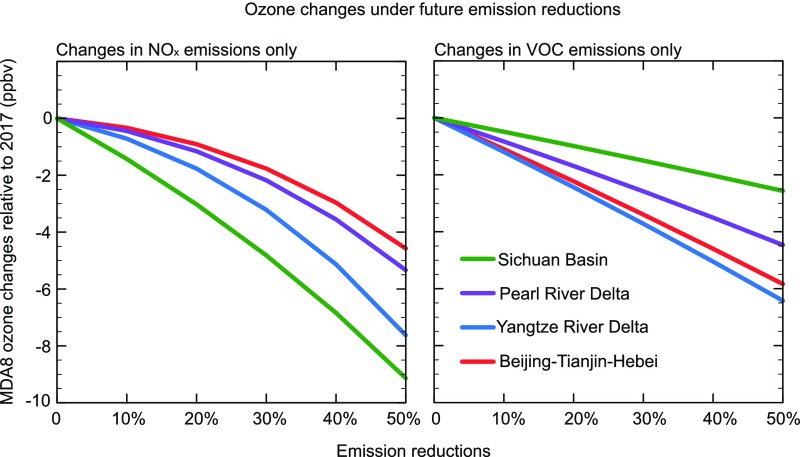
Significance: Drastic air pollution control in China since 2013 has achieved sharp decreases in fine particulate matter (PM 2.5 ), but ozone pollution has not improved. After removing the effect of meteorological variability, we find that surface ozone has increased in megacity clusters of China, notably Beijing and Shanghai. The increasing trend cannot be simply explained by changes in anthropogenic precursor [NO x and volatile organic compound (VOC)] emissions, particularly in North China Plain (NCP). The most important cause of the increasing ozone in NCP appears to be the decrease in PM 2.5 , slowing down the sink of hydroperoxy radicals and thus speeding up ozone production. Decreasing ozone in the future will require a combination of NO x and VOC emission controls to overcome the effect of decreasing PM 2.5 .
Overview
The claims and statistics of this paper haven’t been checked yet.
Free: it reads the open-access text and checks the first 5 claims that cite a source we can check. Create a free account to check every claim.
Integrity signals
Registry
Cites
Statistics
Figures
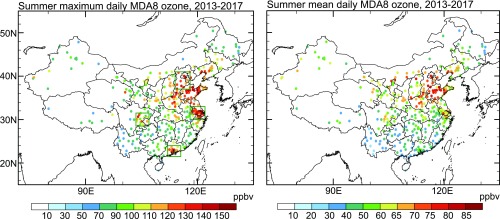
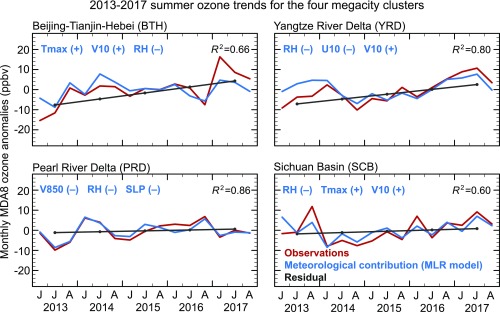
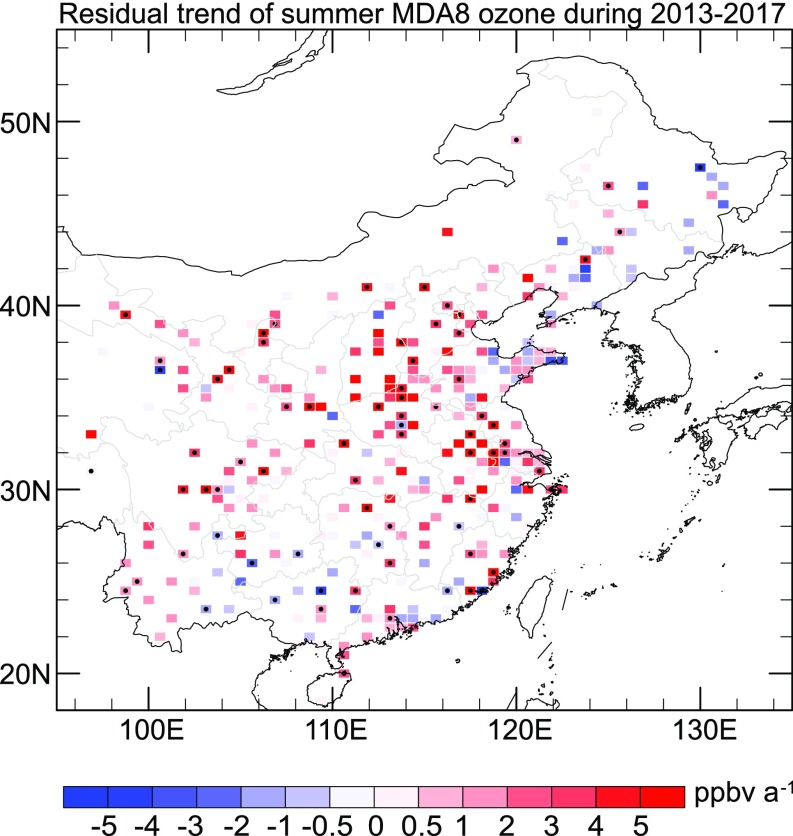
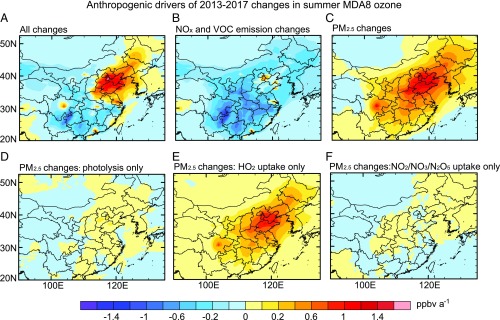
Verification
Claims the paper makes
The claims and statistics of this paper haven’t been checked yet.
Free: it reads the open-access text and checks the first 5 claims that cite a source we can check. Create a free account to check every claim.
Claims other papers make about this one
Each is checked against this paper’s own text: does it say what the citing paper says it does?
The cited source doesn’t support the claim as written.
In the citing paper
“a recent analysis of ground-level ozone concentrations measured at nearly 1,000 sites across China also found an increasing trend of summertime ozone in northeastern China from 2013 to 2017 (6).”
From Ozone pollution: A Major health hazard worldwide (2019) · cites this paper as [6]
Checked by a reasoning model — may be wrong.
Experimental — accuracy not yet measuredThe source backs part of the claim, not all of it — or backs it for a different population, condition or comparison.
In the citing paper
“Simulations with numerical models show several possible reasons including increases in UV radiation [31, 33–39], shifts in the VOC/NOx chemical regime resulting in increased production of O3 efficiency [35, 40], higher emissions of biogenic VOC due to rising temperatures [30], and decreased competition for gas-phase radicals by aerosol surfaces [34, 40], with reality likely being a combination of”
From Changes in tropospheric air quality related to the protection of stratospheric ozone in a changing climate (2023) · cites this paper as [34]
Experimental — accuracy not yet measuredThe source backs part of the claim, not all of it — or backs it for a different population, condition or comparison.
In the citing paper
“This increase was attributed to changes in anthropogenic emissions of ozone precursors as well as reductions in PM2.5 concentrations as described earlier.”
From Ozone pollution: A Major health hazard worldwide (2019) · cites this paper as [6]
Experimental — accuracy not yet measuredThe source backs part of the claim, not all of it — or backs it for a different population, condition or comparison.
In the citing paper
“anthropogenic emissions of NOx have decreased substantially in most urban areas of China (a 21% nationwide reduction) from 2013 to 2017 (6).”
From Ozone pollution: A Major health hazard worldwide (2019) · cites this paper as [6]
Experimental — accuracy not yet measuredThe cited source says what the claim attributes to it.
In the citing paper
“A recent study showed that a 40% reduction in PM2.5 from 2013 to 2017 in the North China Plain was partly responsible for an increasing ozone trend (at 1–3 ppb per year) during the period of 2013–2017 observed in megacity clusters of eastern China (6).”
From Ozone pollution: A Major health hazard worldwide (2019) · cites this paper as [6]
2 more claims about this paper
Create a free account to see every claim other papers make about this one.
Self-check
Percentages, sums and reported differences re-computed from the paper’s own numbers.
The self-check needs the paper’s full text.
Citations
Cites
Modern Applied Statistics with S
Venables, W. N., & Ripley, B. D. (2002) · Statistics and Computing · doi:10.1007/978-0-387-21706-2 · Cited by 24,305
The Modern-Era Retrospective Analysis for Research and Applications, Version 2 (MERRA-2)
Gelaro, R., McCarty, W., Suárez, M. J., Todling, R., Molod, A., Takacs, L., Randles, C. A., Darmenov, A., Bosilovich, M. G., Reichle, R., et al. (2017) · Journal of Climate · doi:10.1175/jcli-d-16-0758.1 · Cited by 9,010 · cited 2×
“Meteorological data from the NASA MERRA-2 reanalysis (23) with 0.”
MethodTrends in China's anthropogenic emissions since 2010 as the consequence of clean air actions
Zheng, B., Tong, D., Li, M., Liu, F., Hong, C., Geng, G., Li, H., Li, X., Peng, L., Qi, J., et al. (2018) · Atmospheric Chemistry and Physics · doi:10.5194/acp-18-14095-2018 · Cited by 2,916 · cited 9×
“The MEIC emission inventory is developed and managed by researchers at Tsinghua University.”
BackgroundMethodInfluentialSelf-citationModern Applied Statistics with S,
Kemp, F. (2003) · Journal of the Royal Statistical Society: Series D (The Statistician) · doi:10.1046/j.1467-9884.2003.t01-19-00383_22.x · Cited by 2,320
Effect of climate change on air quality
Jacob, D. J., & Winner, D. A. (2009) · Atmospheric Environment · doi:10.1016/j.atmosenv.2008.09.051 · Cited by 1,979 · cited 1×
“These variables are frequently observed to be correlated with ozone air quality (24) and can be viewed as general indicators of stagnation.”
BackgroundSelf-citationWang, T., Xue, L., Brimblecombe, P., Lam, Y. F., Li, L., & Zhang, L. (2017) · Science of The Total Environment · doi:10.1016/j.scitotenv.2016.10.081 · Cited by 1,876 · cited 5×
“A number of previous studies have examined meteorological influences on ozone variability in China (4, 9, 39, 40), On the basis of these studies we considered the correlation of MDA8 ozone across China with a large number of candidate meteorological variables from the MERRA-2 archive (SI Appendix, Table S3 and Fig.”
BackgroundInfluentialLi, M., Zhang, Q., Kurokawa, J.-I., Woo, J.-H., He, K., Lu, Z., Ohara, T., Song, Y., Streets, D. G., Carmichael, G. R., et al. (2017) · Atmospheric Chemistry and Physics · doi:10.5194/acp-17-935-2017 · Cited by 1,616
Self-citationHeterogeneous chemistry and tropospheric ozone
Jacob, D. (2000) · Atmospheric Environment · doi:10.1016/s1352-2310(99)00462-8 · Cited by 1,289 · cited 3×
“The relevant aerosol chemistry involves reactive uptake of the gaseous precursors to ozone formation, as described in GEOS-Chem by firstorder reactive uptake coefficients γ (32).”
BackgroundMethodInfluentialSelf-citationTai, A. P. K., Mickley, L. J., & Jacob, D. J. (2010) · Atmospheric Environment · doi:10.1016/j.atmosenv.2010.06.060 · Cited by 1,048
Self-citationSevere Surface Ozone Pollution in China: A Global Perspective
Lu, X., Hong, J., Zhang, L., Cooper, O. R., Schultz, M. G., Xu, X., Wang, T., Gao, M., Zhao, Y., & Zhang, Y. (2018) · Environmental Science & Technology Letters · doi:10.1021/acs.estlett.8b00366 · Cited by 1,040 · cited 1×
“5) concentration has decreased significantly since then, but ozone pollution has not decreased and is seemingly getting worse (8, 16).”
Background
Cited by
Items 801–900 of 1,003
Wang, C., An, X., Hou, Q., Sun, Z., Li, Y., & Li, J. (2021) · Geoscientific model development · doi:10.5194/gmd-14-337-2021 · Cited by 15
“Meanwhile, several mega urban agglomerations in China are facing atmospheric compound pollution with high PM 2.5 and O 3 concentrations (Li et al., 2019; Zhang et al., 2019; Xiang et al., 2019; Haque et al., 2020; Zhao et al., 2020).”
BackgroundInfluentialThe regional impact of the COVID-19 lockdown on the air quality in Ji'nan, China
Li, K., Ni, R., Jiang, T., Tian, Y., Zhang, X., Li, C., & Xie, C. (2022) · Scientific Reports · doi:10.1038/s41598-022-16105-6 · Cited by 17
Self-citationGround-based formaldehyde across the Pearl River Delta: A snapshot and meta-analysis study
Mo, X., Gong, D., Liu, Y., Li, J., Zhao, Y., Zhao, W., Shen, J., Liao, T., Wang, H., & Wang, B. (2023) · Atmospheric Environment · doi:10.1016/j.atmosenv.2023.119935 · Cited by 15
The atmospheric oxidizing capacity in China – Part 2: Sensitivity to emissions of primary pollutants
Dai, J., Brasseur, G. P., Vrekoussis, M., Kanakidou, M., Qu, K., Zhang, Y., Zhang, H., & Wang, T. (2024) · Atmospheric chemistry and physics · doi:10.5194/acp-24-12943-2024 · Cited by 15
Impacts of wildfire smoke aerosols on near-surface ozone photochemistry
Shen, J., Cohen, R. C., Wolfe, G. M., & Jin, X. (2025) · Atmospheric chemistry and physics · doi:10.5194/acp-25-8701-2025 · Cited by 19
Wang, X., Zhu, J., Jiao, G., Chen, X., Yang, Z., Chen, L., Jin, X., & Liao, H. (2025) · Atmospheric chemistry and physics · doi:10.5194/acp-25-13863-2025 · Cited by 16
“Numerous studies have leveraged GC to simulate O 3 air quality in China, demonstrating alignment between observational data and model outcomes (Dai et al., 2024; Dang et al., 2021; Li et al., 2019; Lu et al., 2019a).”
Self-citationChen, C., Chen, W., Guo, L., Wu, Y., Duan, X., Wang, X., & Shao, M. (2025) · Atmospheric chemistry and physics · doi:10.5194/acp-25-15145-2025 · Cited by 15
“This approach enables the isolation of local emis-sions’ contributions to regional background O 3 levels (Zhang et al., 2011; Li et al., 2018; Lu et al., 2019a; Pfister et al., 2013 .”
Fan, H. M., Zhao, C., Yang, Y., Yang, X., & Wang, C. (2021) · Air Quality Atmosphere & Health · doi:10.1007/s11869-021-01023-9 · Cited by 14
“At present, China’s air pollution control urgently needs to analyze the impact of emissions at different spatial scales (Li et al. 2019; Vandyck et al. 2018).”
BackgroundInfluentialWang, R., Bei, N., Pan, Y., Wu, J., Liu, S., Li, X., Yu, J., Jiang, Q., Tie, X., & Li, G. (2022) · Chemosphere · doi:10.1016/j.chemosphere.2022.137124 · Cited by 15
Summertime ozone pollution in China affected by stratospheric quasi-biennial oscillation
Li, M., Yang, Y., Wang, H., Li, H., Wang, P., & Liao, H. (2023) · Atmospheric chemistry and physics · doi:10.5194/acp-23-1533-2023 · Cited by 15
Self-citationZheng, X., Ren, J., Hao, Y., & Xie, S. (2023) · Atmospheric Environment · doi:10.1016/j.atmosenv.2023.119679 · Cited by 15
Wang, Z., Zhang, P., Pan, L., Qian, Y., Li, Z., Li, X., Guo, C., Zhu, X., Xie, Y., & Wei, Y. (2023) · Toxics · doi:10.3390/toxics11080651 · Cited by 14
“Meteorological data were obtained from the China Meteorological Station Data Sharing Service System (http://cdc.cma.gov.cn/home.do, accessed on 5 January 2021).”
BackgroundInfluentialZhang, Y., Tang, C., Liu, Y., Jiang, H., Lu, Z., Lu, Z., Xu, L., Zhang, S., Lina, Z., Ye, J., et al. (2023) · Chemosphere · doi:10.1016/j.chemosphere.2023.140040 · Cited by 15
Fu, G., Cheng, H., Lu, Q., Liu, H., Zhang, X., & Zhang, X. (2023) · Frontiers in Public Health · doi:10.3389/fpubh.2023.1266643 · Cited by 14
Applications of environmental mass spectrometry in atmospheric haze chemistry
Chen, T., Ge, Y., Chu, B., Zhang, P., Ma, Q., & He, H. (2024) · TrAC Trends in Analytical Chemistry · doi:10.1016/j.trac.2024.117614 · Cited by 15
The impact of ozone pollution on mortality: Evidence from China
Qiu, Y., Liu, Y., Shi, W. K., & Zhou, M. (2024) · Journal of Environmental Economics and Management · doi:10.1016/j.jeem.2024.102980 · Cited by 19
Dong, Z., Jiang, Y., Wang, S., Xing, J., Ding, D., Zheng, H., Wang, H., Huang, C. Y., Yin, D., Song, Q., et al. (2024) · Environmental Science & Technology · doi:10.1021/acs.est.4c01345 · Cited by 14
Du, J., Wang, X., & Zhou, S. (2024) · Atmospheric Environment · doi:10.1016/j.atmosenv.2024.120658 · Cited by 14
Jing, Q., & Liao, H. (2024) · Advances in Atmospheric Sciences · doi:10.1007/s00376-024-4071-4 · Cited by 15
Self-citationBVOCs' role in dynamic shifts of summer ozone formation regimes across China and policy implications
Gao, C., Zhang, X., Lun, X., Gao, Y., Guenther, A., Zhao, H., Zhang, S., Huang, L., Song, K., Huang, X., et al. (2025) · Journal of Environmental Management · doi:10.1016/j.jenvman.2025.124150 · Cited by 15
Souri, A. H., Abad, G. G., Wolfe, G. M., Verhoelst, T., Vigouroux, C., Pinardi, G., Compernolle, S., Langerock, B., Duncan, B. N., & Johnson, M. S. (2025) · Atmospheric chemistry and physics · doi:10.5194/acp-25-2061-2025 · Cited by 20
“Tropospheric ozone (O 3 ) is a secondary pollutant formed through complex photochemical reactions involving various precursors, including nitrogen oxides (NO x = NO + NO 2 ), volatile organic compounds (VOCs), aerosols, and halogens (Kleinman et al., 2002, Simpson et al., 2015; Li et al., 2019).”
Gao, X., Zhong, C., Wang, X., Ma, Q., & Liu, C. (2021) · Journal of Geophysical Research Atmospheres · doi:10.1029/2021jd034694 · Cited by 14
“…the atmospheric fate of gaseous pollutants (including radicals), but also has a great impact on the chemical composition and physicochemical properties of particles such as hygroscopicity and cloud condensation nuclei activity (Krueger et al., 2003; K. Li et al., 2018; Tang et al., 2017).”
BackgroundWang, S., Liu, G., Zhang, H., Yi, M., Liu, Y., Hong, X., & Bao, X. (2021) · Air Quality Atmosphere & Health · doi:10.1007/s11869-021-01090-y · Cited by 15
Kang, M., Hu, J., Zhang, H., & Ying, Q. (2021) · The Science of The Total Environment · doi:10.1016/j.scitotenv.2021.151922 · Cited by 14
Wang, Y., Zhu, R., Bo, X., Dan, M., & Shu, M. (2022) · International Journal of Environmental Science and Technology · doi:10.1007/s13762-022-04135-6 · Cited by 15
Meda, B. N. M., & Mathew, A. (2022) · Arabian Journal of Geosciences · doi:10.1007/s12517-022-09996-2 · Cited by 15
“Higher level of ozone, especially in urban regions, is a major air quality issue and has huge impact on urban life (Li et al. 2019; Paoletti et al. 2014; Wang et al. 2009; Fuhrer et al. 1997).”
BackgroundWang, H., Gao, Y., Sheng, L., Wang, Y., Zeng, X., Kou, W., Ma, M., & Cheng, W. (2022) · International Journal of Environmental Research and Public Health · doi:10.3390/ijerph19116758 · Cited by 15
“Anthropogenic emissions—including industries, power plants, and mobile vehicles—are the major ozone-formation sources in megacities in China [14,15].”
BackgroundShang, N., Gui, K., Zhao, H., Yao, W., Zhao, H., Zhang, X., Zhang, X., Li, L., Zheng, Y., Wang, Z., et al. (2023) · Atmospheric Pollution Research · doi:10.1016/j.apr.2023.101841 · Cited by 14
Ma, M., Liu, M., Liu, M., Xing, H., Wang, Y., & Meng, F. (2023) · Sustainability · doi:10.3390/su16010123 · Cited by 15
“As for China, surface ozone estimation has been implemented by many previous studies [17,18,26–36].”
BackgroundZhang, Z., Zheng, N., Liang, Y., Luo, L., Xiao, H., & Xiao, H. (2020) · ACS Earth and Space Chemistry · doi:10.1021/acsearthspacechem.0c00101 · Cited by 14
A high ozone event over Beijing after the May 2017 Belt and Road Forum
Xu, J., He, Y., Li, M., Zhang, Z., Du, X., Wang, J., Yang, X., Wu, Z., Li, H., Chen, Y., et al. (2021) · Atmospheric Pollution Research · doi:10.1016/j.apr.2020.12.019 · Cited by 16
Lien, J., & Hung, H. (2021) · Heliyon · doi:10.1016/j.heliyon.2021.e08210 · Cited by 15
“However, the O3 concentration may not have a corresponding response due to the increasing background O3 concentration [9] and the complex feedbacks of precursor gases [10-12].”
BackgroundZhang, H., Guo, W., Wang, J., Zhang, H., Ge, M., Tong, S., Zhao, N., & Yao, Z. (2025) · Journal of Hazardous Materials · doi:10.1016/j.jhazmat.2025.139468 · Cited by 13
Critical transition of urban ozone formation regime in the North China Plain
Xue, L., Zhu, Y., Gao, J., Zhong, X., Cui, C., Wang, S., Jiang, Z., Sun, Y., Li, Q., Zhang, Y., et al. (2025) · National Science Review · doi:10.1093/nsr/nwaf596 · Cited by 18
“Previous studies have attributed the deteriorating O 3 pollution across China to the reduction of anthropogenic NO x emissions [10 – 13 ], although the concurrent PM 2.5 reduction might also contribute by weakening the heterogeneous loss of HO 2 radicals on the aerosol surfaces [11 ].”
InfluentialBei, N., Liang, J., Li, X., & Wang, R. (2022) · Atmospheric Environment · doi:10.1016/j.atmosenv.2022.118974 · Cited by 14
Tan, R. Q., Guo, S., Lü, S., Wang, H., Zhu, W., Yu, Y., Tang, R., Shen, R., Song, K., Lv, D., et al. (2023) · Atmosphere · doi:10.3390/atmos14050806 · Cited by 13
Data‐ and Model‐Based Urban O3 Responses to NOx Changes in China and the United States
Chen, X., Wang, M., He, T., Jiang, Z., Zhang, Y., Zhou, L., Liu, J. J., Liao, H., Worden, H. M., Jones, D. B. A., et al. (2023) · Journal of Geophysical Research Atmospheres · doi:10.1029/2022jd038228 · Cited by 13
“He et al., 2019; J. Li et al., 2018; Tan et al., 2018; Wang et al., 2020).”
Self-citationLonger dust events over Northwest China from 2015 to 2022
Yu, H., Wang, Y., Yuan, L., Kong, R., Han, S., Han, W., & Li, J. (2024) · Atmospheric Research · doi:10.1016/j.atmosres.2024.107365 · Cited by 13
Impact of soil–atmosphere HONO exchange on concentrations of HONO and O3 in the North China Plain
Ran, H., An, J., Zhang, J., Huang, J., Qu, Y., Chen, Y., Xue, C., Mu, Y., & Liu, X. (2024) · The Science of The Total Environment · doi:10.1016/j.scitotenv.2024.172336 · Cited by 13
Diurnal emission variation of ozone precursors: Impacts on ozone formation during Sep. 2019
Tang, Y., Wang, Y., Chen, X., Liang, J., Li, S., Chen, G., Chen, Z., Tang, B., Zhu, J., & Li, X. (2024) · The Science of The Total Environment · doi:10.1016/j.scitotenv.2024.172591 · Cited by 13
Ozone sensitivity regimes vary at different heights in the planetary boundary layer
Li, X., Wang, W., Yang, S., Cheng, Y., Zeng, L., Yu, X., Lu, S., Liu, Y., Hu, M., Xie, S., et al. (2024) · The Science of The Total Environment · doi:10.1016/j.scitotenv.2024.173712 · Cited by 13
Nussbaumer, C. M., Kohl, M., Pozzer, A., Tadić, I., Rohloff, R., Marno, D., Harder, H., Ziereis, H., Zahn, A., Obersteiner, F., et al. (2024) · Journal of Geophysical Research Atmospheres · doi:10.1029/2024jd041168 · Cited by 14
“There are numerous studies that have investigated O 3 sensitivity to NO x and VOC levels at the surface and they almost exclusively focus on urban areas (Akimoto & Tanimoto, 2022; Jaffe et al., 2022; Li et al., 2019; Zhao et al., 2022).”
Cui, W. Q., Wang, J., Yan, L., Liu, P., & Dong, F. (2024) · Environmental Science Nano · doi:10.1039/d4en00715h · Cited by 16
Luo, H., Zhao, K., Yuan, Z., Yang, L., Zheng, J., Huang, Z., & Huang, X. (2021) · Journal of Environmental Sciences · doi:10.1016/j.jes.2020.12.033 · Cited by 13
Clustering Analysis on Drivers of O3 Diurnal Pattern and Interactions with Nighttime NO3 and HONO
Wang, X., Wang, S., Zhang, S., Gu, C., Tanvir, A., Zhang, R., & Zhou, B. (2022) · Atmosphere · doi:10.3390/atmos13020351 · Cited by 15
Zeren, Y., Guo, H., Lyu, X., Zhou, B., Liu, X., Yang, L., Yuan, Z., & Wang, Y. (2022) · The Science of The Total Environment · doi:10.1016/j.scitotenv.2022.154788 · Cited by 15
Li, X., Bei, N., Wu, J., Liu, S., Wang, Q., Tian, J., Liu, L., Wang, R., & Li, G. (2022) · Journal of Geophysical Research Atmospheres · doi:10.1029/2021jd036191 · Cited by 16
“, 2020), as well as the aerosol sink for O3 precursors (Li et al., 2019).”
BackgroundEffects of Seasonal Variation on Spatial and Temporal Distributions of Ozone in Northeast China
Chen, J., Sun, L. M., Jia, H., Li, C., Ai, X., & Zang, S. (2022) · International Journal of Environmental Research and Public Health · doi:10.3390/ijerph192315862 · Cited by 16
Xiao, S., Zhang, Y. L., Zhang, Z., Song, W., Pei, C., Chen, D., & Wang, X. (2023) · The Science of The Total Environment · doi:10.1016/j.scitotenv.2023.162432 · Cited by 13
Xu, T., Nie, W., Xu, Z., Yan, C., Liu, Y., Zha, Q., Wang, R., Li, Y., Wang, L., Ge, D., et al. (2024) · The Science of The Total Environment · doi:10.1016/j.scitotenv.2024.170373 · Cited by 14
Hu, F., & Guo, Y. (2020) · SN Applied Sciences · doi:10.1007/s42452-020-04004-2 · Cited by 16
Zhang, X., Yan, Y., Duan, X., Chai, J., Li, R., Xu, Y., Li, Z., & Peng, L. (2022) · Atmosphere · doi:10.3390/atmos13030393 · Cited by 15
Hua, C., Ma, W., Li, J., Wang, Y., Zheng, F., Zhang, Y., Ren, Y., Chen, T., Li, H., Bianchi, F., et al. (2025) · Environmental Science & Technology · doi:10.1021/acs.est.5c00578 · Cited by 12
Uncovering the impact of urban functional zones on air quality in China
Yuan, L., Han, W., Meng, J., Wang, Y., Yu, H., & Li, W. (2025) · Atmospheric chemistry and physics · doi:10.5194/acp-25-10421-2025 · Cited by 12
“5 concentration of a station is greater than PM 10 for an hour, the data for that hour will be considered invalid.”
Tian, Y., Yun, W., Han, Y., Che, H., Qi, X., Xu, Y., Chen, Y., Long, X., & Wei, C. (2023) · Atmosphere · doi:10.3390/atmos14101591 · Cited by 13
Meteorology-driven trends in PM2.5 concentrations and related health burden over India
Wang, X., Zhu, J., Li, K., Chen, L., Yang, Y., Zhao, Y., Xu, Y., Gu, Y., & Liao, H. (2024) · Atmospheric Research · doi:10.1016/j.atmosres.2024.107548 · Cited by 12
Self-citationLi, Y., Wang, T., Wang, Q., Li, M., Qu, Y., Wu, H., Fan, J., Shao, M., & Xie, M. (2024) · The Science of The Total Environment · doi:10.1016/j.scitotenv.2024.174327 · Cited by 11
Kim, Y., Park, S., Choi, H., & Im, J. (2025) · Journal of Hazardous Materials · doi:10.1016/j.jhazmat.2025.137369 · Cited by 14
Fang, T., Hu, J., Gu, Y., Sung, J. J. �., & Yim, S. H. L. (2025) · Environment International · doi:10.1016/j.envint.2025.109333 · Cited by 12
Guo, J., Wu, X., Guo, Y., Tang, Y., & Dzandu, M. D. (2021) · Natural Hazards · doi:10.1007/s11069-021-04517-y · Cited by 12
Wang, W., Li, X., Kuang, Y., Su, H., Cheng, Y., Hu, M., Zeng, L., Tan, T., & Zhang, Y. (2021) · Environmental Science & Technology Letters · doi:10.1021/acs.estlett.1c00300 · Cited by 14
A New Index Developed for Fast Diagnosis of Meteorological Roles in Ground-Level Ozone Variations
Chen, W., Wang, W., Jia, S., Mao, J., Yan, F., Zheng, L., Wu, Y., Zhang, X., Dong, Y., Kong, L., et al. (2022) · Advances in Atmospheric Sciences · doi:10.1007/s00376-021-1257-x · Cited by 12
Song, Y., Zhang, Y., Liu, J., Zhang, C., Liu, C., Liu, P., & Mu, Y. (2022) · Journal of Environmental Sciences · doi:10.1016/j.jes.2021.08.015 · Cited by 12
Ding, S., Wei, Z., He, J., Liu, D., & Zhao, R. (2022) · Journal of Environmental Management · doi:10.1016/j.jenvman.2022.115983 · Cited by 13
Bui, L. T., & Nguyen, P. H. (2022) · Environmental Science and Pollution Research · doi:10.1007/s11356-022-23819-7 · Cited by 13
Hini, G., Gao, K., Zheng, Y., Simayi, M., & Xie, S. (2023) · Aerosol and Air Quality Research · doi:10.4209/aaqr.220347 · Cited by 12
“In previous studies of VOCs emissions inventories from anthropogenic and industrial sources in China, VOCs emissions from the petrochemical industry have been considered as integrated sources (Qiu et al. , 2014; Wu et al. , 2016; Zheng et al. , 2018; Li et al. , 2019c; Simayi et al. , 2020).”
BackgroundLi, Y., Ma, L., Ni, M., Bai, Y., & Li, C. (2023) · Journal of Environmental Management · doi:10.1016/j.jenvman.2023.118663 · Cited by 12
Zhu, C., He, Q., Zhao, Z., Liu, X., & Pu, Z. (2023) · Atmosphere · doi:10.3390/atmos14091387 · Cited by 12
Cheng, Y., Yan, P., Cao, L., Huang, X., & He, L. (2024) · The Science of The Total Environment · doi:10.1016/j.scitotenv.2024.172763 · Cited by 12
COVID-19 lockdown: a boon in boosting the air quality of major Indian Metropolitan Cities
Rathore, D. S., Nagda, C., Shaktawat, B. S., Kain, T., Chouhan, C. S., Purohit, R., Harish, Khangarot, R. K., Nagda, G., & Jhala, L. S. (2020) · Aerobiologia · doi:10.1007/s10453-020-09673-5 · Cited by 13
Rendana, M., & Komariah, L. N. (2021) · Jurnal Pengelolaan Sumberdaya Alam dan Lingkungan (Journal of Natural Resources and Environmental Management) · doi:10.29244/jpsl.11.1.93-100 · Cited by 12
Ye, C., Wang, H., Li, X., Lu, K., & Zhang, Y. (2024) · Environmental Science & Technology · doi:10.1021/acs.est.3c10927 · Cited by 12
Fang, J., Zhang, Y., Hauglustaine, D. A., Zheng, B., Wang, M., Li, J., Sun, Y., Li, H., Wang, J., Wu, Y., et al. (2026) · Atmospheric chemistry and physics · doi:10.5194/acp-26-851-2026 · Cited by 11
“However, surface ozone levels have continued to rise in many regions, raising concerns over the complex drivers of ozone trends and highlighting the need for scientific attribution to guide effective mitigation strategies (Li et al., 2019a; Liu et al., 2023; Wang et al., 2023a; Weng et al., 2022).”
Sun, J., Xie, X., Qin, M., Yu, X., Ji, D., Gong, K., Li, J., Huang, L., & Hu, J. (2021) · Chinese Science Bulletin (Chinese Version) · doi:10.1360/tb-2021-0742 · Cited by 14
Impact of the ‘Coal-to-Natural Gas’ Policy on Criteria Air Pollutants in Northern China
Meng, H., Shen, Y., Fang, Y., & Zhu, Y. (2022) · Atmosphere · doi:10.3390/atmos13060945 · Cited by 11
“Since 2013, the emission-driven decrease in NO2 concentrations reportedly occurred across China [36,37].”
BackgroundDong, Z., Wang, S., Jiang, Y., Xing, J., Ding, D., Zheng, H., & Hao, J. (2022) · The Science of The Total Environment · doi:10.1016/j.scitotenv.2022.160116 · Cited by 11
Xu, W., Xing, Q., Pan, L., Wang, Z., Cao, X., Yan, W., Xie, W., Meng, X., & Wu, X. (2023) · Atmospheric Environment · doi:10.1016/j.atmosenv.2023.120167 · Cited by 11
Rapid reduction of air pollution and short-term exposure risks in China
Fan, H. M., Zhao, C., Yang, Y., & Yang, X. (2023) · Journal of Environmental Sciences · doi:10.1016/j.jes.2023.11.002 · Cited by 12
Si, J., Zhang, L., Zhang, S., Li, Y., Zhang, Z., He, Z., Chen, Y., & Zhan, H. (2024) · Atmospheric Environment · doi:10.1016/j.atmosenv.2024.120390 · Cited by 11
Li, W., Wang, G., Wang, X., Wu, W., Zhao, Z., Zhang, F., Jiang, G., Li, G., Cheng, J., Zhang, Z., et al. (2024) · ACS ES&T Engineering · doi:10.1021/acsestengg.3c00633 · Cited by 11
Ma, S., Cheng, D., Tang, Y., Fan, Y., Li, Q., He, C., Zhao, Z., & Xu, T. (2024) · Journal of Environmental Sciences · doi:10.1016/j.jes.2024.04.023 · Cited by 12
Färber, M., Fuchs, H., Bohn, B., Carlsson, P. T. M., Gkatzelis, G. I., Lara, A. C. M., Röhrer, F., Vereecken, L., Wedel, S., Wahner, A., et al. (2024) · ACS ES&T Air · doi:10.1021/acsestair.4c00064 · Cited by 12
Zhang, Y., Li, N., Tang, K., Wang, M., Li, H., Li, K., Zheng, B., Zhang, Q., Gao, M. C., Fang, J., et al. (2025) · Science Advances · doi:10.1126/sciadv.adr4297 · Cited by 14
Self-citationZhang, F., Yan, R., Ye, X., Fei, L., Zhu, Y., Chen, X., Zhu, S., Qi, B., Xu, D., & Li, W. (2025) · Environmental Pollution · doi:10.1016/j.envpol.2025.126775 · Cited by 11
Air quality and health impacts from the updated industrial emission standards in China
Yang, H., Tao, W., Wang, Y., Liu, Y., Liu, J., Zhang, Y., & Tao, S. (2019) · Environmental Research Letters · doi:10.1088/1748-9326/ab54fa · Cited by 12
Qiu, Y., Wu, Z., Shang, D., Zhang, Z., Xu, N., Zong, T., Zhao, G., Tang, L., Guo, S., Wang, S., et al. (2021) · Chinese Science Bulletin (Chinese Version) · doi:10.1360/tb-2021-0765 · Cited by 16
Impact of synoptic climate system interaction on surface ozone in China during 1950–2014
Song, A., Yan, Y., Kong, S., Ma, J., & Tong, Z. (2022) · Atmospheric Environment · doi:10.1016/j.atmosenv.2022.119126 · Cited by 11
Urban air quality changes resulting from the lockdown period due to the COVID-19 pandemic
Galán‐Madruga, D. (2022) · International Journal of Environmental Science and Technology · doi:10.1007/s13762-022-04464-6 · Cited by 11
Fan, S., & Li, Y. (2022) · The Science of The Total Environment · doi:10.1016/j.scitotenv.2022.160456 · Cited by 11
Do city lockdowns effectively reduce air pollution?
Lin, W., He, Q., Xiao, Y., & Yang, J. (2023) · Technological Forecasting and Social Change · doi:10.1016/j.techfore.2023.122885 · Cited by 11
Understanding the formation of high-ozone episodes at Raoyang, a rural site in the north China plain
Xu, J. X., Xu, X., Lin, W., Ma, Z., Ma, J., Wang, R., Wang, Y., Zhang, G., & Xu, W. (2020) · Atmospheric Environment · doi:10.1016/j.atmosenv.2020.117797 · Cited by 11
Qiu, L., Yue, X., Hua, W., & Lei, Y. (2020) · Advances in Climate Change Research · doi:10.1016/j.accre.2020.09.002 · Cited by 11
Westervelt, D. M., Fiore, A. M., Baublitz, C. B., & Correa, G. J. P. (2021) · Atmospheric chemistry and physics · doi:10.5194/acp-21-6799-2021 · Cited by 13
“Changes in similar magnitude have been reported over China using both a chemistry transport model and observations (Li et al., 2019).”
BackgroundResultInfluentialHow will window opening change under global warming: A study for China residence
Liu, Y., Liu, S., Wang, S., & Zhao, B. (2021) · Building and Environment · doi:10.1016/j.buildenv.2021.108672 · Cited by 11
Emission Sector Impacts on Air Quality and Public Health in China From 2010 to 2020
Conibear, L., Reddington, C. L. S., Silver, B. J., Chen, Y., Arnold, S. R., & Spracklen, D. V. (2022) · GeoHealth · doi:10.1029/2021gh000567 · Cited by 11
Diurnal regulation of VOCs may not be effective in controlling ozone pollution in China
Wu, W., Xue, W., Zheng, Y., Wang, Y., Lei, Y., & Jinnan, W. (2021) · Atmospheric Environment · doi:10.1016/j.atmosenv.2021.118442 · Cited by 11
Governing atmospheric oxidation capacity is the key to synergistic air quality and climate gains
Tan, Z., Ma, X., Lu, K. D., Li, X., Zhu, Q., Röhrer, F., Novelli, A., Fuchs, H., Wahner, A., Whalley, L., et al. (2026) · One Earth · doi:10.1016/j.oneear.2025.101569 · Cited by 16
Xu, J., Zhou, D., Gao, J. G., Huang, X., Xue, L., Huo, J., Fu, Q., & Ding, A. (2023) · Applied Geochemistry · doi:10.1016/j.apgeochem.2023.105634 · Cited by 11
Winter-spring droughts exacerbated PM2.5-O3 compound pollution? Evidence from China
Wu, B., Jiang, F., Long, K., Zhang, J., Liu, C., & Shi, K. (2024) · The Science of The Total Environment · doi:10.1016/j.scitotenv.2024.178309 · Cited by 11
Population exposure evaluation and value loss analysis of PM2.5 and ozone in China
Wang, B., Ji, Y., Yang, X., Shi, J., Xu, W., Ma, J., Shen, R., Wang, B., Zhang, J., & Feng, Y. (2025) · Journal of Environmental Management · doi:10.1016/j.jenvman.2025.124480 · Cited by 10
Metadata
- Authors
- Li, K., Jacob, D. J., Liao, H., Shen, L., Zhang, Q., & Bates, K. H.
- Affiliations
- Harvard University (US)
- Nanjing University of Information Science and Technology (CN)
- Tsinghua University (CN)
- Corresponding author
- Jacob, Daniel J.
- Liao, Hong
- Venue
- Proceedings of the National Academy of Sciences
- Publisher
- National Academy of Sciences
- Published
- 2018-12-31
- Volume
- 116
- Issue
- 2
- Pages
- 422-427
- ISSN
- 0027-8424 (ISSN-L)
- 1091-6490
- PMC
- PMC6329973
- OpenAlex
- W2908510209
- Cited by
- 1,804
- References
- 45
- Citations by year
- 2026: 164 · 2025: 191 · 2024: 203 · 2023: 263 · 2022: 348 · 2021: 326 · 2020: 224 · 2019: 80 · 2018: 1
- FWCI
- 76.82
- Type
- journal article
- Language
- en
- Open access
- hybrid
- doi.org
- Licence
- Locations
- Proceedings of the National Academy of Sciences (publishedVersion, cc-by-nc-nd)
- Europe PMC (PubMed Central) (publishedVersion, cc-by-nc-nd)
- PubMed Central (publishedVersion, cc-by-nc-nd)
- PubMed (publishedVersion)
- Funders
- National Natural Science Foundation of China (91744311)
- Topics
- Physical Sciences › Earth and Planetary Sciences › Atmospheric Science › Atmospheric chemistry and aerosols
- Physical Sciences › Earth and Planetary Sciences › Atmospheric Science › Atmospheric Ozone and Climate
- Physical Sciences › Environmental Science › Global and Planetary Change › COVID-19 impact on air quality
- Keywords
- surface ozone trends, anthropogenic factors, PM2.5 reduction, NOx emissions, volatile organic compounds, hydroperoxyl radical, ozone sink, ozone formation, North China Plain, air pollution control, weather variability, Beijing, Shanghai
- MeSH terms
- Air, Air Pollutants, Air Pollution, China, Humans, Ozone, Urban Renewal, Volatile Organic Compounds
About these checks
Registry, retraction, Cites and statistics results are computed, not judged, with one exception: a printed reference that no index lists is read once by a model before it counts as a citation error. Claims are extracted by a model and kept only when their quote appears verbatim in the text; each cited source is then checked, with a model’s help, for whether it says what the claim relies on. Those verdicts can be wrong — read the claim’s quote and the cited source before relying on one.
Statistics and arithmetic are recomputed, not judged.
Confidence bands are shown only for fields calibrated on our annotated test set. None is calibrated yet, so no band is shown.
What counts as a claim ›How we measure confidence ›How we check this ›
Are you an author, or do you see a problem with this page? Request a review
Data sources
Bibliographic data: Semantic Scholar, OpenAlex, Crossref.
Contains information from the Semantic Scholar Academic Graph Datasets, made available under the ODC Attribution License (ODC-BY 1.0).
Semantic Scholar’s data is described in: Kinney, R., et al. (2023). The Semantic Scholar Open Data Platform. arXiv:2301.10140.
