

Measuring actual learning versus feeling of learning in response to being actively engaged in the classroom
Open accessThe DOI matches its Crossref record; 41 of the 43 references it cites were found in a registry or an index.
Abstract
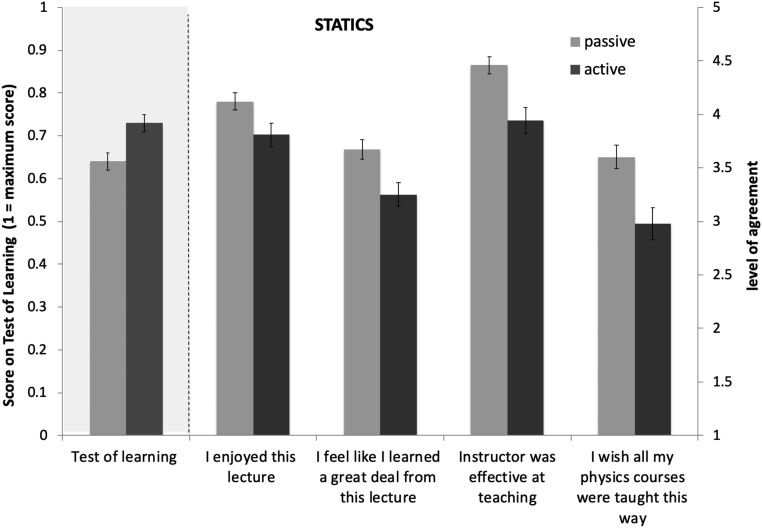
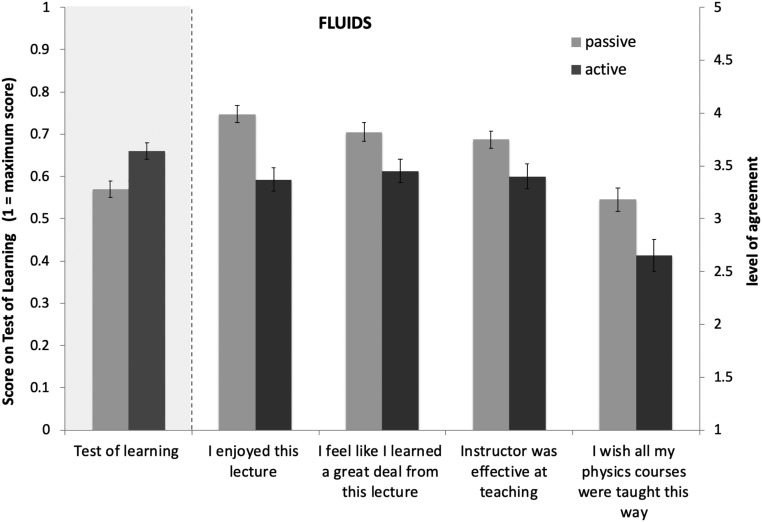
Significance: Despite active learning being recognized as a superior method of instruction in the classroom, a major recent survey found that most college STEM instructors still choose traditional teaching methods. This article addresses the long-standing question of why students and faculty remain resistant to active learning. Comparing passive lectures with active learning using a randomized experimental approach and identical course materials, we find that students in the active classroom learn more, but they feel like they learn less. We show that this negative correlation is caused in part by the increased cognitive effort required during active learning. Faculty who adopt active learning are encouraged to intervene and address this misperception, and we describe a successful example of such an intervention.
Overview
The claims and statistics of this paper haven’t been checked yet.
Free: it reads the open-access text and checks the first 5 claims that cite a source we can check. Create a free account to check every claim.
Integrity signals
Registry
Cites
Statistics
Figures
Verification
Claims the paper makes
The claims and statistics of this paper haven’t been checked yet.
Free: it reads the open-access text and checks the first 5 claims that cite a source we can check. Create a free account to check every claim.
Claims other papers make about this one
Each is checked against this paper’s own text: does it say what the citing paper says it does?
The source backs part of the claim, not all of it — or backs it for a different population, condition or comparison.
In the citing paper
“Our results support this approach, indicating that reducing cognitive offloading through active engagement can mitigate the negative impact of AI tools on critical thinking.”
From AI Tools in Society: Impacts on Cognitive Offloading and the Future of Critical Thinking (2025) · cites this paper as Deslauriers et al. [46]
Experimental — accuracy not yet measuredThe source backs part of the claim, not all of it — or backs it for a different population, condition or comparison.
In the citing paper
“Such perceptions can be different from actual learning and have been shown to disadvantage more effective teachers and teaching methods (Carrell and West 2010, Deslauriers et al. 2019).”
From AI Meets the Classroom: When Do Large Language Models Harm Learning? (2024) · cites this paper as Deslauriers et al. 2019
Experimental — accuracy not yet measuredThe source backs part of the claim, not all of it — or backs it for a different population, condition or comparison.
In the citing paper
“The exercise is a reminder that we are often poor judges of our own knowledge and may overestimate our understanding of various subjects, blurring the line between familiarity and fluency.”
From Assigning AI: Seven Approaches for Students, with Prompts (2023) · cites this paper as Deslauriers et al., 2019
Experimental — accuracy not yet measuredThe source backs part of the claim, not all of it — or backs it for a different population, condition or comparison.
In the citing paper
“A growing number of studies demonstrate, however, that people prefer simpler constructs, even though they learn more and perform better with more complex ones.”
From To Trust or to Think: Cognitive Forcing Functions Can Reduce Overreliance on AI in AI-assisted Decision-making (2021) · cites this paper as [18]
Experimental — accuracy not yet measuredThe source backs part of the claim, not all of it — or backs it for a different population, condition or comparison.
In the citing paper
“the scaffolded, conversational nature of the AI tool may have created a strong subjective sense of mastery that did not fully translate to improved performance under traditional assessment conditions”
From Socratic Mind: Impact of a Novel GenAI-Powered Formative Assessment Tool on Student Learning and Higher-Order Thinking (2026) · cites this paper as Deslauriers et al., 2019
Experimental — accuracy not yet measured
3 more claims about this paper
Create a free account to see every claim other papers make about this one.
Self-check
Percentages, sums and reported differences re-computed from the paper’s own numbers.
The self-check needs the paper’s full text.
Citations
Cites
A heteroskedasticity-consistent covariance matrix estimator and a direct test for heteroskedasticity
White, H. (1980) · Econometrica · doi:10.2307/1912934 · Cited by 25,861
(1999) · Cited by 12,812
Active learning increases student performance in science, engineering, and mathematics
Freeman, S., Eddy, S. L., McDonough, M., Smith, M. K., Okoroafor, N., Jordt, H., & Wenderoth, M. P. (2014) · Proceedings of the National Academy of Sciences · doi:10.1073/pnas.1319030111 · Cited by 9,787 · cited 1×
“(4) had to correct for this oversight in their metaanalysis.”
BackgroundThe role of deliberate practice in the acquisition of expert performance
Ericsson, K. A., Krampe, R. T., & Tesch-Römer, C. (1993) · Psychological Review · doi:10.1037/0033-295x.100.3.363 · Cited by 9,564 · cited 1×
“In the experimental group, the instructor actively engaged the students using the principles of deliberate practice (3, 36, 37): students were instructed to solve the sample problems by working together in small groups while the instructor roamed the room asking questions and offering assistance.”
MethodKruger, J., & Dunning, D. (1999) · Journal of Personality and Social Psychology · doi:10.1037/0022-3514.77.6.1121 · Cited by 7,731
Hake, R. R. (1998) · American Journal of Physics · doi:10.1119/1.18809 · Cited by 6,072 · cited 1×
“The pretest FCI scores in this study (Table 1) are similar to those clustered near the high end of the distribution of university scores in the metaanalysis published by Hake (1), which confirms that the students in our study have high school preparation comparable to that at other top universities.”
ResultHestenes, D., Wells, M., & Swackhamer, G. (1992) · The Physics Teacher · doi:10.1119/1.2343497 · Cited by 3,235
Peer Instruction: Ten years of experience and results
Crouch, C. H., & Mazur, E. (2001) · American Journal of Physics · doi:10.1119/1.1374249 · Cited by 2,682
When Should You Adjust Standard Errors for Clustering?
Abadie, A., Athey, S., Imbens, G., & Wooldridge, J. (2017) · National Bureau of Economic Research · doi:10.3386/w24003 · Cited by 1,360
Improved Learning in a Large-Enrollment Physics Class
Deslauriers, L., Schelew, E., & Wieman, C. (2011) · Science · doi:10.1126/science.1201783 · Cited by 1,270 · cited 4×
“4, used distinctly different class materials with each group, potentially confounding active engagement with changes in class content (3).”
BackgroundMethodInfluentialSelf-citation
Research works printed but not linked: 3
- Henderson C., Stelzer T., Hsu L., Meredith D., Maximizing the benefits of physics education research: Building productive relationships and promoting institutional change. American Physical Society Forum on Education Newsletter, Fall 2005, pp. 11–14. https://www.aps.org/units/fed/newsletters/fall2005/maximize.html. Accessed 20 June 2019.
- Felder R. M., Random thoughts: Sermons for grumpy campers. Chem. Eng. Educ. 41, 183– 184 (2007).
- Felder R. M., Random thoughts: The link between teaching and research. 2. How to strengthen each without weakening the other. Chem. Eng. Educ. 44, 213– 214 (2010).
Cited by
Items 101–200 of 1,005
Haley, C. M., Brown, B. P., Koerber, A., Nicholas, C. L., & Belcher, A. (2020) · Journal of Dental Education · doi:10.21815/jde.019.190 · Cited by 52
Active and Distance Learning in Neuroscience Education
Sandrone, S., & Schneider, L. D. (2020) · Neuron · doi:10.1016/j.neuron.2020.06.001 · Cited by 52
Integrity-based Explanations for Fostering Appropriate Trust in AI Agents
Mehrotra, S., Jorge, C. C., Jonker, C. M., & Tielman, M. L. (2024) · ACM Transactions on Interactive Intelligent Systems · doi:10.1145/3610578 · Cited by 51
Sørensen, A., Lagestad, P., & Mikalsen, H. K. (2023) · Education Sciences · doi:10.3390/educsci13090965 · Cited by 51
The Case for Pragmatic Evidence-Based Higher Education: A Useful Way Forward?
Newton, P. M., Da Silva, A., & Berry, S. (2020) · Frontiers in Education · doi:10.3389/feduc.2020.583157 · Cited by 50
Walsh, J. N., O’Brien, M. P., & Costin, Y. (2021) · The International Journal of Management Education · doi:10.1016/j.ijme.2021.100505 · Cited by 50
Evolution and hotspots of peer instruction: a visualized analysis using CiteSpace
Bicheng, D., Adnan, N., Harji, M. B., & Ravindran, L. (2022) · Education and Information Technologies · doi:10.1007/s10639-022-11218-x · Cited by 51
Student Motivations and Barriers toward Online and In-Person Office Hours in STEM Courses
Hsu, J. L., Rowland‐Goldsmith, M., & Schwartz, E. B. (2022) · CBE—Life Sciences Education · doi:10.1187/cbe.22-03-0048 · Cited by 50
Digital Marketing Communication Activities on Online Magazine Gettinlow
Teguh, M., Dumais, M. A. O., Wijaya, C. T., Torsten, P., & Vera, A. (2023) · Journal International Dakwah and Communication · doi:10.55849/jidc.v3i1.196 · Cited by 49
How and Why Teachers Use Technology: Distinct Integration Practices in K-12 Education
Raave, D. K., Saks, K., Pedaste, M., & Roldan-Roa, E. (2024) · Education Sciences · doi:10.3390/educsci14121301 · Cited by 51
Towards convergence of mobile and psychological theories of learning
Bernacki, M. L., Crompton, H., & Greene, J. A. (2019) · Contemporary Educational Psychology · doi:10.1016/j.cedpsych.2019.101828 · Cited by 50
Universal Design for Learning: A Framework for Blended Learning in Nursing Education
Davis, D., McLaughlin, M. K., & Anderson, K. M. (2021) · Nurse Educator · doi:10.1097/nne.0000000000001116 · Cited by 49
Medical student engagement in small‐group active learning: A stimulated recall study
Grijpma, J. W., der Vossen, M. M., Kusurkar, R. A., Meeter, M., & de la Croix, A. (2021) · Medical Education · doi:10.1111/medu.14710 · Cited by 48
Fan, H., Xie, H., Feng, Q., Bonizzoni, E., Heidari, H., McEwan, M., & Ghannam, R. (2022) · IEEE Transactions on Education · doi:10.1109/te.2022.3186184 · Cited by 48
Active Learning in Psychiatry Education: Current Practices and Future Perspectives
Sandrone, S., Berthaud, J. V., Carlson, C., Cios, J. S., Dixit, N., Farheen, A., Kraker, J., Owens, J. W. M., Patiño, G. A., Sarva, H., et al. (2020) · Frontiers in Psychiatry · doi:10.3389/fpsyt.2020.00211 · Cited by 48
Alamoudi, A. A., Shawwa, L. A. A., Gad, H., & Tekian, A. S. (2021) · Biochemistry and Molecular Biology Education · doi:10.1002/bmb.21501 · Cited by 48
Crawford, L. K., Carmona, K. A., & Kumar, R. (2024) · Pedagogy in Health Promotion · doi:10.1177/23733799241234065 · Cited by 47
Archer, M., DeWitt, J., Davenport, C., Keenan, O., Coghill, L., Christodoulou, A., Durbin, S., Campbell, H. C., & Hou, L. (2021) · Research for All · doi:10.14324/rfa.05.1.07 · Cited by 47
Reid, J. W., Kırbulut, Z. D., Fateh, S., Fatima, A., Macrie-Shuck, M., Nennig, H. T., Quintanilla, F., States, N. E., Syed, A., Cole, R. S., et al. (2022) · Chemistry Education Research and Practice · doi:10.1039/d1rp00227a · Cited by 47
Hew, K. F., Bai, S., Huang, W., Dawson, P., Du, J., Huang, G., Jia, C., & Thankrit, K. (2021) · Australasian Journal of Educational Technology · doi:10.14742/ajet.6475 · Cited by 46
The effectiveness of learning to improve students' higher-order thinking skills
Shanti, M. R. S., Istiyono, E., & Munadi, S. (2022) · Cypriot Journal of Educational Sciences · doi:10.18844/cjes.v17i5.7220 · Cited by 50
Clemmons, A. W., Donovan, D. A., Theobald, E. J., & Crowe, A. J. (2021) · CBE—Life Sciences Education · doi:10.1187/cbe.21-02-0054 · Cited by 45
Bassner, P., Lenk-Ostendorf, B., Beinstingel, R., Wasner, T., & Krusche, S. (2025) · Computers and Education Artificial Intelligence · doi:10.1016/j.caeai.2025.100537 · Cited by 46
Nickerson, L. A., & Shea, K. M. (2020) · Journal of Chemical Education · doi:10.1021/acs.jchemed.0c00674 · Cited by 45
Teaching and Learning Science through Multiple Representations: Intuitions and Executive Functions
Hansen, J., & Richland, L. E. (2020) · CBE—Life Sciences Education · doi:10.1187/cbe.19-11-0253 · Cited by 45
Harnessing active engagement in educational videos: Enhanced visuals and embedded questions
Kestin, G., & Miller, K. (2022) · Physical Review Physics Education Research · doi:10.1103/physrevphyseducres.18.010148 · Cited by 45
Self-citationUndergraduate neuroscience education: Meeting the challenges of the 21st century
Ramirez, J. J. (2020) · Neuroscience Letters · doi:10.1016/j.neulet.2020.135418 · Cited by 45
Student resistance to active learning: do instructors (mostly) get it wrong?
Andrews, M., Graham, M., Prince, M., Borrego, M. J., Finelli, C., & Husman, J. E. (2020) · Australasian journal of engineering education · doi:10.1080/22054952.2020.1861771 · Cited by 45
Simões, A. V., & Sangiamchit, C. (2023) · Education Sciences · doi:10.3390/educsci13030264 · Cited by 43
Muenks, K. M., Yan, V. X., Woodward, N. R., & Frey, S. E. (2021) · Learning and Individual Differences · doi:10.1016/j.lindif.2021.102088 · Cited by 43
The past, the present, and the future of flipped teaching
Gopalan, C., Daughrity, S., & Hackmann, E. (2022) · AJP Advances in Physiology Education · doi:10.1152/advan.00016.2022 · Cited by 43
Alon, L., Sung, S., Cho, J., & Kizilcec, R. F. (2023) · Computers & Education · doi:10.1016/j.compedu.2023.104870 · Cited by 42
Smith, A. H., Grupp, L. L., Doukopoulos, L., Foo, J. C., Rodriguez, B. J., Seeley, J., Boland, L. M., & Hester, L. L. (2022) · To improve the academy · doi:10.3998/tia.453 · Cited by 43
Innovations in medical education in Vietnam
Duong, D., Phan, T., Trung, N. Q., Le, B. N., Do, H., Nguyen, H. M., Tang, S. H., Pham, V.-A., Le, B. K., Le, L. C., et al. (2021) · BMJ Innovations · doi:10.1136/bmjinnov-2021-000708 · Cited by 41
Aluko, H. A., Aluko, A., Offiah, G. A., Ogunjimi, F., Aluko, A. O., Alalade, F. M., Ukeje, I. O., & Nwani, C. H. (2025) · International journal of organizational analysis · doi:10.1108/ijoa-07-2024-4632 · Cited by 42
Kim, D.-H., Lee, H. J., Lin, Y., & Kang, Y. J. (2021) · Journal of Educational Evaluation for Health Professions · doi:10.3352/jeehp.2021.18.24 · Cited by 41
Jeno, L. M., Egelandsdal, K., & Grytnes, J. (2022) · Computers and Education Open · doi:10.1016/j.caeo.2022.100108 · Cited by 41
Exploring Students’ Perceived Difficulties of Learning Physics
Wangchuk, D., Wangdi, D., Tshomo, S., & Zangmo, J. (2023) · Educational innovation and practice · doi:10.17102/eip.6.2023.03 · Cited by 40
Wilson, E., Roche, T., Goode, E., & McKenzie, J. (2024) · Higher Education · doi:10.1007/s10734-024-01283-1 · Cited by 40
Cooperative Learning in Higher Education Physics – A Systematic Literature Review
Kilpeläinen, J., Koskinen, P., Lehtinen, A., & Mäntylä, T. (2025) · International Journal of Science and Mathematics Education · doi:10.1007/s10763-024-10538-3 · Cited by 40
Humanistic Wellbeing: Toward a Value-Based Science of the Good Life
Vittersø, J. (2025) · Springer eBooks · doi:10.1007/978-3-031-69292-5 · Cited by 42
Larraín, A., Fortes, G., & Rojas, M. T. (2021) · Frontiers in Psychology · doi:10.3389/fpsyg.2021.660825 · Cited by 41
Towards Process-Oriented, Modular, and Versatile Question Generation that Meets Educational Needs
Wang, X., Fan, S., Houghton, J., & Wang, L. (2022) · Conference of the North American Chapter of the Association for Computational Linguistics: Human Language Technologies (NAACL-HLT) · doi:10.18653/v1/2022.naacl-main.22 · Cited by 40
Haag, K., Pickett, S. B., Trujillo, G., & Andrews, T. C. (2022) · CBE—Life Sciences Education · doi:10.1187/cbe.22-08-0169 · Cited by 40
Lee, J., Lim, R., Mohamad, F. S., Chan, K. G., & Mas’ud, F. H. (2023) · Journal of University Teaching and Learning Practice · doi:10.53761/1.20.01.16 · Cited by 39
Bonner, R. L., Stone, C. B., Mittal, S., Phillips, W., & Utecht, R. L. (2020) · Organizational Behavior Teaching Review · doi:10.1177/1052562920907132 · Cited by 38
Using active learning strategies on travel and tourism higher education programmes in Ireland
O’Connor, N. (2021) · Journal of Hospitality Leisure Sport & Tourism Education · doi:10.1016/j.jhlste.2021.100326 · Cited by 38
Dataset of mathematics learning and assessment of higher education students using the MathE platform
Azevedo, B. F., Pacheco, M. F., Fernandes, F. P., & Pereira, A. I. (2024) · Data in Brief · doi:10.1016/j.dib.2024.110236 · Cited by 38
Why Students Struggle in Undergraduate Biology: Sources and Solutions
Tracy, C. B., Driessen, E. P., Beatty, A. E., Lamb, T., Pruett, J. E., Botello, J. D., Brittain, C., Ford, Í. C., Josefson, C. C., Klabacka, R. L., et al. (2022) · CBE—Life Sciences Education · doi:10.1187/cbe.21-09-0289 · Cited by 37
Metodologias ativas no ensino de Ciências: desafios e possibilidades na prática docente
Araújo, W. P., & Ramos, L. P. S. (2023) · Research Society and Development · doi:10.33448/rsd-v12i1.39150 · Cited by 37
Teacher, peer, or AI? Comparing effects of feedback sources in higher education
Weidlich, J., Gotsch, F., Schudel, K., Marusic-Würscher, C., Mazzarella, J., Bolten, H., Bütler, D., Luger, S., Wohlfender, B., & Merki, K. M. (2025) · Computers and Education Open · doi:10.1016/j.caeo.2025.100300 · Cited by 36
Redesigning a “Writing for Chemists” Course Using Specifications Grading
McKnelly, K. J., Morris, M. A., & Mang, S. A. (2021) · Journal of Chemical Education · doi:10.1021/acs.jchemed.0c00859 · Cited by 36
Stieha, V., Earl, B., Hagens, H., Haynes, M., Ulappa, A. C., Bond, L., & Oxford, J. T. (2024) · AJP Advances in Physiology Education · doi:10.1152/advan.00247.2022 · Cited by 36
Moseley, A., & Connolly, J. (2020) · Teaching Public Administration · doi:10.1177/0144739420935971 · Cited by 36
Buijs-Spanjers, K. R., Harmsen, A., Hegge, H. H., Spook, J. E., de Rooij, S. E., & Jaarsma, D. A. D. C. (2020) · BMC Medical Education · doi:10.1186/s12909-020-02210-5 · Cited by 36
Transition to higher education and assessment: a one year longitudinal study
Panadero, E., Fraile, J., & García-Pérez, D. (2022) · Educación XX1 · doi:10.5944/educxx1.29870 · Cited by 36
El‐Thalji, I. (2025) · Education Sciences · doi:10.3390/educsci15040430 · Cited by 35
Addressing student motivation and learning experiences when taking teaching online
Randi, J., & Corno, L. (2021) · Theory and Practice · doi:10.1080/00405841.2021.1932158 · Cited by 19
Contemporary educational methods in periodontology
Preshaw, P. M., Ramseier, C. A., Loos, B. G., Balčiūnaitė, A., Crnić, T., Davey, K., Dommisch, H., Ettmayer, J. B., Roberts, A., Verheijck, E. E., et al. (2024) · Journal Of Clinical Periodontology · doi:10.1111/jcpe.13986 · Cited by 35
Martella, A. M., Martella, R. C., Yatcilla, J., Newson, A., Shannon, E. N., & Voorhis, C. (2023) · Educational Psychology Review · doi:10.1007/s10648-023-09826-1 · Cited by 34
Science Teachers’ Experiences when Implementing Problem-based Learning in Rural Schools
Osman, A., & Kriek, J. (2021) · African Journal of Research in Mathematics Science and Technology Education · doi:10.1080/18117295.2021.1983307 · Cited by 34
Quality of digital learning experiences – effective, efficient, and appealing designs?
Jahnke, I. (2022) · International Journal of Information and Learning Technology · doi:10.1108/ijilt-05-2022-0105 · Cited by 38
Harpine, E. C. (2024) · Springer eBooks · doi:10.1007/978-3-031-51378-7_5 · Cited by 36
Beimel, D., Tsoury, A., & Barnett‐Itzhaki, Z. (2024) · Frontiers in Education · doi:10.3389/feduc.2024.1432054 · Cited by 34
Effects of Segmentation and Self-Explanation Designs on Cognitive Load in Instructional Videos
Yoon, M., Zheng, H., Jung, E., & Li, T. (2022) · Contemporary Educational Technology · doi:10.30935/cedtech/11522 · Cited by 34
Clay‐Based Modeling in the Anatomist's Toolkit: A Systematic Review
Curlewis, K., Leung, B., Perera, M., Bazira, P. J., & Sanders, K. A. (2020) · Anatomical Sciences Education · doi:10.1002/ase.1996 · Cited by 32
Goeltz, J. C., & Cuevas, L. A. (2021) · Journal of Chemical Education · doi:10.1021/acs.jchemed.0c01198 · Cited by 32
Park, E. S., & Xu, D. (2022) · Journal of Research on Educational Effectiveness · doi:10.1080/19345747.2022.2151954 · Cited by 32
Gao, X., & Hew, K. F. (2023) · Journal of Educational Computing Research · doi:10.1177/07356331221133560 · Cited by 32
Seeing Beyond Expert Blind Spots: Online Learning Design for Scale and Quality
Wang, X., Rosé, C. P., & Koedinger, K. R. (2021) · CHI Conference on Human Factors in Computing Systems · doi:10.1145/3411764.3445045 · Cited by 32
Hew, K. F., & Huang, W. (2023) · Future in Educational Research · doi:10.1002/fer3.9 · Cited by 31
Case-based learning for cybersecurity leaders: A systematic review and research agenda
Anderson, A., Ahmad, A., & Chang, S. (2024) · Information & Management · doi:10.1016/j.im.2024.104015 · Cited by 31
Challenges and Benefits of Inquiry-Based Learning in Physics
Bogador, C. J., Camarao, M. K. G., Matunding, C. G., & Sombria, K. J. F. (2024) · International Journal of Multidisciplinary Applied Business and Education Research · doi:10.11594/ijmaber.05.07.26 · Cited by 31
Wei, W., Sun, Y., & Xu, X. (2020) · Assessment & Evaluation in Higher Education · doi:10.1080/02602938.2020.1846017 · Cited by 32
Srivatanakul, T., & Annansingh, F. (2021) · Journal of Computers in Education · doi:10.1007/s40692-021-00194-9 · Cited by 31
The Problems of the COVID-19 Pandemic in Higher Education
Salakhova, V. B., Shukshina, L. V., Belyakova, N. V., Kidinov, A. V., Morozova, N. S., & Osipova, N. V. (2022) · Frontiers in Education · doi:10.3389/feduc.2022.803700 · Cited by 31
A Reflection on the Current State of Active Learning Research
Martella, A. M., & Schneider, D. W. (2024) · Journal of the Scholarship of Teaching and Learning · doi:10.14434/josotl.v24i3.35263 · Cited by 31
Understanding student perceptions of worked example videos through the technology acceptance model
Dart, S., Cunningham, S., & Dawes, L. A. (2020) · Computer Applications in Engineering Education · doi:10.1002/cae.22301 · Cited by 31
Multidimensional research on university engagement using a mixed method approach
Mundet, H. B., Llop, E., Verdaguer, M., Comas, J., Sitjar, A. L., Alís, M. O., Amadó, A., & Rostán, C. (2021) · Educación XX1 · doi:10.5944/educxx1.28561 · Cited by 30
Escape the Monotony: Gamification Enhances Nursing Education
Seymour, A., Borggren, M., & Baker, R. (2023) · Journal of Emergency Nursing · doi:10.1016/j.jen.2023.06.004 · Cited by 30
Implementing a flipped classroom approach in remote instruction
Heiss, E. M., & Oxley, S. P. (2021) · Analytical and Bioanalytical Chemistry · doi:10.1007/s00216-020-03147-w · Cited by 30
Mobile language app learners’ self-efficacy increases after using generative AI
Kittredge, A. K., Hopman, E. W. M., Reuveni, B., Dionne, D., Freeman, C., & Jiang, X. (2025) · Frontiers in Education · doi:10.3389/feduc.2025.1499497 · Cited by 29
Heterogeneous peer effects of college roommates on academic performance
Cao, Y., Zhou, T., & Gao, J. G. (2024) · Nature Communications · doi:10.1038/s41467-024-49228-7 · Cited by 29
Project-Based Learning for Language Education in Higher Education: A Scoping Review
Jaleniauskienė, E., & Venckienė, D. (2025) · Interdisciplinary Journal of Problem-based Learning · doi:10.14434/ijpbl.v19i1.35846 · Cited by 29
Paradise, C. J., & Bartkovich, L. (2021) · Citizen Science Theory and Practice · doi:10.5334/cstp.405 · Cited by 29
Scaradozzi, D., Guasti, L., Stasio, M. D., Miotti, B., Monteriù, A., & Blikstein, P. (2021) · Lecture notes in networks and systems · doi:10.1007/978-3-030-77040-2 · Cited by 29
The Concept of German Bildung as a Realization of the Hero Archetype
Neuhaus, T., & Vogt, M. (2022) · Historia scholastica · doi:10.15240/tul/006/2022-2-001 · Cited by 29
Challenges and motivation for teachers transitioning to active learning spaces
Aga, K. (2023) · European Journal of Engineering Education · doi:10.1080/03043797.2023.2193552 · Cited by 29
MOOC-Based Flipped Classroom for On-Campus Teaching in Undergraduate Engineering Courses
Pertuz, S. D., Reyes, O. M., Sancristobal, E., Meier, R., & Castro, M. A. (2023) · IEEE Transactions on Education · doi:10.1109/te.2023.3282896 · Cited by 29
DeStephano, C. C., Nitsche, J. F., Heckman, M. G., Banks, E. H., & Hur, H.-C. (2019) · Journal of surgical education · doi:10.1016/j.jsurg.2019.12.002 · Cited by 29
Online EMI learner engagement and perceptions of teaching and learning during the COVID-19 pandemic
Lim, H., Murdoch, Y. D., & Cho, J. (2021) · Innovations in Education and Teaching International · doi:10.1080/14703297.2021.1905030 · Cited by 30
Alternative Assessment of Active Learning
Hunter, R. A., Pompano, R. R., & Tuchler, M. F. (2022) · ACS symposium series · doi:10.1021/bk-2022-1409.ch015 · Cited by 29
Designing and Using Simulations and Games
Shaw, C. M., & Rosen, A. M. (2017) · Oxford University Press eBooks · doi:10.1093/acrefore/9780190846626.013.66 · Cited by 29
Why the Southern Cross Model? How one University’s Curriculum was TransformedPreprint
Roche, T., Wilson, E., & Goode, E. (2022) · SSRN Electronic Journal · doi:10.2139/ssrn.4029237 · Cited by 29
Do AI tutors empower or enslave learners? Toward a critical use of AI in educationPreprint
Favero, L., Pérez-Ortiz, J.-A., Käser, T., & Oliver, N. (2025) · arXiv (Cornell University) · doi:10.48550/arxiv.2507.06878 · Cited by 30
Wang, K. D., Wu, Z., Tufts, L., Wieman, C., Salehi, S., & Haber, N. (2025) · 2025 IEEE Global Engineering Education Conference (EDUCON) · doi:10.1109/educon62633.2025.11016406 · Cited by 28
Specifications Grading Is an Effective Approach to Teaching Biochemistry
Donato, J. J., & Marsh, T. C. (2023) · Journal of Microbiology & Biology Education · doi:10.1128/jmbe.00236-22 · Cited by 28
Halmo, S. M., Sensibaugh, C. A., Reinhart, P. E., Stogniy, O., Fiorella, L., & Lemons, P. P. (2020) · CBE—Life Sciences Education · doi:10.1187/cbe.19-11-0260 · Cited by 28
Grijpma, J. W., de la Croix, A., Kleinveld, J. H., Meeter, M., & Kusurkar, R. A. (2020) · Medical Teacher · doi:10.1080/0142159x.2020.1854705 · Cited by 28
Mijares, S. H., Sullivan, P. A., Cramer, C., Román-Muñiz, N., & Edwards-Callaway, L. (2021) · Translational Animal Science · doi:10.1093/tas/txab222 · Cited by 28
Metadata
- Authors
- Deslauriers, L., McCarty, L. S., Miller, K., Callaghan, K., & Kestin, G.
- Affiliations
- Harvard University (US)
- Corresponding author
- Deslauriers, Louis
- Venue
- Proceedings of the National Academy of Sciences
- Publisher
- National Academy of Sciences
- Published
- 2019-09-04
- Volume
- 116
- Issue
- 39
- Pages
- 19251-19257
- ISSN
- 0027-8424 (ISSN-L)
- 1091-6490
- PMC
- PMC6765278
- OpenAlex
- W2971755171
- Cited by
- 1,371
- References
- 43
- Citations by year
- 2026: 186 · 2025: 222 · 2024: 251 · 2023: 216 · 2022: 196 · 2021: 165 · 2020: 122 · 2019: 13
- FWCI
- 334.20
- Type
- journal article
- Language
- en
- Open access
- hybrid
- doi.org
- Licence
- Locations
- Proceedings of the National Academy of Sciences (publishedVersion, cc-by-nc-nd)
- Europe PMC (PubMed Central) (publishedVersion, cc-by-nc-nd)
- PubMed Central (publishedVersion, cc-by-nc-nd)
- PubMed (publishedVersion)
- Topics
- Social Sciences › Education › Innovative Teaching Methods
- Social Sciences › Education › Evaluation of Teaching Practices
- Social Sciences › Psychology › Developmental and Educational Psychology › Innovative Teaching and Learning Methods
- Keywords
- active learning, student perceptions of learning, introductory college physics, large-enrollment courses, cognitive effort, student motivation, student self-regulation, teaching evaluation, student engagement
- MeSH terms
- Formative Feedback, Educational Measurement, Emotions, Female, Humans, Male, Perception, Physics, Students, Teaching, Universities, Problem-Based Learning
About these checks
Registry, retraction, Cites and statistics results are computed, not judged, with one exception: a printed reference that no index lists is read once by a model before it counts as a citation error. Claims are extracted by a model and kept only when their quote appears verbatim in the text; each cited source is then checked, with a model’s help, for whether it says what the claim relies on. Those verdicts can be wrong — read the claim’s quote and the cited source before relying on one.
Statistics and arithmetic are recomputed, not judged.
Confidence bands are shown only for fields calibrated on our annotated test set. None is calibrated yet, so no band is shown.
What counts as a claim ›How we measure confidence ›How we check this ›
Are you an author, or do you see a problem with this page? Request a review
Data sources
Bibliographic data: Semantic Scholar, OpenAlex, Crossref.
Contains information from the Semantic Scholar Academic Graph Datasets, made available under the ODC Attribution License (ODC-BY 1.0).
Semantic Scholar’s data is described in: Kinney, R., et al. (2023). The Semantic Scholar Open Data Platform. arXiv:2301.10140.
