

Measuring actual learning versus feeling of learning in response to being actively engaged in the classroom
Open accessThe DOI matches its Crossref record; 41 of the 43 references it cites were found in a registry or an index.
Abstract
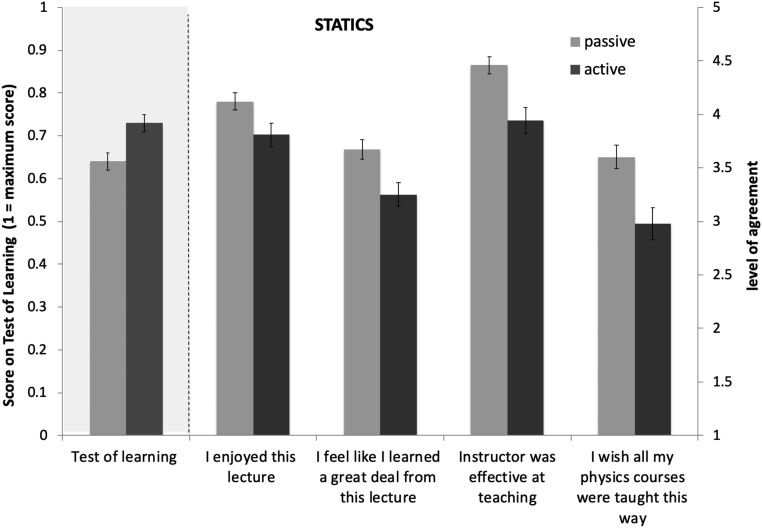
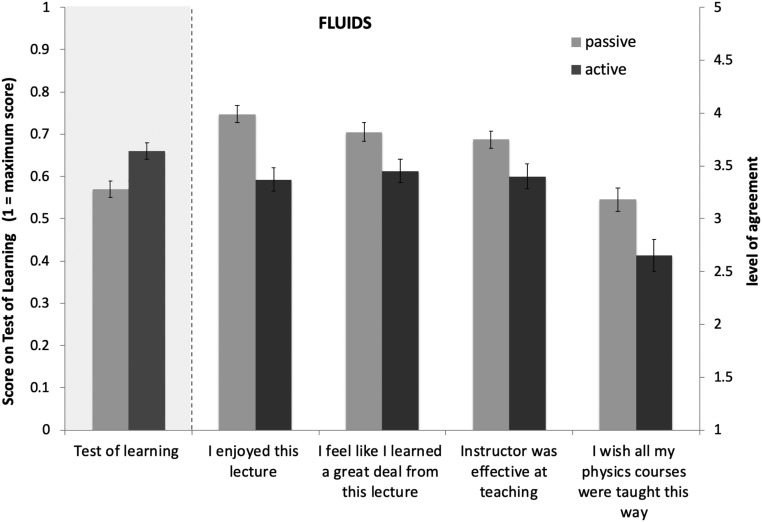
Significance: Despite active learning being recognized as a superior method of instruction in the classroom, a major recent survey found that most college STEM instructors still choose traditional teaching methods. This article addresses the long-standing question of why students and faculty remain resistant to active learning. Comparing passive lectures with active learning using a randomized experimental approach and identical course materials, we find that students in the active classroom learn more, but they feel like they learn less. We show that this negative correlation is caused in part by the increased cognitive effort required during active learning. Faculty who adopt active learning are encouraged to intervene and address this misperception, and we describe a successful example of such an intervention.
Overview
The claims and statistics of this paper haven’t been checked yet.
Free: it reads the open-access text and checks the first 5 claims that cite a source we can check. Create a free account to check every claim.
Integrity signals
Registry
Cites
Statistics
Figures
Verification
Claims the paper makes
The claims and statistics of this paper haven’t been checked yet.
Free: it reads the open-access text and checks the first 5 claims that cite a source we can check. Create a free account to check every claim.
Claims other papers make about this one
Each is checked against this paper’s own text: does it say what the citing paper says it does?
The source backs part of the claim, not all of it — or backs it for a different population, condition or comparison.
In the citing paper
“Our results support this approach, indicating that reducing cognitive offloading through active engagement can mitigate the negative impact of AI tools on critical thinking.”
From AI Tools in Society: Impacts on Cognitive Offloading and the Future of Critical Thinking (2025) · cites this paper as Deslauriers et al. [46]
Experimental — accuracy not yet measuredThe source backs part of the claim, not all of it — or backs it for a different population, condition or comparison.
In the citing paper
“Such perceptions can be different from actual learning and have been shown to disadvantage more effective teachers and teaching methods (Carrell and West 2010, Deslauriers et al. 2019).”
From AI Meets the Classroom: When Do Large Language Models Harm Learning? (2024) · cites this paper as Deslauriers et al. 2019
Experimental — accuracy not yet measuredThe source backs part of the claim, not all of it — or backs it for a different population, condition or comparison.
In the citing paper
“The exercise is a reminder that we are often poor judges of our own knowledge and may overestimate our understanding of various subjects, blurring the line between familiarity and fluency.”
From Assigning AI: Seven Approaches for Students, with Prompts (2023) · cites this paper as Deslauriers et al., 2019
Experimental — accuracy not yet measuredThe source backs part of the claim, not all of it — or backs it for a different population, condition or comparison.
In the citing paper
“A growing number of studies demonstrate, however, that people prefer simpler constructs, even though they learn more and perform better with more complex ones.”
From To Trust or to Think: Cognitive Forcing Functions Can Reduce Overreliance on AI in AI-assisted Decision-making (2021) · cites this paper as [18]
Experimental — accuracy not yet measuredThe source backs part of the claim, not all of it — or backs it for a different population, condition or comparison.
In the citing paper
“the scaffolded, conversational nature of the AI tool may have created a strong subjective sense of mastery that did not fully translate to improved performance under traditional assessment conditions”
From Socratic Mind: Impact of a Novel GenAI-Powered Formative Assessment Tool on Student Learning and Higher-Order Thinking (2026) · cites this paper as Deslauriers et al., 2019
Experimental — accuracy not yet measured
3 more claims about this paper
Create a free account to see every claim other papers make about this one.
Self-check
Percentages, sums and reported differences re-computed from the paper’s own numbers.
The self-check needs the paper’s full text.
Citations
Cites
A heteroskedasticity-consistent covariance matrix estimator and a direct test for heteroskedasticity
White, H. (1980) · Econometrica · doi:10.2307/1912934 · Cited by 25,861
(1999) · Cited by 12,812
Active learning increases student performance in science, engineering, and mathematics
Freeman, S., Eddy, S. L., McDonough, M., Smith, M. K., Okoroafor, N., Jordt, H., & Wenderoth, M. P. (2014) · Proceedings of the National Academy of Sciences · doi:10.1073/pnas.1319030111 · Cited by 9,787 · cited 1×
“(4) had to correct for this oversight in their metaanalysis.”
BackgroundThe role of deliberate practice in the acquisition of expert performance
Ericsson, K. A., Krampe, R. T., & Tesch-Römer, C. (1993) · Psychological Review · doi:10.1037/0033-295x.100.3.363 · Cited by 9,564 · cited 1×
“In the experimental group, the instructor actively engaged the students using the principles of deliberate practice (3, 36, 37): students were instructed to solve the sample problems by working together in small groups while the instructor roamed the room asking questions and offering assistance.”
MethodKruger, J., & Dunning, D. (1999) · Journal of Personality and Social Psychology · doi:10.1037/0022-3514.77.6.1121 · Cited by 7,731
Hake, R. R. (1998) · American Journal of Physics · doi:10.1119/1.18809 · Cited by 6,072 · cited 1×
“The pretest FCI scores in this study (Table 1) are similar to those clustered near the high end of the distribution of university scores in the metaanalysis published by Hake (1), which confirms that the students in our study have high school preparation comparable to that at other top universities.”
ResultHestenes, D., Wells, M., & Swackhamer, G. (1992) · The Physics Teacher · doi:10.1119/1.2343497 · Cited by 3,235
Peer Instruction: Ten years of experience and results
Crouch, C. H., & Mazur, E. (2001) · American Journal of Physics · doi:10.1119/1.1374249 · Cited by 2,682
When Should You Adjust Standard Errors for Clustering?
Abadie, A., Athey, S., Imbens, G., & Wooldridge, J. (2017) · National Bureau of Economic Research · doi:10.3386/w24003 · Cited by 1,360
Improved Learning in a Large-Enrollment Physics Class
Deslauriers, L., Schelew, E., & Wieman, C. (2011) · Science · doi:10.1126/science.1201783 · Cited by 1,270 · cited 4×
“4, used distinctly different class materials with each group, potentially confounding active engagement with changes in class content (3).”
BackgroundMethodInfluentialSelf-citation
Research works printed but not linked: 3
- Henderson C., Stelzer T., Hsu L., Meredith D., Maximizing the benefits of physics education research: Building productive relationships and promoting institutional change. American Physical Society Forum on Education Newsletter, Fall 2005, pp. 11–14. https://www.aps.org/units/fed/newsletters/fall2005/maximize.html. Accessed 20 June 2019.
- Felder R. M., Random thoughts: Sermons for grumpy campers. Chem. Eng. Educ. 41, 183– 184 (2007).
- Felder R. M., Random thoughts: The link between teaching and research. 2. How to strengthen each without weakening the other. Chem. Eng. Educ. 44, 213– 214 (2010).
Cited by
Items 201–300 of 1,005
Rodríguez, V. J., Rodríguez, M. I. B., Galán, J. I. P., Carabantes-Alarcón, D., Cáceres, O. I. M., Borrás-Gené, O., Medina, E. F. L., Jiménez, M. L., Valle, M. C., Enríquez, I. G., et al. (2022) · Etic net Revista científica electrónica de Educación y Comunicación en la Sociedad del Conocimiento · doi:10.30827/eticanet.v22i1.22262 · Cited by 28
Zhang, M., Croiset, E., & Ioannidis, M. A. (2022) · Education for Chemical Engineers · doi:10.1016/j.ece.2022.09.002 · Cited by 28
Handbook Transdisciplinary Learning
Philipp, T., Schmohl, T., BMBF, & Berlin University Alliance (2023) · Hochschulbildung: Lehre und Forschung · doi:10.1515/9783839463475 · Cited by 32
ACTIVE METHODOLOGIES IN HIGHER EDUCATION: A SYSTEMATIC MAPPING IN THE CONTEXT OF ENGINEERING COURSES
Reis, A., Alves, A., & Wendland, E. C. (2023) · Educação em Revista · doi:10.1590/0102-469839012 · Cited by 28
Class integration of ChatGPT and learning analytics for higher education
Civit, M., Escalona, M. J., Cuadrado, F., & de Cózar, S. R. (2024) · Expert Systems · doi:10.1111/exsy.13703 · Cited by 29
Undergraduates’ lived experience of project-/problem-based learning in introductory biology
Webster, A., Metcalf, A., Kelly, L. J., Bisesi, A. T., Marnik-Said, M., Colbeck, C. L., Marine, R. J., Vinces, M., Campbell, A. E., & Allen, T. S. (2022) · AJP Advances in Physiology Education · doi:10.1152/advan.00042.2021 · Cited by 28
Wichmann-Hansen, G., & Nielsen, K.-J. S. (2023) · Scandinavian Journal of Educational Research · doi:10.1080/00313831.2023.2204113 · Cited by 27
The refinement of flipped teaching implementation to include retrieval practice
Gopalan, C., Fentem, A., & Rever, A. L. (2020) · AJP Advances in Physiology Education · doi:10.1152/advan.00143.2019 · Cited by 27
Adapting guided inquiry learning worksheets for emergency remote learning
Howley, I. K. (2020) · Information and Learning Sciences · doi:10.1108/ils-04-2020-0086 · Cited by 27
Borchers, C., Fleischer, H., Schanze, S., Scheiter, K., & Aleven, V. A. W. M. M. (2025) · Computers & Education · doi:10.1016/j.compedu.2025.105364 · Cited by 26
AlZoubi, D., Kelley, J., Baran, E., Gilbert, S. B., Ilgu, A. K., & Jiang, S. (2021) · CHI Conference Extended Abstracts on Human Factors in Computing Systems (CHI EA) · doi:10.1145/3411763.3451709 · Cited by 26
Kovarik, M. L., Robinson, J. K., & Wenzel, T. J. (2022) · ACS symposium series · doi:10.1021/bk-2022-1409.ch001 · Cited by 26
Lin, Y.-M., Chen, M., Lee, S. Y., Yi, S. H., Chen, Y., Tandoc, E. C., Goh, Z. H., & Salmon, C. T. (2023) · Health Communication · doi:10.1080/10410236.2023.2165750 · Cited by 26
Scoping Review: Innovations in Clinical Neurology Education
Zimmerman, W. D., Pergakis, M. B., Gorman, E. F., Motta, M., Jin, P. H., Salas, R. M. E., & Morris, N. A. (2023) · Neurology Education · doi:10.1212/ne9.0000000000200048 · Cited by 26
Pattemore, A., Suárez, M. D. M., & Muñoz, C. (2024) · ReCALL · doi:10.1017/s0958344024000065 · Cited by 26
Crous, G., Rodríguez, J. R., & Petry, P. P. (2024) · Educatio Siglo XXI · doi:10.6018/educatio.550001 · Cited by 26
Priante, A., & Tsekouras, D. (2025) · Information & Management · doi:10.1016/j.im.2025.104105 · Cited by 26
Fischer, K. M., Sekula, M. N., Hannigan, J. D., Vaught, R. L., House, H., Souza, G. M. D., & Williams, T. (2024) · Journal of Dental Education · doi:10.1002/jdd.13490 · Cited by 26
Translating the learning sciences into practice: A primer for clinical and translational educators
Norman, M. K., & Lotrecchiano, G. R. (2021) · Journal of Clinical and Translational Science · doi:10.1017/cts.2021.840 · Cited by 25
Learning as a peer assessor: evaluating peer-assessment strategies
Culver, C. (2022) · Assessment & Evaluation in Higher Education · doi:10.1080/02602938.2022.2107167 · Cited by 25
Yik, B. J., Raker, J. R., Apkarian, N., Stains, M., Henderson, C., Dancy, M., & Johnson, E. (2022) · Frontiers in Education · doi:10.3389/feduc.2022.1016415 · Cited by 25
Towards Responsible Development of Generative AI for Education: An Evaluation-Driven Approach
Jurenka, I., Kunesch, M., McKee, K. R., Gillick, D., Zhu, S., Wiltberger, S., Phal, S. M., Hermann, K., Kasenberg, D., Bhoopchand, A., et al. (2024) · arXiv · doi:10.48550/arxiv.2407.12687 · Cited by 24
Luo, X., Wang, S., & Hew, K. F. (2025) · Computers & Education · doi:10.1016/j.compedu.2025.105486 · Cited by 24
Effectiveness of a Laboratory Course with Arduino and Smartphones
Organtini, G., & Tufino, E. (2022) · Education Sciences · doi:10.3390/educsci12120898 · Cited by 24
Training benefits driver behaviour while using automation with an attention monitoring system
DeGuzman, C. A., & Donmez, B. (2024) · Transportation Research Part C Emerging Technologies · doi:10.1016/j.trc.2024.104752 · Cited by 24
Developing a safe learning environment in primary-level innovative schools in the Czech Republic
Báčová, V. (2024) · Education 3-13 · doi:10.1080/03004279.2024.2410482 · Cited by 24
Church, F. (2021) · Education Sciences · doi:10.3390/educsci11080370 · Cited by 24
Lee, J., Hung, J.-T., Yilmaz Soylu, M., Popescu, D., Cui, C. Z., Grigoryan, G., Joyner, D. A., & Harmon, S. W. (2026) · Technology, Knowledge and Learning · doi:10.1007/s10758-026-10007-6 · Cited by 23
Ma, Q., Koedinger, K. R., & Wu, T. (2026) · CHI Conference on Human Factors in Computing Systems · doi:10.1145/3772318.3791283 · Cited by 23
Illusions of Understanding in the Sciences
Shiffrin, R. M., Stigler, S., & Keil, F. C. (2026) · Computational Brain & Behavior · doi:10.1007/s42113-026-00271-1 · Cited by 23
Charalambous, M., Hodge, J. A., & Ippolito, K. (2020) · Educational Action Research · doi:10.1080/09650792.2020.1782240 · Cited by 23
Zhao, C., Xu, T., Yao, Y., Song, Q., & Xu, B. (2023) · International Journal of Medical Informatics · doi:10.1016/j.ijmedinf.2023.105117 · Cited by 23
The Impact of Interprofessional Education on Health Profession Students’ Professional Identity
Ciani, G. J., Grimaldi, G., Macalintal, M., & Orner, D. (2023) · Education Sciences · doi:10.3390/educsci13050494 · Cited by 23
Chouvalova, A., Navlekar, A. S., Mills, D. J., Adams, M., Daye, S., Anda, F. D., & Limeri, L. B. (2024) · International Journal of STEM Education · doi:10.1186/s40594-024-00485-4 · Cited by 23
Mind the gap: the reality of remote learning during COVID-19
Osborne, S., & Hogarth, K. (2021) · Accounting Research Journal · doi:10.1108/arj-09-2020-0303 · Cited by 23
Niekerk, M. V., & Delport, M. (2022) · Accounting Education · doi:10.1080/09639284.2022.2029748 · Cited by 23
Prerequisites for learning in networked immersive virtual reality.
Han, E., Nowak, K. L., & Bailenson, J. N. (2022) · Technology Mind and Behavior · doi:10.1037/tmb0000094 · Cited by 23
Doolittle, P. E., & Byrnes, M. K. (2023) · Wiley eBooks · doi:10.1002/9781119852865.ch3 · Cited by 23
Carrasco, C. J. G., Rodríguez‐Medina, J., Martínez, P. M., & Facal, R. L. (2021) · Frontiers in Psychology · doi:10.3389/fpsyg.2021.661780 · Cited by 22
Fernandez, T., Martin, K. M., Mangum, R., & Bell-Huff, C. L. (2020) · ASEE Annual Conference & Exposition · doi:10.18260/1-2--35512 · Cited by 22
Yik, B. J., Machost, H. R., Streifer, A. C., Palmer, M. S., Morkowchuk, L., & Stains, M. (2024) · Journal of Chemical Education · doi:10.1021/acs.jchemed.4c00698 · Cited by 23
Comparing Active Learning to Team-Based Learning in Undergraduate Neuroscience.
Ng, M., & Newpher, T. M. (2020) · PubMed Central · Cited by 22
A Multicenter VA Study of the Format and Content of Internal Medicine Morning Report
Heppe, D. B., Beard, A. S., Cornia, P. B., Albert, T. J., Lankarani‐Fard, A., Bradley, J., Guidry, M. M., Kwan, B., Jagannath, A., Tuck, M., et al. (2020) · Journal of General Internal Medicine · doi:10.1007/s11606-020-06069-6 · Cited by 22
Behavior-Driven Development: An Expert Panel to evaluate benefits and challenges
Nascimento, N., Santos, A. R., de Sales, A. H. C., & Chanin, R. M. (2020) · Brazilian Symposium on Software Engineering · doi:10.1145/3422392.3422460 · Cited by 22
Callaghan‐Koru, J. A., & Aqil, A. R. (2020) · Pedagogy in Health Promotion · doi:10.1177/2373379920979684 · Cited by 22
Taher, T. M. J., Saadi, R. B., Oraibi, R. R., Ghazi, H. F., Abdul‐Rasool, S., & Tuma, F. (2022) · Cureus · doi:10.7759/cureus.24969 · Cited by 22
Lourakis, E., & Petridis, K. (2023) · Education Sciences · doi:10.3390/educsci13020126 · Cited by 22
Durk, J., Davies, A., Hughes, R. W. M., & Jardine-Wright, L. (2020) · Physical Review Physics Education Research · doi:10.1103/physrevphyseducres.16.020126 · Cited by 21
Cirillo, M., Berk, D., LaRochelle, R., Bieda, K. N., & Arbaugh, F. (2022) · International Journal of Research in Undergraduate Mathematics Education · doi:10.1007/s40753-022-00191-y · Cited by 22
The Impact of Social Media on Literature
Shahwan, S. J. (2023) · Arab World English Journal · doi:10.24093/awej/comm1.18 · Cited by 21
A call for spaced repetition in medical education
French, B. N., Marxen, T., Akhnoukh, S., Novack, J., Anderlecht, K. V., Jung, E. H., Preston, J. D., & Spicer, J. O. (2023) · The Clinical Teacher · doi:10.1111/tct.13669 · Cited by 21
Picturing innovation in higher education: A photovoice study of innovative pedagogies
Ciolan, L., & Manasia, L. (2024) · Active Learning in Higher Education · doi:10.1177/14697874241245350 · Cited by 21
Assessing a novel problem‐based learning approach with game elements in a business analytics course
Bayley, T., Wheatley, D., & Hurst, A. (2021) · Decision Sciences Journal of Innovative Education · doi:10.1111/dsji.12246 · Cited by 23
Assisted Discovery Based Learning of the Electric Force with Scaffolding for Novice Students
Gutierrez, O. A., Galloway, R., Santos-Guevara, A., Martínez-Huerta, H., & González, H. (2022) · Education Sciences · doi:10.3390/educsci12040269 · Cited by 21
Amzalag, M., Beimel, D., & Zviel-Girshin, R. (2025) · Computers and Education Open · doi:10.1016/j.caeo.2025.100313 · Cited by 22
Reflections on Course-Based Undergraduate Research in Organic and Biochemistry during COVID-19
Deveau, A. M., Wang, Y., & Small, D. J. (2020) · Journal of Chemical Education · doi:10.1021/acs.jchemed.0c00787 · Cited by 20
Magnone, K. Q., Ebert, J. A., Creeden, R., Karlock, G., Loveday, M. E., Blake, E., Pratt, J. M., Schafer, A. G. L., & Yezierski, E. J. (2023) · Journal of Chemical Education · doi:10.1021/acs.jchemed.2c00591 · Cited by 20
Cultivating educational adaptability through collaborative transdisciplinary learning spaces
Ramachandran, A., Schwellnus, M., Gladwin, D., Derby-Talbot, R., & Ellis, N. (2024) · Discover Education · doi:10.1007/s44217-023-00084-5 · Cited by 20
Hallinger, P. (2023) · Interdisciplinary Journal of Problem-based Learning · doi:10.14434/ijpbl.v17i2.35761 · Cited by 21
Comfort in active learning spaces – students’ perceptions and preferences
Aga, K. (2024) · European Journal of Engineering Education · doi:10.1080/03043797.2024.2341756 · Cited by 20
Integrating Python data analysis in an existing introductory laboratory course
Tufino, E., Oss, S., & Alemani, M. (2024) · European Journal of Physics · doi:10.1088/1361-6404/ad4fcc · Cited by 20
Enhancing Student Engagement Through Problem-Based Learning: A Case of the Built Environment
Nemakhavhani, R. B. (2024) · International Conference on Education Research · doi:10.34190/icer.1.1.3053 · Cited by 20
Teaching a Conversational Agent using Natural Language: Effect on Learning and Engagement
Love, R., Law, E., Cohen, P. R., & Kulić, D. (2025) · International Journal of Artificial Intelligence in Education · doi:10.1007/s40593-025-00461-1 · Cited by 21
Detyna, M., Ogunbase, A., & Briffa, H. (2025) · Learning Environments Research · doi:10.1007/s10984-025-09529-0 · Cited by 20
Moraes, K. R. D. M., Heidemann, L. A., & Espinosa, T. (2020) · Caderno Brasileiro de Ensino de Física · doi:10.5007/2175-7941.2020v37n2p369 · Cited by 21
Liyanage, D., Lo, S. M., & Hunnicutt, S. S. (2021) · Chemistry Education Research and Practice · doi:10.1039/d0rp00031k · Cited by 20
Profiles of Instructor Responses to Emergency Distance Learning
Rutherford, T. A., Karamarkovich, S. M., Xu, D., Tate, T. P., Sato, B. K., Baker, R. B., & Warschauer, M. (2021) · Online Learning · doi:10.24059/olj.v25i1.2472 · Cited by 22
Characteristics of interactive classrooms that first year students find helpful
Vroom, K., Gehrtz, J., Apkarian, N., Elizondo, T. A., Ellis, B. M., & Hagman, J. E. (2022) · International Journal of STEM Education · doi:10.1186/s40594-022-00354-y · Cited by 19
Wargaming for Learning: How Educational Gaming Supports Student Learning and Perspectives
Rosen, A. M., & Kerr, L. M. (2024) · Journal of Political Science Education · doi:10.1080/15512169.2024.2304769 · Cited by 19
Keadkraichaiwat, I., Sitticharoon, C., Lertsiripatarajit, V., & Maprapho, P. (2024) · Education and Information Technologies · doi:10.1007/s10639-024-12548-8 · Cited by 19
Chen, C., Said, T., Sadler, P. M., Perry, A., & Sonnert, G. (2024) · Journal of Research in Science Teaching · doi:10.1002/tea.21948 · Cited by 19
Impact of question presence and interactivity in instructional videos on student learning
Deng, R., Yang, Y., & Shen, S. (2024) · Education and Information Technologies · doi:10.1007/s10639-024-12862-1 · Cited by 20
The illusion of attendance: a critical study of large-class lectures
Loughlin, C. (2024) · Teaching in Higher Education · doi:10.1080/13562517.2024.2441183 · Cited by 19
Managing a Curriculum Innovation Process
Lemay, J., & Moreau, P. R. (2020) · Pharmacy · doi:10.3390/pharmacy8030153 · Cited by 19
França, V. C. P. L. A. D., & Campos, W. F. (2021) · AJP Advances in Physiology Education · doi:10.1152/advan.00042.2020 · Cited by 20
Improving models for student retention and graduation using Markov chains
Tedeschi, M. N., Hose, T. M., Mehlman, E. K., Franklin, S., & Wong, T. E. (2023) · PLoS ONE · doi:10.1371/journal.pone.0287775 · Cited by 19
Blended Learning Delivery Methods for a Sustainable Learning Environment: A Delphi Study
Alammary, A. S. (2024) · Sustainability · doi:10.3390/su16083269 · Cited by 19
Teaching and Learning Centre: Analysis of Key Elements
Lotti, A., Serbati, A., Doria, B., Picasso, F., & Felisatti, E. (2022) · FORMAZIONE & INSEGNAMENTO. Rivista internazionale di Scienze dell'educazione e della formazione · doi:10.7346/-fei-xx-02-22_06 · Cited by 19
Chase, L., McMurray, M. S., Stavnezer, A. J., Buffalari, D. M., Fernandes, J. J., Lom, B., & Morrison, M. E. (2020) · PubMed Central · Cited by 20
Editorial: Artificial Intelligence is Awesome, but Good Teaching Should Always Come First.
Crawford, J., Vallis, C., Yang, J., Fitzgerald, R., O'Dea, C., & Cowling, M. (2024) · Journal of University Teaching and Learning Practice · doi:10.53761/1.20.7.01 · Cited by 18
Ghasem, N. M. (2025) · Cogent Education · doi:10.1080/2331186x.2025.2560057 · Cited by 18
Beimel, D., Amzalag, M., Zviel-Girshin, R., & Voloch, N. (2025) · Education Sciences · doi:10.3390/educsci15111480 · Cited by 18
Learning team-based quality improvement in a virtual setting: a qualitative study
Hovlid, E., Husabø, G., Valestrand, E. A., & Hartveit, M. (2022) · BMJ Open · doi:10.1136/bmjopen-2022-061390 · Cited by 18
Metodologías activas para la enseñanza aprendizaje de física en el bachillerato
Hurtado, T. A. S., Garcés, M. F. L., León, M. B. A., & Escobar, M. C. E. (2023) · Ciencia Latina Revista Científica Multidisciplinar · doi:10.37811/cl_rcm.v7i1.5069 · Cited by 18
Self-study enhances the learning effect of discussions
Lim, J., & Park, J. (2023) · Journal of the Learning Sciences · doi:10.1080/10508406.2023.2185148 · Cited by 18
Student Perceptions of Team-Based Learning in an Advanced Inorganic Chemistry Course
Hancock, L. M. (2024) · Journal of Chemical Education · doi:10.1021/acs.jchemed.3c00655 · Cited by 18
Neuwirt, H., Eder, I. E., Gauckler, P., Horvath, L., Koeck, S., Noflatscher, M., Schaefer, B., Simeon, A., Petzer, V., Prodinger, W. M., et al. (2024) · BMC Medical Education · doi:10.1186/s12909-024-05091-0 · Cited by 18
Using Team-Based Learning to Teach Pharmacology within the Medical Curriculum
Luitjes, N. L. D., van der Velden, G. J., & Pandit, R. (2024) · Pharmacy · doi:10.3390/pharmacy12030091 · Cited by 18
Newton’s Second Law Teaching Strategies—Identifying Opportunities for Educational Innovation
Zeltzer, V. P., Huincahue, J., & Abril, D. (2025) · Education Sciences · doi:10.3390/educsci15060748 · Cited by 18
Assessing evaluation: Why student engages or resists to active learning?
Nuez, M. J. A., Gil‐Lacruz, A. I., & Martínez, J. R. (2020) · International Journal of Technology and Design Education · doi:10.1007/s10798-020-09582-1 · Cited by 18
Carpenter, S. K., Witherby, A. E., & Tauber, S. K. (2020) · Journal of Applied Research in Memory and Cognition · doi:10.1016/j.jarmac.2020.04.003 · Cited by 18
Martella, A. M., Yatcilla, J., Martella, R. C., Marchand‐Martella, N. E., Ozen, Z., Karatas, T., Park, H. H., Simpson, A., & Karpicke, J. D. (2021) · Review of Educational Research · doi:10.3102/0034654321991228 · Cited by 18
Gonsar, N., Patrick, L. E., & Cotner, S. H. (2021) · Disciplinary and Interdisciplinary Science Education Research · doi:10.1186/s43031-021-00035-w · Cited by 18
Ramirez, S., Teten, S. L., Mamo, M., Speth, C. A., Kettler, T. A., & Sindelar, M. E. (2021) · Journal of Geoscience Education · doi:10.1080/10899995.2021.1965419 · Cited by 18
Instructor facilitation mediates students’ negative perceptions of active learning instruction
Park, E. S., Harlow, A. N., AghaKouchak, A., Baldi, B., Burley, N. T., Buswell, N. T., Crooks, R. N., Denenberg, D., Ditto, P. H., Edwards, K., et al. (2021) · PLoS ONE · doi:10.1371/journal.pone.0261706 · Cited by 18
Learning to Learn: Drawing Students’ Attention to Ideas about Learning
Kruse, J., Wilcox, J. L., & Easter, J. (2022) · The Clearing House A Journal of Educational Strategies Issues and Ideas · doi:10.1080/00098655.2022.2033670 · Cited by 18
Inquiry-based mathematics education: a call for reform in tertiary education seems unjustified
Evans, T., & Dietrich, H. (2022) · STEM Education · doi:10.3934/steme.2022014 · Cited by 19
The Impact of The Dissemination of The Covid-19 Epidemic on Social Development in Early Children
Najamuddin, N., Sahrip, S., Siahaan, K. W. A., Yunita, W., & Ananda, R. (2022) · International Journal of Elementary Education · doi:10.23887/ijee.v6i2.45336 · Cited by 19
Lam, Y. W., Hew, K. F., & Jia, C. (2022) · Language learning & technology · doi:10.64152/10125/73467 · Cited by 18
Katsioudi, G., & Kostareli, E. (2021) · FEBS Open Bio · doi:10.1002/2211-5463.13135 · Cited by 18
Metadata
- Authors
- Deslauriers, L., McCarty, L. S., Miller, K., Callaghan, K., & Kestin, G.
- Affiliations
- Harvard University (US)
- Corresponding author
- Deslauriers, Louis
- Venue
- Proceedings of the National Academy of Sciences
- Publisher
- National Academy of Sciences
- Published
- 2019-09-04
- Volume
- 116
- Issue
- 39
- Pages
- 19251-19257
- ISSN
- 0027-8424 (ISSN-L)
- 1091-6490
- PMC
- PMC6765278
- OpenAlex
- W2971755171
- Cited by
- 1,371
- References
- 43
- Citations by year
- 2026: 186 · 2025: 222 · 2024: 251 · 2023: 216 · 2022: 196 · 2021: 165 · 2020: 122 · 2019: 13
- FWCI
- 334.20
- Type
- journal article
- Language
- en
- Open access
- hybrid
- doi.org
- Licence
- Locations
- Proceedings of the National Academy of Sciences (publishedVersion, cc-by-nc-nd)
- Europe PMC (PubMed Central) (publishedVersion, cc-by-nc-nd)
- PubMed Central (publishedVersion, cc-by-nc-nd)
- PubMed (publishedVersion)
- Topics
- Social Sciences › Education › Innovative Teaching Methods
- Social Sciences › Education › Evaluation of Teaching Practices
- Social Sciences › Psychology › Developmental and Educational Psychology › Innovative Teaching and Learning Methods
- Keywords
- active learning, student perceptions of learning, introductory college physics, large-enrollment courses, cognitive effort, student motivation, student self-regulation, teaching evaluation, student engagement
- MeSH terms
- Formative Feedback, Educational Measurement, Emotions, Female, Humans, Male, Perception, Physics, Students, Teaching, Universities, Problem-Based Learning
About these checks
Registry, retraction, Cites and statistics results are computed, not judged, with one exception: a printed reference that no index lists is read once by a model before it counts as a citation error. Claims are extracted by a model and kept only when their quote appears verbatim in the text; each cited source is then checked, with a model’s help, for whether it says what the claim relies on. Those verdicts can be wrong — read the claim’s quote and the cited source before relying on one.
Statistics and arithmetic are recomputed, not judged.
Confidence bands are shown only for fields calibrated on our annotated test set. None is calibrated yet, so no band is shown.
What counts as a claim ›How we measure confidence ›How we check this ›
Are you an author, or do you see a problem with this page? Request a review
Data sources
Bibliographic data: Semantic Scholar, OpenAlex, Crossref.
Contains information from the Semantic Scholar Academic Graph Datasets, made available under the ODC Attribution License (ODC-BY 1.0).
Semantic Scholar’s data is described in: Kinney, R., et al. (2023). The Semantic Scholar Open Data Platform. arXiv:2301.10140.
