

Measuring actual learning versus feeling of learning in response to being actively engaged in the classroom
Open accessThe DOI matches its Crossref record; 41 of the 43 references it cites were found in a registry or an index.
Abstract
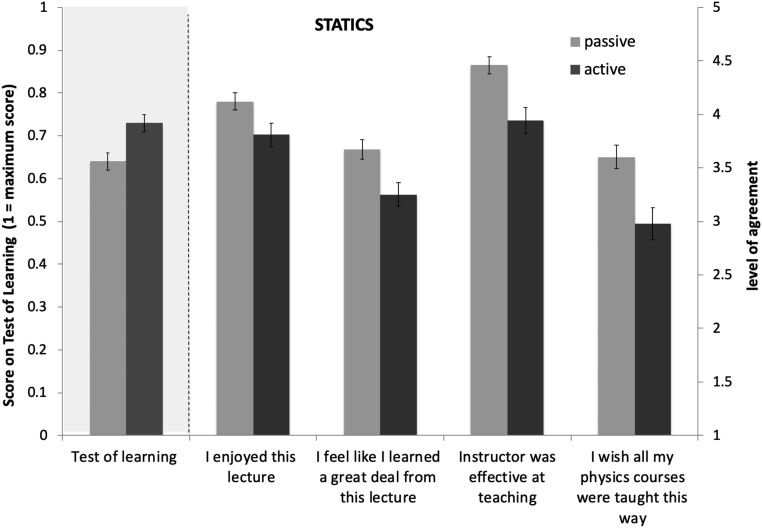
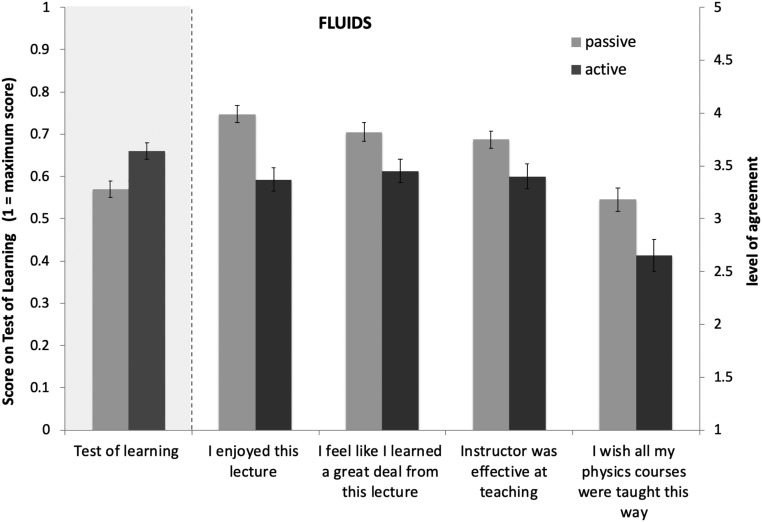
Significance: Despite active learning being recognized as a superior method of instruction in the classroom, a major recent survey found that most college STEM instructors still choose traditional teaching methods. This article addresses the long-standing question of why students and faculty remain resistant to active learning. Comparing passive lectures with active learning using a randomized experimental approach and identical course materials, we find that students in the active classroom learn more, but they feel like they learn less. We show that this negative correlation is caused in part by the increased cognitive effort required during active learning. Faculty who adopt active learning are encouraged to intervene and address this misperception, and we describe a successful example of such an intervention.
Overview
The claims and statistics of this paper haven’t been checked yet.
Free: it reads the open-access text and checks the first 5 claims that cite a source we can check. Create a free account to check every claim.
Integrity signals
Registry
Cites
Statistics
Figures
Verification
Claims the paper makes
The claims and statistics of this paper haven’t been checked yet.
Free: it reads the open-access text and checks the first 5 claims that cite a source we can check. Create a free account to check every claim.
Claims other papers make about this one
Each is checked against this paper’s own text: does it say what the citing paper says it does?
The source backs part of the claim, not all of it — or backs it for a different population, condition or comparison.
In the citing paper
“Our results support this approach, indicating that reducing cognitive offloading through active engagement can mitigate the negative impact of AI tools on critical thinking.”
From AI Tools in Society: Impacts on Cognitive Offloading and the Future of Critical Thinking (2025) · cites this paper as Deslauriers et al. [46]
Experimental — accuracy not yet measuredThe source backs part of the claim, not all of it — or backs it for a different population, condition or comparison.
In the citing paper
“Such perceptions can be different from actual learning and have been shown to disadvantage more effective teachers and teaching methods (Carrell and West 2010, Deslauriers et al. 2019).”
From AI Meets the Classroom: When Do Large Language Models Harm Learning? (2024) · cites this paper as Deslauriers et al. 2019
Experimental — accuracy not yet measuredThe source backs part of the claim, not all of it — or backs it for a different population, condition or comparison.
In the citing paper
“The exercise is a reminder that we are often poor judges of our own knowledge and may overestimate our understanding of various subjects, blurring the line between familiarity and fluency.”
From Assigning AI: Seven Approaches for Students, with Prompts (2023) · cites this paper as Deslauriers et al., 2019
Experimental — accuracy not yet measuredThe source backs part of the claim, not all of it — or backs it for a different population, condition or comparison.
In the citing paper
“A growing number of studies demonstrate, however, that people prefer simpler constructs, even though they learn more and perform better with more complex ones.”
From To Trust or to Think: Cognitive Forcing Functions Can Reduce Overreliance on AI in AI-assisted Decision-making (2021) · cites this paper as [18]
Experimental — accuracy not yet measuredThe source backs part of the claim, not all of it — or backs it for a different population, condition or comparison.
In the citing paper
“the scaffolded, conversational nature of the AI tool may have created a strong subjective sense of mastery that did not fully translate to improved performance under traditional assessment conditions”
From Socratic Mind: Impact of a Novel GenAI-Powered Formative Assessment Tool on Student Learning and Higher-Order Thinking (2026) · cites this paper as Deslauriers et al., 2019
Experimental — accuracy not yet measured
3 more claims about this paper
Create a free account to see every claim other papers make about this one.
Self-check
Percentages, sums and reported differences re-computed from the paper’s own numbers.
The self-check needs the paper’s full text.
Citations
Cites
A heteroskedasticity-consistent covariance matrix estimator and a direct test for heteroskedasticity
White, H. (1980) · Econometrica · doi:10.2307/1912934 · Cited by 25,861
(1999) · Cited by 12,812
Active learning increases student performance in science, engineering, and mathematics
Freeman, S., Eddy, S. L., McDonough, M., Smith, M. K., Okoroafor, N., Jordt, H., & Wenderoth, M. P. (2014) · Proceedings of the National Academy of Sciences · doi:10.1073/pnas.1319030111 · Cited by 9,787 · cited 1×
“(4) had to correct for this oversight in their metaanalysis.”
BackgroundThe role of deliberate practice in the acquisition of expert performance
Ericsson, K. A., Krampe, R. T., & Tesch-Römer, C. (1993) · Psychological Review · doi:10.1037/0033-295x.100.3.363 · Cited by 9,564 · cited 1×
“In the experimental group, the instructor actively engaged the students using the principles of deliberate practice (3, 36, 37): students were instructed to solve the sample problems by working together in small groups while the instructor roamed the room asking questions and offering assistance.”
MethodKruger, J., & Dunning, D. (1999) · Journal of Personality and Social Psychology · doi:10.1037/0022-3514.77.6.1121 · Cited by 7,731
Hake, R. R. (1998) · American Journal of Physics · doi:10.1119/1.18809 · Cited by 6,072 · cited 1×
“The pretest FCI scores in this study (Table 1) are similar to those clustered near the high end of the distribution of university scores in the metaanalysis published by Hake (1), which confirms that the students in our study have high school preparation comparable to that at other top universities.”
ResultHestenes, D., Wells, M., & Swackhamer, G. (1992) · The Physics Teacher · doi:10.1119/1.2343497 · Cited by 3,235
Peer Instruction: Ten years of experience and results
Crouch, C. H., & Mazur, E. (2001) · American Journal of Physics · doi:10.1119/1.1374249 · Cited by 2,682
When Should You Adjust Standard Errors for Clustering?
Abadie, A., Athey, S., Imbens, G., & Wooldridge, J. (2017) · National Bureau of Economic Research · doi:10.3386/w24003 · Cited by 1,360
Improved Learning in a Large-Enrollment Physics Class
Deslauriers, L., Schelew, E., & Wieman, C. (2011) · Science · doi:10.1126/science.1201783 · Cited by 1,270 · cited 4×
“4, used distinctly different class materials with each group, potentially confounding active engagement with changes in class content (3).”
BackgroundMethodInfluentialSelf-citation
Research works printed but not linked: 3
- Henderson C., Stelzer T., Hsu L., Meredith D., Maximizing the benefits of physics education research: Building productive relationships and promoting institutional change. American Physical Society Forum on Education Newsletter, Fall 2005, pp. 11–14. https://www.aps.org/units/fed/newsletters/fall2005/maximize.html. Accessed 20 June 2019.
- Felder R. M., Random thoughts: Sermons for grumpy campers. Chem. Eng. Educ. 41, 183– 184 (2007).
- Felder R. M., Random thoughts: The link between teaching and research. 2. How to strengthen each without weakening the other. Chem. Eng. Educ. 44, 213– 214 (2010).
Cited by
Items 401–500 of 1,005
Words of advice: preparing to teach
Silverthorn, D. U., Lee, M. W., Corliss, S. B., Nelson, E. A., & Bergemann, A. D. (2020) · FEBS Journal · doi:10.1111/febs.15184 · Cited by 12
Reduced Learning Time with Maintained Learning Outcomes
Bälter, O., Glassey, R. J., & Wiggberg, M. (2021) · ACM Technical Symposium on Computer Science Education (SIGCSE) · doi:10.1145/3408877.3432382 · Cited by 12
Oje, O., Adesope, O., & Oje, A. V. (2024) · ASEE Annual Conference & Exposition · doi:10.18260/1-2--38204 · Cited by 12
Zhao, F., Schützler, L., Christ, O., & Gaschler, R. (2022) · Teaching Statistics · doi:10.1111/test.12324 · Cited by 12
Innovation in a Time of Crisis
Debelius, M., & Mooney, S. (2020) · Journal on Centers for Teaching and Learning · Cited by 12
A Primer on Practical SignificancePreprint
Silan, M. A. A. (2019) · PsyArXiv (OSF Preprints) · doi:10.31234/osf.io/zdhfe · Cited by 12
AI Meets the Classroom: When Do Large Language Models Harm Learning?
Lehmann, M., Cornelius, P. B., & Sting, F. J. (2024) · arXiv · doi:10.48550/arxiv.2409.09047 · Cited by 11
Grünewald, S. T. F., Lucchetti, A. L. G., Grünewald, T., Vale, A. H. F., Silva, L. F. C., Feliciano, C. D. S., Castelo, B. B., Ezequiel, O. D. S., & Lucchetti, G. (2024) · Medical Science Educator · doi:10.1007/s40670-024-02241-3 · Cited by 11
Heng, W., Ho, M. H., Mah, X. H., Lim, J. J., Syamsury, N. H. B. A., Haagensen, E. J., Ong, E. L. C., & Hubbard, P. S. (2025) · Medical Education · doi:10.1111/medu.15611 · Cited by 11
Sertu, B. B., Chakraborty, S., & Galatro, D. (2025) · Technology Knowledge and Learning · doi:10.1007/s10758-025-09917-8 · Cited by 11
Wijtmans, M., Edink, E., van Linden, O. P. J., Zheng, Y., Blaazer, A. R., Siderius, M. H., & van Muijlwijk‐Koezen, J. E. (2021) · Drug Discovery Today · doi:10.1016/j.drudis.2021.02.012 · Cited by 11
Student Preferences for Active Learning and Their Beliefs, Experiences, and Knowledge
Shilling, T., Thayer, J., Coria‐Navia, A., & Ferguson, H. (2023) · Teaching and Learning in Communication Sciences & Disorders · doi:10.30707/tlcsd7.2.1690393489.74901 · Cited by 11
Syihabuddin, A. A., Nursyamsiyah, S., & Putra, D. W. (2023) · Jurnal Pendidikan Islam · doi:10.47134/pjpi.v1i1.28 · Cited by 12
Murthy, V. D., Le, L., Heater, H. D., Guess, S. C., & Chen, A. V. (2023) · Journal of Veterinary Medical Education · doi:10.3138/jvme-2023-0017 · Cited by 11
Johnson, D. C., & Coulter-Kern, M. (2024) · Active Learning in Higher Education · doi:10.1177/14697874241254465 · Cited by 11
Johnson-Ojeda, V., Hill, L. B., Shin, S., York, A. M., & Frey, R. F. (2025) · CBE—Life Sciences Education · doi:10.1187/cbe.24-01-0016 · Cited by 12
Battlespace Next(TM): Developing a Serious Game to Explore Multi-Domain Operations
Flack, N., Lin, A., Peterson, G. L., & Reith, M. G. (2020) · International Journal of Serious Games · doi:10.17083/ijsg.v7i2.349 · Cited by 11
Arbeidslivets perspektiv inn i klasserommet via filmatiserte case
Jakobsen, A. N., Mehli, L., & Hoel, S. (2020) · Uniped · doi:10.18261/issn.1893-8981-2020-04-04 · Cited by 11
Nguyen, A. T. H., Antoine-Goeas, X. D., Sulman, M., Tra, L. L. V., Cox, C. T., & Gulacar, O. (2021) · Education Sciences · doi:10.3390/educsci11100655 · Cited by 11
Comparison of Modern and Conventional Learning Methods for Children with Special Needs
Sokpheng, S., & Meng, L. H. (2022) · Journal of Asian Multicultural Research for Educational Study · doi:10.47616/jamres.v3i1.264 · Cited by 11
Bilalić, M., Đokić, R., Koso-Drljević, M., Đapo, N., & Pollet, T. V. (2022) · Current Psychology · doi:10.1007/s12144-022-03336-z · Cited by 11
Using CREATE and Scientific Literature to Teach Chemistry
Perla, A. A., Hollar, S. M., Muzikar, K. A., & Liu, J. M. (2023) · Journal of Chemical Education · doi:10.1021/acs.jchemed.2c00781 · Cited by 11
Medical Education Should Say Goodbye to Lectures
Roman, B. J. B., Hayden, C., & Parmelee, D. X. (2021) · Academic Medicine · doi:10.1097/acm.0000000000004236 · Cited by 11
Scalable Teaching of Software Engineering Theory and Practice: An Experience Report
Pirelli, S. (2024) · IEEE/ACM International Conference on Software Engineering: Software Engineering Education and Training (ICSE-SEET) · doi:10.1145/3639474.3640053 · Cited by 10
Content-Based Instruction In Communicative Language Teaching
Roodsari, S. Z., & Harrison, J. (2024) · Journal of Classroom Action Research · doi:10.52622/jcar.v3i2.265 · Cited by 10
Reactivity to confidence ratings: evidence of impaired rule-learning
Double, K. S., Goldwater, M. B., & Birney, D. P. (2025) · Metacognition and Learning · doi:10.1007/s11409-025-09413-5 · Cited by 10
Rahmawati, N. I., & Cintamulya, I. (2025) · Biosfer · doi:10.21009/biosferjpb.49262 · Cited by 10
Tulving’s (1989) Doctrine of Concordance Revisited
Schwartz, B. L., & Cleary, A. M. (2025) · Journal of Cognition · doi:10.5334/joc.447 · Cited by 10
AI tutors vs. tenacious myths: Evidence from personalised dialogue interventions in education
Corbett, B. J., & Tangen, J. M. (2025) · Computers in Human Behavior · doi:10.1016/j.chb.2025.108828 · Cited by 11
Making failure desired during learning – A quasi-experimental study
Sinha, T. (2025) · Thinking Skills and Creativity · doi:10.1016/j.tsc.2025.102094 · Cited by 11
Toward understanding and quantifying halo in students’ evaluation of teaching
Michela, J. L. (2022) · Assessment & Evaluation in Higher Education · doi:10.1080/02602938.2022.2086965 · Cited by 10
Lubbe, A., Awad, A., Bunt, B. J., Kruger, C., Mokwatsi, G. G., Chahine, I., Pool, J., Beer, J. J. D., White, L., Mdakane, M., et al. (2023) · NWU self-directed learning series · doi:10.4102/aosis.2023.bk426 · Cited by 10
Buggé, D. (2023) · Physical Review Physics Education Research · doi:10.1103/physrevphyseducres.19.020166 · Cited by 10
Campbell, E. C., Christensen, K. M., Nuwer, M., Ahuja, A., Boram, O., Liu, J., Miller, R., Osuna, I., & Riser, S. C. (2024) · Journal of Geoscience Education · doi:10.1080/10899995.2024.2384338 · Cited by 10
McDonald, S., Huntington, B., & Allen, H. A. (2024) · Open Scholarship of Teaching and Learning · doi:10.56230/osotl.108 · Cited by 10
Beyond Lectures: The Flipped Learning Model
Gerges, E. (2024) · Advances in educational technologies and instructional design book series · doi:10.4018/979-8-3693-4407-1.ch005 · Cited by 10
Essop, M. F., & Beselaar, L. (2020) · AJP Advances in Physiology Education · doi:10.1152/advan.00165.2019 · Cited by 10
du Boulay, B. (2020) · International Journal of Artificial Intelligence in Education · doi:10.1007/s40593-020-00198-z · Cited by 10
Implementing a Virtual Flipped Classroom in a Rheumatology Fellowship Program
Wade, S. D., Freed, J. A., Kyttaris, V. C., Saunders, S., & Hausmann, J. S. (2022) · Arthritis Care & Research · doi:10.1002/acr.24791 · Cited by 10
Drawing-to-Learn: Active and Culturally Relevant Pedagogy for Biology
Edlund, A. F., & Balgopal, M. M. (2021) · Frontiers in Communication · doi:10.3389/fcomm.2021.739813 · Cited by 10
The biasing impact of positive instructor reputation on student evaluations of teaching
McNatt, D. B. (2022) · The International Journal of Management Education · doi:10.1016/j.ijme.2022.100607 · Cited by 10
Zeidan, M., Huang, X., Xiao, L., & Zhao, R.-K. (2022) · Journal of Learning Development in Higher Education · doi:10.47408/jldhe.vi24.888 · Cited by 10
Effect of virtual group EcoMeditation on psychological conditions and flow states
Church, D., Stapleton, P., Gosatti, D., & O’Keefe, T. (2022) · Frontiers in Psychology · doi:10.3389/fpsyg.2022.907846 · Cited by 10
Ibrahim, A., Sulaiman, N., & Ali, I. (2022) · Proceedings of the National Academy of Sciences · doi:10.1073/pnas.2108666119 · Cited by 10
The freedom to teach (at the best)
Hortsch, M., & Rompolski, K. (2022) · Anatomical Sciences Education · doi:10.1002/ase.2240 · Cited by 10
Sagala, A. H. (2023) · WARAQAT Jurnal Ilmu-Ilmu Keislaman · doi:10.51590/waraqat.v8i1.423 · Cited by 10
Bucchiarone, A., Vázquez‐Ingelmo, A., Schiavo, G., García‐Holgado, A., García‐Peñalvo, F. J., & Zschaler, S. (2023) · Iberian Conference on Information Systems and Technologies (CISTI) · doi:10.23919/cisti58278.2023.10211772 · Cited by 10
Students’ Assessment of Learning in a Volleyball Course at a University: A Mixed Methods Study
Moa, I. F., Lagestad, P., & Sørensen, A. (2024) · Education Sciences · doi:10.3390/educsci14030317 · Cited by 10
Ly, A. (2022) · Emerald Group Publishing Limited eBooks · doi:10.1108/s1535-120320220000014016 · Cited by 10
Lowering Activation Barriers to Success in Physical Chemistry (LABSIP): A Community Project
Baiz, C. R., Berger, R., Donald, K. J., de Paula, J. C., Fried, S. D., Rubenstein, B. M., Stokes, G. Y., Takematsu, K., & Londergan, C. H. (2023) · The Journal of Physical Chemistry A · doi:10.1021/acs.jpca.3c07015 · Cited by 10
Identifying and Overcoming Barriers to Classroom Engagement in Biomedical Engineering Education
Rooney, S. I., King, C., Christian, L. M., Kavdia, M., Kays, J. C., & Shady, S. F. (2025) · Biomedical Engineering Education · doi:10.1007/s43683-025-00176-8 · Cited by 10
CoCo Matrix: Taxonomy of Cognitive Contributions in Co-writing with Intelligent Agents
Wan, R., Gebreegziabher, S. A., Li, T. J.-J., & Badillo-Urquiola, K. (2024) · Creativity and Cognition · doi:10.1145/3635636.3664260 · Cited by 9
Metacognitive Management of Attention in Online Learning
Hays, M. J., Kustes, S. R., & Bjork, E. L. (2024) · Journal of Intelligence · doi:10.3390/jintelligence12040046 · Cited by 9
Effect of laboratory manual layout: does experiential learning benefit from authentic context?
Easton, V. (2025) · Access Microbiology · doi:10.1099/acmi.0.000955.v4 · Cited by 9
Hartmann, C. (2025) · College Teaching · doi:10.1080/87567555.2025.2558563 · Cited by 9
Zhou, J., Jin, L., & Hu, Y. (2026) · Frontiers in Psychology · doi:10.3389/fpsyg.2025.1592370 · Cited by 9
Towards a More Meaningful Evaluation of University Lecturers
Hagen, T. (2020) · New Zealand Journal of Educational Studies · doi:10.1007/s40841-020-00180-2 · Cited by 9
New Approaches to the Investigation of Language Teaching and Literature
Costa Lopes, A. M., Costa, C. A. D., Coutinho, E., Oliveira, I., Pereira, J. L. S., Gillain, R., Amante, S., Fidalgo, S., Relvas, S., & Delplancq, V. (2023) · Advances in educational technologies and instructional design book series · doi:10.4018/978-1-6684-6020-7 · Cited by 9
Change as a Scientific Enterprise: Practical Suggestions about Using Change Theory
Reinholz, D. L., & Andrews, T. C. (2024) · CBE—Life Sciences Education · doi:10.1187/cbe.23-06-0103 · Cited by 9
Connor, M. C., & Raker, J. R. (2024) · Chemistry Education Research and Practice · doi:10.1039/d3rp00194f · Cited by 9
Engaging classroom observation: A brief measure of active learning in the college classroom
Young, C., Mitchell-Yellin, B., & Randall, G. K. (2024) · Active Learning in Higher Education · doi:10.1177/14697874241229421 · Cited by 9
Gielnik, M. M., & Bohlayer, C. (2024) · European Journal of Work and Organizational Psychology · doi:10.1080/1359432x.2024.2383424 · Cited by 9
Active Learning Strategies in Higher Education
Sharma, M., & Gupta, S. (2024) · Advances in higher education and professional development book series · doi:10.4018/979-8-3693-3559-8.ch002 · Cited by 9
Active versus Passive Teaching: Students’ Perceptions and Thinking Skills
Terentev, E., Щеглова, И. А., Federiakin, D. A., Корешникова, Ю. Н., & Costley, J. (2024) · Voprosy Obrazovaniya/ Educational Studies Moscow · doi:10.17323/vo-2024-16364 · Cited by 9
Tulungagung, U. S. A. R., & Ningsih, F. (2023) · Issues in Applied Linguistics & Language Teaching · doi:10.37253/iallteach.v5i1.7773 · Cited by 9
Biwer, F., Taban, G., & de Bruin, A. B. H. (2025) · European Journal of Engineering Education · doi:10.1080/03043797.2025.2458117 · Cited by 9
Bridging the gap: empowering patients as research partners through a structured training program
Redding, A., Copeland, L., Murphy, D. M., Clemmons-Lloyd, K., Cummings, K., Doyle, J., Kesavan, S., Mitchell, V., Riley, D., Stechison, L., et al. (2025) · Research Involvement and Engagement · doi:10.1186/s40900-025-00685-4 · Cited by 9
Cleary, A. M., & Robinson, D. H. (2025) · Journal of Social Issues · doi:10.1111/josi.70005 · Cited by 9
Boysen, G. A. (2020) · Journal of Applied Research in Memory and Cognition · doi:10.1016/j.jarmac.2020.02.001 · Cited by 9
Munroe, D. D., Moore, M. A., Bonnet, J. P., Rastorguieva, K., Mascaro, J. S., Craighead, L. W., Haack, C. I., Quave, C. L., & Bergquist, S. H. (2021) · American Journal of Lifestyle Medicine · doi:10.1177/15598276211031493 · Cited by 10
Solberg, M. T., Landfald, Ø. F., Clarke, S., & Sørensen, A. L. (2022) · Social Sciences & Humanities Open · doi:10.1016/j.ssaho.2022.100286 · Cited by 9
Experiences with team-based learning in an introductory bachelor course on sustainability
Huijbregts, M. A. J., Hanssen, S. V., Derks, N. M., Collas, F. P. L., Erich, I., LEUVEN, R. S. E. W., Ragas, A. M. J., Schipper, A. M., Vos, J., & Huijbregts-Verheyden, F. J. (2022) · Journal of Integrative Environmental Sciences · doi:10.1080/1943815x.2022.2108460 · Cited by 9
Chapman, K. E., Davidson, M. E., Azuka, N., & Liberatore, M. W. (2023) · Computer Applications in Engineering Education · doi:10.1002/cae.22614 · Cited by 9
Research and scholarly methods: The scholarship of teaching and learning
Cox, W., Wettergreen, S. A., Savage, A., & Brock, T. P. (2023) · JACCP JOURNAL OF THE AMERICAN COLLEGE OF CLINICAL PHARMACY · doi:10.1002/jac5.1845 · Cited by 9
Confronting Failure: Building Confidence and Resilience in Undergraduate Researchers
(2022) · Council on Undergraduate Research eBooks · doi:10.18833/cf/20 · Cited by 9
Active Learning Improves Financial Education: Experimental Evidence from UgandaPreprint
Kaiser, T., & Menkhoff, L. (2022) · SSRN Electronic Journal · doi:10.2139/ssrn.4075492 · Cited by 9
Poupard, M., Sauzeon, H., Tricot, A., & Larrue, F. (2023) · EdArXiv (OSF Preprints) · doi:10.35542/osf.io/q7tup · Cited by 9
Type of Active Learning Implementation in Science Education: A Systematic Review
Ridani, M., & Arianingrum, R. (2024) · Indonesian Journal Of Educational Research and Review · doi:10.23887/ijerr.v7i2.65623 · Cited by 8
An Extended Active Learning Framework of Entrepreneurship Education and Training
Gielnik, M. M., & Glösenberg, A. (2025) · Foundations and Trends® in Entrepreneurship · doi:10.1561/0300000120 · Cited by 8
Castillo-Cruz, B., González-Espada, W. J., Vedrine-Pauléus, J., & Casillas-Martínez, L. (2025) · Journal of Chemical Education · doi:10.1021/acs.jchemed.5c00123 · Cited by 8
Treibergs, K. A., Stetzer, M. R., Olson, A. N., Schmid, K. M., Adjei-Opong, T., Onimode, R., Noyes, K., Eldermire, E., Couch, B. A., & Smith, M. K. (2025) · CBE—Life Sciences Education · doi:10.1187/cbe.25-04-0068 · Cited by 8
Martella, A. M., Lawson, A. P., Martella, R. C., LaBonte, K., Zhao, F., Delgado, C. Y., Munns, M. E., LeRoy, A. W., Gluck, J. A., & Mayer, R. E. (2025) · Journal of Computer Assisted Learning · doi:10.1002/jcal.70165 · Cited by 8
Srichinda, J., Frenay, M., & Mecheri, H. (2025) · Cogent Education · doi:10.1080/2331186x.2025.2604343 · Cited by 8
Symposium: Better teaching through science: incorporating the scholarship of teaching & learning
Karcher, E., Koltes, D. A., Robinson, F. E., Zuidhof, M. J., Grenwich, L., & Applegate, T. J. (2022) · Poultry Science · doi:10.1016/j.psj.2022.102234 · Cited by 8
Wollmuth, E. M., Correa, A., Obando, M. A., Smith, M. K., Buckley, D. H., Hefferon, K. L., & Angert, E. R. (2023) · Journal of Microbiology and Biology Education · doi:10.1128/jmbe.00089-23 · Cited by 8
Bälter, O., Glassey, R. J., Jemstedt, A., & Bosk, D. (2024) · Education Sciences · doi:10.3390/educsci14080882 · Cited by 8
Kerrigan, J., & Kwaik, J. (2024) · College Teaching · doi:10.1080/87567555.2024.2399624 · Cited by 8
O’Mahony, T., Murray, M. D., Hill, M., Oneț, R., Neag, M. G., de la Torre, L., & Zhou, D. (2024) · Journal on Teaching Engineering · doi:10.24840/2183-6493_003-001_1884 · Cited by 8
Smart Worksheets and Their Positive Impact on a First-Year Quantitative Chemistry Course
Shallcross, D. E., Davies‐Coleman, M. T., Lloyd, C., Dennis, F. M., McCarthy, A., Heslop, B., Eastman, J., Baldwin, T., & Thistlethwaite, I. (2025) · Journal of Chemical Education · doi:10.1021/acs.jchemed.4c00705 · Cited by 8
Price, S. A., Larouche, O., Friedman, S. T., Corn, K. A., Wainwright, P. C., & Martinez, C. M. (2020) · Integrative Organismal Biology · doi:10.1093/iob/obaa004 · Cited by 8
Shifting towards the action-oriented approach in Higher Education: language learners’ perceptions
Jaleniauskienė, E. (2021) · Language Learning in Higher Education · doi:10.1515/cercles-2021-2031 · Cited by 8
Mellado-Moreno, P. C., Lacave, C., Antolín, P., & Molina, A. I. (2022) · Cogent Education · doi:10.1080/2331186x.2022.2090189 · Cited by 8
Tørris, C., Gjølstad, E., Morseth, M. S., Debesay, J., & Almendingen, K. (2022) · Education Sciences · doi:10.3390/educsci12100670 · Cited by 8
A Semester-Long Learning Path Teaching Computational Skills via Molecular Graphics in PyMOL
Kjærgaard, M., Rasmussen, L. S., Vinther, J. N., Andersen, K. R., Andersen, E. S., Lorentzen, E., Thirup, S., Otzen, D. E., & Brodersen, D. E. (2022) · The Biophysicist · doi:10.35459/tbp.2022.000219 · Cited by 8
Students' Reading Skills in Science Lessons in the Education 4.0 (E4.0)
Fatmawaty, F. (2023) · Jurnal Penelitian Pendidikan IPA · doi:10.29303/jppipa.v9i3.3269 · Cited by 8
Putting learners at the heart of the feedback process: Reflections on the special issue
Wiliam, D. (2023) · Learning and Instruction · doi:10.1016/j.learninstruc.2023.101785 · Cited by 8
Roberts, J., Zhong, Q. P. W., & Linger, R. M. A. (2023) · Medical Science Educator · doi:10.1007/s40670-023-01817-9 · Cited by 8
Evaluating a Photogrammetry-Based Video for Undergraduate Anatomy Education
Gianotto, I., Coutts, A., Pérez-Pachón, L., & Gröning, F. (2023) · Advances in experimental medicine and biology · doi:10.1007/978-3-031-30379-1_4 · Cited by 8
Use of a Professional Development Course to Promote Student-Centered Teaching in Large STEM Courses
Shumar, W., Silverman, J. H., Moyer, A. E., Casino, M., Condon, B. M., Murasko, D. M., King, D. B., & Stanford, J. S. (2023) · College Teaching · doi:10.1080/87567555.2023.2246618 · Cited by 8
States, N. E., Lovig, C., Martin, K., Nennig, H. T., & Cole, R. S. (2023) · Journal of Chemical Education · doi:10.1021/acs.jchemed.3c00750 · Cited by 8
Metadata
- Authors
- Deslauriers, L., McCarty, L. S., Miller, K., Callaghan, K., & Kestin, G.
- Affiliations
- Harvard University (US)
- Corresponding author
- Deslauriers, Louis
- Venue
- Proceedings of the National Academy of Sciences
- Publisher
- National Academy of Sciences
- Published
- 2019-09-04
- Volume
- 116
- Issue
- 39
- Pages
- 19251-19257
- ISSN
- 0027-8424 (ISSN-L)
- 1091-6490
- PMC
- PMC6765278
- OpenAlex
- W2971755171
- Cited by
- 1,371
- References
- 43
- Citations by year
- 2026: 186 · 2025: 222 · 2024: 251 · 2023: 216 · 2022: 196 · 2021: 165 · 2020: 122 · 2019: 13
- FWCI
- 334.20
- Type
- journal article
- Language
- en
- Open access
- hybrid
- doi.org
- Licence
- Locations
- Proceedings of the National Academy of Sciences (publishedVersion, cc-by-nc-nd)
- Europe PMC (PubMed Central) (publishedVersion, cc-by-nc-nd)
- PubMed Central (publishedVersion, cc-by-nc-nd)
- PubMed (publishedVersion)
- Topics
- Social Sciences › Education › Innovative Teaching Methods
- Social Sciences › Education › Evaluation of Teaching Practices
- Social Sciences › Psychology › Developmental and Educational Psychology › Innovative Teaching and Learning Methods
- Keywords
- active learning, student perceptions of learning, introductory college physics, large-enrollment courses, cognitive effort, student motivation, student self-regulation, teaching evaluation, student engagement
- MeSH terms
- Formative Feedback, Educational Measurement, Emotions, Female, Humans, Male, Perception, Physics, Students, Teaching, Universities, Problem-Based Learning
About these checks
Registry, retraction, Cites and statistics results are computed, not judged, with one exception: a printed reference that no index lists is read once by a model before it counts as a citation error. Claims are extracted by a model and kept only when their quote appears verbatim in the text; each cited source is then checked, with a model’s help, for whether it says what the claim relies on. Those verdicts can be wrong — read the claim’s quote and the cited source before relying on one.
Statistics and arithmetic are recomputed, not judged.
Confidence bands are shown only for fields calibrated on our annotated test set. None is calibrated yet, so no band is shown.
What counts as a claim ›How we measure confidence ›How we check this ›
Are you an author, or do you see a problem with this page? Request a review
Data sources
Bibliographic data: Semantic Scholar, OpenAlex, Crossref.
Contains information from the Semantic Scholar Academic Graph Datasets, made available under the ODC Attribution License (ODC-BY 1.0).
Semantic Scholar’s data is described in: Kinney, R., et al. (2023). The Semantic Scholar Open Data Platform. arXiv:2301.10140.
