

Measuring actual learning versus feeling of learning in response to being actively engaged in the classroom
Open accessThe DOI matches its Crossref record; 41 of the 43 references it cites were found in a registry or an index.
Abstract
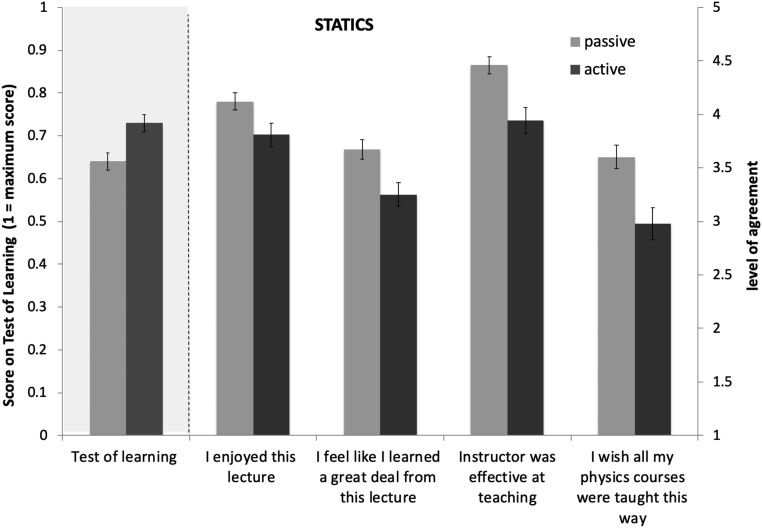
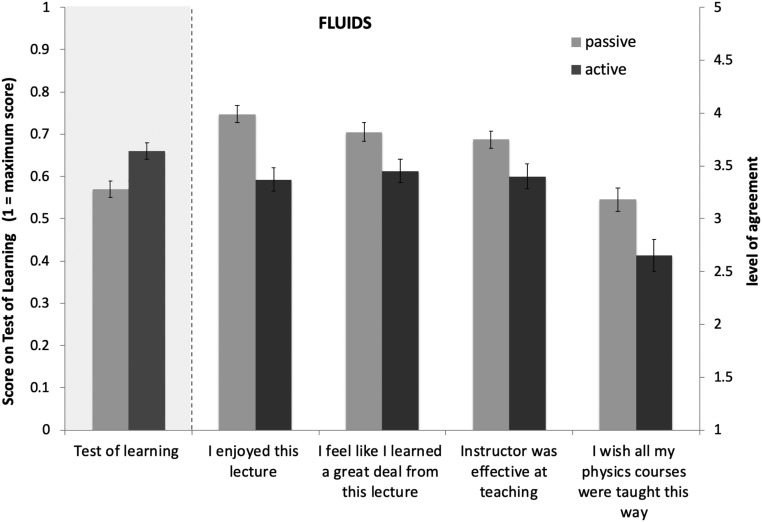
Significance: Despite active learning being recognized as a superior method of instruction in the classroom, a major recent survey found that most college STEM instructors still choose traditional teaching methods. This article addresses the long-standing question of why students and faculty remain resistant to active learning. Comparing passive lectures with active learning using a randomized experimental approach and identical course materials, we find that students in the active classroom learn more, but they feel like they learn less. We show that this negative correlation is caused in part by the increased cognitive effort required during active learning. Faculty who adopt active learning are encouraged to intervene and address this misperception, and we describe a successful example of such an intervention.
Overview
The claims and statistics of this paper haven’t been checked yet.
Free: it reads the open-access text and checks the first 5 claims that cite a source we can check. Create a free account to check every claim.
Integrity signals
Registry
Cites
Statistics
Figures
Verification
Claims the paper makes
The claims and statistics of this paper haven’t been checked yet.
Free: it reads the open-access text and checks the first 5 claims that cite a source we can check. Create a free account to check every claim.
Claims other papers make about this one
Each is checked against this paper’s own text: does it say what the citing paper says it does?
The source backs part of the claim, not all of it — or backs it for a different population, condition or comparison.
In the citing paper
“Our results support this approach, indicating that reducing cognitive offloading through active engagement can mitigate the negative impact of AI tools on critical thinking.”
From AI Tools in Society: Impacts on Cognitive Offloading and the Future of Critical Thinking (2025) · cites this paper as Deslauriers et al. [46]
Experimental — accuracy not yet measuredThe source backs part of the claim, not all of it — or backs it for a different population, condition or comparison.
In the citing paper
“Such perceptions can be different from actual learning and have been shown to disadvantage more effective teachers and teaching methods (Carrell and West 2010, Deslauriers et al. 2019).”
From AI Meets the Classroom: When Do Large Language Models Harm Learning? (2024) · cites this paper as Deslauriers et al. 2019
Experimental — accuracy not yet measuredThe source backs part of the claim, not all of it — or backs it for a different population, condition or comparison.
In the citing paper
“The exercise is a reminder that we are often poor judges of our own knowledge and may overestimate our understanding of various subjects, blurring the line between familiarity and fluency.”
From Assigning AI: Seven Approaches for Students, with Prompts (2023) · cites this paper as Deslauriers et al., 2019
Experimental — accuracy not yet measuredThe source backs part of the claim, not all of it — or backs it for a different population, condition or comparison.
In the citing paper
“A growing number of studies demonstrate, however, that people prefer simpler constructs, even though they learn more and perform better with more complex ones.”
From To Trust or to Think: Cognitive Forcing Functions Can Reduce Overreliance on AI in AI-assisted Decision-making (2021) · cites this paper as [18]
Experimental — accuracy not yet measuredThe source backs part of the claim, not all of it — or backs it for a different population, condition or comparison.
In the citing paper
“the scaffolded, conversational nature of the AI tool may have created a strong subjective sense of mastery that did not fully translate to improved performance under traditional assessment conditions”
From Socratic Mind: Impact of a Novel GenAI-Powered Formative Assessment Tool on Student Learning and Higher-Order Thinking (2026) · cites this paper as Deslauriers et al., 2019
Experimental — accuracy not yet measured
3 more claims about this paper
Create a free account to see every claim other papers make about this one.
Self-check
Percentages, sums and reported differences re-computed from the paper’s own numbers.
The self-check needs the paper’s full text.
Citations
Cites
A heteroskedasticity-consistent covariance matrix estimator and a direct test for heteroskedasticity
White, H. (1980) · Econometrica · doi:10.2307/1912934 · Cited by 25,861
(1999) · Cited by 12,812
Active learning increases student performance in science, engineering, and mathematics
Freeman, S., Eddy, S. L., McDonough, M., Smith, M. K., Okoroafor, N., Jordt, H., & Wenderoth, M. P. (2014) · Proceedings of the National Academy of Sciences · doi:10.1073/pnas.1319030111 · Cited by 9,787 · cited 1×
“(4) had to correct for this oversight in their metaanalysis.”
BackgroundThe role of deliberate practice in the acquisition of expert performance
Ericsson, K. A., Krampe, R. T., & Tesch-Römer, C. (1993) · Psychological Review · doi:10.1037/0033-295x.100.3.363 · Cited by 9,564 · cited 1×
“In the experimental group, the instructor actively engaged the students using the principles of deliberate practice (3, 36, 37): students were instructed to solve the sample problems by working together in small groups while the instructor roamed the room asking questions and offering assistance.”
MethodKruger, J., & Dunning, D. (1999) · Journal of Personality and Social Psychology · doi:10.1037/0022-3514.77.6.1121 · Cited by 7,731
Hake, R. R. (1998) · American Journal of Physics · doi:10.1119/1.18809 · Cited by 6,072 · cited 1×
“The pretest FCI scores in this study (Table 1) are similar to those clustered near the high end of the distribution of university scores in the metaanalysis published by Hake (1), which confirms that the students in our study have high school preparation comparable to that at other top universities.”
ResultHestenes, D., Wells, M., & Swackhamer, G. (1992) · The Physics Teacher · doi:10.1119/1.2343497 · Cited by 3,235
Peer Instruction: Ten years of experience and results
Crouch, C. H., & Mazur, E. (2001) · American Journal of Physics · doi:10.1119/1.1374249 · Cited by 2,682
When Should You Adjust Standard Errors for Clustering?
Abadie, A., Athey, S., Imbens, G., & Wooldridge, J. (2017) · National Bureau of Economic Research · doi:10.3386/w24003 · Cited by 1,360
Improved Learning in a Large-Enrollment Physics Class
Deslauriers, L., Schelew, E., & Wieman, C. (2011) · Science · doi:10.1126/science.1201783 · Cited by 1,270 · cited 4×
“4, used distinctly different class materials with each group, potentially confounding active engagement with changes in class content (3).”
BackgroundMethodInfluentialSelf-citation
Research works printed but not linked: 3
- Henderson C., Stelzer T., Hsu L., Meredith D., Maximizing the benefits of physics education research: Building productive relationships and promoting institutional change. American Physical Society Forum on Education Newsletter, Fall 2005, pp. 11–14. https://www.aps.org/units/fed/newsletters/fall2005/maximize.html. Accessed 20 June 2019.
- Felder R. M., Random thoughts: Sermons for grumpy campers. Chem. Eng. Educ. 41, 183– 184 (2007).
- Felder R. M., Random thoughts: The link between teaching and research. 2. How to strengthen each without weakening the other. Chem. Eng. Educ. 44, 213– 214 (2010).
Cited by
Items 801–900 of 1,005
Improving Elementary School Students' Learning Outcomes using the Problem Based Learning Model
Komarudin, D., & Sukarno, S. (2025) · Jurnal Indonesia Pendidikan Profesi Guru · doi:10.64420/jippg.v2i3.318 · Cited by 3
Saitta, E. K. H., & Donnelly, J. (2022) · Emerald Group Publishing Limited eBooks · doi:10.1108/979-8-88730-047-420251008 · Cited by 3
Teaching Autonomic Cardiovascular Pharmacology to Medical Students: An Innovative Worksheet Approach
Cooley, C., & Trout, M. J. (2021) · MedEdPublish · doi:10.15694/mep.2021.000065.1 · Cited by 3
Teaching Econometrics Dynamically with R-Shiny
Metzger, S. K. J. (2021) · PS Political Science & Politics · doi:10.1017/s1049096521001141 · Cited by 3
Teaching BDD in Active Learning Environments: A Multi-study Analysis
Nascimento, N., Santos, A. R., de Sales, A. H. C., & Chanin, R. M. (2022) · International Conference on Computer Supported Education · doi:10.5220/0011057300003182 · Cited by 3
Bagley, M., Smith, A. G., Morton, D. A., & Chow, C. J. (2022) · Medical Science Educator · doi:10.1007/s40670-022-01682-y · Cited by 3
Developing territory for active learning
Marder, M. P. (2022) · Proceedings of the National Academy of Sciences · doi:10.1073/pnas.2217999119 · Cited by 3
Active Learning Techniques to Enhance Conceptual Learning in Greek Mythology
Sansom, S. A., Clary, T., & Aslan, C. (2022) · The Classical World · doi:10.1353/clw.2022.0025 · Cited by 3
Examining Effects of Science Flipped Classrooms A Meta-analysis
Bai, S., Hew, K. F., Zhang, S., Huang, W., & Gonda, D. E. (2022) · IEEE International Conference on Teaching, Assessment, and Learning for Engineering · doi:10.1109/tale54877.2022.00053 · Cited by 3
Pacala, F. A., & Obiedo, R. V. (2023) · HO CHI MINH CITY OPEN UNIVERSITY JOURNAL OF SCIENCE - SOCIAL SCIENCES · doi:10.46223/hcmcoujs.soci.en.13.1.2682.2023 · Cited by 3
Pedagogy of play in a virtual excursion to foster self-directed learning in health care students
Pool, J., Heymans, Y., Koch, R., & Mokwatsi, G. G. (2023) · NWU self-directed learning series · doi:10.4102/aosis.2023.bk426.09 · Cited by 3
Hughes, M. D., Riello, S., & Krause, A. (2023) · International Journal of Higher Education · doi:10.5430/ijhe.v12n6p63 · Cited by 3
Riana, N., Putri, F. E., & Katimah, K. (2023) · Scientia · doi:10.51773/sssh.v2i2.236 · Cited by 3
A Course Design for Remote Teaching Advanced Topics in Neuroscience
Ramos, R., & Rivera-Rodriguez, E. J. (2022) · Journal of Undergraduate Neuroscience Education · doi:10.59390/gsxq3224 · Cited by 3
Kotsalidis, P. E., Kranc, S. N., Berryman, M., Radhakrishnan, M. L., & Elmore, D. E. (2024) · Journal of Chemical Education · doi:10.1021/acs.jchemed.4c00036 · Cited by 3
Turismo rural, sustentabilidade e educação ambiental: uma revisão sistemática
de Lourdes, I. D. C. (2023) · Cenário Revista Interdisciplinar em Turismo e Território · doi:10.26512/rev.cenario.v10i2.39150 · Cited by 3
Cardozo‐Gaibisso, L., Hodges, G. W., Mardones-Segovia, C., & Cohen, A. S. (2024) · Education Sciences · doi:10.3390/educsci14101068 · Cited by 3
Francis, T., & Afful, J. B. A. (2024) · Africa Education Review · doi:10.1080/18146627.2024.2396597 · Cited by 3
QGrover: Teaching Grover's Algorithm Through Visual Exploration
Norrie, S., Estey, A., Müller, H. A., & Stege, U. (2024) · IEEE International Conference on Quantum Computing and Engineering (QCE) · doi:10.1109/qce60285.2024.20454 · Cited by 3
Adorno, D. P., & Pizzolato, N. (2025) · International Journal of Mechanical Engineering Education · doi:10.1177/03064190251319413 · Cited by 3
SAStutorials.org – online tutorials on small-angle scattering data analysis
Larsen, A. H., Jacobsen, J. B., Graewert, M. A., Grøndahl, L. B., Svaneborg, C., Sebastiani, F., Kikhney, A., Tyler, A. I. I., Kihara, S., Lytje, K., et al. (2025) · Journal of Applied Crystallography · doi:10.1107/s1600576725001062 · Cited by 3
The Role of Future Technology in the Preparation of Prospective Teachers
Ritonga, M., Ritonga, S., Mudinillah, A., Julhadi, J., & Putra, I. E. (2025) · Studies in computational intelligence · doi:10.1007/978-3-031-80334-5_16 · Cited by 3
Análisis combinado del clima académico y el ABP: Influencia en el engagement universitario
Amadó, A., Tarrés, M. A. I., Senar, F., Llop, E., Verdaguer, M., Comas, J., del Moral, M. J. G., Ferrando, D. B., Rodríguez‐Roda, I., Rostán, C., et al. (2025) · RELIEVE - Revista Electrónica de Investigación y Evaluación Educativa · doi:10.30827/relieve.v31i1.31967 · Cited by 3
Andriyani, L. P. Y., Tika, I. N., & Artawan, P. (2025) · Jurnal Penelitian Pendidikan IPA · doi:10.29303/jppipa.v11i7.11519 · Cited by 3
Student-Generated Examples and Group Work in Mathematics
Cornock, C. (2021) · MSOR Connections · doi:10.21100/msor.v19i1.1117 · Cited by 3
Sidecar Learning vs LibWizard: A Comparison of Two Split-Screen Tutorial Platforms
Chan, B. (2021) · Journal of Web Librarianship · doi:10.1080/19322909.2021.1927930 · Cited by 3
Rhinehart, L. V., Vazquez, S. R., & Greenfield, P. M. (2021) · Teaching of Psychology · doi:10.1177/00986283211017443 · Cited by 3
Lee, M. W., & Witchel, H. J. (2022) · Methods in physiology · doi:10.1007/978-3-030-95633-2_1 · Cited by 3
Lindstrøm, C., Spagnoli, D., Pye, M. G., Beckman, J., & Kepert, A. (2022) · International Journal of Innovation in Science and Mathematics Education · doi:10.30722/ijisme.30.03.004 · Cited by 3
Bridging the gap: from instruction to co-construction in higher education
Probst, G., & Zizka, L. (2022) · Edward Elgar Publishing eBooks · doi:10.4337/9781800889224.00025 · Cited by 3
INFOGRAPHICS AS A MODERN METHOD OF TEACHING ENGLISH
Jumashova, Z., & Kuzembekova, Z. (2023) · Tiltanym · doi:10.55491/2411-6076-2023-1-133-140 · Cited by 3
Anderson, L. C., & Jacobson, T. (2023) · AJP Advances in Physiology Education · doi:10.1152/advan.00160.2022 · Cited by 3
WORK IN PROGRESS: DEVELOPMENT OF EDUCATIONAL KIT FOR TEACHING ADDITIVE MANUFACTURING
Valjak, F., Kapetanović, A., Taradi, I., & Bojčetić, N. (2023) · Proceedings of the Design Society · doi:10.1017/pds.2023.392 · Cited by 3
Chen, F., Liu, J., & Chen, P. (2023) · International Journal of Higher Education · doi:10.5430/ijhe.v12n3p97 · Cited by 3
Tucker, T., Goldstein, M. H., & Mercier, E. (2023) · Studies in Engineering Education · doi:10.21061/see.98 · Cited by 3
Preparation for Future Active Learning
Burkholder, E. W., Sake, M., & Zhang, J. (2023) · The Physics Teacher · doi:10.1119/5.0096237 · Cited by 3
Detyna, M., Granelli, F., & Betts, T. (2023) · Journal of Education and Training Studies · doi:10.11114/jets.v12i1.6499 · Cited by 4
Thematic Learning Model for Islamic Religious Education in Madrasah Ibtidaiyah
Ardinal, E., Destari, D., Irawan, I., Zuhdi, A., & Pranajaya, S. A. (2023) · Al-Hijr Journal of Adulearn World · doi:10.55849/alhijr.v2i4.554 · Cited by 3
Gregg, A., & O'Connor, J. A. (2024) · ASEE Annual Conference & Exposition · doi:10.18260/1-2--40982 · Cited by 3
Ding, X., Sun, K., Xiao, Z., Varadhan, S., Li, J., Gersich, N., Agarwal, A., Gopannagari, M., Tao, A., Vogiatzis, C., et al. (2024) · ASEE Annual Conference & Exposition · doi:10.18260/1-2--43448 · Cited by 3
Rasmussen, S. B., Bosker, T., Ramanand, G. G., & Vijver, M. G. (2024) · Environmental Science and Pollution Research · doi:10.1007/s11356-024-32566-w · Cited by 3
Education Research: Making a Tweetorial Fly
Albin, C. S. W., Ma, T., Pucci, G. F., Zelikovich, A. S., Lawson, E. C., Dhruva, N., Masiero, S., Sarwal, A., Dangayach, N. S., Berkowitz, A. L., et al. (2024) · Neurology Education · doi:10.1212/ne9.0000000000200160 · Cited by 3
Multi-objective Clustering Algorithm Applied to the MathE Categorization Problem
Azevedo, B. F., Leite, G. F., Pacheco, M., Fernandes, F. P., Rocha, A. M. A. C., & Pereira, A. I. (2026) · Information Systems Frontiers · doi:10.1007/s10796-025-10674-3 · Cited by 3
Bennoun, S. (2020) · PRIMUS · doi:10.1080/10511970.2020.1827104 · Cited by 3
Wolford, G. W., Wolford, L. L., Brannick, S. F., Scott, M., & Smith, R. (2020) · The Clinical Supervisor · doi:10.1080/07325223.2020.1833268 · Cited by 3
Supporting STEM Faculty of Large Enrollment Undergraduate Courses: A Mixed Methods Study of Impact
Wheeler, L. B. (2021) · International Journal for the Scholarship of Teaching and Learning · doi:10.20429/ijsotl.2021.150107 · Cited by 3
'Can you hear me? Are you there?': student engagement in an online environment
Symons, K. (2021) · Journal of Learning Development in Higher Education · doi:10.47408/jldhe.vi22.730 · Cited by 3
Schulmeister, C., Laves, E., Wong, J. C., & Walch, A. (2023) · MedEdPORTAL · doi:10.15766/mep_2374-8265.11301 · Cited by 3
Lee, I. C. J., & Wong, P. (2024) · MedEdPublish · doi:10.12688/mep.19535.2 · Cited by 3
Miner, N., Ilgu, A. K., Shane, J. S., & Madson, K. (2024) · ASEE Annual Conference & Exposition · doi:10.18260/1-2--37081 · Cited by 3
Witchel, H. J., Thompson, G. A., Jones, C. I., Westling, C. E. I., Romero, J., Nicotra, A., Maag, B., & Critchley, H. (2021) · Journal of Medical Internet Research · doi:10.2196/29452 · Cited by 3
Designing and Evaluating Chain-of-Hints for Scientific Question AnsweringPreprint
Jangra, A., & Muresan, S. (2025) · arXiv (Cornell University) · doi:10.48550/arxiv.2510.21087 · Cited by 3
Tung, I. K., Shi, Y., Chien, A., Liu, W., & Zheng, L. (2026) · arXiv (Cornell University) · doi:10.48550/arxiv.2601.22720 · Cited by 3
Active learning through flexible collaborative exams: Improving assessments across disciplines
Callaghan, K., Kestin, G., Klales, A., McCarty, L., & Deslauriers, L. (2026) · Active Learning in Higher Education · doi:10.1177/14697874251344293 · Cited by 2
“…recognized that research-based educational strategies that promote engagement and collaboration among peers substantially enhance both learning outcomes and student attitudes (Crouch & Mazur, 2001; Deslauriers et al., 2011, 2019; Freeman et al., 2014; Smith et al., 2009; Theobald et al., 2020).”
Self-citationMiller, A. N., Clark, M. H., Donnelly, J., & Hahs‐Vaughn, D. L. (2022) · Journal of Chemical Education · doi:10.1021/acs.jchemed.1c01020 · Cited by 2
The Necessarily, Wonderfully Unsettled State of Methodology in PER: A Reflection
Hammer, D. (2023) · doi:10.1063/9780735425514_022 · Cited by 2
Camelot: A Council of Machine Learning Strategies to Enhance Teaching
Pallipuram, V. K., Mammadov, G., Ho, B., Dhulipala, M., & Dziallas, S. (2024) · Springer eBooks · doi:10.1007/978-981-99-9379-6_4 · Cited by 2
How university mathematics instructors form groups and how students experience them
Küchle, V. A. B., Smith, J. P., Hwang, J. J., & Menon, R. (2024) · International Journal of Mathematical Education in Science and Technology · doi:10.1080/0020739x.2024.2369651 · Cited by 2
Contradicting Objects: An Activity Systems Perspective Towards Transformative Learning
Grundy, L. S., & Koretsky, M. (2024) · ASEE Annual Conference & Exposition · doi:10.18260/1-2--47075 · Cited by 2
Donegan, J., & Ostafichuk, P. (2024) · Proceedings of the Canadian Engineering Education Association (CEEA) · doi:10.24908/pceea.2024.18554 · Cited by 2
Is Gamification Effective for Women Who Wish to Learn Computer Programming?
Cubillos, C., Mellado, R., & Nóbile, C. (2025) · Human Behavior and Emerging Technologies · doi:10.1155/hbe2/6410654 · Cited by 2
Goldberg, E. R., & Darwin, T. K. (2025) · Journal of Research in Science Mathematics and Technology Education · doi:10.31756/jrsmte.411si · Cited by 2
The blind leading the blind? Filling the knowledge gaps by student peer assessment
Møllersen, K., & Micheron, D. (2025) · Journal of STEM Education Innovations and Research · doi:10.63504/jstem.v26i1.2680 · Cited by 2
Lived Experiences of Technical-Vocational Students in Learning Science: Challenges and Adaptation
Tabat, G., & Daza, S. (2025) · Psychology and Education A Multidisciplinary Journal · doi:10.70838/pemj.370402 · Cited by 2
Harrington, R. N. (2025) · International Journal of Kinesiology in Higher Education · doi:10.1080/24711616.2025.2502973 · Cited by 2
Virtual Tools and Student Engagement: Insights from Engineering Education
Hakobyan, L., Lee, R., & Webber, T. (2025) · IEEE Global Engineering Education Conference (EDUCON) · doi:10.1109/educon62633.2025.11016523 · Cited by 2
Bradley, L. J., Meyer, K. E., Kerr, M. S., Maddux, S. D., Heck, A. J., Reeves, R., & Handler, E. (2025) · Anatomical Sciences Education · doi:10.1002/ase.70066 · Cited by 2
Attendance and learning platforms in college course success
Chang, I. (2025) · Active Learning in Higher Education · doi:10.1177/14697874251347189 · Cited by 2
Massaro, S. (2025) · FrancoAngeli srl eBooks · doi:10.3280/oa-1395 · Cited by 2
Küchle, V. A. B. (2025) · International Journal of Research in Undergraduate Mathematics Education · doi:10.1007/s40753-025-00270-w · Cited by 2
Instructional Approaches for Learner Engagement in Large Classes
Christopher, P., Nero, R., & Aye, L. (2025) · IGI Global eBooks · doi:10.4018/979-8-3373-0644-5.ch006 · Cited by 2
Gerges, E., & Rice, B. (2025) · Assessment & Evaluation in Higher Education · doi:10.1080/02602938.2025.2536565 · Cited by 2
Practicas en Inglés como Lengua Extranjera: Enfoques Innovadores y Centrados en el Estudiante
Rojas-Burbano, S. C., & Andrade, S. S. N. (2025) · MQRInvestigar · doi:10.56048/mqr20225.9.3.2025.e892 · Cited by 2
Adebiyi, E. B., Ukoh, E. E., & Adeduyigbe, A. M. (2025) · Physics Education · doi:10.1088/1361-6552/ae0d3c · Cited by 2
Harz, D., Esparza-Pérez, R. I., Sullivan, A. M., Delgado-Figueroa, N., Colunga‐Lozano, L. E., Fischer, K., Campos‐Zamora, M., & Besche, H. C. (2025) · Journal of Medical Education and Curricular Development · doi:10.1177/23821205251385013 · Cited by 2
Woodzicka, J. A., Greer, L., Murdock, K. K., Johnson, D. R., Locy, T., & Goldsmith, A. H. (2025) · Frontiers in Education · doi:10.3389/feduc.2025.1670426 · Cited by 2
Sweet, L. M., Elsbernd, P. M., & Kiley, J. L. (2025) · Military Medicine · doi:10.1093/milmed/usaf562 · Cited by 2
Active learning in authentic conditions has a positive effect on first-year student success
Bächtold, M., Asensio, D. B., Papet, J., & Ondo, A. N. (2025) · Higher Education Research & Development · doi:10.1080/07294360.2025.2586686 · Cited by 2
Jawarneh, T. Y., & Al-Jizawi, F. A.-R. (2025) · Journal of Cultural Analysis and Social Change · doi:10.64753/jcasc.v10i2.1800 · Cited by 2
Practical aspects of teaching a graduate-level small-molecule chemical crystallography course
Berry, J. F., & Guzei, I. A. (2026) · Acta Crystallographica Section E Crystallographic Communications · doi:10.1107/s2056989025010527 · Cited by 2
Sangwa, S., & Nsabiyumva, S. (2025) · Open Journal of Transformative Education & Lifelong Learning · doi:10.65655/jscsaa20 · Cited by 2
Park, H. S., & Cho, H. M. (2025) · Journal of Chemical Education · doi:10.1021/acs.jchemed.5c00448 · Cited by 2
An Effective Team: Active Learning Also Needs the Sage on a Stage
Bordonaro, M. (2026) · Journal of Medical Education and Curricular Development · doi:10.1177/23821205251408671 · Cited by 2
Evaluating Nutrition Education in K‐12 Schools: A Comprehensive Review 2024
Lissain, N., Willis, D., Hutson, K., Cassidy, O. L., Bragg, M. A., & Dupuis, R. (2026) · Journal of School Health · doi:10.1111/josh.70117 · Cited by 2
Eady, M. J., & Cliff, K. (2026) · The Asia-Pacific Education Researcher · doi:10.1007/s40299-026-01080-7 · Cited by 2
We look like economists: A first day of class lesson plan
Dilden, E. B., & Hobbs, K. G. (2026) · The Journal of Economic Education · doi:10.1080/00220485.2026.2621114 · Cited by 2
Artificial Intelligence: A Maturity Test. Perspectives on Learning, Teaching, and Assessment
Istrate, O., Capogna, S., Kleitsch, O. B., & Jourde, F. (2026) · Revista de Pedagogie Digitala · doi:10.61071/rpd.2611 · Cited by 2
Negotiating EMI teacher identity in Japan's internationalized classrooms: A duoethnography
Terashima, A. V., & Dalziel, G. (2026) · Journal of International Students · doi:10.32674/13jzda57 · Cited by 2
La transformación de la enseñanza universitaria: Una visión comparada entre Argentina y España
Domínguez, M. Á. R., & Maggio, M. (2026) · Educar · doi:10.5565/rev/educar.2485 · Cited by 2
Tang, J., Guo, Q., Tang, Z., & Shang, Y. (2025) · IEEE International Conference on Future Machine Learning and Data Science (FMLDS) · doi:10.1109/fmlds67896.2025.00031 · Cited by 2
Kumar, A. P., Padmavathi, R., Maheshkumar, K., Omprakash, A., Mani, P. K. C., Sathiyasekaran, B. W., & Maruthy, K. N. (2026) · JMIR Human Factors · doi:10.2196/84339 · Cited by 2
Boult, L., Douglass, T., Tremblett, M., & Joyce, J. B. (2026) · Vox Sanguinis · doi:10.1111/vox.70263 · Cited by 2
Usta, N., Özkaya, A., KARAMIK, G. A., & Akin, Y. (2026) · PLoS ONE · doi:10.1371/journal.pone.0341380 · Cited by 2
Reid, D. P., Kuznetcov, M. V., Don, A. T., Shahzadi, I., Podilchak, S. K., & Drysdale, T. D. (2026) · IEEE Access · doi:10.1109/access.2026.3699404 · Cited by 2
Hossen, M. N. (2025) · Journal of Academic Biology and Biology Education · doi:10.37251/jouabe.v2i2.2323 · Cited by 2
Nguyen, P. T., Hung, N. T., & Nguyen, T. Q. (2026) · Journal for Multicultural Education · doi:10.1108/jme-03-2026-0055 · Cited by 2
Lederer, M. L., Barbe, A. G., Janson, M., von Kohout, M., & Schoppmeier, C. M. (2026) · BMC Medical Education · doi:10.1186/s12909-026-10035-x · Cited by 2
Learning Style Tendencies of Early Adult Community Education Students Across Cohorts
Hilmi, M. I., Ardiwinata, J. S., Indrianti, D. T., Sucianingsih, S., & Ariefianto, L. (2026) · EDUKASIA Jurnal Pendidikan dan Pembelajaran · doi:10.62775/edukasia.v7i1.2139 · Cited by 2
Martín‐Alguacil, N., & Avedillo, L. (2026) · Education Sciences · doi:10.3390/educsci16081265 · Cited by 2
Metadata
- Authors
- Deslauriers, L., McCarty, L. S., Miller, K., Callaghan, K., & Kestin, G.
- Affiliations
- Harvard University (US)
- Corresponding author
- Deslauriers, Louis
- Venue
- Proceedings of the National Academy of Sciences
- Publisher
- National Academy of Sciences
- Published
- 2019-09-04
- Volume
- 116
- Issue
- 39
- Pages
- 19251-19257
- ISSN
- 0027-8424 (ISSN-L)
- 1091-6490
- PMC
- PMC6765278
- OpenAlex
- W2971755171
- Cited by
- 1,371
- References
- 43
- Citations by year
- 2026: 186 · 2025: 222 · 2024: 251 · 2023: 216 · 2022: 196 · 2021: 165 · 2020: 122 · 2019: 13
- FWCI
- 334.20
- Type
- journal article
- Language
- en
- Open access
- hybrid
- doi.org
- Licence
- Locations
- Proceedings of the National Academy of Sciences (publishedVersion, cc-by-nc-nd)
- Europe PMC (PubMed Central) (publishedVersion, cc-by-nc-nd)
- PubMed Central (publishedVersion, cc-by-nc-nd)
- PubMed (publishedVersion)
- Topics
- Social Sciences › Education › Innovative Teaching Methods
- Social Sciences › Education › Evaluation of Teaching Practices
- Social Sciences › Psychology › Developmental and Educational Psychology › Innovative Teaching and Learning Methods
- Keywords
- active learning, student perceptions of learning, introductory college physics, large-enrollment courses, cognitive effort, student motivation, student self-regulation, teaching evaluation, student engagement
- MeSH terms
- Formative Feedback, Educational Measurement, Emotions, Female, Humans, Male, Perception, Physics, Students, Teaching, Universities, Problem-Based Learning
About these checks
Registry, retraction, Cites and statistics results are computed, not judged, with one exception: a printed reference that no index lists is read once by a model before it counts as a citation error. Claims are extracted by a model and kept only when their quote appears verbatim in the text; each cited source is then checked, with a model’s help, for whether it says what the claim relies on. Those verdicts can be wrong — read the claim’s quote and the cited source before relying on one.
Statistics and arithmetic are recomputed, not judged.
Confidence bands are shown only for fields calibrated on our annotated test set. None is calibrated yet, so no band is shown.
What counts as a claim ›How we measure confidence ›How we check this ›
Are you an author, or do you see a problem with this page? Request a review
Data sources
Bibliographic data: Semantic Scholar, OpenAlex, Crossref.
Contains information from the Semantic Scholar Academic Graph Datasets, made available under the ODC Attribution License (ODC-BY 1.0).
Semantic Scholar’s data is described in: Kinney, R., et al. (2023). The Semantic Scholar Open Data Platform. arXiv:2301.10140.
