

Measuring actual learning versus feeling of learning in response to being actively engaged in the classroom
Open accessThe DOI matches its Crossref record; 41 of the 43 references it cites were found in a registry or an index.
Abstract
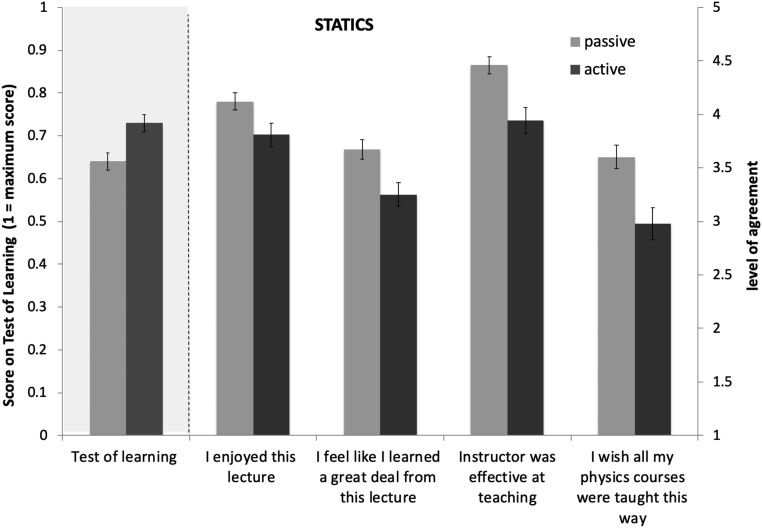
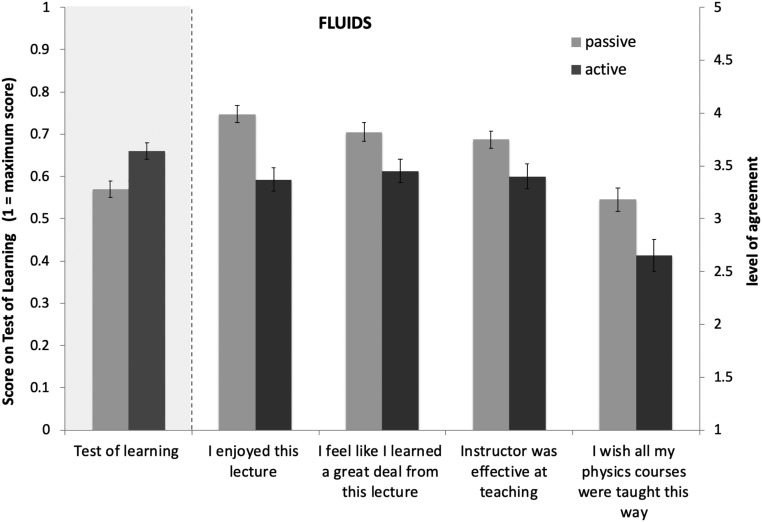
Significance: Despite active learning being recognized as a superior method of instruction in the classroom, a major recent survey found that most college STEM instructors still choose traditional teaching methods. This article addresses the long-standing question of why students and faculty remain resistant to active learning. Comparing passive lectures with active learning using a randomized experimental approach and identical course materials, we find that students in the active classroom learn more, but they feel like they learn less. We show that this negative correlation is caused in part by the increased cognitive effort required during active learning. Faculty who adopt active learning are encouraged to intervene and address this misperception, and we describe a successful example of such an intervention.
Overview
The claims and statistics of this paper haven’t been checked yet.
Free: it reads the open-access text and checks the first 5 claims that cite a source we can check. Create a free account to check every claim.
Integrity signals
Registry
Cites
Statistics
Figures
Verification
Claims the paper makes
The claims and statistics of this paper haven’t been checked yet.
Free: it reads the open-access text and checks the first 5 claims that cite a source we can check. Create a free account to check every claim.
Claims other papers make about this one
Each is checked against this paper’s own text: does it say what the citing paper says it does?
The source backs part of the claim, not all of it — or backs it for a different population, condition or comparison.
In the citing paper
“Our results support this approach, indicating that reducing cognitive offloading through active engagement can mitigate the negative impact of AI tools on critical thinking.”
From AI Tools in Society: Impacts on Cognitive Offloading and the Future of Critical Thinking (2025) · cites this paper as Deslauriers et al. [46]
Experimental — accuracy not yet measuredThe source backs part of the claim, not all of it — or backs it for a different population, condition or comparison.
In the citing paper
“Such perceptions can be different from actual learning and have been shown to disadvantage more effective teachers and teaching methods (Carrell and West 2010, Deslauriers et al. 2019).”
From AI Meets the Classroom: When Do Large Language Models Harm Learning? (2024) · cites this paper as Deslauriers et al. 2019
Experimental — accuracy not yet measuredThe source backs part of the claim, not all of it — or backs it for a different population, condition or comparison.
In the citing paper
“The exercise is a reminder that we are often poor judges of our own knowledge and may overestimate our understanding of various subjects, blurring the line between familiarity and fluency.”
From Assigning AI: Seven Approaches for Students, with Prompts (2023) · cites this paper as Deslauriers et al., 2019
Experimental — accuracy not yet measuredThe source backs part of the claim, not all of it — or backs it for a different population, condition or comparison.
In the citing paper
“A growing number of studies demonstrate, however, that people prefer simpler constructs, even though they learn more and perform better with more complex ones.”
From To Trust or to Think: Cognitive Forcing Functions Can Reduce Overreliance on AI in AI-assisted Decision-making (2021) · cites this paper as [18]
Experimental — accuracy not yet measuredThe source backs part of the claim, not all of it — or backs it for a different population, condition or comparison.
In the citing paper
“the scaffolded, conversational nature of the AI tool may have created a strong subjective sense of mastery that did not fully translate to improved performance under traditional assessment conditions”
From Socratic Mind: Impact of a Novel GenAI-Powered Formative Assessment Tool on Student Learning and Higher-Order Thinking (2026) · cites this paper as Deslauriers et al., 2019
Experimental — accuracy not yet measured
3 more claims about this paper
Create a free account to see every claim other papers make about this one.
Self-check
Percentages, sums and reported differences re-computed from the paper’s own numbers.
The self-check needs the paper’s full text.
Citations
Cites
A heteroskedasticity-consistent covariance matrix estimator and a direct test for heteroskedasticity
White, H. (1980) · Econometrica · doi:10.2307/1912934 · Cited by 25,861
(1999) · Cited by 12,812
Active learning increases student performance in science, engineering, and mathematics
Freeman, S., Eddy, S. L., McDonough, M., Smith, M. K., Okoroafor, N., Jordt, H., & Wenderoth, M. P. (2014) · Proceedings of the National Academy of Sciences · doi:10.1073/pnas.1319030111 · Cited by 9,787 · cited 1×
“(4) had to correct for this oversight in their metaanalysis.”
BackgroundThe role of deliberate practice in the acquisition of expert performance
Ericsson, K. A., Krampe, R. T., & Tesch-Römer, C. (1993) · Psychological Review · doi:10.1037/0033-295x.100.3.363 · Cited by 9,564 · cited 1×
“In the experimental group, the instructor actively engaged the students using the principles of deliberate practice (3, 36, 37): students were instructed to solve the sample problems by working together in small groups while the instructor roamed the room asking questions and offering assistance.”
MethodKruger, J., & Dunning, D. (1999) · Journal of Personality and Social Psychology · doi:10.1037/0022-3514.77.6.1121 · Cited by 7,731
Hake, R. R. (1998) · American Journal of Physics · doi:10.1119/1.18809 · Cited by 6,072 · cited 1×
“The pretest FCI scores in this study (Table 1) are similar to those clustered near the high end of the distribution of university scores in the metaanalysis published by Hake (1), which confirms that the students in our study have high school preparation comparable to that at other top universities.”
ResultHestenes, D., Wells, M., & Swackhamer, G. (1992) · The Physics Teacher · doi:10.1119/1.2343497 · Cited by 3,235
Peer Instruction: Ten years of experience and results
Crouch, C. H., & Mazur, E. (2001) · American Journal of Physics · doi:10.1119/1.1374249 · Cited by 2,682
When Should You Adjust Standard Errors for Clustering?
Abadie, A., Athey, S., Imbens, G., & Wooldridge, J. (2017) · National Bureau of Economic Research · doi:10.3386/w24003 · Cited by 1,360
Improved Learning in a Large-Enrollment Physics Class
Deslauriers, L., Schelew, E., & Wieman, C. (2011) · Science · doi:10.1126/science.1201783 · Cited by 1,270 · cited 4×
“4, used distinctly different class materials with each group, potentially confounding active engagement with changes in class content (3).”
BackgroundMethodInfluentialSelf-citation
Research works printed but not linked: 3
- Henderson C., Stelzer T., Hsu L., Meredith D., Maximizing the benefits of physics education research: Building productive relationships and promoting institutional change. American Physical Society Forum on Education Newsletter, Fall 2005, pp. 11–14. https://www.aps.org/units/fed/newsletters/fall2005/maximize.html. Accessed 20 June 2019.
- Felder R. M., Random thoughts: Sermons for grumpy campers. Chem. Eng. Educ. 41, 183– 184 (2007).
- Felder R. M., Random thoughts: The link between teaching and research. 2. How to strengthen each without weakening the other. Chem. Eng. Educ. 44, 213– 214 (2010).
Cited by
AI Tools in Society: Impacts on Cognitive Offloading and the Future of Critical Thinking
Gerlich, M. (2025) · Societies · doi:10.3390/soc15010006 · Cited by 1,248
AI Tools in Society: Impacts on Cognitive Offloading and the Future of Critical Thinking
Gerlich, M. (2025) · doi:10.2139/ssrn.5082524 · Cited by 1,238
Buçinca, Z., Malaya, M. B., & Gajos, K. Z. (2021) · arXiv · doi:10.48550/arxiv.2102.09692 · Cited by 1,124
“But when evaluated objectively, their actual learning and performance was better with the more cognitively demanding, active instruction [18].”
BackgroundBai, S., Hew, K. F., & Huang, B. (2020) · Educational Research Review · doi:10.1016/j.edurev.2020.100322 · Cited by 994
Assigning AI: Seven Approaches for Students, with Prompts
Mollick, E., & Mollick, L. (2023) · arXiv · doi:10.48550/arxiv.2306.10052 · Cited by 586
Does ChatGPT enhance student learning? A systematic review and meta-analysis of experimental studies
Deng, R., Jiang, M., Yu, X., Lu, Y., & Liu, S. (2025) · Computers & Education · doi:10.1016/j.compedu.2024.105224 · Cited by 531
The Curious Construct of Active Learning
Lombardi, D., Shipley, T. F., Astronomy Team, B. T., Bailey, J. M., Bretones, P. S., Prather, E. E., Ballen, C. J., Knight, J. K., Smith, M. K., Stowe, R. L., et al. (2021) · Psychological Science in the Public Interest · doi:10.1177/1529100620973974 · Cited by 381
Generative AI without guardrails can harm learning: Evidence from high school mathematics
Bastani, H., Bastani, O., Sungu, A., Ge, H., Kabakcı, Ö., & Mariman, R. (2025) · Proceedings of the National Academy of Sciences · doi:10.1073/pnas.2422633122 · Cited by 309
Proxy tasks and subjective measures can be misleading in evaluating explainable AI systems
Buçinca, Z., Lin, P., Gajos, K. Z., & Glassman, E. L. (2020) · Proceedings of the 25th International Conference on Intelligent User Interfaces · doi:10.1145/3377325.3377498 · Cited by 307
“that decision, and incorporating that information into the decisionmaking process requires cognitive effort and the existing evidence suggests that preference does not predict performance on cognitive tasks [8, 12, 37].”
BackgroundHew, K. F., Jia, C., Gonda, D. E., & Bai, S. (2020) · International Journal of Educational Technology in Higher Education · doi:10.1186/s41239-020-00234-x · Cited by 252
Kestin, G., Miller, K., Klales, A., Milbourne, T., & Ponti, G. (2025) · Scientific Reports · doi:10.1038/s41598-025-97652-6 · Cited by 214
Self-citationAI Tutoring Outperforms Active Learning
Kestin*, G., Miller*, K., Klales, A., Milbourne, T., & Ponti, G. (2024) · doi:10.21203/rs.3.rs-4243877/v1 · Cited by 214
Self-citationWestern Journal of Emergency Medicine
(2022) · Western Journal of Emergency Medicine · doi:10.5811//westjem.2022.1.56133 · Cited by 209
Klein, P., Ivanjek, L., Dahlkemper, M. N., Jeličić, K., Geyer, M.-A., Küchemann, S., & Susac, A. (2021) · Physical Review Physics Education Research · doi:10.1103/physrevphyseducres.17.010117 · Cited by 208
The polarizing effect of the online flipped classroom
Stöhr, C., Demazière, C., & Adawi, T. (2020) · Computers & Education · doi:10.1016/j.compedu.2019.103789 · Cited by 196
The link between flipped and active learning: a scoping review
Li, R., Lund, A., & Nordsteien, A. (2021) · Teaching in Higher Education · doi:10.1080/13562517.2021.1943655 · Cited by 198
Instructor strategies to aid implementation of active learning: a systematic literature review
Nguyen, K. A., Borrego, M., Finelli, C. J., DeMonbrun, M., Crockett, C., Tharayil, S., Shekhar, P., Waters, C., & Rosenberg, R. (2021) · International Journal of STEM Education · doi:10.1186/s40594-021-00270-7 · Cited by 193
Poupard, M., Larrue, F., Sauzeon, H., & Tricot, A. (2022) · HAL · doi:10.1111/bjet.13503 · Cited by 10
The science of effective learning with spacing and retrieval practice
Carpenter, S. K., Pan, S. C., & Butler, A. C. (2022) · Nature Reviews Psychology · doi:10.1038/s44159-022-00089-1 · Cited by 184
On students’ (mis)judgments of learning and teaching effectiveness.
Carpenter, S. K., Witherby, A. E., & Tauber, S. K. (2020) · Journal of Applied Research in Memory and Cognition · doi:10.1016/j.jarmac.2019.12.009 · Cited by 183
Fear of Negative Evaluation and Student Anxiety in Community College Active-Learning Science Courses
Downing, V. R., Cooper, K. M., Cala, J. M., Gin, L. E., & Brownell, S. E. (2020) · CBE—Life Sciences Education · doi:10.1187/cbe.19-09-0186 · Cited by 179
International Journal of Training and Development
(2010) · International Journal of Training and Development · doi:10.1111/(issn)1468-2419 · Cited by 177
Harris, B. N., McCarthy, P. C., Wright, A. M., Schutz, H., Boersma, K. S., Shepherd, S. L., Manning, L. A., Malisch, J. L., & Ellington, R. (2020) · Ecology and Evolution · doi:10.1002/ece3.6915 · Cited by 165
Active learning: “Hands-on” meets “minds-on”
Yannier, N., Hudson, S. E., Koedinger, K. R., Hirsh‐Pasek, K., Golinkoff, R. M., Munakata, Y., Doebel, S., Schwartz, D. L., Deslauriers, L., McCarty, L. S., et al. (2021) · Science · doi:10.1126/science.abj9957 · Cited by 161
Self-citationMartín‐Alguacil, N., Avedillo, L., Mota-Blanco, R., & Gallego-Agúndez, M. (2024) · Education Sciences · doi:10.3390/educsci14111179 · Cited by 159
Nguyen, T., Netto, C. L. M., Wilkins, J. F., Bröker, P., Vargas, E. E., Sealfon, C. D., Puthipiroj, P., Li, K. S., Bowler, J. E., Hinson, H. R., et al. (2021) · Frontiers in Education · doi:10.3389/feduc.2021.647986 · Cited by 157
“Some studies conclude that, while students learn more via active learning, they may report greater perceptions of their learning and greater enjoyment when passive approaches are used (Deslauriers et al., 2019).”
BackgroundResearch on Educational Innovations
Ellis, A. K., Aker, L. B., & Wicks, D. (2014) · Routledge eBooks · doi:10.4324/9781003626282 · Cited by 156
Lugosi, E., & Uribe, G. (2020) · International Journal of Mathematical Education in Science and Technology · doi:10.1080/0020739x.2020.1773555 · Cited by 150
The neuroscience of active learning and direct instruction
Dubinsky, J. M., & Hamid, A. (2024) · Neuroscience & Biobehavioral Reviews · doi:10.1016/j.neubiorev.2024.105737 · Cited by 151
Galán, J. I. P., Medina, E. F. L., Cáceres, O. I. M., Enríquez, I. G., Hernández-Melián, A., Rodríguez, M. I. B., Rodríguez, V. J., Logares, M., Carabantes-Alarcón, D., Toro, M. R., et al. (2021) · Education Sciences · doi:10.3390/educsci11110667 · Cited by 145
Cavanagh, T., Chen, B., Lahcen, R. A. M., & Paradiso, J. (2020) · The International Review of Research in Open and Distributed Learning · doi:10.19173/irrodl.v21i1.4557 · Cited by 141
Promoting student interaction, engagement, and success in an online environment
Cavinato, A. G., Hunter, R. A., Ott, L. S., & Robinson, J. K. (2021) · Analytical and Bioanalytical Chemistry · doi:10.1007/s00216-021-03178-x · Cited by 140
Petersen, C. I., Baepler, P., Beitz, A., Ching, P., Gorman, K. S., Neudauer, C. L., Rozaitis, W., Walker, J. D., & Wingert, D. (2020) · CBE—Life Sciences Education · doi:10.1187/cbe.19-04-0079 · Cited by 137
AI Meets the Classroom: When Does ChatGPT Harm Learning?Preprint
Lehmann, M., Cornelius, P. B., & Sting, F. J. (2024) · SSRN Electronic Journal · doi:10.2139/ssrn.4941259 · Cited by 138
Meta-analyses of flipped classroom studies: A review of methodology
Hew, K. F., Bai, S., Dawson, P., & Lo, C. K. (2021) · Educational Research Review · doi:10.1016/j.edurev.2021.100393 · Cited by 138
Martin, F., Wu, T., Wan, L., & Xie, K. (2022) · Online Learning · doi:10.24059/olj.v26i1.2604 · Cited by 132
“Deslauriers et al. (2019) compared students’ self-reported perception of learning with their actual learning in college physics courses and found that evaluating instruction based on students’ perceived learning could inadvertently promote passive pedagogical methods compared to active learning…”
ResultDigital learning designs in physiotherapy education: a systematic review and meta-analysis
Ødegaard, N. B., Myrhaug, H. T., Dahl-Michelsen, T., & Røe, Y. (2021) · BMC Medical Education · doi:10.1186/s12909-020-02483-w · Cited by 132
Infographics in higher education: A scoping review
Jaleniauskienė, E., & Kasperiūnienė, J. (2022) · E-Learning and Digital Media · doi:10.1177/20427530221107774 · Cited by 134
Online project-based learning in engineering design: Supporting the acquisition of design skills
Beneroso, D., & Robinson, J. P. (2021) · Education for Chemical Engineers · doi:10.1016/j.ece.2021.09.002 · Cited by 131
Generative Students: Using LLM-Simulated Student Profiles to Support Question Item Evaluation
Lu, X., & Wang, X. (2024) · ACM Conference on Learning @ Scale (L@S) · doi:10.1145/3657604.3662031 · Cited by 130
An astonishing regularity in student learning rate
Koedinger, K. R., Carvalho, P. F., Liu, R., & McLaughlin, E. A. (2023) · Proceedings of the National Academy of Sciences · doi:10.1073/pnas.2221311120 · Cited by 127
Equitable and Inclusive Practices Designed to Reduce Equity Gaps in Undergraduate Chemistry Courses
White, K. N., Vincent-Layton, K., & Villarreal, B. J. (2020) · Journal of Chemical Education · doi:10.1021/acs.jchemed.0c01094 · Cited by 123
A Pragmatic Master List of Action Verbs for Bloom's Taxonomy
Newton, P. M., Silva, A. S. D., & Peters, L. (2020) · Frontiers in Education · doi:10.3389/feduc.2020.00107 · Cited by 121
Virtual vs. traditional learning in higher education: A systematic review of comparative studies
Santilli, T., Ceccacci, S., Mengoni, M., & Giaconi, C. (2024) · Computers & Education · doi:10.1016/j.compedu.2024.105214 · Cited by 121
Systems Thinking in Science Education and Outreach toward a Sustainable Future
Blatti, J. L., Garcia, J. A. S., Cave, D., Monge, F., Cuccinello, A., Portillo, J., Juarez, B. M., Chan, E., & Schwebel, F. (2019) · Journal of Chemical Education · doi:10.1021/acs.jchemed.9b00318 · Cited by 118
The long-term effects of introducing the 5E model of instruction on students’ conceptual learning
Grau, F. G. I., Valls, C., Piqué, N., & Martín, H. R. (2021) · International Journal of Science Education · doi:10.1080/09500693.2021.1918354 · Cited by 117
Defining Active Learning: A Restricted Systemic Review
Doolittle, P., Wojdak, K., & Walters, A. (2023) · Teaching and Learning Inquiry · doi:10.20343/teachlearninqu.11.25 · Cited by 115
Hood, S., Barrickman, N. L., Djerdjian, N. T., Farr, M., Magner, S., Roychowdhury, H. S., Gerrits, R., Lawford, H. L., Ott, B., Ross, K. T., et al. (2021) · CBE—Life Sciences Education · doi:10.1187/cbe.19-12-0271 · Cited by 114
Inclusive and active pedagogies reduce academic outcome gaps and improve long-term performance
Dewsbury, B. M., Swanson, H. J., Moseman‐Valtierra, S. M., & Caulkins, J. L. (2022) · PLoS ONE · doi:10.1371/journal.pone.0268620 · Cited by 112
Vidak, A., Šapić, I. M., Mešić, V., & Gomzi, V. (2024) · European Journal of Physics · doi:10.1088/1361-6404/ad0e84 · Cited by 108
The impact of audience response platform Mentimeter on the student and staff learning experience
Mayhew, E., Davies, M., Millmore, A., Thompson, L. J., & Bizama, A. P. (2020) · Research in Learning Technology · doi:10.25304/rlt.v28.2397 · Cited by 103
A Comprehensive Review of Educational Technology on Objective Learning Outcomes in Academic Contexts
Yeung, K. L., Carpenter, S. K., & Corral, D. (2021) · Educational Psychology Review · doi:10.1007/s10648-020-09592-4 · Cited by 103
Collaborative Learning in Engineering Education
Mercier, E., Goldstein, M. H., Baligar, P., & Rajarathinam, R. J. (2023) · Routledge eBooks · doi:10.4324/9781003287483-23 · Cited by 102
Kozlinska, I., Rebmann, A., & Mets, T. (2020) · Journal of Small Business & Entrepreneurship · doi:10.1080/08276331.2020.1821159 · Cited by 101
Strategies for enhancing remote student engagement through active learning
Venton, B. J., & Pompano, R. R. (2021) · Analytical and Bioanalytical Chemistry · doi:10.1007/s00216-021-03159-0 · Cited by 101
Blinkoff, E., Nesbitt, K. T., Golinkoff, R. M., & Hirsh‐Pasek, K. (2023) · Acta Psychologica · doi:10.1016/j.actpsy.2023.103983 · Cited by 103
Implementing an epistemologically authentic approach to student-centered inquiry learning
Brookes, D. T., Etkina, E., & Planinšič, G. (2020) · Physical Review Physics Education Research · doi:10.1103/physrevphyseducres.16.020148 · Cited by 100
From Face-to-Face to e-Mentoring: Does the "e" Add Any Value for Mentors?
Heaton‐Shrestha, C., May, S., Edırısıngha, P., Burke, L. M., & Linsey, T. (2009) · Leicester Research Archive (University of Leicester) · Cited by 97
Mehta, K. J., Milétich, I., & Detyna, M. (2021) · Research in Learning Technology · doi:10.25304/rlt.v29.2551 · Cited by 96
Jia, C., Hew, K. F., Du, J., & Li, L. (2022) · The Internet and Higher Education · doi:10.1016/j.iheduc.2022.100878 · Cited by 92
Active learning-based STEM education for in-person and online learning
Sandrone, S., Scott, G., Anderson, W. J., & Musunuru, K. (2021) · Cell · doi:10.1016/j.cell.2021.01.045 · Cited by 90
Soubra, L., Al-Ghouti, M. A., Abu‐Dieyeh, M. H., Crovella, S., & Abou-Saleh, H. (2022) · Sustainability · doi:10.3390/su14159625 · Cited by 87
Pulukuri, S. V., & Abrams, B. (2020) · Journal of Chemical Education · doi:10.1021/acs.jchemed.0c00855 · Cited by 84
Misconceptions in Physics Explainer Videos and the Illusion of Understanding: an Experimental Study
Kulgemeyer, C., & Wittwer, J. (2022) · International Journal of Science and Mathematics Education · doi:10.1007/s10763-022-10265-7 · Cited by 82
Culinary fluid mechanics and other currents in food science
Mathijssen, A. J. T. M., Lisicki, M., Prakash, V. N., & Mossige, E. J. L. (2023) · Reviews of Modern Physics · doi:10.1103/revmodphys.95.025004 · Cited by 80
Team-based learning in health professions education: an umbrella review
Alizadeh, M., Masoumi, R., Mafinejad, M. K., Parmelee, D. X., Khalaf, R. J., & Norouzi, A. (2024) · BMC Medical Education · doi:10.1186/s12909-024-06147-x · Cited by 79
Murphy, L., Eduljee, N. B., & Croteau, K. (2021) · Journal of Effective Teaching in Higher Education · doi:10.36021/jethe.v4i1.156 · Cited by 75
“In contrast, Deslauriers et al. (2019) in a study of 149 physics students found that students felt they learned more in a lecture-based class versus one that used active learning strategies.”
ResultDepartment of Management Information Systems, C. O. B. A., & Alzahrani, L. (2023) · International Journal of Recent Technology and Engineering (IJRTE) · doi:10.35940/ijrte.f7475.0311623 · Cited by 74
Lawson, A. P., Martella, A. M., LaBonte, K., Delgado, C. Y., Zhao, F., Gluck, J. A., Munns, M. E., LeRoy, A. W., & Mayer, R. E. (2024) · Educational Psychology Review · doi:10.1007/s10648-024-09908-8 · Cited by 74
Marini, A., Safitri, D., Niladini, A., Zahari, M., Dewiyani, L., & Muawanah, U. (2025) · Social Sciences & Humanities Open · doi:10.1016/j.ssaho.2025.101402 · Cited by 74
Mutambuki, J. M., Mwavita, M., Muteti, C. Z., Jacob, B. I., & Mohanty, S. (2020) · Journal of Chemical Education · doi:10.1021/acs.jchemed.0c00254 · Cited by 70
Gao, X., & Hew, K. F. (2021) · Journal of Educational Computing Research · doi:10.1177/07356331211037757 · Cited by 70
The Transformative Impact of a Mathematical Mindset Experience Taught at Scale
Boaler, J., Dieckmann, J. A., LaMar, T., Leshin, M., Selbach-Allen, M. E., & Pérez-Núñez, G. (2021) · Frontiers in Education · doi:10.3389/feduc.2021.784393 · Cited by 70
Perspectives on Active Learning: Challenges for Equitable Active Learning Implementation
Nardo, J. E., Chapman, N. C., Shi, E. Y., Wieman, C., & Salehi, S. (2022) · Journal of Chemical Education · doi:10.1021/acs.jchemed.1c01233 · Cited by 68
Clinical Reasoning Curricula in Health Professions Education: A Scoping Review
Elvén, M., Henriksson, E. W., Edström, D. W., Petreski, T., Szopa, M., Durning, S. J., & Edelbring, S. (2023) · Journal of Medical Education and Curricular Development · doi:10.1177/23821205231209093 · Cited by 69
Evans, N. S., & Ferreira, J.-A. L. (2019) · Environmental Education Research · doi:10.1080/13504622.2019.1703908 · Cited by 66
Betti, A., Biderbost, P., & Domonte, A. G. (2022) · PLoS ONE · doi:10.1371/journal.pone.0265408 · Cited by 64
Bächtold, M., Roca, P., & Checchi, K. D. (2022) · Studies in Higher Education · doi:10.1080/03075079.2022.2112028 · Cited by 63
Blended learning in first year engineering mathematics
Quinn, D., & Aarão, J. (2020) · ZDM · doi:10.1007/s11858-020-01160-y · Cited by 64
Supriya, K., Mead, C., Anbar, A. D., Caulkins, J. L., Collins, J. P., Cooper, K. M., LePore, P. C., Lewis, T., Pate, A., Scott, R. A., et al. (2021) · Frontiers in Education · doi:10.3389/feduc.2021.759624 · Cited by 62
The use of lectures: effective pedagogy or seeds scattered on the wind?
Loughlin, C., & Lindberg‐Sand, Å. (2022) · Higher Education · doi:10.1007/s10734-022-00833-9 · Cited by 60
Use of active learning classrooms in health professional education: A scoping review
Bingen, H. M., Aamlid, H. I., Hovland, B. M., Nes, A. A. G., Larsen, M. H., Skedsmo, K. S., Petersen, E. K., & Steindal, S. A. (2023) · International Journal of Nursing Studies Advances · doi:10.1016/j.ijnsa.2023.100167 · Cited by 60
Short-Term and Long-Term Effects of POGIL in a Large-Enrollment General Chemistry Course
Vincent‐Ruz, P., Meyer, T. Y., Garrett-Roe, S., & Schunn, C. D. (2020) · Journal of Chemical Education · doi:10.1021/acs.jchemed.9b01052 · Cited by 59
Taggart, J., & Wheeler, L. B. (2023) · Active Learning in Higher Education · doi:10.1177/14697874231193938 · Cited by 58
Kalir, J. H., Morales, E., Fleerackers, A., & Alperín, J. P. (2020) · Information and Learning Sciences · doi:10.1108/ils-12-2019-0128 · Cited by 58
Pranjol, M. Z. I., Oprandi, P., & Watson, S. (2022) · Journal of Biological Education · doi:10.1080/00219266.2022.2147576 · Cited by 57
Boedeker, P., Schlingmann, T. R., Kailin, J. A., Nair, A., Foldes, C. A., Rowley, D. R., Salciccioli, K. B., Maag, R., Moreno, N. P., & Ismail, N. J. (2024) · Medical Science Educator · doi:10.1007/s40670-024-02219-1 · Cited by 55
Sahito, Z. H., Khoso, F. J., & Phulpoto, J. (2025) · journal of social sciences review · doi:10.62843/jssr.v5i1.471 · Cited by 55
Bozzi, M., Raffaghelli, J. E., & Zani, M. (2021) · Education Sciences · doi:10.3390/educsci11020067 · Cited by 55
Møgelvang, A., Vandvik, V., Ellingsen, S., Strømme, C. B., & Cotner, S. H. (2022) · International Journal of Educational Research · doi:10.1016/j.ijer.2022.102114 · Cited by 55
Vallis, C., & Redmond, P. (2021) · Journal of University Teaching and Learning Practice · doi:10.53761/1.18.6.14 · Cited by 54
Active learning improves financial education: Experimental evidence from Uganda
Kaiser, T., & Menkhoff, L. (2022) · Journal of Development Economics · doi:10.1016/j.jdeveco.2022.102870 · Cited by 54
Chen, A. M. H., Brown, S. D., Mark, K., & McBane, S. E. (2023) · American Journal of Pharmaceutical Education · doi:10.1016/j.ajpe.2022.12.001 · Cited by 54
Offline Reinforcement Learning for Adaptive Support in AI-Assisted Decision-Making
Buçinca, Z., Swaroop, S., Paluch, A. E., Murphy, S. A., & Gajos, K. Z. (2026) · ACM Transactions on Computer-Human Interaction · doi:10.1145/3815418 · Cited by 54
Active Learning to Improve Student Learning Experiences in an Online Postgraduate Course
Lamon, S., Knowles, O., Hendy, A. M., Story, I. H., & Currey, J. (2020) · Frontiers in Education · doi:10.3389/feduc.2020.598560 · Cited by 54
Boaler, J., Brown, K., LaMar, T., Leshin, M., & Selbach-Allen, M. E. (2022) · Education Sciences · doi:10.3390/educsci12100694 · Cited by 53
Science faculty conceptions of equity and their association to teaching practices
Russo‐Tait, T. (2022) · Science Education · doi:10.1002/sce.21781 · Cited by 53
Restructuring physics labs to cultivate sense of student agency
Kalender, Z. Y., Stump, E. M., Hubenig, K., & Holmes, N. G. (2021) · Physical Review Physics Education Research · doi:10.1103/physrevphyseducres.17.020128 · Cited by 53
ChatGPT in Education: An Effect in Search of a Cause
Weidlich, J., Gašević, D., Drachsler, H., & Kirschner, P. (2025) · Journal of Computer Assisted Learning · doi:10.1111/jcal.70105 · Cited by 52
Learning from the Experts: Stimulating Student Engagement in Small-group Active Learning
Grijpma, J. W., Ramdas, S., Broeksma, L., Meeter, M., Kusurkar, R. A., & de la Croix, A. (2024) · Perspectives on Medical Education · doi:10.5334/pme.1245 · Cited by 52
Metadata
- Authors
- Deslauriers, L., McCarty, L. S., Miller, K., Callaghan, K., & Kestin, G.
- Affiliations
- Harvard University (US)
- Corresponding author
- Deslauriers, Louis
- Venue
- Proceedings of the National Academy of Sciences
- Publisher
- National Academy of Sciences
- Published
- 2019-09-04
- Volume
- 116
- Issue
- 39
- Pages
- 19251-19257
- ISSN
- 0027-8424 (ISSN-L)
- 1091-6490
- PMC
- PMC6765278
- OpenAlex
- W2971755171
- Cited by
- 1,371
- References
- 43
- Citations by year
- 2026: 186 · 2025: 222 · 2024: 251 · 2023: 216 · 2022: 196 · 2021: 165 · 2020: 122 · 2019: 13
- FWCI
- 334.20
- Type
- journal article
- Language
- en
- Open access
- hybrid
- doi.org
- Licence
- Locations
- Proceedings of the National Academy of Sciences (publishedVersion, cc-by-nc-nd)
- Europe PMC (PubMed Central) (publishedVersion, cc-by-nc-nd)
- PubMed Central (publishedVersion, cc-by-nc-nd)
- PubMed (publishedVersion)
- Topics
- Social Sciences › Education › Innovative Teaching Methods
- Social Sciences › Education › Evaluation of Teaching Practices
- Social Sciences › Psychology › Developmental and Educational Psychology › Innovative Teaching and Learning Methods
- Keywords
- active learning, student perceptions of learning, introductory college physics, large-enrollment courses, cognitive effort, student motivation, student self-regulation, teaching evaluation, student engagement
- MeSH terms
- Formative Feedback, Educational Measurement, Emotions, Female, Humans, Male, Perception, Physics, Students, Teaching, Universities, Problem-Based Learning
About these checks
Registry, retraction, Cites and statistics results are computed, not judged, with one exception: a printed reference that no index lists is read once by a model before it counts as a citation error. Claims are extracted by a model and kept only when their quote appears verbatim in the text; each cited source is then checked, with a model’s help, for whether it says what the claim relies on. Those verdicts can be wrong — read the claim’s quote and the cited source before relying on one.
Statistics and arithmetic are recomputed, not judged.
Confidence bands are shown only for fields calibrated on our annotated test set. None is calibrated yet, so no band is shown.
What counts as a claim ›How we measure confidence ›How we check this ›
Are you an author, or do you see a problem with this page? Request a review
Data sources
Bibliographic data: Semantic Scholar, OpenAlex, Crossref.
Contains information from the Semantic Scholar Academic Graph Datasets, made available under the ODC Attribution License (ODC-BY 1.0).
Semantic Scholar’s data is described in: Kinney, R., et al. (2023). The Semantic Scholar Open Data Platform. arXiv:2301.10140.
