

Measuring actual learning versus feeling of learning in response to being actively engaged in the classroom
Open accessThe DOI matches its Crossref record; 41 of the 43 references it cites were found in a registry or an index.
Abstract
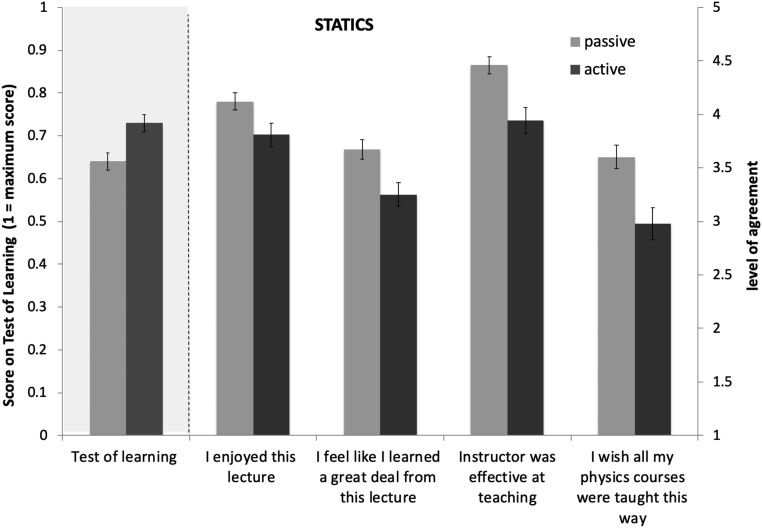
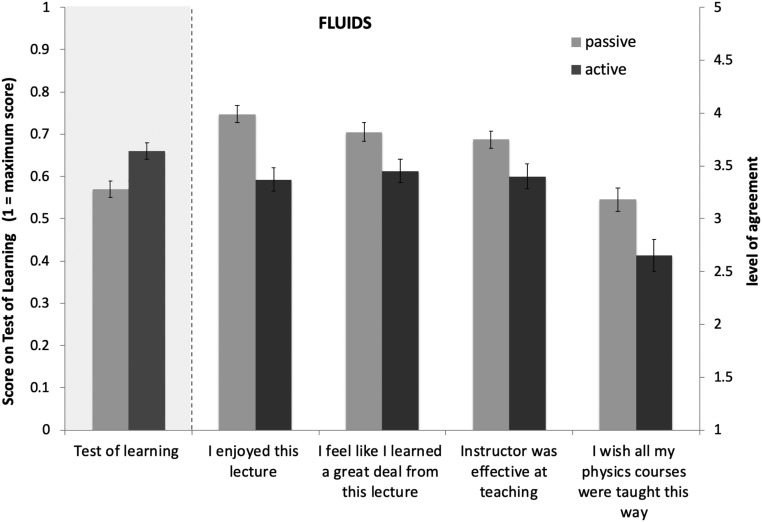
Significance: Despite active learning being recognized as a superior method of instruction in the classroom, a major recent survey found that most college STEM instructors still choose traditional teaching methods. This article addresses the long-standing question of why students and faculty remain resistant to active learning. Comparing passive lectures with active learning using a randomized experimental approach and identical course materials, we find that students in the active classroom learn more, but they feel like they learn less. We show that this negative correlation is caused in part by the increased cognitive effort required during active learning. Faculty who adopt active learning are encouraged to intervene and address this misperception, and we describe a successful example of such an intervention.
Overview
The claims and statistics of this paper haven’t been checked yet.
Free: it reads the open-access text and checks the first 5 claims that cite a source we can check. Create a free account to check every claim.
Integrity signals
Registry
Cites
Statistics
Figures
Verification
Claims the paper makes
The claims and statistics of this paper haven’t been checked yet.
Free: it reads the open-access text and checks the first 5 claims that cite a source we can check. Create a free account to check every claim.
Claims other papers make about this one
Each is checked against this paper’s own text: does it say what the citing paper says it does?
The source backs part of the claim, not all of it — or backs it for a different population, condition or comparison.
In the citing paper
“Our results support this approach, indicating that reducing cognitive offloading through active engagement can mitigate the negative impact of AI tools on critical thinking.”
From AI Tools in Society: Impacts on Cognitive Offloading and the Future of Critical Thinking (2025) · cites this paper as Deslauriers et al. [46]
Experimental — accuracy not yet measuredThe source backs part of the claim, not all of it — or backs it for a different population, condition or comparison.
In the citing paper
“Such perceptions can be different from actual learning and have been shown to disadvantage more effective teachers and teaching methods (Carrell and West 2010, Deslauriers et al. 2019).”
From AI Meets the Classroom: When Do Large Language Models Harm Learning? (2024) · cites this paper as Deslauriers et al. 2019
Experimental — accuracy not yet measuredThe source backs part of the claim, not all of it — or backs it for a different population, condition or comparison.
In the citing paper
“The exercise is a reminder that we are often poor judges of our own knowledge and may overestimate our understanding of various subjects, blurring the line between familiarity and fluency.”
From Assigning AI: Seven Approaches for Students, with Prompts (2023) · cites this paper as Deslauriers et al., 2019
Experimental — accuracy not yet measuredThe source backs part of the claim, not all of it — or backs it for a different population, condition or comparison.
In the citing paper
“A growing number of studies demonstrate, however, that people prefer simpler constructs, even though they learn more and perform better with more complex ones.”
From To Trust or to Think: Cognitive Forcing Functions Can Reduce Overreliance on AI in AI-assisted Decision-making (2021) · cites this paper as [18]
Experimental — accuracy not yet measuredThe source backs part of the claim, not all of it — or backs it for a different population, condition or comparison.
In the citing paper
“the scaffolded, conversational nature of the AI tool may have created a strong subjective sense of mastery that did not fully translate to improved performance under traditional assessment conditions”
From Socratic Mind: Impact of a Novel GenAI-Powered Formative Assessment Tool on Student Learning and Higher-Order Thinking (2026) · cites this paper as Deslauriers et al., 2019
Experimental — accuracy not yet measured
3 more claims about this paper
Create a free account to see every claim other papers make about this one.
Self-check
Percentages, sums and reported differences re-computed from the paper’s own numbers.
The self-check needs the paper’s full text.
Citations
Cites
A heteroskedasticity-consistent covariance matrix estimator and a direct test for heteroskedasticity
White, H. (1980) · Econometrica · doi:10.2307/1912934 · Cited by 25,861
(1999) · Cited by 12,812
Active learning increases student performance in science, engineering, and mathematics
Freeman, S., Eddy, S. L., McDonough, M., Smith, M. K., Okoroafor, N., Jordt, H., & Wenderoth, M. P. (2014) · Proceedings of the National Academy of Sciences · doi:10.1073/pnas.1319030111 · Cited by 9,787 · cited 1×
“(4) had to correct for this oversight in their metaanalysis.”
BackgroundThe role of deliberate practice in the acquisition of expert performance
Ericsson, K. A., Krampe, R. T., & Tesch-Römer, C. (1993) · Psychological Review · doi:10.1037/0033-295x.100.3.363 · Cited by 9,564 · cited 1×
“In the experimental group, the instructor actively engaged the students using the principles of deliberate practice (3, 36, 37): students were instructed to solve the sample problems by working together in small groups while the instructor roamed the room asking questions and offering assistance.”
MethodKruger, J., & Dunning, D. (1999) · Journal of Personality and Social Psychology · doi:10.1037/0022-3514.77.6.1121 · Cited by 7,731
Hake, R. R. (1998) · American Journal of Physics · doi:10.1119/1.18809 · Cited by 6,072 · cited 1×
“The pretest FCI scores in this study (Table 1) are similar to those clustered near the high end of the distribution of university scores in the metaanalysis published by Hake (1), which confirms that the students in our study have high school preparation comparable to that at other top universities.”
ResultHestenes, D., Wells, M., & Swackhamer, G. (1992) · The Physics Teacher · doi:10.1119/1.2343497 · Cited by 3,235
Peer Instruction: Ten years of experience and results
Crouch, C. H., & Mazur, E. (2001) · American Journal of Physics · doi:10.1119/1.1374249 · Cited by 2,682
When Should You Adjust Standard Errors for Clustering?
Abadie, A., Athey, S., Imbens, G., & Wooldridge, J. (2017) · National Bureau of Economic Research · doi:10.3386/w24003 · Cited by 1,360
Improved Learning in a Large-Enrollment Physics Class
Deslauriers, L., Schelew, E., & Wieman, C. (2011) · Science · doi:10.1126/science.1201783 · Cited by 1,270 · cited 4×
“4, used distinctly different class materials with each group, potentially confounding active engagement with changes in class content (3).”
BackgroundMethodInfluentialSelf-citation
Research works printed but not linked: 3
- Henderson C., Stelzer T., Hsu L., Meredith D., Maximizing the benefits of physics education research: Building productive relationships and promoting institutional change. American Physical Society Forum on Education Newsletter, Fall 2005, pp. 11–14. https://www.aps.org/units/fed/newsletters/fall2005/maximize.html. Accessed 20 June 2019.
- Felder R. M., Random thoughts: Sermons for grumpy campers. Chem. Eng. Educ. 41, 183– 184 (2007).
- Felder R. M., Random thoughts: The link between teaching and research. 2. How to strengthen each without weakening the other. Chem. Eng. Educ. 44, 213– 214 (2010).
Cited by
Items 501–600 of 1,005
Darcie, I., Kloet, M. V., & Gray, R. (2024) · European Journal of Higher Education · doi:10.1080/21568235.2023.2301599 · Cited by 8
Atanasova, A. (2024) · SCIENCE International Journal · doi:10.35120/sciencej0301127a · Cited by 8
Is There a Problem With Evidence in Health Professions Education?
Ellaway, R., OʼBrien, B. C., Sherbino, J., Maggio, L. A., Artino, A. R., Nimmon, L., Park, Y. S., Young, M. E., & Thomas, A. (2024) · Academic Medicine · doi:10.1097/acm.0000000000005730 · Cited by 8
Leistungsbeurteilungen an Hochschulen lernförderlich gestalten
Zimmermann, T. (2024) · Verlag Barbara Budrich eBooks · doi:10.3224/84743045 · Cited by 8
Co-kreatives Lernen und Lehren: Hochschulbildung im Zeitalter der Disruption
:null (2024) · doi:10.3278/9783763976225 · Cited by 9
Estrategias de Enseñanza STEM: Un Análisis de Métodos Activos en el Aula
Barzallo, J. G. H., Dávila, C. A. H., Sánchez, I. V. M. D. O., Triviño-Sanchez, J. J., & Marín, H. J. V. (2024) · Multidisciplinary Latin American Journal (MLAJ) · doi:10.62131/mlaj-v2-n3-002 · Cited by 8
Getting Your Hands Dirty in Integral Calculus
Singleton, L., Davishahl, E., & Haskell, T. R. (2020) · ASEE Annual Conference & Exposition · doi:10.18260/1-2--34707 · Cited by 8
Expanding Global Access to Neurology Education
Alemán, M. J., Nematollahi, S., & Berkowitz, A. L. (2021) · JAMA Neurology · doi:10.1001/jamaneurol.2021.2685 · Cited by 8
AIChE Virtual Communities of Practice _ Supporting Faculty during the COVID-19 Pandemic
Lepek, D. (2021) · Chemical Engineering Education · doi:10.18260/2-1-370.660-125282 · Cited by 8
Rethinking Radiology: An Active Learning Curriculum for Head Computed Tomography Interpretation
Aliaga, L., & Clarke, S. (2022) · Western Journal of Emergency Medicine · doi:10.5811/westjem.2021.10.53665 · Cited by 8
Kim, J. (2021) · Springer eBooks · doi:10.1007/978-3-030-84067-9_10 · Cited by 8
Anderson, R., Irvin, P. S., Bousselot, T., Beard, N. K., & Beach, P. T. (2022) · Creativity theory and action in education · doi:10.1007/978-3-030-98729-9_9 · Cited by 8
Sullivan, P. A., Davis, M. K., Smith, C. L., Delmore, R. J., Román-Muñiz, N., Cramer, C., Stallones, L. F., & Edwards-Callaway, L. (2022) · Translational Animal Science · doi:10.1093/tas/txac108 · Cited by 8
Shaping a Sustainable Future: Innovative Teaching Practices for Educating Responsible Leaders
Bustamante, S., Saltevo, E., Schmitz, M., Martinović, M., & Verlagsgesellschaft, N. (2022) · Nomos Verlagsgesellschaft mbH & Co. KG eBooks · doi:10.5771/9783748933090 · Cited by 8
Lowder, S. R., Moyer, M. M., Cooper, M. L., Pscheidt, J. W., & Mahaffee, W. F. (2023) · PhytoFrontiers™ · doi:10.1094/phytofr-07-23-0081-r · Cited by 8
USING ACTIVE LEARNING IN HYBRID LEARNING ENVIRONMENTS
Demazière, C. (2021) · EPJ Web of Conferences · doi:10.1051/epjconf/202124714001 · Cited by 8
Flipping the Classroom in Political Science: Student Achievement and Perceptions
Betti, A., Domonte, A. G., & Biderbost, P. (2020) · Revista de ciencia política · doi:10.4067/s0718-090x2020005000102 · Cited by 8
Skip the reading assignment: Effective and efficient learning with only practice and feedbackPreprint
Carvalho, P. F., Asher, M. W., Sana, F., & Koedinger, K. R. (2024) · OSF Preprints (OSF Preprints) · doi:10.31219/osf.io/9y2tb · Cited by 8
Alfaraj, R., Özdemir, B., Aljuffali, L. A., Alsabhan, J. F., Aloola, N. A. A., Alkofide, H., Aljadeed, R., Aljadeed, R., Alodaib, F. M., Alkhudair, N. A., et al. (2026) · Frontiers in Psychology · doi:10.3389/fpsyg.2026.1720303 · Cited by 7
Understanding The Concept of Plant Diversity by Utilising The School Environment In Biology Lessons
Amin, A., Sitio, H., Farrell, J., Saadoon, A. R., & Simanjuntak, M. R. P. (2026) · Marlajar Journal of Science Technology and Innovation · doi:10.66784/marlajar.v1i1.17 · Cited by 7
Augmentation or Erosion? Regulating Cognitive Offloading in Generative AI-Supported STEM Learning
Nakamura, D. (2026) · Educational Psychology Review · doi:10.1007/s10648-026-10224-6 · Cited by 8
Adebola, O. O., & Tsotetsi, C. T. (2022) · Journal of Educational and Social Research · doi:10.36941/jesr-2022-0135 · Cited by 7
Chananil, S., Julakarn, P., & Promsatien, Y. (2025) · International Journal of STEM Education for Sustainability · doi:10.53889/ijses.v5i1.481 · Cited by 7
Aguiar, A., & Calabrese, J. (2025) · Discover Education · doi:10.1007/s44217-025-00729-7 · Cited by 7
Wild, M. G., & Bachorowski, J. (2020) · Frontiers in Psychology · doi:10.3389/fpsyg.2020.00277 · Cited by 7
Impact of Calango language in an Introductory Computer Programming Course
Silva, G. R. S., Santos, G. A., Canedo, E. D., Rissoli, V. R. V., Praciano, B. J. G., & de Andrade, G. G. (2020) · IEEE Frontiers in Education Conference (FIE) · doi:10.1109/fie44824.2020.9274150 · Cited by 7
Lowering barriers to active learning: a novel approach for online instructional environments
Rhodes, A. E. (2021) · AJP Advances in Physiology Education · doi:10.1152/advan.00009.2021 · Cited by 7
Mind the Gap: The Illusion of Skill Acquisition in Computational Thinking
Bao, Y., & Hosseini, H. (2023) · ACM Technical Symposium on Computer Science Education (SIGCSE) · doi:10.1145/3545945.3569749 · Cited by 7
Kaye, M. P., & Kim, B. K. (2023) · Journal of Occupational Therapy Education · doi:10.26681/jote.2023.070110 · Cited by 7
Pinto‐Pinho, P., Ferreira, A. F., Matos, B., Santiago, J., Henriques, M. C., Corda, P. O., Lima, T., Rodrigues, M., Pereira, M. D. L., & Fardilha, M. (2023) · Innovations in Education and Teaching International · doi:10.1080/14703297.2023.2259384 · Cited by 7
Idrus, F., & Halim, A. (2023) · Journal of International Students · doi:10.32674/jis.v15i1.5499 · Cited by 7
Mehta, M., Mehta, N., & Group Project Manager, I. L. (2023) · Journal of Engineering Education Transformations · doi:10.16920/jeet/2023/v37i2/23149 · Cited by 7
Investigating the Impact of Active Learning in Large Coordinated Calculus Courses
Fuchs, S., & Sahmbi, G. (2024) · International Journal of Research in Undergraduate Mathematics Education · doi:10.1007/s40753-024-00234-6 · Cited by 7
Sørensen, A., & Lagestad, P. (2024) · Frontiers in Education · doi:10.3389/feduc.2024.1365916 · Cited by 8
Schechtel, S., & Bongers, A. (2024) · Chemistry Education Research and Practice · doi:10.1039/d3rp00272a · Cited by 7
Importance of undergraduate institution prestige in physics faculty hiring networks
Grunspan, D. Z., Komperda, R., Offerdahl, E. G., Abraham, A. E., Etebari, S., Maas, S. A., Roberts, J. A., Ghafoor, S., & Brownell, S. E. (2024) · Physical Review Physics Education Research · doi:10.1103/physrevphyseducres.20.010144 · Cited by 7
Using the interactive software FossilSketch to teach micropaleontology to undergraduate students
Степанова, А., Belanger, C. L., Anwar, S., Stanley, C. A., Nath, A., Cherian, J., & Hammond, T. (2024) · Journal of Geoscience Education · doi:10.1080/10899995.2024.2347156 · Cited by 7
Amponsah, K. D., Mensah, R. O., Aheto, S.-P. K., Commey-Mintah, P., Tutu‐Danquah, C., & Cobbinah, D. (2024) · African Journal of Social Issues · doi:10.4314/ajosi.v7i1.13 · Cited by 7
Koedinger, K. R., Blaser, M., McLaughlin, E. A., Cheng, H., & Yaron, D. (2025) · JACS Au · doi:10.1021/jacsau.4c01126 · Cited by 7
Vieira, M. L. (2025) · FEMS Microbiology Letters · doi:10.1093/femsle/fnaf075 · Cited by 7
Pratama, F. I., Rohaeti, E., & Laksono, E. W. (2025) · Jurnal Pendidikan Matematika dan Sains · doi:10.21831/jpms.v13ispecial_issue.88392 · Cited by 7
Data‐rich textbook figures promote core competencies: Comparison of two textbooks
Finby, B., Heyer, L. J., & Campbell, A. M. (2021) · Biochemistry and Molecular Biology Education · doi:10.1002/bmb.21488 · Cited by 7
Lacher, L. L., & Gibson, C. M. (2020) · International Conference on Computational Science and Computational Intelligence (CSCI) · doi:10.1109/csci51800.2020.00175 · Cited by 7
Ahlstrom, L. J. (2021) · The Journal of Economic Education · doi:10.1080/00220485.2021.1963372 · Cited by 7
A metodologia da problematização como estratégia de ensino em curso superior
Souza, G. L., dos Reis, L. A., & Malheiro, T. O. (2021) · Research Society and Development · doi:10.33448/rsd-v10i13.20873 · Cited by 7
Getting Started on Active Learning
Kovarik, M. L., Ott, L. S., Robinson, J. K., & Wenzel, T. J. (2022) · ACS symposium series · doi:10.1021/bk-2022-1409.ch002 · Cited by 7
Sarlin, M., Arsyad, A., & Haris, İ. (2022) · Journal of Higher Education Theory and Practice · doi:10.33423/jhetp.v22i5.5215 · Cited by 7
Impact of Scholarly Project on students’ perception of research skills: A quasi-experimental study
Duc, N. T. M., Viet, K. H., & Vuong, L. N. (2022) · The Asia Pacific Scholar · doi:10.29060/taps.2022-7-4/oa2748 · Cited by 7
Undergraduate Nursing Students’ Experiences of Learning Caring Using a Variety of Learning Didactics
Mårtensson, S. K., Knutsson, S. E. M., Hodges, E. A., Sherwood, G. D., Broström, A., & Björk, M. (2022) · International Journal for Human Caring · doi:10.20467/humancaring-d-21-00012 · Cited by 7
Bullet screen in pre-clinical undergraduate pharmacology education: a survey study
Chen, Y., Qi, H. Y., Yu, Q., Li, J., Zhu, L., Wang, H., Gao, X., & Jiang, G. (2022) · BMC Medical Education · doi:10.1186/s12909-022-03906-6 · Cited by 7
Esnaashari, S., Gardner, L. A., Rehm, M., Arthanari, T. S., & Filippova, O. (2023) · International Journal of Information and Education Technology · doi:10.18178/ijiet.2023.13.4.1852 · Cited by 7
Munfaridah, N., & Goedhart, M. J. (2022) · Momentum Physics Education Journal · doi:10.21067/mpej.v7i1.6982 · Cited by 8
Anand, P. (2020) · QUT ePrints (Queensland University of Technology) · Cited by 7
Kane, I., Hansen, J., & Lewis, R. J. (2021) · AJP Advances in Physiology Education · doi:10.1152/advan.00078.2021 · Cited by 7
Negro, F., Masson, M. H., & Beuers, U. H. (2024) · JHEP Reports · doi:10.1016/j.jhepr.2024.101266 · Cited by 8
Co-creative practice reconciling theory and practice in tertiary student documentary production
Wright-Brough, F., Hart, P., Maher, S., & Cake, S. (2023) · Media Practice and Education · doi:10.1080/25741136.2022.2157936 · Cited by 6
Tomsho, K. S., Quinn, M. R., Wang, Z., Preston, E. V., Adamkiewicz, G., Joseph, N. T., Wylie, B. J., & James-Todd, T. M. (2024) · International Journal of Environmental Research and Public Health · doi:10.3390/ijerph21121571 · Cited by 6
Ghosh, A., Malva, L., Gotovos, A., Hooshyar, D., & Singla, A. K. (2025) · ACM Technical Symposium on Computer Science Education (SIGCSE) · doi:10.1145/3641554.3701782 · Cited by 6
Empowering Education Harnessing AI Tools for Innovative Content Development
Hossain, M., Amin, S. Z., & Hossain, F. (2025) · Advances in computational intelligence and robotics book series · doi:10.4018/979-8-3693-6507-6.ch012 · Cited by 6
Fernández-Escandón, R. L., Estébanez, R. P., & Estébanez, M. P. (2025) · Educational Point · doi:10.71176/edup/16225 · Cited by 6
Lu, B. D., & Watanapokakul, S. (2025) · rEFLections · doi:10.61508/refl.v32i1.280462 · Cited by 6
Exploration and Practice of AI Application-oriented Talent Training Model Based on OBE Concept
Zhu, Y., & Xiang-ju, L. (2024) · doi:10.1145/3722237.3722361 · Cited by 6
Schirone, R., Schmedding, M., Weigner, J., Werner, M., Corte, G. M., Ehlers, J. P., Klass, L. G., & Bahramsoltani, M. (2025) · Animals · doi:10.3390/ani15101380 · Cited by 6
Gunawan, Y. I., Ahsani, N., & Putra, A. S. (2025) · Journal of Problem Based Learning in Higher Education · doi:10.54337/ojs.jpblhe.v13i1.10036 · Cited by 7
Tang, J. T., Mo, D., & Lan, W. C. (2025) · Research in Science & Technological Education · doi:10.1080/02635143.2025.2543267 · Cited by 7
Herendi, B., & Jenei, P. (2025) · Physics Education · doi:10.1088/1361-6552/adf933 · Cited by 6
Basic sciences are non-negotiable: debunking three critical fallacies in engineering education
Guerra, J., & Meneses-La-Riva, M. E. (2025) · Frontiers in Education · doi:10.3389/feduc.2025.1600009 · Cited by 6
Interpersonal neural synchronization underlies interactive concept learning in older adults
Liang, Z.-W., Zhan, Z.-J., Liu, Y.-C., Xu, H.-Z., & Yu, J. (2025) · npj Science of Learning · doi:10.1038/s41539-025-00368-5 · Cited by 6
EFFECTIVENESS OF CONTEXTUALIZED LEARNING MATERIAL IN TEACHING MOTHER TONGUE 3
LARDIZABAL, A. D., BANTULO, J. S., & ORIAS, E. E. (2023) · Zenodo (CERN European Organization for Nuclear Research) · doi:10.5281/zenodo.7841933 · Cited by 6
Xiao, F., Wang, C., & Jiang, J. (2026) · Sustainability · doi:10.3390/su18062791 · Cited by 6
Conti, D., Romeo, G., & Nuovo, S. D. (2025) · De Gruyter eBooks · doi:10.1515/9783112206393-002 · Cited by 6
Exploring the Benefits of Arts-Based Kinesthetic Activities in the College Classroom
Nosek, S., & Goldman, B. (2022) · College Teaching · doi:10.1080/87567555.2022.2088676 · Cited by 6
Lu, W. (2022) · Communication Teacher · doi:10.1080/17404622.2022.2117395 · Cited by 6
Aggarwal, A., & Ashok, A. (2022) · Koli Calling International Conference on Computing Education Research · doi:10.1145/3564721.3564740 · Cited by 6
Aperapar, P. S., & Anthonysamy, L. (2023) · Malaysian Journal of Learning and Instruction · doi:10.32890/mjli2023.20.1.3 · Cited by 6
Introducing Debate as a pedagogical tool in pharmacy education
Alfarah, M., Raddum, A. M., Holst, L., & Kjome, R. L. S. (2023) · Nordic Journal of STEM Education · doi:10.5324/njsteme.v7i1.4934 · Cited by 6
Simões, A. V., Moreira, G., & Oswald, T. (2023) · ICERI proceedings · doi:10.21125/iceri.2023.2516 · Cited by 6
Reimagining undergraduate teaching in materials science and engineering
Choy, J., Peltz, K., Sayers, Z., Spaldin, N. A., & Wells, M. A. (2023) · Nature Reviews Materials · doi:10.1038/s41578-023-00621-6 · Cited by 6
Bielefeldt, A. R. (2024) · ASEE Annual Conference & Exposition · doi:10.18260/1-2--41337 · Cited by 6
Leese, B., & Rosen, A. M. (2024) · International Studies Perspectives · doi:10.1093/isp/ekae004 · Cited by 6
Direct instruction or active learning? The spectrum of first-year university teaching practices
Bächtold, M., Papet, J., Asensio, D. B., & Ondo, A. N. (2024) · Higher Education Research & Development · doi:10.1080/07294360.2024.2366318 · Cited by 6
Study preferences and exam outcomes in medical education: insights from renal physiology
Heltne, S. F., Hovdenakk, S., Kvernenes, M., & Tenstad, O. (2024) · BMC Medical Education · doi:10.1186/s12909-024-05964-4 · Cited by 6
Caparos, P. J. T., & Napil, M. C. (2024) · Journal of Natural Language and Linguistics · doi:10.54536/jnll.v2i1.3849 · Cited by 6
The right tool for the job: matching active learning techniques to learning objectives
Jacobson, S., Zhang, L., & Zhu, J. (2024) · Advances in Economics Education · doi:10.4337/aee.2024.02.04 · Cited by 6
THE EFFECTIVENESS OF THE ARCS LEARNING MODEL IN IMPROVING STUDENT LEARNING OUTCOMES IN ECONOMICS
Rahayu, S., Sutarni, N., Nofriansyah, N., & Soffiatun, S. (2025) · Research and Development Journal of Education · doi:10.30998/rdje.v11i1.27273 · Cited by 6
Gallagher, A. M., Peacock, M., Williams, E. D., Zasada, M., & Cox, A. (2020) · Nursing Inquiry · doi:10.1111/nin.12383 · Cited by 6
Lunn, A. M., Cogan, L. S., & Manfrin, A. (2021) · Currents in Pharmacy Teaching and Learning · doi:10.1016/j.cptl.2021.01.010 · Cited by 6
Co-Creating Learning in Oceanography
Gleßmer, M. S., & Daae, K. (2021) · Oceanography · doi:10.5670/oceanog.2021.405 · Cited by 6
Educational Robotics: From Structured Game to Curricular Activity in Lower Secondary Schools
Parola, A., Vitti, E. L., Sacco, M. M., & Trafeli, I. (2021) · Lecture notes in networks and systems · doi:10.1007/978-3-030-77040-2_29 · Cited by 6
The impact of remote teaching on statistics learning and anxiety
Marshall, E., Mahmood, B., Alexander, C. L., Bock, M., Haigney, D., Jack, E., & Verrier, D. B. (2022) · MSOR Connections · doi:10.21100/msor.v20i1.1312 · Cited by 6
Garzón, A., Rubio, A., & Pérez‐Pulido, A. J. (2022) · Bioinformatics Advances · doi:10.1093/bioadv/vbac031 · Cited by 6
Encouraging Productive Behavior in Student Teams with Interventions
Zalewski, J. M., & Brudvig, S. (2022) · Teaching Sociology · doi:10.1177/0092055x221108105 · Cited by 6
Bohlson, S. S., Baty, J. J., Greenlee‐Wacker, M. C., & Bruns, H. A. (2022) · ImmunoHorizons · doi:10.4049/immunohorizons.2200040 · Cited by 6
Effective Teaching for Millennial Learner
Patra, S. M., & Shastry, K. (2022) · Journal of Engineering Education Transformations · doi:10.16920/jeet/2022/v35i4/22112 · Cited by 6
Nowak, K. L., & Watt, J. H. (2022) · Proceedings of the ACM on Human-Computer Interaction · doi:10.1145/3555184 · Cited by 6
Brain Science Learning Guides: An Innovative Strategy for Cultivating Effective Study Skills
Onello, R. (2023) · Nurse Educator · doi:10.1097/nne.0000000000001415 · Cited by 6
Designing and Reflecting on Active Learning and Flipped Classrooms for Renal Physiology
Drumm, B. T. (2023) · International Journal for the Scholarship of Teaching and Learning · doi:10.20429/ijsotl.2023.17122 · Cited by 6
Lee, I. C. J., & Wong, P. (2023) · MedEdPublish · doi:10.12688/mep.19535.1 · Cited by 6
Gilbertson, R. J., Hessler, E. E., & Leff, D. J. (2022) · Journal of Undergraduate Neuroscience Education · doi:10.59390/vuna6753 · Cited by 6
Setiawan, D. G. E., Kuengo, N. R., Supartin, S., Arbie, A., Paramata, D. D., & Ntobuo, N. E. (2024) · Jurnal Penelitian Pendidikan IPA · doi:10.29303/jppipa.v10i3.6933 · Cited by 6
Metadata
- Authors
- Deslauriers, L., McCarty, L. S., Miller, K., Callaghan, K., & Kestin, G.
- Affiliations
- Harvard University (US)
- Corresponding author
- Deslauriers, Louis
- Venue
- Proceedings of the National Academy of Sciences
- Publisher
- National Academy of Sciences
- Published
- 2019-09-04
- Volume
- 116
- Issue
- 39
- Pages
- 19251-19257
- ISSN
- 0027-8424 (ISSN-L)
- 1091-6490
- PMC
- PMC6765278
- OpenAlex
- W2971755171
- Cited by
- 1,371
- References
- 43
- Citations by year
- 2026: 186 · 2025: 222 · 2024: 251 · 2023: 216 · 2022: 196 · 2021: 165 · 2020: 122 · 2019: 13
- FWCI
- 334.20
- Type
- journal article
- Language
- en
- Open access
- hybrid
- doi.org
- Licence
- Locations
- Proceedings of the National Academy of Sciences (publishedVersion, cc-by-nc-nd)
- Europe PMC (PubMed Central) (publishedVersion, cc-by-nc-nd)
- PubMed Central (publishedVersion, cc-by-nc-nd)
- PubMed (publishedVersion)
- Topics
- Social Sciences › Education › Innovative Teaching Methods
- Social Sciences › Education › Evaluation of Teaching Practices
- Social Sciences › Psychology › Developmental and Educational Psychology › Innovative Teaching and Learning Methods
- Keywords
- active learning, student perceptions of learning, introductory college physics, large-enrollment courses, cognitive effort, student motivation, student self-regulation, teaching evaluation, student engagement
- MeSH terms
- Formative Feedback, Educational Measurement, Emotions, Female, Humans, Male, Perception, Physics, Students, Teaching, Universities, Problem-Based Learning
About these checks
Registry, retraction, Cites and statistics results are computed, not judged, with one exception: a printed reference that no index lists is read once by a model before it counts as a citation error. Claims are extracted by a model and kept only when their quote appears verbatim in the text; each cited source is then checked, with a model’s help, for whether it says what the claim relies on. Those verdicts can be wrong — read the claim’s quote and the cited source before relying on one.
Statistics and arithmetic are recomputed, not judged.
Confidence bands are shown only for fields calibrated on our annotated test set. None is calibrated yet, so no band is shown.
What counts as a claim ›How we measure confidence ›How we check this ›
Are you an author, or do you see a problem with this page? Request a review
Data sources
Bibliographic data: Semantic Scholar, OpenAlex, Crossref.
Contains information from the Semantic Scholar Academic Graph Datasets, made available under the ODC Attribution License (ODC-BY 1.0).
Semantic Scholar’s data is described in: Kinney, R., et al. (2023). The Semantic Scholar Open Data Platform. arXiv:2301.10140.
