

Measuring actual learning versus feeling of learning in response to being actively engaged in the classroom
Open accessThe DOI matches its Crossref record; 41 of the 43 references it cites were found in a registry or an index.
Abstract
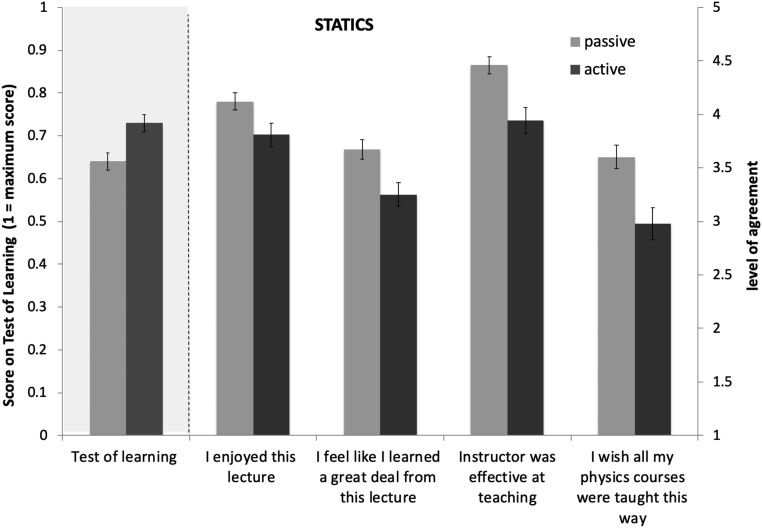
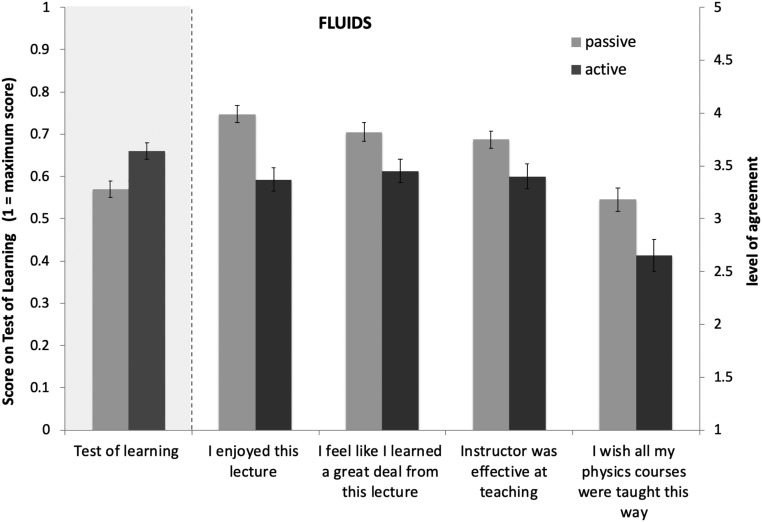
Significance: Despite active learning being recognized as a superior method of instruction in the classroom, a major recent survey found that most college STEM instructors still choose traditional teaching methods. This article addresses the long-standing question of why students and faculty remain resistant to active learning. Comparing passive lectures with active learning using a randomized experimental approach and identical course materials, we find that students in the active classroom learn more, but they feel like they learn less. We show that this negative correlation is caused in part by the increased cognitive effort required during active learning. Faculty who adopt active learning are encouraged to intervene and address this misperception, and we describe a successful example of such an intervention.
Overview
The claims and statistics of this paper haven’t been checked yet.
Free: it reads the open-access text and checks the first 5 claims that cite a source we can check. Create a free account to check every claim.
Integrity signals
Registry
Cites
Statistics
Figures
Verification
Claims the paper makes
The claims and statistics of this paper haven’t been checked yet.
Free: it reads the open-access text and checks the first 5 claims that cite a source we can check. Create a free account to check every claim.
Claims other papers make about this one
Each is checked against this paper’s own text: does it say what the citing paper says it does?
The source backs part of the claim, not all of it — or backs it for a different population, condition or comparison.
In the citing paper
“Our results support this approach, indicating that reducing cognitive offloading through active engagement can mitigate the negative impact of AI tools on critical thinking.”
From AI Tools in Society: Impacts on Cognitive Offloading and the Future of Critical Thinking (2025) · cites this paper as Deslauriers et al. [46]
Experimental — accuracy not yet measuredThe source backs part of the claim, not all of it — or backs it for a different population, condition or comparison.
In the citing paper
“Such perceptions can be different from actual learning and have been shown to disadvantage more effective teachers and teaching methods (Carrell and West 2010, Deslauriers et al. 2019).”
From AI Meets the Classroom: When Do Large Language Models Harm Learning? (2024) · cites this paper as Deslauriers et al. 2019
Experimental — accuracy not yet measuredThe source backs part of the claim, not all of it — or backs it for a different population, condition or comparison.
In the citing paper
“The exercise is a reminder that we are often poor judges of our own knowledge and may overestimate our understanding of various subjects, blurring the line between familiarity and fluency.”
From Assigning AI: Seven Approaches for Students, with Prompts (2023) · cites this paper as Deslauriers et al., 2019
Experimental — accuracy not yet measuredThe source backs part of the claim, not all of it — or backs it for a different population, condition or comparison.
In the citing paper
“A growing number of studies demonstrate, however, that people prefer simpler constructs, even though they learn more and perform better with more complex ones.”
From To Trust or to Think: Cognitive Forcing Functions Can Reduce Overreliance on AI in AI-assisted Decision-making (2021) · cites this paper as [18]
Experimental — accuracy not yet measuredThe source backs part of the claim, not all of it — or backs it for a different population, condition or comparison.
In the citing paper
“the scaffolded, conversational nature of the AI tool may have created a strong subjective sense of mastery that did not fully translate to improved performance under traditional assessment conditions”
From Socratic Mind: Impact of a Novel GenAI-Powered Formative Assessment Tool on Student Learning and Higher-Order Thinking (2026) · cites this paper as Deslauriers et al., 2019
Experimental — accuracy not yet measured
3 more claims about this paper
Create a free account to see every claim other papers make about this one.
Self-check
Percentages, sums and reported differences re-computed from the paper’s own numbers.
The self-check needs the paper’s full text.
Citations
Cites
A heteroskedasticity-consistent covariance matrix estimator and a direct test for heteroskedasticity
White, H. (1980) · Econometrica · doi:10.2307/1912934 · Cited by 25,861
(1999) · Cited by 12,812
Active learning increases student performance in science, engineering, and mathematics
Freeman, S., Eddy, S. L., McDonough, M., Smith, M. K., Okoroafor, N., Jordt, H., & Wenderoth, M. P. (2014) · Proceedings of the National Academy of Sciences · doi:10.1073/pnas.1319030111 · Cited by 9,787 · cited 1×
“(4) had to correct for this oversight in their metaanalysis.”
BackgroundThe role of deliberate practice in the acquisition of expert performance
Ericsson, K. A., Krampe, R. T., & Tesch-Römer, C. (1993) · Psychological Review · doi:10.1037/0033-295x.100.3.363 · Cited by 9,564 · cited 1×
“In the experimental group, the instructor actively engaged the students using the principles of deliberate practice (3, 36, 37): students were instructed to solve the sample problems by working together in small groups while the instructor roamed the room asking questions and offering assistance.”
MethodKruger, J., & Dunning, D. (1999) · Journal of Personality and Social Psychology · doi:10.1037/0022-3514.77.6.1121 · Cited by 7,731
Hake, R. R. (1998) · American Journal of Physics · doi:10.1119/1.18809 · Cited by 6,072 · cited 1×
“The pretest FCI scores in this study (Table 1) are similar to those clustered near the high end of the distribution of university scores in the metaanalysis published by Hake (1), which confirms that the students in our study have high school preparation comparable to that at other top universities.”
ResultHestenes, D., Wells, M., & Swackhamer, G. (1992) · The Physics Teacher · doi:10.1119/1.2343497 · Cited by 3,235
Peer Instruction: Ten years of experience and results
Crouch, C. H., & Mazur, E. (2001) · American Journal of Physics · doi:10.1119/1.1374249 · Cited by 2,682
When Should You Adjust Standard Errors for Clustering?
Abadie, A., Athey, S., Imbens, G., & Wooldridge, J. (2017) · National Bureau of Economic Research · doi:10.3386/w24003 · Cited by 1,360
Improved Learning in a Large-Enrollment Physics Class
Deslauriers, L., Schelew, E., & Wieman, C. (2011) · Science · doi:10.1126/science.1201783 · Cited by 1,270 · cited 4×
“4, used distinctly different class materials with each group, potentially confounding active engagement with changes in class content (3).”
BackgroundMethodInfluentialSelf-citation
Research works printed but not linked: 3
- Henderson C., Stelzer T., Hsu L., Meredith D., Maximizing the benefits of physics education research: Building productive relationships and promoting institutional change. American Physical Society Forum on Education Newsletter, Fall 2005, pp. 11–14. https://www.aps.org/units/fed/newsletters/fall2005/maximize.html. Accessed 20 June 2019.
- Felder R. M., Random thoughts: Sermons for grumpy campers. Chem. Eng. Educ. 41, 183– 184 (2007).
- Felder R. M., Random thoughts: The link between teaching and research. 2. How to strengthen each without weakening the other. Chem. Eng. Educ. 44, 213– 214 (2010).
Cited by
Items 901–1,000 of 1,005
Favero, L., Pérez-Ortiz, J.-A., Käser, T., & Oliver, N. (2026) · arXiv (Cornell University) · doi:10.48550/arxiv.2608.17451 · Cited by 2
Blatt-Gross, C. E. (2020) · Journal for Learning through the Arts A Research Journal on Arts Integration in Schools and Communities · doi:10.21977/d915142844 · Cited by 2
Unplugging Students: Utilizing Guided Technology Policies to Enhance Classroom Engagement
(2022) · Journal of Instructional Research · doi:10.9743/jir.2022.1.5 · Cited by 2
Paying Attention in Class: Using In-Class Quizzes to Incentivize Student Attention
Nevid, J. S., & Armata, C. E. (2023) · Teaching of Psychology · doi:10.1177/00986283231185136 · Cited by 2
Kruger, C., & Mdakane, M. (2023) · NWU self-directed learning series · doi:10.4102/aosis.2023.bk426.05 · Cited by 2
Wer lehrt wie in Deutschland? Debatten zur Zukunft politikwissenschaftlicher Hochschullehre
Blum, S., Cronqvist, L., Ohnesorge, H. W., Becker, M., Lambach, D., Schwanholz, J., Glaab, K., & Engelkamp, S. (2023) · Politische Vierteljahresschrift · doi:10.1007/s11615-023-00512-z · Cited by 2
Strange Bedfellows: An experiment in Student-directed Interdisciplinary Research
Chiu, R. K. (2024) · University of Groningen Press eBooks · doi:10.21827/6399d913c9fa9 · Cited by 2
Student Advice for Success in High Structure Science and Engineering Courses
Shaffer, J. F., & Ringsby, A. (2024) · The journal of college science teaching · doi:10.1080/0047231x.2024.2316380 · Cited by 2
Pérez-Quiñones, M. A., & Basu, D. (2025) · ASEE Annual Conference & Exposition · doi:10.18260/1-2--47331 · Cited by 2
Pelangi, H., Ariaji, R., & Siregar, I. (2025) · Al-Madrasah Jurnal Pendidikan Madrasah Ibtidaiyah · doi:10.35931/am.v9i2.4218 · Cited by 2
Developing an AI/ML activity for a BME physiology course
Christian, L., Winslett, O., Gautam, A., & Fernandez, T. (2025) · ASEE Annual Conference & Exposition · doi:10.18260/1-2--56252 · Cited by 2
Engaging Students Daily in General Chemistry
Fischer, A. E. (2020) · ACS symposium series · doi:10.1021/bk-2020-1343.ch001 · Cited by 2
Sánchez, A. X., & Ríos, L. (2020) · Physics Education Research Conference (PERC) · doi:10.1119/perc.2020.pr.sanchez · Cited by 3
Godager, L. H., Sandve, S. R., & Fjellheim, S. (2021) · Nordic Journal of STEM Education · doi:10.5324/njsteme.v5i1.3931 · Cited by 2
Shea, L., Bégin, C., Osovitz, C., & Prevost, L. B. (2020) · The journal of college science teaching · doi:10.1080/0047231x.2020.12290687 · Cited by 2
Always Flipped? A Peer-Centred Cycle for Teaching and Learning in the English Literature Class
Gordon, C. (2021) · Studi e ricerche · doi:10.30687/978-88-6969-529-2/012 · Cited by 2
Learning in Engineering Project Management Classes: Does Technology Matter?
Nguyen, L. D., O'Neill, R., & Komisar, S. J. (2020) · ASEE Annual Conference & Exposition · doi:10.18260/1-2--34902 · Cited by 2
Teaching the Psychology of Learning
Jesseau, S. A. (2021) · Springer international handbooks of education · doi:10.1007/978-3-030-26248-8_7-2 · Cited by 2
Lineweaver, T. T., Hall, A. C. G., Throgmorton, H., Callahan, S. M., & Bell, A. J. (2022) · Journal of College Reading and Learning · doi:10.1080/10790195.2022.2056097 · Cited by 2
Thompson, P., Smith, A. A., & Jeffery, J. (2022) · Community College Journal of Research and Practice · doi:10.1080/10668926.2022.2064366 · Cited by 2
How Much Does Student Perception of Course Attributes Impact Student Motivation?
Vigeant, M. A.-S., & Golightly, A. (2020) · ASEE Annual Conference & Exposition · doi:10.18260/1-2--34733 · Cited by 2
Lilly, C. P., Ormond, A. B., Carter, A. A., & Powell, W. J. (2022) · Journal of Chemical Education · doi:10.1021/acs.jchemed.1c00542 · Cited by 2
Witchel, H. J., Klein, R., Sinnayah, P., & Rathner, J. A. (2022) · Methods in physiology · doi:10.1007/978-3-030-95633-2_4 · Cited by 2
Lascano, R. B., Roxas, A. C. D., Marcellana, A. C., Baxa, E. N. G., & rachelle.lascano@g.batstate-u.edu.ph, A. D. B.-U. E. P. (2022) · International Multidisciplinary Research Journal · doi:10.54476/ioer-imrjv4i2jun20229848 · Cited by 2
The Effects of COVID-19 on Teaching Practices in Medical Education
LeBlanc, H. P. (2022) · Medical Research Archives · doi:10.18103/mra.v10i9.3081 · Cited by 2
Pain Overview: Classification, Conceptual Framework, and Assessment
Duarte, N., García‐Pedraza, J. Á., & Santos, M. (2022) · University of Maribor, University Press eBooks · doi:10.18690/um.3.2022.24 · Cited by 2
Students' experiences with short videos in a flipped classroom design in physic
Rolstad, K. B., & Andersen, T. (2022) · Annual Conference of the European Society for Engineering Education (SEFI) · doi:10.5821/conference-9788412322262.1314 · Cited by 2
Intrinsically Disordered Proteins as an Instrument for Research-Integrating Teaching
Skriver, K., Sjørup, S. A., Langkilde, A. E., Balouka, E., Christensen, C. S., Carbel, K., Decker, J. N. V., Essenbæk, D. N., Gräf, J. F., Jessen, C. H., et al. (2023) · The Biophysicist · doi:10.35459/tbp.2022.000221 · Cited by 2
Sekali, P. B. K., Marasabesy, A., Nasution, N. F., & Sekali, E. B. K. (2023) · Jurnal Obsesi Jurnal Pendidikan Anak Usia Dini · doi:10.31004/obsesi.v7i2.3982 · Cited by 2
Ward, S., Barker, A.-C., Shoocongdej, R., Wangthongchaicharoen, N., Miszkiewicz, J. J., King, C. L., & Halcrow, S. E. (2023) · Advances in Archaeological Practice · doi:10.1017/aap.2023.16 · Cited by 2
Kawinkoonlasate, P. (2023) · English Language Teaching · doi:10.5539/elt.v16n12p39 · Cited by 2
The Influence of Teacher Professional Competence on Student Learning Motivation in PAI Subjects
Arrobi, J., Supiani, E., & Lestari, S. R. (2023) · Al-Hijr Journal of Adulearn World · doi:10.55849/alhijr.v2i3.559 · Cited by 2
Enhancing Classroom Learning: Exploring the Synergy of Microlearning and the Community of Inquiry
Alias, N. F., & Razak, R. A. (2023) · International Journal of Advanced Research in Education and Society · doi:10.55057/ijares.2023.5.4.11 · Cited by 2
Cressman, J., Burns, K. A., Calin‐Jageman, I. E., King, D. E., Krafnick, A. J., Li, Y., Reavey, B. M., Silvers, P., & Kreher, S. A. (2024) · To improve the academy · doi:10.3998/tia.4451 · Cited by 2
McClure, J., Bickel, F., Jiang, S., Chao, J., & Rosé, C. P. (2024) · Proceedings. · doi:10.22318/icls2024.875205 · Cited by 2
Using expectancy-value theory to understand the teaching motivations of women physics lecturers
Durk, J., Smith, A., Aydın, B., Julia, A., & Rabey, I. M. (2024) · Physical Review Physics Education Research · doi:10.1103/physrevphyseducres.20.010157 · Cited by 2
Edgeworth: Efficient and Scalable Authoring of Visual Thinking Activities
Ni, W., Estep, S., Harriman, H.-S., Koedinger, K. R., & Sunshine, J. S. (2024) · ACM Conference on Learning @ Scale (L@S) · doi:10.1145/3657604.3662034 · Cited by 2
УПРОВАДЖЕННЯ АКТИВНОГО НАВЧАННЯ В ОСВІТНІЙ ПРОЦЕС ЗАСОБАМИ ІНФОРМАЦІЙНИХ ТЕХНОЛОГІЙ
Квас, О., & Петровський, О. (2024) · Молодь і ринок · doi:10.24919/2308-4634.2024.311079 · Cited by 2
Skills Acquisition and Engagement with the Use of a Structured Journal Club Curriculum
Thakkar, V. J., Toups, M. S. P., & Cruz, A. M. D. (2024) · Academic Psychiatry · doi:10.1007/s40596-024-02079-2 · Cited by 2
Walter, J. M., Dueñas, A. N., Horne, J. P., & Brucker, J. B. (2024) · ATS Scholar · doi:10.34197/ats-scholar.2024-0032ps · Cited by 2
Enhancing Research Through Image Analysis Workshops: Experiences and Best Practices
Marcotti, S., Jones, M. L., Slater, T. J. A., & Barry, D. J. (2024) · Microscopy Research and Technique · doi:10.1002/jemt.24769 · Cited by 2
Sørensen, A., & Lagestad, P. (2024) · Physical Education of Students · doi:10.15561/20755279.2024.0601 · Cited by 2
OLIVEIRA-MELO, F. G. D., Sant’Anna, Â. M. O., & Barbosa, A. S. (2025) · Brazilian Journal of Production Engineering · doi:10.47456/bjpe.v11i1.47140 · Cited by 2
Tarasova, K., Павлович, Т. Д., Щеглова, И. А., Пащенко, Т., & Беляева, А. (2024) · Voprosy Obrazovaniya/ Educational Studies Moscow · doi:10.17323/vo-2024-18286 · Cited by 2
Transcending subjectivity: artistic and creative development in university students
González, D. J. G., & Rodríguez, M. G. (2025) · European Public & Social Innovation Review · doi:10.31637/epsir-2025-1359 · Cited by 2
Short introductory videos for elaborative encoding of physics principles
Gjerde, V. (2025) · Nordic Journal of STEM Education · doi:10.5324/njsteme.v9i1.5922 · Cited by 2
Effectiveness of Sparcs on The Reading Comprehension Performance of Grade 6 Learners
Suplaag, M. C., PANTUJAN, S. A. R., ROJAS, P. K. G., LAHOY, J. R., & BAYER, A. D. P. (2025) · JOURNAL OF DIGITAL LEARNING AND DISTANCE EDUCATION · doi:10.56778/jdlde.v3i11.470 · Cited by 2
Rachmi, C. N., Jupri, A., Juandi, D., Putri, N., & Bulubaan, S. (2025) · Jurnal Pendidikan MIPA · doi:10.23960/jpmipa.v26i1.pp227-243 · Cited by 2
Dunnett, K. (2025) · International Journal for Students as Partners · doi:10.15173/ijsap.v9i1.5760 · Cited by 2
Joshi, A., Marthen, W. D., & Megasari, N. (2025) · Forum for education studies. · doi:10.59400/fes2922 · Cited by 2
Collins, J. S., Dickson‐Karn, N. M., Berhe, M., & Ogrin-Cotarlan, S. (2025) · Journal of Chemical Education · doi:10.1021/acs.jchemed.4c00970 · Cited by 2
Order in the Court: Teaching U.S. Criminal Trials and Procedure Through a Mock Trial
Williams, R. J. (2025) · Journal of Criminal Justice Education · doi:10.1080/10511253.2025.2527087 · Cited by 2
Student views on active learning in the Geoscience curriculum
Kordts, R., Daae, K., de Vareilles, M., Gandrud, E., Årvik, A. D., & Gleßmer, M. S. (2025) · Nordic Journal of STEM Education · doi:10.5324/njsteme.v9i3.6361 · Cited by 2
Policy in action: Improvisation, role-play, and the creative use of AI in public policy classrooms
Roggio, A. M. (2025) · Politics · doi:10.1177/02633957251378260 · Cited by 2
Ludwig, S., Rausch, A., & Taub, M. (2025) · Learning and Instruction · doi:10.1016/j.learninstruc.2025.102255 · Cited by 2
Duke, B. (2022) · E- Revista de Estudos Interculturais · doi:10.34630/erei.vi10.4752 · Cited by 2
de Vries, S. J., & van Dijk, M. L. (2024) · Annals of Pharmacy Education Safety and Public Health Advocacy · doi:10.51847/qa9bnzgatq · Cited by 2
Agile and Active: Sustaining Pedagogical Change in a Large-Enrollment Calculus Course
Cogswell, C., Pauls, S. D., Gauthier, A. J., & DeSilva, E. (2019) · Journal of Effective Teaching in Higher Education · doi:10.36021/jethe.v2i2.32 · Cited by 2
Meeting the Learning Demands of a Dynamic Teaching Era: The Challenge-Based Learning Strategy
Carrión, B., Rodriguez, A. M. M., & Cabrera, M. V. L. (2020) · Advances in medical education, research, and ethics (AMERE) book series · doi:10.4018/978-1-7998-3066-5.ch008 · Cited by 2
Lai, V. K. (2020) · Chemical Engineering Education · doi:10.18260/2-1-370.660-115591 · Cited by 2
Open Educational Resource Exercises for Fisheries Classes
Grossman, G. D., Bozeman, B. B., Sliger, R., Simon, T. N., & Matsumoto, G. I. (2020) · Fisheries · doi:10.1002/fsh.10529 · Cited by 2
Strategies to Effectively Integrate Visualization with Active Learning in Computer Science Class
Shaziya, H., & Zaheer, R. (2020) · Lecture notes on data engineering and communications technologies · doi:10.1007/978-981-15-8767-2_6 · Cited by 2
Assessment as Pedagogy in a Compressed-Format Summer Physics Abroad Program
Ho, H., Lam, Y. W., Wahl, K. E., Yao, E., Grant, J., & Dunne, P. A. (2021) · Frontiers The Interdisciplinary Journal of Study Abroad · doi:10.36366/frontiers.v33i1.515 · Cited by 2
Lessons Learnt from Operationalising an International Collaborative Multi-Centre Study
Raj, R., Dominic, C., Gandhi, S. R., Taylor, E. H., Politis, M., Hussain, S. N. F., Parwani, D., Bandyopadhyay, S., Peter, N., & Lakhoo, K. (2021) · International Journal of Medical Students · doi:10.5195/ijms.2021.1029 · Cited by 2
Transforming Spaces and Innovative Uses of Technology to Enhance the Student Learning Experience
Holland, P. M., & Hainke, M. (2021) · Springer eBooks · doi:10.1007/978-3-030-80889-1_6 · Cited by 2
Multimedia Learning with Cognitive Tutors
Koedinger, K. R., & Aleven, V. A. W. M. M. (2021) · Cambridge University Press eBooks · doi:10.1017/9781108894333.046 · Cited by 2
Multimedia Learning with Media
Mayer, R. E., & Fiorella, L. (2021) · Cambridge University Press eBooks · doi:10.1017/9781108894333.045 · Cited by 2
Exploring an Active-learning Focus in a Liberal Arts Engineering Curriculum
Bruce, D. R., & Dziallas, S. (2020) · ASEE Annual Conference & Exposition · doi:10.18260/1-2--34639 · Cited by 2
New Voices of Inquiry: How the Inclusive Classroom Catalyzes Innovative Research
Denny, E. K., Amechi, B., Sanchez, A. B., Acosta, S. C., Pina, G. D., Frausto, J., Meza, J., Torres, E. M., Morales, I., Murillo, A., et al. (2022) · PS Political Science & Politics · doi:10.1017/s1049096522000968 · Cited by 2
Looking for solutions: students’ use of infrared cameras in calorimetry labs
Samuelsson, C. R., Ho, F. M., Elmgren, M., & Haglund, J. (2023) · Chemistry Education Research and Practice · doi:10.1039/d2rp00178k · Cited by 2
Hölzlhammer, L., Schäfer, L., Meyhöfer, F., Neumann, F., & Lahm, S. (2021) · doi:10.3278/6004807w · Cited by 2
Towards Developing Scalable Assessments of Higher-Order Learning
Sealfon, C. D. (2023) · Computer-supported collaborative learning/The Computer-Supported Collaborative Learning Conference · doi:10.22318/cscl2023.978554 · Cited by 2
Oviawe, J. I., Nashir, I. M., & Azman, M. N. A. (2021) · Journal of Technology and Humanities · doi:10.53797/jthkkss.v2i1.1.2021 · Cited by 2
Instructional Strategies for Active Learning
Carbonneau, K. J. (2024) · Education and human development · doi:10.5772/intechopen.114410 · Cited by 2
Mesghina, A. (2024) · Education and human development · doi:10.5772/intechopen.114344 · Cited by 2
Lernwelt Hochschule gestalten: Dimensionen der politischen Steuerung und Konzepte
Stang, R., & Becker, A. (2024) · De Gruyter eBooks · doi:10.1515/9783111349619 · Cited by 3
Tocco, A. J., Narla, A. V., Giardina, E., Hughes, E., Ab Latif, F., Wooten, H. J., Fisk, J. N., Baker, J., Simmons, J., Lue, K., et al. (2022) · Digital Commons - USU (Utah State University) · doi:10.26079/da16-f285 · Cited by 2
Designing Arabic Learning with Prediction Guide: A Prospect
Rahmawati, F. A., & Kurniawan, M. A. (2022) · Proceeding International Conference on Religion Science and Education · Cited by 2
Khoiriyah, R., Slamet, S., Johanna, A., & Avinash, B. (2023) · Journal International Dakwah and Communication · Cited by 2
Vázquez, G., & Azucena, M. (2019) · LA Referencia (Red Federada de Repositorios Institucionales de Publicaciones Científicas) · Cited by 2
Perumal, S. D. (2020) · Preprints.org · doi:10.20944/preprints202008.0463.v1 · Cited by 2
Qian, W. (2020) · Jyväskylä University Digital Archive (University of Jyväskylä) · Cited by 2
Shofer, S. L. (2020) · Carolina Digital Repository (University of North Carolina at Chapel Hill) · doi:10.17615/ez8j-3c17 · Cited by 2
Scoping the Potential Use of Serious Games for Public Engagement with Tree and Plant Health
Docherty, C. W. (2020) · Cited by 2
Understanding and Analyzing Non-Technical AR Novices’ Online Interactions and AR Projects
Ko, H.-S. (2023) · Carleton University's Institutional Repository (MacOdrum Library, Carleton University) · doi:10.22215/etd/2023-15587 · Cited by 2
The Effect of Hybrid Collaborative Learning on Academic PerformancePreprint
Song, M. H., & Park, J. (2023) · SSRN Electronic Journal · doi:10.2139/ssrn.4648814 · Cited by 2
El-Mansy, S. Y. (2023) · PDXScholar (Portland State University) · doi:10.15760/etd.3688 · Cited by 2
Why asking learners what they want is a recipe for confusion
Sadki, R. (2024) · doi:10.59350/6z9yb-r4b94 · Cited by 2
AI Tutors vs. Tenacious Myths: Evidence from Personalised Dialogue Interventions in EducationPreprint
Corbett, B. J., & Tangen, J. M. (2025) · PsyArXiv (OSF Preprints) · doi:10.31234/osf.io/x4wqh_v1 · Cited by 2
Veniel-Martí, F. (2024) · Repository of Digital Objects for Teaching Research and Culture (University of Valencia) · Cited by 2
Brosseau, R. (2024) · eScholarship@McGill (McGill) · doi:10.82308/20578 · Cited by 2
Li, A. T., De, L., & Ye, T. (2025) · SSRN Electronic Journal · doi:10.2139/ssrn.5533921 · Cited by 2
Hu, Y., Peng, X., Peng, S., Wang, H., & Wang, T. (2026) · arXiv (Cornell University) · doi:10.48550/arxiv.2601.05019 · Cited by 2
Training to Support Appropriate Reliance on Advanced Driver Assistance Systems
DeGuzman, C. A. (2023) · TSpace (University of Toronto) · Cited by 2
Callaghan, K., Milbourne, T., Klales, A., Kestin, G., Arguelles, C., McCarty, L., & Deslauriers, L. (2026) · Journal of College Science Teaching · doi:10.1080/0047231x.2026.2620442 · Cited by 1
“Under the direction of an instructor with active learning experience (Deslauriers et al., 2019), the 90-minute, biweekly, interactive lectures combine small-group activities and instructor feedback (Deslauriers et al., 2011; Deslauriers & Wieman, 2011; Beyer et al., 2016; McCarty & Deslauriers,…”
Self-citationSalem, M. F. A., Sharaf, A. K., & Younis, A. A. A. (2026) · Nurse Education in Practice · doi:10.1016/j.nepr.2026.104904 · Cited by 1
TACTivities: A Way to Promote Hands-On, Minds-On Learning in a Virtual Learning Environment
Hodge-Zickerman, A., Stade, E., & York, C. S. (2021) · Advances in mobile and distance learning book series · doi:10.4018/978-1-7998-7222-1.ch014 · Cited by 1
Daniel, M., & Urke, H. B. (2022) · Springer eBooks · doi:10.1007/978-3-030-96005-6_11 · Cited by 1
Guided Inquiry Learning with Technology: Community Feedback and Software for Social Constructivism
Kussmaul, C., & Pirmann, T. (2022) · Communications in computer and information science · doi:10.1007/978-3-031-14756-2_20 · Cited by 1
Development of an Inclusive Multiplayer Serious Game for Deaf and Blind
Neto, N., Galasso, B., Esdras, D., & Escudeiro, P. M. (2022) · University of Maribor, University Press eBooks · doi:10.18690/um.3.2022.7 · Cited by 1
Metadata
- Authors
- Deslauriers, L., McCarty, L. S., Miller, K., Callaghan, K., & Kestin, G.
- Affiliations
- Harvard University (US)
- Corresponding author
- Deslauriers, Louis
- Venue
- Proceedings of the National Academy of Sciences
- Publisher
- National Academy of Sciences
- Published
- 2019-09-04
- Volume
- 116
- Issue
- 39
- Pages
- 19251-19257
- ISSN
- 0027-8424 (ISSN-L)
- 1091-6490
- PMC
- PMC6765278
- OpenAlex
- W2971755171
- Cited by
- 1,371
- References
- 43
- Citations by year
- 2026: 186 · 2025: 222 · 2024: 251 · 2023: 216 · 2022: 196 · 2021: 165 · 2020: 122 · 2019: 13
- FWCI
- 334.20
- Type
- journal article
- Language
- en
- Open access
- hybrid
- doi.org
- Licence
- Locations
- Proceedings of the National Academy of Sciences (publishedVersion, cc-by-nc-nd)
- Europe PMC (PubMed Central) (publishedVersion, cc-by-nc-nd)
- PubMed Central (publishedVersion, cc-by-nc-nd)
- PubMed (publishedVersion)
- Topics
- Social Sciences › Education › Innovative Teaching Methods
- Social Sciences › Education › Evaluation of Teaching Practices
- Social Sciences › Psychology › Developmental and Educational Psychology › Innovative Teaching and Learning Methods
- Keywords
- active learning, student perceptions of learning, introductory college physics, large-enrollment courses, cognitive effort, student motivation, student self-regulation, teaching evaluation, student engagement
- MeSH terms
- Formative Feedback, Educational Measurement, Emotions, Female, Humans, Male, Perception, Physics, Students, Teaching, Universities, Problem-Based Learning
About these checks
Registry, retraction, Cites and statistics results are computed, not judged, with one exception: a printed reference that no index lists is read once by a model before it counts as a citation error. Claims are extracted by a model and kept only when their quote appears verbatim in the text; each cited source is then checked, with a model’s help, for whether it says what the claim relies on. Those verdicts can be wrong — read the claim’s quote and the cited source before relying on one.
Statistics and arithmetic are recomputed, not judged.
Confidence bands are shown only for fields calibrated on our annotated test set. None is calibrated yet, so no band is shown.
What counts as a claim ›How we measure confidence ›How we check this ›
Are you an author, or do you see a problem with this page? Request a review
Data sources
Bibliographic data: Semantic Scholar, OpenAlex, Crossref.
Contains information from the Semantic Scholar Academic Graph Datasets, made available under the ODC Attribution License (ODC-BY 1.0).
Semantic Scholar’s data is described in: Kinney, R., et al. (2023). The Semantic Scholar Open Data Platform. arXiv:2301.10140.
