

Measuring actual learning versus feeling of learning in response to being actively engaged in the classroom
Open accessThe DOI matches its Crossref record; 41 of the 43 references it cites were found in a registry or an index.
Abstract
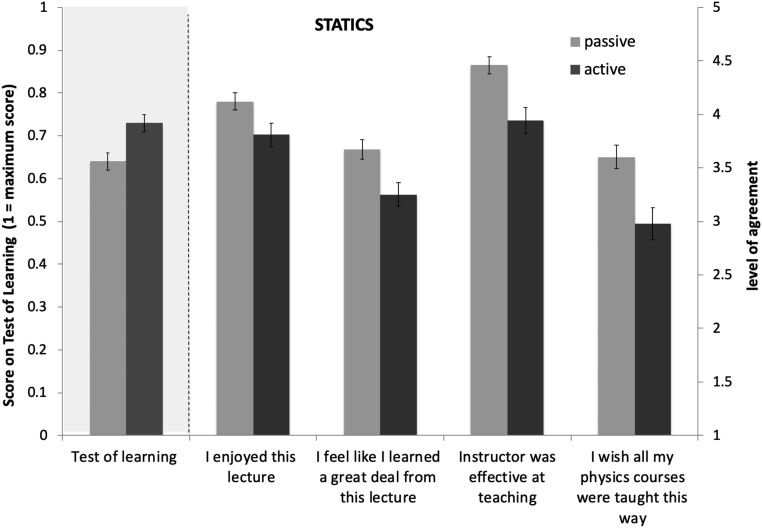
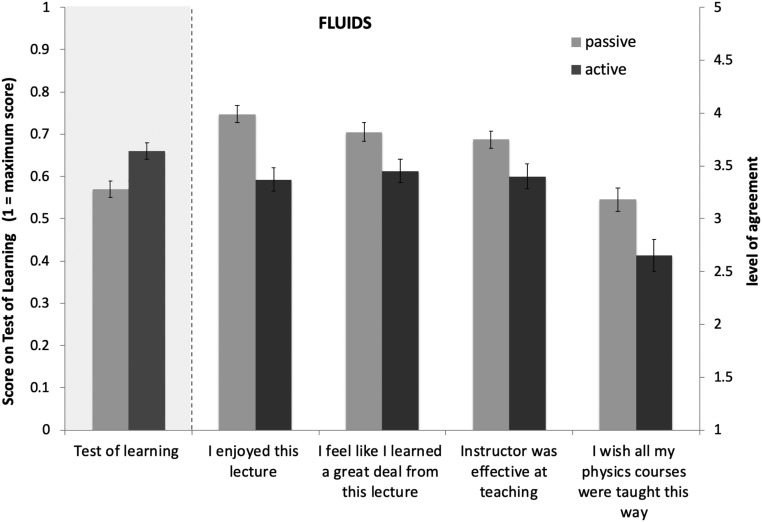
Significance: Despite active learning being recognized as a superior method of instruction in the classroom, a major recent survey found that most college STEM instructors still choose traditional teaching methods. This article addresses the long-standing question of why students and faculty remain resistant to active learning. Comparing passive lectures with active learning using a randomized experimental approach and identical course materials, we find that students in the active classroom learn more, but they feel like they learn less. We show that this negative correlation is caused in part by the increased cognitive effort required during active learning. Faculty who adopt active learning are encouraged to intervene and address this misperception, and we describe a successful example of such an intervention.
Overview
The claims and statistics of this paper haven’t been checked yet.
Free: it reads the open-access text and checks the first 5 claims that cite a source we can check. Create a free account to check every claim.
Integrity signals
Registry
Cites
Statistics
Figures
Verification
Claims the paper makes
The claims and statistics of this paper haven’t been checked yet.
Free: it reads the open-access text and checks the first 5 claims that cite a source we can check. Create a free account to check every claim.
Claims other papers make about this one
Each is checked against this paper’s own text: does it say what the citing paper says it does?
The source backs part of the claim, not all of it — or backs it for a different population, condition or comparison.
In the citing paper
“Our results support this approach, indicating that reducing cognitive offloading through active engagement can mitigate the negative impact of AI tools on critical thinking.”
From AI Tools in Society: Impacts on Cognitive Offloading and the Future of Critical Thinking (2025) · cites this paper as Deslauriers et al. [46]
Experimental — accuracy not yet measuredThe source backs part of the claim, not all of it — or backs it for a different population, condition or comparison.
In the citing paper
“Such perceptions can be different from actual learning and have been shown to disadvantage more effective teachers and teaching methods (Carrell and West 2010, Deslauriers et al. 2019).”
From AI Meets the Classroom: When Do Large Language Models Harm Learning? (2024) · cites this paper as Deslauriers et al. 2019
Experimental — accuracy not yet measuredThe source backs part of the claim, not all of it — or backs it for a different population, condition or comparison.
In the citing paper
“The exercise is a reminder that we are often poor judges of our own knowledge and may overestimate our understanding of various subjects, blurring the line between familiarity and fluency.”
From Assigning AI: Seven Approaches for Students, with Prompts (2023) · cites this paper as Deslauriers et al., 2019
Experimental — accuracy not yet measuredThe source backs part of the claim, not all of it — or backs it for a different population, condition or comparison.
In the citing paper
“A growing number of studies demonstrate, however, that people prefer simpler constructs, even though they learn more and perform better with more complex ones.”
From To Trust or to Think: Cognitive Forcing Functions Can Reduce Overreliance on AI in AI-assisted Decision-making (2021) · cites this paper as [18]
Experimental — accuracy not yet measuredThe source backs part of the claim, not all of it — or backs it for a different population, condition or comparison.
In the citing paper
“the scaffolded, conversational nature of the AI tool may have created a strong subjective sense of mastery that did not fully translate to improved performance under traditional assessment conditions”
From Socratic Mind: Impact of a Novel GenAI-Powered Formative Assessment Tool on Student Learning and Higher-Order Thinking (2026) · cites this paper as Deslauriers et al., 2019
Experimental — accuracy not yet measured
3 more claims about this paper
Create a free account to see every claim other papers make about this one.
Self-check
Percentages, sums and reported differences re-computed from the paper’s own numbers.
The self-check needs the paper’s full text.
Citations
Cites
A heteroskedasticity-consistent covariance matrix estimator and a direct test for heteroskedasticity
White, H. (1980) · Econometrica · doi:10.2307/1912934 · Cited by 25,861
(1999) · Cited by 12,812
Active learning increases student performance in science, engineering, and mathematics
Freeman, S., Eddy, S. L., McDonough, M., Smith, M. K., Okoroafor, N., Jordt, H., & Wenderoth, M. P. (2014) · Proceedings of the National Academy of Sciences · doi:10.1073/pnas.1319030111 · Cited by 9,787 · cited 1×
“(4) had to correct for this oversight in their metaanalysis.”
BackgroundThe role of deliberate practice in the acquisition of expert performance
Ericsson, K. A., Krampe, R. T., & Tesch-Römer, C. (1993) · Psychological Review · doi:10.1037/0033-295x.100.3.363 · Cited by 9,564 · cited 1×
“In the experimental group, the instructor actively engaged the students using the principles of deliberate practice (3, 36, 37): students were instructed to solve the sample problems by working together in small groups while the instructor roamed the room asking questions and offering assistance.”
MethodKruger, J., & Dunning, D. (1999) · Journal of Personality and Social Psychology · doi:10.1037/0022-3514.77.6.1121 · Cited by 7,731
Hake, R. R. (1998) · American Journal of Physics · doi:10.1119/1.18809 · Cited by 6,072 · cited 1×
“The pretest FCI scores in this study (Table 1) are similar to those clustered near the high end of the distribution of university scores in the metaanalysis published by Hake (1), which confirms that the students in our study have high school preparation comparable to that at other top universities.”
ResultHestenes, D., Wells, M., & Swackhamer, G. (1992) · The Physics Teacher · doi:10.1119/1.2343497 · Cited by 3,235
Peer Instruction: Ten years of experience and results
Crouch, C. H., & Mazur, E. (2001) · American Journal of Physics · doi:10.1119/1.1374249 · Cited by 2,682
When Should You Adjust Standard Errors for Clustering?
Abadie, A., Athey, S., Imbens, G., & Wooldridge, J. (2017) · National Bureau of Economic Research · doi:10.3386/w24003 · Cited by 1,360
Improved Learning in a Large-Enrollment Physics Class
Deslauriers, L., Schelew, E., & Wieman, C. (2011) · Science · doi:10.1126/science.1201783 · Cited by 1,270 · cited 4×
“4, used distinctly different class materials with each group, potentially confounding active engagement with changes in class content (3).”
BackgroundMethodInfluentialSelf-citation
Research works printed but not linked: 3
- Henderson C., Stelzer T., Hsu L., Meredith D., Maximizing the benefits of physics education research: Building productive relationships and promoting institutional change. American Physical Society Forum on Education Newsletter, Fall 2005, pp. 11–14. https://www.aps.org/units/fed/newsletters/fall2005/maximize.html. Accessed 20 June 2019.
- Felder R. M., Random thoughts: Sermons for grumpy campers. Chem. Eng. Educ. 41, 183– 184 (2007).
- Felder R. M., Random thoughts: The link between teaching and research. 2. How to strengthen each without weakening the other. Chem. Eng. Educ. 44, 213– 214 (2010).
Cited by
Items 601–700 of 1,005
de Vries, T. J., Schoenmaker, T., Peferoen, L. A. N., Krom, B. P., & Bloemena, E. (2024) · Frontiers in Oral Health · doi:10.3389/froh.2024.1386904 · Cited by 6
Less to produce and less to consume: the advantage of pure question-based learning
Jemstedt, A., Bälter, O., Gavel, A., Glassey, R. J., & Bosk, D. (2024) · Interactive Learning Environments · doi:10.1080/10494820.2024.2362830 · Cited by 6
Exploring Self-Explanations in a Flipped Database Course
Sibia, N., Bernuy, A. Z., Tran, E., Xu, J. J.-N., Williams, J. J., Petersen, A., & Liut, M. (2024) · International Workshop on Data Systems Education (DataEd) · doi:10.1145/3663649.3664374 · Cited by 6
Ritchie, H. E., Denyer, G. S., & Webster, K. E. (2024) · Immunology and Cell Biology · doi:10.1111/imcb.12833 · Cited by 6
Suiter, S. V., Morgan, K. Y., & Thurber, A. (2023) · Journal of higher education outreach & engagement/Journal of higher education outreach and engagement. · Cited by 6
Exploring the effect of standards-based grading on student learning
McKell, K. C., & Danowitz, A. (2020) · IEEE Frontiers in Education Conference (FIE) · doi:10.1109/fie44824.2020.9273889 · Cited by 6
Tegon, R., & Labbri, M. (2021) · Lecture notes in networks and systems · doi:10.1007/978-3-030-77040-2_35 · Cited by 6
Vorteile durch aktives Lernen bei Schülerinnen und Schülern
Opitz, B., & Ruggeri, A. (2022) · Lernen und Lernstörungen · doi:10.1024/2235-0977/a000375 · Cited by 6
A plumber’s guide to the cardiovascular system
Washburn, S. E., & Stewart, R. H. (2020) · AJP Advances in Physiology Education · doi:10.1152/advan.00104.2019 · Cited by 6
‘Don’t flip out!’: Flipping the research methods classroom to improve student performance
Mapp, S. C. (2020) · Social Work Education · doi:10.1080/02615479.2020.1793936 · Cited by 6
Relationships among perceived learning, challenge and affect in a clinical context
Rudland, J., Jaye, C., Tweed, M., & WILKINSON, T. J. (2021) · BMC Medical Education · doi:10.1186/s12909-021-02574-2 · Cited by 6
Introducing Variational Inference in Statistics and Data Science Curriculum
Kejzlar, V., & Hu, J. (2023) · The American Statistician · doi:10.1080/00031305.2023.2232006 · Cited by 6
Jahnke, I., & Wildt, J. (2023) · Hochschulbildung: Lehre und Forschung · doi:10.14361/9783839463475-024 · Cited by 6
Humanity Amplified: The Fusion of Deep Learning and Human Insight to Shape the Future of InnovationPreprint
Bauschard, S., & Quidwai, S. (2023) · SSRN Electronic Journal · doi:10.2139/ssrn.4621210 · Cited by 6
Gao, W., Malomo, O., Akkaladevi, S., Eyob, E., Adekoya, A. A., Gao, S., Allagan, J. D., & Su, J. (2022) · International Conference on Computational Science and Computational Intelligence (CSCI) · doi:10.1109/csci58124.2022.00361 · Cited by 5
Clay modeling as a learning tool for medical trainees in urology: a narrative review and pilot study
Leung, S., Blottner, M., Wheeler, S. P., Zee, R. S., Roseman, J. T., Klausner, A. P., & Krzastek, S. C. (2024) · Translational Andrology and Urology · doi:10.21037/tau-23-57 · Cited by 5
Levin, S. M. (2024) · Векторы благополучия · doi:10.18799/26584956/2024/2/1823 · Cited by 5
Chen, L., & Schunn, C. D. (2025) · Studies In Educational Evaluation · doi:10.1016/j.stueduc.2025.101475 · Cited by 5
Grundy, L. S., & Koretsky, M. (2025) · Journal of Engineering Education · doi:10.1002/jee.70035 · Cited by 5
Baluković, J., Sliško, J., & Doz, D. (2025) · Research in Science & Technological Education · doi:10.1080/02635143.2025.2571616 · Cited by 5
Merghani, T. H., Babiker, R. A., Alawad, A. O., Hamad, S. B., Hashim, N. T., & Jhancy, M. (2025) · Advances in Medical Education and Practice · doi:10.2147/amep.s539611 · Cited by 5
Sletvold, H., Amundstuen, L., Zeiss, D. H., & Köhler, M. (2025) · BMC Medical Education · doi:10.1186/s12909-025-08470-3 · Cited by 5
NEW PEDAGOGICAL TECHNOLOGIES IN TEACHING ORGANIC CHEMISTRY
Abdullayeva, X. D., Ergashovna, S. N., & qizi, B. D. B. (2025) · Multidisciplinary Journal of Science and Technology · doi:10.5281/zenodo.15484155 · Cited by 5
El impacto del ChatGPT en el aprendizaje activo: un estudio en la educación superior
Guerrero, D. O., Campoverde, A. R. J., & Salinas, G. C. (2026) · Runae. · doi:10.70141/run.14.1212 · Cited by 5
Dai, Y., He, Q., & Lei, L. (2026) · Scientific Reports · doi:10.1038/s41598-026-37120-x · Cited by 5
Hoke, R., & Risk, J. (2026) · International Journal of Role-Playing · doi:10.33063/ijrp.vi17.594 · Cited by 5
Jackson, M. A., Liu, H., Moon, S., Doherty, J. H., & Wenderoth, M. P. (2026) · PLoS ONE · doi:10.1371/journal.pone.0327269 · Cited by 5
Agentivism: a learning theory for the age of artificial intelligence
Yan, L., & Gašević, D. (2026) · Computers and Education Artificial Intelligence · doi:10.1016/j.caeai.2026.100684 · Cited by 5
Sainab, S., Nasution, B., & Rahman, A. (2025) · Tarbiyah Jurnal Ilmiah Kependidikan · doi:10.18592/tarbiyah.v14i2.17736 · Cited by 5
Wang, Z., & Guo, S. (2026) · Behavioral Sciences · doi:10.3390/bs16050643 · Cited by 5
Laksana, D. N. L. (2025) · EduBasic Journal Jurnal Pendidikan Dasar · doi:10.17509/ebj.v7i2.88741 · Cited by 5
Mubarok, H., Lubis, N. L. A., Daulay, F. F., & Syafnan, S. (2026) · Jurnal Penelitian Ilmu Pendidikan Indonesia · doi:10.31004/jpion.v5i2.1280 · Cited by 5
Studentaktive læringsformer i høyere utdanning - i emner med stort antall studenter.
Godager, L. H., Fjellheim, S., & Sandve, S. R. (2022) · Nordic Journal of STEM Education · doi:10.5324/njsteme.v6i1.4123 · Cited by 5
Farmer-centered pesticide risk reduction education in Senegal: A novel, participatory approach
Halbleib, M. L., & Dinsdale, B. (2023) · Journal of International Agricultural and Extension Education · doi:10.4148/2831-5960.1127 · Cited by 5
Perceived Barriers to Equitable Participation in the Learning Assistant Program
Kattoum, R. N., Abbood, I., Huff, K. E., & Baillie, M. T. (2023) · Journal of Chemical Education · doi:10.1021/acs.jchemed.2c00635 · Cited by 5
Petersen, N. T., Mentz, E., & Beer, J. J. D. (2023) · NWU self-directed learning series · doi:10.4102/aosis.2023.bk426.03 · Cited by 5
Navigating Ethical Benefits and Risks as AIED Comes of Age
Koedinger, K. R. (2023) · International Journal of Artificial Intelligence in Education · doi:10.1007/s40593-023-00350-5 · Cited by 5
Sygeplejestudiet under forandring – forberedelse af et uddannelseseksperiment
Bernild, C. (2023) · doi:10.23865/noasp.198.ch2 · Cited by 5
Osterhage, J. L., Caybas, U., Han, J., & Usher, E. L. (2024) · Journal of Biological Education · doi:10.1080/00219266.2024.2342801 · Cited by 5
Chng, H. T., Ng, H. Y., Teo, Z., Liew, S. D., & Gan, M. J. S. (2024) · Currents in Pharmacy Teaching and Learning · doi:10.1016/j.cptl.2024.102162 · Cited by 5
Uma proposta para o uso de RPG no Ensino de Física: A Vingança de Newton
Souza, M., Freitas, L., da Silva, G. V., de Carvalho, F. A. B., & Souza, L. A. M. (2024) · Jornal Mato-Grossense de Física · doi:10.59396/29651964jmfis.7-2.11.2024 · Cited by 5
Utilizing Peer Instruction to Enhance Academic Achievement and Active Learning in Business Education
Zendrato, R., Chang, B., & Fernando, A. (2025) · Journal of Education, Innovation, and Communication. · doi:10.34097/jeicom-7-1-1 · Cited by 5
Popichak, K. A., Krupinsky, K., Worthington, D., Fredricks, S., Takahashi-Ruiz, L., Howerton, M., Henao-Tamayo, M. I., Suchman, E., & McLean, J. (2025) · Journal of Microbiology and Biology Education · doi:10.1128/jmbe.00188-24 · Cited by 5
Theelen, H., Canisius, E., & Lambert, G. (2025) · Active Learning in Higher Education · doi:10.1177/14697874251356242 · Cited by 5
Development of the Participation and Attendance Tracking Tool (PATT) for University Professors
Saulls, M., Summers, S. L., & Wood, D. A. (2026) · Journal of Emerging Technologies in Accounting · doi:10.2308/jeta-2023-038 · Cited by 5
Using Entrepreneurial Mindset Constructs to Compare Engineering Students and Entrepreneurs
Schell, W., Kwapisz, A., Aytes, K., Bryant, S. E., LaMeres, B. J., & Varnes, E. (2020) · ASEE Annual Conference & Exposition · doi:10.18260/1-2--35462 · Cited by 5
Implementation of ARCS models to improve teachers’ ability in flipped classroom learning
Bhakti, Y. B., Astuti, I. A. D., Sumarni, R. A., Sulisworo, D., & Toifur, M. (2021) · Journal of Physics Conference Series · doi:10.1088/1742-6596/1816/1/012009 · Cited by 5
Complementary teaching approaches facilitating interdisciplinary soil science education
Brown, S., Fu, G., & White, L. W. (2021) · Canadian Journal of Soil Science · doi:10.1139/cjss-2021-0096 · Cited by 5
Evaluation of an Interactive Top Hat Text for Engaged Learning
Wismer, S. E., Dosse, L. A., & Barry, M. M. (2021) · IEEE Frontiers in Education Conference (FIE) · doi:10.1109/fie49875.2021.9637435 · Cited by 5
A new resource to help instructors incorporate active learning into analytical chemistry courses
Kovarik, M. L., Robinson, J. K., & Wenzel, T. J. (2022) · Analytical and Bioanalytical Chemistry · doi:10.1007/s00216-022-04077-5 · Cited by 5
Interest, identity and perceptions: What makes a food technologist?
Staberg, R. L., Jakobsen, A. N., Persson, J. R., & Mehli, L. (2022) · British Food Journal · doi:10.1108/bfj-02-2022-0146 · Cited by 5
Instructor Perception of Incorporating Active Learning in College of Agriculture Classrooms
Karcher, E., Guberman, D., Bonem, E. M., & Lumkes, J. (2022) · Teaching & Learning Inquiry The ISSOTL Journal · doi:10.20343/teachlearninqu.10.36 · Cited by 5
On a Mission to Break Ground for a More Democratic School System
Grevle, T. E. (2023) · Nordic Journal of Comparative and International Education (NJCIE) · doi:10.7577/njcie.4916 · Cited by 5
Lectures or small group discussions: What do undergraduate medical students perceive and prefer
Ali, Z., Khan, R., bin Gulshad, S. M., Mushtaq, S., Waqas, S., & Farooq, R. (2023) · Journal of Medical Education Development · doi:10.52547/edcj.15.48.38 · Cited by 5
Active Learning Strategies and their Effects on Learning: A Review
Junejo, S. (2022) · PAKISTAN LANGUAGES AND HUMANITIES REVIEW · doi:10.47205/plhr.2022(6-iii)65 · Cited by 5
Enhancing the Value of Large-Enrollment Course Evaluation Data Using Sentiment Analysis
Hoar, B. B., Ramachandran, R., Levis‐Fitzgerald, M., Sparck, E. M., Wu, K., & Liu, C. (2023) · Journal of Chemical Education · doi:10.1021/acs.jchemed.3c00258 · Cited by 5
Application of Pattern Recognition Techniques for MathE Questions Difficulty Level Definition
Azevedo, B. F., de Souza, R. M., Pacheco, M. F., Fernandes, F. P., & Pereira, A. I. (2024) · Communications in computer and information science · doi:10.1007/978-3-031-53025-8_21 · Cited by 5
Southern de Oro Philippines College, Cagayan de Oro City, Philippines
Casiño, A. A., & Tantiado, R. C. (2024) · INTERNATIONAL JOURNAL OF MULTIDISCIPLINARY RESEARCH AND ANALYSIS · doi:10.47191/ijmra/v7-i03-59 · Cited by 5
Innovative Approaches to Higher Education: BlendedLearning in Kazakhstan
Mombek, A., Baimukhambetova, B., Kulmanova, S., Kolesnikova, G. I., Kuzbakova, G., Suleimenova, B., ADILKHANKYZY, T. S., & Nauryzbayeva, E. (2024) · International Journal of Modern Education and Computer Science · doi:10.5815/ijmecs.2024.05.03 · Cited by 5
Leshin, M., LaMar, T., & Boaler, J. (2024) · Education Sciences · doi:10.3390/educsci14111229 · Cited by 5
GenAI and Prompt Engineering: A Progressive Framework for Empowering the Workforce
Schuckart, A. (2024) · European Conference on Pattern Languages of Programs · doi:10.1145/3698322.3698348 · Cited by 5
Interactive Multimedia in Teaching Physics Concepts Effectively
Kafle, R. (2024) · Journal of Nepal Physical Society · doi:10.3126/jnphyssoc.v10i1.72833 · Cited by 5
Ham, P. (2025) · The Open Journal of Occupational Therapy · doi:10.15453/2168-6408.2254 · Cited by 5
Evaluation of the Level of Network Communicative Culture among Teachers and Students
Abdigapbarova, U., Yeshenkulova, D., Shalabayeva, L. I., Aitenova, E. A., Zhiyenbayeva, N., & Tapalova, O. (2025) · International Journal of Interactive Mobile Technologies (iJIM) · doi:10.3991/ijim.v19i02.51129 · Cited by 5
Peer-led learning: a novel approach to promote rural healthcare interest among medical students
Perez, G., Groves, A., Fehr, L., & Johnston, A. (2025) · Frontiers in Medicine · doi:10.3389/fmed.2025.1566472 · Cited by 5
Engagement and joy in the active learning classroom
Frank, B. W. (2019) · The Physics Teacher · doi:10.1119/1.5141986 · Cited by 5
Engaging teaching strategies in neurology: the flipped classroom and simulation training
Albin, C. S. W., & Berkowitz, A. L. (2022) · Practical Neurology · doi:10.1136/pn-2022-003371 · Cited by 5
Survival!: A Portable Simulation That Encourages Failure
Schoettmer, P. (2023) · Journal of Political Science Education · doi:10.1080/15512169.2023.2167208 · Cited by 5
Nwabuwe, H. I., & Osagiede, M. A. (2023) · International Journal of Humanities and Innovation (IJHI) · doi:10.33750/ijhi.v6i1.177 · Cited by 5
The Nephrology Clinician Educator: Pathway and Future
Roberts, J. K., Burgner, A. M., & Yau, T. T. (2020) · Advances in Chronic Kidney Disease · doi:10.1053/j.ackd.2020.05.004 · Cited by 5
Rakangthong, N. K., Hareebin, Y., Dowpiset, K., Jutidharabongse, J., & Aujirapongpan, S. (2023) · HighTech and Innovation Journal · doi:10.28991/hij-2023-04-01-03 · Cited by 5
van Alten, D. C. D. (2021) · Utrecht University Repository (Utrecht University) · doi:10.33540/375 · Cited by 6
The Effect of Active Learning on Academic Motivation Among Pre-Service Teachers
Caruso, C. M. (2021) · VTechWorks (Virginia Tech) · Cited by 5
An Atlas of Epsilon-Delta Continuity Proofs in Function Space F(R, R)Preprint
Soltanifar, M. (2025) · Preprints.org · doi:10.20944/preprints202510.2359.v3 · Cited by 5
Mualim, M., Margana, M., Widyantoro, A., & Maknun, L. (2025) · International Journal of Modern Education and Computer Science · doi:10.5815/ijmecs.2025.04.03 · Cited by 4
Reimagining Science Education through Student-Led Dynamics
Santos, B. (2025) · Psychology and Education A Multidisciplinary Journal · doi:10.70838/pemj.440805 · Cited by 4
Pedagogical Practices of Multigrade Teachers: A Phenomenological Study
Maloloy-on, J., & Apas, R. (2025) · Psychology and Education A Multidisciplinary Journal · doi:10.70838/pemj.460504 · Cited by 4
Peer learning in higher education: An example of practices
Bozzi, M., Mazzola, R. L., & Zani, M. (2023) · CNR SOLAR (Scientific Open-access Literature Archive and Repository) (National Research Council) · doi:10.1393/ncc/i2023-23206-7 · Cited by 4
AI in design education: Factors affecting students' professional learning adaptability
Meng, X., Li, S., Wang, K., & Sun, X. (2026) · Acta Psychologica · doi:10.1016/j.actpsy.2026.106854 · Cited by 4
Building Bridges and Breaking Barriers: OER and Active Learning in Mathematics
Gagné, A., Wang, X., & Yusun, T. (2021) · The Open/Technology in Education Society and Scholarship Association Journal · doi:10.18357/otessaj.2021.1.1.5 · Cited by 4
Beer, J. J. D. (2023) · NWU self-directed learning series · doi:10.4102/aosis.2023.bk426.02 · Cited by 4
Cultivating Classroom Connectivity: Navigating the Role of Cell Phones in Education
Sharma, S. (2024) · The Clearing House A Journal of Educational Strategies Issues and Ideas · doi:10.1080/00098655.2024.2427334 · Cited by 4
He, S., Liu, X., & Cui, Y. D. (2025) · Educational Psychology · doi:10.1080/01443410.2024.2448563 · Cited by 4
Pandit, K., Andon, A., Ptak, C., Worley, E., Davenport, G., & Murano, T. (2025) · Teaching and Learning in Medicine · doi:10.1080/10401334.2025.2461991 · Cited by 4
Assessment of the LLM-based Chatbots on Student Engagement and Learning Outcomes in Afghanistan
Haqbeen, J. A., Sahab, S., & Itō, T. (2025) · Annual International Conference on Digital Government Research · doi:10.59490/dgo.2025.956 · Cited by 4
Baran, E., AlZoubi, D., Morales, A. S., Yass, J., Karabulut‐Ilgu, A., & Gilbert, S. B. (2025) · Lecture notes in computer science · doi:10.1007/978-3-031-93567-1_15 · Cited by 4
Pre-collegiate factors contributing to the choice of a chemistry major: the role of science capital
Mickelson, R. A., Allen, D., Bottía, M. C., Stearns, E., Dancy, M., & Möller, S. (2025) · Chemistry Education Research and Practice · doi:10.1039/d4rp00229f · Cited by 4
James, N. M., Anachebe, K., & LaDue, N. (2025) · ACS Omega · doi:10.1021/acsomega.5c02931 · Cited by 4
Saffar, M. A. (2025) · F1000Research · doi:10.12688/f1000research.167517.1 · Cited by 4
Albaladejo-Saura, M., Mateo‐Orcajada, A., Esparza-Ros, F., & Vaquero‐Cristóbal, R. (2025) · Education Sciences · doi:10.3390/educsci15101405 · Cited by 4
A Data-Driven Analysis of Cognitive Learning and Illusion Effects in University Mathematics
Bojorque, R., Moscoso, F., Arcos-Argudo, M., & Pesántez-Avilés, F. (2025) · Data · doi:10.3390/data10110192 · Cited by 4
Kercher, K. A., Heeter, K. N., Dannelley, C., King, J. F., Schaefer, S. C., & Kercher, V. M. M. (2025) · Frontiers in Public Health · doi:10.3389/fpubh.2025.1637788 · Cited by 4
Improving cognition and perception towards failure: a conceptual replication study
Sinha, T. (2025) · Frontiers in Psychology · doi:10.3389/fpsyg.2025.1650136 · Cited by 4
Alibasyah, L. M., Astija, A., Isnainar, Febriani, V. I., Akram, & Setyorini, D. (2025) · Jurnal Penelitian Pendidikan IPA · doi:10.29303/jppipa.v11i11.12805 · Cited by 4
Teaching Systems Engineering for Students – Experiences from the Swedish Education System
Cederbladh, J., & Forsberg, H. (2025) · INCOSE International Symposium · doi:10.1002/iis2.70095 · Cited by 4
Discovery Learning in an Interdisciplinary Course on Finite Fields and Applications
O’Neill, C., & Silverstein, L. (2022) · PRIMUS · doi:10.1080/10511970.2022.2073412 · Cited by 4
Foreman, J., Farag, A. A., Ali, A., Alkabbany, I. M., DeCaro, M. S., & Tretter, T. R. (2020) · ASEE Annual Conference & Exposition · doi:10.18260/1-2--35392 · Cited by 4
Kelly, S., & O’Regan, N. (2021) · International Sport Coaching Journal · doi:10.1123/iscj.2020-0090 · Cited by 4
Johnson, S. N., & Gallagher, E. D. (2021) · AJP Advances in Physiology Education · doi:10.1152/advan.00135.2020 · Cited by 4
Chapman, K. E., & Liberatore, M. W. (2021) · ASEE Annual Conference & Exposition · doi:10.18260/1-2--36779 · Cited by 4
Metadata
- Authors
- Deslauriers, L., McCarty, L. S., Miller, K., Callaghan, K., & Kestin, G.
- Affiliations
- Harvard University (US)
- Corresponding author
- Deslauriers, Louis
- Venue
- Proceedings of the National Academy of Sciences
- Publisher
- National Academy of Sciences
- Published
- 2019-09-04
- Volume
- 116
- Issue
- 39
- Pages
- 19251-19257
- ISSN
- 0027-8424 (ISSN-L)
- 1091-6490
- PMC
- PMC6765278
- OpenAlex
- W2971755171
- Cited by
- 1,371
- References
- 43
- Citations by year
- 2026: 186 · 2025: 222 · 2024: 251 · 2023: 216 · 2022: 196 · 2021: 165 · 2020: 122 · 2019: 13
- FWCI
- 334.20
- Type
- journal article
- Language
- en
- Open access
- hybrid
- doi.org
- Licence
- Locations
- Proceedings of the National Academy of Sciences (publishedVersion, cc-by-nc-nd)
- Europe PMC (PubMed Central) (publishedVersion, cc-by-nc-nd)
- PubMed Central (publishedVersion, cc-by-nc-nd)
- PubMed (publishedVersion)
- Topics
- Social Sciences › Education › Innovative Teaching Methods
- Social Sciences › Education › Evaluation of Teaching Practices
- Social Sciences › Psychology › Developmental and Educational Psychology › Innovative Teaching and Learning Methods
- Keywords
- active learning, student perceptions of learning, introductory college physics, large-enrollment courses, cognitive effort, student motivation, student self-regulation, teaching evaluation, student engagement
- MeSH terms
- Formative Feedback, Educational Measurement, Emotions, Female, Humans, Male, Perception, Physics, Students, Teaching, Universities, Problem-Based Learning
About these checks
Registry, retraction, Cites and statistics results are computed, not judged, with one exception: a printed reference that no index lists is read once by a model before it counts as a citation error. Claims are extracted by a model and kept only when their quote appears verbatim in the text; each cited source is then checked, with a model’s help, for whether it says what the claim relies on. Those verdicts can be wrong — read the claim’s quote and the cited source before relying on one.
Statistics and arithmetic are recomputed, not judged.
Confidence bands are shown only for fields calibrated on our annotated test set. None is calibrated yet, so no band is shown.
What counts as a claim ›How we measure confidence ›How we check this ›
Are you an author, or do you see a problem with this page? Request a review
Data sources
Bibliographic data: Semantic Scholar, OpenAlex, Crossref.
Contains information from the Semantic Scholar Academic Graph Datasets, made available under the ODC Attribution License (ODC-BY 1.0).
Semantic Scholar’s data is described in: Kinney, R., et al. (2023). The Semantic Scholar Open Data Platform. arXiv:2301.10140.
