

Two distinct ways to form long-term object recognition memory during sleep and wakefulness
Open accessThe DOI matches its Crossref record; 63 of the 64 references it cites were found in a registry or an index.
Abstract
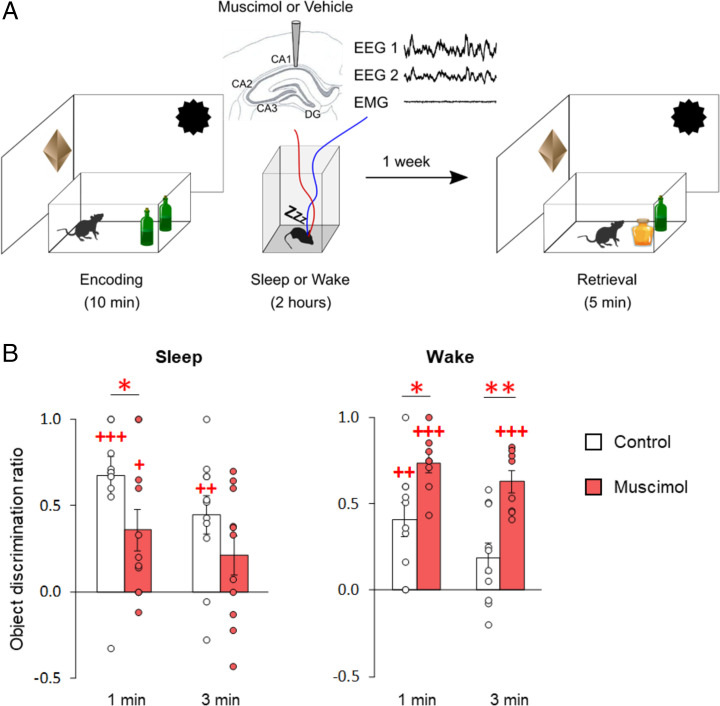
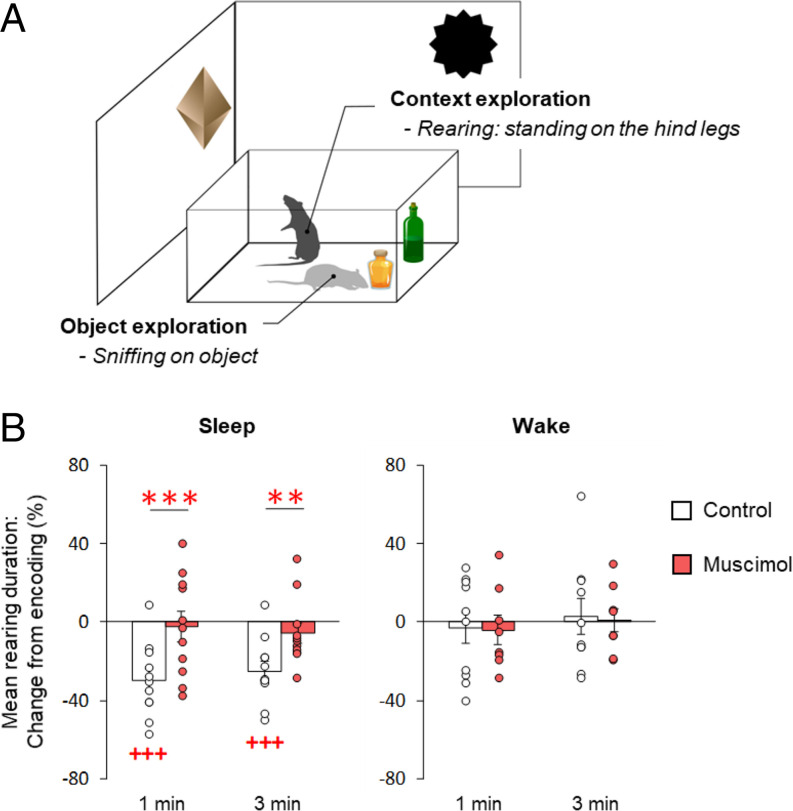
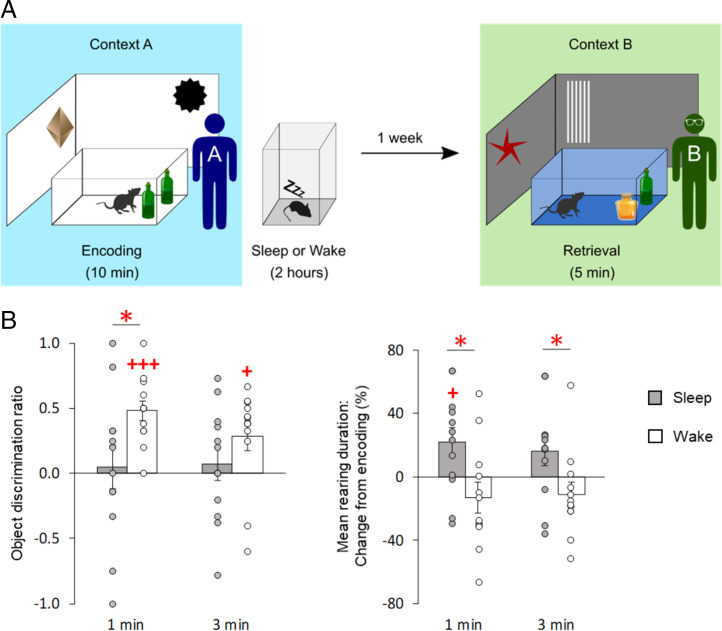
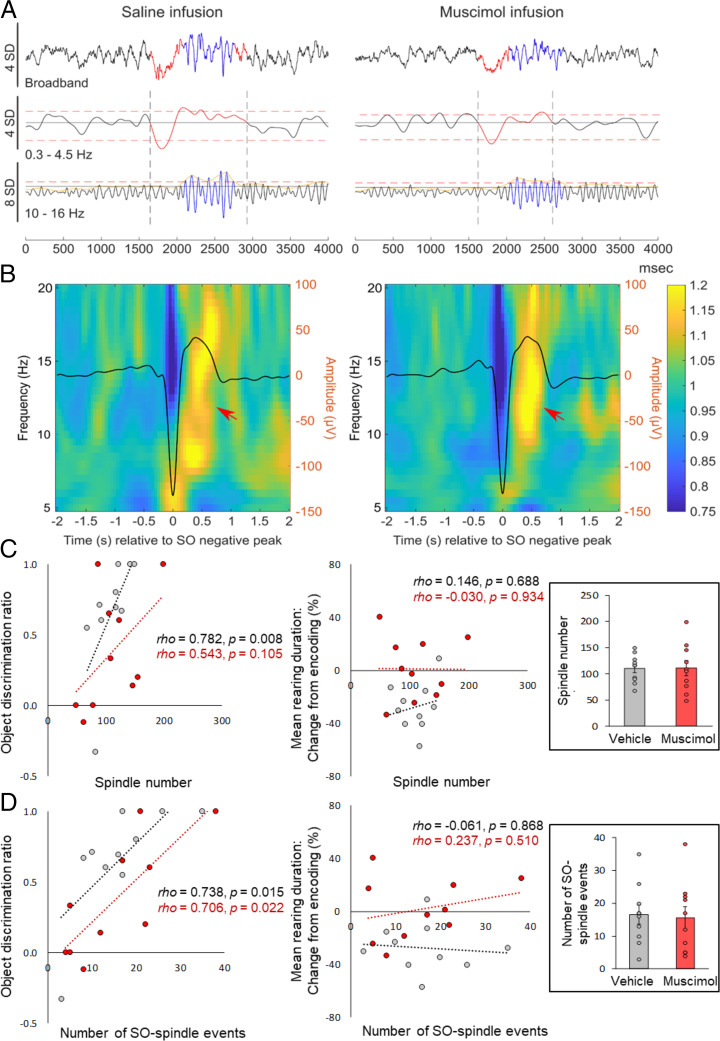
Memory consolidation is promoted by sleep. However, there is also evidence for consolidation into long-term memory during wakefulness via processes that preferentially affect nonhippocampal representations. We compared, in rats, the effects of 2-h postencoding periods of sleep and wakefulness on the formation of long-term memory for objects and their associated environmental contexts. We employed a novel-object recognition (NOR) task, using object exploration and exploratory rearing as behavioral indicators of these memories. Remote recall testing (after 1 wk) confirmed significant long-term NOR memory under both conditions, with NOR memory after sleep predicted by the occurrence of EEG spindle–slow oscillation coupling. Rats in the sleep group decreased their exploratory rearing at recall testing, revealing successful recall of the environmental context. By contrast, rats that stayed awake after encoding showed equally high levels of rearing upon remote testing as during encoding, indicating that context memory was lost. Disruption of hippocampal function during the postencoding interval (by muscimol administration) suppressed long-term NOR memory together with context memory formation when animals slept, but enhanced NOR memory when they were awake during this interval. Testing remote recall in a context different from that during encoding impaired NOR memory in the sleep condition, while exploratory rearing was increased. By contrast, NOR memory in the wake rats was preserved and actually superior to that after sleep. Our findings indicate two distinct modes of long-term memory formation: Sleep consolidation is hippocampus dependent and implicates event-context binding, whereas wake consolidation is impaired by hippocampal activation and strengthens context-independent representations.
Overview
The claims and statistics of this paper haven’t been checked yet.
Free: it reads the open-access text and checks the first 5 claims that cite a source we can check. Create a free account to check every claim.
Integrity signals
Registry
Cites
Statistics
Figures
Verification
Claims the paper makes
The claims and statistics of this paper haven’t been checked yet.
Free: it reads the open-access text and checks the first 5 claims that cite a source we can check. Create a free account to check every claim.
Claims other papers make about this one
Each is checked against this paper’s own text: does it say what the citing paper says it does?
The source backs part of the claim, not all of it — or backs it for a different population, condition or comparison.
In the citing paper
“recently, there has been a growing number of experiments failing to reveal superior retrieval of memory for post-encoding sleep compared with wake conditions, and a few studies even suggesting enhanced forgetting of memory by sleep.6,7”
From Sleep—A brain-state serving systems memory consolidation (2023) · cites this paper as [6]
Experimental — accuracy not yet measuredThe source backs part of the claim, not all of it — or backs it for a different population, condition or comparison.
In the citing paper
“In fact, suppressing hippocampal activity in rats during a post-encoding period of wakefulness improved rather than impaired memory consolidation, 6 indicating that spontaneous hippocampal offline inputs during the wake state interfere with, rather than support the formation of stable cortical representations.”
From Sleep—A brain-state serving systems memory consolidation (2023) · cites this paper as [6]
Experimental — accuracy not yet measuredThe cited source says what the claim attributes to it.
In the citing paper
“By contrast, consolidation during wakefulness for such tasks is not impaired but can be even enhanced when hippocampal activity is disrupted during the post-encoding wake interval.6”
From Sleep—A brain-state serving systems memory consolidation (2023) · cites this paper as [6]
The cited source says what the claim attributes to it.
In the citing paper
“By contrast, inhibiting the hippocampus during post-encoding wakefulness significantly improved object recognition memory at test, suggesting that hippocampal activity in the wake state interferes with ongoing consolidation.”
From Sleep—A brain-state serving systems memory consolidation (2023) · cites this paper as [6]
The cited source says what the claim attributes to it.
In the citing paper
“Interestingly, in the experiments natural awake consolidation turned out to be also superior to sleep consolidation when object recognition after 1 week was tested in an environmental context entirely different from that during encoding.”
From Sleep—A brain-state serving systems memory consolidation (2023) · cites this paper as [6]
Self-check
Percentages, sums and reported differences re-computed from the paper’s own numbers.
The self-check needs the paper’s full text.
Citations
Cites
Reactivation of hippocampal ensemble memories during sleep
Wilson, M. A., & McNaughton, B. L. (1994) · Science · doi:10.1126/science.8036517 · Cited by 3,118 · cited 4×
“Replay of hippocampal neuronal ensembles involved in episodic context binding is considered to be the key to active systems consolidation that occurs during sleep (9, 10).”
BackgroundInfluentialRasch, B., & Born, J. (2013) · Physiological Reviews · doi:10.1152/physrev.00032.2012 · Cited by 2,783
The Medial Temporal Lobe and Recognition Memory
Eichenbaum, H., Yonelinas, A. P., & Ranganath, C. (2007) · Annual Review of Neuroscience · doi:10.1146/annurev.neuro.30.051606.094328 · Cited by 2,580 · cited 1×
“The hippocampus plays a binding role in episodic memory formation which, in the NOR task, requires the integration of object-related information from the perirhinal cortex and spatial information from, among other structures, the parahippocampal (postrhinal in rats) cortex, that is, two structures that are reciprocall…”
BackgroundSleep-dependent memory consolidation
Stickgold, R. (2005) · Nature · doi:10.1038/nature04286 · Cited by 1,857 · cited 2×
“185, with the two predictors explaining R(2)adj = 53% of the total variance, F(2,7) = 6.”
BackgroundMechanisms of systems memory consolidation during sleep
Klinzing, J. G., Niethard, N., & Born, J. (2019) · Nature Neuroscience · doi:10.1038/s41593-019-0467-3 · Cited by 1,176 · cited 6×
“NOR memory was well above chance level for discrimination scores at the first and third minutes (t(7) = 12.”
BackgroundResultSelf-citationCompetition among multiple memory systems: converging evidence from animal and human brain studies
Poldrack, R. A., & Packard, M. G. (2003) · Neuropsychologia · doi:10.1016/s0028-3932(02)00157-4 · Cited by 880
Staresina, B. P., Bergmann, T. O., Bonnefond, M., van der Meij, R., Jensen, O., Deuker, L., Elger, C. E., Axmacher, N., & Fell, J. (2015) · Nature Neuroscience · doi:10.1038/nn.4119 · Cited by 831 · cited 1×
“There is increasing evidence that such SO–spindle events support hippocampal-to-neocortical information transfer, as well as extra-hippocampal storage processes during systems consolidation (22, 25, 39).”
BackgroundWhen Is the Hippocampus Involved in Recognition Memory?
Barker, G. R. I., & Warburton, E. C. (2011) · Journal of Neuroscience · doi:10.1523/jneurosci.6413-10.2011 · Cited by 815
Sleep spindles: mechanisms and functions
Fernandez, L. M. J., & Lüthi, A. (2020) · Physiological Reviews · doi:10.1152/physrev.00042.2018 · Cited by 716
Causal evidence for the role of REM sleep theta rhythm in contextual memory consolidation
Boyce, R., Glasgow, S. D., Williams, S., & Adamantidis, A. (2016) · Science · doi:10.1126/science.aad5252 · Cited by 696
Attractor Dynamics in the Hippocampal Representation of the Local Environment
Wills, T. J., Lever, C., Cacucci, F., Burgess, N., & O'Keefe, J. (2005) · Science · doi:10.1126/science.1108905 · Cited by 655
Dix, S. L., & Aggleton, J. P. (1999) · Behavioural Brain Research · doi:10.1016/s0166-4328(98)00079-5 · Cited by 597
Winters, B. D., Forwood, S. E., Cowell, R. A., Saksida, L. M., & Bussey, T. J. (2004) · The Journal of Neuroscience · doi:10.1523/jneurosci.1346-04.2004 · Cited by 586
Latchoumane, C.-F. V., Ngo, H.-V. V., Born, J., & Shin, H.-S. (2017) · Neuron · doi:10.1016/j.neuron.2017.06.025 · Cited by 561 · cited 2×
“There is increasing evidence that such SO–spindle events support hippocampal-to-neocortical information transfer, as well as extra-hippocampal storage processes during systems consolidation (22, 25, 39).”
BackgroundSelf-citationOverlapping memory replay during sleep builds cognitive schemata
Lewis, P. A., & Durrant, S. J. (2011) · Trends in Cognitive Sciences · doi:10.1016/j.tics.2011.06.004 · Cited by 512 · cited 1×
“The repeated neuronal replay of spatial context information in hippocampal place cell ensembles during SWS epochs represents a core mechanism of sleep-dependent consolidation (7, 10, 33, 34) that might foster the gradual transformation of the representation, such that it becomes more stably integrated within preexisti…”
BackgroundLong-duration hippocampal sharp wave ripples improve memory
Fernández-Ruiz, A., Oliva, A., Fermino de Oliveira, E., Rocha-Almeida, F., Tingley, D., & Buzsáki, G. (2019) · Science · doi:10.1126/science.aax0758 · Cited by 490 · cited 1×
“The repeated neuronal replay of spatial context information in hippocampal place cell ensembles during SWS epochs represents a core mechanism of sleep-dependent consolidation (7, 10, 33, 34) that might foster the gradual transformation of the representation, such that it becomes more stably integrated within preexisti…”
BackgroundBoth the Hippocampus and Striatum Are Involved in Consolidation of Motor Sequence Memory
Albouy, G., Sterpenich, V., Balteau, E., Vandewalle, G., Desseilles, M., Dang-Vu, T., Darsaud, A., Ruby, P., Luppi, P.-H., Degueldre, C., et al. (2008) · Neuron · doi:10.1016/j.neuron.2008.02.008 · Cited by 463
Rearing on Hind Legs, Environmental Novelty, and the Hippocampal Formation
Lever, C., Burton, S., & Ο'Keefe, J. (2006) · Reviews in the Neurosciences · doi:10.1515/revneuro.2006.17.1-2.111 · Cited by 366
Hippocampal mechanisms for the context-dependent retrieval of episodes
Hasselmo, M. E., & Eichenbaum, H. (2005) · Neural Networks · doi:10.1016/j.neunet.2005.08.007 · Cited by 298
Sustained increase in hippocampal sharp-wave ripple activity during slow-wave sleep after learning
Eschenko, O., Ramadan, W., Mölle, M., Born, J., & Sara, S. J. (2008) · Learning & Memory · doi:10.1101/lm.726008 · Cited by 277
An opportunistic theory of cellular and systems consolidation
Mednick, S. C., Cai, D. J., Shuman, T., Anagnostaras, S., & Wixted, J. T. (2011) · Trends in Neurosciences · doi:10.1016/j.tins.2011.06.003 · Cited by 267 · cited 2×
“(50) that the hippocampus contributes to memory consolidation in an “opportunistic” manner, that is, whenever there are moments of reduced interference due to encoding.”
BackgroundSleep for Preserving and Transforming Episodic Memory
Inostroza, M., & Born, J. (2013) · Annual Review of Neuroscience · doi:10.1146/annurev-neuro-062012-170429 · Cited by 266 · cited 1×
“Indeed, sleep is considered to support such active systems consolidation of episodic memory for events experienced in a spatiotemporal context (31, 32), in which the hippocampus serves to bind the event representation into the spatial–temporal context.”
BackgroundSelf-citationElevated Sleep Spindle Density after Learning or after Retrieval in Rats
Eschenko, O., Mölle, M., Born, J., & Sara, S. J. (2006) · The Journal of Neuroscience · doi:10.1523/jneurosci.3175-06.2006 · Cited by 258
The role of the dentate gyrus, CA3a,b, and CA3c for detecting spatial and environmental novelty
Hunsaker, M. R., Rosenberg, J. S., & Kesner, R. P. (2008) · Hippocampus · doi:10.1002/hipo.20464 · Cited by 251 · cited 2×
“Here, rats of the sleep group displayed the expected increase in exploratory rearing in response to the change in context (16), but, simultaneously, NOR performance was distinctly impaired; that is, the change in context apparently interfered with the retrieval of the NOR memory.”
BackgroundCortical circuit activity underlying sleep slow oscillations and spindles
Niethard, N., Ngo, H.-V. V., Ehrlich, I., & Born, J. (2018) · Proceedings of the National Academy of Sciences · doi:10.1073/pnas.1805517115 · Cited by 245 · cited 2×
“There is increasing evidence that such SO–spindle events support hippocampal-to-neocortical information transfer, as well as extra-hippocampal storage processes during systems consolidation (22, 25, 39).”
BackgroundSelf-citationLangston, R. F., & Wood, E. R. (2010) · Hippocampus · doi:10.1002/hipo.20714 · Cited by 244
Fast track to the neocortex: A memory engram in the posterior parietal cortex
Brodt, S., Gais, S., Beck, J., Erb, M., Scheffler, K., & Schönauer, M. (2018) · Science · doi:10.1126/science.aau2528 · Cited by 224
Bidirectional prefrontal-hippocampal dynamics organize information transfer during sleep in humans
Helfrich, R. F., Lendner, J. D., Mander, B. A., Guillen, H., Paff, M., Mnatsakanyan, L., Vadera, S., Walker, M. P., Lin, J. J., & Knight, R. T. (2019) · Nature Communications · doi:10.1038/s41467-019-11444-x · Cited by 222 · cited 1×
“In light of evidence suggesting that spindles nesting in the up state of the SO are of particular importance for memory consolidation (22, 24, 25), we separately analyzed such coupled SO–spindles events.”
BackgroundPost-training reversible inactivation of the hippocampus enhances novel object recognition memory
Oliveira, A. M. M., Hawk, J. D., Abel, T., & Havekes, R. (2010) · Learning & Memory · doi:10.1101/lm.1625310 · Cited by 222
The hippocampus is crucial for forming non-hippocampal long-term memory during sleep
Sawangjit, A., Oyanedel, C. N., Niethard, N., Salazar, C., Born, J., & Inostroza, M. (2018) · Nature · doi:10.1038/s41586-018-0716-8 · Cited by 208 · cited 8×
“Replay of hippocampal neuronal ensembles involved in episodic context binding is considered to be the key to active systems consolidation that occurs during sleep (9, 10).”
BackgroundResultSelf-citationFactors that influence the relative use of multiple memory systems
Packard, M. G., & Goodman, J. (2013) · Hippocampus · doi:10.1002/hipo.22178 · Cited by 196
Assembly-specific disruption of hippocampal replay leads to selective memory deficit
Gridchyn, I., Schoenenberger, P., O’Neill, J., & Csicsvari, J. (2020) · Neuron · doi:10.1016/j.neuron.2020.01.021 · Cited by 178
Gulli, R. A., Duong, L., Corrigan, B. W., Doucet, G., Williams, S., Fusi, S., & Martínez-Trujillo, J. (2019) · Nature Neuroscience · doi:10.1038/s41593-019-0548-3 · Cited by 155
The rat perirhinal cortex: A review of anatomy, physiology, plasticity, and function
Kealy, J., & Commins, S. (2011) · Progress in Neurobiology · doi:10.1016/j.pneurobio.2011.03.002 · Cited by 150
Delay-dependent contributions of medial temporal lobe regions to episodic memory retrieval
Ritchey, M., Montchal, M. E., Yonelinas, A. P., & Ranganath, C. (2015) · eLife · doi:10.7554/elife.05025 · Cited by 148
Hippocampal activation of Rac1 regulates the forgetting of object recognition memory
Liu, Y., Du, S., Lv, L., Lei, B., Shi, W., Tang, Y., Wang, L., & Zhong, Y. (2016) · Current Biology · doi:10.1016/j.cub.2016.06.056 · Cited by 114 · cited 2×
“In contrast, rather than being independent of hippocampal function, wake consolidation processes appear to be disturbed by interfering hippocampal activity (12, 19, 20).”
BackgroundThe alcohol facilitation effect on memory: A dose-response study
Parker, E. S., Morihisa, J. M., Wyatt, R. J., Schwartz, B. L., Weingartner, H., & Stillman, R. C. (1981) · Psychopharmacology · doi:10.1007/bf00431763 · Cited by 107
Complementary memory systems: competition, cooperation and compensation
Hartley, T., & Burgess, N. (2005) · Trends in Neurosciences · doi:10.1016/j.tins.2005.02.004 · Cited by 101
Sleep-dependency of episodic-like memory consolidation in rats
Inostroza, M., Binder, S., & Born, J. (2013) · Behavioural Brain Research · doi:10.1016/j.bbr.2012.09.011 · Cited by 98
Self-citationSchapiro, A. C., Reid, A. G., Morgan, A., Manoach, D. S., Verfaellie, M., & Stickgold, R. (2019) · Hippocampus · doi:10.1002/hipo.23101 · Cited by 94 · cited 1×
“be encoded and retrieved in the absence of a functioning hippocampus (9, 48).”
BackgroundTimofeev, I., Grenier, F., Bazhenov, M., Houweling, A. R., Sejnowski, T. J., & Steriade, M. (2002) · The Journal of Physiology · doi:10.1113/jphysiol.2001.013479 · Cited by 93
Coping with Sleep Deprivation: Shifts in Regional Brain Activity and Learning Strategy
Hagewoud, R., Havekes, R., Tiba, P. A., Novati, A., Hogenelst, K., Weinreder, P., Van der Zee, E. A., & Meerlo, P. (2010) · Sleep · doi:10.1093/sleep/33.11.1465 · Cited by 92
A mechanism for learning with sleep spindles
Peyrache, A., & Seibt, J. (2020) · Philosophical Transactions of the Royal Society B: Biological Sciences · doi:10.1098/rstb.2019.0230 · Cited by 89
Sleep supports the slow abstraction of gist from visual perceptual memories
Lutz, N. D., Diekelmann, S., Hinse-Stern, P., Born, J., & Rauss, K. (2017) · Scientific Reports · doi:10.1038/srep42950 · Cited by 79
Availability of food determines the need for sleep in memory consolidation
Chouhan, N. S., Griffith, L. C., Haynes, P., & Sehgal, A. (2021) · Nature · doi:10.1038/s41586-020-2997-y · Cited by 76 · cited 3×
“Factors active during organismic states—such as neuropeptide Y during hunger or glucocorticoids during mild stress (3, 11, 30)—may promote wake-associated memory consolidation by enhancing synaptic consolidation processes.”
BackgroundBarbosa, F. F., de Oliveira Pontes, I. M., Ribeiro, S., Ribeiro, A. M., & Silva, R. H. (2012) · Behavioural Brain Research · doi:10.1016/j.bbr.2012.04.022 · Cited by 71
Travelling spindles create necessary conditions for spike-timing-dependent plasticity in humans
Dickey, C. W., Sargsyan, A., Madsen, J. R., Eskandar, E. N., Cash, S. S., & Halgren, E. (2021) · Nature Communications · doi:10.1038/s41467-021-21298-x · Cited by 70
Martínez, M. C., Villar, M. E., Ballarini, F., & Viola, H. (2014) · Hippocampus · doi:10.1002/hipo.22328 · Cited by 62
Neckelmann, D., Olsen, Ø. E., Fagerland, S., & Ursin, R. (1994) · Sleep · doi:10.1093/sleep/17.2.120 · Cited by 61 · cited 1×
“Sleep stage classification was performed offline by an experienced experimenter using 10-s epochs according to standard criteria (63).”
MethodNap sleep preserves associative but not item memory performance
Studte, S., Bridger, E. K., & Mecklinger, A. (2015) · Neurobiology of Learning and Memory · doi:10.1016/j.nlm.2015.02.012 · Cited by 56
Opposite effects of cortisol on consolidation of temporal sequence memory during waking and sleep
Wilhelm, I., Wagner, U., & Born, J. (2011) · Journal of Cognitive Neuroscience · doi:10.1162/jocn_a_00093 · Cited by 54 · cited 1×
“Factors active during organismic states—such as neuropeptide Y during hunger or glucocorticoids during mild stress (3, 11, 30)—may promote wake-associated memory consolidation by enhancing synaptic consolidation processes.”
BackgroundHippocampal Network Dynamics during Rearing Episodes
Barth, A. M., Domonkos, A., Fernandez-Ruiz, A., Freund, T. F., & Varga, V. (2018) · Cell Reports · doi:10.1016/j.celrep.2018.04.021 · Cited by 46 · cited 1×
“Rearing on hind legs is a spontaneous exploratory behavior, presumably to enhance the rat’s perception of distal stimuli, which is associated with an increase in hippocampal theta activity and information flow through the medial perforant pathway (15, 17).”
BackgroundBehavioral correlates of the distributed coding of spatial context
Anderson, M. I., Killing, S., Morris, C., O'Donoghue, A., Onyiagha, D., Stevenson, R., Verriotis, M., & Jeffery, K. J. (2006) · Hippocampus · doi:10.1002/hipo.20206 · Cited by 44 · cited 1×
“Exploratory rearing decreases after repeated exposures to a familiar environment, and increases in response to environmental novelty or a reconfiguration of familiar contextual stimuli (16, 47).”
BackgroundKelemen, E., Bahrendt, M., Born, J., & Inostroza, M. (2014) · Hippocampus · doi:10.1002/hipo.22266 · Cited by 43 · cited 2×
“Factors active during organismic states—such as neuropeptide Y during hunger or glucocorticoids during mild stress (3, 11, 30)—may promote wake-associated memory consolidation by enhancing synaptic consolidation processes.”
BackgroundSelf-citationNovel object presentation affects sleep–wake behavior in rats
Schiffelholz, T., & Aldenhoff, J. B. (2002) · Neuroscience Letters · doi:10.1016/s0304-3940(02)00452-4 · Cited by 43
Sleep deprivation impairs spontaneous object-place but not novel-object recognition in rats
Ishikawa, H. A., Yamada, K., Pavlides, C., & Ichitani, Y. (2014) · Neuroscience Letters · doi:10.1016/j.neulet.2014.08.004 · Cited by 39
CA1 inactivation impairs episodic-like memory in rats
Drieskens, D. C., Neves, L. R., Pugliane, K. C., de Souza, I. B. M. B., Lima, Á. D. C., Salvadori, M. G. D. S. S., Ribeiro, A. M., Silva, R. H., & Barbosa, F. F. (2017) · Neurobiology of Learning and Memory · doi:10.1016/j.nlm.2017.08.008 · Cited by 31
Villar, M. E., Martínez, M. C., da Cunha, P. L., Ballarini, F., & Viola, H. (2016) · Neurobiology of Learning and Memory · doi:10.1016/j.nlm.2016.04.010 · Cited by 28 · cited 2×
“In contrast, rather than being independent of hippocampal function, wake consolidation processes appear to be disturbed by interfering hippocampal activity (12, 19, 20).”
BackgroundAssociations between sleep and episodic memory updating
Bryant, N. B., Nadel, L., & Gómez, R. L. (2019) · Hippocampus · doi:10.1002/hipo.23178 · Cited by 21
Sleep enhances inhibitory behavioral control in discrimination learning in rats
Quintas, M. B., Born, J., Navarro, V., Betancourt, R., & Inostroza, M. (2013) · Experimental Brain Research · doi:10.1007/s00221-013-3797-5 · Cited by 16
Self-citationDeepened sleep makes hippocampal spatial memory more persistent
Sawangjit, A., Oyanedel, C. N., Niethard, N., Born, J., & Inostroza, M. (2020) · Neurobiology of Learning and Memory · doi:10.1016/j.nlm.2020.107245 · Cited by 16
Self-citationSleep-dependent consolidation patterns reveal insights into episodic memory structure
Oyanedel, C. N., Sawangjit, A., Born, J., & Inostroza, M. (2018) · Neurobiology of Learning and Memory · doi:10.1016/j.nlm.2018.05.013 · Cited by 15
Self-citationNiethard, N., & Born, J. (2020) · Neuron · doi:10.1016/j.neuron.2020.03.034 · Cited by 8
Self-citation
Cited by
Sleep—A brain-state serving systems memory consolidation
Brodt, S., Inostroza, M., Niethard, N., & Born, J. (2023) · Neuron · doi:10.1016/j.neuron.2023.03.005 · Cited by 343
Self-citationRearing is critical for forming spatial representations in pre-weanling rats
Xia, S., Contreras, M. P., Sawangjit, A., Dimitrov, S., Born, J., & Inostroza, M. (2023) · Behavioural Brain Research · doi:10.1016/j.bbr.2023.114545 · Cited by 45
Self-citationKam, K., Vetter, K., Tejiram, R. A., Pettibone, W. D., Shim, K., Audrain, M., Yu, L., Daehn, I. S., Ehrlich, M. E., & Varga, A. W. (2023) · Journal of Neuroscience · doi:10.1523/jneurosci.1828-22.2023 · Cited by 26
Sleep’s contribution to memory formation
Lutz, N. D., Harkotte, M., & Born, J. (2025) · Physiological Reviews · doi:10.1152/physrev.00054.2024 · Cited by 59
Self-citationSleep-slow oscillation-spindle coupling precedes spindle-ripple coupling during development
Fechner, J., Contreras, M. P., Zorzo, C., Xia, S., Born, J., & Inostroza, M. (2024) · SLEEP · doi:10.1093/sleep/zsae061 · Cited by 15
Self-citation
Metadata
- Authors
- Sawangjit, A., Harkotte, M., Oyanedel, C. N., Niethard, N., Born, J., & Inostroza, M.
- Affiliations
- University of Tübingen (DE)
- Max Planck Society (DE)
- Institute of Medical Psychology and Behavioral Neurobiology, University of Tübingen, 72076 Tübingen, Germany
- Corresponding author
- Inostroza, Marion
- Venue
- Proceedings of the National Academy of Sciences
- Publisher
- National Academy of Sciences
- Published
- 2022-08-15
- Volume
- 119
- Issue
- 34
- Pages
- e2203165119-e2203165119
- ISSN
- 0027-8424 (ISSN-L)
- 1091-6490
- PMC
- PMC9407643
- OpenAlex
- W4291804557
- Semantic Scholar
- 3f0edf228d6c05587a28a7789483f61c5a223489
- Cited by
- 28
- References
- 64
- Citations by year
- 2026: 5 · 2025: 12 · 2024: 3 · 2023: 6 · 2022: 2
- FWCI
- 2.97
- Type
- journal article
- Language
- en
- Open access
- hybrid
- doi.org
- Licence
- Locations
- Proceedings of the National Academy of Sciences (publishedVersion, cc-by-nc-nd)
- PubMed Central (publishedVersion, cc-by-nc-nd)
- PubMed (publishedVersion)
- PuSH - Publication Server of Helmholtz Zentrum München (submittedVersion, cc-by-nc-nd)
- Site cant be reached (submittedVersion, cc-by-nc-nd)
- Funders
- EC | ERC | HORIZON EUROPE European Research Council (883098)
- Deutsche Forschungsgemeinschaft (279/1-1)
- Topics
- Life Sciences › Neuroscience › Cognitive Neuroscience › Sleep and Wakefulness Research
- Life Sciences › Neuroscience › Cognitive Neuroscience › Memory and Neural Mechanisms
- Life Sciences › Neuroscience › Cognitive Neuroscience › Memory Processes and Influences
- Keywords
- memory consolidation, sleep-dependent memory consolidation, novel object recognition memory, hippocampus, muscimol, rats
- MeSH terms
- Memory Consolidation, Animals, Mental Recall, Sleep, Wakefulness, Rats, Memory, Long-Term
About these checks
Registry, retraction, Cites and statistics results are computed, not judged, with one exception: a printed reference that no index lists is read once by a model before it counts as a citation error. Claims are extracted by a model and kept only when their quote appears verbatim in the text; each cited source is then checked, with a model’s help, for whether it says what the claim relies on. Those verdicts can be wrong — read the claim’s quote and the cited source before relying on one.
Statistics and arithmetic are recomputed, not judged.
Confidence bands are shown only for fields calibrated on our annotated test set. None is calibrated yet, so no band is shown.
What counts as a claim ›How we measure confidence ›How we check this ›
Are you an author, or do you see a problem with this page? Request a review
Data sources
Bibliographic data: Semantic Scholar, OpenAlex, Crossref.
Contains information from the Semantic Scholar Academic Graph Datasets, made available under the ODC Attribution License (ODC-BY 1.0).
Semantic Scholar’s data is described in: Kinney, R., et al. (2023). The Semantic Scholar Open Data Platform. arXiv:2301.10140.
