

The effectiveness of a five-session workshop on the distress of international students in Finland – a pilot study.
Open accessThe DOI matches its Crossref record; 59 of the 61 references it cites were found in a registry or an index, and 2 are not checked yet; 7 of the 28 sources its claims cite were checked for support.
Abstract
The mental health of international students has become a concern, as they face high levels of psychological distress. We designed a five-week acceptance and commitment therapy (ACT) workshop with two additional individual assessment meetings. The intervention aimed at helping international students attending a Finnish university to reduce their symptoms of stress, depression, and anxiety, and enhance skills of psychological flexibility. The post-assessment was conducted seven weeks after the pre-measurement. Using data from 53 participants, an evaluation indicated that statistically and clinically significant reductions in symptoms were observed, and the workshop was well received. Regression analyses revealed that changes in psychological inflexibility, mindfulness, and value-based living acted as predictors of change in symptoms. Furthermore, changes in these psychological skills predicted changes in different kinds of distress. This study suggests that a brief group intervention might be a feasible alternative for enhancing the psychological well-being of international students.
Verified 2026-11-22 · 2 references not checked yet
Overview
CoChat Summary
TL;DR
A five-week ACT workshop plus individual assessment meetings for international students at a Finnish university was associated with statistically and clinically significant reductions in stress, depression, and anxiety and increases in psychological flexibility skills. Changes in psychological inflexibility, mindfulness, and value-based living predicted symptom changes, but the pilot lacked a control group.
Key findings
- Among 53 pre-measurement participants, symptoms decreased significantly from pre to post: PSS-10 stress 20.74 to 15.61 (d = 0.94), GAD-7 anxiety 8.72 to 5.60 (d = 0.76), and PHQ-9 depression 9.47 to 6.39 (d = 0.63). Psychological inflexibility (AFQ-Y) decreased 26.45 to 17.08 (d = 0.84), while mindfulness (FFMQ total) increased 118.48 to 129.58 (d = −0.57) and engaged living (ELS total) increased 54.23 to 60.02 (d = −0.51).
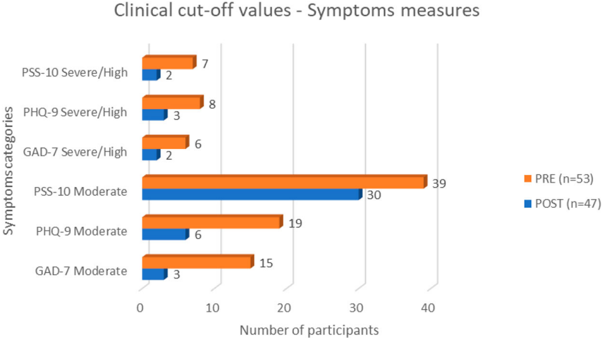
- Clinically, moderate-to-high anxiety fell from 40% (n = 21) at pre to 11% (n = 5) at post, and moderate-to-severe depression fell from 51% (n = 27) to 19% (n = 9). Satisfaction averaged 8.57 (SD = 1.30) on a 1–10 scale; 83% (n = 39) would recommend the workshop and 55% (n = 26) would highly recommend it.
- Regression analyses showed changes in psychological inflexibility explained 32% of variance in stress change; adding mindfulness explained an additional 7%, for close to 40% total. Changes in mindfulness total and acting with awareness each explained 9% of anxiety change; changes in engaged living total explained 14% of depression change, and life fulfilment explained 11%.
- Attrition was 11% (n = 6 of 53); about 83% attended four to five group meetings. Students attending all five sessions showed larger mean changes on PSS-10 (m = 6.00) than those attending four (m = 4.53) or three (m = 3.75) sessions.
Methods
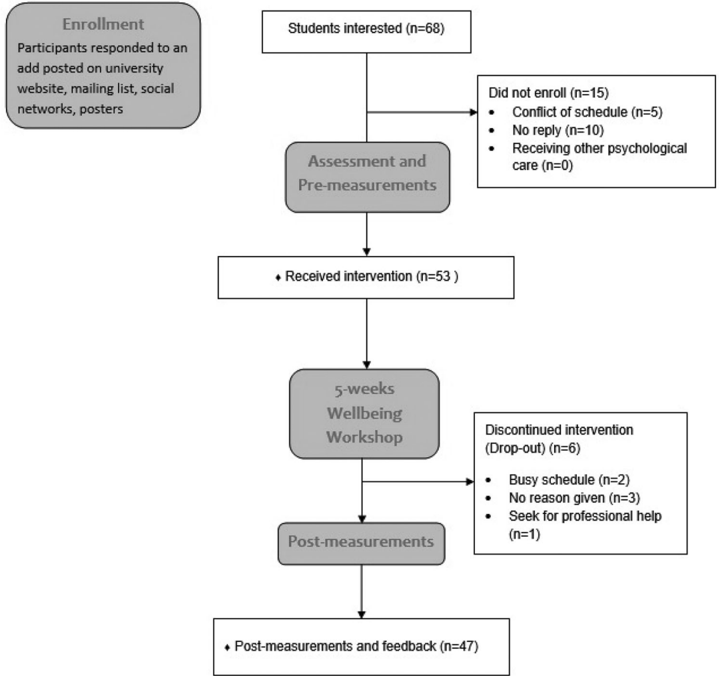
- Pilot within-group study of international students recruited from the University of Jyväskylä via online and campus ads/flyers. Sixty-eight students expressed willingness; 53 completed pre-measurements, and post-measurement was completed seven to eight weeks after pre-measurement (n = 47 for some analyses). Participants were 18–46 years old, mostly female (n = 44; 83%), with 28 nationalities represented.
- Intervention: a 10-hour ACT workshop delivered in face-to-face groups of 5–10 students across seven groups from 2017 to 2019. It included an individual pre-assessment interview (60–90 min), five weekly 90-min workshops, and a closing individual meeting (60 min) for post-measurements and feedback.
- Measures included PSS-10 (main outcome), GAD-7, PHQ-9, AFQ-Y, FFMQ, and ELS. Within-group changes were analyzed with structural equation modelling and Cohen’s d; clinical significance was assessed by counts above symptom cut-offs; multiple regression tested whether changes in psychological flexibility measures predicted symptom changes.
Limitations
- The paper states the most important limitation is the lack of a control group, making firm causal conclusions impossible; maturation, measurement effects, and regression toward the mean cannot be ruled out, and without a waitlist or alternative treatment comparison, changes cannot be unambiguously attributed to ACT components. The low number of interested students per semester prevented creating a control condition.
- The paper also states limited representativeness because most participants were female university students (83%), possible self-selection bias from voluntary participation, possible socially desirable responding, limited questions about negative aspects of the workshop, and possible researcher allegiance to the ACT model. More studies with larger samples are needed to generalize to the overall international student population.
- Evident from the text: the sample is small (n = 53 pre, n = 47 post), and outcomes are reported only at post-intervention, with no longer-term follow-up described.
Model-written summary. Check it against the paper before relying on it.
Integrity signals
Registry
Cites
Statistics
Figures


Verification
Claims the paper makes
4 Valid · 1 Not valid · 11 Not checked · 56 Own results and interpretations
The cited sources that could be checked couldn’t confirm or dispute this claim.
In the paper
“On the other hand, our results are congruent with earlier ACT-based studies reporting positive outcomes in general student (e.g.Grégoire et al., 2018;Levin et al., 2014Levin et al., , 2016Levin et al., , 2020;;Räsänen et al., 2016) as well as in international student populations (Muto et al., 2011;Xu et al., 2020).”
§ The effectiveness of a five-session workshop on the distress of international students in Finlanda pilot study > Discussion
What the sources say
- Not checked — no full text of the sourcecites Grégoire et al., 2018 matched to “The Use of Acceptance and Commitment Therapy to Promote Mental Health and School Engagement in University Students: A Multisite Randomized Controlled Trial.” (2018) source
- Could not verifycites Levin et al., 2014 matched to “Examining psychological inflexibility as a transdiagnostic process across psychological disorders” (2014) sourceExperimental — accuracy not yet measured
The Method (Participants and Procedure; page not provided) says this study analyzed pre-intervention baseline data from first-year college students. The Discussion describes cross-sectional findings about psychological inflexibility, not positive outcomes from an ACT intervention. Searches for ACT intervention and treatment outcomes found no such result in our copy. (LLM, conf=0.76)
- Not checked — no full text of the sourcecites Muto et al., 2011 matched to “The Effectiveness of Acceptance and Commitment Therapy Bibliotherapy for Enhancing the Psychological Health of Japanese College Students Living Abroad” (2011) source
plainstates an association- Asserted: passes — The authors put it forward as true.
- Checkable: passes — It can be checked against evidence.
- Load-bearing: unclear — It is unclear whether the paper’s conclusions depend on it.
- Based: passes — The paper gives a reason why it holds.
- Rests on an assumption not shown here.
The sources with a verdict support this claim; the rest weren’t checked yet, have no full text we could read, or their verdicts aren’t rated yet.
In the paper
“These results suggest that changes in different psychological flexibility skills may predict changes in different kind of distress, which is congruent with Gallego, McHugh, Villatte, and Lappalainen (2020) and Kinnunen, Puolakanaho, Tolvanen, Mäkikangas, and Lappalainen (2020), who found that different aspects of mindfulness and psychological inflexibility may be related to different psychological”
§ The effectiveness of a five-session workshop on the distress of international students in Finlanda pilot study > Discussion
What the sources say
- Not checked — no full text of the sourcecites Gallego, McHugh, Villatte, and Lappalainen (2020) matched to “Examining the relationship between public speaking anxiety, distress tolerance and psychological flexibility” (2020) source
- Supportedcites Kinnunen, Puolakanaho, Tolvanen, Mäkikangas, and Lappalainen (2020) matched to “Improvements in Mindfulness Facets Mediate the Alleviation of Burnout Dimensions” (2020) source
In “Similarities and Differences Between Burnout Dimensions in Mediators of Change” (page unavailable), the paper reports that changes in different mindfulness facets mediated changes in burnout dimensions, with some facets more relevant to particular dimensions during follow-up. This supports the citing sentence’s hedged suggestion that changes in different skills may relate to changes in different forms of distress. (LLM, conf=0.86)
hedgedstates a possible cause- Asserted: passes — The authors put it forward as true.
- Checkable: passes — It can be checked against evidence.
- Load-bearing: passes — The paper’s conclusions depend on it.
- Based: passes — The paper gives a reason why it holds.
- Rests on an assumption not shown here.
A result the paper reports from its own data — it cites no other source for it, so there is none to check. The quote shows it is in the paper.
In the paper
“All participants (n = 47) agreed that the workshop helped them cope better with previously challenging issues.”
§ The effectiveness of a five-session workshop on the distress of international students in Finlanda pilot study > Participant satisfaction and motivation
plainstates a causen = 47- Asserted: passes — The authors put it forward as true.
- Checkable: passes — It can be checked against evidence.
- Load-bearing: passes — The paper’s conclusions depend on it.
- Based: passes — The paper gives a reason why it holds.
- Rests on an assumption not shown here.
A result the paper reports from its own data — it cites no other source for it, so there is none to check. The quote shows it is in the paper.
In the paper
“AFQ-Y | 1. Model | 0.381* | 0.336*** | 0.320 | 0.336***”
§ The effectiveness of a five-session workshop on the distress of international students in Finlanda pilot study > Raimo
plainstates an association- Asserted: passes — The authors put it forward as true.
- Checkable: passes — It can be checked against evidence.
- Load-bearing: passes — The paper’s conclusions depend on it.
- Based: passes — The paper gives a reason why it holds.
A result the paper reports from its own data — it cites no other source for it, so there is none to check. The quote shows it is in the paper.
In the paper
“Students attending all five sessions of the workshops showed higher improvement compared to students who attended three or four sessions only.”
§ The effectiveness of a five-session workshop on the distress of international students in Finlanda pilot study > Changes in symptoms and psychological flexibility
plainstates an associationn = 24- Asserted: passes — The authors put it forward as true.
- Checkable: passes — It can be checked against evidence.
- Load-bearing: passes — The paper’s conclusions depend on it.
- Based: passes — The paper gives a reason why it holds.
31 more claims
Create a free account to see all 72 claims and every source verdict.
- It may state two separate claims as one. 29
- Probably not a substantial claim. 11
- The quote only partly states this claim. 2
Claims other papers make about this one
Each is checked against this paper’s own text: does it say what the citing paper says it does?
The source backs part of the claim, not all of it — or backs it for a different population, condition or comparison.
In the citing paper
“we previously observed low dropout rates and linear reduction in symptoms when the students attended more sessions”
From Examining the effectiveness and acceptability of a group-based ACT intervention delivered by videoconference to international university students during the COVID-19 pandemic. (2024) · cites this paper as Brandolin et al., 2023
Experimental — accuracy not yet measuredThe cited source says what the claim attributes to it.
In the citing paper
“We observed earlier that a five-week in-person ACT group workshop was effective at reducing psychological symptoms of stress, depression, and anxiety”
From Examining the effectiveness and acceptability of a group-based ACT intervention delivered by videoconference to international university students during the COVID-19 pandemic. (2024) · cites this paper as Brandolin et al., 2023
Statistics that don’t add up
Each reported p-value recomputed from its test statistic and degrees of freedom, each partial η² from its F, and each ratio, mean difference or B printed with a p checked against its own confidence interval.
Rated minor: it would not touch a result — a value no result rests on, a p-value that stays on the same side of the significance level, or a conflict that is clerical, resolved elsewhere in the paper, or outside its own findings.
In the paper
“F (1,45) = 6.889, p = 0.011”
§ The effectiveness of a five-session workshop on the distress of international students in Finlanda pilot study > Predictors of changes in symptoms
Reported p = .011 · recomputed p = .012
Statistics recomputed
Every reported test result, recomputed from its test statistic and degrees of freedom. A result shows as not adding up only once an independent check has confirmed it.
- Doesn’t add upF(1, 45) = 6.889reported p = .011 · recomputed p = .012
“F (1,45) = 6.889, p = .011”
- ConsistentF(1, 43) = 21.736reported p < .001 · recomputed p < .001
“F (1,43) = 21.736,p < .001”
- ConsistentF(2, 42) = 14.39reported p < .001 · recomputed p < .001
“F (2,42) = 14.390, p < .001”
- ConsistentF(1, 43) = 15.416reported p < .001 · recomputed p < .001
“F (1,43) = 15.416,p < .001”
- ConsistentF(2, 42) = 12.033reported p < .001 · recomputed p < .001
“F (2,42) = 12.033, p < .001”
3 more recomputed tests
Create a free account to see every test the Stats check recomputed.
Self-check
Percentages, sums and reported differences re-computed from the paper’s own numbers.
Each contradiction between two passages listed here was confirmed by an independent check.
Rated major: it would touch a result — a value a result rests on, reported and recomputed p-values on opposite sides of the significance level, two passages that conflict with no sign which is right, or a cited work retracted before this paper was published.
In the paper
§ The effectiveness of a five-session workshop on the distress of international students in Finlanda pilot study > Predictors of changes in symptoms
“only changes in the FFMQ total score was a significant predictor of the changes in anxiety (F (1,43) = 11.971,p = 0.001).Changes in the FFMQ total score explained nine percent of the variance in anxiety symptoms.”
§ The effectiveness of a five-session workshop on the distress of international students in Finlanda pilot study > Raimo
“| | FFMQ Total | 1. Model | -0.308* | 0.095* | 0.074 | 0.095* |”
Rated minor: it would not touch a result — a value no result rests on, a p-value that stays on the same side of the significance level, or a conflict that is clerical, resolved elsewhere in the paper, or outside its own findings.
In the paper
§ The effectiveness of a five-session workshop on the distress of international students in Finlanda pilot study > Raimo
“| ELS | | | | 1 | 0.97** | 0.88** | -0.41** | 0.51** | 0.35* | 0.45** | -0.28 | 0.34* | 0.26 |”
§ The effectiveness of a five-session workshop on the distress of international students in Finlanda pilot study > Raimo
“| ELS-VL | | | | | 1 | 0.75** | -0.43** | 0.48** | 0.35* | 0.39** | 0.26 | 0.31* | 0.23 | | ELS-LF | | | | | | 1 | -0.28 | 0.50** | 0.28 | 0.47** | 0.29 | 0.33 | 0.28 |”
Rated minor: it would not touch a result — a value no result rests on, a p-value that stays on the same side of the significance level, or a conflict that is clerical, resolved elsewhere in the paper, or outside its own findings.
In the paper
“All items are scored on a 5-point Likert scale ranging from 1 to 5 (1 = completely disagree, 5 = completely agree).Total scores can be calculated for each subscale and the main scale (min 0, max 80).Previous studies including students have shown that the ELS-16 presents adequate to good psychometric properties”
§ The effectiveness of a five-session workshop on the distress of international students in Finlanda pilot study > Process measures
Reported 0 · recomputed 16
Citations
Cites
Statistical Power Analysis for the Behavioral Sciences
Muller, K. (1989) · Technometrics · doi:10.1080/00401706.1989.10488618 · Cited by 99,167
The PHQ-9: Validity of a brief depression severity measure
Kroenke, K., Spitzer, R. L., & Williams, J. B. W. (2001) · Journal of General Internal Medicine · doi:10.1046/j.1525-1497.2001.016009606.x · Cited by 44,910 · cited 3×
“Internal consistency has been shown to be high in general, clinical (Kroenke et al., 2001, 2002) and university student populations (Tavakoli et al., 2019).”
BackgroundStatistical Power Analysis for the Behavioral Sciences (2nd ed.).
Lachenbruch, P. A., & Cohen, J. (1989) · Journal of the American Statistical Association · doi:10.2307/2290095 · Cited by 37,395
A Global Measure of Perceived Stress
Cohen, S., Kamarck, T., & Mermelstein, R. (1983) · Journal of Health and Social Behavior · doi:10.2307/2136404 · Cited by 32,807 · cited 1×
“The Perceived Stress Scale-10 (PSS-10) was used to measure symptoms of stress (Cohen & Williamson, 1988; Cohen, Kamarck, & Mermelstein, 1983), and it was our main outcome measurement.”
MethodA Brief Measure for Assessing Generalized Anxiety Disorder: The GAD-7
Spitzer, R. L., Kroenke, K., Williams, J. B. W., & Löwe, B. (2006) · Archives of Internal Medicine · doi:10.1001/archinte.166.10.1092 · Cited by 31,765 · cited 3×
“The items are linked to the DSM-IV criteria, and a score of 10 or greater is considered to represent a cut point for identifying cases of General Anxiety Disorder (Spitzer et al., 2006).”
BackgroundUsing Self-Report Assessment Methods to Explore Facets of Mindfulness
Baer, R. A., Smith, G. T., Hopkins, J., Krietemeyer, J., & Toney, L. (2006) · Assessment · doi:10.1177/1073191105283504 · Cited by 7,511 · cited 2×
“The Five Facet Mindfulness Questionnaire (FFMQ) measures mindfulness using 39 statements rated on a scale ranging from 1 to 5 (1 = rarely or never true , 5 = very often true or always true ) (Baer, Smith, Hopkins, Krietemeyer, & Toney, 2006).”
BackgroundMethod(1988) · Cited by 4,111
The PHQ-15: Validity of a New Measure for Evaluating the Severity of Somatic Symptoms
Kroenke, K., Spitzer, R. L., & Williams, J. B. W. (2002) · Psychosomatic Medicine · doi:10.1097/00006842-200203000-00008 · Cited by 3,298 · cited 1×
“Internal consistency has been shown to be high in general, clinical (Kroenke et al., 2001, 2002) and university student populations (Tavakoli et al., 2019).”
BackgroundBaer, R. A., Smith, G. T., Lykins, E., Button, D., Krietemeyer, J., Sauer, S., Walsh, E., Duggan, D., & Williams, J. M. G. (2008) · Assessment · doi:10.1177/1073191107313003 · Cited by 2,930 · cited 1×
“The FFMQ has an adequate internal consistency (Baer et al., 2008), and is a valid measure of mindfulness with university students (Baer et al., 2006; Carmody, Baer, Lykins, & Olendzki, 2009).”
BackgroundReview of the Psychometric Evidence of the Perceived Stress Scale
Lee, E.-H. (2012) · Asian Nursing Research · doi:10.1016/j.anr.2012.08.004 · Cited by 2,305 · cited 1×
“The PSS-10 ’ s internal consistency in previous studies has ranged from .74 to .91 (Lee, 2012).”
BackgroundCarmody, J., & Baer, R. A. (2008) · Journal of Behavioral Medicine · doi:10.1007/s10865-007-9130-7 · Cited by 1,823 · cited 2×
“In addition, a clari fi cation of values and increases in cognitive, emotional, and behavioural fl exi-bility have been found to be partial mediators of the relationship between mindfulness training and symptom reduction (Carmody et al., 2009; Carmody & Baer, 2008).”
BackgroundAcceptance and commitment therapy.
Hayes, S. C., & Lillis, J. (2012) · American Psychological Association eBooks · doi:10.1037/17335-000 · Cited by 1,543
Applied Linear Statistical Models
Senter, H. F. (2008) · Journal of the American Statistical Association · doi:10.1198/016214508000000300 · Cited by 1,387
Addressing the Mental Health Concerns of International Students
Mori, S. C. (2000) · Journal of Counseling & Development · doi:10.1002/j.1556-6676.2000.tb02571.x · Cited by 1,111 · cited 1×
“…face a range of challenges, which may result in feelings of isolation, loneliness, homesickness, and psychological distress, such as stress, anxiety, and depression (e.g. Brown & Brown, 2013; Mori, 2000; Russell, Rosenthal, & Thomson, 2010; Sawir, Marginson, Deumert, Nyland, & Ramia, 2008).”
A-Tjak, J. G. L., Davis, M. L., Morina, N., Powers, M. B., Smits, J. A. J., & Emmelkamp, P. M. G. (2015) · Psychotherapy and Psychosomatics · doi:10.1159/000365764 · Cited by 1,031
Loneliness and international students: an Australian study
Sawir, E., Marginson, S., Deumert, A., Nyland, C., & Ramia, G. (2008) · Journal of Studies in International Education · doi:10.1177/1028315307299699 · Cited by 829 · cited 1×
“…face a range of challenges, which may result in feelings of isolation, loneliness, homesickness, and psychological distress, such as stress, anxiety, and depression (e.g. Brown & Brown, 2013; Mori, 2000; Russell, Rosenthal, & Thomson, 2010; Sawir, Marginson, Deumert, Nyland, & Ramia, 2008).”
The empirical status of acceptance and commitment therapy: A review of meta-analyses
Gloster, A. T., Walder, N., Levin, M. E., Twohig, M. P., & Karekla, M. (2020) · Journal of Contextual Behavioral Science · doi:10.1016/j.jcbs.2020.09.009 · Cited by 622
An empirical study of the mechanisms of mindfulness in a mindfulness-based stress reduction program.
Carmody, J., Baer, R. A., L. B. Lykins, E., & Olendzki, N. (2009) · Journal of Clinical Psychology · doi:10.1002/jclp.20579 · Cited by 526 · cited 2×
“In addition, a clari fi cation of values and increases in cognitive, emotional, and behavioural fl exi-bility have been found to be partial mediators of the relationship between mindfulness training and symptom reduction (Carmody et al., 2009; Carmody & Baer, 2008).”
BackgroundGreco, L. A., Lambert, W., & Baer, R. A. (2008) · Psychological Assessment · doi:10.1037/1040-3590.20.2.93 · Cited by 514 · cited 1×
“The Avoidance and Fusion Questionnaire for Youth (AFQ-Y) measures psychological in fl exibility, a construct referring to avoidance of thoughts and feelings (Greco, Lambert, & Baer, 2008).”
BackgroundAdlaf, E. M., Gliksman, L., Demers, A., & Newton-Taylor, B. (2001) · Journal of American College Health · doi:10.1080/07448480109596009 · Cited by 406
Examining psychological inflexibility as a transdiagnostic process across psychological disorders
Levin, M. E., MacLane, C., Daflos, S., Seeley, J. R., Hayes, S. C., Biglan, A., & Pistorello, J. (2014) · Journal of Contextual Behavioral Science · doi:10.1016/j.jcbs.2014.06.003 · Cited by 400 · cited 3×
“Following the example of Levin et al. (2014), we used the AFQ-Y for the student population in this study.”
BackgroundMethodResultThe international student experience: three styles of adaptation
Russell, J., Rosenthal, D., & Thomson, G. (2010) · Higher Education · doi:10.1007/s10734-009-9297-7 · Cited by 253 · cited 1×
“…face a range of challenges, which may result in feelings of isolation, loneliness, homesickness, and psychological distress, such as stress, anxiety, and depression (e.g. Brown & Brown, 2013; Mori, 2000; Russell, Rosenthal, & Thomson, 2010; Sawir, Marginson, Deumert, Nyland, & Ramia, 2008).”
Masuda, A., & Tully, E. C. (2012) · Journal of Evidence-Based Complementary & Alternative Medicine · doi:10.1177/2156587211423400 · Cited by 250 · cited 2×
“…di ff erent cultural context, Forbes-Mewett and Sawyer (2016) identi fi ed another critical factor to the mental health of international students: recognising and seeking of mindfulness and psychological fl exibility (Masuda & Tully, 2012), as these skills are associated with psychological well-being.”
BackgroundResultInternational Students and Mental Health
Forbes-Mewett, H., & Sawyer, A.-M. (2016) · Journal of International Students · doi:10.32674/jis.v6i3.348 · Cited by 244
Räsänen, P., Lappalainen, P., Muotka, J., Tolvanen, A., & Lappalainen, R. (2016) · Behaviour Research and Therapy · doi:10.1016/j.brat.2016.01.001 · Cited by 221 · cited 3×
“But, based on our earlier fi ndings (Räsänen et al., 2016), we believe that this impact is signi fi cantly smaller compared to the changes in the current study (e.g. PSS.10, d = 0.27 vs. d = 0.94).”
ResultInfluentialSelf-citationMasuda, A., Hayes, S. C., Fletcher, L. B., Seignourel, P. J., Bunting, K., Herbst, S. A., Twohig, M. P., & Lillis, J. (2007) · Behaviour Research and Therapy · doi:10.1016/j.brat.2007.05.008 · Cited by 185
Lee, J. K., & Orsillo, S. M. (2014) · Journal of Behavior Therapy and Experimental Psychiatry · doi:10.1016/j.jbtep.2013.10.008 · Cited by 171 · cited 1×
“…fl exibility and mindfulness skills can increase the ability to respond more adequately to stressful situations, which may lead to improvements in a wide range of mental health outcomes (see e.g. Danitz, Suvak, & Orsillo, 2016; Grégoire et al., 2018; Lee & Orsillo, 2014; Levin et al., 2014, 2016).”
BackgroundAcceptance and commitment therapy: towards a unified model of behavior change
Hayes, S. C. (2019) · World Psychiatry · doi:10.1002/wps.20626 · Cited by 154
Muto, T., Hayes, S. C., & Jeffcoat, T. (2011) · Behavior Therapy · doi:10.1016/j.beth.2010.08.009 · Cited by 144 · cited 1×
“On the other hand, our results are congruent with earlier ACT-based studies reporting positive outcomes in general student (e.g. Grégoire et al., 2018; Levin et al., 2014, 2016, 2020; Räsänen et al., 2016) as well as in international student populations (Muto et al., 2011; Xu et al., 2020).”
ResultGrégoire, S., Lachance, L., Bouffard, T., & Dionne, F. (2018) · Behavior Therapy · doi:10.1016/j.beth.2017.10.003 · Cited by 129 · cited 2×
“…fl exibility and mindfulness skills can increase the ability to respond more adequately to stressful situations, which may lead to improvements in a wide range of mental health outcomes (see e.g. Danitz, Suvak, & Orsillo, 2016; Grégoire et al., 2018; Lee & Orsillo, 2014; Levin et al., 2014, 2016).”
BackgroundResultSelf-Critical Perfectionism, Acculturative Stress, and Depression Among International Students
Rice, K. G., Choi, C.-C., Zhang, Y., Morero, Y. I., & Anderson, D. (2012) · The Counseling Psychologist · doi:10.1177/0011000011427061 · Cited by 110 · cited 1×
“In terms of depression, Rice, Choi, Zhang, Morero, and Anderson (2012) investigated international college students in the US and found that close to 40% of them met the clinical cut-o ff point of depressive symptoms.”
BackgroundLevin, M. E., Hayes, S. C., Pistorello, J., & Seeley, J. R. (2016) · Journal of Clinical Psychology · doi:10.1002/jclp.22254 · Cited by 103 · cited 2×
“…fl exibility and mindfulness skills can increase the ability to respond more adequately to stressful situations, which may lead to improvements in a wide range of mental health outcomes (see e.g. Danitz, Suvak, & Orsillo, 2016; Grégoire et al., 2018; Lee & Orsillo, 2014; Levin et al., 2014, 2016).”
BackgroundResultLu, S. H., Dear, B. F., Johnston, L., Wootton, B. M., & Titov, N. (2014) · Counselling Psychology Quarterly · doi:10.1080/09515070.2013.824408 · Cited by 97
Howell, A. J., & Passmore, H.-A. (2019) · Journal of Happiness Studies · doi:10.1007/s10902-018-0027-7 · Cited by 83
Shadowen, N. L., Williamson, A. A., Guerra, N. G., Ammigan, R., & Drexler, M. L. (2019) · Journal of International Students · doi:10.32674/jis.v9i1.277 · Cited by 79
Stabbe, O. K., Rolffs, J. L., & Rogge, R. D. (2019) · Journal of Contextual Behavioral Science · doi:10.1016/j.jcbs.2019.03.003 · Cited by 78
International students and mental health
Forbes-Mewett, H. (2020) · Monash University · doi:10.26180/5ee8016ab569a · Cited by 76
Tavakoli, N., Broyles, A., Reid, E. K., Sandoval, J. R., & Correa-Fernández, V. (2019) · Journal of Contextual Behavioral Science · doi:10.1016/j.jcbs.2018.11.001 · Cited by 72 · cited 2×
“Internal consistency has been shown to be high in general, clinical (Kroenke et al., 2001, 2002) and university student populations (Tavakoli et al., 2019).”
BackgroundMethodMeasuring experiential avoidance in adults: the Avoidance and Fusion Questionnaire
Schmalz, J. E., & Murrell, A. R. (2010) · International Journal of Behavioral Consultation and Therapy · doi:10.1037/h0100908 · Cited by 65 · cited 1×
“The AFQ-Y has shown adequate reliability and validity in samples of university students (Schmalz & Murrell, 2010).”
MethodClarity of Personal Values and Committed Action: Development of a Shorter Engaged Living Scale
Trindade, I. A., Ferreira, C., Pinto-Gouveia, J., & Nooren, L. (2016) · Journal of Psychopathology and Behavioral Assessment · doi:10.1007/s10862-015-9509-7 · Cited by 53
Katajavuori, N., Vehkalahti, K., & Asikainen, H. (2023) · Current Psychology · doi:10.1007/s12144-021-01837-x · Cited by 50
Gallego, A., McHugh, L., Villatte, M., & Lappalainen, R. (2020) · Journal of Contextual Behavioral Science · doi:10.1016/j.jcbs.2020.04.003 · Cited by 49
Self-citationDanitz, S. B., Suvak, M. K., & Orsillo, S. M. (2016) · Behavior Therapy · doi:10.1016/j.beth.2016.03.002 · Cited by 45 · cited 1×
“…fl exibility and mindfulness skills can increase the ability to respond more adequately to stressful situations, which may lead to improvements in a wide range of mental health outcomes (see e.g. Danitz, Suvak, & Orsillo, 2016; Grégoire et al., 2018; Lee & Orsillo, 2014; Levin et al., 2014, 2016).”
BackgroundPaliliunas, D., Belisle, J., & Dixon, M. R. (2018) · Behavior Analysis in Practice · doi:10.1007/s40617-018-0252-x · Cited by 43
(2006) · Cited by 43
The international student sojourn, identity conflict and threats to well-being
Brown, J., & Brown, L. (2013) · British Journal of Guidance & Counselling · doi:10.1080/03069885.2012.729026 · Cited by 41 · cited 1×
“…face a range of challenges, which may result in feelings of isolation, loneliness, homesickness, and psychological distress, such as stress, anxiety, and depression (e.g. Brown & Brown, 2013; Mori, 2000; Russell, Rosenthal, & Thomson, 2010; Sawir, Marginson, Deumert, Nyland, & Ramia, 2008).”
Grégoire, S., Doucerain, M., Morin, L., & Finkelstein-Fox, L. (2021) · Journal of Contextual Behavioral Science · doi:10.1016/j.jcbs.2021.03.006 · Cited by 38 · cited 1×
“Accordingly, it has also been shown in a recent study by Grégoire et al. (2021) that when students reported being more engaged in committed actions, they also reported lower distress and greater well-being.”
ResultMuthén, B., & Muthén, L. (2017) · Handbook of Item Response Theory · doi:10.1201/9781315117430-28 · Cited by 37
Kim, Y. K., Maleku, A., Lemieux, C. M., Du, X., & Chen, Z. (2019) · Journal of International Students · doi:10.32674/jis.v9i1.264 · Cited by 35 · cited 5×
“The Generalized Anxiety Disorder Assessment (GAD-7) is a seven-item questionnaire for assessing generalised anxiety disorder (Spitzer, Kroenke, Williams, & Löwe, 2006).”
BackgroundInfluentialHecker, J., & Thorpe, G. (2015) · Psychology Press eBooks · doi:10.4324/9781315665122-12 · Cited by 35
(2019) · Cited by 32
Chinese international student stress and coping: A pilot study of acceptance and commitment therapy
Xu, H., O'Brien, W. H., & Chen, Y. (2020) · Journal of Contextual Behavioral Science · doi:10.1016/j.jcbs.2019.12.010 · Cited by 32
Ruiz, F. J., & Odriozola-González, P. (2015) · The Spanish journal of psychology · doi:10.1017/sjp.2015.31 · Cited by 28
Wilson, G. T., Wilfley, D. E., Agras, W. S., & Bryson, S. W. (2011) · Clinical Psychology: Science and Practice · doi:10.1111/j.1468-2850.2011.01243.x · Cited by 26 · cited 1×
“However, there are mixed results of allegiance bias, and the bias is mostly directed to the randomised controlled trials when comparing the intervention to other treatment models (Wilson, Wil fl ey, Agras, & Bryson, 2011).”
ResultImprovements in Mindfulness Facets Mediate the Alleviation of Burnout Dimensions
Kinnunen, S. M., Puolakanaho, A., Tolvanen, A., Mäkikangas, A., & Lappalainen, R. (2020) · Mindfulness · doi:10.1007/s12671-020-01490-8 · Cited by 25
Self-citationRuiz, F. J. (2014) · Anales de Psicologia · doi:10.6018/analesps.30.3.150651 · Cited by 16
Levin, M. E., Krafft, J., Seifert, S., & Lillis, J. (2022) · Behavior Modification · doi:10.1177/0145445520913987 · Cited by 14 · cited 1×
“On the other hand, our results are congruent with earlier ACT-based studies reporting positive outcomes in general student (e.g. Grégoire et al., 2018; Levin et al., 2014, 2016, 2020; Räsänen et al., 2016) as well as in international student populations (Muto et al., 2011; Xu et al., 2020).”
ResultAn exploratory analysis of students’ perceptions of mental health in the media
Aguiniga, D. M., Madden, E. E., & Zellmann, K. T. (2016) · Social Work in Mental Health · doi:10.1080/15332985.2015.1118002 · Cited by 9
ACT with Pain : measurement, efficacy and mechanisms of Acceptance & Commitment Therapy
Trompetter, H. (2014) · doi:10.3990/1.9789036537087 · Cited by 4
A-Tjak, J. G. L., Davis, M. L., Nexhmedin Morina, B., et al. (2014) · Figshare · doi:10.6084/m9.figshare.5126893
Research works printed but not linked: 5
- 20. Hauschildt, K., Gwosc, C., Netz, N., & Mishra, S. (2015). Social and economic conditions of student life in Europe: Synopsis of indicators. Eurostudent V 2012-2015.
- 40. Muthén, L. K., & Muthén, B. (2017). Mplus user's guide: Statistical analysis with latent variables, user's guide. Los Angeles, CA: Muthén & Muthén.
- 43. Pistorello, J. (Ed.). (2013). Mindfulness and acceptance for counseling college students: Theory and practical applications for intervention, prevention, and outreach. Oakland, CA: New Harbinger Publications.
- 47. Ruiz, F. J. (2014). The relationship between low levels of mindfulness skills and pathological worry: The mediating role of psychological inflexibility. Anales de Psicologia, 30(3), 887-897.
- 56. Strosahl, K. D., Robinson, P. J., & Gustavsson, T. (2012). Brief interventions for radical change: Principles and practice of focused acceptance and commitment therapy. Oakland, CA: New Harbinger Publications.
Cited by
Brandolin, F., Lappalainen, P., Gorinelli, S., Muotka, J., & Lappalainen, R. (2024) · Counselling Psychology Quarterly · doi:10.1080/09515070.2023.2254726 · Cited by 5
“We observed earlier that a five-week in-person ACT group workshop was effective at reducing psychological symptoms of stress, depression, and anxiety (Brandolin et al., 2023).”
Self-citationEfficacy of a Cognitive Stress Management Intervention for International Students
Karing, C., & Kirchhoff, S. E. (2026) · European Journal of Health Psychology · doi:10.1027/2512-8442/a000198 · Cited by 1
Mental health and well-being in higher education: A review of international students living abroad
Aziz, A. L., Talib, C. A., Hakim, A. R., & Rimadani, R. (2026) · Social Sciences & Humanities Open · doi:10.1016/j.ssaho.2026.103120 · Cited by 2
Metadata
- Authors
- Brandolin, F., Lappalainen, P., Gorinelli, S., Muotka, J., Räsänen, P., & Lappalainen, R.
- Affiliations
- University of Jyväskylä (FI)
- Corresponding author
- Brandolin, Francesca
- ORCID
- Venue
- British Journal of Guidance & Counselling
- Publisher
- Informa UK Limited
- Published
- 2023-04-17
- Volume
- 51
- Issue
- 6
- Pages
- 865-882
- ISSN
- 0306-9885 (ISSN-L)
- 1469-3534
- OpenAlex
- W4366131701
- Cited by
- 3
- References
- 58
- Citations by year
- 2026: 2 · 2023: 1
- FWCI
- 0.88
- Type
- journal article
- Language
- en
- Open access
- hybrid
- dx.doi.org
- Licence
- Locations
- British Journal of Guidance and Counselling (publishedVersion, cc-by)
- Jyväskylä University Digital Archive (University of Jyväskylä) (submittedVersion, cc-by)
- Funders
- University of Jyväskylä
- Jyvaskylan Yliopisto Psykologian laitos
- Topics
- Social Sciences › Psychology › Clinical Psychology › Mindfulness and Compassion Interventions
- Social Sciences › Communication › International Student and Expatriate Challenges
- Social Sciences › Psychology › Developmental and Educational Psychology › Student Stress and Coping
- Keywords
- international students, psychological distress, acceptance and commitment therapy, psychological flexibility, mindfulness, stress, depression, anxiety, psychological well-being, brief intervention
About these checks
Registry, retraction, Cites and statistics results are computed, not judged, with one exception: a printed reference that no index lists is read once by a model before it counts as a citation error. Claims are extracted by a model and kept only when their quote appears verbatim in the text; each cited source is then checked, with a model’s help, for whether it says what the claim relies on. Those verdicts can be wrong — read the claim’s quote and the cited source before relying on one.
The claim verdicts this report counts are experimental: their accuracy is not yet measured.
A language model drew the claims from the paper on 2026-10-11, under version 3 of the claim definition (model deepseek-v4.1-flash, prompt extract-v3).
A second model labelled each claim on 2026-10-11 (model jev-1.13-20260917, definition revision gold-guideline-v0.2).
Cited sources are checked with a language model’s help (gpt-6-sol).
Statistics and arithmetic are recomputed, not judged.
Confidence bands are shown only for fields calibrated on our annotated test set. None is calibrated yet, so no band is shown.
What counts as a claim ›How we measure confidence ›How we check this ›
Are you an author, or do you see a problem with this page? Request a review
Data sources
Bibliographic data: Semantic Scholar, OpenAlex, Crossref.
Contains information from the Semantic Scholar Academic Graph Datasets, made available under the ODC Attribution License (ODC-BY 1.0).
Semantic Scholar’s data is described in: Kinney, R., et al. (2023). The Semantic Scholar Open Data Platform. arXiv:2301.10140.
