

The DOI matches its Crossref record; 68 of the 68 references it cites were found in a registry or an index.
‘Help for trauma from the app stores?’ A systematic review and standardised rating of apps for Post-Traumatic Stress Disorder (PTSD)
Open accessAbstract
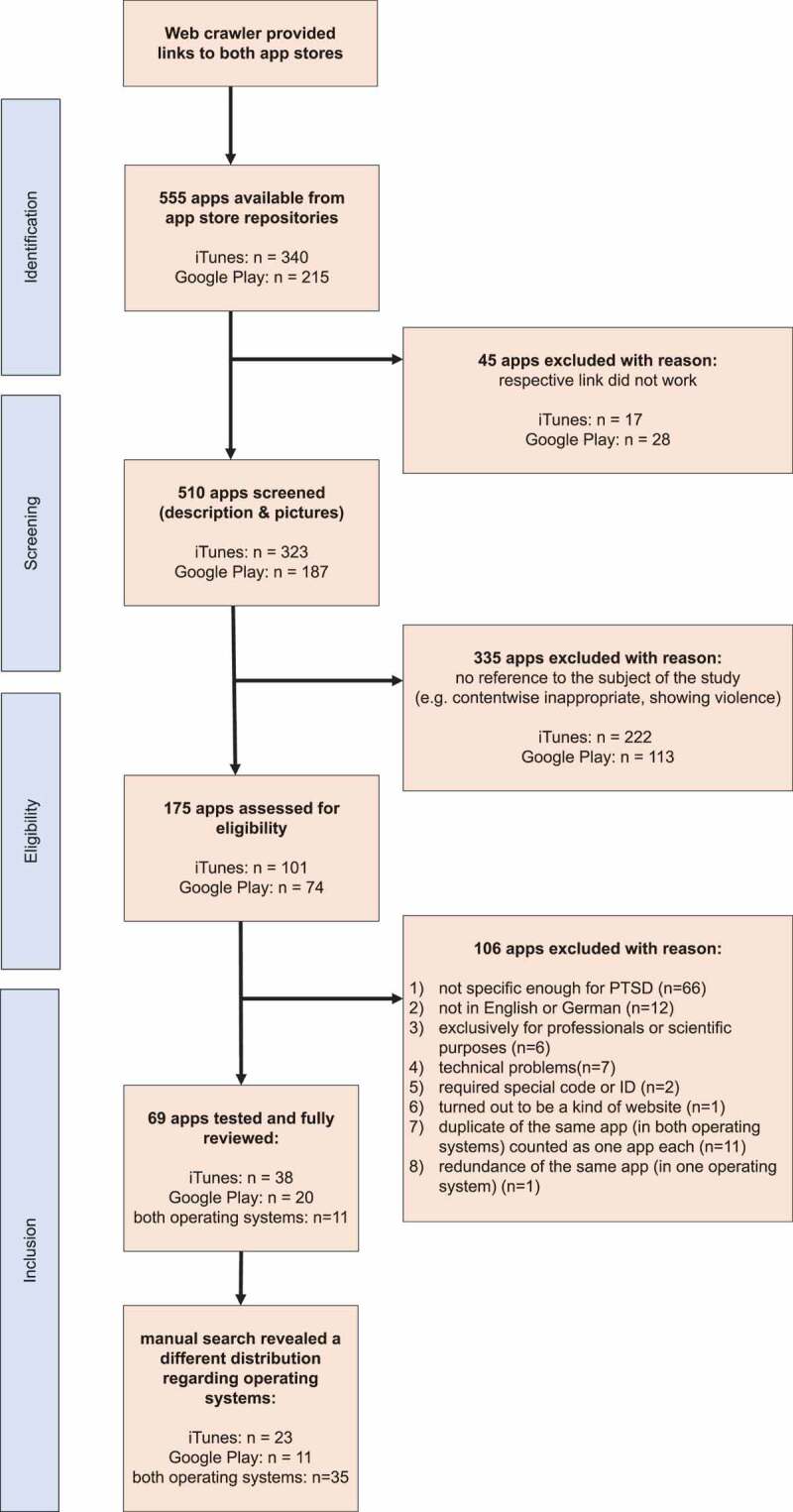
Background: Mobile health applications (apps) are considered to complement traditional psychological treatments for Post-Traumatic Stress Disorder (PTSD). However, the use for clinical practice and quality of available apps is unknown.Objective: To assess the general characteristics, therapeutic background, content, and quality of apps for PTSD and to examine their concordance with established PTSD treatment and self-help methods.Method: A web crawler systematically searched for apps targeting PTSD in the British Google Play and Apple iTunes stores. Two independent researchers rated the apps using the Mobile App Rating Scale (MARS). The content of high-quality apps was checked for concordance with psychological treatment and self-help methods extracted from current literature on PTSD treatment.Results: Out of 555 identified apps, 69 met the inclusion criteria. The overall app quality based on the MARS was medium (M = 3.36, SD = 0.65). Most apps (50.7%) were based on cognitive behavioural therapy and offered a wide range of content, including established psychological PTSD treatment methods such as processing of trauma-related emotions and beliefs, relaxation exercises, and psychoeducation. Notably, data protection and privacy standards were poor in most apps and only one app (1.4%) was scientifically evaluated in a randomized controlled trial.Conclusions: High-quality apps based on established psychological treatment techniques for PTSD are available in commercial app stores. However, users are confronted with great difficulties in identifying useful high-quality apps and most apps lack an evidence-base. Commercial distribution channels do not exploit the potential of apps to complement the psychological treatment of PTSD.
Overview
The claims and statistics of this paper haven’t been checked yet.
Run the check — free, no account needed. It reads the open-access text and checks the sources it cites.
Integrity signals
Registry
Cites
Statistics
Figures
Verification
Claims the paper makes
The claims and statistics of this paper haven’t been checked yet.
Run the check — free, no account needed. It reads the open-access text and checks the sources it cites.
Claims other papers make about this one
Each is checked against this paper’s own text: does it say what the citing paper says it does?
The cited source says what the claim attributes to it.
In the citing paper
“Eventually, we performed an independent scientific evaluation of a commercially available product, which seems important given the plethora of health apps that have not been scientifically reviewed [14,15].”
From Diagnostic Performance of an App-Based Symptom Checker in Mental Disorders: Comparative Study in Psychotherapy Outpatients (2022) · cites this paper as [15]
Self-check
Percentages, sums and reported differences re-computed from the paper’s own numbers.
The self-check needs the paper’s full text.
Citations
Cites
Diagnostic and Statistical Manual of Mental Disorders
American Psychiatric Association (2013) · doi:10.1176/appi.books.9780890425596 · Cited by 116,369
The PHQ-9: Validity of a brief depression severity measure
Kroenke, K., Spitzer, R. L., & Williams, J. B. W. (2001) · Journal of General Internal Medicine · doi:10.1046/j.1525-1497.2001.016009606.x · Cited by 44,910
Diagnostic and Statistical Manual of Mental Disorders, 5th ed.
Carter, M. J. (2014) · Therapeutic Recreation Journal · Cited by 15,154
Blevins, C. A., Weathers, F. W., Davis, M. T., Witte, T. K., & Domino, J. L. (2015) · Journal of Traumatic Stress · doi:10.1002/jts.22059 · Cited by 5,233
The Design and Analysis of Clinical Experiments
Fleiss, J. L. (1999) · Wiley eBooks · doi:10.1002/9781118032923 · Cited by 4,819
Mobile app rating scale: a new tool for assessing the quality of health mobile apps
Stoyanov, S. R., Hides, L., Kavanagh, D. J., Zelenko, O., Tjondronegoro, D., & Mani, M. (2015) · JMIR mHealth and uHealth · doi:10.2196/mhealth.3422 · Cited by 2,233
The global burden of mental disorders: An update from the WHO World Mental Health (WMH) surveys
Kessler, R. C., Aguilar-Gaxiola, S., Alonso, J., Chatterji, S., Lee, S., Ormel, J., Üstün, T. B., & Wang, P. S. (2009) · Epidemiologia e Psichiatria Sociale · doi:10.1017/s1121189x00001421 · Cited by 1,895
Glasgow, R. E., Lichtenstein, E., & Marcus, A. C. (2003) · American Journal of Public Health · doi:10.2105/ajph.93.8.1261 · Cited by 1,836
Trauma and PTSD in the WHO World Mental Health Surveys
Kessler, R. C., Aguilar-Gaxiola, S., Alonso, J., Benjet, C., Bromet, E. J., Cardoso, G., Degenhardt, L., de Girolamo, G., Dinolova, R. V., Ferry, F., et al. (2017) · European Journal of Psychotraumatology · doi:10.1080/20008198.2017.1353383 · Cited by 1,661
Managing Clinical Knowledge for Health Care Improvement
Balas, E. A., & Boren, S. A. (2000) · Yearbook of Medical Informatics · doi:10.1055/s-0038-1637943 · Cited by 1,479
Posttraumatic stress disorder in the world mental health surveys
Koenen, K. C., Ratanatharathorn, A., Ng, L., McLaughlin, K. A., Bromet, E. J., Stein, D. J., Karam, E. G., Meron Ruscio, A., Benjet, C., Scott, K., et al. (2017) · Psychological Medicine · doi:10.1017/s0033291717000708 · Cited by 1,453
Barriers to mental health treatment: results from the WHO World Mental Health surveys
Andrade, L. H., Alonso, J., Mneimneh, Z., Wells, J. E., Al-Hamzawi, A., Borges, G., Bromet, E., Bruffaerts, R., de Girolamo, G., de Graaf, R., et al. (2014) · Psychological Medicine · doi:10.1017/s0033291713001943 · Cited by 1,289
Smartphones for smarter delivery of mental health programs: A systematic review
Donker, T., Petrie, K., Proudfoot, J., Clarke, J., Birch, M.-R., & Christensen, H. (2013) · Journal of Medical Internet Research · doi:10.2196/jmir.2791 · Cited by 1,136 · cited 3×
“In addition, in blended care models, apps can improve psychological treatment approaches through functions like activity and symptom monitoring, mobile sensing, or automatically displayed tiny tasks in everyday life, which repeat contents of the therapy (Donker et al., 2013; Ebert et al., 2018).”
BackgroundRates of post-traumatic stress disorder in trauma-exposed children and adolescents: meta-analysis
Alisic, E., Zalta, A. K., van Wesel, F., Larsen, S. E., Hafstad, G. S., Hassanpour, K., & Smid, G. E. (2014) · British Journal of Psychiatry · doi:10.1192/bjp.bp.113.131227 · Cited by 930
Mental Health Smartphone Apps: Review and Evidence-Based Recommendations for Future Developments
Bakker, D., Kazantzis, N., Rickwood, D., & Rickard, N. (2016) · JMIR Mental Health · doi:10.2196/mental.4984 · Cited by 886
Psychological therapies for chronic post-traumatic stress disorder (PTSD) in adults
Bisson, J. I., Roberts, N. P., Andrew, M., Cooper, R., & Lewis, C. (2013) · Cochrane Database of Systematic Reviews · doi:10.1002/14651858.cd003388.pub4 · Cited by 829
mHealth for mental health: Integrating smartphone technology in behavioral healthcare.
Luxton, D. D., McCann, R. A., Bush, N. E., Mishkind, M. C., & Reger, G. M. (2011) · Professional Psychology: Research and Practice · doi:10.1037/a0024485 · Cited by 809 · cited 1×
“…2015; Luxton, McCann, Bush, Mishkind, & Reger, 2011), possible harms in case of device failure, especially for patients relying on functional apps (Luxton et al., 2011), and a low quality of evidence of effectiveness as well as the absence of quality standards for the development of apps…”
BackgroundMobile medical and health apps: state of the art, concerns, regulatory control and certification
Kamel Boulos, M. N., Brewer, A. C., Karimkhani, C., Buller, D. B., & Dellavalle, R. P. (2014) · Online Journal of Public Health Informatics · doi:10.5210/ojphi.v5i3.4814 · Cited by 659
A Meta-Analysis of Risk Factors for Combat-Related PTSD among Military Personnel and Veterans
Xue, C., Ge, Y., Tang, B., Liu, Y., Kang, P., Wang, M., & Zhang, L. (2015) · PLoS ONE · doi:10.1371/journal.pone.0120270 · Cited by 578
Treating PTSD: A Review of Evidence-Based Psychotherapy Interventions
Watkins, L. E., Sprang, K. R., & Rothbaum, B. O. (2018) · Frontiers in Behavioral Neuroscience · doi:10.3389/fnbeh.2018.00258 · Cited by 563
Review and evaluation of mindfulness-based iPhone apps
Mani, M., Kavanagh, D. J., Hides, L., & Stoyanov, S. R. (2015) · JMIR mHealth and uHealth · doi:10.2196/mhealth.4328 · Cited by 495
mHealth: A Mechanism to Deliver More Accessible, More Effective Mental Health Care
Price, M., Yuen, E. K., Goetter, E. M., Herbert, J. D., Forman, E. M., Acierno, R., & Ruggiero, K. J. (2014) · Clinical Psychology & Psychotherapy · doi:10.1002/cpp.1855 · Cited by 488
Posttraumatic Stress Disorder in Adults: Impact, Comorbidity, Risk Factors, and Treatment
Sareen, J. (2014) · The Canadian Journal of Psychiatry · doi:10.1177/070674371405900902 · Cited by 467
Ebert, D. D., Van Daele, T., Nordgreen, T., Karekla, M., Compare, A., Zarbo, C., Brugnera, A., Øverland, S., Trebbi, G., Jensen, K. L., et al. (2018) · European Psychologist · doi:10.1027/1016-9040/a000318 · Cited by 437
Self-citationBardus, M., van Beurden, S. B., Smith, J. R., & Abraham, C. (2016) · International Journal of Behavioral Nutrition and Physical Activity · doi:10.1186/s12966-016-0359-9 · Cited by 350
Towards a consensus around standards for smartphone apps and digital mental health
Torous, J., Andersson, G., Bertagnoli, A., Christensen, H., Cuijpers, P., Firth, J., Haim, A., Hsin, H., Hollis, C., Lewis, S., et al. (2019) · World Psychiatry · doi:10.1002/wps.20592 · Cited by 325
Psychotherapies for PTSD: what do they have in common?
Schnyder, U., Ehlers, A., Elbert, T., Foa, E. B., Gersons, B. P. R., Resick, P. A., Shapiro, F., & Cloitre, M. (2015) · European Journal of Psychotraumatology · doi:10.3402/ejpt.v6.28186 · Cited by 319
Huckvale, K., Torous, J., & Larsen, M. E. (2019) · JAMA Network Open · doi:10.1001/jamanetworkopen.2019.2542 · Cited by 312
Sijbrandij, M., Acartürk, C., Bird, M., Bryant, R. A., Burchert, S., Carswell, K., de Jong, J. T. V. M., Dinesen, C., Dawson, K. S., Chammay, R. E., et al. (2017) · European Journal of Psychotraumatology · doi:10.1080/20008198.2017.1388102 · Cited by 309
Kantor, V., Knefel, M., & Lueger-Schuster, B. (2017) · Clinical Psychology Review · doi:10.1016/j.cpr.2016.12.001 · Cited by 294
Prescribable mHealth apps identified from an overview of systematic reviews
Byambasuren, O., Sanders, S., Beller, E., & Glasziou, P. (2018) · npj Digital Medicine · doi:10.1038/s41746-018-0021-9 · Cited by 291
Miller, M. W., & Sadeh, N. (2014) · Molecular Psychiatry · doi:10.1038/mp.2014.111 · Cited by 288
Mobile mental health: a challenging research agenda
Olff, M. (2015) · European Journal of Psychotraumatology · doi:10.3402/ejpt.v6.27882 · Cited by 258
Santo, K., Richtering, S. S., Chalmers, J. P., Thiagalingam, A., Chow, C. K., & Redfern, J. (2016) · JMIR mhealth and uhealth · doi:10.2196/mhealth.6742 · Cited by 256
Health Care Costs Associated With Posttraumatic Stress Disorder Symptoms in Women
Walker, E. A., Katon, W. J., Russo, J. E., Ciechanowski, P. S., Newman, E., & Wagner, A. W. (2003) · Archives of General Psychiatry · doi:10.1001/archpsyc.60.4.369 · Cited by 234
Anxiety: There is an app for that. A systematic review of anxiety apps: SUCALA et al.
Sucala, M., Cuijpers, P., Muench, F., Cardoș, R., Soflau, R., Dobrean, A., Achimas-Cadariu, P., & David, D. (2017) · Depression and Anxiety · doi:10.1002/da.22654 · Cited by 232
A randomized controlled trial of a smartphone app for posttraumatic stress disorder symptoms.
Kuhn, E., Kanuri, N., Hoffman, J. E., Garvert, D. W., Ruzek, J. I., & Taylor, C. B. (2017) · Journal of Consulting and Clinical Psychology · doi:10.1037/ccp0000163 · Cited by 225
mHealth in the Wild: Using Novel Data to Examine the Reach, Use, and Impact of PTSD Coach
Owen, J. E., Jaworski, B. K., Kuhn, E., Makin-Byrd, K. N., Ramsey, K. M., & Hoffman, J. E. (2015) · JMIR Mental Health · doi:10.2196/mental.3935 · Cited by 216 · cited 1×
“Today, mental health apps are available in abundance in commercial app stores, including apps for PTSD and related disorders, and they are used by the general public (Owen et al., 2015).”
BackgroundBaumel, A., Faber, K., Mathur, N., Kane, J. M., & Muench, F. (2017) · Journal of Medical Internet Research · doi:10.2196/jmir.7270 · Cited by 206
Miner, A., Kuhn, E., Hoffman, J. E., Owen, J. E., Ruzek, J. I., & Taylor, C. B. (2016) · Psychological Trauma: Theory, Research, Practice, and Policy · doi:10.1037/tra0000092 · Cited by 185
Reviewing the data security and privacy policies of mobile apps for depression
O'Loughlin, K., Neary, M., Adkins, E. C., & Schueller, S. M. (2019) · Internet Interventions · doi:10.1016/j.invent.2018.12.001 · Cited by 179
Quantifying App Store Dynamics: Longitudinal Tracking of Mental Health Apps
Larsen, M. E., Nicholas, J., & Christensen, H. (2016) · JMIR mHealth and uHealth · doi:10.2196/mhealth.6020 · Cited by 177
Continuous Evaluation of Evolving Behavioral Intervention Technologies
Mohr, D. C., Cheung, K., Schueller, S. M., Brown, C. H., & Duan, N. (2013) · American Journal of Preventive Medicine · doi:10.1016/j.amepre.2013.06.006 · Cited by 171
Possemato, K., Kuhn, E., Johnson, E., Hoffman, J. E., Owen, J. E., Kanuri, N., De Stefano, L., & Brooks, E. (2016) · General Hospital Psychiatry · doi:10.1016/j.genhosppsych.2015.09.005 · Cited by 167
Self-help interventions for anxiety disorders: An overview
Cuijpers, P. J., & Schuurmans, J. (2007) · Current Psychiatry Reports · doi:10.1007/s11920-007-0034-6 · Cited by 165
The German Version of the Mobile App Rating Scale (MARS-G): Development and Validation Study
Messner, E.-M., Terhorst, Y., Barke, A., Baumeister, H., Stoyanov, S., Hides, L., Kavanagh, D., Pryss, R., Sander, L., & Probst, T. (2020) · JMIR mHealth and uHealth · doi:10.2196/14479 · Cited by 156
Self-citationKoffel, E., Kuhn, E. R., Petsoulis, N., Erbes, C. R., Anders, S. L., Hoffman, J. E., Ruzek, J. I., & Polusny, M. A. (2016) · Health Informatics Journal · doi:10.1177/1460458216656472 · Cited by 153
The Oxford Handbook of Traumatic Stress Disorders
(2012) · Oxford University Press eBooks · doi:10.1093/oxfordhb/9780195399066.001.0001 · Cited by 137
Hussain, M., Al-Haiqi, A., Zaidan, A. A., Zaidan, B. B., Kiah, M. L. M., Anuar, N. B., & Abdulnabi, M. S. H. (2015) · Computer Methods and Programs in Biomedicine · doi:10.1016/j.cmpb.2015.08.015 · Cited by 130
Brief, D. J., Rubin, A., Keane, T. M., Enggasser, J. L., Roy, M., Helmuth, E., Hermos, J., Lachowicz, M., Rybin, D., & Rosenbloom, D. (2013) · Journal of Consulting and Clinical Psychology · doi:10.1037/a0033697 · Cited by 125
Mueser, K. T., Gottlieb, J. D., Xie, H., Lu, W., Yanos, P. T., Rosenberg, S. D., Silverstein, S. M., Marcello, S. C., Minsky, S. K., Wolfe, R. S., et al. (2015) · The British Journal of Psychiatry · doi:10.1192/bjp.bp.114.147926 · Cited by 121
Digital apothecaries: a vision for making health care interventions accessible worldwide
Muñoz, R. F., Chavira, D. A., Himle, J. A., Koerner, K., Muroff, J. R., Reynolds, J., Rose, R. D., Ruzek, J. I., Teachman, B. A., & Schueller, S. M. (2018) · mHealth · doi:10.21037/mhealth.2018.05.04 · Cited by 121
Online Journal of Public Health Informatics
(2022) · Online Journal of Public Health Informatics · doi:10.5210/ojphi · Cited by 119
Mobile Apps for the Management of Diabetes
Chavez, S., Fedele, D., Guo, Y., Bernier, A., Smith, M., Warnick, J., & Modave, F. (2017) · Diabetes Care · doi:10.2337/dc17-0853 · Cited by 97
Terhorst, Y., Rathner, E.-M., Baumeister, H., & Sander, L. (2018) · Verhaltenstherapie · doi:10.1159/000481692 · Cited by 84
Self-citationBrown, C. H., Kellam, S. G., Kaupert, S., Muthén, B. O., Wang, W., Muthén, L. K., Chamberlain, P., PoVey, C. L., Cady, R., Valente, T. W., et al. (2012) · Administration and Policy in Mental Health and Mental Health Services Research · doi:10.1007/s10488-011-0387-3 · Cited by 68
Charney, M. E., Hellberg, S. N., Bui, É., & Simon, N. M. (2018) · Harvard Review of Psychiatry · doi:10.1097/hrp.0000000000000186 · Cited by 68
Kuhn, E. R., van der Meer, C. A. I., Owen, J. E., Hoffman, J. E., Cash, R., Carrese, P., Olff, M., Bakker, A., Schellong, J., Lorenz, P., et al. (2018) · mHealth · doi:10.21037/mhealth.2018.05.01 · Cited by 67
Mobile Mental Health: Navigating New Rules and Regulations for Digital Tools
Armontrout, J. A., Torous, J. B., Fisher, M., Drogin, E. Y., & Gutheil, T. G. (2016) · Current Psychiatry Reports · doi:10.1007/s11920-016-0726-x · Cited by 61
Zammit, S., Lewis, C., Dawson, S., Colley, H., McCann, H. M., Piekarski, A., Rockliff, H., & Bisson, J. I. (2018) · The British Journal of Psychiatry · doi:10.1192/bjp.2017.8 · Cited by 61
Wickersham, A., Petrides, P. M., Williamson, V., & Leightley, D. (2019) · DIGITAL HEALTH · doi:10.1177/2055207619842986 · Cited by 54
Trauma treatment across Europe: where do we stand now from a perspective of seven countries
Kazlauskas, E., Javakhishvili, J. D., Meewisse, M. L., Merecz‐Kot, D., Şar, V., Schäfer, I., Schnyder, U., & Gersons, B. P. R. (2016) · European Journal of Psychotraumatology · doi:10.3402/ejpt.v7.29450 · Cited by 46
Reger, G. M., Skopp, N. A., Edwards‐Stewart, A., & Lemus, E. L. (2015) · Military Psychology · doi:10.1037/mil0000083 · Cited by 40
Kuhn, E. R., Crowley, J. J., Hoffman, J. E., Eftekhari, A., Ramsey, K. M., Owen, J. E., Reger, G. M., & Ruzek, J. I. (2015) · Professional Psychology Research and Practice · doi:10.1037/pro0000051 · Cited by 38
Post-traumatic stress disorder among former Islamic State child soldiers in northern Iraq
Kizilhan, J. I., & Noll‐Hussong, M. (2018) · The British Journal of Psychiatry · doi:10.1192/bjp.2018.88 · Cited by 37
Schellong, J., Lorenz, P., & Weidner, K. (2019) · European Journal of Psychotraumatology · doi:10.1080/20008198.2019.1611090 · Cited by 23
The Global Epidemiology of Trauma Exposure and Posttraumatic Stress Disorder
Bromet, E. J., Karam, E. G., Koenen, K. C., & Stein, D. J. (2018) · Cambridge University Press eBooks · doi:10.1017/9781107445130.002 · Cited by 13
Owen, J. E., Jaworski, B. K., Kuhn, E. R., Hoffman, J. E., Schievelbein, L., Chang, A., Ramsey, K. M., & Rosen, C. S. (2017) · Journal of Family Studies · doi:10.1080/13229400.2017.1377629 · Cited by 11
Research works printed but not linked: 1
- American Psychiatric Association, 2019, App evaluation model
Cited by
Sorted by citations
Validation of the Mobile Application Rating Scale (MARS)
Terhorst, Y., Philippi, P., Sander, L., Schultchen, D., Paganini, S., Bardus, M., Santo, K., Knitza, J., Machado, G. C., Schöeppe, S., et al. (2020) · PLoS ONE · doi:10.1371/journal.pone.0241480 · Cited by 291
Self-citationRauschenberg, C., Schick, A., Hirjak, D., Seidler, A., Paetzold, I., Apfelbacher, C., Riedel-Heller, S. G., & Reininghaus, U. (2021) · Journal of Medical Internet Research · doi:10.2196/23365 · Cited by 205
Reviewing the data security and privacy policies of mobile apps for depression
O'Loughlin, K., Neary, M., Adkins, E. C., & Schueller, S. M. (2019) · Internet Interventions · doi:10.1016/j.invent.2018.12.001 · Cited by 179
Rauschenberg, C., Schick, A., Goetzl, C., Roehr, S., Riedel-Heller, S. G., Koppe, G., Durstewitz, D., Krumm, S., & Reininghaus, U. (2021) · European Psychiatry · doi:10.1192/j.eurpsy.2021.17 · Cited by 158
A Self-Help App for Syrian Refugees With Posttraumatic Stress (Sanadak): Randomized Controlled Trial
Röhr, S., Jung, F. U., Pabst, A., Grochtdreis, T., Dams, J., Nagl, M., Renner, A., Hoffmann, R., König, H.-H., Kersting, A., et al. (2021) · JMIR mhealth and uhealth · doi:10.2196/24807 · Cited by 92
Metadata
- Authors
- Sander, L. B., Schorndanner, J., Terhorst, Y., Spanhel, K., Pryss, R., Baumeister, H., & Messner, E.-M.
- Affiliations
- University of Freiburg (DE)
- Universität Ulm (DE)
- University of Würzburg (DE)
- Corresponding author
- Sander, Lasse Bosse
- ORCID
- Venue
- European Journal of Psychotraumatology
- Publisher
- Informa UK Limited
- Published
- 2020-01-09
- Volume
- 11
- Issue
- 1
- Pages
- 1701788-1701788
- ISSN
- 2000-8066 (ISSN-L)
- PMC
- PMC6968629
- OpenAlex
- W3000028621
- Cited by
- 102
- References
- 68
- Citations by year
- 2026: 5 · 2025: 10 · 2024: 18 · 2023: 20 · 2022: 12 · 2021: 25 · 2020: 11
- FWCI
- 2.67
- Type
- journal article
- Language
- en
- Open access
- gold
- doi.org
- Licence
- Locations
- European Journal of Psychotraumatology (publishedVersion, cc-by-nc)
- PubMed Central (publishedVersion, cc-by-nc)
- PubMed (publishedVersion)
- DOAJ (DOAJ: Directory of Open Access Journals) (submittedVersion)
- Funders
- Deutsche Forschungsgemeinschaft (Open Access Fund)
- Topics
- Social Sciences › Psychology › Applied Psychology › Digital Mental Health Interventions
- Social Sciences › Psychology › Clinical Psychology › Posttraumatic Stress Disorder Research
- Health Sciences › Health Professions › General Health Professions › Mobile Health and mHealth Applications
- Keywords
- post-traumatic stress disorder, mobile health apps, app quality, Mobile App Rating Scale, cognitive behavioral therapy, self-help intervention, App Store, privacy and data protection, evidence base, psychological intervention
About these checks
Registry, retraction, Cites and statistics results are computed, not judged, with one exception: a printed reference that no index lists is read once by a model before it counts as a citation error. Claims are extracted by a model and kept only when their quote appears verbatim in the text; each cited source is then checked, with a model’s help, for whether it says what the claim relies on. Those verdicts can be wrong — read the claim’s quote and the cited source before relying on one.
Statistics and arithmetic are recomputed, not judged.
Confidence bands are shown only for fields calibrated on our annotated test set. None is calibrated yet, so no band is shown.
What counts as a claim ›How we measure confidence ›How we check this ›
Are you an author, or do you see a problem with this page? Request a review
