

IENet: a robust convolutional neural network for EEG based brain-computer interfaces
Open accessThe DOI matches its Crossref record; 115 of the 137 references it cites were found in a registry or an index; 40 of the 58 sources its claims cite were checked for support.
Abstract
Abstract Objective.Brain-computer interfaces (BCIs) based on electroencephalogram (EEG) develop into novel application areas with more complex scenarios, which put forward higher requirements for the robustness of EEG signal processing algorithms. Deep learning can automatically extract discriminative features and potential dependencies via deep structures, demonstrating strong analytical capabilities in numerous domains such as computer vision and natural language processing. Making full use of deep learning technology to design a robust algorithm that is capable of analyzing EEG across BCI paradigms is our main work in this paper.Approach.Inspired by InceptionV4 and InceptionTime architecture, we introduce a neural network ensemble named InceptionEEG-Net (IENet), where multi-scale convolutional layer and convolution of length 1 enable model to extract rich high-dimensional features with limited parameters. In addition, we propose the average receptive field (RF) gain for convolutional neural networks (CNNs), which optimizes IENet to detect long patterns at a smaller cost. We compare with the current state-of-the-art methods across five EEG-BCI paradigms: steady-state visual evoked potentials (VEPs), epilepsy EEG, overt attention P300 VEPs, covert attention P300 visual-EPs and movement-related cortical potentials.Main results.The classification results show that the generalizability of IENet is on par with the state-of-the-art paradigm-agnostic models on test datasets. Furthermore, the feature explainability analysis of IENet illustrates its capability to extract neurophysiologically interpretable features for different BCI paradigms, ensuring the reliability of algorithm.Significance.It can be seen from our results that IENet can generalize to different BCI paradigms. And it is essential for deep CNNs to increase the RF size using average RF gain.
Overview
CoChat Summary
TL;DR
IENet is a CNN ensemble combining multi-scale convolutions and length-1 convolutions, optimized with an average receptive field gain metric, for EEG-based BCI across paradigms. It performs comparably to state-of-the-art paradigm-agnostic models on five EEG datasets and extracts neurophysiologically interpretable features.
Key findings
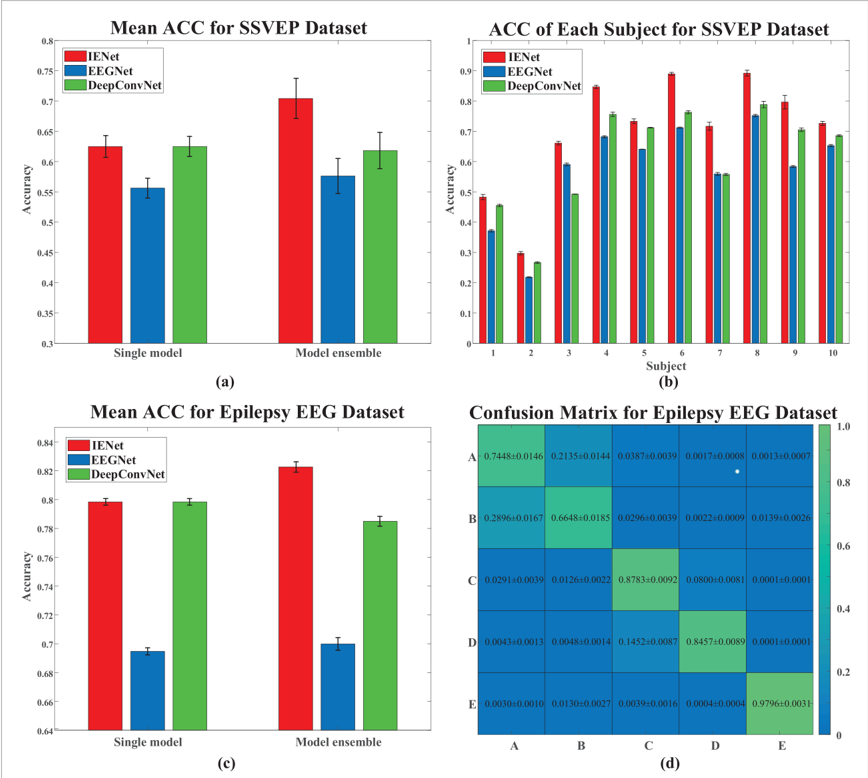
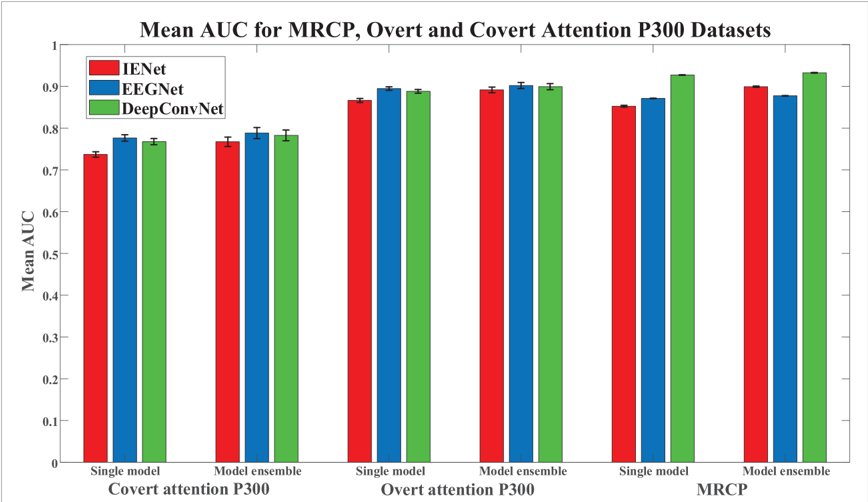
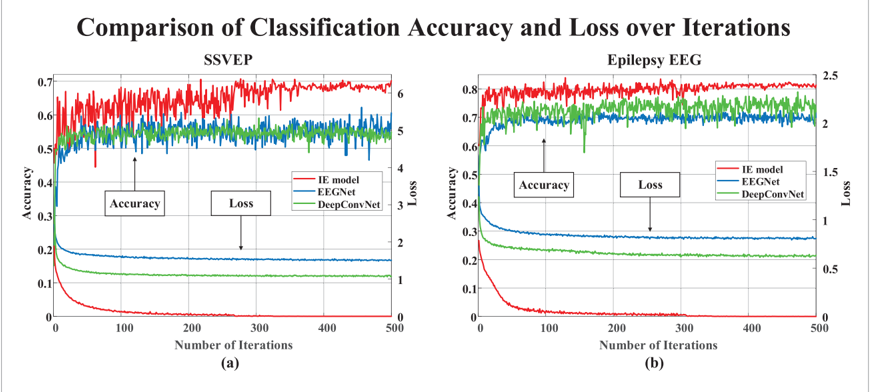
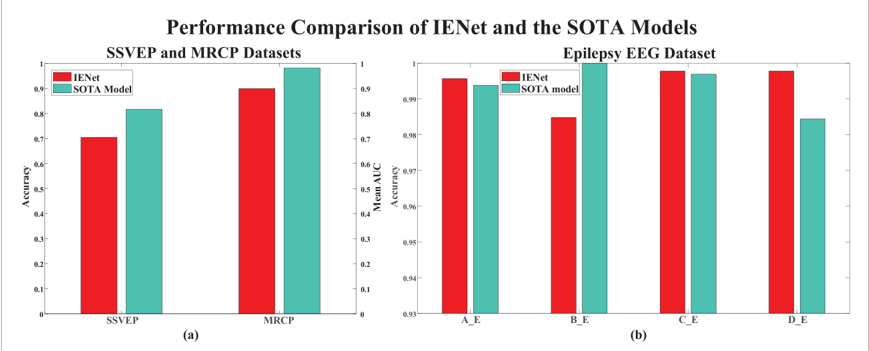
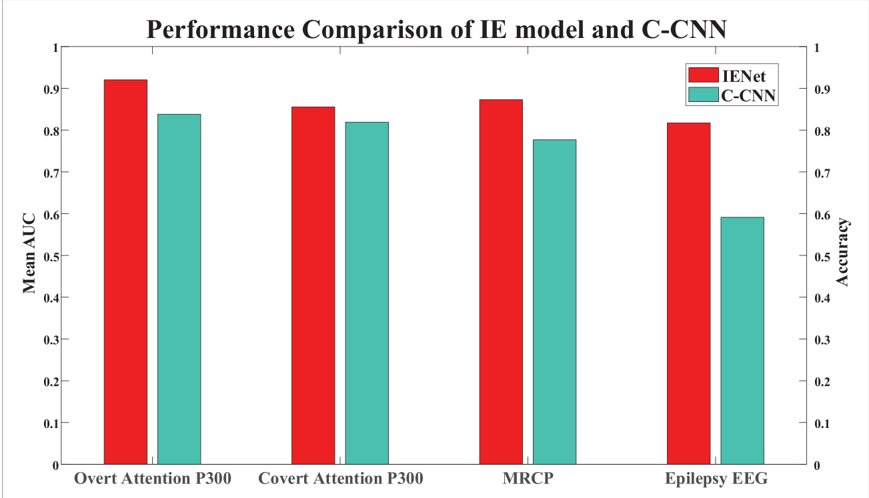
- On SSVEP and epilepsy EEG, IENet significantly outperformed DeepConvNet and EEGNet (p<0.05) for both single models and ensembles; on overt and covert attention P300, EEGNet was best for a single model (p<0.05) but ensemble differences were not significant (p>0.05); on MRCP, IENet ranked third for a single model and second for the ensemble (p<0.05).
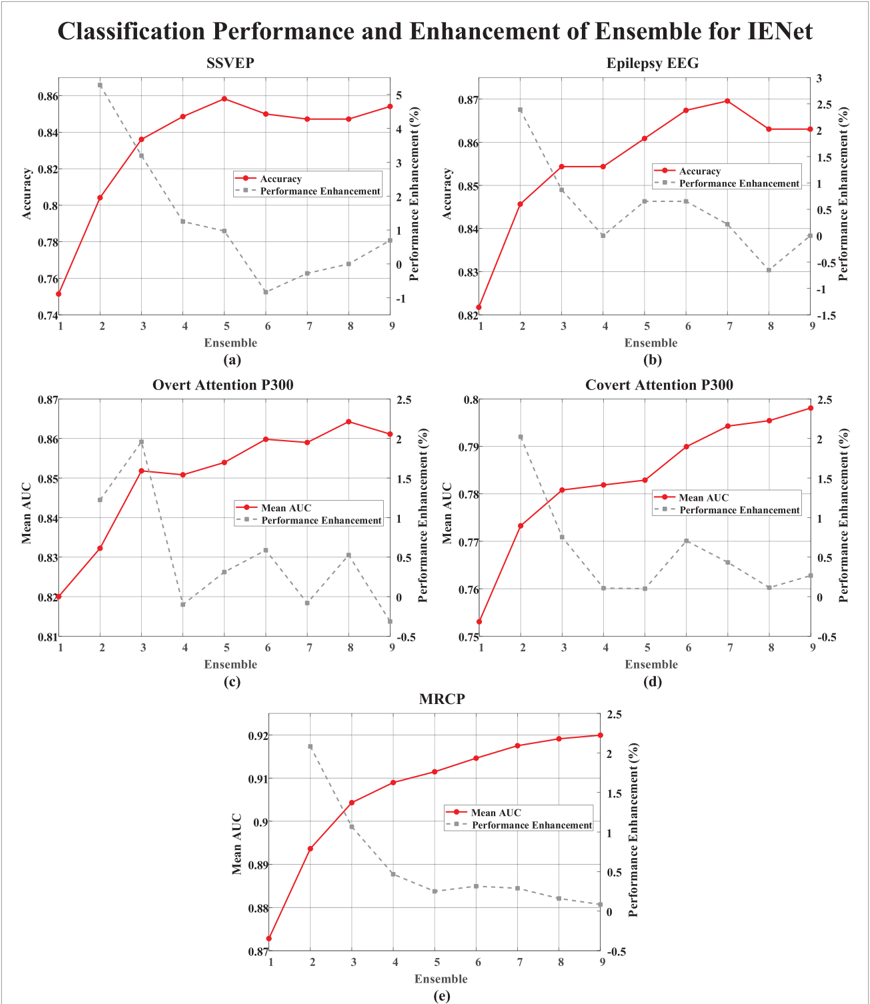
- Ensemble gains for IENet were 7.93% on SSVEP, 2.42% on epilepsy EEG, 2.53% on overt attention P300, 3.04% on covert attention P300, and 4.68% on MRCP.
- The optimized IE model (RF size 229) outperformed the original IE model (RF 169) and deepened IE model (RF 225) across all datasets: SSVEP 86.52% vs 82.36% vs 80.97%; epilepsy EEG 81.74% vs 80.21% vs 76.52%; overt attention P300 91.74% vs 89.29% vs 87.06%; covert attention P300 75.90% vs 70.82% vs 74.77%; MRCP 87.28% vs 83.97% vs 81.82%.
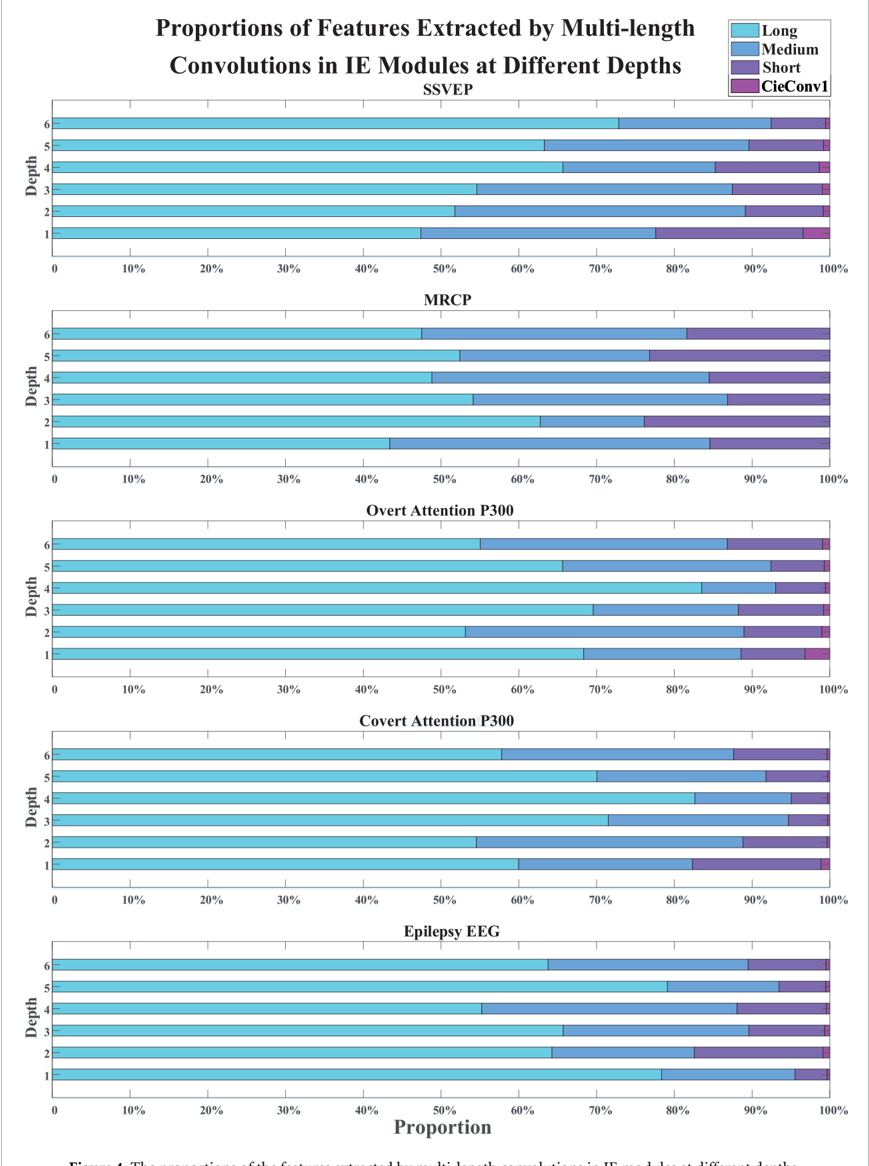
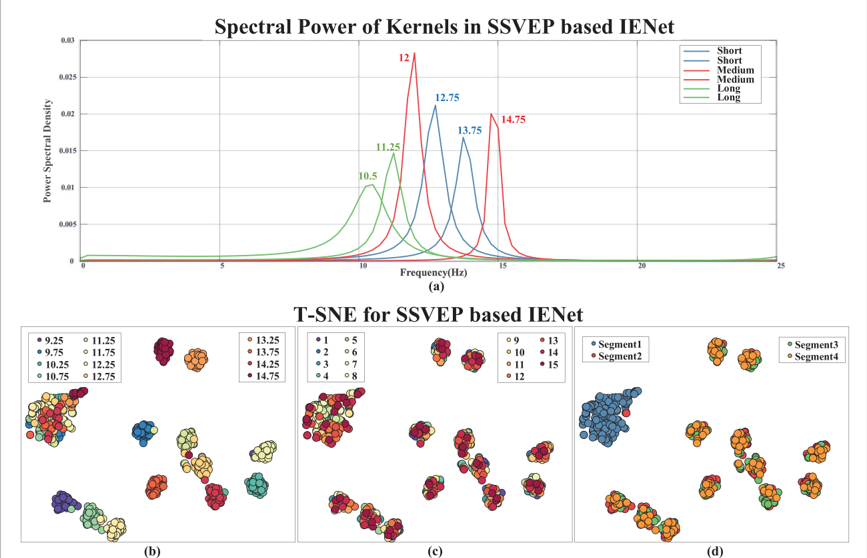
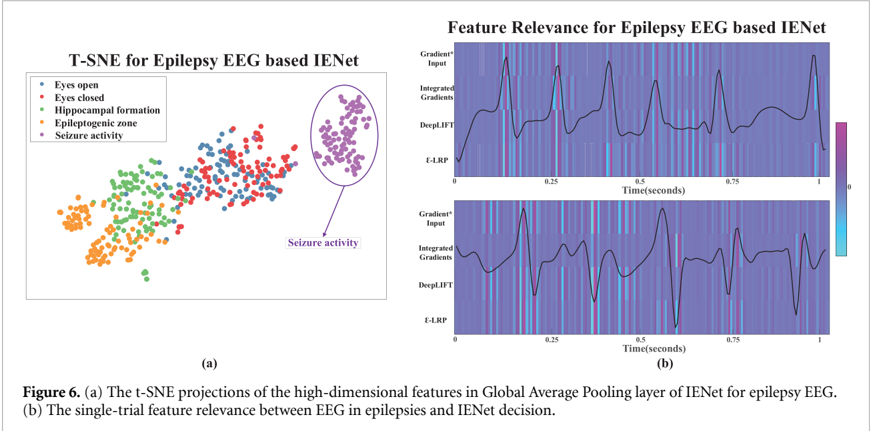
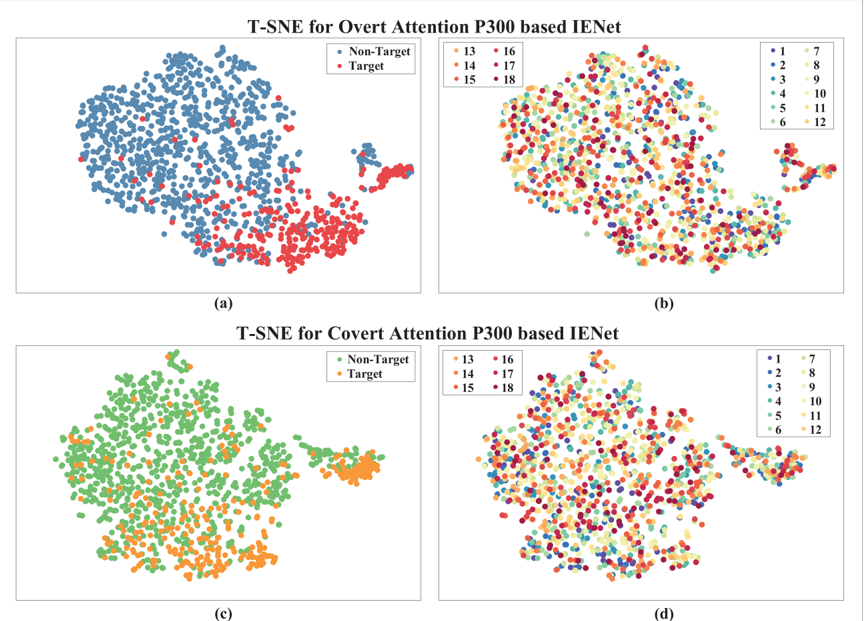
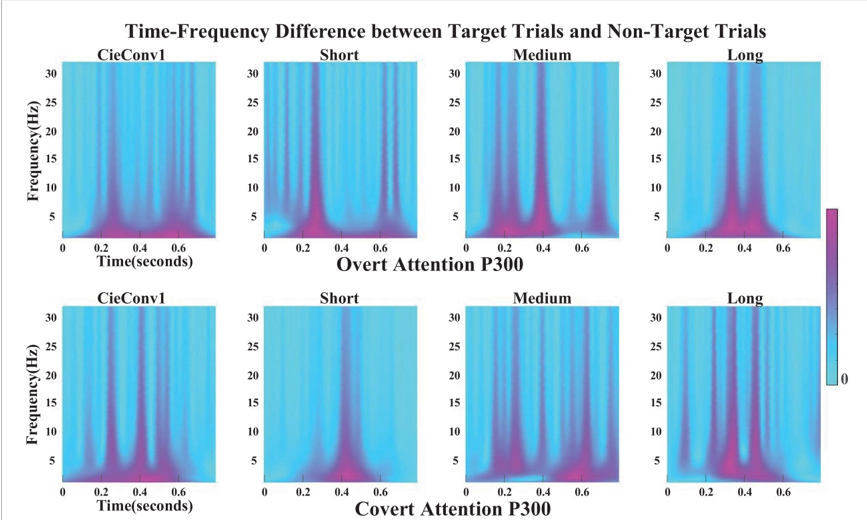
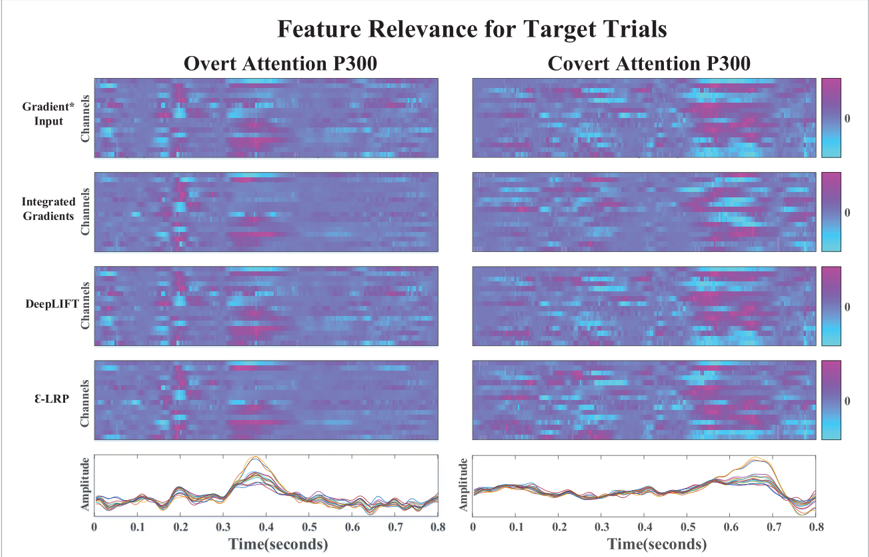
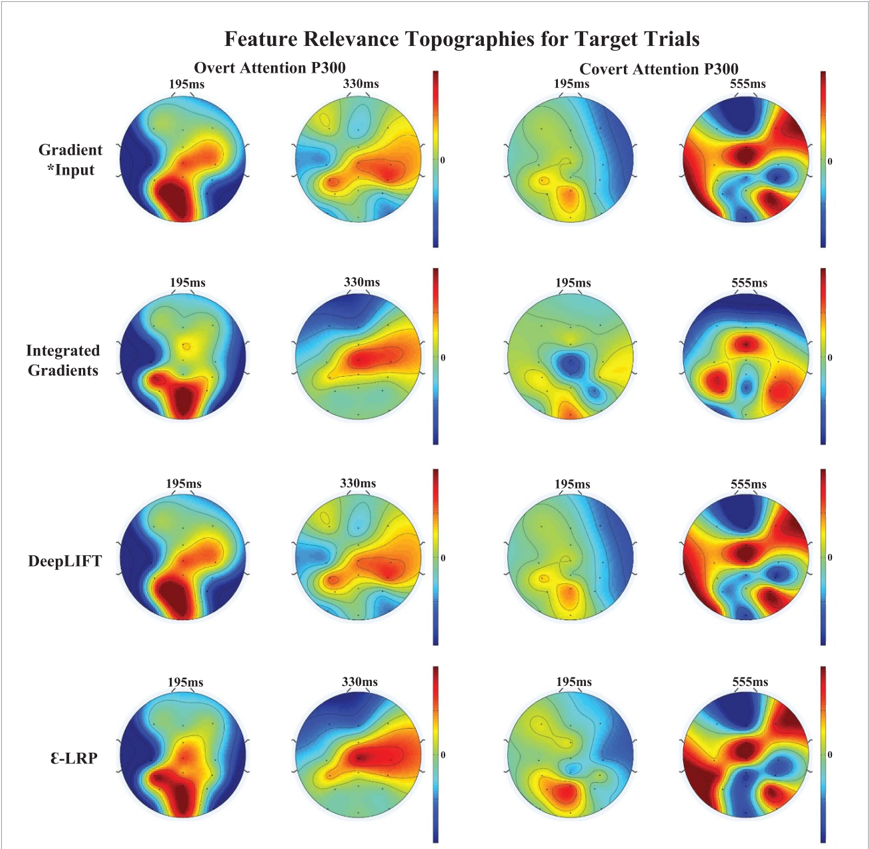
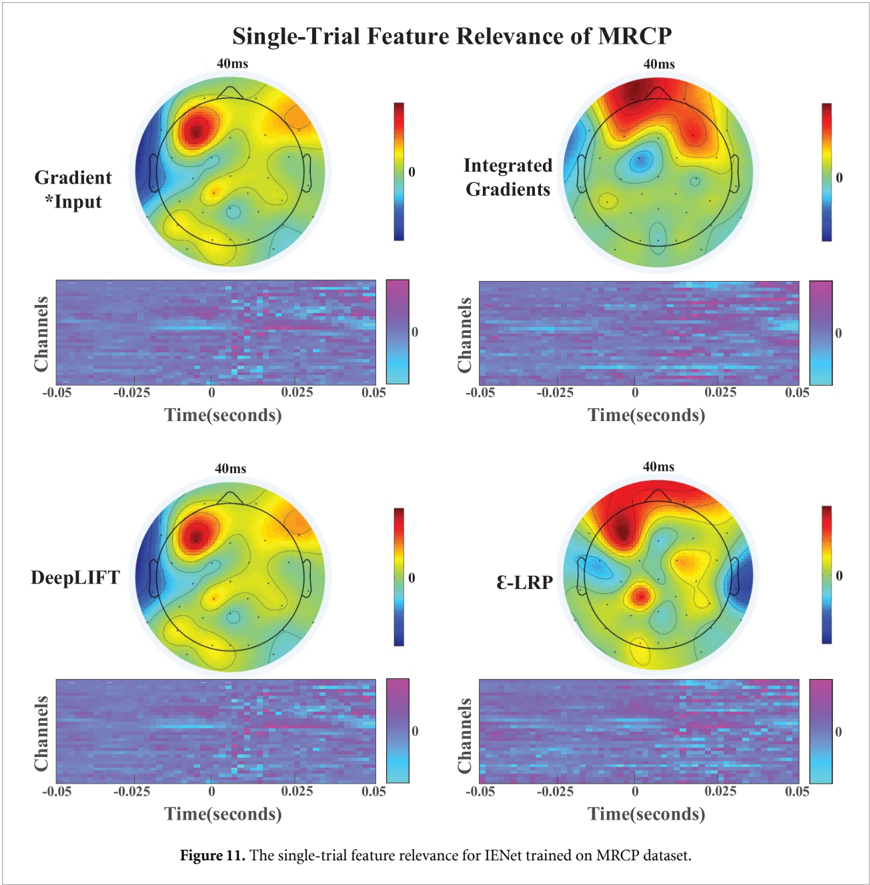
- Feature explainability showed long convolutions contributed the largest proportion across depths; SSVEP temporal kernels matched the stimulus frequency range 9.25–14.75 Hz; P300 peak positive potential appeared at approximately 330 ms for overt attention and 550 ms for covert attention; MRCP relevance was highest approximately 50 ms after right-hand movement.
Methods
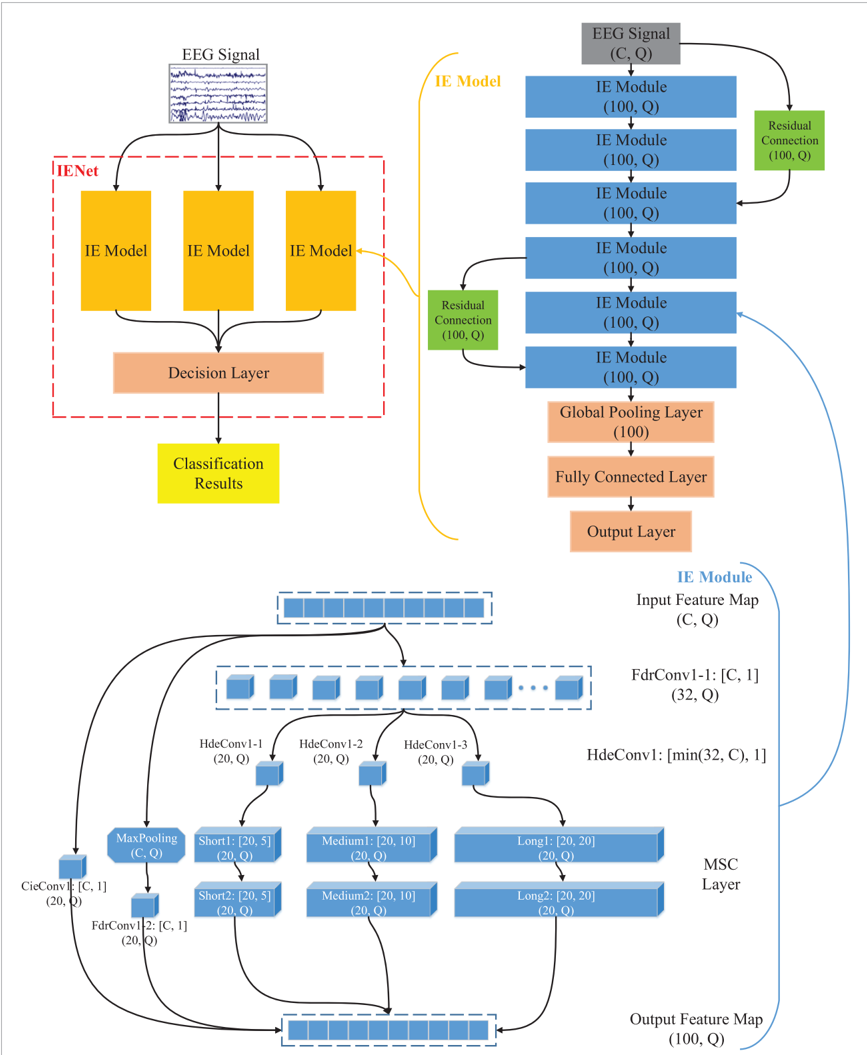
- IENet is an ensemble of three IE models; each IE model contains six IE modules with multi-scale convolutional layers using long, medium, and short convolutions, plus FdrConv1, HdeConv1, CieConv1, residual connections, batch normalization, and global average pooling. The average RF gain metric guided increasing the long convolution length to 20.
- Five datasets were used: SSVEP (10 subjects, 8 channels, 12 classes, 7200 epochs), epilepsy EEG (10 subjects, 1 channel, 5 classes, 11,500 epochs), overt attention P300 (10 subjects, 16 channels, 2 classes, 11,590 epochs), covert attention P300 (same), and MRCP (12 subjects, 32 channels, 6 labels, 11,883,171 epochs). Cross-validation included leave-one-subject-out for SSVEP and P300, 25-fold for epilepsy EEG, and 8-fold for MRCP; metrics were ACC and AUC, with one-way ANOVA, Friedman, and Wilcoxon tests.
- Comparisons were made against EEGNet and DeepConvNet. Feature explainability used trained kernel weights, hidden-unit activations, t-SNE, Morlet wavelet transform, and four DeepExplain gradient-based methods; ablation studies examined convolutions, residual connections, batch normalization, and ensemble size.
Limitations
- The paper states that IENet’s test-set accuracy during training was not stable, that it was sensitive to SSVEP stimulus onset, and that a large discrepancy remained between IENet and SOTA results on SSVEP and MRCP, with a mean accuracy/AUC difference of about 10%.
- The paper states that future work is needed to test more EEG-BCI paradigms and deploy IENet in a real BCI system; the data availability statement says no new data were created or analyzed.
- Evident from the text: the three-model ensemble increases model size and computation, though the authors chose three to balance accuracy and response speed; evaluation is offline on existing datasets rather than online or real-time BCI use.
Model-written summary. Check it against the paper before relying on it.
Integrity signals
Registry
Cites
Statistics
Figures

Verification
Claims the paper makes
34 Valid · 3 Not valid · 10 Not checked · 130 Own results and interpretations
Every source the paper cites for this claim was checked and supports it.
In the paper
“Therefore, we apply the ensemble of three IE models instead of a single one to improve stability [62].”
What the sources say
- Supportedcites [62] [62] Fawaz H I, Lucas B, Forestier G, Pelletier C, Schmidt D F, Weber J, Webb G I, Idoumghar L, Muller P-A and Petitjean F 2020 Inceptiontime: finding alexnet for <!-- image --> - time series classification Data Min. Knowl. Discovery 34 1936-62 - source
Section 3.2 (p. 7) says a single Inception network had high variability and that the authors used ensembling to address it. The citing authors' choice of three models is their own; the source used five, but supports the cited rationale for ensembling instead of using a single model. (LLM, conf=0.88)
plainstates a cause- Asserted: passes — The authors put it forward as true.
- Checkable: passes — It can be checked against evidence.
- Load-bearing: passes — The paper’s conclusions depend on it.
- Based: passes — The paper gives a reason why it holds.
- Supported
Every source the paper cites for this claim was checked and supports it.
In the paper
“Additionally, data-driven neural networks are required to generalize to the variable size of EEG datasets due to the different acquisition conditions of BCI paradigms [13].”
What the sources say
- Supportedcites [13] [13] Lawhern V J, Solon A J, Waytowich N R, Gordon S M, Hung C P and Lance B J 2018 EEGNet: a compact convolutional neural network for EEG-based brain-computer interfaces J. Neural Eng. 15 056013 - source
The Introduction (p. 2) says training-data amounts varied substantially across studies, partly because of difficulties collecting data under different experimental designs, and identifies generalization to variable training-data sizes as an open question. The Discussion (p. 19) reports that EEGNet generalized across BCI paradigms with different dataset sizes. (LLM, conf=0.87)
plainstates a cause- Asserted: passes — The authors put it forward as true.
- Checkable: passes — It can be checked against evidence.
- Load-bearing: passes — The paper’s conclusions depend on it.
- Based: passes — The paper gives a reason why it holds.
- Supported
The cited sources support only part of this claim — read each source’s verdict below.
In the paper
“The difficulty of EEG signal processing is to extract high-dimensional features from non-stationary time series with low signal-to-noise ratio [18].”
What the sources say
- Partly supportedcites [18] [18] Craik A, He Y and Contreras-Vidal J L 2019 Deep learning for electroencephalogram (EEG) classification tasks: a review J. Neural Eng. 16 031001 - sourceExperimental — accuracy not yet measured
The Introduction describes EEG data as high-dimensional, typically having low signal-to-noise ratios, and identifies feature extraction as part of the classification pipeline. Section 3.3 also discusses the challenge of formulating inputs and extracting EEG features. Our copy does not establish the claim’s specific description of EEG as non-stationary time series. (LLM, conf=0.85)
plain- Asserted: passes — The authors put it forward as true.
- Checkable: passes — It can be checked against evidence.
- Load-bearing: passes — The paper’s conclusions depend on it.
- Based: passes — The paper gives a reason why it holds.
- Partly supported
Every source the paper cites for this claim was checked and supports it.
In the paper
“Specifically, with the increasing implementation of EEG-BCI, the algorithm design relied on expert experience is time-consuming and difficult [6].”
What the sources say
- Supportedcites [6] [6] Zhang X, Yao L, Wang X, Monaghan J, Mcalpine D and Zhang Y 2021 A survey on deep learning-based non-invasive brain signals: recent advances and new frontiers J. Neural Eng. 18 031002 - source
Section 1.1 (General workflow; page unavailable) says EEG feature extraction depends heavily on domain knowledge and that manual extraction is time-consuming and difficult. Section 1.2 (Why deep learning?; page unavailable) likewise describes its dependence on human expertise. These passages support the citing sentence’s point about expert-dependent algorithm design for EEG-BCI. (LLM, conf=0.91)
plainstates a cause- Asserted: passes — The authors put it forward as true.
- Checkable: passes — It can be checked against evidence.
- Load-bearing: passes — The paper’s conclusions depend on it.
- Based: passes — The paper gives a reason why it holds.
- Supported
The cited sources support only part of this claim — read each source’s verdict below.
In the paper
“where multi-scale convolutional layer and convolution of length 1 enable model to extract rich high-dimensional features with limited parameters.”
- Also stated in: § IENet: a robust convolutional neural network for EEG based brain-computer interfaces · p. 4 · plain
“multi-scale convolutional layers (MSC Layers) [19, 62] and convolutions of length 1 (Conv1) [63] are adopted to enable IENet to extract rich high-dimensional features with limited parameters.”
What the sources say
- Partly supportedcites [19] [19] Szegedy C, Ioffe S, Vanhoucke V and Alemi A A 2017 Inception-v4, inception-resnet and the impact of residual connections on learning 31st AAAI Conf. on Artificial Intelligence - sourceExperimental — accuracy not yet measured
The Residual Inception Blocks section describes a 1 × 1 convolution that expands filter-bank dimensionality, and the Related Work section says a 1 × 1 convolution can reduce computational cost (page numbers unavailable). The paper also says its Inception models keep parameter counts in check, but it does not evaluate IENet or establish that these layers enable IENet to extract rich features with limited parameters. (LLM, conf=0.82)
- Partly supportedcites [62] [62] Fawaz H I, Lucas B, Forestier G, Pelletier C, Schmidt D F, Weber J, Webb G I, Idoumghar L, Muller P-A and Petitjean F 2020 Inceptiontime: finding alexnet for <!-- image --> - time series classification Data Min. Knowl. Discovery 34 1936-62 - sourceExperimental — accuracy not yet measured
Section 3.1 (p. 6) says filters of different lengths extract multiresolution features, while the length-1 bottleneck reduces dimensionality and permits longer filters with roughly the same number of parameters. The paper establishes this for InceptionTime, not specifically for IENet; it therefore supports the architectural rationale but not its application to IENet. (LLM, conf=0.84)
- Partly supportedcites [63] [63] Lin M, Chen Q and Yan S 2013 Network in network (arXiv:1312.4400) - sourceExperimental — accuracy not yet measured
Section 3.1 (p. 3) describes 1×1 convolution as part of NIN and says its cross-channel operations allow complex, learnable feature interactions. The paper does not describe a multi-scale convolutional layer or say that these layers extract features with limited parameters; its parameter-free claim concerns global average pooling (Section 3.2, p. 4). It studies NIN, not IENet. (LLM, conf=0.87)
plainstates a cause- Asserted: passes — The authors put it forward as true.
- Checkable: passes — It can be checked against evidence.
- Load-bearing: passes — The paper’s conclusions depend on it.
- Based: passes — The paper gives a reason why it holds.
- Also stated in: § IENet: a robust convolutional neural network for EEG based brain-computer interfaces · p. 4 · plain
96 more claims · 7 with their cited sources checked
Create a free account to see all 177 claims and to verify the 4 references still open.
- It may state two separate claims as one. 48
- Probably not a substantial claim. 39
- The quote only partly states this claim. 1
Self-check
Percentages, sums and reported differences re-computed from the paper’s own numbers.
Each contradiction between two passages listed here was confirmed by an independent check.
Rated minor: it would not touch a result — a value no result rests on, a p-value that stays on the same side of the significance level, or a conflict that is clerical, resolved elsewhere in the paper, or outside its own findings.
In the paper
§ 2.1.2. Average RF gain · p. 8
“Specifically, the lengths of the long, medium and short convolutions in the MSC Layer of our original designed model are 5, 10, and 15 respectively.”
§ 5.3. Effect of average RF gain · p. 23
“The length of the long, medium and short convolutions of the MSC Layer in the original IE model are 15, 10, and 5 respectively.”
Rated minor: it would not touch a result — a value no result rests on, a p-value that stays on the same side of the significance level, or a conflict that is clerical, resolved elsewhere in the paper, or outside its own findings.
In the paper
§ 2.2. State-of-the-art algorithms used for comparison · p. 9
“| SSVEP | SSEP | 250 | 8 | 12 classes | 7200 | 10 |”
§ 3.1.1. Dateset 1: SSVEP · p. 9
“All data was down-sampled to 256 Hz, and then filtered from 6 to 80 Hz using an infinite impulse response filter after acquisition [64].”
Cited works that were retracted
Works this paper cites that were later retracted, from the retraction notices publishers deposit. Major when the notice came out before this paper was published.
A note, not an issue: for example, a cited work that was retracted only after this paper was published, which its authors could not have known.
In the paper
“Liu, 2021, Multi-class motor imagery EEG classification method with high accuracy and low individual differences based on hybrid neural network, J. Neural Eng., 18, 0460f1, 10.1088/1741-2552/ac1ed0”
Cited work 10.1088/1741-2552/ac1ed0 · retracted 2023-03-22 · notice 10.1088/1741-2552/acc172 · this paper published 2022-06-01
Citations
Cites
1 retracted
Liu, J., Ye, F., & Xiong, H. (2021) · Journal of Neural Engineering · doi:10.1088/1741-2552/ac1ed0 · Cited by 25
Self-citationRetractedDeep Residual Learning for Image Recognition
He, K., Zhang, X., Ren, S., & Sun, J. (2016) · 2016 IEEE Conference on Computer Vision and Pattern Recognition (CVPR) · doi:10.1109/cvpr.2016.90 · Cited by 235,474 · cited 3×
“From AlexNet [70] to VGG [46], to ResNet [20] and Inception [19], the development of CNNs in CV also corresponds to the improvement of the RF [71].”
MethodResultVery Deep Convolutional Networks for Large-Scale Image Recognition
Simonyan, K., & Zisserman, A. (2014) · arXiv · doi:10.48550/arxiv.1409.1556 · Cited by 114,148 · cited 5×
“The SOTA model for epilepsy EEG dataset is fine-tuning VGG16 (FT-VGG16), which converts the raw EEG signals to time-frequency images as input through continuous wavelet transform.”
MethodResultInfluentialImageNet classification with deep convolutional neural networks
Krizhevsky, A., Sutskever, I., & Hinton, G. E. (2017) · Communications of the ACM · doi:10.1145/3065386 · Cited by 112,155 · cited 1×
“From AlexNet [70] to VGG [46], to ResNet [20] and Inception [19], the development of CNNs in CV also corresponds to the improvement of the RF [71].”
ResultAdam: A Method for Stochastic Optimization
Kingma, D. P., & Ba, J. (2014) · arXiv · doi:10.48550/arxiv.1412.6980 · Cited by 98,946 · cited 1×
“Each model is trained using the Adam optimization algorithm [90] and model weights are initialized by Glorot’s uniform technique [91].”
Method(2008) · Journal of Machine Learning Research · Cited by 33,051
Rethinking the Inception Architecture for Computer Vision
Szegedy, C., Vanhoucke, V., Ioffe, S., Shlens, J., & Wojna, Z. (2016) · 2016 IEEE Conference on Computer Vision and Pattern Recognition (CVPR) · doi:10.1109/cvpr.2016.308 · Cited by 32,138 · cited 1×
“Like Inception [60] in the CV field and transformer [61] in the natural language processing (NLP) field, these deep learning models have strong capability of extracting discriminative features for different tasks.”
BackgroundBatch Normalization: Accelerating Deep Network Training by Reducing Internal Covariate Shift
Ioffe, S., & Szegedy, C. (2015) · arXiv · doi:10.48550/arxiv.1502.03167 · Cited by 27,818 · cited 1×
“We adopt batch normalization [67] as the regularization method in IE module.”
Method(2010) · Cited by 14,134
EEGNet: a compact convolutional neural network for EEG-based brain-computer interfaces
Lawhern, V. J., Solon, A. J., Waytowich, N. R., Gordon, S. M., Hung, C. P., & Lance, B. J. (2018) · Journal of Neural Engineering · doi:10.1088/1741-2552/aace8c · Cited by 5,115 · cited 23×
“And they perform better than EEGNet ensemble according to the critical difference diagram.”
BackgroundMethodResultInfluentialEEGNet: A Compact Convolutional Network for EEG-based Brain-Computer Interfaces
Lawhern, V. J., Solon, A. J., Waytowich, N. R., Gordon, S. M., Hung, C. P., & Lance, B. J. (2016) · arXiv · doi:10.48550/arxiv.1611.08024 · Cited by 5,105
Inception-v4, Inception-ResNet and the Impact of Residual Connections on Learning
Szegedy, C., Ioffe, S., Vanhoucke, V., & Alemi, A. (2017) · Proceedings of the AAAI Conference on Artificial Intelligence · doi:10.1609/aaai.v31i1.11231 · Cited by 4,636 · cited 12×
“By applying convolutions of different lengths in the convolutional layer, IENet is capable of generating the long-term and short-term features of EEG simultaneously to improve feature diversity [19, 62].”
MethodResultInfluentialOn Pixel-Wise Explanations for Non-Linear Classifier Decisions by Layer-Wise Relevance Propagation
Bach, S., Binder, A., Montavon, G., Klauschen, F., Müller, K.-R., & Samek, W. (2015) · PLOS ONE · doi:10.1371/journal.pone.0130140 · Cited by 4,524 · cited 1×
“The algorithms we use include ‘Gradient ∗ Input’ method [96], ‘DeepLIFT’ method with the Rescale rule and modified chain-rule [97], ‘Integ-rated Gradients’ method [98] and ‘ ε -LRP’ method with the modified chain-rule [99].”
MethodAxiomatic attribution for deep networks
Sundararajan, M., Taly, A., & Yan, Q. (2017) · arXiv · doi:10.48550/arxiv.1703.01365 · Cited by 4,087 · cited 1×
“The algorithms we use include ‘Gradient ∗ Input’ method [96], ‘DeepLIFT’ method with the Rescale rule and modified chain-rule [97], ‘Integ-rated Gradients’ method [98] and ‘ ε -LRP’ method with the modified chain-rule [99].”
MethodDeep learning with convolutional neural networks for EEG decoding and visualization
Schirrmeister, R. T., Springenberg, J. T., Fiederer, L. D. J., Glasstetter, M., Eggensperger, K., Tangermann, M., Hutter, F., Burgard, W., & Ball, T. (2017) · Human Brain Mapping · doi:10.1002/hbm.23730 · Cited by 3,751
Farwell, L. A., & Donchin, E. (1988) · Electroencephalography and Clinical Neurophysiology · doi:10.1016/0013-4694(88)90149-6 · Cited by 3,228 · cited 2×
“The P300 speller based on overt attention [84] is one of the most widely validated BCI paradigms for communication applications [85].”
BackgroundMethodAndrzejak, R. G., Lehnertz, K., Mormann, F., Rieke, C., David, P., & Elger, C. E. (2001) · Physical Review E · doi:10.1103/physreve.64.061907 · Cited by 3,032
BCI2000: A General-Purpose Brain-Computer Interface (BCI) System
Schalk, G., McFarland, D. J., Hinterberger, T., Birbaumer, N., & Wolpaw, J. R. (2004) · IEEE Transactions on Biomedical Engineering · doi:10.1109/tbme.2004.827072 · Cited by 3,024 · cited 1×
“The raw EEG data was digitized and low-pass filtered in the amplifier software VisionRecorder and sent to BCI2000 [89] for data storage.”
MethodIndividual Comparisons by Ranking Methods
Wilcoxon, F. (1992) · Springer Series in Statistics · doi:10.1007/978-1-4612-4380-9_16 · Cited by 2,915
A Comparison of Alternative Tests of Significance for the Problem of $m$ Rankings
Friedman, M. (1940) · The Annals of Mathematical Statistics · doi:10.1214/aoms/1177731944 · Cited by 2,785
Learning Important Features Through Propagating Activation Differences
Shrikumar, A., Greenside, P., & Kundaje, A. (2017) · arXiv · doi:10.48550/arxiv.1704.02685 · Cited by 2,761
A review of classification algorithms for EEG-based brain–computer interfaces
Lotte, F., Congedo, M., Lécuyer, A., Lamarche, F., & Arnaldi, B. (2007) · Journal of Neural Engineering · doi:10.1088/1741-2560/4/2/r01 · Cited by 2,665 · cited 1×
“The continuous development of EEG-BCI applications puts forward higher requirements for the processes of BCI, where the reliance on human expertise is a necessary problem to be solved [16].”
BackgroundMotor imagery and direct brain-computer communication
Pfurtscheller, G., & Neuper, C. (2001) · Proceedings of the IEEE · doi:10.1109/5.939829 · Cited by 1,990
Inceptiontime: finding alexnet for time series classification
Ismail Fawaz, H., Lucas, B., Forestier, G., Pelletier, C., Schmidt, D. F., Weber, J., Webb, G. I., Idoumghar, L., Muller, P.-A., & Petitjean, F. (2020) · Data Mining and Knowledge Discovery · doi:10.1007/s10618-020-00710-y · Cited by 1,788
Deep learning for electroencephalogram (EEG) classification tasks: a review
Craik, A., He, Y., & Contreras-Vidal, J. L. (2019) · Journal of Neural Engineering · doi:10.1088/1741-2552/ab0ab5 · Cited by 1,758 · cited 3×
“Therefore, robust algorithm that can automatically extract EEG features across paradigms without human experience is required for EEG-BCI, which can promote BCI technologies to be more practical and reduce the dependence on well-trained professionals in application areas [18].”
BackgroundMethodInfluentialTemporary suppression of visual processing in an RSVP task: an attentional blink?
Raymond, J. E., Shapiro, K. L., & Arnell, K. M. (1992) · Journal of Experimental Psychology: Human Perception and Performance · doi:10.1037/0096-1523.18.3.849 · Cited by 1,649 · cited 1×
“To avoid the attentional blink phenomenon [86], the designed pseudo-random stimulus sequences ensured that each target would not be intensified within 500 ms after the previous one.”
MethodUnderstanding the Effective Receptive Field in Deep Convolutional Neural Networks
Luo, W., Li, Y., Urtasun, R., & Zemel, R. (2017) · arXiv · doi:10.48550/arxiv.1701.04128 · Cited by 1,575
Deep learning-based electroencephalography analysis: a systematic review
Roy, Y., Banville, H., Albuquerque, I., Gramfort, A., Falk, T. H., & Faubert, J. (2019) · Journal of Neural Engineering · doi:10.1088/1741-2552/ab260c · Cited by 1,532 · cited 4×
“EEG based BCI (EEG-BCI) has been applied widely in the clinical field due to its non-invasiveness, high temporal resolution, low cost and other ideal characteristics [2, 3].”
BackgroundMethodInfluentialStatistical Comparisons of Classifiers over Multiple Data Sets
DemšarJanez (2006) · Journal of Machine Learning Research · doi:10.5555/1248547.1248548 · Cited by 1,074
Steady-state visually evoked potentials: Focus on essential paradigms and future perspectives
Vialatte, F.-B., Maurice, M., Dauwels, J., & Cichocki, A. (2010) · Progress in Neurobiology · doi:10.1016/j.pneurobio.2009.11.005 · Cited by 1,066 · cited 1×
“[77, 78].”
A comprehensive review of EEG-based brain–computer interface paradigms
Abiri, R., Borhani, S., Sellers, E. W., Jiang, Y., & Zhao, X. (2019) · Journal of Neural Engineering · doi:10.1088/1741-2552/aaf12e · Cited by 946 · cited 2×
“Moreover, EEG-BCI technologies in non-medical scenarios, such as spellers [8], wheelchair control [9], robotic arm [10] and emotion recognition [11], have shown great potential [3, 6] and are extending into new application areas [12–15].”
BackgroundFrequency recognition based on canonical correlation analysis for SSVEP-based BCIs
Lin, Z., Zhang, C., Wu, W., & Gao, X. (2007) · IEEE Transactions on Biomedical Engineering · doi:10.1109/tbme.2006.889197 · Cited by 867
A novel deep learning approach for classification of EEG motor imagery signals
Tabar, Y. R., & Halici, U. (2017) · Journal of Neural Engineering · doi:10.1088/1741-2560/14/1/016003 · Cited by 859 · cited 3×
“Numerous studies have demonstrated the superiority of deep neural networks in classifying motor imagery EEG signals [25], some of which directly analyze raw signal data [27–30] while others employ extracted features [31–34], spectral images [24, 35, 36] or topological maps [37, 38] as model input.”
BackgroundMethodAutomated EEG analysis of epilepsy: A review
Acharya, U. R., Vinitha Sree, S., Swapna, G., Martis, R. J., & Suri, J. S. (2013) · Knowledge-Based Systems · doi:10.1016/j.knosys.2013.02.014 · Cited by 837
A comparison of classification techniques for the P300 Speller
Krusienski, D. J., Sellers, E. W., Cabestaing, F., Bayoudh, S., McFarland, D. J., Vaughan, T. M., & Wolpaw, J. R. (2006) · Journal of Neural Engineering · doi:10.1088/1741-2560/3/4/007 · Cited by 762 · cited 1×
“Moreover, the power of target related visual evoked potentials (VEPs) [101, 102] in overt attention P300 is higher than that in covert attention P300, according to the time-frequency analysis of CieConv1 and medium convolutions.”
Deep learning in computer vision: A critical review of emerging techniques and application scenarios
Chai, J., Zeng, H., Li, A., & Ngai, E. W. T. (2021) · Machine Learning with Applications · doi:10.1016/j.mlwa.2021.100134 · Cited by 754
Toward enhanced p300 speller performance
Krusienski, D. J., Sellers, E. W., McFarland, D. J., Vaughan, T. M., & Wolpaw, J. R. (2008) · Journal of Neuroscience Methods · doi:10.1016/j.jneumeth.2007.07.017 · Cited by 749 · cited 1×
“Moreover, the power of target related visual evoked potentials (VEPs) [101, 102] in overt attention P300 is higher than that in covert attention P300, according to the time-frequency analysis of CieConv1 and medium convolutions.”
Frequency Recognition Based on Canonical Correlation Analysis for SSVEP-Based BCIs
Lin, Z., Zhang, C., Wu, W., & Gao, X. (2006) · IEEE Transactions on Biomedical Engineering · doi:10.1109/tbme.2006.886577 · Cited by 724 · cited 1×
“This idea is commonly used in other EEG processing algorithms such as canonical correlation analysis [65] and common spatial pattern [66].”
MethodAutomated EEG-based screening of depression using deep convolutional neural network
Acharya, U. R., Oh, S. L., Hagiwara, Y., Tan, J. H., Adeli, H., & Subha, D. P. (2018) · Computer Methods and Programs in Biomedicine · doi:10.1016/j.cmpb.2018.04.012 · Cited by 650 · cited 2×
“In [45], a 13-layer CNN model was proposed for EEG-based screening of depression and achieved accuracies of 93.”
BackgroundMethodTsiouris, Κ. Μ., Pezoulas, V. C., Zervakis, M., Konitsiotis, S., Koutsouris, D. D., & Fotiadis, D. I. (2018) · Computers in Biology and Medicine · doi:10.1016/j.compbiomed.2018.05.019 · Cited by 632 · cited 2×
“Tsiouris et al presented a two-layer LSTM network for seizure prediction with model input including time and frequency domain features, channels cross-correlation and graph theoretic features [51].”
BackgroundAn automated system for epilepsy detection using EEG brain signals based on deep learning approach
Ullah, I., Hussain, M., Qazi, E.-U.-H., & Aboalsamh, H. (2018) · Expert Systems with Applications · doi:10.1016/j.eswa.2018.04.021 · Cited by 622 · cited 1×
“CNNs have shown great power in several EEG-BCI paradigms, including SSVEPs [17, 39], event-related potentials [40–42], epilepsy EEG [43, 44], depression EEG [45] and motor imagery EEG [28, 31, 36], etc. Ravi et al proposed taking complex fast Fourier transform (FFT) as input to one-dimensional…”
BackgroundSpatial–Temporal Recurrent Neural Network for Emotion Recognition
Zhang, T., Zheng, W., Cui, Z., Zong, Y., & Li, Y. (2019) · IEEE Transactions on Cybernetics · doi:10.1109/tcyb.2017.2788081 · Cited by 595 · cited 2×
“RNNs have achieved great results in detecting SSVEP response [50], identifying motor imagery [33], predicting epileptic seizures [51], detecting sleep disorders [52] and recognizing emotion [53].”
BackgroundAltaheri, H., Muhammad, G., Alsulaiman, M., Amin, S. U., Altuwaijri, G. A., Abdul, W., Bencherif, M. A., & Faisal, M. (2023) · Neural Computing and Applications · doi:10.1007/s00521-021-06352-5 · Cited by 590 · cited 2×
“Numerous studies have demonstrated the superiority of deep neural networks in classifying motor imagery EEG signals [25], some of which directly analyze raw signal data [27–30] while others employ extracted features [31–34], spectral images [24, 35, 36] or topological maps [37, 38] as model input.”
BackgroundRashid, M., Sulaiman, N., P. P. Abdul Majeed, A., Musa, R. M., Ab. Nasir, A. F., Bari, B. S., & Khatun, S. (2020) · Frontiers in Neurorobotics · doi:10.3389/fnbot.2020.00025 · Cited by 506
Not Just a Black Box: Learning Important Features Through Propagating Activation Differences
Shrikumar, A., Greenside, P., Shcherbina, A., & Kundaje, A. B. (2016) · arXiv (Cornell University) · doi:10.48550/arxiv.1605.01713 · Cited by 496 · cited 1×
“The algorithms we use include ‘Gradient ∗ Input’ method [96], ‘DeepLIFT’ method with the Rescale rule and modified chain-rule [97], ‘Integrated Gradients’ method [98] and ‘ε-LRP’ method with the modified chain-rule [99].”
MethodDeep learning for motor imagery EEG-based classification: A review
Al-Saegh, A., Dawwd, S. A., & Abdul-Jabbar, J. M. (2021) · Biomedical Signal Processing and Control · doi:10.1016/j.bspc.2020.102172 · Cited by 437
The role of EEG in epilepsy: A critical review
Noachtar, S., & Rémi, J. (2009) · Epilepsy & Behavior · doi:10.1016/j.yebeh.2009.02.035 · Cited by 434
TSception: Capturing Temporal Dynamics and Spatial Asymmetry From EEG for Emotion Recognition
Ding, Y., Robinson, N., Zhang, S., Zeng, Q., & Guan, C. (2023) · IEEE Transactions on Affective Computing · doi:10.1109/taffc.2022.3169001 · Cited by 428 · cited 1×
“Moreover, EEG-BCI technologies in non-medical scenarios, such as spellers [8], wheelchair control [9], robotic arm [10] and emotion recognition [11], have shown great potential [3, 6] and are extending into new application areas [12–15].”
BackgroundBrain-Computer Interfaces Based on Visual Evoked Potentials
Wang, Y., Gao, X., Hong, B., Jia, C., & Gao, S. (2008) · IEEE Engineering in Medicine and Biology Magazine · doi:10.1109/memb.2008.923958 · Cited by 423 · cited 1×
“[77, 78].”
Nakanishi, M., Wang, Y., Wang, Y.-T., & Jung, T.-P. (2015) · PLoS ONE · doi:10.1371/journal.pone.0140703 · Cited by 376 · cited 4×
“Dataset 1 consisted of 12 classes SSVEP recorded by ten subjects in a simulated online BCI experiment [64].”
BackgroundMethodInfluentialTowards better understanding of gradient-based attribution methods for Deep Neural Networks
Ancona, M., Ceolini, E., Öztireli, C., & Groß, M. H. (2017) · Zurich Open Repository and Archive (University of Zurich) · doi:10.3929/ethz-b-000249929 · Cited by 368
Brain-Computer Interfaces: Beyond Medical Applications
van Erp, J., Lotte, F., & Tangermann, M. (2012) · Computer · doi:10.1109/mc.2012.107 · Cited by 362 · cited 1×
“By means of this system, no external equipment or muscle intervention is needed from issuing instructions to completing the interaction [1].”
BackgroundLSTM-Based EEG Classification in Motor Imagery Tasks
Wang, P., Jiang, A., Liu, X., Shang, J., & Zhang, L. (2018) · IEEE Transactions on Neural Systems and Rehabilitation Engineering · doi:10.1109/tnsre.2018.2876129 · Cited by 358 · cited 2×
“Wang et al employed a one dimension-aggregate approximation to extract EEG signal representation for the proposed RNN to identify motor imagery [33].”
BackgroundMethodState-of-the-art augmented NLP transformer models for direct and single-step retrosynthesis
Tetko, I. V., Karpov, P., Van Deursen, R., & Godin, G. (2020) · Nature Communications · doi:10.1038/s41467-020-19266-y · Cited by 350 · cited 1×
“Like Inception [60] in the CV field and transformer [61] in the natural language processing (NLP) field, these deep learning models have strong capability of extracting discriminative features for different tasks.”
BackgroundSubject-Independent Brain–Computer Interfaces Based on Deep Convolutional Neural Networks
Kwon, O.-Y., Lee, M.-H., Guan, C., & Lee, S.-W. (2020) · IEEE Transactions on Neural Networks and Learning Systems · doi:10.1109/tnnls.2019.2946869 · Cited by 347
Computing receptive fields of convolutional neural networks
Araujo, A., Norris, W., & Sim, J. (2019) · Distill · doi:10.23915/distill.00021 · Cited by 312 · cited 4×
“From AlexNet [70] to VGG [46], to ResNet [20] and Inception [19], the development of CNNs in CV also corresponds to the improvement of the RF [71].”
BackgroundResultInfluentialA survey on deep learning-based non-invasive brain signals: recent advances and new frontiers
Zhang, X., Yao, L., Wang, X., Monaghan, J., McAlpine, D., & Zhang, Y. (2021) · Journal of Neural Engineering · doi:10.1088/1741-2552/abc902 · Cited by 296 · cited 6×
“Deep learning, a subfield of machine learning, can jointly train feature extractors and classifiers from data [6].”
BackgroundInfluentialShould we really use post-hoc tests based on mean-ranks?
Benavoli, A., Giorgio Corani, A., & Mangili, F. (2015) · arXiv (Cornell University) · doi:10.48550/arxiv.1505.02288 · Cited by 284 · cited 1×
“We apply the classification results of eight folds for each dataset to compare performance, where the Friedman test [104] is utilized to reject the null hypothesis and then the pairwise post-hoc analysis using the Wilcoxon signed ranks test [105] is conducted [106].”
MethodSteady-state evoked potentials
Regan, D. (1977) · Journal of the Optical Society of America · doi:10.1364/josa.67.001475 · Cited by 266 · cited 1×
“EPs can be divided into ERPs [75] and SSEPs [76] according to the frequency of external stimuli.”
BackgroundWaytowich, N., Lawhern, V. J., Garcia, J. O., Cummings, J., Faller, J., Sajda, P., & Vettel, J. M. (2018) · Journal of Neural Engineering · doi:10.1088/1741-2552/aae5d8 · Cited by 262 · cited 2×
“For instance, frequency features extracted manually from steady-state visual evoked potentials (SSVEPs) need neuroscience knowledge [6, 17].”
BackgroundLin, M., Chen, Q., & Yan, S. (2013) · arXiv · doi:10.48550/arxiv.1312.4400 · Cited by 252
Huang, D., Qian, K., Fei, D.-Y., Jia, W., Chen, X., & Bai, O. (2012) · IEEE Transactions on Neural Systems and Rehabilitation Engineering · doi:10.1109/tnsre.2012.2190299 · Cited by 237 · cited 7×
“EEG signals in BCIs are generally categorized into spontaneous EEG [73] and EPs [74].”
BackgroundInfluentialZhang, C., Kim, Y.-K., & Eskandarian, A. (2021) · Journal of Neural Engineering · doi:10.1088/1741-2552/abed81 · Cited by 224
Deep learning with convolutional neural networks for decoding and visualization of EEG pathology
Schirrmeister, R., Gemein, L., Eggensperger, K., Hutter, F., & Ball, T. (2017) · 2017 IEEE Signal Processing in Medicine and Biology Symposium (SPMB) · doi:10.1109/spmb.2017.8257015 · Cited by 213
Roy, A. M. (2022) · Biomedical Signal Processing and Control · doi:10.1016/j.bspc.2022.103496 · Cited by 187
A Deep Learning Method for Classification of EEG Data Based on Motor Imagery
An, X., Kuang, D., Guo, X., Zhao, Y., & He, L. (2014) · Lecture Notes in Computer Science · doi:10.1007/978-3-319-09330-7_25 · Cited by 183
Comparing user-dependent and user-independent training of CNN for SSVEP BCI
Ravi, A., Beni, N. H., Manuel, J., & Jiang, N. (2020) · Journal of Neural Engineering · doi:10.1088/1741-2552/ab6a67 · Cited by 165 · cited 7×
“Ravi et al proposed taking complex fast Fourier transform (FFT) as input to one-dimensional convolutions for SSVEP classification [39].”
BackgroundMethodInfluentialA novel approach of decoding EEG four-class motor imagery tasks via scout ESI and CNN
Hou, Y., Zhou, L., Jia, S., & Lun, X. (2020) · Journal of Neural Engineering · doi:10.1088/1741-2552/ab4af6 · Cited by 149 · cited 1×
“Numerous studies have demonstrated the superiority of deep neural networks in classifying motor imagery EEG signals [25], some of which directly analyze raw signal data [27–30] while others employ extracted features [31–34], spectral images [24, 35, 36] or topological maps [37, 38] as model input.”
BackgroundMulti-channel EEG recordings during 3,936 grasp and lift trials with varying weight and friction
Luciw, M., Jarocka, E., & Edin, B. B. (2014) · Scientific Data · doi:10.1038/sdata.2014.47 · Cited by 146
Motor-Imagery EEG-Based BCIs in Wheelchair Movement and Control: A Systematic Literature Review
Palumbo, A., Gramigna, V., Calabrese, B., & Ielpo, N. (2021) · Sensors · doi:10.3390/s21186285 · Cited by 143 · cited 1×
“Moreover, EEG-BCI technologies in non-medical scenarios, such as spellers [8], wheelchair control [9], robotic arm [10] and emotion recognition [11], have shown great potential [3, 6] and are extending into new application areas [12–15].”
BackgroundRashed-Al-Mahfuz, M., Moni, M. A., Uddin, S., Alyami, S. A., Summers, M. A., & Eapen, V. (2021) · IEEE Journal of Translational Engineering in Health and Medicine · doi:10.1109/jtehm.2021.3050925 · Cited by 138 · cited 5×
“Following the data processing method given in [44], we generate training set, validation set and test set in a ratio of 8:1:1.”
BackgroundMethodInfluentialAbsence Seizure Control by a Brain Computer Interface
Maksimenko, V. A., van Heukelum, S., Makarov, V. V., Kelderhuis, J., Lüttjohann, A., Koronovskii, A. A., Hramov, A. E., & van Luijtelaar, G. (2017) · Scientific Reports · doi:10.1038/s41598-017-02626-y · Cited by 127 · cited 1×
“EEG is the gold standard for seizure detection [80] and BCI based on automatic epilepsy detection is one of the significant ways to solve this problem [81, 82].”
BackgroundParini, S., Maggi, L., Turconi, A. C., & Andreoni, G. (2009) · Computational Intelligence and Neuroscience · doi:10.1155/2009/864564 · Cited by 126 · cited 1×
“This idea is commonly used in other EEG processing algorithms such as canonical correlation analysis [65] and common spatial pattern [66].”
MethodCecotti, H., Eckstein, M. P., & Giesbrecht, B. (2014) · IEEE Transactions on Neural Networks and Learning Systems · doi:10.1109/tnnls.2014.2302898 · Cited by 109 · cited 1×
“We apply three different methods to explain predictions of IENet, thus ensuring the reliability of the algorithm: • The analysis of the trained model’s weights: This technique has been widely used in the deep learning models for EEG analysis [24, 93].”
MethodDeep Neural Network Ensembles for Time Series Classification
Ismail Fawaz, H., Forestier, G., Weber, J., Idoumghar, L., & Muller, P.-A. (2019) · 2019 International Joint Conference on Neural Networks (IJCNN) · doi:10.1109/ijcnn.2019.8852316 · Cited by 103 · cited 1×
“Besides, similar to the behavior of InceptionTime [62] and ResNet [20], we find that classification performance of a single IE model shows high standard deviation due to the random weight initialization in the experiment [68].”
MethodSLEEPNET: Automated Sleep Staging System via Deep Learning
Biswal, S., Kulas, J. A., Sun, H., Goparaju, B., Westover, M. B., Bianchi, M. T., & Sun, J. (2017) · arXiv (Cornell University) · doi:10.48550/arxiv.1707.08262 · Cited by 101 · cited 2×
“RNNs have achieved great results in detecting SSVEP response [50], identifying motor imagery [33], predicting epileptic seizures [51], detecting sleep disorders [52] and recognizing emotion [53].”
BackgroundRecognition of EEG Signal Motor Imagery Intention Based on Deep Multi-View Feature Learning
Xu, J., Zheng, H., Wang, J., Li, D., & Fang, X. (2020) · Sensors · doi:10.3390/s20123496 · Cited by 99
Deep learning-based classification for brain-computer interfaces
Thomas, J., Maszczyk, T., Sinha, N., Kluge, T., & Dauwels, J. (2017) · 2017 IEEE International Conference on Systems, Man, and Cybernetics (SMC) · doi:10.1109/smc.2017.8122608 · Cited by 95 · cited 2×
“RNNs have achieved great results in detecting SSVEP response [50], identifying motor imagery [33], predicting epileptic seizures [51], detecting sleep disorders [52] and recognizing emotion [53].”
BackgroundResultA covert attention P300-based brain–computer interface: Geospell
Aloise, F., Aricò, P., Schettini, F., Riccio, A., Salinari, S., Mattia, D., Babiloni, F., & Cincotti, F. (2012) · Ergonomics · doi:10.1080/00140139.2012.661084 · Cited by 88 · cited 5×
“In the stimulus interface of the covert attention P300 based BCI [87], only six characters were evenly distributed at the vertices of the hexagon at a time, marked by the gaze cross.”
BackgroundMethodResultInfluentialAricò, P., Aloise, F., Schettini, F., Salinari, S., Mattia, D., & Cincotti, F. (2014) · Journal of Neural Engineering · doi:10.1088/1741-2560/11/3/035008 · Cited by 87 · cited 4×
“Dataset 3 contained overt attention P300 data collected by ten healthy women with P300 based BCI experience [85].”
BackgroundMethodInfluentialVahid, A., Mückschel, M., Stober, S., Stock, A.-K., & Beste, C. (2020) · Communications Biology · doi:10.1038/s42003-020-0846-z · Cited by 87 · cited 1×
“EEGNet [13] is one of the most widely used classification algorithms in the EEG based BCI sys-tem [72].”
MethodEEG Based Emotion Identification Using Unsupervised Deep Feature Learning
Li, X., Zhang, P., Song, D., Yu, G., Hou, Y., & Hu, B. X. (2015) · Open Research Online - ORO (The Open University) · Cited by 85
Zhang, X., Wu, D., Ding, L., Luo, H., Lin, C.-T., Jung, T., & Chavarriaga, R. (2020) · National Science Review · doi:10.1093/nsr/nwaa233 · Cited by 85 · cited 1×
“Moreover, EEG-BCI technologies in non-medical scenarios, such as spellers [8], wheelchair control [9], robotic arm [10] and emotion recognition [11], have shown great potential [3, 6] and are extending into new application areas [12–15].”
BackgroundClassification of Epileptic EEG Signals with Stacked Sparse Autoencoder Based on Deep Learning
Lin, Q., Ye, S.-Q., Huang, X., Li, S.-Y., Zhang, M., Xue, Y., & Chen, W.-S. (2016) · Lecture notes in computer science · doi:10.1007/978-3-319-42297-8_74 · Cited by 82 · cited 2×
“Lin et al proposed a framework for the automatic detection of epileptic EEG by constructing a stacked sparse AE with a softmax classifier [55].”
MethodA review of EEG and MEG epileptic spike detection algorithms
Abd El-Samie, F. E., Alotaiby, T. N., Khalid, M. I., Alshebeili, S. A., & Aldosari, S. A. (2018) · IEEE Access · doi:10.1109/access.2018.2875487 · Cited by 82
Zhang, J., Wu, Y., Bai, J., & Chen, F. (2016) · Transactions of the Institute of Measurement and Control · doi:10.1177/0142331215587568 · Cited by 77 · cited 2×
“Moreover, deep belief networks (DBNs), composed of many stacked restricted Boltzmann machines, have a wide application in the fields of motor imagery identification [34], seizure detection [47], sleep stage classification [48] and emotion recognition [49].”
BackgroundMethodLearning EEG topographical representation for classification via convolutional neural network
Xu, M., Yao, J., Zhang, Z., Li, R., Yang, B., Li, C., Li, J., & Zhang, J. (2020) · Pattern Recognition · doi:10.1016/j.patcog.2020.107390 · Cited by 70 · cited 1×
“Numerous studies have demonstrated the superiority of deep neural networks in classifying motor imagery EEG signals [25], some of which directly analyze raw signal data [27–30] while others employ extracted features [31–34], spectral images [24, 35, 36] or topological maps [37, 38] as model input.”
BackgroundOptimizing channel selection for seizure detection
Shah, V., Golmohammadi, M., Ziyabari, S., Von Weltin, E., Obeid, I., & Picone, J. (2017) · 2017 IEEE Signal Processing in Medicine and Biology Symposium (SPMB) · doi:10.1109/spmb.2017.8257019 · Cited by 67 · cited 2×
“Hybrid structures combine the advantages of different deep learning models and have performed well in multiple tasks such as epilepsy EEG detection [56], SSVEP classification [57], P300 visual-evoked potentials (EPs) detection [58] and motor imagery EEG classification [24, 27].”
BackgroundTurner, J., Page, A., Mohsenin, T., & Oates, T. (2017) · arXiv (Cornell University) · doi:10.48550/arxiv.1708.08430 · Cited by 65
Liu, X., Lv, L., Shen, Y., Xiong, P., Yang, J., & Liu, J. (2021) · Journal of Neural Engineering · doi:10.1088/1741-2552/abd82b · Cited by 60 · cited 2×
“Numerous studies have demonstrated the superiority of deep neural networks in classifying motor imagery EEG signals [25], some of which directly analyze raw signal data [27–30] while others employ extracted features [31–34], spectral images [24, 35, 36] or topological maps [37, 38] as model input.”
BackgroundSelf-citationZhang, X. L., Wu, D., Ding, L., Luo, H., Lin, C.-T., Jung, T., & Chavarriaga, R. (2020) · Zürcher Hochschule für Angewandte Wissenschaften digital collection (Zurich University of Applied Sciences) · doi:10.21256/zhaw-20507 · Cited by 57
Optimization of preprocessing stage in EEG based BCI systems in terms of accuracy and timing cost
Dağdevır, E., & Tokmakçı, M. (2021) · Biomedical Signal Processing and Control · doi:10.1016/j.bspc.2021.102548 · Cited by 55
Benefits of deep learning classification of continuous noninvasive brain–computer interface control
Stieger, J. R., Engel, S. A., Suma, D., & He, B. (2021) · Journal of Neural Engineering · doi:10.1088/1741-2552/ac0584 · Cited by 55 · cited 1×
“Furthermore, it has been applied to the decoding of multiple EEG-BCI paradigms, and proved to perform better than hand-crafted approaches [22–24].”
MethodA systematic deep learning model selection for p300-based brain-computer interfaces
Abibullaev, B., & Zollanvari, A. (2022) · IEEE Transactions on Systems Man and Cybernetics Systems · doi:10.1109/tsmc.2021.3051136 · Cited by 53 · cited 3×
“Abibullaev et al conducted a systematic model selection and found a best performing model across three datasets for decoding P300 event-related potentials [42].”
BackgroundMethodCecotti, H., & Ries, A. J. (2017) · International Journal of Psychophysiology · doi:10.1016/j.ijpsycho.2016.07.500 · Cited by 50 · cited 2×
“We test the generalizability of IENet on different EEG types for BCI, including event related potentials (ERPs) (overt attention P300 EPs, covert attention P300 visual-EPs and movement-related cortical potentials (MRCPs)), SSVEPs and spontaneous EEG (epilepsy EEG).”
BackgroundDeep Recurrent Convolutional Neural Networks For Classifying P300 Bci Signals
Maddula, R., Stivers, J., Mousavi, M., Ravindran, S., & de Sa, V. R. (2017) · TUGraz OPEN Library (Graz University of Technology) · doi:10.3217/978-3-85125-533-1-54 · Cited by 47 · cited 2×
“Hybrid structures combine the advantages of different deep learning models and have performed well in multiple tasks such as epilepsy EEG detection [56], SSVEP classification [57], P300 visual-evoked potentials (EPs) detection [58] and motor imagery EEG classification [24, 27].”
BackgroundBCI controlled robotic arm as assistance to the rehabilitation of neurologically disabled patients
Casey, A., Azhar, H., Grzes, M., & Sakel, M. (2021) · Disability and Rehabilitation: Assistive Technology · doi:10.1080/17483107.2019.1683239 · Cited by 42 · cited 1×
“Moreover, EEG-BCI technologies in non-medical scenarios, such as spellers [8], wheelchair control [9], robotic arm [10] and emotion recognition [11], have shown great potential [3, 6] and are extending into new application areas [12–15].”
BackgroundAttia, M., Hettiarachchi, I. T., Hossny, M., & Nahavandi, S. (2018) · IEEE International Symposium on Biomedical Imaging (ISBI) · doi:10.1109/isbi.2018.8363685 · Cited by 35 · cited 2×
“Hybrid structures combine the advantages of different deep learning models and have performed well in multiple tasks such as epilepsy EEG detection [56], SSVEP classification [57], P300 visual-evoked potentials (EPs) detection [58] and motor imagery EEG classification [24, 27].”
BackgroundCollazos-Huertas, D. F., Álvarez-Meza, A. M., Acosta-Medina, C. D., Castaño-Duque, G. A., & Castellanos-Dominguez, G. (2020) · Brain Informatics · doi:10.1186/s40708-020-00110-4 · Cited by 29
Towards better understanding of gradient-based attribution methods for Deep Neural NetworksPreprint
Ancona, M., Ceolini, E., Öztireli, C., et al. (2017) · Zurich Open Repository and Archive (University of Zurich) · doi:10.48550/arxiv.1711.06104 · Cited by 26
Real World BCI: Cross-Domain Learning and Practical Applications
Gordon, S. M., Jaswa, M., Solon, A. J., & Lawhern, V. J. (2017) · Proceedings of the 2017 ACM Workshop on An Application-oriented Approach to BCI out of the laboratory · doi:10.1145/3038439.3038444 · Cited by 20
Cortically Coupled Computing: A New Paradigm for Synergistic Human-Machine Interaction
Saproo, S., Faller, J., Shih, V., Sajda, P., Waytowich, N. R., Bohannon, A., Lawhern, V. J., Lance, B. J., & Jangraw, D. (2016) · Computer · doi:10.1109/mc.2016.294 · Cited by 18
Knowledge-driven feature component interpretable network for motor imagery classification
Niu, X., Lü, N., Kang, J., & Cui, Z. (2022) · Journal of Neural Engineering · doi:10.1088/1741-2552/ac463a · Cited by 18 · cited 2×
“Niu et al introduced a feature component interpretable network that combined spatial and temporal convolutional structures for motor imagery EEG classification [28].”
BackgroundFeature Extraction of Motor Imagery EEG Based on Extreme Learning Machine Auto-encoder
Duan, L., Xu, Y., Cui, S., Chen, J., & Bao, M. (2015) · Proceedings in adaptation, learning and optimization · doi:10.1007/978-3-319-28397-5_28 · Cited by 15
Perez-Benitez, J. L., Perez-Benitez, J. A., & Espina-Hernandez, J. H. (2018) · 2018 International Conference on Electronics, Communications and Computers (CONIELECOMP) · doi:10.1109/conielecomp.2018.8327170 · Cited by 15
Convolutional neural networks for event-related potential detection: impact of the architecture
Cecotti, H. (2017) · Annual International Conference of the IEEE Engineering in Medicine and Biology Society (EMBC) · doi:10.1109/embc.2017.8037251 · Cited by 12 · cited 1×
“CNNs have shown great power in several EEG-BCI paradigms, including SSVEPs [17, 39], event-related potentials [40–42], epilepsy EEG [43, 44], depression EEG [45] and motor imagery EEG [28, 31, 36], etc. Ravi et al proposed taking complex fast Fourier transform (FFT) as input to one-dimensional…”
BackgroundBrain-computer interface for the epileptic seizures prediction and prevention
Maksimenko, V., Luttjohann, A., van Heukelum, S., Kelderhuis, J., Makarov, V., Hramov, A., Koronovskii, A., & van Luijtelaar, G. (2020) · 2020 8th International Winter Conference on Brain-Computer Interface (BCI) · doi:10.1109/bci48061.2020.9061655 · Cited by 11 · cited 1×
“EEG is the gold standard for seizure detection [80] and BCI based on automatic epilepsy detection is one of the significant ways to solve this problem [81, 82].”
BackgroundVisualizing extracted feature by deep learning in P300 discrimination task
Kawasaki, K., Yoshikawa, T., & Furuhashi, T. (2015) · International Conference of Soft Computing and Pattern Recognition (SoCPaR) · doi:10.1109/socpar.2015.7492799 · Cited by 9
FPGA based seizure detection and control for brain computer interface
Tamilarasi, S., & Sundararajan, J. (2018) · Cluster Computing · doi:10.1007/s10586-017-1501-4 · Cited by 9
Carretero (1998) · doi:10.1175/1520-0477(1998)079<0741:cwasit>2.0.co;2
TSception: Capturing Temporal Dynamics and Spatial Asymmetry from EEG for Emotion Recognition
Ding, Y., Robinson, N., Zhang, S., et al. (2021) · arXiv · doi:10.48550/arxiv.2104.02935
Deep Neural Network Ensembles for Time Series Classification
Fawaz, H. I., Forestier, G., Weber, J., et al. (2019) · arXiv · doi:10.48550/arxiv.1903.06602
Motor-Imagery EEG-based BCIs in Wheelchairs Movement and Control: A Systematic Literature Review
Palumbo, A., Gramigna, V., Calabrese, B., et al. (2021) · doi:10.36227/techrxiv.14916537.v2
Benefits of Deep Learning Classification of Continuous Noninvasive Brain-Computer Interface Control
Stieger, J. R., Engel, S. A., Suma, D., et al. (2020) · doi:10.1101/2020.09.09.289462
Huertas, D. F. C., Meza, A. M. A., & Dominguez, G. C. (2020) · doi:10.21203/rs.3.rs-27669/v1
Cited by
A transformer-based deep neural network model for SSVEP classification
Chen, J., Zhang, Y., Pan, Y., Xu, P., & Guan, C. (2023) · Neural Networks · doi:10.1016/j.neunet.2023.04.045 · Cited by 173
Status of deep learning for EEG-based brain–computer interface applications
Hossain, K. M., Islam, M. A., Hossain, S., Nijholt, A., & Ahad, M. A. R. (2023) · Frontiers in Computational Neuroscience · doi:10.3389/fncom.2022.1006763 · Cited by 190
EEG-based emotion recognition using multi-scale dynamic CNN and gated transformer
Cheng, Z., Bu, X., Wang, Q., Yang, T., & Tu, J. (2024) · Scientific Reports · doi:10.1038/s41598-024-82705-z · Cited by 130
Elashmawi, W. H., Ayman, A., Antoun, M., Mohamed, H. C., Mohamed, S. E., Amr, H., Talaat, Y., & Ali, A. (2024) · Applied Sciences · doi:10.3390/app14146347 · Cited by 98
Ahn, H.-J., Lee, D.-H., Jeong, J.-H., & Lee, S. (2022) · IEEE Transactions on Neural Systems and Rehabilitation Engineering · doi:10.1109/tnsre.2022.3229330 · Cited by 82
“Various kinds of deep learning models were proposed to classify EEG signals [11], [12], [13], [14].”
Background
Metadata
- Authors
- Du, Y., & Liu, J.
- Affiliations
- University of Science and Technology Beijing (CN)
- Corresponding author
- Liu, Jian
- ORCID
- Venue
- Journal of Neural Engineering
- Publisher
- IOP Publishing
- Published
- 2022-06-01
- Volume
- 19
- Issue
- 3
- Pages
- 036031
- ISSN
- 1741-2552 (ISSN-L)
- 1741-2560
- OpenAlex
- W4281399130
- Cited by
- 34
- References
- 137
- Citations by year
- 2026: 5 · 2025: 9 · 2024: 14 · 2023: 5 · 2022: 1
- FWCI
- 3.74
- Type
- journal article
- Language
- en
- Open access
- hybrid
- doi.org
- Licence
- cc-by
- creativecommons.org/licenses/by/4.0 (vor, 6 d)
- iopscience.iop.org/info/page/text-and-data-mining (tdm, 6 d)
- Locations
- Journal of Neural Engineering (publishedVersion, cc-by)
- PubMed (publishedVersion)
- Topics
- Life Sciences › Neuroscience › Cognitive Neuroscience › EEG and Brain-Computer Interfaces
- Physical Sciences › Computer Science › Artificial Intelligence › Emotion and Mood Recognition
- Physical Sciences › Computer Science › Human-Computer Interaction › Gaze Tracking and Assistive Technology
- Keywords
- EEG-based brain-computer interface, neural network ensembles, Inception-v4, InceptionTime, multi-scale convolution, steady-state visual evoked potentials, P300, covert attention, movement-related cortical potentials
- MeSH terms
- Algorithms, Electroencephalography, Evoked Potentials, Visual, Reproducibility of Results, Neural Networks, Computer, Brain-Computer Interfaces
About these checks
Registry, retraction, Cites and statistics results are computed, not judged, with one exception: a printed reference that no index lists is read once by a model before it counts as a citation error. Claims are extracted by a model and kept only when their quote appears verbatim in the text; each cited source is then checked, with a model’s help, for whether it says what the claim relies on. Those verdicts can be wrong — read the claim’s quote and the cited source before relying on one.
The claim verdicts this report counts are experimental: their accuracy is not yet measured.
A language model drew the claims from the paper on 2026-10-10, under version 3 of the claim definition (model deepseek-v4.1-flash, prompt extract-v3).
A second model labelled each claim on 2026-10-10 (model jev-1.13-20260917, definition revision gold-guideline-v0.2).
Cited sources are checked with a language model’s help (gpt-6-sol).
Statistics and arithmetic are recomputed, not judged.
Confidence bands are shown only for fields calibrated on our annotated test set. None is calibrated yet, so no band is shown.
What counts as a claim ›How we measure confidence ›How we check this ›
Are you an author, or do you see a problem with this page? Request a review
Data sources
Bibliographic data: Semantic Scholar, OpenAlex, Crossref.
Contains information from the Semantic Scholar Academic Graph Datasets, made available under the ODC Attribution License (ODC-BY 1.0).
Semantic Scholar’s data is described in: Kinney, R., et al. (2023). The Semantic Scholar Open Data Platform. arXiv:2301.10140.
